This content was reviewed and updated in September 2026 to ensure all information remains accurate and up to date.
Talent management software runs the side of HR that treats employees as careers, not payroll records. Talent management covers hiring into the company, reviewing performance, developing skills, planning successors, and keeping good people. Core HR and payroll hold the employee record, pay, and time off. This category builds on that record and changes how managers act.
Choosing the best talent management software starts with an awkward fact: the label covers 4 different products. Some are full suites, some handle performance, some map skills, and some focus on recruiting. Most buyers need 1 of those 4, not all of them.
Spending keeps climbing. Precedence Research puts this market at $12.70 billion in 2025 and projects $14.31 billion for 2026. The pressure behind that money is familiar. Good people leave when growth stalls, skills gaps widen faster than training plans, and managers ignore the review module they were given. Most buyers of talent management solutions in 2026 are not starting from zero. They are replacing spreadsheets, a legacy suite, or a bundled module nobody opens after the first cycle.

INSIGHT: Is talent management software 1 product or 4?

The label covers full suites, performance platforms, skills platforms, and recruiting tools, and most companies need 1 of them, not all 4.
- Precedence Research sizes the global market at $12.70 billion in 2025 and expects about $41.13 billion by 2035, a 12.47% annual growth rate.
- At best-practice organizations, 79% of managers are engaged, nearly quadruple the global average (Gallup, 2026).
- A company that buys a suite to fix a feedback problem pays for 5 modules and uses 1.
Sources:
both read in September 2026
So which platform should you buy? That depends on what your current stack lacks, since the 16 here fall into 4 families that fix different gaps. Manager behavior is usually the missing piece. Gallup’s State of the Global Workplace 2026 found 79% of managers engaged at best-practice organizations, nearly quadruple the global average. Solutions for talent management earn their cost when they change what managers do each week. Below, I’ve reviewed 16 of the leading platforms in A-Z order.
INSIGHT: Suite, performance platform, skills platform, or recruiting tool?
The 16 platforms here fix 4 separate problems. Most stalled rollouts I have seen began with a team buying 1 family while expecting the results of another.
- Full-lifecycle suites (Bridge, ClearCo, Crosstalent, Mitratech Trakstar, Rival): recruiting through succession on 1 employee record, Bridge without the recruiting step, with implementation measured in months.
- Performance and engagement platforms (15Five, Empowill, Engagedly, Leapsome, Small Improvements, Zest): reviews, goals, feedback and surveys, usually with published per-employee pricing and a fast rollout.
- Skills and succession platforms (NEOBRAIN, TalentGuard): capability mapping and internal mobility, which need a skills taxonomy before they are useful.
- Recruiting-side tools (Beetween, Timeko, ZoomInfo): tracking, communication, and sourcing that feed the pipeline before an employee exists, and stop there.
The table below lines up the talent management software solutions I reviewed. Start with the family column. It shows which problem each tool was built for, and tools from different families rarely compete head-to-head.
Modules come from each vendor’s own product navigation, and company fit follows how each vendor describes its customers. Only 4 of the talent management platforms below include recruiting inside a suite.
| Tool | Family | Modules covered | Includes recruiting | Company fit | G2 rating |
|---|---|---|---|---|---|
| 15Five | Performance and engagement | Performance, goals, feedback, engagement, careers | No | Mid-market | 4.6/5 (1,927 reviews) |
| Beetween | Recruiting-side | Recruiting, analytics | Yes | Mid-market | N/A (no G2 reviews yet) |
| Bridge | Full-lifecycle suite | Learning, careers, performance, goals, succession | No | Mid-market | 4.2/5 (396 reviews) |
| ClearCo | Full-lifecycle suite | Recruiting, onboarding, performance, learning, engagement | Yes | Mid-market | 4.6/5 (508 reviews) |
| Crosstalent | Full-lifecycle suite | Recruiting, performance, learning, careers, analytics | Yes | Enterprise | N/A (no G2 reviews yet) |
| Empowill | Performance and engagement | Performance, careers, learning, succession | No | Mid-market | N/A (no G2 reviews yet) |
| Engagedly | Performance and engagement | Performance, goals, learning, engagement, careers | No | Both | 4.3/5 (545 reviews) |
| Leapsome | Performance and engagement | Performance, goals, engagement, learning, recruiting | Yes (early access) | Mid-market | 4.8/5 (2,584 reviews) |
| Mitratech Trakstar | Full-lifecycle suite | Recruiting, performance, learning, engagement, analytics | Yes | Mid-market | 4.2/5 (463 reviews) |
| NEOBRAIN | Skills and succession | Careers, performance, succession, analytics | No | Enterprise | 4.7/5 (64 reviews) |
| Rival | Full-lifecycle suite | Recruiting, onboarding, learning, performance | Yes | Enterprise | 3.8/5 (202 reviews) |
| Small Improvements | Performance and engagement | Performance, goals, feedback, engagement | No | Small team | 4.3/5 (78 reviews) |
| TalentGuard | Skills and succession | Careers, succession, learning, analytics | No | Enterprise | 4.6/5 (4 reviews) |
| Timeko | Recruiting-side | Recruiting | Yes | Small team | N/A (no G2 reviews yet) |
| Zest | Performance and engagement | Engagement, feedback, performance, goals | No | Mid-market | N/A (no G2 profile) |
| ZoomInfo | Recruiting-side | Recruiting | Yes | Both | 4.5/5 (124 reviews) |
Ratings come from each product’s G2 profile, checked on September 24, 2026.
HR Talent Management Software: Suite Module or Standalone Platform?
Anyone hunting for the best talent management HR software should first check what their current HR platform already includes.
Workday, SAP SuccessFactors, Oracle HCM, UKG, ADP, and Dayforce all sell talent modules inside a wider human capital management (HCM) platform. HCM is the system of record for employees, pay, and time. A module is 1 licensed part of it, and a suite bundles many modules on shared data. I don’t review these vendors here, because each is bought as a whole platform. Their talent management system software is a bundle decision, not a standalone purchase.
The bundled module deserves a fair hearing. It shares 1 data model with payroll and core HR, so nobody reconciles employee IDs between systems. There is 1 vendor, 1 contract, and 1 security review. For annual reviews and basic goal tracking, the module is often adequate, and a second system would only split the data.
A standalone platform wins in 4 situations, and none of them is about the HR software talent management checklist. Managers refuse to use the module, so reviews drift into documents. Continuous feedback, meaning short and frequent notes between formal reviews, is missing or clumsy. Skills and succession work needs more depth than the suite offers. Or the company has no HCM suite at all.
The practical test is simple: ask whether managers use the module you already pay for. If they don’t, a standalone platform is the purchase, and the best HR software for talent management is the one they will open every week. If they do, the gap is somewhere else on this page.
Recruiting follows the same logic. An applicant tracking system (ATS) moves candidates from application to offer, and many HCM suites bundle a basic one. When that bundled tool falls short, our guide to ATS recruiting software covers dedicated options.
The 4 Families of Talent Management Software
Full-lifecycle suites. Bridge, ClearCo, Crosstalent, Mitratech Trakstar and Rival cover recruiting through succession, with 1 exception: Bridge ships no recruiting module. Succession planning means naming and preparing likely successors for key roles. A suite counts as integrated talent management software when every module shares 1 employee record, rather than 3 products joined by connectors. That shared record is also why implementation runs for months.
Performance and engagement platforms. 15Five, Empowill, Engagedly, Leapsome, Small Improvements and Zest run reviews, goals, feedback and surveys. Most are priced per employee per month, a monthly fee for every person on the platform. An engagement survey asks employees how they feel about their work, team, and employer. Survey-led buying is covered in our employee engagement software guide, so this page stays on performance.
Skills and succession platforms. NEOBRAIN and TalentGuard map what people can do and where they could go next. A skills taxonomy is the agreed list of skills and levels every profile is measured against. Internal mobility means filling roles by moving existing employees. Both vendors document AI features that match skills to roles. Headcount questions belong to workforce planning software, which this family feeds.
Recruiting-side tools. Beetween, Timeko and ZoomInfo work before an employee exists. Beetween tracks applicants, Timeko handles candidate messaging and interviews, and ZoomInfo supplies sourcing data. All 3 stop at the offer. Buyers comparing full hiring platforms should read our review of talent acquisition software.
Vendors also use the phrase total talent management solutions. Defined honestly, it means managing employees and contingent workers, such as contractors and freelancers, in 1 system. Few of the 16 here cover contingent workers at all, so treat the phrase mostly as a vendor label.
Best Talent Management Solutions by Team Type
Families describe products, while team types describe buyers. Most HR teams I speak with know their pain long before they know which category of talent management tools fixes it.
The 5 groups below match the top solutions for talent management to the teams that usually buy them. Every tool appears once, in A-Z order within its group, and no ranking is implied.
For Full-Lifecycle Talent Management
Bridge, ClearCo, Crosstalent, Mitratech Trakstar and Rival suit teams that want 1 platform from requisition to succession. The price is implementation weight: data migration, workflow design, and training usually take months. Crosstalent adds a platform question, since it runs natively on Salesforce and fits best where Salesforce is already licensed. Bridge covers learning, skills, and performance but leaves hiring out entirely. Rival leans the other way, with recruiting and onboarding carrying most of its product line. ClearCo and Mitratech Trakstar balance hiring, performance and learning under 1 roof.
For Performance and Continuous Feedback
15Five, Engagedly and Leapsome replace the annual review with a steady rhythm of goals, check-ins and calibrated feedback. Calibration is the meeting where managers compare ratings so standards match across teams. An OKR, short for objectives and key results, pairs a goal with measurable outcomes. This is the family most readers end up buying, because it fixes a manager habit that rarely changes.
As employee talent management software, all 3 put the manager, not HR, at the center of the process. When exits are the main worry, our employee retention software guide covers tools built around that signal.
For Small Teams and Startups
Empowill, Small Improvements and Zest suit companies where HR is 1 or 2 people, and nobody has time for a 6-month rollout. Small Improvements publishes its rates and offers a 30-day trial, so a pilot costs little. Zest sells by pillar, letting a team start with surveys and add reviews later. Empowill targets French SMEs and mid-sized firms, with career interviews and training plans handled in French. The test for this group is whether a manager can run a review in the talent management app without a training session.
For Skills, Careers and Succession
NEOBRAIN and TalentGuard answer a question most companies skip: which capabilities do we already have before we hire for them? Both need a skills taxonomy first, and building one takes real work from HR and line managers. TalentGuard suggests a pilot of 25 to 50 roles, which is a sensible scope. NEOBRAIN leans toward large French employers mapping skills across many entities.
Teams that only need a grid of who knows what should start with skills matrix software before buying either platform.
For Recruiting-Led Talent Management
Beetween, Timeko and ZoomInfo cover the front of the funnel, and I list them as the recruiting side rather than talent management proper. Beetween tracks applicants and, according to the vendor, posts jobs to more than 180 job boards. Timeko sends candidate messages by SMS, email, and WhatsApp and books interviews. ZoomInfo Talent finds and contacts candidates using verified professional data. All 3 stop at the hire, so pair any of them with a performance platform for everything after day 1.
Talent Management Software Pricing
Of the 16 talent management software vendors here, 5 publish a starting price on their own site: 15Five, Bridge, Engagedly, Small Improvements and Timeko. The other 11 quote after a demo. The split follows the families, since performance tools can print a number while suites price the modules and headcount you bring.
You will meet 2 models. Most SaaS talent management solutions charge per employee per month, billed annually and often with a minimum contract. The rest use quote-based licensing sized by employee count and module mix. Watch the seat trap: a rate that looks cheap at 60 people is a very different line item at 600.
Deployment rarely changes the bill anymore. Every product on this page is cloud talent management software hosted by the vendor, so you don’t need to budget for servers. Extra lines appear for implementation and premium support, as ClearCo’s ClearCare packages and Engagedly’s service tiers show.
| Tool | Pricing model | Free trial or demo | Published starting price |
|---|---|---|---|
| 15Five | Per user per month, billed annually, 3 plans | Demo | Engage $4, Perform $11, Total Platform $16 per user per month |
| Beetween | Quote-based | Demo | Custom pricing |
| Bridge | Annual platform plans, 3 tiers | Demo | Plans start at $15,000 a year |
| ClearCo | Quote-based packages | Demo | Custom pricing |
| Crosstalent | Quote-based, per module | Demo | Custom pricing |
| Empowill | Quote-based | Demo | Custom pricing |
| Engagedly | Per user per month by suite, billed annually | Demo | Performance Suite $5 to $8 per user per month; $7,500 yearly minimum |
| Leapsome | Quote-based, per module | Demo | Custom pricing |
| Mitratech Trakstar | Quote-based | Demo | Custom pricing |
| NEOBRAIN | Quote-based | Demo | Custom pricing |
| Rival | Quote-based, per product | Demo | Custom pricing |
| Small Improvements | Per user per month, billed annually, minimum applies | 30-day free trial | From $3 per user per month |
| TalentGuard | Quote-based, pilot of 25 to 50 roles | Demo | Custom pricing |
| Timeko | Monthly plans by channel and user count | Free trial | Starter from €49 per month plus €99 setup |
| Zest | Quote-based, by number of pillars | Demo | Custom pricing |
| ZoomInfo | Quote-based | Demo | Custom pricing |
As pricing is subject to change, prices are listed as of September 2026.
INSIGHT: Why do some talent management vendors publish a price and others hide it?
Performance platforms sell per employee and can publish the number; suites price by module and headcount and require an inquiry first.
- 5 of the 16 publish a starting rate openly; 11 quote only.
- Published entry points: Small Improvements from $3 and 15Five from $4 per user per month, Engagedly $5 to $8 with a $7,500 yearly minimum, Timeko from €49 per month, and Bridge from $15,000 a year.
- Quote-based tiers depend on employee count, module mix, and whether implementation is billed as a separate line.
- Price the tool at next year’s headcount, because per-employee rates grow with every hire.
How to Choose the Best Talent Management Tools
I start every shortlist with the family question. A performance platform and a suite aren’t alternatives, so comparing their feature grids wastes a month. Decide which problem you are buying for, then compare tools only within that family.
Next, check whether managers use the module you already pay for. Pull the completion rate from last year’s review cycle, because that 1 number settles the suite question faster than any demo. Treat AI features the same way and ask what they change in a manager’s week.
Count the modules you will really run in year 1. Unused modules are the hidden cost of a suite, and most talent management software tools are sold with more than a team adopts.
Make sure data flows both ways between the platform and your HRIS, the core system that holds employee records. Tools for talent management that cannot read new hires, leavers, and reporting lines turn into another spreadsheet within a quarter.
Ask who will own the platform day to day, and whether that person exists yet. Talent management tools and systems fail quietly when nobody is assigned to chase reviews and clean the data.
Keep assessment out of this decision. Candidate testing is a purchase in itself, and our guide to pre-employment assessment tools compares the options.
Price at next year’s headcount, not this year’s, since per-seat costs grow with every hire you make.
Finally, look at the services around the tool if your team is distributed. People moving between offices may need employee relocation assistance alongside the career moves planned inside the platform.
Development plans also land better when basic health support is in place, so some teams budget for employee wellness services in the same cycle.
Top 16 Talent Management Solutions for 2026
For this update, I read each vendor’s product and pricing pages and checked every G2 profile on the day of publication. That covered 16 talent management software companies. They range from full suites like ClearCo and Rival to performance platforms like Leapsome and 15Five and skills platforms like NEOBRAIN.
Several are European vendors with small review counts, and I say so rather than hide it. I did not rank anyone, because the leading talent management software for one team is the wrong fit for another.
The top talent management software for a 40-person startup looks nothing like the right pick for a 4,000-person insurer.
So treat this best talent management software 2026 review as a shortlist builder, not a scoreboard.
Each block covers the family, modules, trade-offs and the right buyer. Those are the 4 facts I wanted most when comparing the best talent management platforms 2026 has to offer.
I’m listing all providers in alphabetical order to keep this comparison neutral.
15Five
Quick Overview:
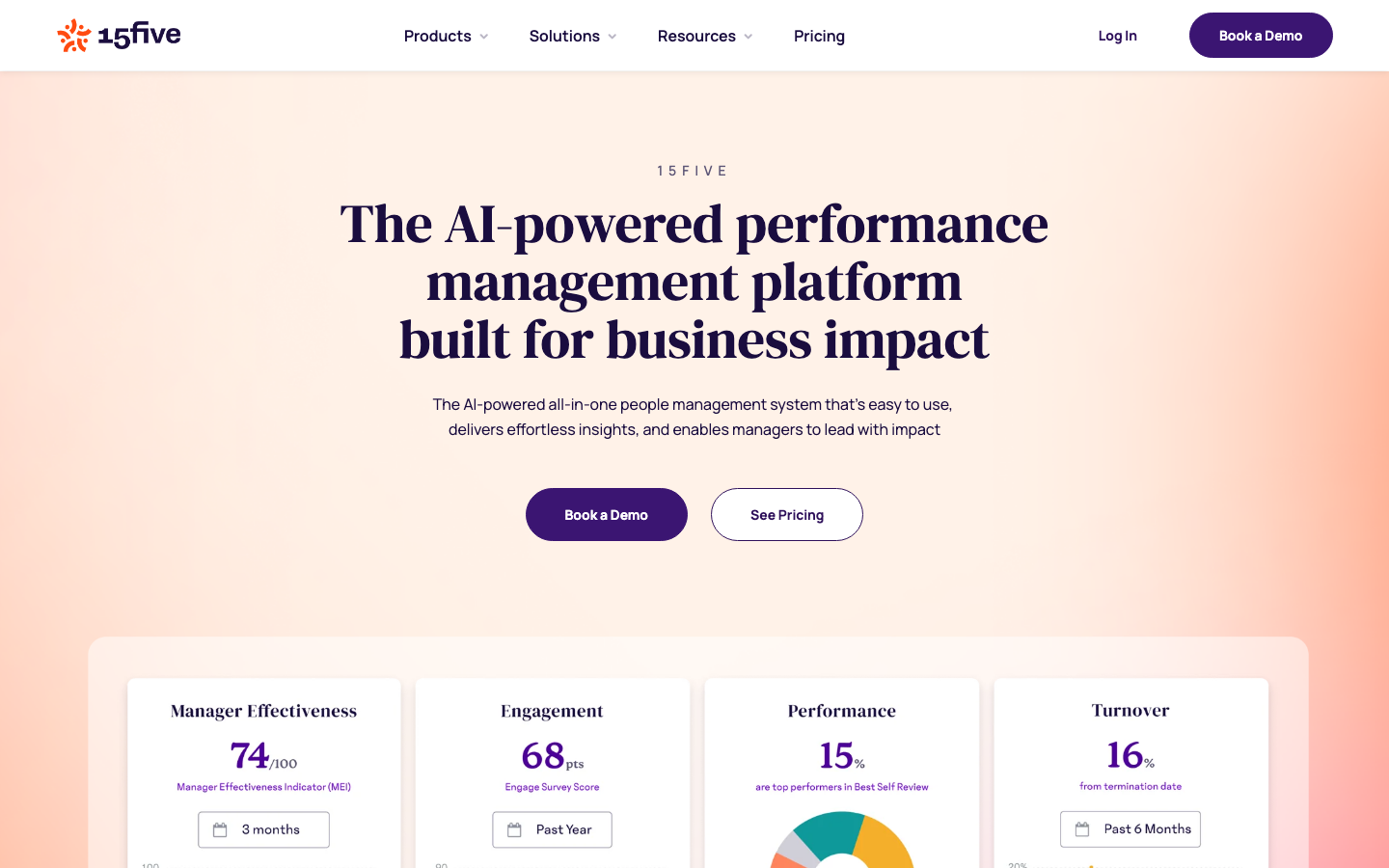
15Five is a performance and engagement platform built around weekly check-ins, 1:1s, reviews, and engagement surveys. Its modules are Perform, Engage, Compensation, and Growth Studio, which adds a 9-box talent matrix, development plans, and succession plans. 15Five says more than 3,000 companies use it.
Software Pros
- Weekly check-ins build a record long before review season
- Growth Studio ties the 9-box grid to development and succession plans
- 3 published plans make the budget easy to forecast
Software Cons
- Single-family scope: no recruiting or learning management
- Manager coaching is sold as a paid add-on
- The full feature set needs the top Total Platform tier
15Five Review
I’d shortlist 15Five for a company of 100 to 1,000 people whose managers need a habit, not another form. The weekly check-in creates a trail that makes reviews faster and fairer. It is the wrong buy for a team hoping to replace its applicant tracking or training system. Those needs call for a suite, and 15Five only makes sense on top once the manager rhythm is the actual gap.
Our Verdict
Manager Habit Builder
Beetween
Quick Overview:
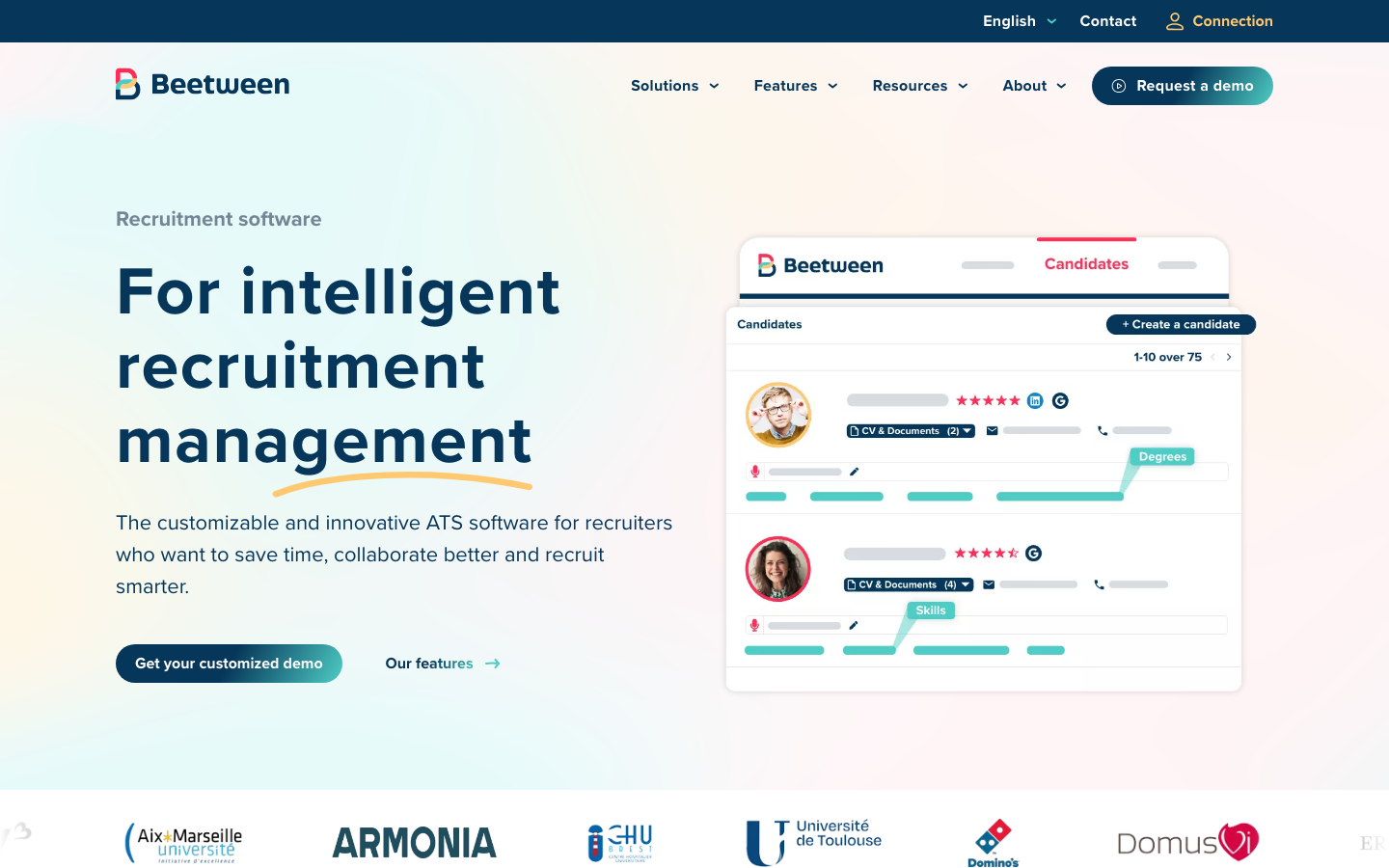
Beetween is a recruiting-side tool: a French applicant tracking and recruitment marketing platform, reviewed here as the front end of talent management. It covers job posting, candidate tracking, team hiring, and talent pool matching. Beetween says it posts to more than 180 job boards as its own multiposting provider.
Software Pros
- Multiposting to 180+ job boards without a separate provider
- Talent pool matching brings past applicants back for new jobs
- Setup, staff training, and follow-up are handled by the vendor
Software Cons
- Recruiting only: no performance, learning, or career modules
- French center of gravity in clients and support
- No G2 reviews yet, so public user feedback is scarce
Beetween Review
My read is that Beetween fits French and European employers hiring steadily across many sites, such as hospitals, universities and retail networks. Hiring managers can take part without recruiter training. It is not the tool for a company trying to fix reviews, development, or retention. Treat it as the intake layer of a talent stack and pair it with a performance platform.
Our Verdict
Recruiting Front Door for Europe
Bridge
Quick Overview:
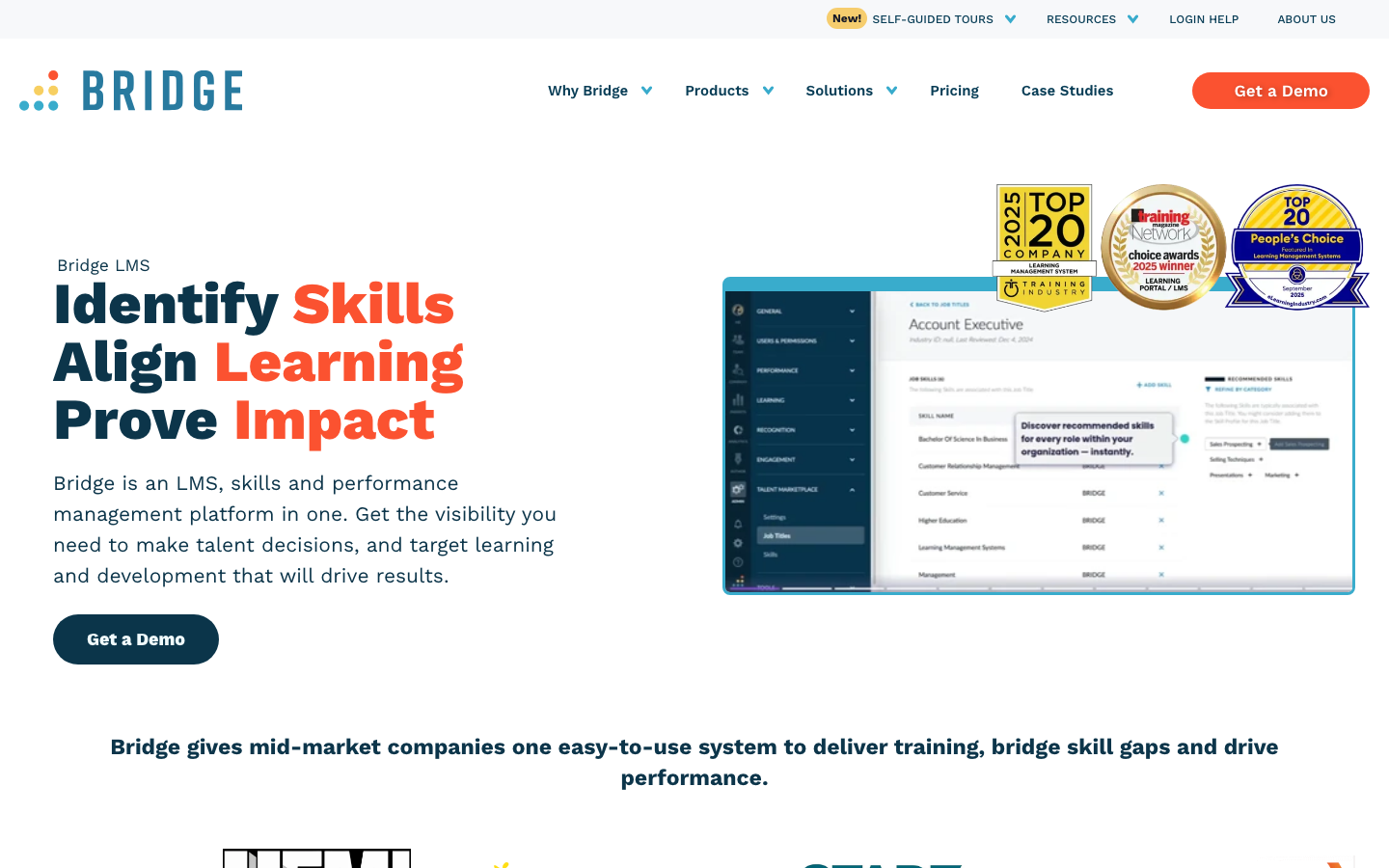
Bridge is a full-lifecycle suite with no applicant tracking system, so it doesn’t include hiring. It combines a learning management system (LMS), a skills library, career paths, performance reviews, goals, 1:1s, and succession planning. GetBridge, LLC sells it in 3 tiers, and the vendor cites 11 million learners.
Software Pros
- Skills gaps point straight to recommended courses
- Full Suite adds reviews, OKRs, and succession without a second vendor
- Compliance training comes with reminders and completion tracking
Software Cons
- No recruiting module, so an ATS has to be bought separately
- Learning-led design, with performance added later than the LMS
- Annual plan pricing is steep for very small teams
Bridge Review
I’d point mid-market companies with heavy training needs toward Bridge, especially where compliance courses already drive the HR calendar. Linking skills gaps to learning paths is its real advantage over performance-only tools. Teams whose main pain is hiring will be disappointed, because candidates never enter the system. With an ATS already in place, Bridge covers learning, skills and reviews at a sensible depth.
Our Verdict
Learning-Led Talent Suite
ClearCo
Quick Overview:
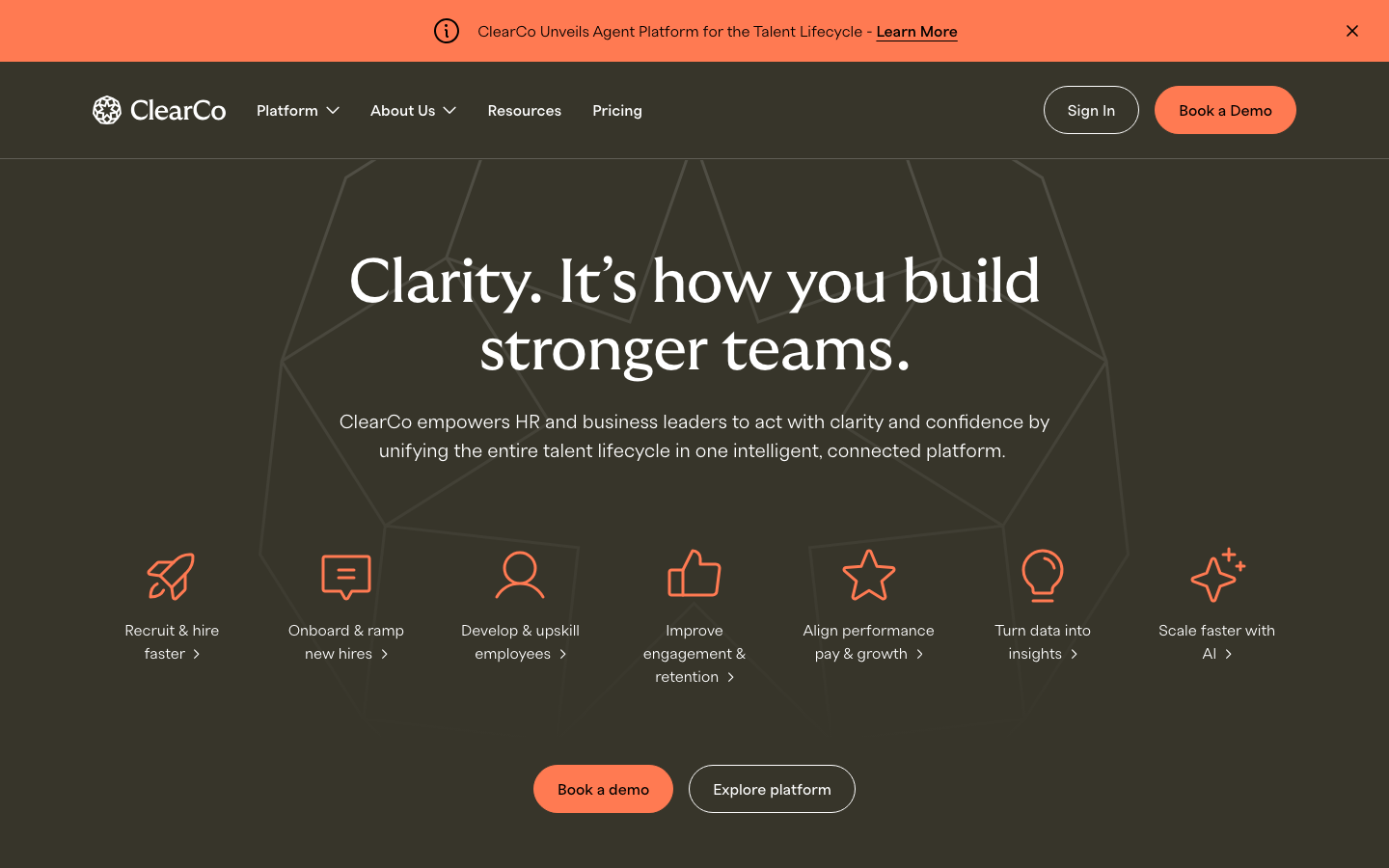
ClearCo, formerly ClearCompany, is a full-lifecycle suite and 1 of the 4 suites on this page that include recruiting. It covers applicant tracking, background checks, onboarding, performance, engagement, learning, compensation, and people analytics. ClearCo says 3,000 organizations and 1.8 million employees use it. It sells 2 packages, ClearRecruit and TotalTalent.
Software Pros
- Hiring, onboarding, and reviews share 1 employee record
- TotalTalent adds learning and compensation to the recruiting core
- Background checks run inside the same hiring workflow
Software Cons
- Quote-only pricing for both packages
- A full-lifecycle rollout takes months, not weeks
- The recent rebrand means older guides still say ClearCompany
ClearCo Review
ClearCo suits a US mid-market employer that hires constantly and wants 1 record to follow each person from applicant to annual review. I like that the packages let a team start with recruiting and add performance later. Small teams with a few hires a year will pay for depth they never use. A company that only needs better reviews should start with the performance family.
Our Verdict
Unified Hiring and Talent Suite
Crosstalent
Quick Overview:
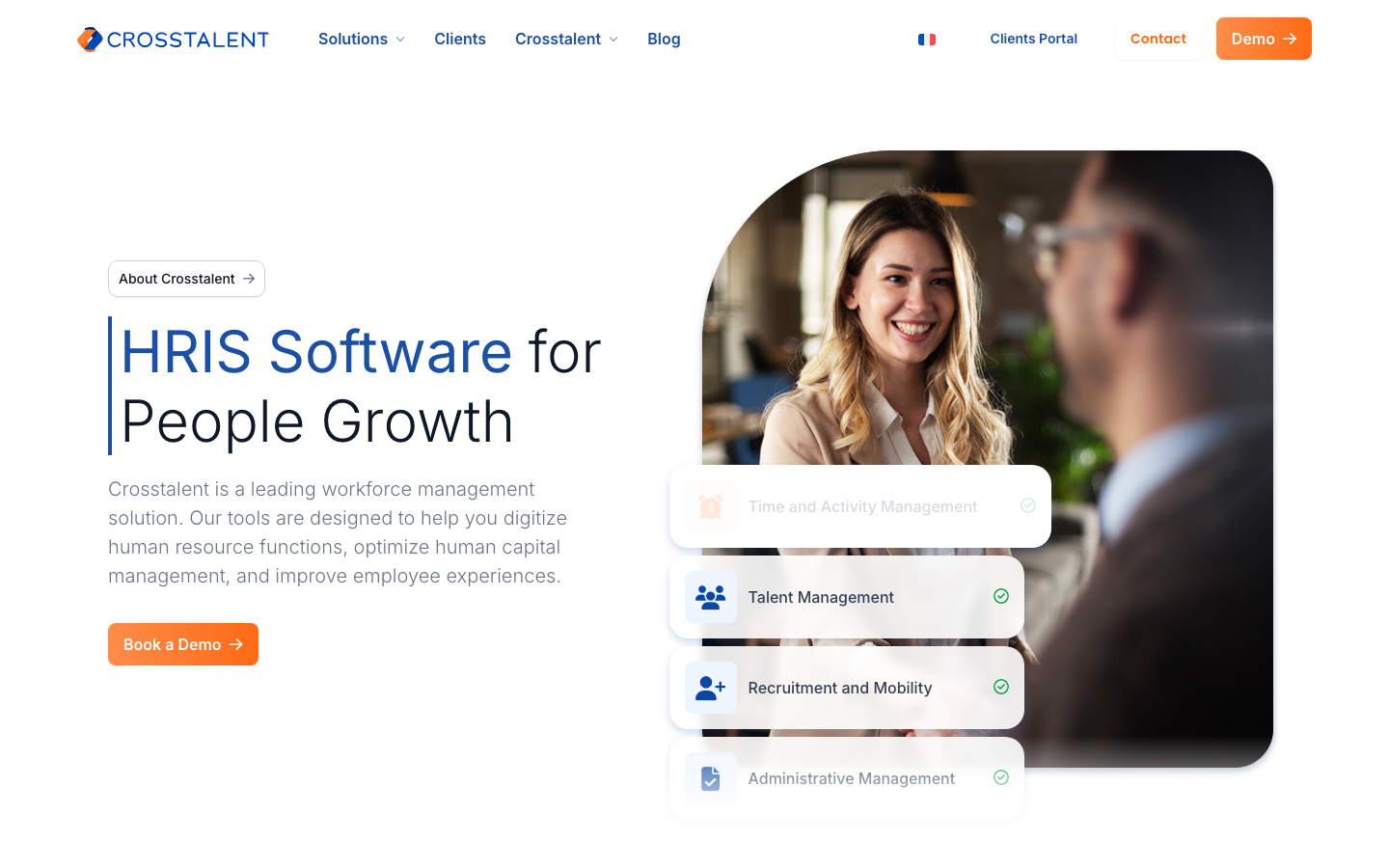
Crosstalent is a full-lifecycle suite built natively on Salesforce and sold as modules. Its 8 modules cover employee files, administration, time and attendance, expenses, talent management, recruitment and mobility, remuneration, and learning and development. Crosstalent says more than 150,000 employees use its tools. It is published on the Salesforce AppExchange.
Software Pros
- HR data lives on the same platform as sales and service data
- Modules deploy 1 at a time as needs grow
- Reports and dashboards reuse familiar Salesforce tooling
Software Cons
- Salesforce dependency: licenses and admin skills come first
- French center of gravity in clients and support
- No G2 reviews yet, so user feedback is thin
Crosstalent Review
I see Crosstalent as the natural pick for a company that already runs Salesforce and employs admins who know it. Workflows, reports, and dashboards then reuse skills the team already has. Without Salesforce, the platform question comes before the HR question, and that adds cost and complexity. It fits enterprise groups in France and wider Europe better than small teams elsewhere.
Our Verdict
Salesforce-Native HR Suite
Empowill
Quick Overview:
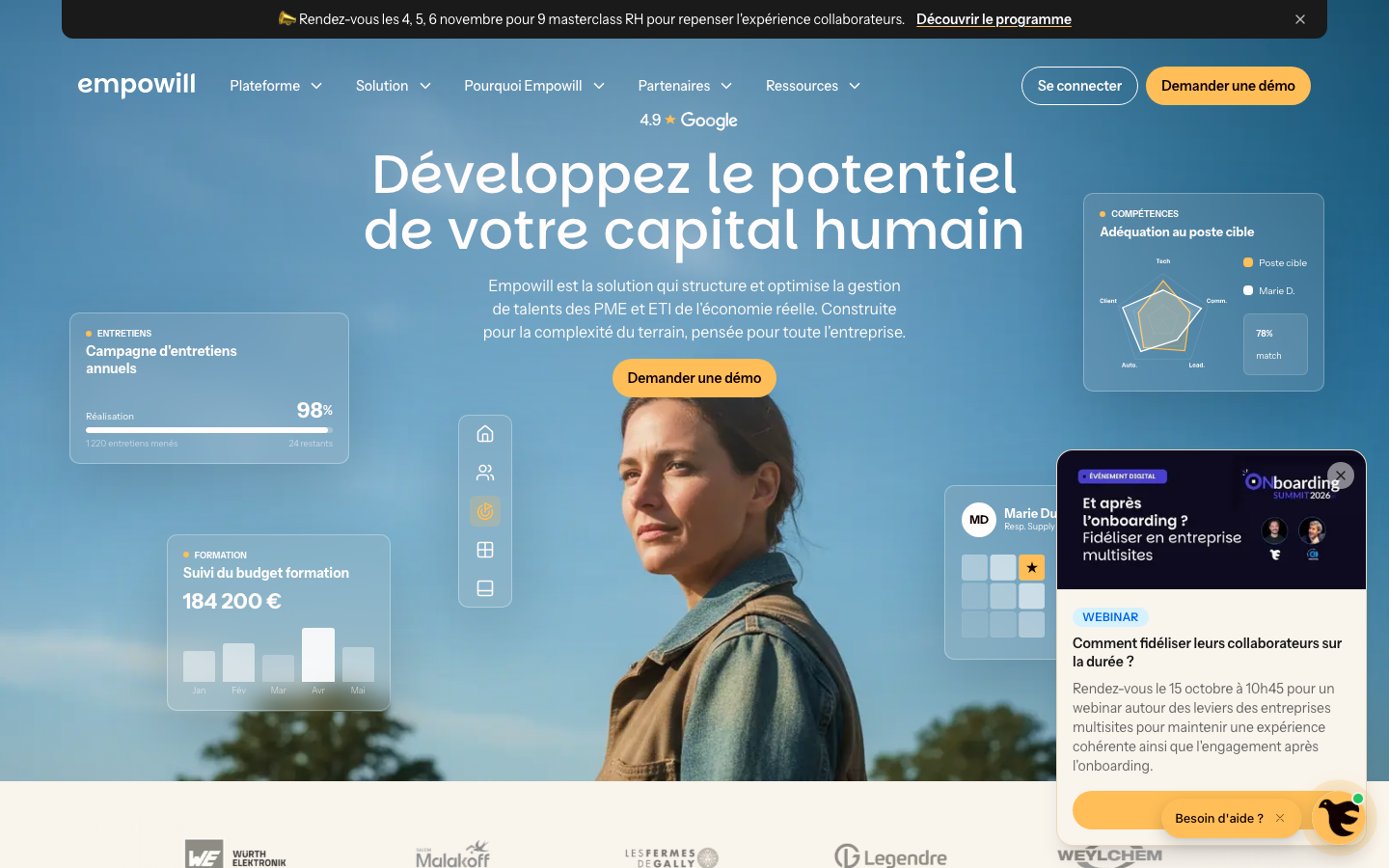
Empowill is a performance and engagement platform for French SMEs and mid-sized companies, centered on reviews, development plans and career paths. Its modules cover career and annual interviews, skills mapping, training plans, and people reviews for succession and internal mobility. Empowill says more than 350 HR directors run their talent development on it.
Software Pros
- Tracks mandatory career interviews so none are missed
- Training requests and budgets are handled in 1 place
- People reviews turn interview data into a talent map
Software Cons
- No English site or English-language positioning
- Workflows follow French HR rules, so value drops elsewhere
- No G2 reviews yet, so public feedback is scarce
Empowill Review
Empowill makes most sense for a French employer with frontline staff and a legal duty to hold career interviews on schedule. It keeps those interviews, skills, and training in 1 system that line managers can follow without HR chasing them. Outside France, the fit weakens, because the workflows mirror French requirements. International teams should choose a performance platform with English support instead.
Our Verdict
French Career Interview Tracking
Engagedly
Quick Overview:
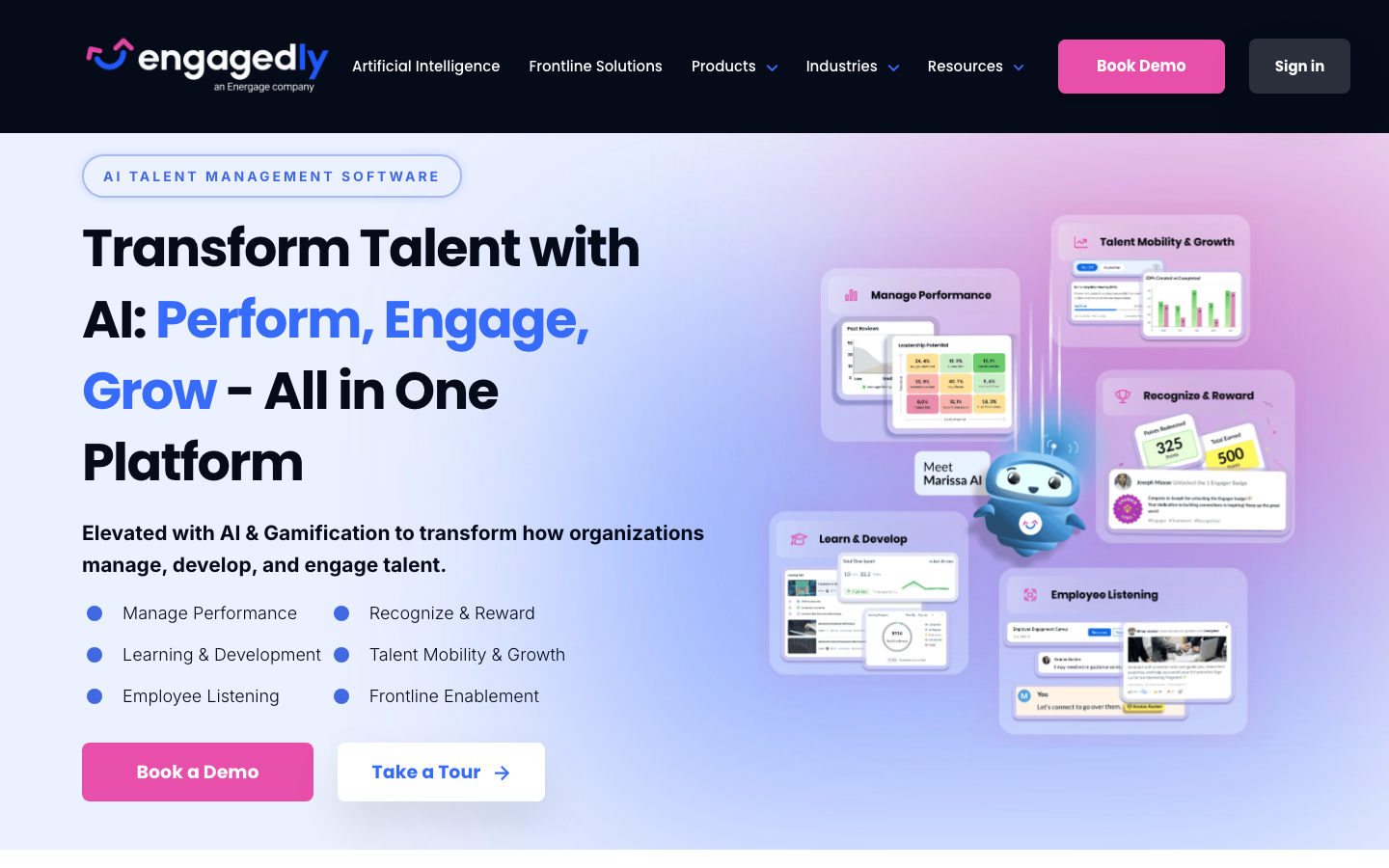
Engagedly is a performance and engagement platform combining reviews, learning, recognition, and surveys. Its suites cover performance, a native learning experience platform, engagement surveys, rewards, talent mobility, mentoring, and compensation. The performance suite includes 360-degree feedback, meaning input from managers, peers, and direct reports. Engagedly says more than 5,000 HR professionals worldwide use it.
Software Pros
- Learning is native rather than an integration
- Gamified recognition with badges and a rewards storefront
- Published per-user pricing for each suite
Software Cons
- An annual minimum spend applies regardless of headcount
- Many suites to configure before the value shows
- Single-family scope: no recruiting module
Engagedly Review
Engagedly fits a mid-sized company that wants reviews, learning, and recognition from 1 vendor without buying a full suite. The modular pricing lets HR start with performance and add learning in a later budget cycle. That breadth has a cost: setup takes planning, and a very small team may find the minimum spend high. Companies that also need hiring will still need a separate recruiting tool.
Our Verdict
Performance Plus Learning
Leapsome
Quick Overview:
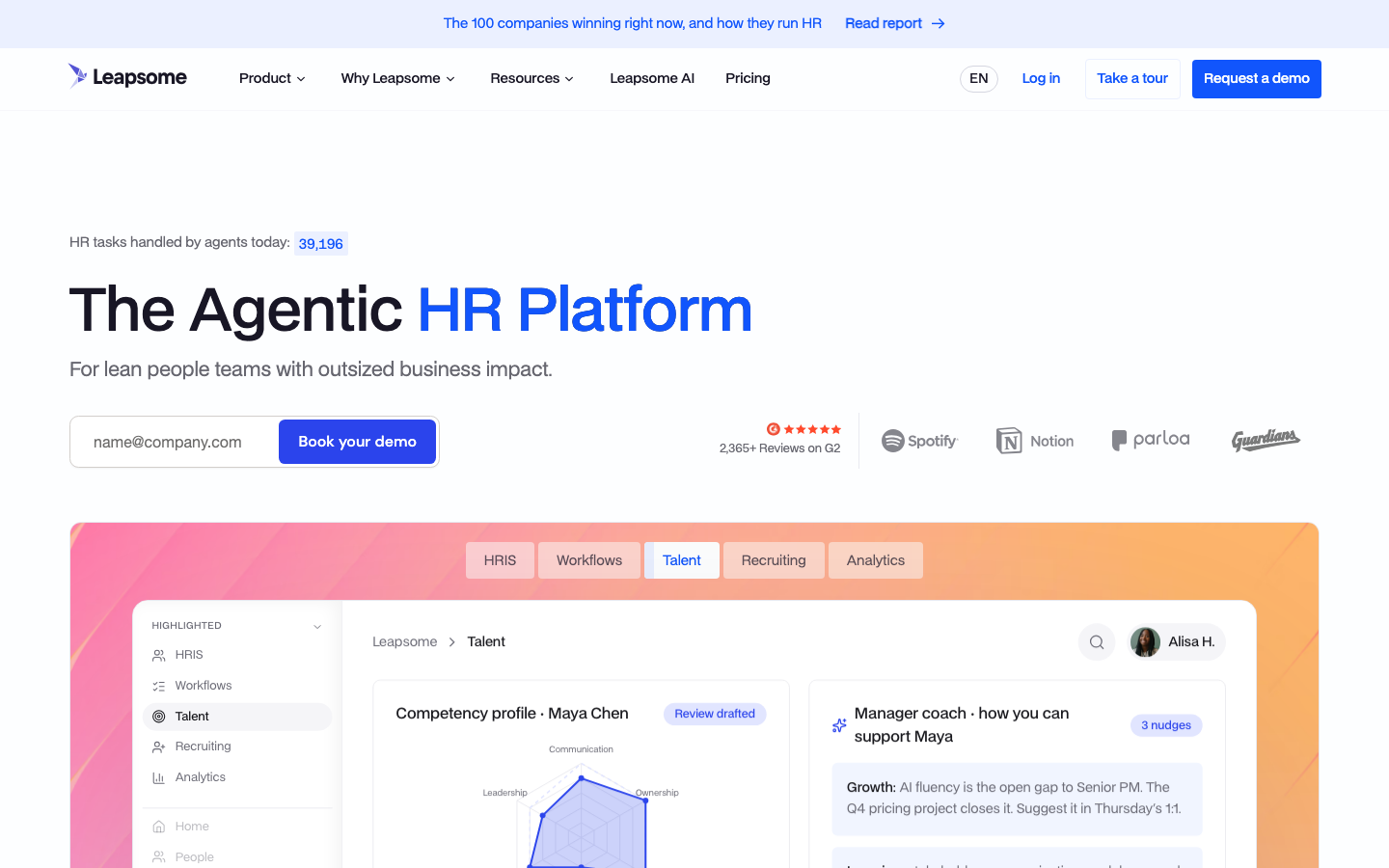
Leapsome is a performance and engagement platform covering reviews, goals, surveys, learning, and compensation, now joined by an HRIS, time tracking, and an early-access recruiting module. Every module runs on 1 connected employee record and can be bought separately. Leapsome says more than 2,000 organizations use it.
Software Pros
- Reviews, goals, and surveys feed shared cross-cycle analytics
- Compensation reviews come with salary bands and pay-gap analytics
- Learning paths connect directly to development goals
Software Cons
- No published rates; every plan is quote-based
- Recruiting is still in early access
- The bill climbs quickly as modules are added
Leapsome Review
Leapsome is the performance platform I’d suggest to fast-growing companies in Europe and the US that may want an HRIS later. The shared record keeps review ratings, goals, and pay decisions aligned. Its breadth is also the risk, since teams can buy 5 modules and adopt 2. If reviews are the only need, a lighter tool will cost less and launch in a few weeks.
Our Verdict
Modular Performance and Pay
Mitratech Trakstar
Quick Overview:
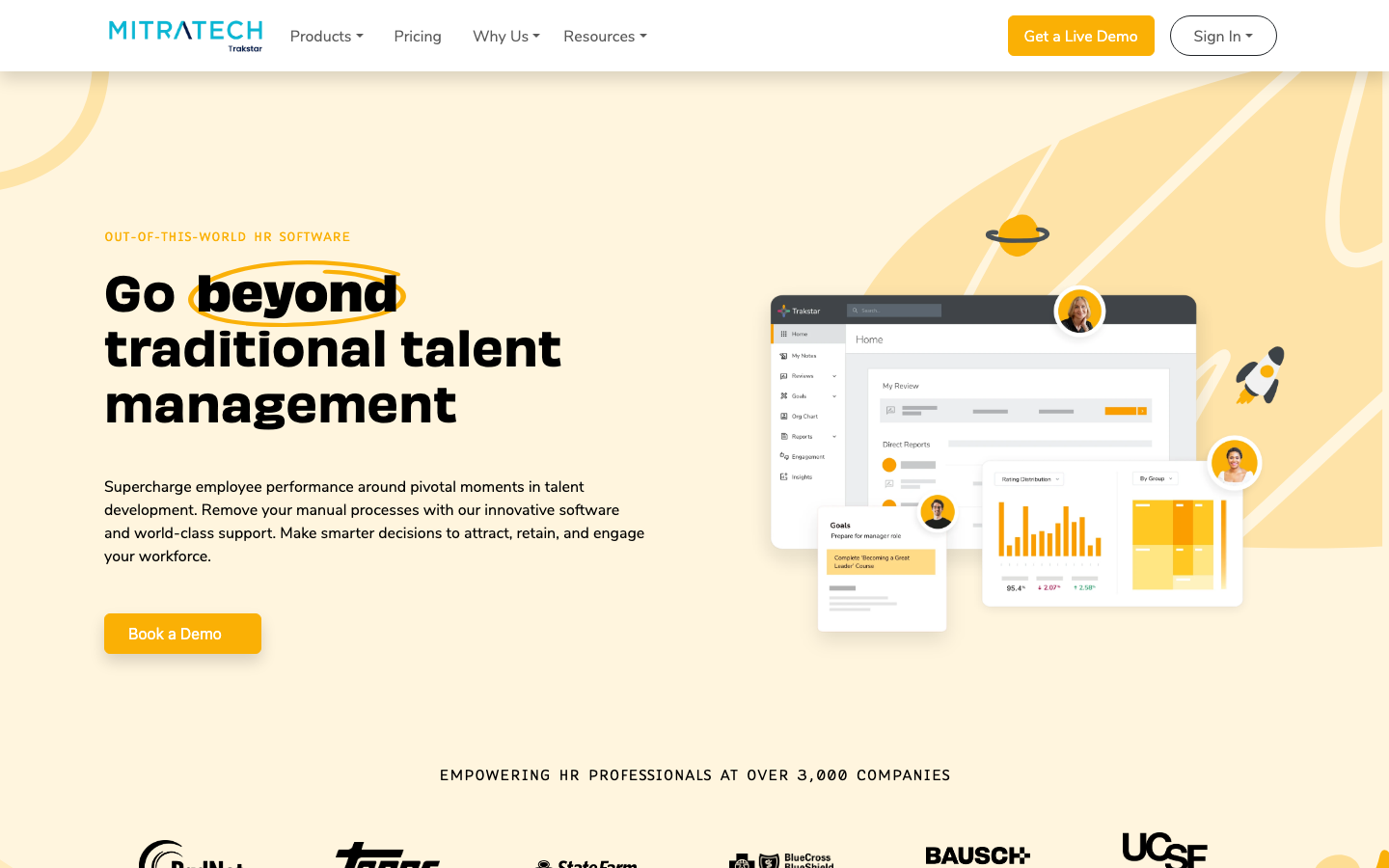
Mitratech Trakstar, sold simply as Trakstar before Mitratech acquired it, is a full-lifecycle suite from a compliance-software parent. Its products are Hire for applicant tracking, Learn, Perform and Insights, quoted together as a talent management and hiring suite. The vendor says HR teams at more than 3,000 companies use it.
Software Pros
- Applicant tracking, training and reviews under 1 login
- Engagement surveys with heatmaps and trend reports
- Ready integrations with common HRIS tools
Software Cons
- Quote-only pricing
- The parent company is centered on legal and compliance software
- Products began as separate tools, so depth varies by module
Mitratech Trakstar Review
I’d consider Mitratech Trakstar for a mid-sized employer that wants hiring, training and reviews without an enterprise HCM project. The 4 products cover the core lifecycle at a practical depth and share 1 support team. Buyers who need advanced skills mapping or succession should look elsewhere. It also pays to ask how the roadmap fits Mitratech’s compliance focus, since that shapes future investment.
Our Verdict
Practical Mid-Market Suite
NEOBRAIN
Quick Overview:
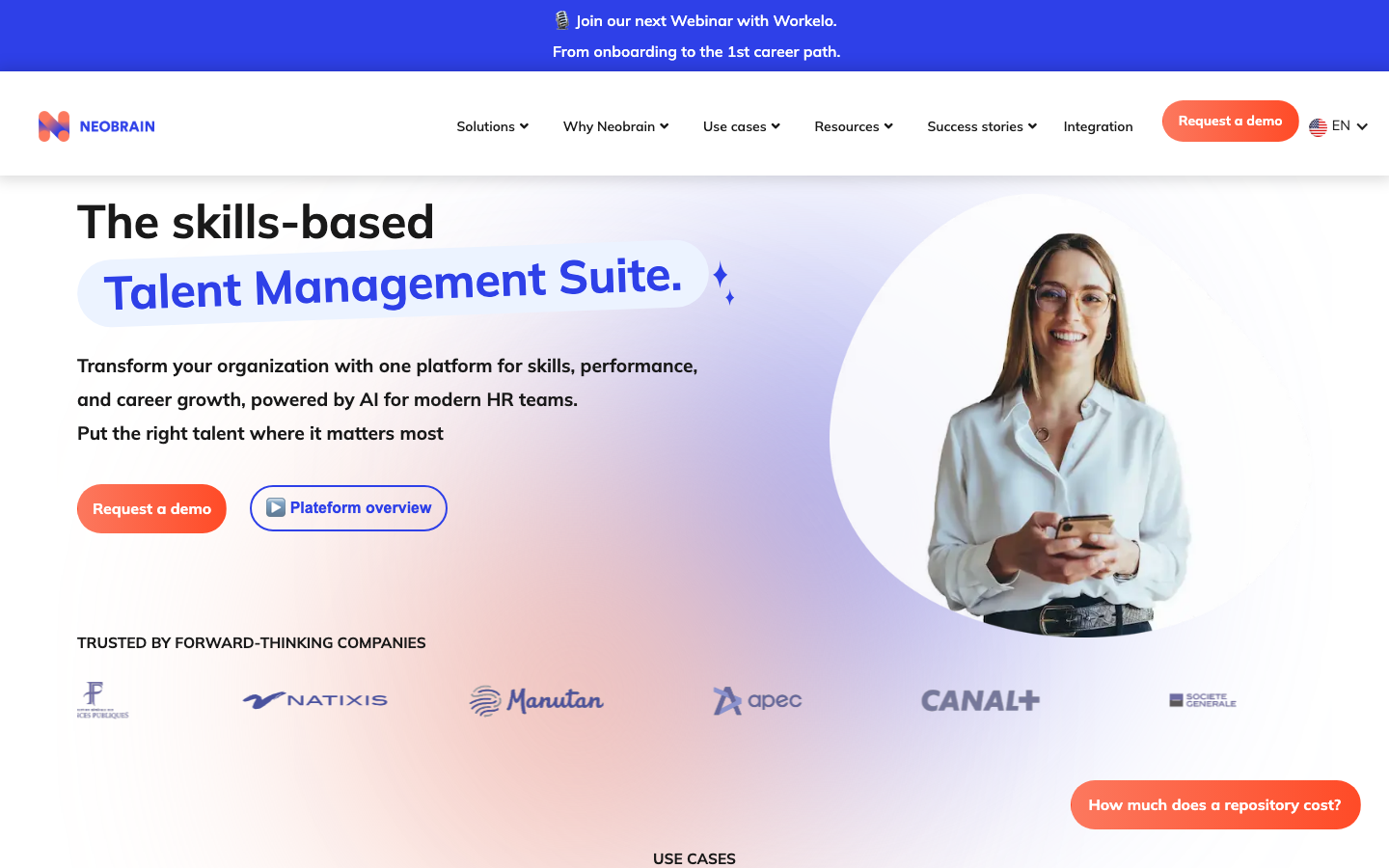
NEOBRAIN is a skills and succession platform that describes itself as a skills-based talent management suite. Its modules cover skills mapping, career opportunities and internal mobility, plus performance review campaigns. In the vendor’s words, its AI helps teams “capture, value and leverage all existing skills.” Clients named on its site include Natixis, BPCE and CNP Assurances.
Software Pros
- Skills mapping that updates instead of static job descriptions
- A matching engine surfaces internal candidates for open roles
- HR dashboards track skills trends and review campaigns
Software Cons
- Needs a skills taxonomy before results appear
- French center of gravity in clients and support
- Quote-only pricing aimed at large employers
NEOBRAIN Review
NEOBRAIN suits large employers, often multi-entity French groups, that want internal moves to beat external hiring. The skills map is the product, so value arrives only after HR agrees on a framework with the business. Smaller companies without that capacity will struggle to keep it fed. For a bank or insurer rethinking career paths across many units, it is a serious option.
Our Verdict
Skills Map for Large Groups
Rival
Quick Overview:
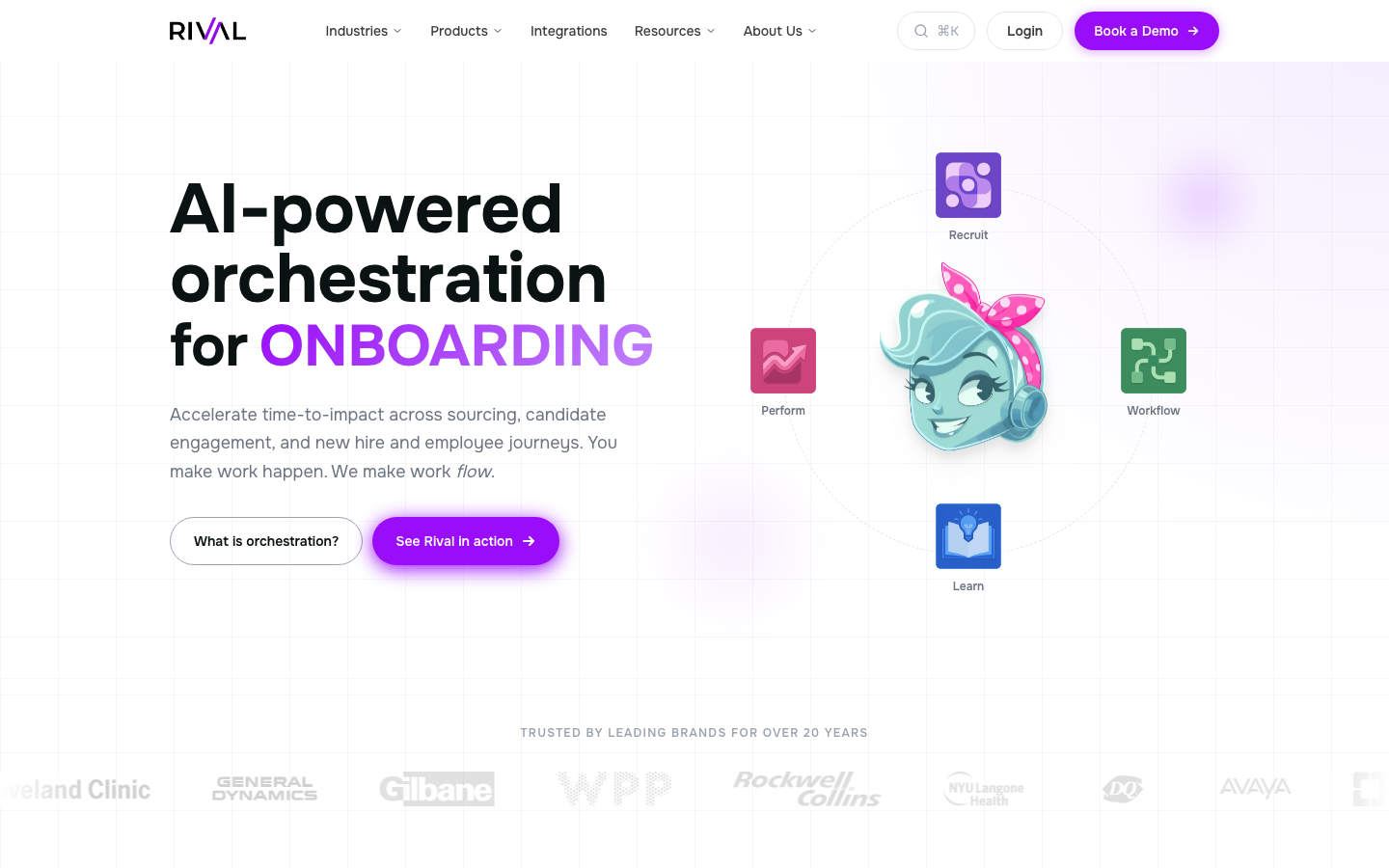
Rival, formerly SilkRoad Technology, is a full-lifecycle suite centered on recruiting. Its products are Recruit for sourcing, candidate CRM and ATS, Workflow for onboarding and employee journeys, and Learn and Perform, sold together or 1 at a time. Rival says its sourcing searches more than 750 million profiles.
Software Pros
- Onboarding and journey workflows are the strongest part
- Products can be bought individually
- Works alongside an ATS or HCM the company already runs
Software Cons
- Recruiting-first weighting; performance is a smaller module
- Quote-only pricing
- Its 3.8 G2 score is the lowest on this list
Rival Review
Rival makes sense for enterprise HR teams whose biggest problem is getting people hired and productive quickly. Preboarding checklists and new hire journeys get the most attention in the product. Readers who want deep reviews, goals and succession will find the performance side lighter than a dedicated platform. I would buy it for the front half of the lifecycle and judge the rest separately.
Our Verdict
Hiring and Onboarding Suite
Small Improvements
Quick Overview:
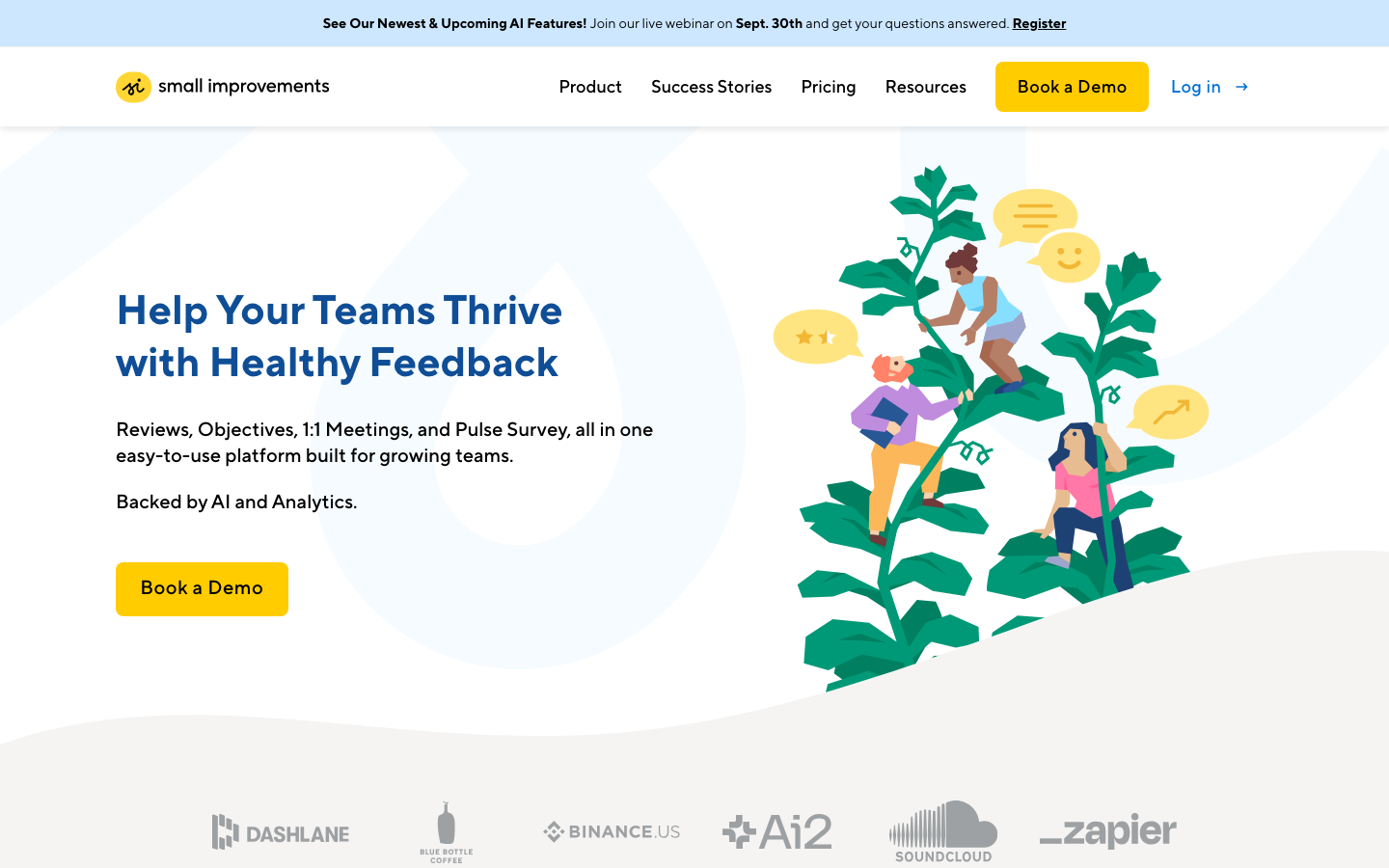
Small Improvements is a performance and engagement platform for small teams, covering reviews, 360-degree feedback, objectives, 1:1 meetings, pulse surveys and praise. The vendor says it is optimized for companies of 50 to 750 staff. Plans are priced per user, and each includes a 30-day free trial.
Software Pros
- A first review cycle can launch within days
- Wording, design and emails can all be customized
- 30-day free trial on every plan
Software Cons
- Single-family scope: no recruiting or learning
- Minimum pricing applies to very small teams
- Companies past about 750 staff may outgrow it
Small Improvements Review
Small Improvements is the easiest recommendation I can make for a company of 50 to 300 people running its first proper review cycle. Managers pick it up without training, and HR can shape the wording to match its culture. Larger organizations with complex calibration or succession needs will outgrow it. For a lean team that just wants feedback on time, it does the job well.
Our Verdict
Simple Reviews for Small Teams
TalentGuard
Quick Overview:
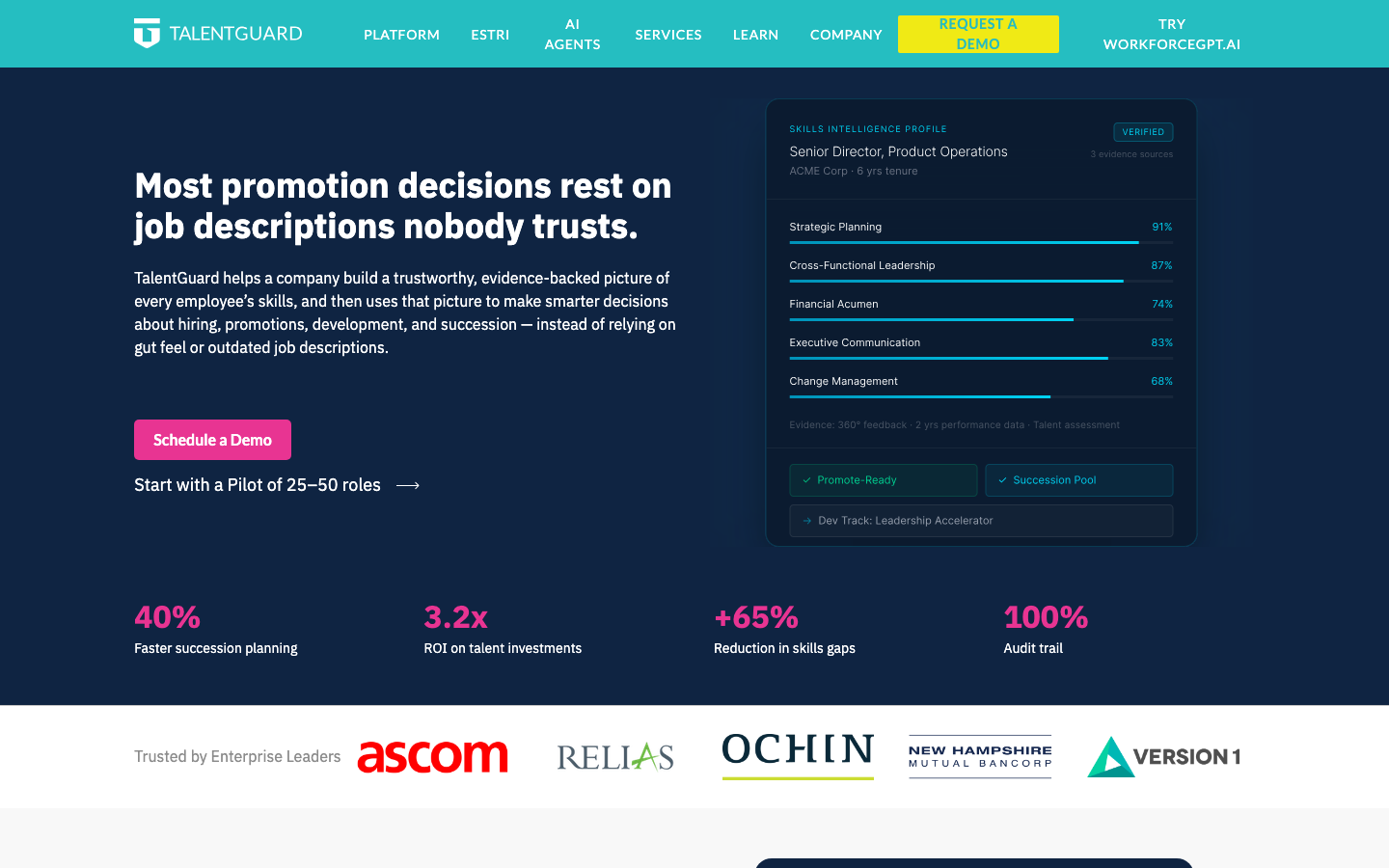
TalentGuard is a skills and succession platform covering role standards, talent assessment, career pathing, development planning and succession. Its WorkforceGPT and AI agents draft job and skill standards, which HR then reviews and approves. TalentGuard claims 40% faster succession planning and suggests starting with a pilot of 25 to 50 roles.
Top Advantages:
- An audit trail shows who approved each role standard
- Career paths are tied to measured skills, not titles
- Pilot scope keeps the first project manageable
Scope of Offerings:
- Only 4 G2 reviews, so public feedback is thin
- Enterprise focus and quote-only pricing
- Taxonomy work comes before any visible benefit
TalentGuard Review
I’d recommend TalentGuard to regulated enterprises that must defend promotion and readiness decisions to a board or regulator. The approval record behind each role standard is its distinguishing feature. A startup looking for quick reviews will find it heavy. When succession choices are often challenged, the evidence behind each move is worth the setup effort and months of taxonomy work.
Our Verdict
Defensible Promotion Decisions
Timeko
Quick Overview:
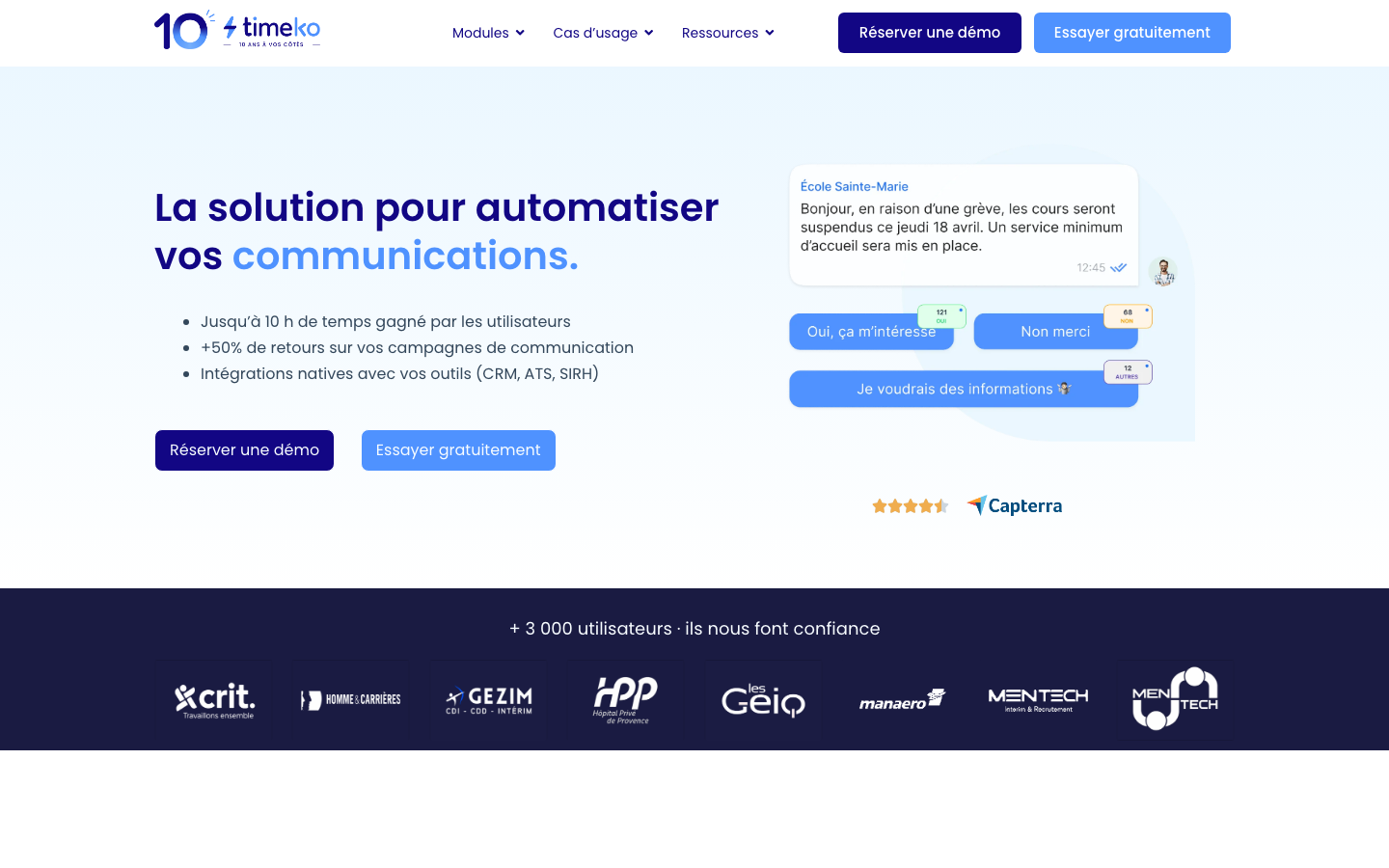
Timeko is a recruiting-side tool for candidate communication and interview scheduling, not an employee management platform. It sends bulk SMS, email, and WhatsApp messages, sorts replies automatically, and adds modules for interviews, surveys, WhatsApp sourcing and timesheets. Timeko says more than 3,000 users rely on it. The site is in French, and the product runs standalone or as an ATS extension.
Top Advantages:
- Candidate replies are sorted as yes, no or other
- A browser extension works inside an existing ATS
- Free trial and published monthly plans
Scope of Offerings:
- Recruiting communication only; nothing after the hire
- French-language site and French market focus
- No G2 reviews yet
Timeko Review
Timeko suits staffing agencies and high-volume recruiters in France who lose hours chasing candidates by phone. The value is response speed, not talent development, and the vendor is clear about that. Anyone looking for reviews, goals or careers should skip it. As a messaging layer beside an ATS, though, it earns its place in a busy recruiting team that fills many roles every week.
Our Verdict
Candidate Messaging for Recruiters
Zest
Quick Overview:
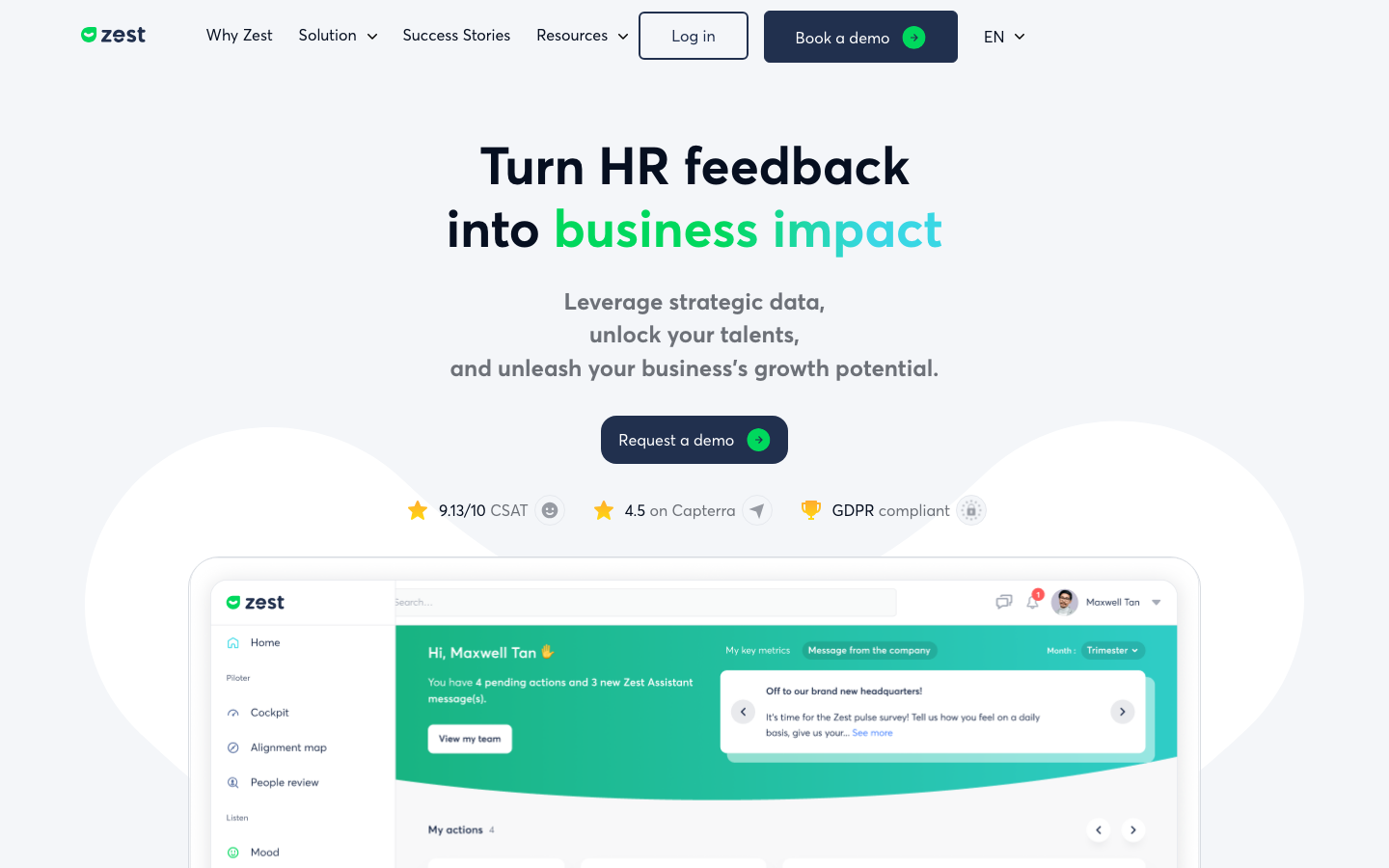
Zest is a performance and engagement platform led by surveys, feedback and recognition, with reviews and goals. Its 4 pillars are Listen for surveys, Perform for reviews and 1:1s, Share for continuous feedback and recognition, and Lead for strategic alignment. Zest says more than 400 companies use it. Pricing depends on how many pillars a company buys.
Software Pros
- Survey results turn into action plans for managers
- Pillars can be bought 1 at a time
- Full English site alongside the French one
Software Cons
- No G2 profile of its own, so no public rating
- Quote-only pricing by pillar
- Single-family scope: no recruiting or learning
Zest Review
Zest works for companies that want to start with listening and grow into reviews without switching tools. The pillar model keeps the first purchase small and easy to approve. Teams needing deep calibration or compensation workflows will find it light. For a mid-sized European employer building a feedback culture from scratch, it is a sensible starting point that can grow 1 pillar at a time.
Our Verdict
Feedback-First Engagement Platform
ZoomInfo
Quick Overview:
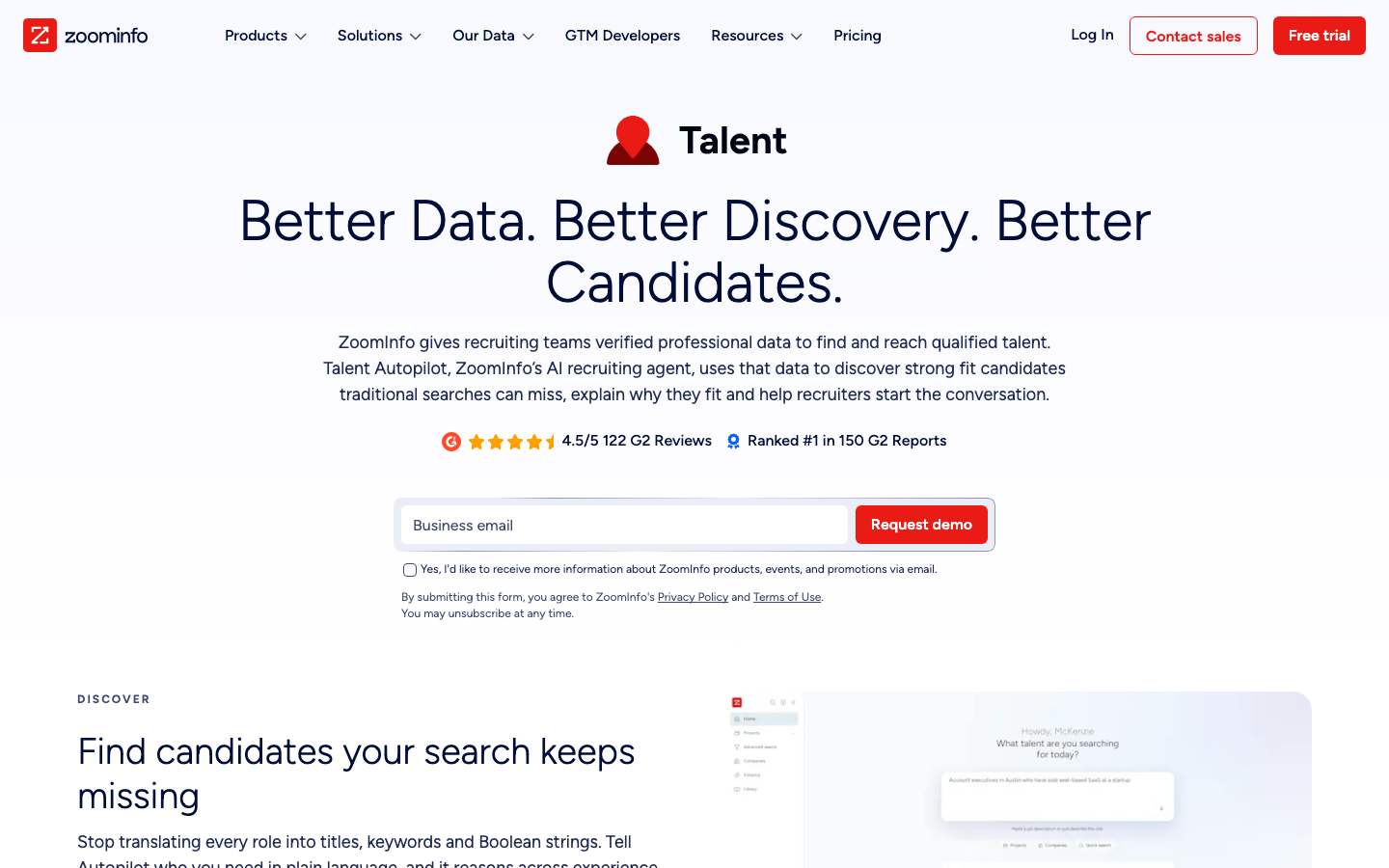
ZoomInfo is an AI-powered go-to-market intelligence platform whose Talent product supports the acquisition side of talent management, giving recruiters verified candidate data, real-time hiring signals, and AI-driven sourcing built on one of the largest B2B databases in the market.
Top Advantages:
- Verified candidate and company data for precise, proactive sourcing
- Real-time signals such as job changes and hiring surges
- AI-powered candidate recommendations and outreach personalization
- Integrates with existing ATS and recruiting workflows
Scope of Offerings:
- Talent sourcing and candidate intelligence
- Company and contact data enrichment
- Buyer-style intent and hiring signals for recruiting
- Workflow automation and CRM/ATS integrations
Our Verdict
Best for teams that want to build talent pipelines proactively with verified data
ZoomInfo strengthens the part of talent management that happens before an employee ever joins: finding the right people. Recruiters can identify candidates by skills, role, and company background instead of waiting for applications, and signals like job changes show exactly when a passive candidate becomes reachable. Because enriched data flows straight into existing recruiting tools, sourcing teams work faster without changing how they already operate.
FAQs About Talent Management Platforms
How does talent management software benefit businesses?
It changes 3 things. First, performance, learning and career data live on 1 employee record instead of scattered files. Second, it builds manager habits, such as regular check-ins and written feedback, that spreadsheets never enforce. Third, it gives leaders evidence for promotions, pay and succession, so decisions rest on recorded facts rather than memory. The admin hours saved matter less than those 3 shifts.
What features should I look for in a talent management system?
Start with the family, then the features. If reviews and goals are the gap, look at a performance platform and check calibration, 360-degree feedback and goal tracking. If you need hiring through succession, compare suites on how well their modules share 1 record. For skills work, test the taxonomy editor with your own roles. For recruiting, check job board reach and candidate messaging.
What Is a Talent Management System?
It is software that manages how people are hired, reviewed, developed and promoted inside a company. It reads employee data from the HRIS, which holds records, pay and time off, and adds workflows for managers and employees on top. Put simply, the HRIS answers who works here, while the talent layer answers how well they are doing and where they could go next.
How do talent management tools differ from HR software?
HR software in the narrow sense handles administration: records, payroll, benefits, time off and compliance reporting. The talent layer handles performance, development, careers and retention. The 2 overlap at the employee record, which is why most companies run both and connect them. Large HCM suites bundle both layers, while mid-sized firms often pair a core HRIS with a separate performance or skills product.
Which companies typically need talent management software?
The trigger is rarely headcount. It is usually the point where a company has more managers than HR can coach directly, often somewhere past 50 employees. Other signs include review cycles run in shared documents, promotions nobody can explain, and a bundled suite module that managers avoid. When spreadsheets no longer give a reliable view of performance, it is time to buy.
What modules do most talent management suites include?
The usual list is recruiting, onboarding, performance reviews, goals, continuous feedback, learning, career paths, succession, and analytics. Few products ship all of them at real depth. Most tools on this page do 2 or 3 well and connect the rest through integrations. Ask each vendor which modules its own customers use most, because that answer shows where the product is strongest.
How much does talent management software cost?
Expect 2 models. Performance platforms usually charge per employee per month, often with an annual minimum. Entry rates published on this page start between $3 and $5 per user per month. Suites and skills platforms mostly quote after a demo, based on headcount and modules. Bridge is the exception among suites, listing plans from $15,000 a year. Budget for implementation as a separate line.
Is a Talent Management Application the Same as an HR Platform?
Not quite. A talent application usually covers 1 module or 1 family, such as reviews or skills mapping. An HR platform is the system of record it reads from, holding employee data, pay, and time off. Some vendors sell both, and Leapsome now offers an HRIS next to its performance modules. In most stacks, though, the 2 remain separate products joined by an integration.

Yaryna is our lead writer with over 8 years of experience in crafting clear, compelling, and insightful content. Specializing in global employment and EOR solutions, she simplifies complex concepts to help businesses expand their remote teams with confidence. With a strong background working alongside diverse product and software teams, Yaryna brings a tech-savvy perspective to her writing, delivering both in-depth analysis and valuable insights.