What Is the Best AI Talent Management Software in 2026?
AI talent management software uses machine learning and language models to infer skills, match people to work, draft reviews, and coach employees. It sits inside the wider category of talent management software. The difference is that it reasons about people instead of only recording decisions. Much of it runs on talent intelligence, meaning skills and career data pulled together so a model can reason about a workforce. I wrote this for CHROs, heads of talent, and talent intelligence leads deciding where AI belongs in their talent cycle.
The timing matters because adoption is uneven. SHRM’s 2026 research, published in April 2026, found that 39% of organizations use AI in their HR functions, rising to 60% among employers with 5,000+ people. Most HR teams I speak with already have AI features built into their suite. Few can say which of those features actually changes a decision about a person.

INSIGHT: How widely is AI actually used in talent management?

Plans to use AI run well ahead of AI that HR teams trust with a real decision.
- 39% of organizations use AI in their HR functions, and 60% of employers with 5,000+ people do (SHRM, April 2026).
- 88% of HR leaders say their organizations have not realized significant business value from AI tools (Gartner, October 2025).
- Most HR teams already own AI features inside their suite and cannot say which of them changes a decision.
So what is the best AI talent management software? The honest answer is that there isn’t one, because AI does 4 different jobs here. It models skills across a workforce, supplies evidence about skills and the market, runs talent pipelines, and develops people through reviews and coaching.
Picking among AI talent management platforms for enterprise starts with that job, not the logo. Regulation raises the stakes: the EU AI Act lists AI systems used for recruitment, promotion, termination, and performance evaluation as high-risk in Annex III. Below, I’ve reviewed 13 of the leading platforms in A-Z order.
INSIGHT: Intelligence, evidence, pipeline, or development?
The 13 platforms here do 4 different jobs, and the one that decides your shortlist is the talent decision you currently make on guesswork.
- Talent intelligence platforms (Beamery, Eightfold AI, Gloat, retrain.ai): skills models across the workforce for mobility, succession, and retention.
- Skills evidence and market data (Draup, Workera): verified skills and outside-in labor market data that feed decisions made elsewhere.
- AI talent pipeline (Gem, HrFlow.ai, Textkernel): rediscovery, enrichment and matching across the candidates and profiles you already hold.
- AI performance and development (CoachHub, Macorva, Sprad, Valence): drafted reviews and plans, and AI coaches for employees and managers.
The table below compares the best AI talent management platforms I reviewed by family and by what the model actually does. It also shows where a person still needs to decide.
Use it as a quick way to sort the top-rated tools for automated talent management by the data they depend on.
| Tool | Family | What the AI does | Where the data comes from | Human decision point | G2 rating |
|---|---|---|---|---|---|
| Beamery | Talent intelligence platform | Infers skills and recommends internal moves | HR records, job data, external labor market data | Manager and HR approve any move | 4.1/5 (158 reviews) |
| CoachHub | AI performance and development | Coaches employees through AIMY and role plays | Goals, self-assessments, coaching sessions | Coachee and program sponsor | 4.6/5 (4,124 reviews) |
| Draup | Skills evidence and market data | Models talent supply, demand and pay by role | External labor market data | Talent leaders decide to build or buy | 4.8/5 (11 reviews) |
| Eightfold AI | Talent intelligence platform | Infers skills and matches people to roles and projects | Work history, HR data, career trajectory data | Hiring manager and HR approve moves | 4.2/5 (225 reviews) |
| Gem | AI talent pipeline | Rediscovers past candidates and runs nurture | Recruiting records in the ATS and CRM | Recruiter decides who to contact | 4.7/5 (307 reviews) |
| Gloat | Talent intelligence platform | Agents flag risk, suggest successors and moves | Workforce knowledge graph of people, roles, skills | HR approval chain signs off actions | 4.4/5 (34 reviews) |
| HrFlow.ai | AI talent pipeline | Parses, scores and matches profiles via API | Profiles and recruiting records you hold | Integrator sets thresholds; recruiter decides | 4.8/5 (8 reviews) |
| Macorva | AI performance and development | Drafts reviews, goals and development plans | Feedback surveys and manager input | Manager edits and owns each review | 4.6/5 (13 reviews) |
| retrain.ai | Talent intelligence platform | Extracts skills and recommends next roles | CVs, job posts, profiles, labor market data | Employee and manager decide on moves | 4.2/5 (961 reviews) |
| Sprad | AI performance and development | Atlas drafts reviews, agendas and skill paths | Living talent profiles and work data | Manager edits and sends every review | N/A (no G2 profile) |
| Textkernel | AI talent pipeline | Parses documents and ranks semantic matches | Candidate and employee databases | Recruiter decides who is contacted | 4.9/5 (113 reviews) |
| Valence | AI performance and development | Coaches managers through Nadia | Profiles, team context, calendars in Teams | Manager holds the conversation | N/A (no G2 profile) |
| Workera | Skills evidence and market data | Verifies skills with adaptive assessments | Assessment results | Manager and HR judge readiness | 4.6/5 (26 reviews) |
G2 ratings taken from each product’s own G2 profile on September 24, 2026.
AI vs Traditional Talent Management Tools
A traditional tool records the process. It stores review forms, goals, succession grids, and requisitions, while a person does all the reasoning. Workflow automation, such as reminders and routing rules, speeds up the process, but those automated talent management solutions still aren’t AI.
In AI-powered talent management platforms, 4 things are genuinely model-driven. Skills inference, meaning a model deducing skills from work history rather than from a checklist. Matching people to roles, projects, or candidates to jobs. Generation of review drafts, development plans and coaching conversations. And AI agents, which are software that takes an action, such as messaging an employee, rather than only suggesting one.
Plenty is rebadged. Dashboards, threshold alerts and templated summaries often carry an AI label without a model making any inference. Just 3 questions expose the difference: what are the inputs, what does the model output, and where does a person sign off?
The HCM suites, meaning Workday, SAP SuccessFactors, Oracle, UKG and Dayforce, now ship AI inside their talent modules, and I cover them only at category level. My guide to AI tools across HR looks at that layer. The platforms below are bought alongside those modules, or instead of them, when the suite’s AI cannot do the specific job.
Can AI Tools Automate Talent Pipeline Management?
Partly, and further than most HR processes. A talent pipeline is the group of internal people and external candidates you are keeping ready for future roles. AI already parses and enriches profiles, runs candidate rediscovery, meaning finding past applicants in your own systems who now fit, and matches people to open work.
Sourcing new people and interviewing them are a separate job, and my review of AI recruiting tools covers those. Here, the line between AI tools for recruitment and talent management sits at the pool you already own: rediscovery, nurture, and redeployment.
AI does not judge fit, maintain a relationship with a senior candidate, or make the decision. Even the best automatic talent pipeline management software only surfaces and ranks people, and a recruiter or hiring manager decides.
Data quality sets the ceiling. Duplicate and stale profiles produce confident wrong matches, so cleanup comes before automation. Regulation matters as well: systems used for recruitment and candidate evaluation are high-risk under Annex III of the EU AI Act. None of this is legal advice, and no vendor makes an organization compliant on its behalf.
How to Choose an AI Platform for Talent Decisions
I start by naming the one talent job the AI must do. The 4 families solve different problems, and a coaching tool will not fix a succession gap. Then I check what data the model needs and whether we actually have it in usable shape.
Next come the 3 questions from above: inputs, outputs, and human sign-off. Most talent management AI tools answer the first 2 easily, and the third is where the vague answers show up.
Anything touching hiring, promotion, or pay needs bias audit and explainability documentation. A bias audit is an independent test of whether outcomes differ by group. New York City’s Local Law 144 already requires one for automated employment decision tools.
I also check that the HRIS and ATS integration runs both ways, and how employees are told they are dealing with an AI. For anything managers must use every week, I ask for adoption evidence from a customer of similar size.
Finally, I price AI platforms for talent management at full rollout, not at pilot size. I also check whether the suite we already own ships the same capability. Keeping a human in the loop, meaning a person approves every consequential decision, belongs in the contract as well as the workflow.
Top 13 AI Talent Management Software Platforms for 2026
I built this list from each vendor’s product, documentation, and pricing pages, plus G2 profiles read on the day of publication. These are among the leading AI platforms for talent management, but they are not interchangeable.
The best AI-powered talent management platforms 2026 has to offer vary widely. They run from enterprise talent intelligence platforms like Eightfold AI and Gloat to AI coaches like Valence and pipeline engines like Textkernel.
Each block states what the model outputs, what data it uses, and where a person signs off. That lets you compare the top AI talent management platforms 2026 on the same terms.
If you only read one line per block, read the review paragraph. That is where I say which decision each of the best AI tools for talent management 2026 is actually built for.
I’m listing all providers alphabetically to keep this comparison neutral.
Beamery
Quick Overview
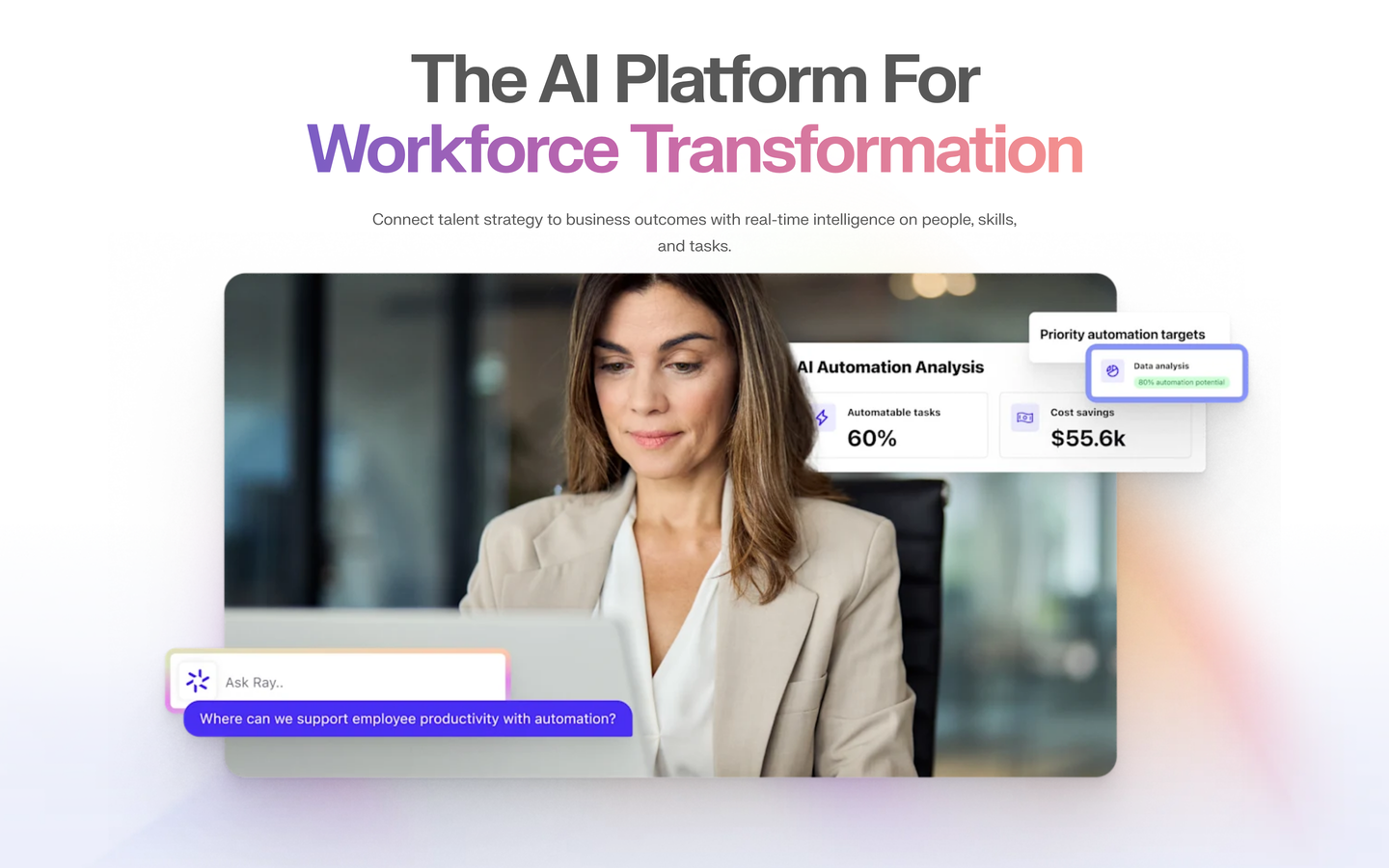
Beamery is a talent intelligence platform that infers skills from employee profiles and job data, then recommends internal moves, upskilling and redeployment. Beamery says its AI reconciles internal profiles with billions of external labor market data points. It connects to Workday and SAP rather than replacing them.
Software Pros
- Builds one skills model shared by hiring, mobility and retention
- Blends internal HR data with external market signals
- Ray, its agentic advisor, suggests talent actions in plain language
Software Cons
- Needs a clean HRIS and a job architecture before the output is useful
- Enterprise implementation measured in months
- Quote-only pricing with no public entry tier
Beamery Review
I’d use Beamery where the decision is who moves where inside a large organization. It works best when mobility, upskilling and retention share one skills model instead of 3 separate spreadsheets. The platform recommends a redeployment or a development path. A manager and HR still approve any move, and they should sanity-check the inferred skills with the employee before acting.
Our Verdict
Skills Model for Large Workforces
CoachHub
Quick Overview
CoachHub is an AI performance and development platform that pairs AIMY, an AI coach working from goals and self-assessments, with live human coaching. Its human side is large: CoachHub cites 3,500+ certified coaches working in 80+ languages and 90+ countries.
Software Pros
- AIMY runs goal-based coaching and video role-plays around the clock
- Human coaches pick up the conversations AI should not handle
- Workday connection makes nominating employees simple
Software Cons
- Value depends on employees actually booking and returning
- Program owners see anonymized themes, not individual progress
- Per-user licensing, so broad rollouts cost real money
CoachHub Review
My read is that CoachHub suits companies that want coaching for first-time managers, not only executives. AIMY handles practice, preparation, and goal tracking, while a certified coach takes the harder sessions. Nothing here decides pay or promotion. The human decision point sits with the coachee, and with whoever sponsors the program and reviews the anonymized results each quarter to judge whether it works.
Our Verdict
Hybrid Human and AI Coaching
Draup
Quick Overview
Draup is a skills-evidence and market-data platform. Draup for Talent maps supply, demand, pay and skill shifts for any role in any location, drawn from external labor market data. Draup says it analyzes 1B+ data points daily from 100K+ sources.
Software Pros
- Outside-in view of talent supply, cost and competitor hiring
- Curie, its AI assistant, answers build-or-buy questions in plain language
- Supply, demand, pay and talent flow in one view
Software Cons
- Feeds decisions made elsewhere rather than running a process
- Market coverage varies by region and role, as Draup itself notes
- Enterprise pricing only, with no self-serve plan
Draup Review
In practice, Draup answers questions like whether to reskill a team or hire in a new location, and what that will cost. It supplies the evidence, and talent leaders still make the call. I’d pair it with an internal skills system. Market data alone cannot tell you which of your own people is ready for a new role or project.
Our Verdict
Labor Market Evidence Engine
Eightfold AI
Quick Overview
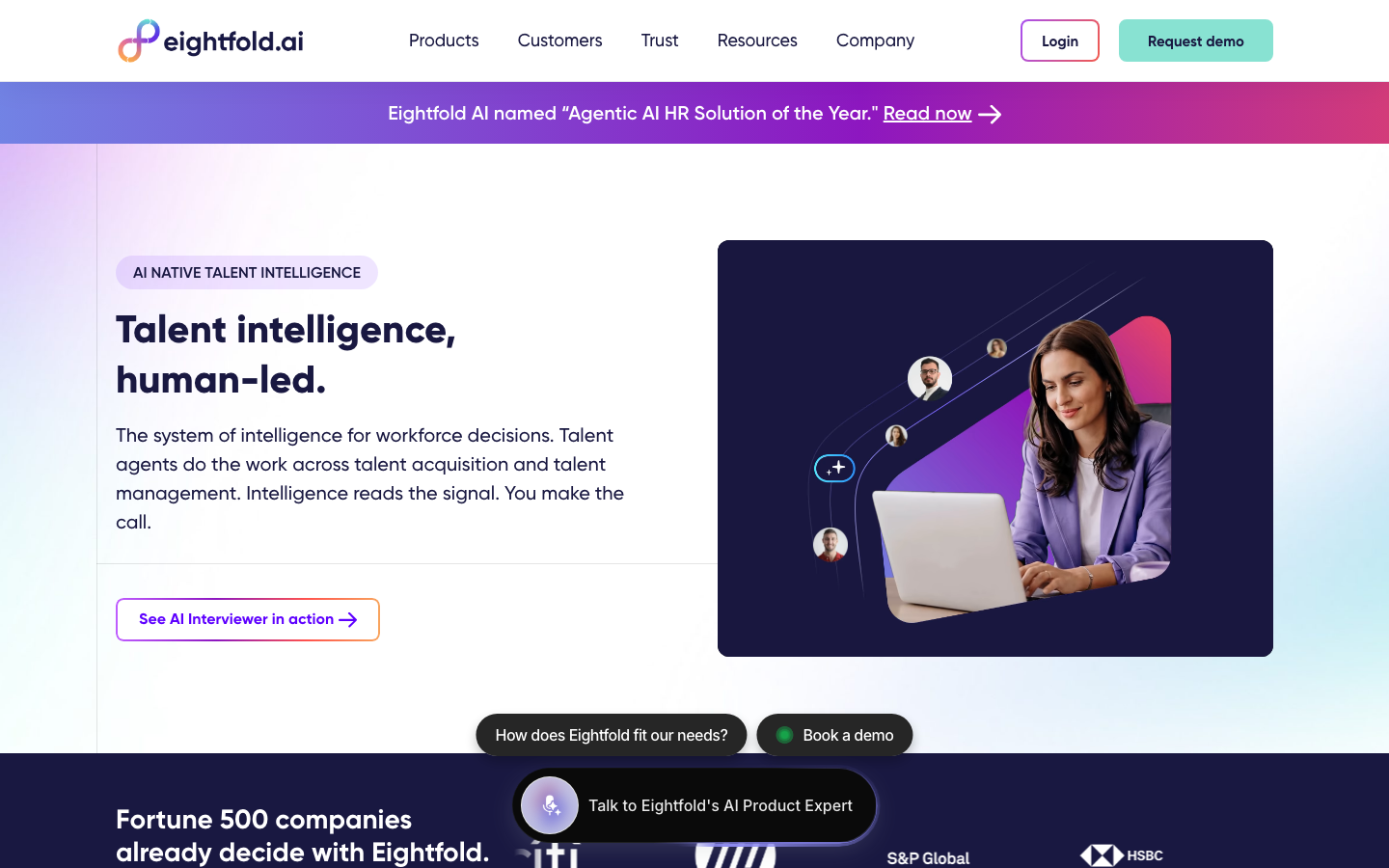
Eightfold AI is a talent intelligence platform that infers skills from work history and recommends internal roles, projects, mentors and learning. Eightfold says its models draw on 1.6 billion career trajectories and 1.6 million skills.
Software Pros
- Career Hub shows employees where they could move next
- Talent marketplace for projects, mentors and gigs
- Agent-powered career coaching inside the same platform
Software Cons
- Best results require rich, well-maintained HR data
- Large-enterprise implementation effort measured in months
- Custom pricing only, with no public plan
Eightfold AI Review
What stood out to me is how directly Eightfold frames the sign-off. Its own line is that intelligence reads the signal and you make the call. The platform suggests a role match, a project or a development plan. An employee then applies, and a hiring manager and HR approve the move. It fits companies trying to raise internal mobility across tens of thousands of people.
Our Verdict
Deep Skills Inference at Scale
Gem
Quick Overview
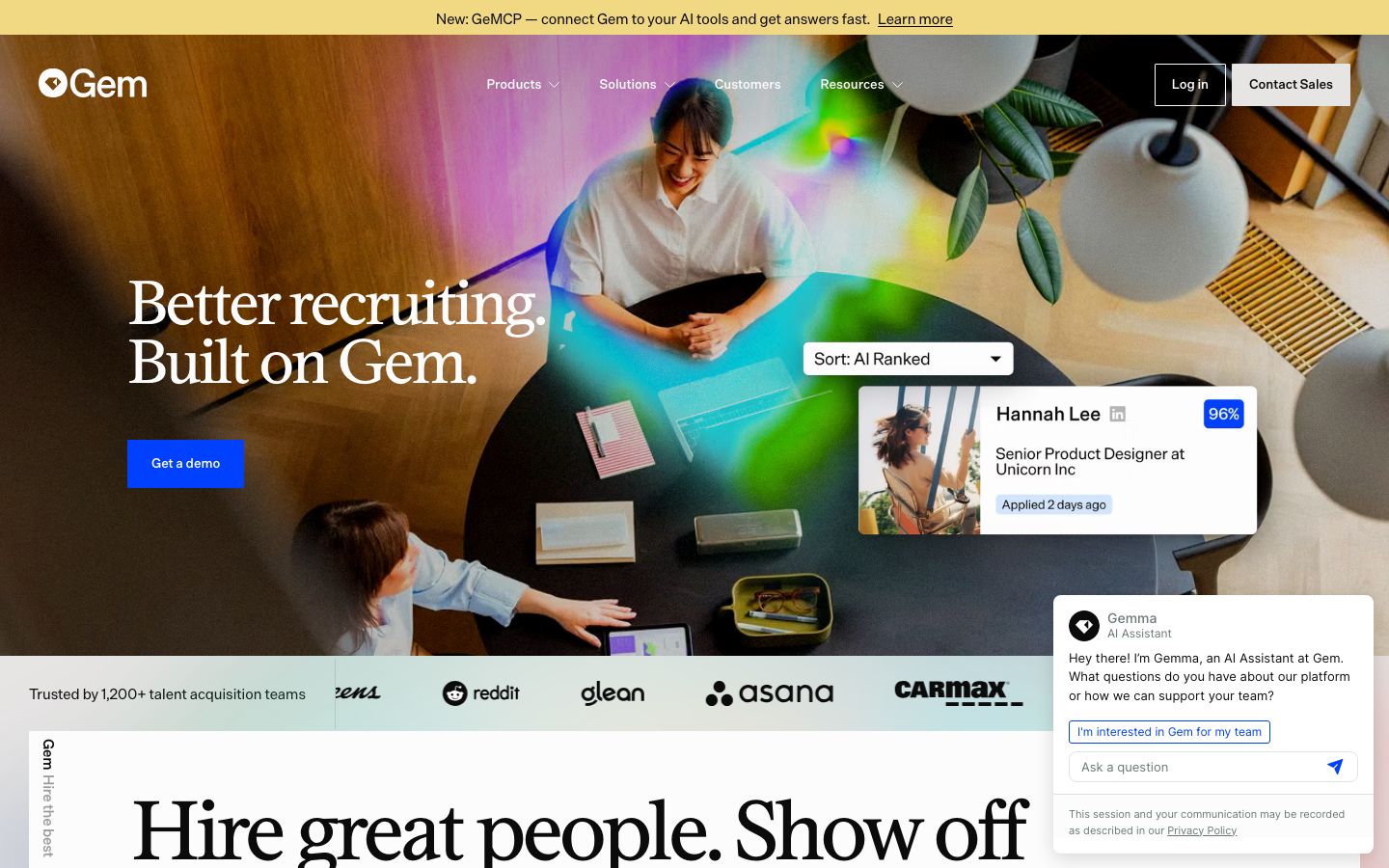
Gem is an AI talent pipeline platform built around a recruiting CRM, AI candidate rediscovery and automated nurture. It works from a company’s own ATS and CRM history. Gem says 46% of hires now come from candidates already in a company’s systems.
Software Pros
- Talent Rediscovery Agent resurfaces past candidates who now fit
- Nurture sequences keep silver-medalist pools warm
- One dataset shared across CRM, sourcing and analytics
Software Cons
- Recruiter-facing product, not a tool for employee development
- Value grows with the size of your candidate history
- Most plans are priced by quote
Gem Review
I reviewed Gem for pipeline work, not as an ATS. Its strongest job is finding the person you already met, whose profile now matches an open role, before anyone pays to source a stranger. The recruiter still decides who to contact and who moves forward. That choice should stay with a person, because a past rejection often had a reason the data never captured.
Our Verdict
Rediscovery for In-House Recruiters
Gloat
Quick Overview
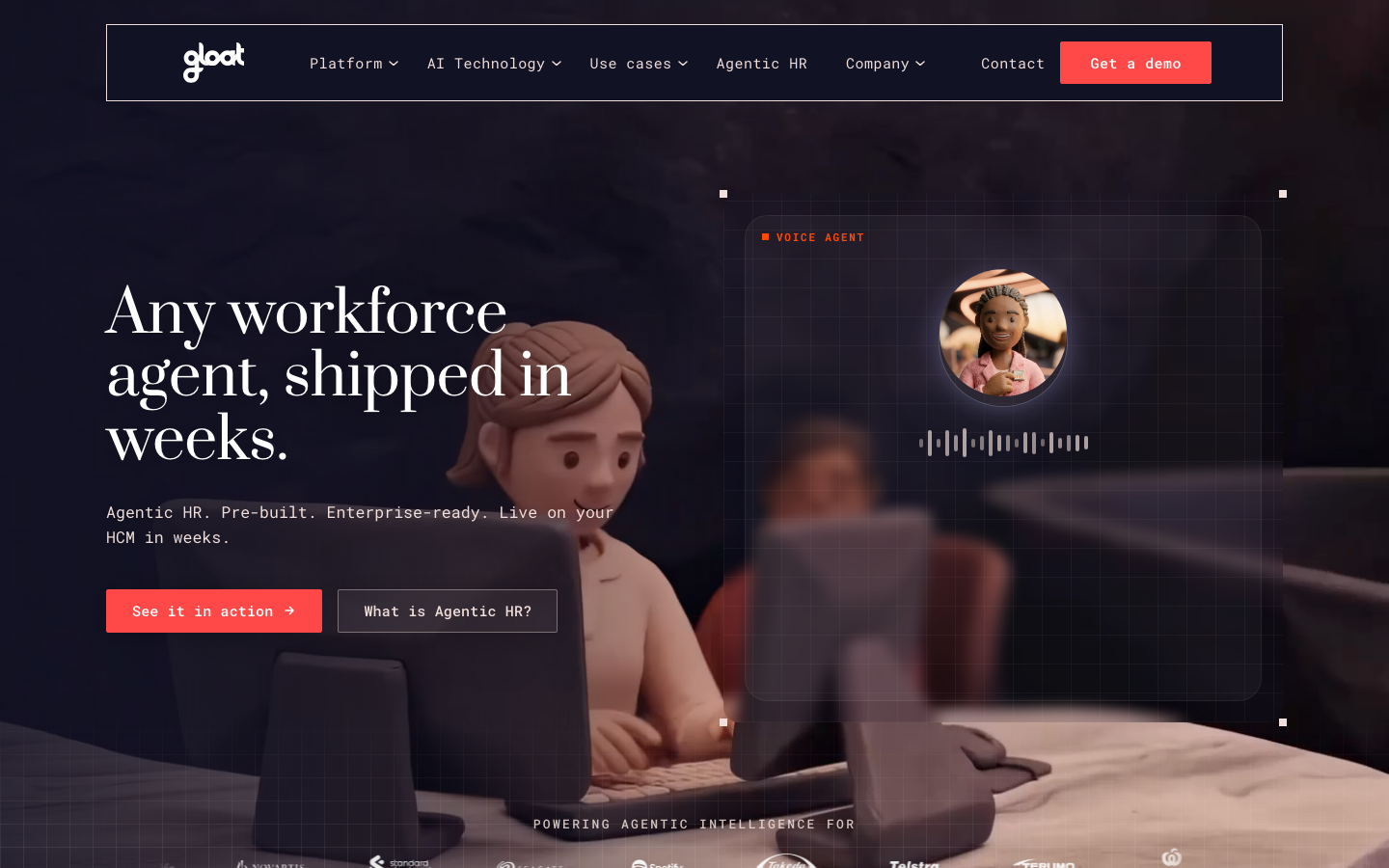
Gloat is a talent intelligence platform whose AI agents work from a workforce knowledge graph of people, roles, and skills. They flag flight risk, surface successors, and suggest internal moves. Gloat says it built its models on 2.5 billion job descriptions and 500 million profiles.
Software Pros
- Agents monitor readiness and attrition signals continuously
- Succession slates update from live skills data
- Actions follow the company’s own approval chains
Software Cons
- Agents need clean HRIS data and defined policies to act well
- Enterprise scope with a matching sales cycle
- Small G2 sample of 34 reviews
Gloat Review
I’d shortlist Gloat for succession and redeployment in organizations with defined HR policies. Its agents can draft a successor list or message an employee about an open role. Gloat says every action is explainable, auditable and reversible, and the approval chain still sits with HR. I would keep a named person signing off on any succession change before the employee hears about it.
Our Verdict
Agents for Succession and Redeployment
HrFlow.ai
Quick Overview
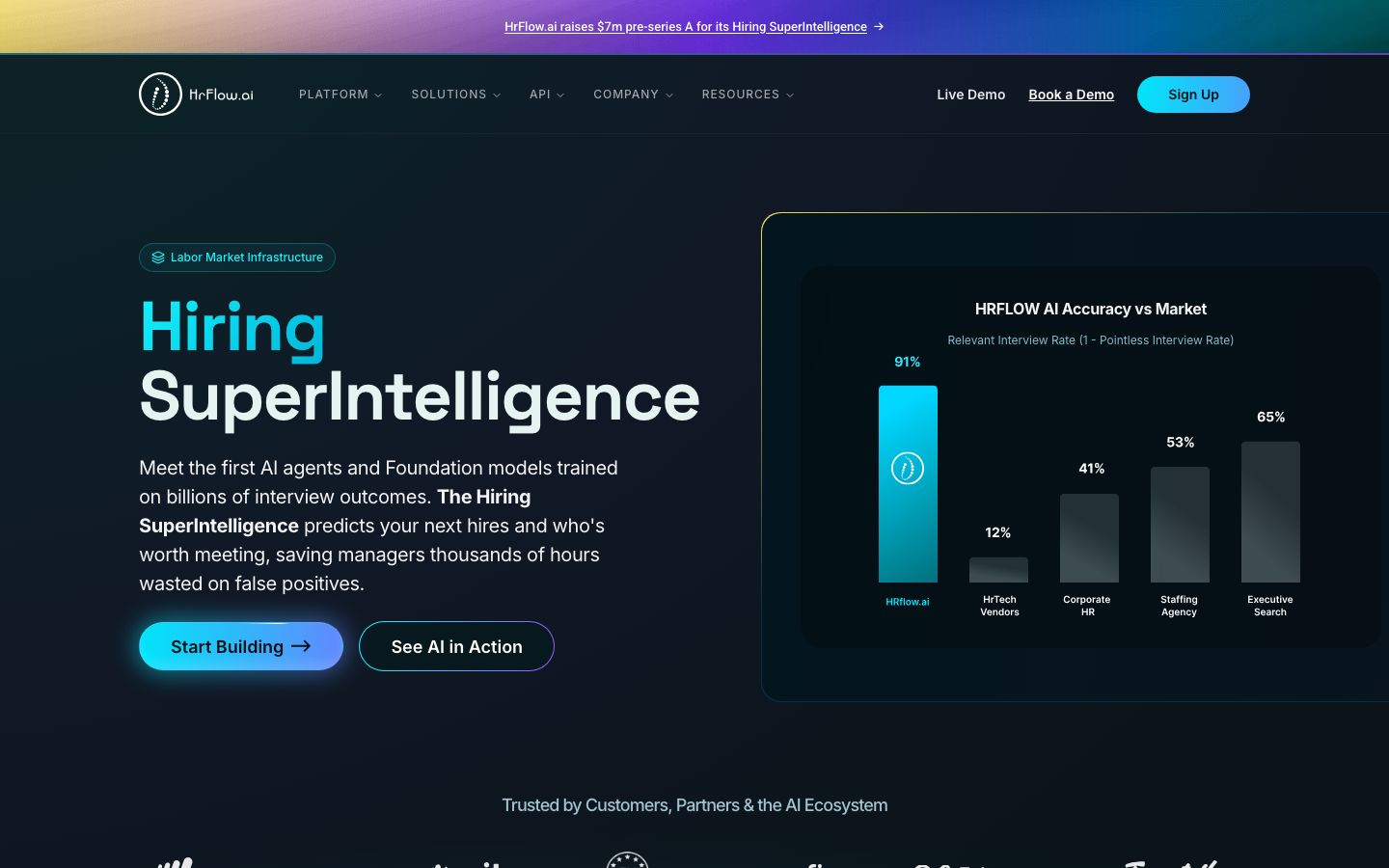
HrFlow.ai is an AI talent pipeline engine delivered as APIs that parse, enrich, score and match profiles across a company’s own talent pools. HrFlow.ai says its models were trained on more than 1.2 billion hiring decisions.
Software Pros
- One API covers parsing, scoring, matching and enrichment
- Region-specific data processing for EU or US deployments
- Built for teams embedding AI into their own stack
Software Cons
- Needs a technical owner to integrate and tune
- Small vendor with a thin public footprint
- Only 8 G2 reviews and no published pricing
HrFlow.ai Review
Staffing firms and HR tech teams use it to score and match the profiles they already hold, inside their own products. Whoever integrates it sets the scoring thresholds, making that technical owner a real decision point. A recruiter still decides what happens with each match, and nobody should hand that choice to the score.
Our Verdict
API Engine for Talent Pools
Macorva
Quick Overview
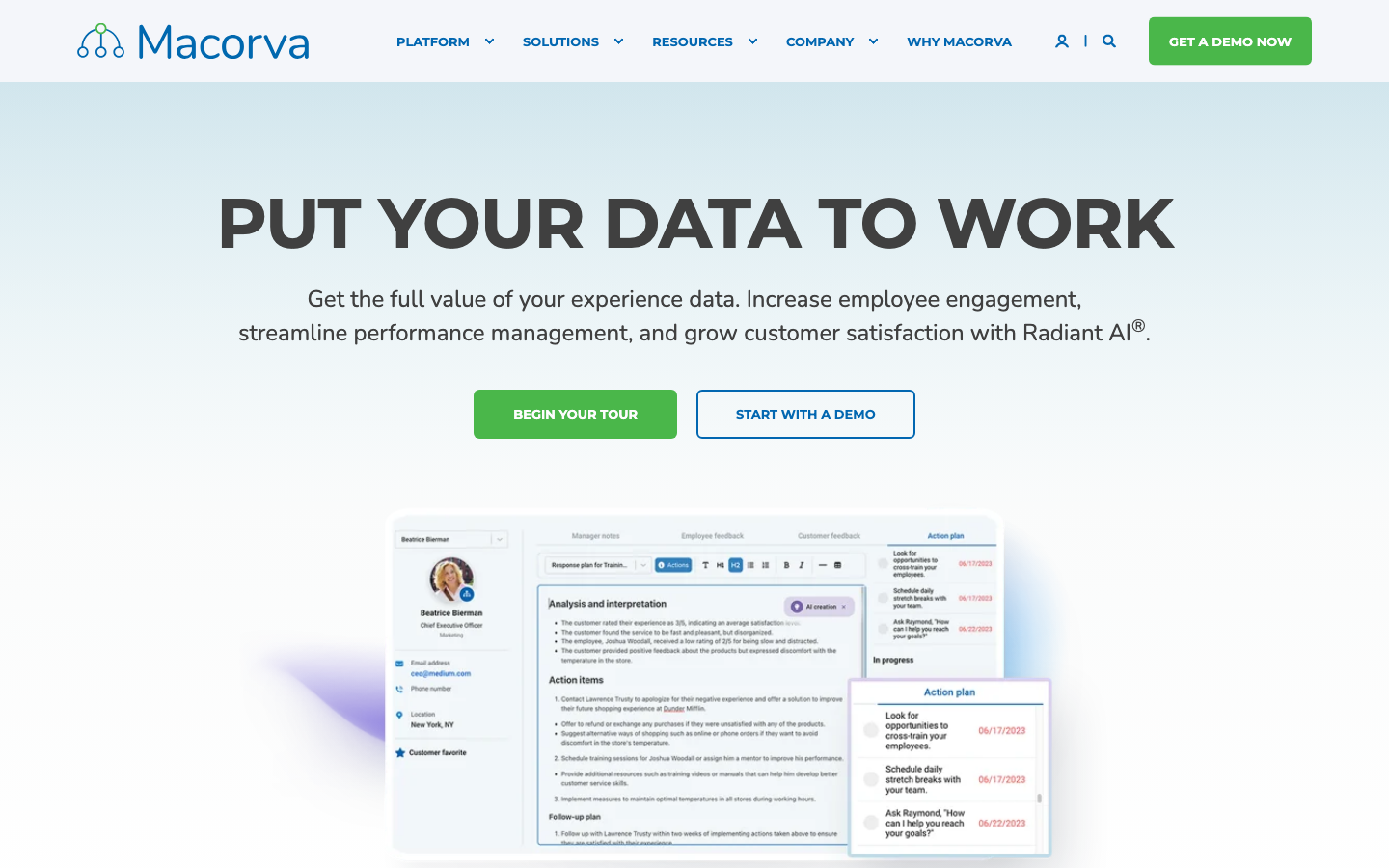
Macorva is an AI performance and development platform whose MX product drafts performance reviews, goals and development plans from feedback surveys and manager input. Macorva says MX saves each manager over 100 hours per year.
Software Pros
- Turns survey results into draft reviews and action plans
- Development plans generated for each employee
- Integrations with ADP Workforce Now and 100+ other apps
Software Cons
- Drafts are only as good as the feedback behind them
- Adoption depends on managers editing rather than forwarding
- Small G2 sample and demo-only pricing
Macorva Review
The honest use case is a mid-size organization, including healthcare, that already runs a regular feedback program. Radiant AI turns that feedback into a first draft of each review and plan. A manager has to read, correct and own that draft before the employee sees it. A generated review repeats whatever the survey data got wrong, so editing is the real work.
Our Verdict
AI Drafts From Real Feedback
retrain.ai
Quick Overview
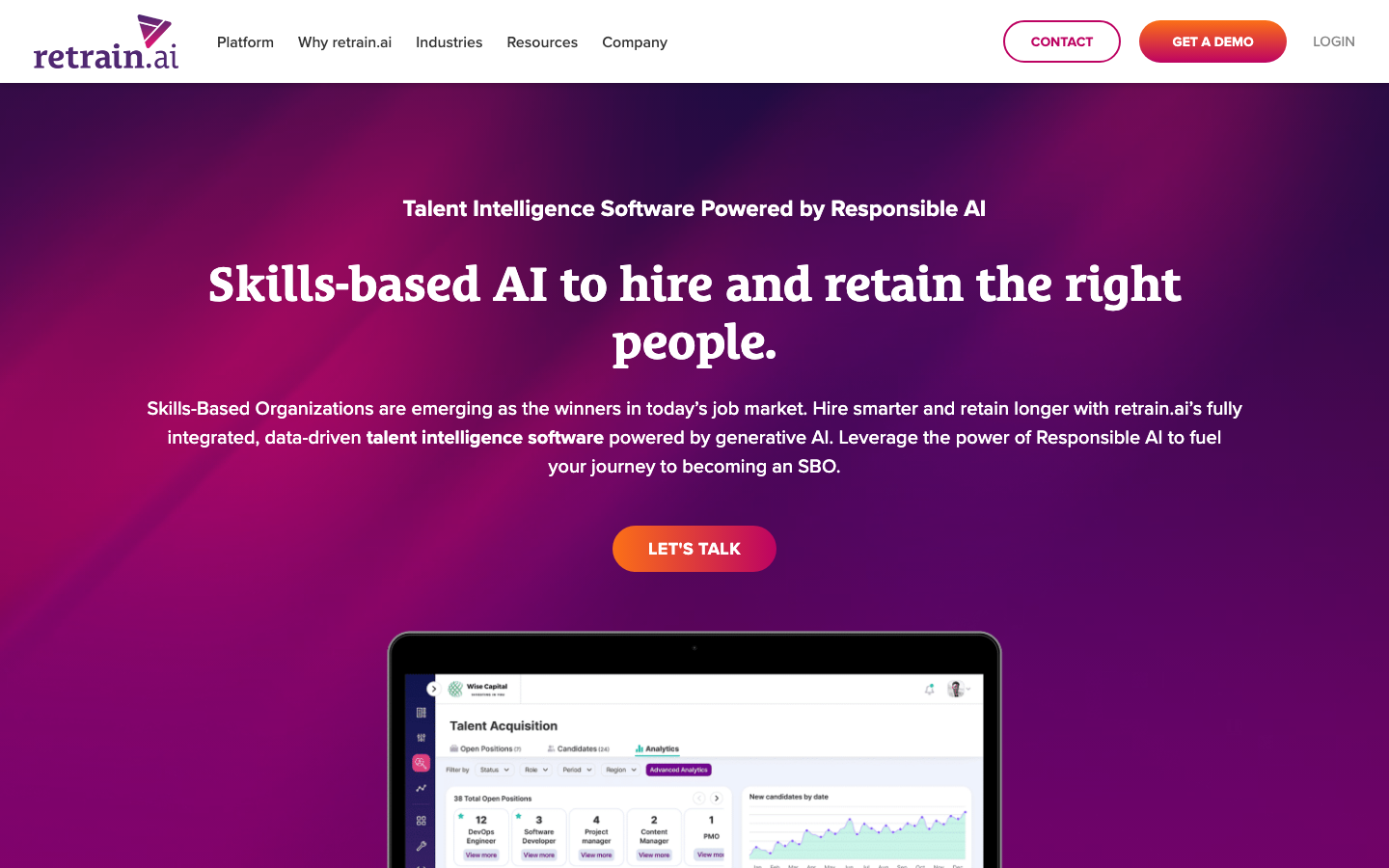
retrain.ai is a talent intelligence platform that extracts skills from CVs, job posts and profiles, then combines them with labor market data for mobility and retention. Its model rests on 4 facets it calls the capabilities genome: knowledge, skills, qualifications and personal attributes.
Software Pros
- Semantic skills extraction rather than keyword matching
- Skills architecture with workforce heat maps
- Integrates with HCM, ATS and learning systems
Software Cons
- Needs a skills taxonomy agreed across HR first
- Enterprise and public-sector implementation effort
- Custom pricing only, with no public plan
retrain.ai Review
I see retrain.ai as a fit for organizations building a skills-based model from scratch, including public-sector employers. It maps who has which skills and suggests the next role or course for each person. Employees and managers still decide on career moves. HR should validate the extracted skills before they shape any promotion, because text extraction misses skills people never wrote down.
Our Verdict
Skills Extraction Meets Market Data
Sprad
Quick Overview
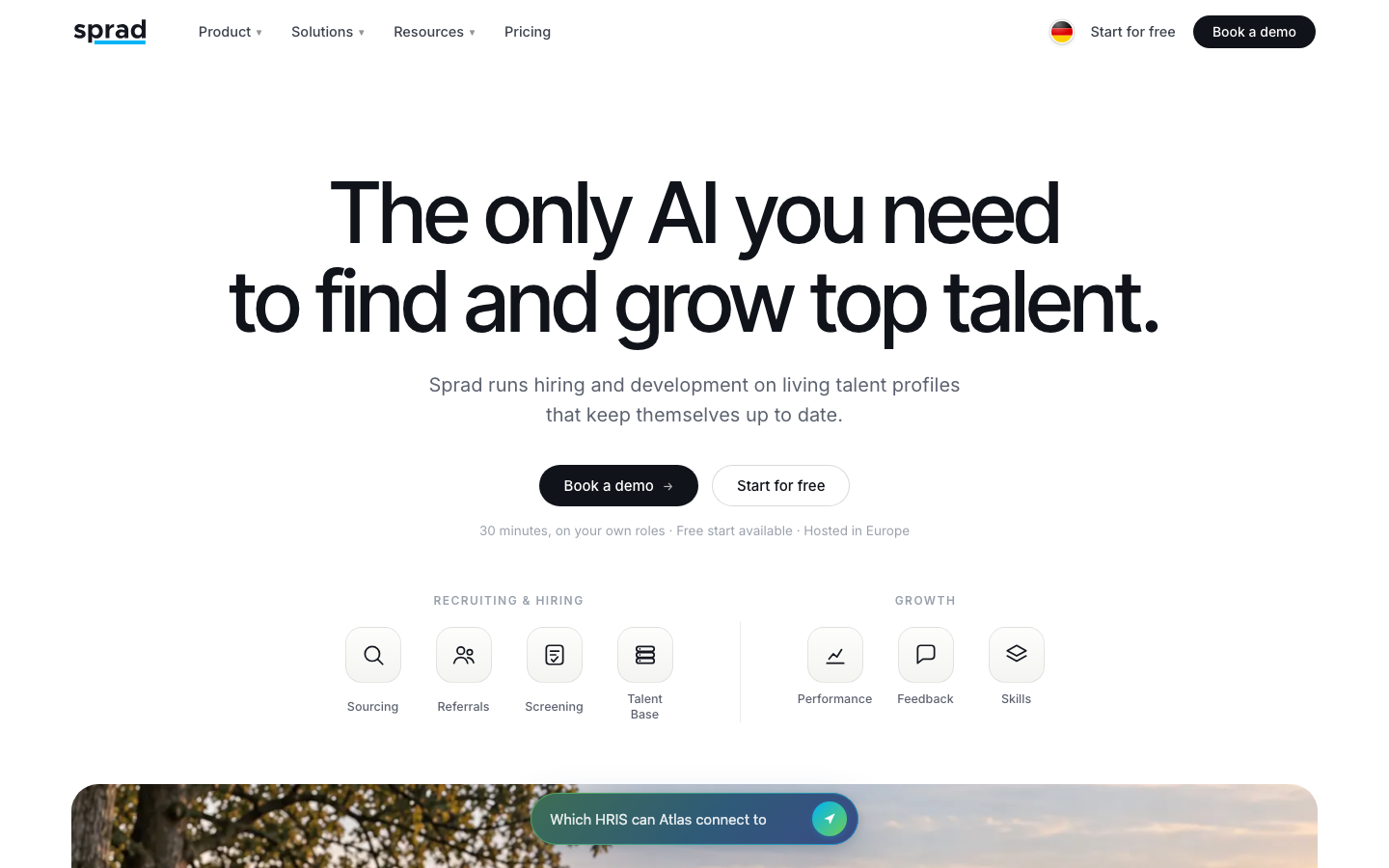
Sprad is a European AI performance and development platform whose Atlas agent drafts performance reviews, one-to-one agendas and skill paths from each employee’s living talent profile. Sprad says managers edit each drafted review in about 15 minutes.
Software Pros
- Atlas drafts reviews and one-to-one agendas automatically
- Skill paths generated from real work in the company
- Hosted in Frankfurt and the EU, with a free core plan
Software Cons
- Small vendor that started in employee referrals
- No G2 profile to check against peers
- Credit-based pricing takes time to model
Sprad Review
For me, Sprad’s clearest statement is its own rule: Atlas prepares, suggests and drafts, but never acts without a human. That fits European mid-market companies that want AI in the review cycle without handing it the decision. A manager still edits and sends every review. I would test the drafts on 1 team first, because a small vendor’s roadmap can move quickly.
Our Verdict
EU-Hosted Review Drafting
Textkernel
Quick Overview
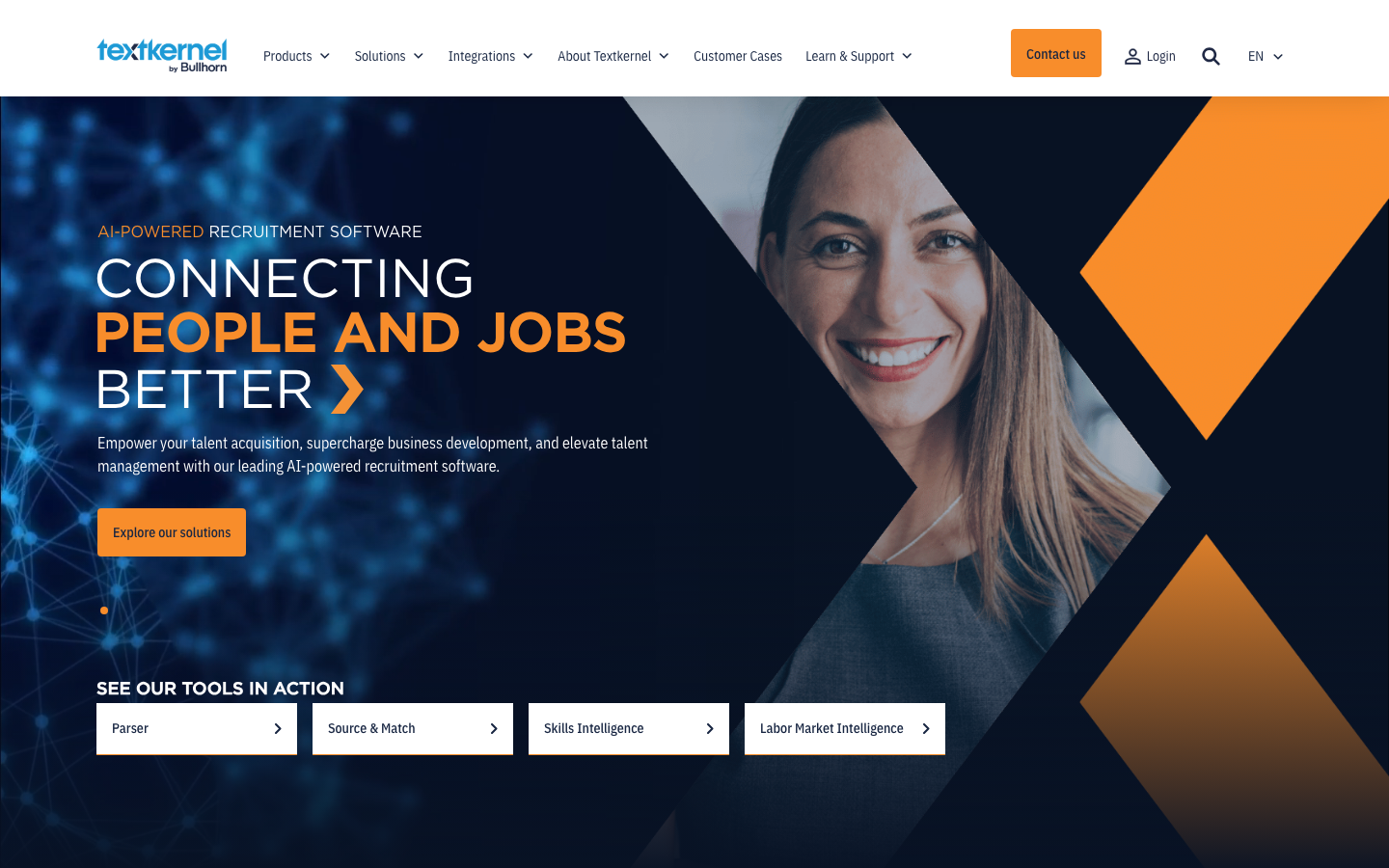
Textkernel is an AI talent pipeline engine for parsing, semantic search and matching across internal and external candidate databases, now part of Bullhorn. It offers structured labor market data for 15 key markets.
Software Pros
- Mature parser for resumes and job postings in many languages
- Semantic search that goes beyond keyword matches
- Skills taxonomies for standardizing messy profile data
Software Cons
- APIs need a technical owner to integrate and maintain
- Built mainly around staffing and recruitment workflows
- Credit plans need usage forecasting before you commit
Textkernel Review
It earns its place through redeployment inside large candidate databases. Staffing firms use it to find the contractor already on file before sourcing a new one, and large employers use the same matching for internal moves. The ranked list is only a suggestion. A recruiter decides who gets the call, and an engineer owns the integration and its upkeep.
Our Verdict
Parsing and Matching Engine
Valence
Quick Overview
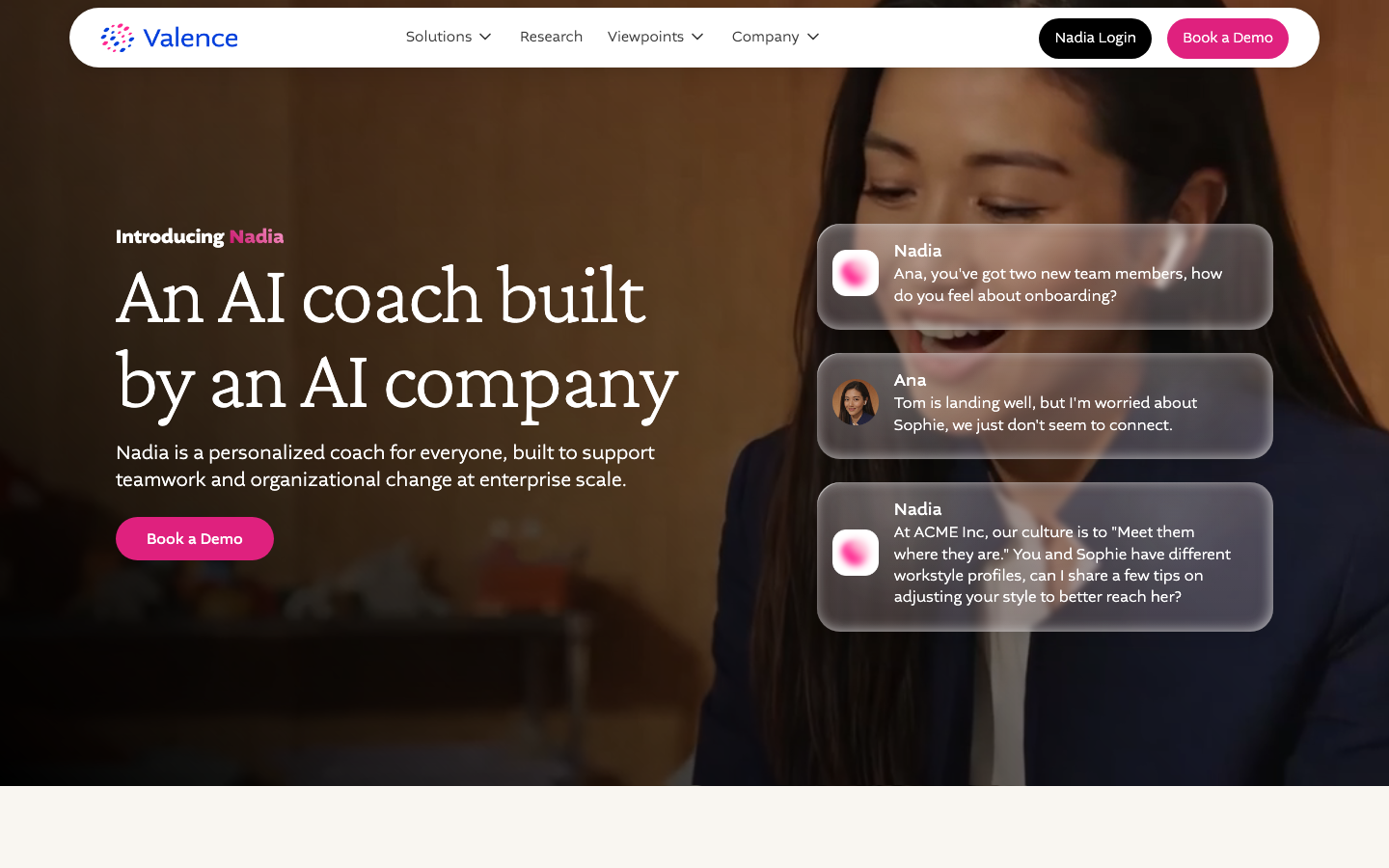
Valence is an AI performance and development platform built around Nadia, an AI coach that works from employee profiles, team context and calendars inside Microsoft Teams. Valence says 91% of users use Nadia’s advice.
Software Pros
- Coaching arrives in Teams and the calendar, not a separate app
- Prepares managers before difficult conversations
- Loads company frameworks so advice matches house language and values
Software Cons
- Calendar and collaboration access needs clear employee disclosure
- Value depends on managers using it weekly
- No G2 profile and quote-only pricing
Valence Review
If I were developing thousands of managers at once, Valence would be on my list. Nadia reads what is coming on the calendar and helps a manager prepare for it. It does not have the conversation for them. It also should not replace a human coach or HR partner when an issue turns serious, and employees should be told what context it reads.
Our Verdict
Manager Coaching in Teams
Workera
Quick Overview
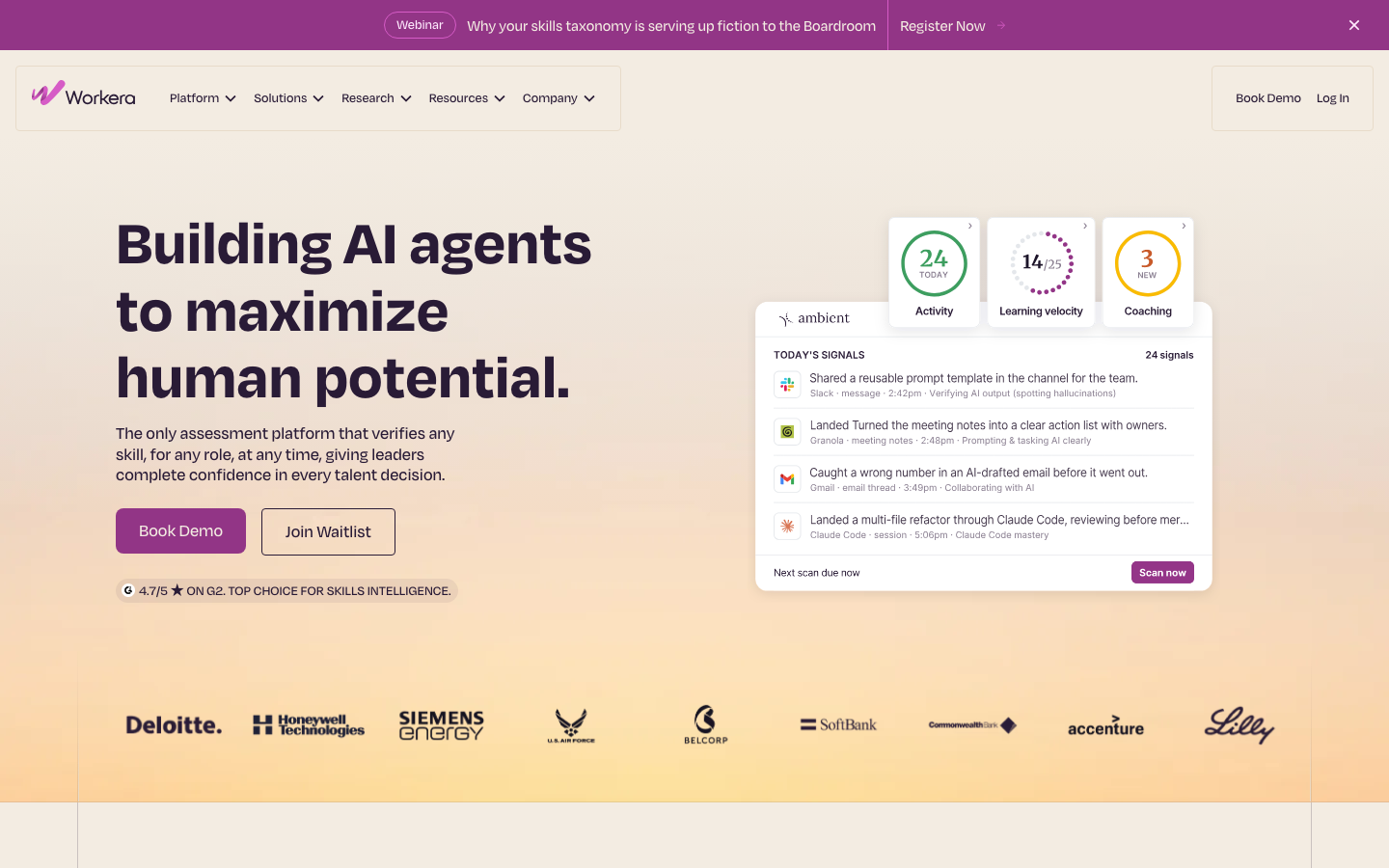
Workera is a skills evidence platform that verifies skills through AI-adaptive assessments, then runs AI agents for readiness, gap analysis and targeted learning. Workera says it offers 100+ signature assessments with benchmarks.
Software Pros
- Verified rather than self-reported skills data for every role
- Custom assessments built in under a day with Compose
- Ambient coaching that follows directly from assessment results
Software Cons
- Assessments take employee time and need clear communication
- Feeds readiness decisions rather than running mobility itself
- Custom pricing only, with no public plan
Workera Review
I tested Workera against a simple question: can it prove a skill rather than guess it? Its assessments answer that better than any profile inference on this list. A readiness score still needs a manager’s judgment before it shapes a promotion or a move. Employees should also know exactly how the score is used, or participation in the assessments drops quickly.
Our Verdict
Verified Skills Before Decisions
Best AI Talent Management Platforms by Team Type
The same model rarely serves every team well. I grouped the 13 platforms by the talent job they do, and listed tools inside each group in alphabetical order. Use these as starting points for a shortlist, because your data and HCM setup will shape the answer more than any feature list.
For Enterprise Talent Management
Beamery, Eightfold AI, Gloat, and retrain.ai build skills models across tens of thousands of employees. These AI talent management platforms for enterprise feed internal mobility, meaning moving people into new roles inside the company, plus succession and retention decisions.
All 4 depend on HCM integrations and implementations measured in months, not weeks. Eightfold AI and Gloat add a talent marketplace, an internal board of roles, projects, and gigs. If the goal is mapping long-term routes rather than the next move, dedicated career pathing software may fit better.
For Skills-Based and Data-Driven Decisions
Draup, retrain.ai, and Workera are the best platforms for data-driven talent management when evidence has to come before a decision. That gap is real: only 31% of recruiting functions use labor market data to shape their talent strategy, per Gartner (February 2026).
Draup looks outside in at the market, retrain.ai pairs extracted skills with market data, and Workera verifies skills through assessment. These tools inform decisions about the people you have today. Planning headcount 2 years out is the job of workforce planning software.
For Manager and Leader Development
CoachHub and Valence bring coaching to a scale human coaching never reached, inside the flow of work. CoachHub pairs its AI coach, AIMY, with certified human coaches, while Valence’s Nadia works from calendars and team context in Microsoft Teams. Both suit companies developing many first-time managers at once.
The limit is simple. An AI coach can prepare a manager for a hard conversation, rehearse it, and suggest wording. It does not have that conversation for them, and a serious people issue still needs a trained human.
For Performance and Growth Cycles
Macorva and Sprad draft reviews, development plans, and goals from real feedback and work data. Macorva works from survey results, and Sprad’s Atlas agent works from a living profile for each employee. Both cut the blank-page time managers spend before every review cycle.
A draft still needs a manager’s judgment before anyone reads it. Generated text repeats whatever the input got wrong, and an employee can usually tell a forwarded draft from a review someone actually wrote.
For Recruiting Teams and Talent Pools
Gem, HrFlow.ai and Textkernel work the candidates you already have before you pay to source new ones. They serve as AI recruitment tools for talent pool management, rediscovering, enriching, and matching profiles already in your systems.
The difference is who operates them. Gem is a recruiter-facing product. HrFlow.ai and Textkernel are AI talent pipeline management tools delivered as engines and APIs, so they need a technical owner.
Cost of AI Solutions for Talent Management
Pricing units differ more here than in most HR categories. The talent intelligence platforms and Draup quote enterprise contracts, usually sized by employee count and modules. Coaching platforms sell per-user licenses; Textkernel and HrFlow.ai charge for API usage, and Sprad bills in credits with no seats. Gem prices by company size.
Data readiness is the line no pricing page shows. A model needs a clean HRIS, a job architecture and a skills taxonomy before it can answer well. A skills taxonomy is an agreed list of skills and how they relate. Adoption effort after launch costs real money too, especially for tools managers use weekly.
| Tool | Pricing model | Free tier or trial | Published starting price |
|---|---|---|---|
| Beamery | Enterprise contract by employee count and modules | None published | Custom pricing |
| CoachHub | Per-user coaching licenses | None published | Custom pricing |
| Draup | Enterprise contract | None published | Custom pricing |
| Eightfold AI | Enterprise contract by employee count and modules | None published | Custom pricing |
| Gem | Based on company FTE count | Free for 6 months under 30 employees | Startup Program from $130 per month for 1-10 FTE, billed yearly |
| Gloat | Enterprise contract | None published | Custom pricing |
| HrFlow.ai | API usage | None published | Custom pricing |
| Macorva | Quote after demo | None published | Custom pricing |
| retrain.ai | Enterprise contract | None published | Custom pricing |
| Sprad | Credits, no seats | Free core with 200 credits a month | 12.0 US cents per credit at list price, less in packages |
| Textkernel | API credits, monthly or annual | 500 free credits | From $99 per month |
| Valence | Enterprise license | None published | Custom pricing |
| Workera | Enterprise contract | None published | Custom pricing |
As pricing is subject to change, prices are listed as of September 2026.
INSIGHT: What does AI talent management actually cost?
The license is rarely the largest line. Data readiness and adoption are.
- 3 of the 13 publish a price openly (Gem’s Startup Program, Sprad and Textkernel); the other 10 quote only, as of September 2026.
- The units scale differently: Textkernel from $99 per month in API credits, Sprad at 12.0 US cents per credit at list price, and Gem’s Startup Program from $130 per month for 1-10 FTE.
- A model that infers skills from a messy HRIS gives confident wrong answers, so the cleanup belongs in the budget before the license does.
FAQs About AI in Talent Management
What are the best platforms for AI-powered talent management?
It depends on which of 4 jobs you need done. Skills models for mobility and succession point to talent intelligence platforms. Verified skills or market evidence point to assessment and labor market tools. Rediscovering past candidates points to pipeline engines, and drafted reviews or coaching point to development tools. Start with the decision you currently make on guesswork, then use the comparison table to shortlist.
How is AI talent management different from traditional tools?
A traditional system records a process: forms, goals, grids and approvals, with people doing all the reasoning. A model-driven system infers skills, recommends matches, drafts text and sometimes takes an action. The practical test is to remove the model and see what is left. If only a workflow remains, the product was never really doing inference.
Can AI make promotion or hiring decisions on its own?
No, and it should not. Human in the loop means a person reviews and approves every decision that affects someone’s job, pay or career. Models can rank, match and draft, but they cannot weigh context a manager knows, and they can repeat patterns hidden in historical data. Keep the approval step explicit, documented and owned by a named person, not a default setting.
How much do these platforms cost?
Most quote custom prices. Units vary: enterprise contracts by employee count, per-user coaching licenses, API credits and company-size plans. Among the 13 here, Textkernel publishes API plans from $99 per month and Sprad lists credits at 12.0 US cents each. Gem’s Startup Program starts at $130 per month for very small companies. Budget for data cleanup and adoption as well.
What data does AI need before it can help?
At minimum, a clean employee record, a job architecture that describes roles consistently, and a skills taxonomy the model can map people against. Messy data does not make a model hesitant. It makes it confidently wrong, recommending moves based on outdated titles or duplicate profiles. Fixing the records usually takes longer than configuring the software, so plan it first.
Is AI in talent management regulated?
Increasingly, yes. The EU treats systems used for recruitment, promotion, termination and performance evaluation as high-risk. New York City requires annual bias audits for automated employment decision tools. Vendors document audits, explainability and human review to very different depths. Ask for that documentation in writing. This is general information, not legal advice.
Will employees accept AI coaching and AI-written reviews?
Acceptance depends on 3 things. Employees need to be told clearly when they are dealing with an AI. They need a human alternative for serious or sensitive issues. And managers need to edit drafts rather than forward them, because people notice a generic review immediately. When those conditions hold, usage tends to follow; when they don’t, trust drops fast.
How is AI talent management different from AI recruiting?
Recruiting AI finds and screens people who do not work for you yet: sourcing engines, AI interviewers, and screening. Talent management AI works with the people you already employ and the candidate pool you already hold. It covers mobility, succession, development, coaching, and rediscovery of past applicants. The 2 often share a skills model but serve different decisions.

Helen is Anywherer’s Market Analyst & Content Researcher, with extensive experience in analyzing global employment markets and HR technology trends. She is skilled at turning complex market data into clear, well-researched insights that inform every piece of content. With a strong grasp of the EOR, PEO, and international hiring space, Helen plays a key role in keeping Anywherer’s research accurate, up to date, and genuinely useful for readers.