No product retains anybody. Employee retention software is an umbrella term covering 4 product types, each addressing a reason people leave. Those are recognition and rewards, listening and analytics that flag risk, development and mentoring, and pay fairness. An employee retention tool is really 1 of those 4 things wearing a broader label.
The buyers are HR leaders and people managers watching voluntary turnover climb, meaning resignations rather than layoffs. Somebody has asked them what software would help. The honest answer starts with a question back: why are people leaving? Until that is answered, any purchase here is a guess with an invoice attached.
The money is what makes it worth solving. Gallup puts the cost of replacing an individual employee at one-half to 2 times that person’s annual salary, and calls that a conservative estimate. A modest reduction in regrettable attrition, meaning the departures you would have paid to prevent, funds the software several times over. The hard part is knowing which departures were preventable.

INSIGHT: What does losing one employee cost?

Replacement cost is usually expressed as a share of salary, and it climbs sharply with seniority and specialization.
- Gallup puts the cost of replacing an individual employee at one-half to 2 times that employee’s annual salary, and describes the range as a conservative estimate rather than a ceiling.
- In the same research, over half of exiting employees, 51%, say that in the 3 months before they left, neither their manager nor any other leader spoke with them about their job satisfaction or their future with the organization.
- Gallup’s State of the Global Workplace reports global engagement at 20% in 2025, and records manager engagement falling 5 points in a year, from 27% to 22%.
- The practical consequence is a measurement gap nobody closes. The business case rests on regrettable attrition rather than on total turnover, and most companies never separate the 2 in their reporting.
There is no single winner, and the reason is uncomfortable to say out loud. The best employee retention software depends entirely on why your people are leaving. No platform on this page fixes underpayment or a manager nobody wants to work for. Gallup found that 51% of leavers had no conversation about their future in their final 3 months. That figure sits alongside its wider engagement data, pointing to behavior rather than software. Below, I’ve reviewed 12 of the leading platforms in A-Z order.
INSIGHT: Recognition, listening, development, or pay?
Retention software pulls 1 of 4 levers, and buying the wrong one is why so many programs show no change in turnover.
- Recognition and rewards (Achievers, Bonusly, Bucketlist Rewards, Tango Card, WorkTango, Xoxoday Empuls) make contribution visible and fund the rewards behind it. The problem addressed is feeling unseen, and Tango Card is explicit that it supplies the rewards rather than the program.
- Analytics and listening (iMocha, Peoplelogic, Worklytics) surface who is disengaging and why before the resignation arrives. Worklytics documents use cases covering burnout, manager effectiveness, and hybrid work patterns.
- Development and mentoring (Chronus, CoachHub, Together Platform) give people growth and better managers to stay for. Chronus lists employee retention as a named use case for its mentoring software.
- Pay fairness is the fourth lever, and nothing on this page pulls it. When people leave over money, the answer starts with market pay data.
Employee Retention Software Comparison
6 columns below carry the whole argument of this page. Sorting the best employee retention software by lever matters far more than sorting it by feature count. A recognition platform and an analytics platform are not alternatives.
The column that decides most purchases is whether a manager gets prompted to do something. A dashboard showing elevated flight risk, meaning the probability that somebody resigns soon, changes nothing by itself.
| Tool | Retention lever | What it does about turnover | Manager action built in | Company fit | G2 rating |
|---|---|---|---|---|---|
| Achievers | Recognition and rewards | Funds and scales recognition | Prompts and workflows | Enterprise | 4.6 (9,596) |
| Bonusly | Recognition and rewards | Drives peer recognition frequency | Prompts and workflows | SMB, Mid-market | 4.7 (7,377) |
| Bucketlist Rewards | Recognition and rewards | Personalizes rewards and milestones | Prompts and workflows | Mid-market, Enterprise | 4.8 (824) |
| Chronus | Development | Matches mentors and tracks programs | Prompts and workflows | Enterprise | 4.7 (38) |
| CoachHub | Development | Coaches managers 1-to-1 | Reporting only | Enterprise | 4.0 (1) |
| iMocha | Analytics | Surfaces skills gaps and internal moves | Reporting only | Enterprise | 4.4 (276) |
| Peoplelogic | Analytics | Flags disengagement early | Prompts and workflows | SMB, Mid-market | 4.9 (28) |
| Tango Card | Recognition and rewards | Delivers the rewards themselves | Not stated | SMB, Enterprise | 4.7 (526) |
| Together Platform | Development | Matches mentors and reports on progress | Prompts and workflows | Mid-market, Enterprise | 4.8 (427) |
| Worklytics | Analytics | Surfaces burnout and manager load | Reporting only | Enterprise | N/A |
| WorkTango | Recognition and rewards | Pairs recognition with listening data | Prompts and workflows | Mid-market, Enterprise | 4.7 (1,329) |
| Xoxoday Empuls | Recognition and rewards | Combines recognition, perks, and surveys | Prompts and workflows | Mid-market | 4.6 (1,577) |
Ratings were read from G2 product profiles in September 2026.
What Employee Retention Software Actually Does
Start from the honest position. Nothing on this page keeps anybody in a job they have decided to leave. The category name promises an outcome the software cannot deliver alone. Employee retention software features cluster into a familiar set. Recognition feeds, reward catalogs, sentiment dashboards, flight-risk scoring, mentoring workflows, and manager prompts appear again and again. What differs is which reason for leaving each one attacks.
The recognition lever addresses feeling unseen. Frequent, visible appreciation changes how people read their own standing. It is also cheap relative to a replacement hire. Our roundup of employee recognition software reviews those platforms properly. Recognition can’t compensate for a bad manager or a below-market salary. Programs sold as retention fixes collide with both routinely.
The listening lever addresses not knowing. Surveys and sentiment tracking tell you how people feel, and our guide to employee survey tools covers 28 platforms built for that job. Measuring sentiment is not the same as acting on it. A quarterly score nobody converts into a manager conversation is an expensive way to document a problem you already suspected.
The development lever addresses the absence of a future. Career paths, mentoring, coaching, and internal mobility, meaning movement into another role inside the company, all give somebody a reason to stay. None of it involves a gift card. This is also where manager quality sits, and manager quality remains the strongest lever most organizations underuse.
The pay lever is the one this page cannot pull. People leave over money more often than any of this addresses. No recognition feed survives contact with a salary 15% below market. That work starts with market data, not a platform. Our guide to salary benchmarking software is the honest first stop when exit interviews keep naming compensation.
Retention Analytics: Can Software Predict Who Will Leave?
Analytics software for employee retention builds models from what it can see. That means tenure, engagement scores, manager and team patterns, pay position, internal movement, and sometimes collaboration data such as meeting load. None of that reads minds. It reads correlations, and correlations describe groups far better than individuals.
The gap between those 2 things is wider than vendors admit. Group-level driver analysis is genuinely useful. Knowing that attrition concentrates in 1 department, or among people 18 months into a role, points at something you can change. Individual flight-risk labels are shakier statistically and worse ethically. A manager who tells somebody they’re likely to quit rarely treats that person the same way afterward.
Among the 12 reviewed here, Peoplelogic and Worklytics document early-warning signals drawn from work and engagement data. iMocha reports on skills and internal mobility rather than on individual risk. The recognition and mentoring platforms report on what already happened: participation, recognition frequency, program completion. Both kinds of reporting are legitimate, and only one is predictive.
The conclusion is simple enough. A prediction with no action attached is a report, not a retention tool. The question to ask any analytics vendor is what happens on the day the score turns red. Where burnout is the signal, the answer usually belongs to a different budget. Our guide to employee wellness software is the right page for that work.
Best Employee Retention Tools by Approach
The approach you need comes from your exit data. A company losing people to a competitor’s salary band and one losing them to boredom face different problems with the same symptom. Each of the 4 sections below covers a single approach, with platforms listed A-Z and no implied order of merit.
For Recognition-Led Retention
Recognition works on visibility and frequency rather than on grand gestures. A monthly award reaches 1 person, while weekly peer recognition reaches most of a team. The budget question comes first, though. On every platform in this group, the rewards are a separate cost from the license. A program with no funded rewards is a notification feed.
Achievers runs formal enterprise programs and reports rewards delivered across 190 countries. Bonusly builds around frequent small peer awards and publishes its rate openly. Bucketlist Rewards ties awards to individual interests and milestones. Xoxoday Empuls bundles recognition with perks and surveys for mid-market teams. None of them address the manager relationship underneath recognition.
For Analytics-Led Retention
This approach suits organizations that keep being surprised by resignations. The value is an early signal. A team whose meeting load doubled, a cohort whose scores dropped 2 quarters running, a skill set with no internal route forward. The requirement attached is that somebody reads it and acts.
iMocha maps skills across the workforce and surfaces where internal moves are possible, serving 300+ enterprise customers. Peoplelogic reads signals from work systems to flag disengagement early. Worklytics analyzes collaboration and work patterns for burnout and manager-load signals. All 3 require a data conversation with employees before deployment. The third requires the hardest one.
For Development-Led Retention
People stay where they are growing. Anyone comparing the best employee retention coaching software is usually trying to fix manager quality. Gallup’s research keeps identifying that as the difference between a team that stays and one that does not. Coaching reaches managers directly. Mentoring reaches everybody else. Both work on the reason people give when they say there was nowhere to go.
Chronus runs structured mentoring at enterprise scale and names retention as a use case on its own site. CoachHub delivers 1-to-1 coaching and says it has more than 3,500 certified coaches across 90+ countries. The best mentorship software for employee retention is judged on participation rather than on features. Together Platform states that 98% of its users are satisfied with their mentor match.
For Small Businesses
Employee retention software for small businesses has to work without an HR team and without a program budget. At 20 people, retention is a management problem before it is a software one. The honest advice is to pay people properly and teach 2 managers to run a decent 1-to-1 before buying anything.
If something is worth buying, keep it small. Bonusly has a free tier for up to 8 users and lists $5 per user per month above it. Bucketlist Rewards says it is built for organizations of 200+ employees, though it can be adapted downward. Tango Card charges no sign-up fee and lets you fund rewards as you send them. That suits a company with no program at all.
Employee Retention Software Pricing
Pricing in this category takes 3 shapes. Recognition platforms charge a per-employee platform fee, and the company funds the rewards separately. The visible price is a fraction of the real spend. Analytics platforms price per employee and quote at the enterprise end. Coaching platforms price per coached individual, which makes them expensive per head and usually restricts them to managers.
The trap is the rewards line. A recognition program with no funded reward budget is a notification system with a monthly invoice. The platform fee tells you almost nothing about the annual cost. 3 of the 12 platforms here publish a usable figure, which is more transparency than most HR categories manage.
| Tool | Pricing model | Free trial or demo | Published starting price |
|---|---|---|---|
| Achievers | Platform fee plus rewards budget | Demo on request | Custom pricing |
| Bonusly | Per employee per month plus rewards budget | 30-day trial | Free for up to 8 users, then $5 per user per month |
| Bucketlist Rewards | Platform fee plus rewards budget | Demo on request | Custom pricing |
| Chronus | Quote-based | Demo on request | Custom pricing |
| CoachHub | Per coached user | Demo on request | Custom pricing |
| iMocha | Quote-based | Demo on request | Custom pricing |
| Peoplelogic | Per employee per month | Demo on request | From $3,588 per year |
| Tango Card | Rewards funded per send | Self-serve portal | No sign-up fee; you fund the rewards |
| Together Platform | Quote-based | Demo on request | Custom pricing |
| Worklytics | Per employee per month | Free tier | Free tier, Business from $2,500 per month |
| WorkTango | Platform fee plus rewards budget | Demo on request | Custom pricing |
| Xoxoday Empuls | Platform fee plus rewards budget | Demo on request | Custom pricing |
As pricing is subject to change, prices are listed as of September 2026.
INSIGHT: Why is the platform fee only half the cost?
On recognition platforms, the company funds the rewards itself, and that budget is usually larger than the software sitting on top of it.
- Only 3 of these 12 platforms put a usable rate in public. Bonusly lists a free tier for up to 8 users and $5 per user per month above it; Peoplelogic starts at $3,588 per year, and Worklytics offers a free tier with its Business plan from $2,500 per month. The other 9 quote.
- Tango Card separates the 2 costs more clearly than anyone, stating no minimums and no sign-up fees, with a self-serve portal that is free to use because the money goes into the rewards themselves.
- 6 of the 12 pull the recognition lever, and every one of them carries the same structure: a per-employee license plus whatever the company decides to fund in awards. The second number is the one that moves.
- The honest comparison is total annual cost per employee including funded rewards, not the per-seat rate on the pricing page. A $4 license with a $60 annual reward budget per head is a $108 decision, not a $48 one.
Sources:
as of September 2026
How to Choose Employee Retention Software
I would refuse to look at a demo until somebody has read the exit data. Ask why people left over the past 4 quarters. Separate the departures you regret from the ones you do not, then look for the pattern. In most companies, that exercise points to a manager or a pay band rather than a missing recognition feed.
Then match the lever to that reason. If the answer is pay, the software on this page will not touch it. If the answer is growth, a mentoring or coaching program addresses it directly. Next, check whether the tool ends at a dashboard or prompts someone to act. A flight-risk score with no workflow behind it is a report.
Ask who owns the program internally. An unowned platform decays within 2 quarters and renews once out of habit before anybody cancels it. Then look hard at what a manager sees about their own team. Retention is won or lost at that level, not in a company-wide dashboard.
If recognition is the lever, budget the rewards separately from the license before you compare vendors. If the tool analyzes work patterns, settle the privacy question with employees before the demo. And be honest about the limit: most of what makes people leave sits outside every product reviewed here.
Top 12 Employee Retention Software Platforms for 2026
I read each vendor’s own product, customer, and pricing pages with 1 question in front of me. Which reason for leaving does this actually act on? Where a turnover figure appears below, it carries the name of the vendor that published it. Almost every statistic circulating in this category traces back to a vendor with something to sell.
I’m listing all providers alphabetically to keep this comparison neutral.
The mix runs from recognition platforms like Achievers and Bonusly to analytics in PeopleLogic and mentoring in Chronus. Read the lever column before the feature list. These 12 are not alternatives to one another in any meaningful sense. 3 of them would not appear on the same shortlist as the other 9.
The blocks below each name the lever and the mechanism in the first sentence. That is deliberate. It lets you rule out 8 platforms in about a minute. That is the most useful thing this page can do for somebody asked to fix turnover by Friday.
Achievers
Quick Overview
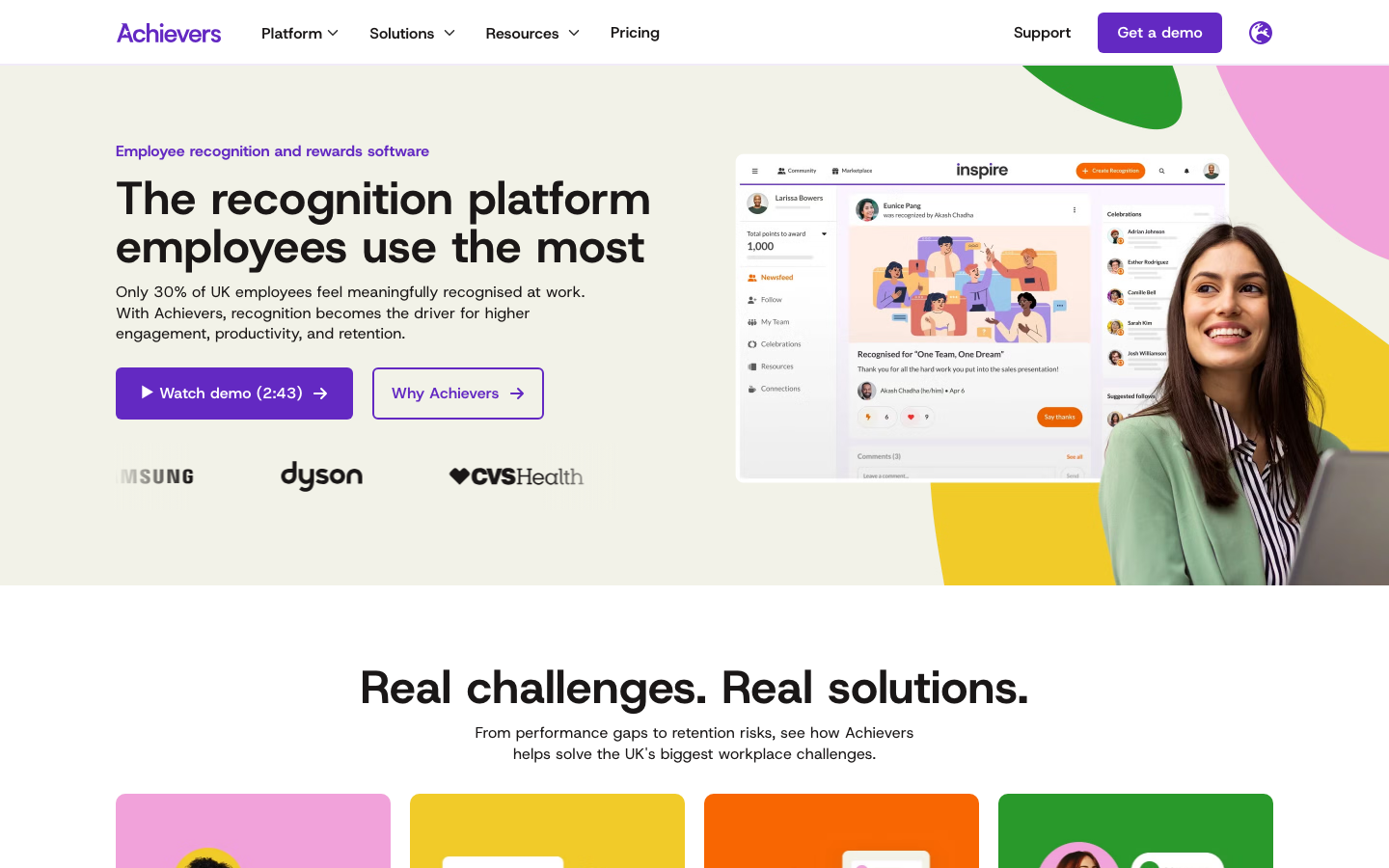
Achievers pulls the recognition lever at enterprise scale, funding frequent peer recognition and tying it to listening and reporting. Turnover risk shows up in the same place as appreciation. The vendor states it has delivered 3 million rewards across 190 countries and cites customer activation rates of 97% in manufacturing.
Software Pros
- Recognition frequency is high enough to change how visible people feel
- Listening data sitting beside the recognition record, not in another tool
- Reward fulfillment across 190 countries, per the vendor
Software Cons
- The rewards budget is a separate and larger cost than the license
- Enterprise scope brings an implementation and a program owner with it
- Recognition does not touch a pay problem or a difficult manager
Achievers Review
The retention problem this addresses is people quietly concluding that nobody notices what they do. At 5,000 employees, that conclusion spreads quietly, without anybody ever reporting it. A program running at real frequency changes the evidence available to them. It will not rescue a team whose manager is the actual reason half of them are quietly updating a resume this month.
Our Verdict
Enterprise Program At Scale
Bonusly
Quick Overview
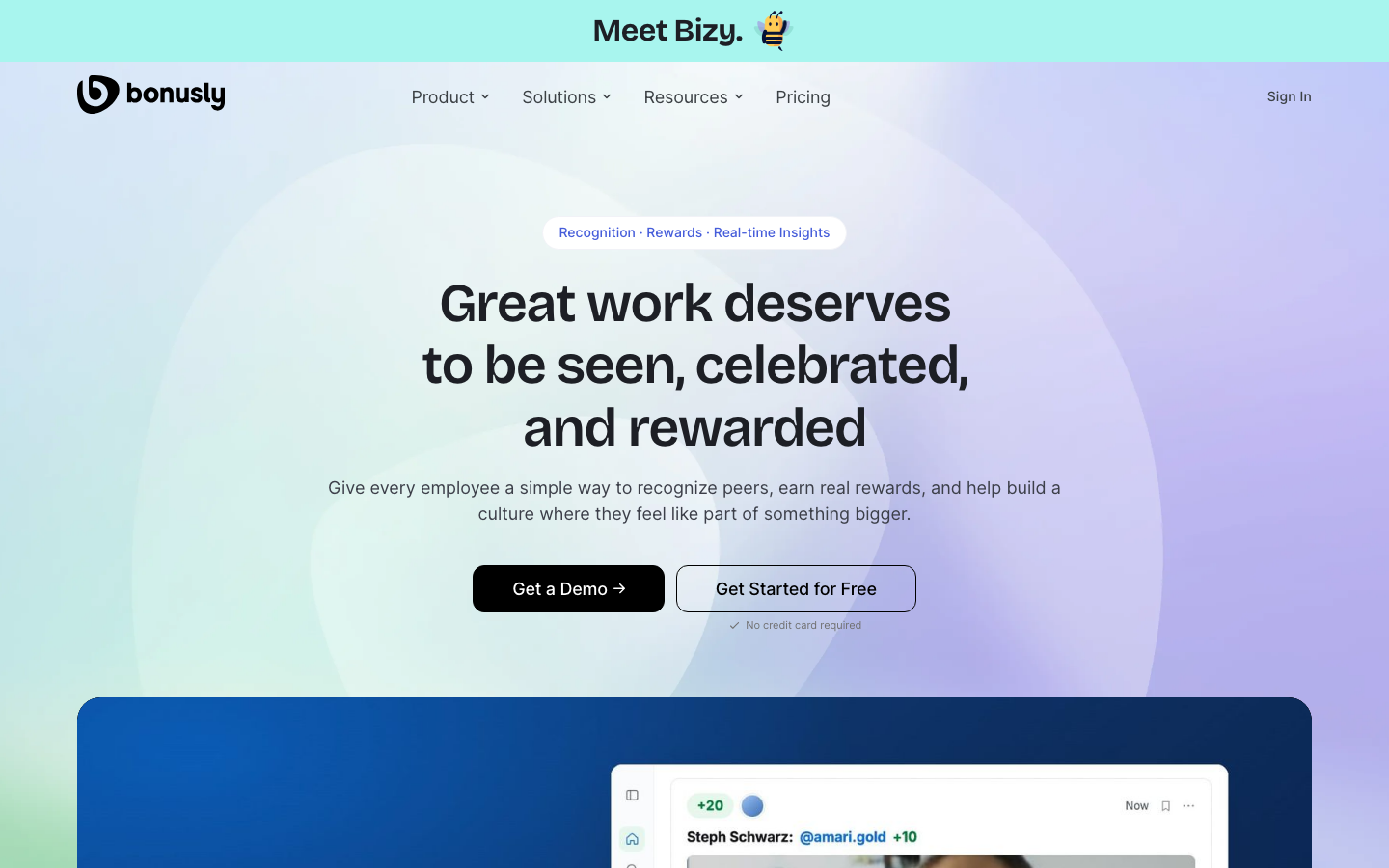
Bonusly works the recognition lever through high-frequency peer-to-peer awards, with analytics showing which teams recognize each other and which have gone quiet. Quiet teams are the retention signal. The vendor publishes its pricing openly, listing a free tier for up to 8 users and $5 per user per month above it.
Software Pros
- Recognition patterns by team, which doubles as an early disengagement signal
- Published pricing and a 30-day trial, unusual in this category
- Automated milestone celebrations and manager alerts on the paid tier
Software Cons
- Rewards are funded by you on top of the per-user fee
- Peer recognition thins out without visible manager participation
- Analytics stop at recognition activity rather than modeling attrition
Bonusly Review
The retention problem this addresses is appreciation that happens only at review time. Bonusly makes it constant and cheap. The pattern data is quietly the most useful part, since a team that stops recognizing each other usually has something wrong. It is not a diagnostic tool, and a company that already knows the problem is pay should spend the budget elsewhere.
Our Verdict
Frequent Peer Recognition Cheaply
*As pricing is subject to change, we are listing prices as they stand in September 2026
Bucketlist Rewards
Quick Overview
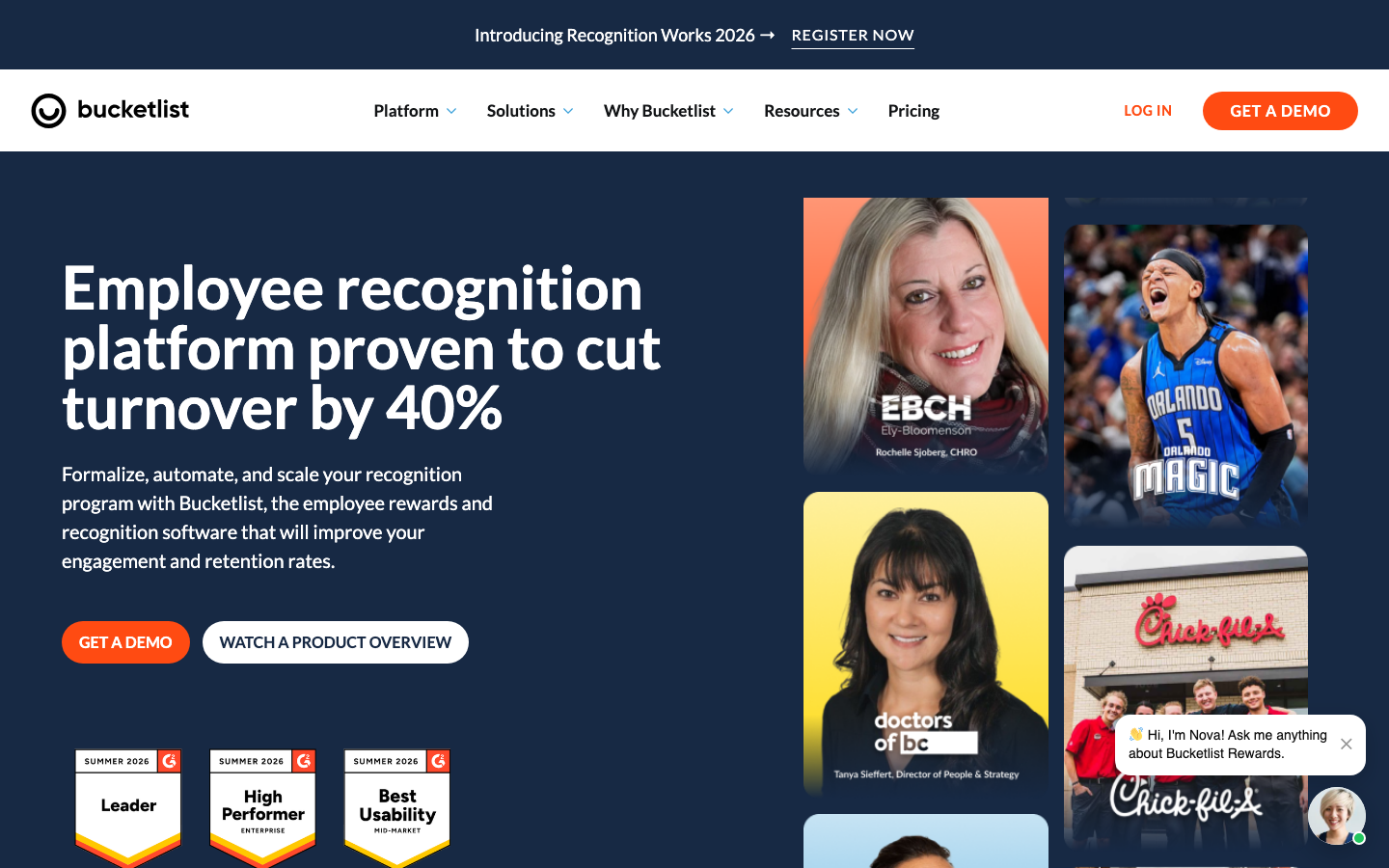
Bucketlist Rewards pulls the recognition lever by matching awards to what an individual actually wants rather than issuing generic points. Automated milestone workflows sit behind it. The vendor states a 40% reduction in voluntary turnover among its customers and says the platform is built for organizations of 200+ employees.
Software Pros
- Rewards matched to personal interests rather than a generic catalog
- Automated workflows and approvals for milestones and service awards
- Strong presence in frontline industries, per the vendor’s customer base
Software Cons
- The reward catalog is funded separately from the platform fee
- Built for 200+ employees, so smaller teams adapt rather than fit
- Its turnover claim is the vendor’s own figure, not an independent result
Bucketlist Rewards Review
Where this earns its place is with workforces that have seen every points catalog and stopped caring. Personalizing the reward decides whether it registers with the person at all. That matters far more in frontline settings than it does in an office. Treat the headline turnover figure as marketing until the vendor walks you through the customer data sitting underneath it.
Our Verdict
Rewards People Actually Want
Chronus
Quick Overview
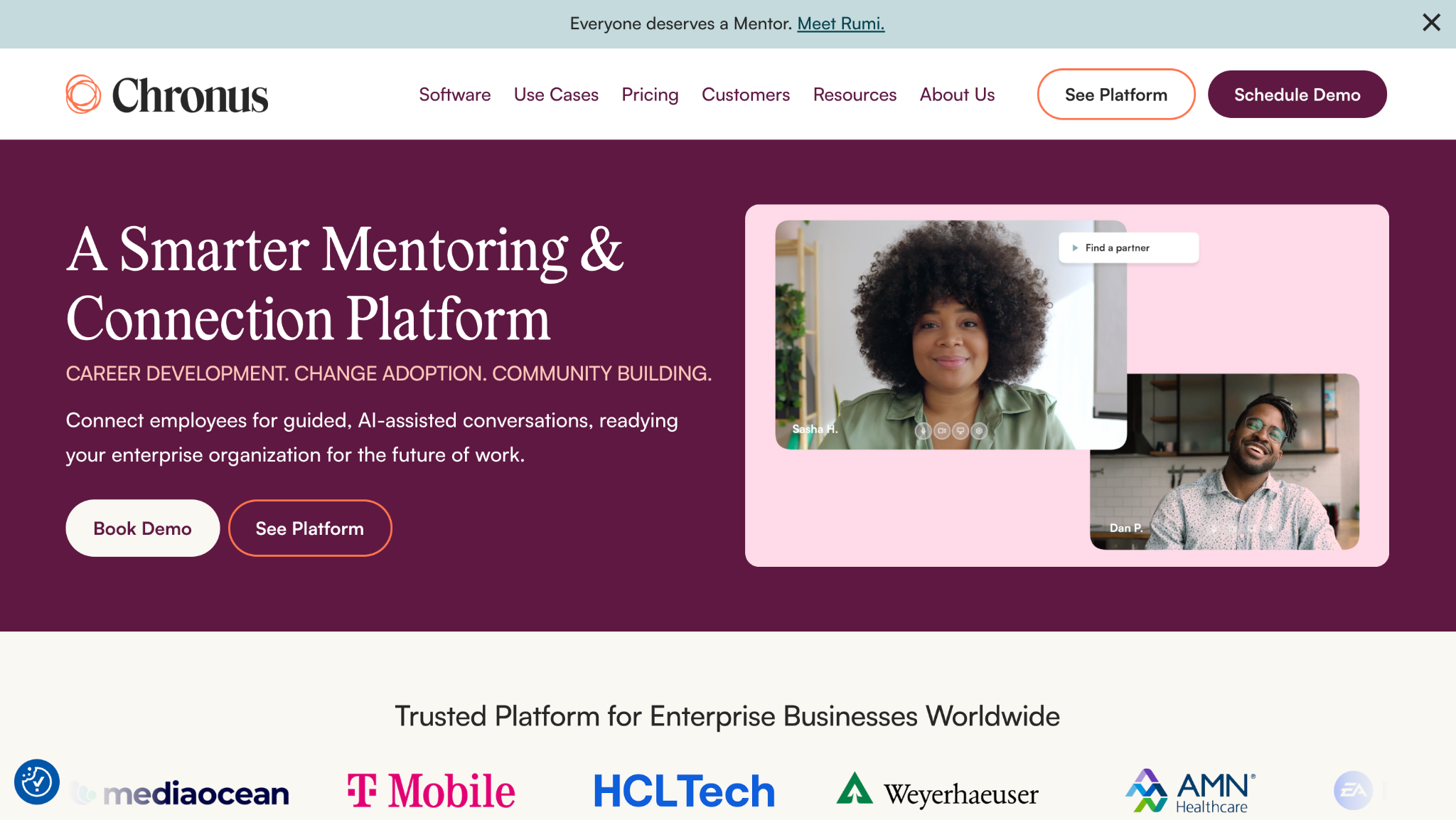
Chronus pulls the development lever through structured mentoring, matching people into programs and reporting on participation and outcomes at enterprise scale. The vendor names employee retention as a use case on its own site, alongside upskilling and belonging, and states Amazon and T-Mobile among its customers.
Software Pros
- Matching and program mechanics built for thousands of participants
- Guided conversations that stop mentoring pairs from stalling after week 2
- Reporting on participation and progression rather than on sign-ups
Software Cons
- Programs live or die on participation, which is a change-management job
- 38 G2 reviews on its mentoring listing, a thin public sample
- Priced by quotation, with no figure published to compare
Chronus Review
I would put this in front of an organization that has run mentoring informally and watched it fade by month 3. Matching and guided structure carry a program past the initial enthusiasm phase and into a second year. A company where nobody senior will champion mentoring should not expect software to fill that gap.
Our Verdict
Mentoring Run As Program
CoachHub
Quick Overview
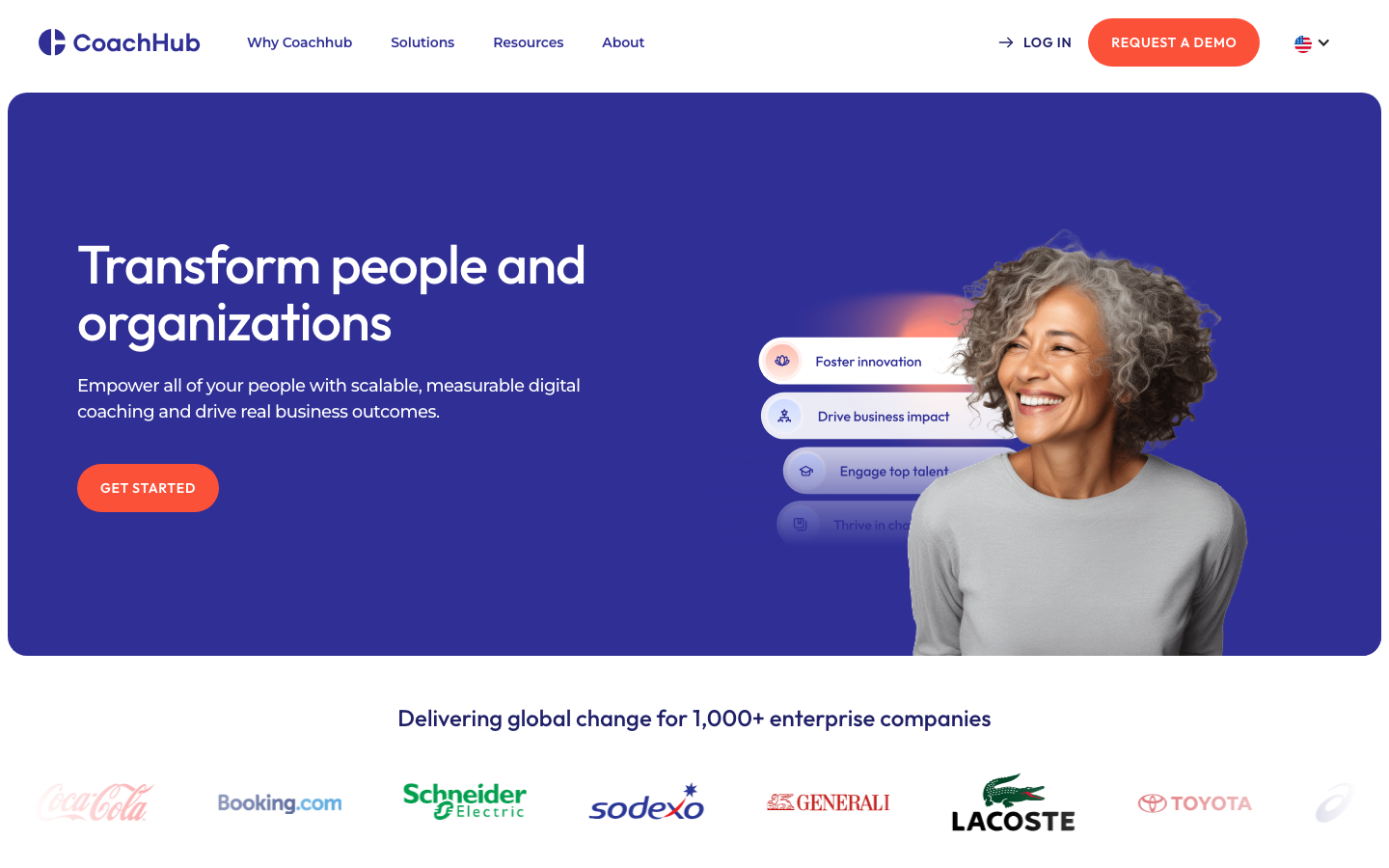
CoachHub pulls the development lever at the manager level, delivering 1-to-1 digital coaching across languages and regions. Manager quality is among the strongest predictors of whether people stay. The vendor states it has more than 3,500 certified coaches across 90+ countries, with coaching available in over 80 languages.
Software Pros
- Coaching aimed at the managers whose behavior decides retention
- 3,500+ coaches across 90+ countries, per the vendor
- Coaching in 80+ languages, which matters for distributed enterprises
Software Cons
- Priced per coached individual, so coverage is usually limited to managers
- Reporting only, with no retention workflow attached to the platform
- 1 public G2 review, which offers no usable outside signal
CoachHub Review
My read is that it attacks exactly the right problem, and it costs accordingly. Gallup keeps finding that people leave managers, and coaching is the only lever on this page working directly on manager behavior. The economics limit it to a population you pick deliberately, so decide who gets coaching before you decide whether to buy at all.
Our Verdict
Coaching The Managers First
iMocha
Quick Overview
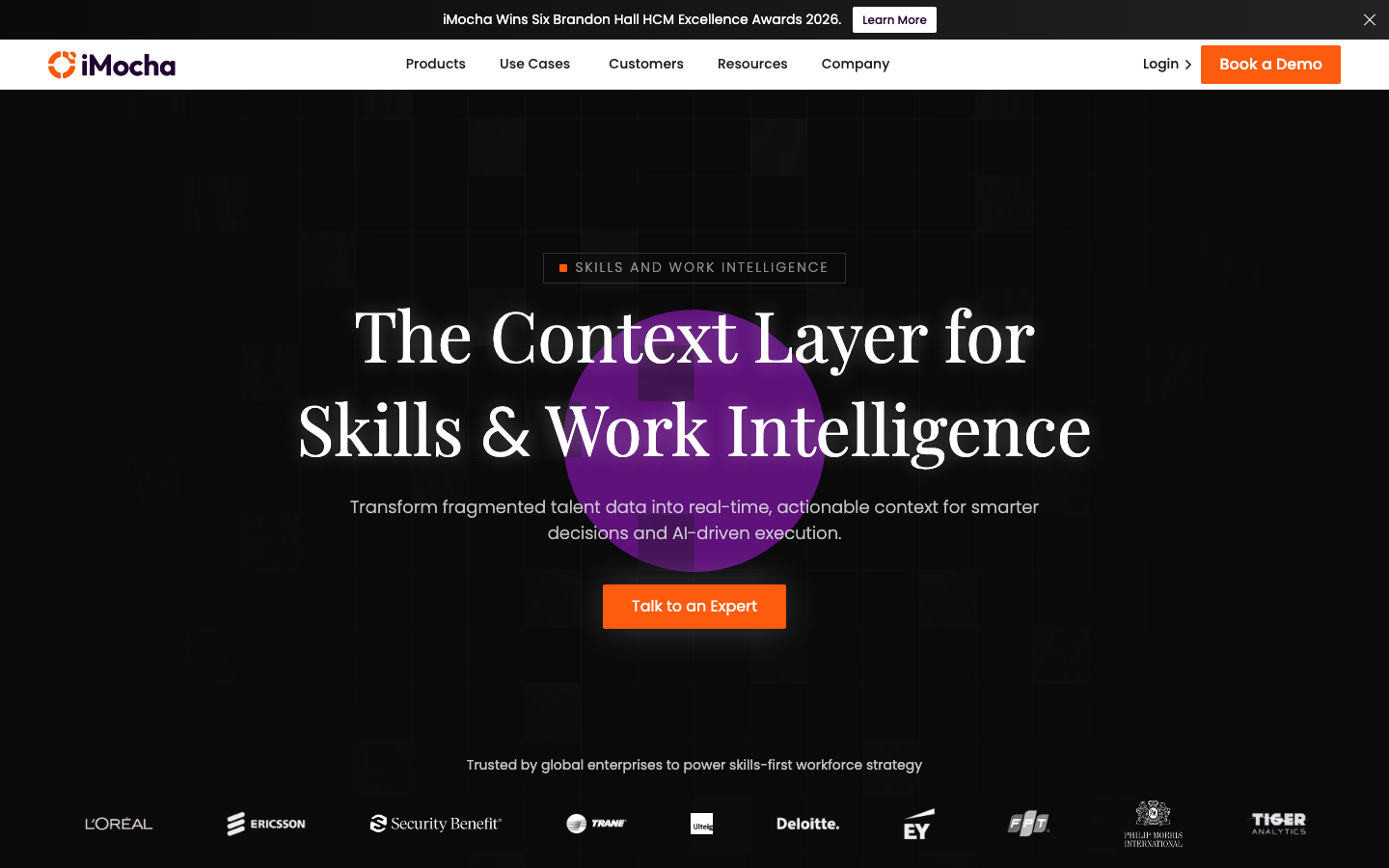
iMocha pulls the analytics lever from the skills side, mapping existing internal capabilities so people can be moved rather than lost. It reports on skills and internal mobility rather than scoring individuals for flight risk. The vendor states 300+ enterprise customers and a library of 10,000+ validated assessments.
Software Pros
- Skills visibility that turns a resignation into an internal move
- Assessment library deep enough to validate rather than assume skills
- Inference that keeps skill profiles current without constant surveys
Software Cons
- Reporting only, with no manager prompt when a gap appears
- Skills work needs an owner and a taxonomy before value appears
- Quote-based pricing aimed at enterprise procurement
iMocha Review
This is worth a demo when good people leave because they could not find their next role inside the company. That is an expensive and entirely preventable category of loss, and it shows up in exit interviews constantly. The catch is that someone has to actively maintain skills data. An organization unwilling to fund that upkeep gets a snapshot that ages badly within a year.
Our Verdict
Skills Before Resignations
Peoplelogic
Quick Overview
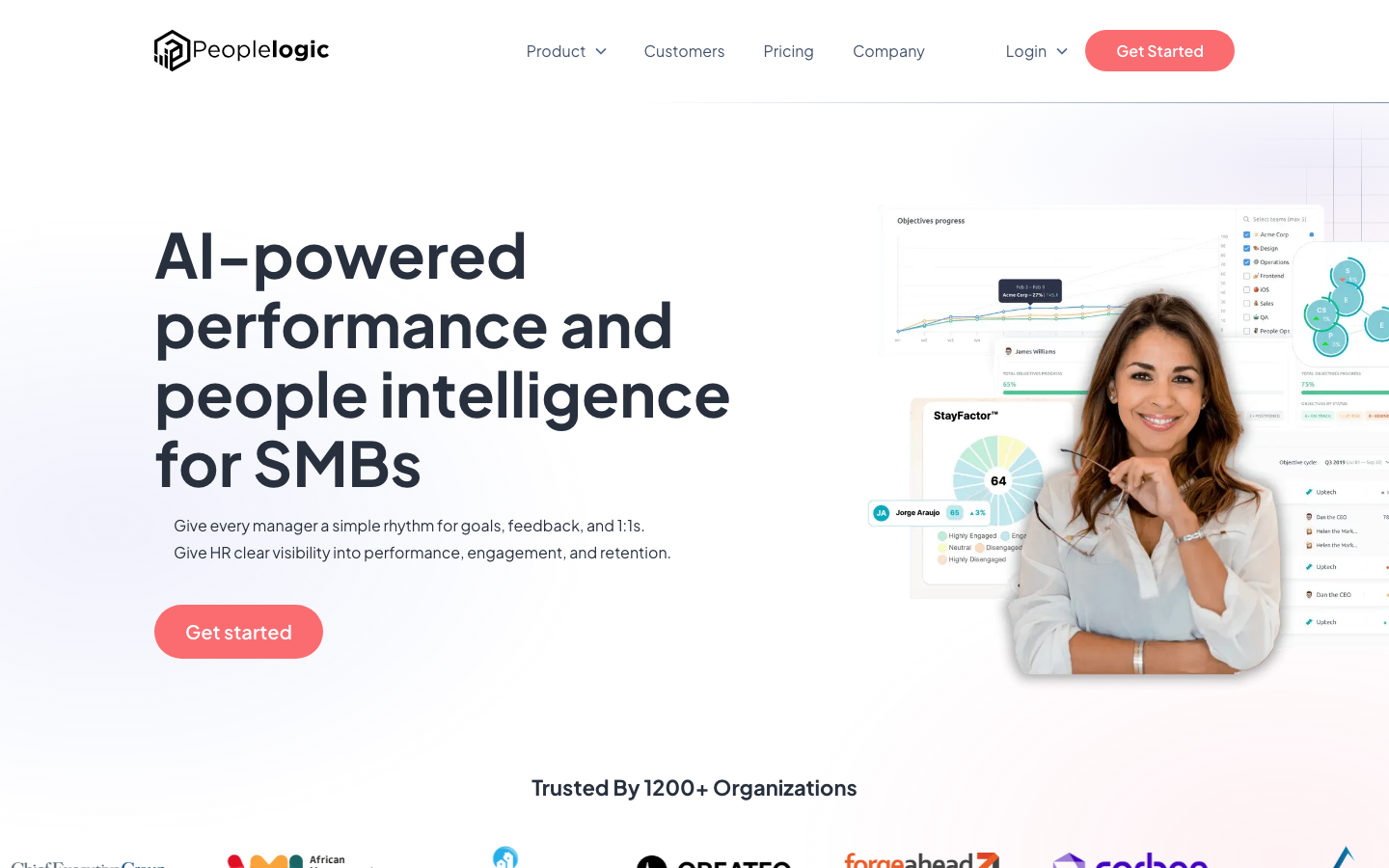
Peoplelogic pulls the analytics lever by reading signals from the systems people already use, surfacing disengagement early and prompting managers to act. It publishes pricing from $3,588 per year, and the vendor states 1,200+ organizations use it across performance, goals, and 1-to-1 tooling.
Software Pros
- Early signals without waiting for the next survey cycle
- Manager prompts attached to the signal rather than a dashboard alone
- Published annual pricing, which almost nobody else here offers
Software Cons
- 28 G2 reviews, too thin a sample to read as evidence
- Signal quality depends on how much work actually happens in connected tools
- Mid-market focus means less depth for a 10,000-person program
Peoplelogic Review
This is worth a demo when resignations keep arriving as complete surprises to everybody involved. Peoplelogic is built around the gap between the last survey and the notice period. It puts the prompt where a manager will actually see it. A company whose work happens mostly outside connected systems gives the model little to read, and the signal thins out.
Our Verdict
Early Warning For Managers
*As pricing is subject to change, we are listing prices as they stand in September 2026
Tango Card
Quick Overview
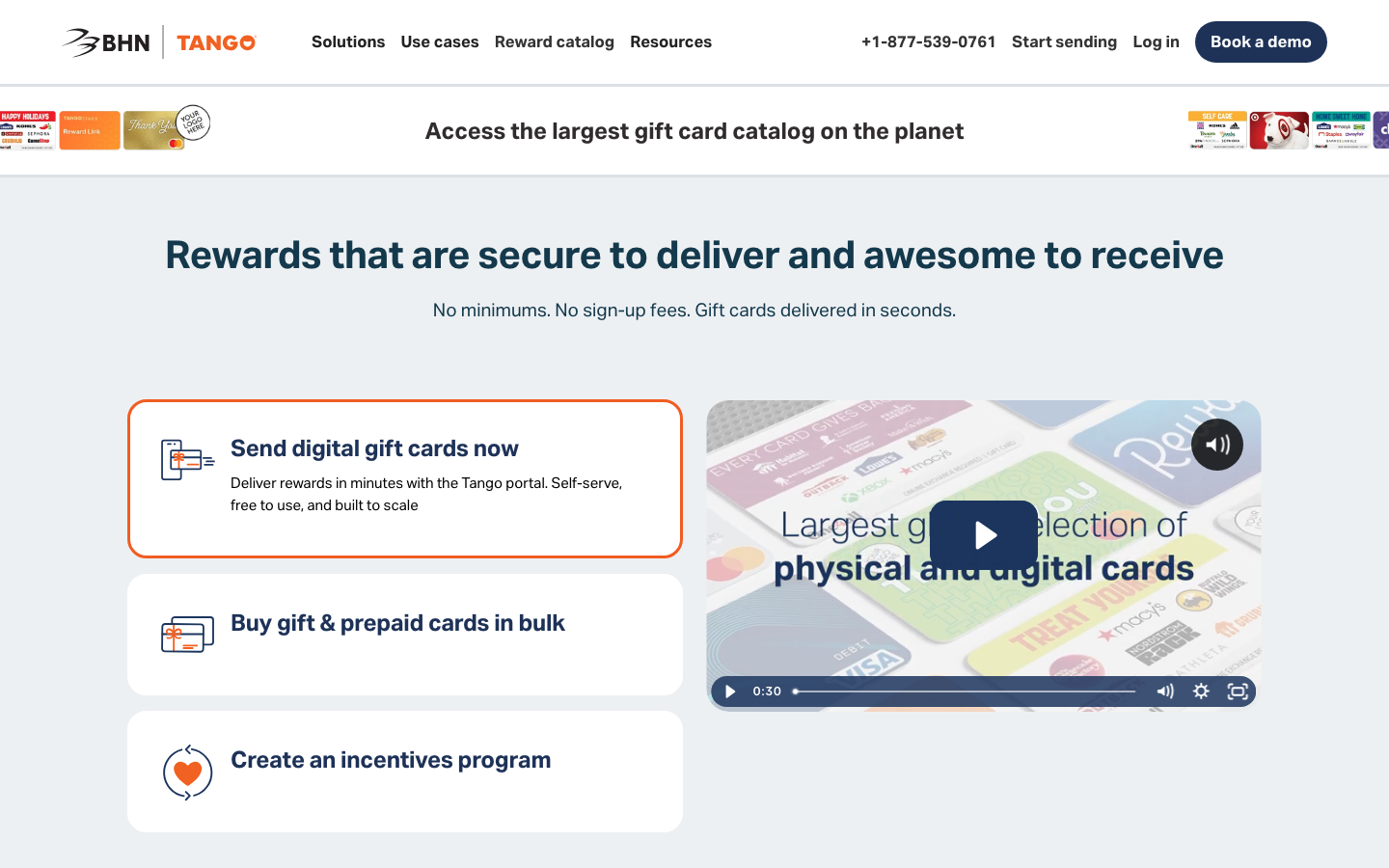
Tango Card, part of Blackhawk Network, supplies the rewards layer rather than a retention program. It sends digital gift cards and incentives through an API or a self-serve portal. It does not run recognition or measure anything about turnover. The vendor states a catalog of 3,100+ cards redeemable in 200+ countries and 50+ currencies.
Software Pros
- Reward delivery in seconds across 200+ countries, per the vendor
- No minimums or sign-up fees, since you fund the rewards themselves
- API access for teams embedding rewards into their own workflows
Software Cons
- Not a program platform, so you need something else on top of it
- No recognition mechanics, reporting, or retention measurement
- Value depends entirely on the program somebody else is running
Tango Card Review
The honest case here is narrow, and it is worth stating plainly before anybody books a call. If you already run recognition through a spreadsheet or your own tooling and simply need rewards to arrive reliably, this is the cheapest sensible answer. Anybody expecting it to shape behavior or report on retention has misunderstood the purchase, and will be disappointed quickly.
Our Verdict
Rewards Layer, Nothing More
Together Platform
Quick Overview
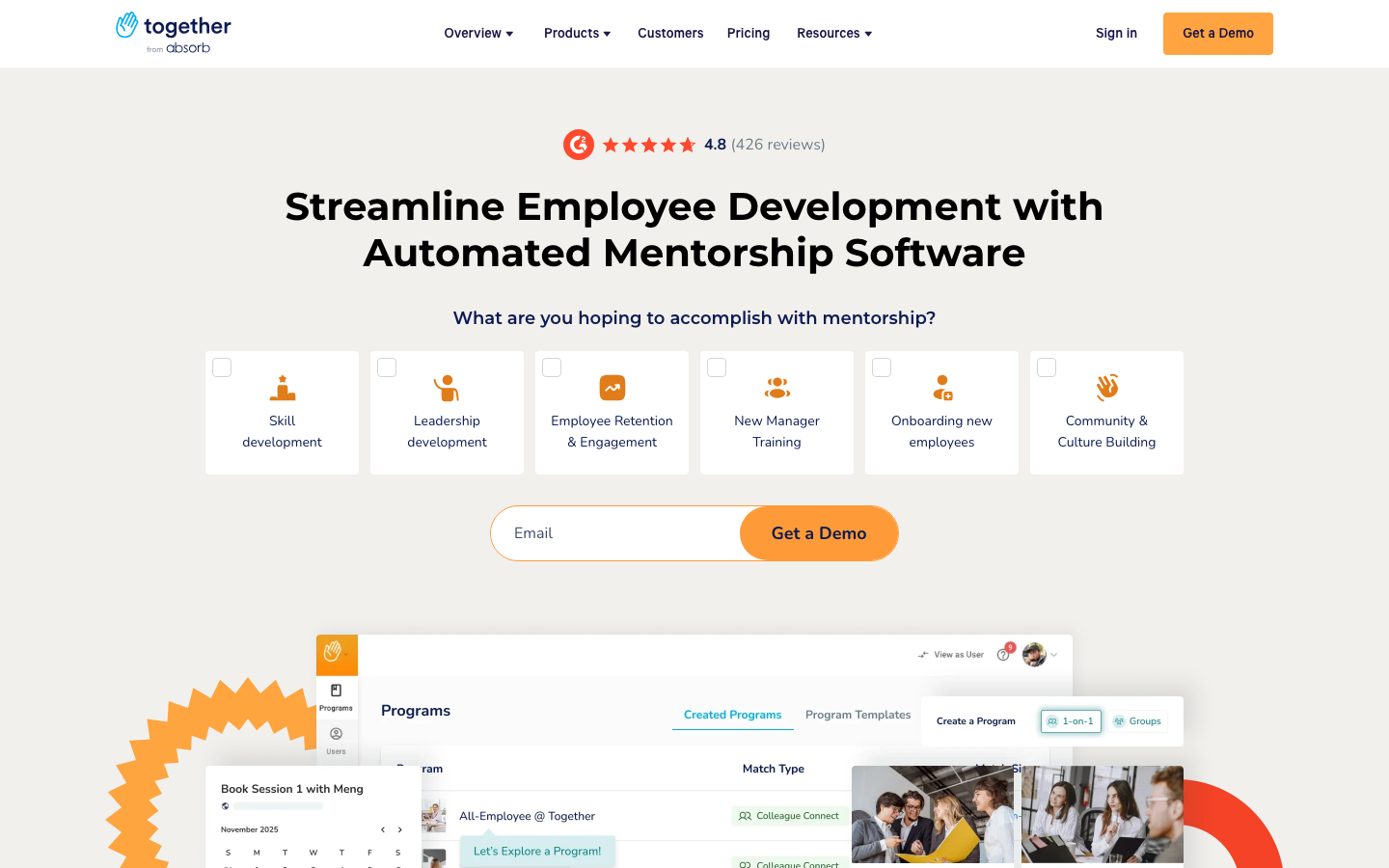
Together Platform pulls the development lever through mentorship, employee pairing, structured programs, and reporting on engagement and progression. The vendor says 98% of employees who use it are satisfied with their mentor match. It also cites a customer lifting program engagement from 3% to 46%.
Software Pros
- Matching quality that the vendor measures and publishes
- Colleague connections and coffee chats beside formal mentorship
- Multi-language support and Microsoft Teams integration for rollout
Software Cons
- Participation still depends on internal promotion after launch
- Mentoring addresses growth, not pay or a difficult manager
- Quote-based pricing with no figure published anywhere
Together Platform Review
I would put this in front of a company where people say there is nowhere to go next. Mentoring is the cheapest credible answer. Matching quality is the whole product, since a bad pairing kills a program faster than no program at all. An organization sitting on an unresolved pay problem will watch none of this land, no matter how good the matching is.
Our Verdict
Matching That People Keep
Worklytics
Quick Overview
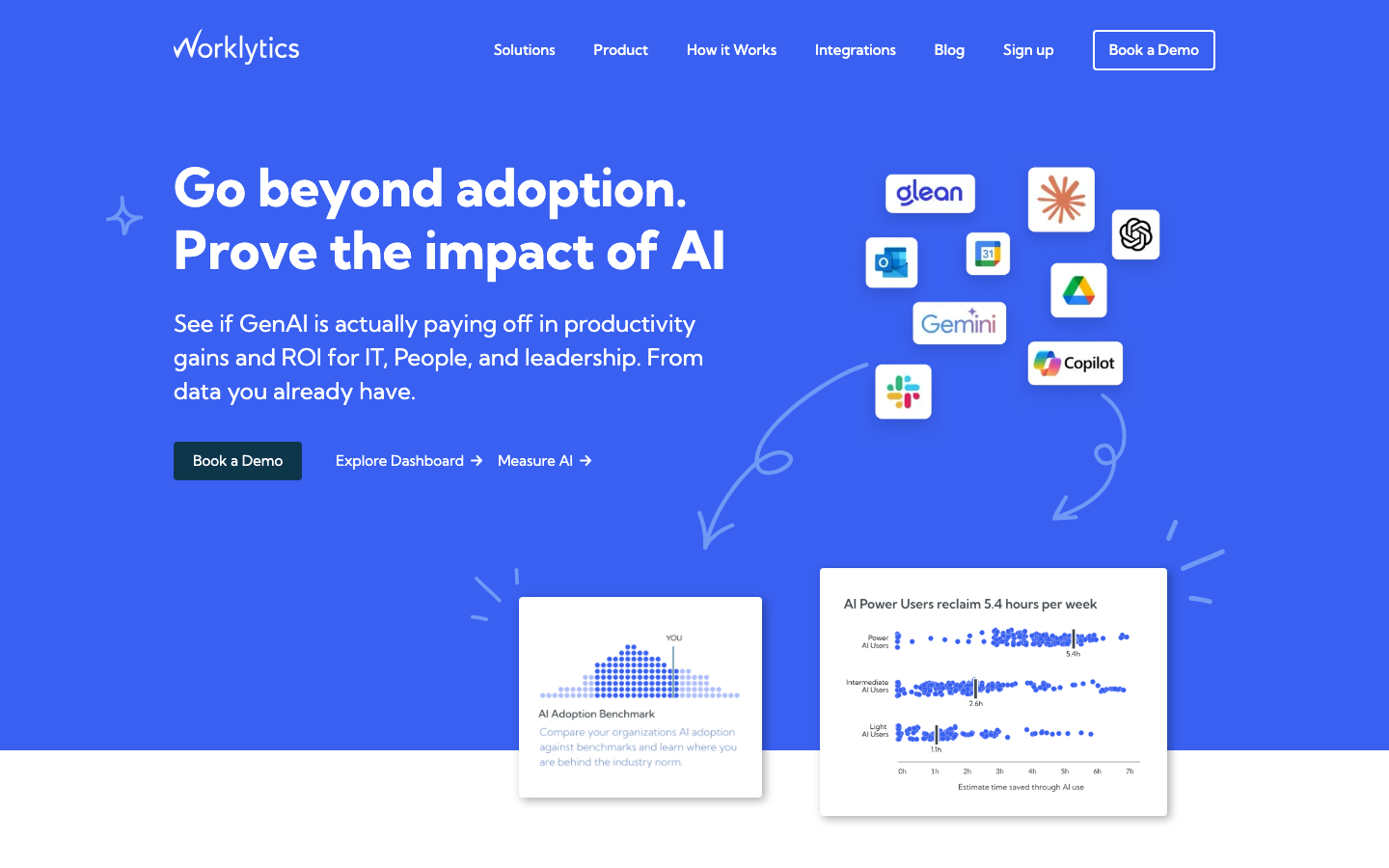
Worklytics pulls the analytics lever using collaboration and work-pattern data, surfacing burnout, isolation, and manager-load signals that tend to precede attrition. Its documented use cases cover burnout and wellbeing, manager effectiveness, and hybrid work patterns. It publishes a free tier with the Business plan starting at $2,500 per month.
Software Pros
- Signals from behavior rather than from what people say in surveys
- Manager-load analysis, which surfaces the overloaded team before it breaks
- A published price and a free tier, rare among analytics platforms
Software Cons
- Analyzing work patterns is unacceptable in some organizations, and staff may reasonably object
- Reporting only, with no manager workflow attached to the finding
- No aggregate G2 score, so there is no public peer signal
Worklytics Review
The honest case here is that behavioral data sees things surveys miss, and that not every company should collect it. Meeting load and after-hours patterns predict burnout considerably better than a quarterly engagement score does. Settle the privacy conversation with employees and their representatives before you switch anything on. Doing it afterward costs more trust than the insight ever returns.
Our Verdict
Work Patterns As Signal
WorkTango
Quick Overview
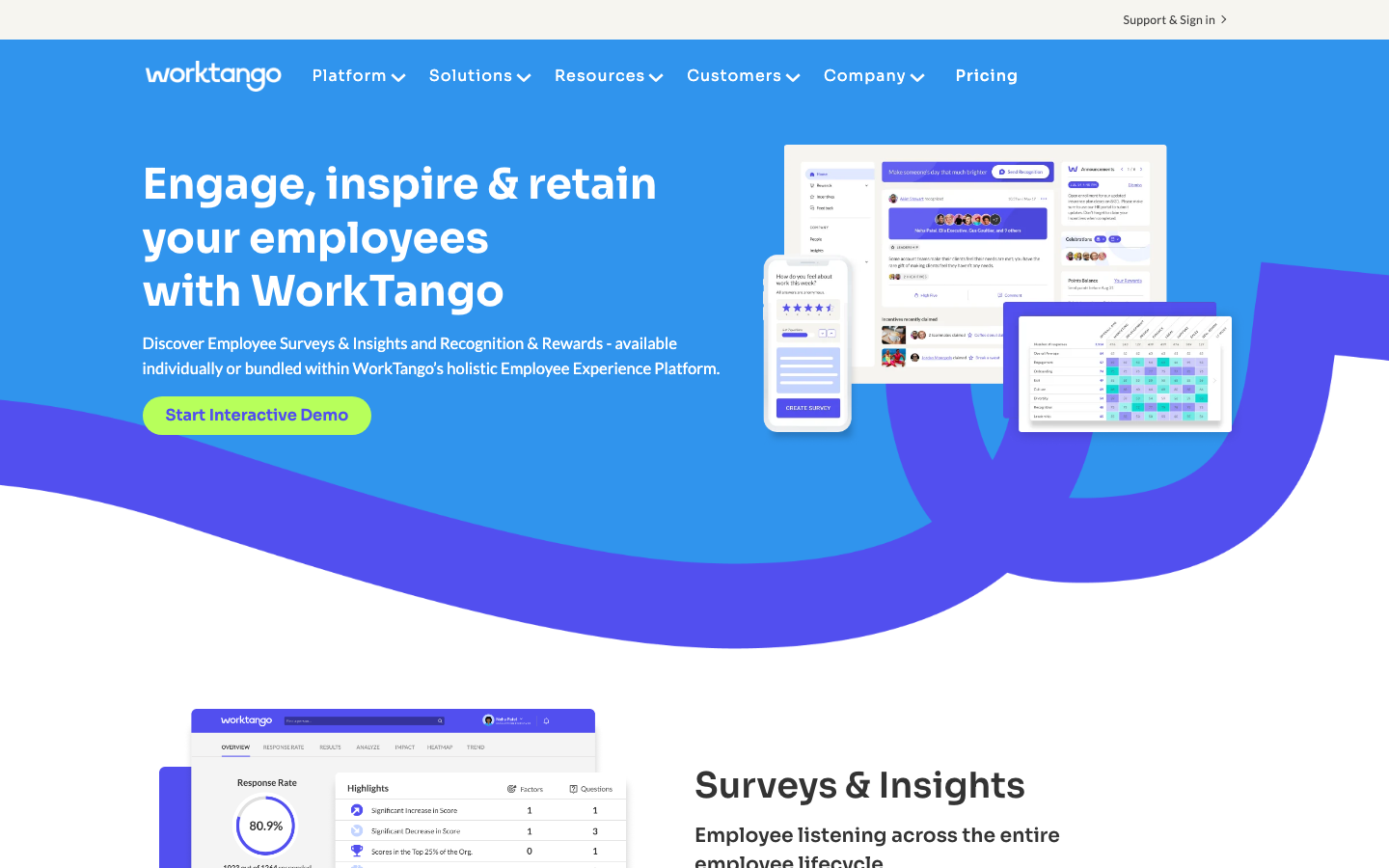
WorkTango pulls the recognition lever with listening attached, combining recognition and rewards with surveys and insights in a single employee experience platform. The pairing matters for retention because the sentiment data and the recognition record sit in the same system. The vendor documents unlimited surveys and recommended action plans for leaders.
Software Pros
- Recognition and sentiment data in 1 system rather than 2 contracts
- Recommended action plans that convert survey results into manager steps
- Automated service awards and milestone celebrations with cost controls
Software Cons
- The rewards budget sits on top of the platform fee, as it does everywhere here
- Breadth means less depth than a dedicated listening platform offers
- Adoption depends on managers running the action plans they are handed
WorkTango Review
Where this earns its place is with companies tired of correlating 2 separate systems by hand. Seeing that recognition dried up in the same quarter engagement fell is a genuinely useful connection. Very few platforms make it visible. A team that already owns a strong survey tool ends up paying twice for the listening half of this platform.
Our Verdict
Recognition Plus Listening Data
Xoxoday Empuls
Quick Overview
Xoxoday Empuls, the employee platform marketed by Xoxoday, pulls the recognition lever with perks and surveys attached. It targets mid-market teams that want appreciation, benefits, and listening on 1 contract. Its reward and perks catalog reflects Xoxoday’s wider rewards infrastructure, with particular depth across Asia and EMEA.
Software Pros
- Recognition, perks, and surveys bundled rather than bought separately
- Reward coverage that suits distributed teams across Asia and EMEA
- Communication features that carry the program to people directly
Software Cons
- The perks and rewards budget is funded separately from the license
- Its G2 profile covers the wider Xoxoday platform, not Empuls alone
- Breadth costs depth against specialists in each of the 3 areas
Xoxoday Empuls Review
My read is that it suits companies whose people are spread across markets where Western reward catalogs are useless. Regional reward depth is the real differentiator here, and it matters more to those teams than another feature comparison. A US-only team will find equally good bundles closer to home, with rather fewer currency questions to answer.
Our Verdict
Recognition Perks And Surveys
FAQs About Employee Retention Software
What does employee retention software do?
It acts on 1 of the reasons people leave. Some platforms make contribution visible and fund the rewards behind it, while others surface who is disengaging before the resignation lands. A third group offers mentoring, coaching, and a route into another role internally. None of them retains anybody on its own, because that behavior is a management job rather than a software one.
Does it actually reduce turnover?
Vendors publish figures suggesting it does, and those figures belong to the companies that published them. One platform reviewed here claims a 40% reduction among its own customers, which is the vendor’s research, not an independent finding. The outcome depends on whether managers act on what the tool surfaces. Most implementations fail at exactly that point, months after the launch email.
How much does it cost?
3 pricing shapes dominate this category, and only 1 of them is honest about the total. Recognition platforms charge per employee per month, with the company funding the rewards separately. Analytics platforms price per employee and quote at enterprise scale, while coaching is priced per coached person. Published rates here run from a free tier to $2,500 per month as of September 2026, and the reward budget rarely appears anywhere.
Can software predict which employees will leave?
Partly, though the useful version is rarely the one vendors demo. Models built on tenure, engagement scores, pay position, and work patterns describe groups reasonably well and individuals poorly. Group-level driver analysis tells you that attrition concentrates in a department or at a tenure point, which is genuinely actionable. Naming individuals as flight risks is statistically shakier, and it changes how managers treat the people on that list.
How is this different from engagement or recognition software?
The products overlap almost completely, and the difference is the question each is bought to answer. Recognition platforms are bought to make appreciation routine, and engagement platforms to measure how people feel. People buy them because they are walking out the door. Same feature lists and a completely different business case, and the framing decides which metrics anybody reports on 6 months later.
Should a small business buy retention software?
Usually not first, and the honest answer disappoints people who arrived with a purchase order. Below roughly 50 people, the lever is management attention, not a platform. The money goes further on market rates and on teaching 2 managers to run a real 1-to-1. If something is worth buying, start with the cheapest recognition tier or a rewards account you fund per send.
Who should own it internally?
HR usually buys it, and managers make it work, which is exactly where most programs come apart. Name 1 owner in HR who is accountable for adoption and for reporting, and make the manager expectation explicit rather than optional. An unowned platform goes quiet within 2 quarters and renews once because nobody reviewed it. It gets canceled the year after that, usually somewhere in a routine spending review.
What is employee knowledge retention software?
That is a different category with a confusingly similar name. It means capturing what somebody knows before they walk out, through documentation, process records, and searchable institutional memory that outlives them. The work belongs to knowledge management rather than to retention, and none of the 12 platforms reviewed on this page does any of it. If the worry is losing expertise rather than losing people, then that is the shelf to shop on instead.

Helen is Anywherer’s Market Analyst & Content Researcher, with extensive experience in analyzing global employment markets and HR technology trends. She is skilled at turning complex market data into clear, well-researched insights that inform every piece of content. With a strong grasp of the EOR, PEO, and international hiring space, Helen plays a key role in keeping Anywherer’s research accurate, up to date, and genuinely useful for readers.