A mentoring program is a structured arrangement in which experienced people share what they know with less experienced colleagues. It runs over an agreed period, with goals and a planned end date. The classic format is one-to-one, but it is not the only one. Group mentoring puts 1 mentor with several mentees at once. Peer mentoring pairs colleagues at the same level, and reverse mentoring has a junior employee teach a senior one, often about technology or inclusion.
Flash mentoring is a single short conversation with no long commitment, which suits busy senior staff. Programs usually serve a defined audience, such as new hires, early-career talent, or an ERG. An ERG is an employee resource group built around a shared identity or interest. The program administrator keeps everything moving. They recruit participants, approve matches, and follow up with pairs that quietly stop meeting.
Which Mentoring Software Is the Best in 2026?
Mentoring software handles a program’s logistics so people involved can focus on the conversations. It enrolls mentors and mentees, suggests matches, schedules sessions, and reports who is actually meeting. For HR, L&D, and talent leads launching a first program or scaling several, picking the best mentoring software matters most. DEI and early-career program owners face the same choice, and so do staff at industry associations who run mentoring for members rather than employees.
Formal mentoring is now common. ATD released its Mentoring for Success research in January 2023. It found that 48% of surveyed organizations had a formal program, and 42% of the rest planned to add one. Mentoring has become a standard way to keep people, next to the tools in our guide to employee retention software. The hard part is follow-through. Most programs start with an energetic kickoff and then lose pairs by the third meeting, when software has to earn its fee.

INSIGHT: Does workplace mentoring actually make a difference?

Mentoring helps when pairs keep meeting, and most programs lose pairs in the first few months.
- In ATD’s 2023 report, more than 40% of organizations with programs rated them highly or very highly successful at meeting their goals. The top challenges were a lack of metrics (56%) and difficulty finding mentors (47%).
- LinkedIn’s Workplace Learning Report 2025 found that 88% of organizations are concerned about employee retention. Providing learning opportunities is their No. 1 retention strategy.
- A match made in January and never followed up on is not a mentoring program.
Sources:
both read October 2026
No single platform suits every program; size and support needs determine the fit. Self-serve platforms let an HR team launch and run a program on its own. Enterprise platforms run many programs across large workforces with HRIS sync and impact reporting. Program services and association platforms add design help or member features. The need is real, according to LinkedIn’s Workplace Learning Report 2025. Only 15% of employees said a manager had helped them build a career plan in the past 6 months. So what is the best mentoring software for your organization? Below, I’ve reviewed 12 of the leading platforms in A-Z order.
INSIGHT: Self-serve, enterprise, or managed program?
The 12 platforms here fit 3 ways of running mentoring, and the right one depends on program size and how much help you want.
- Self-serve mentoring (Mentorloop, Mentornity, PushFar): launch and run a program in-house.
- Enterprise mentoring (Guider, Mentorink, People360, Qooper, Ten Thousand Coffees): many programs, integrations, and impact reporting.
- Program services and associations (Art of Mentoring, Higher Logic Mentor Match, MentorCity, Mentoring Complete): software with program design support or member features.
Mentoring Software Comparison
The table sorts the 12 by group, so a shortlist starts with how the program will be run rather than with a brand. Rows follow the same A-Z order as the reviews below. Prices are omitted here and collected in the pricing section, where each pricing unit can be properly compared.
| Tool | Group | Best for | Matching | Program types | G2 rating |
|---|---|---|---|---|---|
| Art of Mentoring | Program services and associations | Programs that need design and training | Configurable algorithm, admin-led | 1:1, group, peer, reverse | 4.5 (1) |
| Guider | Enterprise | Large employers running several programs | AI | 1:1 mentoring, coaching | 5.0 (29) |
| Higher Logic Mentor Match | Program services and associations | Associations already on Higher Logic | Self-select requests | 1:1 | 4.4 (435) |
| MentorCity | Program services and associations | Canadian organizations and member networks | Algorithm, self-directed | 1:1, group, peer | 4.2 (10) |
| Mentoring Complete | Program services and associations | Teams that want coaching with the platform | AI-powered algorithm (Precision Matching) | 1:1, group, self-directed | 4.4 (30) |
| Mentorink | Enterprise | Mid-size and large companies across regions | AI | 1:1, group | 4.6 (130) |
| Mentorloop | Self-serve | Companies launching a first program | Algorithm (Smart Match), admin, self-select | 1:1 | 4.4 (561) |
| Mentornity | Self-serve | Small companies and multilingual programs | Weighted rules, admin, self-select | 1:1, group | 5.0 (1) |
| People360 | Enterprise | Mentoring next to coaching and career programs | Algorithm, admin, self-select, hybrid | 1:1, audience-specific programs | 4.3 (2) |
| PushFar | Self-serve | UK and European companies and professional bodies | AI, admin, self-select | 1:1, coaching, buddying, sponsorship | 4.1 (12) |
| Qooper | Enterprise | Mid-size and large companies with several programs | AI, configurable rules | 1:1, group, peer | 4.6 (70) |
| Ten Thousand Coffees | Enterprise | Early-talent and career cohorts | Smart-matching algorithm | 1:1, peer, cohorts | 4.9 (32) |
G2 ratings were read in October, 2026.
Mentoring Software vs Coaching and Career Pathing Platforms
Mentoring pairs an employee with a more experienced colleague inside the same organization, usually for several months. The mentor shares what they have learned, and the mentee sets the agenda. Mentoring software matches the 2, keeps the program on schedule, and shows the program administrator which pairs have stopped meeting. Its matching algorithm, meaning the rules or model that score possible pairs, is the feature buyers compare most.
Career pathing platforms do a different job. They map roles, skills, and the internal moves between them, which is the territory of career pathing software. Coaching platforms pair employees with trained external coaches or AI coaches and usually charge per seat. A coach is trained to help someone reach their own answers, while a mentor mostly shares experience.
The categories work best together. A career path shows where someone wants to go, and a mentor shows how people actually got there. Several vendors here sell mentoring and coaching in 1 platform, including Guider and People360, which can save a second contract. If the main need is paid external coaching, though, a mentoring platform will feel thin.
Which Software Offers the Best AI Mentoring?
AI in this category mostly helps admins match people and prompt them. Mentorloop’s Smart Match reads free-text goals, and its Match Rationale explains why 2 people were paired. Guider, Mentorink, PushFar, and Qooper also offer AI matching. Mentorloop’s Smart Nudges and Meeting Agendas prompt pairs between sessions, while Mentorloop and Mentornity draft survey summaries and impact reports. Qooper AI Coach adds on-demand coaching between human sessions.
Not everything that sounds smart is AI. Ten Thousand Coffees calls its matching a smart-matching algorithm, and Mentornity scores pairs with weighted rules. Both work well, and neither is sold as AI. AI coaches that run without a human mentor are a separate category, closer to AI talent management software than to a mentoring program.
The limit is simple. AI can suggest who should meet, but it cannot make a pair keep meeting. Admins should be able to review and override every match, especially in inclusion programs where a poor pairing does real harm. Mentorloop says every AI suggestion goes through the program team for review, and Mentornity asks for approval before each change.
Plans matter as well. Mentornity AI runs on credits an organization adds, and Mentorloop limits its improved Smart Match to Enterprise. The strongest AI for you depends on whether you want help with matching, coaching, or admin work.
Best Mentoring Software by Program Type
These groupings follow the type of program, not a score. Tools appear in A-Z order inside each group, and a platform named twice is broad rather than better. Program size decides a lot. A 60-person startup piloting 10 pairs and a bank running 6 programs across 4 continents both need mentoring software. They need very different amounts of integration, reporting, and outside help.
Best Mentoring Software for Small and Mid-Sized Companies
A first program should be running in weeks, not quarters. Mentorloop lets a team build a program for free, without a credit card, and offers program themes so HR does not design every step. Mentornity is free for up to 10 users with every feature, which covers a genuine pilot. PushFar adds program templates and lets admins choose AI, manual, or self-select matching. All 3 suit a company where 1 HR generalist runs mentoring alongside other work. In that setting, automated reminders matter more than enterprise features.
Best Enterprise Mentoring Software for Large Companies
Large companies run many programs at once, so HRIS sync, single sign-on (SSO), and reporting tied to retention matter most. Guider combines AI matching with mentoring and coaching programs for big employers. People360 lets each program target its own audience with separate matching criteria. Qooper connects to Workday, UKG, HiBob, Slack, and Microsoft Teams and tracks relationship health across programs. Ten Thousand Coffees includes a retention and promotion analysis in each plan, which helps when leadership asks whether mentoring moved anyone up. Expect quote-only pricing and a setup measured in weeks.
Best Group Mentoring Software
Group mentoring reaches more people than one-to-one pairs, because a single mentor can support several mentees at once. MentorCity lets program administrators create groups with several mentors and mentees, with group discussions and scheduling. Mentorink supports group sessions alongside 1:1 mentoring and adapts workflows by team or region. Mentornity runs group mentoring next to one-to-one matches on every plan, the free one included. Ten Thousand Coffees builds cohort programs that combine 1:1 mentoring with peer learning. Groups work best with a clear agenda and a fixed end date.
Best Mentoring Software for Industry Associations and Professional Bodies
Associations match members from different employers, so a program can’t rely on an HRIS. Art of Mentoring serves associations and government and can run the whole program for staff who lack the time. Higher Logic Mentor Match lives inside the Higher Logic Thrive community, so members enroll and request mentors where they already engage. MentorCity works with associations and nonprofits through self-directed matching, and Mentoring Complete lists professional associations among its use cases. For most member organizations, mentoring is a member benefit, so enrollment and reporting matter as much as matching.
For Remote and Global Teams
Distributed teams need matching across offices and time zones, plus scheduling that handles the conversion for people. Mentorloop’s calendar integration shows each person’s availability, and it offers data residency in Australia, the United Kingdom, and the United States. Mentornity lets mentees book in their own time zone, adds Zoom, Google Meet, and Teams links, and shows the interface in each participant’s language. Qooper is available in 30+ languages and connects to Slack and Microsoft Teams. The rest of a distributed team’s stack is covered in our guide to remote work tools.
How Much Does Mentoring Software Cost?
Pricing units vary more in this category than features do. Mentorloop and Mentornity price monthly plans by active participants, and Mentoring Complete prices annual plans by the number of matches. Guider, People360, Qooper, and Ten Thousand Coffees quote enterprise contracts sized by learners, programs, or employees with access. Higher Logic Mentor Match is an add-on to a wider community platform. The point most buyers miss is that time is the highest cost. The program owner and every mentor give hours each month, so reporting and automation that save admin work matter more than a small price gap.
| Tool | Pricing model | Free plan or trial | Published starting price |
|---|---|---|---|
| Art of Mentoring | Quote | Demo | Custom pricing |
| Guider | Custom proposal | Not stated | Custom pricing |
| Higher Logic Mentor Match | Add-on to Higher Logic Thrive | Demo | Custom pricing |
| MentorCity | Standard and Enterprise quotes | Free demo | Custom pricing |
| Mentoring Complete | Annual plans by number of matches | Not stated | $5,000/year minimum for 25 matches |
| Mentorink | Quote | Not stated | Custom pricing |
| Mentorloop | Pro and Enterprise plans | Free build, no card | From $299/month (Pro) |
| Mentornity | Monthly plans by active users | Free plan up to 10 users | $289/month for 50 active users ($260 billed yearly) |
| People360 | Quote | Not stated | Custom pricing |
| PushFar | Quote | Not stated | Custom pricing |
| Qooper | Quote by program scope | Not stated | Custom pricing |
| Ten Thousand Coffees | Plans by employees with access | Not stated | Custom pricing |
As pricing is subject to change, prices are listed as they stand in October 2026.
INSIGHT: What does mentoring software actually cost?
Most vendors quote a price, but the real cost is the time people spend running the program.
- 3 of the 12 publish a starting price (Mentoring Complete, Mentorloop, Mentornity), 1 runs a free plan (Mentornity), and 9 quote only.
- Mentorloop and Mentornity price by active participants, and Mentoring Complete by matches. Ten Thousand Coffees is priced by employees with access, and Higher Logic Mentor Match is a platform add-on.
- Integrations and AI often sit on higher plans. Mentoring Complete keeps HRIS and SSO for its $25,000 Enterprise plan, and Mentornity prices SSO separately.
How to Choose Mentoring Software
I would define the program goal before opening any demo. Onboarding, early talent, leadership, and inclusion programs match people on different criteria, so the goal decides who gets paired with whom. Next, decide how matching should work, whether by algorithm, AI, admin choice, or self-selection, and confirm admins can review matches before they go out. Check program types beyond one-to-one, since group, reverse, and peer formats often arrive in year 2. Then confirm HRIS sync and SSO, and which plan includes them.
Find out where people will actually meet, whether in Slack, Microsoft Teams, a video link, or a shared calendar. Look at the reports you will need to show leadership, such as meeting frequency, feedback, and retention. Ask who will run the program week to week, because a program without an owner fades on any platform. Finally, check whether mentoring should connect to your employee training software, so mentors can point mentees to courses in the same flow. A pilot of 10 to 20 pairs will tell you more than any feature list.
Top 12 Best Mentoring Software Platforms in 2026
I built each review from the vendor’s product, documentation, and pricing pages, read in October 2026. I pulled G2 ratings from each product profile on October 28, 2026, and labeled vendor numbers as vendor claims. The list runs from self-serve platforms like Mentorloop and Mentornity to enterprise tools like Guider and Qooper and association platforms like Higher Logic. Each block says how matching works, which program types are supported, and who has to run the program. These software tools for mentoring programs differ most on that last point, so read it closely.
I’m listing all providers in alphabetical order to keep this comparison neutral.
Art of Mentoring
Quick Overview
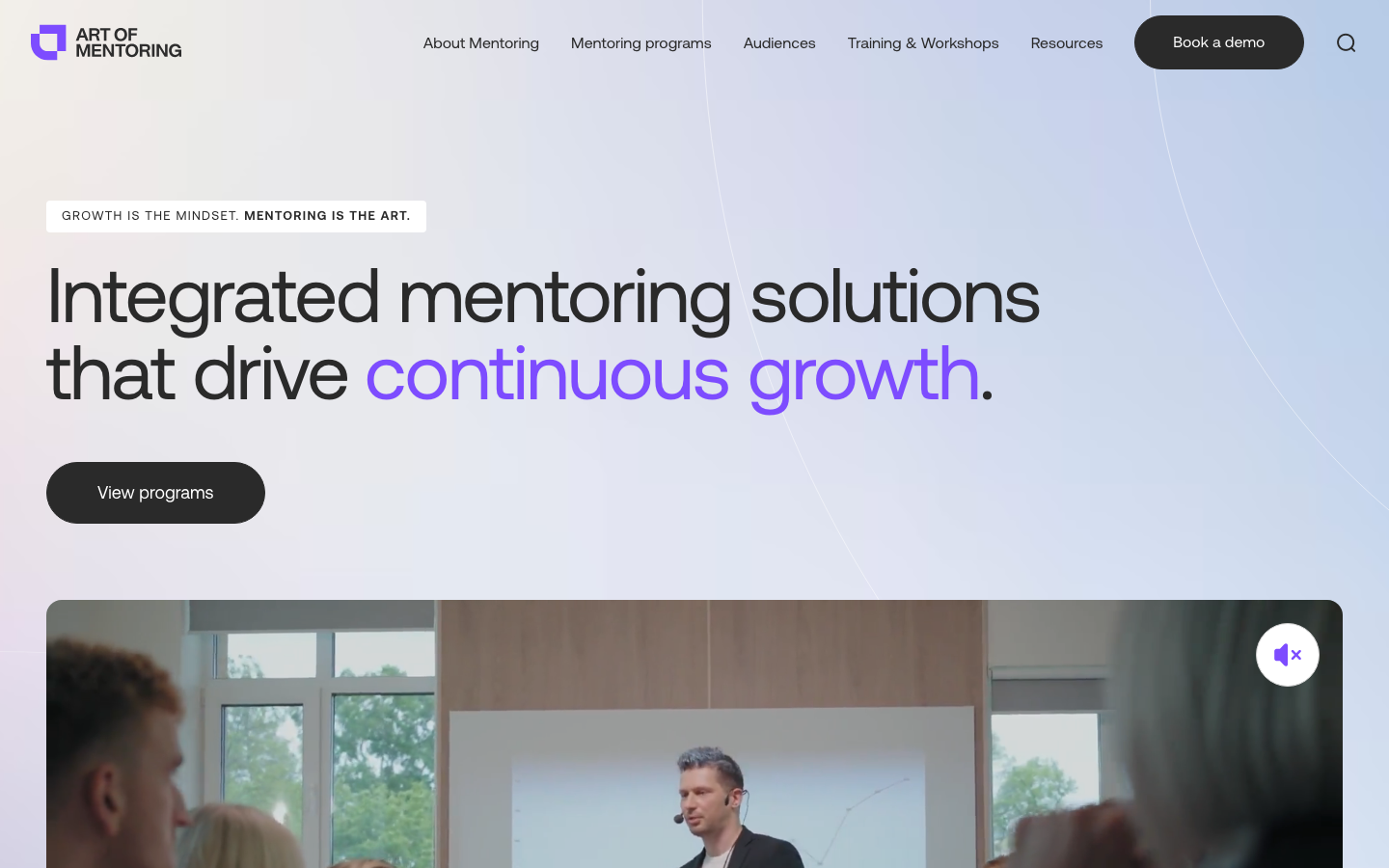
Art of Mentoring is a program services provider whose platform matches pairs with a configurable, evidence-based algorithm and supports 1:1, peer, reverse, and group mentoring. It can run your program fully, train your team to run it, or support a hybrid model. The platform is ISO 27001 certified, and the company has offices in Sydney and Austin.
Software Pros
- Fully managed, self-run, or hybrid delivery
- Mentor and mentee training built into programs
- Weighted matching tuned to each program’s goals
Software Cons
- Pricing is quote-only
- No AI feature named
- 1 G2 review, too few to judge
Art of Mentoring Review
I’d recommend this to an association, government body, or corporate team that wants expert program design as much as software. Admins configure matching criteria and weights, and reporting supports stakeholder updates. The managed option means Art of Mentoring staff can carry the week-to-week work. Teams that prefer to run everything themselves may end up paying for support they never use.
Our Verdict
Managed Programs With Expert Design
Guider
Quick Overview
Guider is an enterprise mentoring platform that uses AI matching to connect colleagues for mentoring and coaching. It adds ready-made programs on leadership, DEI, and career topics. Thrive acquired it in July 2025 and said in its announcement that Guider would continue operating as a standalone product.
Software Pros
- AI matching that connects people with real mentors and coaches
- Mentoring and coaching run from 1 platform
- Ready-made programs cut preparation time
Software Cons
- Pricing is by custom proposal
- Built for large companies, heavy for small teams
- 29 G2 reviews, a thin sample
Guider Review
This program suits a large employer running leadership, inclusion, and career programs at the same time. AI matching proposes pairs, and people still decide whether the relationship works. Thrive’s ownership points toward tighter links with its learning platform, which may appeal to Thrive customers. Each program still needs an internal owner to recruit mentors and keep pairs meeting.
Our Verdict
AI Matching for Large Employers
Higher Logic Mentor Match
Quick Overview
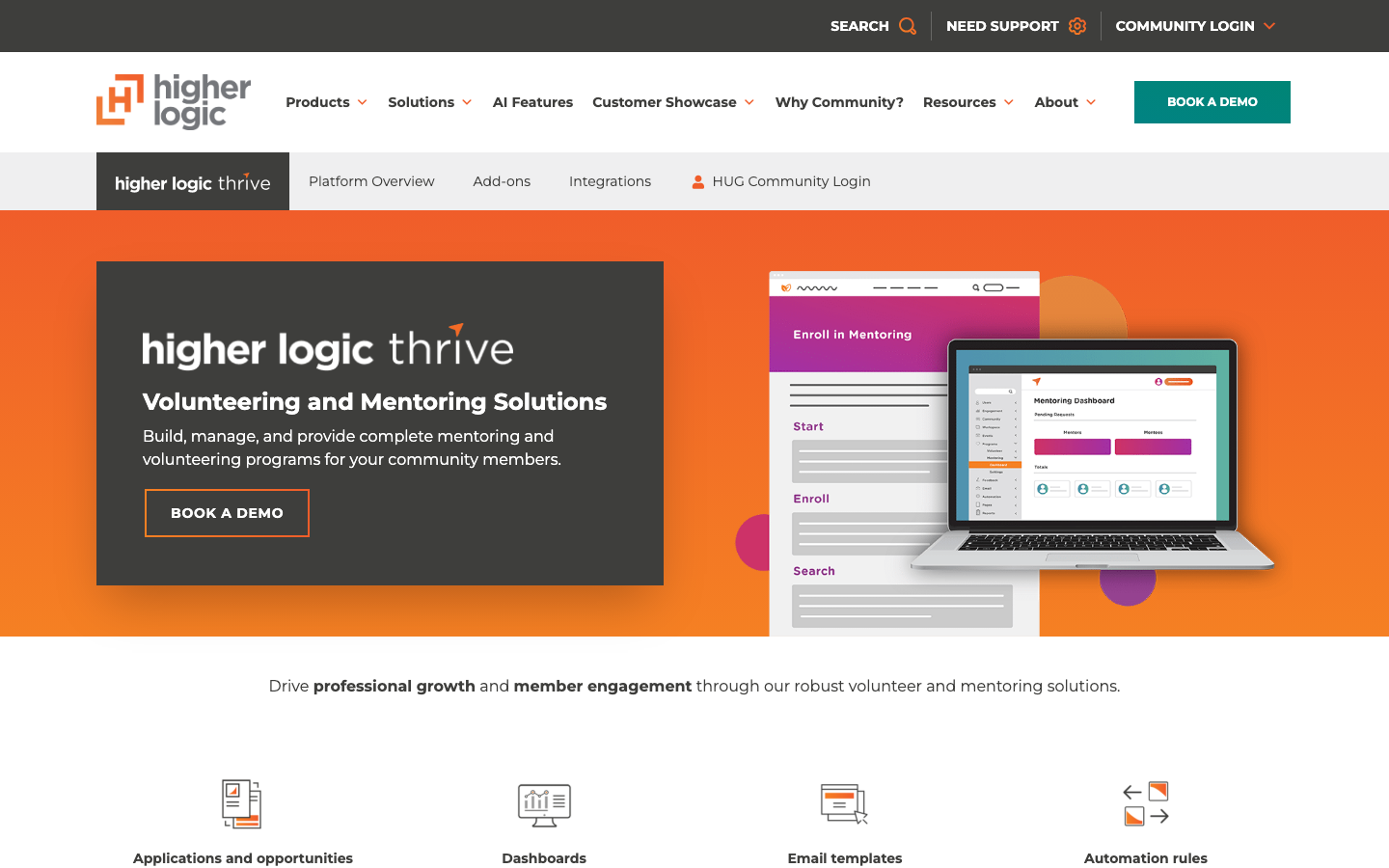
Higher Logic Mentor Match is an association module for the Higher Logic Thrive community platform. Members enroll as mentor, mentee, or both and request a 1:1 relationship with another enrolled member. Admins set each program’s timeframe and capacity. It names no mentoring-specific AI feature.
Software Pros
- Members match themselves through requests
- Runs inside the community members already use
- Pairs with Volunteer Manager for wider engagement
Software Cons
- Requires the Higher Logic Thrive platform
- Pricing is quote-only
- G2 rates the whole Thrive platform, not the module
Higher Logic Mentor Match Review
In practice, Mentor Match makes sense only for an association already on Higher Logic Thrive. Matching is member-driven: people find enrolled users and send requests, while admins set capacity and timeframes. That keeps staff effort low, but leaves match quality to members’ choices. Dashboards, email templates, and automation rules sit alongside the module, so a small member services team can run it without extra tools.
Our Verdict
Member Mentoring Inside Thrive
MentorCity
Quick Overview
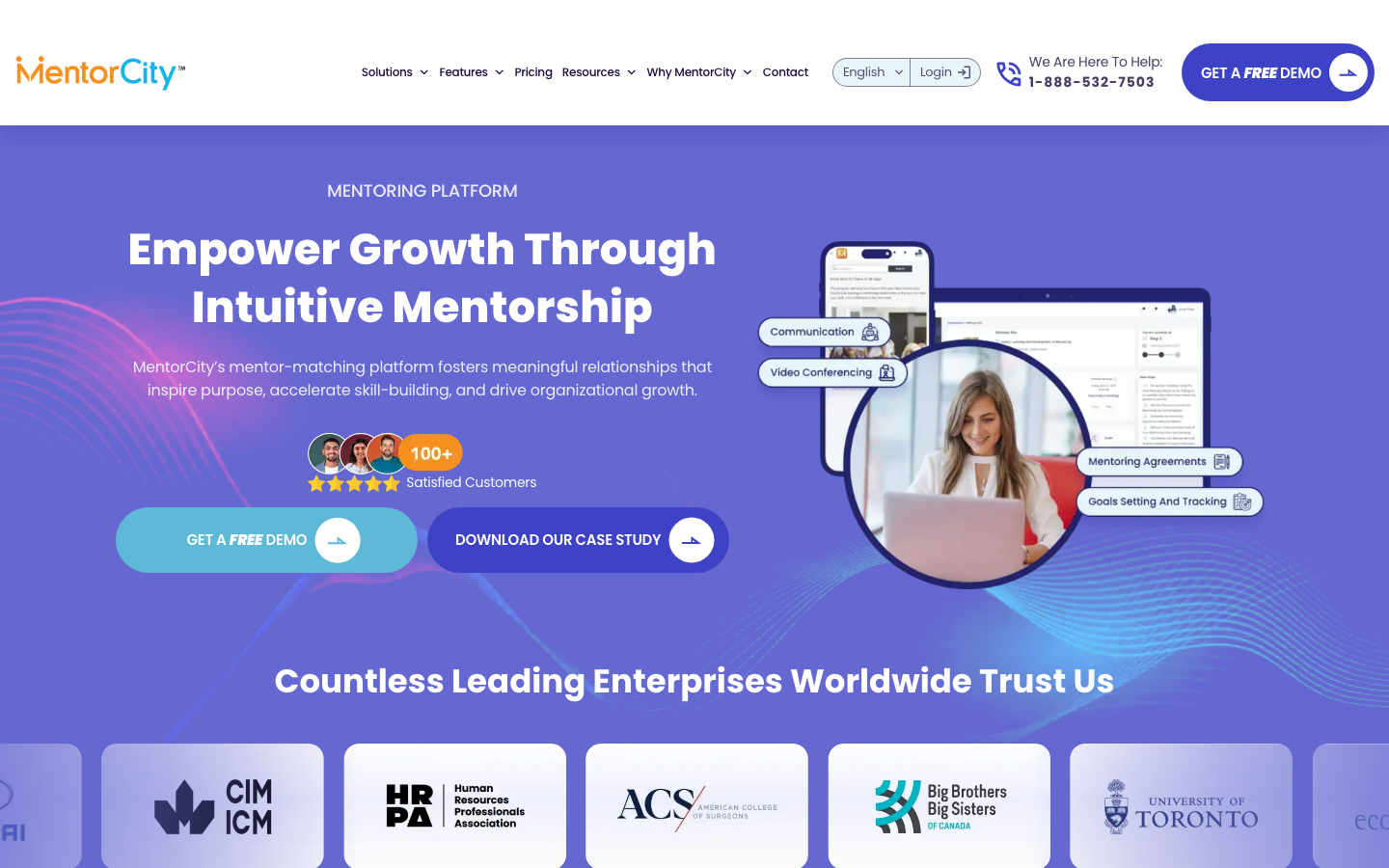
MentorCity is a Canadian program services and association platform that offers algorithm-based and self-directed matching, plus group mentoring for organizations, associations, and nonprofits. It adds video calls with AI note-taking, goals, and mentoring agreements. Its features page claims a 95% satisfaction rate for its matching algorithm.
Software Pros
- Self-directed matching cuts admin time
- Built-in video calls with AI note-taking
- Group mentoring included on the Standard plan
Software Cons
- Pricing is by quote on both plans
- SSO and custom integrations need Enterprise
- 10 G2 reviews, a thin sample
MentorCity Review
My view is that MentorCity fits member networks, nonprofits, and Canadian organizations that want a self-directed program with a dedicated account manager. Mentees can search for and request mentors, which reduces matching work for admins, and reporting covers program evaluation and surveys. A mobile app helps volunteers who rarely sit at a desk. Larger employers will want Enterprise for single sign-on and custom integrations.
Our Verdict
Self-Directed Programs for Networks
Mentoring Complete
Quick Overview
Mentoring Complete is a program services platform with Precision Matching, which it describes as an AI-powered algorithm, plus one-to-one, self-directed, and group programs. It pairs software with a success coach and courses through Mentoring University. The vendor claims a 90% success rate for its matches.
Software Pros
- Published annual prices by number of matches
- Matching questionnaire covers 5 key sections
- Mentoring University courses for mentors and admins
Software Cons
- The entry plan runs only 1 program in a 1:1 format
- HRIS and SSO sit on the $25,000 Enterprise plan
- Annual minimums are steep for a tiny pilot
Mentoring Complete Review
Here the strength is support. Mentoring Complete suits workplaces, universities, and associations that want a coach beside the software while they learn to run mentoring. Precision Matching starts at a $5,000 yearly minimum for 25 matches, Starter costs $10,000 a year with up to 3 programs, and Scale costs $15,000. Advanced reporting starts on Scale, so entry plans give admins basic reports only.
Our Verdict
Coached Programs With Clear Pricing
*As pricing is subject to change, we are listing prices as they stand in October 2026
Mentorink
Quick Overview
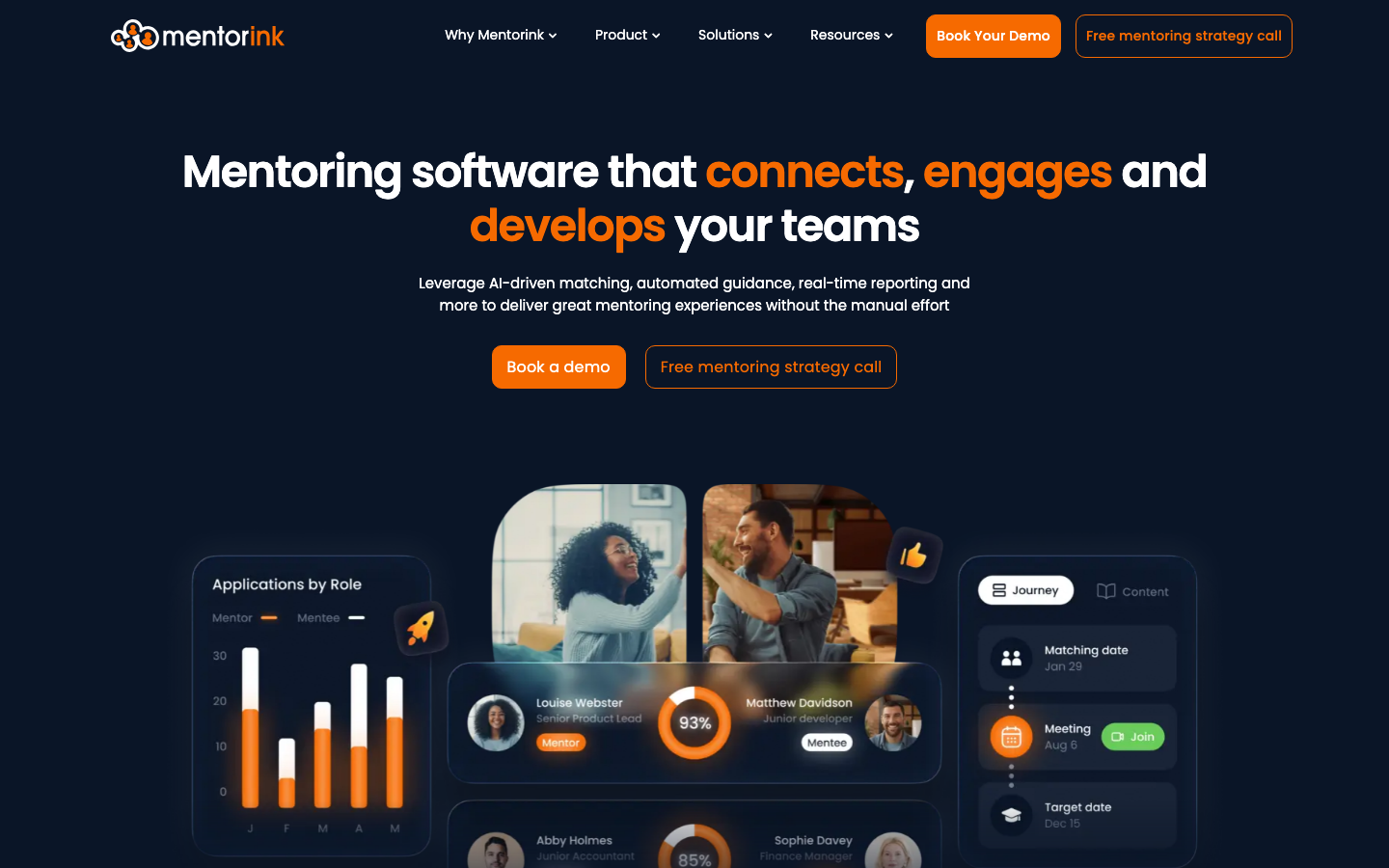
Mentorink is an enterprise mentoring platform with AI-powered matching on skills, goals, and preferences, supporting 1:1 and group programs across teams, departments, or regions. It connects to HRIS, LMS, and SSO platforms and automates scheduling and feedback. On its About page, the London company says its team formed in 2014 and serves 15+ markets.
Software Pros
- Automated matching, scheduling, and feedback collection
- Workflows adapted by team, department, or region
- HRIS, LMS, and SSO integrations
Software Cons
- Pricing is quote-only
- Setup suits mid-size and large companies more than small teams
- AI matching is not documented in depth
Mentorink Review
The honest pitch for Mentorink is less admin for a talent team running several programs at once. Matching runs automatically, and admins follow real-time reporting instead of chasing spreadsheets. It suits mid-size and large companies running group and 1:1 formats across regions. Someone still owns recruitment and communications, but the platform takes over scheduling and reminders. Ask for a demo of the matching logic, since its AI is not documented in depth.
Our Verdict
Automated Programs Across Regions
Mentorloop
Quick Overview
Mentorloop is a self-serve mentoring platform from Australia with manual, self, and Smart Match algorithm matching for workplaces, associations, universities, and government. Mentorloop Intelligence adds Match Rationale, Smart Nudges, Survey Summaries, Meeting Agendas, and Coco, an AI co-coordinator. The vendor says over 100,000 people use it.
Software Pros
- Build a program for free before inviting anyone
- Match Rationale explains why 2 people were paired
- Live sentiment tracking and a program dashboard
Software Cons
- SSO and HRIS integrations sit on Enterprise
- The improved Smart Match is limited to Enterprise
- Pro’s billing cycle is not stated on the pricing page
Mentorloop Review
If you run a first program at a 300-person company, Mentorloop is quick to stand up. Admins review draft matches with the rationale shown, and the vendor says every AI suggestion goes through the team. Slack notifications and calendar sync keep pairs moving between meetings. Pro starts at $299 per month, and Enterprise adds dedicated support, SSO, and HRIS links.
Our Verdict
Fast First Program Launch
*As pricing is subject to change, we are listing prices as they stand in October 2026
Mentornity
Quick Overview
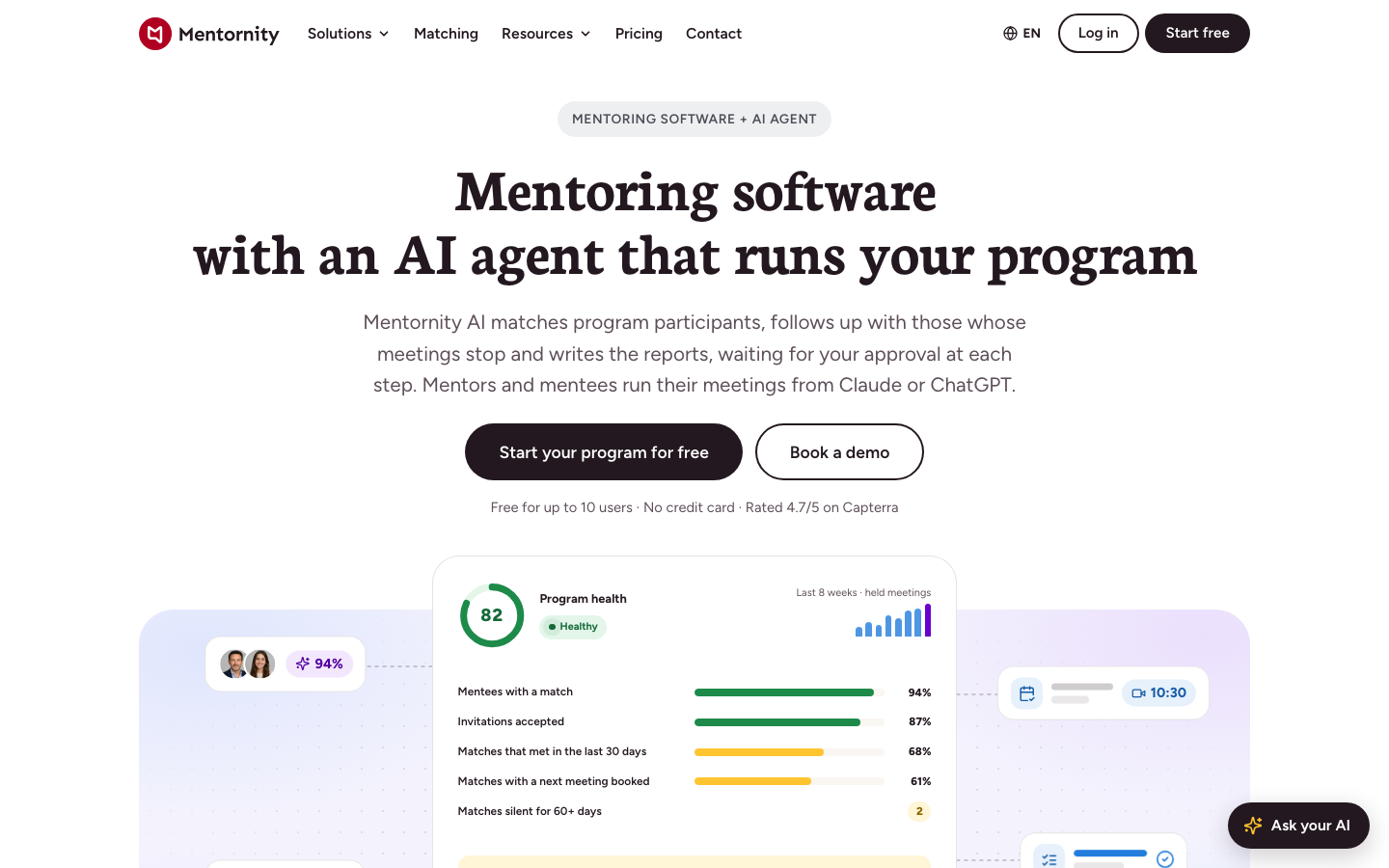
Mentornity is a self-serve mentoring platform with weighted rule-based matching on a 0 to 100 score. Admin, mentee-choice, and open-pool options cover one-to-one and group programs. Mentornity AI runs on credits and proposes matches, follows up on stalled pairs, and drafts reports for admin approval. It is free for up to 10 users.
Software Pros
- Every feature is on the free plan up to 10 users
- A program health score with the reasons behind it
- Google and Outlook calendar sync in both directions
Software Cons
- Mentornity AI runs on paid credits
- SAML SSO and white-label cost extra
- 1 G2 review, too few to judge
Mentornity Review
What stands out is how much a small company gets before paying anything. The Program plan costs $289/month for 50 active users, or $260/month billed yearly, and admins never count toward the total. Mentors and mentees can even run meetings from Claude through an MCP connector. A coordinator still approves every AI action, so someone must own the program.
Our Verdict
Generous Free Plan With AI
*As pricing is subject to change, we are listing prices as they stand in October 2026
People360
Quick Overview
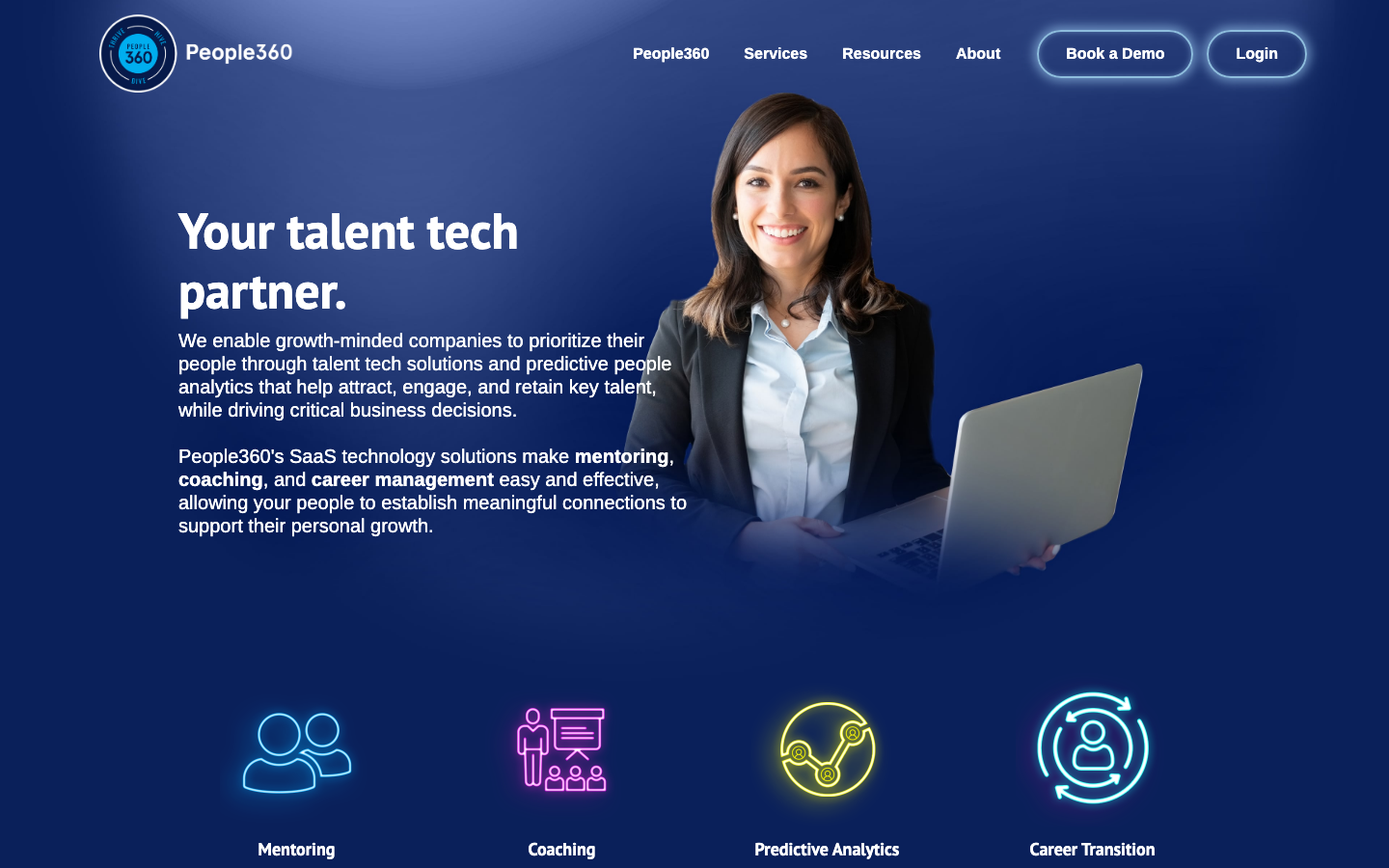
People360, formerly Insala, is an enterprise talent suite whose mentoring module uses a 3-level algorithm built on a questionnaire, imported profile data, and personality compatibility. Programs can use self, admin, or hybrid matching, and each can target its own audience. The mentoring page also covers goals and mentoring agreements.
Software Pros
- Several programs, each with its own matching rules
- Mentoring agreements and goal setting after matching
- HRIS data feeds and SSO for enrollment
Software Cons
- Pricing is quote-only
- AI is described only in general terms
- G2 lists mentoring under the old Insala name, with 2 reviews
People360 Review
The program this suits is a large company that wants mentoring besides coaching and career programs from 1 vendor. Matching can be automatic, admin-led, or a mix where mentees see recommended mentors. People360’s team helps design a communication plan, which is useful when HR lacks mentoring experience. Admins build custom reports and share them with other administrators, or export them to other tools.
Our Verdict
Mentoring Inside a Talent Suite
PushFar
Quick Overview
PushFar is a self-serve mentoring platform from the UK with AI-powered, admin, and self-select matching for mentoring, coaching, buddying, and sponsorship programs. It offers white-label options, HRIS and LMS integrations, calendar sync, and SSO. Founded in 2018, it says it serves clients in more than 100 countries.
Software Pros
- 3 matching modes in 1 platform
- Support for inclusion networks and ERG programs
- Instances deployed within 24 hours, per the vendor
Software Cons
- Pricing is quote-only
- 12 G2 reviews, a thin sample
- Program design still falls on an internal owner
PushFar Review
I’d recommend this to UK and European companies or professional bodies that want flexibility in how matching works. Admins can let AI suggest pairs, match by hand, or let people choose, and reports track activity while keeping conversations confidential. European hosting and GDPR controls help with procurement. Someone inside the organization still runs recruitment and keeps pairs meeting, so budget an owner along with the license.
Our Verdict
Flexible Matching for UK Teams
Qooper
Quick Overview
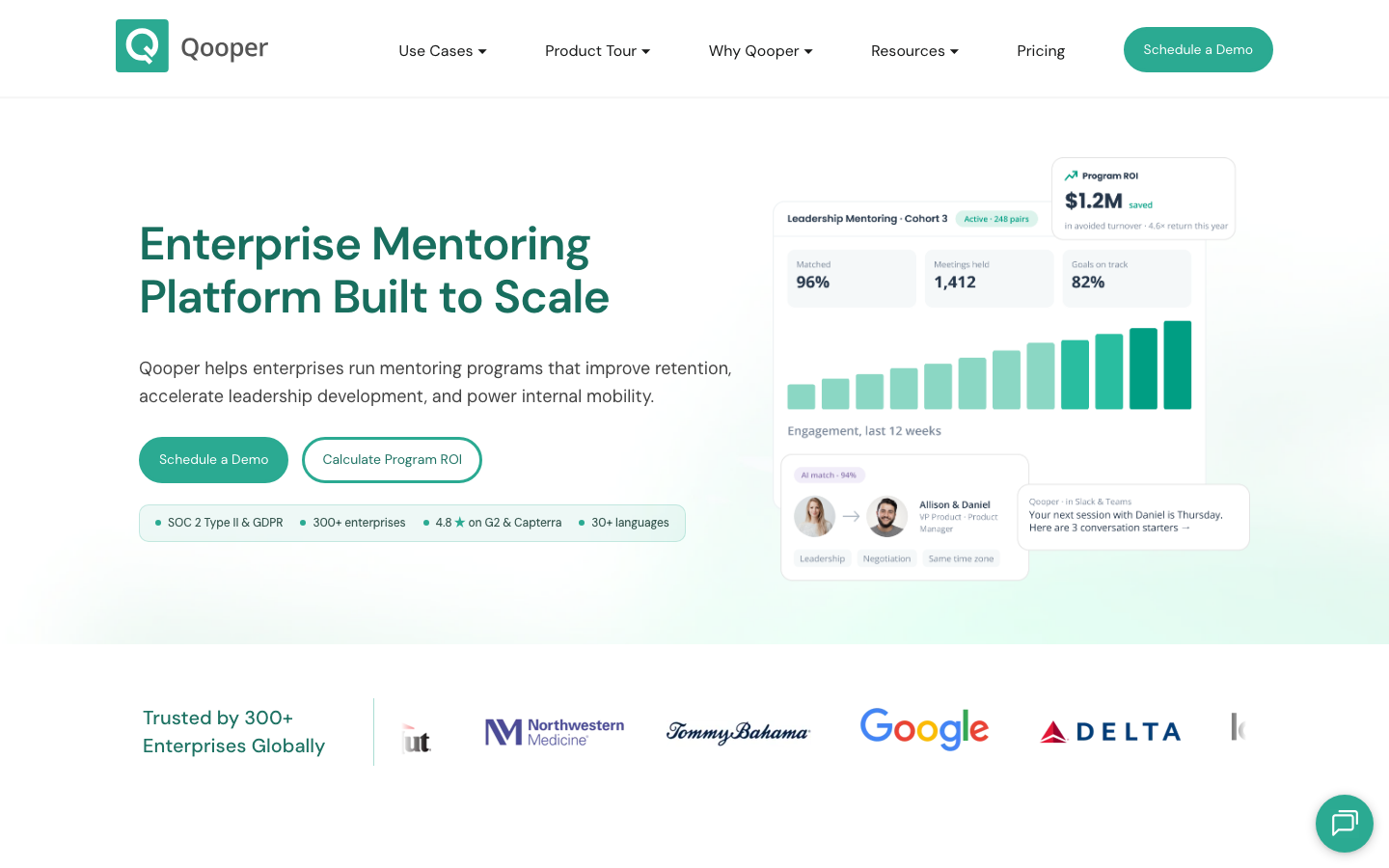
Qooper is an enterprise mentoring platform with configurable weighted matching and AI matching for 1:1, group, peer, and alumni programs. Qooper AI Coach gives employees on-demand coaching between human sessions, grounded in the organization’s content. The vendor says 300+ enterprises use it.
Software Pros
- Integrations with Workday, UKG, HiBob, Slack, and Microsoft Teams
- AI Coach for practice between sessions
- Platform available in 30+ languages
Software Cons
- Pricing is quote-only
- Feature depth means a longer setup
- Each program still needs its own owner
Qooper Review
Think of this as the platform for a talent team juggling onboarding, career, and AI-adoption programs at once. Admins adjust match criteria and weighting, then track relationship health and outcomes in dashboards. The AI Coach helps employees rehearse difficult conversations, while human mentors provide context. Mid-size and large companies get the most from it, and each program needs a named owner on the HR side to keep cohorts moving.
Our Verdict
Multi-Program Enterprise Mentoring
Ten Thousand Coffees
Quick Overview
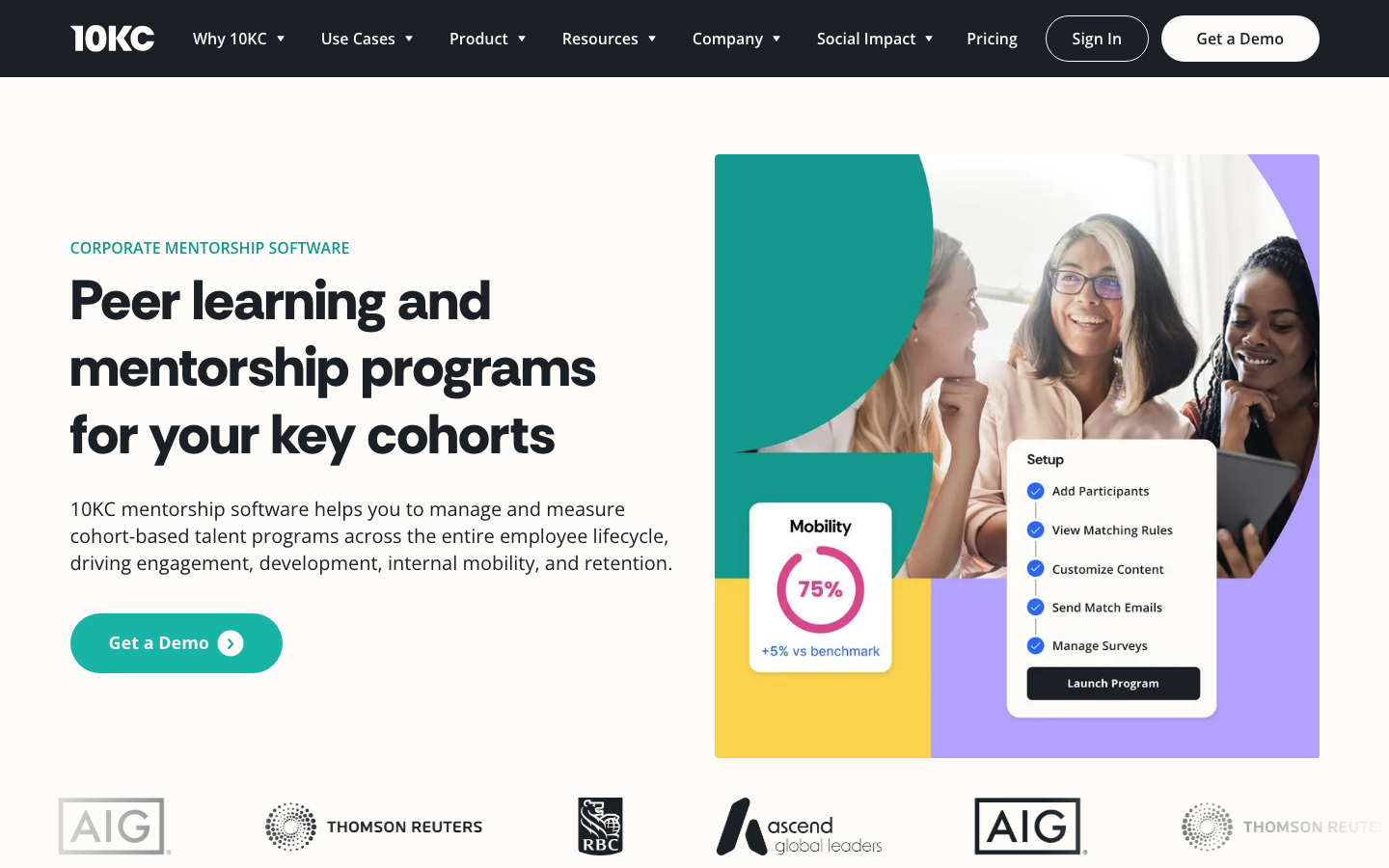
Ten Thousand Coffees is an enterprise mentoring platform for cohort-based programs. It uses a smart matching algorithm based on title, role, location, and skills, rather than a feature it calls AI. It supports mentoring pathways for early talent, career development, and leadership. The vendor says 200+ companies use it.
Software Pros
- Every feature on every plan, priced by employee access
- Retention and promotion analysis included in each plan
- Works inside HRIS, LMS, and meeting tools
Software Cons
- Pricing is by quote only
- The Standard plan is sized for up to 5,000 employees
- 32 G2 reviews, a thin sample
Ten Thousand Coffees Review
Ten Thousand Coffees’ honest pitch is proof for budget holders. Its dashboards track connections and outcomes, so talent teams can show ROI. It suits large companies running cohort-based early-talent and career programs. A dedicated implementation manager handles setup, and AI-assisted translation helps global cohorts read the same program in their own language. An internal program owner still recruits mentors and keeps each cohort on schedule.
Our Verdict
Cohort Programs With ROI Proof
FAQs About Mentoring Software
What’s the best mentoring software for a company?
It depends on program size, how matching should work, and who will run the program. A company launching its first program usually fits a self-serve platform with a published price. A large employer running several programs needs an enterprise platform with HRIS sync and impact reporting. An association, or a team without mentoring experience, often gets more from a provider that combines software with hands-on program design.
How does mentoring software match mentors and mentees?
Participants fill in profiles and questionnaires covering goals, skills, experience, and background. The platform then suggests pairs using weighted rules, an algorithm, or AI, or an admin can match people by hand. Many platforms also let mentees browse and request a mentor themselves. The strongest setups combine methods, with admins reviewing suggested matches before notifying anyone and re-matching pairs that don’t work out.
What is the difference between mentoring and coaching?
A mentor is an experienced colleague who shares what they have learned, usually inside the same organization and without payment. A coach is trained to help someone find their own answers through questions and often comes from outside the company for a fee. Mentoring builds relationships and organizational knowledge. Coaching targets a specific goal or behavior, and many companies run both programs side by side.
What is reverse mentoring?
Reverse mentoring flips the usual roles, so a junior employee mentors a senior one. Common topics are technology, social media, and how inclusion looks from the junior side of the organization. It works best when both people treat it as an exchange rather than a one-way favor. When choosing a platform, check that anyone can take either role, because some tools assume mentors are always more senior than mentees.
How many people do you need to start a mentoring program?
A pilot can start with 10 to 20 pairs, which is enough to test matching, meeting rhythms, and feedback. Size matters less than a clear goal, such as onboarding or leadership development, and a named person who runs the program. A small pilot with an engaged owner usually teaches more than a large launch that nobody follows up after the kickoff event. Expand once the first cohort finishes.
How do you measure whether a mentoring program works?
Start with participation and meeting frequency, since pairs that stop meeting cannot produce results. Add participant feedback after sessions and at the end of the program. Over time, compare retention, promotions, and internal moves for participants with similar employees who didn’t join. Keep the comparison honest, because people who volunteer for mentoring may already be more engaged than those who do not sign up.
Can mentoring software work with Slack or Microsoft Teams?
Many platforms send nudges, reminders, and meeting links through Slack or Microsoft Teams, so pairs see them where they already work. Some also sync with Google or Outlook calendars and create video links automatically. Check which plan includes these connections, because several vendors keep Teams, single sign-on, and HRIS integrations for higher tiers. Ask for a demo inside your own workspace before signing anything.
How much time do mentors need to give?
A common design asks for 1 meeting a month over 6 to 12 months, with each meeting lasting about an hour. That is a typical design choice, and programs vary widely. Short formats such as flash mentoring ask for a single conversation. Whatever you choose, tell mentors the expected time before they sign up, so nobody drops out in month 2 because the load was a surprise.

Helen is Anywherer’s Market Analyst & Content Researcher, with extensive experience in analyzing global employment markets and HR technology trends. She is skilled at turning complex market data into clear, well-researched insights that inform every piece of content. With a strong grasp of the EOR, PEO, and international hiring space, Helen plays a key role in keeping Anywherer’s research accurate, up to date, and genuinely useful for readers.