Equity compensation means paying people partly in ownership rather than only in cash. A company records who owns what in its cap table, short for capitalization table. Equity compensation software keeps that record up to date with every grant. The most common award is the stock option, the right to buy shares later at a fixed price. In the US, options come as ISOs (incentive stock options), which offer tax advantages for employees, or NSOs (nonqualified stock options), which anyone can receive.
An RSU, or restricted stock unit, is a promise to deliver shares once conditions are met, with no purchase price. Phantom or virtual shares pay out the value of shares, usually in cash, without issuing real ones. Most awards vest over time, often 4 years with a 1-year cliff. Exercise is the moment an option holder actually buys the shares. Public companies also run ESPPs, employee stock purchase plans that let staff buy shares at a discount.
What Is the Best Equity Compensation Software in 2026?
Most growing companies reach the same point: the spreadsheet tracking grants no longer matches the legal documents. Equity compensation management software replaces it with a single system for grants, vesting, exercises, valuations, and reporting. The usual buyers are founders, finance and people leads at startups and scale-ups, and stock plan administrators at pre-IPO and public companies. Equity is 1 part of total compensation, listed alongside the cash pay that salary benchmarking software helps price.
Equity reaches more employees than many founders assume. The NCEO page Employee Ownership by the Numbers, updated in January 2026, cites a Rutgers estimate of 11.8 million US employees in equity compensation plans. Those plans include stock options, restricted stock, and ESPPs. The practical lesson is less about numbers. Equity motivates only people who understand what they hold, and a grant letter written in legal shorthand rarely does.

INSIGHT: How many employees actually receive equity?

Equity is common in startups and listed companies, but it only works when employees understand what they hold.
- The same NCEO page cites the NASPP/Deloitte 2024 Equity Incentives Design Survey. About 92% of US public companies in it give equity below the senior executive level.
- HMRC’s statistics published July 3, 2026 put the average value of options per EMI grant at £13,930.
- A grant letter nobody can read is a cost, not an incentive.
Sources:
both read October 2026
No single tool fits every company, because stage and country decide the fit. Startup cap table platforms combine grants and ownership records at a low entry price. UK and European share plan platforms are built around local schemes. In the UK, those are EMI (Enterprise Management Incentives) and CSOP (Company Share Option Plan). Enterprise stock plan administrators run RSUs and ESPPs for public companies. HMRC’s July 2026 statistics show how much the UK relies on EMI: 90% of the 20,650 companies with tax-advantaged schemes ran one. Nothing on this page is tax, legal, or investment advice. Below, I’ve reviewed 12 of the leading tools in A-Z order.
INSIGHT: Startup platform, local share plan, or stock plan administrator?
The 12 tools here fit 3 stages of a company’s life. The right one depends on where your employees are and what you grant.
- Startup cap table and equity (Cake Equity, Capboard, Carta, Eqvista, Qapita): options and cap table in 1 place at a low entry price.
- UK and European share plans (Ledgy, Optio Incentives, SeedLegals, Vestd): local tax-advantaged schemes and multi-country European plans.
- Enterprise stock plan administration (Certent, J.P. Morgan Workplace Solutions, Morgan Stanley at Work): RSUs, ESPPs, and public-company reporting for many participants.
Equity Compensation Management Software Comparison
This equity compensation software tools comparison sorts the 12 by group, so a shortlist starts with stage and location rather than brand. Rows follow the same A-Z order as the reviews below. Prices sit in the pricing section because the units behind them differ too much to share 1 column.
| Tool | Group | Best for | Award types | International plans | G2 rating |
|---|---|---|---|---|---|
| Cake Equity | Startup cap table and equity | Small, distributed startup teams | ISOs, NSOs, RSUs, RSAs, SAFEs, warrants | Yes | 4.8 (146) |
| Capboard | Startup cap table and equity | European startups using phantom shares | Options, phantom shares, RSAs, RSUs, SARs, warrants | Limited | 4.7 (3) |
| Carta | Startup cap table and equity | US startups through pre-IPO | Options (ISO, NSO), RSUs, restricted stock | Yes | 4.3 (234) |
| Certent | Enterprise stock plan administration | Pre-IPO and US public companies | 15+ award types | Limited | 4.4 (122) |
| Eqvista | Startup cap table and equity | Early-stage US startups on a budget | Options, SAFEs | Home market | 4.2 (10) |
| J.P. Morgan Workplace Solutions | Enterprise stock plan administration | Employees in many countries | Options, RSUs, ESPP, LTIPs | Yes | 4.8 (165) |
| Ledgy | UK and European share plans | European scale-ups heading to IPO | Options, EMI, SAYE, BSPCE | Yes | 4.7 (94) |
| Morgan Stanley at Work | Enterprise stock plan administration | Large private and public companies | Private and public stock plans | Yes | 3.8 (32) |
| Optio Incentives | UK and European share plans | Nordic and European plans, pre-IPO to listed | Options, EMI, SAYE, share purchase | Yes | 4.8 (75) |
| Qapita | Startup cap table and equity | Teams across the US and Asia | Options and other equity plans | Yes | 4.6 (375) |
| SeedLegals | UK and European share plans | UK startups granting EMI options | EMI, unapproved options | Home market | 5.0 (2) |
| Vestd | UK and European share plans | UK SMEs wanting guided schemes | EMI, CSOP, growth shares, phantom shares | Home market | 4.7 (66) |
G2 ratings were read in October, 2026.
Equity Compensation vs Pay Equity Software
Equity compensation is ownership given to employees, such as options, RSUs, or shares. Every tool on this page grants and tracks that ownership: who holds what, when it vests, and what it is worth. Here the word equity means a stake in the company, not fairness.
Pay equity is a different idea. It means paying people fairly for similar work, regardless of gender, race, or other protected characteristics. That analysis happens in compensation planning software for pay equity, usually inside the compensation management software HR teams already use for salary reviews.
Buyers searching for compensation equity software are usually after that fairness analysis, not an equity management tool. The 2 categories share a word and very little else, so it is worth checking which one a vendor actually sells.
They meet in 2 places. Total compensation statements show salary, bonus, and equity side by side, so employees see the full value of their package. Equity grant guidelines also deserve the same fairness check as any other pay. That check belongs in software for managing compensation equity, using the grant data these platforms export.
What Does AI Do in Equity Management Software?
Today, AI in this category mostly answers questions about the cap table. Carta’s Cap Table Plugin lets Claude read live Carta records on ownership, vesting, and 409A history. Cake Equity connects Claude, Codex, or other assistants through Cake MCP. Ledgy offers Ledgy Agent for admin tasks and Ledgy MCP for plain-language questions. Vestd adds an AI search assistant, and Certent has Ask Certent.
The limit is the data. Answers are only as good as the cap table behind them, and a missing exercise or unrecorded transfer can produce a confident wrong answer. Grant decisions, valuations, and tax treatment still need people and qualified advisers. Ledgy says every agent action needs approval before it runs, which is the right default for ownership records.
None of the 12 vendors uses AI to decide who receives equity or how much. That stays a board and compensation committee decision, recorded in the platform afterward.
Best Equity Compensation Software by Company Type
These groupings follow company stage and location, not a score. Tools appear in A-Z order inside each group, and a tool named twice is broad rather than better. Location matters as much as size. A 15-person US startup, a London SaaS company granting EMI options, and a German scale-up paying out virtual shares all need equity software. They should not buy the same product.
Best Equity Compensation Software for Startups
Early-stage companies need a free or cheap plan, grants and vesting in 1 place, and a 409A valuation once they start issuing US options. A 409A valuation is the independent appraisal that supports a defensible strike price. Cake Equity is free up to 5 stakeholders and includes 2 valuations a year on its Team plan. Carta’s Launch plan is free up to 25 stakeholders and $1M raised. Eqvista is free below 20 stakeholders and bundles 409A work with its paid cap table. Software firms, often the first buyers of equity compensation tracking tools, should watch how fast per-stakeholder pricing grows with hiring.
For UK Companies Using EMI and Other Tax-Advantaged Schemes
UK companies mostly grant EMI options because the scheme carries tax advantages for qualifying companies and employees. Running one means agreeing a valuation with HMRC, adopting scheme rules, notifying HMRC of grants, and filing annual returns. SeedLegals covers that process for EMI and unapproved options, with unlimited EMI valuations and specialist support on its Options plan. Vestd handles EMI, CSOP, growth shares, unapproved options, and phantom shares, with a Companies House integration that syncs in both directions. Both are built for the UK, so a team that later hires in Germany or the US will need a second look.
For European and Global Scale-Ups
Scale-ups with staff in several countries face a different tax treatment for each award in each place. That forces an early choice between real options and phantom or virtual shares, which avoid issuing shares abroad. Capboard supports phantom shares, RSUs, SARs (stock appreciation rights), and warrants for European startups. Ledgy covers EMI reports, SAYE, BSPCE valuations for France, and global mobility reporting on Enterprise. Optio Incentives serves the Nordics, the UK, and wider Europe, from startups to listed companies. Qapita reports serving companies in 60+ countries from 1 platform.
For Pre-IPO and Public Companies
At IPO, equity administration changes scale. Thousands of participants hold RSUs and ESPP shares, public reporting needs ASC 718 and SEC disclosures, and employees need a brokerage account to sell. Certent automates ASC 718 expense, Section 16 filings, and proxy reporting. J.P. Morgan Workplace Solutions produces ASC 718, IFRS 2, ASPE, and JGAAP reports. Morgan Stanley at Work adds 409A services and liquidity events for private companies, plus stock plan accounts for public ones. Governance across subsidiaries is a separate job, covered in our guide to corporate entity management software.
For Companies With Employees Hired Through an Employer of Record
An employer of record (EOR) employs the person on paper, but the parent company still grants the equity under its own plan. The grant agreement, local tax reporting, and payroll withholding must then align across 2 organizations. J.P. Morgan Workplace Solutions runs global plans across dozens of countries, and Ledgy offers global mobility reporting. Qapita supports holders in many countries from 1 plan. Some EOR providers now sell equity add-ons of their own, so ask which side keeps the records. Contractors and employees often qualify for different awards, which our contractor vs employee checklist helps sort out.
How Much Does Equity Compensation Software Cost?
Pricing units here follow company stage. Cake Equity, Carta, Eqvista, and Qapita start with a free tier, then charge per stakeholder, meaning anyone on the cap table. Ledgy sells annual platform tiers, while SeedLegals and Vestd charge a flat subscription for running a UK scheme. Certent, J.P. Morgan Workplace Solutions, Morgan Stanley at Work, and Optio Incentives quote contracts sized by participants and services. Buyers often miss what sits outside the base price. Valuations, accounting reports, and legal documents are often extras. ASC 718 and IFRS 2 reports, the US and international rules for expensing share-based pay, are a common add-on.
| Tool | Pricing model | Free plan or trial | Published starting price | Valuations and reports |
|---|---|---|---|---|
| Cake Equity | Annual plans by stakeholder | Free up to 5 stakeholders | $1,000/year for 25 stakeholders (Build) | 2 409As on Team; ASC 718 on Pro |
| Capboard | Per stakeholder, billed annually | Free trial | €22.50/month for 15 stakeholders, billed annually | 409A on custom Scale-up |
| Carta | Tiers by stakeholder count | Free up to 25 stakeholders | Custom pricing for paid tiers | 409A from Grow; ASC 718 and IFRS on Scale |
| Certent | Quote | Not stated | Custom pricing | ASC 718 and SEC reports included |
| Eqvista | Per stakeholder per month | Free under 20 stakeholders | $2 per stakeholder/month (Premium) | 409A bundle and ASC 718 extra |
| J.P. Morgan Workplace Solutions | Quote | Not stated | Custom pricing | ASC 718, IFRS 2, ASPE, JGAAP reports |
| Ledgy | Annual platform tiers | Free up to 50 stakeholders | €5,000/year (Scale) | Valuations included; reporting add-on |
| Morgan Stanley at Work | Quote | Not stated | Custom pricing | 409A and reporting services offered |
| Optio Incentives | Quote on all plans | Not stated | Custom pricing | Fair value and 409A on Pre IPO |
| Qapita | Annual plans by stakeholder | Free up to 25 stakeholders | $1,600/year for 40 stakeholders (Surge) | 409A on Growth; ASC 718 and IFRS on Enterprise |
| SeedLegals | Flat annual subscription | Not stated | £2,699/year plus VAT (Options) | Unlimited EMI valuations included |
| Vestd | Monthly plans, 12-month minimum | Not stated | £25/month excl. VAT (Essentials) | Unlimited HMRC valuations on Guided service |
As pricing is subject to change, prices are listed as they stand in October 2026.
INSIGHT: What does equity compensation software actually cost?
The price grows with each person who holds equity, and valuations and reports are often billed on top of that.
- 7 of the 12 publish a paid starting price, Carta publishes only its free Launch plan, and 4 quote everything. 5 run a free plan: Cake Equity, Carta, Eqvista, Ledgy, and Qapita.
- Per-stakeholder plans grow with every new grant holder, and Ledgy’s annual tiers step up at set stakeholder counts. SeedLegals and Vestd charge flat subscriptions that cover a scheme at any size.
- Valuations, accounting reports, and legal documents are often extra. Cake Equity sells a 409A add-on for $1,500 a year, and Ledgy’s financial reporting add-on starts at €3,000 a year.
How to Choose Equity Compensation Software
I would start by listing the award types you grant today and the ones you expect at IPO. Moving from options to RSUs and an ESPP changes the tool you need. Then list every country where people with equity work, including anyone employed through an EOR. Check whether valuations and ASC 718 or IFRS 2 reports come in the base price or as paid extras. Look at the employee portal from the employee’s side, because a clear view of vested value is what makes equity feel real.
Test the modeling next. Good software for equity compensation scenarios shows what a new grant, a funding round, or an exit does to each holder’s stake. Size the option pool to the hiring plan, where headcount planning software earns its place. Price the tool at next year’s headcount, not today’s, since per-stakeholder plans climb with every hire. Finally, plan the migration before you need it. Ask how a vendor exports the cap table, grant documents, and vesting history, and how a new provider imports them.
Top 12 Equity Compensation Software Tools for 2026
I built each review from the vendor’s product, documentation, and pricing pages, read in October 2026. I pulled G2 ratings from each product profile on October 28, 2026, and labeled vendor numbers as vendor claims. The list runs from startup platforms like Cake Equity and Carta to UK scheme specialists like SeedLegals. It ends with stock plan administrators like Morgan Stanley at Work. Each block names the award types, the countries covered, whether valuations and reports cost extra, and what employees see. That last point decides whether equity compensation tracking software actually wins over the people holding the grants.
I’m listing all providers in alphabetical order to keep this comparison neutral.
Cake Equity
Quick Overview
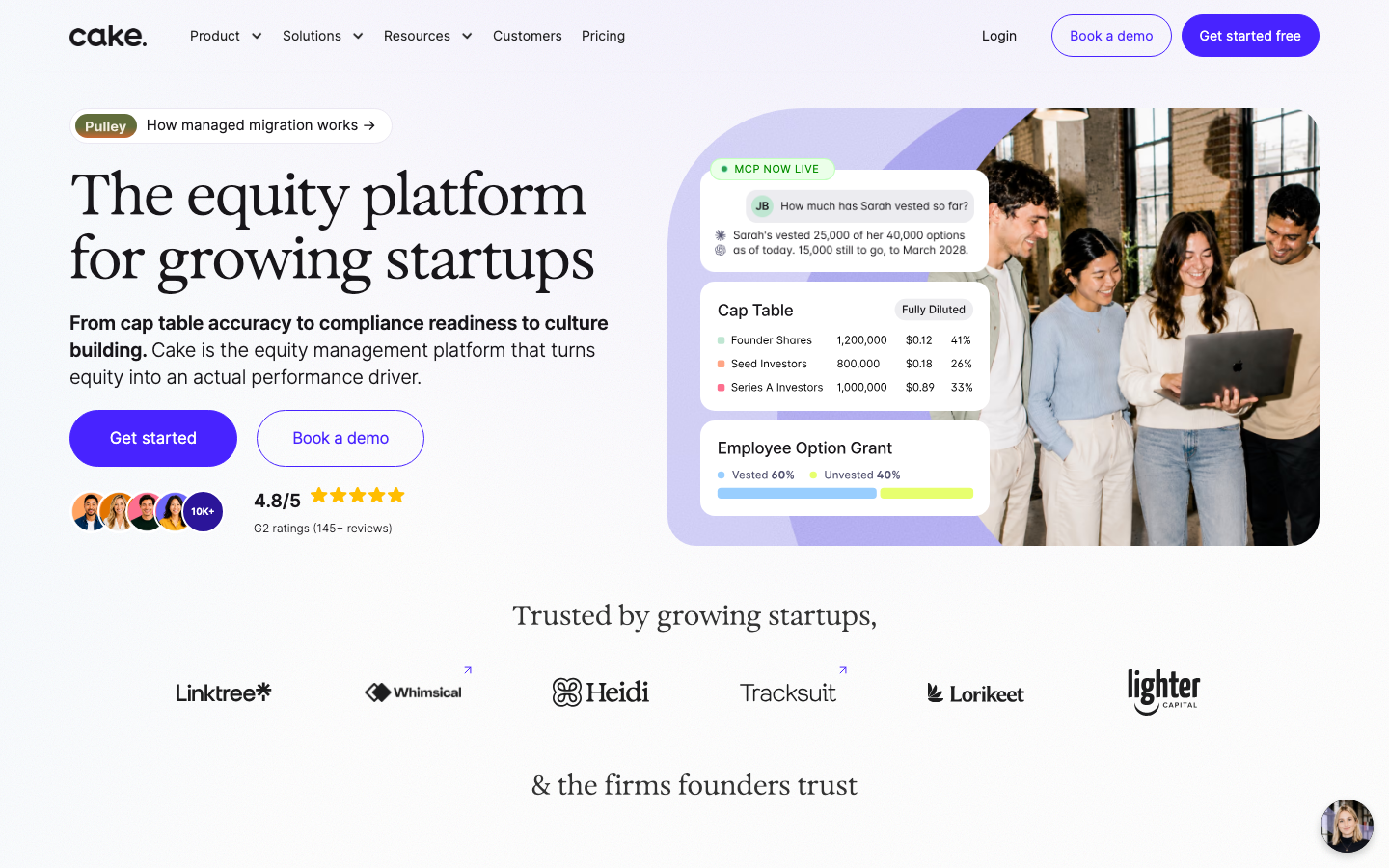
Cake Equity is a startup cap table and equity platform covering ISOs, NSOs, RSUs, RSAs, SAFEs, and warrants. It prices plans for the US, Canada, Australia, the UK, Singapore, and New Zealand. Cake MCP lets Claude, Codex, or other AI assistants answer questions from the cap table. The vendor says 10,000+ companies use it.
Software Pros
- Free plan for up to 5 stakeholders
- Team plan includes 2 409A valuations a year
- Built-in equity education for employees on Team
Software Cons
- $60 for each stakeholder above the plan limit
- ASC 718 expensing sits on the custom Pro plan
- Option exercising starts on Team, not Build
Cake Equity Review
I’d point Cake Equity at a seed or Series A startup with a small, distributed team. Build costs $1,000 a year for 25 stakeholders, and Team costs $2,750 a year for 40 stakeholders, including 2 valuations. Employees see their holdings and vesting in a stakeholder portal, with explanations of what each grant means. A 409A add-on costs $1,500 a year on plans without it.
Our Verdict
Startup Equity With 409A Included
*As pricing is subject to change, prices are listed as they stand in October 2026.
Capboard
Quick Overview
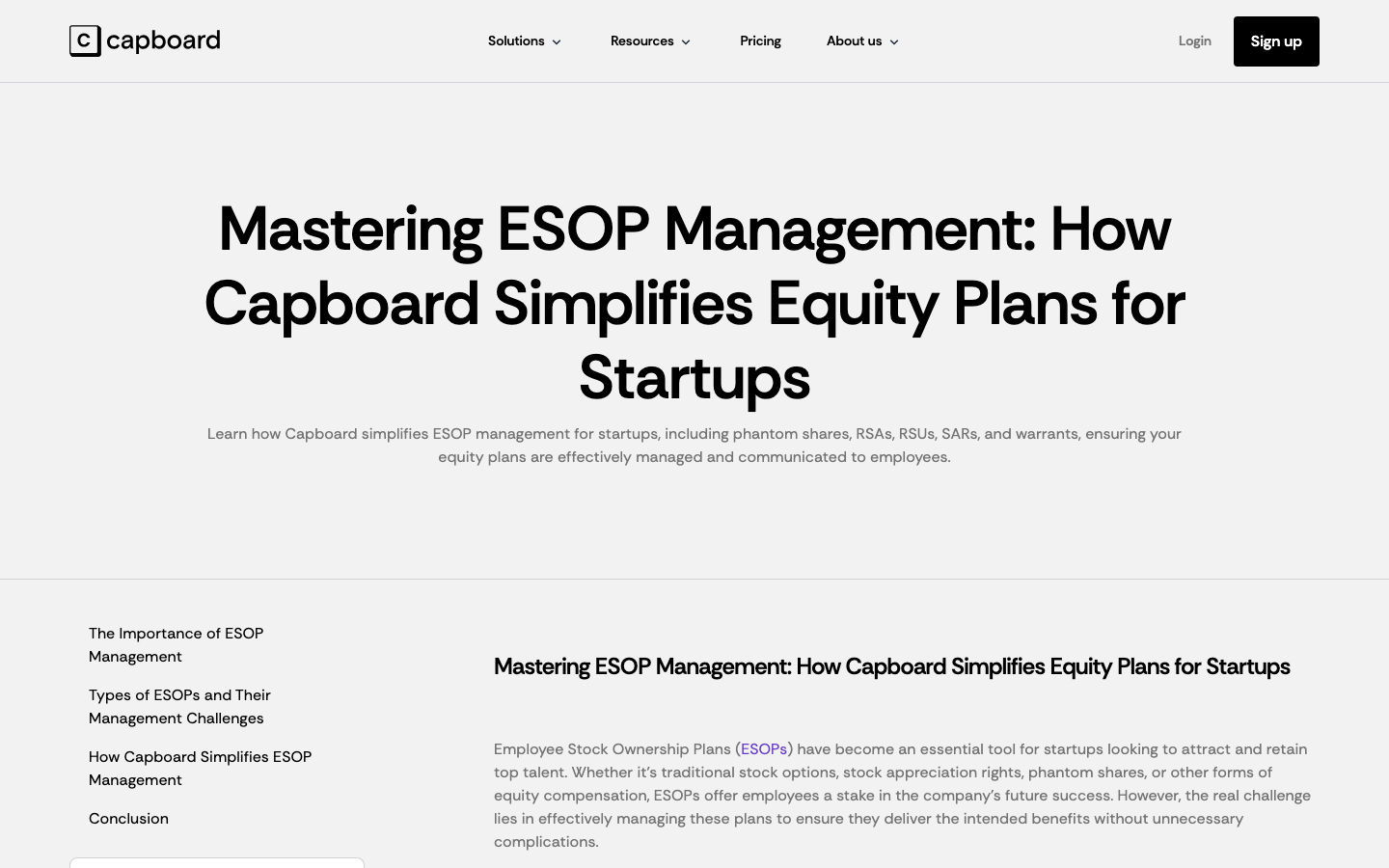
Capboard is a startup cap table and equity tool for European companies, covering stock options, phantom shares, RSAs, RSUs, SARs, and warrants. It adds vesting tracking, funding round simulations, and automated grant letters. Its pricing page starts at €22.50 per month, billed annually, for 15 stakeholders.
Software Pros
- Phantom shares and SARs alongside real options
- Automated grant letters and e-signature
- Free trial on the Stakeholder plan
Software Cons
- €1.50 per month for each extra stakeholder
- 409A valuation only on the custom Scale-up plan
- 3 G2 reviews, too few to judge
Capboard Review
This fits a European startup that prefers phantom or virtual shares to issuing real equity abroad. Grants, vesting, and exercises run in 1 place, and employees receive automated grant letters for e-signature. Funding round simulations help founders test dilution before a raise. The vendor names no AI feature, and accounting reports are not listed on the base plan, so ask how expensing will be handled.
Our Verdict
Phantom Shares for European Startups
*As pricing is subject to change, prices are listed as they stand in October 2026.
Carta
Quick Overview
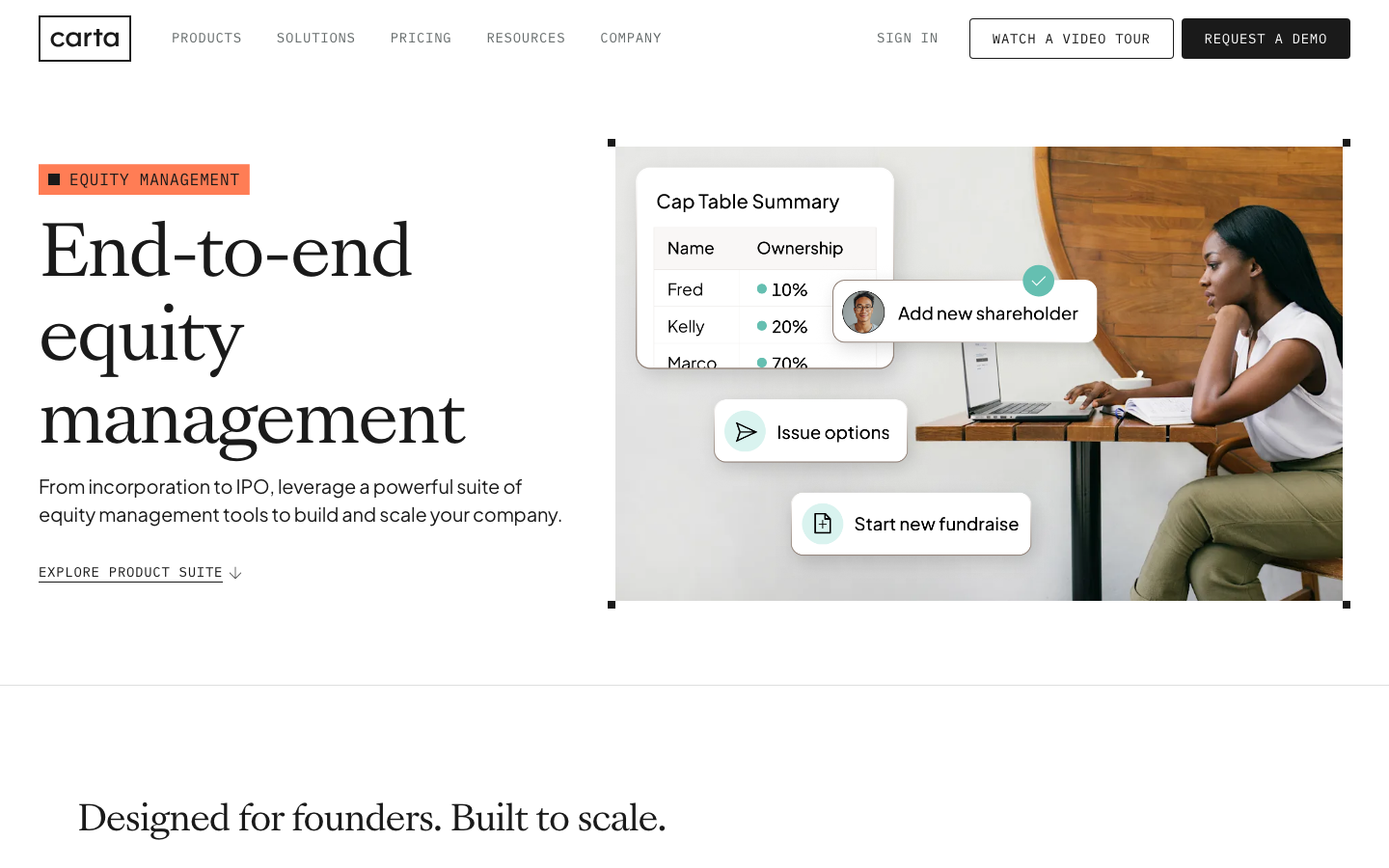
Carta is a startup cap table and equity platform for US companies through pre-IPO. It supports options, RSUs, and restricted stock, and runs a UK site. Its Cap Table Plugin lets Claude read live Carta records on ownership, vesting, and 409A history. The vendor says 50,000+ companies use it.
Software Pros
- Free Launch plan up to 25 stakeholders and $1M raised
- SEC-registered transfer agent for US companies
- ASC 718 and IFRS reporting on the Scale plan
Software Cons
- Paid tiers are not priced publicly
- 409A valuations start on the Grow plan
- Feature depth can feel heavy for a 5-person team
Carta Review
My take is that Carta suits US startups that expect several funding rounds and a path to pre-IPO. HRIS and payroll integrations sync terminations and tax withholding, and employees exercise options online. Pulley customers should note that Pulley closes on December 8, 2026, with Carta as its migration partner. Ask for paid-tier pricing at your expected stakeholder count before you sign.
Our Verdict
Built to Scale Toward IPO
Certent
Quick Overview
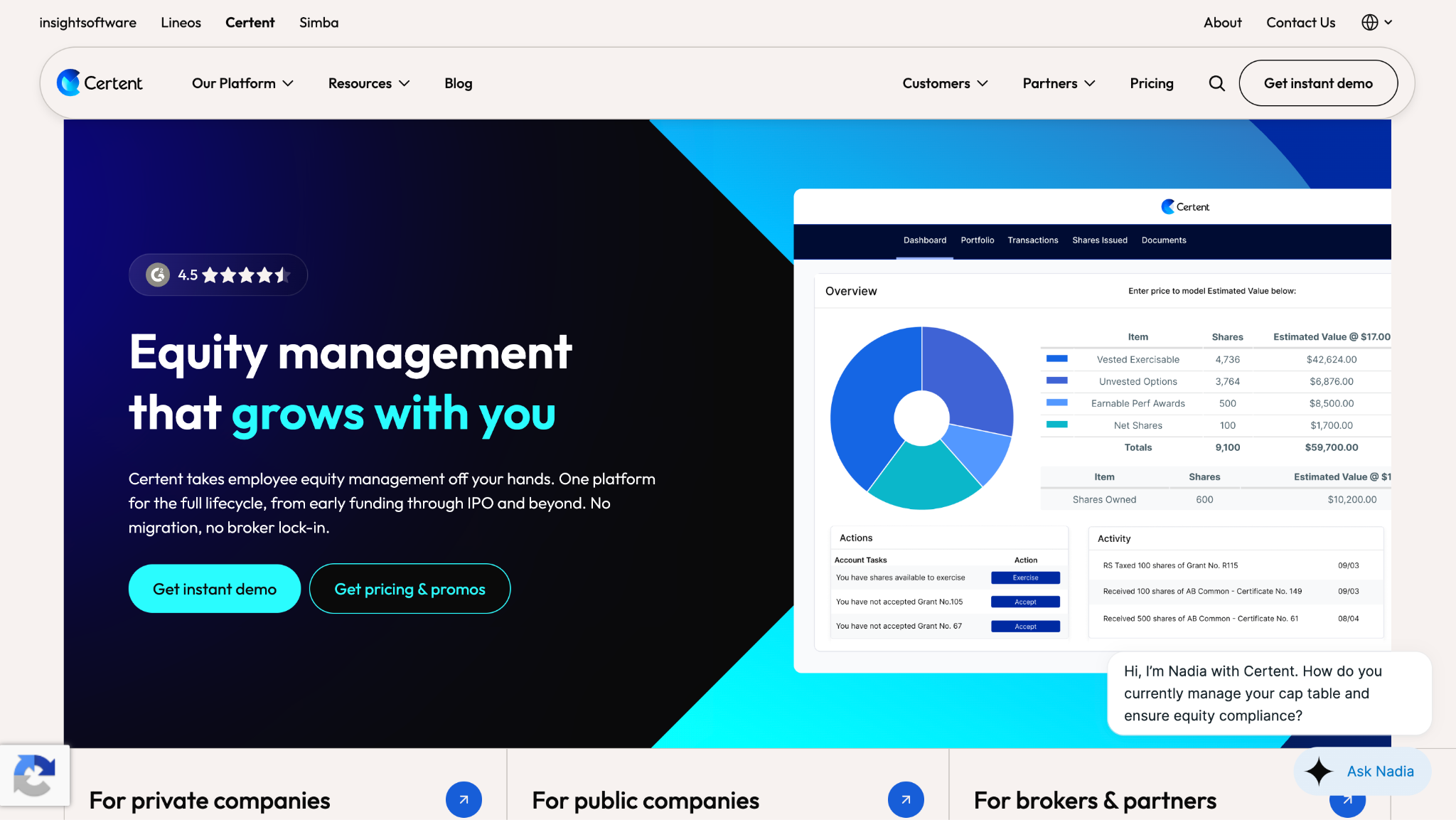
Certent is an enterprise stock plan administration platform from insightsoftware for private companies through IPO and public companies. It covers 15+ award types with a participant portal. It automates ASC 718 expense, Section 16 filings, and SEC and proxy reporting, and offers the Ask Certent assistant. The vendor cites 1.5k+ corporate clients and more than 1 million plan participants.
Software Pros
- 1 system from first priced round to public reporting
- Section 16 and proxy reporting automated
- Participants get self-service access
Software Cons
- Pricing is quote-only
- Strongest on US public-company reporting
- Heavy for a company that only needs a cap table
Certent Review
The clearest case for Certent is a pre-IPO or US-listed company that wants to avoid switching systems at IPO. Admins manage the cap table, grants, and approvals, then produce ASC 718 and SEC reports from the same data. Participants log into a portal to view their awards. Companies can run it themselves or hand the work to insightsoftware, which offers to take equity administration off their hands.
Our Verdict
Pre-IPO to Public Reporting
Eqvista
Quick Overview
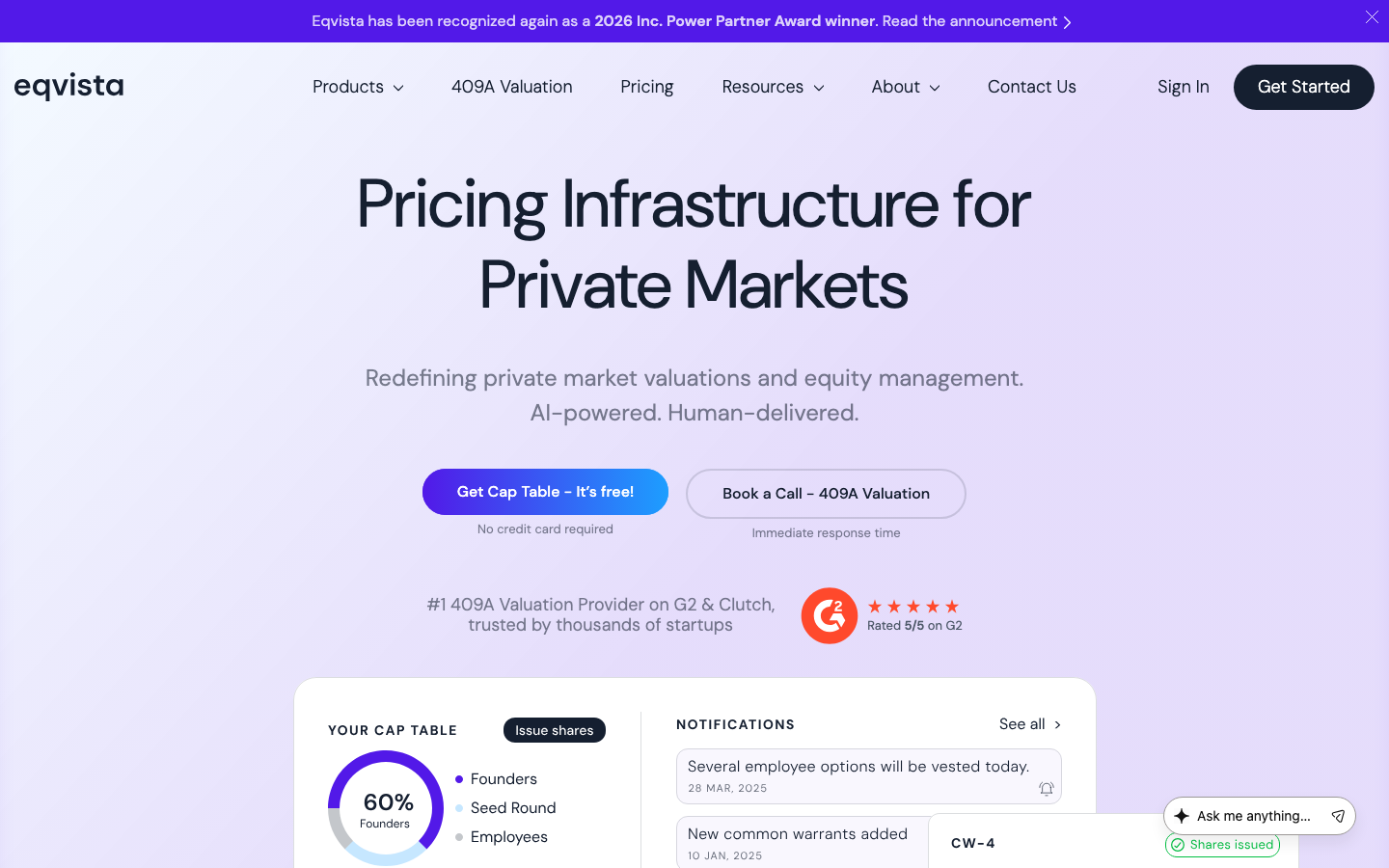
Eqvista is a startup cap table and equity tool for early-stage US companies, covering cap table and ESOP management, vesting schedules, and SAFEs. Its Eqvista Real-Time Company Valuation, which the vendor calls AI-powered, supports 409A pricing. The vendor says 25,000+ companies trust it.
Software Pros
- Free plan under 20 stakeholders
- 409A valuation bundles from $990 a year
- Form 3921 and Rule 701 on Premium
Software Cons
- Built mainly for US companies
- ASC 718 reports cost $500 and up
- 10 G2 reviews on the cap table profile
Eqvista Review
In short, Eqvista is the budget route for a US startup that wants a cap table and 409A valuations from 1 vendor. Premium costs $2 per stakeholder per month, with custom pricing above 50 stakeholders. Stakeholders get their own accounts to view holdings and vesting. The valuation business has the larger G2 following, with 107 reviews on its 409A profile against 10 for the cap table.
Our Verdict
Budget Cap Table and 409A
*As pricing is subject to change, prices are listed as they stand in October 2026
J.P. Morgan Workplace Solutions
Quick Overview
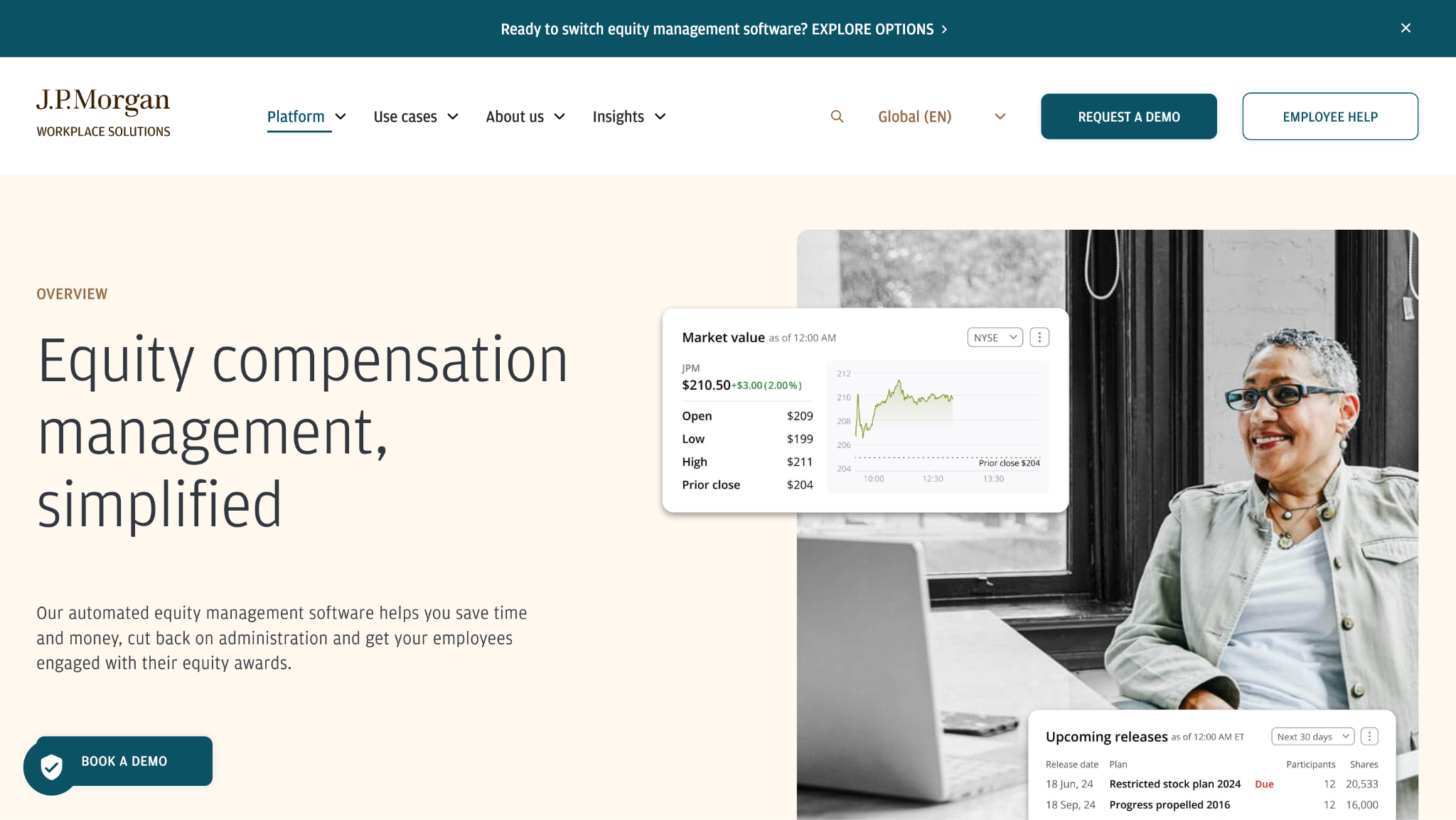
J.P. Morgan Workplace Solutions, formerly Global Shares, is an enterprise stock plan administrator for companies from early stage to public. It covers stock options, RSUs, ESPPs, and LTIPs (long-term incentive plans) across many countries. It produces audit-ready reports for ASC 718, IFRS 2, ASPE, and JGAAP. It names no AI feature.
Software Pros
- Global plans run across dozens of countries
- 4 accounting standards covered in reporting
- Participant portal for accepting grants and enrolling
Software Cons
- Pricing is quote-only
- Implementation includes data conversion and reconciliation
- More platform than a small startup needs
J.P. Morgan Workplace Solutions Review
This one suits a company with employees in many countries that wants a bank-backed administrator. J.P. Morgan says it has launched global plans for businesses with several thousand employees across dozens of countries. Employees log into a portal to accept grants or enroll in plans. Onboarding involves converting historical data and building the participant portal, so plan a project rather than a quick switch.
Our Verdict
Global Plans With Bank Backing
Ledgy
Quick Overview
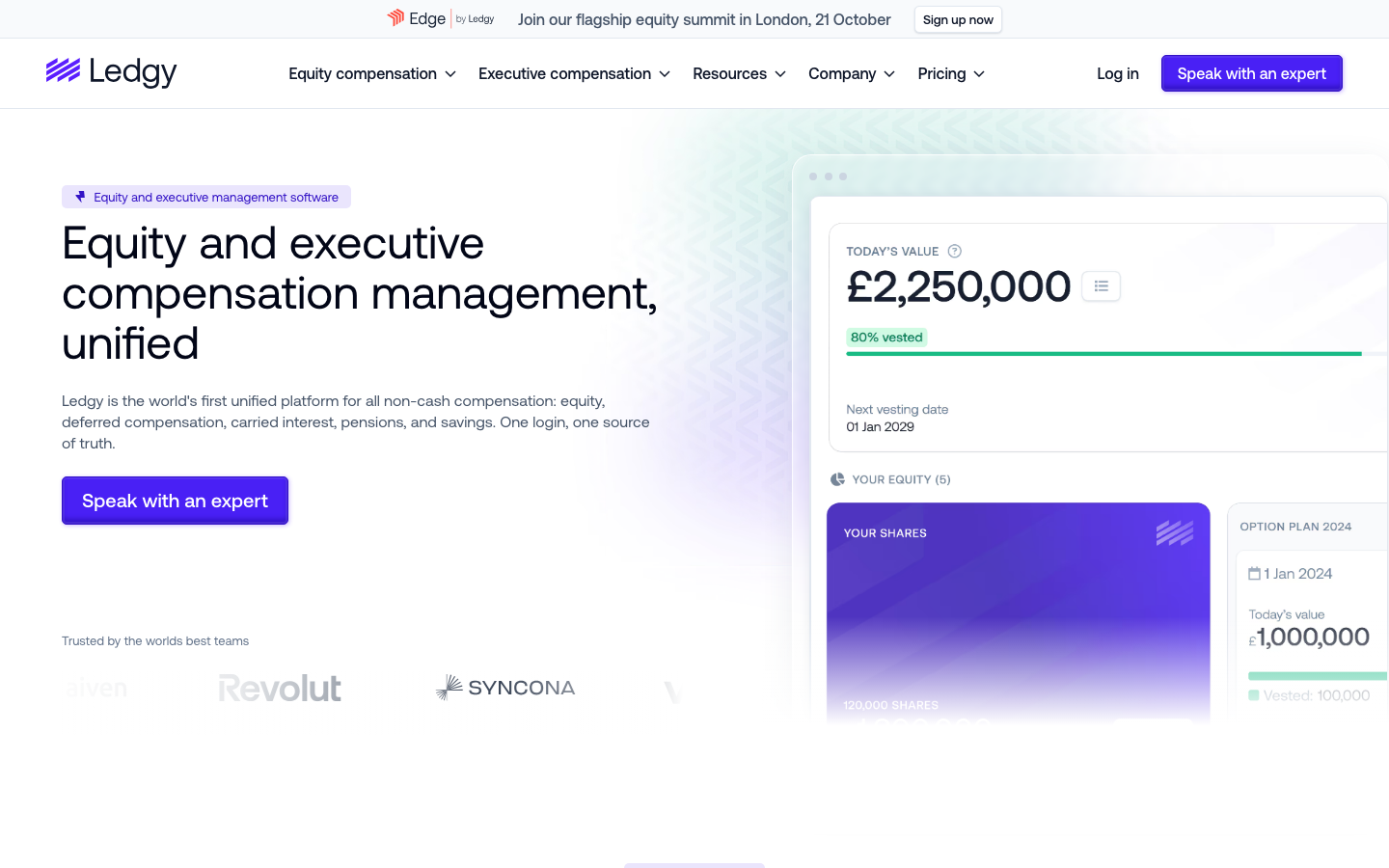
Ledgy is a UK and European share plan platform for scale-ups through public companies. It covers equity plans and grants, EMI reporting, and SAYE, with HMRC, 409A, and BSPCE valuations. Ledgy Agent completes admin tasks after approval, and Ledgy MCP connects AI assistants to live equity data. The free Launch plan covers up to 50 stakeholders.
Software Pros
- 70+ HRIS integrations from the Scale plan
- Global mobility reporting on Enterprise
- IFRS 2, FRS 102, and ASC 718 expensing as an add-on
Software Cons
- Scale starts at €5,000 a year
- The financial reporting add-on starts at €3,000 a year
- SAML SSO only on Enterprise
Ledgy Review
It earns its keep for a European scale-up with employees in several countries and an IPO on the horizon. Employees get dashboards showing their holdings and scenarios, and the Enterprise plan adds localized dashboards. Enterprise starts at €18,000 a year and includes IPO readiness support. Budget for the reporting add-on, since share-based payment expensing is not in the base price.
Our Verdict
European Scale-Ups Heading to IPO
*As pricing is subject to change, prices are listed as they stand in October 2026
Morgan Stanley at Work
Quick Overview
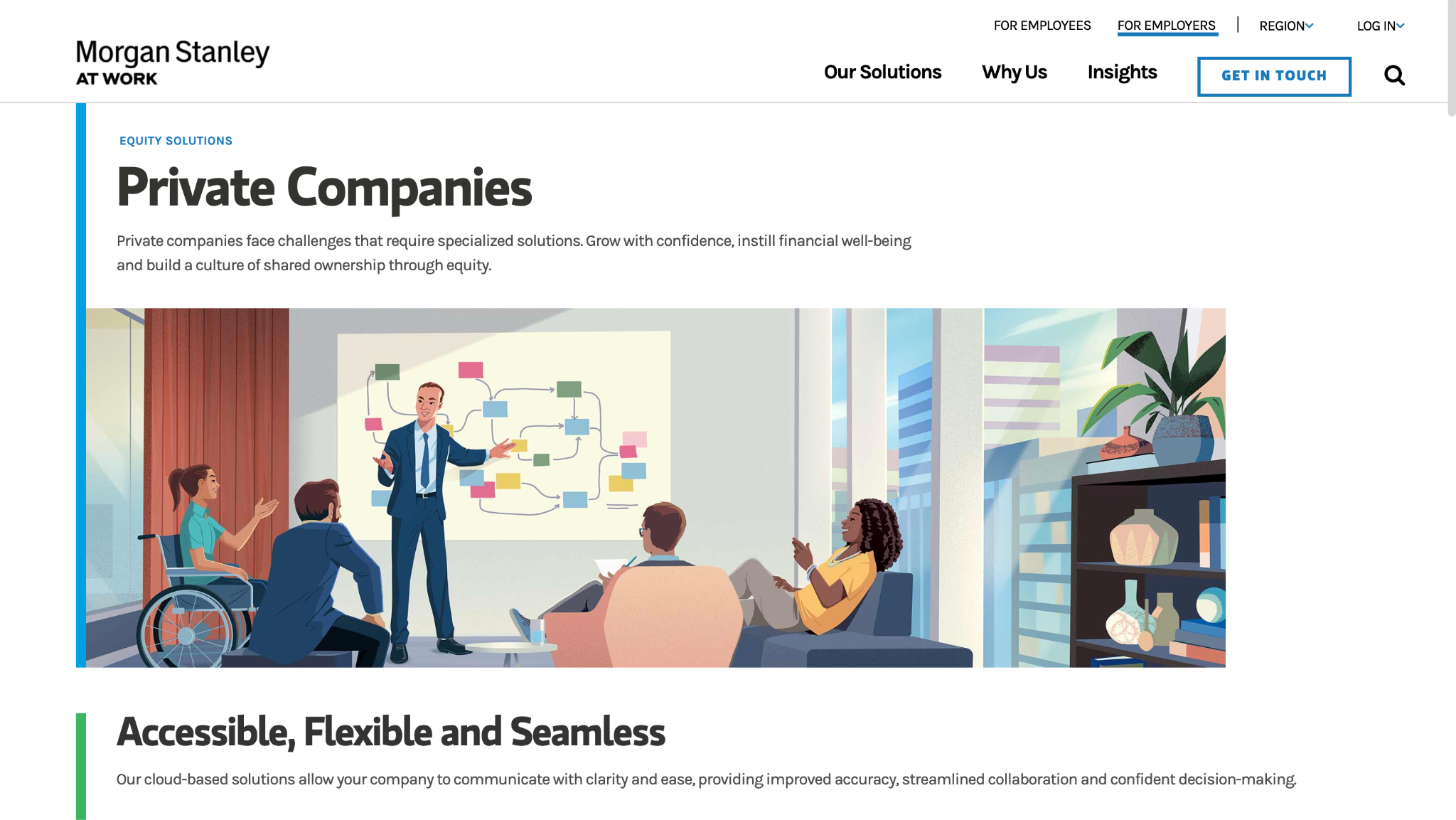
Morgan Stanley at Work, formerly Shareworks, is an enterprise stock plan administrator for private and public companies. It covers cap table management, plan administration, 409A valuation services, and liquidity events. Its global intelligence service helps with tax and legal complexity across countries. It names no AI feature on its equity pages.
Software Pros
- 409A services and liquidity events from 1 provider
- Financial wellness education for every participant
- Stock plan accounts for public company employees
Software Cons
- Pricing is quote-only
- Private and public offerings sit on separate pages
- 32 G2 reviews, listed under Shareworks
Morgan Stanley at Work Review
This fits a large private company planning liquidity events or a public company with participants worldwide. Morgan Stanley at Work notes that its stock plan accounts were previously called Shareworks, StockPlan Connect, or E*TRADE accounts. Employees get financial wellness tools and access to Financial Advisors alongside their equity. Smaller startups will find more than they need here.
Our Verdict
Equity Plus Brokerage at Scale
Optio Incentives
Quick Overview
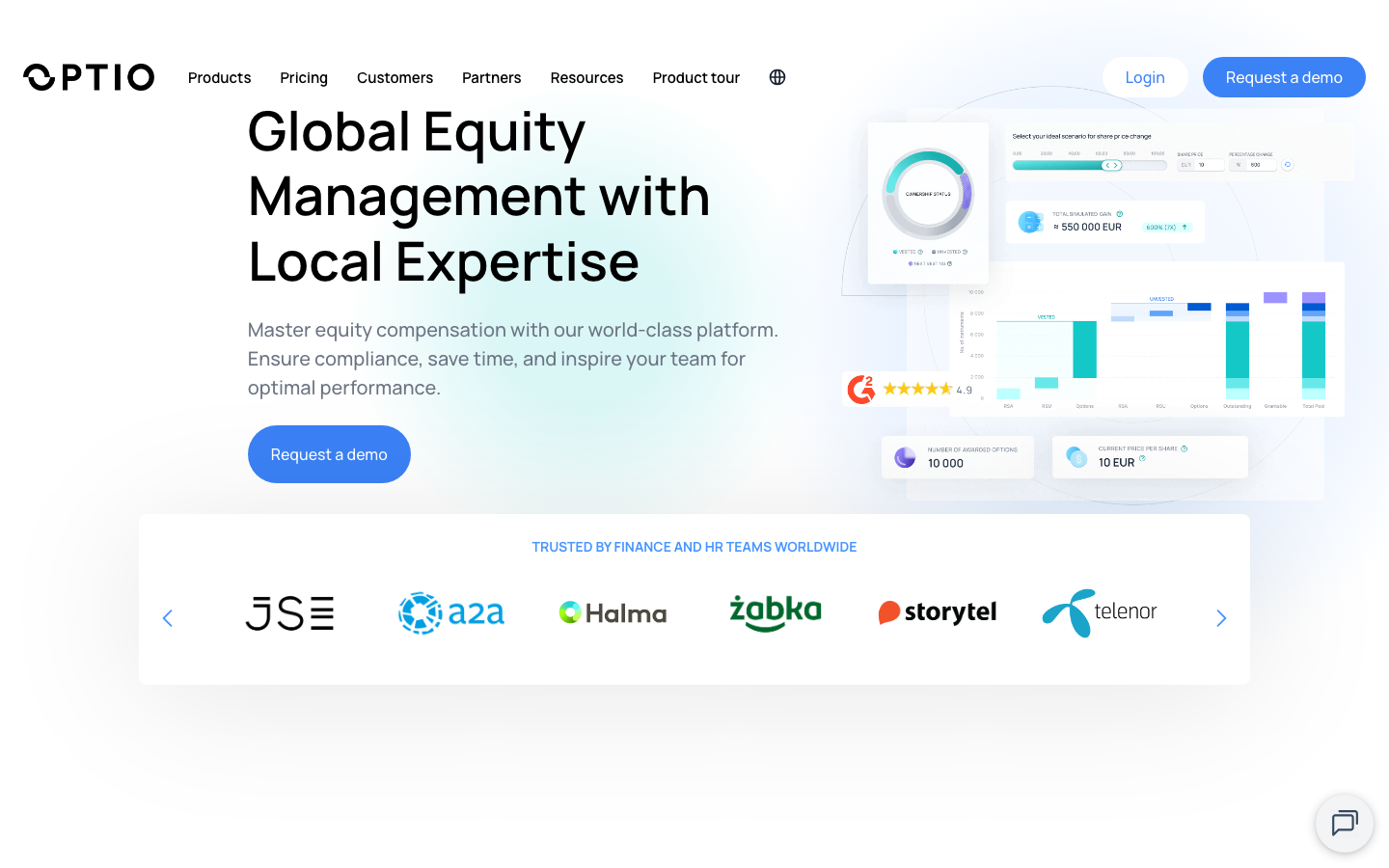
Optio Incentives is a UK and European share plan platform for the Nordics, Europe, and the UK, from startups to listed companies. It covers share plans, EMI, SAYE, and employee share purchases. Its Pre IPO plan adds fair value and 409A valuations plus cost amortization. The vendor says it serves 500+ clients with shareholders in more than 130 countries.
Software Pros
- Employee portal with gains modeling on every plan
- Share warehousing and sell-to-cover for listed companies
- Employer tax and remuneration report data on Public
Software Cons
- Every plan is quote-only
- Strongest in the Nordics and Europe
- Valuations wait for the Pre IPO tier
Optio Incentives Review
For a team that runs share plans across the Nordics and Europe, Optio Incentives covers the path from startup to stock exchange. Employees use a portal to model their gains, and Scale adds end-to-end plan management. Public plans add share warehousing, settlement directly to employees, and dilution reports. Scale includes a dedicated customer success manager to help first-time plan owners.
Our Verdict
Nordic Plans Through to Listing
Qapita
Quick Overview
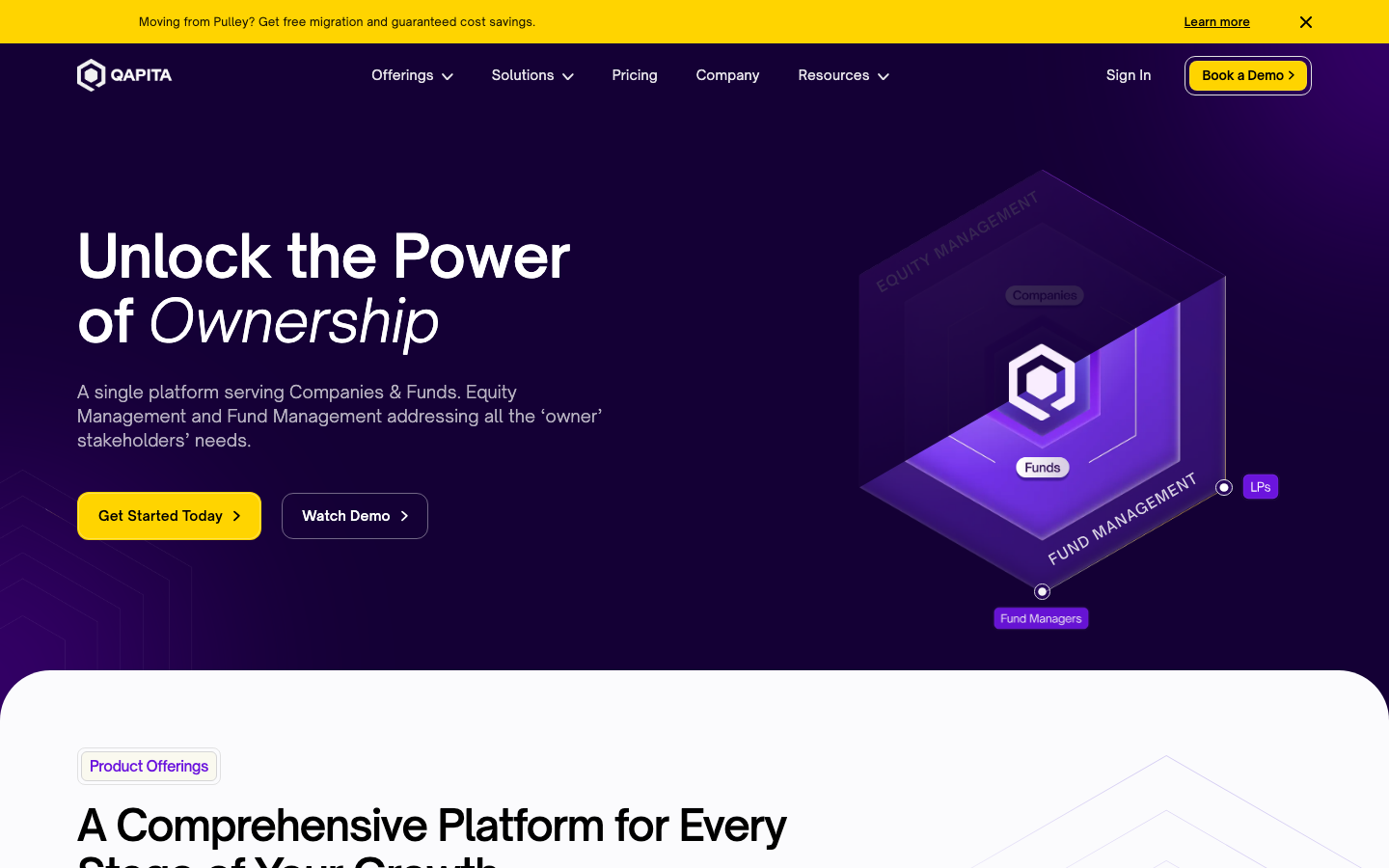
Qapita is a startup cap table and equity platform for private companies up to IPO. It offers equity plan management, funding round modeling, and DocuSign for grants. It reports 2,400+ companies served in 60+ countries, with 500,000+ stakeholders. It names no AI feature.
Software Pros
- Free Spark plan up to 25 stakeholders
- 409A report included on the Growth plan
- ASC 718 and IFRS reporting on Enterprise
Software Cons
- $40 to $60 a year for each extra stakeholder
- HRIS integration and SSO only on Enterprise
- Valuation reports priced per report
Qapita Review
I’d point Qapita at a startup with teams in the US and Asia that wants 1 cap table across borders. Surge costs $1,600 a year for 40 stakeholders, and Growth costs $3,000 for 50, with a 409A report. Enterprise adds a helpdesk for plan participants. Employee town halls with an equity expert cost $500 an hour, a useful add-on when staff do not understand their grants.
Our Verdict
Cross-Border Equity for Growing Teams
*As pricing is subject to change, prices are listed as they stand in October 2026
SeedLegals
Quick Overview
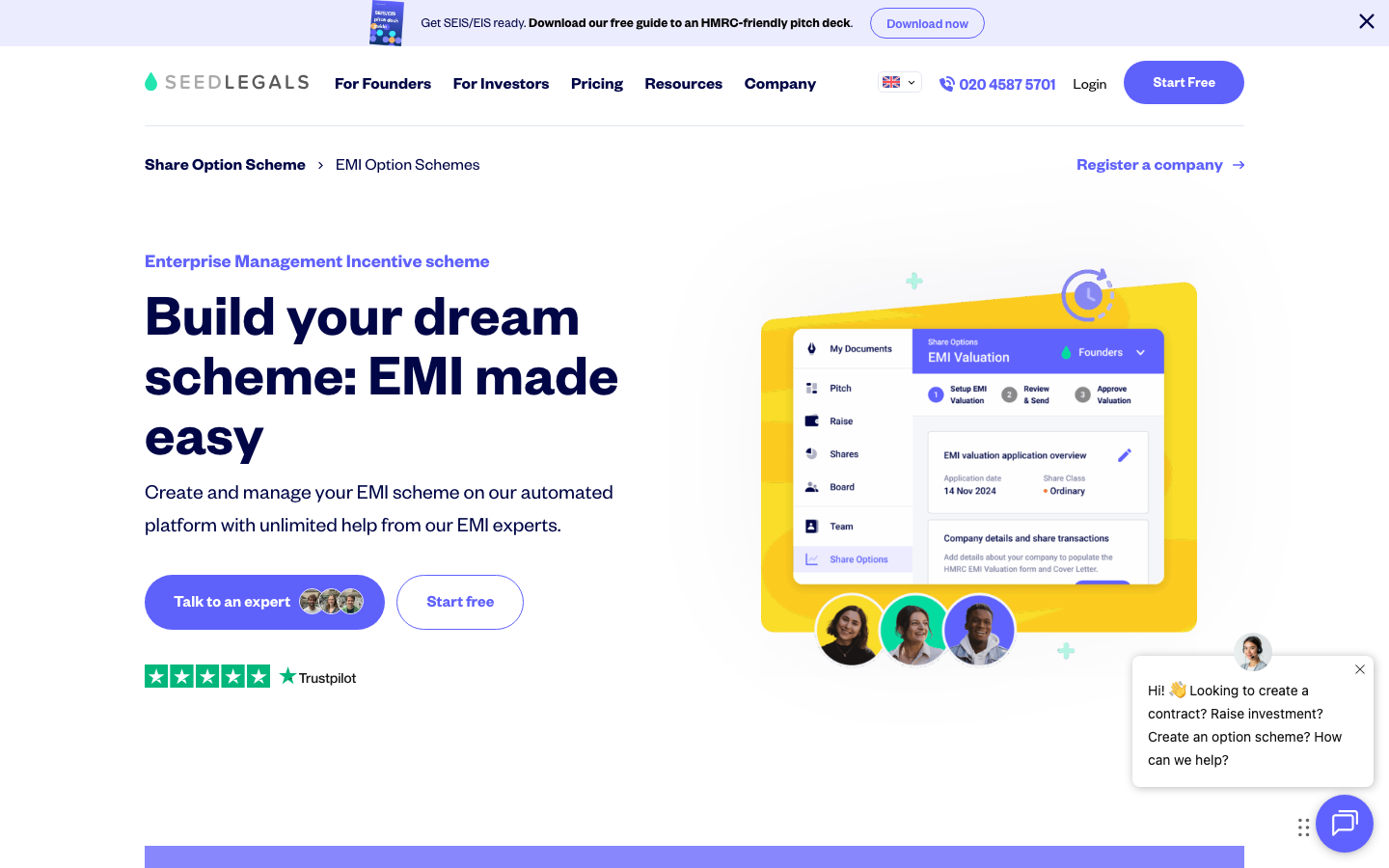
SeedLegals is a UK share plan platform for setting up and running EMI option schemes. Unapproved options, HMRC registration, and option grants sit on 1 automated platform. Its Options plan includes unlimited EMI valuations and unlimited support from share option specialists. The vendor invites founders to join over 14,000 UK companies using EMI schemes.
Software Pros
- Guided EMI setup from valuation to HMRC registration
- Unlimited EMI valuations on the Options plan
- Option holder portal for staff
Software Cons
- Built for UK companies only
- The Options plan costs £2,699 a year plus VAT
- 2 G2 reviews, too few to judge
SeedLegals Review
Employees will see their options in a holder portal designed to keep them engaged, which matters at a startup handing out its first grants. SeedLegals suits UK startups from first hire to Series A that want specialists checking each step. The Options plan covers unlimited schemes and grants for 1 fixed annual fee. It names no AI feature on its EMI pages.
Our Verdict
EMI Schemes Done With You
*As pricing is subject to change, prices are listed as they stand in October 2026
Vestd
Quick Overview
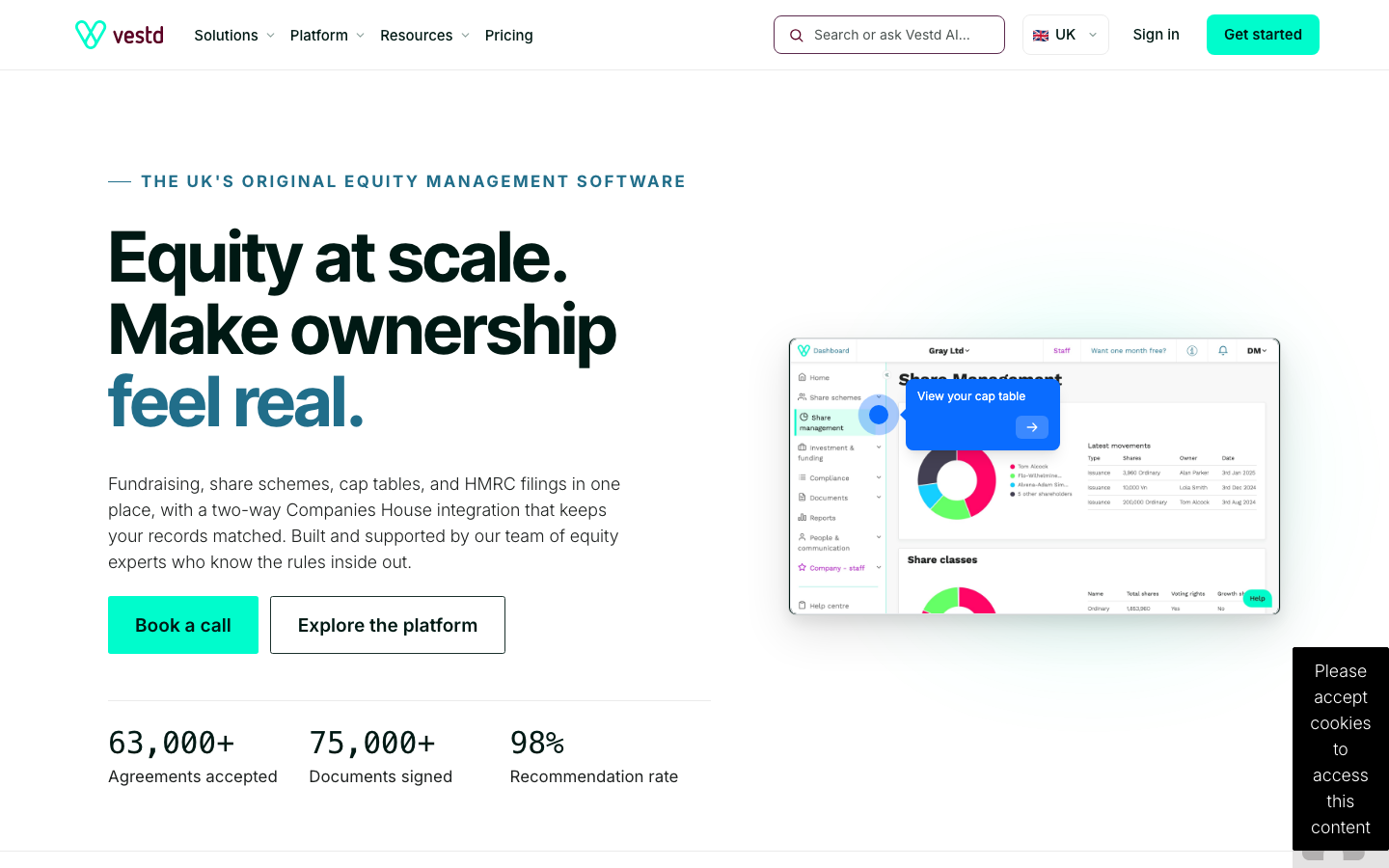
Vestd is a UK share plan platform for startups and SMEs, covering EMI, CSOP, growth shares, unapproved options, and phantom shares. It adds a cap table and Companies House filings. It is authorized and regulated by the FCA and offers a Vestd AI search assistant. The vendor reports 63,000+ agreements accepted on the platform.
Software Pros
- Companies House integration that syncs in both directions
- Unlimited HMRC valuations on the Guided service plan
- Specialists handle the HMRC and legal steps
Software Cons
- Prices exclude VAT with a 12-month minimum term
- Focused on the UK
- EMI needs the £420 Guided service plan
Vestd Review
This one suits a UK SME that wants a share scheme designed with a specialist rather than alone. Essentials starts at £25 a month for cap table work, Starter at £220, and Guided service at £420, with annual billing giving 2 months free. Employees track grants, vesting, and exercises in 1 place. Enterprise adds IFRS 2 reporting support for companies with 200+ stakeholders.
Our Verdict
Guided UK Share Schemes
*As pricing is subject to change, prices are listed as they stand in October 2026
FAQs About Equity Compensation Software
What does equity compensation software do?
It grants awards, tracks vesting and exercises, and keeps the cap table current as people join, leave, or buy shares. Most platforms also produce valuation, accounting, and tax reports, such as US 409A valuations and ASC 718 or IFRS 2 expense reports. Employees get a portal showing what they hold and its value. The goal is 1 accurate record that lawyers, auditors, and staff can all trust.
What is the difference between stock options and RSUs?
A stock option gives the right to buy shares at a fixed strike price after vesting. It has value only if the share price rises above that price. An RSU delivers shares, or their cash value, once vesting conditions are met, with no purchase price. Startups grant options more often, while larger companies lean on RSUs, and each is taxed differently by country.
What are phantom or virtual shares?
Phantom or virtual shares are awards that track the value of real shares without issuing any. When they pay out, usually at an exit, holders receive cash, or sometimes shares, equal to that value. They are common in parts of Europe, including Germany, because they avoid adding employees to the share register. The trade-off is that holders get no voting rights or dividends along the way.
Do I need a 409A or EMI valuation?
US companies granting stock options usually get a 409A valuation, an independent appraisal that supports the strike price and helps protect employees from tax penalties. UK companies granting EMI options typically agree a share valuation with HMRC first. Both are general practices, and your legal and tax advisers should confirm what your company needs. Many platforms sell valuations as an add-on, priced per report or per year.
Can a company grant equity to employees in other countries?
Yes, but each country taxes awards differently, and some award types do not work everywhere. An option that works well in the US may be taxed at grant elsewhere, while phantom shares can be simpler abroad. Software helps track local rules, withholding, and reporting for each holder. Local legal and tax advice is still needed before launching a plan in a new country for the first time.
How is equity granted to employees hired through an employer of record?
The employer of record employs the person on paper, while the parent company grants the award under its own plan. The grant agreement, local tax reporting, and any payroll withholding then involve both organizations, so responsibilities should be written down clearly. Check that your platform records these employees correctly and supports their country. This is general information, not legal advice for any case.
What happens to my data if my equity software shuts down?
Export everything while you still have access: the cap table, grant agreements, vesting schedules, exercise history, and valuation reports. Pulley is a recent example, since it announced it will close on December 8, 2026, with Carta as its migration partner. Its customers were told to move before that date to keep their records. Whatever vendor you use, check its export options before you sign.
Is equity compensation taxed when it vests or when it is sold?
It depends on the award type and the country, and nothing here is tax advice. Some awards are taxed when they vest, others when you exercise an option, and gains are often taxed again when you sell shares. Tax-advantaged schemes such as the UK EMI change that timing for qualifying employees. Employees should check local rules with a qualified adviser before acting on any grant.

Helen is Anywherer’s Market Analyst & Content Researcher, with extensive experience in analyzing global employment markets and HR technology trends. She is skilled at turning complex market data into clear, well-researched insights that inform every piece of content. With a strong grasp of the EOR, PEO, and international hiring space, Helen plays a key role in keeping Anywherer’s research accurate, up to date, and genuinely useful for readers.