OKR stands for objectives and key results, a goal method built on a few ambitious outcomes. Each outcome includes numbers that prove progress toward it. An objective is the qualitative direction, such as winning the mid-market. A key result is a measurable checkpoint with a start value and a target, such as lifting net revenue retention from 98% to 105%. Choosing the best OKR software starts with understanding that structure.
Alignment links goals across levels. Vertical alignment connects company, team, and individual OKRs, while horizontal alignment links teams that depend on each other. Each OKR cycle, usually a quarter, runs on check-ins, meaning short updates on progress and confidence. The cycle ends with scoring: a grade for how much of each key result was achieved, usually on a 0.0 to 1.0 scale.
What Is the Best OKR Software in 2026?
OKR software gives that structure a home. It stores objectives and key results, shows how they connect across the company, reminds owners to check in, and keeps a history of each cycle. Good OKR management software also pulls progress from the tools where work happens, so updates do not depend on memory. The buyers are founders, chiefs of staff, strategy and operations leads, and the HR leaders who run the process. Product and engineering leaders join them when key results must reflect what ships.
Google’s Work guide to OKRs explains the original method. Key results are graded on a 0 to 1.0 scale, with a sweet spot of 60% to 70%. Full scores suggest the goals were not ambitious enough. The guide also recommends checking in throughout the quarter. That step is where most programs break. OKRs usually stall in the second quarter, when check-ins stop, and the spreadsheet holding them goes stale.

INSIGHT: Do employees actually know what they are working toward?

Most OKR programs fail on clarity and follow-through, not on the goals themselves.
- Gallup’s engagement indicator shows that, as of May 2026, 31% of US employees are engaged at work, and 17% are actively disengaged.
- Google’s Work guide says low grades should be viewed as data to help refine the next OKRs, not as a failure to punish.
- OKRs set in January and opened again in March are not OKRs; they are a document.
No single tool wins, because the category covers 4 ways of running OKRs. Dedicated OKR platforms are built around the cycle itself. Jira and Atlassian tools put OKRs next to engineering work. Product roadmap tools tie key results to features and releases, and enterprise strategy suites run OKRs inside wider strategy or performance processes. The need for clarity is real. Gallup reports that, as of May 2026, only 49% of US employees knew what was expected of them at work. Below, I’ve reviewed 12 of the leading tools in A-Z order.
INSIGHT: Dedicated OKR tool, Jira, roadmap, or strategy suite?
The 12 tools here run OKRs in 4 different places, and the right one is usually where your team already does its work.
- Dedicated OKR platforms (Perdoo, Profit.co, Synergita, Weekdone): built around the OKR cycle.
- Jira and Atlassian (Atlassian Goals, Jira Align, OKR in Jira, UpRaise): OKRs next to engineering work.
- Product roadmap tools (Aha! Roadmaps, Productboard): key results linked to features and releases.
- Enterprise strategy suites (Inspire Software, WorkBoard): OKRs inside wider strategy and performance processes.
Best OKR Software 2026 Comparison
Picking the best OKR tracking software starts with where progress comes from, so the table sorts the 12 by group. Rows follow the same A-Z order as the reviews below. Prices sit in the pricing section, where the plan that includes OKRs matters as much as the number.
| Tool | Group | Best for | Key results update from | AI features | Free plan | G2 rating |
|---|---|---|---|---|---|---|
| Aha! Roadmaps | Product roadmap tool | Product teams tying roadmap work to key results | Manual updates, linked roadmap work | Elle | No | 4.4 (369) |
| Atlassian Goals | Jira and Atlassian | Teams already on Jira and Confluence | Written updates, linked projects and epics | Rovo status updates | Included | N/A |
| Inspire Software | Enterprise strategy suite | Mid-size companies running OKRs with reviews | Manual check-ins | AI, not itemized | No | 4.7 (112) |
| Jira Align | Jira and Atlassian | Large enterprises running scaled agile | Jira delivery data | Not itemized | No | 4.1 (12) |
| OKR in Jira | Jira and Atlassian | Engineering teams updating key results from Jira | Jira work items, Power BI, API | AI Assistant integration (MCP) | Yes | 4.6 (16) |
| Perdoo | Dedicated OKR platform | Startups and SMBs starting with OKRs | Check-ins, integrations | AI Assistant, AI Coach | Yes | 4.4 (551) |
| Productboard | Product roadmap tool | Product organizations prioritizing against objectives | Linked initiatives and features | Productboard Spark | No | 4.2 (256) |
| Profit.co | Dedicated OKR platform | Growing companies wanting OKRs and strategy in 1 place | Check-ins, integrations | Athena AI, AI Authoring | No | 4.7 (499) |
| Synergita | Dedicated OKR platform | Startups and budget-conscious teams | Check-ins, Jira on Growth | OKR Pilot | Yes | 4.6 (54) |
| UpRaise | Jira and Atlassian | Jira teams wanting OKRs and feedback together | Linked Jira issues | None named | Yes | 3.8 (4) |
| Weekdone | Dedicated OKR platform | Small teams wanting a weekly OKR rhythm | Weekly check-ins | None named | Yes | 4.2 (36) |
| WorkBoard | Enterprise strategy suite | Large enterprises across business units | Scorecards, integrations | WorkBoardAI agents | No | 4.6 (308) |
G2 ratings were read on October 28, 2026.
OKR Software vs Goal-Setting and Performance Management Tools
A tool earns the OKR label when it handles the full OKR methodology. That means measurable key results with start and target values, alignment across levels, regular check-ins, and end-of-cycle scoring. Broader goal setting software supports OKRs as 1 format among several, next to SMART goals and simple targets. That flexibility suits HR-led goal programs, but it often leaves out scoring and alignment views.
Many HR suites bundle OKRs with reviews, feedback, and 1:1 meetings, the territory of performance management software. Those suites suit companies that want 1 vendor for every people process. Dedicated OKR tools suit companies whose main need is alignment and execution rather than appraisal, and they usually go deeper on check-ins and strategy maps.
Keep OKR scores apart from pay and ratings. Ambitious key results stop being ambitious the moment missing them costs someone a bonus, and people start setting targets they know they can hit. Individual performance belongs in employee evaluation software and review conversations, while OKRs set the team’s direction.
What Does AI Do in OKR Software?
AI in this category drafts, summarizes, and answers questions. Profit.co’s AI Authoring and Synergita’s OKR Pilot generate objectives and key results from a prompt. WorkBoard uses agents to assist OKR creation and team retros. Profit.co’s AI Summaries condense reviews, Atlassian Goals uses Rovo to create status updates, and Perdoo offers an AI Assistant and AI Coach. Productboard Spark draws on product strategy and objectives as context for product decisions.
The limit is judgment. AI can write a measurable key result, but it cannot know whether that result matters this quarter. Drafts need the owner’s call, and progress summaries are only as good as the check-ins behind them. A summary of stale updates is simply a polished version of stale data.
Plans and meters matter too. Profit.co runs AI on credits, with 500 per user per month on Essentials. Synergita includes 60 or 120 pooled AI credits per user, depending on the plan. OKR in Jira puts its AI Assistant integration on the Advanced edition with 10 seats included. Weekdone and UpRaise have no AI features at all.
Best OKR Software by Team Type
These groupings follow team type and where work is tracked, not a score. Tools appear in A-Z order in each group, and a tool named twice is broad rather than better. The right OKR software for teams that live in Jira looks nothing like the right tool for a 30-person agency. Company size also changes the answer, mostly through price and setup time.
Best OKR Software for Startups and Small Teams
Startups need a free plan for the first few users, a simple weekly check-in, and no setup project. Perdoo is free for up to 5 users and includes strategy maps, OKR and KPI tracking, and its AI Assistant and Coach. Synergita’s Starter plan is free for up to 3 users, with alignment, templates, and reminders. Weekdone is also free for up to 3 users and builds OKRs around a weekly Plans, Progress, Problems report. All 3 can launch a first quarter of OKRs in an afternoon, which matters more than depth at this stage.
Best OKR Software for Small Business and Mid-Sized Companies
Once OKRs cover several departments, KPIs matter alongside them. A KPI, or key performance indicator, tracks the health of ongoing work rather than a change. Inspire Software combines OKRs with continuous performance and recognition, priced per user in volume bands. Profit.co puts OKRs, strategy roadmaps, and balanced scorecards in its Essentials plan. Weekdone suits companies of 10 to 1,000 employees and includes a dedicated OKR coach in the package. Templates and coaching shorten the learning curve for teams new to the method.
Best Enterprise OKR Software
Enterprises need alignment across business units, scorecards for leadership reviews, and a link to portfolio planning. Jira Align connects company strategy to portfolio, program, and team delivery in Jira. It supports SAFe, the Scaled Agile Framework used by large engineering organizations. Profit.co’s Enterprise plan adds data residency, audit logs, SCIM, and SSO. WorkBoard runs OKRs across business units with AI agents and absorbed Quantive’s customers after acquiring it in May 2025. Expect quote-only pricing or, for Jira Align, a published enterprise floor.
For Product and Engineering Teams
Product and engineering leaders want key results tied to features, epics, and releases, so progress reflects what shipped. Aha! Roadmaps links initiatives, releases, epics, and features to each objective on its Enterprise+ plan. OKR in Jira updates key results automatically as Jira work items move, which makes it practical OKR software for engineering projects. Productboard connects product objectives to initiatives and features, with objective hierarchy on Enterprise. The catch is scope, since these tools cover product teams well and the rest of the company poorly.
For Teams Already Working in Jira and Atlassian
Teams on Jira can skip adopting a new tool and keep goals next to the work. Atlassian Goals sits in Atlassian Home, links goals to projects and Jira epics, and documents OKR scoring on a 0.0 to 1.0 scale. OKR in Jira adds a strategy map, executive dashboards, and, on Advanced, a portal for people outside Jira. UpRaise lets teams link Jira issues as key results and run feedback in the same app. The trade-off is reach, because OKRs then live only where engineering lives. The rest of an Atlassian-based team’s stack is covered in our guide to remote work tools.
How Much Does OKR Software Cost?
Pricing units vary by group. Perdoo, Synergita, and Weekdone charge per user after a free tier. If you’re looking for the best free OKR software, you’ll find genuine free plans among them. Profit.co offers a 30-day trial before its paid Essentials plan. Atlassian Goals comes with Atlassian Cloud apps, while OKR in Jira and UpRaise bill through the Atlassian Marketplace by Jira user tier. Aha! Roadmaps keeps OKRs on its top plan, and Jira Align and WorkBoard sell enterprise contracts. AI credits, view-only seats, and the plan that includes OKRs change the real price.
| Tool | Pricing model | Free plan or trial | Published starting price | Plan that includes OKRs |
|---|---|---|---|---|
| Aha! Roadmaps | Per user per month | 30-day trial | $149/user/month (Enterprise+) | Enterprise+ only |
| Atlassian Goals | Included with Atlassian Cloud | Included | No separate price | Goals app |
| Inspire Software | Per user, volume bands | Not stated | $16/user/month billed annually (50-99 users) | Single plan |
| Jira Align | Annual Strategy Collection | No free trial | $77,400/year for 1-50 users | Strategy Collection |
| OKR in Jira | Marketplace, by Jira user tier | Free up to 10 users | $108/month for 50 users (Standard, monthly) | Both editions |
| Perdoo | Per user, volume pricing | Free up to 5 users | $9/user/month at 10 users, billed annually | All plans |
| Productboard | Quote | Not stated | Custom pricing | Objective hierarchy on Enterprise |
| Profit.co | Plan quote | 30-day trial | Custom pricing | Essentials |
| Synergita | Per user per month | Free up to 3 users | $3/user/month billed annually (Lite) | All plans |
| UpRaise | Marketplace, by Jira user tier | Free up to 10 users | $125/month for 50 users (Standard) | Both editions |
| Weekdone | Package by company size | Free up to 3 users; 14-day trial | $108/month for a 10-user package | All plans |
| WorkBoard | Quote | Demo | Custom pricing | All plans |
As pricing is subject to change, prices are listed as they stand in October 2026.
INSIGHT: What does OKR software actually cost?
The plan that includes OKRs, the AI credits, and the number of paid seats matters more than the headline price.
- 8 of the 12 publish a starting price, 3 quote (Productboard, Profit.co, WorkBoard), and Atlassian Goals comes with Atlassian Cloud apps. 5 run a free plan or free tier: OKR in Jira, Perdoo, Synergita, UpRaise, and Weekdone.
- Per-user prices at Inspire Software and Perdoo fall as headcount rises, and Marketplace apps price by Jira user tier. Jira Align starts at $77,400 a year for up to 50 users.
- In product roadmap tools, OKRs sit on the most expensive plan. Aha! Roadmaps lists them on Enterprise+ at $149 per user per month.
Sources:
all read October 28, 2026
How to Choose OKR Software
I would start with where the work behind your key results is tracked, whether Jira, a roadmap tool, a CRM, or spreadsheets. That determines whether progress updates automatically or relies on manual check-ins. Then decide who sets OKRs: leadership only, every team, or individuals. The answer shapes how much alignment you need, and it narrows the field to an OKR software solution with a handful of real candidates.
Check the alignment views and the check-in reminders, because those keep the cycle alive after week 3. Leadership reviews need dashboards that show progress and confidence at a glance. The top OKR software with the best dashboards lets you filter by team without exporting to slides. Confirm which plan includes OKRs and AI, and count view-only users, since some vendors charge for them.
Decide whether you need KPIs next to OKRs, because many teams track both and do not want 2 tools. Then run 1 full quarter as a pilot with 2 or 3 teams before a company-wide rollout. A pilot shows which reliable OKR software people still open in week 10, and that is the only test that really matters.
Top 12 Best OKR Software in 2026
I built these best OKR software 2026 reviews from each vendor’s product, documentation, and pricing pages, read in October 2026. Jira apps were checked on the Atlassian Marketplace. G2 ratings come from each product profile as of October 28, 2026, and vendor numbers are labeled as vendor claims.
The 12 OKR software tools below start with dedicated platforms like Perdoo and Weekdone. They also include Jira apps like OKR in Jira and enterprise suites like WorkBoard. Each block says how key results update, how alignment is shown, and which plan includes OKRs.
I’m listing all providers in alphabetical order to keep this comparison neutral.
Aha! Roadmaps
Quick Overview
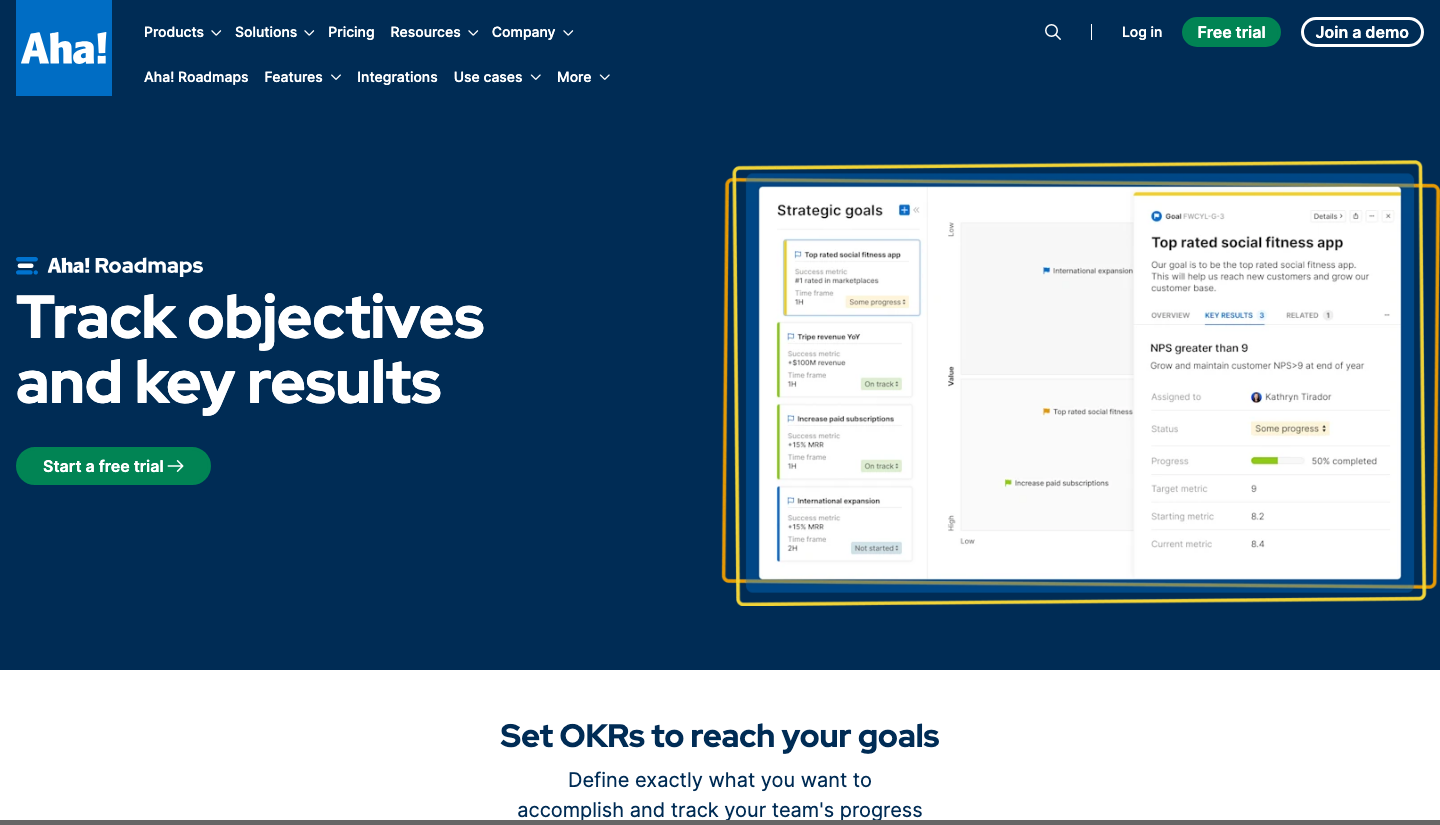
Aha! Roadmaps is a product roadmap tool where OKRs are available on the Enterprise+ plan only, while lower plans have goals without key results. Owners update the current value of each key result, and initiatives, releases, epics, and features link to objectives. Elle, the Aha! AI assistant, works across the product.
Software Pros
- Roadmap work links straight to each objective
- Reports show all OKRs and related work in 1 view
- Read-only users are free on Enterprise plans
Software Cons
- OKRs require Enterprise+ at $149 per user per month
- Key results update by hand, with reminders as to-dos
- Covers product teams, not the whole company
Aha! Roadmaps Review
I’d pick this for a product organization that already plans in Aha! and wants objectives in the same place. Alignment runs from company objectives down to divisions and product lines. Check-ins are manual, since owners update the current metric, often through a recurring to-do. Premium costs $59 and Enterprise $99 per user per month billed annually, but neither includes OKRs.
Our Verdict
OKRs Inside the Product Roadmap
*As pricing is subject to change, prices are listed as they stand in October 2026
Atlassian Goals
Quick Overview
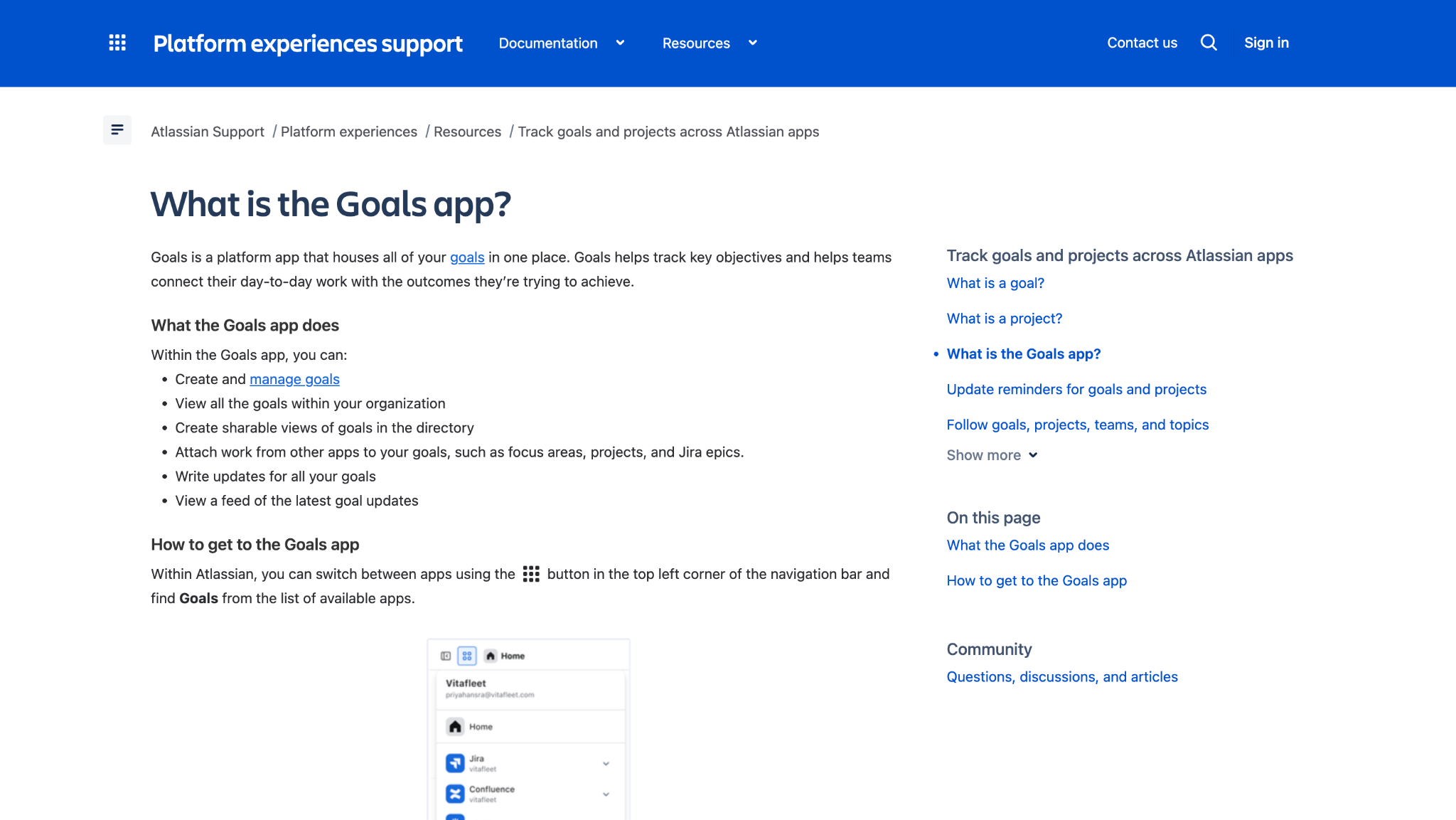
Atlassian Goals is a Jira and Atlassian Goals app in Atlassian Home. Teams create goals, attach projects, focus areas, and Jira epics, and write updates in a shared feed. Atlassian documents OKR use with key results and 0.0 to 1.0 scoring. Rovo can create status updates.
Software Pros
- No new tool for teams already on Atlassian
- Goals link directly to projects and Jira epics
- Update reminders and a feed of the latest goal updates
Software Cons
- Updates are written by hand, not calculated from issues
- Fewer OKR-specific views than dedicated tools
- No G2 product profile to check
Atlassian Goals Review
The team this fits is a company that runs on Jira and Confluence and wants goals visible without buying anything new. Updates arrive as scheduled posts with reminders, and a feed shows the latest changes. Atlassian’s scoring guidance treats 0.7 as the target and 0.0 to 0.3 as off track. Teams that want a strict OKR process will need more structure than this.
Our Verdict
Built-In Goals for Atlassian
Inspire Software
Quick Overview
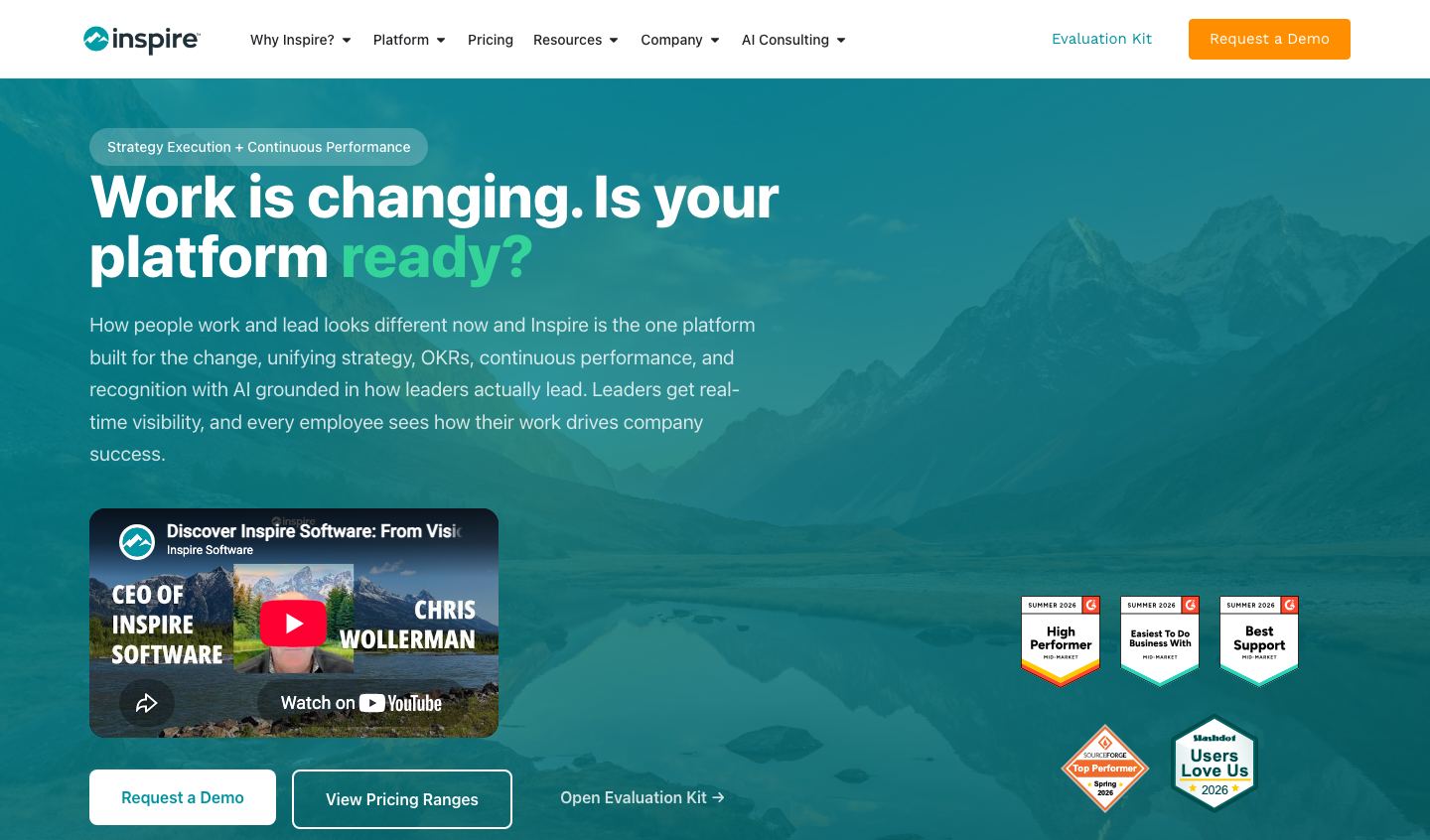
Inspire Software is an enterprise strategy suite that connects company strategy to team and individual OKRs, with goal check-ins, performance conversations, and recognition. Every feature sits in 1 plan priced per user. Existing Fitbots customers can move to Inspire under a partnership between the 2 companies.
Software Pros
- OKRs, performance conversations, and recognition together
- Published per-user prices with volume bands
- Manager dashboards that surface trends early
Software Cons
- Published bands start at 50 users
- AI features are not itemized on the site
- A broader suite than teams wanting only OKRs need
Inspire Software Review
This one suits a mid-size company of 300 to 500 employees that wants OKRs and continuous performance from 1 vendor. Check-ins tie goals to regular performance conversations, and alignment runs from vision to individual objectives. Pricing starts at $16 per user per month billed annually for 50 to 99 users, falling to $5 at 500 to 999 users. Coaching packages cost extra.
Our Verdict
OKRs Joined to Performance
*As pricing is subject to change, prices are listed as they stand in October 2026
Jira Align
Quick Overview
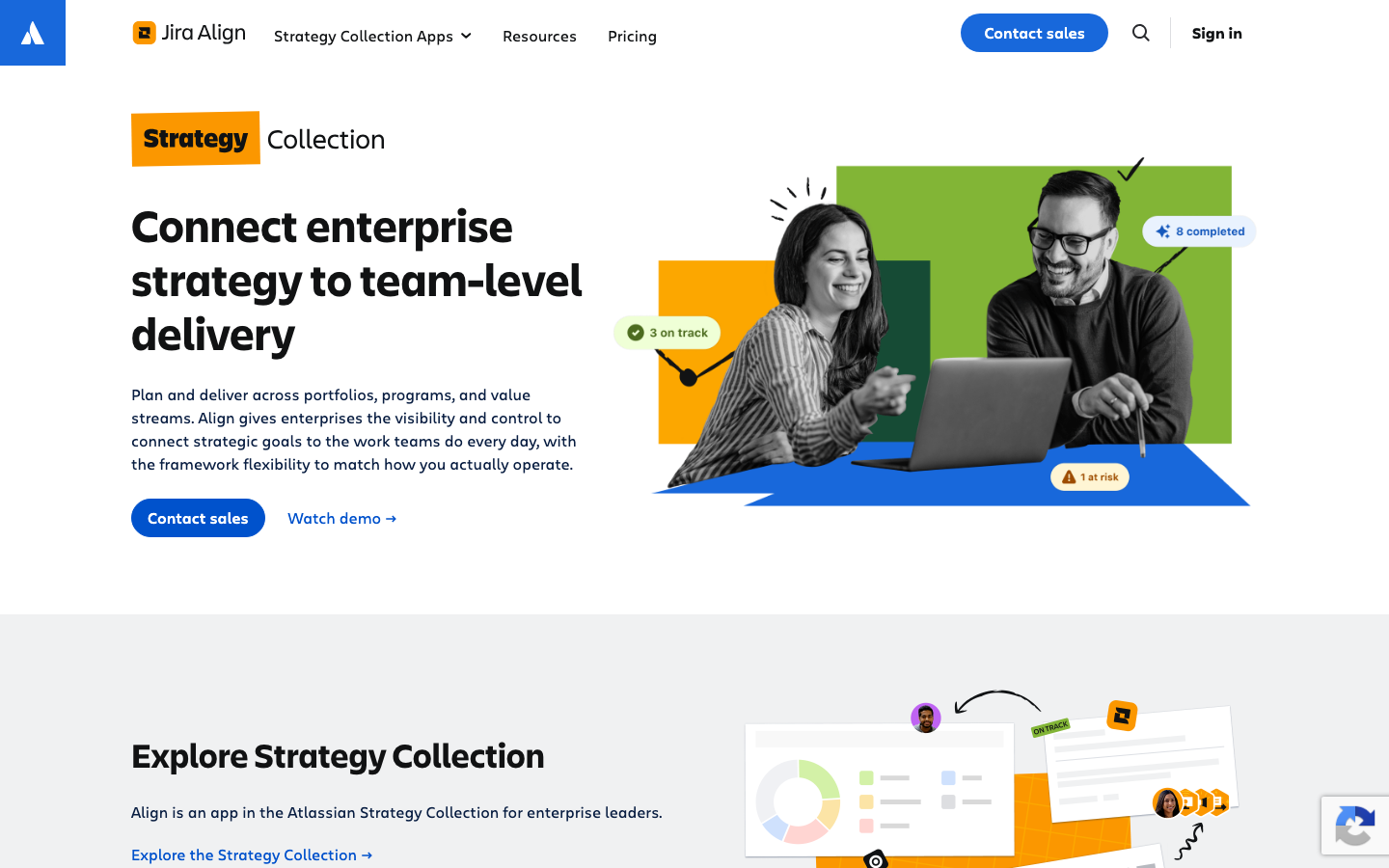
Jira Align is Atlassian’s enterprise app for linking strategy and OKRs to portfolio, program, and team delivery in Jira, sold in the Strategy Collection. Progress comes from Jira work across portfolios and value streams, with framework support for SAFe. It is Cloud-only and requires Jira Cloud Premium or higher.
Software Pros
- Connects strategy to delivery data across portfolios
- Dependency, risk, and funding views for executives
- Works with Jira and Azure DevOps
Software Cons
- Starts at $77,400 a year for up to 50 users
- No free trial
- 12 G2 reviews, a thin sample
Jira Align Review
The clearest case for Jira Align is a large enterprise running scaled agile across many teams. Key results draw on delivery data from Jira rather than manual check-ins, so leaders see progress, risks, and spend in 1 view. Buying it involves demos and a value assessment instead of a trial. Smaller companies will find the price floor out of reach.
Our Verdict
Scaled Agile Strategy Execution
*As pricing is subject to change, prices are listed as they stand in October 2026
OKR in Jira
Quick Overview
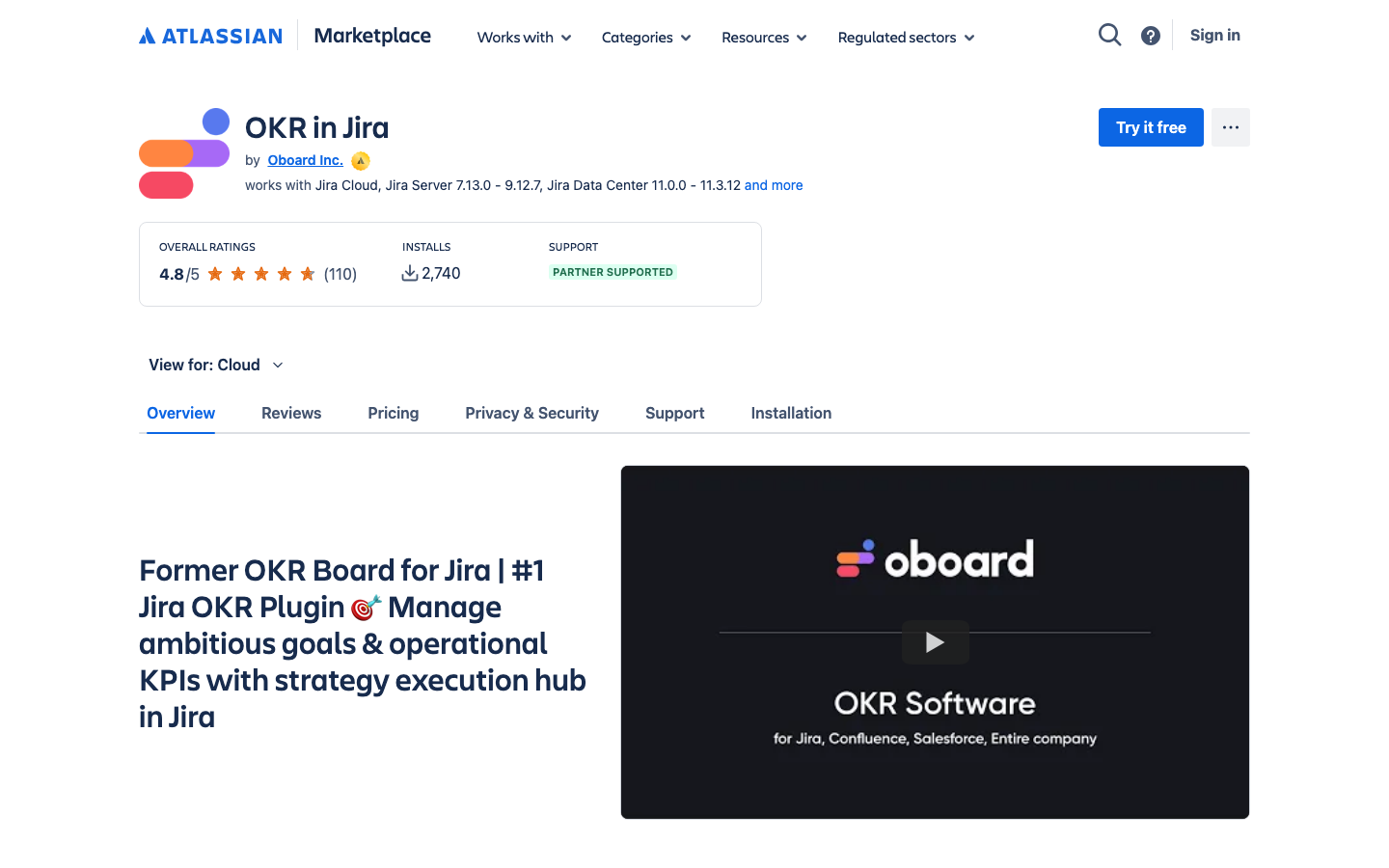
OKR in Jira is a Jira and Atlassian Marketplace app by Oboard, formerly OKR Board for Jira. Jira work items, Power BI metrics, and API data update its OKRs and KPIs automatically. A strategy map shows how company goals cascade to team OKRs. Its Marketplace listing shows a 4.8 rating from 110 reviews.
Software Pros
- Progress updates as Jira work moves
- Check-in schedules with Slack, Teams, Discord, and email alerts
- Standard is free for up to 10 users
Software Cons
- Executive portal and AI Assistant need the Advanced edition
- Only 10 portal and AI seats included on Advanced
- Requires Jira
OKR in Jira Review
It shines for engineering team that want key results to reflect real work instead of status meetings. Check-ins run on custom schedules, and dashboards give leadership a quick read. At 50 users, Standard costs $108/month and Advanced $129.50/month. The Advanced portal lets executives outside Jira follow the same goals without a Jira license of their own.
Our Verdict
Key Results Fed by Jira
*As pricing is subject to change, prices are listed as they stand in October 2026
Perdoo
Quick Overview
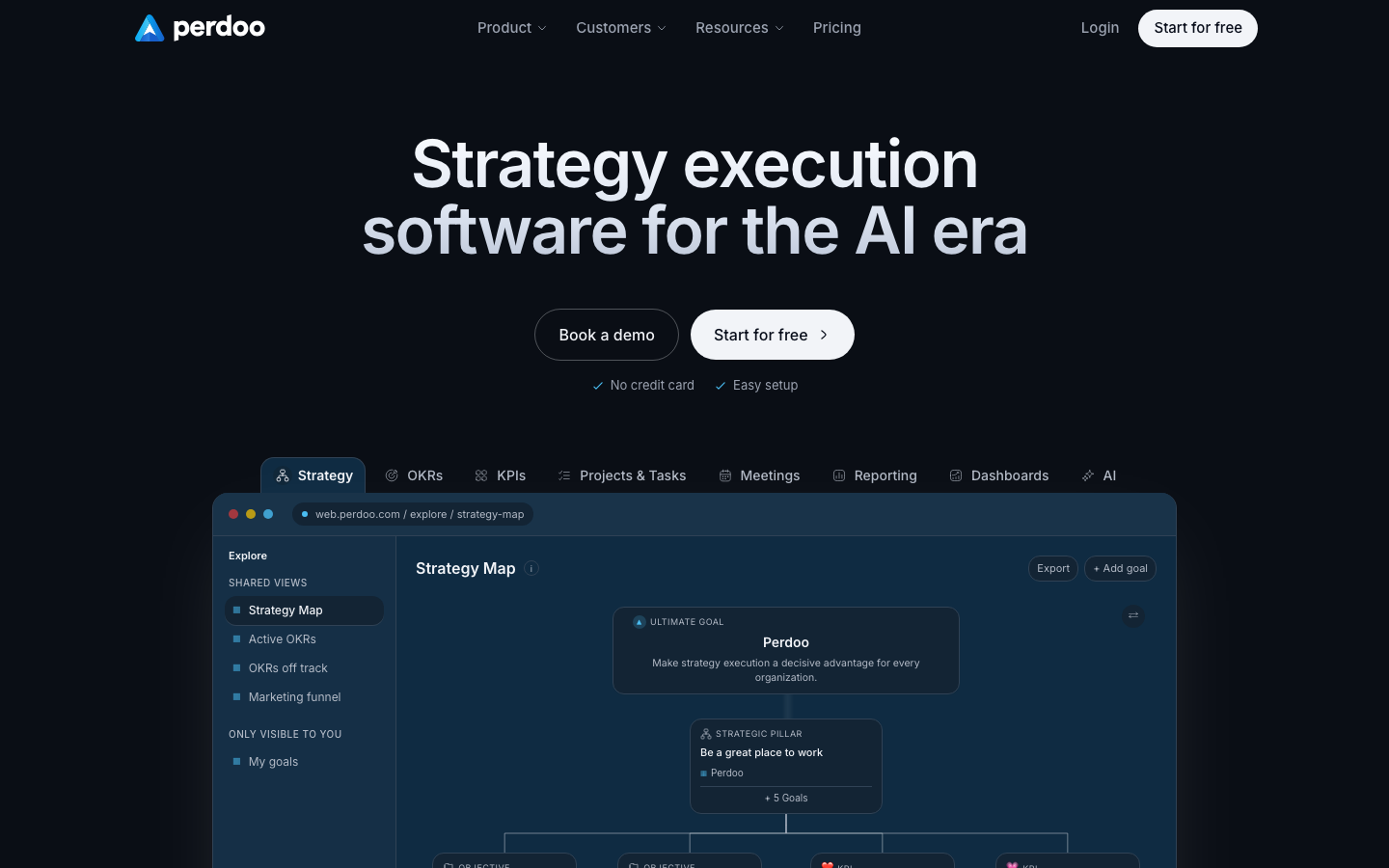
Perdoo is a dedicated OKR platform for startups and SMBs, with OKRs and KPIs on a strategy map and progress from check-ins or integrations. OKR tracking is on every plan, including Free for up to 5 users. Its AI Assistant and Coach are included from the free plan.
Software Pros
- Strategy map links OKRs, KPIs, and initiatives
- Integrations with Jira, Salesforce, Power BI, and HRIS tools
- 3 free coaching hours with 50+ user licenses
Software Cons
- Dashboards and SSO start on Premium
- View-only licenses only on Supreme
- Per-user price drops only with volume
Perdoo Review
For a company that is running OKRs for the first time, Perdoo pairs the method with coaching. Updates come from check-ins or connected tools, and the strategy map shows alignment at a glance. Premium costs $9 per user per month at 10 users billed annually, falling to $7.20 at 100. Supreme adds board views and custom dashboards for leadership reviews.
Our Verdict
OKR Starter With Coaching
*As pricing is subject to change, prices are listed as they stand in October 2026
Productboard
Quick Overview
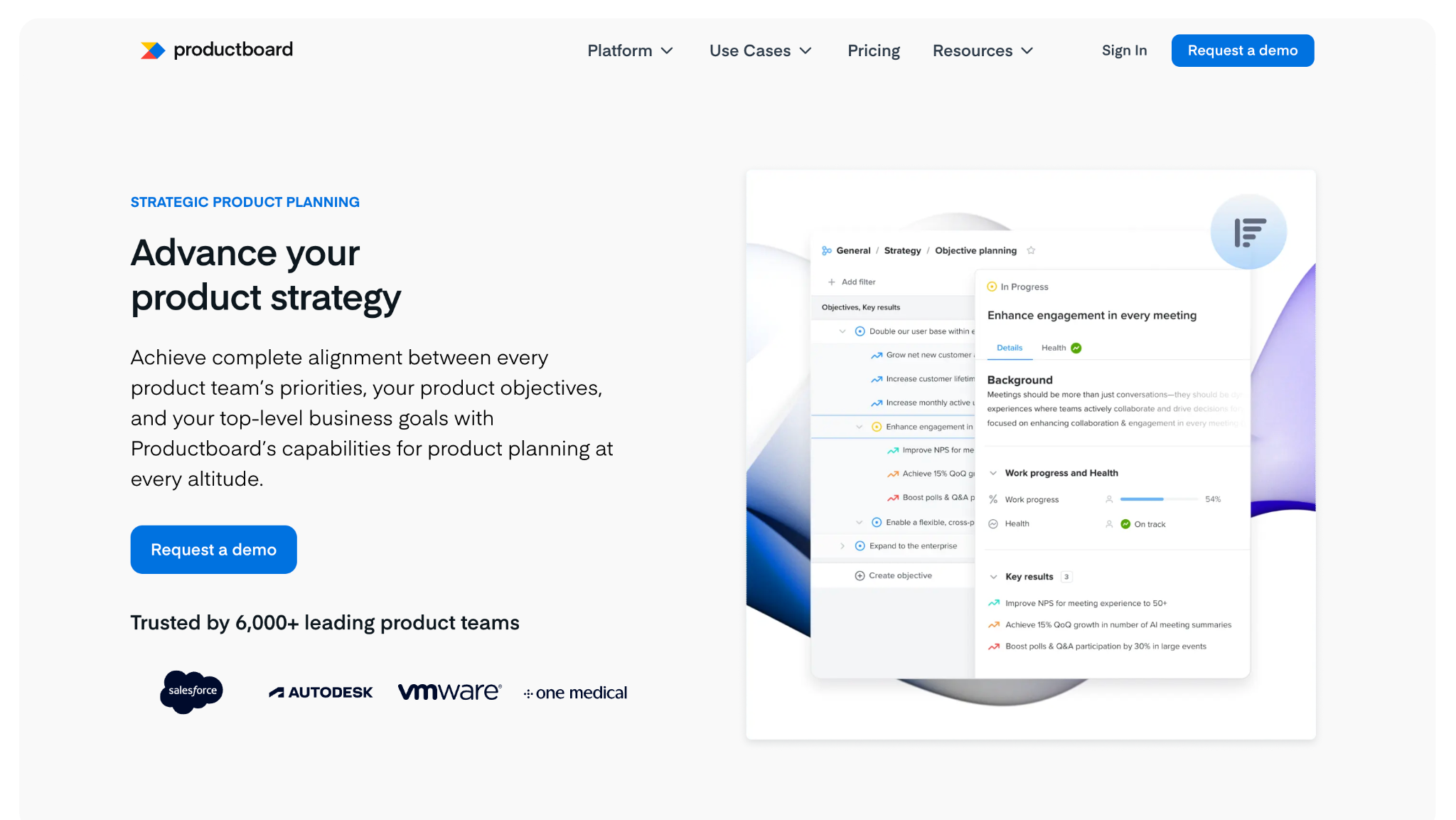
Productboard is a product roadmap tool where objectives define measurable outcomes and link to initiatives and features. Objective hierarchy is on the Enterprise plan only, and both plans are priced by quote. Productboard Spark, its AI system, uses product strategy as context for insights and automations.
Software Pros
- Objectives tie directly to prioritization frameworks for features
- Multi-level objectives that map product strategy to business goals
- Spark included on both plans
Software Cons
- Objective hierarchy only on Enterprise
- Quote-only pricing
- Built for product teams rather than company-wide OKRs
Productboard Review
My take is that Productboard fits a product organization that prioritizes features against objectives every week. Each objective defines measurable outcomes, and progress follows the initiatives linked to them. The vendor says 6,000+ product teams use it. Companies wanting OKRs for sales, HR, or finance will need a second tool alongside it. Expect to talk to sales early, because neither plan lists a price.
Our Verdict
Objectives Driving Product Priorities
Profit.co
Quick Overview
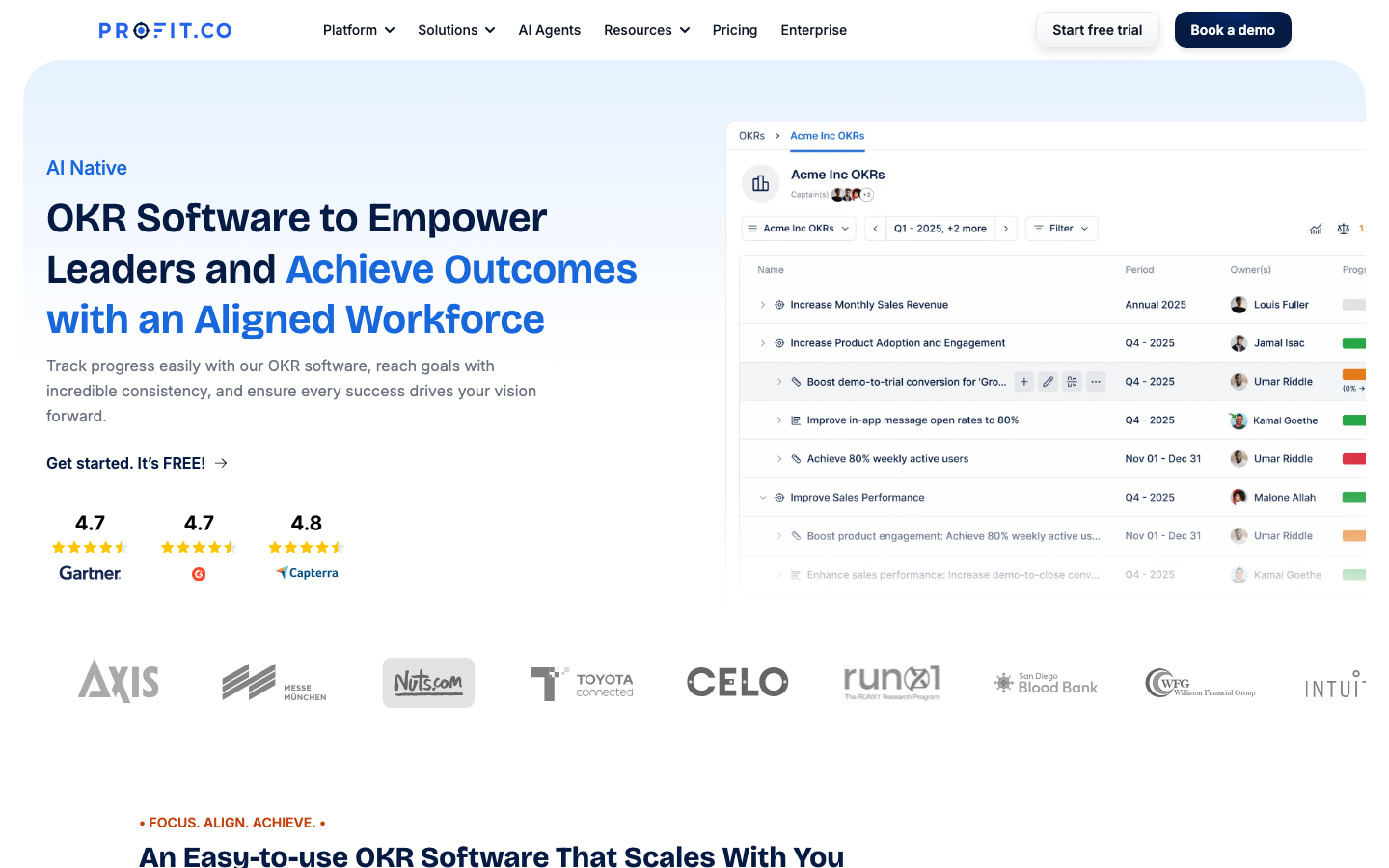
Profit.co is a dedicated OKR platform for SMB to enterprise, with vertical and horizontal alignment, custom scoring, and check-ins fed by 100+ integrations. OKRs come in the Essentials plan alongside strategy roadmaps and balanced scorecards. The vendor says 1,500+ organizations use it.
Software Pros
- AI Authoring drafts objectives and key results
- Dashboards built for each meeting and persona
- Approval steps for OKR updates
Software Cons
- Paid prices are not shown on the pricing page
- AI runs on a monthly credit allowance
- Performance and project modules add breadth you may not need
Profit.co Review
In practice, Profit.co suits a growing company that wants OKRs, strategy, and reviews on 1 platform. Check-ins can pull from connected tools such as Jira, Slack, and Teams, and heatmaps compare progress with plan. Athena AI runs on credits, with 500 per user per month on Essentials and 250 in the 30-day trial. Enterprise adds data residency, audit logs, and SSO.
Our Verdict
OKRs With Room to Grow
Synergita
Quick Overview
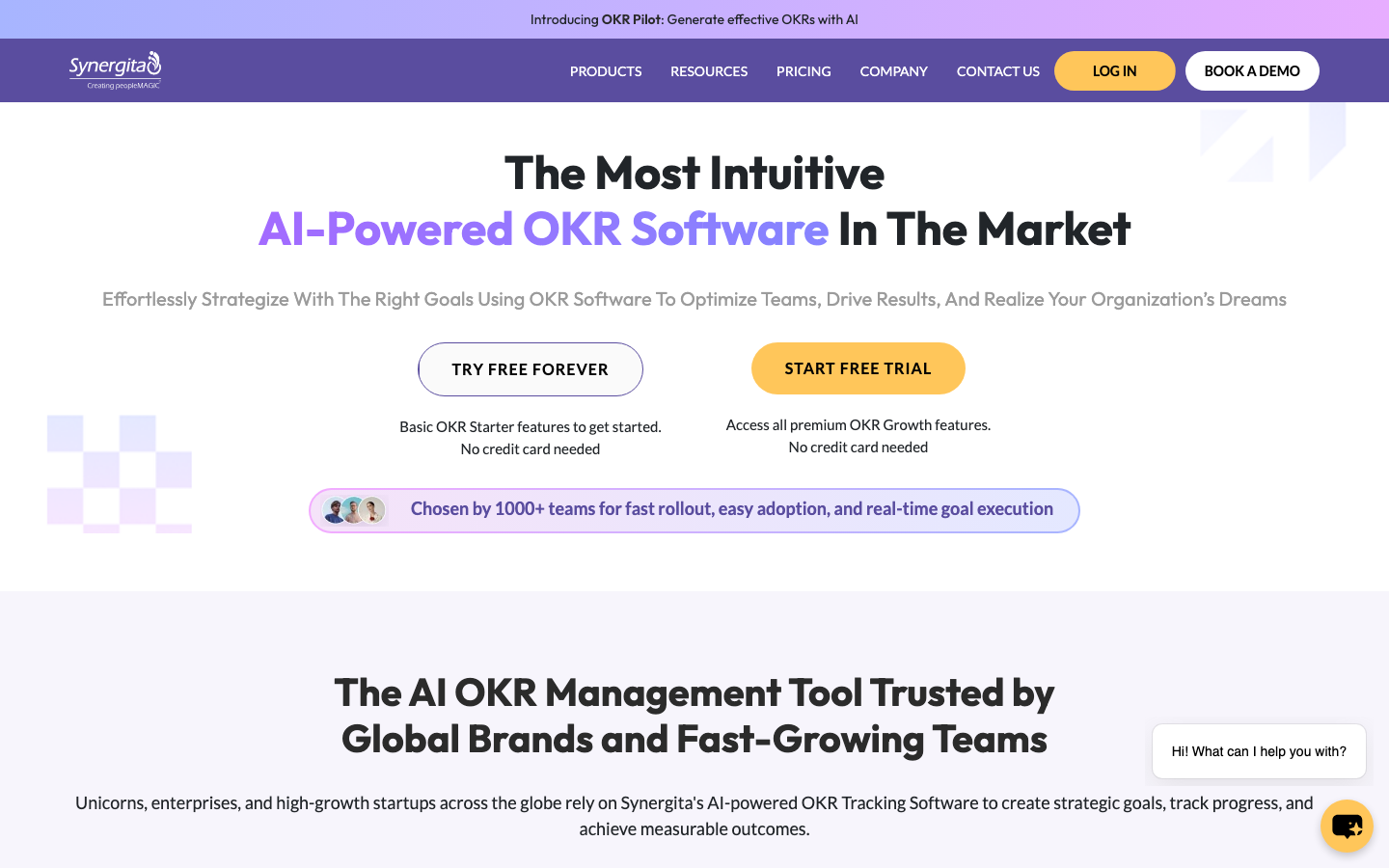
Synergita is a dedicated OKR platform for startups and growing teams, with an alignment tree, dashboards, check-ins, and reminders. OKRs are on every plan, including the free Starter plan for up to 3 users. OKR Pilot, its AI assistant, drafts OKRs on pooled AI credits, and the vendor says 1,000+ teams use it.
Software Pros
- Free plan with alignment and templates
- Low per-user prices on paid plans
- Purchased AI credits carry forward on renewal
Software Cons
- Jira, Teams, and Slack integrations need Growth
- AI limited to 60 or 120 credits per user
- Starter caps the number of objectives
Synergita Review
The team this fits is a budget-conscious startup or remote team that wants OKR structure without a large bill. Lite costs $3 and Growth $6 per user per month billed annually, and 100 extra AI credits cost $5. Check-ins run with reminders and notifications. Growth adds cascading OKRs, SSO, an AI support buddy, and HRMS integration for teams that outgrow the basics.
Our Verdict
Budget OKRs With AI Drafting
*As pricing is subject to change, prices are listed as they stand in October 2026
UpRaise
Quick Overview
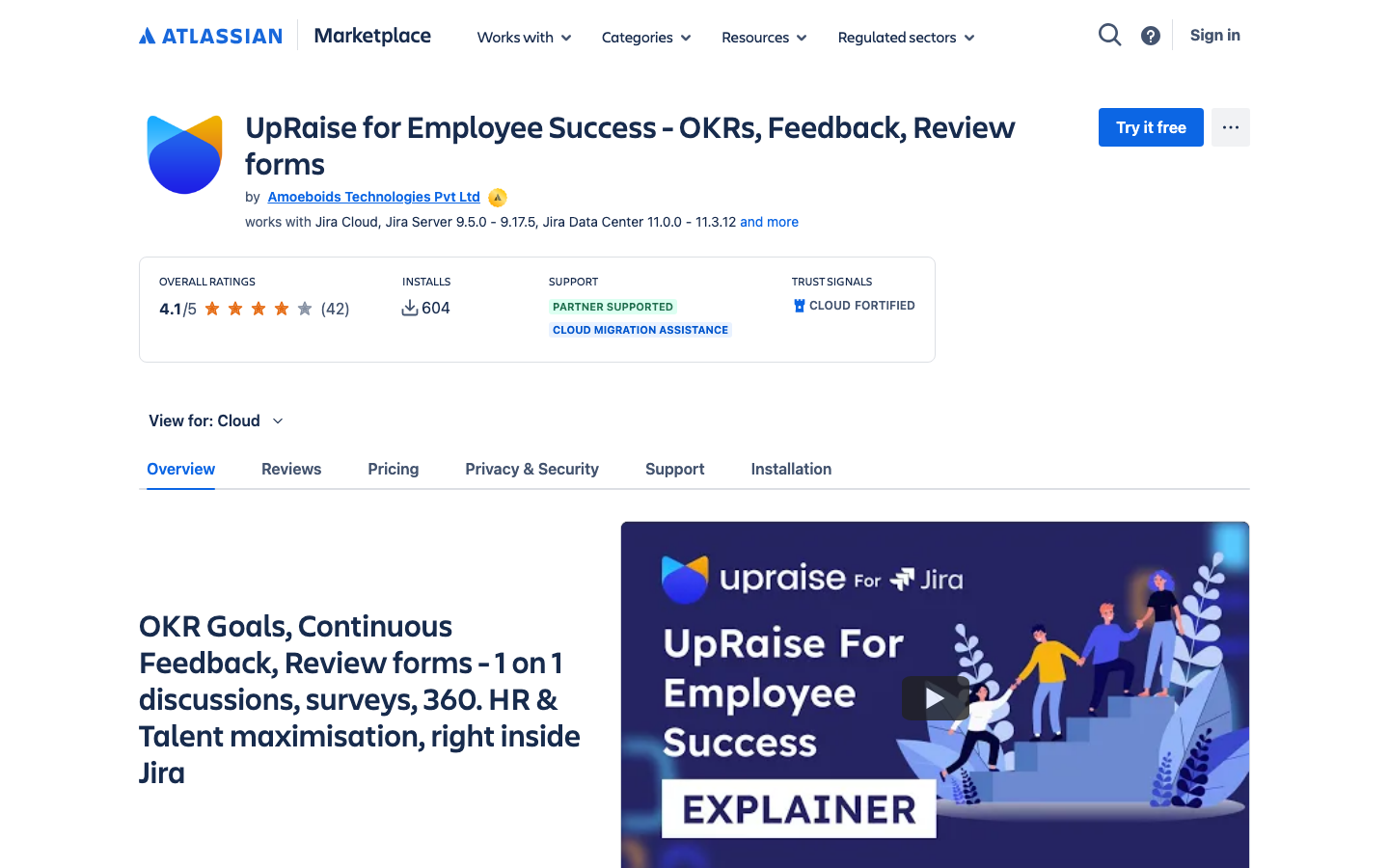
UpRaise is a Jira and Atlassian Marketplace app by Amoeboids Technologies, where teams create objectives and link Jira issues as key results. It adds OKR hierarchy and alignment views, continuous feedback, and review forms inside Jira. It names no AI feature.
Software Pros
- Jira issues double as key results, so progress follows work
- Feedback, surveys, and review forms in the same app
- Free for up to 10 users
Software Cons
- No AI features named by the vendor
- Mixing OKRs with reviews risks tying goals to ratings
- 4 G2 reviews, a thin sample
UpRaise Review
Check-ins here happen inside Jira, where people link issues to key results and track progress on dashboard gadgets. UpRaise fits a Jira team of 10 to 100 people that wants OKRs and feedback without a separate HR tool. At 50 users, Standard costs $125 a month and Advanced $137.50. Advanced adds custom fields on OKRs and a punch-in approval workflow.
Our Verdict
OKRs and Feedback in Jira
*As pricing is subject to change, prices are listed as they stand in October 2026
Weekdone
Quick Overview
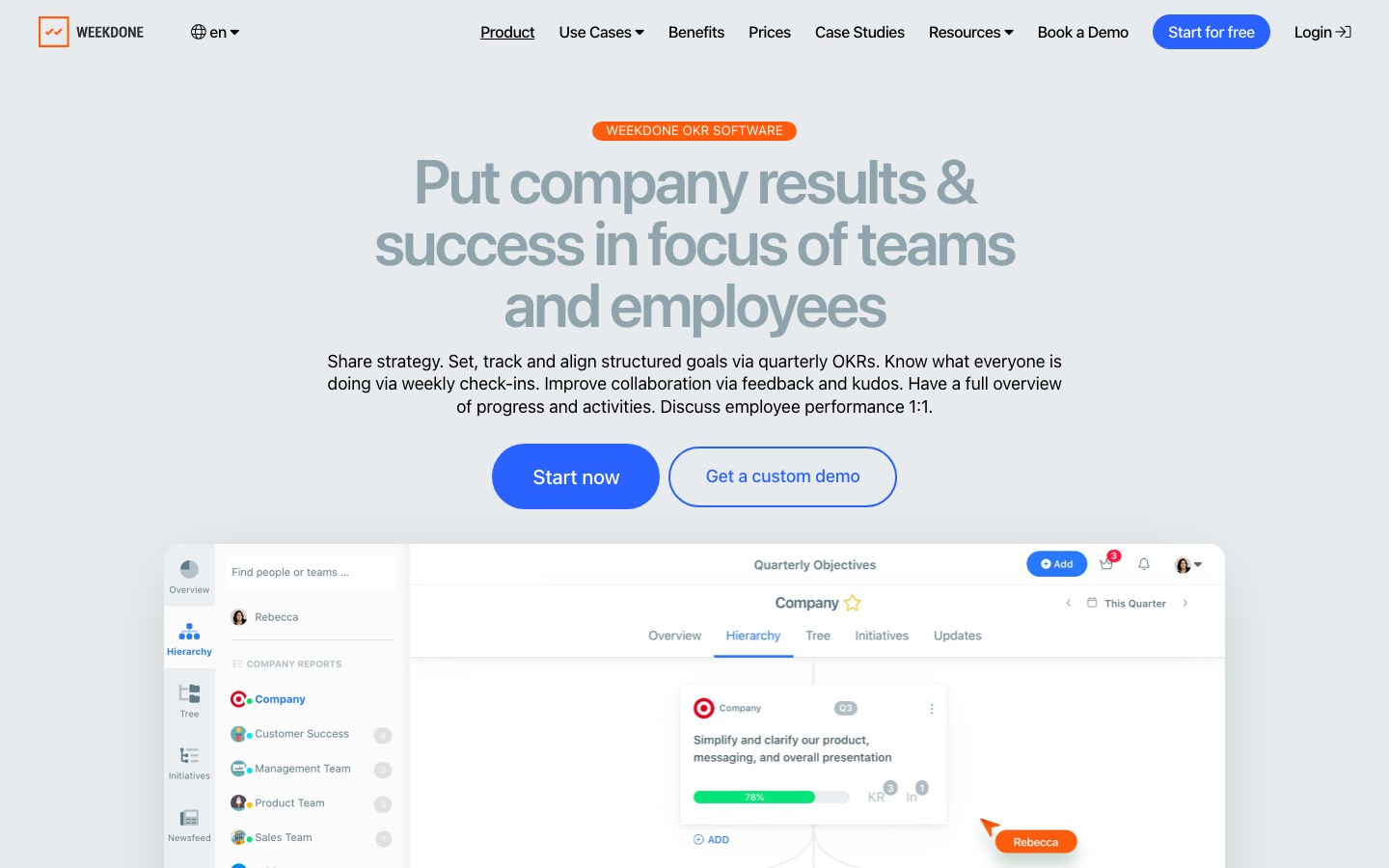
Weekdone is a dedicated OKR platform for companies of 10 to 1,000 employees. Company, team, and personal OKRs sit in a hierarchy tree, with tasks linked underneath. Progress comes from weekly Plans, Progress, Problems check-ins. Every feature is in 1 package, free for up to 3 users, and it doesn’t name any AI features.
Software Pros
- Simple weekly check-in rhythm
- Dedicated OKR coach included in the package
- Slack, Teams, Jira, and Asana integrations
Software Cons
- No AI features
- Per-user price is higher on small packages
- 36 G2 reviews, a thin sample
Weekdone Review
I’d pick this for a small company that wants OKRs to become a weekly habit rather than a quarterly event. Each person reports plans, progress, and problems weekly, keeping key results current. A 10-user package costs $108/month on monthly billing, and annual billing costs less. Company TV dashboards help teams see progress in the office every day.
Our Verdict
Weekly Rhythm for Small Teams
*As pricing is subject to change, prices are listed as they stand in October 2026
WorkBoard
Quick Overview
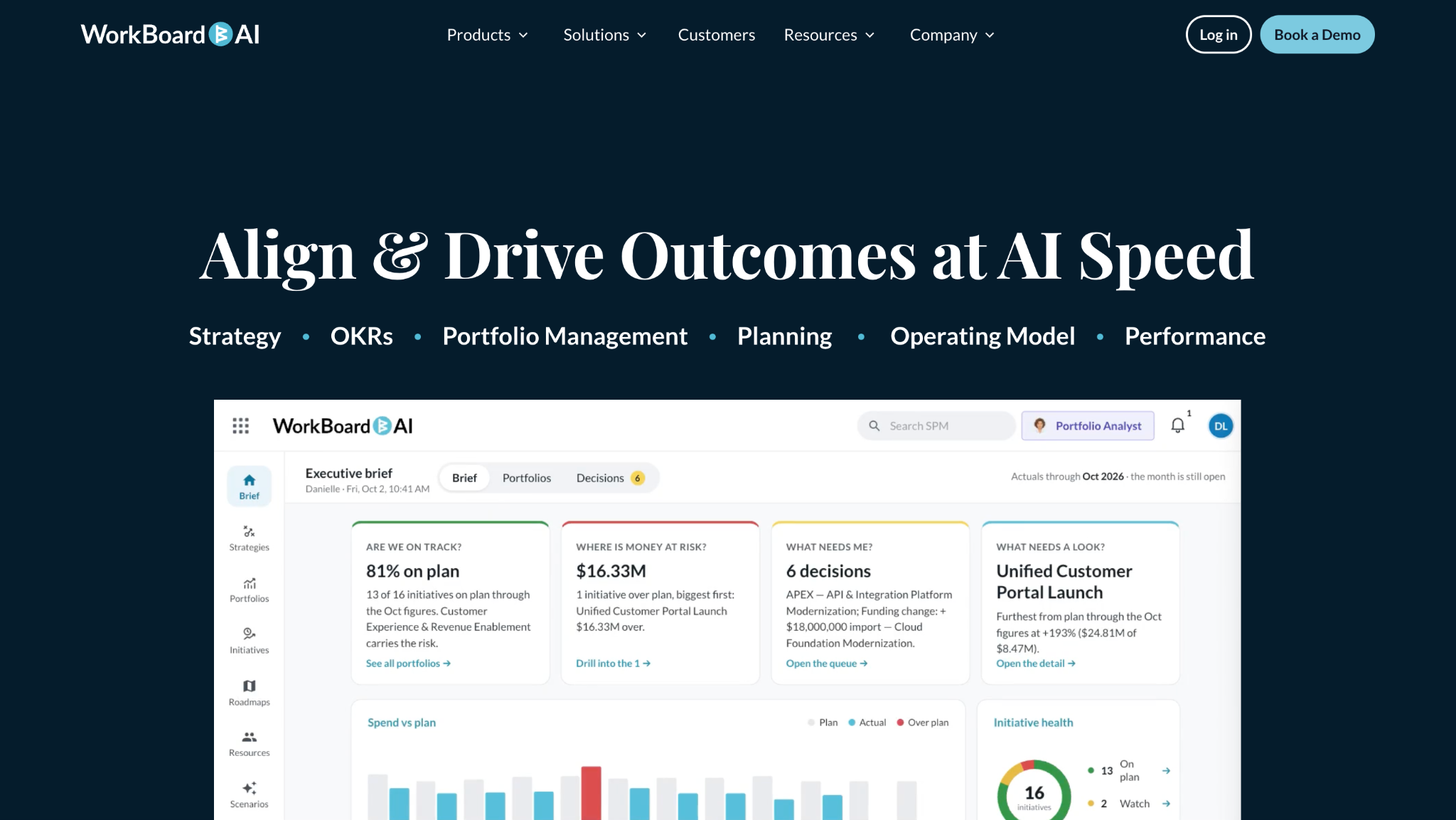
WorkBoard is an enterprise strategy suite for OKRs across business units, with AI agent-assisted OKR creation, alignment, and portfolio management. It acquired Quantive, formerly GTM Hub, in May 2025. WorkBoardAI includes Chief of Staff and Portfolio Analyst agents.
Software Pros
- AI agents assist with OKR creation and team retrospectives
- Strategy, OKRs, and portfolio management in 1 platform
- Built for alignment across many business units and regions
Software Cons
- Quote-only pricing
- Evaluation runs through guided demos only
- Heavy for companies with fewer than 300 people
WorkBoard Review
The clearest case for WorkBoard is a large enterprise that wants agents to carry part of the OKR cycle. Agents help draft OKRs and run team retros, and scorecards feed leadership reviews. Former Quantive customers have been moving onto the platform since the acquisition. Plan for a structured rollout with business-unit owners rather than a self-serve start, and ask for a demo built on your own strategy.
Our Verdict
Agent-Assisted Enterprise OKRs
FAQs About OKR Software
What’s the best OKR software for work?
It depends on where your team’s work is tracked and who sets OKRs. Engineering teams on Jira usually do best with an app that reads Jira progress, while product teams lean toward roadmap tools. Companies running OKRs across every department often prefer a dedicated platform, and large enterprises look at strategy suites. The comparison table above sorts all 12 tools by that logic, so start your shortlist there.
Do you need software to run OKRs?
Not at first, since a spreadsheet works for 1 team running 1 quarter, as long as someone updates it every week. Software pays off once several teams need alignment, reminders, and a history of past cycles. The usual warning sign is the moment people stop opening the shared file, which tends to happen around week 6 of the first quarter. By then, the spreadsheet no longer reflects reality.
How often should OKRs be checked in?
Weekly or every 2 weeks works well for most key results, with a short note on progress and confidence. At the end of each quarter, teams score every key result, review what they learned, and set goals for the next cycle. Frequent short check-ins beat long monthly reports because problems surface while there is still time to act. A missed check-in is itself a useful signal that an owner needs help.
What is the difference between OKRs and KPIs?
KPIs track the health of ongoing work, such as uptime or monthly churn, and usually stay the same from quarter to quarter. OKRs set a few ambitious changes for a fixed period. A KPI can become a key result when a team decides to move it sharply. Many tools track both side by side, so leaders see the steady baseline and the push in 1 view.
Should OKRs be tied to performance reviews or pay?
Generally no. Tying OKRs to pay pushes people to set safe targets they know they can hit, which defeats the purpose of ambitious goals. Use OKRs for direction and learning, and use performance reviews to judge individual contribution. Managers can still discuss OKR progress in a review, as long as the score itself does not set a bonus or a rating.
What’s the best product OKR tracking software?
Look for tools that link key results to roadmap items, epics, or releases, so progress reflects what actually shipped. Roadmap platforms do this for product teams, though they often keep objectives on their top plan. Jira apps do it for engineering by reading work-item status. Check how each tool handles a key result that depends on several teams at once, since shared goals are common in product work.
What happened to Microsoft Viva Goals?
Microsoft retired Viva Goals on December 31, 2025, after ending new feature work in December 2024. Users kept access to the product and their data only until that date. Teams still holding exports from it need a new tool and a plan to import past OKRs. Most dedicated platforms accept spreadsheet imports, which is the usual route for bringing that history across without retyping it.
How long does it take to roll out OKR software?
A small team can start in a day: invite users, set a few objectives, and schedule check-ins. A company-wide rollout usually takes 1 full quarter, including training, a pilot with a few teams, and a first scoring cycle. Agree on naming conventions and alignment rules before launch, since changing them mid-quarter confuses everyone involved. Most teams need 2 full cycles before the habit sticks for good.

Helen is Anywherer’s Market Analyst & Content Researcher, with extensive experience in analyzing global employment markets and HR technology trends. She is skilled at turning complex market data into clear, well-researched insights that inform every piece of content. With a strong grasp of the EOR, PEO, and international hiring space, Helen plays a key role in keeping Anywherer’s research accurate, up to date, and genuinely useful for readers.