Eleven platforms, sorted by the only thing that really separates them: where their pay numbers come from. A survey house, an HRIS feed, and a pool of self-reported salaries give three different answers for the same job. Knowing which you are buying is most of the decision.
What Is the Best Salary Benchmarking Software in 2026?
Salary benchmarking software supplies market pay data. It tells you what comparable employers pay for comparable roles in the markets where you hire. With that, you can price a job, build a band, and defend the number.
A compensation benchmarking tool is the same product under a different name, and searchers use both phrases interchangeably.
The buyers are HR and people leaders, compensation analysts, and founders. One boundary is worth drawing early: this is market data, not the software that runs your merit cycle and generates letters.
The reason 2026 matters is regulatory. Under Directive (EU) 2023/970, member states had to transpose the EU Pay Transparency rules into national law by 7 June 2026. Employers must now disclose pay ranges to applicants, explain the criteria behind pay levels, and report gender pay gaps above certain headcounts.
That changes what a benchmark is for. A range that used to sit in a spreadsheet now appears in a job advertisement and in a report a regulator may read. It has to come from somewhere you can point at.

INSIGHT: Why is pay benchmarking suddenly a compliance question?

Once ranges have to be published and pay gaps reported, a benchmark stops being an internal reference and becomes something an employer has to defend.
- Directive (EU) 2023/970 required member states to bring the EU Pay Transparency rules into national law by 7 June 2026. It obliges employers to give applicants pay information before an interview, publish the criteria behind pay levels, and report gender pay gaps, with joint assessments triggered where a gap of 5% or more is unexplained.
- In the United States, the picture is state by state. Jackson Lewis, writing on 30 January 2026, tracks pay transparency obligations across sixteen jurisdictions including California, Colorado, New York and Washington DC, and expects that by 2027 at least a dozen states plus multiple cities and counties will require pay range disclosure.
- The practical consequence is simple enough. The number in the job advertisement and the number in the offer now have to come from the same defensible place, which is a documentation problem before it is a data problem.
So which platform should you buy? No single platform wins here, because the real question is about data. Choosing the best salary benchmarking software means asking three things. Where the numbers originate, how recently they were collected, and whether the dataset covers the countries and job families you hire for.
Below, I’ve reviewed 11 of the leading platforms in A to Z order. Each block states the data source in its first sentence, because that fact predicts almost everything else about the tool.
INSIGHT: Survey data, HRIS data, or self-reported data?
The 11 tools here answer the same question from three different sources, and the source explains almost every disagreement between them.
- Employer surveys (Mercer, Payscale, Salary.com, WTW Compensation Software): structured participation and published methodology, defensible to a board and broad across industries, but slower to reflect a market that has already moved.
- HRIS-integrated real-time data (Figures, Pave, Ravio): current to the month because it flows out of participating employers’ systems, and concentrated in the industries and regions where each vendor’s customers cluster.
- Blended and adjacent sources (Carta Total Comp on cap table and equity data, Comprehensive on aggregated public ranges, Paychex on payroll and market data inside an HR suite): useful exactly where the standard datasets run thin, with coverage limits of their own.
Salary Benchmarking Software Comparison
Start with the data source column, then look at geography. Identifying the best compensation benchmarking tool for your company is mostly a question of matching those two against the roles you actually price.
| Tool | Data source | Refresh rate | Geographic strength | Free tier | G2 rating |
|---|---|---|---|---|---|
| Carta Total Comp | Blended, cap table data | Continuous | US | No | 4.3 (233) |
| CompensAI | AI-generated estimates; underlying dataset not specified | Not stated | Location-based benchmarks; country list not stated | No; 30-day trial | N/A |
| Comprehensive | Blended, aggregated ranges | Continuous | US | Yes, US tech ranges | 4.9 (29) |
| Figures | HRIS-integrated | Continuous | Europe | No | 4.3 (9) |
| Mercer | Employer surveys | Annual | Global | No | 3.8 (10) |
| Pave | HRIS-integrated | Continuous | US, Canada | Yes, Market Data Lite | 4.7 (46) |
| Paychex | Blended, payroll and market | Not stated | US | No | 4.1 (1,739) |
| Payscale | Surveys plus employee-reported | Continuous | Global | No | 4.4 (274) |
| Ravio | HRIS-integrated | Continuous | Europe | Tied to data contribution | 4.7 (10) |
| Salary.com | HR-reported surveys | Continuous | US | No | 4.4 (1,095) |
| WTW Compensation Software | Employer surveys, aggregated | Continuous | US | No | 4.9 (15) |
Each score belongs to that tool’s individual G2 product profile, pulled in August 2026.
Where Salary Benchmarking Data Actually Comes From
Employer surveys are the oldest method and still the most defensible. A provider collects pay data directly from participating companies against a fixed job catalog, cleans it, and publishes results by industry, location, and job level. The cost is time: most surveys run annually, so a role whose pay moved in March is priced on data gathered last year.
HRIS-fed platforms invert that trade. Instead of a questionnaire, they connect to participating employers’ HR systems and read actual pay records. Benchmarks update continuously rather than once a cycle. The catch is concentration. The dataset reflects whoever that vendor sold to. A platform with mostly European technology customers stays thin on American logistics roles, no matter how current it is.
Employee-reported data is the third source, gathered from individuals submitting their own salaries. Its weakness is self-selection. The people who report are not a random sample, and nobody checks the numbers against a payroll system.
A fourth category gets confused with all of this. Job postings, public filings, and government wage statistics feed what is often sold as the best labor analytics software salary benchmarking buyers stumble into. It answers a genuinely different question. Advertised ranges and workforce supply describe the market for a role. They do not say what employers pay the people already doing it. Those numbers land better next to HR reporting and analytics tools than inside a pay decision.
In practice, this is why two platforms can disagree by double digits on the same job. Aging factors, the uplift applied to stale survey data to estimate today’s value, differ between providers. Job matching differs more, and a wrong match corrupts every number downstream.
AI Salary Benchmarking Software: What the AI Actually Does
The genuine application is job matching, and it is unglamorous. Mapping internal titles onto standardized survey job codes used to occupy an analyst for weeks. Errors made there quietly wreck every range built afterward.
Two further uses are real. Range recommendations propose a band based on your data and the market cut you choose. Outlier detection flags employees sitting well outside their range before a review cycle exposes it.
Among these 11, Comprehensive, Payscale, and WTW Compensation Software document AI-assisted job matching explicitly on their own product pages. Elsewhere, the term covers ordinary automation. Test AI salary benchmarking software against one question: what does the model decide that a rule could not? That question travels well across AI tools across HR, where the products worth having sit close to operational data.
Best Salary Benchmarking Tools by Use Case
Most shortlists in this category fall into four situations, each rewarding a different kind of dataset. Within a group, the order is alphabetical and means nothing else.
For Retail and Hourly Workforces
Mercer, Paychex, Payscale, and Salary.com have the depth hourly hiring needs. Pricing store associates across forty locations is more of a geographic differential problem than a market one. The survey houses have collected exactly that for decades. A compensation benchmarking tool for retail also has to cover shift premiums and hourly rates.
For Software and Tech Companies
Carta Total Comp, Comprehensive, and Pave suit engineering pay, which moves faster than an annual survey can track. Equity is the other reason. For a venture-backed company, the option grant can outweigh the salary, and pricing one without the other misses most of the offer. A salary benchmarking app for software companies needs refresh rates measured in weeks and cash-plus-equity views as standard.
For Global and Multi-Country Teams
Figures, Mercer and Ravio handle hiring across borders, where local differentials and currency turn one range into fifteen. The best software for global salary benchmarking states country coverage explicitly rather than claiming to be worldwide. Figures and Ravio are shaped by European pay transparency requirements in a way US-centric platforms are not.
Pricing a role in a country is a separate problem from paying somebody there. Companies without a local entity usually solve the second half through employer of record companies rather than through their benchmarking platform.
For Teams That Want Benchmarking Inside Their HR System
Paychex is the entry here, and several other HR platforms ship benchmarking modules alongside payroll. The appeal of HR software with salary benchmarking data is fewer exports and market numbers sitting beside the payroll they inform. The trade-off is depth. A bundled module rarely matches a dedicated dataset in job-family or geographic granularity, which matters to an analyst comparing sources.
Salary Benchmarking Software Pricing
Almost nobody in this category publishes a price because there is no single product to price. What you pay depends on which surveys you buy, which job families you need, and how many employees you have. Two companies on the same platform can pay very different amounts. Free tiers exist, but several are paid for in data rather than money. You connect your own HR system and contribute pay records to the pool everyone else reads.
| Tool | Pricing model | Free tier and its limit | Starting price |
|---|---|---|---|
| Carta Total Comp | Quote-based | No | Custom pricing |
| CompensAI | Subscription; Enterprise custom | No permanent tier; 30-day trial, no card required | Custom pricing |
| Comprehensive | Free tier plus quote | Yes, US tech salary ranges | Custom pricing |
| Figures | Quote by headcount and modules | No | Custom pricing |
| Mercer | Quote-based, per survey | No | Custom pricing |
| Pave | Free tier plus quote | Yes, Market Data Lite | Custom pricing |
| Paychex | Bundled into HR platform | No | Custom pricing |
| Payscale | Quote-based | No | Custom pricing |
| Ravio | Free tier tied to data contribution | Yes, with HRIS connection | Custom pricing |
| Salary.com | Quote-based | No | Custom pricing |
| WTW Compensation Software | Quote-based | No | Custom pricing |
As pricing is subject to change, prices are listed as of August 2026.
INSIGHT: Is free benchmarking data actually free?
On several platforms, the free tier is paid for in data: you connect your HRIS and contribute your own pay information to the pool.
- 3 of the 11 offer a free tier: Comprehensive, Pave and Ravio. Ravio ties its access to contributing your own pay data through an HRIS connection, and Pave builds its free market data from employer submissions of the same kind.
- Not one of the 11 states a usable figure on its own pricing page. Figures prices by headcount and modules, and the survey houses the price by which surveys and job families you buy.
- Contributing data is normally aggregated and anonymous, but it is still a decision with an owner.
How to Choose Salary Benchmarking Software
I would start with the roles you actually have to price, not the ones in the demo. A dataset deep in software engineering can be close to empty in warehouse operations. The gap only shows up when you search your own job titles.
Then check the markets you hire in, not the markets a vendor covers in total. Fifty countries in a marketing headline means little if the three that matter to you carry a handful of data points each.
Match refresh rate to how fast your roles move. Annual survey data is fine for stable functions and actively misleading for jobs whose pay has run away during the year.
Test job matching before anything else, because it decides whether the numbers mean anything. Hand a vendor twenty of your messiest internal titles and look at what they map to. A wrong match produces a confident number that is simply incorrect.
Decide early whether you are willing to contribute your own pay data, and find out who signs off on it. On several platforms it is the price of the cheaper tier, and it is a real decision rather than a checkbox during a trial.
Ask whether the output is defensible to somebody outside the team. Under pay transparency rules, the point is explaining a number to an applicant, an employee or a regulator. Documented methodology beats a prettier interface.
Last, be clear about where benchmarking stops. Producing market data is a different job from running a merit cycle with budgets, approvals and letters. Running that process is the job of compensation management software, which is a separate purchase.
Top 11 Salary Benchmarking Software Platforms for 2026
Every entry below rests on the vendor’s published documentation, its pricing page and its G2 profile, all read within a single week. Dataset sizes here are advertised heavily. Wherever a figure appears below, it is attributed to the company that published it rather than stated as fact.
The mix runs from survey houses like Mercer and Salary.com to real-time platforms like Pave and Ravio, with blended sources in between. Judging the best salary benchmarking software 2026 has produced starts with the data family, then moves to features.
I’m listing all providers in alphabetical order to keep this comparison neutral.
Carta Total Comp

Quick Overview
Carta Total Comp draws on customer-reported compensation blended with Carta’s cap table records, so salary benchmarks sit beside real equity benchmarks for private companies. Benchmarking is not Carta’s main business, and its G2 presence sits under the wider Carta Equity Suite listing.
Software Pros
- Equity benchmarks come from cap table data rather than from a survey estimate
- Cash and equity are priced together, which matches how private offers are made
- Coverage of venture-backed private companies is stronger than in general surveys
Software Cons
- Compensation data is adjacent to Carta’s core cap table business, not central to it
- Coverage concentrates on US venture-backed companies
- No published pricing for the compensation product
Carta Total Comp Review
What stood out to me is that the equity side is genuinely hard to replicate.
Our Verdict
Salary And Equity Together
CompensAI
Quick Overview
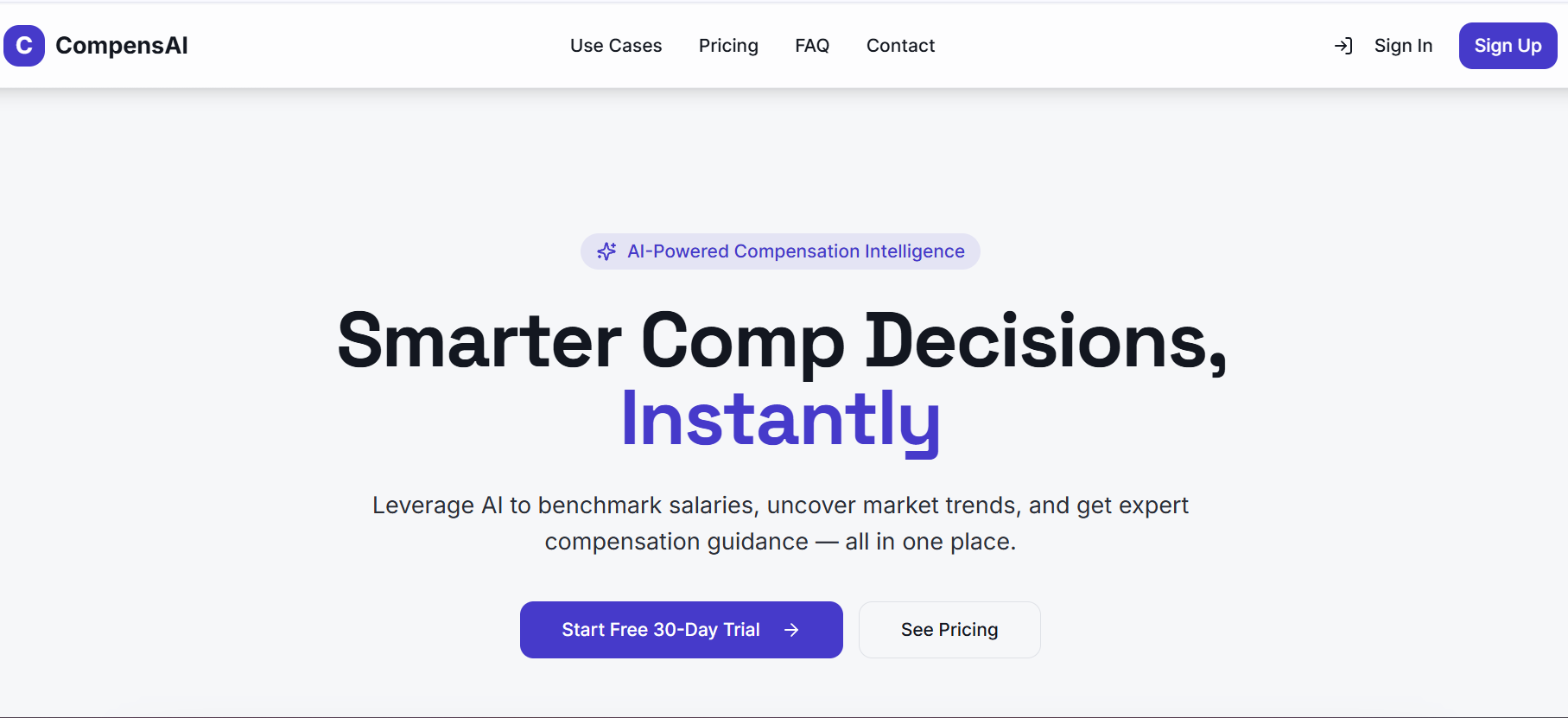
CompensAI generates AI-powered salary benchmarks for single and hybrid roles by industry, location, and company size. Its tools cover job matching to published survey benchmarks, five-point pay scales, total rewards modeling, market insights, and pay gap analysis. Adjustable hybrid-role weights and saved history help teams refine their compensation work over time.
Software Pros
- Job Matcher extracts attributes from bulk-pasted job descriptions, matches roles to published survey benchmarks, and exports the results as CSV
- Pay Scale Builder compares Lagging, Matching, and Leading philosophies with visual overlays; Total Rewards Modeler tests base pay, bonuses, equity, benefits, and perks
- Market Insights creates sourced trend and forecast reports from free-text queries. Pay Gap Analysis accepts drag-and-drop pay files and returns demographic breakdowns, risk flags, and actionable summaries
Software Cons
- Job Matcher, Pay Scale Builder, Total Rewards Modeler, and Pay Gap Analysis require Business or Enterprise
- Free access is limited to a 30-day trial; no permanent free plan is listed
- AI-generated benchmarks and pay gap findings need human review before informing pay decisions
CompensAI Review
CompensAI suits HR teams that want to turn role pricing into pay ranges and compensation packages. Salary reports include responsibilities, skills, and hiring recommendations, while branded total rewards PDFs help present an offer. Hybrid role blending and saved history make it practical to revisit earlier analyses as roles and budgets change.
Our Verdict
AI Role Pricing and Compensation Modeling
Comprehensive
Quick Overview
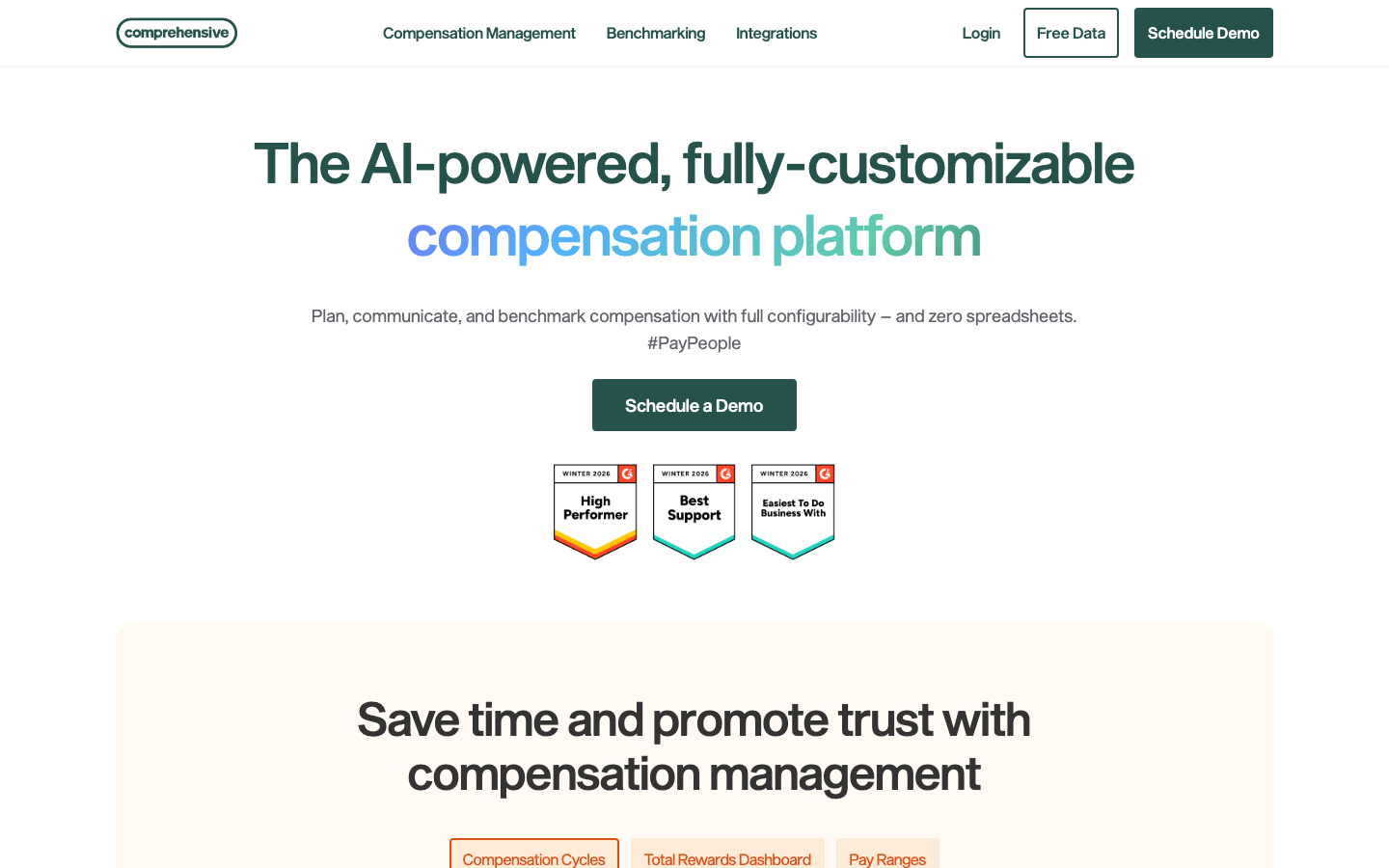
Comprehensive blends aggregated public pay ranges with licensed survey feeds. Its free tier covers salary ranges the vendor describes as drawn from over 6,000 US technology companies, refreshed daily.
Software Pros
- A free tier with daily refreshed US technology ranges, unusual in this category
- Paid tiers pull in established survey datasets alongside the aggregated ranges
- AI-assisted job matching is documented rather than implied
Software Cons
- Free data covers US technology companies and thins out elsewhere
- The platform extends into compensation planning, which is a wider purchase
- A G2 score resting on 29 reviews is easy to over-read
Comprehensive Review
During my evaluation of Comprehensive, the free tier was more useful than free tiers usually are.
Our Verdict
Free Daily-Refreshed Tech Ranges
Figures
Quick Overview
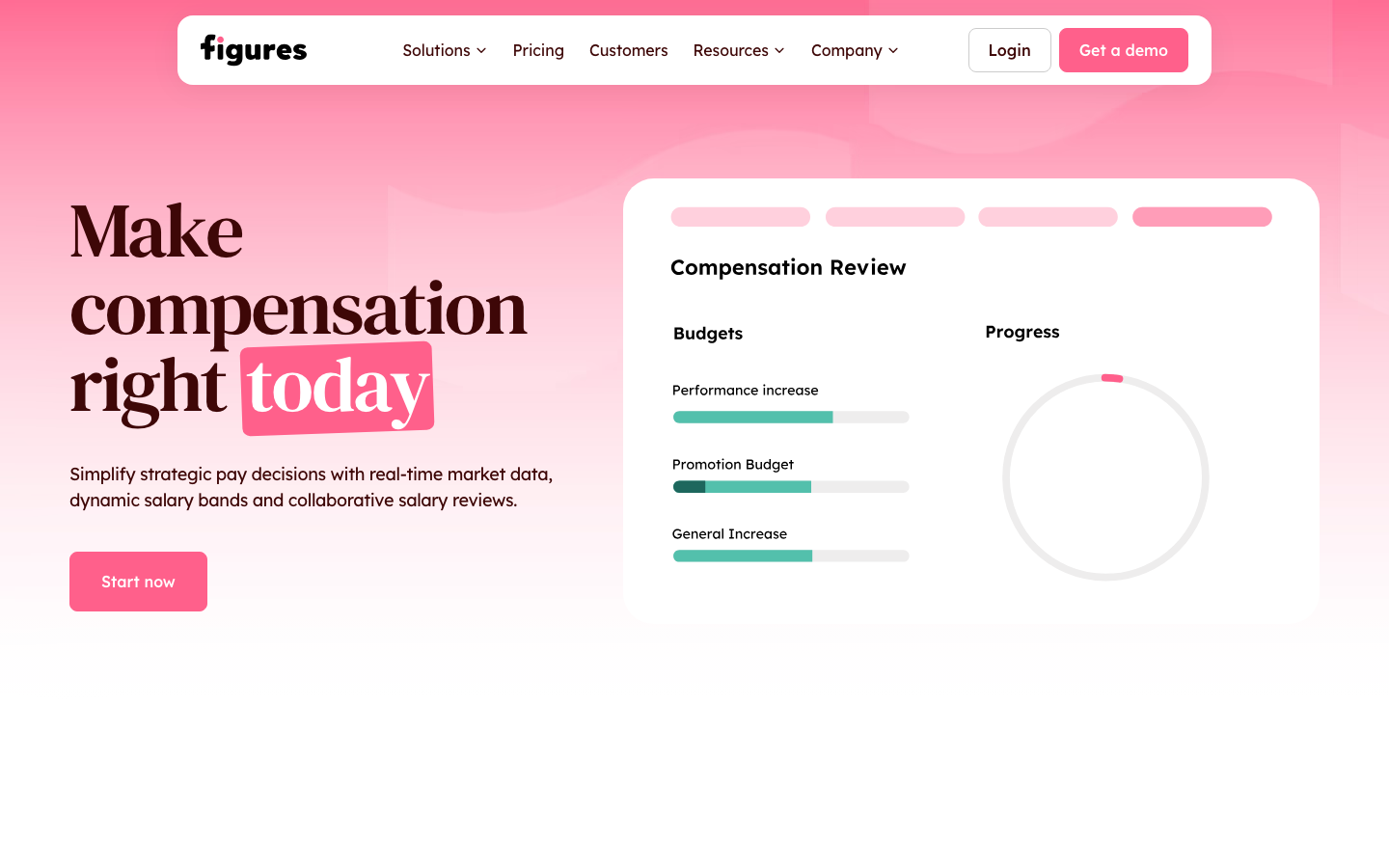
Figures builds European benchmarks from participating employers’ HR systems, so the data updates continuously rather than annually, and pricing depends on headcount and modules. The platform is shaped around the EU Pay Transparency Directive, with salary band construction and pay gap reporting alongside the benchmarks.
Software Pros
- European coverage built from employer HR systems rather than survey questionnaires
- Pay gap reporting and band building are designed against EU transparency rules
- Continuous refresh keeps fast-moving European roles priced closer to the market
Software Cons
- Coverage is European, so it answers little about US or Asian markets
- No published price; cost is quoted by headcount and module selection
- At 9 G2 reviews, it has the smallest sample here
Figures Review
I spent time on the pay transparency side, which separates Figures from a general benchmarking tool.
Our Verdict
European Pay Transparency Platform
Mercer

Quick Overview
Mercer is the established survey house here, running global compensation surveys across industries and job families through its own data platform. The methodology is documented, and the participant base is broad, which is why its numbers appear in board papers.
Software Pros
- Global survey coverage across industries, job families and seniority levels
- Documented methodology that stands up to a board or an auditor
- Depth in non-technology sectors where real-time platforms hold little data
Software Cons
- Annual survey cycles mean fast-moving roles are priced behind the market
- Quote-based pricing that varies by which surveys and job families you buy
- Only 10 G2 reviews, on a listing spanning more than the benchmarking data
Mercer Review
The feature I kept coming back to with Mercer is reach rather than any one capability.
Our Verdict
Established Global Survey House
Pave
Quick Overview
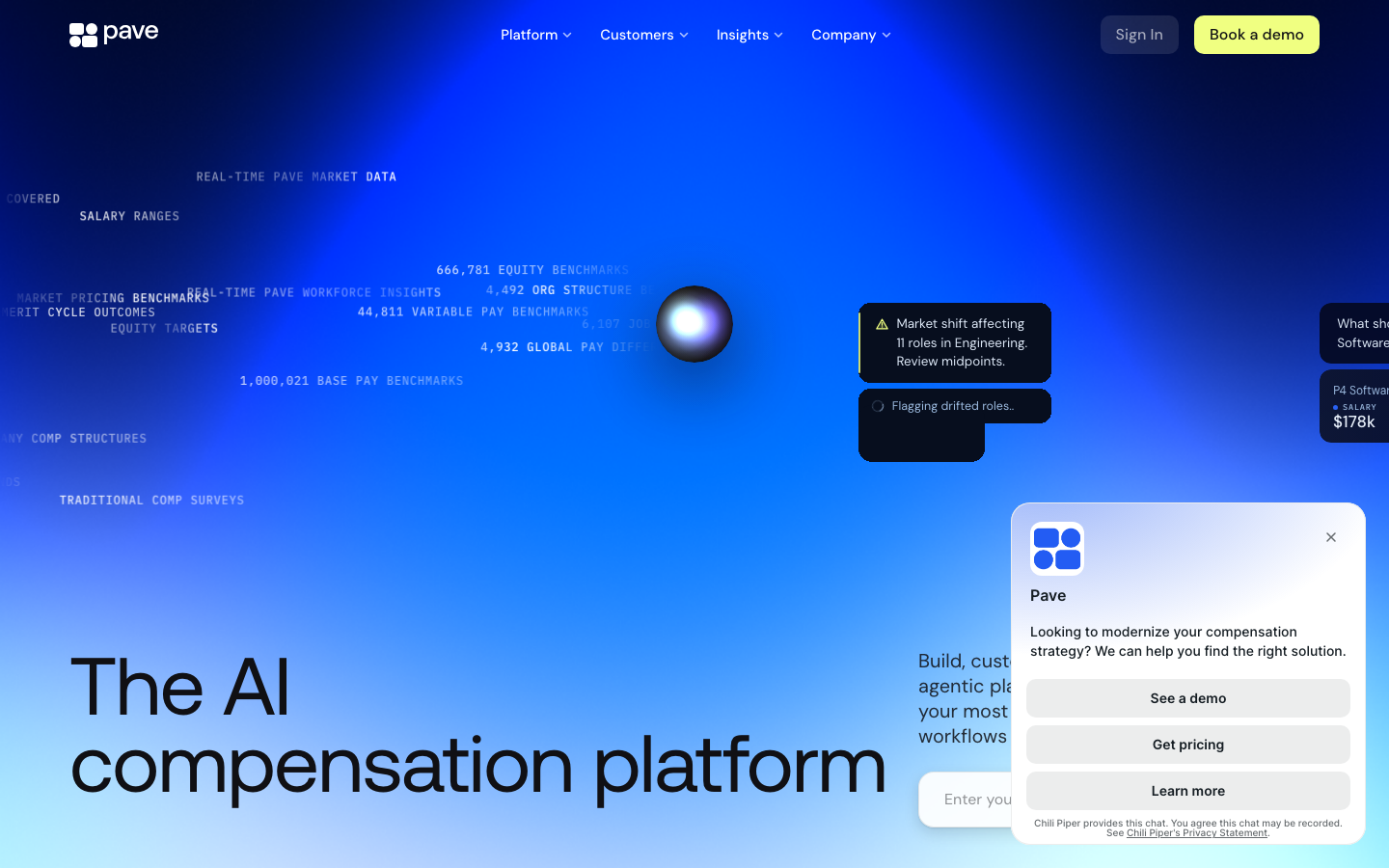
Pave builds real-time benchmarks from HRIS integrations, drawing on data the vendor attributes to more than 9,000 participating companies. Benchmarking, band building and planning sit in one platform. A free Market Data Lite tier covers over 200 job families across the US plus one further market.
Software Pros
- Benchmarks refresh continuously from connected HR systems rather than annually
- The free Market Data Lite tier covers 200-plus job families without a contract
- Cash and equity benchmarks sit together, which suits venture-backed offers
Software Cons
- Coverage is strongest in North America and thins out beyond it
- Data flows both ways, so participation means contributing your own pay records
- At 46 G2 reviews, it sits just under the count worth leaning on
Pave Review
While reviewing Pave, the trade at its center is worth naming plainly.
Our Verdict
Real-Time HRIS Benchmarks
Paychex

Quick Overview
Paychex blends aggregated payroll and market data into an HR platform that also runs payroll, benefits, and HR administration. The benchmarking capability is a component of that suite rather than a standalone data product, aimed at US small and mid-market employers already using Paychex. Its G2 listing covers the whole platform.
Software Pros
- Market data sits in the same system that already runs payroll, with no exports
- Aggregated payroll data gives real visibility into US small-business pay levels
- Sensible fit for companies that will never staff a compensation analyst
Software Cons
- Benchmarking is one element of a wider suite, not a dataset you can license alone
- US-focused, with little to offer a company hiring internationally
- Depth on job families and geographic cuts trails the dedicated providers
Paychex Review
What stood out to me about Paychex is the buyer it actually suits. A 200-person company without a compensation function does not need a survey subscription. It needs a defensible number where the salary is already recorded.
Our Verdict
Benchmarks Inside Your Payroll
Payscale
Quick Overview
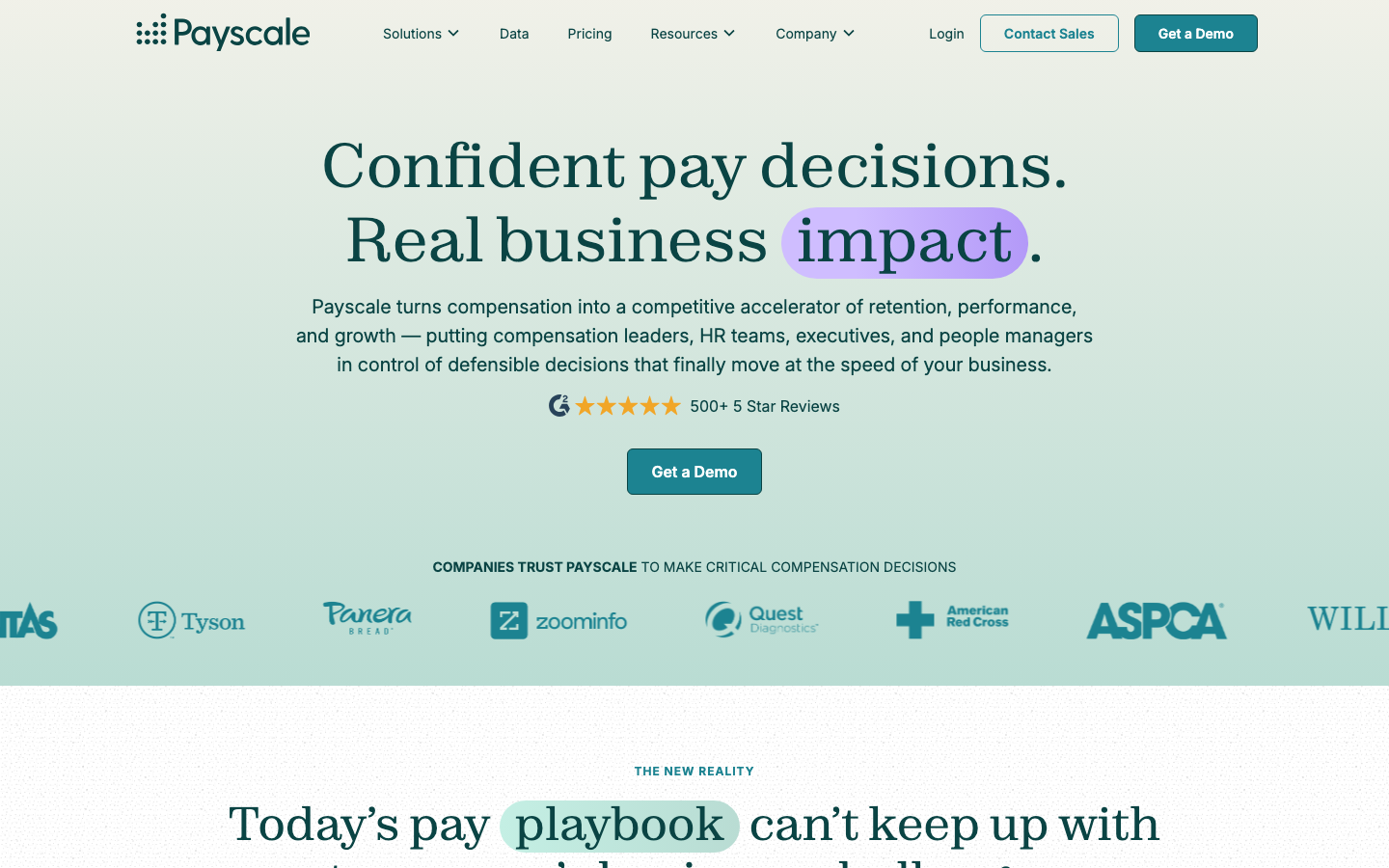
Payscale combines employer survey data with a large body of employee-reported salary profiles. The blend gives it unusual breadth across company sizes and industries. AI-assisted job pricing sits on top. Its G2 entry sits under the Payscale Ascent listing, formerly MarketPay.
Software Pros
- Two data sources together cover roles that a single method would miss
- AI-assisted job pricing speeds up matching internal titles to market codes
- Breadth across industries and company sizes, not only large employers
Software Cons
- Employee-reported data carries self-selection bias that surveys avoid
- Quote-based pricing that varies widely by configuration
- Blended sources make it harder to say exactly which numbers drove a range
Payscale Review
During my evaluation of Payscale, the two-source blend cut both ways.
Our Verdict
Surveys Plus Employee-Reported Data
Ravio
Quick Overview
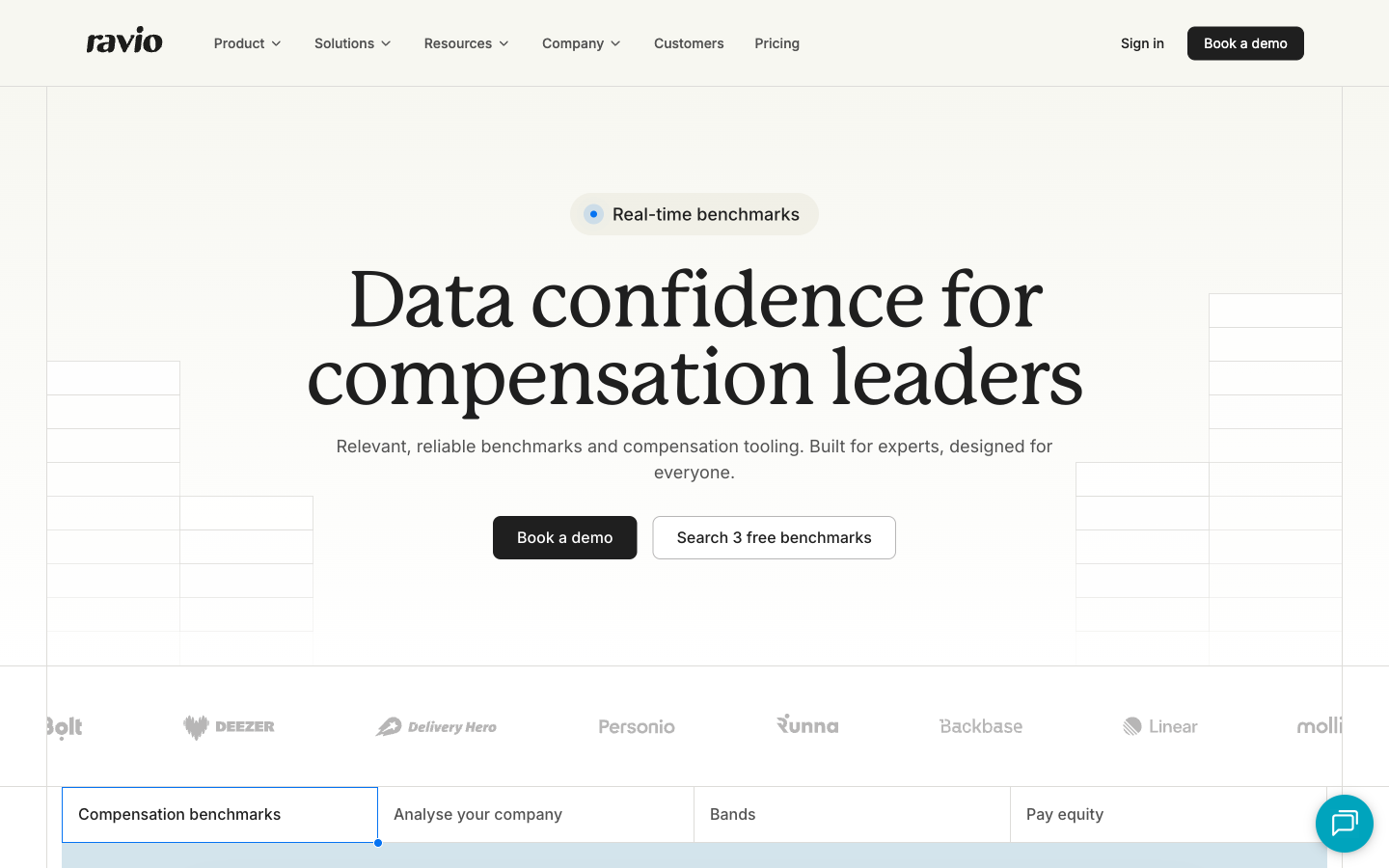
Ravio sources verified pay data straight from participating employers’ HR systems, weighted toward European and globally distributed technology companies. You can upload existing surveys for side-by-side comparison, and free access depends on connecting your own HR system.
Software Pros
- Verified data pulled from HR systems rather than self-reported or surveyed
- Existing survey data can be uploaded and compared against live benchmarks
- European technology coverage that the US-centric platforms cannot match
Software Cons
- Free access depends on contributing your own pay data through an integration
- Coverage clusters in European technology rather than across all sectors
- Just 10 G2 reviews, which is a very thin evidence base
Ravio Review
I spent time with the side-by-side comparison, which is a more honest feature than it first appears.
Our Verdict
European Real-Time Pay Data
Salary.com
Quick Overview
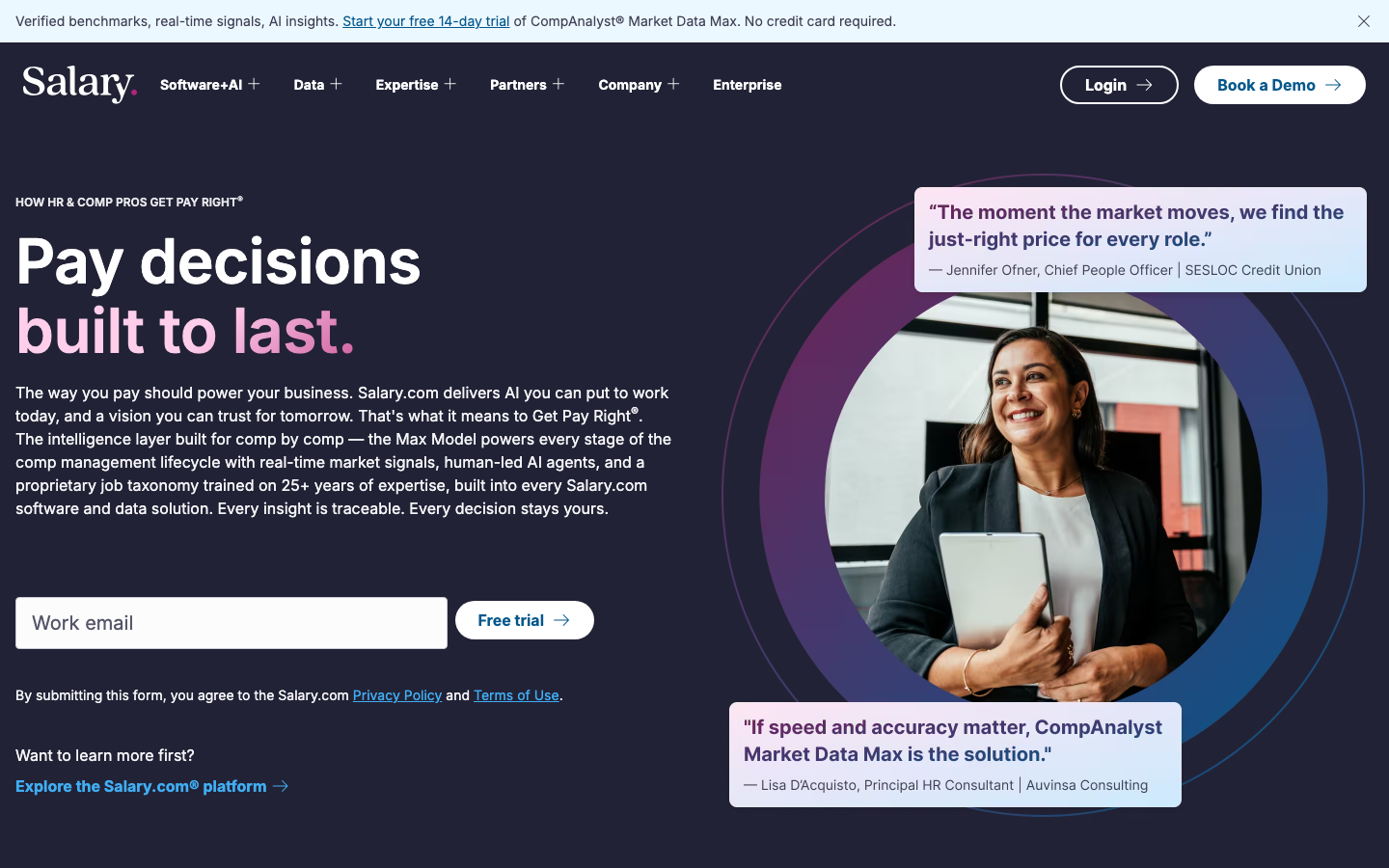
Salary.com runs CompAnalyst on HR-reported survey data collected directly from employers’ compensation departments. It covers market pricing, salary structure building, and survey participation tooling.
Software Pros
- HR-reported data collected from compensation departments rather than from employees
- Salary structure tooling builds and maintains bands, not just point benchmarks
- Survey participation is managed inside the same platform
Software Cons
- US-centric, with limited value for companies hiring across many countries
- Quote-based pricing with no published entry point
- Built for compensation teams, so a generalist HR manager will find it dense
Salary.com Review
The feature I kept coming back to is how Salary.com maintains whole band architectures. Plenty of tools hand you a market number and stop. Keeping a whole architecture of bands current as jobs change is what consumes a compensation team.
Our Verdict
HR-Reported Data And Structures
WTW Compensation Software
Quick Overview
WTW Compensation Software is market pricing software that aggregates the employer surveys a company already licenses, rather than selling its own data. It automates job matching and data cut selection, meaning which industry, size, and location slice you price against, with range modeling and dashboards on top. WTW describes the tools as powered by BetterComp. A strategic partnership announced in January 2026 pairs its own advisory and benchmarking reports with that platform.
Software Pros
- Aggregates multiple purchased surveys into one market pricing workflow
- Automated job matching removes the slowest manual step in market pricing
- Range modeling lets a team test several structures before committing to one
Software Cons
- It carries no proprietary dataset, so you still buy the surveys separately
- Priced by quote, with no figure published anywhere to weigh it against
- Only 15 G2 reviews stand behind the software’s score
WTW Compensation Software Review
While reviewing WTW Compensation Software, the clearest way to place it is as the layer above your survey subscriptions rather than a rival to them.
Our Verdict
Multi-Survey Market Pricing
FAQs About Salary Benchmarking Software
What HR Software Has Salary Benchmarking Data?
Several payroll and HR platforms include a benchmarking module, so market figures appear beside the payroll record without an export. Dedicated data providers go considerably deeper on job families, geographic cuts, and sample size. The trade-off is convenience against depth, and it usually comes down to whether anyone in the company prices roles as an actual job.
How Much Does Salary Benchmarking Software Cost?
Almost every provider quotes rather than publishes, because cost depends on which surveys, job families, and market cuts you buy, plus your headcount. Among the 11 reviewed here, not one publishes a usable rate as of August 2026. Free tiers exist at three of them, though on some the price is contributing your own pay data instead of money.
How Accurate Is Salary Benchmarking Data?
Accuracy depends on three things. Where the data came from, how well your jobs were matched to it, and the sample size behind your role in your market. Two providers can differ by double digits on the same job and both be defensible. Always ask for the sample size behind a number before you rely on it.
How Often Should We Re-Benchmark?
Annually is enough for stable roles, and quarterly is closer to right for functions where pay is moving quickly. Between refreshes, providers apply an aging factor, an uplift estimating today’s value from older data. That works until a market moves faster than the assumption behind it.
Do We Have to Share Our Own Pay Data to Use These Tools?
On several real-time platforms, yes, at least for the cheaper tiers. You connect your HR system and pay records flow into a pool that other participants also read. The data is aggregated and anonymized before anyone sees it. Sending payroll information outside the company still needs an owner and a proper review.
Does the EU Pay Transparency Directive Require Benchmarking Software?
No. The Directive requires employers to give applicants pay information, explain the criteria behind pay levels, and report pay gaps above certain headcount thresholds. Software is one way to produce that evidence, but it is not a legal requirement in itself. This describes the rules rather than providing legal advice, and obligations differ by member state.
What Is the Difference Between Salary Benchmarking and Compensation Management Software?
Benchmarking supplies the market data you use to price roles. Compensation management runs the process afterward: merit budgets, manager recommendations, approvals, and the letters that go out at the end. Several platforms now cover both, which is convenient but makes it easy to buy a planning tool when what you needed was better data.

Helen is Anywherer’s Market Analyst & Content Researcher, with extensive experience in analyzing global employment markets and HR technology trends. She is skilled at turning complex market data into clear, well-researched insights that inform every piece of content. With a strong grasp of the EOR, PEO, and international hiring space, Helen plays a key role in keeping Anywherer’s research accurate, up to date, and genuinely useful for readers.