A manager approves one employee’s vacation because the week looks quiet, then denies another request the next day because coverage suddenly feels tight. No written rule exists, so the second employee sees favoritism. Remote teams make this harder. People work across time zones, countries, school calendars, and different expectations about vacation, sick days, and carryover. A PTO policy template gives managers a rulebook before those small judgment calls become payroll disputes or employee-relations problems.
Time-off planning also connects to staffing. A workforce planning template can show when the team is thin, but the PTO policy explains how requests are earned, approved, and tracked. The Bureau of Labor Statistics reports that access to paid vacation is common in private industry, yet the amount varies by tenure and worker group. That variation is exactly why copied handbook language can cause trouble.
What Is a PTO Policy?
A PTO policy defines how employees earn, request, use, approve, and track paid time away from work. It should say who is eligible, when the benefit starts, which system records balances, and which manager or HR role is responsible for approvals. The policy also explains how the company treats public holidays, sick leave, and protected absences.
Some companies use one combined PTO bank. Others keep separate pools for vacation, sick leave, and personal days. Accrual-based policies add time each pay period, while front-loaded policies give employees a set balance at the start of the year. Unlimited PTO removes the fixed bank, but it still needs guardrails.
The right structure depends on the team. Small businesses often need short rules that managers can apply without a full HR department. Distributed teams need calendar and handoff rules. Global teams need local statutory minimums, payroll settings, and annual review by country.
Why Companies Need a Clear PTO Policy Template
A clear policy removes ambiguity. Employees know when they can take time off, how much notice is expected, and what happens if several people request the same week. Managers get a consistent basis for approval decisions. That matters when a denial later needs to be explained to HR, payroll, or a labor authority.
Payroll needs the same clarity. The BLS paid vacation factsheet shows how vacation benefits vary across workers and years of service, including a 2025 benchmark where 31% of private-industry workers with one year of service received 10 to 14 paid vacation days. Accruals, carryover, and payout rules need to match the payroll system. A companion attendance policy template can keep absences, tardiness, and no-shows separate from planned PTO.
For distributed and global teams, the stakes are higher. The U.S. Department of Labor explains that federal law does not require vacation leave under the FLSA, but state and local rules can still apply. Outside the U.S., statutory annual leave may be mandatory. A template should make room for local rules rather than assuming a single clause works everywhere.
8 PTO Policy Template Examples
The eight examples below cover common company stages and leave structures. Use them as drafting language, then localize the final policy for payroll, employment contracts, state rules, country rules, and any collective agreement. This section includes a paid time off PTO policy template, a vacation policy template, small-business language, unlimited PTO wording, and global-team wording.
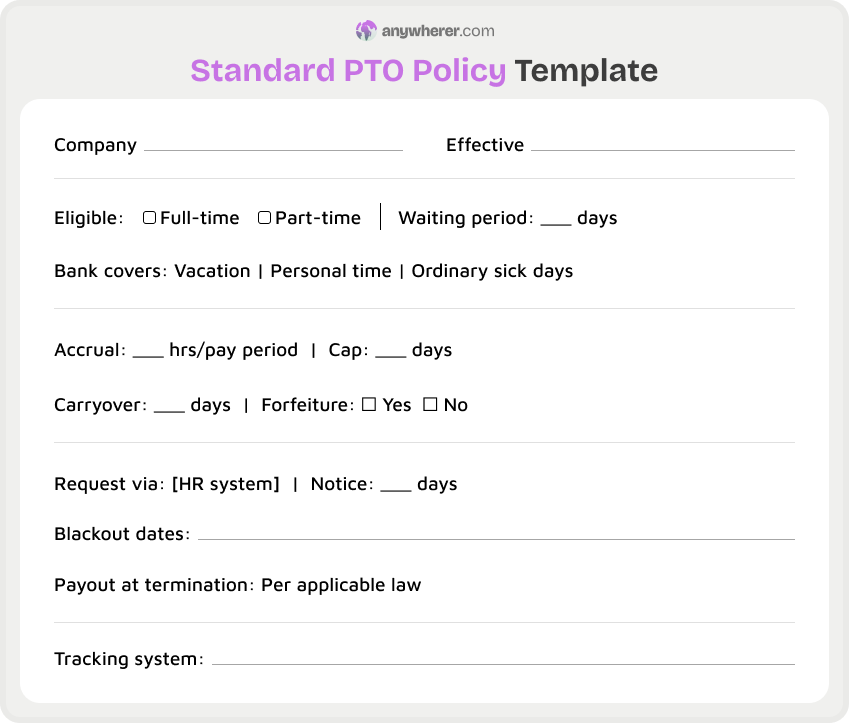
Standard PTO Policy Template
Purpose: Use this for an established company offering one combined PTO bank that accrues each pay period. It works when vacation, personal days, and ordinary sick time are tracked together.
Policy sections:
- Eligibility and effective date. Defines which employment classifications qualify: full-time, part-time, or both, and the exact date PTO begins accruing or becomes available.
- Combined PTO bank. Sets what the bank covers (vacation, personal time, and ordinary sick days) and what it excludes (parental leave, disability, or other protected leave types).
- Accrual rate, waiting period, and cap. States how quickly time accumulates each pay period, whether a new-hire waiting period applies, and the maximum unused balance before accrual pauses.
- Carryover, forfeiture, and termination payout. Explains how much unused PTO rolls into the next year, whether uncarried balances are forfeited, and what employees receive when employment ends.
- Request and approval process. Sets how employees submit requests, who approves them, the minimum notice period, and any dates when approval is restricted due to business needs.
- Public holidays and recordkeeping. Clarifies whether public holidays count against the PTO bank or are treated separately, and identifies the system that tracks balances.
Example of a template (text version):
- Company name: ___________________________ | Policy effective date: ___________
- Which employees are eligible? Full-time / Part-time / Other: ___ | When does PTO start accruing? First day / After waiting period of ___ days
- What does the PTO bank cover? Vacation / Personal time / Ordinary sick days / Other: ___
- What is the accrual rate? ___ hours per pay period | Maximum balance cap: ___ days
- Is there a new-hire waiting period? Yes: ___ days / No
- What is the carryover limit? ___ days | What happens to uncarried balances? Forfeited / Paid out / Other: ___
- What is the payout rule at termination? Per applicable law / Company policy: ___________________________
- How should requests be submitted? [HR system / tool]: ___ | Minimum notice required: ___ days
- Are there blackout dates when approvals are restricted? ___________________________
- Do public holidays draw from the PTO bank? Yes / No | Which system tracks balances? ___________________________
Best for: Established companies in one main jurisdiction with a mature payroll process.
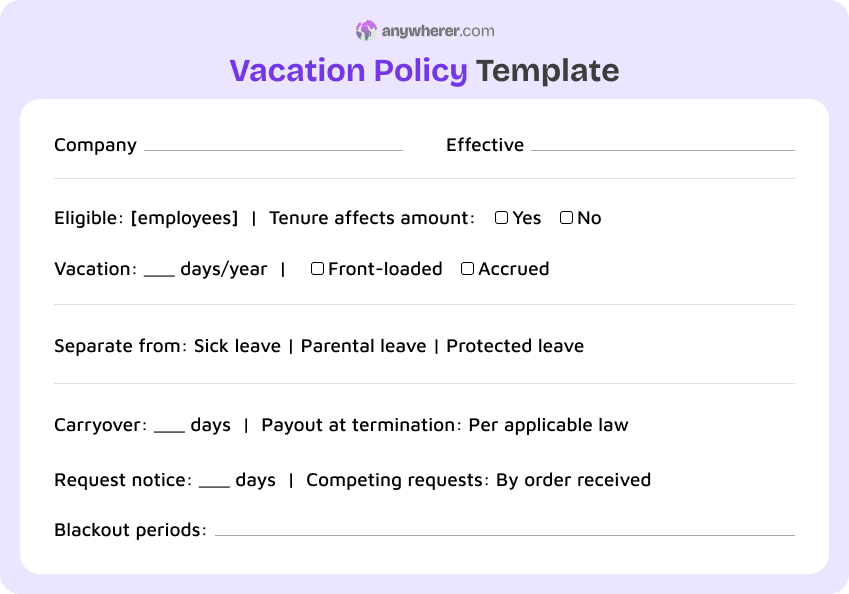
Vacation Policy Template
Purpose: Use this when vacation is separate from sick leave, parental leave, and other protected absences. This vacation policy template is easier for employees to understand when sick leave has its own rules.
Policy sections:
- Eligibility by employment status and tenure. Defines which employees receive vacation, whether part-time workers are included, and whether tenure affects the annual amount.
- Annual allotment or accrual schedule. States the total vacation days available and how they are earned: front-loaded at the start of the year or accrued per pay period.
- Separate sick, personal, and protected leave. Confirms that illness, personal emergencies, parental leave, and other protected absences draw from different balances, not from vacation.
- Carryover, cap, and payout on termination. Explains the maximum rollover, what happens to uncarried days, and whether unused vacation is paid out when employment ends.
- Request timing, approval, and blackout periods. Sets how far in advance employees must submit requests, how managers evaluate competing requests, and any seasonal restrictions.
- Public holidays. Clarifies which holidays the company observes and how they interact with vacation scheduling.
Example of a template (text version):
- Company name: ___________________________ | Vacation policy effective date: ___________
- Who receives vacation? Full-time / Part-time / Tenure-based: ___ | Does tenure affect the annual amount? Yes: ___ / No
- How is vacation earned? Front-loaded at start of year: ___ days / Accrued per pay period at: ___ hrs per period
- What is separate from vacation? Sick leave / Personal days / Parental leave / Protected leave / Other: ___
- What is the carryover limit? ___ days | What happens to uncarried vacation? Forfeited / Paid out / Other: ___
- Is unused vacation paid out at termination? Yes / No / Per applicable law: ___________________________
- Minimum request notice: ___ days | How are competing requests evaluated? By order received / Seniority / Other: ___
- Are there blackout periods? Which dates or seasons? ___________________________
- Which public holidays does the company observe? ___________________________
Best for: Employers who want a clear employee vacation policy template while keeping sick leave separate.
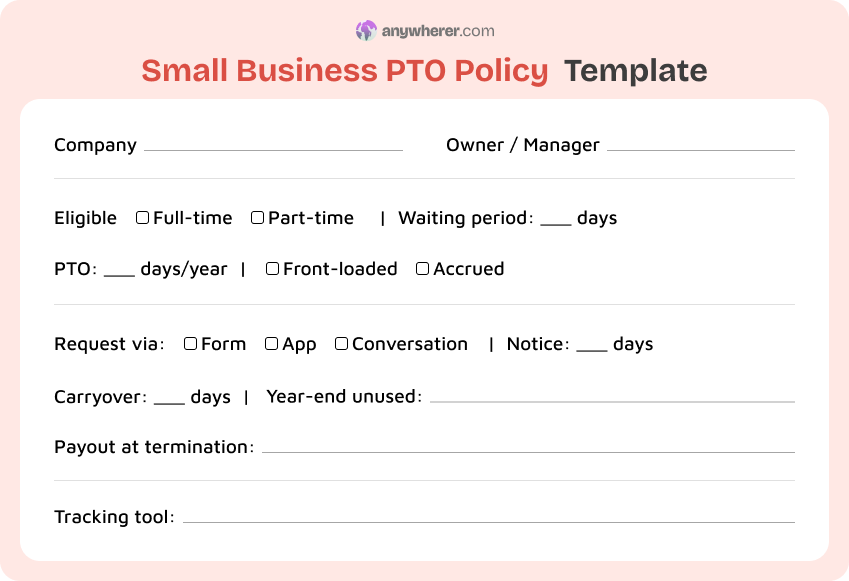
Small Business PTO Policy Template
Purpose: Use this for teams under 50 employees that need simple rules before hiring becomes harder to manage. A vacation policy for small business template should be short enough for managers to apply consistently.
Policy sections:
- Eligibility and PTO start date. States who qualifies (typically all full-time employees) and when the waiting period ends.
- Annual PTO amount or simple accrual. Sets the total leave available in plain terms, either as a flat annual amount or a straightforward per-pay-period schedule.
- Request process. Explains how employees request time off, whether via a form, an app, or a direct conversation with the owner or manager.
- Notice requirements. Sets the minimum notice expected for planned leave and how the company handles last-minute or emergency requests.
- Carryover, cap, and termination payout. Brief rules on how much unused PTO rolls over, any year-end limit, and what departing employees receive.
- Tracking method. Identifies the spreadsheet or tool used to record approved leave and ensure payroll has the correct balance.
Example of a template (text version):
- Company name: ___________________________ | Owner / Manager name: ___________________________
- Who is eligible? Full-time employees / Part-time / Contractors / Other: ___ | Waiting period: ___ days
- How much PTO is provided? ___ days per year | Front-loaded / Accrued at: ___ hrs per pay period
- How should planned leave be requested? Form / App / Direct conversation with: ___________________________
- Minimum notice for planned leave: ___ days | Emergency requests handled by: ___________________________
- Carryover limit: ___ days | What happens to unused days at year-end? ___________________________
- What do departing employees receive? Payout / No payout / Per applicable law: ___________________________
- Which tool or spreadsheet tracks approved leave for payroll? ___________________________
Best for: Founders and operations managers formalizing time-off rules for the first time.
Simple / Free PTO Policy Template
Purpose: Use this when the company needs a lightweight, plug-and-play policy. This PTO policy template free version avoids legal detail that belongs in a jurisdiction-specific handbook.
Policy sections:
- Eligibility date and PTO amount. Defines who qualifies and how much leave they receive under the company schedule.
- Front-loaded or accrued. States whether PTO is given as a lump sum at the start of the period or earned over time through each pay cycle.
- Request method and approval path. Explains how employees submit time-off requests and identifies who reviews and approves them.
- Carryover limit and year-end treatment. Sets the cap on unused PTO and determines what happens to any remaining balance at year-end.
- Payout on termination. States whether unused PTO is paid out when an employee leaves, subject to applicable state or country law.
- Tracking and employee responsibility. Clarifies which tool employees use to check balances before submitting requests and where approved leave is recorded.
Example of a template (text version):
- Who is eligible and when does PTO start? ___________________________
- How much PTO do eligible employees receive? ___ days | Schedule: ___________________________
- Is PTO front-loaded or accrued per pay cycle? Front-loaded / Accrued at: ___ hrs per pay period
- How should requests be submitted? [Tool / system]: ___ | Who approves? ___________________________
- What is the carryover limit? ___ days | What happens at year-end to unused days? ___________________________
- Is unused PTO paid out at termination? Yes / No / Per applicable law: ___________________________
- How can employees check their available balance before submitting a request? [Tool]: ___________________________
- Where is approved leave recorded for payroll? ___________________________
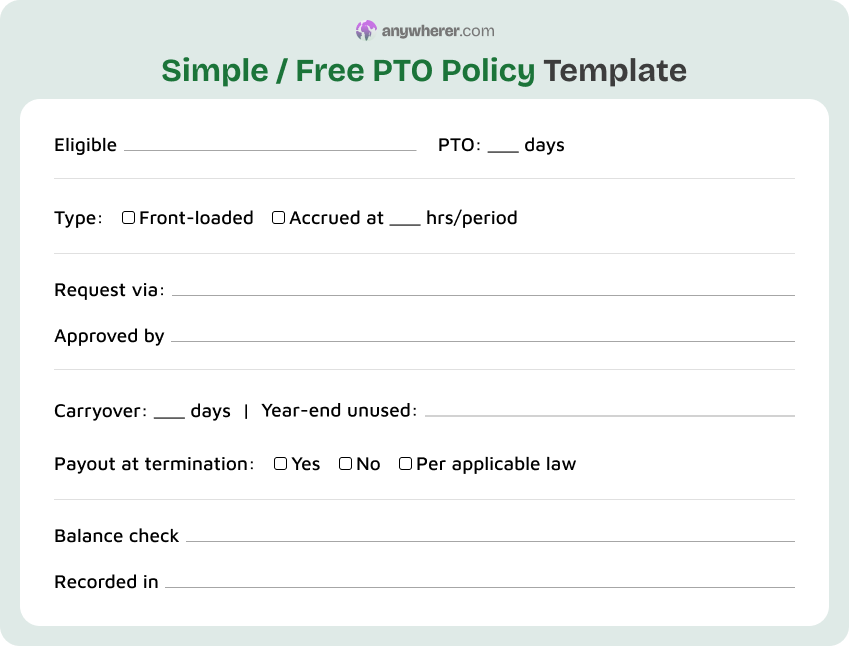
Best for: Small teams looking for a simple vacation policy template or free vacation policy template starter.
Unlimited PTO Policy Template
Purpose: Use this for exempt or salaried teams where performance is measured by outcomes rather than hours. An unlimited PTO policy template still needs approval rules and minimum usage expectations.
Policy sections:
- Eligibility by role, classification, and location. Identifies which employee types and locations the unlimited policy covers, including any exclusions where local law requires a fixed balance.
- No fixed balance or accrual. States clearly that no PTO bank accumulates, nothing carries over, and there is no balance to pay out under a standard unlimited structure.
- Minimum use expectation. Sets a baseline for how much time off employees are expected to take so that no one feels pressured to skip rest entirely.
- Approval process, coverage, and blackout periods. Confirms that manager approval is still required and explains how coverage is managed during peak business periods.
- Sick leave and statutory leave. Clarifies that legally required sick leave or protected leave is tracked and administered separately under applicable law.
- No payout on termination. States that unused unlimited PTO is not paid out upon termination of employment, unless local law requires otherwise.
Example of a template (text version):
- Which roles, classifications, and locations does the unlimited policy cover? ___________________________
- What is excluded from unlimited PTO? Fixed-balance employees / Locations with statutory minimums / Other: ___
- Is there a minimum expected usage? ___ days per year / Describe expectation: ___________________________
- How should requests be submitted? [System]: ___ | Who approves? ___________________________
- What blackout periods or peak-season restrictions apply? ___________________________
- How is legally required sick leave tracked separately? [System / tool]: ___________________________
- Is unused unlimited PTO paid out at termination? No / Per applicable local law: ___________________________
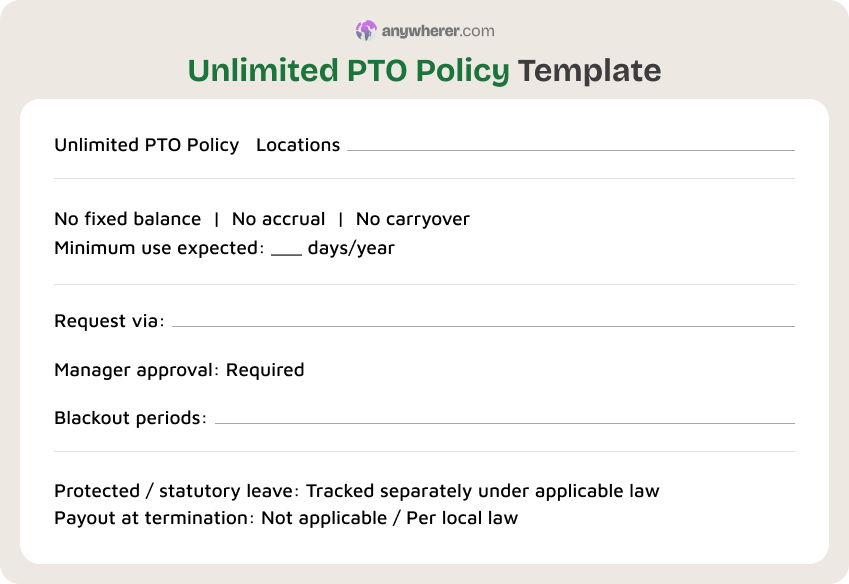
Best for: Outcome-based teams with experienced managers and reliable workload planning.
Vacation and Sick Leave Combined Policy Template
Purpose: Use this when the company wants one shared bank for routine vacation and ordinary illness. A vacation and sick leave policy template needs clear documentation rules for longer absences.
Policy sections:
- Combined bank definition. Describes what the shared balance covers (typically vacation, personal time, and routine illness) and what it does not include.
- Accrual, front-loading, or annual allotment. States how the combined leave is earned or distributed across the year and at what rate.
- Planned vacation versus unexpected illness. Sets different notice and communication rules depending on whether leave is planned in advance or taken unexpectedly due to illness.
- Documentation for extended absences. Defines when medical or other documentation is required for absences longer than a set threshold.
- Carryover, cap, and protected leave interaction. Explains balance limits at year-end and how legally protected leave types interact with the combined bank.
- Payroll and HR recordkeeping. Identifies who owns the tracking system and how leave balances feed into payroll processing.
Example of a template (text version):
- Company name: ___________________________ | Policy effective date: ___________
- Who is eligible and what does the combined bank cover? Vacation / Personal time / Ordinary illness / Other: ___
- What is excluded from the combined bank? Parental leave / Disability / Protected statutory leave / Other: ___
- How is combined leave earned? Accrual: ___ hrs/period / Front-loaded: ___ days/year / Annual allotment: ___
- How much advance notice is expected for planned vacation? ___ days
- How should employees notify the company for unexpected illness? Notify manager by: ___ [method and deadline]: ___
- When is documentation required for extended absences? After ___ consecutive days
- What is the carryover limit? ___ days | Balance limit at year-end: ___ | What happens to excess? ___
- Who owns the tracking system and feeds balances to payroll? HR / Payroll / Manager / Other: ___
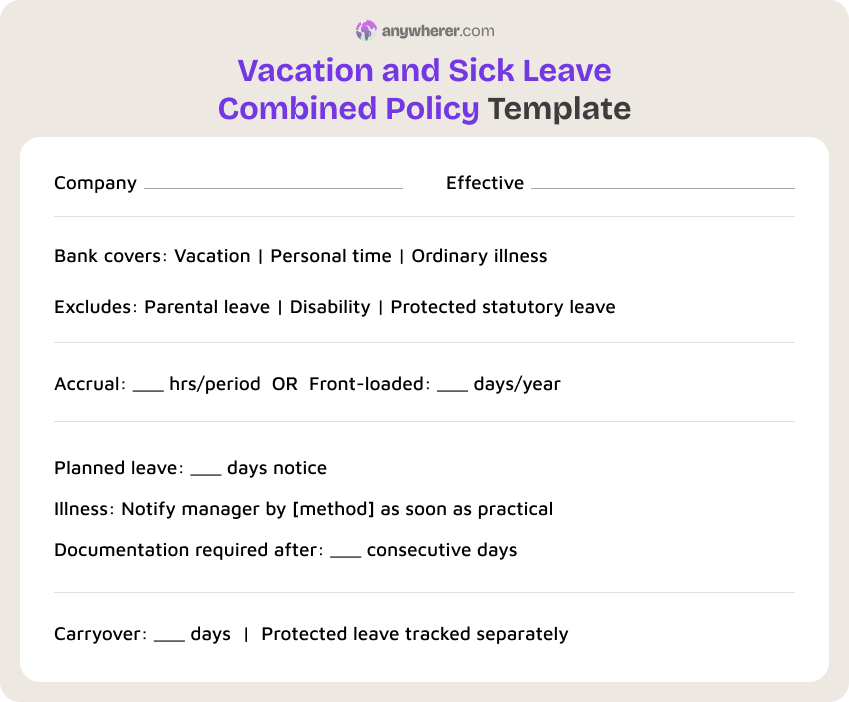
Best for: Employers who want a single PTO bank but still need sick leave guardrails.
Remote / Distributed Team PTO Policy Template
Purpose: Use this for remote, hybrid, or globally distributed teams where managers cannot rely on office visibility. It pairs well with a remote work policy template that defines availability and communication norms.
Policy sections:
- Eligibility by location and employment type. Defines which remote and distributed workers the policy covers and whether contractors or freelancers are included.
- Time-zone and coverage expectations. Sets when requests must be submitted relative to planned leave and how team coverage is coordinated across different time zones.
- Calendar updates and handoff notes. Requires employees to update shared calendars and document active work handoffs before leave begins.
- Accrual, carryover, and local statutory differences. Addresses how leave balances and carryover rules may vary by the employee’s home location.
- Public holidays by location or company calendar. Clarifies whether employees follow their local public holiday schedule or a company-wide calendar.
- HRIS tracking and manager approval. Identifies the system for submitting requests and how managers confirm approvals across distributed teams.
Example of a template (text version):
- Which remote and distributed workers does this policy cover? Employees / Contractors / Freelancers: ___________________________
- Through which system must requests be submitted? [HRIS / tool]: ___________________________
- How far in advance must requests be submitted? ___ days | What time-zone and coverage notes are required? ___________________________
- Must employees update shared calendars after approval? Yes / No | By when? ___________________________
- What handoff documentation is required before leave begins? Active work / Customer needs / Time-zone contacts: ___________________________
- How do accrual and carryover rules vary by the employee’s home location? ___________________________
- Which public holiday schedule applies? Local schedule / Company-wide calendar / Other: ___________________________
- What out-of-office and communication steps are required before leave begins? ___________________________
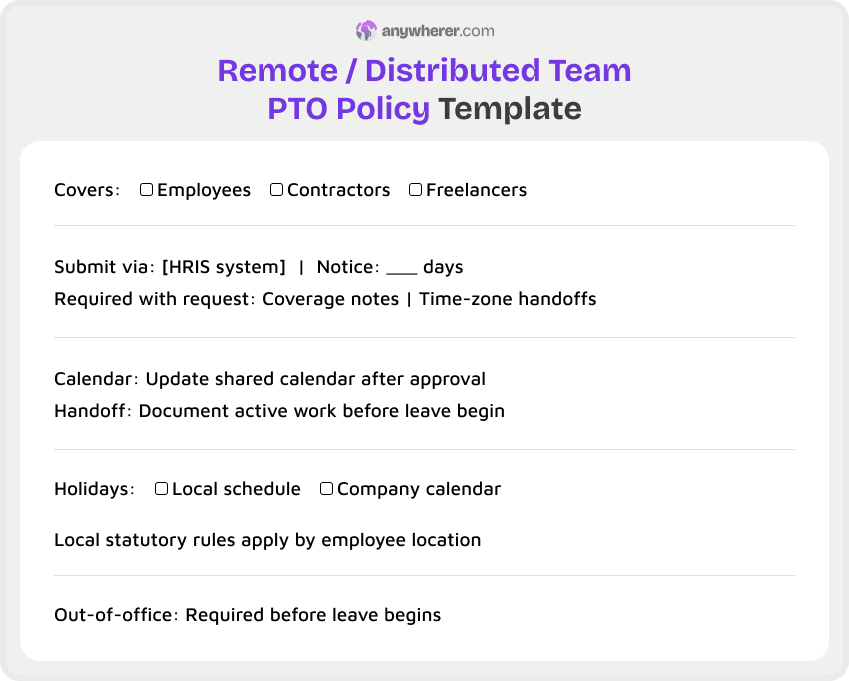
Best for: Remote-first teams with employees across several time zones or countries.
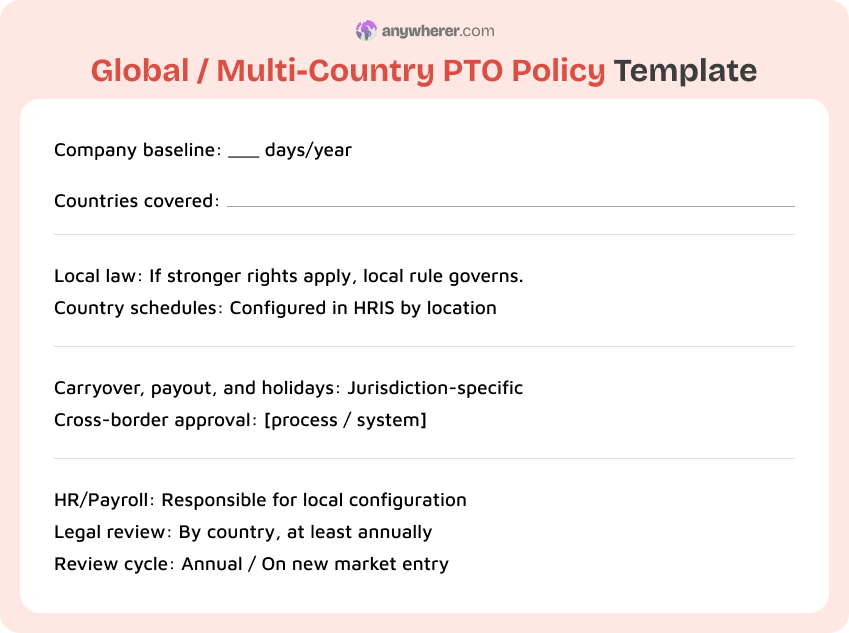
Global / Multi-Country PTO Policy Template
Purpose: Use this for companies hiring employees in several countries or states. The global template sets a company baseline, then defers to local law when statutory rules are more generous.
Policy sections:
- Company baseline and local minimum rule. Establishes the global floor for time off and confirms that local law controls when it grants employees more leave than the baseline.
- Country-specific schedules. Lists vacation entitlements, sick leave rules, and public holidays by country or region, configured separately for each location.
- Accrual, carryover, and payout by jurisdiction. Addresses how these rules differ across countries and where local settings are maintained in payroll and HRIS.
- Approval process for cross-border teams. Explains how employees and managers in different countries coordinate requests, coverage, and approval chains.
- Payroll, HRIS, and legal review. Assigns responsibility for configuring local rules and conducting periodic compliance checks by jurisdiction.
- Annual review cadence. Sets when the policy is reviewed globally, with triggered updates when the company enters new markets.
Example of a template (text version):
- What is the company’s global baseline for time off? ___ days per year
- Which countries or regions does this policy cover? ___________________________
- What rule applies when local law grants more leave than the global baseline? Local law controls: Yes / Confirm by country: ___
- List vacation entitlements, sick leave rules, and public holidays by country or region: ___________________________
- How do accrual, carryover, and payout rules differ across countries? ___________________________
- How do cross-border teams coordinate approval requests? [Process]: ___________________________
- Who owns payroll and HRIS configuration for each country? HR / Payroll / Local team / Other: ___
- When is this policy reviewed globally? Annual / On new market entry / Other: ___________________________
Best for: Companies with employees in multiple countries, states, or employment-law systems.
How to Roll Out and Manage a PTO Policy
Rollout should start with stakeholder review. HR, payroll, finance, legal, and managers should check the draft before employees see it. The review should confirm eligibility, accrual logic, payout rules, and any location-specific leave requirements. After approval, employees should receive the policy and sign an acknowledgment.
Manager training matters. A fair policy can still fail if one department approves every request and another denies routine vacation. Managers need examples for busy seasons, overlapping requests, emergency leave, and remote handoffs. Payroll or HR should configure balances before the policy goes live.
Manual tracking can work for a very small team, but growing companies should compare leave management software before balances become hard to audit. Review the policy annually, and sooner after new laws, new locations, mergers, payroll changes, or a move to unlimited PTO.
Key Elements Every PTO Policy Should Include
Every PTO policy must address the same core topics regardless of company size, leave structure, or worker location. The list below identifies what HR, payroll, and legal should confirm are covered before the policy is distributed to employees.
- Eligibility and effective start date.
- Structure type: combined PTO, separate pools, or unlimited PTO.
- Accrual rate, front-loaded amount, or no-balance rule.
- Carryover, cap, and payout-on-termination rules.
- Request method, approval owner, and notice period.
- Treatment of public holidays and company closures.
- Tracking method and system of record.
- Manager, payroll, and HR responsibilities.
Common Mistakes in PTO Policies
Most PTO policy problems trace back to gaps in the original draft or inconsistent enforcement across managers and departments. The issues below appear regularly in policies of all sizes and are worth reviewing before a policy goes live or is next updated.
- Calling a policy unlimited without setting minimum-use expectations.
- Letting managers enforce the same rule differently.
- Ignoring statutory minimums for international or multi-state employees.
- Failing to define the treatment of unused PTO at termination.
- Mixing sick leave and vacation without documentation rules.
- Skipping the annual review after changes to laws or payroll systems.
FAQs on PTO Policy Templates
What should be included in a PTO policy template?
A PTO policy template should cover eligibility, when time off starts, whether leave is accrued or front-loaded, and how employees request approval. It should also explain carryover, caps, payout on termination, public holidays, sick leave, and the tracking system of record. The U.S. Department of Labor notes that vacation leave is generally a matter of agreement between employer and employee, not a federal FLSA requirement. State, local, and country rules may still apply.
Is there a free PTO policy template for small businesses?
Yes, a PTO policy template free option can work for a small business if it is treated as a starting point. The company should still add its own eligibility rules, notice periods, carryover limits, and state or country requirements. A vacation policy template free download can miss payout-on-termination rules, sick leave requirements, or local statutory minimums. HR or counsel should review the policy before it is issued to employees.
What is the difference between PTO and vacation policy?
A PTO policy usually combines vacation, personal time, and ordinary sick time into one bank. A vacation policy covers only vacation and keeps sick leave, bereavement, parental leave, and protected leave in separate sections. A time off vacation policy template is better when the company wants employees to see exactly what counts as vacation. A combined PTO bank is simpler, but it can blur documentation rules for illness.
How does an unlimited PTO policy work?
Unlimited PTO removes the fixed annual balance, but it does not remove approval, coverage, or performance expectations. Employees request leave when work can be covered, and managers approve based on staffing, deadlines, and fairness. A good unlimited PTO policy sets a minimum-use expectation so employees do not avoid taking leave. It should also state whether legally required sick leave or protected leave is tracked separately.
How often should a PTO policy be updated?
A PTO policy should be reviewed at least once a year and whenever the company enters a new state or country. Updates are also needed after changes to sick leave, public holidays, payout rules, or payroll system configuration. Employers can use SHRM or similar HR references to monitor changes in benefits practices, but legal updates should come from official sources or counsel. Managers should be retrained after major policy changes.
How do you build a PTO policy for a remote or global team?
Start with one company baseline, then add local rules by employee location. Remote teams need calendar updates, time-zone coverage plans, and clear handoff expectations. Global teams need payroll and HRIS settings that reflect local accruals, statutory holidays, carryover, and payout rules. OECD country data can help HR understand that annual leave norms differ widely, but each policy still needs jurisdiction-specific legal review.

Yaryna is our lead writer with over 8 years of experience in crafting clear, compelling, and insightful content. Specializing in global employment and EOR solutions, she simplifies complex concepts to help businesses expand their remote teams with confidence. With a strong background working alongside diverse product and software teams, Yaryna brings a tech-savvy perspective to her writing, delivering both in-depth analysis and valuable insights.