A founder hires a third employee, then a fifth, and the old verbal version of “how we work” starts to break. One manager approves flexible hours. Another insists everyone ask first. A new hire joins remotely and has no nearby teammate to explain benefits, conduct rules, or what happens after a missed shift. An employee handbook template turns those loose habits into a written source of truth.
This guide gives HR teams, founders, and operations managers a free downloadable starter they can adapt by stage, work model, and location. It can become a handbook page, PDF, or image card after legal review.
For handbook structure and policy ownership, HR teams can also compare the SHRM employee handbook guide with the templates below before drafting local addenda.
What Is an Employee Handbook?
An employee handbook is a company document that explains workplace policies, employee expectations, benefits, reporting channels, and basic employment rules. It gives employees the same baseline information rather than relying on memory, managerial style, or informal Slack answers.
A strong handbook aligns expectations and reduces legal risk. It explains how the company handles pay, leave, conduct, discrimination complaints, discipline, termination, safety, data security, and acknowledgments. It should also show where local addenda or employment contracts control.
The right handbook changes by environment. A small business may need a short handbook. A startup needs room for change. Remote, hourly, field service, California, and global teams need more specific rules because their risks differ.
Why Companies Need an Employee Handbook Template
A template saves drafting time by providing the company with a vetted structure before HR starts writing. It also makes gaps easier to spot. Missing sections on timekeeping, harassment reporting, remote work, or final pay are easier to catch when the table of contents already exists.
Compliance is the bigger reason. The U.S. Department of Labor explains FLSA wage-and-hour rules, while the EEOC publishes guidance on preventing harassment and discrimination. A handbook does not replace legal advice, but it helps employers document how those policies are communicated.
For distributed teams, a handbook also standardizes onboarding. Employees can find answers on schedules, benefits, leave, device security, and complaint channels. A workforce planning template can show where hiring is headed; the handbook explains how work should be done once people join.
Small businesses benefit just as much. A small business employee handbook template gives managers written rules before inconsistent habits become policy. It also creates an acknowledgment record when policies change.
9 Employee Handbook Template Examples
The templates below cover common handbook scenarios for different company types, team structures, locations, and worker categories. Use the sample employee handbook template language as a starting point, then adapt the final version based on location, worker type, and applicable legal requirements.
Standard Employee Handbook Template
Purpose: Use this for established companies with office-based, hybrid, or mixed teams in a single country. It provides managers with a comprehensive baseline for policies, benefits, conduct, and employee acknowledgments.
Policy sections:
- Company introduction: explain mission, values, and operating principles.
- Employment basics: define classification, working hours, and at-will language where applicable.
- Code of conduct: set EEO, anti-harassment, and reporting channels.
- Compensation and benefits: cover pay, leave, attendance, and time-off rules.
- Performance: outline reviews, discipline, termination, and offboarding.
- Acknowledgment page: confirm receipt and link to companion attendance rules from the attendance policy template.
Example of a template (text version):
- Company name: ___________________________ | Handbook effective date: ___________
- Which employment types does this handbook cover? Full-time / Part-time / Contractors / Other: ___
- Does at-will employment apply in this location? Yes / No / Not applicable: ___
- Standard working hours: ___ to ___ | Days: ___________________________ | Overtime approval required: Yes / No
- Pay period: Weekly / Bi-weekly / Semi-monthly / Monthly | Payday: ___________________________
- Leave structure: Combined PTO / Separate vacation and sick / Other: ___ | Accrual or front-loaded: ___
- Who should employees contact to report harassment or discrimination? Name / Role / Channel: ___________________________
- What is the progressive discipline process? Verbal warning / Written warning / PIP / Termination / Other: ___
- How are performance reviews conducted? Frequency: ___ | Format: ___ | Owner: ___________________________
- Employee acknowledgment method: Wet signature / Electronic signature / Other: ___ | Date: ___________
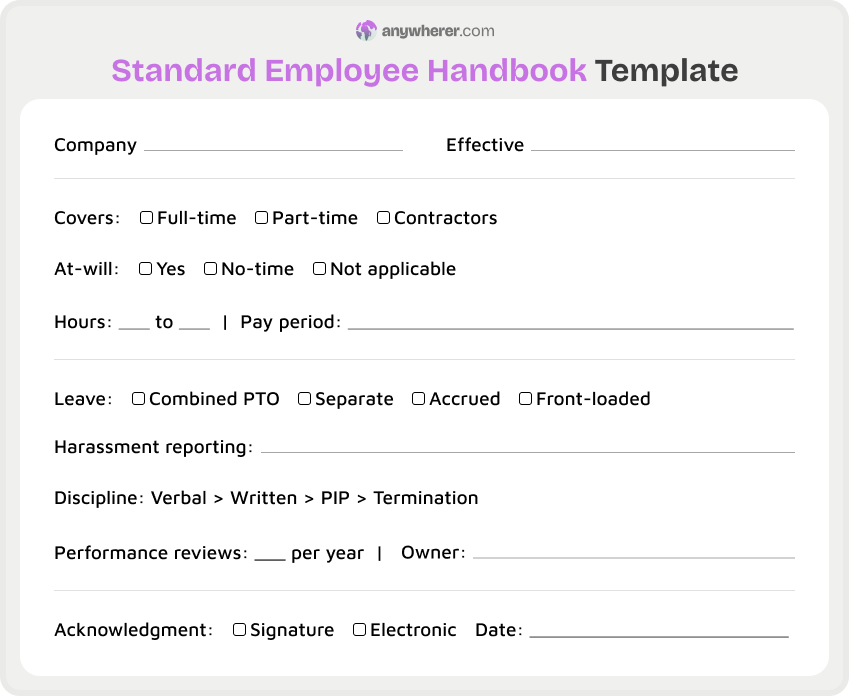
Best for: Established companies that need a sample employee handbook template with a broad policy structure.
Small Business Employee Handbook Template
Purpose: Use this for teams with fewer than 50 employees that need clear rules without a corporate HR department. A small business employee handbook template should stay plain and usable.
Policy sections:
- Company introduction: keep the business overview short and practical.
- Employment status: explain schedules, attendance, and timekeeping.
- Pay and benefits: list pay dates, time off, and expenses.
- Conduct rules: cover harassment reporting, safety, and confidentiality.
- Ending employment: explain discipline, resignation, termination, and final pay.
- Acknowledgment page: collect a signed record from every employee.
Example of a template (text version):
- Company name: ___________________________ | Owner / Manager name: ___________________________
- How many employees does this handbook currently cover? ___
- What are the standard working hours? ___ to ___ | Days: ___________________________ | Time tracking method: ___________________________
- When are employees paid? Payday: ___ | Method: Direct deposit / Check / Other: ___
- How many PTO or vacation days do employees receive? ___ days per year | Accrued / Front-loaded
- What is the process for requesting time off? ___________________________
- Who handles harassment or safety complaints? ___________________________
- What notice period applies for voluntary resignation? ___ days
- What is the final pay timeline at termination? Per applicable law / ___ days
- Employee acknowledgment: Name: ___________________________ | Signature: ___ | Date: ___________
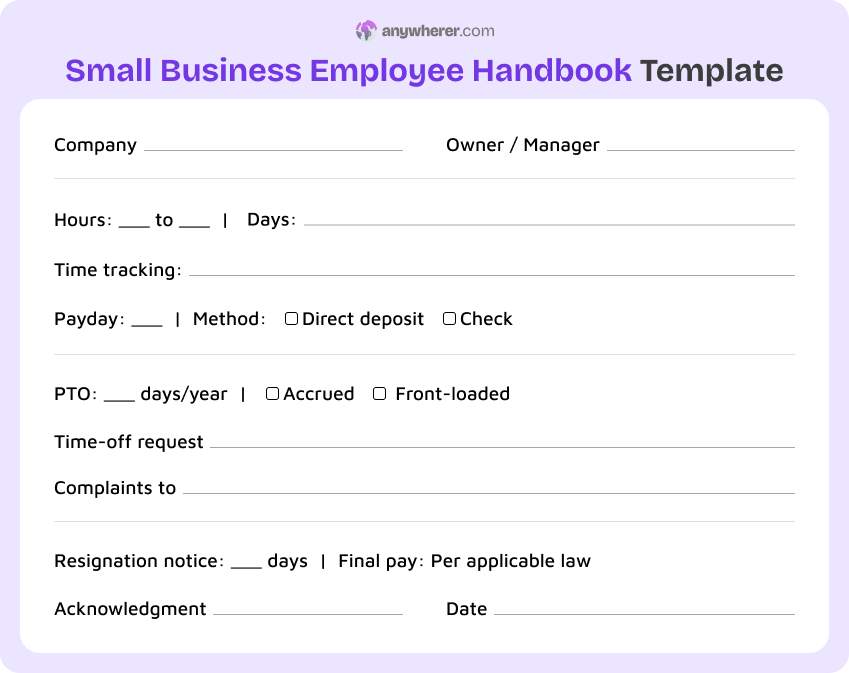
Best for: Owners looking for an employee handbook for small business template before policies become informal habits.
Free / Simple Employee Handbook Template
Purpose: Use this as a minimal plug-and-play starting point. This simple employee handbook template keeps the structure short while leaving room for local legal review.
Policy sections:
- Welcome statement: explain why the handbook exists.
- Employment basics: add relationship and classification language.
- Work rules: summarize hours, pay, attendance, and leave.
- Conduct and safety: cover reporting, safety, and data security.
- Discipline and termination: state the basic process.
- Local addenda: leave space for required notices.
Example of a template (text version):
- Company name: ___________________________ | Handbook effective date: ___________
- Who does this handbook apply to? Full-time / Part-time / All employees / Other: ___
- What are the standard working hours and schedule? ___________________________
- How is pay structured and when are employees paid? ___________________________
- What leave is available and how is it requested? ___________________________
- How should employees report safety concerns or misconduct? ___________________________
- What data security or confidentiality rules apply? ___________________________
- What is the basic discipline process? ___________________________
- What local legal notices or addenda apply in this location? ___________________________
- Employee acknowledgment: Name: ___________________________ | Date: ___________
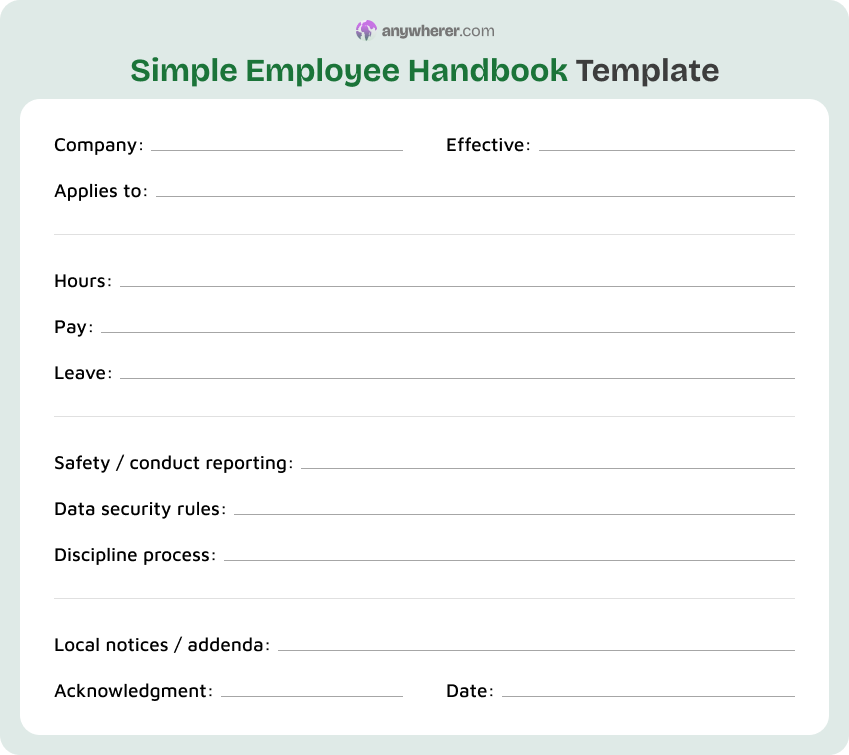
Best for: Teams looking for a simple employee handbook free template they can use as a starting point and customize for their workplace.
Remote Team Employee Handbook Template
Purpose: Use this for remote or hybrid teams that need a single source of truth when a manager is not nearby. Pair it with a remote work policy template for availability and equipment rules.
Policy sections:
- Remote expectations: define availability windows and meeting norms.
- Communication: explain time zones, response times, and calendars.
- Equipment and security: cover devices, confidentiality, and home-office safety.
- Location rules: explain pay, benefits, leave, attendance, and moves.
- Performance: describe feedback, discipline, and offboarding.
- Acknowledgment page: confirm that remote and hybrid employees received it.
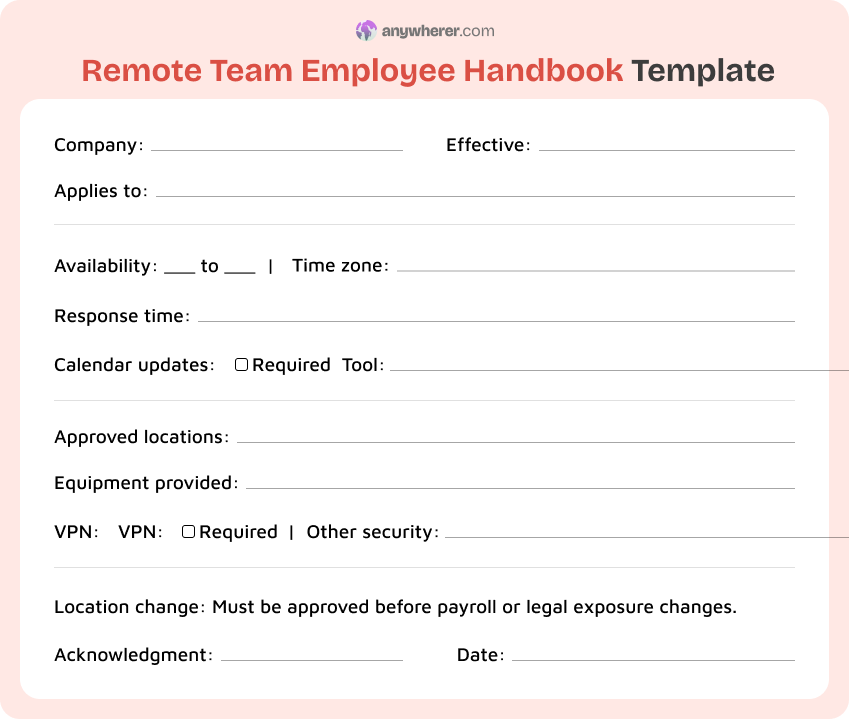
Example of a template (text version):
- Company name: ___________________________ | Handbook effective date: ___________
- What are the required availability hours for remote employees? ___ to ___ | Time zone reference: ___
- What response-time expectation applies to messages and emails? ___________________________
- Are employees required to update shared calendars with their availability? Yes / No | Tool used: ___
- Which locations are approved for remote work? Countries / states / cities: ___________________________
- What equipment does the company provide? Laptop / Monitor / Other: ___ | Employee provides: ___
- What are the data security rules for remote employees? VPN required: Yes / No | Other requirements: ___
- How must employees notify the company before changing their work location? ___________________________
- How are performance reviews and disciplinary matters handled remotely? ___________________________
- Employee acknowledgment: Name: ___________________________ | Location: ___ | Date: ___________
Best for: Distributed teams that need consistent onboarding across locations and time zones.
Startup Employee Handbook Template
Purpose: Use this for early-stage companies where roles and policies may change quickly. It sets a baseline without pretending the company is finished.
Policy sections:
- Company stage: explain mission, values, and current operating reality.
- Role flexibility: define reporting lines, hours, and communication norms.
- Rewards and leave: summarize equity, pay, benefits, and time off.
- Performance: cover feedback, role changes, discipline, and exits.
- Confidential information: address inventions, security, and conflicts.
- Headcount planning: connect handbook updates with the workforce planning template.
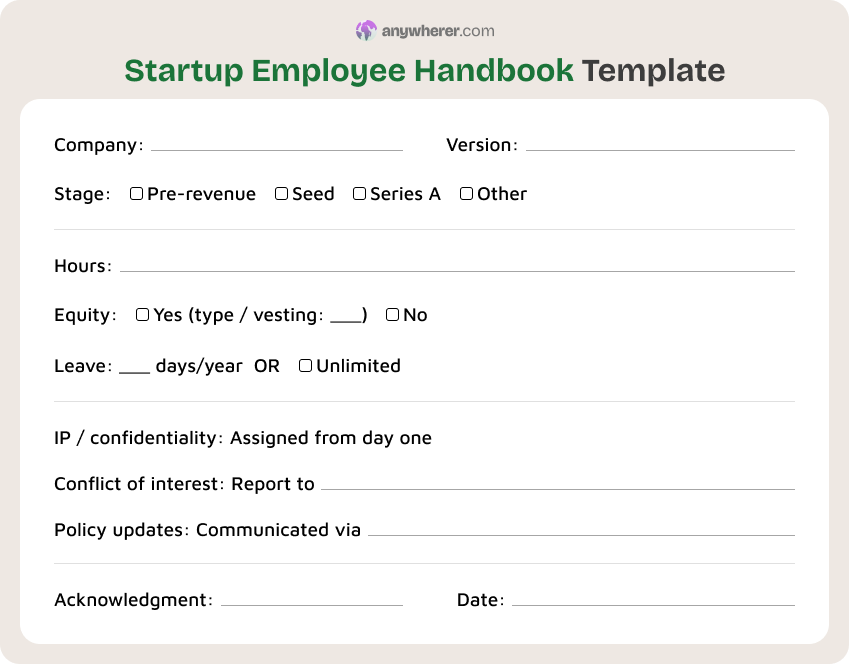
Example of a template (text version):
- Company name: ___________________________ | Current headcount: ___ | Handbook version: ___________
- What is the company’s current stage? Pre-revenue / Seed / Series A / Other: ___
- How are working hours and schedules defined at this stage? ___________________________
- Does the company offer equity? Yes: type and vesting schedule: ___ / No
- What is the pay structure and review cycle? ___________________________
- What leave is available? PTO days: ___ | Unlimited: Yes / No | Other: ___
- Who handles conflict-of-interest disclosures and IP assignment? ___________________________
- What data security and confidentiality obligations apply from day one? ___________________________
- How are policy updates communicated when the handbook changes? ___________________________
- Employee acknowledgment: Name: ___________________________ | Role: ___ | Date: ___________
Best for: Startups that need structure while headcount, teams, and operating habits are still changing.
Hourly / Shift-Based Employee Handbook Template
Purpose: Use this for retail, hospitality, healthcare support, logistics, and other teams with non-exempt or shift-based employees. It should reflect FLSA and local wage-and-hour rules.
Policy sections:
- Timekeeping: define clock-in rules, breaks, meals, and schedules.
- Overtime and payroll: explain approval, cutoffs, swaps, and call-outs.
- Attendance: cover tardiness, no-call/no-show, and leave coordination.
- Workplace standards: include uniforms, safety, conduct, and security.
- Records and exits: cover discipline, final pay, and termination.
- Acknowledgment page: confirm receipt of the wage-and-hour and scheduling policy.
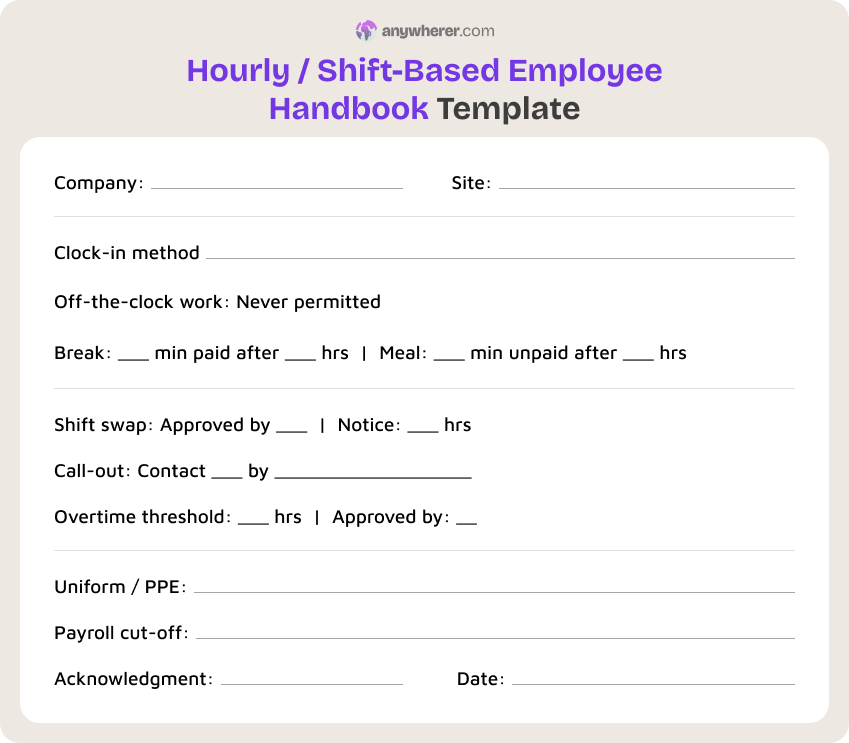
Example of a template (text version):
- Company name: ___________________________ | Location or site: ___________________________
- How must employees clock in and out? System / method: ___ | Off-the-clock work: Never permitted
- What are the break and meal period rules? Paid break: ___ min after ___ hrs | Unpaid meal: ___ min after ___ hrs
- How must shift swaps be handled? Must be approved by: ___ | Notice required: ___ hrs
- What is the process for reporting a no-show or calling out? Contact: ___ | Deadline: ___
- How is overtime defined and approved? Daily / Weekly threshold: ___ hrs | Approved by: ___
- When does the payroll cut-off occur and what is the correction process? ___________________________
- What uniform and safety equipment is required? ___________________________
- What is the progressive discipline process for attendance violations? ___________________________
- Employee acknowledgment: Name: ___________________________ | Site: ___ | Date: ___________
Best for: Employers with shift schedules, hourly payroll, and wage-and-hour compliance exposure.
Trade & Field-Service Employee Handbook Template
Purpose: Use this for field teams such as HVAC, cleaning, plumbing, electrical, maintenance, and facilities work. It adds jobsite conduct and equipment rules to the core handbook.
Policy sections:
- Jobsite standards: define customer-site conduct, uniforms, tools, and vehicles.
- Dispatch rules: explain scheduling, timekeeping, travel, and emergency calls.
- Safety: cover protective equipment, incident reporting, and training.
- Customer property: address confidentiality, photos, and job records.
- Company property: cover attendance, discipline, exits, and returns.
- Acknowledgment page: confirm receipt of field-service rules.
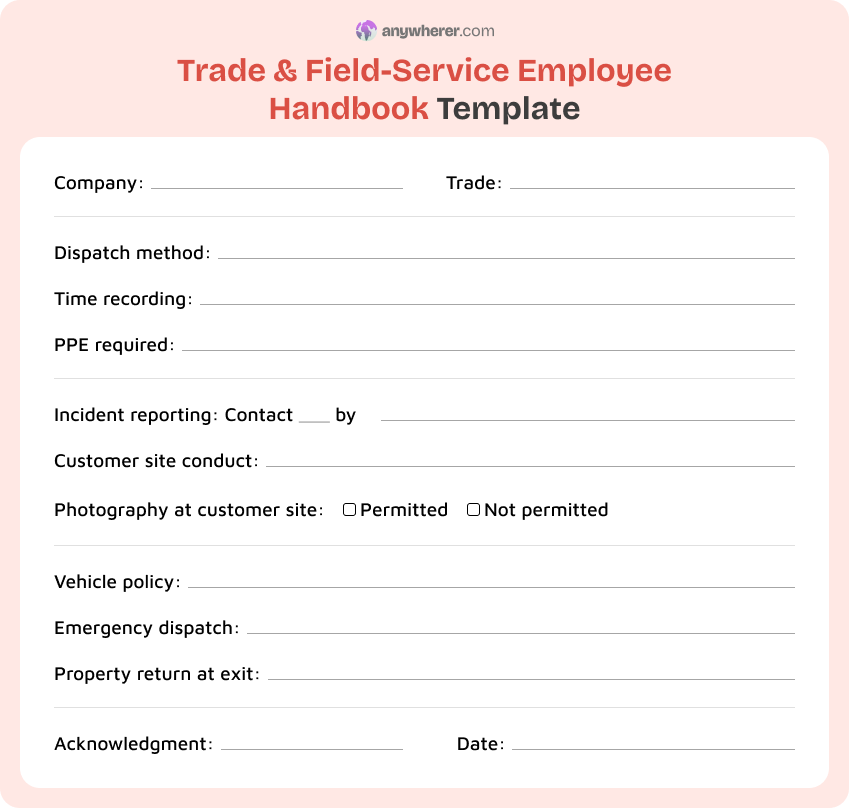
Example of a template (text version):
- Company name: ___________________________ | Trade or service type: ___________________________
- How are daily jobs dispatched to field employees? System / method: ___________________________
- How must employees record time on each job? App / Paper / Other: ___________________________
- What personal protective equipment is required on every job? ___________________________
- What is the process for reporting a jobsite incident or injury? Contact: ___ | Deadline: ___
- What conduct rules apply at customer sites? Photography: ___ | Customer property handling: ___
- What vehicle or tool policy applies? Personal vehicle use: Yes / No | Return deadline: ___
- What is the emergency dispatch procedure for after-hours calls? ___________________________
- What company property must be returned at the end of employment? ___________________________
- Employee acknowledgment: Name: ___________________________ | Trade: ___ | Date: ___________
Best for: Trade and field-service teams adapting an HVAC employee handbook template or plumbing employee handbook template for their day-to-day operations.
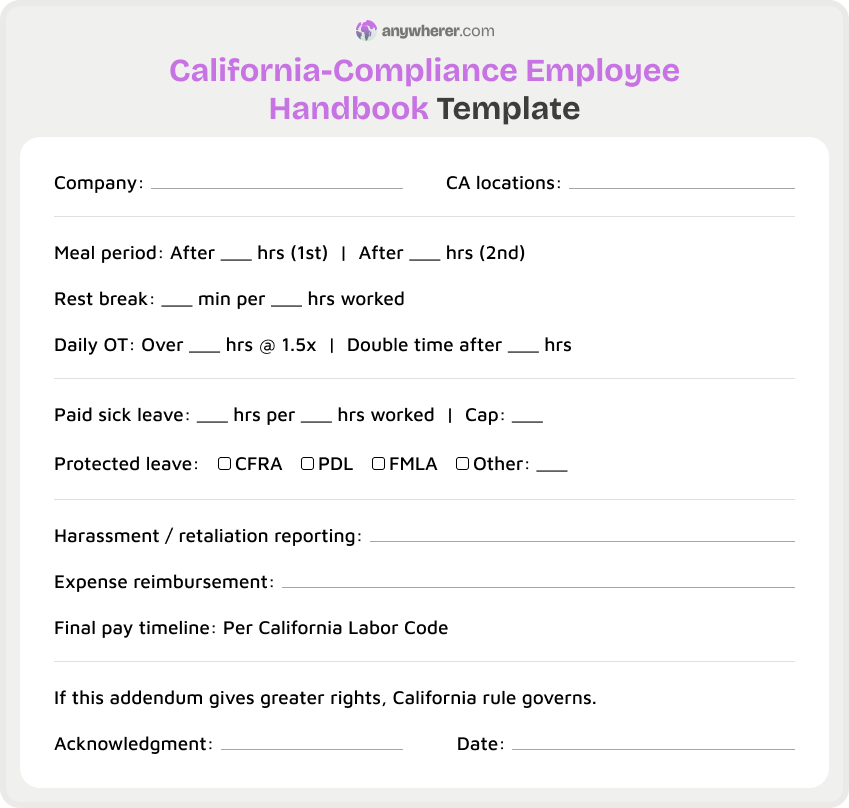
California-Compliance Employee Handbook Template
Purpose: Use this for employers with California employees. A California employee handbook template requires state-specific review of wage-and-hour, leave, harassment, privacy, and final pay rules.
Policy sections:
- Wage-and-hour rules: address meals, rest breaks, overtime, and time records.
- Leave and accommodation: cover sick leave, pregnancy leave, disability leave, and protected leave.
- Complaint process: includes reporting of harassment, discrimination, and retaliation.
- Pay administration: cover reimbursement, final pay, wage statements, and records.
- Required notices: address privacy, safety, emergency plans, and postings.
- California addendum: collect signed acknowledgment from covered employees.
Example of a template (text version):
- Company name: ___________________________ | California locations covered: ___________________________
- What are the meal period rules for California employees? First unpaid meal after ___ hrs | Second meal after ___ hrs
- What are the rest break rules? Paid break of ___ min for every ___ hrs worked
- What is the daily overtime threshold for California? Over ___ hrs per day at ___ x rate | Double time after ___ hrs
- How much paid sick leave do California employees earn? ___ hrs per ___ hrs worked | Annual cap: ___
- Which protected leave types apply in this California location? CFRA / PDL / FMLA / Other: ___
- How should employees report harassment, discrimination, or retaliation? Channel: ___ | Backup contact: ___
- What is the expense reimbursement process for California employees? ___________________________
- What is the final pay timeline at termination or resignation in California? ___________________________
- Employee acknowledgment for California addendum: Name: ___________________________ | Date: ___________
Best for: Companies with California employees or plans to hire in California.
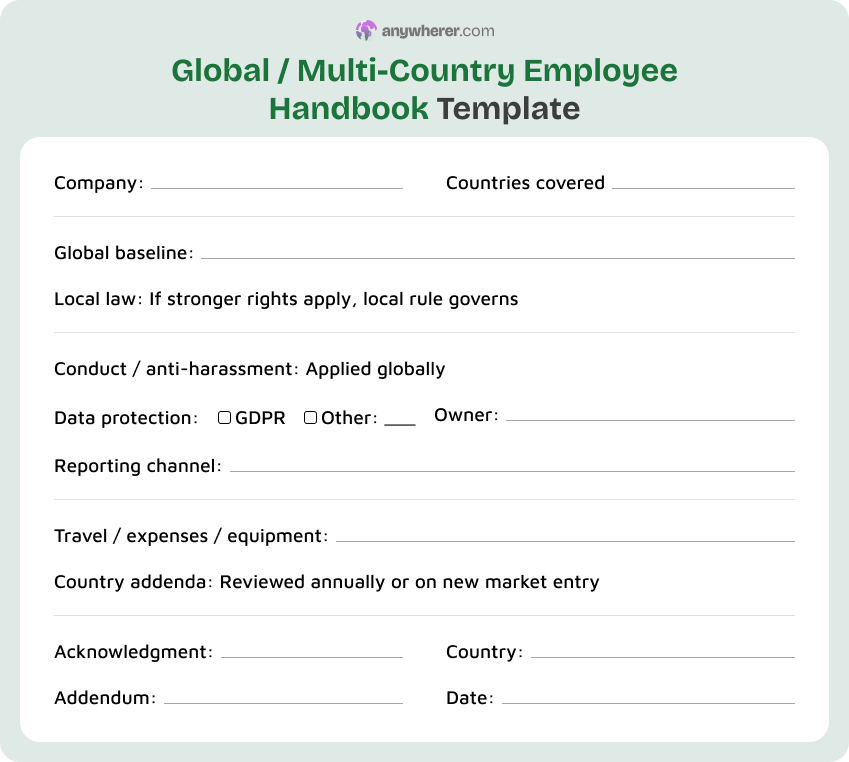
Global / Multi-Country Employee Handbook Template
Purpose: Use this for companies with employees in several countries. It sets global standards, then defers to local laws, contracts, and country addenda.
Policy sections:
- Global standards: define values, conduct, and ethics expectations.
- Country rules: reference local contracts, working time, leave, and benefits.
- Reporting channels: cover harassment, equal opportunity, and data protection.
- Operational rules: include safety, security, travel, equipment, and expenses.
- Employment lifecycle: explain performance, discipline, termination, and offboarding.
- Country addenda: require acknowledgment for each applicable location.
Example of a template (text version):
- Company name: ___________________________ | Countries covered by this handbook: ___________________________
- What is the company-wide global baseline for working hours and leave? ___________________________
- Which rule applies when local law gives employees greater rights than the global baseline? Local law governs: Yes / Confirm by country: ___
- What conduct and anti-harassment standards apply globally? ___________________________
- What reporting channel should employees use in each country? Channel: ___ | Backup contact per country: ___
- What data protection framework applies? GDPR / Other: ___ | Who owns compliance? ___
- What travel, expense, and equipment policies apply globally and how do local rules differ? ___________________________
- Who reviews and updates country addenda when laws change? HR / Legal / Local team / Other: ___
- How often is the global handbook reviewed? Annual / On new country entry / Other: ___
- Employee acknowledgment by country: Name: ___ | Country: ___ | Local addendum version: ___ | Date: ___________
Best for: Companies hiring across multiple countries, states, or employment-law systems.
Readers who need an employee handbook template free download can use the sections above as a drafting map. The image-ready versions are shorter for design layouts, while the body-text versions are better for handbook pages. For a small business employee handbook template free starter, choose the closest template above, remove irrelevant sections, and add required local notices before publishing.
How to Maintain and Update an Employee Handbook
A handbook should have an owner. HR, operations, legal, or the founder should know who reviews policy changes and who sends updates to employees. The review should happen annually and sooner after new laws, new locations, payroll changes, benefit changes, or major shifts in the work model.
Manual updates can work for a small team. Larger employers may want the best employee handbook software to manage versions, acknowledgments, and location-specific policies. Whatever system is used, employees should sign or electronically acknowledge each major update.
The update record matters. If a dispute arises, the employer should be able to show which policy was active, when it changed, and whether the employee received it.
Key Elements Every Employee Handbook Should Include
A strong handbook does not need to be long, but it should cover the policies employees and managers use most often. These elements give the document a dependable baseline.
- Company mission, values, and culture statement.
- Employment basics, classification, at-will language where applicable, and working hours.
- Code of conduct, EEO, anti-harassment, and complaint reporting rules.
- Compensation, benefits, leave policies, and payroll basics.
- Attendance, remote work, time-tracking, and schedule expectations.
- Performance, discipline, termination, and offboarding procedures.
- Health, safety, security, confidentiality, and data protection rules.
- Acknowledgment page with employee signature or electronic confirmation.
Common Mistakes in Employee Handbooks
Most handbook problems come from copying language, leaving ownership unclear, or letting policies age without review. The mistakes below are worth checking before publication.
- Copying a template without adapting it to local law.
- Using promises such as “always” or “never” in policy language.
- Mixing legal requirements and culture statements without clear labels.
- Skipping the signed acknowledgment page after publication.
- Letting the handbook go stale without review cadence.
- Ignoring remote, multi-state, or multi-country work arrangements.
Legal Disclaimer
These templates are starting points, not legal advice. Each handbook should be reviewed by qualified legal counsel for the company’s location, industry, and workforce. California employers should also check California DIR guidance before publishing. Review is especially important for California, hourly or shift-based teams, field-service teams, and multi-country deployments.
FAQs on Employee Handbook Templates
What should be included in an employee handbook template?
An employee handbook template should include company values, employment basics, pay practices, benefits, leave, attendance, conduct, anti-harassment rules, safety, discipline, termination, and an acknowledgment page. The template for employee handbook drafting should also say which policies apply by location or worker type. EEOC guidance is useful when drafting anti-harassment and discrimination reporting language. The handbook should be specific enough for managers to enforce consistently.
Is there a free employee handbook template for small businesses?
Yes, a free template can help a small business start quickly, but it should not be published without edits. It needs local wage-and-hour rules, leave rules, harassment reporting channels, and an acknowledgment page. A free sample employee handbook template is best treated as a structure rather than a final legal document. The business should review it before employees sign.
How long should an employee handbook be?
An employee handbook should be long enough to explain the policies employees actually need. A small business may use a short handbook with plain sections, while a multi-state or global employer may need country or state addenda. Length matters less than clarity. Employees should be able to find pay, leave, conduct, safety, complaint, and termination rules without having to guess
How often should an employee handbook be updated?
A handbook should be reviewed annually and whenever laws, benefits, pay practices, work models, or company policies change. Updates are also needed after hiring in a new state or country. SHRM and official agency updates can help HR track common policy changes, but legal counsel should review jurisdiction-specific language. Employees should sign a new acknowledgment after major updates.
Does a small business legally need an employee handbook?
Many small businesses are not required to have a single handbook, but they may still need written notices or policies under federal, state, local, or country law. A handbook helps organize those obligations and makes managers’ decisions easier to defend. DOL wage-and-hour resources are especially important for hourly staff. Even a short handbook can reduce confusion around pay, schedules, leave, conduct, and complaints.
How do you build an employee handbook for a remote or global team?
Start with one company baseline, then add location-specific rules. Remote teams need policies for availability, equipment, expense reimbursement, data security, and approved work locations. Global teams also need local contracts, working-time rules, leave, benefits, privacy, and termination procedures. ILO materials can help frame the basics of the employment relationship, but local counsel should review each country’s addendum.

Yaryna is our lead writer with over 8 years of experience in crafting clear, compelling, and insightful content. Specializing in global employment and EOR solutions, she simplifies complex concepts to help businesses expand their remote teams with confidence. With a strong background working alongside diverse product and software teams, Yaryna brings a tech-savvy perspective to her writing, delivering both in-depth analysis and valuable insights.