Monday morning, 9:17 AM. Two desks are empty, one person is dialing in from a coffee shop, and the manager is staring at a Slack thread trying to figure out who is actually working today. Sound familiar? Most attendance headaches start with no written rules.
The numbers back this up. The U.S. Bureau of Labor Statistics reports a 3.2% daily absence rate across the workforce. Gallup found that unplanned absences linked to poor mental health alone cost employers $47.6 billion a year. You will never get that to zero, but an attendance policy template gives everyone the same reference point, so managers stop guessing and start quoting page two of the handbook.
Below you will find nine attendance policy template examples, one for each common setup: office, remote, hybrid, flex, shift, startup, strict compliance, and global. Each comes with a full template block plus a shorter image-ready version you can drop onto a slide or one-pager.
What Is an Attendance Policy?
Short version: it is a written set of rules that tells people when to show up, how to call in absent, what leave they get, and what happens if they keep breaking the rules. Without one, every attendance conversation turns into a debate.
The details depend on how your company operates. A warehouse with three shifts needs language about clock-in windows and no-call no-shows. A remote team spread across five time zones cares more about overlap hours and response times. A good employee attendance policy sample covers those differences in plain language, two or three pages tops, with a clear escalation path anyone can follow.
Why Companies Need a Clear Attendance Policy
Picture two managers on the same floor. One lets people wander in at 9:30 without a word. The other sends a warning email if someone is two minutes late. Neither is wrong in a vacuum, but side by side they breed resentment. A written policy fixes that.
- Kills the gray area. People know how many sick days they have, how early to request time off, and what paperwork to bring.
- Gives managers a script. Instead of winging it, they point to the same page for every employee, which makes enforcement feel less personal.
- Works for distributed teams too. A time and attendance policy template with overlap-hour rules and response-time expectations keeps remote and hybrid workers in sync with the office.
- Simplifies shift planning. A sample attendance policy for hourly employees turns last-minute scrambling into a predictable process.
The policy is a shared playbook that keeps attendance conversations grounded in facts rather than opinions.
9 Attendance Policy Template Examples
Here are nine employee attendance policy examples, each tailored to a different setup. You get the purpose, the key sections, a copy-paste template block, a shorter image version for slides or one-pagers, and a note on who it fits best. Think of it as a free employee attendance policy template library. Grab the closest match, tweak the numbers, and drop it into your handbook.
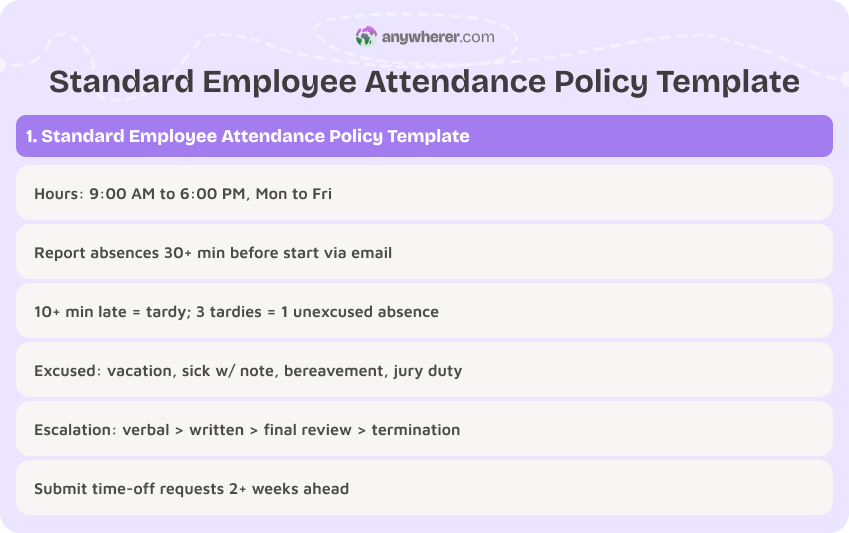
1. Standard Employee Attendance Policy Template
Purpose: The vanilla option. Fixed hours, office-based teams, one set of rules for everybody. Start here if you have never written an attendance policy template before and need something that just works.
Key policy sections:
- Hours run 9:00 AM to 6:00 PM, Monday through Friday
- Call or email your manager and HR 30+ min before start if you are not coming in
- 10+ minutes late counts as tardy, and 3 tardies in a month roll into 1 unexcused absence
- Excused leave covers sick, personal, vacation, bereavement, and jury duty
- Discipline ladder: verbal, then written, then final review, then possible termination
Template text:
Your shift starts at 9:00 AM. Be at your desk, logged in, ready to go. Running late or unable to come in? Email or call your manager and HR at least 30 minutes before the start. Show up 10+ minutes past your start time, and it counts as tardy. Three tardies in one calendar month become a single unexcused absence. Approved vacation, sick leave backed by a doctor’s note, bereavement, and jury duty are all excused. The escalation path is simple: two unexcused absences within 90 days earn a verbal warning, the third a written one, the fourth a final review that can end in termination. Time-off requests need to be submitted two weeks before the date; no exceptions.
Best for: Corporate offices, mid-size to large orgs with set schedules, any team after a no-frills sample employee attendance policy to build on.
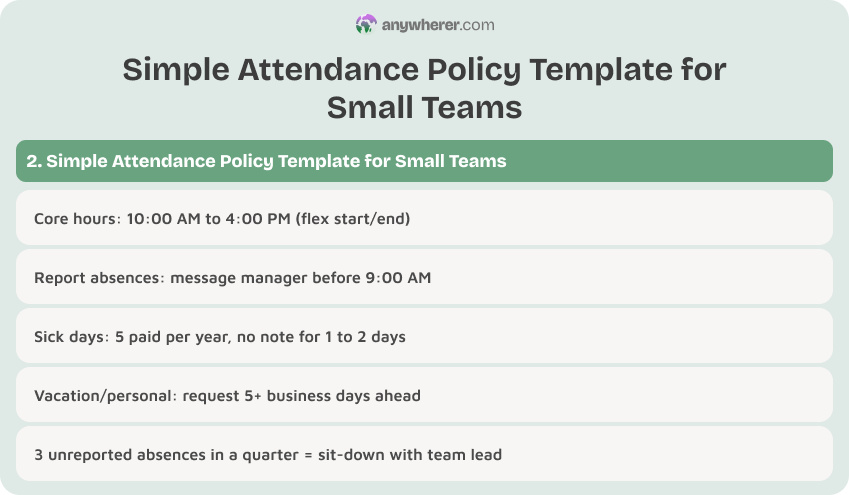
2. Simple Attendance Policy Template for Small Teams
Purpose: Thirty people or fewer, minimal HR overhead. This attendance policy example for small businesses strips out the corporate layers and keeps the rules to one page.
Key policy sections:
- Core hours are 10:00 AM to 4:00 PM; flex before and after
- Absent? Slack or text your manager before 9:00 AM
- 5 paid sick days per year, no note for 1 or 2-day absences
- Request time off at least 5 business days ahead
- Three unreported absences, and the founder sits you down for a talk
Template text:
Core hours are 10:00 AM to 4:00 PM. That window is sacred. Before and after it, start and wrap up whenever you want. Cannot come in at all? Shoot your manager a text or Slack before 9:00 AM. Five paid sick days come with the job, and no one will demand a doctor’s note unless you disappear for three days straight. Vacation? Put it in 5 business days ahead. Ghost the team three times in a quarter without telling anyone, and the team lead will pull you aside.
Best for: Seed to Series A startups, freelance collectives, and any small business hunting for attendance policy examples for small businesses minus the HR red tape.
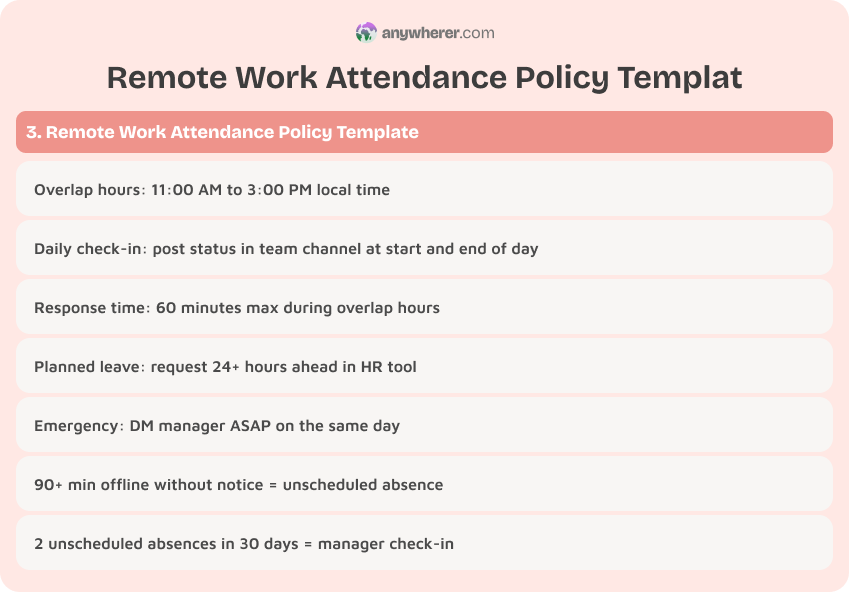
3. Remote Work Attendance Policy Template
Purpose: Nobody walks into an office. Availability and accountability are tracked through overlap hours, check-ins, and response times instead of badge swipes.
Key policy sections:
- 11:00 AM to 3:00 PM local time is the overlap window
- Post a status update in the team channel when you start
- Reply to messages within 60 min during overlap
- Planned leave goes into the HR tool 24 hours ahead
- Vanish for 90+ min during overlap, and it is an unscheduled absence
Template text:
Overlap hours are 11:00 AM to 3:00 PM your local time. Be reachable during that block, full stop. When you log on for the day, post a status in the team channel. Someone pings you during overlap? Reply in 60 minutes or less. Planning a day off tomorrow? Drop the request in the HR tool today. Emergencies do not follow a schedule, so just DM your manager the moment you know about it. Disappear for 90+ minutes during the overlap window without saying anything and that is an unscheduled absence. Do it twice within 30 days, and your manager will book a check-in.
Best for: Fully remote companies, distributed engineering teams, and customer support squads working from home.
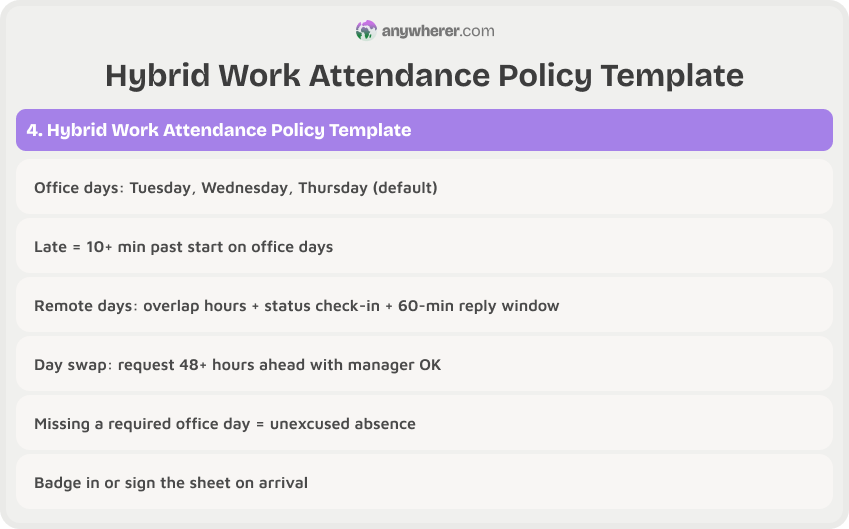
4. Hybrid Work Attendance Policy Template
Purpose: Three days at a desk, two on the couch. This one spells out which days require an office badge tap and the rules for remote days.
Key policy sections:
- Tue, Wed, Thu in the office (default)
- Remote days follow the same overlap and check-in rules as template 3
- Badge swipe or sign-in sheet on arrival
- Swap an office day by asking your manager 48 hours ahead
Template text:
Office days: Tuesday, Wednesday, Thursday. Get there on time. More than 10 minutes late? Tardy. On Monday and Friday, you work remotely, and the remote-policy overlap and check-in rules apply on those days. If you want to flip an office day to remote, run it by your manager 48 hours out. Miss a required office day without that approval, and HR logs it as unexcused. Badge in or sign the sheet on your way through the door.
Best for: Companies with a set hybrid schedule (e.g., 3 days office, 2 days remote), mid-to-large teams transitioning from fully in-person.
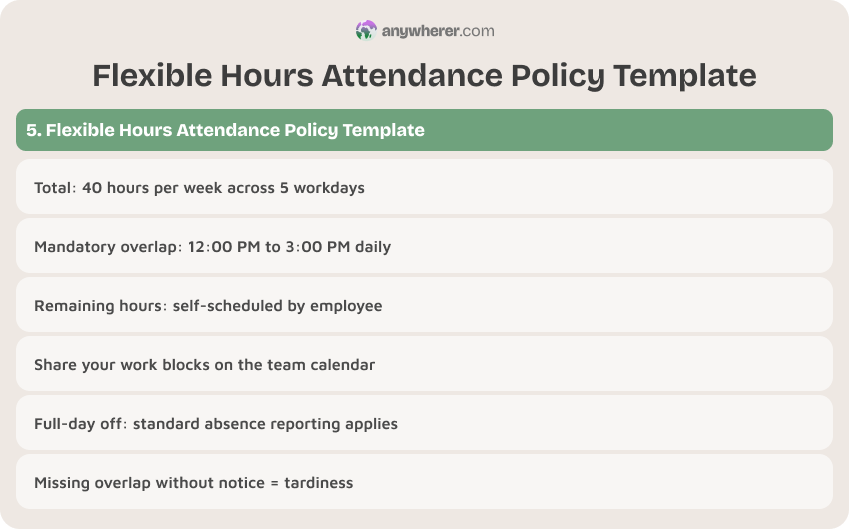
5. Flexible Hours Attendance Policy Template
Purpose: Output over punch clocks. Employees run their own schedule around a short afternoon overlap window.
Key policy sections:
- 40 hours a week, scheduled however you want outside the overlap
- Noon to 3:00 PM is the only mandatory window
- Block your hours on the shared calendar
- Full-day absences follow the normal reporting flow
Template text:
Forty hours, five days, your call on the schedule. The catch: noon to 3:00 PM is locked for meetings and syncs, so block that on your calendar. The rest of the day, work whenever you are productive. Pop your hours on the shared calendar so people know when you are around. Taking a full day off counts as any other absence. Skip the noon window repeatedly without a heads-up, and it counts as tardiness.
Best for: Creative agencies, product teams, engineering orgs with async cultures, any team that values results over rigid schedules.
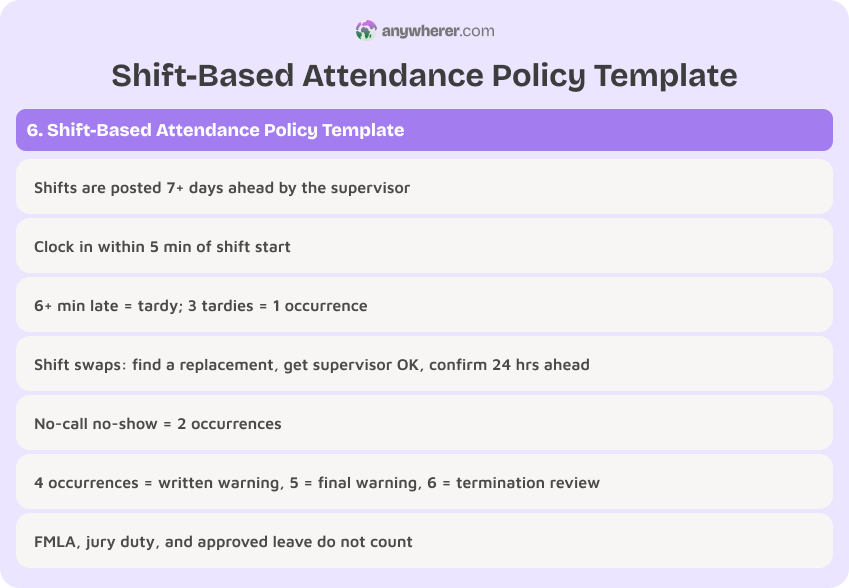
6. Shift-Based Attendance Policy Template
Purpose: Coverage gaps here cost real money. This sample attendance policy for hourly employees clarifies shift-swap rules and what happens when someone drops off the schedule without warning.
Key policy sections:
- The schedule goes up at least 7 days before the shift
- Clock in within 5 min or it is a tardy
- 3 tardies in 30 days = 1 occurrence
- Swap a shift: find your own replacement, get supervisor OK, confirm 24 hours out
- No-call no-show = 2 occurrences right away
- 6 occurrences in 12 months, and you are in a termination review
Template text:
Schedules get posted a week out. Be clocked in within 5 minutes of your shift. Six minutes late or more goes down as a tardy, and three tardies inside 30 days become one occurrence. Want to trade a shift? Find someone to cover, get supervisor sign-off, and lock it in a day ahead. Go no-call no-show, and the system logs two occurrences, not one. Four occurrences within a rolling 12-month period: written warning. Five: final warning. Six: termination review. FMLA leave, jury duty, and pre-approved time off stay off the tally.
Best for: Retail stores, warehouses, manufacturing plants, hospitals, restaurants, and any team needing a sample attendance policy for employees working scheduled shifts.
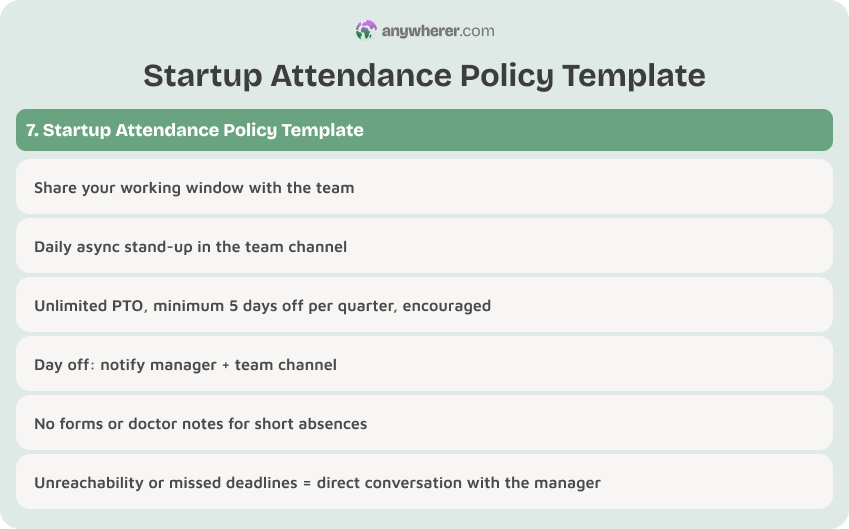
7. Startup Attendance Policy Template
Purpose: Early-stage company, small headcount, big on trust. Guardrails exist, but stay light on purpose.
Key policy sections:
- Tell the team your working hours
- Post a quick async stand-up every morning
- PTO is unlimited, but take at least 5 days a quarter
- Heads-up your manager and the channel if you are out
- Output drops or going silent = a direct conversation
Template text:
There is no company-wide 9-to-5. Share your working window with the team so they know when to reach you. Every morning, post a quick async stand-up: yesterday, today, blockers. Taking a day off? Let your manager and the channel know. PTO is uncapped, but we strongly suggest a minimum of 5 days per quarter. Nobody fills out a form for a one-day sick call. The deal is simple: if deliverables stall or you keep going quiet during work hours, your manager brings it up in person.
Best for: Seed-stage and Series A startups, small product teams, companies that operate on trust, and want the lightest possible attendance structure.
8. Strict Attendance Policy Template
Purpose: Regulated industries, strict SLAs, safety-critical floors. The best attendance policy sample for settings where even a 5-minute gap in coverage creates risk.
Key policy sections:
- Start and end times are fixed, no grace period
- Biometric tap or badge scan on entry
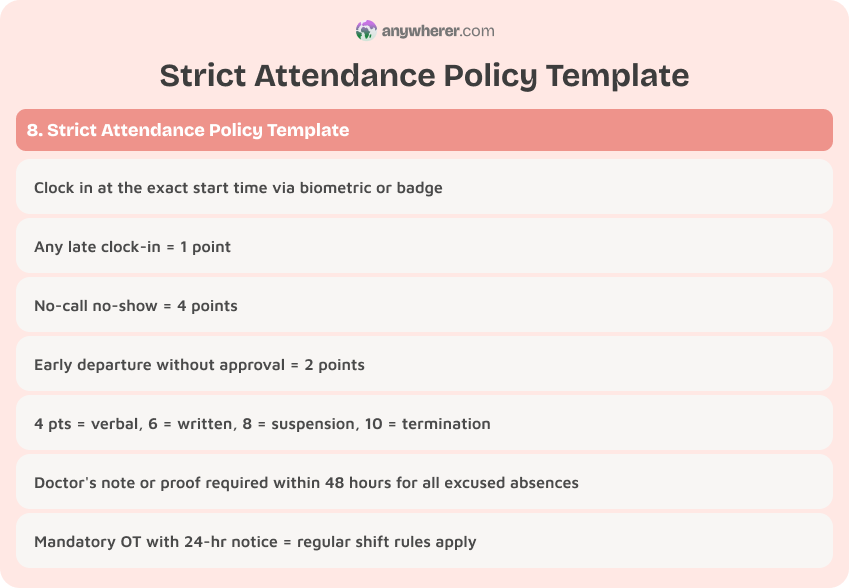
- Points system: late = 1 pt, early leave = 2, no-call no-show = 4
- Every excused absence needs paperwork within 48 hours
Mandatory overtime follows regular shift rules when announced 24+ hours ahead
Template text:
Use the biometric reader or badge at exactly your start time. There is no 5-minute grace here. Show up late: 1 point. Walk out early without approval: 2 points. No-call no-show: 4 points. Everything rolls up over 6 months. At 4 points, you get a verbal warning, at 6 a written warning, at 8 a suspension, and if you reach 10, the company starts termination. Excused absences need proof on file within 48 hours, whether that is a doctor’s note or a court summons. When mandatory overtime is announced 24+ hours in advance, regular shift rules apply.
Best for: Healthcare facilities, call centers with SLAs, manufacturing floors, government contractors, and financial institutions with audit requirements.
9. Global Team Attendance Policy Template
Purpose: Multiple countries, different holidays, different labor laws. This example of attendance policy gives every region the same framework without pretending one size fits all.
Key policy sections:
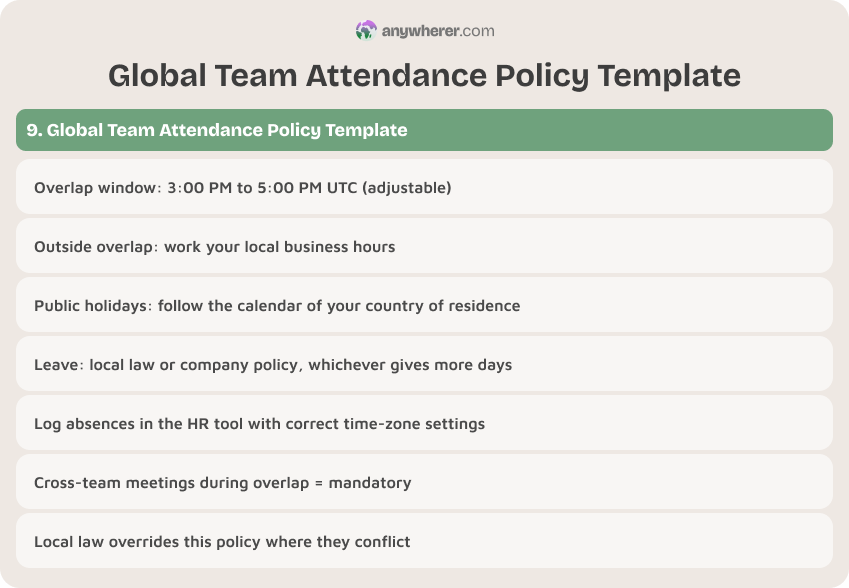
- One 2-hour daily overlap window for all regions
- Public holidays? Follow your own country
- Leave goes by local law or company policy, whichever is more generous
- Log absences in the HR tool and set your time zone correctly
- If local law says something different, local law wins
Template text:
There is one window the entire company shares: 3:00 PM to 5:00 PM UTC, two hours. Be available then. Outside of that, work normal hours wherever you are. Holidays go by the calendar in your country. Leave follows local law or the company policy, whichever gives you more days. Log every absence in the HR tool and double-check that your time zone setting is right. Syncs during the overlap window are mandatory. And if local employment law contradicts anything in this document, local law takes priority.
Best for: Distributed companies with offices or contractors in 3+ countries, global engineering teams, and any company attendance policy examples that need to account for multiple jurisdictions.
Key Elements Every Attendance Policy Should Include
Whichever attendance policy sample you start from, six pieces need to be in place before you hit publish. Pull up any example attendance policy that still works two years after launch, and every one of these will be there:
- Working hours or availability windows. Not “be available during business hours.” Actual times: 9 to 6, overlap from noon to 3, whatever fits.
- Absence reporting steps. Who do I tell, how do I tell them, and by when? One sentence should answer all three.
- Time tracking method. Badge reader, software tool, shared calendar. Name it so nobody has to ask.
- Leave buckets. Vacation, sick, personal, bereavement, parental, jury duty. Spell out the number of days for each one.
- Escalation ladder. First offense, second offense, final warning, termination. People accept consequences they can see in advance; surprises breed lawsuits.
- Flexibility carve-outs. If the warehouse crew has different rules than the marketing team, say so. A blanket policy that ignores real differences will get ignored right back.
Common Mistakes in Attendance Policies
A solid attendance policy template free of legal issues can still flop in practice. After reviewing dozens of attendance policy samples, the same five problems keep showing up:
- Vague wording. “Employees should arrive on time” means something different to every person reading it. Put a number on it.
- Zero-tolerance overkill. Treating one late arrival the same as a no-show pushes good people out the door and gives lawyers easy ammunition.
- Forgetting remote workers exist. If half the company is at home, a policy that only mentions office hours sends the message that nobody thought about them.
- Uneven enforcement. Manager A lets everything slide; Manager B writes people up for two minutes. The policy exists on paper but not in practice.
- One time zone for everybody. Global companies that pin rules to HQ local time create expectations that are literally impossible for teams twelve hours away.
Putting Your Attendance Policy Into Practice
Picking a company attendance policy template is step one. Step two is making sure people actually read the thing. Walk managers through it first so they can answer questions on day one. Tweak the language until it sounds like your company, not a legal textbook. Post the final draft in the handbook, the intranet, or wherever new hires look first. Running a hybrid or remote setup? Pair this with your remote work policy examples so there is one document for attendance and another for location rules, no overlap, no contradictions.
Revisit the policy at least once a year. Teams grow, labor laws change, and the office-first rules you wrote in January might not make sense by December. The best attendance policy sample is the one that stays current.FAQs on Attendance Policy Template
FAQs on Attendance Policy Template
What should be included in an attendance policy?
Working hours, absence reporting steps, leave buckets with day counts, a time-tracking method, and an escalation ladder. If part of your team works remotely, add overlap hours and response-time expectations.
How do you manage attendance for remote or hybrid teams?
Set overlap hours everyone shares, pick one channel for daily check-ins, and use an HR tool that handles time zones. Hybrid teams also need a clear list of required office days and a way to track attendance.
What is a flexible attendance policy?
One where employees set their own start and end times as long as they hit a weekly hour target and show up for a short daily overlap window. It suits roles where results weigh more than clock-in times.
How should employees report absences?
Through one channel only: email, the HR tool, or a dedicated Slack thread. Require the message before the workday starts. Phone calls work as a backup for genuine emergencies.
What are common mistakes in attendance policies?
Vague wording (“arrive on time” without a number), inconsistent enforcement across managers, ignoring remote workers altogether, and never updating the policy once the company outgrows it.
How do you enforce an attendance policy fairly?
Same rules at the same job level, every incident documented the same way, escalation ladder followed to the letter. Train every manager so that enforcement is not personality-dependent. A quarterly audit of records catches drift before it becomes a pattern.

Yaryna is our lead writer with over 8 years of experience in crafting clear, compelling, and insightful content. Specializing in global employment and EOR solutions, she simplifies complex concepts to help businesses expand their remote teams with confidence. With a strong background working alongside diverse product and software teams, Yaryna brings a tech-savvy perspective to her writing, delivering both in-depth analysis and valuable insights.