A founder pulls a Word doc from a Google search, edits the names, and sends it to a developer in Portugal. Six months later, the contractor claims employee status under Portuguese law. The agreement did not include a governing-law clause; the IP assignment language did not cover work-for-hire under civil-law systems; and the payment terms referenced US tax forms that have no legal meaning in the EU. Using the right independent contractor agreement template from the start would not have guaranteed a win in every jurisdiction, but it would have closed the gaps that turned a straightforward engagement into an expensive dispute.
HR teams managing dozens of contractors across multiple states and countries face the same exposure at scale. A single template used for every engagement leaves holes: 1099 tax language missing from agreements with U.S. contractors, no AB5 considerations for California workers, no currency or GDPR clause for international hires. A working template stack covers jurisdiction, engagement type, and engagement stage. For comparison with the employee side of the decision, a job offer letter template handles the parallel track. For the classification decision itself, the contractor vs employee checklist is the starting point.
What Is an Independent Contractor Agreement?
An independent contractor agreement is a written contract between a client company and an individual or business entity engaged to perform specific services. It defines the scope of work, deliverables, payment terms, IP ownership, confidentiality obligations, and termination process. Critically, it establishes that the relationship is a contractor engagement, not an employment relationship, and that the contractor operates as an independent business rather than as an integrated member of the client’s workforce.
An independent contractor agreement differs from an employment contract in legal status, tax treatment, IP defaults, and termination rules. Contractors handle their own taxes, receive no statutory employment benefits, and are not entitled to the notice periods and redundancy protections that apply to employees. IP ownership differs under contractor agreements from under employment law: in many jurisdictions, work produced by a contractor belongs to the contractor unless explicitly assigned. A well-drafted agreement addresses each of these areas. For help making the classification decision before drafting an agreement, the contractor vs employee checklist provides a structured framework.
The agreement controls the written terms. The working relationship controls how tax authorities and labor courts treat the engagement if it is challenged. Under the IRS common-law test, the IRS evaluates behavioral control, financial control, and the type of relationship, not just what the contract says.
A contract that says ‘independent contractor’ does not protect the client if the day-to-day working relationship resembles employment: fixed hours, dedicated equipment, single-client dependence, or integration into a reporting line.
Why Companies Need an Independent Contractor Agreement Template
A written agreement documents scope, deliverables, payment, and IP ownership in a way both parties agree to before work begins. Oral arrangements and email chains do not hold up in disputes over deliverable quality, late payment, or IP ownership. The agreement is also the primary evidence that both parties intended a contractor relationship, a key factor in misclassification proceedings, where back taxes, penalties, and reclassification are the most common failure modes.
Misclassification exposure is not limited to large enterprises. The IRS Form 1099-NEC filing requirement applies to any business that pays a U.S. contractor $600 or more in a calendar year, and the IRS can trigger a misclassification audit through 1099 discrepancies. Misclassified workers may be owed retroactively unpaid employment taxes, benefits, and statutory leave. A template designed for the specific engagement type, such as U.S. 1099, international, or California, reduces the structural gaps that create this exposure.
For international engagements, the stakes are higher still. The European Commission’s platform work directive introduced a rebuttable presumption of employment for platform workers in EU member states, placing the burden of proving contractor status on the engaging company. Similar presumptions exist in the UK, Australia, and several Latin American jurisdictions. A template without governing-law and IP-transfer clauses calibrated to the contractor’s home jurisdiction exposes the client to reclassification under local rules, regardless of what the contract says.
For companies where direct contracting across multiple jurisdictions feels unmanageable, working with one of the best EOR companies shifts the compliance burden onto a provider that directly holds the employment or contractor relationship. Contractor agreement templates remain essential for direct engagements without an EOR or AOR partner.
8 Independent Contractor Agreement Template Examples
The eight templates below cover the most common contractor engagement types and jurisdictions. Each includes a body-text version suitable for a wiki, HR portal, or legal folder, as well as an image-ready version for design layouts or reference documents. The text versions use [PLACEHOLDER] fields for company-specific details. All templates are starting points and should be reviewed by local legal counsel before use, particularly for engagements outside the client’s home jurisdiction. A template independent contractor agreement adapted without legal review for a new jurisdiction carries the same risk as no template at all. Each independent contractor template agreement below is designed for a specific context: jurisdiction, engagement type, or engagement stage.
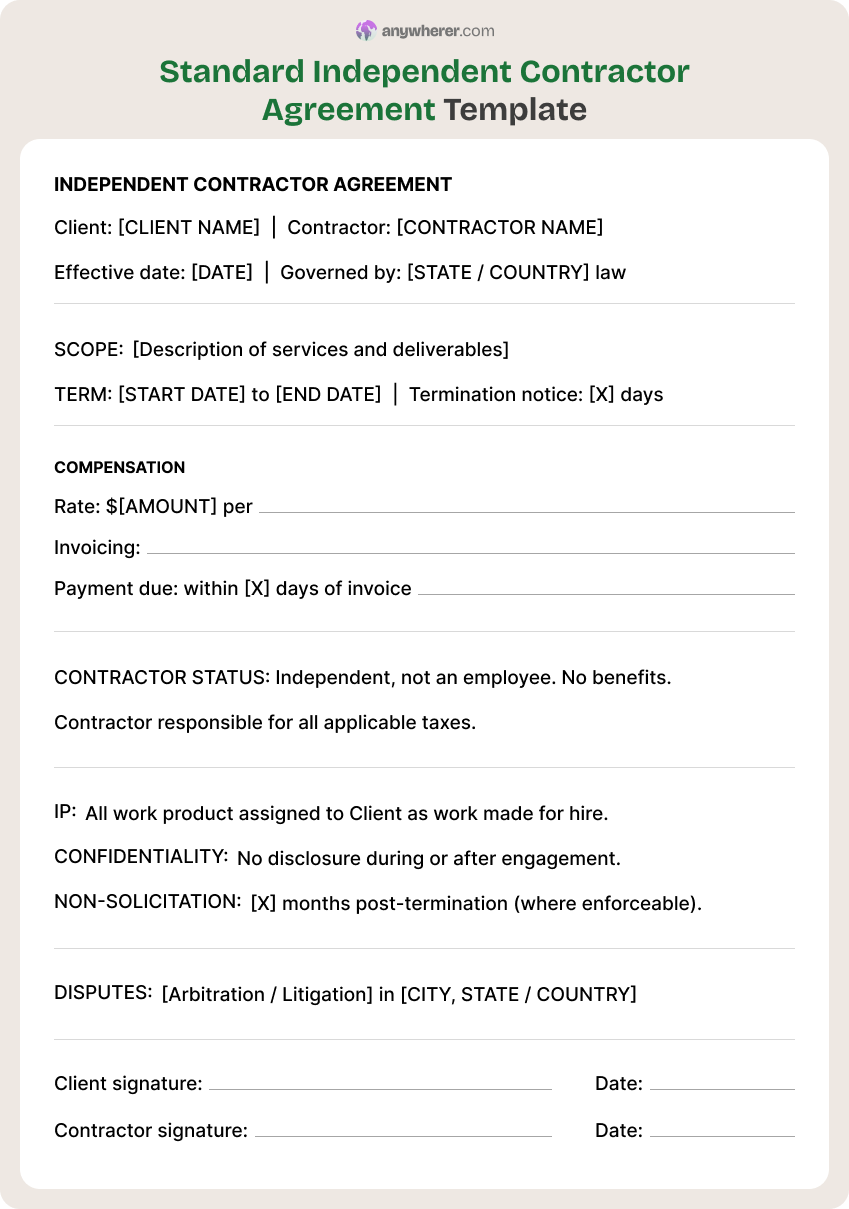
Standard Independent Contractor Agreement Template
Purpose: The general-purpose independent contractor agreement template suitable for most single-jurisdiction engagements. It covers the full set of contract sections that protect both parties, such as scope, payment, IP, confidentiality, and termination, in a format that legal teams can review and adapt quickly.
Agreement sections:
- Parties and effective date: names and addresses of the client and contractor, and the effective date of the agreement.
- Scope of services: description of the services to be performed and expected deliverables.
- Term and termination: start date, end date or ongoing term, and notice requirements for early termination.
- Compensation and payment: fee structure, invoicing schedule, payment timeline, and acceptable payment methods.
- Independent contractor status: statement that the contractor is not an employee, receives no benefits, and is responsible for their own taxes.
- Intellectual property: assignment of all work product to the client as work for hire; contractor waives moral rights where permitted.
- Confidentiality: the contractor’s obligation to protect confidential information and not disclose it during or after the engagement.
- Non-solicitation: restriction on soliciting the client’s employees or clients for a defined period after the engagement ends.
- Indemnification and liability: each party’s obligation to indemnify the other and any cap on total liability.
- Governing law and disputes: the state or country whose law governs; the mechanism (mediation, arbitration, litigation) and venue for disputes.
- Signatures: physical or electronic signatures of both parties.
Example of a template (text version):
INDEPENDENT CONTRACTOR AGREEMENT
This Independent Contractor Agreement (“Agreement”) is entered into as of [EFFECTIVE DATE] by and between [CLIENT COMPANY NAME], a [STATE/COUNTRY] [entity type] (“Client”), and [CONTRACTOR FULL NAME / ENTITY NAME], [State/Country of Contractor] (“Contractor”).
1. Scope of Services
Contractor agrees to provide the following services to Client: [DESCRIPTION OF SERVICES AND DELIVERABLES]. Contractor will perform services in a professional manner and deliver [DELIVERABLE DESCRIPTION] by [DATE / on a schedule agreed in writing].
2. Term and Termination
This Agreement begins on [START DATE] and continues until [END DATE / completion of services], unless earlier terminated. Either party may terminate with [X] days’ written notice. Client may terminate immediately for material breach, fraud, or gross negligence.
3. Compensation
Client will pay Contractor [RATE: hourly / fixed fee] of $[AMOUNT] per [hour / project / month]. Contractor will invoice Client [weekly / bi-weekly / monthly]. Payment is due within [X] days of invoice receipt.
4. Independent Contractor Status
Contractor is an independent contractor, not an employee, agent, or partner of Client. Contractor is responsible for all taxes on compensation received, including self-employment tax. Client will not withhold income tax, social security, or Medicare from payments. Contractor is not entitled to any employee benefits, including health insurance, retirement plans, or paid leave.
5. Intellectual Property
All work product, deliverables, and inventions created by Contractor in connection with this Agreement are works made for hire and are the sole property of Client. To the extent any work product does not qualify as a work made for hire under applicable law, Contractor irrevocably assigns all right, title, and interest in such work product to Client.
6. Confidentiality
Contractor agrees not to disclose any confidential information of Client to third parties during or after the term of this Agreement. Confidential information includes trade secrets, business plans, client lists, pricing, and technical information.
7. Non-Solicitation
For [X] months after termination of this Agreement, Contractor will not directly solicit any employee or client of Client for purposes of competitive business, where permitted by applicable law.
8. Governing Law
This Agreement is governed by the laws of [STATE / COUNTRY], without regard to conflict-of-law rules. Disputes will be resolved by [arbitration / mediation / litigation] in [CITY, STATE / COUNTRY].
IN WITNESS WHEREOF, the parties have signed this Agreement as of the Effective Date.
Client: ___________________________ Date: ___________ | Contractor: ___________________________ Date: ___________
Best for: General-purpose contractor engagements within a single U.S. state or single-country jurisdiction where no special classification rules apply.
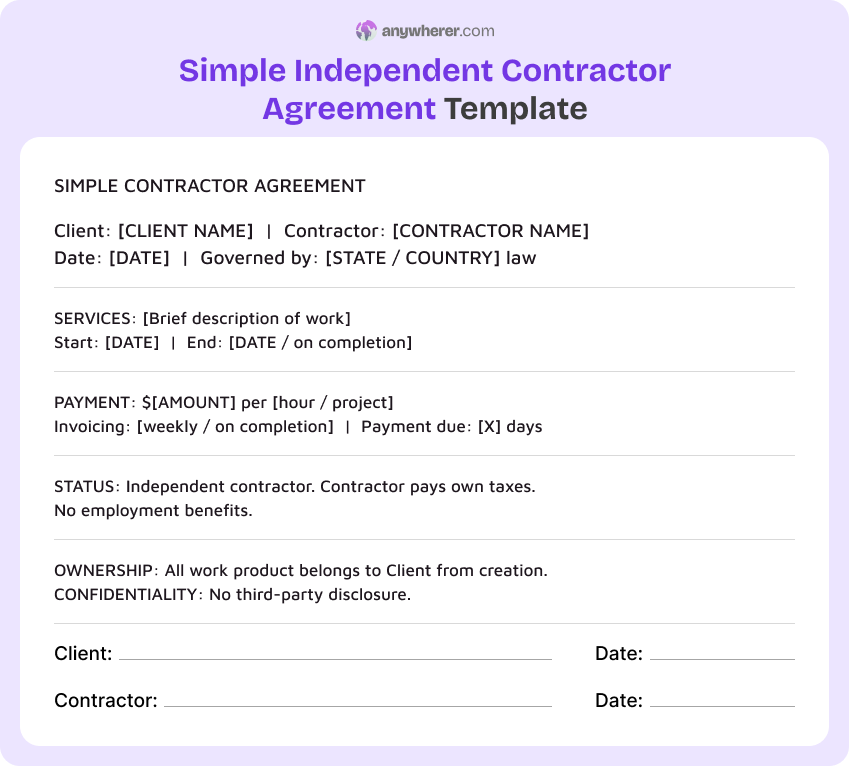
Simple Independent Contractor Agreement Template
Purpose: A lightweight, plug-and-play version of the standard agreement. The simple independent contractor agreement template removes non-solicitation, indemnification detail, and complex dispute resolution language, keeping only the clauses most engagements require. This free independent contractor agreement template is the fastest way for small businesses, freelancers, and solo founders to get a signed agreement in place before work starts. An independent contractor agreement template free of complexity is a starting point, not a complete legal solution.
Agreement sections:
- Parties: client name, contractor name, and effective date.
- Services: short description of what the contractor will deliver.
- Term: start date and how the engagement ends.
- Payment: flat fee or hourly rate, invoicing method, and payment timeline.
- Contractor status: contractor handles own taxes; no employment benefits.
- IP assignment: all work product belongs to the client.
- Confidentiality: contractor does not share client information.
- Governing law: governing state or country.
- Signatures: both parties sign.
Example of a template (text version):
SIMPLE CONTRACTOR AGREEMENT
This Agreement is made on [DATE] between [CLIENT NAME] (“Client”) and [CONTRACTOR NAME] (“Contractor”).
Services:
Contractor will provide the following services: [BRIEF DESCRIPTION]. Work begins [START DATE] and ends [END DATE / upon completion].
Payment:
Client will pay Contractor $[AMOUNT] [per hour / as a flat fee]. Contractor invoices [weekly / on project completion]. Payment is due within [X] days of invoice.
Contractor status:
Contractor is an independent contractor. Contractor pays all applicable taxes on income received. No employment benefits apply.
Ownership:
All work product is owned by Client from the date of creation.
Confidentiality:
Contractor will not share Client’s confidential information with any third party.
Governing law: Laws of [STATE / COUNTRY].
Client: ___________________________ Date: ___________ | Contractor: ___________________________ Date: ___________
Best for: Short-duration, low-complexity engagements between a small business and a single contractor within one jurisdiction. Not suitable for international engagements or high-value IP projects.
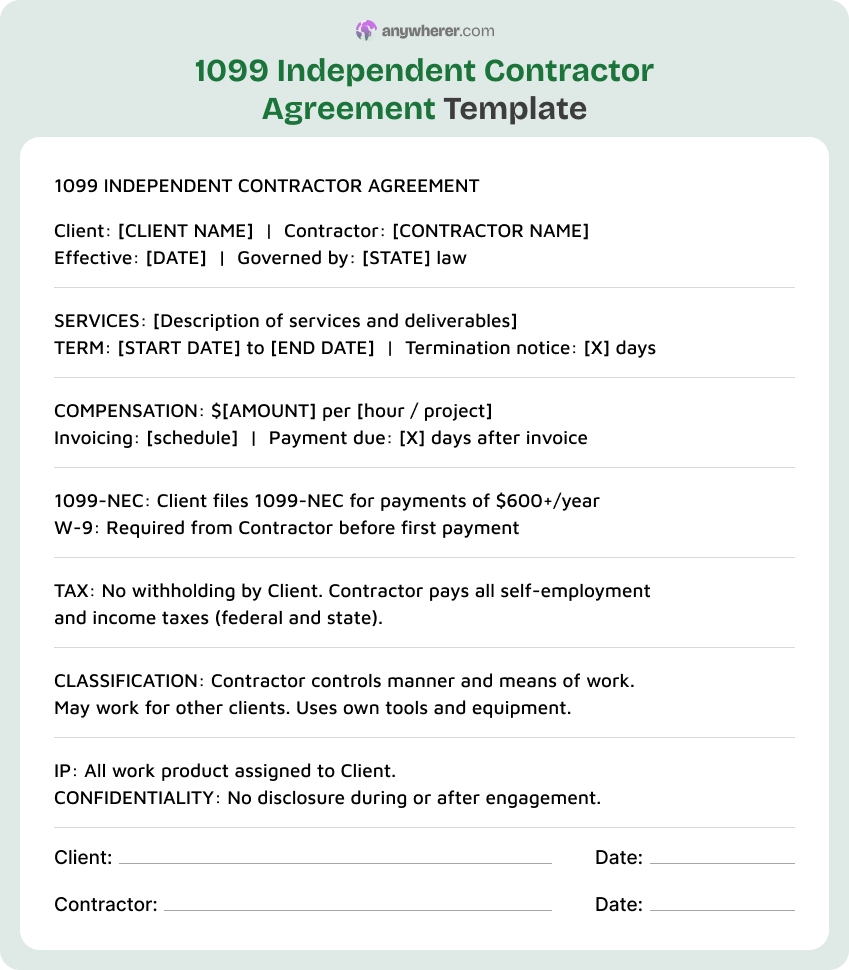
1099 Independent Contractor Agreement Template
Purpose: The 1099 independent contractor agreement template is the U.S.-specific version of the standard agreement. It adds explicit language referencing the IRS 1099-NEC filing requirement, the contractor’s W-9 obligation, and the fact that the client will not withhold federal or state income tax. It also addresses the IRS behavioral control, financial control, and relationship-type factors that inform worker classification review.
Agreement sections:
- Parties and tax classification: same as standard plus explicit IRS 1099-NEC and W-9 language.
- Scope of services: scope and deliverables.
- Term and termination: term and notice.
- Compensation and 1099 filing: rate, invoicing, payment timeline, and 1099-NEC reporting threshold acknowledgment.
- Contractor status and taxes: statement that contractor is not an employee; no withholding; contractor responsible for self-employment tax, federal, and state income tax.
- W-9: W-9 requirement: contractor provides a completed W-9 before first payment.
- Intellectual property: IP assignment.
- Confidentiality: confidentiality.
- Governing law: governing U.S. state law and dispute venue.
- Signatures: signatures.
Example of a template (text version):
1099 INDEPENDENT CONTRACTOR AGREEMENT
This Agreement is entered into as of [DATE] between [CLIENT NAME], a [STATE] [entity type] (“Client”), and [CONTRACTOR NAME / ENTITY], a [STATE] [entity type / individual] (“Contractor”). The parties intend for Contractor to serve as an independent contractor and not as an employee of Client for all purposes, including IRS classification.
Services and Deliverables:
[DESCRIPTION OF SERVICES AND DELIVERABLES].
Compensation and 1099 Reporting:
Client will pay Contractor $[AMOUNT] per [hour / project]. Contractor will invoice Client [invoicing schedule]. Payment is due within [X] days. Client will file IRS Form 1099-NEC for all payments to Contractor of $600 or more in a calendar year. Contractor must provide a completed IRS Form W-9 prior to the first payment.
Tax Obligations:
Client will not withhold federal income tax, state income tax, Social Security (OASDI), or Medicare (HI) from amounts paid to Contractor. Contractor is solely responsible for paying all applicable federal and state income taxes and self-employment tax on income received under this Agreement.
Contractor Classification:
Contractor retains the right to control the manner and means by which the services are performed. Contractor may work for other clients during the term. Contractor uses their own tools and equipment unless otherwise specified in writing. Contractor is not subject to Client’s employee policies, performance review processes, or daily supervision.
IP, Confidentiality, and Governing Law:
All work product is assigned to Client. Contractor protects confidential information during and after the engagement. This Agreement is governed by the laws of [STATE]. Disputes are resolved in [CITY, STATE].
Client: ___________________________ Date: ___________ | Contractor: ___________________________ Date: ___________
Best for: All U.S.-based contractor engagements where the contractor is a U.S. person or entity and payments will trigger a 1099-NEC filing obligation.
International Independent Contractor Agreement Template
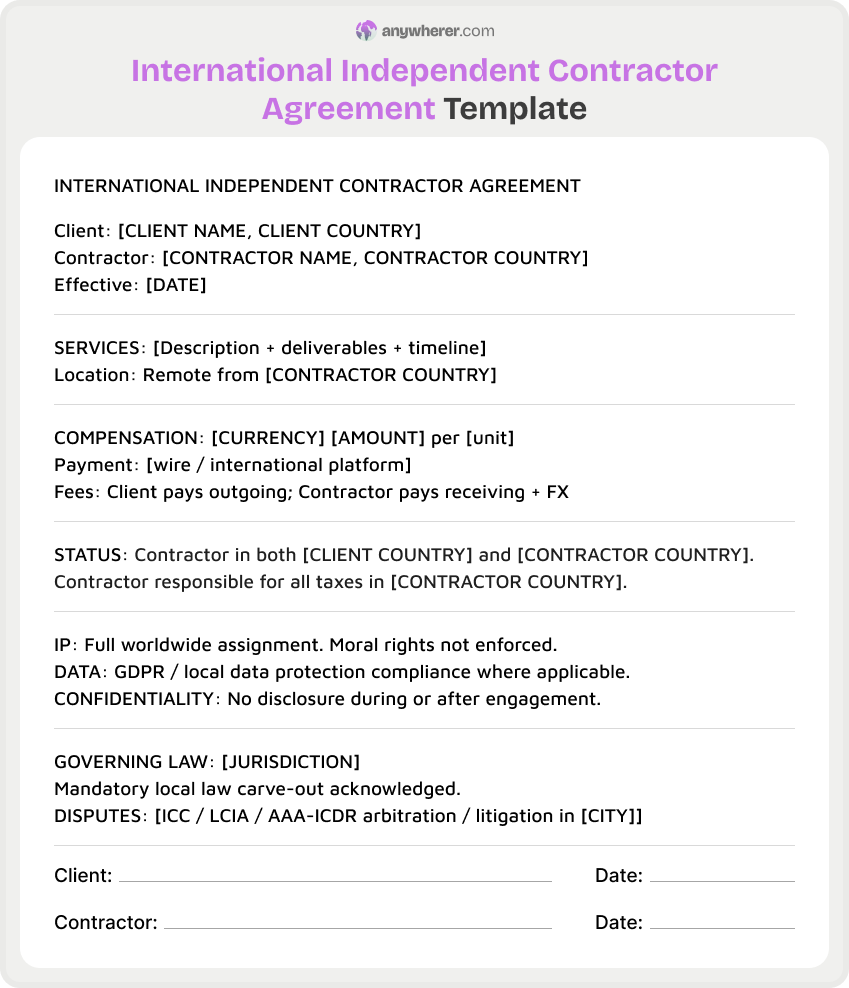
Purpose: The international independent contractor agreement template is designed for cross-border engagements where the client and contractor are in different countries. It adds governing-law choice, currency and payment-method clauses, data-transfer obligations, and a cross-border IP assignment clause that works in civil-law jurisdictions where work-for-hire defaults do not apply. For companies that find direct cross-border contracting too risky across multiple markets, working with one of the best EOR companies is the alternative for full compliance management.
Agreement sections:
- Parties and jurisdictions: client country, contractor country, entity types in each jurisdiction.
- Scope of services: services, deliverables, and any location or travel requirements.
- Term and termination: contract term, notice periods, and applicable local law on termination.
- Compensation and currency: currency, payment method (wire, international transfer platform), and responsibility for bank fees.
- Contractor status: explicit statement that the engagement is not employment under the laws of either jurisdiction, and reference to local classification tests where required.
- Intellectual property (cross-border): express IP assignment that holds under both common-law and civil-law systems; moral rights waiver where permitted.
- Data protection: GDPR or equivalent data protection obligations where applicable.
- Confidentiality: confidentiality and non-disclosure.
- Governing law and mandatory law carve-out: choice of governing law (typically client’s home jurisdiction or a neutral third country), with a carve-out acknowledging that local mandatory laws may apply.
- Dispute resolution: international arbitration clause (ICC, LCIA, or AAA-ICDR rules) or agreed jurisdiction.
- Signatures: signatures and date.
Example of a template (text version):
INTERNATIONAL INDEPENDENT CONTRACTOR AGREEMENT
This Agreement is entered into as of [DATE] between [CLIENT NAME], a [CLIENT COUNTRY] [entity type] (“Client”), and [CONTRACTOR NAME / ENTITY], a [CONTRACTOR COUNTRY] [entity type / individual] (“Contractor”).
Scope of Services:
[DESCRIPTION OF SERVICES, DELIVERABLES, AND EXPECTED TIMELINE]. Services will be performed remotely from [CONTRACTOR COUNTRY] unless the parties agree otherwise in writing.
Compensation and Currency:
Client will pay Contractor [CURRENCY] [AMOUNT] per [unit]. Payment will be made by [wire transfer / international payment platform] to the bank account or payment account designated by Contractor. Client is responsible for any outgoing transfer fees. Contractor is responsible for any receiving fees and for any currency conversion costs.
Independent Contractor Status:
The parties intend this to be a contractor relationship under the laws of both [CLIENT COUNTRY] and [CONTRACTOR COUNTRY]. Contractor is not an employee, agent, or partner of Client under the laws of any jurisdiction. Contractor is responsible for their own tax obligations in [CONTRACTOR COUNTRY], including income tax and social security contributions as required by local law.
Intellectual Property:
Contractor irrevocably assigns to Client all right, title, and interest in all work product and deliverables created under this Agreement, including copyright, patent rights, and all other intellectual property rights worldwide. To the extent moral rights cannot be waived under [CONTRACTOR COUNTRY] law, Contractor agrees not to enforce them against Client.
Data Protection:
Where Contractor processes personal data subject to [GDPR / applicable local law] on behalf of Client, Contractor agrees to process such data only as instructed, to implement appropriate technical and organisational measures, and not to transfer personal data outside [EEA / CLIENT COUNTRY] without written authorisation.
Governing Law and Disputes:
This Agreement is governed by the laws of [GOVERNING JURISDICTION], without regard to conflict-of-law principles. The parties acknowledge that mandatory provisions of [CONTRACTOR COUNTRY] law may apply notwithstanding this choice. Disputes will be resolved by [international arbitration under [ICC / LCIA / AAA-ICDR] rules / litigation in [CITY, COUNTRY]].
Client: ___________________________ Date: ___________ | Contractor: ___________________________ Date: ___________
Best for: Any engagement where the client and contractor are in different countries. Essential for EU, UK, and APAC engagements where work-for-hire defaults and data protection laws differ from the U.S.
California Independent Contractor Agreement Template
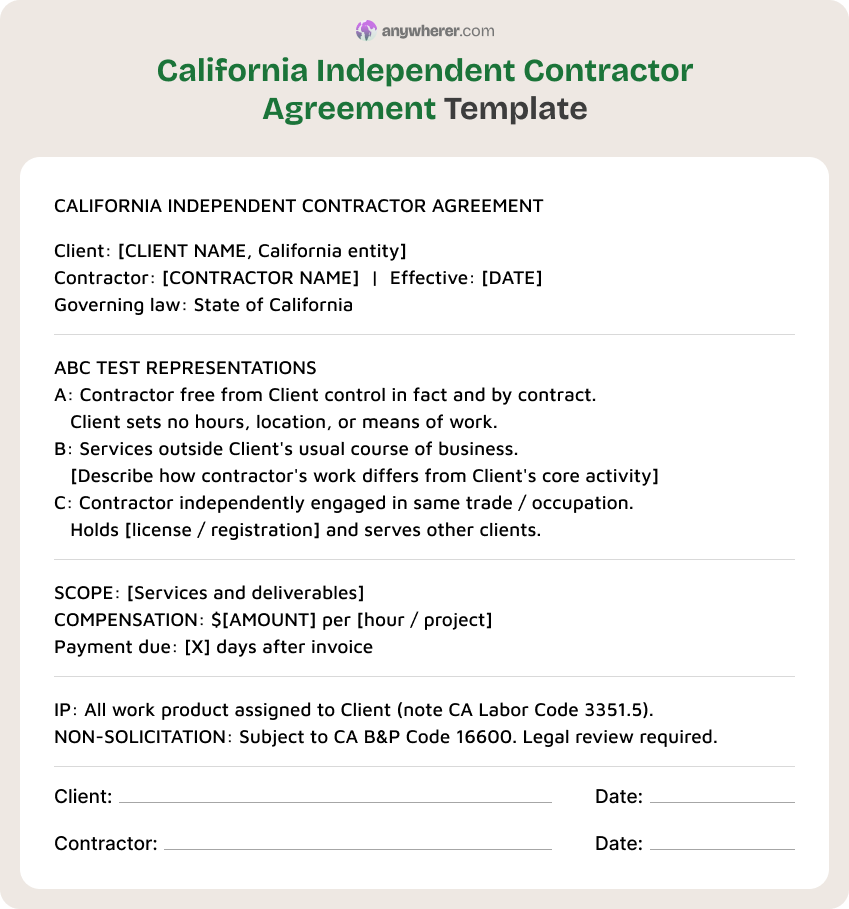
Purpose: The independent contractor agreement template California version addresses the state’s AB5 law and the ABC test it codified. Under AB5, a worker is presumed to be an employee unless the hiring entity can satisfy all three prongs of the ABC test. The template includes representations from the contractor designed to support each prong, but as the California DIR makes clear, the agreement alone does not determine classification. The working relationship must match the representations.
Agreement sections:
- Parties: client and contractor, California governing law.
- Scope and AB5 alignment: services outside Client’s usual course of business (AB5 Prong B); contractor performs in a separate trade or occupation (Prong C).
- Term and control (Prong A): no fixed schedule imposed by Client; Contractor sets own hours.
- Compensation: rate, invoicing, payment.
- Contractor status and ABC representations: Contractor free from Client’s control and direction (ABC Prong A); uses own tools; may work for others.
- Intellectual property: IP assignment.
- Confidentiality: confidentiality.
- Governing law and non-solicitation note: California law governs; any non-solicitation clause noted as subject to California Business and Professions Code section 16600.
- Signatures: signatures.
Example of a template (text version):
CALIFORNIA INDEPENDENT CONTRACTOR AGREEMENT
This Agreement is entered into as of [DATE] between [CLIENT NAME], a California [entity type] (“Client”), and [CONTRACTOR NAME / ENTITY] (“Contractor”). This Agreement is governed by the laws of the State of California.
ABC Test Representations:
The parties represent and agree as follows: (A) Contractor is free from the control and direction of Client in connection with the performance of services, both under this Agreement and in fact. Client does not set Contractor’s hours, require Contractor to work at a specific location, or supervise the means and methods by which Contractor performs services. (B) Contractor performs services outside the usual course of Client’s business. [DESCRIPTION OF HOW CONTRACTOR’S WORK DIFFERS FROM CLIENT’S CORE BUSINESS ACTIVITY]. (C) Contractor is customarily engaged in an independently established trade, occupation, or business of the same nature as the services performed. Contractor holds [business license / professional registration / other indicator of independent business] and actively offers services to [other clients / the market generally].
Scope of Services:
[DESCRIPTION OF SERVICES AND DELIVERABLES].
Compensation:
Client will pay Contractor $[AMOUNT] per [hour / project]. Contractor invoices [schedule]. Payment is due within [X] days of invoice.
Intellectual Property:
All work product is assigned to Client. Note: California Labor Code section 3351.5 limits work-for-hire classification for certain works. Parties confirm this Agreement is structured accordingly.
Non-Solicitation:
Any non-solicitation provision in this Agreement is subject to California Business and Professions Code section 16600, which generally voids non-compete and non-solicitation clauses in California. Legal review is recommended before relying on any such clause.
Client: ___________________________ Date: ___________ | Contractor: ___________________________ Date: ___________
Best for: Any engagement where the contractor performs services in California or is a California-resident individual. The ABC test representations and non-solicitation note are specific to California law.
Project-Based Independent Contractor Agreement Template
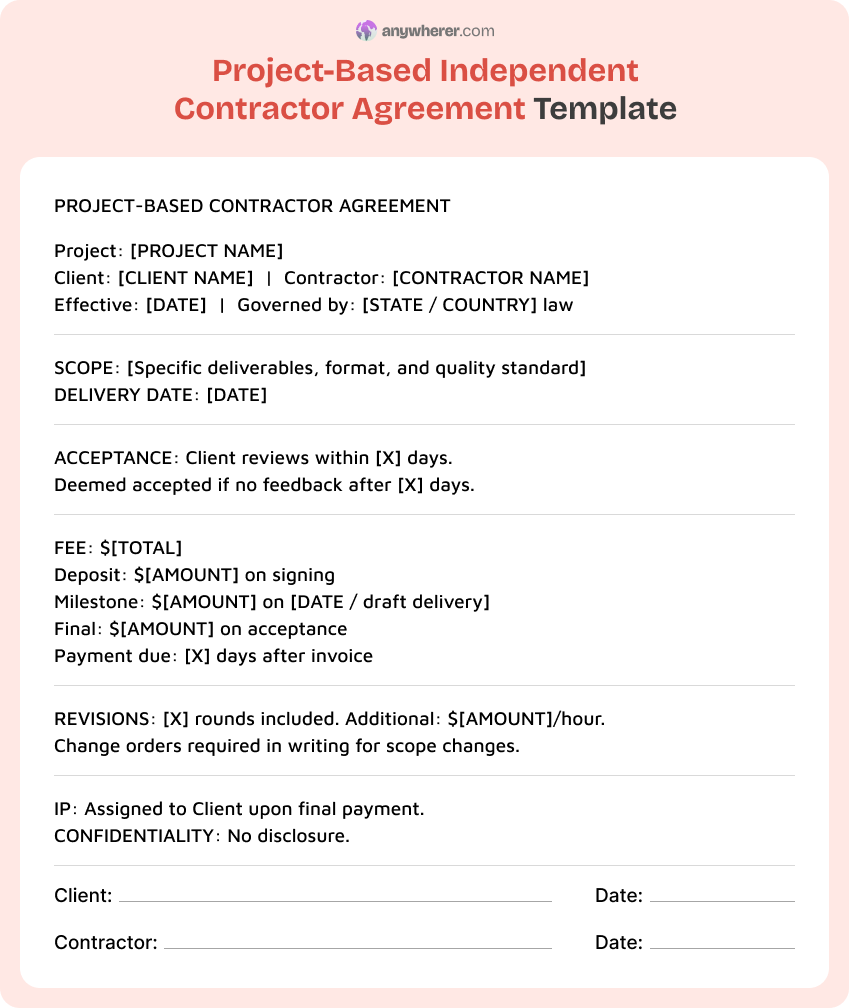
Purpose: A discrete-deliverable version for engagements with a fixed scope, defined start and end, and milestone-based payments. The project-based template is suitable for website builds, audits, research reports, design projects, and any engagement where the relationship ends when the deliverable is accepted. Unlike a retainer, there is no ongoing work cadence and no auto-renewal.
Agreement sections:
- Parties: parties and project title.
- Project scope and deliverables: precise description of what will be delivered, in what format, and by what date.
- Timeline and acceptance: project start date, delivery date, and acceptance process.
- Compensation: fixed project fee, milestone payment schedule, and late-payment terms.
- Contractor status: contractor status.
- Intellectual property: IP assignment upon final payment.
- Revisions and change orders: revision policy: how many revision rounds are included, and what constitutes out-of-scope work.
- Confidentiality: confidentiality.
- Governing law: governing law.
- Signatures: signatures.
Example of a template (text version):
PROJECT-BASED CONTRACTOR AGREEMENT
Project title: [PROJECT NAME] | Client: [CLIENT NAME] | Contractor: [CONTRACTOR NAME] | Effective date: [DATE]
Project Scope:
Contractor will deliver: [SPECIFIC DELIVERABLES – e.g., a fully designed 5-page website, a 10,000-word market research report, a brand identity package]. Final deliverables will be provided in [FORMAT] by [DELIVERY DATE].
Acceptance:
Client will review deliverables within [X] business days and either accept in writing or provide specific written feedback. If Client does not respond within [X] business days, deliverables are deemed accepted.
Compensation:
Total project fee: $[AMOUNT]. Payment schedule: $[AMOUNT] on signing (deposit), $[AMOUNT] on [MILESTONE DATE / delivery of first draft], $[AMOUNT] on final acceptance. Invoices are due within [X] days.
Revisions and Change Orders:
This Agreement includes [X] rounds of revisions. Additional revisions or changes to project scope require a written change order and may incur additional fees of $[AMOUNT] per hour.
Intellectual Property:
All work product is assigned to Client upon receipt of final payment. Prior to final payment, work product remains the property of Contractor.
Governing law: [STATE / COUNTRY].
Client: ___________________________ Date: ___________ | Contractor: ___________________________ Date: ___________
Best for: Website builds, design projects, research reports, audits, and any fixed-scope engagement with a defined end date and milestone payments.
Long-Term Retainer Independent Contractor Agreement Template
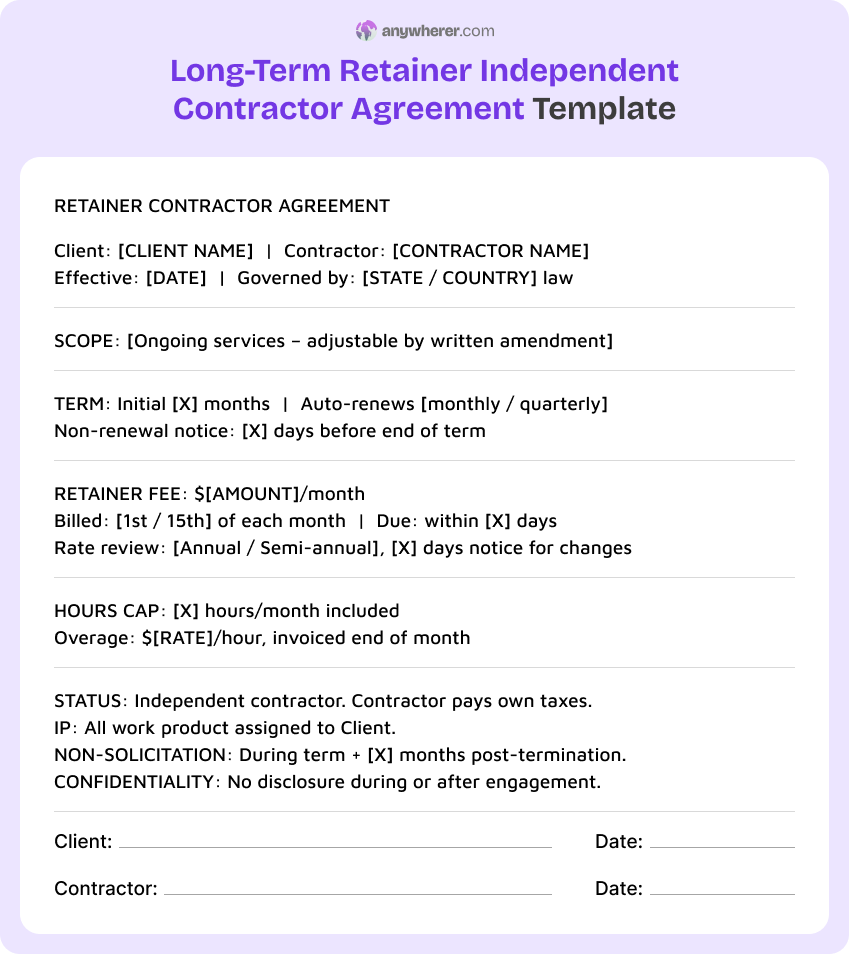
Purpose: An ongoing, recurring engagement template for contractors providing services over a sustained period – monthly retainers for marketing, fractional executives, technical advisors, or ongoing operational support. The retainer template adds auto-renewal provisions, a rate review clause, and a scope management mechanism to handle the fluid nature of long-term engagements without requiring a new agreement for every work cycle.
Agreement sections:
- Parties: parties and effective date.
- Scope of services: ongoing scope of services with a mechanism for adjusting scope by written amendment.
- Term and auto-renewal: initial term, auto-renewal cadence, and termination notice period.
- Retainer fee and rate review: monthly retainer fee, billing date, payment due date, and rate review schedule.
- Hours cap and overage: monthly cap on hours included; overage rate if hours exceed cap.
- Contractor status: contractor status.
- Intellectual property: IP assignment for all work produced during the engagement.
- Confidentiality: confidentiality.
- Non-solicitation: non-solicitation for the term plus a defined post-termination period.
- Governing law: governing law.
- Signatures: signatures.
Example of a template (text version):
RETAINER CONTRACTOR AGREEMENT
This Agreement is entered into as of [DATE] between [CLIENT NAME] (“Client”) and [CONTRACTOR NAME / ENTITY] (“Contractor”).
Scope of Services:
Contractor will provide the following services on an ongoing basis: [DESCRIPTION OF ONGOING SERVICES]. Scope may be adjusted by mutual written agreement without requiring a new contract.
Term and Auto-Renewal:
This Agreement begins on [START DATE] for an initial term of [X] months and automatically renews for successive [monthly / quarterly] periods unless either party gives [X] days’ written notice of non-renewal prior to the end of the then-current term.
Retainer Fee and Rate Review:
Client will pay Contractor a monthly retainer of $[AMOUNT], billed on the [1st / 15th] of each month and due within [X] days. The retainer rate will be reviewed on [ANNUAL / SEMI-ANNUAL] basis beginning [DATE]. Any rate adjustment requires [X] days’ written notice.
Hours Cap and Overage:
The monthly retainer covers up to [X] hours of services. Hours exceeding the cap are billed at $[OVERAGE RATE] per hour, invoiced separately at the end of each month.
Contractor Status and IP:
Contractor is an independent contractor. All work product created during this engagement is assigned to Client. Contractor handles own taxes.
Governing law: [STATE / COUNTRY].
Client: ___________________________ Date: ___________ | Contractor: ___________________________ Date: ___________
Best for: Fractional executives, ongoing marketing support, technical advisors, and any contractor engagement that runs month-to-month with a recurring fee and variable scope.
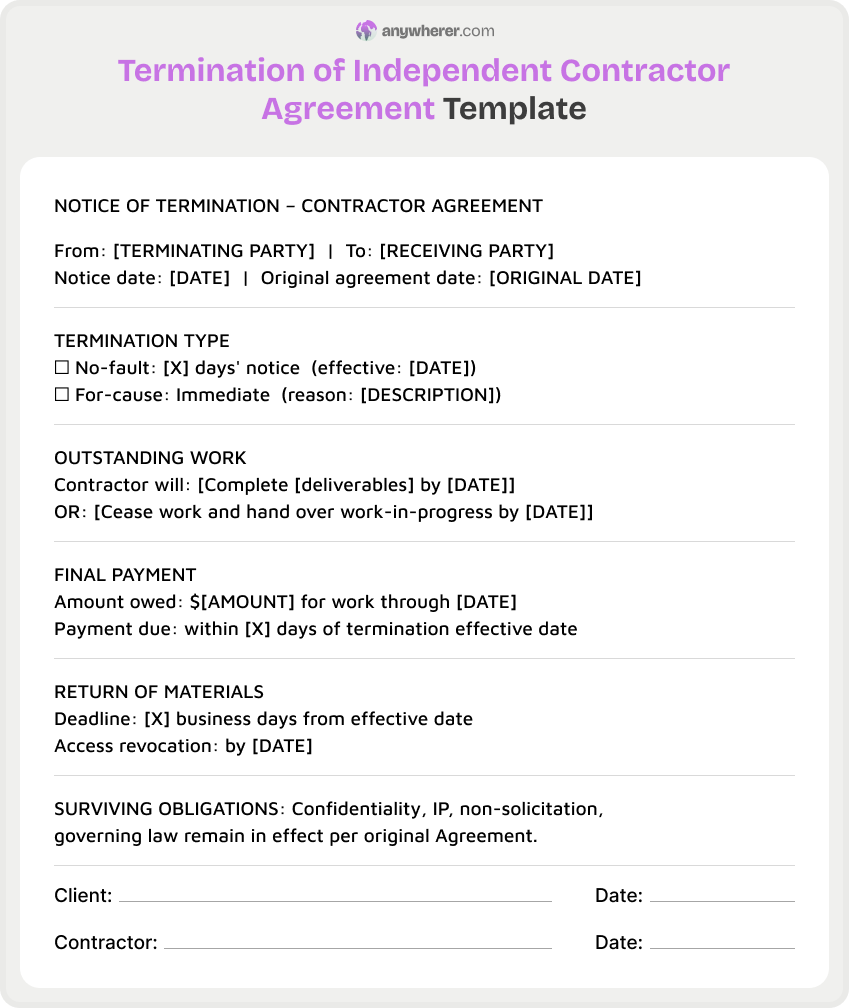
Termination of Independent Contractor Agreement Template
Purpose: A companion termination notice that formally ends an existing contractor engagement. The termination of independent contractor agreement template documents the effective date, the notice period being observed, the status of outstanding work and payments, and the post-termination obligations that survive – confidentiality, IP, non-solicitation. It is used alongside (not as a replacement for) the original agreement.
Agreement sections:
- Parties and reference: both parties, original agreement date, and termination notice date.
- Termination type: whether this is a no-fault notice or for-cause termination, and which provision of the original agreement applies.
- Effective date: the date termination takes effect.
- Outstanding work: what the contractor will complete or hand over before the effective date.
- Final payment: amounts owed for completed work and the payment timeline.
- Return of materials: return or destruction of confidential materials and access revocation.
- Surviving obligations: obligations from the original agreement that continue after termination.
- Mutual release (optional): both parties confirm the original agreement is terminated as of the effective date.
- Signatures: signatures.
Example of a template (text version):
NOTICE OF TERMINATION – INDEPENDENT CONTRACTOR AGREEMENT
This Notice of Termination (“Notice”) is given as of [NOTICE DATE] by [TERMINATING PARTY: CLIENT / CONTRACTOR] (“Terminating Party”) to [RECEIVING PARTY] (“Receiving Party”) with respect to the Independent Contractor Agreement dated [ORIGINAL AGREEMENT DATE] (“Agreement”).
Termination:
Terminating Party hereby provides notice of termination of the Agreement in accordance with [Section X / the applicable termination clause] of the Agreement. This is a [no-fault termination with [X] days’ notice / for-cause termination effective immediately due to [REASON]]. The Agreement will terminate on [EFFECTIVE DATE OF TERMINATION].
Outstanding Work:
Contractor will [complete the following deliverables before the effective date: DESCRIPTION / cease work immediately and hand over all work in progress to Client in its current state by [DATE]].
Final Payment:
Client will pay Contractor $[AMOUNT] for work completed through [DATE], including any outstanding invoices. Final payment will be processed within [X] days of the effective termination date.
Return of Materials:
Contractor will return or permanently delete all confidential information, data, and materials belonging to Client within [X] business days of the effective date. Contractor confirms that all access credentials and system access will be revoked by [DATE].
Surviving Obligations:
The confidentiality, intellectual property, non-solicitation (if applicable and enforceable), and governing law provisions of the Agreement survive termination and remain in full force.
Client: ___________________________ Date: ___________ | Contractor: ___________________________ Date: ___________
Best for: Any clean termination of a contractor engagement, whether no-fault or for-cause. Use alongside the original agreement, not as a standalone document.
How to Use These Agreements
The workflow starts with the classification decision. Before selecting a template, confirm the engagement qualifies as contractor under the applicable jurisdiction’s test. The contractor vs employee checklist is the starting point. If the engagement fails the relevant classification test – IRS common-law factors for U.S. federal, ABC test for California, or equivalent in the contractor’s home jurisdiction – using a contractor agreement does not resolve the misclassification risk.
Once classification is confirmed, pick the template that matches the jurisdiction and engagement type. Adapt scope, compensation, and IP clauses to the specifics of the engagement. Have local counsel review any agreement for contractors outside the client’s home jurisdiction before signing. Both parties sign before work begins – not after the first invoice. For distributed teams managing contractors at scale, the recruitment process plan template provides the broader sourcing and onboarding framework that contractor agreement management sits within.
The agreement does not by itself prevent misclassification. The day-to-day working relationship has to match the contractor framing: no fixed hours imposed by the client, no dedicated equipment or workstation provided, no integration into the team’s reporting line, and the contractor must be free to work for other clients. Companies where that structure is not feasible should evaluate whether an EOR or direct employment is the appropriate model.
Key Elements Every Independent Contractor Agreement Should Include
- Clear scope of services and deliverables – the most common source of contractor disputes is vague or missing scope.
- Defined term, termination notice period, and for-cause termination rights.
- Compensation, invoicing cadence, and payment timeline – including what happens to outstanding invoices on termination.
- Explicit independent contractor status: no employment, no benefits, contractor handles own taxes.
- IP assignment and work-for-hire clause – work product defaults to the contractor in many jurisdictions without this clause.
- Confidentiality and data-handling obligations that survive termination.
- Governing law and dispute resolution mechanism – essential for any cross-border engagement.
- Signatures of both parties with effective date before work begins.
Common Mistakes With Independent Contractor Agreements
- Using a U.S. template for international contractors. Most countries do not recognise U.S. work-for-hire defaults, and IP may not transfer without an express assignment clause valid in the contractor’s jurisdiction.
- Treating contractors like employees day-to-day – fixed hours, dedicated workstation, embedded in the reporting line – while calling them contractors in the agreement. The working relationship controls classification more than the contract.
- Missing or vague scope of services. Scope disputes are the leading cause of contractor payment conflicts and the hardest to resolve without written specifics.
- Skipping IP assignment language. Without an explicit assignment, work product may legally belong to the contractor even if the client paid for it.
- Auto-renewing long-term retainers with no rate review or scope adjustment clause. Rates and scope drift over time without a formal mechanism to address both.
- No governing law or jurisdiction clause for cross-border engagements. Without it, both jurisdictions may claim authority – and neither may produce a predictable outcome.
- Reusing the same template across California, other U.S. states, and international markets without adjusting for AB5, local classification rules, or data protection laws.
FAQs on Independent Contractor Agreement Templates
What should be included in an independent contractor agreement?
A complete template for independent contractor agreement use includes: parties and effective date, scope of services and deliverables, term and termination provisions, compensation and payment terms, explicit independent contractor status (no employment, no benefits, contractor pays own taxes), IP assignment, confidentiality, governing law, and signatures. For U.S. engagements, 1099-NEC and W-9 language is also required. For California, ABC test representations are necessary. For international engagements, add currency, data protection, and cross-border IP transfer clauses.
Is there a free independent contractor agreement template?
Yes. The simple independent contractor agreement template in this guide is a free independent contractor agreement template that covers the core clauses for most straightforward engagements: parties, services, payment, contractor status, IP, confidentiality, and governing law. It is a starting point. For U.S. 1099 engagements, California contractors, or any international hire, use the jurisdiction-specific template and have local counsel review it before signing.
What is the difference between a 1099 contractor and a W-2 employee?
A 1099 contractor is an independent contractor who receives Form 1099-NEC from each client that paid them $600 or more in a calendar year. They pay their own self-employment and income taxes and receive no employee benefits. A W-2 employee has taxes withheld by the employer and receives statutory employment protections. Per the IRS common-law test, the distinction rests on behavioral control, financial control, and the type of relationship – not solely on what the parties call the arrangement. Misclassification exposes the hiring company to back-taxes, penalties, and benefits liability.
Do you need a separate contractor agreement for international hires?
Yes. A U.S.-based contractor agreement is not sufficient for international contractors. The international independent contractor agreement template adds governing-law choice, currency and payment-method clauses, a cross-border IP assignment that holds in civil-law systems, and data protection obligations where GDPR or equivalent law applies. The European Commission’s platform work rules place the burden of proving contractor status on the engaging company in EU jurisdictions – making a well-structured agreement even more important for EU-based contractors.
What does California’s AB5 mean for contractor agreements?
AB5, effective January 2020, codified the ABC test for worker classification in California. Under the ABC test, a worker is presumed to be an employee unless the hiring entity proves all three prongs: (A) the worker is free from the company’s control, (B) the worker performs work outside the company’s usual course of business, and (C) the worker is engaged in an independently established trade or occupation. Per the California DIR, the agreement alone does not satisfy the test – the working relationship must match. Use the California independent contractor agreement template california version and include explicit ABC test representations. Several occupation categories have AB5 exemptions; legal review is recommended before classifying any California worker as a contractor.
How do you terminate an independent contractor agreement?
Use the termination notice template provided in this guide. Reference the termination clause in the original agreement – whether no-fault with notice or for-cause immediate. Document the effective date, the status of outstanding work and final payment, the deadline for returning materials and revoking access, and which obligations survive termination. Both parties should sign the termination notice to confirm the original agreement is closed. For retainer agreements with auto-renewal, the non-renewal notice must be sent before the end of the current term as specified in the contract.

Yaryna is our lead writer with over 8 years of experience in crafting clear, compelling, and insightful content. Specializing in global employment and EOR solutions, she simplifies complex concepts to help businesses expand their remote teams with confidence. With a strong background working alongside diverse product and software teams, Yaryna brings a tech-savvy perspective to her writing, delivering both in-depth analysis and valuable insights.