A first harassment complaint is received by HR, and the manager asks which written standard applies. The answer is awkward: the company has policies, values, and Slack norms, but no single conduct document. Distributed teams make this harder because behavior standards may be pulled from several countries and managers’ habits. A code of conduct template provides the company with a written baseline before a problem becomes personal.
The Ethics & Compliance Initiative treats codes of conduct as practical tools for setting expectations and supporting ethical decisions. For employers, the code often becomes a handbook chapter, even when the full employee handbook is maintained separately.
What Is a Code of Conduct
A code of conduct defines acceptable and unacceptable behavior at work. It protects employees and the company by providing managers with a written standard for communication, safety, confidentiality, conflict resolution, reporting, and discipline.
A code of conduct is different from a code of ethics. Ethics language is usually broader and values-led. Conduct language is more practical: it tells employees what to do, what to avoid, and where to report concerns.
It is also narrower than a full employee handbook. A handbook covers the policy stack. A code of conduct focuses on behavior, accountability, reporting, and consequences across small businesses, startups, remote teams, global teams, and regulated industries.
Why Companies Need a Code of Conduct Template
A template sets a shared behavior standard across roles, locations, and time zones. It also gives HR and managers a more consistent basis for coaching, discipline, investigation, and documentation.
Legal risk is part of the reason. EEOC materials explain the concepts of harassment and retaliation that employers often address in conduct rules and reporting channels. A code cannot replace legal advice, but it can show that employees received clear expectations.
The code also sends an external signal. Candidates, clients, vendors, and partners can see that the company has a written standard for behavior. A workforce planning template may show where the team is growing; the code of conduct shows how people are expected to work as that growth happens.
8 Code of Conduct Template Examples
The code of conduct templates below cover general-purpose companies, employee conduct, formal policy framing, small businesses, startups, simple free use, remote teams, and global teams. In each table, the left column lists the policy field, and the right column provides text to paste after replacing the bracketed details.
A template for code of conduct drafting should be adapted by location, worker type, reporting channel, and enforcement process. Do not publish a starter draft without those details.
Standard Code of Conduct Template
Purpose: Use this general-purpose template for established companies with office-based, hybrid, or mixed teams in a single country. It sets a baseline for expected workplace behavior.
Code of Conduct sections:
- Purpose and scope: define who must follow the code.
- Expected behaviors: connect company values to daily conduct.
- Professional conduct: cover communication, attendance, dress, and meeting norms.
- Attendance companion: use the attendance policy template for schedule and absence rules.
- Respect at work: prohibit harassment, discrimination, bullying, and retaliation.
- Conflicts and confidentiality: address gifts, outside interests, data, and IP.
- Company property: set rules for equipment, IT systems, and AI tools.
- Reporting and discipline: explain reporting channels, investigation steps, consequences, and acknowledgment.
Example of a template (text version):
- Company name: ___________________________ | Effective date: ___________
- Who must follow this code? Employees / Managers / Contractors / Temp workers / Other: ___
- When does this code apply? At work / Business travel / Company events / Company systems / Other: ___
- What professional conduct is expected from everyone? Describe the standard: ___________________________
- What is prohibited? Select all that apply: Harassment / Discrimination / Retaliation / Conflicts of interest / Property misuse / Unauthorized disclosure / Other: ___
- Where should concerns be reported? [HR contact name or reporting channel]: ___________________________
- What consequences may follow a violation? Coaching / Written warning / Suspension / Termination / Other: ___
- Who must acknowledge receipt of this code? ___________________________
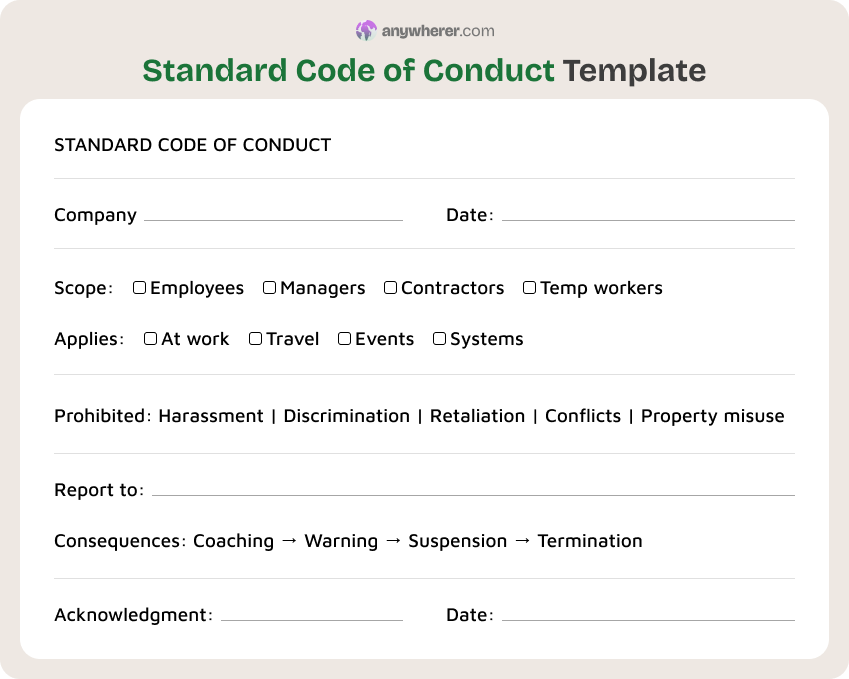
Best for: Companies that need one code of conduct for employees template for a broad employee population.
Employee Code of Conduct Template
Purpose: This policy sets expectations for daily workplace behavior. A company code of conduct template can use the same structure when the policy covers everyone. A workplace code of conduct template should also cover digital communication and company events.
Code of Conduct sections:
- Employee scope: state that the code applies during work, events, travel, and digital communication.
- Workplace behavior: define respectful communication, attendance, and cooperation.
- Manager expectations: set a higher standard for escalation and fair treatment.
- Harassment and discrimination: explain prohibited conduct and reporting.
- Company standards: cover property, confidentiality, data, and external communication.
- Acknowledgment: requires employees to confirm they understand the code.
Example of a template (text version):
- Company name: ___________________________ | Applies to: All employees
- When does this code apply? At work / Company events / Online communication / When representing the company / Other: ___
- What daily conduct is expected from employees? List key behaviors: ___________________________
- What is prohibited? Harassment / Discrimination / Retaliation / Inappropriate conduct / Other: ___
- Where should employees report concerns? [HR contact/channel]: ___________________________
- What are managers expected to do that individual employees are not? ___________________________
- How will employees confirm they have received and understood this code? Signature / Digital acknowledgment / Training record / Other: ___
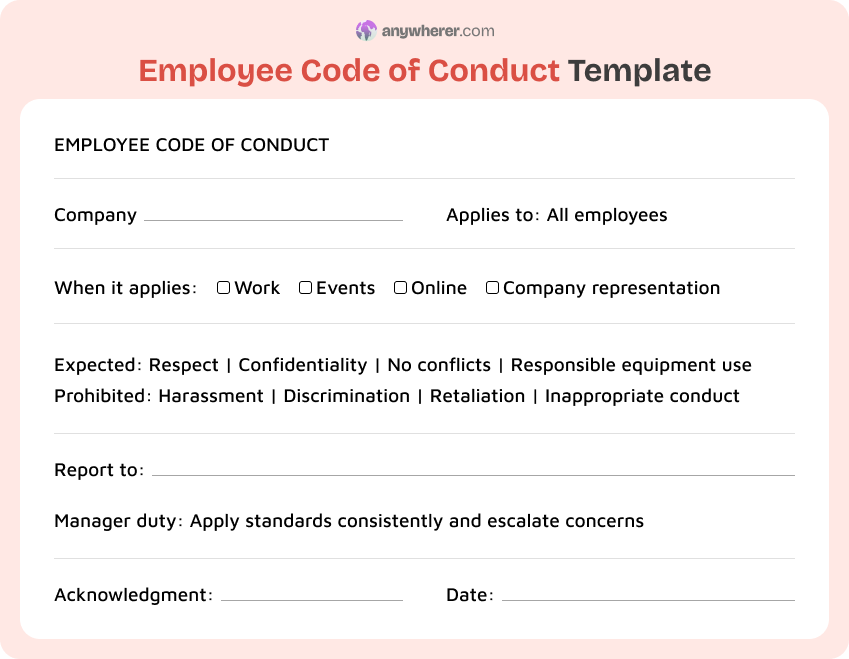
Best for: HR teams defining day-to-day conduct rules for office, hybrid, and field employees.
Code of Conduct Policy Template
Purpose: Use a template when the document needs formal policy language, policy ownership, approval history, and revision controls. An employee code of conduct policy template is useful when HR must track approvals.
Code of Conduct sections:
- Policy owner: name HR, legal, compliance, or operations as the accountable function.
- Effective date: show when the policy starts and how revisions are approved.
- Policy scope: define covered workers, locations, systems, and events.
- Standards of conduct: list prohibited and expected behaviors.
- Reporting process: define how concerns are raised, reviewed, and documented.
- Corrective action: explain possible outcomes after investigation.
Example of a template (text version):
- Policy owner: [function or role]: ___________________________ | Date last approved: ___________
- Effective date: ___________ | Review cycle: Annual / Every 2 years / Other: ___
- Who does this policy cover? Workers: ___ | Locations: ___ | Systems: ___ | Events: ___
- What conduct standards are required? List expected behaviors: ___________________________
- What is prohibited? Harassment / Discrimination / Retaliation / Conflicts of interest / Confidentiality breaches / Property misuse / Other: ___
- How should suspected violations be reported? [Reporting channel]: ___________________________
- What corrective action may follow an investigation? Describe the range of outcomes: ___________________________
- Who approves this policy? [HR / Legal / Executive]: ___ | How will employees acknowledge receipt? ___
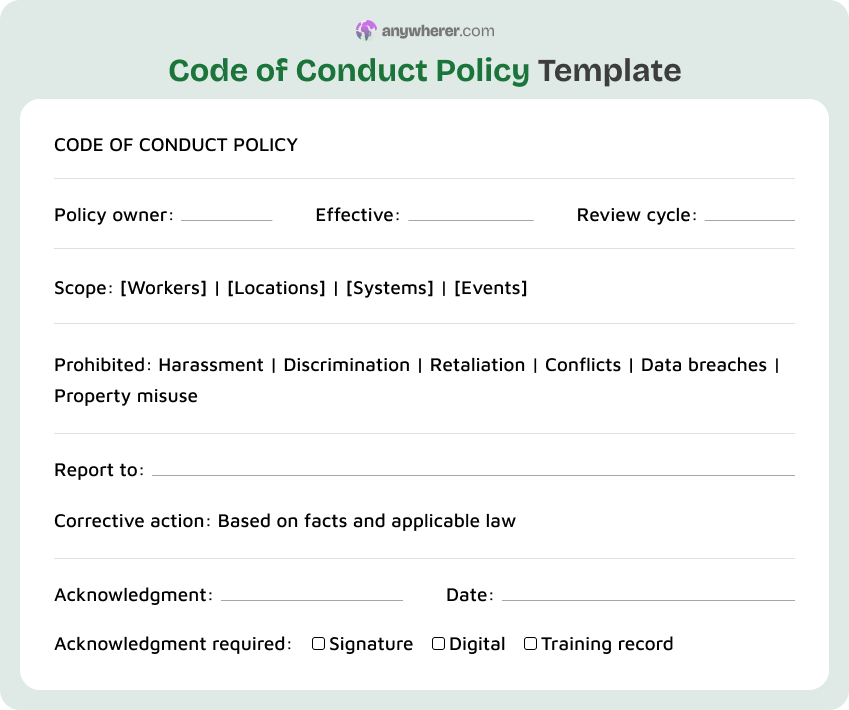
Best for: Employers that need formal policy framing and version control.
Small Business Code of Conduct Template
Purpose: Use this for companies with fewer than 50 employees that need clear behavior rules without a large HR team. Keep the language clear enough for managers to apply.
Code of Conduct sections:
- Basic expectations: state respectful behavior, honesty, and reliability.
- Attendance and communication: define notice, scheduling, and customer-facing conduct.
- Harassment and safety: explain the no-tolerance standard and reporting path.
- Conflicts and confidentiality: cover outside work, gifts, client data, and records.
- Owner or manager review: state who receives concerns and makes decisions.
- Acknowledgment: collect a signed record from each employee.
Example of a template (text version):
- Company name: ___________________________ | Owner / Manager name: ___________________________
- Who must follow this code? Employees / Part-time staff / Contractors / Other: ___
- What basic conduct is expected? e.g., treat everyone with respect, arrive as scheduled, communicate honestly: ___________________________
- What is prohibited? Harassment / Discrimination / Retaliation / Threats / Unsafe behavior / Other: ___
- Where should concerns be reported? [Owner / Manager / Other]: ___________________________
- How will the company handle concerns? Who reviews them and makes decisions? ___________________________
- How will employees confirm receipt of this code? Signature / Date: ___________________________
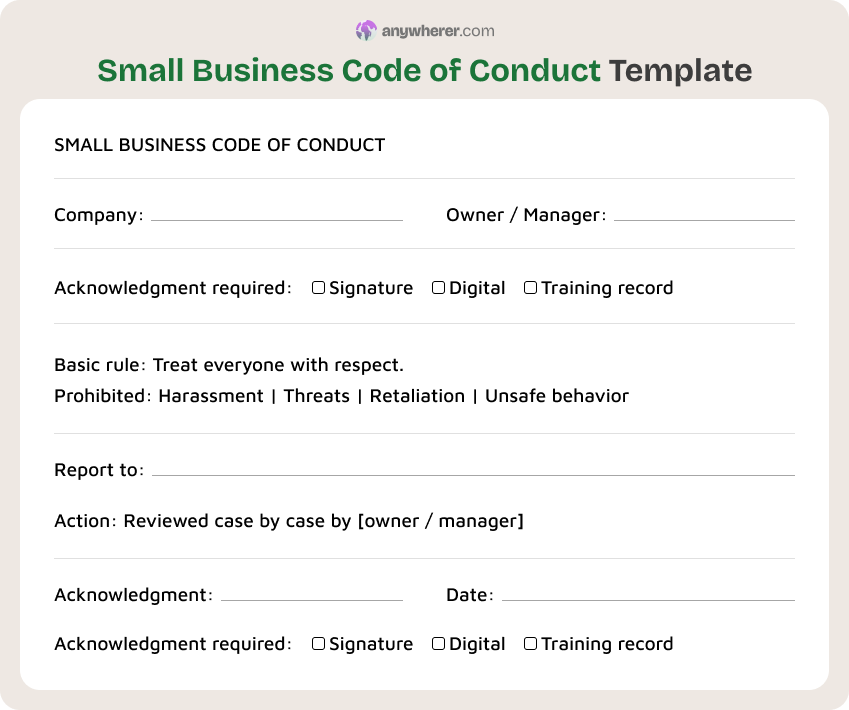
Best for: Owners looking for a code of conduct template for small businesses before informal habits become hard to change.
Startup Code of Conduct Template
Purpose: Use this for early-stage companies where roles, reporting lines, and policies may change quickly. The code gives structure without freezing the culture.
Code of Conduct sections:
- Operating values: explain how the team expects people to work together.
- Role flexibility: define respectful conduct when responsibilities change.
- Communication norms: cover Slack, email, meetings, and customer channels.
- Confidentiality and IP: protect product, customer, investor, and employee information.
- Hiring and growth: connect conduct ownership with workforce planning template updates.
- Escalation path: name founders, HR, legal, or an outside channel for concerns.
Example of a template (text version):
- Company name: ___________________________ | Stage: Seed / Series A / Growth / Other: ___
- What operating values guide how the team works together? e.g., candor, respect, accountability: ___________________________
- What is prohibited even during rapid growth or role changes? Harassment / Retaliation / Confidentiality breaches / Conflicts of interest / Tool misuse / Other: ___
- Where should employees raise concerns, including concerns about founders or managers? [Channel]: ___________________________
- What information must employees protect? Product data / Customer data / Investor data / Employee data / Other: ___
- How will leaders apply this code consistently as teams, roles, and locations change? ___________________________
- How will employees acknowledge receipt as the company grows and onboards new people? ___________________________
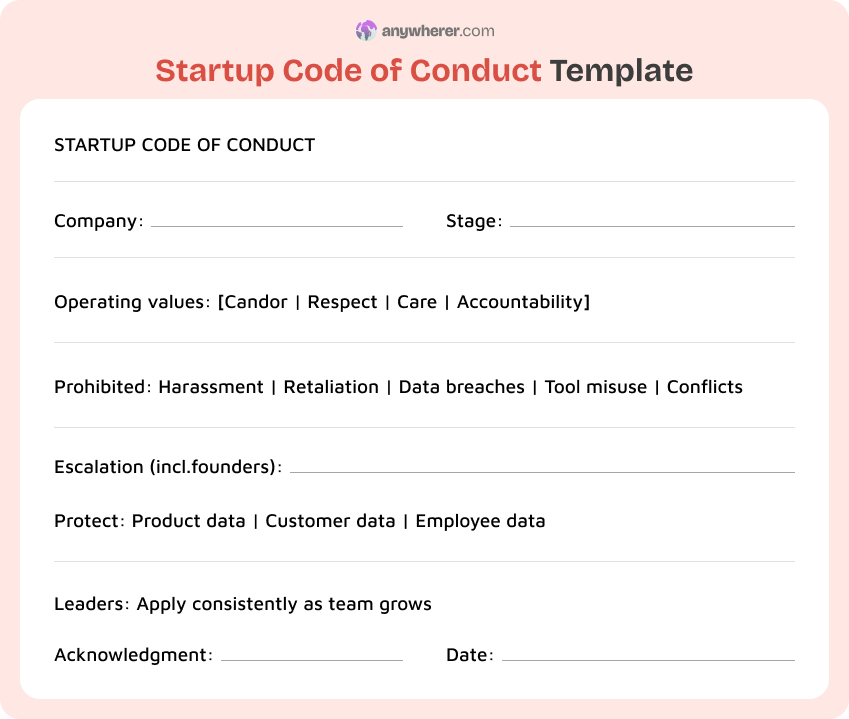
Best for: Startups that need conduct rules before headcount, teams, and operating habits become more complex.
Simple Code of Conduct Template
Purpose: Use this when the organization needs a short starter document. It should still include reporting channels and review ownership.
Code of Conduct sections:
- Purpose: explain why the code exists.
- Expected conduct: list the behaviors employees should follow.
- Prohibited conduct: name harassment, discrimination, threats, fraud, and retaliation.
- Confidentiality and property: cover company information, equipment, and systems.
- Reporting channel: tell employees where to raise concerns.
- Acknowledgment: confirm employees received the code.
Example of a template (text version):
- Company name: ___________________________ | Date: ___________
- Why does this code exist? Write a one-sentence purpose: ___________________________
- What behaviors are expected? List 3 to 5 key conduct standards: ___________________________
- What is prohibited? Harassment / Discrimination / Retaliation / Threats / Fraud / Conflicts of interest / Unsafe behavior / Other: ___
- How should company property and information be used? ___________________________
- Where should concerns be reported? [Channel]: ___________________________
- Who reviews concerns and applies appropriate action? Manager / HR / Owner / Other: ___
- Where can employees ask questions about this code? ___________________________
- How will employees confirm they have received and understood this code? ___________________________
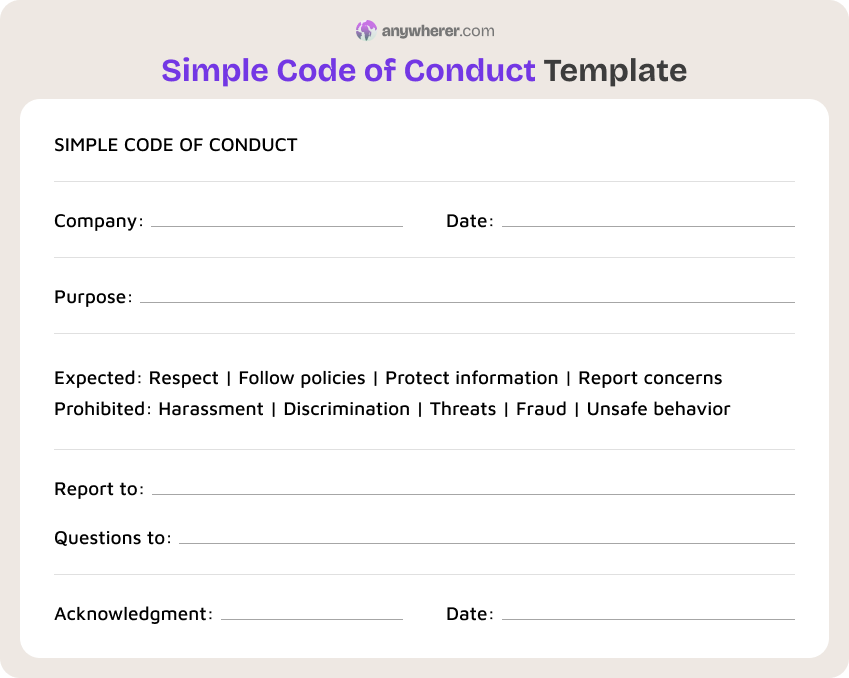
Best for: Small teams that need a short starter before adding legal review and local rules.
Remote / Distributed Team Code of Conduct Template
Purpose: Use this for teams working across locations, time zones, remote tools, and digital channels. It defines behavior when office norms are not visible.
Code of Conduct sections:
- Digital conduct: define respectful behavior in chat, email, video, and shared documents.
- Availability and attendance: connect expectations with the remote work policy template.
- Time-zone respect: cover meeting scheduling, response times, and async handoffs.
- Harassment and exclusion: address online behavior, jokes, screenshots, and private channels.
- Security and confidentiality: cover devices, access, AI tools, and location changes.
- Reporting: give remote employees clear ways to raise concerns safely.
Example of a template (text version):
- Company name: ___________________________ | Team type: Fully remote / Hybrid / Distributed
- What channels does this code cover? Chat / Email / Video calls / Shared files / Events / Customer channels / Other: ___
- What conduct standards apply to remote employees? e.g., respect time zones, communicate professionally, protect confidential information: ___________________________
- What exclusionary or inappropriate online behavior is prohibited? ___________________________
- What security requirements apply? Approved systems only / Device policies / Access controls / Other: ___
- Where should remote employees report concerns? [Channel]: ___________________________
- How will managers respond consistently across different locations and time zones? ___________________________
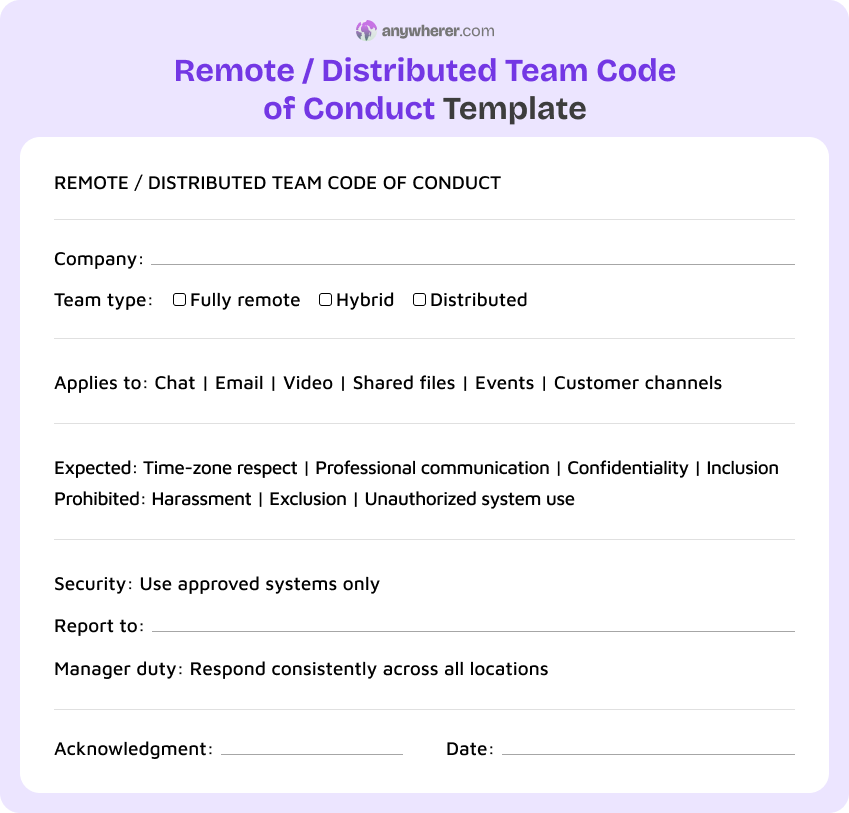
Best for: Remote-first or hybrid teams with employees, contractors, or managers in multiple locations.
Global / Multi-Country Code of Conduct Template
Purpose: Use this for companies with workers in several countries. It sets a baseline for conduct, then allows local addenda where law or culture requires more detail.
Code of Conduct sections:
- Global baseline: define values and conduct standards that apply company-wide.
- Local law: states that local law, contracts, and country addenda may add rights.
- Human rights and labor standards: reference responsible business conduct expectations.
- Anti-harassment and discrimination: define global minimum behavior standards.
- Reporting and non-retaliation: provide local and global channels where appropriate.
- Country acknowledgment: collect signed receipts by location.
Example of a template (text version):
- Company name: ___________________________ | Countries covered: ___________________________
- What baseline conduct standards apply company-wide, regardless of location? ___________________________
- Where does local law, a contract, or a country addendum add stronger employee rights? List countries or note ‘see country addendum’: ___
- What human rights and responsible business conduct commitments does the company make? ___________________________
- What anti-harassment and non-discrimination standards apply globally? ___________________________
- How should employees report concerns? Global channel: ___ | Local channel: ___ | Other legally protected route: ___
- How will the company maintain location-specific reporting instructions for each country? ___________________________
- How will employees in each country acknowledge receipt? Signature / Digital / Local format: ___
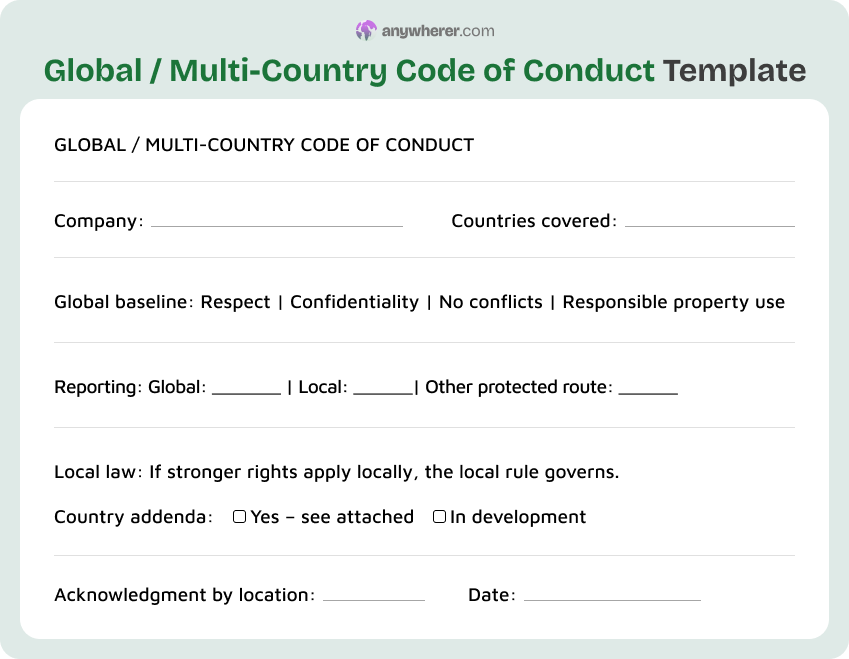
Best for: Companies hiring across multiple countries, states, or employment-law systems.
How to Roll Out and Maintain a Code of Conduct
Start with stakeholder review. HR, legal, operations, and senior leaders should agree on scope, reporting channels, discipline, and acknowledgment before the code is issued.
Leadership should introduce the code, not bury it in a folder. Employees should receive the document, attend a short training or briefing, and sign an acknowledgment. The code usually lives inside the employee handbook or policy library, so an employee handbook template can also include a dedicated code of conduct section.
A staff code of conduct template should match the language employees see in onboarding. A business code of conduct template may need extra clauses for client meetings, vendors, public statements, and sales conduct.
Review the code annually and after new laws, incidents, policy changes, new locations, or major work-model changes. A refresher is useful when employees forget reporting channels or managers apply rules unevenly.
Key Elements Every Code of Conduct Should Include
A code of conduct should be clear enough for employees to use and specific enough for managers to enforce. These elements create the baseline.
- Purpose, scope, and who the code applies to.
- Company values and expected behaviors.
- Anti-harassment, anti-discrimination, and equal-opportunity standards.
- Conflict-of-interest and confidentiality rules.
- Use of company property, IT systems, and AI tools.
- Reporting channels and whistleblower or non-retaliation protection.
- Disciplinary process and possible consequences.
- Acknowledgment page with employee signature.
Common Mistakes in Code of Conduct Documents
Most weak conduct codes are too generic, too broad, or too hard to act on. These mistakes are worth fixing before employees sign.
- Using copied language that employees do not recognize as company-specific.
- Making broad promises that managers cannot enforce consistently.
- Leaving reporting channels vague or hidden.
- Skipping the disciplinary process and forcing managers to improvise.
- Ignoring distributed-team realities such as time zones and country rules.
- Letting the code go stale without annual review or refresher training.
FAQs on Code of Conduct Templates
What should be included in a code of conduct template?
A code of conduct template should include purpose, scope, expected behaviors, anti-harassment rules, equal opportunity standards, conflicts of interest, and confidentiality. It should also cover property and systems use, reporting channels, discipline, acknowledgment, and policy ownership. A template code of conduct should be tailored to the company’s size, locations, and types of workers before publication. A separate code of conduct form template can document acknowledgment.
What is the difference between a code of conduct and a code of ethics?
A code of conduct explains the behavior standards employees are expected to follow at work. A code of ethics is usually broader and describes values, principles, and decision-making standards. Some companies combine both documents, but the conduct section should still be practical enough for HR and managers to apply. Employees should know what behavior is expected and how to report concerns.
Is there a free code of conduct template for small businesses?
Yes, a free code of conduct template can help a small business start quickly. It should still be edited for local law, industry risks, customer contact, and the company’s reporting structure. A code of conduct template free download is useful only if employees know where to report concerns and managers know how to respond. Legal or HR review is recommended before publishing.
How long should a code of conduct be?
A code of conduct should be sufficiently detailed to explain the standards employees apply in real situations. Small companies may use a short code with plain sections. Larger or regulated employers may need more detail on conflicts, confidentiality, gifts, reporting, and investigations. Length matters less than clarity, ownership, and consistent enforcement.
How often should a code of conduct be updated?
A code of conduct should be reviewed at least once a year and after major changes to law, work model, leadership, reporting channels, or business risk. Updates are also needed after incidents that reveal unclear language. Employees should receive the revised code and sign a new acknowledgment when material changes are made. EEOC materials on harassment are a useful reference for reporting and anti-retaliation language.
How do you build a code of conduct for a remote or global team?
Start with one company baseline, then add location-specific rules and reporting channels. Remote teams need standards for chat, email, video, time zones, confidentiality, screenshots, and digital exclusion. Global teams also need local law review, contract alignment, and country addenda. The OECD Guidelines for Multinational Enterprises can help frame responsible business conduct for cross-border employers.

Yaryna is our lead writer with over 8 years of experience in crafting clear, compelling, and insightful content. Specializing in global employment and EOR solutions, she simplifies complex concepts to help businesses expand their remote teams with confidence. With a strong background working alongside diverse product and software teams, Yaryna brings a tech-savvy perspective to her writing, delivering both in-depth analysis and valuable insights.