A recruiting team opens the referral inbox at the end of a tough quarter. Three submissions. Two are for roles already closed. The program exists on paper: eligibility rules, a bonus rate, a mention in the onboarding deck from a year ago, but employees have no reason to use it. They do not know which roles are open. They are unsure how to submit a name. The last person who referred a contact heard nothing back for six weeks. An employee referral program template solves the structural problem, not just the document problem.
Distributed teams face the same gap more acutely. Without a break-room poster or an all-hands moment to relaunch the program, referrals stay dormant. A working program is not one file. It is a coordinated set of assets: a policy, a submission form, recurring emails, a launch announcement, a bonus structure, and visual materials that keep the program in view. These eight templates cover each layer of that stack. They pair with a recruitment process plan template to give HR and talent teams the full documentation set before going live.
What Is an Employee Referral Program?
An employee referral program is a formal channel for employees to recommend candidates for open roles. It pairs a submission process with eligibility rules, a tracking mechanism, and a payout schedule. The employer commits to acknowledging every referral, communicating outcomes to the referrer, and paying the agreed bonus when a referral converts to a hire and meets the conditions stated in the policy.
The mechanics matter as much as the incentive. A program without a clear submission process generates ad-hoc recruiter messages that get lost. One without a tracking system makes it impossible to pay bonuses accurately or measure which referral sources produce quality hires. Eligibility rules prevent compliance issues when candidates are family members or former employees of a hiring manager.
A referral program is a stack of assets working together. The policy sets the rules. The form captures each submission. Emails and announcements keep employees aware between open reqs. The bonus structure makes the payout transparent. Posters and decks keep the program visible without requiring employees to search for it. Each template in this guide addresses one layer of that stack.
Why Companies Need an Employee Referral Program Template
Referral programs consistently cut time-to-hire on hard-to-fill roles. According to LinkedIn Talent Solutions, referred candidates move through hiring pipelines faster than applicants from job boards or career sites. The network match is already pre-qualified because the referring employee has done an informal screening. Recruiters spend less time on outreach and early-stage screening.
Referred hires also stay longer. ERIN Referrals research consistently shows referred employees have higher one-year retention rates than non-referred hires. When an employee vouches for a candidate, that candidate enters with realistic job expectations and an existing social connection to the team. Both factors reduce early turnover.
For distributed teams, referral programs solve a reach problem. A company hiring in new markets cannot rely on the same offline networks as a local employer. Employees with professional contacts in those markets become informal talent scouts. A workforce planning template identifies which markets need headcount; a structured referral program helps fill those roles faster without adding sourcing headcount.
Small businesses and startups benefit because the referral channel costs less per hire than most job board subscriptions or search firm fees. Templates reduce the setup cost. Instead of building a policy, form, email, and poster from scratch, HR adapts these formats to fit the company’s specific bonus structure and eligibility rules.
8 Employee Referral Program Template Examples
The eight templates below cover every document format in a functioning referral program. Use the body-text versions inside an internal wiki, HR portal, or employee handbook. Use the image-ready versions for design layouts, printed materials, or digital signage. Each template includes a purpose, the key sections it covers, and a ready-to-use version with [PLACEHOLDER] fields for company-specific details. HR teams who need an employee referral program template Word file can copy any body-text section directly into a .docx or Google Doc. Every template here is an employee referral program template free to adapt with no licensing requirements.
Standard Employee Referral Program Template
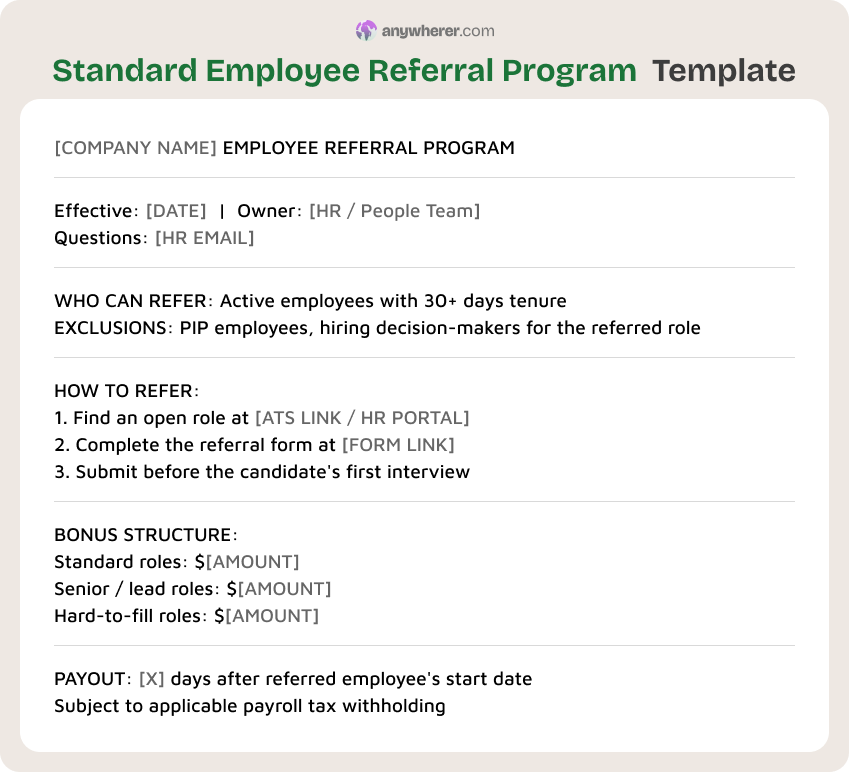
Purpose: The master reference document that defines how the program works. Employees read this once during onboarding or when the program launches to understand who can refer, which roles qualify, how to submit, and what they earn. This is the employee referral program template that everything else connects to.
Template sections:
- Program overview: introduce the program and its purpose.
- Eligibility: define who is eligible to refer and to be referred.
- Open roles: list current roles accepting referrals and where to find the full list.
- Submission process: explain how to submit a referral and the submission deadline.
- Bonus structure: show bonus amounts by role tier.
- Payout timeline: state when bonuses are paid and under what conditions.
- Contact: provide an HR contact for questions.
Example of a template (text version):
[COMPANY NAME] EMPLOYEE REFERRAL PROGRAM
Effective: [DATE] | Policy owner: [HR / People Team] | Questions: [HR EMAIL]
What is this program?
[COMPANY NAME] pays a cash bonus to employees who refer a qualified candidate for an open role. A referral is confirmed when the candidate applies and lists the referring employee, and the recruiting team accepts the submission.
Who can refer?
All active employees who have completed [30 / 60 / 90] days of employment. Employees on a performance improvement plan and employees directly involved in the hiring decision for the referred role are excluded from that specific referral.
Which roles qualify?
All open roles listed in [ATS LINK / HR PORTAL] unless marked ‘no referral bonus.’ Senior and executive roles may carry a separate bonus tier.
How to submit?
Complete the referral form at [FORM LINK]. Include your name and employee ID, the candidate’s full name and contact details, the role you are referring them for, and a brief note on why you recommend them. Submit before the candidate’s first interview or within [X] business days of their application.
Bonus structure:
Standard roles: $[AMOUNT] | Senior / lead roles: $[AMOUNT] | Hard-to-fill roles: $[AMOUNT]. Current rates are published at [HR PORTAL].
When is the bonus paid?
Bonuses are paid [as a lump sum / in two installments] after the referred employee completes [X] days of employment, subject to payroll tax withholding.
Best for: Companies launching or formalizing their first referral program and need a single document employees can return to as the single source of truth.
Employee Referral Program Policy Template
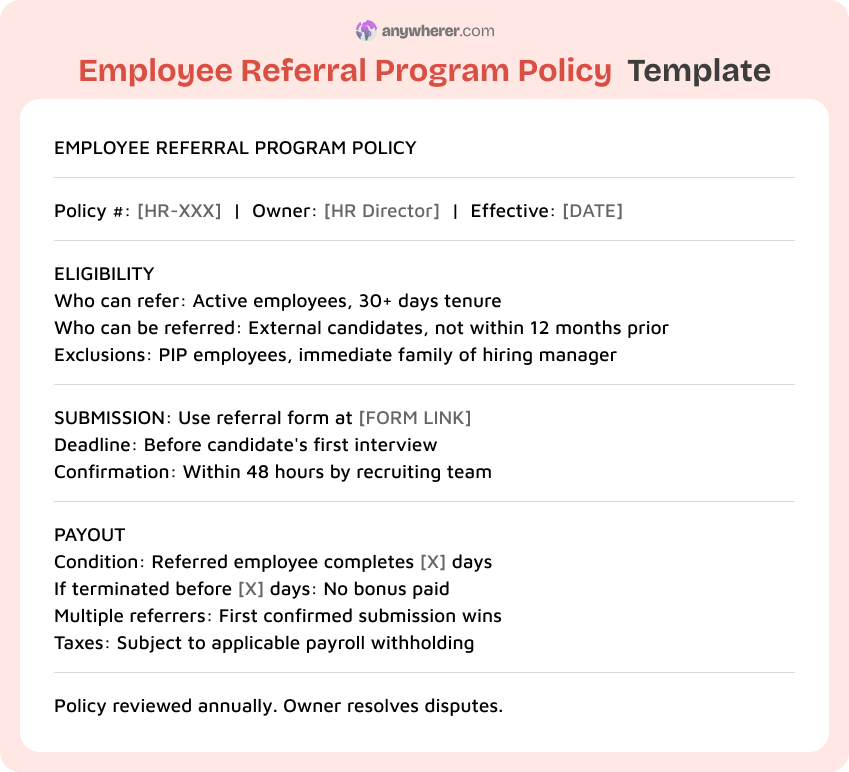
Purpose: A formal HR policy document for the employee handbook or intranet. The employee referral program policy template uses numbered sections, defined terms, and explicit conditions to govern the program in a legally reviewable format. HR teams use it when the program needs to hold up to an audit, employee disputes, or payroll compliance review.
Template sections:
- Purpose and scope: state why the program exists and who it covers.
- Eligibility: define who may refer and who may be referred, including exclusions.
- Submission requirements: specify the required form, deadline, and ATS confirmation step.
- Bonus structure: set amounts by role tier; rates are published in the HR portal.
- Payout conditions: state tenure threshold, clawback provision, and split-referral handling.
- Exclusions: list role types and submission scenarios that do not qualify.
- Administration: name the policy owner and the review cycle.
Example of a template (text version):
EMPLOYEE REFERRAL PROGRAM POLICY
Policy number: [HR-XXX] | Policy owner: [HR Director / VP People] | Effective date: [DATE] | Last reviewed: [DATE] | Applies to: All active [COMPANY NAME] employees in [LOCATION / ALL LOCATIONS]
1. Purpose
This policy governs [COMPANY NAME]’s Employee Referral Program. It defines participation eligibility, the submission and tracking process, and the conditions under which referral bonuses are calculated and paid.
2. Eligibility
Who may refer: Any active employee who has completed [30 / 60 / 90] days of continuous employment and is not on a performance improvement plan, under active disciplinary review, or directly involved in the hiring decision for the role being referred. Who may be referred: External candidates not currently employed by [COMPANY NAME] and not employed by [COMPANY NAME] within the preceding [12 / 24] months. Immediate family members of the hiring manager for the role are excluded.
3. Submission requirements
Employees must submit referrals using the official referral form at [FORM LINK] before the candidate’s first interview or within [X] business days of the candidate applying. Late submissions are not eligible for a bonus. The recruiting team confirms each submission in writing within [48 hours / 5 business days].
4. Bonus structure
Current bonus amounts by role tier are published in [HR PORTAL / ATS LINK]. Amounts are reviewed and updated by [HR / Compensation Team] at the end of each calendar quarter or when role designations change. Bonuses are subject to applicable payroll taxes.
5. Payout conditions
The referral bonus is paid after the referred employee completes [30 / 60 / 90] days of active employment. If the referred employee resigns or is terminated before that date, no bonus is paid. If a bonus has been paid and the referred employee leaves before [X] days, the referring employee may be required to return a prorated portion. If multiple employees submit the same candidate, the first confirmed submission receives the full bonus unless [COMPANY NAME] authorizes a split at its discretion.
6. Exclusions
Referrals for roles designated ‘no referral bonus’ in the HR portal are excluded. Referrals submitted after the candidate’s first interview with [COMPANY NAME] are excluded. Referrals submitted by an employee who is no longer active on the referred employee’s start date are excluded.
7. Administration
[HR Director / VP People] owns and administers this policy. Disputes are resolved by [HR Director / VP People] in consultation with Legal where required. This policy is reviewed annually and updated as needed. Employees are notified of material changes via [company email / intranet / all-hands].
Best for: Companies that need a policy document for their employee handbook, compliance audit, or legal review.
Employee Referral Submission Form Template
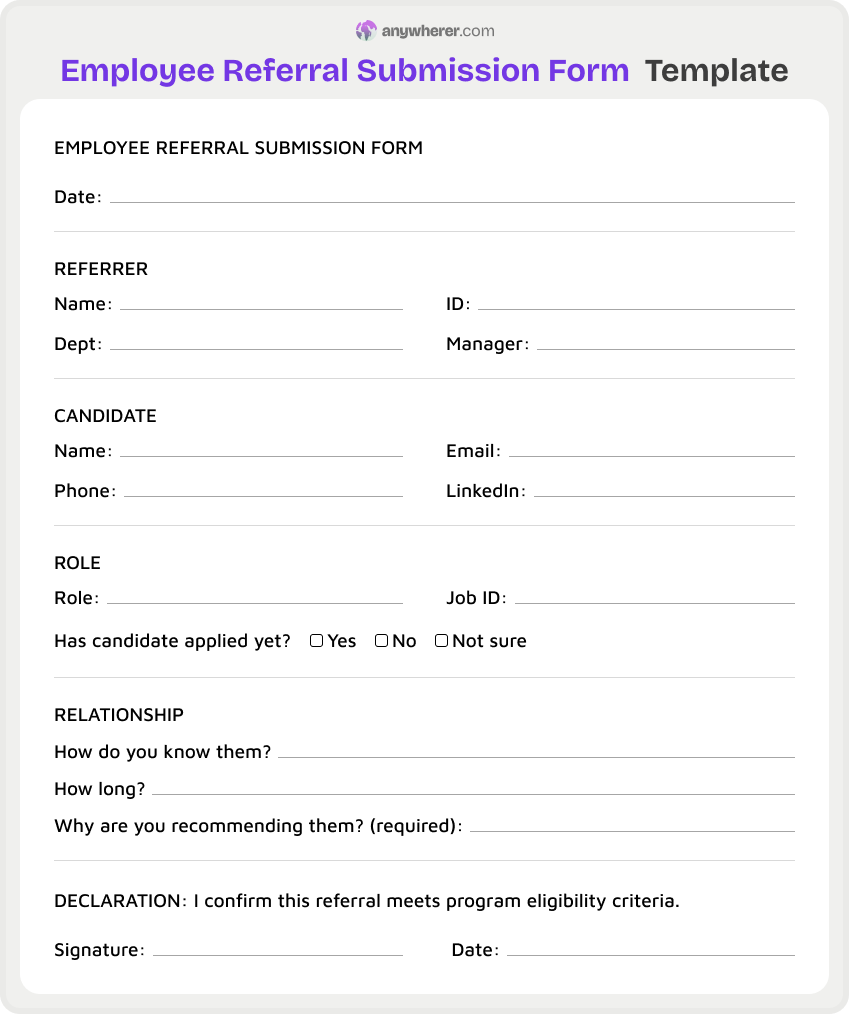
Purpose: The form employees complete to submit a referral. The employee referral program form template captures the information the recruiting team needs to confirm the referral, route the candidate, and track the submission for bonus purposes. It can be built in Google Forms, ATS workflows, or printed for field teams.
Template sections:
- Referrer information: employee name, ID, department, and manager.
- Candidate information: candidate name, email, phone, and optional LinkedIn or portfolio.
- Role details: role title, posting ID or link, and whether the candidate has already applied.
- Relationship: how the employee knows the candidate and for how long.
- Referral rationale: a short explanation of why the employee recommends this person for this role.
- Declaration: confirmation that the referral meets eligibility criteria and no undisclosed conflicts exist.
Example of a template (text version):
EMPLOYEE REFERRAL SUBMISSION FORM
Date submitted: ___________
REFERRER INFORMATION
Employee name: ___________________________ | Employee ID: ___________ | Department: ___________________________ | Manager: ___________________________
CANDIDATE INFORMATION
Candidate full name: ___________________________ | Email: ___________________________ | Phone: ___________________________ | LinkedIn or portfolio (optional): ___________________________
ROLE DETAILS
Role you are referring this candidate for: ___________________________ | Job posting ID or link (if known): ___________________________ | Has this candidate already applied? Yes / No / Not sure
YOUR RELATIONSHIP WITH THE CANDIDATE
How do you know this candidate? Former colleague / Professional contact / Personal contact / Other: ___ | How long have you known them? ___________ | Why do you recommend this person for this role? (2-4 sentences, required): ___________________________________________________________________________
DECLARATION
I confirm this referral meets the eligibility criteria in the Employee Referral Program Policy and that I have no undisclosed conflict of interest.
Employee signature: ___________________________ | Date: ___________
Best for: All program types. Build this as a digital form in the ATS or Google Forms, or as a printable PDF for field and trade teams.
Employee Referral Program Email Template
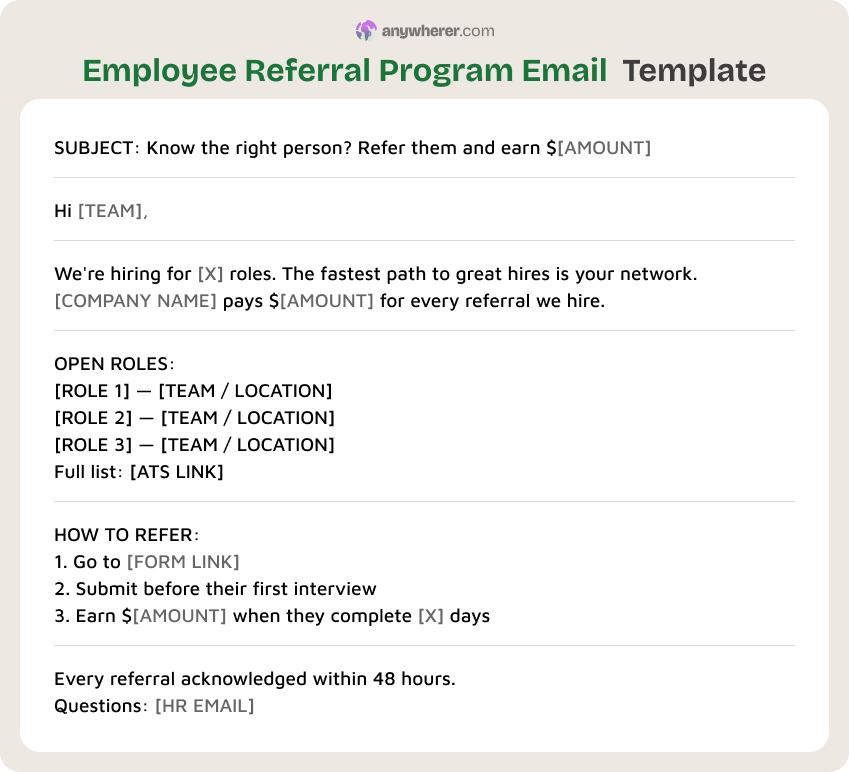
Purpose: A recurring email sent to all employees to keep the program active. The employee referral program email template is the primary ongoing communication asset. Send it at program launch, when new roles open, when the bonus structure changes, and on a regular cadence (monthly or bi-weekly) to prevent referral volume from dropping after the initial launch spike.
Template sections:
- Subject line: a clear, direct line mentioning the bonus and referral.
- Opening paragraph: brief context on why the team is hiring and what’s available now.
- Open roles list: current open roles accepting referrals, with team and location context.
- How to refer: three-step summary of how to submit.
- Bonus reminder: bonus amount and payout timeline.
- Call to action: a single link to the referral form.
Example of a template (text version):
Subject: Know the right person? Refer them and earn $[AMOUNT]
Hi [TEAM / ALL],
We are actively hiring for [X] roles, and we want to make sure you know about it. The fastest way to find the right people is through our own network. [COMPANY NAME]’s Employee Referral Program pays $[AMOUNT] for every qualified referral we hire.
Roles currently accepting referrals:
[ROLE 1] — [TEAM / LOCATION] | [ROLE 2] — [TEAM / LOCATION] | [ROLE 3] — [TEAM / LOCATION] | Full list: [ATS LINK / HR PORTAL]
How to refer:
Step 1: Complete the referral form at [FORM LINK].
Step 2: Submit before your contact’s first interview (or within [X] business days of their application).
Step 3: When they are hired and complete [X] days, your $[AMOUNT] bonus is processed through payroll.
Not sure if someone fits? Submit their name anyway. The recruiting team will review and follow up. Every submission is acknowledged within [48 hours / 5 business days].
Questions? Contact [HR CONTACT] at [EMAIL]. | [COMPANY NAME] People Team
Best for: Monthly or bi-weekly distribution to all employees. Adjust the role list and bonus reminder before each send.
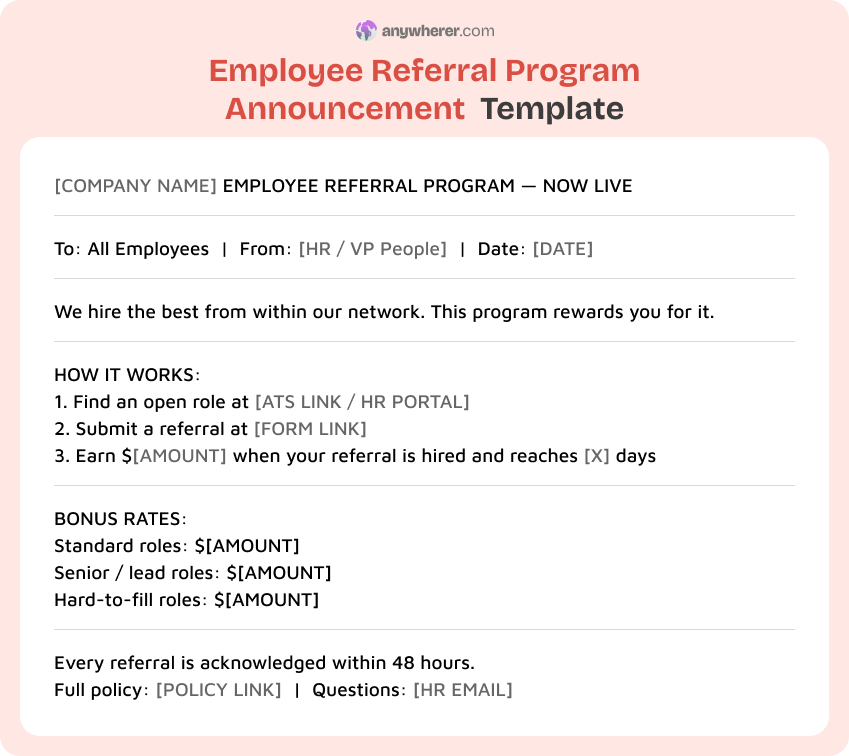
Employee Referral Program Announcement Template
Purpose: A formal program launch message from HR, the CEO, or the VP of People. The employee referral program announcement template (also used as an employee referral program letter template for written internal communications) is longer than the recurring email because it needs to explain the program from scratch to employees who have never seen it. Use it for program launches, relaunch campaigns, and major changes to bonus structure or eligibility.
Template sections:
- Header: To, From, Date, and Re fields for internal distribution.
- Context: explain why the company is launching the program now.
- How it works: a three-step numbered summary of the referral process.
- Bonus details: bonus amounts by role tier and payout date.
- Feedback commitment: acknowledgment commitment (every referral acknowledged within [X] hours).
- Resources: link to the full policy and referral form.
Example of a template (text version):
[COMPANY NAME] — EMPLOYEE REFERRAL PROGRAM ANNOUNCEMENT
To: All [COMPANY NAME] Employees | From: [HR / CEO / VP People] | Date: [DATE] | Re: Employee Referral Program — Now Live
[COMPANY NAME] is launching its Employee Referral Program, effective [DATE]. We hire the best when we hire from within our network. Employees who refer candidates they know and respect tend to recommend people who fit the role and the team. This program formalizes that process and rewards employees who help us grow.
How it works:
1. Browse open roles at [ATS LINK / HR PORTAL]. 2. If you know someone who is a strong fit, complete the referral form at [FORM LINK]. 3. If we hire your referral and they reach [X] days of employment, you receive a $[AMOUNT] bonus through payroll.
Bonus rates:
Standard roles: $[AMOUNT] | Senior / lead roles: $[AMOUNT] | Hard-to-fill roles: $[AMOUNT]. Rates are published in full at [HR PORTAL].
We will acknowledge every referral within [48 hours / 5 business days] and update you on the status every [2 weeks / 30 days] until the role closes or the candidate exits the process. Referrals are kept confidential.
Full program rules are in the Employee Referral Program Policy at [POLICY LINK]. Questions? Contact [HR CONTACT] at [EMAIL].
[SIGNATURE] | [NAME], [TITLE] | [COMPANY NAME]
Best for: Program launches, relaunch campaigns after a dormant period, and all-hands or company-wide announcements.
Employee Referral Bonus Program Template
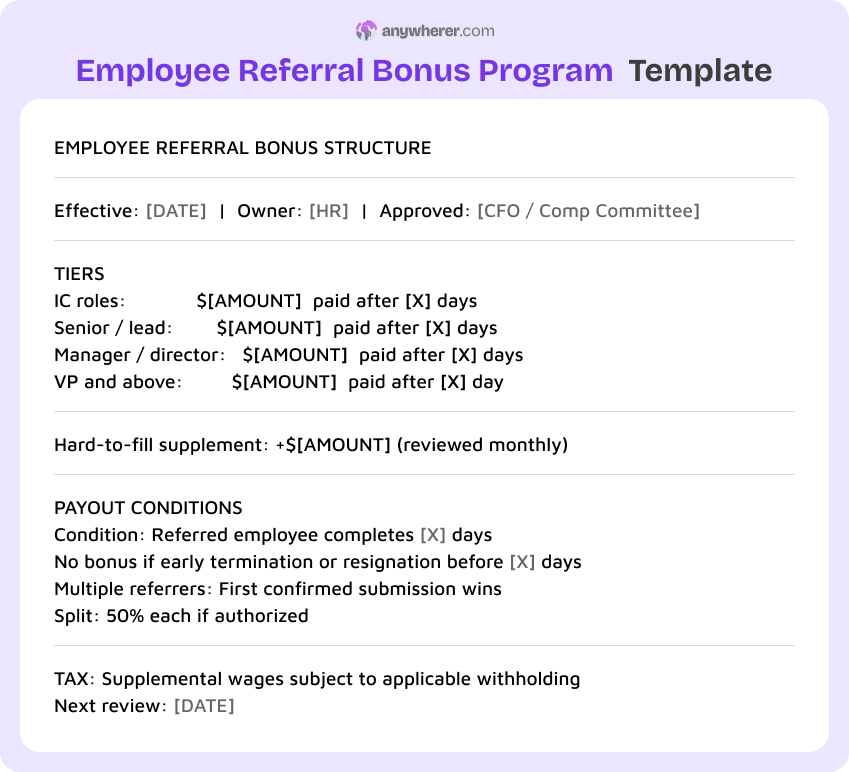
Purpose: A standalone document that defines the complete bonus structure in one place. The employee referral bonus program template is the source of truth for HR, payroll, and finance when calculating, approving, and processing bonus payments. It separates compensation design from policy language and is updated independently when bonus rates change.
Template sections:
- Bonus tiers: bonus amounts by role level (IC, senior, manager, director, executive).
- Hard-to-fill multiplier: additional amount for roles the talent team designates as hard to fill.
- Payout conditions: tenure milestone that triggers payment, clawback provisions, and split-referral handling.
- Payment schedule: how payroll processes installments and the timeline.
- Tax treatment: that bonuses are supplemental wages subject to federal, state, and local withholding.
- Administration: owner name, approval date, and next scheduled review.
Example of a template (text version):
[COMPANY NAME] EMPLOYEE REFERRAL BONUS STRUCTURE
Effective: [DATE] | Owner: [HR Director / VP People] | Approved by: [CFO / Compensation Committee] | Next review: [DATE]
BONUS TIERS
Individual contributor (IC) roles: $[AMOUNT], paid as a lump sum after [X] days. Senior / lead roles: $[AMOUNT], paid as a lump sum after [X] days. Manager / director roles: $[AMOUNT], paid as a lump sum after [X] days. Vice president and above: $[AMOUNT], paid as a lump sum after [X] days.
HARD-TO-FILL SUPPLEMENT
Roles designated hard-to-fill by the Talent Acquisition team receive a supplement of $[AMOUNT] added to the applicable tier bonus. Hard-to-fill designation is reviewed monthly and published in [HR PORTAL].
PAYOUT CONDITIONS
The referred employee must complete [30 / 60 / 90] days of active employment. If the referred employee resigns or is terminated before that date, no bonus is paid. If the bonus has already been paid and the employee leaves before [X] days, a prorated clawback may apply. If multiple employees submit the same candidate, the first confirmed submission wins. Authorized split referrals pay each party [50% / an equal share].
PAYMENT SCHEDULE
Day 1: Referred employee starts. Day [X]: Bonus approved by HR and submitted to payroll. Day [X+7 to X+14]: Bonus appears in the referring employee’s paycheck per the regular payroll cycle.
TAX TREATMENT
Referral bonuses are supplemental wages subject to federal income tax withholding at the supplemental rate, state and local income tax, and FICA contributions. Bonuses appear on the employee’s W-2.
Best for: Finance and payroll teams that need a standalone bonus schedule to process payments without referencing the full policy document.
Employee Referral Program Poster Template
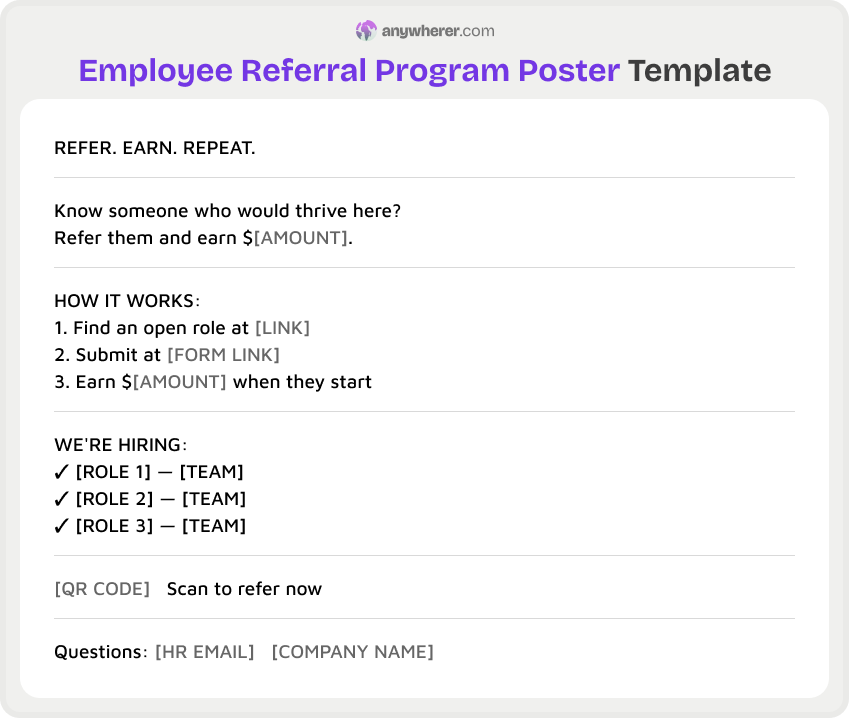
Purpose: A visual asset for breakrooms, digital signage, intranet homepages, Slack channel banners, and onboarding packet inserts. The employee referral program poster template keeps the program visible between email sends without requiring employees to search for information. The image version is the primary deliverable for this template type.
Template sections:
- Headline: a short, direct line stating what employees can earn.
- How it works (3 items): three concise points covering how to find roles, how to refer, and how to earn.
- Current open roles: two or three current roles the company is actively hiring for.
- QR code: a QR code linking directly to the referral form.
- Call to action: a one-line contact or resource for questions.
Example of a template (text version):
REFER. EARN. REPEAT.
Know someone who would thrive here? Refer them and earn $[AMOUNT].
HOW IT WORKS:
1. Find an open role at [LINK] | 2. Submit at [FORM LINK] | 3. Earn $[AMOUNT] when they are hired and reach [X] days
WE’RE HIRING:
[ROLE 1] — [TEAM] | [ROLE 2] — [TEAM] | [ROLE 3] — [TEAM] | Full list: [LINK]
Scan to refer now: [QR CODE]
Questions? Contact [HR EMAIL / NAME]
[COMPANY NAME] | [LOGO PLACEMENT]
Best for: Breakrooms, digital signage, intranet banners, and Slack channel headers. Refresh the open roles list monthly to keep the poster up to date.
Employee Referral Program PowerPoint Template
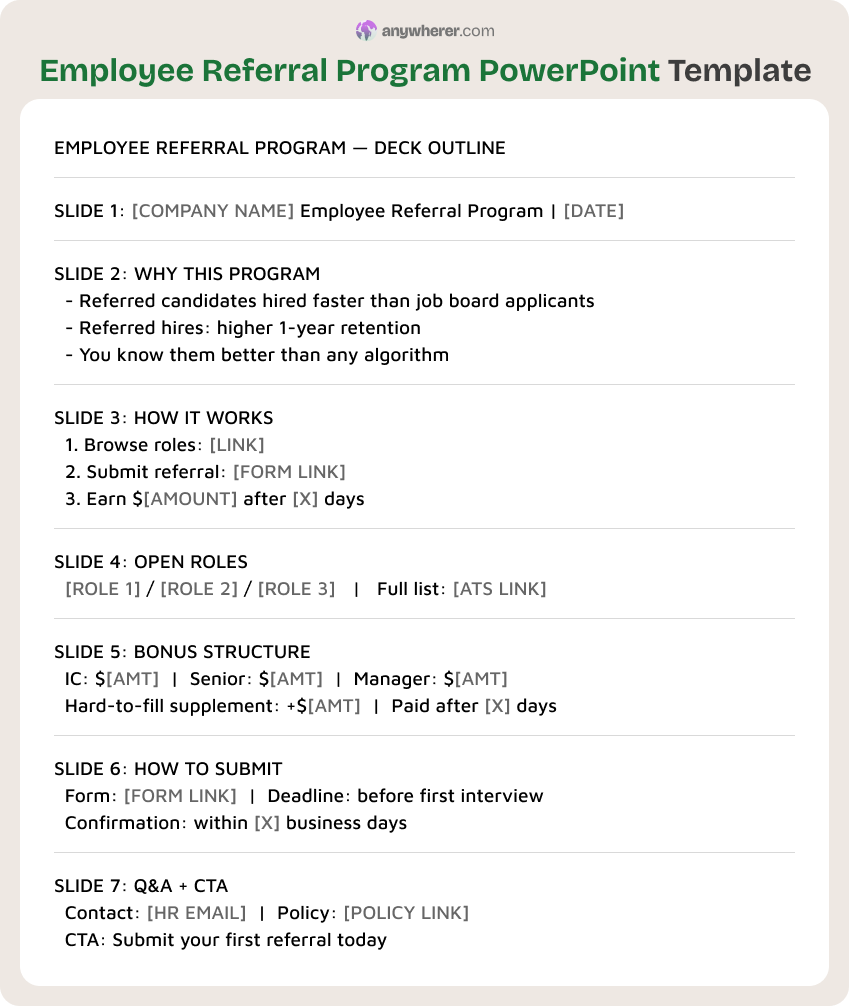
Purpose: A slide deck for team briefings, all-hands presentations, and manager training sessions. The employee referral program template PowerPoint format is the most important asset for a program relaunch because it allows HR to walk through the program live, address questions in real time, and generate referral submissions in the same session. The image version shows the complete slide outline at a glance.
Template sections:
- Slide 1 — Title: program name, presenter, and date.
- Slide 2 — Why this program: why referred hires perform better and stay longer, with one supporting data point.
- Slide 3 — How it works: three-step visual of find, submit, earn.
- Slide 4 — Open roles: current roles with team, location, and applicable bonus.
- Slide 5 — Bonus structure: full bonus table by role tier plus hard-to-fill supplement and payout date.
- Slide 6 — How to submit: form link, submission deadline, and what happens after submission.
- Slide 7 — Q&A and CTA: contact, policy link, and a single direct CTA to submit the first referral.
Example of a template (text version):
EMPLOYEE REFERRAL PROGRAM DECK — SLIDE OUTLINE
SLIDE 1 — TITLE
[COMPANY NAME] Employee Referral Program | Presented by: [HR / People Team] | Date: [DATE]
SLIDE 2 — WHY THIS PROGRAM
Headline: Our best hires come from within our network. Key point 1: Referred candidates move through the hiring process faster than applicants from job boards. Key point 2: Referred hires have higher one-year retention rates. Key point 3: You know these candidates better than any algorithm does.
SLIDE 3 — HOW IT WORKS
Step 1: Browse open roles at [LINK]. Step 2: Submit a referral at [FORM LINK]. Step 3: Your referral is hired and completes [X] days. You earn $[AMOUNT].
SLIDE 4 — OPEN ROLES NOW
[ROLE 1] — [TEAM / LOCATION] — Bonus: $[AMOUNT]. [ROLE 2] — [TEAM / LOCATION] — Bonus: $[AMOUNT]. [ROLE 3] — [TEAM / LOCATION] — Bonus: $[AMOUNT]. Full list: [ATS LINK].
SLIDE 5 — BONUS STRUCTURE
IC roles: $[AMOUNT] | Senior / lead: $[AMOUNT] | Manager / director: $[AMOUNT] | Hard-to-fill roles: +$[SUPPLEMENT] above tier rate. Bonus paid [X] days after start date through payroll. Subject to applicable tax withholding.
SLIDE 6 — HOW TO SUBMIT
Go to [FORM LINK]. Enter your details and the candidate’s details. Select the role. Add a short note on why you recommend them. Submit before the candidate’s first interview. The recruiting team confirms within [X] business days.
SLIDE 7 — QUESTIONS AND NEXT STEPS
Questions: [HR CONTACT] at [EMAIL]. Full policy: [POLICY LINK]. CTA: Submit your first referral today at [FORM LINK].
Best for: Team briefings, manager training, and all-hands relaunch sessions where HR needs a structured walkthrough of the full program.
How to Run a Referral Program End-to-End
A referral program runs on a loop. It starts with the policy and bonus structure, which define the rules and the reward. The launch announcement and deck introduce the program to employees. Recurring emails and posters keep it visible between hiring cycles. The submission form captures each referral and routes it into the ATS or recruiter queue. Tracking closes the loop: HR monitors referral source by stage, measures hire rate and retention, and pays bonuses once payout conditions are met.
The operating system behind that loop is usually the ATS. Most modern applicant tracking systems allow recruiters to tag the referral source at the candidate level and automatically trigger bonus workflows. Teams running a simpler process can use a spreadsheet tied to the submission form. Either way, the referral form is the intake point, and the interview scorecard template handles structured evaluation once the referred candidate reaches the interview stage. Referrals go through the same assessment as any other candidate.
The most important habit is the acknowledgment loop. Every employee who submits a referral should receive a confirmation within 48 hours. Status updates should follow on a regular cadence until the referral is hired, rejected, or the role closes. Employees who hear nothing stop referring. The feedback loop is what separates a program that generates ongoing submissions from one that peaks at launch and goes quiet by week three.
Key Elements Every Employee Referral Program Should Include
A working referral program covers more than a bonus amount. These components give the program the structure it needs to run reliably and withstand compliance scrutiny.
- Clear eligibility rules: who can refer, who can be referred, and what roles qualify.
- A single submission process using a form or ATS integration, not ad-hoc emails.
- A published bonus structure by role tier, reviewed and updated on a defined schedule.
- A communication rhythm: launch announcement, recurring email, and a visual asset that stays in view.
- A tracking and reporting system that connects the referral source to the hire stage and outcome.
- Tax and payroll handling that treats bonuses as supplemental wages.
- An acknowledgment commitment: every referrer hears back within 48 hours.
Common Mistakes in Employee Referral Programs
Most referral programs underperform for the same reasons. Identifying these issues before launch is easier than diagnosing them after submission volume drops.
- Launching with no ongoing communication plan. Referrals dry up after the initial week if there is no recurring email or visual asset to keep the program top of mind.
- A bonus structure that pays only at day 90 or day 180 with no interim acknowledgment. Employees lose confidence in the program before the payout cycle even starts.
- No feedback loop. Referrers who hear nothing after submitting a name stop submitting.
- Eligibility rules that exclude the people most likely to refer. Blocking recruiters, hiring managers, and senior leaders removes the network nodes with the most relevant contacts.
- Treating the program as a static document rather than a recurring campaign.
- Paying bonuses for every hire, regardless of fit, which encourages low-quality submissions that waste recruiters’ time.
FAQs on Employee Referral Program Templates
What should be included in an employee referral program template?
A complete template for employee referral program use includes the policy (eligibility, submission rules, exclusions), a submission form, bonus structure by role tier, a launch announcement or letter, a recurring email, a poster, and a deck for team briefings. Each asset serves a different moment in the program lifecycle. Using the full set ensures employees can find the information they need regardless of how they encounter the program.
How much is a typical employee referral bonus?
Referral bonus amounts vary by role level, industry, and region. SHRM research shows bonuses for individual contributor roles typically range from $1,000 to $2,500. Senior, lead, and manager-level roles often carry bonuses of $3,000 to $5,000 or more. Hard-to-fill technical or specialized roles sometimes exceed $7,500. Companies in high-competition markets or with long time-to-fill averages tend to set higher rates to increase referral volume.
Is there a free employee referral program template?
Yes. A free employee referral program template provides the core structure without customization costs. The templates in this guide are free to use and adapt. The starting point should be reviewed by HR and, where applicable, legal counsel before employees are asked to sign or acknowledge any policy. Pay particular attention to eligibility rules and clawback language, which vary by jurisdiction and employment classification.
How do you announce an employee referral program to employees
Use two assets: a formal announcement letter or email from HR or senior leadership explaining why the program exists, how it works, and what employees can earn; and a deck for a live team briefing or all-hands session where employees can ask questions in real time. Follow the launch with a poster in shared spaces and a recurring email cadence. Companies that announce once and then go quiet see referral submissions drop within two weeks of launch.
How do you track employee referrals?
Most ATS platforms include a referral source field at the candidate level. The submission form feeds that field with the referrer’s name and employee ID, which HR uses to track referral outcomes and process bonus payments. Teams without an ATS can use a shared spreadsheet tied to the Google Form or PDF form. The key metric is referral-to-hire rate by referrer and by role. Jobvite research consistently shows referrals produce the highest hire-to-applicant conversion rate of any source. Tracking that data by referrer helps identify which employees have the most relevant networks for specific role types.
How do you run a referral program in a remote or distributed team?
Remote and distributed teams need the program in digital form from day one. Post the standard template document on the intranet or wiki during onboarding. Send recurring emails on a fixed cadence, monthly at minimum. Use a digital poster in Slack, Teams, or the intranet homepage. Build the submission form as a web form rather than a PDF. Run a virtual all-hands briefing using the deck template when relaunching. The acknowledgment loop matters even more in distributed teams because employees have no hallway or breakroom to hear informal updates on their referral’s status.

Yaryna is our lead writer with over 8 years of experience in crafting clear, compelling, and insightful content. Specializing in global employment and EOR solutions, she simplifies complex concepts to help businesses expand their remote teams with confidence. With a strong background working alongside diverse product and software teams, Yaryna brings a tech-savvy perspective to her writing, delivering both in-depth analysis and valuable insights.