Your VP of Engineering puts in two weeks’ notice on a Tuesday. By Friday, the product roadmap is frozen because no one else has the context, vendor relationships, or sign-off authority she had. Three months later, the external replacement is still onboarding. Two senior devs have already left.
SHRM estimates that replacing a salaried employee costs six to nine months of that person’s salary when you add up recruiting fees, lost output, and ramp-up time. Meanwhile, Gallup’s research shows roughly one in three leaders is actually engaged at work, and DDI’s 2024 Global Leadership Forecast puts the share of organizations that rate their bench strength as strong at under 12%. So the pipeline is thinner than the org chart makes it look.
A succession planning template will not fix that gap overnight. What it does is give you a single document that names the roles at risk, lists who could step in, and tracks what each candidate still needs to learn. Below are seven succession planning template examples you can grab, fill out, and drop into your HR toolkit.
What Is Succession Planning?
Short answer: figuring out who takes over a critical role before the role is empty. That includes leadership seats, sure, but also any job where one person holds client relationships or institutional knowledge that would take months to rebuild.
The mechanics are straightforward. HR and department heads flag the positions that would hurt the most if someone walked out tomorrow, name the internal people who could step up, rate how ready each one is right now, and map out the coaching or stretch assignments required to close the gaps. Companies that review it quarterly instead of once a year get noticeably better results.
Fast-growing teams need it just as badly as Fortune 500 boards. When headcount doubles in twelve months, yesterday’s senior IC becomes tomorrow’s team lead. Without a written plan, that promotion happens reactively, and the new manager ends up running a group of eight with zero preparation.
7 Succession Planning Template Examples
Seven templates, same layout for each: purpose, key sections to fill in, a realistically filled example, a shorter image version for slides, and a note on where it fits. Together, they form a succession planning framework template library you can dip into whenever a role opens up or a reorganization lands. We built these succession planning examples around real-world scenarios.
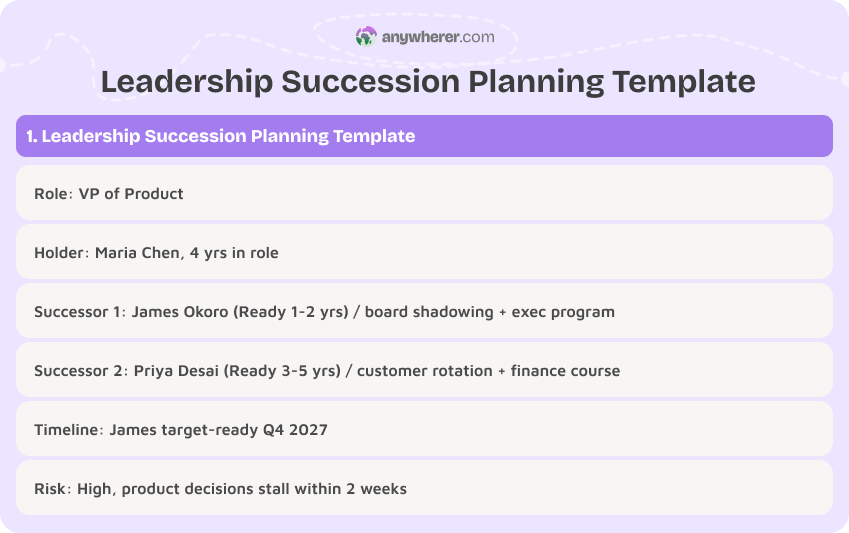
1. Leadership Succession Planning Template
Purpose: The classic executive pipeline document. Use this leadership succession planning template when the board wants to see names, readiness scores, and development actions for every director-level seat and above.
Template structure:
- Role and reporting line (e.g., VP of Product, reports to CEO)
- Who holds the role now, and how long they have been in it
- Up to 3 potential successors, ranked by readiness
- Readiness bucket: Ready Now, 1-2 Years, or 3-5 Years
- Development actions: courses, mentorship pairings, committee work, or acting-role rotations
- Target date for the successor to be fully prepared
- Risk rating: what stalls if this seat sits empty for 60+ days
Example (filled version):
| Role | VP of Product |
| Current Holder | Maria Chen (4 years in role) |
| Successor 1 | James Okoro, Sr. Director of Product |
| Readiness | Ready in 1-2 Years |
| Development Actions | Shadow CEO in board meetings Q2-Q3; lead cross-functional launch of Platform v3; complete executive leadership program at Wharton |
| Successor 2 | Priya Desai, Director of Product Ops |
| Readiness | Ready in 3-5 Years |
| Development Actions | Rotate into a customer-facing role for 6 months; pair with the CFO on P&L ownership; enroll in a strategic finance course |
| Timeline | James target-ready by Q4 2027 |
| Risk Level | High. Product decisions stall within 2 weeks without this role filled. |
Best for: Mid-size to enterprise orgs building an executive succession planning template for board decks and annual talent reviews.
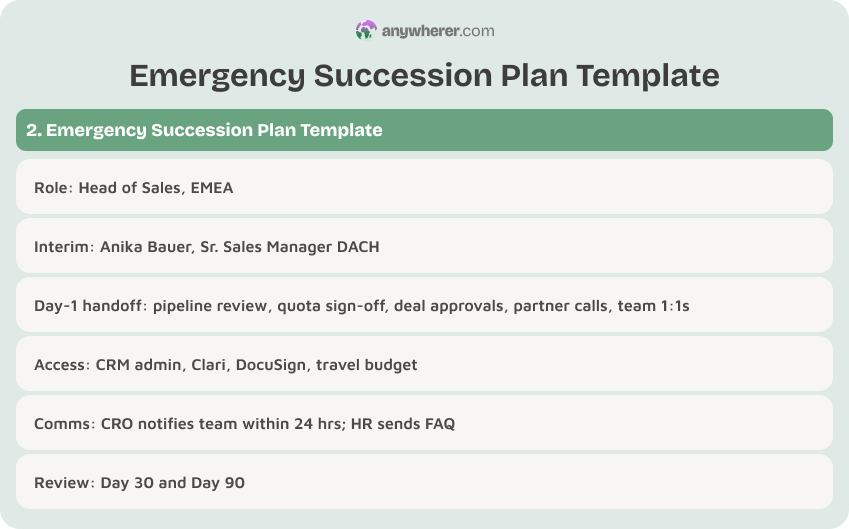
2. Emergency Succession Plan Template
Purpose: Not about grooming anyone long-term. This is the break-glass document: who takes over on day one, where the passwords live, and who has signing authority. Covers the first 30 to 90 days after an unplanned exit.
Template structure:
- Critical role: title and department
- Interim successor who steps in immediately, even if the assignment is temporary
- Top 5 responsibilities that cannot wait a single week
- Access list: systems, accounts, and signing authority that the interim person needs on day one
- Communication plan: who hears the news first and in what order
- Review date: when leadership reassesses the interim setup (usually day 30 and day 90)
Example (filled version):
| Critical Role | Head of Sales, EMEA |
| Interim Successor | Anika Bauer, Sr. Sales Manager DACH |
| Top 5 Responsibilities | 1) Weekly pipeline review with CRO 2) Q3 quota sign-off 3) Enterprise deal approvals above 250K 4) Monthly partner check-in with Salesforce AE 5) Team 1:1s for 9 direct reports |
| Access Needed | CRM admin, Clari forecasting dashboard, DocuSign signing authority, EMEA travel budget approval |
| Communication Plan | CRO notifies EMEA team within 24 hrs; HR sends FAQ doc; Anika meets each direct report by the end of week 1 |
| Review Date | Day 30 and Day 90 |
Best for: Any organization that needs a break-glass plan. Pair this with the leadership template for a full picture. A solid example of succession planning that prioritizes speed over long-term development.
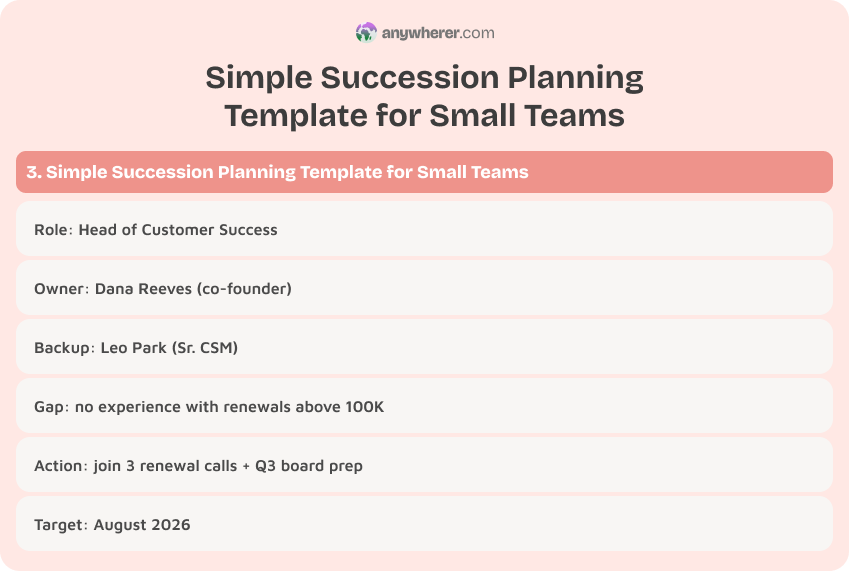
3. Simple Succession Planning Template for Small Teams
Purpose: One page, zero jargon. The founder or a single manager holds most of the know-how, and a single page listing a backup and one action item is better than nothing. This small business succession planning template keeps the overhead near zero.
Template structure:
- Job title
- Who does this today
- The backup person who could take over with the least amount of ramp-up
- The biggest knowledge gap the backup still has
- One concrete action to close that gap
- Date by which the backup should be ready
Example (filled version):
| Role | Head of Customer Success |
| Current Owner | Dana Reeves, co-founder |
| Backup | Leo Park, Senior CSM |
| Biggest Gap | Leo has never handled contract renewals above 100K or spoken directly with the board about churn numbers |
| Action | Dana includes Leo in the next 3 renewal calls and invites him to the Q3 board prep session |
| Target Date | August 2026 |
Best for: Startups, family businesses, and lean teams that need a free succession planning template without the overhead of a full HR process.
4. 9-Box Succession Planning Matrix Template
Purpose: Plots every person on a 3×3 grid: performance on one axis (low / moderate / high), potential on the other. The top-right cell holds your succession bench. This HR succession planning template works best when you already run performance reviews and want a visual shortcut to spot future leaders.
Template structure:
- Employee name and current title
- Performance rating from the latest review cycle (Low, Moderate, High)
- Potential rating based on manager input and growth signals (Low, Moderate, High)
- Which of the 9 cells does the person fall into
- Recommended next step: promote, develop, coach, reassign, or manage out
- The specific role this person could grow into
Example (filled version):
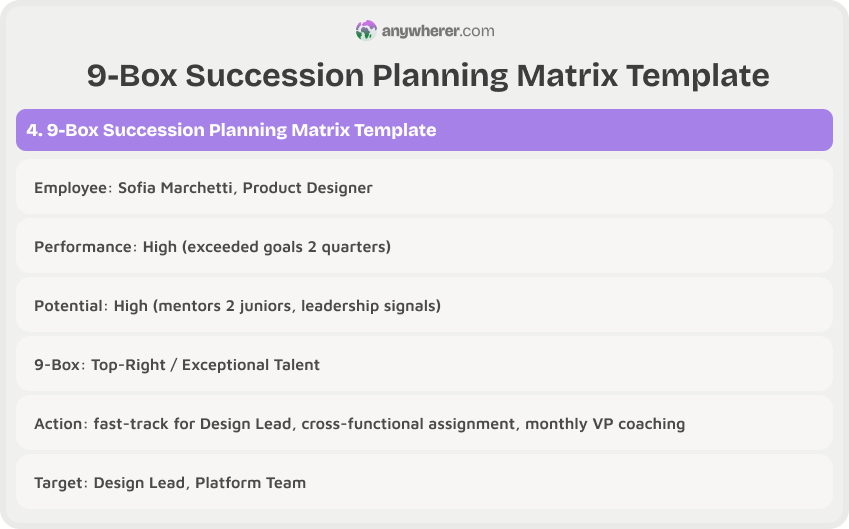
| Employee | Sofia Marchetti, Product Designer |
| Performance | High (exceeded goals 2 consecutive quarters) |
| Potential | High (strong leadership signals, mentors 2 junior designers) |
| 9-Box Cell | Top-Right: Exceptional Talent |
| Recommended Action | Fast-track for Design Lead; assign to cross-functional initiative; pair with VP Design for monthly coaching |
| Target Role | Design Lead, Platform Team |
Best for: Companies with 100+ employees that already do calibration sessions. A strong succession planning template for managers who want data-backed talent decisions.
5. Role-Based Succession Planning Template
Purpose: Zeroes in on a single critical position and stacks every qualified internal candidate against it. The question is: “If this chair is empty tomorrow, who are the three best options?” A solid business succession planning template when role continuity matters more than individual career pathing.
Template structure:
- Target role: title, department, level
- Criticality score (High / Medium / Low) with a one-line justification
- Up to 3 candidates: name, current role, years of experience
- Readiness: Ready Now / 1-2 Years / 3+ Years
- What each candidate brings to the target role
- What each candidate is missing
- Actions and timeline to close the gap for each person
Example (filled version):
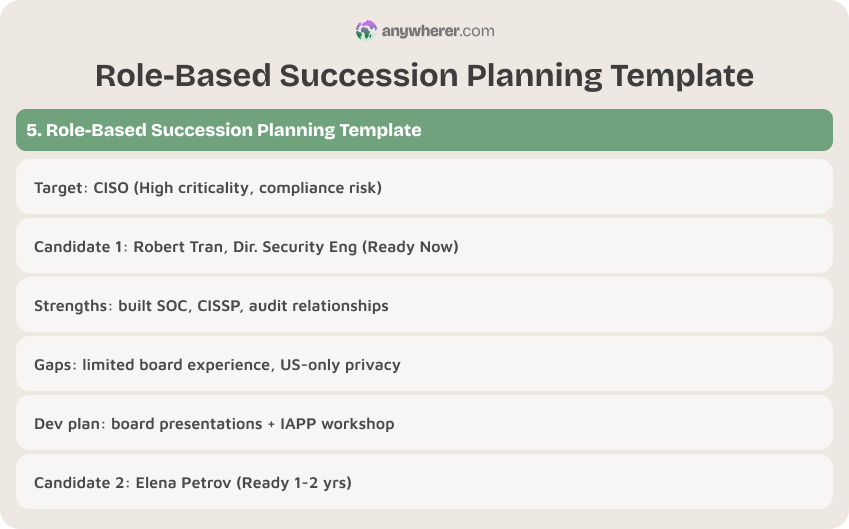
| Target Role | Chief Information Security Officer (CISO) |
| Criticality | High. Regulatory audits require a named CISO; a vacancy triggers compliance risk. |
| Candidate 1 | Robert Tran, Director of Security Engineering, 8 yrs exp |
| Readiness | Ready Now |
| Strengths | Built the current SOC from scratch; holds CISSP; direct relationship with external auditors |
| Gaps | Limited board-facing experience; needs exposure to data privacy regulations outside the US |
| Development Plan | Present at next 2 board risk-committee meetings; attend IAPP privacy law workshop by Q2 2027 |
| Candidate 2 | Elena Petrov, Sr. Manager of IT Compliance, 6 yrs exp |
| Readiness | Ready in 1-2 Years |
Best for: Regulated industries, companies preparing for audits, and any org that tracks succession by position rather than by person. Works well as an employee succession planning template for compliance-heavy environments.
6. Skills-Based Succession Planning Template
Purpose: Ignores job titles and looks at raw capabilities. List the skills the target role demands, then score every candidate against them on a 1-to-5 scale. This is a career succession planning template for teams that promote based on what people can do.
Template structure:
- Target role and 5-8 required competencies
- Proficiency scale from 1 (Beginner) to 5 (Expert)
- Candidate name and current position
- Numeric score per competency
- Overall readiness score: simple average or weighted
- The 1-2 skills with the widest gap
- One action per gap: training, stretch project, or mentorship
Example (filled version):
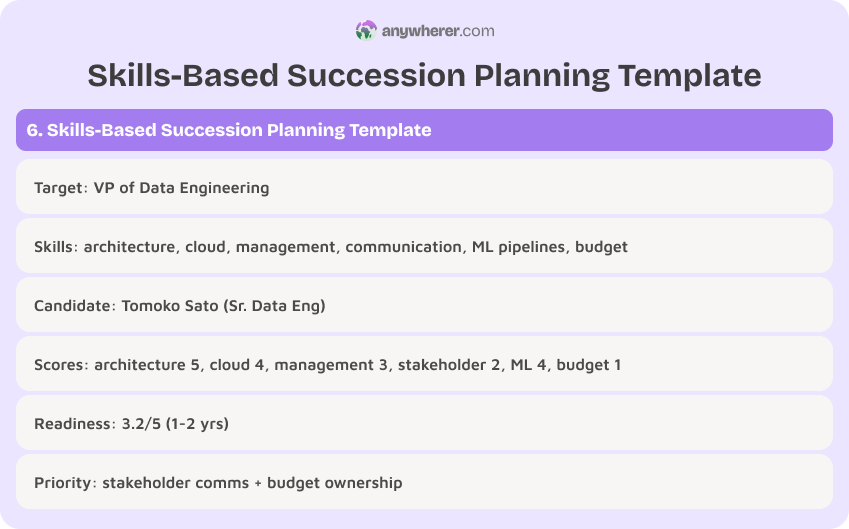
| Target Role | VP of Data Engineering |
| Required Skills | 1) Data architecture 2) Cloud platforms (AWS/GCP) 3) Team management 4) Stakeholder communication 5) ML pipeline design 6) Budget ownership |
| Candidate | Tomoko Sato, Sr. Data Engineer |
| Scores | Architecture: 5 / Cloud: 4 / Management: 3 / Stakeholder: 2 / ML Pipelines: 4 / Budget: 1 |
| Overall | 3.2 out of 5 (Ready in 1-2 Years) |
| Dev Priority | Stakeholder communication and budget ownership |
| Action | Present quarterly data-platform updates to the exec team; co-own the 2027 infrastructure budget with the current VP |
Best for: Engineering orgs, companies shifting to skills-based hiring, and teams that want a succession planning sample grounded in measurable competencies rather than gut feeling.
7. Remote Team Succession Planning Template
Purpose: Your successor might be 8,000 miles away. Standard templates assume the same office; this one bakes in time zones, local labor law, and async leadership skills. A practical template for succession planning in distributed companies.
Template structure:
- Role and location of the current holder
- Candidate names, locations, and time-zone overlap with the role’s stakeholders
- Readiness: Ready Now / 1-2 Years / 3+ Years
- Remote-specific gaps: weak stakeholder ties, time-zone conflicts, missing async leadership experience
- Development actions: virtual shadowing, on-site visits, async project ownership
- Legal flags: local notice periods, non-compete clauses, work-authorization issues
Example (filled version):
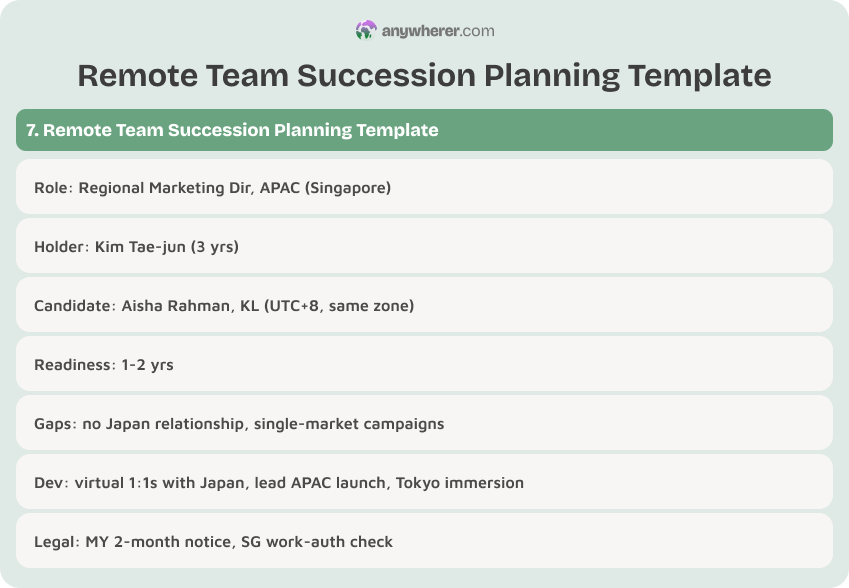
| Role | Regional Marketing Director, APAC (based in Singapore) |
| Current Holder | Kim Tae-jun, Singapore, 3 yrs in role |
| Candidate 1 | Aisha Rahman, Kuala Lumpur (UTC+8, same zone as Singapore) |
| Readiness | Ready in 1-2 Years |
| Remote Gaps | No relationship with the Japan sales team; has not led a campaign across more than 2 markets |
| Development Actions | Monthly virtual 1:1 with Japan country manager; lead APAC-wide product launch in Q1 2027; fly to Tokyo office for a 1-week immersion |
| Legal Note | Malaysia requires a 2-month notice period; verify Singapore work authorization if relocation is needed |
Best for: Distributed companies with offices or contractors in multiple countries. Pair this with your examples of workforce planning to build a complete talent strategy.
Key Elements Every Succession Plan Should Include
Whichever of the examples of succession planning templates above you use, five things have to be in the finished version. Skip one and the plan sits in a Drive folder gathering dust.
- Role criticality. Not every seat needs a succession plan. Zone in on the ones where a 60-day vacancy would visibly damage revenue, compliance, or product delivery.
- Successor readiness levels. Three buckets: Ready Now, Ready in 1-2 Years, Ready in 3-5 Years. Anything finer and people argue categories instead of doing the development work.
- Development plans. Each name needs a specific action and a deadline. “Co-lead the Q3 product launch with the current VP by September” is the plan.
- Timeline. Lock in a date for each successor to be fully ready. No date, no urgency, no movement.
- Risk rating. Spell out what breaks if this role stays empty for 30, 60, or 90 days. That is the line that gets executive attention during budget talks.
Common Mistakes in Succession Planning
Even a polished succession planning template free of formatting problems falls apart if the logic is wrong. Five issues come up over and over:
- Only covering the C-suite. The IT director who runs every integration, or the lone payroll specialist in a 200-person shop, can be just as painful to lose as a VP. Cast a wider net.
- Naming successors with no development plan. Typing someone’s name in a cell is a wish list, not a succession plan. Attach at least one real action to every name. Look at any proven template for employee development plan for ideas on structuring that work.
- Stale data. People get promoted, quit, or change their goals. Update the sheet once a year and a half the names will be wrong by summer.
- Total secrecy. If a potential successor has no idea they are being considered, they cannot prepare. Worse, they leave for a company that is more upfront about growth.
- Skipping global roles. A head of engineering in Berlin and one in Austin have different notice periods, labor laws, and stakeholder networks. One-size plans miss all of that.
Putting Your Succession Plan to Work
Choosing the best succession planning template for HR or Ops is the quick part. Actually filling it out, sitting down every quarter to review it, and acting on the gaps it reveals? That is where most companies stall. Start small: pick the two or three roles that would sting the most if they opened up next Monday, fill in a template for each, and book a 30-minute review for next quarter.
Succession planning plugs into your performance reviews, your hiring roadmap, and the broader workforce design. A succession planning template for managers works best when it is part of a talent system rather than a standalone file buried in a shared drive.
FAQs on Succession Planning Templates
How do you create a succession planning template for a small business?
One page per role. Write down the position, who owns it now, one or two backups, the single biggest knowledge gap each backup has, and one action to close it. A small business succession planning template needs names, dates, and someone who keeps the sheet current.
How often should a succession plan be updated?
Quarterly works for most companies. Annual reviews are too slow; people move roles, leave, or change goals mid-year. If a big reorg lands between cycles, run an off-schedule review immediately.
How does a 9-box succession planning matrix work?
Put performance on one axis (low, moderate, high) and potential on the other. Each person lands in one of nine cells. Top-right means strong on both counts and first in line. Bottom-left may need a performance improvement plan. The cells in between tell you where targeted coaching can move someone closer to being ready.
What is an emergency succession planning template?
A short, tactical document that answers: if this person vanishes tomorrow, who takes over, and what access do they need by the end of the day? It lists interim leads, system credentials, the five tasks that cannot wait, and a comms plan. The template succession planning teams build for emergencies is leaner and faster than a long-term plan.
Who should be included in a succession planning process?
HR runs the calendar and owns the framework. Department heads pick critical roles and grade candidates. Senior leadership sponsors the effort and clears roadblocks. At a startup, the founder may wear all three hats, which is fine as long as somebody keeps the document alive.
How do you identify potential successors within a team?
Start with hard data: who consistently hits or beats targets? Then look at softer signals: volunteering for stretch work, mentoring peers, bouncing back from setbacks. Get input from the direct manager and at least one skip-level. A succession planning example built on one data point almost always picks the wrong person.
What are common mistakes in succession planning?
Only planning for the C-suite, listing names with zero development actions behind them, reviewing the plan once a year and forgetting it, hiding the plan from the people named in it, and ignoring time zones or labor-law differences for global teams.

Yaryna is our lead writer with over 8 years of experience in crafting clear, compelling, and insightful content. Specializing in global employment and EOR solutions, she simplifies complex concepts to help businesses expand their remote teams with confidence. With a strong background working alongside diverse product and software teams, Yaryna brings a tech-savvy perspective to her writing, delivering both in-depth analysis and valuable insights.