Introduction: Team Meeting Agenda Template Basics
Team meetings are supposed to make work easier: clearer priorities, faster decisions, fewer surprises. In real life, meetings often drift into long updates, side conversations, and “we will follow up later” notes that nobody ever reads.
A good agenda is the simplest fix. It turns a meeting into a short, focused work session where people know why they are there, what is being decided, and what “done” looks like by the end. It also protects deep work time because the agenda forces trade-offs: you either time-box the discussion or you cut topics that do not belong.
Below are 15 ready-to-use meeting agenda template examples you can copy, paste, and customize. Each agenda template for a meeting includes:
- Purpose (when to use it)
- Sections (the essential building blocks)
- Agenda examples
- Customization ideas (how to adapt it to your team)
You will see different styles: a simple meeting agenda template for quick alignment, a project meeting agenda template for delivery, a management meeting agenda template for leaders, a formal meeting agenda template for executive accountability, and more. If you also run regular 1:1s, pair these group formats with a dedicated 1:1 meeting template, so individual check-ins stay as structured as your team meetings.
15 Team Meeting Agenda Template Samples
Weekly Team Meeting Agenda Template
Purpose
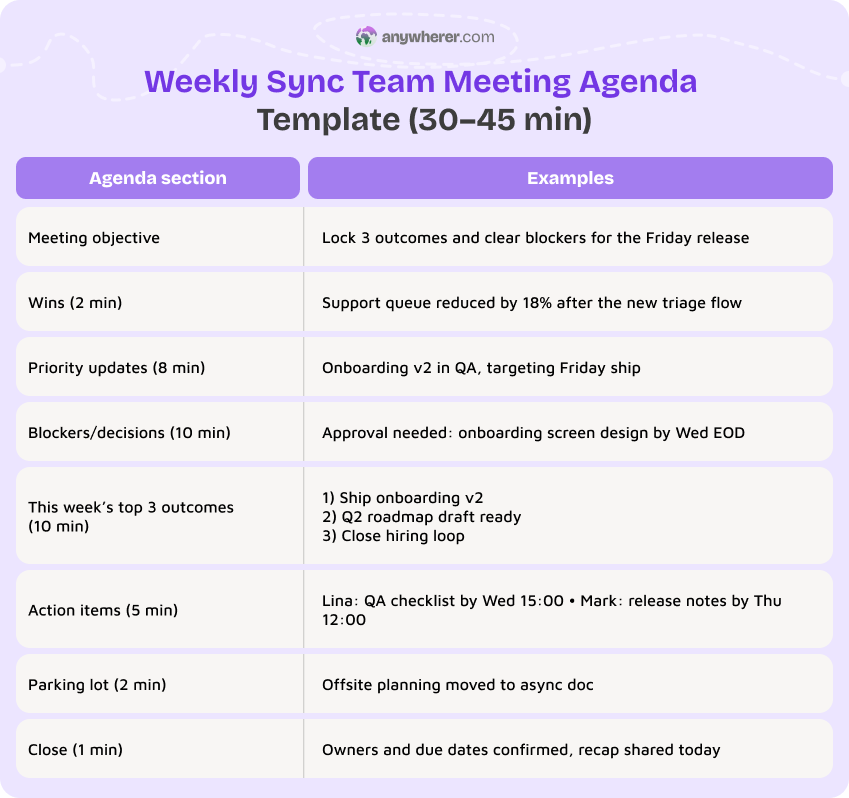
Use this weekly meeting agenda template to keep execution clean: confirm priorities, surface blockers, and leave with clear owners. It also works well as a staff meeting agenda template for a department that needs a steady rhythm.
Sections
- Objective: what must be achieved by the end
- Wins: quick momentum builder (2 to 3 minutes)
- Priority updates: updates that affect others (not every detail)
- Blockers and decisions: what is stuck, what choice is needed
- This week’s top 3 outcomes: outcomes, not a long task list
- Meeting agenda template with action items: owner, deadline, definition of done
- Parking lot: topics that should move to async or a separate meeting
Agenda example
- Objective: “Agree on top 3 outcomes and unblock release work.”
- Wins: “Support backlog down 18% after new triage routine.”
- Priority update: “Onboarding v2 is in QA, launch window still Friday.”
- Blocker: “Need design approval for onboarding screen by Wednesday.”
- Top outcomes: “Ship onboarding v2, finalize Q2 roadmap draft, close hiring loop.”
- Action item: “Lina drafts QA checklist by Wed 3 pm; Mark confirms release notes by Thu 12 pm.”
Customization ideas
- Add “Customer signal of the week” for product teams (one insight, one implication)
- Add “Safety and quality check” for ops teams (incidents, near misses, lessons)
- If updates keep eating time, make updates async and keep the live meeting for decisions only, which often becomes the best meeting agenda template move you can make without changing the calendar
Project Update Meeting Agenda Template
Purpose
This project meeting agenda template is for stakeholder alignment: progress, risks, dependencies, and decisions without endless presentations. Use it when multiple teams or functions need the same picture.
Sections
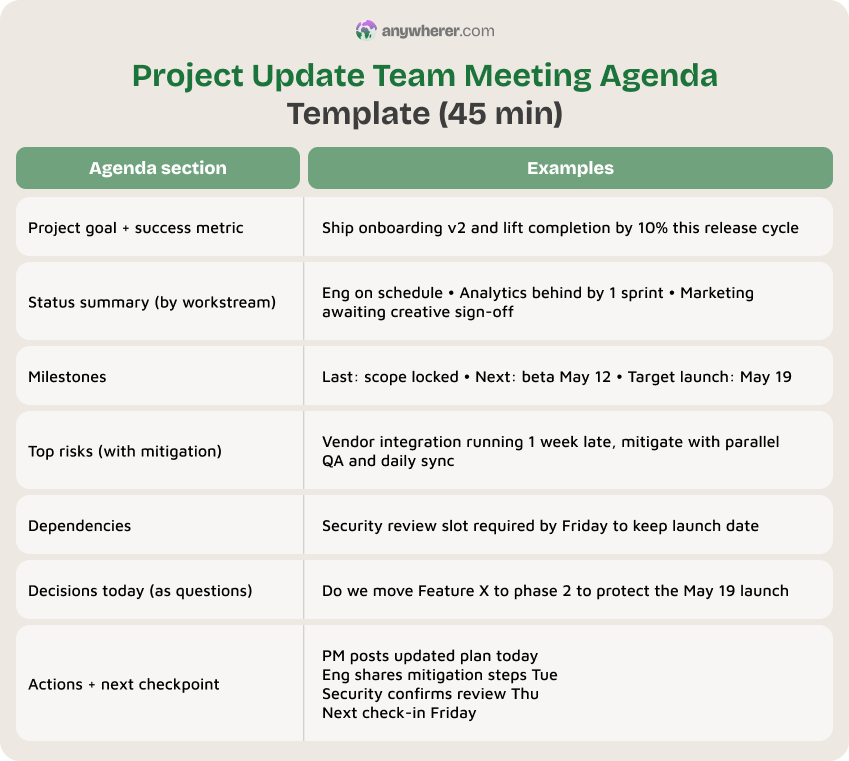
- Project goal and success metric
- Status summary by workstream (short, time-boxed)
- Milestones: last achieved and next due
- Risks and issues: top 3 plus mitigation
- Dependencies: what you need from other teams
- Decisions today: written as questions
- Actions: owners, deadlines, next checkpoint
Agenda example
- Goal: “Launch onboarding v2 with plus 10% completion rate.”
- Status: “Engineering on track, analytics delayed, marketing assets in review.”
- Milestone: “Beta May 12; launch May 19.”
- Risk: “Vendor integration lead time slipped by one week.”
- Dependency: “Need security review slot by Friday.”
- Decision: “Move Feature X to phase 2, yes or no?”
- Action: “PM updates timeline today; Eng lead posts mitigation plan by Tue; Security confirms review window by Thu.”
Customization ideas
- Add a short “Change log” section if scope changes frequently
- Add compliance checkpoints for regulated industries
- If your projects are large, add a 3-line executive summary at the top so the meeting starts with clarity
Team Check In Meeting Agenda Template
Purpose
A simple meeting agenda template for fast alignment and team pulse, especially when schedules are packed or the team is new.
Sections
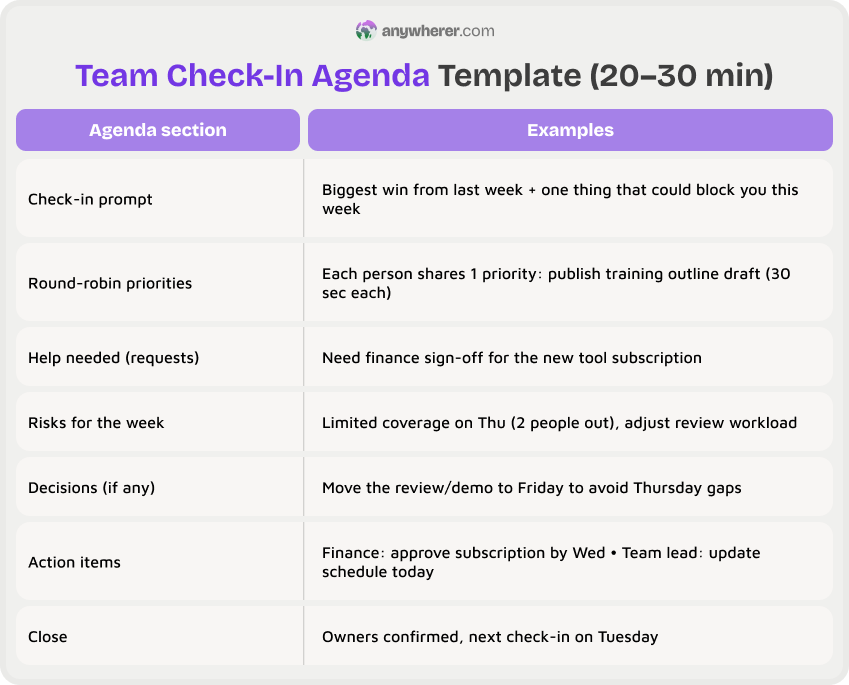
- Check in prompt (one question)
- One priority per person
- Help needed (requests, not updates)
- Risks for the week
- Close: confirm next steps
Agenda example
- Prompt: “One win last week and one challenge this week.”
- Priority: “Finalize training outline.”
- Help needed: “Need finance approval for tool purchase.”
- Risk: “Two people out Thursday, adjust review schedule.”
- Close: “Owners confirmed; next check in Tuesday.”
Customization ideas
- Add a quick mood score (1 to 5) if team health matters
- In remote teams, have people write their updates in the shared doc before the call
- Use this as your default agenda for meeting template when the week is chaotic and you need a light structure that still produces clarity
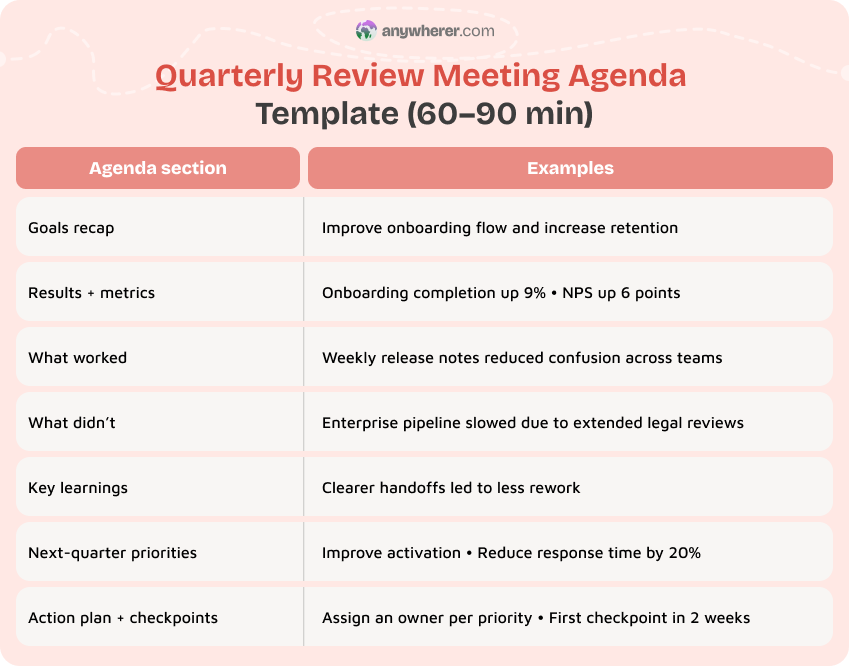
Quarterly Team Review Meeting Agenda Template
Purpose
A planning meeting agenda template to review outcomes and reset priorities for the next quarter. Use it to reduce “busy work” and increase focused bets.
Sections
- Goals recap: what we aimed for
- Results and metrics: what moved, what did not
- What worked: repeatable wins with evidence
- What did not: gaps with examples
- Key learnings: 3 to 5 insights
- Next quarter priorities: focus list
- Action plan: owners and checkpoints
Agenda example
- Metrics: “Onboarding completion up 9%, NPS up 6.”
- Worked: “Weekly release notes reduced cross-team confusion.”
- Did not: “Enterprise pipeline slipped due to long legal cycle.”
- Learning: “Shorter handoffs reduced rework.”
- Priorities: “Improve activation, cut response time by 20%.”
Customization ideas
- Add “Customer stories” for customer-facing teams
- Add “Process improvements” if delivery is the bottleneck
- Keep the structure consistent each quarter so it becomes a standard meeting agenda template that everyone recognizes
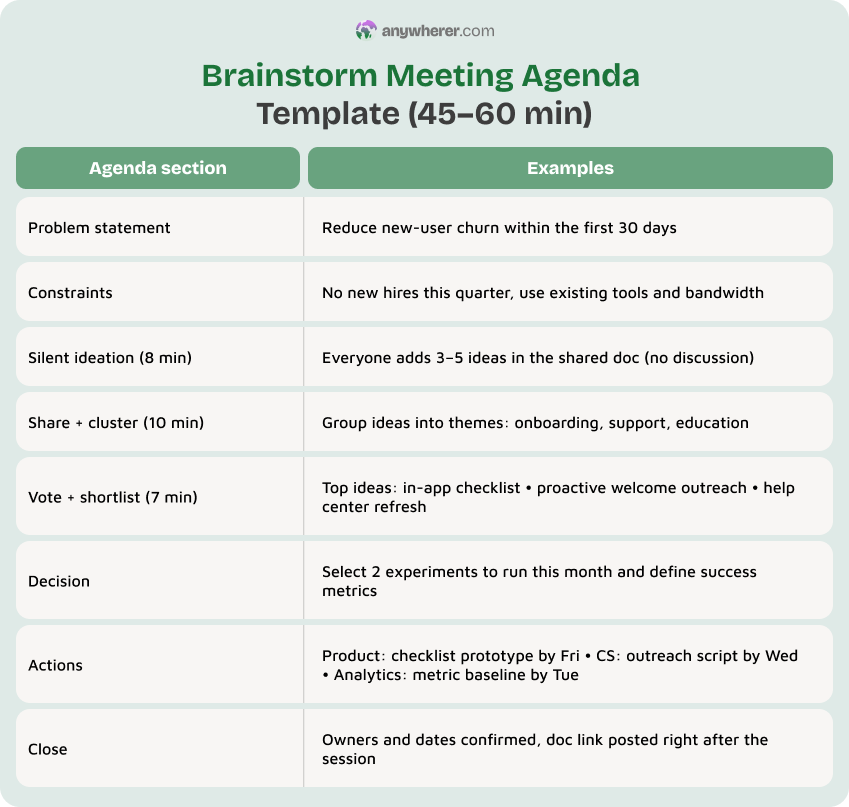
Brainstorming Session Agenda Template
Purpose
An agenda meeting template for generating ideas and leaving with a shortlist, plus owners. Use it when the team needs solutions, not just conversation.
Sections
- Problem statement (one clear question)
- Constraints (budget, timeline, rules)
- Silent ideation (5 to 10 minutes)
- Share and cluster (group similar ideas)
- Vote and shortlist (pick top 3)
- Next steps (experiments, owners, dates)
Agenda example
- Question: “How do we reduce churn in the first 30 days?”
- Constraints: “No new hires this quarter.”
- Shortlist: “In app checklist, welcome calls for high value users, FAQ refresh.”
- Action: “Product prototypes checklist by Fri; CS drafts call script by Wed.”
Customization ideas
- Add a short pre-read if the topic needs context
- Assign a timekeeper and a note taker so the session stays energetic and usable
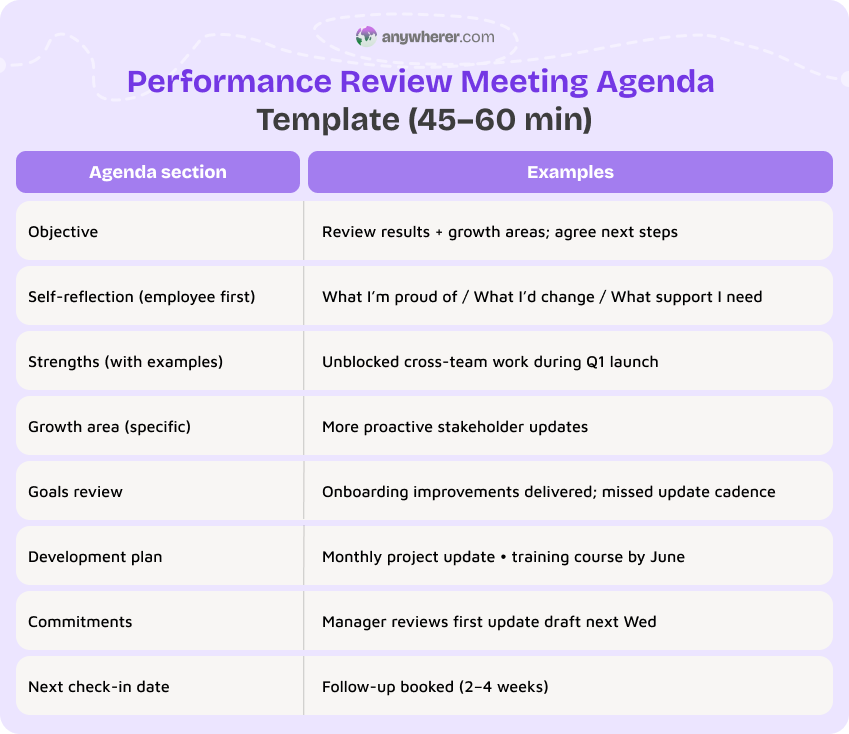
Performance Review Meeting Agenda Template
Purpose
A structured review that pairs well with an ongoing one-on-one meeting agenda template cadence. Use it to keep feedback fair, specific, and actionable.
Sections
- Objective: What this review should accomplish
- Self-reflection (employee first)
- Manager feedback (with examples)
- Goals review (results vs expectations)
- Development plan (skills, projects, coaching)
- Commitments (owners, dates)
- Next check in date
Agenda example
- Strength: “Unblocked cross-team work during Q1 launch.”
- Growth: “More proactive stakeholder updates.”
- Goal review: “Owned onboarding improvements; missed internal update cadence.”
- Plan: “Monthly project update; training course by June.”
- Commitment: “Manager reviews first update draft by next Wednesday.”
Customization ideas
- Add “support needed from manager” so the plan is shared responsibility
- Add “career direction” for retention and motivation
- If your org uses rating scales, keep the rating separate from the discussion so it does not dominate the conversation
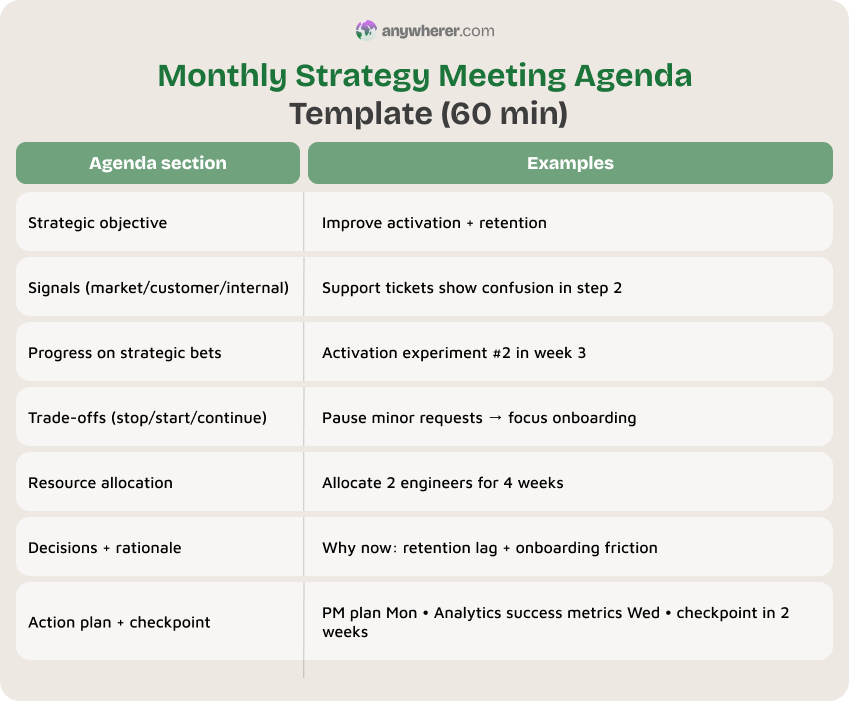
Monthly Strategy Meeting Agenda Template
Purpose
A planning meeting agenda template for strategic alignment, trade-offs, and resourcing. Use it when weekly meetings cover execution, and you still need a space for bigger decisions.
Sections
- Strategic objective
- Signals: customer, market, internal insights
- Progress on strategic bets
- Trade-offs: stop, start, continue
- Resource allocation
- Decisions and rationale (written)
- Action plan plus checkpoint
Agenda example
- Objective: “Increase user engagement and retention.”
- Signal: “Customers request faster onboarding; support tickets show confusion in step 2.”
- Trade off: “Pause minor feature requests, focus onboarding.”
- Decision: “Allocate 2 engineers to activation work for 4 weeks.”
- Action: “PM drafts plan by Monday; analytics defines success metrics by Wednesday.”
Customization ideas
- Put decisions first if meetings drift into endless discussion
- Add a short “assumptions” section so disagreements become visible early
- Keep a running decision log so this becomes your best meeting agenda template for direction setting
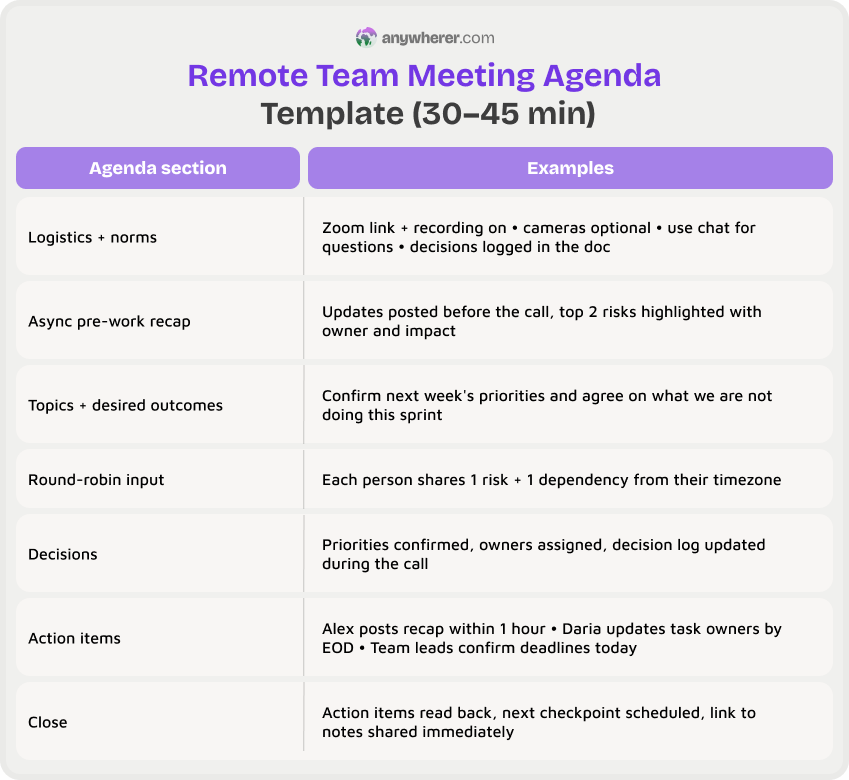
Remote Team Meeting Agenda Template
Purpose
A remote-friendly agenda for meeting template to reduce confusion and increase participation across time zones.
Sections
- Logistics and norms (link, recording, chat rules)
- Async pre-work recap
- Discussion topics with desired outcomes
- Round robin input (every voice)
- Decisions and action items
- Recap the owner and the deadline
Agenda example
- Norms: “Use hand raise; decisions written in the doc.”
- Pre work: “Read sprint brief (10 minutes) and comment on risks.”
- Outcome: “Decide sprint scope today.”
- Action item: “Nina posts recap within 2 hours; Pavel updates Jira owners by the end of the day.”
Customization ideas
- Rotate times for timezone fairness
- Use the same shared doc for agenda, notes, and action items so nothing gets lost
- Add “quiet participation” options (chat input, written comments) for teams that do not like speaking up live
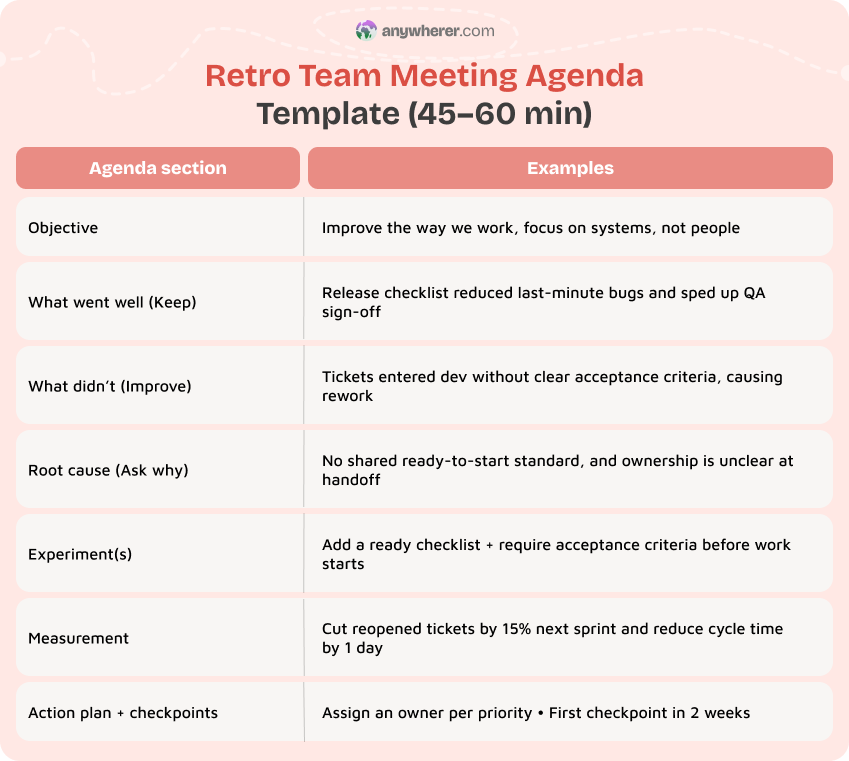
Team Retrospective Meeting Agenda Template
Purpose
A retrospective agenda to improve how you work after a sprint, launch, or project. This is not a blame session; it is a learning session.
Sections
- Objective: improve process, not blame
- What went well
- What did not
- Root causes (ask why)
- Experiments (pick 1 to 3)
- Owners and measurement
Agenda example
- Went well: “Daily triage cut response time.”
- Did not: “Design to dev handoff unclear; rework increased.”
- Root cause: “No shared definition of ready.”
- Experiment: “Definition of ready checklist used before development starts.”
- Measure: “Reduce rework tickets by 20% next sprint.”
Customization ideas
- Add a “team health” prompt if morale is uneven
- Add “customer impact” if you are customer-facing
- Keep experiments small and measurable, nothing changes
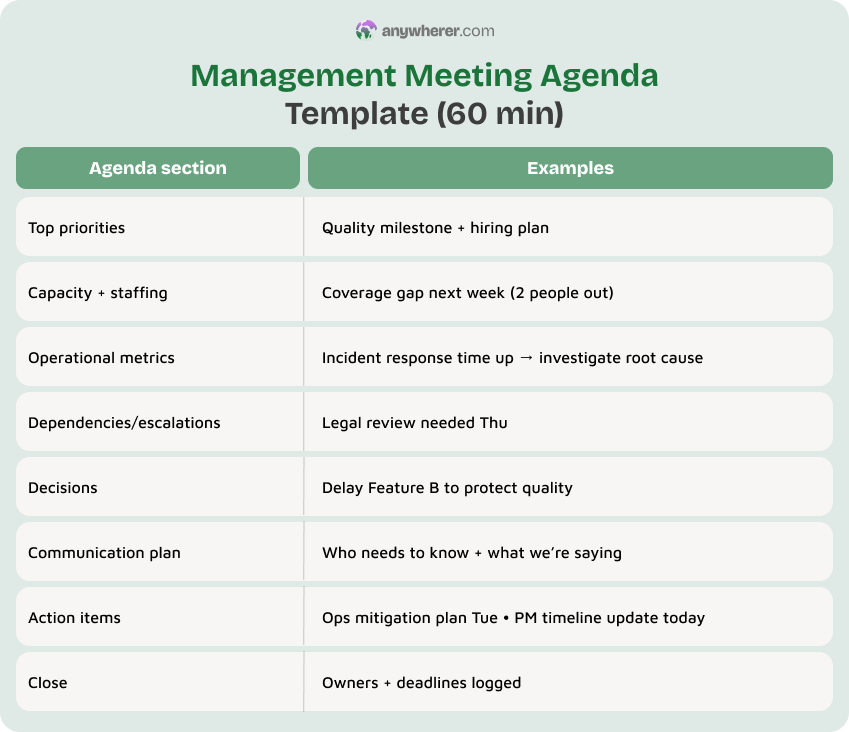
Management Meeting Agenda Template
Purpose
A management meeting agenda template for leaders coordinating staffing, risks, metrics, and cross-team decisions. Use it to avoid “leadership as status reporting”.
Sections
- Top priorities (leadership focus list)
- Capacity and staffing (hiring, workload, coverage)
- Operational metrics (KPIs, quality, SLAs)
- Cross-team dependencies (escalations)
- Decisions (budget, scope, priorities)
- Communication plan (who needs to hear what)
- Actions (owners, deadlines)
Agenda example
- Capacity: “Two people out next week, adjust release plan.”
- Metric: “Incident response time up; investigate root cause.”
- Dependency: “Legal review needed by Thursday.”
- Decision: “Delay Feature B to protect quality milestone.”
- Action: “Ops drafts mitigation plan by Tuesday; PM posts updated timeline today.”
Customization ideas
- Add a short risk register review so leaders discuss the real threats
- Add policy updates if you operate in regulated environments
- Keep a consistent structure so this becomes a repeatable agenda meeting template for leadership
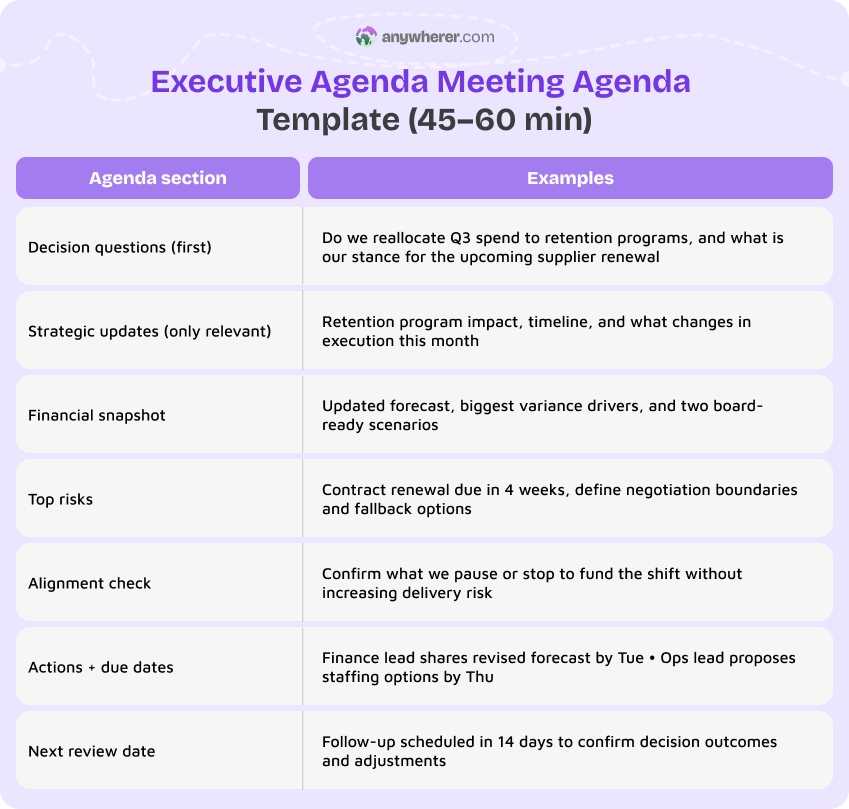
Executive Meeting Agenda Template
Purpose
An executive meeting agenda template for high-impact decisions and accountability. This is also a strong formal meeting agenda template when decisions must be documented.
Sections
- Decision list first (written as questions)
- Strategic updates (only what affects decisions)
- Financial snapshot (forecast, risks, key numbers)
- Top risks (business, legal, reputational)
- Alignment check (what stays in scope)
- Actions (owners, deadlines, next review date)
Agenda example
- Decision: “Approve Q3 budget shift toward retention initiatives?”
- Finance: “Two scenario forecasts needed for board update.”
- Risk: “Vendor renewal in 30 days; define negotiation stance.”
- Alignment: “Confirm what we stop this quarter to fund the shift.”
- Action: “CFO drafts forecast by Monday; COO proposes staffing changes by Wednesday.”
Customization ideas
- Send the agenda in advance, so people can prepare, as recommended in Master the Team Meeting
- Put “decision owner” next to every decision question
- Keep deep dives out of the executive meeting unless a decision requires it today
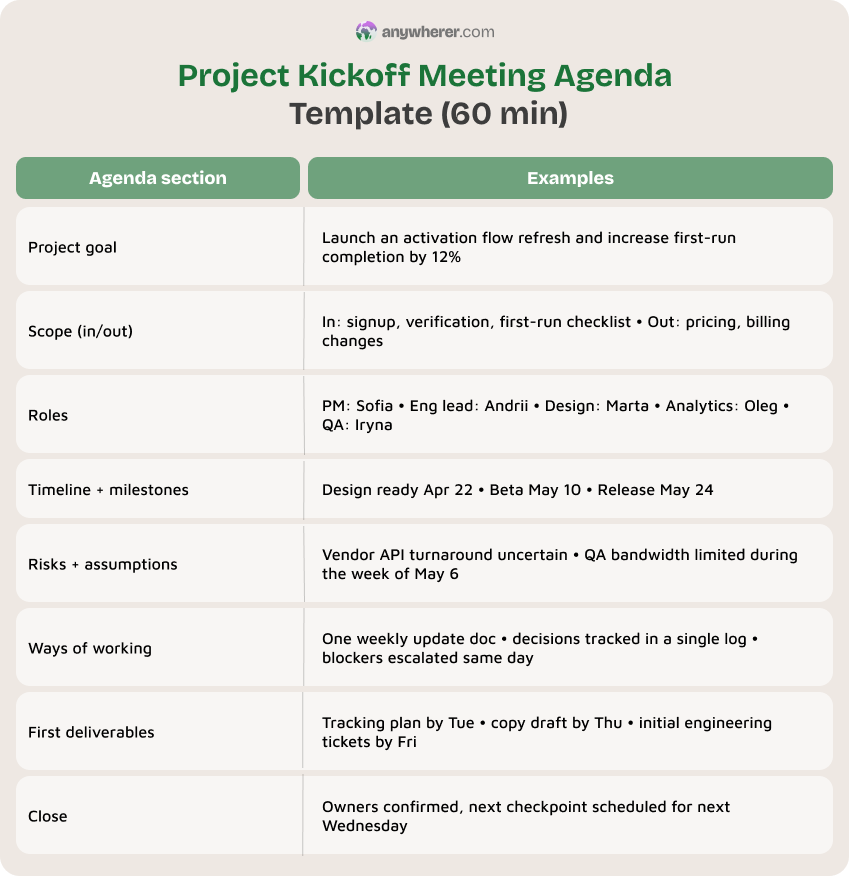
Project Kickoff Meeting Agenda Template
Purpose
A project kickoff meeting agenda template to align on goals, scope, roles, timeline, and working norms before execution starts.
Sections
- Introductions and roles
- Project overview (why it matters now)
- Scope in and scope out
- Timeline and milestones
- Risks and assumptions
- Ways of working (cadence, tools, escalation)
- Next steps (first deliverables)
Agenda example
- Scope in: “New onboarding flow.”
- Scope out: “Pricing changes.”
- Milestones: “Prototype Apr 18; beta May 12; launch May 19.”
- Risks: “Vendor lead time; limited QA bandwidth.”
- Ways of working: “Weekly update doc; decisions logged in one place.”
- Next steps: “Owners assigned for analytics, copy, engineering; first drafts due next Friday.”
Customization ideas
- Add a stakeholder map if many teams are involved
- Add RACI if ownership is unclear
- Create a single source of truth doc and link it in every update
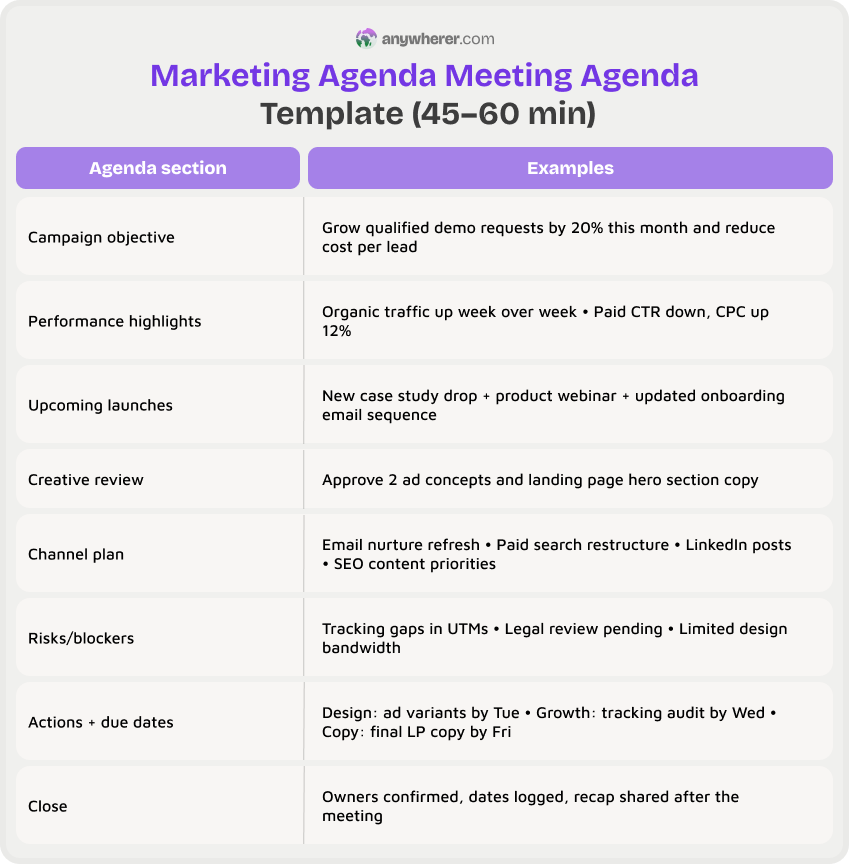
Marketing Meeting Agenda Template
Purpose
A marketing meeting agenda template for aligning campaigns, creative, channels, and performance.
Sections
- Campaign objective (what success means)
- Performance highlights (last period)
- Upcoming launches (timelines, dependencies)
- Creative review (approvals, feedback rules)
- Channel plan (email, paid, social, SEO priorities)
- Risks and blockers (tracking, budget, approvals)
- Actions (owners, due dates)
Agenda example
- Objective: “Increase demo sign-ups by 15% in April.”
- Performance: “Webinar conversion up; paid search CPC rising.”
- Creative: “Approve landing page headline and CTA.”
- Channel plan: “Email nurture refresh; paid search tests; LinkedIn thought leadership post.”
- Action: “Design assets Tuesday; Growth tracking QA Wednesday; Copy final draft by Monday.”
Customization ideas
- Add a brand compliance checkpoint if approvals are strict
- Add “experiment backlog” so you do not only discuss current work
- If you have multiple markets, add a 5-minute “regional risks” section
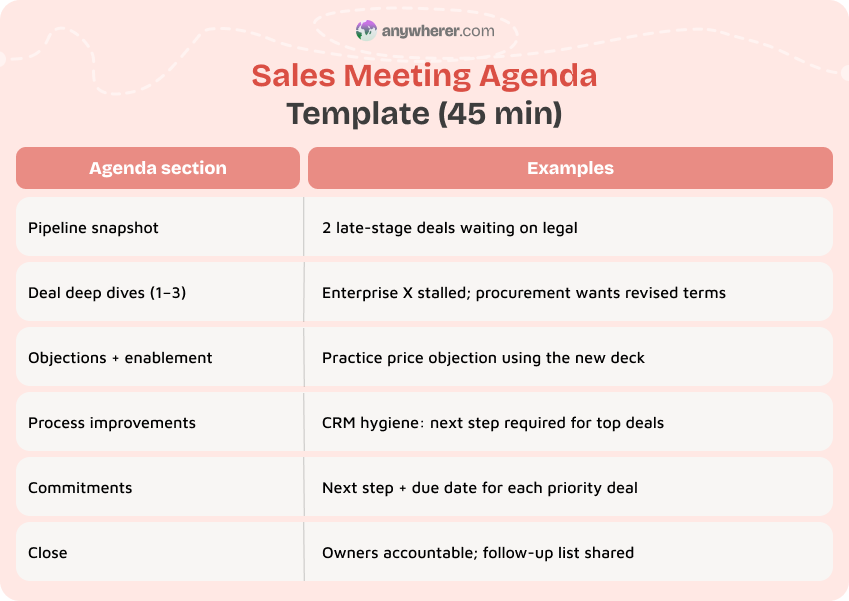
Sales Meeting Agenda Template
Purpose
A sales meeting agenda template for pipeline review, deal support, and weekly execution.
Sections
- Targets and forecast
- Pipeline snapshot (key deals by stage)
- Deal deep dives (1 to 3 deals)
- Objections and enablement
- Process improvements (handoffs, CRM hygiene)
- Commitments (next step per deal)
Agenda example
- Forecast: “On track for 92% of target.”
- Pipeline: “Two late-stage deals waiting on legal.”
- Deep dive: “Enterprise X stalled; procurement wants revised terms.”
- Enablement: “Practice price objection using new deck.”
- Commitments: “Next step and due date for each priority deal.”
Customization ideas
- Add a short call review segment for training (one clip, one lesson)
- Add win-loss notes to improve messaging
- If time is tight, push pipeline updates to async and focus live time on deal strategy
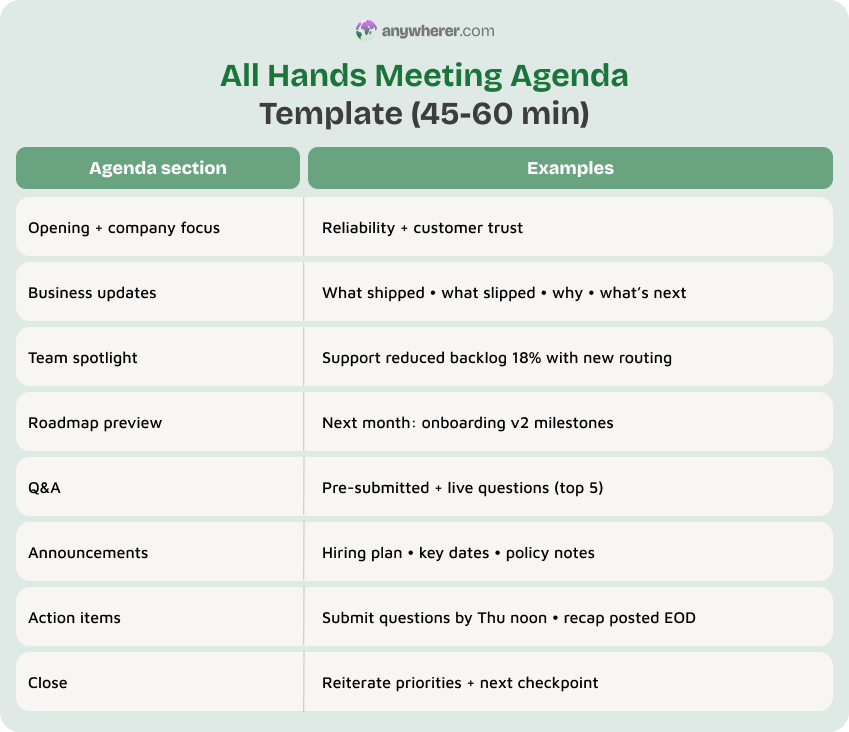
All Hands Meeting Agenda Template
Purpose
An all hands meeting agenda template for company-wide alignment. Many teams treat this as a corporate meeting agenda template because it sets direction and culture in one place.
Sections
- Opening and company focus
- Business updates (product, customers, finance highlights)
- Team spotlights (demos, wins)
- Roadmap preview
- Questions and answers (pre-submitted plus live)
- Announcements and action items
- Close (reinforce priorities)
Agenda example
- Focus: “Reliability and customer trust.”
- Update: “Top customer requests; what we shipped; what slipped and why.”
- Spotlight: “Support reduced backlog by 18% with new routing.”
- Q and A: “Hiring plan for Q2; roadmap trade-offs.”
- Action: “Submit questions by Thursday noon; recap posted by the end of the day.”
Customization ideas
- Collect questions ahead of time so leaders can answer with specifics
- Rotate spotlights so every team gets visibility over time
- Publish a recap within 24 hours, including decisions and next steps, so the message sticks
FAQs: Team Meeting Agenda Template Examples
Why are team meeting agendas important for productivity?
Because they protect focus and reduce drift. When work is already fragmented by constant pings and last-minute coordination, an agenda forces prioritization, creates time limits, and makes decisions visible. Microsoft’s Breaking down the infinite workday describes how interruptions and meeting patterns can erode focus, which is exactly what a structured agenda helps counter.
What should be included in a team meeting agenda?
At minimum: meeting objective, agenda items in priority order, time boxes, topic owners, and a section for action items and next steps. Atlassian’s meeting agenda guidance also emphasizes meeting details and clear objectives as core components.
How can I make my team meetings more efficient using an agenda?
Move status updates to async notes, then use the live meeting only for decisions, blockers, and trade-offs. Close by reading action items out loud so there is no confusion about ownership, deadlines, and what “done” means.
How do I customize a team meeting agenda for my team’s specific needs?
Start with the meeting’s job: inform, decide, unblock, or brainstorm. Then remove anything that does not serve that job. For example, project meetings need risks and dependencies, sales meetings need deep dives, and executive meetings need decisions first.
What is the ideal length for a team meeting agenda?
The ideal agenda length is the one that fits your time box without rushing. If you cannot complete the agenda in 30 or 45 minutes, you likely have too many topics or topics that belong in a separate meeting.
How do I ensure that everyone is engaged during a team meeting?
Send the agenda in advance, assign topic owners, and include at least one structured participation moment (round robin input, silent ideation, or a quick pulse check). Harvard Business School Working Knowledge recommends sending the agenda ahead so attendees are prepared and there are fewer surprises.
Should action items be assigned during the meeting or before?
Assign them during the meeting, right after a decision or conclusion. That is when context is fresh and it is easiest to confirm ownership, due dates, and what “done” means.
How can I create an agenda for remote team meetings?
Use one shared doc, define norms (chat, hand raise, decision logging), and add a recap owner with a deadline. Remote meetings need extra structure because silence can look like agreement even when it is not.
What are common mistakes to avoid when planning a team meeting?
- No objective, so the meeting has no outcome
- Too many topics, so nothing gets finished
- No time boxes, so one topic takes over
- No owners, so action items vanish

Yaryna is our lead writer with over 8 years of experience in crafting clear, compelling, and insightful content. Specializing in global employment and EOR solutions, she simplifies complex concepts to help businesses expand their remote teams with confidence. With a strong background working alongside diverse product and software teams, Yaryna brings a tech-savvy perspective to her writing, delivering both in-depth analysis and valuable insights.