What Is a Recruitment Strategy?
A recruitment strategy is a documented plan for how your company will attract, assess, and hire the right people in ways that support business goals (growth, quality, speed, cost, and fairness). A good recruitment strategy makes hiring repeatable rather than reactive. It also reduces random “hero recruiting” where success depends on one recruiter’s personal tricks rather than a system.
In 2026, the strategy part matters more because the talent market is changing fast. In the World Economic Forum’s workforce strategies section, skills-based approaches like skills assessment are highlighted as an increasingly common practice, and the report expects adoption to grow across employers during 2025-2030. LinkedIn’s Future of Recruiting 2025 report adds another pressure: recruiting teams are rapidly integrating AI tools, and their focus is shifting toward quality of hire and skills-based hiring.
That is where templates help. A strong recruitment strategy plan template gives you a framework you can adapt for your roles, your budget, and your hiring volume. It also makes it easier to standardize evaluation, which is a practical way to support consistency and fairness. Instead of starting from scratch every quarter, you update the same structure, compare results, and improve.
This post gives you 7 recruitment strategy templates, each focused on a different part of hiring. You will see recruitment strategies examples, a recruitment strategy example for each template, plus realistic sample text you can copy into your own docs. If you also need a separate planning document for headcount, timelines, and approvals, use these recruitment plan templates as a companion resource. And yes, we will also mention a recruitment process template, because many companies keep that as a separate SOP document.
7 Recruitment Strategy Template Samples
Candidate Sourcing Strategy Template
Purpose
Use this recruitment sourcing strategy template when you need consistency in where candidates come from and how you evaluate source quality. It is ideal for high-volume roles, niche roles, or any team that wants to reduce “random sourcing” and build a repeatable pipeline. This is your core sourcing strategy recruitment example.
Template structure
- Role requirements snapshot
Skills, must-haves vs nice-to-haves, location/timezone, level, compensation range. - Target candidate profiles
Titles to target, adjacent titles, industries, company sizes, seniority signals. - Channel plan (sourcing mix)
Outbound (LinkedIn, email), inbound (job boards), referrals, communities, events, agencies. - Messaging and value proposition
2 to 3 message angles, personalization rules, follow-up sequence. - Screening and qualification rules
Knockout criteria, skill checks, portfolio expectations, red flags. - Pipeline targets and timing
Weekly target outreach, response rate expectations, interview conversion targets. - Source quality tracking
Quality of hire proxy, pass-through rates, diversity mix, time-to-fill per channel.
Template sample (example of recruitment strategy for a Product Analyst hire)
| Key points | Description |
| Role snapshot | Product Analyst (mid-level), strong SQL, stakeholder updates, basic experimentation |
| Candidate profiles | Data analyst, product insights, BI analyst; adjacent: operations analyst with SQL |
| Channels | Referrals: 25% of interviews LinkedIn outbound: 40 targeted messages per week Community: local analytics Slack + meetup talk once per month |
| Messaging angle | Own metrics that shape roadmap; direct exposure to product leadership; strong mentorship |
| Screening rules | Must show SQL examples or project links 15-minute structured screen with 5 questions |
| Targets | 40 outbound touches/week 20% reply rate goal 10 qualified screens/month |
| Source tracking | Track screen-to-onsite rate by channel, plus offer acceptance rate |
Best practices and actionable tips
- Keep the sourcing plan “skills-first.” The WEF report highlights how widely employers assess skills and how skills assessments are growing. Use that trend as permission to write requirements around skills, not prestige signals.
- Write one “gold standard profile” and one “adjacent profile” to widen the funnel without losing quality.
- Treat sourcing like an experiment: test two outreach messages for 2 weeks, then keep the winner.
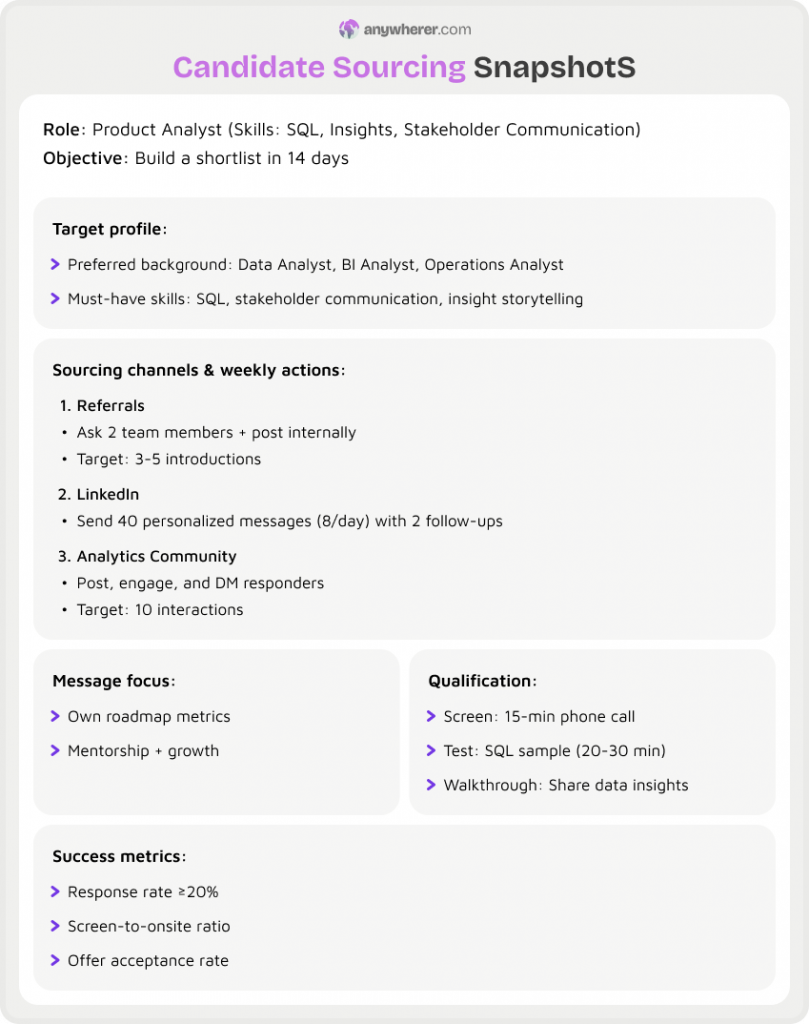
Candidate Sourcing Snapshot
Role: Product Analyst (Skills: SQL, Insights, Stakeholder Communication)
Objective: Build a shortlist in 14 days
Target profile:
- Preferred background: Data Analyst, BI Analyst, Operations Analyst
- Must-have skills: SQL, stakeholder communication, insight storytelling
Sourcing channels & weekly actions:
- Referrals
- Ask 2 team members + post internally
- Target: 3-5 introductions
- LinkedIn
- Send 40 personalized messages (8/day) with 2 follow-ups
- Analytics Community
- Post, engage, and DM responders
- Target: 10 interactions
Message focus:
- Own roadmap metrics
- Mentorship + growth
Qualification:
- Screen: 15-min phone call
- Test: SQL sample (20-30 min)
- Walkthrough: Share data insights
Success metrics:
- Response rate ≥20%
- Screen-to-onsite ratio
- Offer acceptance rate
Employer Branding Recruitment Strategy Template
Purpose
Use this template when you are getting candidates to apply but not the right ones, or when offer acceptance is low. It is best for competitive markets where candidates compare companies on growth, flexibility, mission, leadership, and learning. This section is also a recruitment strategy plan example for “quality of applicants.”
Template structure
- Employer brand positioning
Your “why join us” in one sentence. - Candidate priorities map
What top candidates care about (growth, flexibility, impact, stability, etc.). - Proof points
Concrete evidence: career paths, learning budget, manager training, product wins, customer stories. - Role-specific narrative
A version of the brand story tailored to each key role family (engineering, sales, ops). - Content plan
Careers page improvements, employee stories, hiring manager visibility, process transparency. - Candidate experience touchpoints
What candidates see at each step (job post, first call, interview, offer). - Measurement
Application-to-interview quality, offer acceptance, time-to-accept, candidate NPS (if you track it).
Sample of template points
- Positioning: “Build practical AI products with a team that ships weekly and invests in learning.”
- Candidate priorities: “Growth + impact + flexible work.”
- Proof points:
- “Monthly learning day”
- “Mentor program for first 90 days”
- “Clear promotion rubric published internally”
- Role narrative for engineers: “Real ownership, strong review culture, pragmatic stack.”
- Content plan: “2 employee stories/month, hiring manager’s day in the life’ video quarterly.”
- Candidate experience: “All interview steps and timelines shown in job post.”
- Measurement: “Offer acceptance target 75%; reduce late-stage drop-off by 15%.”
Best practices and actionable tips
- Stop saying “great culture” and show proof. A good recruitment strategy example always replaces vague claims with evidence.
- Audit your top 10 job posts: do they clearly explain outcomes, team, and growth path?
- Use consistent language across recruiter screens and hiring manager interviews so the story does not change mid-process.
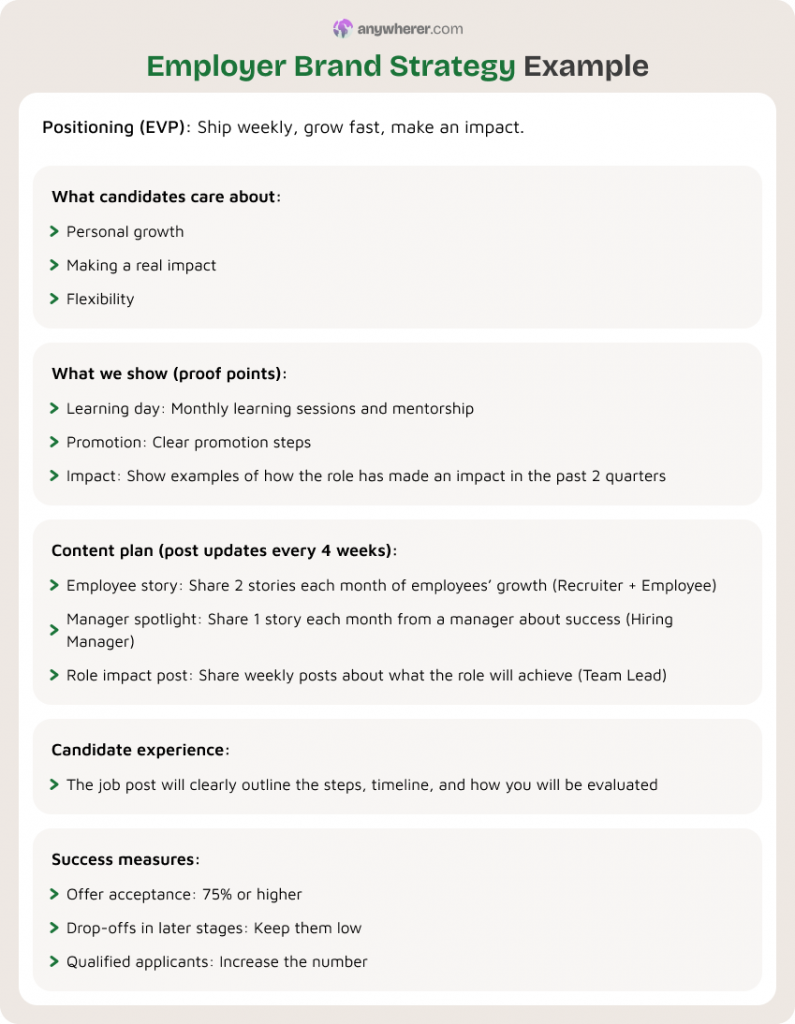
Employer Brand Strategy Example
Positioning (EVP): Ship weekly, grow fast, make an impact.
What candidates care about:
- Personal growth
- Making a real impact
- Flexibility
What we show (proof points):
- Learning day: Monthly learning sessions and mentorship
- Promotion: Clear promotion steps
- Impact: Show examples of how the role has made an impact in the past 2 quarters
Content plan (post updates every 4 weeks):
- Employee story: Share 2 stories each month of employees’ growth (Recruiter + Employee)
- Manager spotlight: Share 1 story each month from a manager about success (Hiring Manager)
- Role impact post: Share weekly posts about what the role will achieve (Team Lead)
Candidate experience:
- The job post will clearly outline the steps, timeline, and how you will be evaluated
Success measures:
- Offer acceptance: 75% or higher
- Drop-offs in later stages: Keep them low
- Qualified applicants: Increase the number
Diversity Hiring Strategy Template
Purpose
Use this when you want to improve representation and fairness without lowering standards. The best DEI recruiting strategy is a quality strategy: it broadens where you look, makes evaluation more consistent, and reduces bias in selection decisions.
Two practical compliance and fairness anchors:
- EEOC guidance stresses that selection procedures must be job-related and should be evaluated for adverse impact risk, with alternatives considered if a method screens out protected groups.
- The UK government guidance recommends using fair and structured interview techniques to reduce bias.
Template structure
- Role analysis and inclusive requirements
Separate “must-have skills” from “nice-to-have signals.” - Inclusive sourcing plan
Diverse channels, communities, referral policy adjustments, and outreach partnerships. - Structured assessment design
Skills tests, work samples, structured interviews, and consistent rubrics. - Bias controls
Panel composition, interviewer training, rubric-first scoring, calibration. - Candidate experience safeguards
Accessibility, clear timelines, transparent criteria, and accommodations. - Metrics and governance
Funnel diversity by stage, pass-through rates, and adverse impact monitoring (where relevant).
Sample of template points
- Inclusive requirements rewrite (software role):
- Must: “Build APIs, write tests, code review.”
- Nice: “Specific cloud certs” (optional, not required)
- Structured assessment: “30-minute work sample, scored rubric, 4 competencies.”
- Bias control: “Score independently, then discuss; no ‘gut feel’ final votes.”
- Metrics: “Track pass-through by stage; investigate drop-offs; adjust process.”
Best practices and actionable tips
- Use structured interviews. The UK guidance is explicit: structured interviews can help reduce bias.
- Avoid over-indexing on credentials when skills are the real predictor. WEF discusses how skills assessment is becoming widespread.
- Make one person responsible for checking whether interview feedback is evidence-based (examples, not vibes).
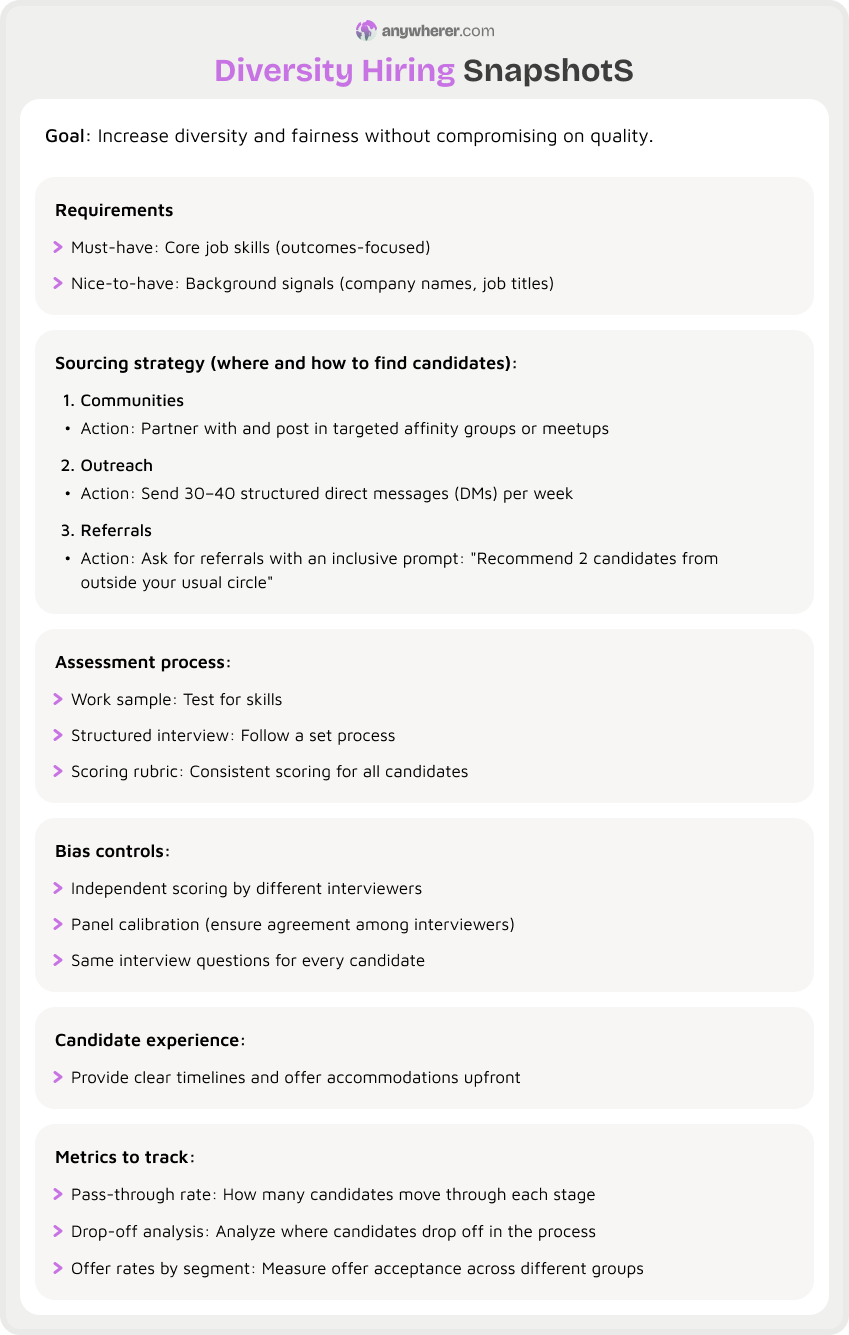
Diversity Hiring Snapshot
Goal: Increase diversity and fairness without compromising on quality.
Requirements:
- Must-have: Core job skills (outcomes-focused)
- Nice-to-have: Background signals (company names, job titles)
Sourcing strategy (where and how to find candidates):
- Communities
- Action: Partner with and post in targeted affinity groups or meetups
- Outreach
- Action: Send 30–40 structured direct messages (DMs) per week
- Referrals
- Action: Ask for referrals with an inclusive prompt: “Recommend 2 candidates from outside your usual circle.”
Assessment process:
- Work sample: Test for skills
- Structured interview: Follow a set process
- Scoring rubric: Consistent scoring for all candidates
Bias controls:
- Independent scoring by different interviewers
- Panel calibration (ensure agreement among interviewers)
- Same interview questions for every candidate
Candidate experience:
- Provide clear timelines and offer accommodations upfront
Metrics to track:
- Pass-through rate: How many candidates move through each stage
- Drop-off analysis: Analyze where candidates drop off in the process
- Offer rates by segment: Measure offer acceptance across different groups
Interview Process Strategy Template
Purpose
Use this when interviews feel inconsistent, slow, or “subjective.” It fits scaling teams that need repeatability, a better candidate experience, and better alignment with hiring managers.
Template structure
- Interview stages and purpose
Screen, skills assessment, team interview, final decision. - Competency model
Rating scale definitions plus “evidence required.” - Question bank
Structured questions mapped to competencies. - Work sample design
What candidates do, time limits, scoring guide, and fairness checks. - Panel guidelines
Who interviews, what they cover, and how to avoid duplication. - Decision meeting rules
How decisions are made and documented.
Sample of template points
- Stages:
- Recruiter screen (15 min): role fit + motivation
- Skills test (30 to 45 min): job-relevant task
- Panel interview (60 min): 4 competencies
- Final (30 min): manager alignment + questions
- Competencies: “Problem solving, collaboration, communication, ownership.”
- Scoring: “Must cite at least 1 example per competency.”
- Work sample: “Write a short plan based on a mock scenario; score clarity and trade-offs.”
Best practices and actionable tips
- Use structured interviews and standardized evaluations. UK guidance highlights the benefits of structured interviews for fairness.
- Keep the work sample realistic and time-bounded. Anything that takes 4 hours will reduce completion and hurt candidate experience.
- Run a monthly calibration session to compare rubric scores across interviewers.
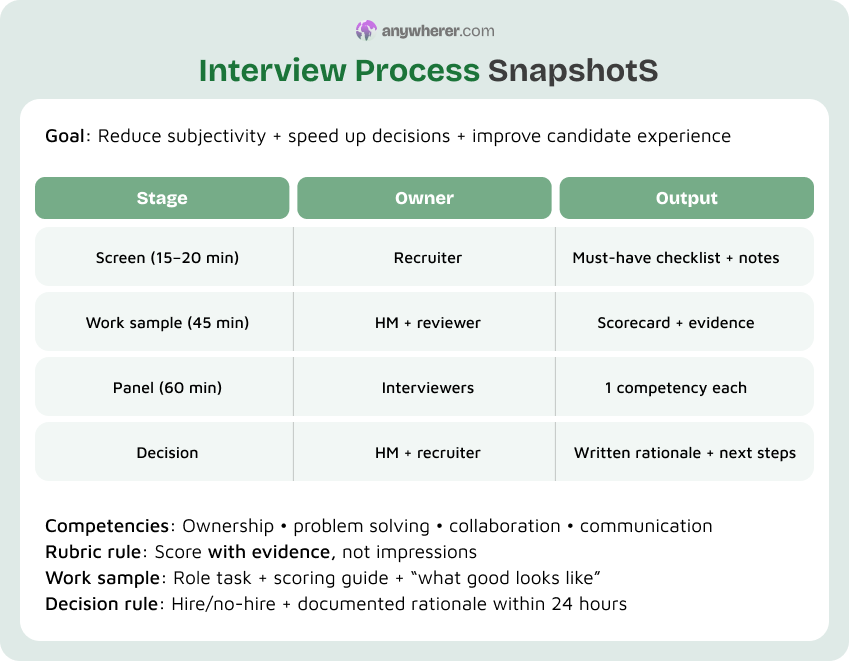
Interview Process Snapshot
Goal: Reduce subjectivity + speed up decisions + improve candidate experience
Stages & ownership
| Stage | Owner | Output |
| Screen (15–20 min) | Recruiter | Must-have checklist + notes |
| Work sample (45 min) | HM + reviewer | Scorecard + evidence |
| Panel (60 min) | Interviewers | 1 competency each |
| Decision | HM + recruiter | Written rationale + next steps |
Competencies: Ownership • problem solving • collaboration • communication
Rubric rule: Score with evidence, not impressions
Work sample: Role task + scoring guide + “what good looks like”
Decision rule: Hire/no-hire + documented rationale within 24 hours
Talent Pool Strategy Template
Purpose
Use this when you hire in waves (seasonal growth, new market launches, product expansions) or when roles are hard to fill, and you cannot start from zero every time. A talent pool strategy is a long-term recruitment strategy plan that reduces time-to-fill and improves quality.
Template structure
- Priority roles and forecast
Which roles will you hire in the next 3 to 12 months? - Talent segments
Passive candidates, warm leads, alumni, referrals, silver medalists. - Engagement cadence
How you stay in touch: newsletter, events, updates, role alerts. - Content and value exchange
What you share that candidates actually want (teamwork, learning, projects). - CRM hygiene rules
Tags, notes, next touch date, opt-out policy. - Activation playbook
How do you move someone from the pool to an interview fast? - Metrics
Pool growth, warm response rate, and pool-to-hire conversion.
Sample of template points
- Priority roles: “2 data analysts, 3 SDRs, 1 product designer in Q3.”
- Talent segments: “Past finalists, referral leads, community contacts.”
- Cadence: “Monthly update email; quarterly virtual meet-and-greet.”
- Activation: “If role opens, contact top 10 warm leads within 48 hours.”
- Metrics: “Pool-to-interview 25%; pool-to-hire 8%.”
Best practices and actionable tips
- Keep your “warm lead” definition strict: interacted in the last 90 days or opted into updates.
- Send content that signals real work, not marketing.
- Assign ownership: talent pools fail when nobody owns the weekly hygiene.
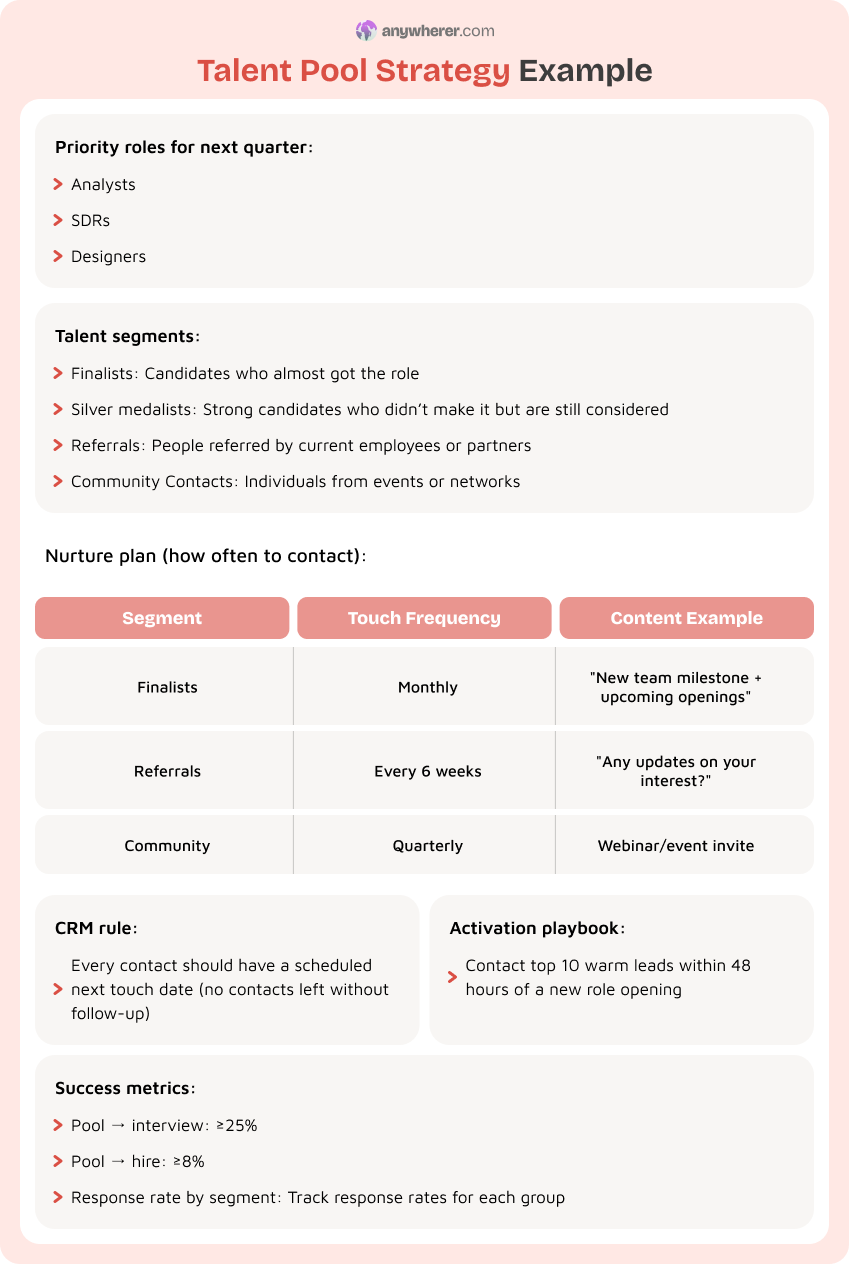
Talent Pool Strategy Example
Priority roles for next quarter:
- Analysts
- SDRs
- Designers
Talent segments:
- Finalists: Candidates who almost got the role
- Silver medalists: Strong candidates who didn’t make it but are still considered
- Referrals: People referred by current employees or partners
- Community Contacts: Individuals from events or networks
Nurture plan (how often to contact):
| Segment | Touch Frequency | Content Example |
| Finalists | Monthly | “New team milestone + upcoming openings” |
| Referrals | Every 6 weeks | “Any updates on your interest?” |
| Community | Quarterly | Webinar/event invite |
CRM rule: Every contact should have a scheduled next touch date (no contacts left without follow-up)
Activation playbook: Contact top 10 warm leads within 48 hours of a new role opening
Success metrics:
- Pool → interview: ≥25%
- Pool → hire: ≥8%
- Response rate by segment: Track response rates for each group
Recruitment Metrics Strategy Template
Purpose
Use this template when leadership wants visibility into what is working, where bottlenecks exist, and whether hiring quality is improving. It is also critical when experimenting with AI tools, as you need consistent measurement.
LinkedIn’s Future of Recruiting report includes metrics-oriented thinking (an emphasis on quality of hire and the growing use of AI in recruiting teams).
Template structure
- Goals and constraints
Speed, quality, cost, diversity, experience. - Core metrics (definition + formula)
Time-to-fill, time-in-stage, offer acceptance, source pass-through. - Quality signals
Hiring manager satisfaction, early retention proxy, and performance at 90 days. - Funnel dashboard
Applicants -> screened -> interviewed -> offered -> hired. - Insights and actions
What changed, why it changed, and what you will do next. - Cadence
Weekly ops review, monthly leadership review, quarterly strategy reset.
Sample of template points
- Goal: “Reduce time-to-fill for SDR roles from 45 days to 30 days.”
- Core metrics:
- Time in recruiter screen stage: target 7 days
- Offer acceptance: target 75%
- Source pass-through: referrals > outbound > job boards
- Quality signal: “90-day manager check: meets expectations 80%+.”
- Action: “If offer acceptance drops, update comp band messaging and interview schedule speed.”
Best practices and actionable tips
- Define metrics once and keep them stable for at least a quarter.
- Track stage bottlenecks, not only end results.
- Always connect metrics to a decision: if a metric moves, what do you do?
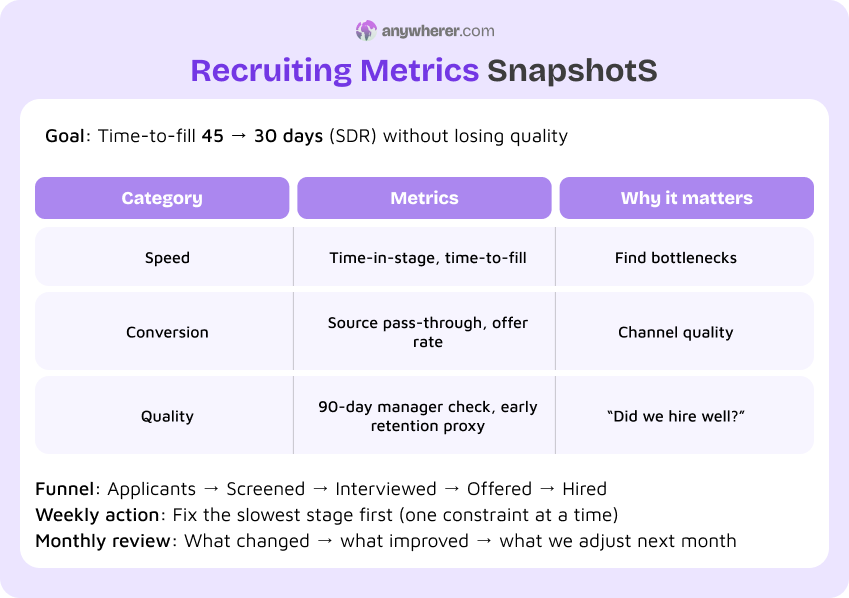
Recruiting Metrics Snapshot
Goal: Time-to-fill 45 → 30 days (SDR) without losing quality
Dashboard metrics
| Category | Metrics | Why it matters |
| Speed | Time-in-stage, time-to-fill | Find bottlenecks |
| Conversion | Source pass-through, offer rate | Channel quality |
| Quality | 90-day manager check, early retention proxy | “Did we hire well?” |
Funnel: Applicants → Screened → Interviewed → Offered → Hired
Weekly action: Fix the slowest stage first (one constraint at a time)
Monthly review: What changed → what improved → what we adjust next month
Onboarding Recruitment Strategy Template
Purpose
This template exists because recruitment does not end at “signed offer.” A hiring strategy that ignores onboarding often creates early churn and weak performance. Onboarding is also a quality-of-hire amplifier: it turns good candidates into productive employees faster.
Template structure
- Preboarding timeline
Offer acceptance to day 1: documents, equipment, access, schedule. - First week plan
Role context, systems, key people, and first small wins. - 30-60-90 outcomes
Clear expectations and milestones. - Manager responsibilities
1:1 schedule, feedback cadence, success criteria. - Buddy or mentor plan
Who helps and how often. - Onboarding feedback loop
Surveys, check-ins, process improvements. - Handoff checklist
Recruiter -> manager -> HR -> IT.
Sample of template points
- Preboarding: “Laptop shipped, accounts created, calendar invites sent by day minus 5.”
- Week 1: “Shadow 2 calls, complete product walkthrough, meet stakeholders.”
- 30-day outcome: “Complete training, deliver first small task independently.”
- 60-day: “Own a recurring responsibility, contribute an improvement idea.”
- 90-day: “Deliver a measurable outcome tied to team goals.”
- Manager cadence: “Weekly 1:1 for first month, then biweekly.”
Best practices and actionable tips
- Write outcomes as observable outputs, not feelings.
- Protect time: onboarding fails when new hires are instantly overloaded.
- Use the feedback loop to improve: track “time to first meaningful contribution.”
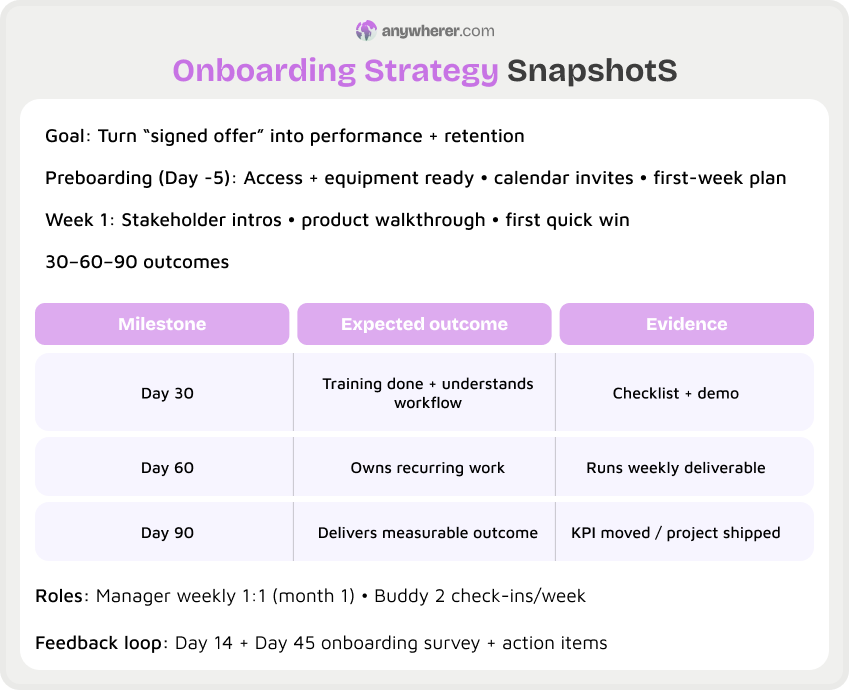
Onboarding Strategy Snapshot
Goal: Turn “signed offer” into performance + retention
Preboarding (Day -5): Access + equipment ready • calendar invites • first-week plan
Week 1: Stakeholder intros • product walkthrough • first quick win
30–60–90 outcomes
| Milestone | Expected outcome | Evidence |
| Day 30 | Training done + understands workflow | Checklist + demo |
| Day 60 | Owns recurring work | Runs a weekly deliverable |
| Day 90 | Delivers measurable outcome | KPI moved / project shipped |
Roles: Manager weekly 1:1 (month 1) • Buddy 2 check-ins/week
Feedback loop: Day 14 + Day 45 onboarding survey + action items
Key Questions for Developing an Effective Recruitment Strategy
What should be included in developing a recruitment strategy?
When developing a recruitment strategy, it’s crucial to define clear job descriptions, target candidate profiles, and establish sourcing channels. Consider your company’s culture, the ideal hiring timeline, and the budget. Focus on the candidate experience throughout the process, and ensure you have a structured approach to assessing and selecting candidates to align with your business needs.
How to customize recruitment strategy examples for my company?
Customizing a recruitment strategy involves understanding your company’s specific culture, industry, and hiring needs. This means tailoring the recruitment process to attract candidates who fit your values and roles. You’ll need to choose the right sourcing channels based on your target audience and make sure the strategy supports both your immediate and long-term talent goals.
What is the role of employer branding in recruitment?
Employer branding is essential because it influences how candidates perceive your company. A strong employer brand helps attract top talent by showcasing your company’s culture, values, and growth opportunities. This creates a competitive edge, as candidates are more likely to choose a company they believe aligns with their values and career aspirations.
How can I measure the success of my recruitment strategy?
Measuring the success of your recruitment strategy involves tracking key metrics such as time-to-hire, cost-per-hire, and hire quality. These metrics help assess whether your strategy is effective in attracting the right talent and if adjustments are needed to optimize your hiring process. Retention rates, especially during the first year, are also an important indicator of a successful recruitment strategy.
What are some common recruitment strategy mistakes to avoid?
Some common mistakes include having vague or unclear job descriptions, failing to prioritize cultural fit, or relying on outdated or ineffective sourcing channels. It’s also important to ensure the recruitment process isn’t rushed, as this can lead to overlooking key qualities in candidates. Continuously evaluating and improving your recruitment strategy helps you avoid these pitfalls.
How do I incorporate diversity and inclusion in my recruitment strategy?
To incorporate diversity and inclusion, focus on neutral, inclusive job descriptions and use diverse sourcing channels to reach underrepresented groups. Creating an inclusive hiring process ensures that every candidate has an equal opportunity. Actively tracking and setting diversity goals can also help measure the effectiveness of these efforts within your recruitment strategy.
What’s the difference between a recruitment strategy and a sourcing strategy?
A recruitment strategy is the overall plan for attracting and retaining talent, encompassing all aspects from employer branding to candidate selection. A sourcing strategy, however, focuses specifically on how to find and engage candidates through channels such as job boards, social media, and recruitment agencies. Both are integral to a successful hiring process, but focus on different elements.
How often should I update my recruitment strategy?
You should update your recruitment strategy at least annually, or sooner if your hiring needs change or you face challenges with talent acquisition. Regular reviews allow you to stay agile and adjust your approach based on market trends, industry shifts, or feedback from candidates. This ensures your strategy remains relevant and effective in meeting your company’s evolving needs.

Yaryna is our lead writer with over 8 years of experience in crafting clear, compelling, and insightful content. Specializing in global employment and EOR solutions, she simplifies complex concepts to help businesses expand their remote teams with confidence. With a strong background working alongside diverse product and software teams, Yaryna brings a tech-savvy perspective to her writing, delivering both in-depth analysis and valuable insights.