Remote.com, often just called Remote, is a compliance-first global Employer of Record competing with Deel, Multiplier, Oyster, and Papaya. But its roughly 80-country owned-entity coverage, $599 premium pricing, and basic contractor tools push some buyers to alternatives. The strongest Remote competitors sorted by reason: Deel is the best overall with about twice the country coverage and free contractor management; Multiplier (about $459) and Remofirst (about $199) deliver core EOR for cost-sensitive teams, and Rippling is the pick if you want HR, IT, and global employment in one system.
This guide ranks the best Remote.com alternatives against Remote specifically: what each one does better, and where Remote still wins. Remote is one of the strongest EORs in the market for what it does, with a number-one G2 compliance rating, 100% owned entities, and a rare no-deposit policy in the industry. The point is not a takedown. It is to match each specific structural need that Remote does not serve with the alternative that does.
A note before the rankings: Remote earns about 4.6 out of 5 on G2, charges a transparent flat $599 with no deposit and no standard termination fees, and includes free IP Guard. If you have read our Remote review and concluded that coverage, cost, or product scope does not fit your plans, here is the alternative that does.
Remote.com vs Competitors: Side-by-Side Comparison
The table below ranks the top Remote competitors and compares Remote against eight alternatives on EOR price, entity model, country coverage, and deposit requirement. Remote is the reference row at the top. The entity-model and deposit columns are where Remote’s strengths stand out: its 100%-owned entities and no-deposit policy are unmatched across the board. Figures reflect published data from May 2026.

| Provider | EOR /ee/mo | Entity model | Countries | Best for | G2 |
|---|---|---|---|---|---|
| Remote | $599 flat / $699 monthly | 100% owned | ~80 owned, 190+ contractor | Compliance / IP / transparency | 4.6★ |
| Deel | ~$599 | Owned + partner | 150+ | Best overall / contractors free | 4.8★ |
| Multiplier | ~$459 | Owned + partner | 160+ | Cost-effective mid-tier | 4.7★ |
| Remofirst | ~$199 | Partner-only | 185+ | Lowest cost / startups | 4.5★ |
| Rippling | Custom / quote | Owned + partner | Global | HR + IT + global all-in-one | 4.8★ |
| Oyster HR | ~$699 | 100% partner | 180+ | Benefits quality / Europe | 4.4★ |
| Papaya Global | ~$650-770 | Owned + partner | 160+ | Enterprise payroll consolidation | 4.5★ |
| Globalization Partners | Premium / quote | 100% owned | 180+ | Enterprise owned-entity | 4.4★ |
| Pebl (Velocity Global) | $599 std / $399 promo | Owned + partner | 185+ | M&A / immigration heritage | 4.6★ / 2.4 TP |
| WorkMotion | €499 | Own (EU) + partner | 160+ | European compliance / direct hiring | 4.6★ |
Why Teams Shop Remote Alternatives
Buyers who shop Remote alternatives are usually not unhappy with Remote. They are hitting a specific structural limit. Here are the reasons that come up most often across G2, eorHQ, and EmployBorderless, led by the coverage gap, the dominant motivation.
Coverage gap, the number-one reason. Remote operates owned entities in roughly 70-85 countries, while Deel covers 150-plus, and G-P and Oyster reach 180-plus. Buyers expanding into Southeast Asia, Sub-Saharan Africa, or Central Asia often encounter gaps and must add a second provider. As one reviewer put it, the EOR service is great, but they hit coverage gaps as they expanded into Africa and Southeast Asia and had to add Deel for countries Remote does not cover. For multi-region expansion, that ceiling is the constraint, and it drives most searches for remote EOR alternatives.
- Premium pricing. Flat $599 per employee per month (annual) or $699 monthly is top-of-market. Multiplier (about $459) and Remofirst (about $199) provide core compliance at significantly lower costs.
- Basic contractor tooling. Remote’s contractor management at $29 per contractor covers the basics but lacks the depth of Deel’s free, richer contractor platform, which includes conversion workflows.
- EOR-focused scope. Remote does EOR, global payroll, and contractor management, with no HRIS or IT and device layer. Teams that want a single system for HR, payroll, and IT prefer Rippling.
- Narrow standalone payroll. Remote’s standalone Global Payroll runs in about 40 markets, narrower than Papaya for enterprises consolidating payroll across 20-plus owned-entity countries.
Balance note: Remote is genuinely best-in-class on several dimensions, and saying so is what makes the rest of this guide credible. It runs 100% owned entities, rare in the industry, which gives a direct liability chain that partner-based competitors cannot match. It holds the number-one G2 compliance rating among EOR providers and charges a transparent flat fee of $599, with no promos or quote-only opacity.
It requires no deposit, which is unique among major EORs, whereas Deel, Oyster, and Papaya all require one to two months of gross salary. It charges no offboarding or termination fees for standard cases, includes free IP Guard, and offers contractor management in 190-plus countries with strong equity and stock-option administration. For compliance-first buyers whose hiring map fits Remote’s footprint, there is genuinely no stronger option.
How We Compared These Remote Alternatives
We evaluated each Remote alternative on the dimensions that drive a real EOR switch, not on brand familiarity.
- EOR category match and country coverage are the dominant motivations.
- Entity model: 100% owned versus partner- or mixed-network models.
- Pricing transparency and total cost, including deposit and termination fees.
- Compliance posture for complex jurisdictions.
- Contractor tooling and broader platform capabilities (HR, IT, payroll).
- Onboarding speed and our own provider reviews.
Best Overall Remote Alternative: Deel
#1 Deel: Best overall and the biggest head-to-head on coverage
Deel

Deel is the central head-to-head in the remote vs Deel alternatives comparison and the best overall Remote alternative. It roughly doubles Remote’s country coverage and makes contractor management free, directly answering Remote’s two most common limits.
What it does better than Remote:
- About twice the country coverage (150-plus vs roughly 80), closing Southeast Asia, Africa, and Central Asia gaps
- Free contractor management versus Remote’s $29 per contractor
- Deeper platform automation, AI tooling, and broader integrations
- Faster onboarding in most major markets
Where Remote still wins:
- Owned-plus-partner entity mix (Remote is 100% owned)
- Documented 2024-25 compliance and hidden-fee complaints Remote does not carry
- Requires a deposit and standard offboarding fees that Remote does not
- Remote’s compliance posture is rated number-one on G2
EOR price:
~$599/ee/mo
Entity model:
Owned + partner
Countries:
150+
Deposit:
Required
G2:
4.8/5
Pick it over Remote if:
you need wider country coverage, free contractor management, or the deepest platform automation.
Stick with Remote if:
you want a 100%-owned entity chain, no deposit, and the top-rated compliance posture.
*As pricing is subject to change, we are listing prices as they stand in June 2026
#2 Multiplier: Best cost-effective mid-tier
Multiplier

Multiplier is the cost-effective Remote alternative for scale-ups. At $459/ee/mo when billed annually, it saves roughly $1,680 per employee per year compared to Remote while maintaining competitive coverage and a growing owned-entity network.
What it does better than Remote:
- Meaningfully cheaper (about $459 vs $599)
- Volume discounts that Remote does not visibly offer
- Competitive 160-plus country coverage
- Strong SMB and scale-up fit with no per-exit termination fees
Where Remote still wins:
- Brand and compliance heritage below Remote’s top-rated posture
- No clear IP Guard equivalent
- Smaller owned-entity network than Remote’s 100%-owned model
- Less consistently strong G2 review depth
EOR price:
~$459/ee/mo
Entity model:
Owned + partner
Countries:
160+
Deposit:
Varies
G2:
4.7/5
Pick it over Remote if:
you want core EOR compliance at roughly three-quarters of Remote’s price.
Stick with Remote if:
you need the top compliance rating, IP Guard, or a fully-owned entity chain.
*As pricing is subject to change, we are listing prices as they stand in September 2026
#3 Remofirst: Best budget pick
Remofirst
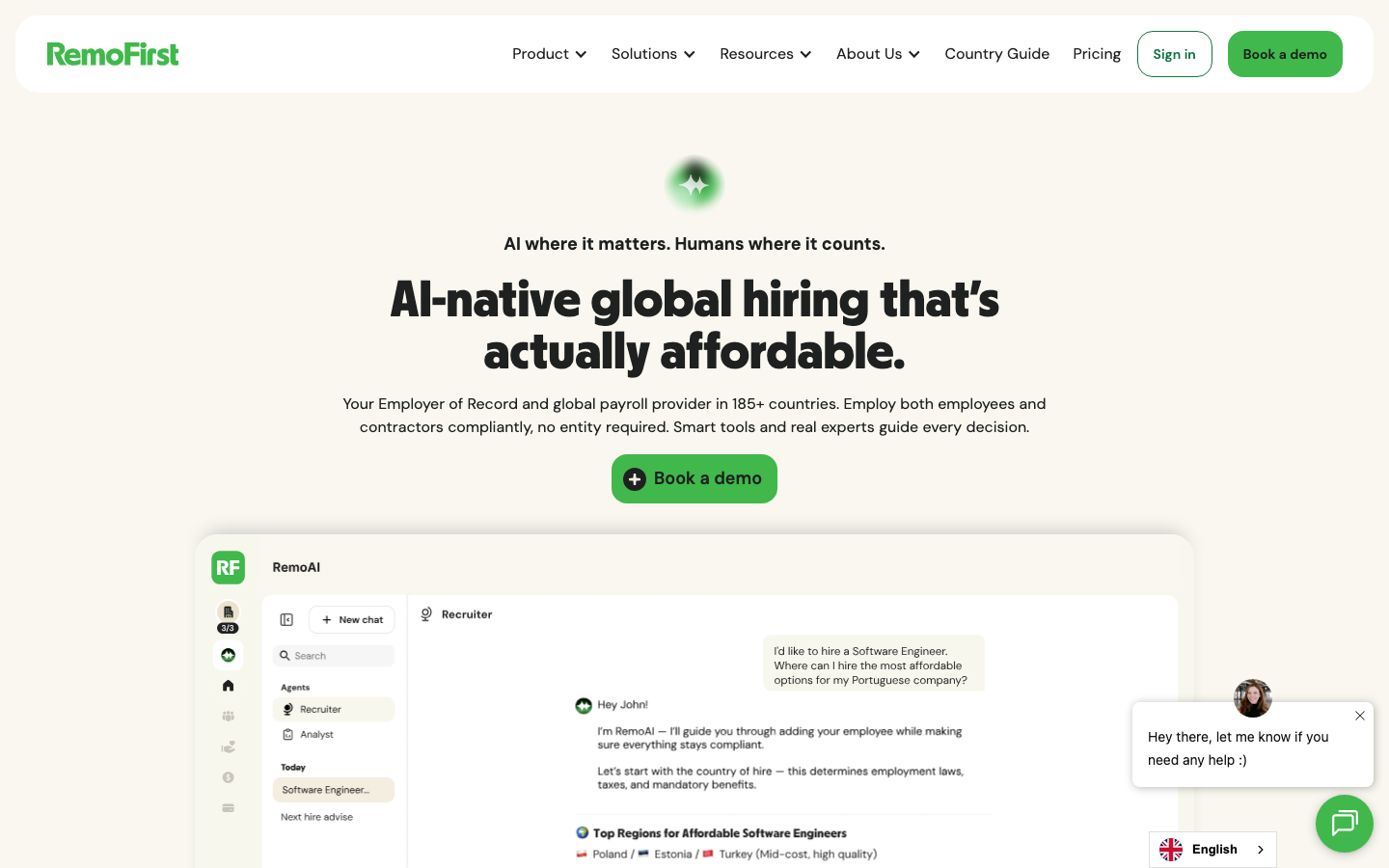
Remofirst is the budget Remote alternative for cost-sensitive startups making their first international hires. At about $199, it is the cheapest in this comparison and has broad partner-based country reach.
What it does better than Remote:
- Dramatically lower price (about $199 vs $599), saving roughly $4,800 per employee per year
- Ideal for cost-sensitive startups and first international hires
- Broad 185-plus country reach via partners
- Free contractor tier and transparent published pricing
Where Remote still wins:
- Partner-only entity network (Remote is 100% owned)
- Thinner compliance posture and IP protection
- Younger, leaner platform
- Weaker support and tooling depth
EOR price:
~$199/ee/mo
Entity model:
Partner-only
Countries:
185+
Deposit:
Varies
G2:
4.5/5
Pick it over Remote if:
cost is the top constraint and your hiring is straightforward.
Stick with Remote if:
you need owned entities, the top compliance posture, or deeper support.
*As pricing is subject to change, we are listing prices as they stand in June 2026
Best All-in-One Remote Alternative: Rippling
#4 Rippling: Best for all-in-one HR, IT, and global
Rippling

Rippling is the pick when you want more than EOR. It unifies global EOR and payroll with HR, IT device and app management, and finance on one platform, whereas Remote is EOR-focused and lacks an HRIS or IT layer.
What it does better than Remote:
- Unifies global EOR with HR, IT, and finance in one system of record
- 600-plus integrations and deep modern automation
- Better for tech-forward teams wanting a single platform
- Broad global coverage through owned and partner entities
Where Remote still wins:
- Less specialized for pure EOR compliance, with a partner-mix entity model
- Quote-based and module-priced, less transparent than Remote’s flat $599
- Requires a deposit and standard termination handling
- More of a platform than a team that only needs EOR
EOR price:
Custom / quote
Entity model:
Owned + partner
Countries:
Global
Deposit:
Required
G2:
4.8/5
Pick it over Remote if:
you want one system of record for HR, IT, payroll, and global employment.
Stick with Remote if:
you only need EOR and value Remote’s flat, transparent pricing and no-deposit terms.
Premium and Enterprise Remote Alternatives: Oyster HR, Papaya Global, and Globalization Partners
#5 Oyster HR: Best for benefits quality and European experience
Oyster
Oyster is a premium peer with broader country reach than Remote and a focus on benefits quality. Its entity posture is the inverse of Remote’s, which is the key trade-off to weigh.
What it does better than Remote:
- Broader country reach (about 180 vs roughly 80)
- Bundled premium benefits (private health, wellness, mental health), especially in Europe
- B Corp positioning and a polished employee portal
Where Remote still wins:
- 100% partner entities, the inverse of Remote’s 100% owned
- Comparable or higher price and a deposit requirement
- Thinner contractor support and no IP Guard equivalent
EOR price:
~$699/ee/mo
Entity model:
100% partner
Countries:
180+
Deposit:
Required
G2:
4.4/5
Pick it over Remote if:
you want broader reach and premium European benefits over a fully-owned entity chain.
Stick with Remote if:
owned-entity compliance, no deposit, and IP Guard are priorities.
*As pricing is subject to change, we are listing prices as they stand in June 2026
#6 Papaya Global: Best for enterprise payroll consolidation
Papaya Global
Papaya Global is the enterprise alternative when the core need is to consolidate payroll across many countries. Its Workforce Operating System goes beyond Remote’s standalone payroll, which runs in about 40 markets.
What it does better than Remote:
- Broader country reach and enterprise payroll consolidation across 20-plus countries
- Payments OS for cross-border payment orchestration
- Deeper workforce analytics and enterprise integrations (SAP, Workday)
Where Remote still wins:
- Higher price at the EOR tier and a deposit requirement
- Mixed owned-plus-partner entities, less consistent than Remote’s 100% owned
- Two-year contracts are typical, and there is no IP Guard equivalent
EOR price:
~$650-770/ee/mo
Entity model:
Owned + partner
Countries:
160+
Deposit:
Required
G2:
4.5/5
Pick it over Remote if:
your core need is enterprise multi-country payroll consolidation.
Stick with Remote if:
you want a fully-owned entity chain with flat pricing and no deposit.
*As pricing is subject to change, we are listing prices as they stand in June 2026
#7 Globalization Partners: Best enterprise-owned entity alternative
Globalization Partners

Globalization Partners (G-P) is the enterprise-owned entity peer, with a larger owned-entity network than Remote and a longer track record since 2012. It is the safest choice for large, regulated deployments.
What it does better than Remote:
- Broader owned-entity coverage across 180-plus countries
- Established enterprise track record since 2012
- Mature compliance infrastructure for large, regulated buyers
Where Remote still wins:
- Typically, the most expensive option at the enterprise tier
- Opaque, quote-only pricing versus Remote’s flat transparency
- Heavier onboarding and a less modern self-serve UX
- Requires a deposit that Remote does not
EOR price:
Premium / quote
Entity model:
100% owned
Countries:
180+
Deposit:
Required
G2:
4.4/5
Pick it over Remote if:
you are a large, regulated enterprise needing the broadest owned-entity coverage.
Stick with Remote if:
you want transparent flat pricing, faster onboarding, and no deposit.
Specialized Remote Alternative: Pebl
#8 Pebl: Best for M&A and immigration heritage
Pebl

Pebl, formerly Velocity Global, rebranded in September 2025, is a specialized Remote alternative for M&A and immigration. It has a broad footprint and offers hands-on compliance consulting.
What it does better than Remote:
- Broad-marketed footprint of 185-plus countries
- Strong M&A, immigration, and visa specialization
- Hands-on compliance consulting
Where Remote still wins:
- Post-rebrand transition friction since September 2025
- Promo-versus-standard pricing adds confusion
- A G2 4.6 versus Trustpilot 2.4 split signals an inconsistent experience
- Mixed owned-and-partner entities versus Remote’s 100% owned
EOR price:
$599 std / $399 promo
Entity model:
Owned + partner
Countries:
185+
Deposit:
Varies
G2:
4.6/5 (Trustpilot 2.4)
Pick it over Remote if:
you need M&A or immigration heritage and a broad marketed footprint.
Stick with Remote if:
you want predictable pricing and a single fully-owned entity chain.
*As pricing is subject to change, we are listing prices as they stand in June 2026
#9 WorkMotion: Best for European compliance depth and a route to direct employment
WorkMotion

WorkMotion is the European specialist alternative to Remote. Both build on owned entities, but WorkMotion concentrates its entity network in Europe and adds a foreign-employer registration product that Remote does not offer.
What it does better than Remote:
- Lower published EOR price: €499/ee/mo against Remote’s $599 annual and $699 monthly
- Direct Hiring registers your own company as a foreign employer in 10 European countries, so hires sit under your brand rather than an EOR entity
- IEC Gold Certification for EOR compliance, the first issued to any provider, on top of ISO/IEC 27001
- German AÜG labor-leasing license and CCNL-level contract handling in Italy, depth that generalist platforms route through partners
Where Remote still wins:
- Owned entities are concentrated in Europe; the 160-plus figure is largely partner-delivered, whereas Remote owns every entity in its footprint
- No IP Guard equivalent for distributed engineering teams, and no equity or stock-option administration at Remote’s depth
- Contractor management at €29/mo across a shorter integration list (Personio, BambooHR, HiBob, Workday)
- Remote’s no-deposit, no-termination-fee terms remain the cleanest economics in the category
EOR price:
~€499/ee/mo
Entity model:
Own (EU) + partner
Countries:
160+
Deposit:
Varies
G2:
4.6/5
Pick it over Remote if:
your hiring is European, and you want a path from EOR to direct employment without changing provider.
Stick with Remote if:
you want a fully-owned entity chain across the whole footprint, no deposit, and IP Guard.
*As pricing is subject to change, we are listing prices as they stand in August 2026
Which Remote Alternative Fits Your Use Case
Best Remote Alternative for Global Payroll
The best alternatives to Remote for global payroll are Papaya Global for enterprise consolidation and Deel for breadth. Remote’s standalone Global Payroll runs in about 40 markets, so teams paying employees across 20-plus owned-entity countries outgrow it. Papaya’s Workforce Operating System and Payments OS handle cross-border orchestration, while Deel pairs payroll with the widest EOR coverage and Rippling adds an HR and IT layer on top.
Best Remote Alternative for Country Coverage
Deel is the best Remote alternative for country coverage, with 150-plus countries against Remote’s roughly 80 owned entities. This directly closes the gaps in Southeast Asia, Sub-Saharan Africa, and Central Asia that drive most multi-region buyers to look elsewhere.
Best Remote Alternative for EOR Only
If you only need EOR, the best alternatives to Remote for EOR are Deel for coverage and features and Multiplier for cost. Both focus on compliant employment without the broader platform layers, so you pay for the EOR capability you actually use.
Cheapest Remote Alternative
The cheapest Remote alternatives are Remofirst at about $199 per employee per month, followed by Multiplier at $459 per employee per month when billed annually. Both undercut Remote’s $599 substantially, though they trade away the 100%-owned entity model and the top-rated compliance posture.
Best Remote Alternative for Contractor-Heavy Workforces
For contractor-heavy workforces, Deel is the strongest Remote alternative. Its contractor management is free and far deeper than Remote’s $29-per-contractor tooling, with richer onboarding and contractor-to-employee conversion workflows that hybrid teams rely on.
Best Remote Alternative for All-in-One HR, IT, and Payroll
Rippling is the all-in-one Remote alternative. It folds device and app management, HR, and finance into the same platform as global EOR and payroll, which Remote, as a focused EOR, does not attempt.
When Remote Is Still the Right Choice
Remote remains the right call for compliance-first buyers whose hiring map fits its roughly 80 owned-entity countries, tech startups prioritizing IP protection and equity administration, and teams that value the no-deposit, no-termination-fee economics. For those buyers, the 100%-owned chain, number-one compliance rating, and flat transparent pricing are hard to beat. The alternatives matter only when coverage, cost, or product scope is the thing holding you back.
How to Switch From Remote
Switching off Remote is relatively clean since its contract terms are more favorable than most, but a few steps can help ensure continuity.
- Check Remote’s notice and termination terms; they are favorable because there are no standard termination fees.
- Plan the legal-employer transition: employees re-onboard to the new EOR’s local entity in each country.
- Confirm benefits continuity, since Remote’s benefits may not transfer to the new provider.
- Protect equity and stock-option continuity, an area where Remote is strong, so confirm the new provider matches it.
- Budget for a deposit. Most new providers require one to two months of gross salary per employee, which Remote did not, creating a real cash-flow impact.
- Avoid mid-tax-year switches per country, and lean on the new provider’s migration team to maintain continuous payroll cycles.
Run a short overlap so each employee is active on the new entity before Remote offboards them.
FAQs on Remote.com Alternatives
What is Remote.com?
Remote.com is a global Employer of Record, payroll, and contractor platform. It runs 100%-owned entities in roughly 80 countries and manages contractors in 190-plus countries, allowing companies to hire full-time international employees without setting up local entities. It is the company often referred to simply as Remote, distinct from generic remote-work topics.
Who are Remote.com’s main competitors?
Remote.com’s main competitors are Deel (the closest head-to-head competitor), plus Multiplier, Remofirst, Oyster HR, Papaya Global, Rippling, Globalization Partners, and Pebl. Deel and Multiplier are the most common direct comparisons on coverage and cost.
What is the best alternative to Remote.com?
The best alternatives to Remote.com depend on the need. Deel is best for coverage and contractors; Multiplier and Remofirst for cost; Rippling for an all-in-one platform; and Papaya Global for enterprise payroll consolidation. There is no single winner, only the right match for your reason to move.
Remote vs Deel, which is better?
In the remote vs Deel alternatives comparison, Deel has about twice the country coverage and free contractor management, while Remote has 100% owned entities, the top G2 compliance rating, no deposit, no termination fees, and free IP Guard. Deel wins on coverage and contractors; Remote wins on compliance posture and transparent economics.
What is the cheapest Remote alternative?
The cheapest Remote alternatives are Remofirst at about $199 per employee per month, followed by Multiplier at $459 per employee per month when billed annually. Both are well below Remote’s $599, though they use partner or mixed-entity models rather than Remote’s 100%-owned network.
Why does Remote not require a deposit when others do?
Remote absorbs the working-capital cost into its monthly fee, a deliberate cash-flow advantage. Most competitors, including Deel, Oyster, and Papaya, require a deposit equal to one to two months of gross salary per employee, tying up cash that Remote leaves free.
Verdict: The Best Remote Alternative for You
Pick Deel as the best overall alternative for coverage and free contractors, Multiplier and Remofirst for cost, Rippling for an all-in-one HR, IT, and global platform, Papaya Global for enterprise payroll consolidation, Oyster HR for European benefits, Globalization Partners for enterprise-owned-entity scale, and Pebl for M&A and immigration heritage. But Remote.com is still the right call for compliance-first buyers whose hiring map fits its footprint, especially tech startups that value 100% owned entities, no deposit, no termination fees, and free IP Guard. Move only when coverage, cost, or product scope no longer fits.

Yaryna is our lead writer with over 8 years of experience in crafting clear, compelling, and insightful content. Specializing in global employment and EOR solutions, she simplifies complex concepts to help businesses expand their remote teams with confidence. With a strong background working alongside diverse product and software teams, Yaryna brings a tech-savvy perspective to her writing, delivering both in-depth analysis and valuable insights.