RemoFirst is the cheapest mainstream EOR at $199 per employee per month, the right pick for startups making their first international hires. But around 10 to 15 employees, or your first hire in a complex market like Germany or Japan, the admin overhead can outweigh the savings. The strongest RemoFirst alternatives, sorted by why you are moving: Multiplier (about $459) is the natural step-up; Deel and Remote (about $599) are the market-default upgrades; Rippling unifies HR, IT, and EOR; and Native Teams is the same-tier peer with a European focus.
This guide ranks the best RemoFirst competitors against RemoFirst specifically: what each one does better, and where RemoFirst still wins. The honest frame is that RemoFirst is the genuine cost leader in the global EOR market. The alternatives earn their premium only when a structural limit, such as the partner-only entity model or 24/5 support, actually applies to your team.
A note before the rankings: RemoFirst earns 4.5 out of 5 on G2 from 151-plus verified buyers, publishes transparent pricing, and shipped RemoAI in 2026 as the first major EOR with a conversational AI agent. This is an outgrowing post, not a fleeing post. If you have read our RemoFirst review and still want more depth, here is the alternative that best fits your reason for moving up.
RemoFirst vs Competitors: Side-by-Side Comparison
The table below compares RemoFirst against eight alternatives on EOR price, entity model, country coverage, contractor tier, and support. RemoFirst is the reference row at the top. The price, contractor-tier, and entity-model columns are the three that matter most: RemoFirst’s free contractor tier is matched only by Deel, while its partner-only entity model is the central structural difference from owned-entity rivals. Figures reflect published data from May 2026.

| Provider | EOR /ee/mo | Entity model | Contractor | Best for | G2 |
|---|---|---|---|---|---|
| Remofirst (reference) | $199 ($129-149 at 50+) | Partner-only | Free | Cost leadership / first hires | 4.5★ |
| Multiplier | ~$459 | Owned + partner | $40/ee | Natural step-up / APAC | 4.7★ |
| Deel | ~$599 | Owned + partner | Free | Best overall / fastest onboarding | 4.8★ |
| Remote | $599 (annual) | 100% owned | $29/ee | Owned-entity compliance | 4.6★ |
| Rippling | Custom / quote | Owned + partner | Quote | HR + IT + global all-in-one | 4.8★ |
| Oyster HR | ~$699 | 100% partner | $29/ee | Benefits quality / Europe | 4.4★ |
| Native Teams | from ~$99 (tiered) | Partner | $19/ee | Same-tier peer / Europe | 4.5★ |
| Pebl (Velocity Global) | $399 promo / $599 std | Owned + partner | Quote | M&A / immigration heritage | 4.6★ |
| Papaya Global | ~$650-770 | Owned + partner | $5-30/ee | Enterprise payroll consolidation | 4.5★ |
| WorkMotion | €499 (~$549) | Owned | €29/ee | Certified compliance / Europe | 4.6★ |
Why Teams Outgrow RemoFirst
Readers who look for alternatives to RemoFirst are almost never unhappy with the price. They are hitting a structural limit. Here are the reasons that come up most across G2, eorHQ, and EmployBorderless, led by the one worth internalizing first.
The admin overhead crossover at 10-15 employees, or the first complex-market hire. Per eorHQ’s analysis, the $ 400-per-month gap between RemoFirst ($199) and Deel ($599) covers roughly 18 hours of People Ops time at typical US rates. If your team spends more than that on manual workarounds, edge-case escalations, or filling gaps in platform automation, the premium pays for itself. The threshold is usually 10 to 15 employees, or the first hire in Germany, Brazil, or Japan. Below that line, RemoFirst is clearly the right pick. Above it, the math flips.
- Partner-only entity model. RemoFirst operates entirely through in-country partners, with no owned entities, so service consistency varies by country and partner quality. Remote (100% owned) and Deel (owned plus partner) offer a more direct liability chain.
- 24/5 support, not 24/7. RemoFirst’s published support window is 24/5. Teams across many time zones, or in industries needing round-the-clock coverage, hit this constraint, where Deel and Rippling offer 24/7.
- Smaller integration catalog. BambooHR was added in March 2026, alongside ADP Workforce Now, but the catalog is still narrower than Deel (200-plus) or Rippling (600-plus).
- Shallower reporting. Reporting and analytics are surface-level for most use cases, but limiting for finance teams wanting workforce intelligence across many countries.
- Complex-market quality variance. Multiple reviews flag inconsistent execution in heavily regulated markets (Germany, Brazil, Japan) where partner quality matters most.
Balance note: RemoFirst is the genuine cost leader in the global EOR market, and saying so plainly is what makes the rest of this guide credible. Its $199 per employee per month, undercutting Deel and Remote by about $400 per employee. Its free contractor management tier is rare, where rivals charge $25 to $29, volume pricing drops to $129 to $149 at 50-plus employees, and it covers 185-plus countries with transparent published pricing. For startups, scale-ups, and cost-sensitive teams making first international hires, RemoFirst is genuinely the smartest first move.
How We Compared These RemoFirst Alternatives
We evaluated each RemoFirst alternative on the dimensions that actually drive an up-tier decision, not on brand familiarity.
- EOR category match and whether the provider competes for the same buyer.
- Total cost at typical headcount thresholds, where the 18-hour break-even math flips.
- Entity model: owned entities versus partner network, which drives liability and complex-market consistency.
- Platform depth, automation, and the integration catalog.
- Support hours and complex-market execution.
- G2 and Trustpilot signals, plus our own provider reviews.
Up-Tier RemoFirst Alternatives: Multiplier, Deel, and Remote
These three are the natural progression as you outgrow the budget tier. Each is a credible RemoFirst EOR alternative when admin overhead, complex markets, or owned-entity compliance start to matter more than the headline price.
#1 Multiplier: Best natural step-up at about $459
Multiplier

Multiplier sits in the middle ground between RemoFirst and the $599 platforms. At roughly $459 per employee per month, it doubles spend but adds deeper tooling and notably stronger APAC execution, which is where many scaling teams hit RemoFirst’s partner-quality ceiling.
What it does better than RemoFirst:
- Deeper platform tooling and automation than RemoFirst’s thin layer
- Stronger APAC execution in India, Singapore, Indonesia, and the Philippines
- Volume discounts and a growing owned-entity network
- Faster onboarding in complex markets
Where RemoFirst still wins:
- Roughly double the price ($459 vs $199)
- No free contractor tier; it charges about $25 per contractor
- Brand and platform are less polished than Deel
EOR price:
~$459/ee/mo
Contractor:
$40/ee/mo
Countries:
160+
Entity model:
Owned + partner
G2:
4.7/5
Pick it over RemoFirst if:
you are scaling into APAC and want stronger execution without jumping to $599.
Stick with RemoFirst if:
your hiring is straightforward and the budget tier still covers it.
*As pricing is subject to change, we are listing prices as they stand in September 2026
#2 Deel: Best market-default upgrade
Deel

Deel is the dominant head-to-head upgrade. At about $599 per employee per month, it is three times RemoFirst’s price, but it is also the most automated platform in this comparison and, like RemoFirst, keeps contractor management free.
What it does better than RemoFirst:
- About three times deeper platform automation and AI tooling
- Fastest onboarding in major markets, often 3 to 7 days
- 200-plus integrations and 24/7 support (RemoFirst is 24/5)
- Broader owned-entity coverage for complex markets
- Free contractor management, matching RemoFirst
Where RemoFirst still wins:
- Three times the price ($599 vs $199), about $4,800 per employee per year more
- The $400 per month gap does not pay back until 10 to 15 employees or a complex-market hire
- Larger platform can be more than a small EOR-only team needs
EOR price:
~$599/ee/mo
Contractor:
Free
Countries:
150+
Entity model:
Owned + partner
G2:
4.8/5
Pick it over RemoFirst if:
you need speed, the deepest automation, 24/7 support, or reliable complex-market onboarding.
Stick with RemoFirst if:
cost is the top constraint and your hiring is simple enough to avoid the admin-overhead crossover.
*As pricing is subject to change, we are listing prices as they stand in June 2026
#3 Remote: Best for owned entities
Remote
Remote is the answer to RemoFirst’s central structural limit. It runs 100%-owned entities in about 80 countries, which provides a direct liability chain and consistent execution that a partner-only model cannot guarantee.
What it does better than RemoFirst:
- 100% owned entities, versus RemoFirst’s partner-only model
- Number-one compliance posture on G2 with no deposit required
- No termination fees and free IP Guard
- Consistent execution across every served market
Where RemoFirst still wins:
- Three times the price ($599 vs $199)
- Narrower coverage (about 80 owned countries vs RemoFirst’s 185-plus)
- No free contractor tier; about $29 per contractor
EOR price:
$599/ee/mo (annual)
Contractor:
$29/ee/mo
Countries:
~80 owned
Entity model:
100% owned
G2:
4.6/5
Pick it over RemoFirst if:
owned-entity compliance, IP protection, or regulated-industry consistency outweighs broad country count.
Stick with RemoFirst if:
you need to reach into many markets cheaply and partner quality is good enough for your jurisdictions.
*As pricing is subject to change, we are listing prices as they stand in June 2026
Best All-in-One RemoFirst Alternative: Rippling
#4 Rippling: Best for HR, IT, and global on one platform
Rippling
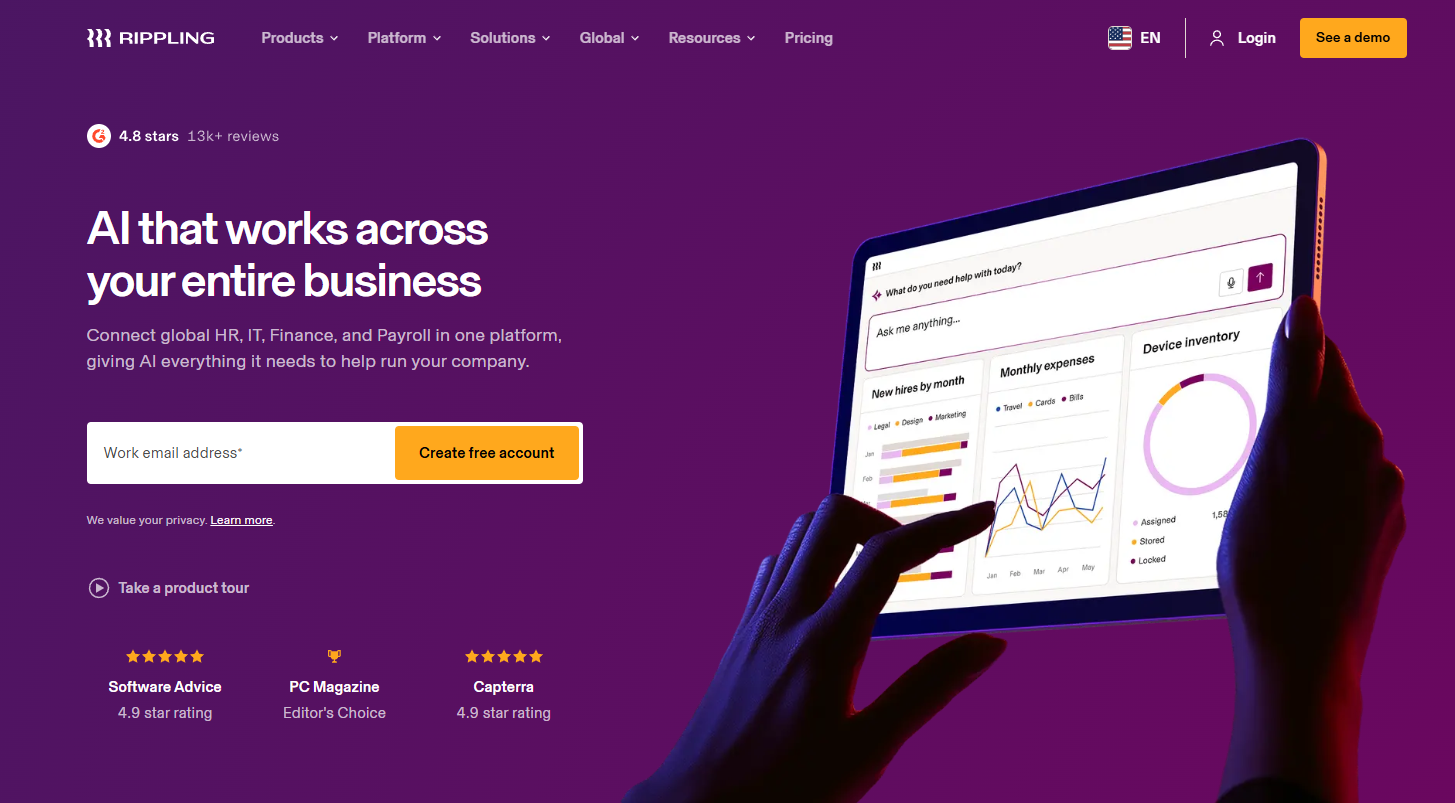
Rippling is the pick when you want more than EOR. It unifies global EOR and payroll with HR, IT (device and app management), and finance on a single platform, replacing the thin layer RemoFirst sits on.
What it does better than RemoFirst:
- Unifies global EOR with HR, IT, and finance in one system of record
- 600-plus integrations, far beyond RemoFirst’s catalog
- Modern automation and 24/7 support
- Strong fit for tech-forward teams wanting one platform
Where RemoFirst still wins:
- Quote-based and module-priced, with no published flat $199
- Much more expensive once modules stack up
- Overkill for a team that only needs EOR
EOR price:
Custom / quote
Contractor:
Quote
Countries:
Global
Entity model:
Owned + partner
G2:
4.8/5
Pick it over RemoFirst if:
you want to consolidate HR, IT, and global employment on one platform.
Stick with RemoFirst if:
you only need EOR and value RemoFirst’s published flat pricing.
Premium RemoFirst Alternative: Oyster HR
#5 Oyster HR: Best for benefits quality and European experience
Oyster HR
Oyster is a premium EOR at about $699 per employee per month. It shares RemoFirst’s partner-only structure, but its bundled benefits and polished employee experience, especially in Europe, are a clear step up.
What it does better than RemoFirst:
- Bundled premium benefits (private health, wellness, mental health)
- Significantly stronger employee experience, especially in Europe
- B Corp positioning and a polished employee portal
- Mature support model
Where RemoFirst still wins:
- About 3.5 times the price ($699 vs $199)
- 100% partner entities, the same structural limit as RemoFirst
- No free contractor tier
EOR price:
~$699/ee/mo
Contractor:
$29/ee/mo
Countries:
180+
Entity model:
100% partner
G2:
4.4/5
Pick it over RemoFirst if:
employee benefits, quality, and a premium European experience are the priority.
Stick with RemoFirst if:
cost matters more than bundled benefits, since the entity model is the same.
*As pricing is subject to change, we are listing prices as they stand in June 2026
Same-Tier RemoFirst Alternative: Native Teams
Native Teams
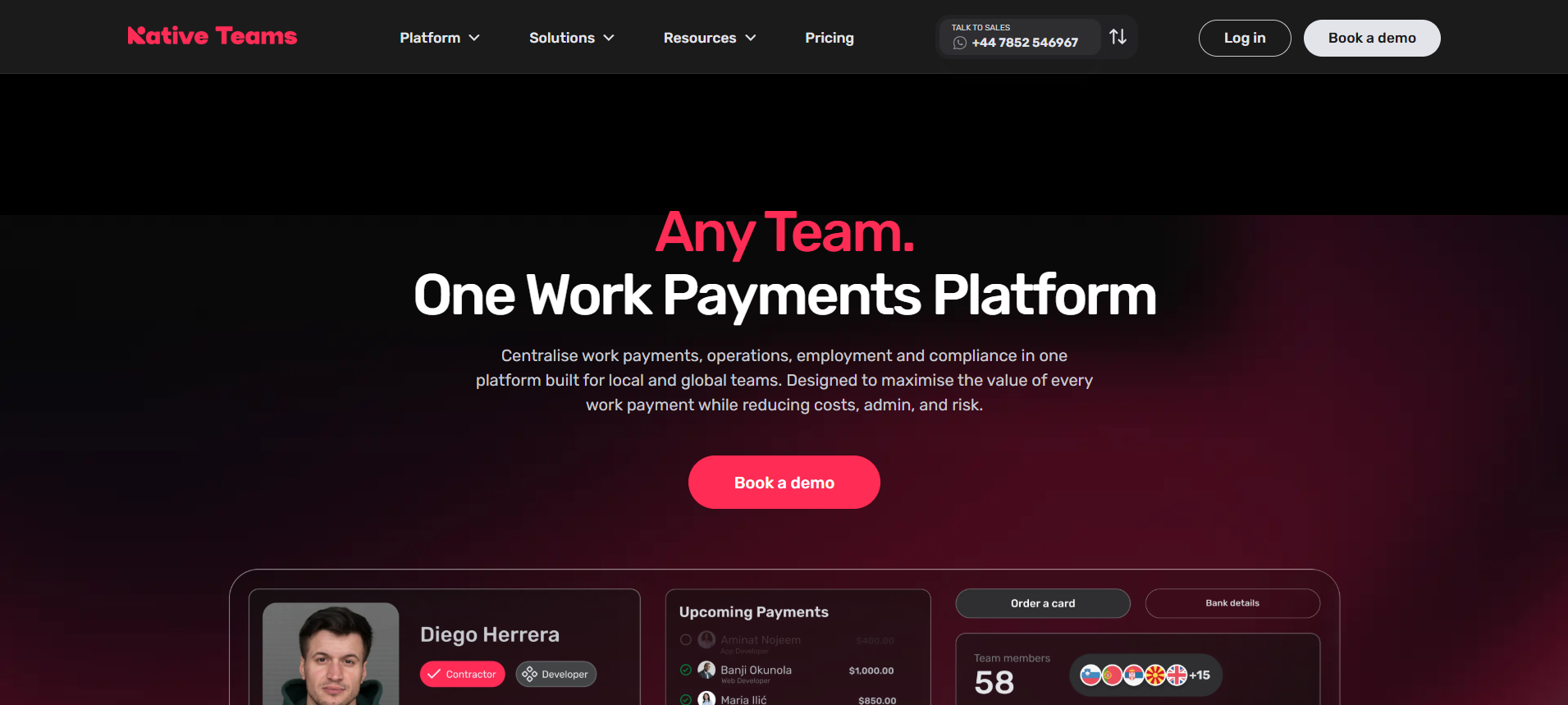
Native Teams is the closest same-tier peer, a budget-positioned EOR with a strong European focus. Its tiered pricing starts at about $99 per employee per month, so for many European hires, it can come in below RemoFirst’s flat $199.
What it does better than RemoFirst:
- Stronger European execution and local depth
- Tiered pricing from about $99 that can beat RemoFirst on cost
- Contractor management at about $19, below most rivals
- Transparent pricing with an alternative cost-leader positioning
Where RemoFirst still wins:
- Narrower global footprint (about 85 countries vs 185-plus)
- Less established brand and a smaller integration catalog
- No AI-native equivalent to RemoAI or RemoFirst’s BambooHR depth
EOR price:
from ~$99/ee/mo (tiered)
Contractor:
$19/ee/mo
Countries:
85+
Entity model:
Partner
G2:
4.5/5
Pick it over RemoFirst if:
your hiring is European and you want a transparent budget EOR that can undercut RemoFirst.
Stick with RemoFirst if:
you need broad global reach, a larger integration catalog, or RemoFirst’s AI tooling.
*As pricing is subject to change, we are listing prices as they stand in June 2026
Specialized RemoFirst Alternative: Pebl (formerly Velocity Global)
#7 Pebl: Best for M&A and immigration heritage
Pebl

Pebl, the EOR rebranded from Velocity Global in September 2025, is a compliance-first option at $399 promotional or $599 standard per employee per month. Its heritage is in M&A and immigration, with a deeper legal team than a budget EOR typically has.
What it does better than RemoFirst:
- M&A, immigration, and visa specialization
- Hands-on compliance consulting
- Broad 185-plus country footprint with a deep legal team
- Number-one compliance rating on G2
Where RemoFirst still wins:
- Two to three times the price even on promo ($399 promo / $599 std vs $199)
- Post-rebrand transition friction since September 2025
- A G2 4.6 versus Trustpilot 2.4 split signals an inconsistent experience
EOR price:
$399 promo / $599 std
Contractor:
Quote
Countries:
185+
Entity model:
Owned + partner
G2:
4.6/5 (Trustpilot 2.4)
Pick it over RemoFirst if:
you need M&A, immigration, or hands-on compliance consulting that a budget EOR cannot provide.
Stick with RemoFirst if:
you want predictable published pricing without promo-to-standard step-ups.
*As pricing is subject to change, we are listing prices as they stand in June 2026
Enterprise RemoFirst Alternative: Papaya Global
#8 Papaya Global: Best for enterprise multi-country payroll
Papaya Global
Papaya Global is the enterprise end of the comparison, a Workforce Operating System with EOR at about $650 to $770 per employee per month and global payroll from $5 to $29. It is for teams projecting they will outgrow the entire budget tier soon, not just RemoFirst.
What it does better than RemoFirst:
- Enterprise payroll consolidation across 20-plus countries
- Payments OS for cross-border payment orchestration
- Deeper workforce analytics than most EOR rivals
- Enterprise integrations such as SAP and Workday
Where RemoFirst still wins:
- Three to four times the price
- Two-year contracts are typical
- Enterprise infrastructure is overkill if you are only outgrowing the budget tier
EOR price:
~$650-770/ee/mo
Contractor:
$5-30/ee/mo
Countries:
160+
Entity model:
Owned + partner
G2:
4.5/5
Pick it over RemoFirst if:
you are consolidating payroll across many countries at true enterprise scale.
Stick with RemoFirst if:
you are simply outgrowing the budget tier and do not need enterprise payroll infrastructure.
*As pricing is subject to change, we are listing prices as they stand in June 2026
Compliance-Certified RemoFirst Alternative: WorkMotion
#9 WorkMotion: Best for certified compliance and European depth
WorkMotion
WorkMotion is a Berlin-based EOR at EUR 499 (about $549) per employee per month, covering 160+ countries through its own entity network. It directly addresses RemoFirst’s partner-only structure: the first and only EOR worldwide to hold IEC Gold Certification for compliance, independently audited across 10+ legal and operational categories.
What it does better than RemoFirst:
- Own entity network versus RemoFirst’s partner-only model, with a direct liability chain
- Independently certified compliance (IEC Gold), not self-assessed
- Deeper European execution, including German employment law and works council requirements
- Synmatch AI adds AI-sourced, pre-screened candidates alongside the EOR workflow
Where RemoFirst still wins:
- Lower price ($199 vs about $549) with volume discounts at 50-plus employees
- Free contractor tier, where WorkMotion charges from EUR 29 per contractor
- Broader country footprint (185-plus vs 160-plus)
EOR price:
€499 (~$549)/ee/mo
Contractor:
€29/ee/mo
Countries:
160+
Entity model:
Owned
G2:
4.6/5
Pick it over RemoFirst if:
certified compliance, own-entity onboarding, or deep EU employment law support outweighs the budget-tier price.
Stick with RemoFirst if:
cost leadership and maximum country reach matter more than certification and entity ownership.
*As pricing is subject to change, we are listing prices as they stand in September 2026
Which RemoFirst Alternative Fits Your Use Case
Best RemoFirst Alternative for Scaling Teams
The best RemoFirst alternative for scaling teams is Multiplier at about $459, then Deel at about $599. Both add platform automation and support depth that absorb the admin overhead generated by a growing team. Multiplier is the gentler step-up; Deel is the choice when you want the deepest tooling and 24/7 support as headcount and complexity climb past the 10-15 employee crossover.
Best RemoFirst Alternative with Owned Entities
For RemoFirst alternatives with owned entities, Remote is the clearest pick: 100% owned entities in about 80 countries, a direct liability chain, and a number-one G2 compliance posture. Deel offers a broad mix of owned and partner channels for broader coverage. This is the structural answer to RemoFirst’s partner-only ceiling for IP-sensitive or regulated buyers.
Best RemoFirst Alternative for Complex Markets
For Germany, Brazil, Japan, and other heavily regulated markets, Deel wins on breadth of owned-entity coverage and mature edge-case handling, while Remote wins on compliance consistency through 100% owned entities. Both remove the partner-quality variance that RemoFirst reviewers flag in exactly these jurisdictions, which is often the sole trigger for a first complex-market hire to move up a tier.
Best RemoFirst Alternative for 24/7 Support
If round-the-clock coverage is the constraint, Deel and Rippling both offer 24/7 support, compared to RemoFirst’s 24/5 window. Teams spread across many time zones, or in industries that cannot wait for a business-hours reply, feel this gap first, and it is a clean, single-reason case for paying the premium.
Best All-in-One RemoFirst Alternative for HR and IT
For teams seeking a single system of record across HR, IT, and global employment, Rippling is the all-in-one alternative. It folds device and app management, HR, and finance into the same platform as EOR and payroll, which RemoFirst, as a focused EOR, does not attempt.
Best Same-Tier RemoFirst Alternative
Buyers who like RemoFirst’s pricing but want a different positioning should consider Native Teams. It is a same-tier peer, with tiered pricing starting at about $99 and a stronger European footprint. Some teams prefer it purely for regional fit at a similar or lower cost.
When RemoFirst Is Still the Right Choice
RemoFirst remains the right call for teams of 10 to 15 employees, simple-market hires, and contractor-heavy workforces that leverage the free contractor tier. It also fits BambooHR-using stacks after the March 2026 integration, as well as any scenario where cost is the top constraint and hiring is straightforward. Conceding this is not a hedge: it is the accurate answer for RemoFirst’s target buyer, and the rest of this comparison only matters once a structural limit applies.
How to Switch From RemoFirst
Switching off RemoFirst is straightforward, since it has none of the minimum-term lock-in friction that enterprise platforms impose. Work through these steps in order.
- Check your current RemoFirst contract terms and notice period before you sign elsewhere.
- Plan the legal-employer transition: employees re-onboard to the new EOR’s local entity in each country.
- Confirm benefits and equity continuity, since RemoFirst’s partner benefits may not transfer to the new provider.
- Align payroll-cycle continuity to ensure there is no gap or double payment during the switch month.
- Budget for a deposit. A new provider like Remote or Deel may require a deposit; RemoFirst did not, which is a real cash-flow consideration.
- Use the move to consolidate contractor management if you have been mixing providers, especially when moving to Deel’s free tier.
Run the transition with a short overlap so each employee is active on the new entity before RemoFirst offboards them.
FAQs on RemoFirst Alternatives
Who are RemoFirst’s main competitors?
RemoFirst’s main competitors are Multiplier as the natural step-up, followed by Deel, Remote, and Rippling in the premium tier. Native Teams is the same-tier budget peer, while Oyster HR, Papaya Global, Pebl, and WorkMotion are specialized alternatives for benefits, enterprise payroll, M&A or immigration, and certified European compliance.
What is the best alternative to RemoFirst?
The best alternative to RemoFirst depends on size and need. Multiplier (about $459) is the natural step-up; Deel is best for speed and features; Remote is best for owned entities, and Native Teams is the pick for similar pricing with a European focus. There is no single winner, only the right match for your reason to move up.
When should I switch from RemoFirst?
Switch around 10 to 15 employees at your first complex-market hire in Germany, Brazil, or Japan, if you need 24/7 support or owned-entity compliance, or if admin overhead managing edge cases exceeds about 18 hours per month. Below those triggers, RemoFirst’s cost advantage usually still wins.
Is RemoFirst cheaper than Deel?
Yes. RemoFirst is cheaper than Deel by about $400 per employee per month at single-employee pricing ($199 vs $599), and the gap widens at 50-plus employees, where RemoFirst drops to $129-$149 while Deel holds near $599. Deel justifies the premium only through deeper automation, 24/7 support, and depth in complex markets.
Does RemoFirst have owned entities?
No. RemoFirst uses a partner-only entity model with no owned entities, so consistency depends on the quality of local partners. For owned-entity coverage, Remote (about $599, 100% owned) is the primary alternative, while Deel offers a broad mix of owned-plus-partner options. This is the central structural reason buyers move up from RemoFirst.
Who has more market share, RemoFirst or Deel?
On RemoFirst competitors market share, Deel is the market leader by a wide margin, the largest EOR by revenue and customer count. RemoFirst is the budget-tier leader, growing fast on the back of cost transparency and its AI-native RemoAI positioning. They lead different segments rather than competing for the same one.
Verdict: The Best RemoFirst Alternative for You
Pick Multiplier (about $459) as the natural step-up, Deel for speed and the deepest features, Remote for 100% owned entities, Rippling for HR plus IT plus global on one platform, Oyster for European benefits quality, Native Teams as the same-tier European peer, Pebl for M&A and immigration heritage, Papaya Global for enterprise payroll consolidation, and WorkMotion for independently certified compliance with European depth. But RemoFirst itself is still the right call when cost is the top constraint and your hiring is straightforward: under 10–15 employees, simple markets, or a contractor-heavy team using the free tier. Move up only when a specific structural limit, not the price, is the thing holding you back.

Yaryna is our lead writer with over 8 years of experience in crafting clear, compelling, and insightful content. Specializing in global employment and EOR solutions, she simplifies complex concepts to help businesses expand their remote teams with confidence. With a strong background working alongside diverse product and software teams, Yaryna brings a tech-savvy perspective to her writing, delivering both in-depth analysis and valuable insights.