A senior engineer was promoted verbally in a 1:1 six months ago. She updated her title on LinkedIn, started running the team stand-up, and assumed the raise would appear in the next payroll cycle. It did not. When her manager moved to another company, HR had no record of the promotion and no signed document to reference. The dispute took four weeks to resolve. A single promotion letter template, signed on the day of the decision, would have prevented all of it.
Distributed teams face this problem at scale. Promotion decisions happen in private Slack messages and video calls, with no consistent format and no paper trail. Two employees in different time zones can receive verbally identical offers and end up with different salaries, titles, and start dates because no one wrote it down the same way twice.
This article covers nine templates across three perspectives: letters the company sends to an employee to confirm a promotion or raise, recommendation letters a manager submits to HR, and request letters an employee writes to make the case for advancement. Each template includes a ready-to-use text version and a clean image-ready version.
What Is a Promotion Letter
A promotion letter is a formal written document that records a change in an employee’s title, responsibilities, compensation, or all three. It is not a substitute for the conversation that precedes it. It is the written record that makes that conversation enforceable. Most HRIS platforms and payroll systems will not process a title or salary change without a signed letter on file.
Without a written letter of promotion template, both parties rely on memory. The employee recalls one set of terms; the company’s records show another. A signed document removes that ambiguity. The effective date is stated. The new salary is confirmed. The scope of the new role is defined.
This article covers three distinct document types. The first group is sent by the company to the employee: formal confirmations of promotions, salary adjustments, and announcements. The second is written by a manager and submitted to HR as a recommendation. The third is written by an employee requesting a promotion, a raise, or a formal internal transfer.
Why Companies Need Promotion Letter Templates
Promotions are high-stakes decisions. According to SHRM, replacing a mid-level employee costs between 50% and 200% of their annual salary. Internal promotion is one of the most cost-effective retention tools available. Using a consistent succession plan template ensures that every promotion feeds into a documented talent pipeline, not just an ad hoc decision.
Without standard templates, promotion documentation varies by manager. One department issues formal letters with a signed acceptance. Another sends a one-line email. That inconsistency creates legal exposure, payroll errors, and morale problems when employees compare notes across departments.
- Document every promotion and salary change consistently for HRIS, payroll, and audits.
- Remove ambiguity around new title, effective date, responsibilities, and compensation.
- Give managers a clean starting point instead of drafting from scratch each cycle.
- Support distributed teams where decisions cannot rely on in-person conversations.
- Create a paper trail that supports future performance reviews and compliance audits.
Promotion decisions are most defensible when they follow a documented review process. Using an employee performance review template before a promotion cycle gives HR the evidence it needs to approve and record the change consistently across the organisation.
9 Promotion Letter Template Examples
The templates below cover every common scenario: company-issued confirmations, manager recommendations, and employee requests. Each includes a body-text version for use in the article and a clean image-ready version. Placeholders appear in square brackets. Adapt tone and legal language to your organisation’s standards before sending.
Company-to-Employee Templates
These four templates are written by HR or a direct manager and sent to the employee. They cover standard promotion confirmations, formal offer letters, compensation-only adjustments, and team-wide announcements.
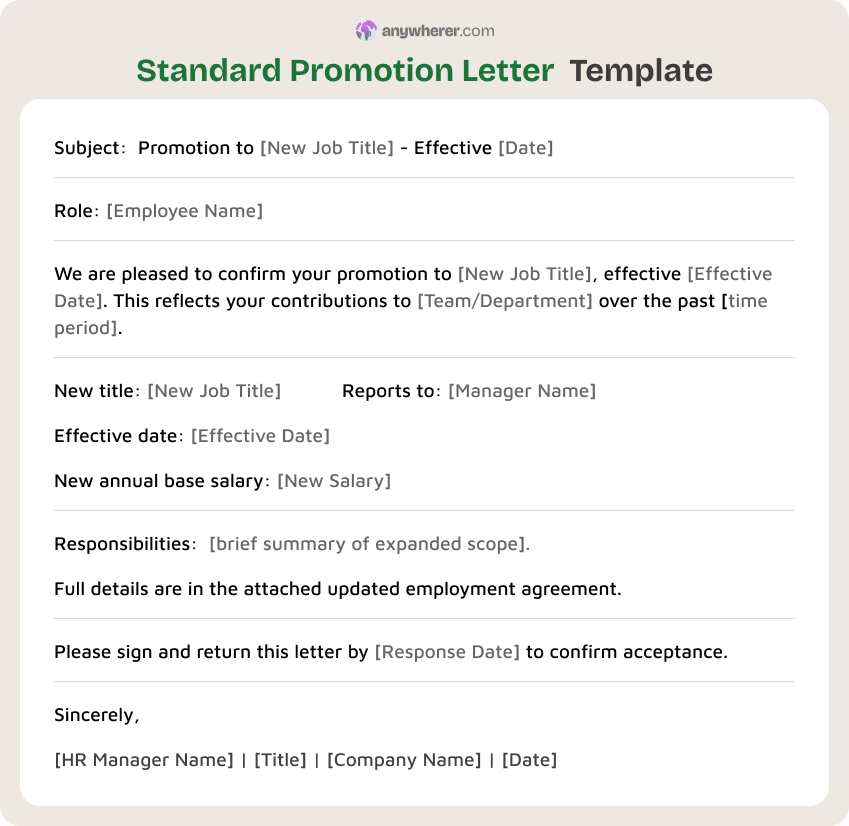
1. Standard Promotion Letter Template
This is the general-purpose employee promotion letter template. HR or a direct manager uses it to formally confirm a promotion to a new role, including the updated title, responsibilities, effective date, and new compensation. It works as a free promotion letter template for any role or level and is the most commonly requested sample promotion letter template across HR teams.
Template sections:
- Opening – formal greeting and promotion announcement.
- New role and title – full new job title and reporting line.
- Effective date – exact date the change takes effect.
- New compensation – new base salary and any changes to bonus, equity, or benefits.
- Updated responsibilities – brief summary of expanded scope.
- Closing and signature – HR or manager signature; employee acceptance line.
Template (ready-to-use text):
Subject: Promotion to [New Job Title] – Effective [Date]
Dear [Employee Name],
We are pleased to confirm your promotion to [New Job Title], effective [Effective Date]. This reflects the quality of your work and your impact on [Team/Department] over the past [time period].
In this role, you will be responsible for [summary of new responsibilities]. You will continue to report to [Manager Name].
Your new annual base salary will be [New Salary], effective [Effective Date]. Details on any changes to bonus eligibility, equity, or benefits are outlined in the updated employment agreement attached.
Please sign and return a copy of this letter by [Response Date] to confirm your acceptance.
Congratulations, and we look forward to your continued contribution.
Sincerely,
[HR Manager Name]
[Title]
[Company Name]
[Date]
Best for: Standard promotions across most roles and levels. Suitable for both in-office and remote employees.
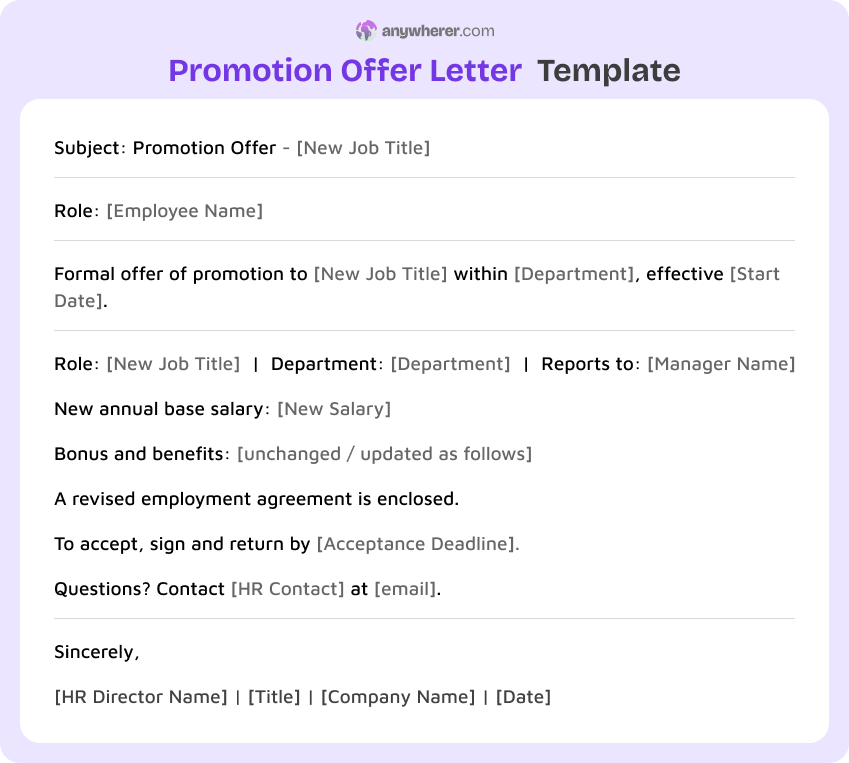
2. Promotion Offer Letter Template
This promotion offer letter template is used when a promotion requires the employee’s formal written acceptance before taking effect. It applies to senior-level moves, leadership changes, or any situation involving equity or contract amendments. It mirrors a job offer letter template but applies to internal movement rather than external hiring.
Template sections:
- Opening – formal offer statement with new role name.
- New role and reporting line – title, department, and manager.
- Compensation – new base salary, bonus, equity, and benefits changes.
- Effective date – when the new role begins.
- Acceptance deadline – date by which the employee must respond.
- Signature and acceptance line – both parties sign.
Template (ready-to-use text):
Subject: Promotion Offer – [New Job Title]
Dear [Employee Name],
This letter is a formal offer of promotion to the position of [New Job Title] within [Department], effective [Start Date].
In your new role, you will be responsible for [key responsibilities]. You will report to [Manager Name], [Manager Title].
Effective [Start Date], your annual base salary will be [New Salary]. Your bonus and benefits [will remain unchanged / will be updated as follows: details]. A revised employment agreement is enclosed.
To accept this offer, please sign and return the enclosed agreement by [Acceptance Deadline]. For questions, contact [HR Contact Name] at [email].
We look forward to your continued growth with [Company Name].
Sincerely,
[HR Director Name]
[Title]
[Company Name]
[Date]
Best for: Senior-level promotions or any move where the new terms require written acceptance before taking effect.
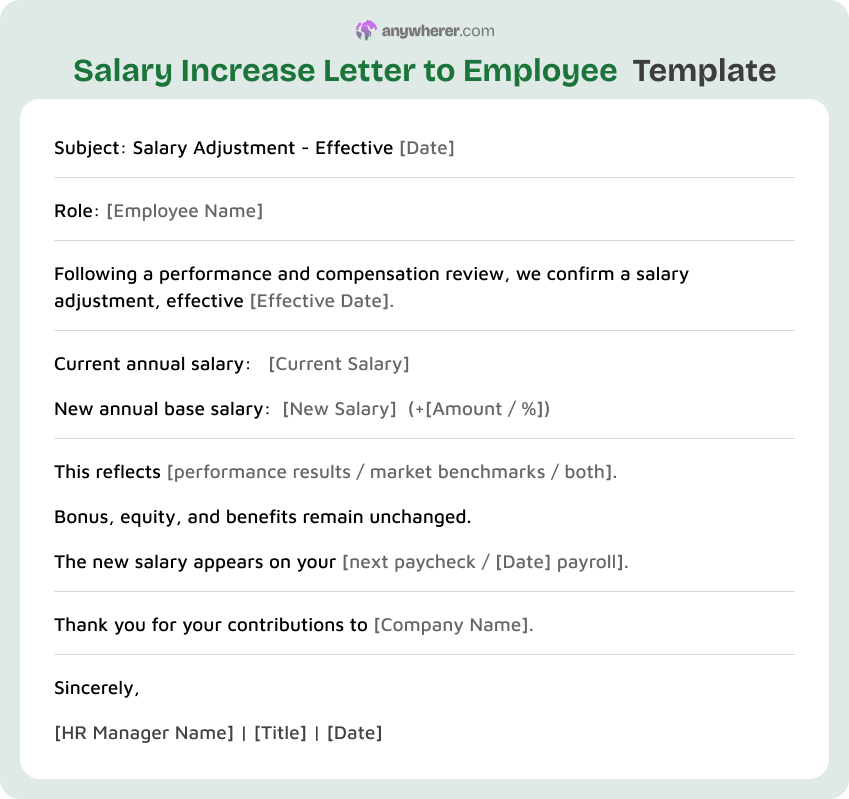
3. Salary Increase Letter to Employee Template
This salary increase letter to employee template documents a merit raise or cost-of-living adjustment without a title change. Use this salary increase letter template when the compensation review is independent of a promotion, for example, after a strong annual performance cycle or a market benchmarking exercise.
Template sections:
- Opening – confirmation of the salary review outcome.
- Current vs new compensation – both figures stated clearly.
- Effective date – exact payroll effective date.
- Rationale – brief context: performance results, market data, or both.
- Unchanged elements – confirm bonus, equity, and benefits are not affected.
- Closing – acknowledge the employee; no acceptance signature required in most cases.
Template (ready-to-use text):
Subject: Salary Adjustment – Effective [Date]
Dear [Employee Name],
Following a review of your performance and current compensation, we are pleased to confirm an adjustment to your annual base salary, effective [Effective Date].
Your new annual base salary will be [New Salary], an increase of [Amount or %] from your current salary of [Current Salary]. This adjustment reflects [your performance in [period] / current market benchmarks for your role / both].
Your other compensation elements, including [bonus structure, equity, and benefits], remain unchanged. The updated salary will appear on your [next paycheck / [specific date] payroll].
Thank you for your continued contributions to [Company Name].
Sincerely,
[HR Manager Name]
[Title]
[Date]
Best for: Merit increases, cost-of-living adjustments, or market realignment raises where the title stays the same.
4. Promotion Announcement Letter / Email Template
This template is shared with a team or the whole organization to announce a promotion publicly. Send it only after the employee has received and accepted their individual promotion letter. Keep it brief, specific, and free of salary details.
Template sections:
- Subject line – employee name and new title.
- Opening – warm, direct announcement with effective date.
- Context and accomplishments – one or two specific achievements that led to the promotion.
- New scope – brief overview of the employee’s expanded responsibilities.
- Call to congratulate – invite the team to celebrate.
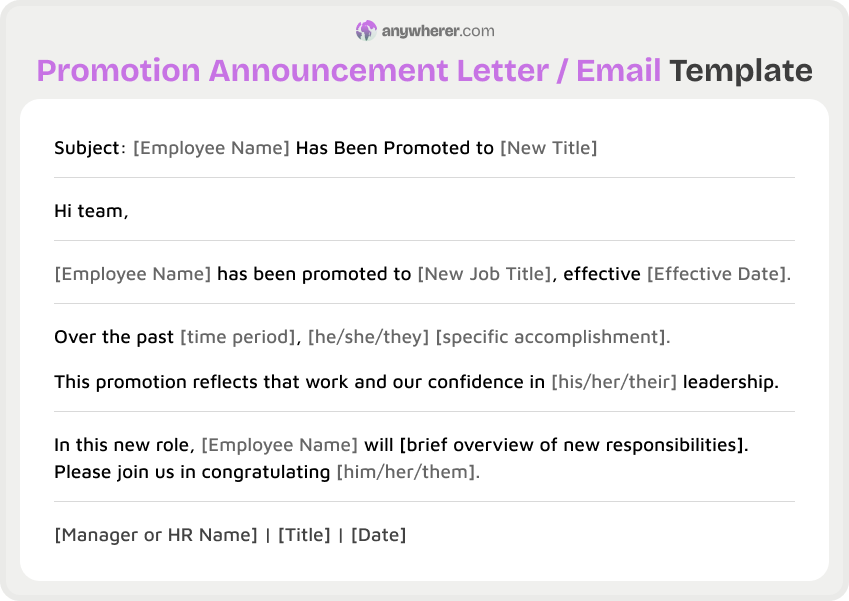
Template (ready-to-use text):
Subject: [Employee Name] Has Been Promoted to [New Title]
Hi team,
We are pleased to share that [Employee Name] has been promoted to [New Job Title], effective [Effective Date].
Over the past [time period], [Employee Name] has [specific accomplishment, e.g., led the redesign of our onboarding process, reducing time-to-productivity by 25%]. This promotion reflects that impact and our confidence in [his/her/their] ability to take on a broader remit.
In this new role, [Employee Name] will [brief overview of new responsibilities]. Please join us in congratulating [him/her/them].
[Manager or HR Name]
[Title]
[Date]
Best for: Internal team announcements and all-hands emails after a confirmed promotion.
Manager-to-HR Template
This template is written by a people manager and submitted to HR or a promotion committee. It provides the evidence and rationale HR needs to approve and process the change.
1. Manager’s Promotion Recommendation Letter Template
A manager uses this template to formally endorse an employee for promotion and submit a written recommendation to HR or a committee. It is most effective when paired with recent performance review data, giving HR concrete evidence rather than general praise.
Template sections:
- Memo header – To, From, Re, Date.
- Employee name and current role – exact title and tenure in role.
- Performance evidence – two or three specific, quantified accomplishments.
- Proposed role and rationale – new title and why the employee is ready.
- De facto scope – note if the employee already operates at the higher level.
- Recommendation statement – clear, unambiguous endorsement.
- Manager signature – name, title, date.
Template (ready-to-use text):
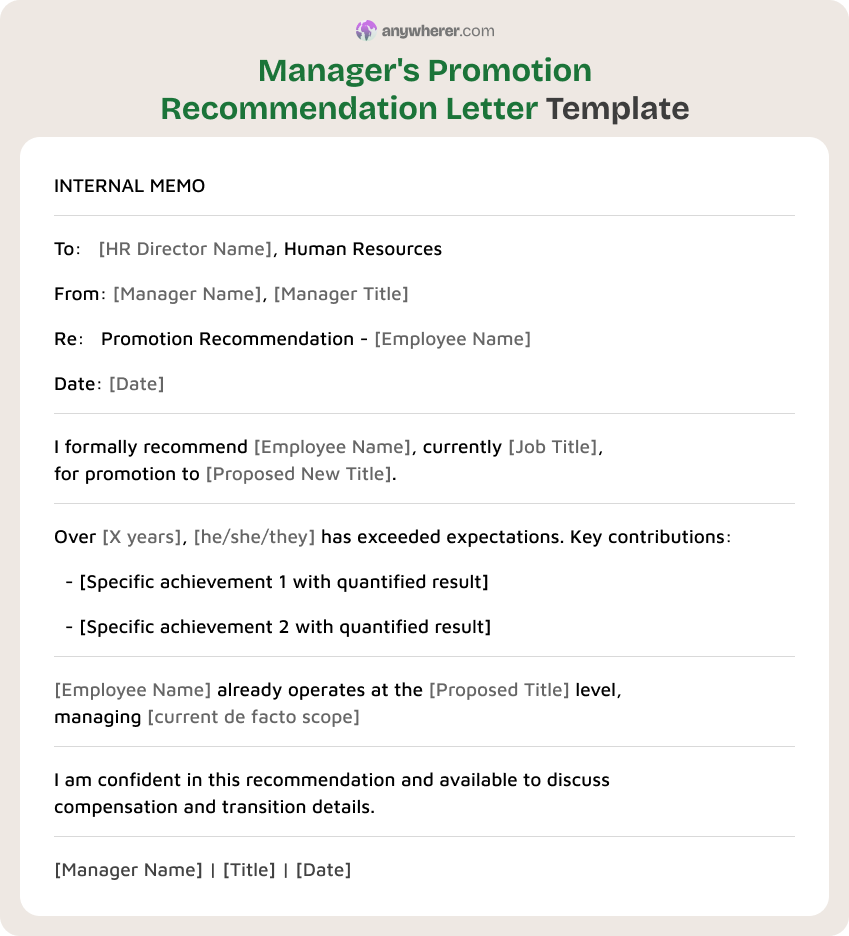
[Company Letterhead / Internal Memo]
To: [HR Director Name], Human Resources
From: [Manager Name], [Manager Title]
Re: Promotion Recommendation – [Employee Name]
Date: [Date]
I am writing to formally recommend [Employee Name], currently [Job Title], for promotion to [Proposed New Title].
During [his/her/their] [X years] in this role, [Employee Name] has consistently exceeded performance expectations. Notable contributions include [specific example 1] and [specific example 2]. [He/She/They] currently operates at the level of [Proposed Title] in practice, managing [brief description of current de facto scope].
I believe this promotion reflects the work [he/she/they] is already doing and positions [him/her/them] for continued growth within [Company Name]. I am available to discuss compensation recommendations at your convenience.
[Manager Name]
[Title]
[Date]
Best for: Formal promotion cycles where HR requires written manager endorsement before approving a change.
Employee-to-Manager Templates
These four templates are written by an employee and submitted to a manager, HR, or a hiring committee. They cover promotion requests, salary increase requests, letters of intent, and formal internal job applications.
1. Promotion Request Letter Template
This promotion request letter template is used by an employee who wants to formally ask their manager for a promotion. It works best when the employee references specific, quantified achievements. Employees preparing their case can align their evidence to documented performance goals examples to show readiness against measurable benchmarks.
Template sections:
- Opening – clear statement of intent.
- Current role context – title and time in role.
- Achievements and impact – two to three quantified results.
- Proposed new title – the specific role being requested.
- Rationale – why the promotion makes sense now.
- Proposed next step – request a meeting; keep it time-bound.
Template (ready-to-use text):
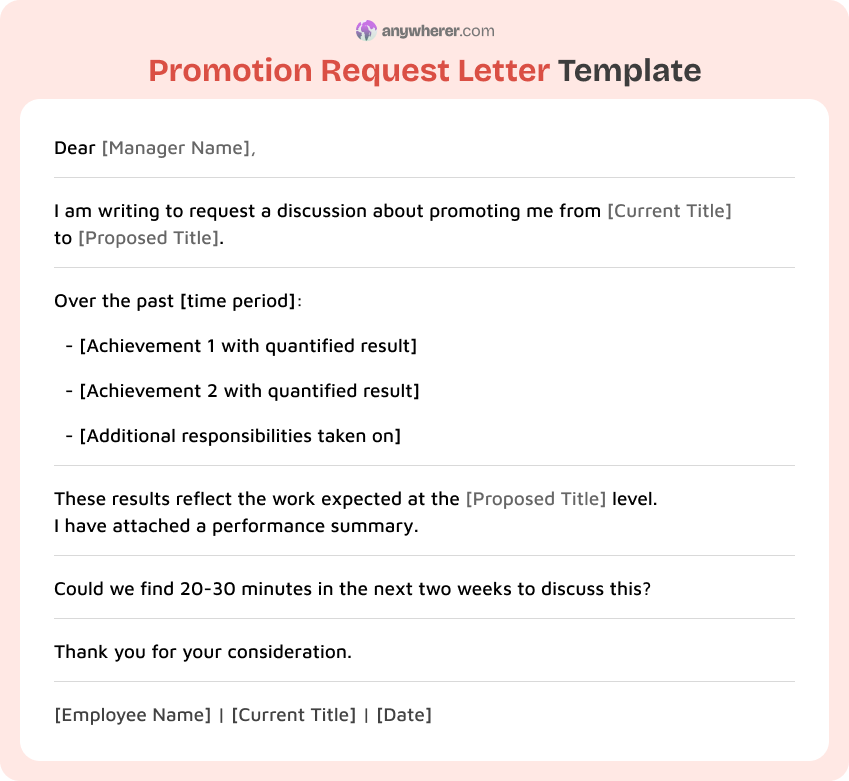
Dear [Manager Name],
I am writing to request a conversation about a potential promotion from [Current Title] to [Proposed Title].
Over the past [time period], I have [specific achievement 1, quantified], [specific achievement 2], and taken on [additional responsibilities] beyond my original scope. These contributions align with the work typically expected at the [Proposed Title] level.
I have attached a brief summary of my recent performance against team goals. I would welcome the chance to discuss this in a 20-to-30-minute meeting over the next two weeks.
Thank you for considering this.
[Employee Name]
[Current Title]
[Date]
Best for: Employees initiating a promotion conversation during a formal review cycle or at any point in the year.
2. Salary Increase / Pay Raise Request Letter Template
This salary increase request letter template, also used as a pay raise request letter template, is written by an employee requesting a compensation review. The strongest versions combine internal performance evidence with external market data. According to the PayScale 2026 Compensation Best Practices Report, employees who cite market benchmarks in salary conversations are significantly more likely to receive a positive outcome.
Template sections:
- Opening – direct statement of the request.
- Current compensation – current salary stated clearly.
- Achievements – quantified contributions since the last raise.
- Market context – relevant benchmark data and source.
- Requested salary – specific target figure or range.
- Proposed next step – request a meeting within a defined timeframe.
Template (ready-to-use text):
Dear [Manager Name],
I am writing to request a review of my current compensation. I would like to propose an adjustment from [Current Salary] to [Requested Salary].
Over the past [time period], I have [specific achievement with measurable impact]. I have also taken on [additional responsibilities] beyond my original scope.
Based on market data from [PayScale / LinkedIn / industry source], the typical range for a [Job Title] with my experience in [location/remote] is [market range]. My current salary of [Current Salary] falls below that range.
I am committed to [Company Name] and want to continue growing here. Could we schedule time to discuss this in the next two weeks?
Thank you for your time.
[Employee Name]
[Current Title]
[Date]
Best for: Employees seeking a merit raise outside of the standard promotion cycle, or where the title is not changing.
3. Letter of Intent for Promotion Template
This letter of intent for promotion template is used when an employee wants to formally declare interest in an upcoming internal role before it is posted or before a decision cycle opens. It is more forward-looking than a standard request letter. Employees can strengthen it by referencing documented performance goals to show readiness against measurable benchmarks.
Template sections:
- Opening – statement of intent, including the specific role or cycle.
- Current role and tenure – how long the employee has been in position.
- Relevant experience and development – key skills or milestones gained.
- Alignment with company goals – why now is the right time.
- Expression of interest – clear, non-demanding close.
- Proposed next step – ask for a conversation or to be included in the process.
Template (ready-to-use text):
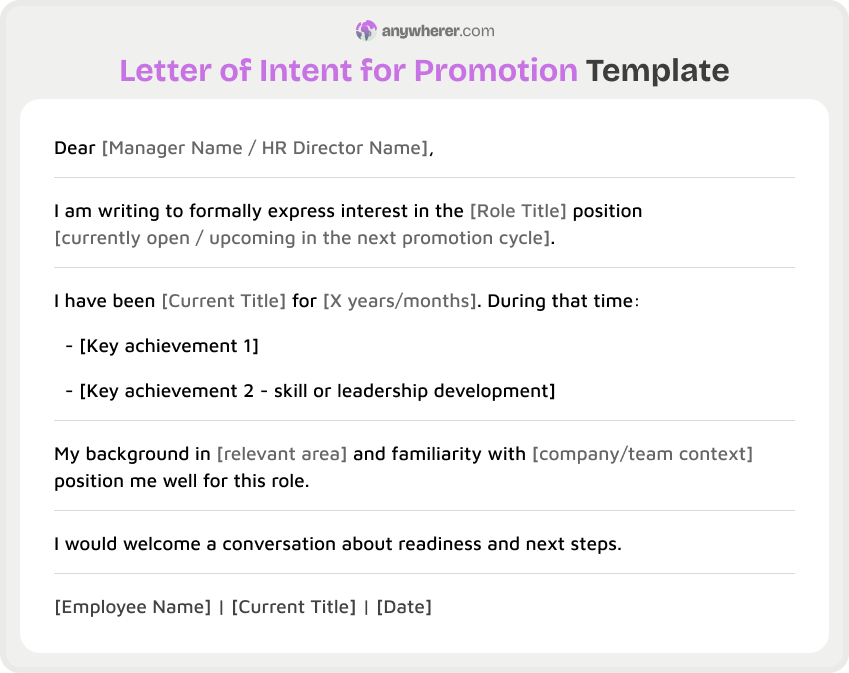
Dear [Manager Name / HR Director Name],
I am writing to formally express interest in the [Role Title] position [currently open / becoming available in the upcoming promotion cycle].
I have been [Current Title] for [X years/months]. During that time I have [key achievement, e.g., led a cross-functional project across three time zones, delivered two weeks ahead of schedule, and onboarded four new team members].
My experience with [relevant area] and familiarity with [company/team context] position me well for this role. I am committed to [Company Name] and eager to contribute at a higher level.
I would welcome a conversation about readiness expectations and next steps. Please let me know the appropriate route to express this interest formally.
[Employee Name]
[Current Title]
[Date]
Best for: Employees signalling interest in a role before a formal posting, or ahead of a company-wide promotion cycle.
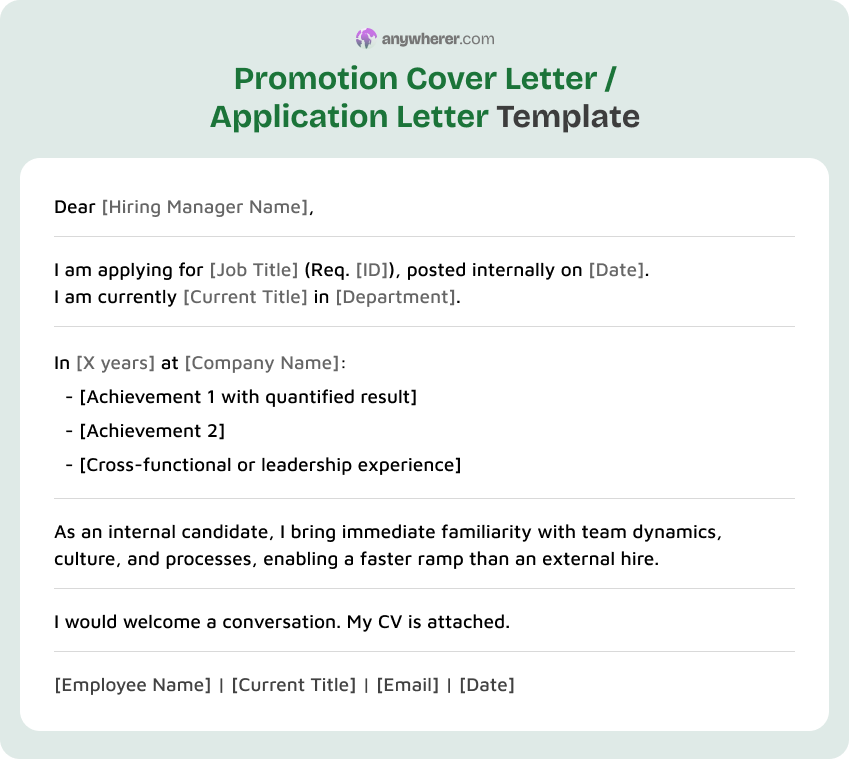
4. Promotion Cover Letter / Application Letter Template
This promotion cover letter template is for employees applying to a formally posted internal role. It follows the same structure as an external cover letter but emphasises institutional knowledge, existing relationships, and evidence that the employee already operates at the target level.
Template sections:
- Opening – role name, requisition ID, and current position.
- Relevant experience and achievements – two or three accomplishments from the current role.
- Internal candidate advantage – institutional knowledge, team relationships, culture fit.
- Readiness statement – evidence of already operating at the higher level.
- Closing and next step – clear ask; professional and brief.
Template (ready-to-use text):
Dear [Hiring Manager Name],
I am applying for the [Job Title] role (Requisition [ID]), posted internally on [Date]. I am currently [Current Title] in [Department].
In my [X years] at [Company Name], I have [specific achievement 1] and [specific achievement 2]. I also [relevant cross-functional experience, e.g., led the integration of two product teams during a restructure, cutting duplicated work by 20%].
As an internal candidate, I bring direct familiarity with [Company Name]’s processes, culture, and team dynamics. I am already working closely with [relevant team or stakeholder], which means I can contribute at full capacity from day one.
I would welcome a conversation about how my background fits the team’s needs. My CV is attached. Thank you for your consideration.
[Employee Name]
[Current Title] | [Department]
[Email] | [Date]
Best for: Employees applying for a formally posted internal opening through the standard recruiting process.
How to Use These Templates in a Promotion Cycle
Most organizations run formal promotion cycles once or twice per year, aligned with annual or mid-year performance reviews. Off-cycle promotions happen, but they require the same documentation. HRIS and payroll systems do not process title or salary changes without a signed letter on file.
The standard flow looks like this. The employee or manager initiates the conversation, typically supported by data from the most recent performance review. The manager submits a formal recommendation to HR (Template 5). HR reviews the request against compensation bands and budget. If approved, HR issues the company-to-employee letter (Templates 1 to 3). If the promotion is public, the announcement follows (Template 4).
For employee-initiated requests, the flow starts from the other direction. The employee submits a request or letter of intent (Templates 6 to 9). The manager decides whether to endorse and escalate. HR processes the approved change. In both cases, every step should produce a written record.
Key Elements Every Promotion Letter Should Include
A strong promotion letter should make the new role clear, confirm the business terms of the change, and give the employee a written record they can rely on. At minimum, include these details:
- Employee name and current role.
- New role title and reporting line.
- Effective date of the change.
- New compensation: base salary; equity; bonus; and benefits, if changed.
- Summary of new responsibilities.
- Acknowledgment of contributions that led to the promotion.
- Signature lines: HR, manager, and employee, where applicable.
- For request-side letters: clear ask, supporting evidence, and a proposed next step.
Common Mistakes in Promotion Letters
Even a simple promotion letter can create confusion if key details are missing or the language is too vague. These are the most common mistakes employers and employees should avoid:
- Verbal promotions were never formalized in writing, leading to disputes months later.
- Missing the effective date or the new compensation figure.
- Vague language about new responsibilities without specifics.
- Inconsistent promotion criteria are applied across managers and departments.
- Salary increase letters without context linking the raise to performance or market data.
- Employee request letters that are too long, too emotional, or rely on tenure alone.
- No documentation trail for HR audits or future performance reviews.
FAQs on Promotion Letter Templates
What should be included in a promotion letter?
A promotion letter should include the employee’s name and current role, the new title and reporting line, the effective date, updated compensation (base salary and any changes to bonuses or benefits), a summary of new responsibilities, and an acknowledgment of the work that led to the promotion. For formal offers requiring acceptance, include a signature line and a response deadline.
What is the difference between a promotion letter and a promotion offer letter?
A standard promotion letter confirms that a promotion has been approved and is informational. The employee acknowledges receipt but does not need to sign to accept. A promotion offer letter is a formal document that requires the employee’s written acceptance before the change takes effect. Use the offer letter format when the promotion involves material changes to contract terms, equity, or compensation structure.
How do you write a salary increase letter to an employee?
State the current and new salary figures clearly and include the effective date. Provide brief context: whether the increase reflects performance, market alignment, or both. Keep it factual. Confirm which other compensation elements remain unchanged. According to SHRM, the average merit increase in the U.S. was approximately 3.5% in 2024, so providing context helps the employee understand how their adjustment compares to broader benchmarks.
How do you write a promotion request letter?
Start with a direct statement of what you are requesting. Provide two or three quantified achievements that demonstrate you are already working at the level of the target role. Name the specific title you want. Close with a proposed next step: a 20- to 30-minute meeting within a defined timeframe. Keep the letter under one page. Emotional appeals and tenure arguments are less persuasive than evidence of measurable impact.
Should a promotion letter be public or kept private?
The individual promotion letter, which contains salary figures and personal terms, should always be private. Share it only with the employee, their manager, and HR. A separate announcement (Template 4) can go to the team or organization once the employee has accepted. Never include compensation details in a company-wide announcement.
How often should companies run promotion cycles?
Most organizations run formal promotion cycles one to two times per year, usually aligned with annual or mid-year performance reviews. This cadence helps managers compare employees fairly, plan compensation changes, and keep promotion decisions consistent across teams. Off-cycle promotions may still happen for exceptional performance, retention needs, or urgent business reasons, but they should follow the same approval and documentation process.

Yaryna is our lead writer with over 8 years of experience in crafting clear, compelling, and insightful content. Specializing in global employment and EOR solutions, she simplifies complex concepts to help businesses expand their remote teams with confidence. With a strong background working alongside diverse product and software teams, Yaryna brings a tech-savvy perspective to her writing, delivering both in-depth analysis and valuable insights.