Three interviewers leave the same conversation with three different impressions. One remembers a strong answer. Another remembers a vague example. A third is already comparing the candidate with someone from last week. Distributed panels make this worse because async video reviews leave more room for memory drift. An interview scorecard template gives the panel a shared way to score evidence before opinions start to blend.
The templates below help recruiters, HR leaders, and hiring managers turn interviews into comparable records. A recruitment process plan template can define the larger hiring workflow. The scorecard then keeps each interview focused on the role’s criteria.
SHRM recommends a structured, job-related evaluation to reduce hiring bias. The same idea sits behind every candidate interview scorecard template in this guide: define the signal first, then ask interviewers to score evidence against it.
What Is an Interview Scorecard
An interview scorecard is a structured rubric used to evaluate candidates against job-relevant criteria. It is scored by each interviewer and reviewed side by side during the hiring debrief.
A scorecard is not a free-form notes page. Notes can support the decision, but the core document should define the criteria, scale, evidence, and recommendation before interviews begin. Scorecards can support structured interviews, behavioral interviews, technical assessments, remote video panels, simple screens, and executive hiring. The format should change with the role and stage.
The best forms are simple enough for busy interviewers to finish the same day. They still need enough structure to show why one candidate advanced and another did not. That balance is what makes the scorecard useful for everyone on the panel after the interview is over.
Why Companies Need an Interview Scorecard Template
A template replaces gut feel with comparable scores. It gives interviewers the same criteria and makes the debrief less dependent on memory, confidence, or speaking order. A job interview scorecard template also keeps each evaluation tied to the same role requirements.
Bias reduction is another reason. Harvard Business Review argues that structured interviews help reduce interview bias by asking candidates the same questions and evaluating answers against consistent criteria. A scorecard turns that process into a written record.
The paper trail also matters. Recruiters can see who scored what, which evidence supported the score, and whether the final decision matched the rubric. LinkedIn Talent Solutions describes interviewer scorecards as a way to make hiring feedback more consistent. An interview scorecard form template gives that feedback a clear format. Distributed panels need that discipline because reviewers may work in different time zones.
7 Interview Scorecard Template Examples
The interview scorecard templates below cover general hiring, committee-based interviews, behavioral interviews, technical roles, lightweight forms, remote panels, and executive hiring. Use each example as a starting point, then adapt criteria and rating anchors before candidates enter the process.
Standard Interview Scorecard Template
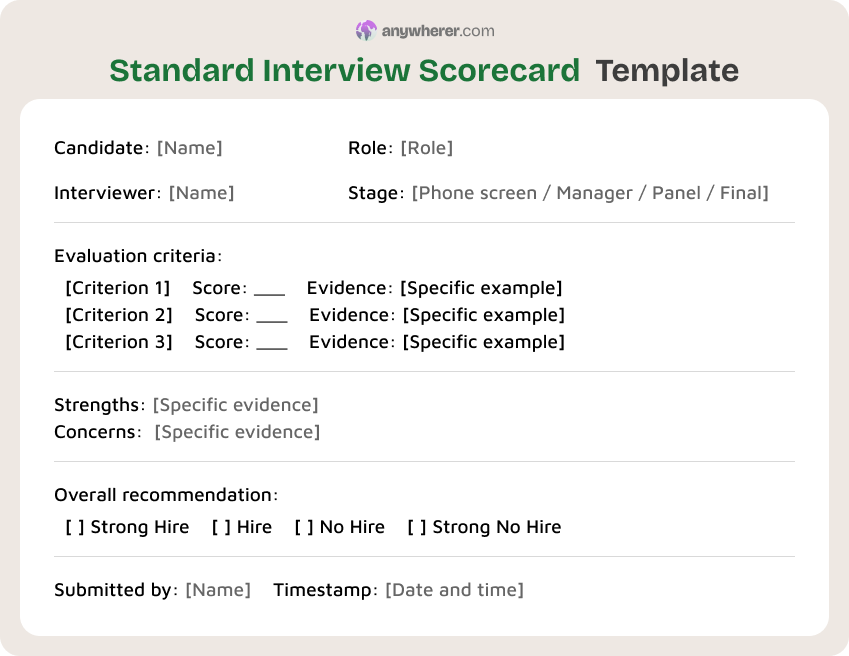
Purpose: Use this as a general-purpose scorecard for most roles and interview stages. It gives every interviewer the same fields before the hiring panel compares notes.
Scorecard sections:
- Candidate details: capture name, role, interview date, stage, and interviewer.
- Evaluation criteria: list job-relevant areas such as skills, communication, judgment, and motivation.
- Rating scale: define each level before interviews begin.
- Evidence field: requires specific examples for each criterion.
- Strengths and concerns: separate positive signals from open risks.
- Recommendation: select Strong Hire, Hire, No Hire, or Strong No Hire with timestamp.
Template (ready-to-use text):
- Candidate: [name]
- Role: [role]
- Interviewer: [name]
- Stage: [phone screen / manager interview / panel / final]
- Criteria: [criterion] | Score: [rating] | Evidence: [specific example]
- Strengths: [specific evidence]
- Concerns: [specific evidence]
- Overall recommendation: [Strong Hire / Hire / No Hire / Strong No Hire]
- Submitted by: [name and timestamp]
Best for: General-purpose hiring across most non-technical roles and interview stages.
Structured Interview Scorecard Template
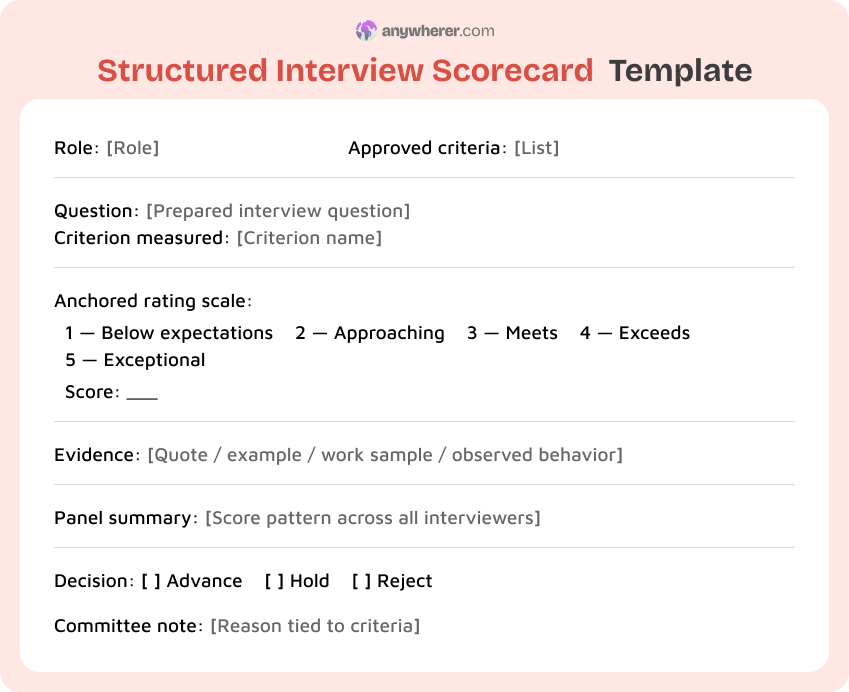
Purpose: A structured interview scorecard template fits hiring committees that use predetermined questions, anchored scoring, and a formal debrief. It is useful when consistency matters more than free-form impressions.
Scorecard sections:
- Role criteria: define the competencies approved by the hiring manager.
- Question mapping: connect each question to one criterion.
- Anchored scale: describe what each score means in plain language.
- Evidence notes: ask interviewers to record direct examples.
- Panel summary: compare scores before the discussion starts.
- Committee decision: record the final decision and reason.
Template (ready-to-use text):
- Role: [role]
- Approved criteria: [list of competencies]
- Interview question: [question]
- Criterion measured: [criterion]
- Rating: [anchored score]
- Evidence: [quote, example, work sample, or behavior]
- Panel summary: [score pattern across interviewers]
- Decision: [advance / hold / reject]
- Committee note: [reason tied to criteria]
Best for: Hiring teams looking for the best interview scorecard template for committee-based selection.
Behavioral Interview Scorecard Template
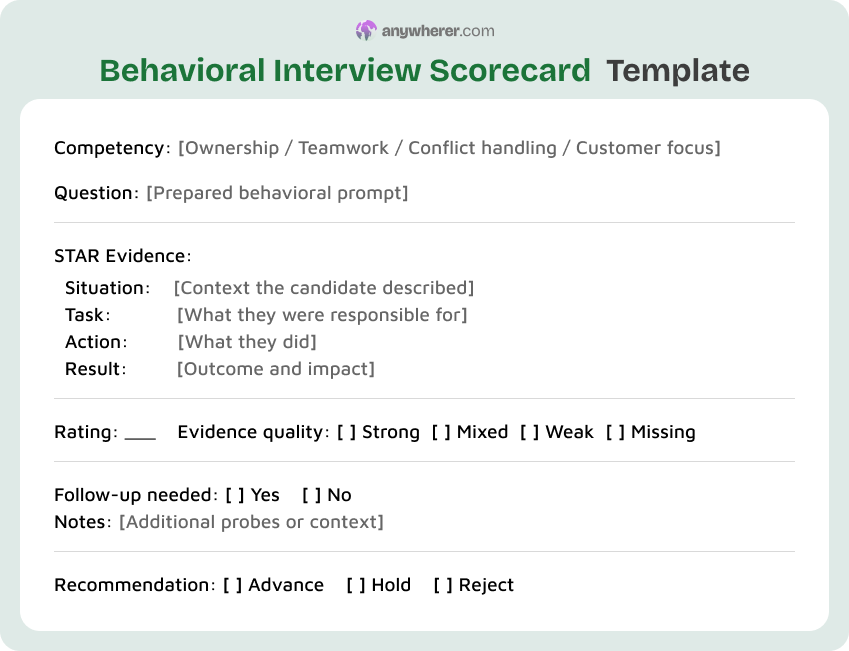
Purpose: A behavioral interview scorecard template helps interviewers evaluate past behavior using STAR-style evidence. It works well when the role requires judgment, collaboration, ownership, or customer handling.
Scorecard sections:
- Behavioral competency: define the behavior being assessed.
- Question prompt: use a prepared question tied to the competency.
- STAR evidence: capture situation, task, action, and result.
- Rating anchor: score evidence against the defined behavior.
- Follow-up notes: record probes from behavioral interview questions and related context.
- Scenario prompts: add situational interview questions when future judgment needs to be tested.
- Concern level: state whether the evidence is strong, mixed, weak, or missing.
Template (ready-to-use text):
- Competency: [ownership / teamwork / conflict handling / customer focus]
- Question: [prepared prompt]
- Situation: [what was the context?]
- Task: [what was the candidate responsible for?]
- Action: [what did the candidate do?]
- Result: [what was the outcome?]
- Rating: [score]
- Evidence quality: [strong / mixed / weak / missing]
- Follow-up needed: [yes / no]
- Recommendation: [advance / hold / reject]
Best for: Roles where prior behavior and situational interview questions matter more than a portfolio or test.
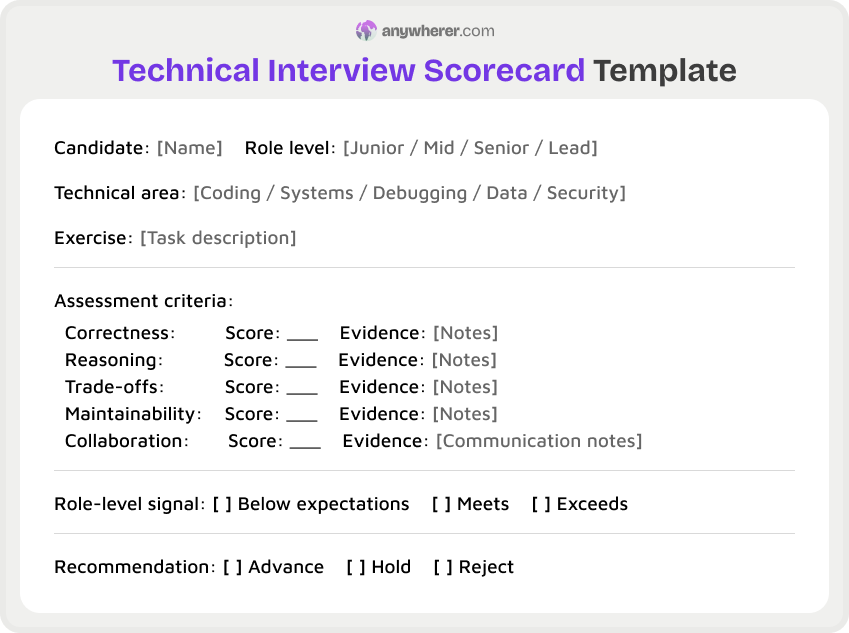
Technical Interview Scorecard Template
Purpose: A technical interview scorecard template helps engineering, IT, data, and security teams compare practical work evidence. It keeps code, architecture, debugging, and collaboration separate.
Scorecard sections:
- Technical area: define coding, systems, debugging, data, security, or platform focus.
- Problem statement: record the task or scenario given to the candidate.
- Assessment criteria: score correctness, reasoning, trade-offs, and maintainability.
- Collaboration notes: record communication, questions, and responses to hints.
- Risk notes: separate missing knowledge from coachable gaps.
- Hiring signal: state whether the evidence meets the role level.
Template (ready-to-use text):
- Role level: [junior / mid / senior / lead]
- Technical area: [coding / systems design / debugging / data / security]
- Technical exercise: [task description]
- Correctness: Score: ___ | Evidence: [notes]
- Reasoning: Score: ___ | Evidence: [notes]
- Trade-offs: Score: ___ | Evidence: [notes]
- Maintainability: Score: ___ | Evidence: [notes]
- Collaboration: Score: ___ | Evidence: [communication and question-handling notes]
- Role-level signal: [below / meets / exceeds]
- Recommendation: [advance / hold / reject]
Best for: Engineering, IT, security, data, and technical operations interviews.
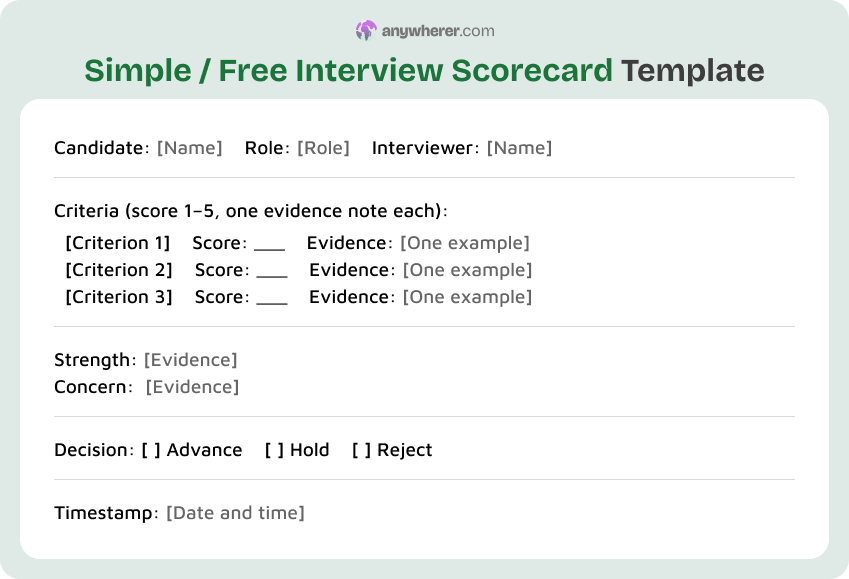
Simple / Free Interview Scorecard Template
Purpose: Use a free interview scorecard template when a team needs a lightweight form that still avoids scattered notes. It works best for early-stage or low-volume hiring.
Scorecard sections:
- Candidate and role: capture the basic hiring context.
- Three to five criteria: keep the scorecard short enough to use consistently.
- Simple scale: define a small rating range with plain descriptors.
- Evidence notes: require one example for each score.
- Decision field: record advance, hold, or reject.
- Interviewer timestamp: create a clear submission record.
Template (ready-to-use text):
- Candidate: [name]
- Role: [role]
- Interviewer: [name]
- Criterion 1: [name] | Score: ___ | Evidence: [one example]
- Criterion 2: [name] | Score: ___ | Evidence: [one example]
- Criterion 3: [name] | Score: ___ | Evidence: [one example]
- Strength: [evidence]
- Concern: [evidence]
- Decision: [advance / hold / reject]
- Timestamp: [date and time]
Best for: Small teams that need an interview scorecard template free version without a long rollout.
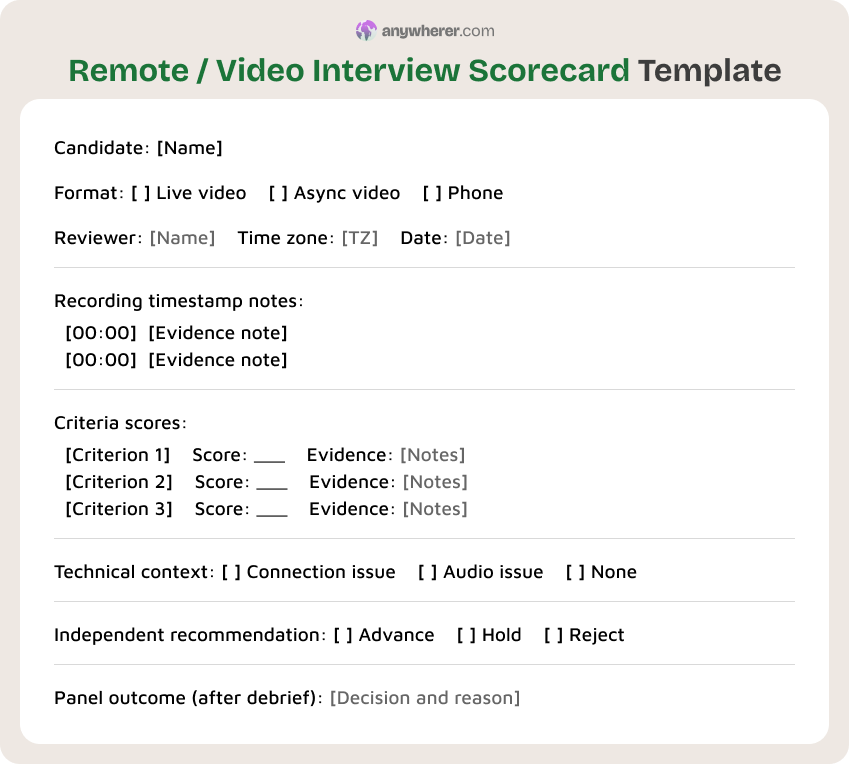
Remote / Video Interview Scorecard Template
Purpose: Use this for distributed hiring panels, video interviews, and async reviews. It keeps timing, recording notes, technical context, and independent scoring visible.
Scorecard sections:
- Interview format: live video, async recording, phone, or mixed panel.
- Reviewer details: capture reviewer, time zone, date, and submission time.
- Criteria and scale: keep the same rubric for all reviewers.
- Evidence notes: record examples with timestamps when a recording is used.
- Async decision: require scores before group discussion.
- Panel debriefs: capture final decision after independent review.
Template (ready-to-use text):
- Candidate: [name]
- Format: [live video / async video / phone]
- Reviewer: [name and time zone]
- Recording timestamp notes: [timestamp — evidence note]
- Criteria scores: [criterion] | Score: ___ | Evidence: [notes]
- Technical context: [connection issue / audio issue / none]
- Independent recommendation: [advance / hold / reject]
- Panel outcome: [decision and reason]
Best for: Distributed hiring teams reviewing candidates across time zones or async video tools.
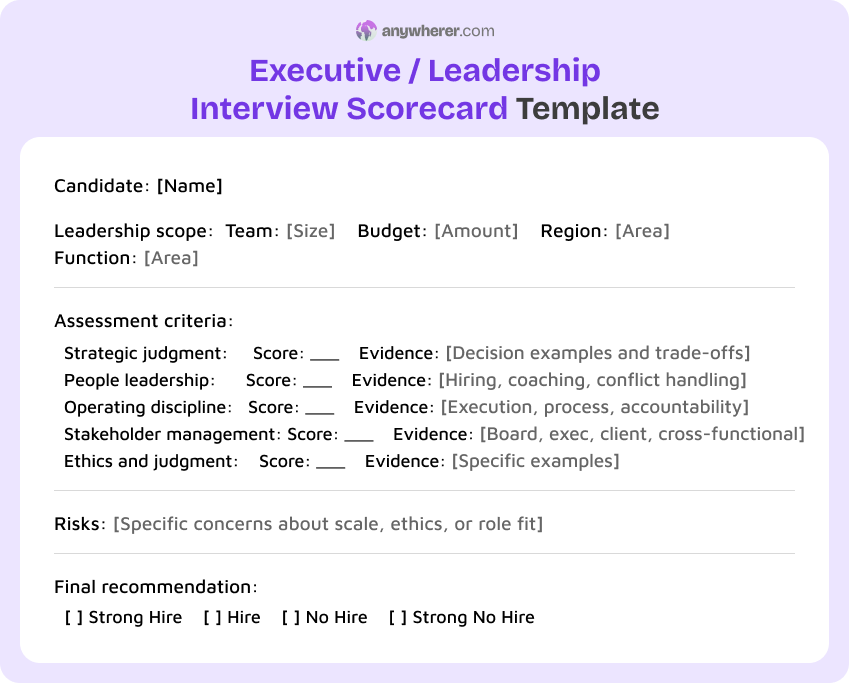
Executive / Leadership Interview Scorecard Template
Purpose: Use this for senior leaders, executives, country managers, and department heads. It separates leadership evidence from personality impressions and informal sponsorship.
Scorecard sections:
- Leadership scope: define team size, budget, region, and business context.
- Strategic judgment: score decision quality, prioritization, and trade-offs.
- People leadership: assess hiring, coaching, conflict handling, and accountability.
- Stakeholder evidence: record board, executive, client, or cross-functional examples.
- Risk review: document concerns about scale, ethics, or role fit.
- Final recommendation: connect the decision to leadership criteria.
Template (ready-to-use text):
- Candidate: [name]
- Leadership scope: [team size / budget / region / function]
- Strategic judgment: Score: ___ | Evidence: [decision examples and trade-offs]
- People leadership: Score: ___ | Evidence: [hiring, coaching, conflict handling]
- Operating discipline: Score: ___ | Evidence: [execution, process, accountability]
- Stakeholder management: Score: ___ | Evidence: [board, exec, client, cross-functional]
- Ethics and judgment: Score: ___ | Evidence: [specific examples]
- Risks: [specific concerns about scale, ethics, or role fit]
- Final recommendation: [Strong Hire / Hire / No Hire / Strong No Hire]
Best for: Executive searches, senior leadership hiring, and final-stage panel reviews.
How to Roll Out and Use Interview Scorecards
Start with the hiring manager. Define the criteria before scheduling interviews, then decide which interviewer owns each area. A scorecard works best when every question maps back to a role requirement.
Keep the first rollout narrow. A recruiting team can pilot the scorecard for one role family, review the quality of the debriefs, and then expand it to other roles once managers understand the rubric.
Calibrate the rating scale before the first interview. Interviewers should know what a strong, average, weak, or missing answer looks like. The hiring lead should collect scorecards before the debrief to avoid anchoring the panel too early.
For recurring roles, revisit the scorecard after every 5 to 10 hires. If role scope changes, update the rubric before the next opening. Post-hire performance can be reviewed with an employee evaluation form template so hiring criteria and performance expectations stay connected.
Key Elements Every Interview Scorecard Should Include
A scorecard should be short enough to use, but specific enough to guide decisions. The fields below keep the review tied to evidence rather than impressions.
- Job-relevant evaluation criteria with clear definitions.
- Anchored rating scale with descriptors for each level.
- Evidence or examples field for every criterion.
- Separate strengths and concerns sections.
- Overall recommendation with calibrated decision levels.
- Interviewer name, interview stage, and timestamp.
- Scoring summary block for hiring-committee debrief.
Common Mistakes With Interview Scorecards
Scorecards fail when the rubric is vague or the process is ignored. These mistakes are common when teams adopt the form without changing interview habits.
- Using vague criteria such as culture fit or communication without behavioral anchors.
- Letting interviewers discuss the candidate before submitting scores.
- Adding too many criteria until no single signal stands out.
- Using a broad rating scale without descriptors.
- Using the same rubric for junior and senior versions of a role.
- Skipping calibration before interviews start.
FAQs on Interview Scorecard Templates
What is the best interview scorecard template?
The best interview scorecard template is the one tied to the role, interview stage, and decision being made. A general scorecard can work for early screening, but structured, behavioral, technical, remote, and executive interviews need different evidence fields. What is the best interview scorecard template for one team may be too thin for another. The safest test is whether two interviewers can score the same evidence in a comparable way.
What should be included in an interview scorecard template?
An interview scorecard template should include candidate details, the interviewer’s name, the interview stage, job-relevant criteria, a defined rating scale, evidence fields, strengths and concerns, and an overall recommendation. It should also include a timestamp or submission record. OPM guidance on structured interviews emphasizes consistent questions and rating methods, which is why the scorecard should not be a loose notes page.
What is the difference between a structured and an unstructured interview scorecard?
A structured scorecard uses predetermined criteria, planned questions, anchored ratings, and evidence fields. An unstructured scorecard may capture impressions, but it often lets interviewers score different things. Structured formats make candidate comparisons easier because every interviewer looks at the same job-relevant signals. Unstructured notes can still be useful, but they should not replace a rubric when the decision needs to be defensible.
How do you score a candidate using an interview scorecard?
Interviewers should score each criterion after the interview and before the group discussion. The score should be based on evidence, such as an example, answer, work sample, or behavior observed during the interview. The written note matters as much as the number because it explains why the score was chosen. The panel can then compare score patterns and discuss gaps without relying solely on memory.
Is there a free interview scorecard template?
Yes, a free interview scorecard template can work well when it includes role criteria, a simple scale, evidence fields, and an overall recommendation. A free form should still be adapted by role and stage. Interviewers should not use the same scorecard for every job if the required evidence differs. Treat the template as a starting point, then calibrate it with the hiring manager.
How do you use interview scorecards on a remote hiring panel?
Remote panels should require each interviewer to submit the scorecard before the debrief. For async video, reviewers can add timestamps beside evidence notes. The hiring lead should compare scores first, then discuss differences. This keeps one strong opinion from setting the tone before others record their own evidence.

Yaryna is our lead writer with over 8 years of experience in crafting clear, compelling, and insightful content. Specializing in global employment and EOR solutions, she simplifies complex concepts to help businesses expand their remote teams with confidence. With a strong background working alongside diverse product and software teams, Yaryna brings a tech-savvy perspective to her writing, delivering both in-depth analysis and valuable insights.