An umbrella company is a third party that becomes your legal employer in the Netherlands. It issues the Dutch employment contract, runs payroll, withholds wage tax, pays employer social contributions, and keeps the employment records. The client still directs the work day-to-day.
The label is an international one. Dutch law has no category called an umbrella company, and providers reach the same result through formal payrolling, an EOR arrangement, secondment or temporary employment. The structure decides which rules apply, so it is the first question to ask.
Formal payrolling has a precise meaning here. You recruit the employee, set the salary, and supervise the work. The payroll company formally employs that person and lends them back to you. That is not a temp-agency placement. It is also not automatically what every provider marketed as an umbrella company Netherlands buyer will find on offer.
Buyers here fall into 2 groups. Contractors who want Dutch employee status without running their own payroll. And companies that want to employ someone here without local payroll infrastructure or a Dutch entity.
Provider choice decides more than price. It sets the employment model, Waadi registration, the terms applied, payroll accuracy, immigration capability, and readiness for the admission system that starts in 2027.
I reviewed 10 providers for this guide. I read each company’s own site in September 2026 for its employment model, pricing, certifications, sponsor status, and payroll depth. Where a provider publishes no figure, I say so instead of guessing.
How Do Umbrella Companies Work in the Netherlands?
A Netherlands umbrella company arrangement puts 3 names on the paperwork. The provider is the legal employer, the worker is its employee, and the client directs the work. The worker sits on the provider’s payroll and works exclusively for that client.
Formal payrolling is defined tightly. Business.gov.nl states that you recruit the payroll employees yourself, set their salary, and fully supervise their work. The payroll company formally hires them, and you loan them back. The provider then handles contracts, salary administration, annual income statements, and pension.
Equal treatment is the rule that surprises foreign buyers. Under the Wet arbeidsmarkt in balans (WAB, Balanced Labor Market Act), payroll staff get at least the conditions and legal position of comparable direct employees. A 13th month, leave, training, and sick pay follow the client’s terms.
If the client has no staff of its own, sector terms for similar work apply instead. Pension is separate: the worker is entitled to an adequate arrangement, either the client’s scheme or a qualifying one run by the payroll company.
Not every provider using the word umbrella works through a payrollovereenkomst (payroll employment agreement). EOR, secondment and temporary-employment structures carry different collective agreement rules, and a temp agreement keeps phase contracts that a payroll agreement does not.
Supply of workers is regulated on top of that. Every intermediary that supplies personnel here must be registered in the KVK Business Register, with that activity stated. That is the Waadi registration requirement under the Wet allocatie arbeidskrachten door intermediairs (Waadi, Workers Allocation by Intermediaries Act). Hirers can be fined too, which is why the KVK Waadi check exists.
EOR is the broader commercial label, used worldwide for hiring without a local entity. Dutch payrolling is a specific legal form with its own equal-treatment rules, so the 2 overlap without matching. I set that model out separately under employer of record in the Netherlands.
Whatever the structure, the work list is similar: contract, gross-to-net payroll, wage-tax withholding, employer contributions, payslips, holiday allowance, pension and collective agreement administration.

INSIGHT: Is a Dutch umbrella company the same as a UK umbrella company?

No. Umbrella company is an informal international label here, while the actual Dutch structure may be payrolling, EOR, secondment, or temporary staffing.
- Formal payrolling leaves recruitment and day-to-day control with the client while the payroll company is the legal employer.
- Payroll employees are entitled to at least the same employment conditions and legal position as comparable employees of the client.
- A business that supplies workers must be registered in the KVK Business Register as a supplier of personnel under the Waadi.
- UK concepts such as PAYE, National Insurance and IR35 have no Dutch equivalent and should not be carried across.
Top Umbrella Companies in the Netherlands for 2026
Rankings of top-rated umbrella companies in the Netherlands tend to reward marketing budgets, so I asked the same questions of every company instead. Which employment model does it use? Does it publish a factor or a fee? Does it name certifications such as SNA or NEN 4400-1, and is it an IND-recognized sponsor?
The list mixes 3 types of companies: classic Dutch payroll specialists, sponsorship firms built around international hires, and 1 large national staffing group. Nobody holds the title of best umbrella company in Netherlands searches for long. An agency payrolling 40 warehouse staff and a US company hiring 1 engineer are buying different things.
All companies below are listed in alphabetical order, so their position on the page does not indicate ranking.
All About Flex
Company Description:
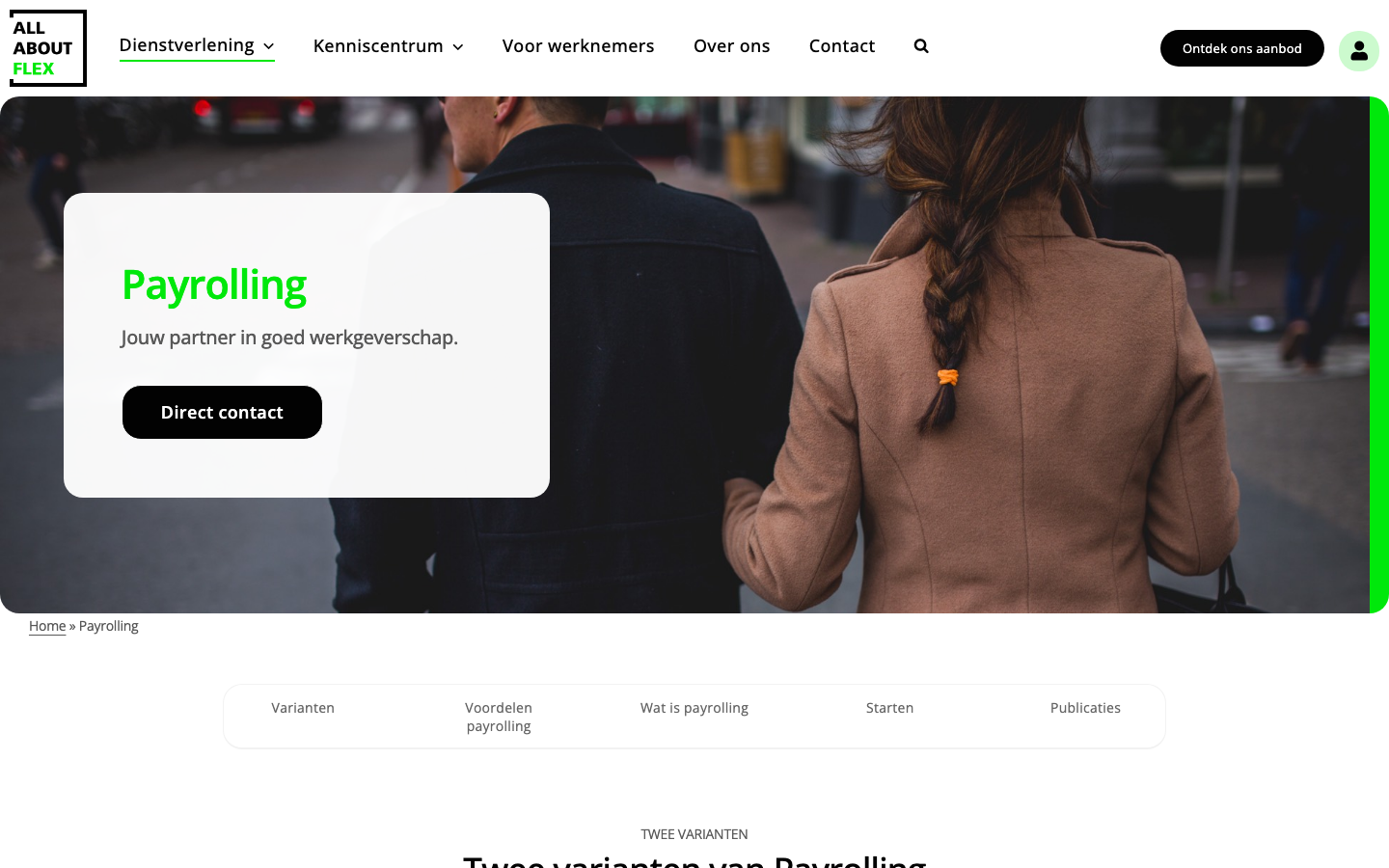
All About Flex is a Dutch payrolling and back-office specialist with more than 25 years of experience in supplying personnel. The client handles recruitment and day-to-day direction, while the provider handles employment administration, in 2 variants.
Key Features:
- Payrolling Vast, built around a fixed monthly salary
- Payrolling Flex, paid weekly or every 4 weeks
- Zero-hours contracts up to 6 months under the Flex variant
- Employment administration while the client directs the work
- A sister service for highly skilled migrant support
Fee Structure:
Conversion factor of 1.55 for the Payrolling Vast variant. The Flex variant is quoted separately.
Top Advantages:
- One of the few published starting factors in this market
- A choice of 2 contract forms rather than 1 product
- More than 25 years of supplying personnel
Additional Services:
- Support for highly skilled migrants through the group
- Advice on which variant fits a given contract type
Our Verdict
I would ask All About Flex for both variants side by side, because the factor only means something next to the contract it belongs to.
*As pricing is subject to change, we are listing prices as they stand in September 2026
Dutch Umbrella Company
Company Description:
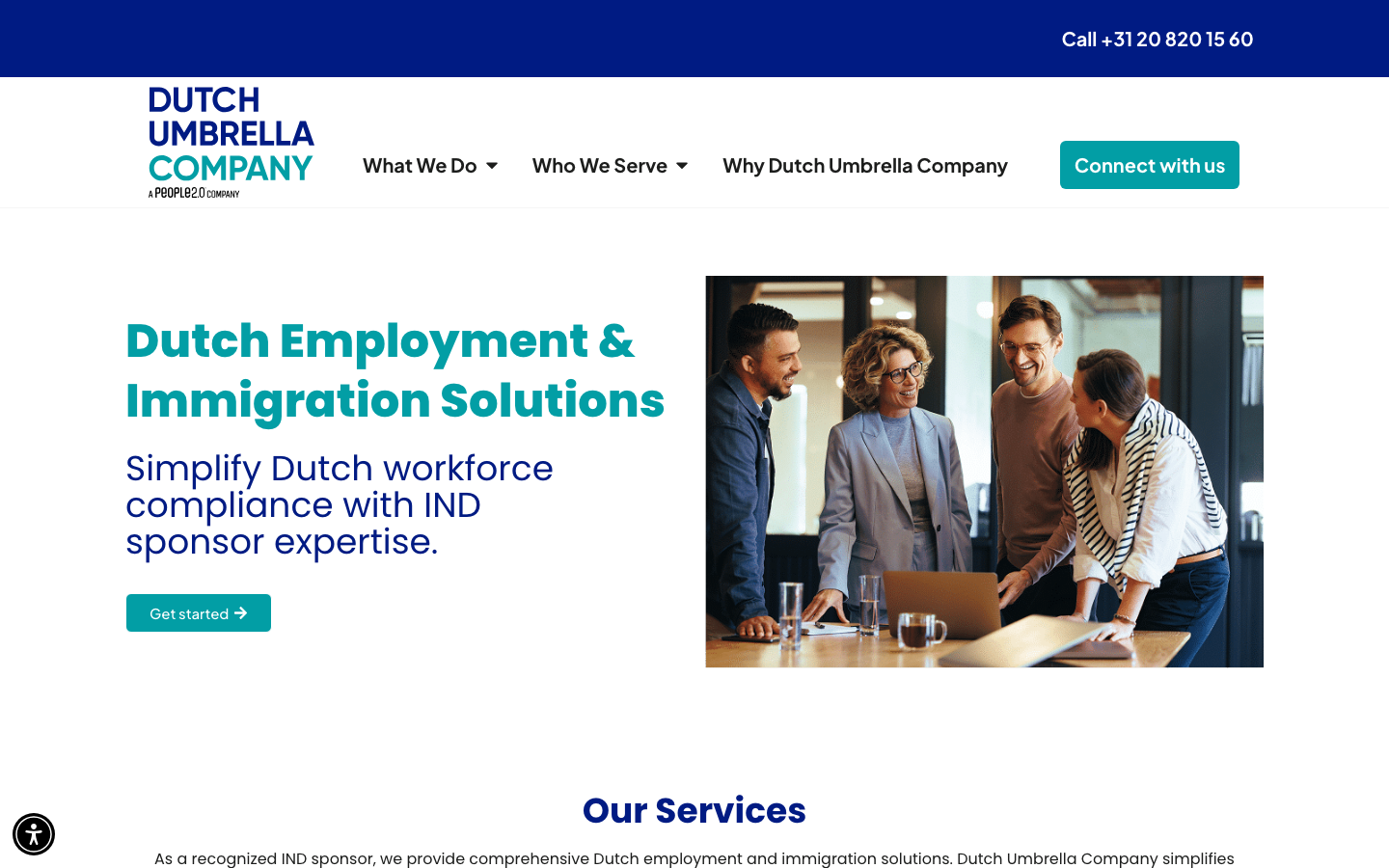
Dutch Umbrella Company is an Amsterdam employment and immigration specialist that acts as a legal employer for international hires. It holds recognized sponsor status with the Immigration and Naturalization Service and payroll administration under the NBBU collective labor agreement. It suits foreign companies with no Dutch entity.
Key Features:
- Legal employer without a Dutch corporate structure
- Payroll administration with tax withholding and social security
- NBBU collective labor agreement compliance
- Visa applications, work permits and registration support
- Dutch expat tax scheme applications
Fee Structure:
Custom. Contact for a quote.
Top Advantages:
- Recognized sponsor status stated on the company’s own site
- Employment and immigration handled by 1 supplier
Additional Services:
- Immigration guidance from application through approval
- Expat tax scheme administration
Our Verdict
I would shortlist this one when the hire is a non-EU specialist, and sponsorship is the deciding factor.
HM Solutions
Company Description:
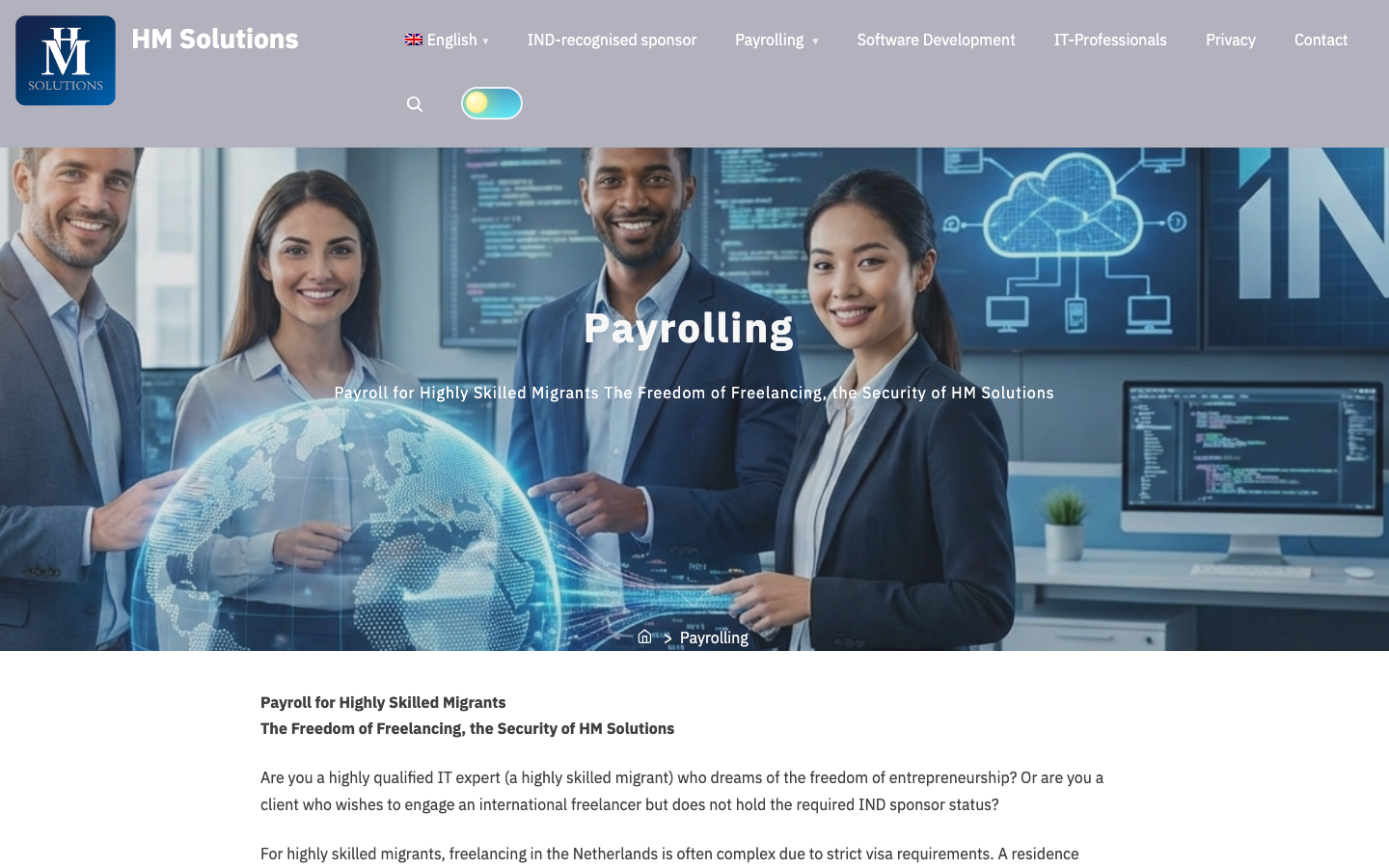
HM Solutions is a payroll provider for highly skilled migrants and international IT professionals, active in ICT since 2002. Recognized sponsor status plus a payroll structure lets a specialist work for several clients on 1 permit.
Key Features:
- Recognized sponsor status with the Immigration and Naturalization Service
- Official employer role with salary-threshold monitoring
- Invoicing, payroll administration and social contributions
- Application and administration of the 30% tax ruling
- Switching between clients without a new visa process
Fee Structure:
Custom. The provider states a fixed fee or a percentage of the invoiced amount, with no standard figure published.
Top Advantages:
- A client without sponsor status can still engage the specialist
- More than 20 years inside the Dutch ICT market
Additional Services:
- Support for clients that are not recognized sponsors
- Net income calculations before signing
Our Verdict
I would talk to HM Solutions when an IT contractor wants several clients without putting the residence permit at risk.
HumanR
Company Description:
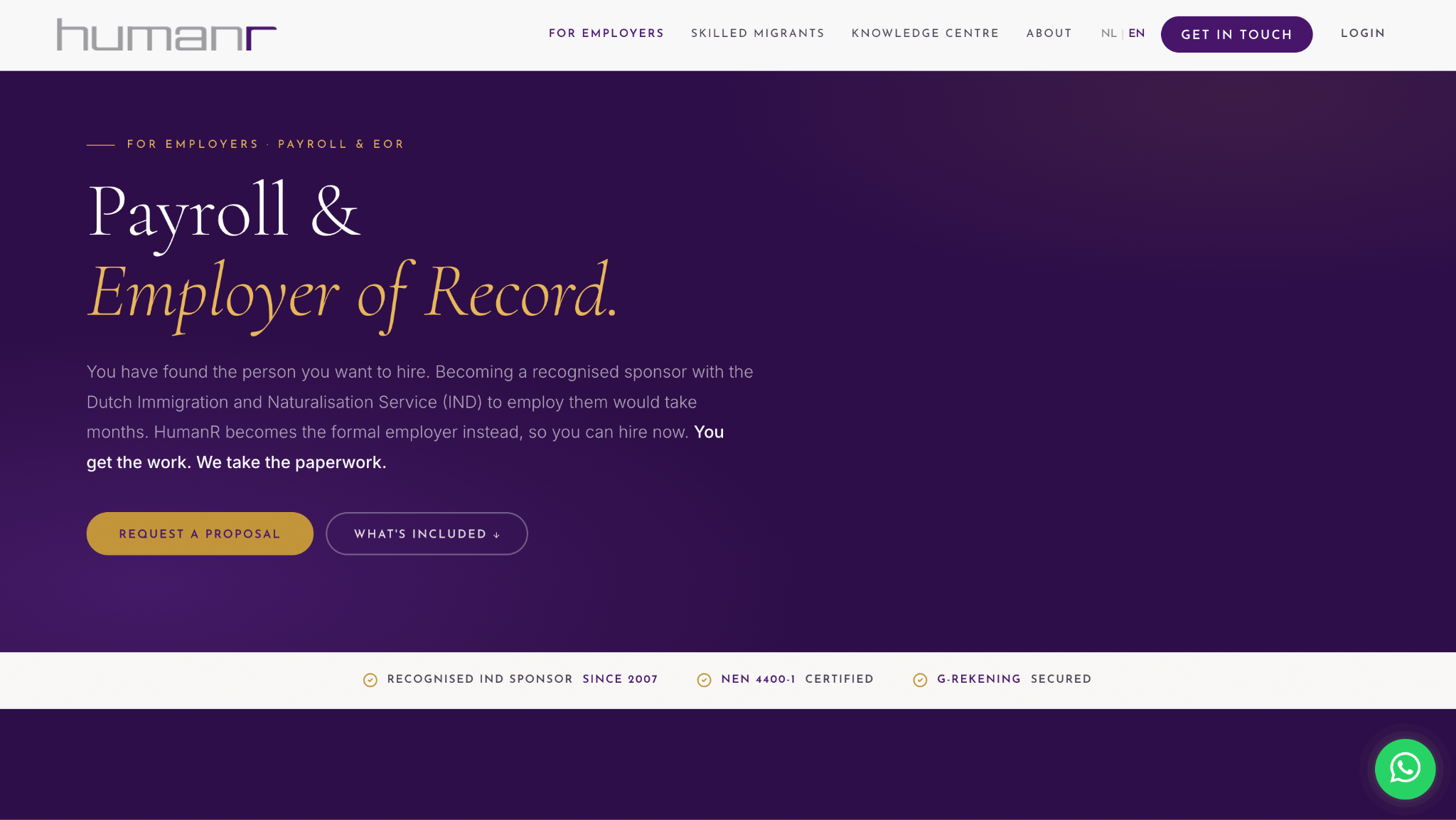
HumanR is a payroll and EOR specialist for highly skilled migrants, stating recognized sponsor status since 2007, NEN 4400-1 certification, and a secured G-rekening. HumanR holds the contract, while the client directs the work.
Key Features:
- Wage tax (loonheffingen) withheld and paid by the provider
- All employer social security contributions carried
- The 30% ruling applied for and managed
- Immigration reporting obligations as a recognized sponsor
- Sick leave and health and safety obligations handled
Fee Structure:
Custom. The provider states a single monthly fee per employed person, with no setup or application fees, and quotes a figure within 24 hours.
Top Advantages:
- A certification set that few providers in this list publish together
- One fee rather than a line-item invoice
- The cost of employment kept visibly separate from the service fee
Additional Services:
- Residence permit applications, renewals and extensions
- Payslips, holiday allowance and annual statements
- Written proposals before any commitment
Our Verdict
I would ask HumanR for the proposal first, because a single monthly figure is the easiest number to compare against a factor.
Pay for People
Company Description:
Pay for People has been active in payroll since 1998 and calls itself one of the country’s first payroll organizations. The client recruits and supervises the worker, while Pay for People assumes legal employment and employer risks.
Key Features:
- Legal employment with the client keeping direction
- Payroll built on in-house developed software
- Employer tasks and risks taken over, including sickness
- A temp agreement offered as an alternative to payroll
- Custom proposals for specific requirements
Fee Structure:
Custom conversion factor. The cost is the factor multiplied by the worker’s gross hourly wage, and the factor depends on the work, the contract type, payment terms, and debtor risk.
Top Advantages:
- Nearly 3 decades in the Dutch payroll market
- A clear explanation of how the factor is built
- A choice of payroll or temp contract, rather than 1
Additional Services:
- Advice on choosing between payroll and a temp agreement
- Support for staffing agencies as well as end clients
Our Verdict
I would use Pay for People when the volume is Dutch domestic flex work rather than a single international hire.
Payper
Company Description:
Payper combines recruitment with payrolling and an HR platform, aimed at employers who want both the candidate and the payroll handled in 1 place. It states the SNA quality mark, the risk-control certification that limits a client’s liability for unpaid payroll taxes.
Key Features:
- Payroll with the legal employer role taken over
- Salary administration and wage calculation
- Recruitment and selection alongside payroll
- An HR platform for employers
- Collective agreement handling for the worker’s sector
Fee Structure:
Custom. Contact for a quote.
Top Advantages:
- The SNA quality mark stated on the site
- One supplier for finding and paying the worker
Additional Services:
- Recruitment and selection services
- Wage calculation tools
Our Verdict
I would consider Payper when having the same supplier find the candidate is an advantage rather than a complication.
Randstad Payroll
Company Description:
Randstad is the largest staffing group in the country and offers formal payrolling alongside its other services. The client selects the worker and sets the salary, and Randstad takes on the legal employer obligations, payroll, pension administration, and sickness risk.
Key Features:
- Formal payrolling with the client choosing the worker
- Legal-employer obligations carried by the provider
- Payroll, pension and employment administration
- Sickness risk taken over from the client
- National coverage across every region
Fee Structure:
Custom. Contact for a quote.
Top Advantages:
- Scale and continuity behind the contract
- A single supplier for payroll and other staffing needs
Additional Services:
- Recruitment and temporary staffing
- Employer services beyond payroll
Our Verdict
I would put Randstad on the list when volume and supplier stability matter more than a specialist immigration service.
Rock Payroll
Company Description:
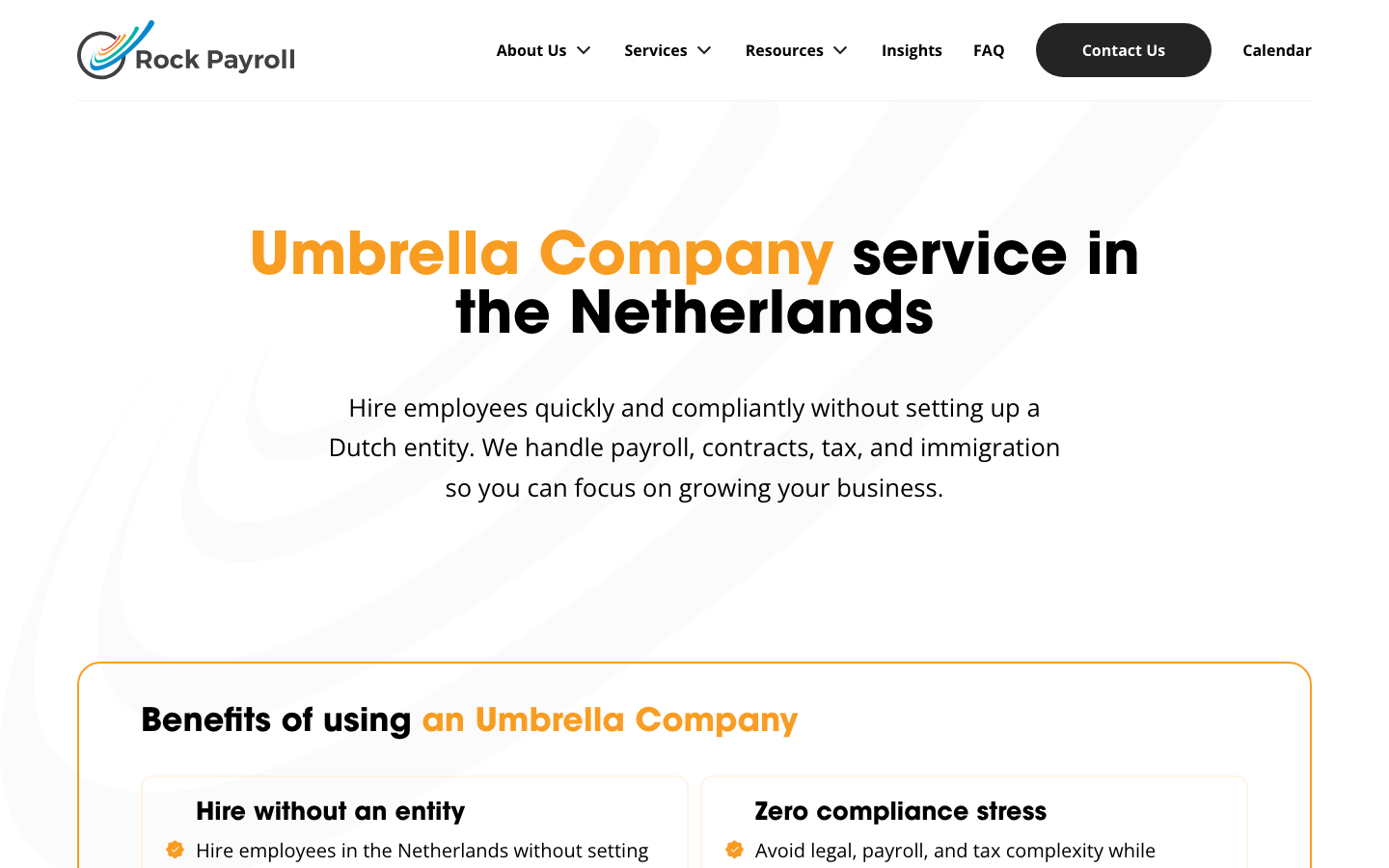
Rock Payroll is one of the few providers here that openly uses the umbrella label, marketing an umbrella company service in the Netherlands alongside EOR, payroll, immigration, and tax work. It employs the worker legally while your company keeps the day-to-day relationship.
Key Features:
- Employment without setting up a Dutch entity
- Contracts, payroll, tax withholding, and social contributions
- Immigration support for non-EU hires
- Fast onboarding for market entry or a small first team
- Guidance on permanent establishment risk
Fee Structure:
Custom. Contact for a quote.
Top Advantages:
- Plain explanation of what the umbrella structure does and does not do
- Built for foreign companies testing the Dutch market
- Highly skilled migrant processes covered in the same service
Additional Services:
- Employer of record for larger teams
- Tax and global mobility support
- Booked calls with a specialist before signing
Our Verdict
I would start here if the company is entering the Dutch market with 1 or 2 people and wants to postpone the entity question.
Tentoo
Company Description:
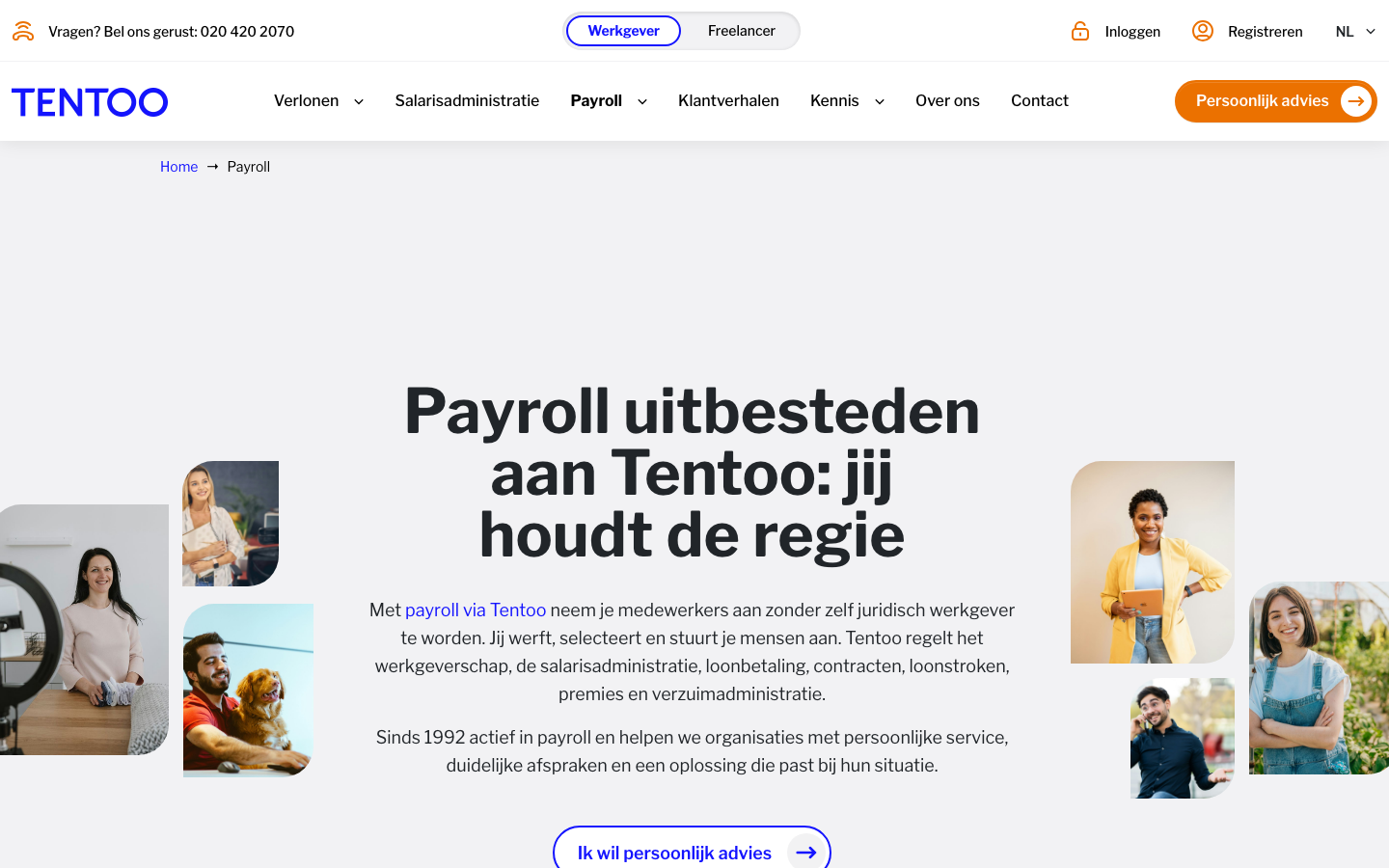
Tentoo has been active in payroll since 1992. The client recruits, selects, and directs the worker, and Tentoo takes the legal employership plus salary administration, contracts, payslips, premiums, and absence handling.
Key Features:
- Legal employership with a 3-party payroll agreement
- Salary administration, payslips and premium payments
- Sickness reporting and continued payment during illness
- Wage costs pre-financed by the provider
- A separate freelance payroll service
Fee Structure:
Custom. The provider states that costs depend on gross wage, hours, role, terms, pension, reservations, premiums, and service level, so there is no standard rate.
Top Advantages:
- More than 3 decades in the Dutch payroll market
- A clear comparison of payroll, temp work and self-employment
- Pre-financing of wage costs for the client
Additional Services:
- Freelance payroll for self-employed workers
- Salary administration as a standalone service
Our Verdict
I would ask Tentoo for a breakdown rather than a rate, because the company is explicit that no standard tariff exists.
The Umbrella Agency
Company Description:
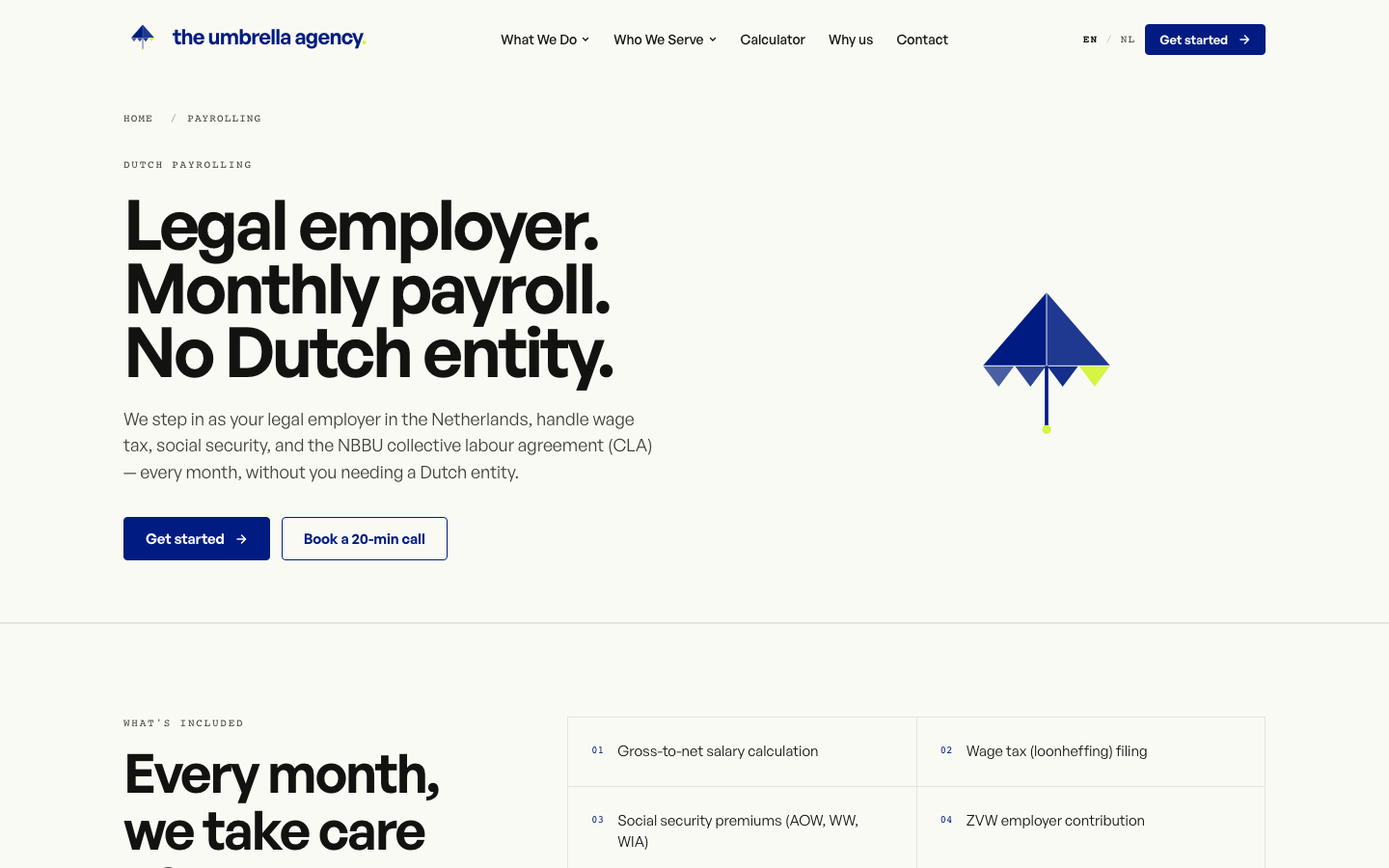
The Umbrella Agency is an Amsterdam legal employer and immigration specialist that holds recognized sponsor status with the Immigration and Naturalization Service. It steps in as the legal employer, runs monthly payroll, and applies the NBBU collective labor agreement, with no Dutch entity needed on the client’s side.
Key Features:
- Gross-to-net calculation and monthly payslips
- Wage tax (loonheffing) filing and social security premiums
- Employer health insurance contribution and pension administration
- The statutory 8% holiday allowance built into payroll
- Immigration notification for permit holders
Fee Structure:
Custom. Contact for a quote.
Top Advantages:
- A published payroll setup time of 1 to 2 weeks
- Year-end tax reconciliation included in the monthly service
Additional Services:
- Work and residence permit support
- Collective agreement compliance
Our Verdict
I would use The Umbrella Agency when the start date is close, and the setup window matters more than the fee.
How Much Do Umbrella Companies Cost in the Netherlands in 2026?
Dutch payroll pricing usually runs through an omrekenfactor (conversion factor). The provider multiplies the gross hourly wage by a factor. That single number carries gross pay, holiday allowance, employer social costs, pension, sickness risk, administration and margin.
That is why a Dutch quote looks nothing like a British one. A weekly or monthly service fee, the model described in my guide to how much umbrella companies charge, sits on top of a salary. A conversion factor swallows the salary, the employer costs, and the margin in 1 multiplier, so the headline number looks large and includes far more.
International specialists price differently. Lists of recommended umbrella companies in Netherlands search results rarely say which model applies. Some quote a fixed monthly fee per person and some a percentage of the invoiced amount.
Ask for the split for whichever model you meet. Gross salary, holiday allowance, employer premiums, pension, sickness risk, and the margin should each be visible before you sign.
One floor sits under every calculation. The statutory minimum hourly wage for workers aged 21 and over is EUR 14.71 from 1 January 2026, and EUR 14.99 from 1 July 2026. Holiday allowance is paid on top of that.
| Provider | Published fee or factor | Other charges and notes | Fee model |
|---|---|---|---|
| All About Flex | From a 1.55 conversion factor on Payrolling Vast | The Flex variant, with weekly or 4-weekly pay, is quoted separately. | Conversion factor |
| Pay for People | Not published | Custom factor set by the work, the contract type, payment terms and debtor risk. | Conversion factor |
| Tentoo | Not published | Custom rate built from salary, hours, role, terms, pension, reservations, premiums and service level. | Conversion factor or custom |
| HM Solutions | No standard amount published | The provider states either a fixed fee or a percentage of the invoiced amount. | Fixed fee or percentage |
| HumanR | Single monthly fee per employed person, amount not published | No setup or application fees; a written figure follows a request. | Fixed monthly fee |
| Dutch Umbrella Company, Payper, Randstad Payroll, Rock Payroll, The Umbrella Agency | Not published on the pages I reviewed | Request a quote or a calculation. | Custom |
*As pricing is subject to change, we are listing prices as they stand in September 2026
INSIGHT: What does an umbrella company in the Netherlands actually cost?
Dutch payrolling is priced around total employer cost, so the provider margin is only a small share of the rate a client pays.
- The common model is the omrekenfactor: gross hourly wage multiplied by a factor that bundles employment costs and service charges.
- All About Flex publishes a factor of 1.55 on its fixed-salary variant, while most providers in this list quote case by case.
- At least 8% holiday allowance sits on top of gross salary in the standard case and has to appear somewhere in the structure.
- Employer premiums vary by employer and contract. In 2026, the AWf contribution is 2.74% or 7.74%, the Aof contribution is 6.27% or 7.63%, the Wko surcharge is 0.50%, and the employer health levy is 6.10%.
How to Choose an Umbrella Company in the Netherlands
Start with the structure, not the price. What umbrella companies Netherlands clients buy is an employment structure. Ask in writing which model applies: formal payrolling, EOR, secondment, or temporary employment. The answer sets the collective agreement and the termination rules.
Check the Waadi registration next. A supplier of personnel must say so in the KVK Business Register, and a hirer that uses an unregistered supplier can be fined as well. The KVK check takes a minute and removes a real risk.
Ask about the SNA quality mark or NEN 4400-1 certification. Neither replaces legal due diligence, but it limits the chance that the tax authority recovers unpaid payroll taxes from you.
Then request a full cost breakdown, not a single factor. Gross wage, holiday allowance, pension, employer premiums, sickness risk, the provider margin, any one-time charges, and immigration fees should each be visible.
Under a formal payroll agreement, ask how the provider will apply your own employment conditions. You must supply those terms before the worker starts, and a provider that never asks for them is not applying the rule properly.
For non-EU hires, confirm recognized sponsor status with the Immigration and Naturalization Service, permit support, salary-threshold monitoring, and expat scheme administration. Not every payroll company holds that status.
Ask how the provider is preparing for the admission system that starts in 2027. Then compare the practical things: payroll calendar, onboarding time, sickness administration, offboarding, and what happens if you later open a Dutch entity.
INSIGHT: What changes for Dutch umbrella and payroll providers after 2026?
The Wtta creates an admission system for businesses that supply workers, and the transition runs through 2026 before enforcement begins.
- The Wet toelating terbeschikkingstelling van arbeidskrachten (Wtta, Admission of Provision of Labor Act) enters into force on 1 January 2027.
- Companies that want to keep supplying workers under the transitional arrangement must report to the Nederlandse Autoriteit Uitleenmarkt before that date.
- The Netherlands Labor Authority starts enforcing the admission requirement on 1 January 2028, and hirers can be fined, as can suppliers.
- Until then, Waadi registration and the KVK Waadi check remain the checks that matter in 2026.
None of this transfers across the border. An umbrella company Germany runs on staff-leasing law with its own permit regime. The best umbrella company in Switzerland works under cantonal and federal authorizations. Check each country’s terms before you sign.
FAQs on Umbrella Companies in the Netherlands
What is an umbrella company, and how does it work in the Netherlands?
It is an international label for a provider that becomes the legal employer while the client directs the work. The provider issues the Dutch contract, runs payroll, withholds wage tax, and pays employer contributions. Dutch providers achieve this through payrolling, EOR, secondment, or temporary employment.
Is an umbrella company the same as an Employer of Record in the Netherlands?
They overlap without being identical. EOR is a commercial label for hiring without a local entity. Formal payrolling is a defined Dutch arrangement with its own equal-treatment rules. Some providers marketed as umbrella, or EOR, use secondment or temporary-employment structures instead, which changes the applicable terms.
What is formal payrolling under Dutch law?
The client recruits the worker, sets the salary, and supervises the work. The payroll company formally employs that worker and lends them back to the client, handling contracts, salary administration, annual statements, and pension. Payroll employees receive at least the same employment conditions and legal position as comparable direct staff.
Do umbrella and payroll companies need Waadi registration?
Every intermediary that supplies personnel in the Netherlands must be registered in the KVK Business Register with that activity stated. The Netherlands Labor Authority checks compliance, and both the supplier and the hirer can be fined. Hirers should run the KVK check before the first invoice.
What is the Wtta and when does it affect payroll providers?
It is the new admission system for businesses that supply workers. The law enters into force on 1 January 2027, and suppliers that want the transitional route must report before that date. Enforcement by the Netherlands Labor Authority starts on 1 January 2028, so 2026 is a preparation year.
Do payroll workers get a pension in the Netherlands?
Yes. A payroll worker is entitled to an adequate pension arrangement. The payroll company can enroll the worker in the client’s pension scheme, or run a qualifying scheme of its own that meets the statutory conditions. Ask which of the 2 applies before the contract starts.
How much do umbrella companies charge in the Netherlands in 2026?
Most quote a conversion factor applied to the gross hourly wage, which covers far more than the margin. All About Flex publishes a factor of 1.55 on its fixed-salary variant. International specialists may charge a fixed monthly fee instead.
*As pricing is subject to change, we are listing prices as they stand in September 2026
What employment costs are included in Dutch umbrella pricing?
Gross salary, at least 8% holiday allowance in the standard case, employer social-insurance contributions, pension where it applies, sickness risk, administration and the provider margin. The exact mix depends on the contract, the sector and the employer, so ask for the lines rather than the total.
Can a Dutch provider sponsor a highly skilled migrant?
Some can. Only a recognized sponsor with the Immigration and Naturalization Service may employ a highly skilled migrant. The hire must also meet the salary and immigration rules. Several companies in this list state that status; a payroll provider without it cannot take the role.
Can an employee use the Dutch expat scheme through an umbrella provider?
Potentially, if the employee and the employment meet the statutory conditions and the employer applies for it. For 2026, the payroll tax threshold for specific expertise is EUR 48,013. A qualifying employee under 30 with a master’s degree has a threshold of EUR 36,497.

Helen is Anywherer’s Market Analyst & Content Researcher, with extensive experience in analyzing global employment markets and HR technology trends. She is skilled at turning complex market data into clear, well-researched insights that inform every piece of content. With a strong grasp of the EOR, PEO, and international hiring space, Helen plays a key role in keeping Anywherer’s research accurate, up to date, and genuinely useful for readers.