Employment in Equatorial Guinea follows the Spanish legal tradition. Contracts are written in Spanish, registered with the labor ministry, and governed by a 2021 statute that was amended in April 2026. Most guidance online still describes the old rules. Employer social charges are also heavy here, at 22.5% of salary across 2 funds, and the published rates show no ceiling.
Hiring in Equatorial Guinea Under the 2026 Labor Law
Any employer of record search in Equatorial Guinea starts with an unusual map. The Republic of Equatorial Guinea splits between Bioko Island and the mainland region of Río Muni. The capital, Malabo, sits on Bioko, and Bata is the largest mainland city. World Bank data show 1,938,431 residents in 2025, a GDP of $12.8 billion, and a 5.8% contraction. Spanish, French and Portuguese are official, with Spanish used for statutes and contracts. Pay runs in the Central African CFA franc (XAF), which the regional central bank pegs at 655.957 per euro.
Oil and gas, liquefied natural gas and their service contractors account for much of the formal hiring. Construction and engineering, logistics and port work, telecommunications, banking, professional services and donor programs follow. Malabo and Bata hold most of a compact formal labor market. Its Spanish-speaking workforce is rare in Africa and helps employers that already run Spanish operations. An Equatorial Guinea employer of record lets an overseas firm put people on payroll before it sets up a subsidiary.
In this arrangement, a separate company holds the employment contract while the people work for a business based abroad. That firm carries the statutory duties and pays salaries, and the overseas business directs what the team does each day. The contract must be in Spanish under the Ley Núm. 4/2021, General de Trabajo (General Labor Law), as amended in 2026, and registered with the Ministerio de Trabajo. The employer joins the Instituto Nacional de Seguridad Social (INSESO) and enrolls every worker, paying monthly into INSESO and the Work Protection Fund (WPF). Income tax follows the 2024 scale, and foreign staff need work authorization. Article 16 of the law prohibits the unlawful assignment of workers, so ask any provider how its structure fits that rule.
The list below holds 10 firms, sorted alphabetically. My site checks turned up 2 based in Malabo, and neither describes its service as employer of record. Only 1 page cites Ley Núm. 4/2021, and none names the April 2026 amending law by number. Each entry covers scope and strengths, so you can weigh any employer of record in Equatorial Guinea against setting up your own company.

INSIGHT: What does an Equatoguinean employer actually pay on top of salary?

Employer contributions exceed 20% across 2 separate funds, with no ceiling in the published rates. A seniority payment builds on top from the first year.
- INSESO: 21.5% from the employer and 4.5% from the employee. WPF: 1% from the employer and 0.5% from the employee, so the employer pays 22.5% in total (PwC Tax Summaries, reviewed November 21, 2025).
- Base and ceiling: no ceiling is published for either fund. One provider says the employee WPF share is charged on net pay, which no official source confirms, so the base is unresolved.
- Seniority: at least 30 days of salary per year worked, based on the last salary, under Article 112 as amended by Ley Núm. 6/2026 (text of the law).
- Income tax: 0% up to XAF 1,400,000 a year, rising through 10%, 15% and 20%. The 2024 tax law sets 25% above XAF 15,000,000 (PwC Tax Summaries).
Sources:
checked October 2026
What Is the Best EOR Option in Equatorial Guinea?
The structural question comes before any comparison. Article 16 of Ley Núm. 4/2021 bans the cesión ilegal de trabajadores, the unlawful assignment of workers. That covers an employer other than a temporary work agency hiring someone only to work for another employer. Separately, Ley Núm. 5/1999 on agencias de trabajo temporal requires an administrative authorization from the Presidency of the Government. It also demands national capital, a dedicated business and a XAF 10 million guarantee fund. Published sources do not clarify how this applies to employer of record arrangements, so get each provider’s answer in writing.
A provider with local footing has real appeal. Contracts run in Spanish under a statute amended in 2026; each contract needs registration after verification, and INSESO enrollment covers every contract type. Of the 10 providers here, Equacom Solutions and Woomax Talent both list Malabo addresses. Neither describes an employer-of-record service, though: Equacom offers integrated business and workforce solutions, and Woomax offers recruitment, temporary work, and payroll.
Multi-country platforms offer something else: identical paperwork and one dashboard across markets. Published Equatoguinean detail on this roster is unreliable, though, and one guide describes Ecuador’s termination rules under an Equatorial Guinea heading. Ask which statute the provider works from, which dismissal ground its severance figure assumes, how it calculates the contribution base, and who handles work permits. Of the 10, only Playroll prints its own fee.
INSIGHT: Equatorial Guinea amended its labor law in April 2026, and remote work is now regulated
The amendment added a teleworking regime with a right to disconnect, reshaped termination pay and made contract registration universal. Most published guidance misses all 3.
- Ley Núm. 6/2026 of April 10, 2026 amends Ley Núm. 4/2021 of December 3, 2021. It takes effect on publication in the Boletín Oficial del Estado, is not retroactive and deletes Article 33 on group contracts (Ley Núm. 6/2026).
- Telework must be voluntary and reversible. The employer needs an internal disconnection policy, must not demand work during rest periods and must give prior notice of cameras, recording, or geolocation.
- Termination: an unfair dismissal means reinstatement with back pay, or 45 days of salary per year if the employer refuses. Economic dismissals pay 3 months after 5 years of service, with other grounds capped at 22 days per year.
- Administration: every contract is registered with the Ministerio de Trabajo after verification, and every worker is enrolled with INSESO, whatever the contract type.
Sources:
checked October 2026
10 Providers Offering Equatorial Guinea EOR Services
Every firm here names Equatorial Guinea on a dedicated page and states an employment, EOR or payroll offer for it. My criteria were Spanish-language contracts under the current statute and registration with the labor ministry. I also checked payroll in XAF, INSESO and WPF contributions, income tax withholding on the 2024 scale, work permit support and pricing transparency. 2 providers sit in Malabo, only 1 cites the 2021 law, and only 1 prints its own fee.
Providers appear in A-to-Z order. The sequence says nothing about quality, preference, or ranking.
Africa HR Solutions
Provider Type:
Regional, Africa-only coverage
Company Description:
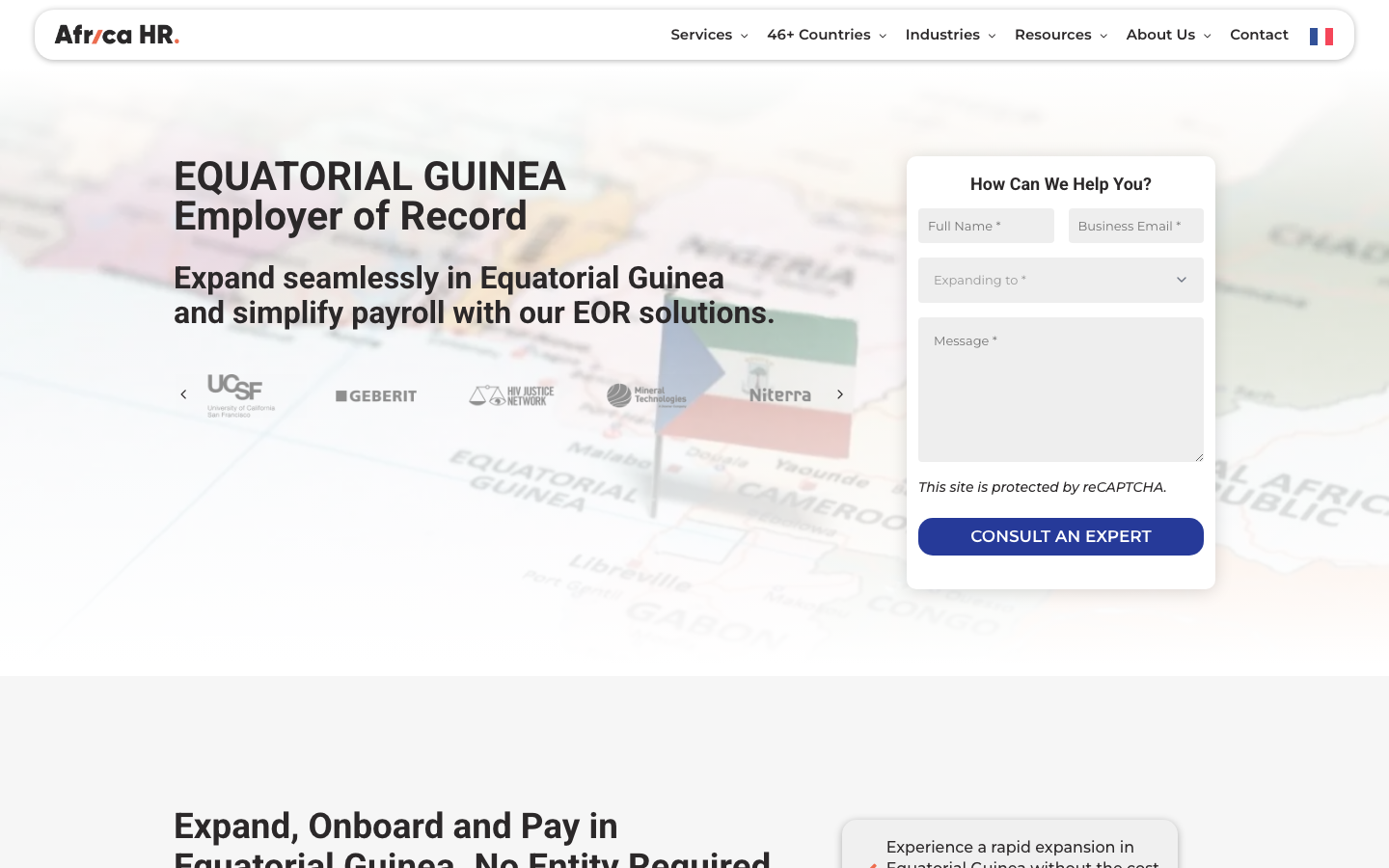
Africa HR Solutions works exclusively on the African continent, pointing to 16 years in the field and coverage of over 46 national markets. Its Equatorial Guinea page names no statute and prints no statutory figures, which avoids the errors found elsewhere on this list.
Key Specialty Area:
Pan-African coverage with a single account lead
Service Cost:
Quote-based
Top Advantages
- Life cover through the Unisure Group for staff
- Health plan option covering staff across Africa
- Single contact person for every query
Scope of Services
- Employment contracts and onboarding for local hires
- Payroll in XAF with statutory deductions
- Statutory compliance handled with no entity required
Our Verdict
Worth briefing when Malabo is just one of several African hiring locations on the roadmap.
Breedj
Provider Type:
Regional, Africa-focused, with no headquarters city stated
Company Description:
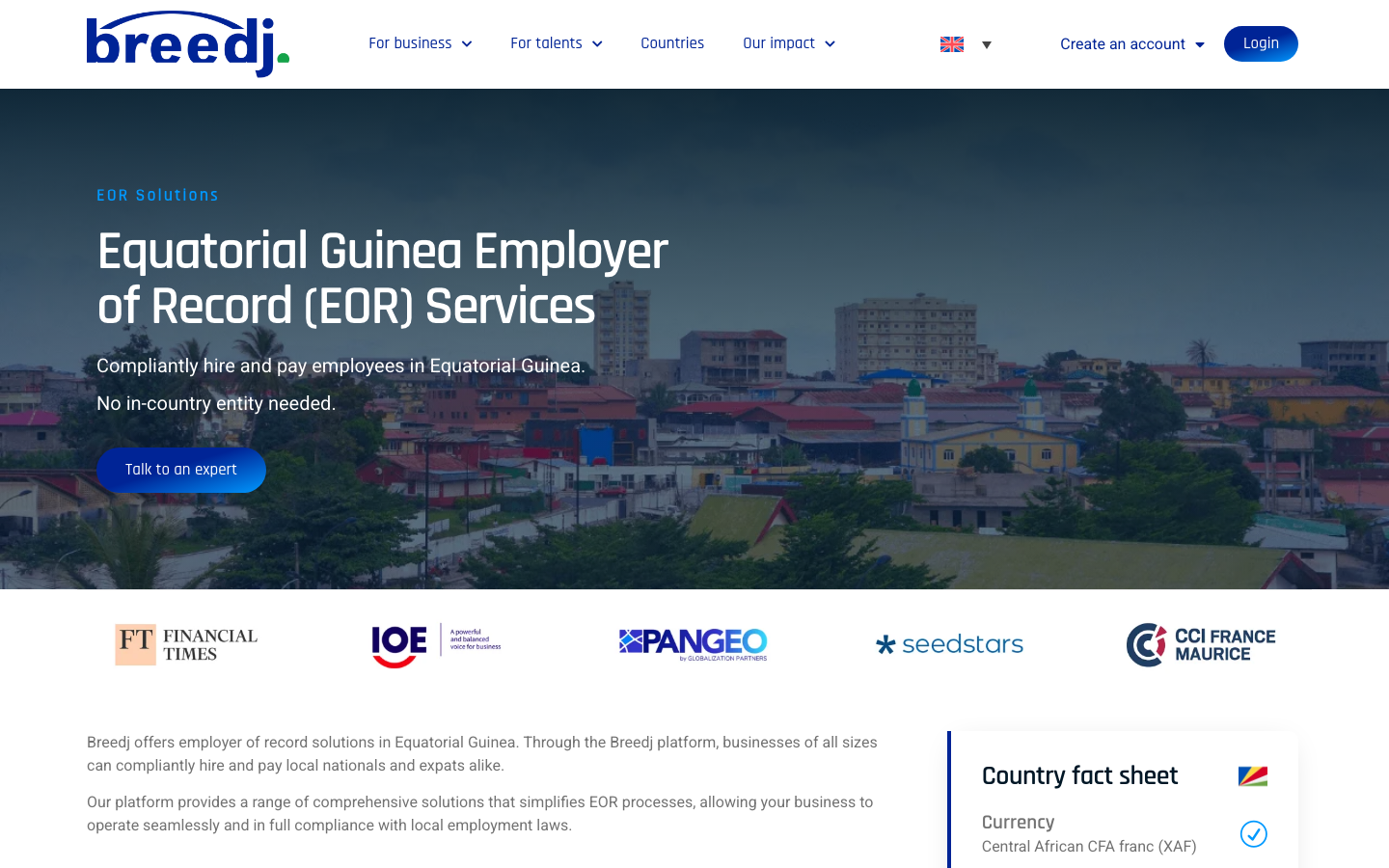
Breedj runs an Africa-focused platform that hires local nationals and expatriates in Equatorial Guinea. Its page sets out contribution rates for both funds. It also states that the employee WPF share is charged on net pay, which official sources do not confirm.
Key Specialty Area:
Detailed contribution notes for both funds
Service Cost:
Quote-based
Top Advantages
- Hires both local nationals and expatriates
- Contribution rates broken down by fund
- Platform built around African markets
Scope of Services
- EOR hiring and onboarding of local staff
- Payroll and INSESO contribution filing
- Benefits administration for each employee
Our Verdict
Useful for a first cost sketch, provided the WPF base is checked with INSESO.
Equacom Solutions
Provider Type:
Local, headquartered in Malabo since 2007
Company Description:
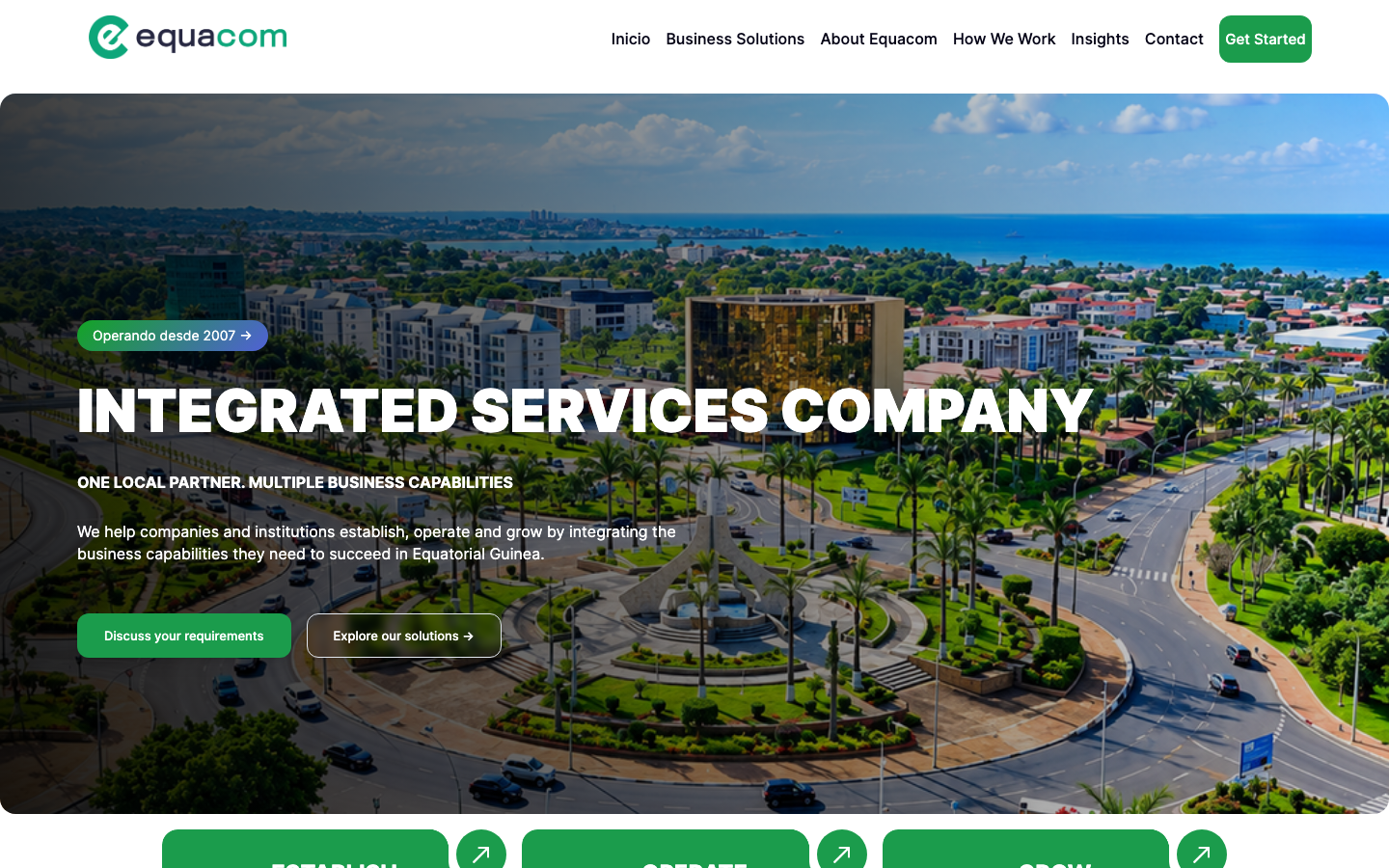
Equacom Solutions (EQUACOM SOLUTIONS, S.L.) is an integrated services company founded in Malabo in 2007. It offers Managed Country Presence, Workforce and Talent, and Operations Support lines, and its site does not describe an employer of record service.
Key Specialty Area:
Malabo office and local operating knowledge
Service Cost:
Quote-based
Top Advantages
- Head office in Malabo since 2007
- Workforce support for attracting and employing talent
- Local representation alongside operations and logistics help
Scope of Services
- Workforce and talent solutions in Equatorial Guinea
- Managed country presence and local representation
- Procurement, logistics and facilities support
Our Verdict
Start here for a Malabo partner on the ground, once it confirms who employs the staff.
Global Expansion
Provider Type:
Global
Company Description:
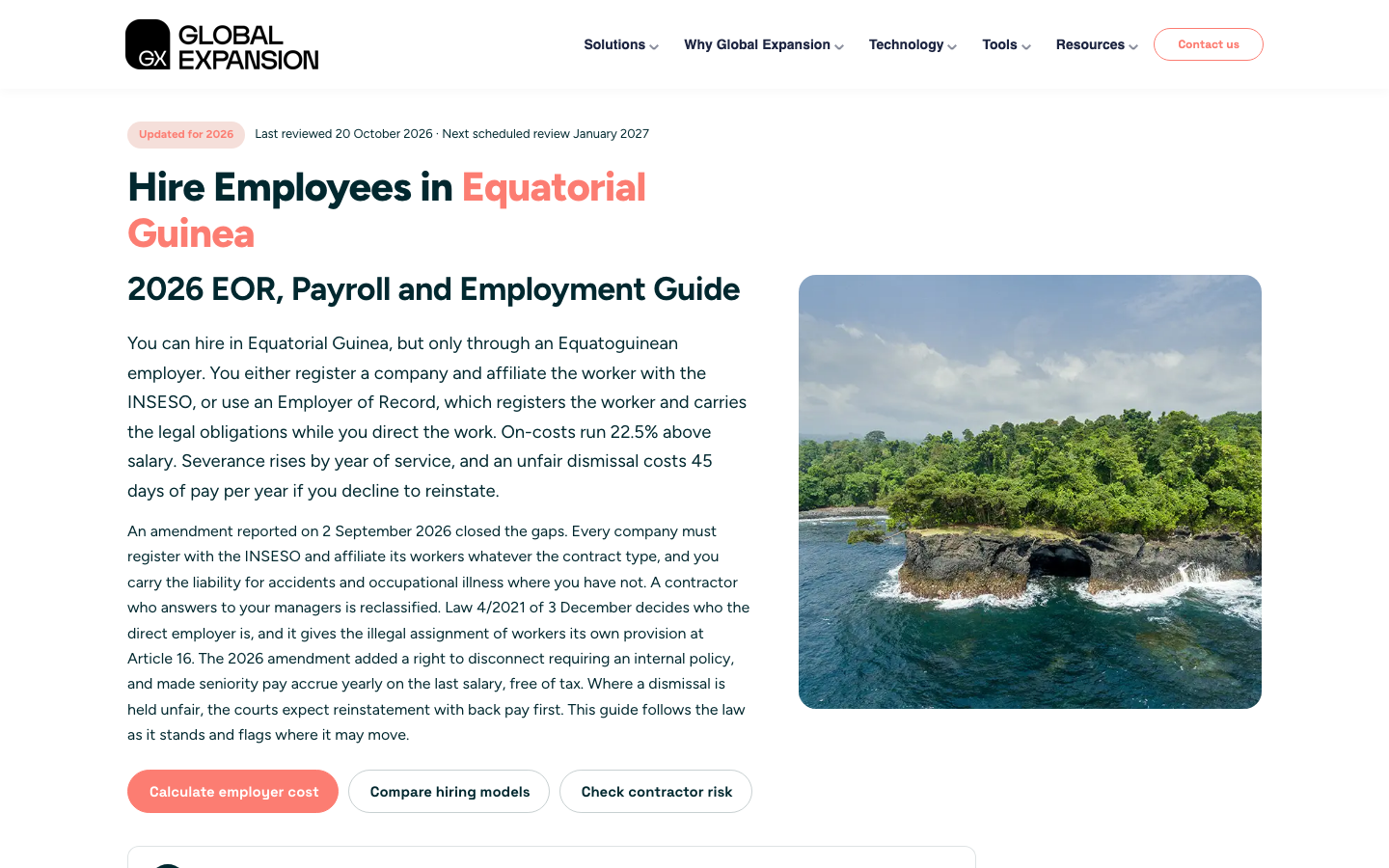
Global Expansion keeps an Equatorial Guinea Countrypedia page reviewed on October 20, 2026, with another check due in January 2027. No other page here flags Article 16 of Ley Núm. 4/2021 and the 2026 right to disconnect.
Key Specialty Area:
Flags the direct employer provision
Service Cost:
Quote-based
Top Advantages
- Raises the unlawful assignment question directly
- Mentions the 2026 right to disconnect
- Last and next review dates shown openly
Scope of Services
- Signing staff as their legal employer locally
- Payroll, INSESO and income tax filings
- Hiring model comparison and cost tools
Our Verdict
The page I read first for the right questions, then verify every answer at source.
INS Global
Provider Type:
Global
Company Description:
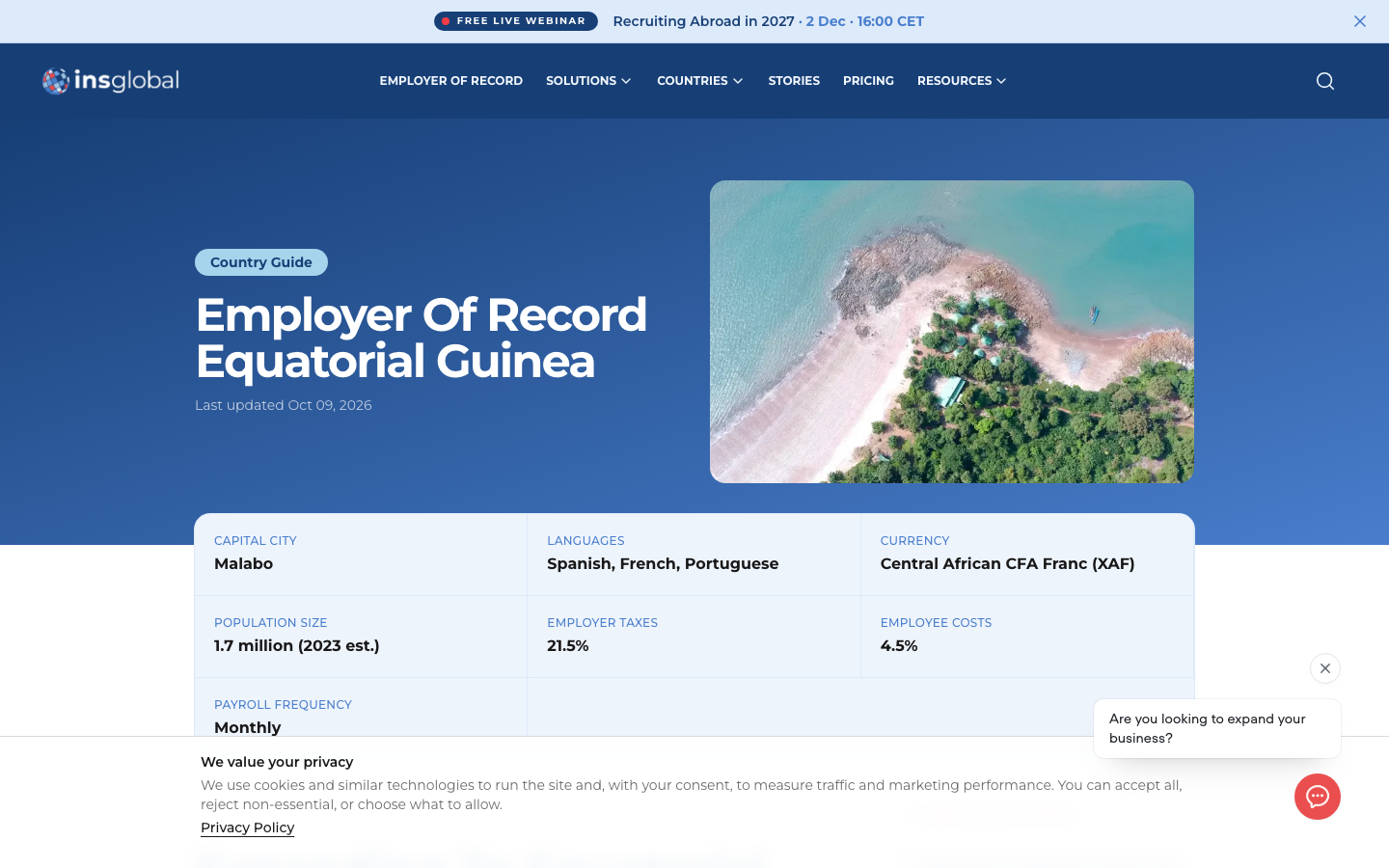
INS Global keeps an Equatorial Guinea EOR guide covering contracts, contribution rates, leave, notice and probation. The guide names no statute, so its figures need checking against the 2021 law and the 2026 amendment before use.
Key Specialty Area:
Contracts and termination steps in one guide
Service Cost:
Quote-based
Top Advantages
- Country guide downloadable for HR teams
- Notice and probation explained by service length
- Several markets managed from one account
Scope of Services
- Employment contracts and employee onboarding
- Payroll, tax and benefits administration
- Termination handling and final pay
Our Verdict
Handy as a process outline, with each statutory figure taken from the law instead.
MaxisHR
Provider Type:
Regional (Africa), with hubs in Nairobi, Lagos, Johannesburg, Cairo and Casablanca
Company Description:
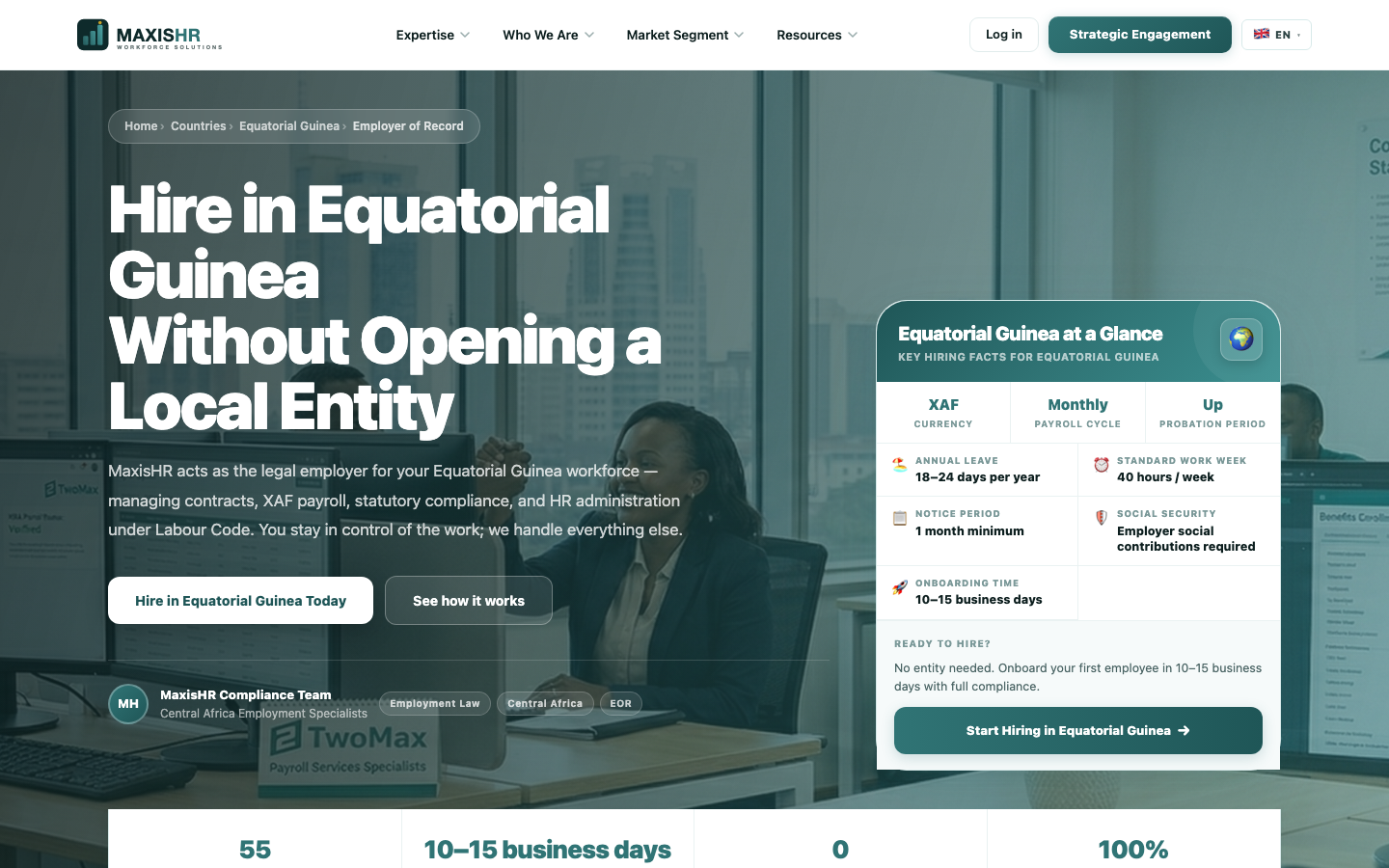
MaxisHR pitches its service across the continent and advertises staff dedicated to Central Africa. Its Equatorial Guinea page runs on a shared template and publishes no contribution or tax rates, so I would use it for service scope only.
Key Specialty Area:
Pan-African hiring across many markets
Service Cost:
Quote-based
Top Advantages
- Contract-ready hires in 10 to 15 business days, per MaxisHR
- Registration and first payroll handled together
- Same platform across many African markets
Scope of Services
- Employment contracts and statutory registration
- Payroll in XAF and HR records
- Leave and public holiday administration
Our Verdict
A fit for regional hiring, as long as the Equatoguinean terms come from the statute.
Playroll
Provider Type:
Global
Company Description:
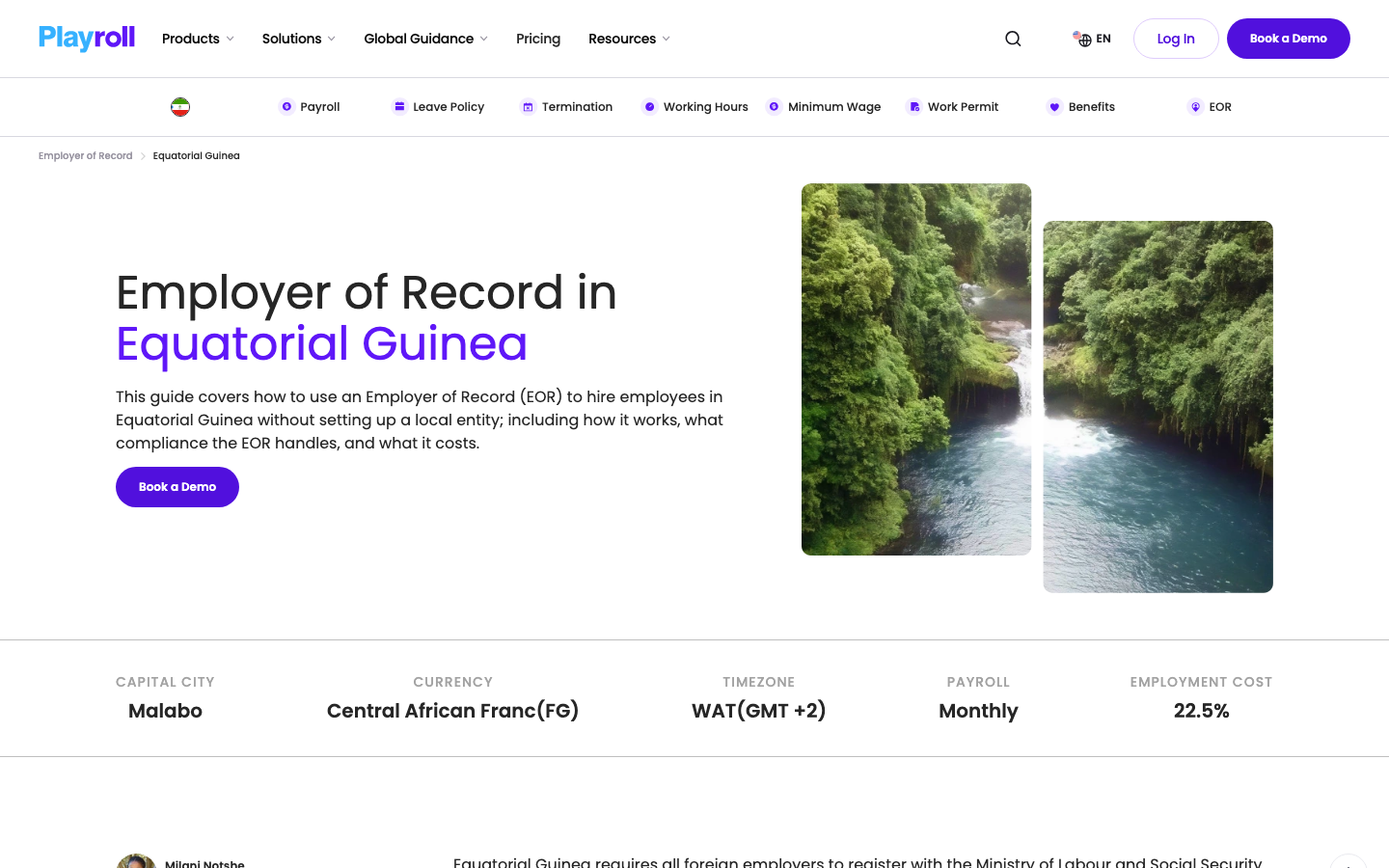
Playroll shows a starting fee on its Equatorial Guinea page and says contracts are drafted in Spanish. Its companion hiring guide, however, describes Ecuador’s termination rules under an Equatorial Guinea heading, so don’t use its exit terms.
Key Specialty Area:
Only own fee published for this market
Service Cost:
Playroll lists a $399 starting fee per employee each month
Top Advantages
- Starting fee visible before any call
- Spanish-language contracts, per its page
- Help converting staff to an own entity later
Scope of Services
- Contract drafting and employee onboarding
- Monthly payroll and statutory filings
- Entity setup through Global Entity Setup
Our Verdict
Its fee helps set a budget, but rebuild exit terms from Equatoguinean law.
*As pricing is subject to change, we are listing prices as they stand in November 2026
RemotePeople
Provider Type:
Global
Company Description:
RemotePeople offers the longest Equatorial Guinea page on this list, published on April 9, 2026. It covers both funds, the 2024 tax bands and severance by ground, but it treats the older Ley 2/1990 as the governing labor law.
Key Specialty Area:
Worked monthly cost breakdown with fee range
Service Cost:
Quote-based; RemotePeople puts typical EOR fees between $300 and $600 a month per employee
Top Advantages
- Monthly cost example with every charge listed
- Separates economic dismissal from unfair dismissal
- Work permit renewal steps explained
Scope of Services
- Employment contracts and payroll in XAF
- INSESO and WPF contribution filing
- Work permits and renewals for foreign staff
Our Verdict
Read it for cost structure, then switch the legal base to the 2021 law.
*As pricing is subject to change, we are listing prices as they stand in November 2026
Skuad
Provider Type:
Global
Company Description:
Skuad runs an Equatorial Guinea EOR page covering hiring, payroll, taxes, business visas and work permits. It positions itself as handling every employer obligation, but its statutory figures need to be checked against current law.
Key Specialty Area:
Visa and work permit guidance alongside EOR
Service Cost:
Quote-based
Top Advantages
- Business visa invitation steps explained
- Work permit handling for foreign hires
- Payroll and tax compliance in one service
Scope of Services
- EOR hiring with full employee onboarding
- Payroll, tax and statutory contributions
- Work permits and visa support
Our Verdict
Worth a quote when the hire is foreign and immigration is the main hurdle.
Woomax Talent

Provider Type:
Local, office in Malabo II
Company Description:
Woomax Talent (Woomax SL) works from Malabo II, opposite the Tesorería General. It offers talent selection, training, temporary work, outsourcing with payroll management, and HR consulting. Nowhere on its site does it present an EOR offer.
Key Specialty Area:
Temporary work and payroll from Malabo
Service Cost:
Quote-based
Top Advantages
- Office in Malabo with a local phone line
- Payroll and personnel administration outsourced
- Recruitment and training under one roof
Scope of Services
- Talent selection and candidate recruitment
- Temporary work and HR outsourcing
- Payroll management and HR consulting
Our Verdict
Ask for its agency authorization number before using the temporary work line.
INSIGHT: What does an EOR in Equatorial Guinea cost?
Fee figures are rare here, and the fee is only part of the bill. Uncapped contributions, bonuses and the seniority accrual decide the real number.
- Published figures: Playroll prints a starting EOR fee of $399 per worker per month. RemotePeople estimates typical fees at $300 to $600 (both checked October 2026). Both numbers come from the companies themselves and say nothing about a going rate.
- Statutory load: 22.5% of salary across INSESO and the WPF, with no published ceiling (PwC Tax Summaries).
- Illustration: 30 days of seniority pay per year equals about 8.2% of annual salary. Article 100 of the 2021 law adds 2 bonuses of 15 days’ salary each year.
- A usable quote itemizes the management fee, both fund contributions, income tax pass-through, seniority accrual, bonuses, work permit costs and the statute assumed.
*As pricing is subject to change, we are listing prices as they stand in October 2026
Cameroon borders the mainland and shares the same CFA franc. If a role could sit anywhere in that currency zone, my Cameroon EOR guide covers a much larger labor market.
Gabon is the other land neighbor, and its economy also leans on oil. For a side-by-side view, see my page on employer of record in Gabon, which covers the nearest equivalent market.
Nigeria lies across the Bight of Bonny from Bioko and is outside the CFA franc zone. My Nigeria EOR services guide shows a very different cost structure. A common currency does not mean common statutes. An EOR in Equatorial Guinea still answers to the 2026 amendment, local contribution rules and contract registration.
What to Know About EOR Equatorial Guinea: FAQs
Which law governs employment in Equatorial Guinea?
The General Labor Law, Ley Núm. 4/2021 of December 3, 2021, as amended by Ley Núm. 6/2026 of April 10, 2026. The amendment added telework rules, reshaped seniority and dismissal pay, and made contract registration universal. It takes effect on publication in the official gazette and does not apply retroactively. Guidance that still treats Ley 2/1990 or its 2012 reform as current is out of date.
What does an employer contribute in Equatorial Guinea?
The employer pays 21.5% to the social security institute and 1% to the Work Protection Fund, for a total of 22.5%. Employees contribute 4.5% and 0.5%. No ceiling appears in the published rates, and one provider’s claim that the employee fund share uses net pay remains unconfirmed. Treat a quote without the fund line as incomplete. The 2026 amendment requires every employer to register and enroll each worker, regardless of contract type.
Can employees work remotely under Equatoguinean law?
Yes. The 2026 amendment regulates telework done fully or partly away from the workplace, and it must be voluntary and reversible. Employers need an internal disconnection policy, cannot demand work during rest periods, and must give prior notice of cameras, recording, or geolocation. They must also provide equipment and guard against psychosocial risks such as isolation and constant availability. A written telework agreement keeps these terms clear for both sides.
What happens when an employment ends?
The worker receives a seniority payment of at least 30 days’ salary per year, or 15 for domestic workers. It is calculated on the last salary and is not taxed. After an unfair dismissal, the default is reinstatement with back pay, or 45 days per year if the employer refuses. Economic dismissals pay 3 months after 5 years of service, and other grounds are capped at 22 days per year. Notice is 1 week after a month, or 20 days after 6 months.
How do I choose between these providers?
Start with the legal basics: which entity signs, where it is registered and whether it holds any authorization required to supply workers to a client. Check that contracts are drafted in Spanish and registered with the labor ministry, and which statute the provider applies. Request a written quote that separates the fee, both fund contributions, bonuses and the seniority accrual. Just 1 firm here prints its own fee.

Helen is Anywherer’s Market Analyst & Content Researcher, with extensive experience in analyzing global employment markets and HR technology trends. She is skilled at turning complex market data into clear, well-researched insights that inform every piece of content. With a strong grasp of the EOR, PEO, and international hiring space, Helen plays a key role in keeping Anywherer’s research accurate, up to date, and genuinely useful for readers.