Eswatini’s statutory payroll looks heavier on paper than it is in practice. The national provident fund takes 5% from each side, but only up to a low monthly ceiling. Once a salary passes that ceiling, the employer’s share stops growing. Income tax starts from the first lilangeni and is then cut by a fixed rebate. The currency sits at par with the South African rand.
Why Eswatini Is Cheaper to Hire In Than It Looks
The Kingdom of Eswatini, still widely known by its pre-2018 name of Swaziland, is a small landlocked state. South Africa borders it on 3 sides and Mozambique on the fourth. Mbabane is the administrative capital, Lobamba the legislative and royal one, and Manzini the main commercial and industrial center. World Bank data put the population at 1,256,174 in 2025, with GDP of $5.16 billion and growth of 4.2%. SiSwati and English are official, and English is the language of statutes and contracts. Any employer of record in Eswatini pays staff in the lilangeni (plural emalangeni, code SZL).
Sugar and agro-processing, textiles and apparel, beverage concentrates, forestry and timber lead private hiring. Retail and distribution, financial services, and donor and NGO programs follow. The workforce speaks English, salaries run below South African levels, and Eswatini shares the Southern African Customs Union (SACU) with its neighbor. The Central Bank of Eswatini keeps the lilangeni at par with the rand inside the Common Monetary Area (CMA). With an Eswatini employer of record, a foreign company hires without registering an entity.
With an employer of record, a third-party firm takes on the legal employer role for people who actually work for a foreign business. That company handles payroll, while the client still directs the day-to-day work. Here, the hire rests on a contract under the Employment Act, 1980, with monthly pay in emalangeni. The worker is registered with the Eswatini National Provident Fund (ENPF), and pay-as-you-earn (PAYE) is withheld against an annual rebate. That tax goes to the Eswatini Revenue Service (ERS) by the 7th of the following month. Workmen’s compensation cover and the relevant sector wage order complete the picture.
10 providers follow in one A to Z list. After checking every site, I found that only 1 states permanent operations in Eswatini, and it is a South African staffing group. Each entry shows what the provider covers and where it stands out. Using an employer of record in Eswatini is also faster than registering a company and then waiting for ERS and ENPF employer codes.

INSIGHT: What does an Eswatini employer actually pay on top of salary?

The provident fund contribution is capped at a fixed monthly amount. Above a modest salary, the employer’s statutory cost stops rising altogether.
- ENPF: employer and employee each owe 5%, but only on the first E4,300 of monthly wages in 2026. The most either side pays is E215 a month (ENPF public notice, January 2026).
- Legal Notice No. 5 of 2025 sets the ceiling at E4,000 for 2025, E4,300 for 2026, E4,600 for 2027, E4,900 for 2028 and E5,200 for 2029 (ENPF).
- Illustration: on a gross salary of E25,000 a month, the capped E215 employer share equals 0.86% of pay, before workmen’s compensation cover.
What Is the Best EOR Option in Eswatini?
A provider with people in the country has a clear case. Contracts follow a 1980 statute, and the provident fund runs on a ceiling and a monthly remittance cycle. Pay floors come from sector orders rather than one national rate. RiseUp is the single provider among the 10 that lists a permanent Eswatini team. RiseUp is a South African group with an Eswatini operation, not an Eswatini company, and that distinction matters when you ask who signs the contract.
A platform reaching in from abroad offers uniform paperwork, one dashboard and the same standards in every market. Payroll in emalangeni needs no currency hedging, because the lilangeni moves with the rand. Published Eswatini detail across these 10 ranges from nothing at all to a band-by-band tax walkthrough. More detail does not mean more accuracy, and some of the longest pages here carry the clearest mistakes.
Put the same 4 questions to every shortlisted firm, in writing. Who exactly is the contracting entity, and does it hold Eswatini registration? Is the provident fund charged on the capped base or on full salary? Which sector wage order covers the role, and how is PAYE worked out against the rebate? Only 2 of the 10 print any fee figure, so most comparisons start with a quote request.
INSIGHT: Why Eswatini income tax has no tax-free band but still starts at zero
Tax is charged from the first lilangeni, and a fixed annual rebate is then subtracted. That produces an effective starting point that many guides describe as a threshold.
- Bands: 20% up to E100,000 of annual taxable income, 25% to E150,000, 30% to E200,000 and 33% above. All apply from the first lilangeni (ERS).
- Rebate: E8,200 a year, or E683.33 a month. Individuals over 60 receive E2,700 on top, so E10,900 in total (ERS).
- Reconciliation: E8,200 divided by the 20% first-band rate equals E41,000. ERS itself calls this the effective tax-free threshold, so both descriptions are correct (ERS PAYE guide).
- Consequence: up to E100,000, the 2 readings give the same tax. A model that shifts every bracket up by E41,000 goes wrong above that, giving E22,250 on E150,000 instead of the correct E24,300.
10 Providers Offering Eswatini EOR Services
Every provider here states an employment, EOR or payroll service for Eswatini on a page built for this country, not a dropdown item. My criteria were payroll in emalangeni and provident fund registration with the cap applied correctly. Contracts had to follow the Employment Act, and PAYE had to be withheld against the rebate under the right sector wage order. I also weighed pricing transparency. Only 1 provider states operations in the country, and only 2 print a fee figure. Remote was left out, because its Eswatini page lists contractor management rather than confirmed employer of record coverage.
Providers appear in A-to-Z order. The sequence says nothing about quality, preference, or ranking.
Africa HR Solutions
Provider Type:
Regional, with its head office in Mauritius
Company Description:
Africa HR Solutions works only in Africa, citing 16 years of experience and more than 46 African countries. Its Eswatini page publishes no statutory figures, and its URL and headline still pair the old country name with the new one.
Key Specialty Area:
Africa-exclusive service with insurance options for staff
Service Cost:
Quote-based
Top Advantages
- Free life cover underwritten by the Unisure Group
- Optional pan-African health plan for employees
- One point of contact for every request
Scope of Services
- Contracts and onboarding for Eswatini hires
- Payroll in emalangeni paid on schedule
- Compliance management without a local entity
Our Verdict
When Eswatini is one of several African markets, I would brief this team first.
Asanify
Provider Type:
Global; the site lists a Kolkata, India address
Company Description:
Asanify runs a dedicated EOR page for the market, filed under the former country name in its URL and title. It covers payroll in emalangeni, tax withholding and exit steps, but gives almost no statutory rates.
Key Specialty Area:
Quick quotes for a first hire
Service Cost:
Quote-based
Top Advantages
- 24-hour quote turnaround, as the company states
- Monthly payroll processed in emalangeni
- Exit steps include ENPF processing and leave payout
Scope of Services
- Contracts issued without a local subsidiary
- Payroll, tax withholding and statutory deductions
- Offboarding with final pay calculations
Our Verdict
Handy for a quick first price, though I would check every rate line by line.
Global Expansion
Provider Type:
Global
Company Description:
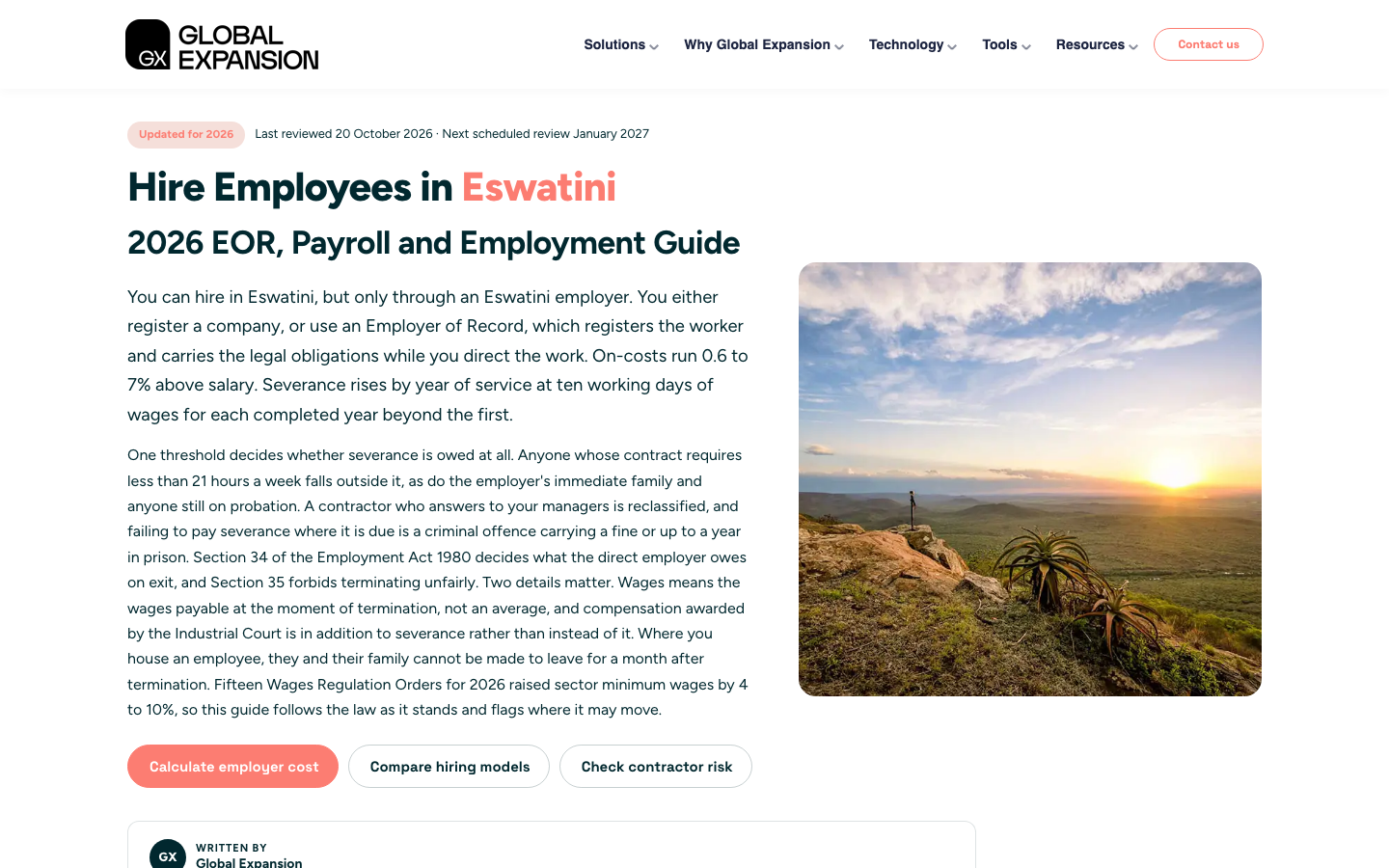
Global Expansion publishes a Countrypedia page for Eswatini, reviewed on 20 October 2026 and scheduled for another check in January 2027. It is the only page here that prints the full ceiling schedule and applies the tax rebate after the calculation.
Key Specialty Area:
Prints the provident fund ceiling schedule to 2029
Service Cost:
Quote-based
Top Advantages
- Ceiling schedule listed year by year
- Employer cost modeled on the capped base
- Severance threshold explained with its exclusions
Scope of Services
- Hiring as legal employer under local contracts
- Monthly PAYE returns and ENPF remittance
- Hiring model comparison and cost calculator
Our Verdict
For cost modeling, this is where I start, then I confirm its flagged figures.
MaxisHR
Provider Type:
Regional (Africa); lists offices in Nairobi, Lagos, Johannesburg, Cairo and Casablanca
Company Description:
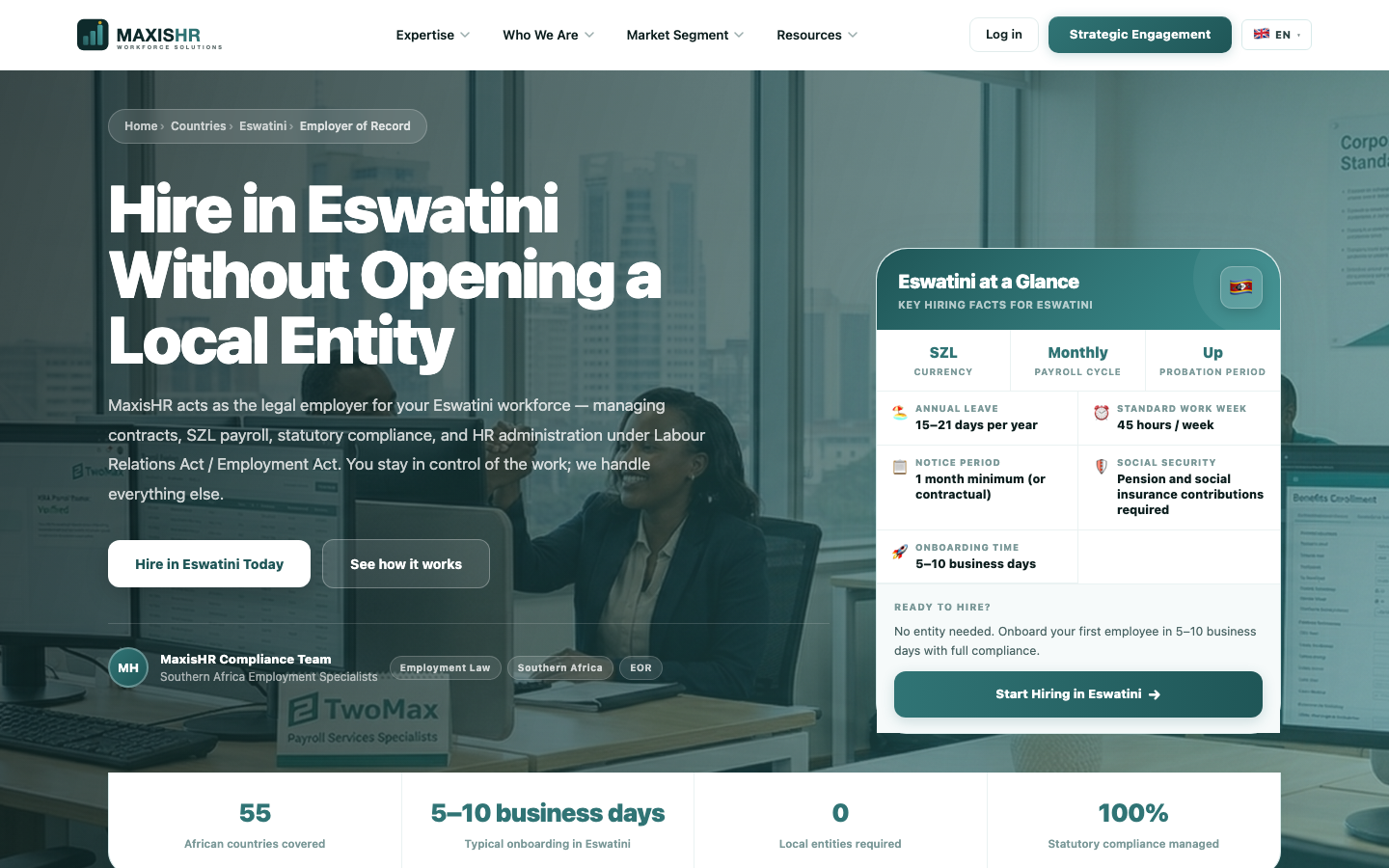
MaxisHR presents itself as Africa’s employer of record and says it can hire anywhere on the continent. Its Eswatini page runs on a shared template, cites a run-together “Labor Relations Act / Employment Act” and lists no contribution or tax rates.
Key Specialty Area:
One provider for hiring across many African markets
Service Cost:
Quote-based
Top Advantages
- Payroll run monthly in emalangeni
- Leave balances tracked on its own platform
- Statutory registrations handled at onboarding
Scope of Services
- Employment agreements drafted for each hire
- Payroll, statutory registrations and HR records
- Leave administration and public holiday tracking
Our Verdict
A fit for pan-African hiring if the Eswatini contract terms are taken from the Act.
Pebl
Provider Type:
Global, with no base stated on its Eswatini page
Company Description:
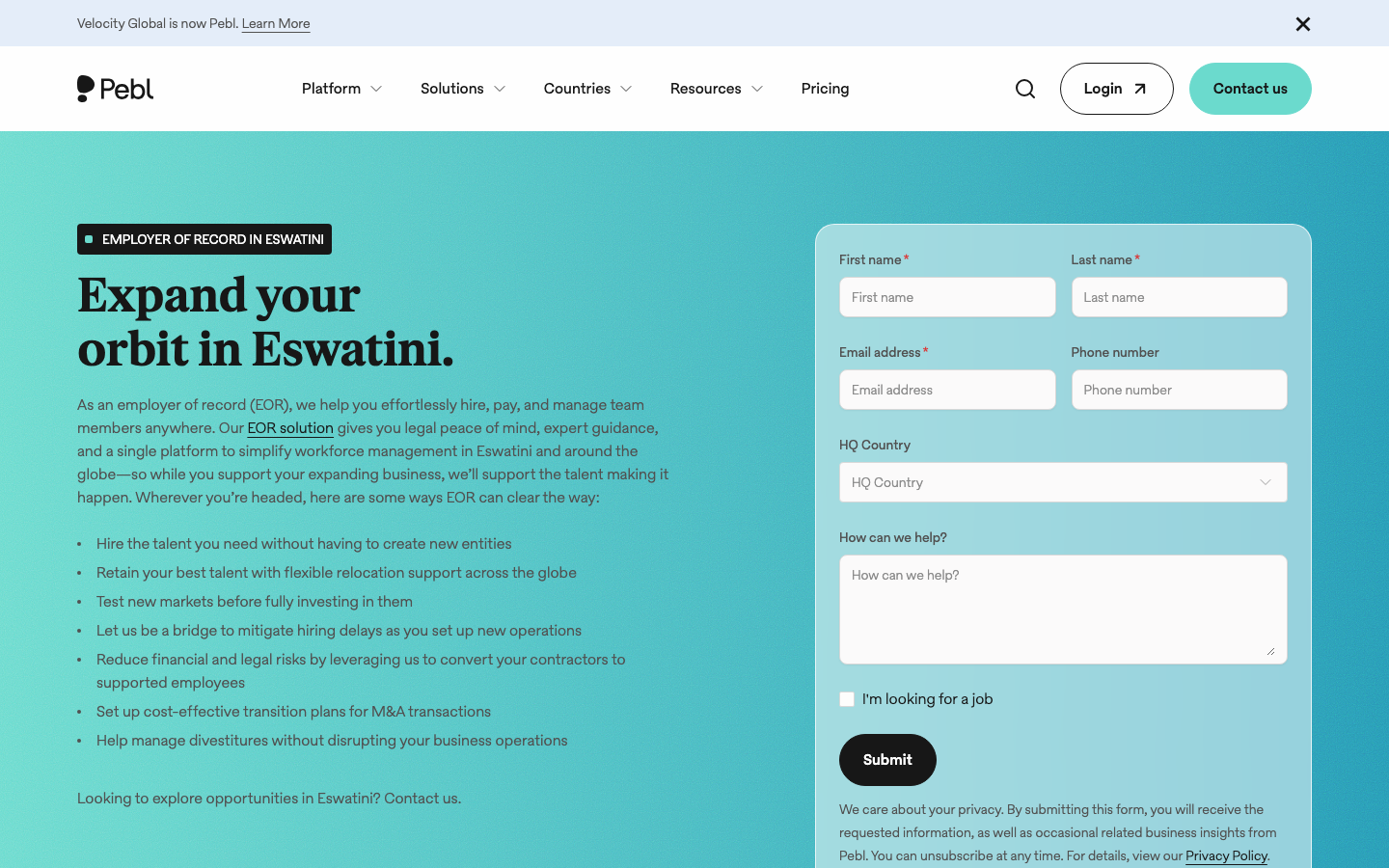
Pebl, formerly Velocity Global, lists Eswatini among its EOR markets. Its country page makes general hiring and payroll claims only and publishes no Eswatini figures, which at least avoids repeating wrong ones.
Key Specialty Area:
Single platform for hiring, pay and management
Service Cost:
Quote-based
Top Advantages
- One platform for hiring, pay and management
- Expert guidance offered alongside the software
- Same contract standards across all markets
Scope of Services
- EOR hiring with Pebl as legal employer
- Payroll and benefits administration in emalangeni
- Compliance guidance for each market
Our Verdict
Sensible for a company already paying staff elsewhere through Pebl’s platform.
Playroll
Provider Type:
Global
Company Description:
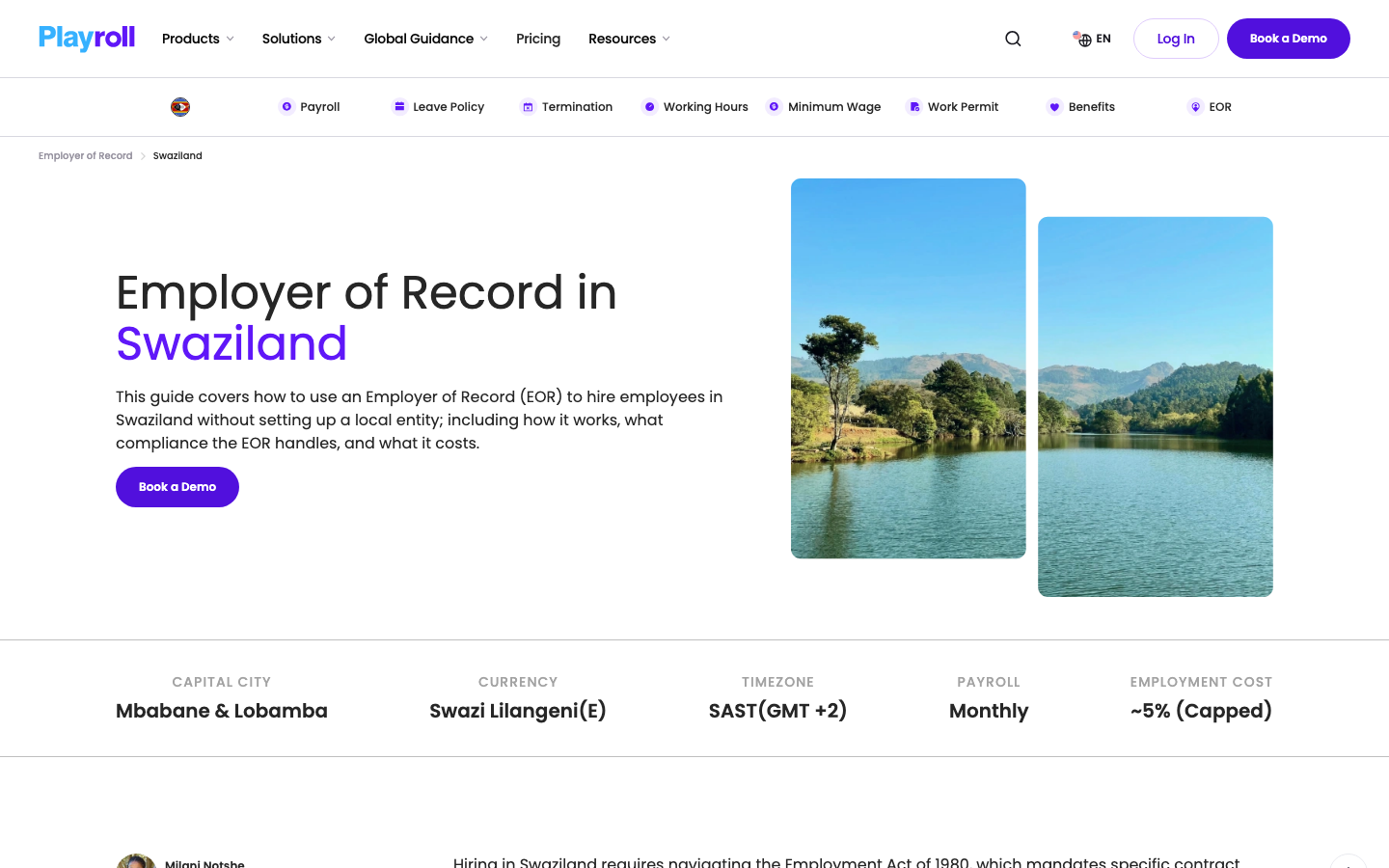
Playroll shows a starting EOR fee on its country page, which carries the former name in its title. The page names the 7th-of-the-month PAYE deadline, but it still uses older names for the revenue service and the provident fund.
Key Specialty Area:
Starting fee shown on the country page
Service Cost:
Starts at $399 per employee per month, according to Playroll
Top Advantages
- Fee shown before any sales call
- PAYE deadline and remittance cycle explained
- Later move to an own entity supported
Scope of Services
- Contract drafting and statutory registrations
- Monthly payroll, PAYE and fund remittance
- Own-entity setup later via Global Entity Setup
Our Verdict
A clear budget line to start from, with institution names corrected in the contract.
*As pricing is subject to change, we are listing prices as they stand in November 2026
RemotePeople
Provider Type:
Global
Company Description:
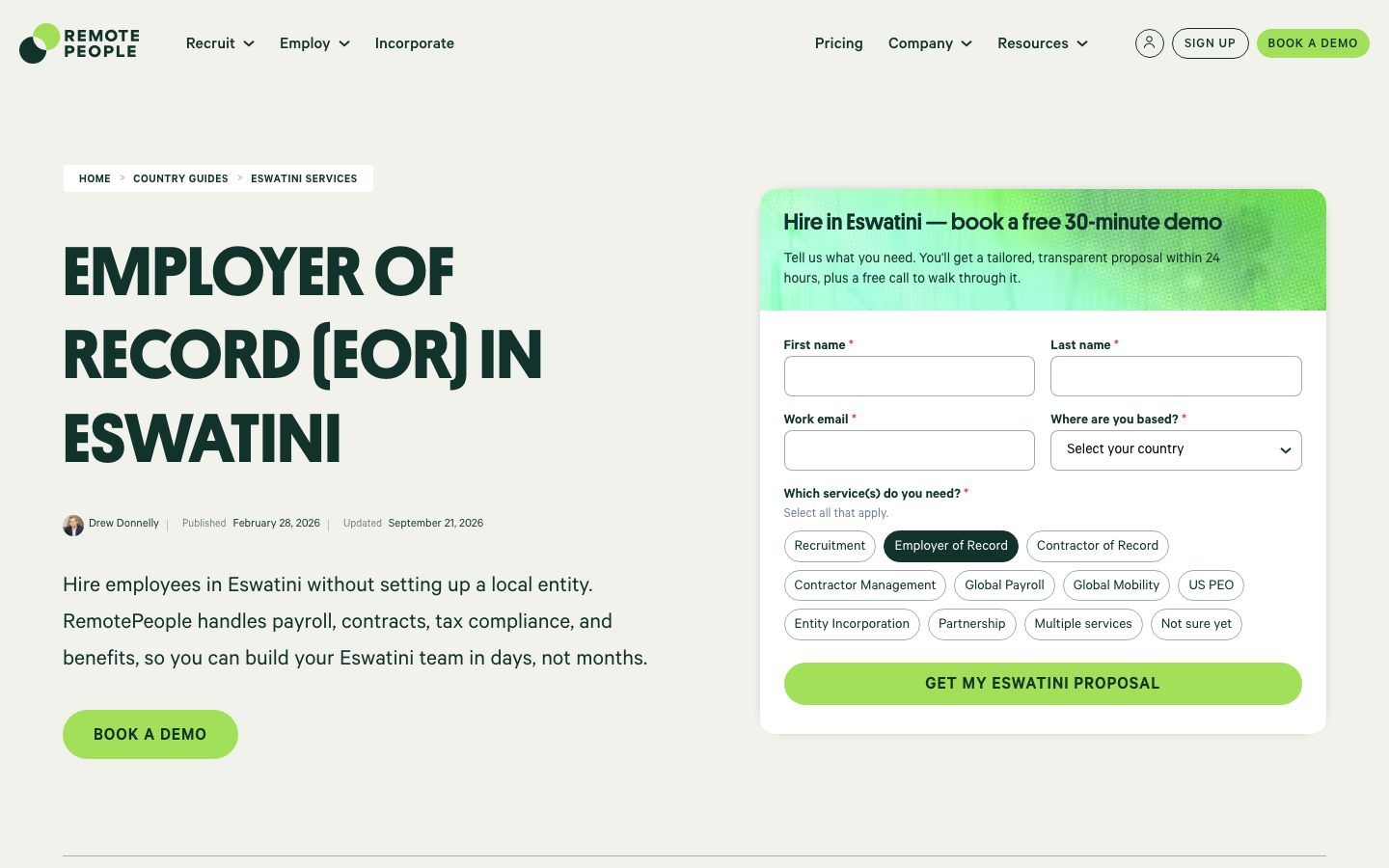
RemotePeople offers the deepest Eswatini page on this list, published on 28 February 2026. Every figure is converted into US dollars at $1 = 16.50 SZL, an April 2026 rate, so its statutory thresholds need converting back.
Key Specialty Area:
Fee estimate and full cost walkthrough
Service Cost:
Quote-based; the page estimates EOR fees at $300 to $600 per employee per month
Top Advantages
- EOR fee and upfront cost estimates published
- Sector wage order changes for 2026 summarized
- Notice, severance and overtime rules gathered together
Scope of Services
- Employment contracts and PAYE withholding
- Work permit guidance for non-citizen employees
- Leave, benefits and termination administration
Our Verdict
I would read it for structure, then rebuild each threshold in emalangeni.
*As pricing is subject to change, we are listing prices as they stand in November 2026
RiseUp
Provider Type:
Regional; a South African staffing group with operations in Eswatini
Company Description:
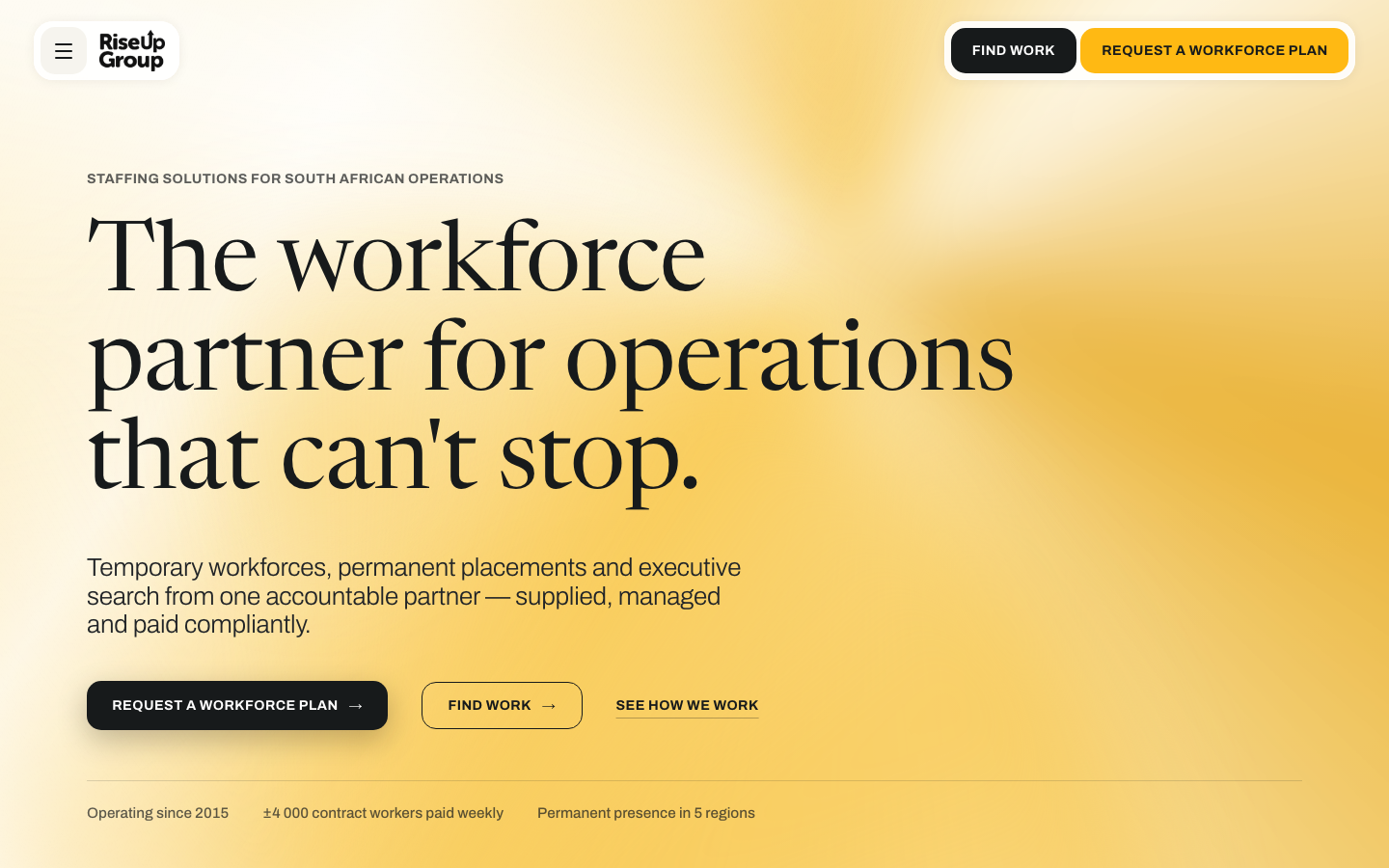
RiseUp is a South African staffing group operating since 2015, with permanent regional teams in KwaZulu-Natal, Gauteng, Mpumalanga, the Western Cape and Eswatini. For the temporary workforces it supplies, RiseUp itself is the employer of record.
Key Specialty Area:
Sole entry with a standing team in Eswatini
Service Cost:
Quote-based
Top Advantages
- Permanent regional presence that includes Eswatini
- About 4,000 contract workers paid weekly, per RiseUp
- 5 named operating models for contract workforces
Scope of Services
- Temporary employment services with RiseUp as employer
- Payroll, HR administration and industrial relations support
- Permanent placement and executive search
Our Verdict
First call for me when an Eswatini contract workforce needs a team that already operates there.
Rivermate

Provider Type:
Global
Company Description:
Rivermate keeps an Eswatini hiring guide last updated on 17 February 2026. Its sick leave and probation rules match the Act, and its fund label uses the older name, which the governing 1974 Order still carries.
Key Specialty Area:
Sick leave and probation rules match the Act
Service Cost:
Quote-based
Top Advantages
- Sick leave set out as in section 129
- Longer probation for supervisory roles explained
- Provident fund cap mentioned in its tables
Scope of Services
- EOR hiring with contracts and onboarding
- Payroll with PAYE and fund contributions
- Leave, probation and termination administration
Our Verdict
Worth reading for leave and probation, then confirm working hours against the wage order.
Talent Grid Africa
Provider Type:
Regional (Africa), with no headquarters city stated on the page
Company Description:
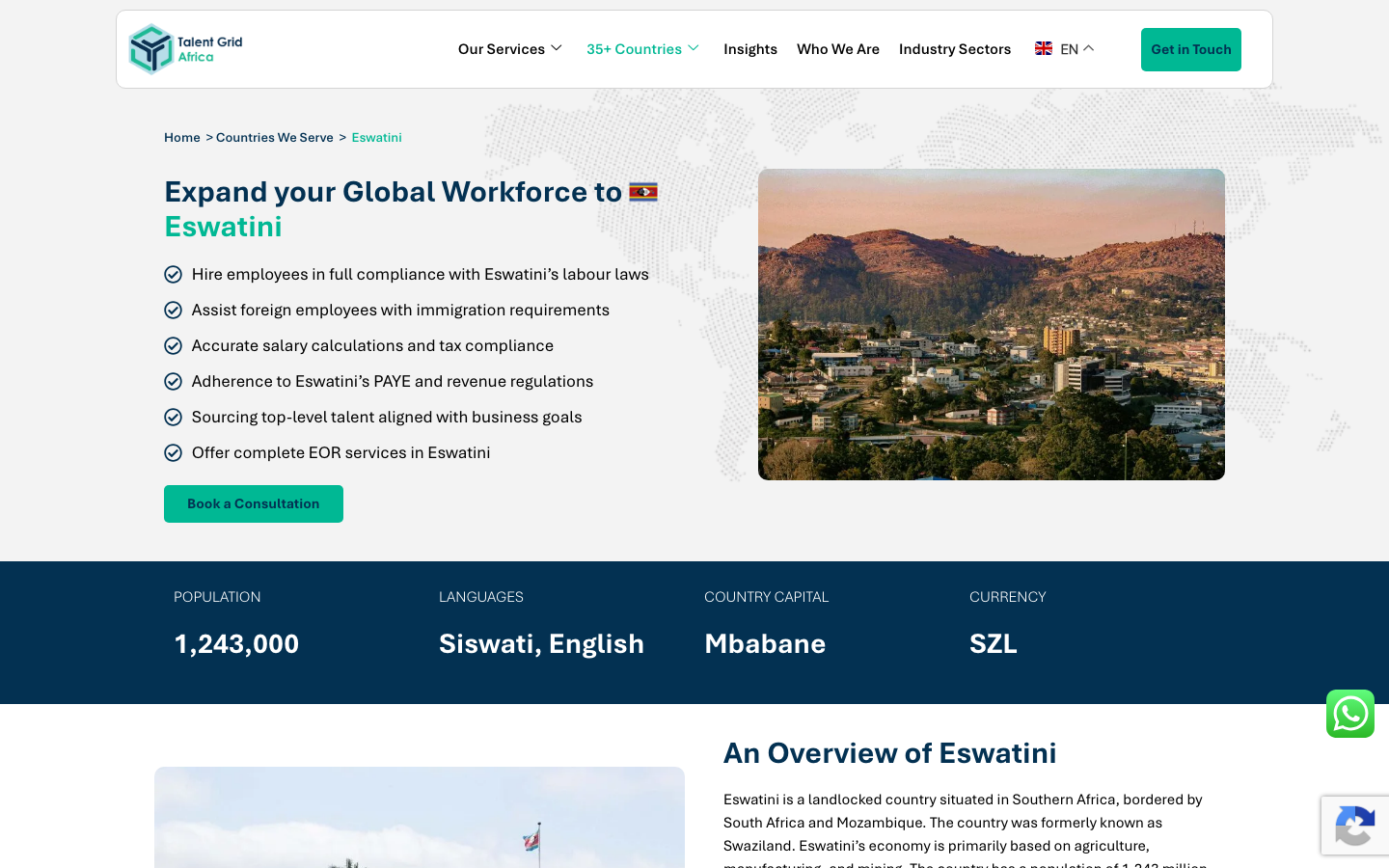
Talent Grid Africa offers EOR services for Eswatini, along with immigration support and recruitment. Its country page gives population and leave figures but names no statute, and it says minimum wages are set by job grade.
Key Specialty Area:
Recruitment and immigration help bundled with EOR
Service Cost:
Quote-based
Top Advantages
- Talent sourcing aligned with business goals
- Help with immigration steps for foreign staff
- PAYE and revenue compliance handled
Scope of Services
- Full EOR services for Eswatini hires
- Payroll with salary and tax calculations
- Talent sourcing and immigration assistance
Our Verdict
Reasonable for a recruit-and-employ package, once each leave figure is checked.
INSIGHT: What does an EOR in Eswatini cost?
Fee figures are scarce for this market. The statutory load underneath is unusually light once the provident fund cap applies.
- Published figures: Playroll lists its EOR fee from $399 per employee per month. RemotePeople estimates typical EOR fees at $300 to $600 a month and upfront costs of $500 to $2,000 (both checked October 2026). These are company figures, not a market rate.
- Statutory load: 5% of wages to the ENPF, capped at E215 a month per employee in 2026 (ENPF), plus a workmen’s compensation premium.
- Salary base: with no national minimum wage, the sector wage order for the role sets the floor. The fee sits on top of that.
- Request itemized lines for the management fee, capped ENPF pass-through, PAYE pass-through, workmen’s compensation premium, severance accrual and any work permit cost.
*As pricing is subject to change, we are listing prices as they stand in October 2026
South Africa wraps around 3 sides of Eswatini and the 2 currencies trade at par. When a role could just as easily be based across the border, my South Africa EOR guide covers that bigger market.
Mozambique is the fourth neighbor and Eswatini’s route to the sea, which matters for export and logistics roles. My page on employer of record in Mozambique covers that market.
Namibia is a fellow CMA member with a rand-linked currency, so my Namibia EOR services guide makes a useful comparison. Shared money is not shared law, though: an EOR in Eswatini still runs on its own fund ceiling, tax rebate and sector wage orders.
What to Know About EOR Eswatini: FAQs
What does an employer contribute to the provident fund?
Each side pays 5% of wages, but only on earnings up to E4,300 a month in 2026. The most either side pays is therefore E215 a month, remitted monthly. Legal Notice No. 5 of 2025 lifts the ceiling to E4,600 in 2027, E4,900 in 2028 and E5,200 in 2029, as the fund’s public notice sets out. Any guide that quotes 5% without the cap overstates the cost of a professional salary.
How is income tax calculated?
Tax runs at 20% up to E100,000 a year, then 25%, 30% and 33%, starting from the first lilangeni. A rebate of E8,200 is then deducted, or E10,900 for people over 60, which means tax effectively begins at E41,000. The relief is a credit, not an exempt band, which is why published thresholds look different. Employers file and pay by the 7th of the following month, or face a 20% penalty plus interest.
Is there a minimum wage in Eswatini?
Eswatini has no single national wage floor. Wages Councils under the Wages Act, 1964 recommend sector floors, which the Minister publishes as wage-order regulations and updates from time to time. A number presented as the country’s minimum wage is really one sector’s floor, which explains the many amounts online. Published guides also disagree on how many sectors are covered, so check the order for your industry before setting pay, hours and allowances.
What leave are employees entitled to?
After every 12 months of service, the Act gives at least 2 weeks of paid annual leave. After 3 months, sick leave runs to 14 days on full pay and 14 on half pay each year, with a medical certificate. Maternity leave lasts at least 12 weeks, and after a year of service at least 2 of those weeks are paid in full. The Act sets no paternity leave, though some wage orders add more.
How do I choose between these providers?
Start by finding out whether the provider owns a local entity, relies on a group company, or covers the country remotely. Check that the quote applies the fund cap, names the sector wage order and calculates tax against the rebate. Severance accrues at 10 working days’ wages for each completed year after the first. Get the quote in writing with the fee, statutory pass-through items and accruals on separate lines, because few firms here print any price.

Helen is Anywherer’s Market Analyst & Content Researcher, with extensive experience in analyzing global employment markets and HR technology trends. She is skilled at turning complex market data into clear, well-researched insights that inform every piece of content. With a strong grasp of the EOR, PEO, and international hiring space, Helen plays a key role in keeping Anywherer’s research accurate, up to date, and genuinely useful for readers.