Risk management software is an umbrella term, and that is the first thing worth saying out loud. Underneath it sit several different products: enterprise governance suites, vendor assessment platforms, and services that score companies from the outside. What almost every search actually wants is third-party risk management software, because that is where the work has moved. The job is the same in every case. Keep a register, assess what is on it, monitor it between assessments, and be able to prove the work happened.
Two forces made 2026 the year this stopped being optional. The first is regulatory. Regulation (EU) 2022/2554, the Digital Operational Resilience Act, has applied to financial entities since 17 January 2025. It also reaches their ICT third-party service providers. It requires a register of contractual arrangements covering those providers. The second is arithmetic. More of what a company depends on now sits outside it. Shopping for software for vendor risk management is really shopping for evidence that somebody is watching.

INSIGHT: Why is vendor risk the biggest part of risk management software?

Because most of what an organization depends on now sits outside it, and supervisors have started asking for evidence that someone is watching.
- The Business Research Company puts the third-party risk management market at $8.09 billion in 2026, up from $6.82 billion in 2025, and forecasts $15.45 billion by 2030 (report published July 2026).
- Estimates vary widely by scope: Research and Markets sizes the same market at $16.76 billion for 2026 (report published August 2026). Treat any single figure as one firm’s definition, not a settled number.
- DORA, Regulation (EU) 2022/2554 of 14 December 2022, has applied since 17 January 2025 and covers financial entities and their ICT third-party service providers.
- The practical consequence: the vendor list stopped being a procurement spreadsheet and became an audited register.
What Is the Best Risk Management Software in 2026?
So there is no single winner, and the honest answer to the heading is a question back: which layer are you missing? The market splits three ways. Enterprise governance suites cover many risk domains on shared data. Third-party specialists run the vendor lifecycle end to end. Security ratings services score companies continuously from the outside. Mature programs run more than one of those. That is why the best software for risk management is usually a combination rather than a single license.
Below, I’ve reviewed 14 of the leading platforms in A-Z order.
INSIGHT: Enterprise GRC, third-party specialist, or security ratings?
These 14 platforms solve three different problems. Buying one while expecting another is the usual reason a risk program stalls in its first year.
- Enterprise GRC suites (Archer, LogicGate, MetricStream, OneTrust, Optro, Riskonnect): many risk domains on shared data, formal governance, heavier to implement.
- Third-party specialists (Mitratech Prevalent, Panorays, ProcessUnity, Venminder, Whistic): the vendor lifecycle from onboarding questionnaire to offboarding, with less reach outside vendor risk.
- Security ratings services (Bitsight, SecurityScorecard): continuous outside-in scoring that fills the gap between assessments. A monitoring layer, not a program.
- The families are not tiers, and none of them is a beginner version of another.
Sources:
Vendor Risk Management Software Comparison
The assessment model column carries more weight than any other, because it says how a platform actually learns about risk. Among leading third-party risk management software, that difference decides whether a tool fits your program.
The type column matters almost as much. Shortlists for best vendor risk management software 2026 routinely mix all three families together. That is how teams end up comparing a monitoring service against a governance suite.
| Tool | Type | Assessment model | Risk domains covered | Fit | G2 rating |
|---|---|---|---|---|---|
| Archer | Enterprise GRC | Control testing plus vendor governance | Enterprise, operational, compliance, third-party | Enterprise | 3.6 (20) |
| Bitsight | Cyber ratings | Outside-in scanning | Cyber, third-party | Both | 4.5 (76) |
| LogicGate | Enterprise GRC | Configurable questionnaires and workflow | Enterprise, third-party, compliance, AI governance | Both | 4.6 (191) |
| MetricStream | Enterprise GRC | Internal assessment plus third-party modules | Enterprise, operational, cyber, compliance | Enterprise | N/A |
| Mitratech Prevalent | TPRM specialist | Questionnaires plus shared exchange | Third-party, compliance, business continuity | Both | N/A |
| OneTrust | Enterprise GRC and TPRM | Questionnaires with pre-completed assessments | Third-party, privacy, tech risk, AI governance | Both | 4.5 (5) |
| Optro | Enterprise GRC | Control testing and issue management | Enterprise, third-party, cyber, compliance, AI governance | Enterprise | 4.6 (1,624) |
| Panorays | TPRM specialist | Blended scanning and questionnaires | Third-party, cyber | Mid-market | 4.3 (52) |
| ProcessUnity | TPRM specialist | Questionnaires plus shared exchange | Third-party, cyber | Enterprise | 4.5 (54) |
| Riskonnect | Enterprise GRC | Risk register and operational workflows | Enterprise, operational, business continuity, third-party | Enterprise | 4.4 (71) |
| SecurityScorecard | Cyber ratings | Outside-in scanning plus questionnaires | Cyber, third-party | Both | 4.3 (92) |
| Vanta | GRC and TPRM | AI-assisted document and questionnaire reviews, customizable risk scoring and continuous monitoring | Third-party, security, compliance, internal risk | Mid-market and enterprise | 4.6 (2,735) |
| Venminder | TPRM specialist | Questionnaires plus analyst-performed reviews | Third-party, contract, compliance | Both | 4.7 (115) |
| Whistic | TPRM specialist | Shared vendor profiles | Third-party, cyber | Mid-market | 4.5 (53) |
Every G2 figure below was pulled on 26 August 2026 from the vendor’s own product profile.
The Three Layers of Vendor Risk Management
Most buyers arrive looking for one product and leave having learned there are three. Anyone searching for third-party vendor risk management software is usually missing one specific layer. Naming which one saves a great deal of money.
Layer one is the questionnaire-first platform, where the program itself lives. You keep a vendor inventory and tier each vendor by how critical it is and what data it touches. Then you send due diligence questionnaires, chase the answers, and track remediation with an owner and a date. Behind it all is the audit trail that proves the work happened. Inherent risk is the exposure before controls; residual risk is what remains after them. Almost every tooling budget in this category goes here first, and rightly so.
Layer two is continuous security ratings. An annual questionnaire tells you what a vendor said in March. A rating tells you what its attack surface looks like in November, meaning everything of its own that is reachable from the internet. That fills the other eleven months. What it cannot tell you is whether the vendor has a control, only whether something visible from outside looks wrong. Scores come from proprietary models, and vendors being scored sometimes dispute their grades.
Layer three is managed and analyst services. A provider reads the vendor’s SOC 2 report and financial statements on your behalf, then hands back a rated review. Smaller regulated teams buy this because the bottleneck is the hours. If you are starting from spreadsheets, sequence it in that order. Get layer one running, add ratings for your tier-one vendors, then buy analyst hours only where your team cannot read the documents. That is how third-party and supplier risk management software gets bought without waste.
What Else Falls Under Risk Management Software
The head term reaches further than this list does, and saying so is the only honest option. Four other things get called risk management software, and the platforms reviewed here cover only some of them.
Enterprise and operational risk. This is the risk register discipline. A catalog of risks with owners and ratings, control testing against them, issue management when a control fails, and reporting a board will read. Archer, LogicGate, MetricStream, Optro, and Riskonnect are all built for this. That is why they turn up in lists of top vendor risk management tools grc software, even though vendor risk is one module among many. A risk platform records the risk. The rule itself belongs in policy management software, and an audit will ask to see both.
Contract risk. Contract risk tooling tracks obligations you have agreed to, flags clauses that create exposure, and warns on renewal and termination dates before they pass. Venminder carries contract management alongside its vendor modules, and several enterprise suites hold obligation records against a third party. Be clear about the boundary though. Real contract risk management software sits inside contract lifecycle management. That is a separate market with its own vendors, and this page does not review them.
AI risk and governance. This means a model inventory, risk assessment of each AI system, and the obligations arriving with the EU AI Act. Four platforms here document AI governance modules: Archer, LogicGate, OneTrust, and Optro, the last having added the capability by acquisition. Anyone shopping specifically for AI risk management software should know a specialist market exists outside this list. A governance module inside a GRC suite is a different depth of product.
Cyber and IT risk. Security ratings and vulnerability data feed a risk program without being one. Bitsight and SecurityScorecard both grade companies from externally observable signals, and both now sell that signal into vendor risk workflows. The distinction that matters is direction. Outside-in data tells you what an attacker can see; a control assessment tells you what the vendor has actually built. Programs that only run the first kind eventually get surprised.
Best Risk Management Software by Program Type
Program shape narrows the field faster than any feature list. A four-person team assessing 200 vendors and a global bank assessing 8,000 are not shopping in the same market. They type the same words anyway. The four groups below cover where most readers land when they search for the best vendor risk management software.
For Enterprise Risk Programs
Large programs span many risk domains and many departments, which is what Archer, MetricStream, OneTrust, and Riskonnect are built for. Each holds enterprise risk, operational risk, and compliance on shared data, so the same control evidence serves several teams. Archer publishes a deployment example of one financial services firm running Archer Evolv Compliance across 15 countries and 2,100 users in seven months.
The honest trade-off in the best risk management software for enterprises is weight. These are configuration projects rather than signups, and the implementation is usually measured in quarters. That is a fair price for formal governance across a big organization. It is a poor one for a team that needs a vendor register running next month.
For Mid-Market Teams
LogicGate, Panorays, and Whistic all aim at getting a defensible program running without an implementation project or a dedicated risk team. LogicGate sells configurable applications you assemble yourself. Panorays blends outside-in scanning with questionnaires so a first assessment exists before anyone answers anything. Whistic inverts the direction entirely, pulling a vendor’s published profile instead of sending a fresh questionnaire.
What these share is a shorter path to the first real assessment. What they give up is reach across other risk domains, which matters only if you were going to use those domains. Most mid-market teams are not, at least not in year one.
For Financial Services and Regulated Sectors
Supervisors in regulated sectors generally expect documented due diligence and evidence that findings were tracked to closure. They also expect a register an examiner can read without a guided tour. Mitratech Prevalent, Optro, and Venminder all speak that language. Optro comes from an internal audit heritage, so its evidence trail is built for people who get examined.
Venminder is the clearest example of why analyst services sell here. Its Vendiligence team reviews vendor documentation on the customer’s behalf, and the vendor states its experts deliver over 30,000 risk-rated assessments a year. That is more than a four-person risk team can do. None of this makes an organization compliant, and no platform can promise that.
For Companies Assessing Outsourced Service Providers
Anywherer readers meet this problem from a particular angle. You employ or pay people across borders. That means your payroll provider, your outsourcing partner, and your employer of record companies all hold employee data in jurisdictions you do not operate in. Their controls are effectively your controls. Bitsight, ProcessUnity, and SecurityScorecard are the three here most often bought for exactly that.
What to ask for is unglamorous and specific. A current SOC 2 Type II report, the subprocessor list, breach notification terms, and where the data physically sits. Then add continuous monitoring. A provider that passed diligence in January can look very different by autumn, and nobody will send you a letter about it.
Risk Management Software Pricing
This is the least transparent category anywhere on this site, and I checked all 14. Not a single vendor publishes a rate. Several run pages titled pricing, but they describe a model or collect your email rather than showing a number. Contracts here are annual and negotiated, and the same platform can differ by an order of magnitude between a mid-market and an enterprise deployment.
What actually moves the number is worth knowing before the first call. Four inputs do most of it: monitored third parties, assessments run per year, risk domains licensed, and managed-service hours bought. No range from a comparison blog appears in the table below, because those figures are not sourced and this category is full of them.
| Tool | Pricing model | Free trial or demo | Published starting price |
|---|---|---|---|
| Archer | Quote-based | Demo only | Custom pricing |
| Bitsight | Quote-based, by rated portfolio | Free cyber risk report | Custom pricing |
| LogicGate | Tiered by applications and power users | Demo only | Custom pricing |
| MetricStream | Quote-based | Demo only | Custom pricing |
| Mitratech Prevalent | Quote-based | Demo only | Custom pricing |
| OneTrust | Packaged modules, quote-based | Demo only | Custom pricing |
| Optro | Quote-based | Demo only | Custom pricing |
| Panorays | Bundles sized by third-party count | Free trial | Custom pricing |
| ProcessUnity | Quote-based | Demo only | Custom pricing |
| Riskonnect | Quote-based | Demo only | Custom pricing |
| SecurityScorecard | Quote-based | 14-day free trial | Custom pricing |
| Vanta | Quote-based; TPRM standalone or add-on | Free demo available | Custom pricing |
| Venminder | Quote-based plus managed service add-on | Demo only | Custom pricing |
| Whistic | Packaged tiers by assessment volume | Guided product tour | Custom pricing |
As pricing is subject to change, prices are listed as of August 2026.
INSIGHT: Why does no one publish risk management software pricing?
Because the number depends on how many third parties you monitor and how many risk domains you license. The vendor has to ask before it can answer.
- Zero of the 14 publish a rate. Six run a page called pricing, and each describes packaging or captures a lead instead of showing a figure (vendor pricing pages, read 26 August 2026).
- The models are still visible even without numbers: LogicGate charges by application and power user, Whistic packages by assessment volume, Panorays bundles by third-party count, and Venminder prices managed analyst hours separately.
- Bitsight and SecurityScorecard both price against the portfolio you rate rather than against seats, which is why their quotes move when your vendor list grows.
- Preparing for the call changes the quote: know your tier-one vendor count and your assessment cadence before the first demo, not after the third.
How to Choose Risk Management Software
I would define the program before shopping for the tool, because no platform decides who owns a risk. Then count the third parties you genuinely monitor, and how many of those are tier one. That single number drives both the scope and the price. After that, ask which layer you are missing rather than which brand ranks highest, because the answer is usually specific and cheap to fix.
Next, the practical checks. Do the assessment templates you need exist out of the box, or does someone on your team have to build them? How does a finding become remediation with an owner and a due date, since an assessment nobody acts on is theatre? What evidence trail would an auditor or an examiner actually be handed, and could you produce it this afternoon?
Then look sideways at the rest of your stack. Check integrations with whatever already holds vendor records, because a register maintained in two places is maintained in neither. Ask where your governance records live too, since corporate entity management software and a risk platform end up answering adjacent questions in the same audit.
Cost comes last, and it should be the year-two cost. Vendor counts grow, assessment volumes grow with them, and the number that looked reasonable at signature is rarely the number you renew at.
Top 14 Risk Management Software Platforms for 2026
I built this shortlist by asking each platform the same question: how does it actually learn that a vendor is risky? Most risk management software vendors answer that in one of five ways, and the answer tells you more than any feature grid does.
I’m listing all providers in alphabetical order to keep this comparison neutral.
The mix runs deliberately wide, from enterprise suites like Archer and MetricStream to third-party specialists like ProcessUnity and Whistic and ratings services like Bitsight. Search for the best third-party risk management software and the results imply 13 versions of one thing. The market does not work that way, and this list is built to show why.
Every block opens with the family and the assessment model, then gives three real advantages and three real trade-offs. Reading only those six bullets is enough to see where a platform is weak. That is the fastest route through a best risk management software 2026 shortlist.
Archer
Quick Overview
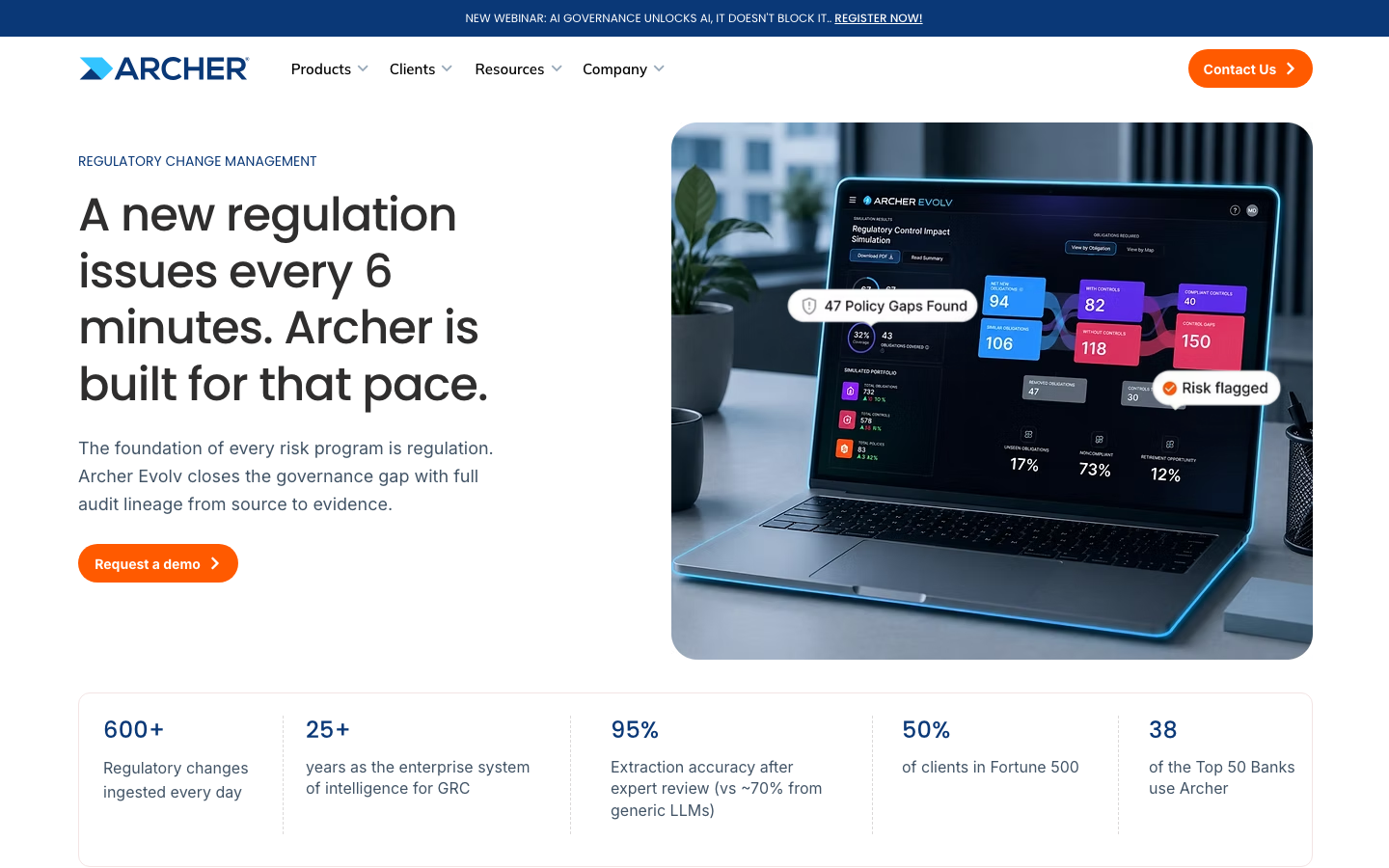
Archer is an enterprise GRC platform that learns about risk through internal control testing and vendor lifecycle governance rather than outside-in signals. Its Evolv portfolio spans compliance, risk, audit, and intelligence, with third-party risk, resilience, and AI governance alongside. The vendor states that 50% of its clients are in the Fortune 500 and that 38 of the top 50 banks use it.
Software Pros
- Regulatory change management with audit lineage from source obligation to evidence
- Third-party risk sits beside enterprise, operational, and IT risk on shared data
- Deep configurability for organizations with unusual governance structures
Software Cons
- Implementation weight is real, and configuration is a project rather than a task
- No figure appears anywhere publicly, so the budget conversation starts with sales
- Only 20 G2 reviews back the score, which is thin for a platform this established
Archer Review
Reading the documentation on Archer, the center of gravity is regulation rather than vendors. It is built for organizations where a new rule lands, obligations get extracted, and controls have to be re-mapped across departments. A team whose problem is 400 unassessed suppliers will find a lot of platform here that it never opens.
Our Verdict
Regulatory Change At Scale
Bitsight
Quick Overview
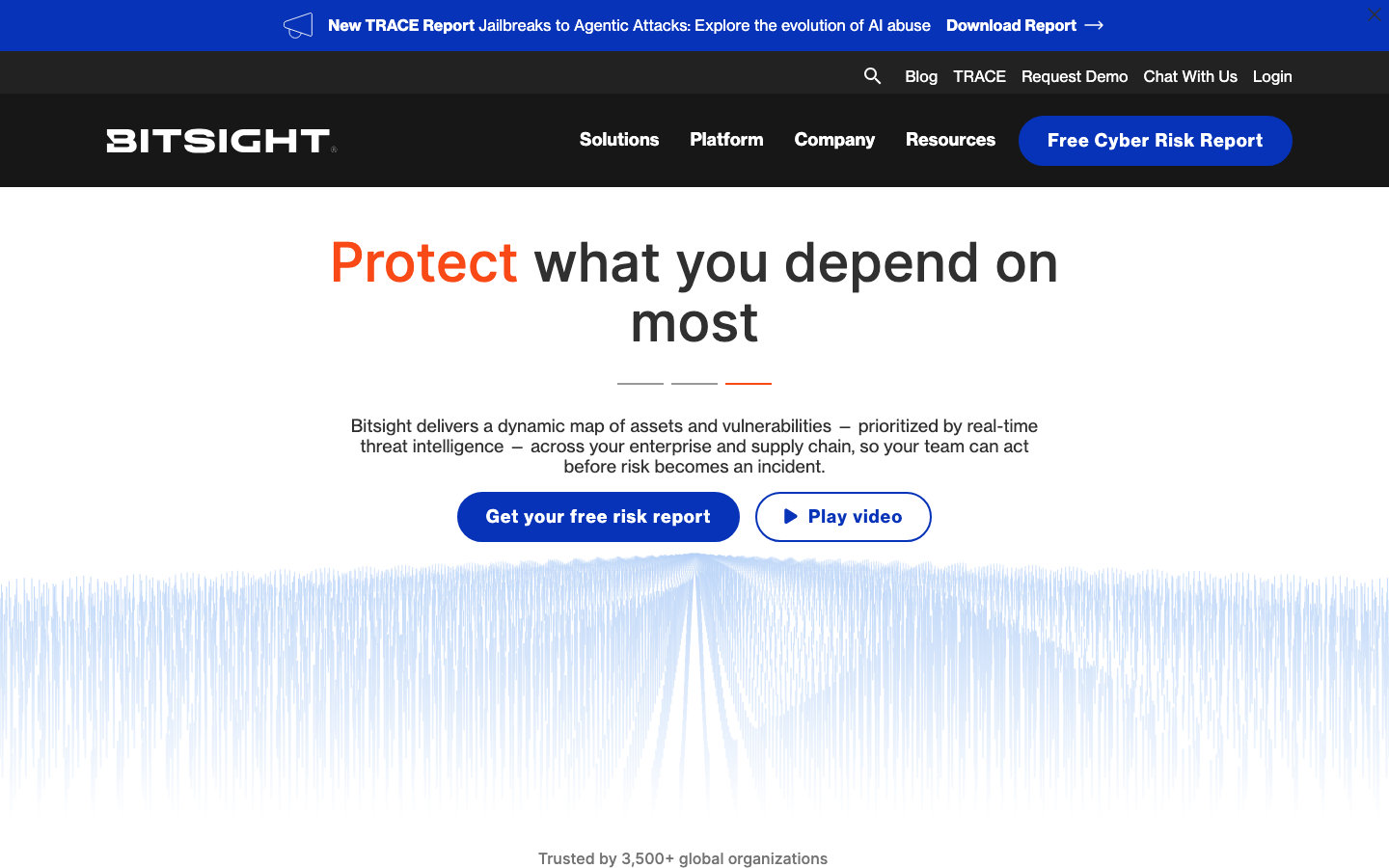
Bitsight is a security ratings service that learns about risk entirely through continuous outside-in scanning and never asks a vendor anything. It grades companies on externally observable signals and feeds that score into vendor monitoring between assessments. The vendor states it is trusted by 3,500+ global organizations and continuously scans over 4 billion IP addresses.
Software Pros
- Continuous signal on vendors you assessed months ago and will not revisit soon
- Attack surface and vulnerability intelligence rather than a score in isolation
- Reporting built to translate technical findings for executives and regulators
Software Cons
- A monitoring layer rather than a program, with no questionnaire workflow at its core
- Scores come from a proprietary model, and rated companies sometimes dispute their grade
- Quote-based pricing that moves with the size of the portfolio you rate
Bitsight Review
Where I would place Bitsight is squarely as layer two, and it is very good at being layer two. It answers what this vendor looks like from the internet today, which no questionnaire can. What it cannot answer is whether the vendor has a control. Treating a good grade as a passed assessment is the mistake to avoid here.
Our Verdict
Outside In Monitoring Layer
LogicGate
Quick Overview
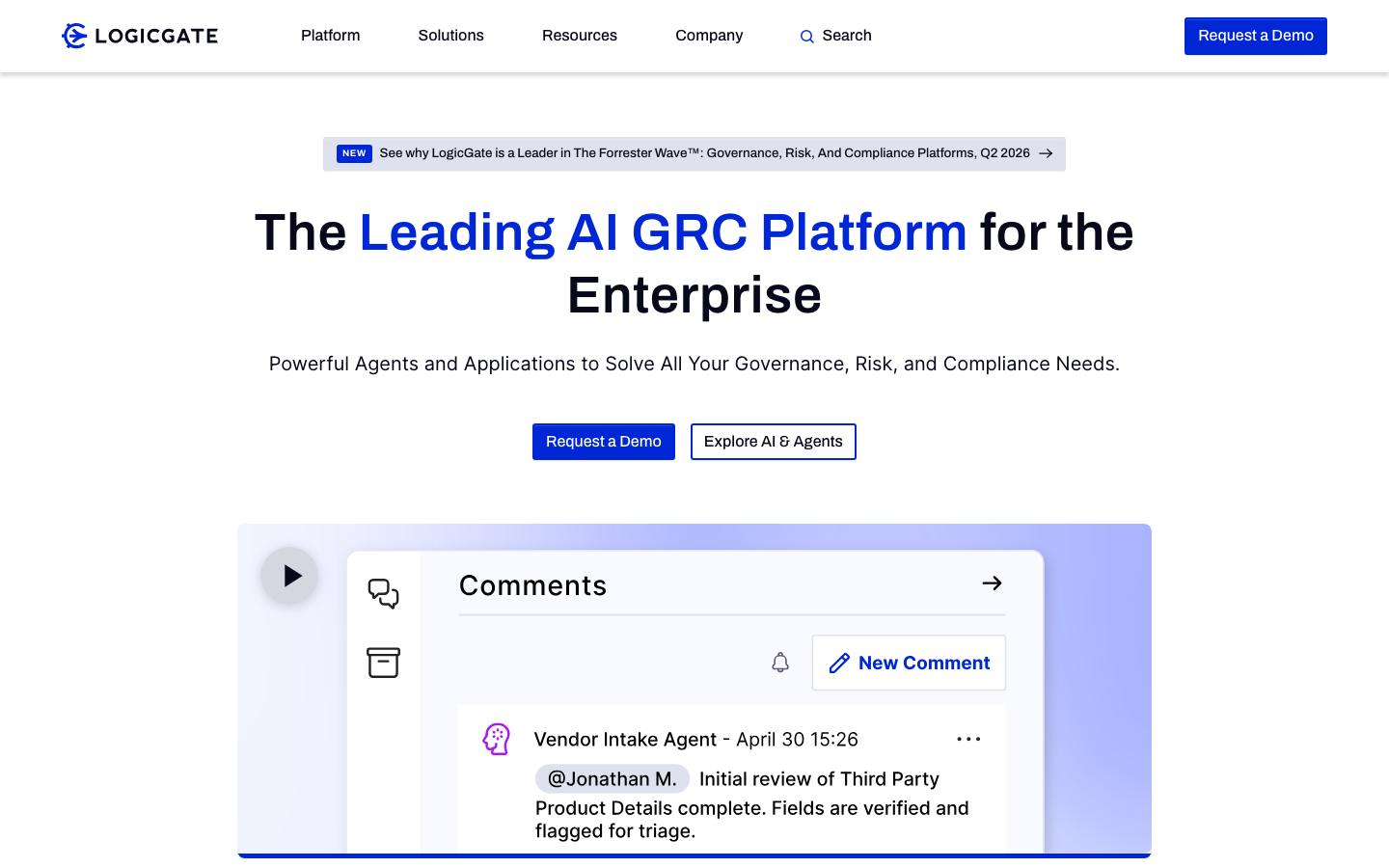
LogicGate is an enterprise GRC platform with a configurable questionnaire and workflow engine. You assemble the process you want rather than adopting the vendor’s. Its Risk Cloud platform ships 30-plus applications across governance, risk, and compliance, including third-party risk. The vendor publishes 20,000-plus workflows automated across its customer base.
Software Pros
- Thirty-plus prebuilt applications, so configuration starts from a template rather than blank
- Risk Cloud Quantify applies Monte Carlo simulation and the Open FAIR model to risk
- Pricing model is published openly by application and power user, even without figures
Software Cons
- Configurable means someone has to configure it, and that someone is usually you
- Depth across many domains can leave a pure vendor risk team paying for unused reach
- No published rate, so the model is transparent while the number is not
LogicGate Review
I looked hardest at how much work LogicGate expects from the buyer, because that is the whole bargain. Teams that already know the process they want get it running without a heavy implementation. Teams hoping the platform will tell them what good looks like will find the flexibility is the problem rather than the feature.
Our Verdict
Configurable Workflow GRC Platform
MetricStream
Quick Overview
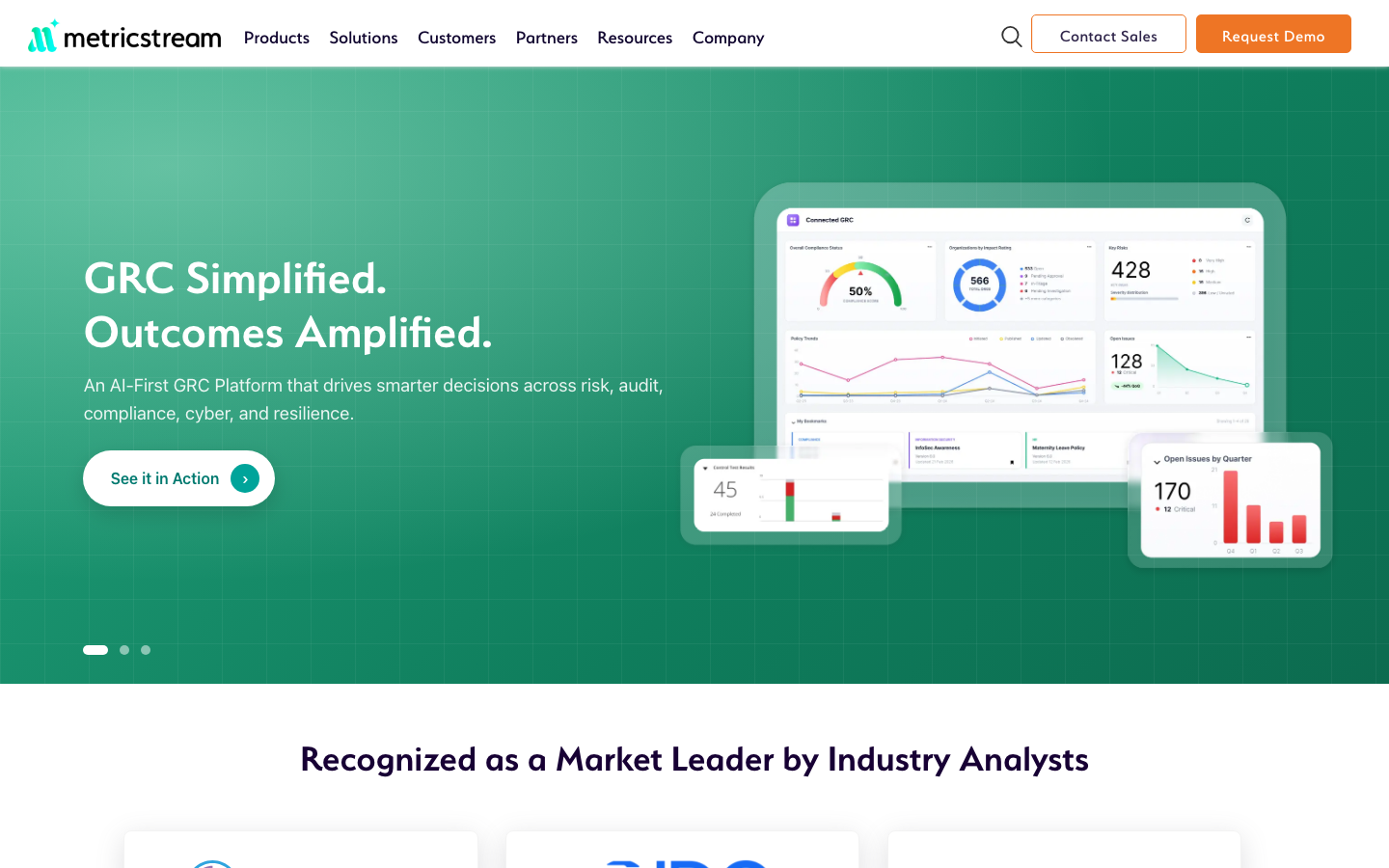
MetricStream is an enterprise GRC suite that assesses risk internally, through risk and control assessment across the organization. Third-party management is one module among many. It covers enterprise and operational risk, regulatory compliance and change, internal audit, IT and cyber risk, and resilience. Its customer page names Nordea, Shell, Siemens Energy, and CIBC among others.
Software Pros
- Genuine breadth across risk, compliance, audit, cyber, and resilience on one platform
- Built for the reporting layer large organizations need at board and regulator level
- Regulatory change and engagement modules for firms with active supervisory relationships
Software Cons
- Enterprise-scale implementation, which is neither quick nor light on internal effort
- Third-party risk is a module here rather than the product, so specialists go deeper
- No rated platform profile on G2, since the listings are split module by module
MetricStream Review
The clearest case for MetricStream is an organization already running several risk programs that want them on one set of data. That is a real problem, and this answers it. For a company whose actual question is how to assess 300 vendors properly, the answer is a smaller platform and a much shorter project.
Our Verdict
Large Enterprise Risk Suite
Mitratech Prevalent
Quick Overview
Mitratech Prevalent is a third-party risk specialist whose assessment model pairs a questionnaire library with a shared exchange of completed vendor assessments. Common vendors need not be surveyed from scratch. Mitratech acquired Prevalent in October 2024 and markets it under the combined name. The vendor states the platform includes a library of 800-plus assessment templates.
Software Pros
- A vendor intelligence network of completed standardized assessments to draw on
- Vendor Threat Monitor screens adverse media, sanctions lists, and politically exposed persons
- Remediation workflows that fire automatically when a risk is identified
Software Cons
- Reach outside third-party risk is narrower than an enterprise GRC suite
- Everything is quoted, with no tier carrying a visible number
- There is no live G2 product profile to check independent peer feedback against
Mitratech Prevalent Review
In my assessment, the exchange is the reason to look here. If a chunk of your vendor list overlaps with everyone else’s, pulling an existing assessment instead of sending your own removes weeks of chasing. The trade-off is scope: this is a vendor risk product, and enterprise risk reporting lives somewhere else.
Our Verdict
Template Library Plus Exchange
OneTrust
Quick Overview
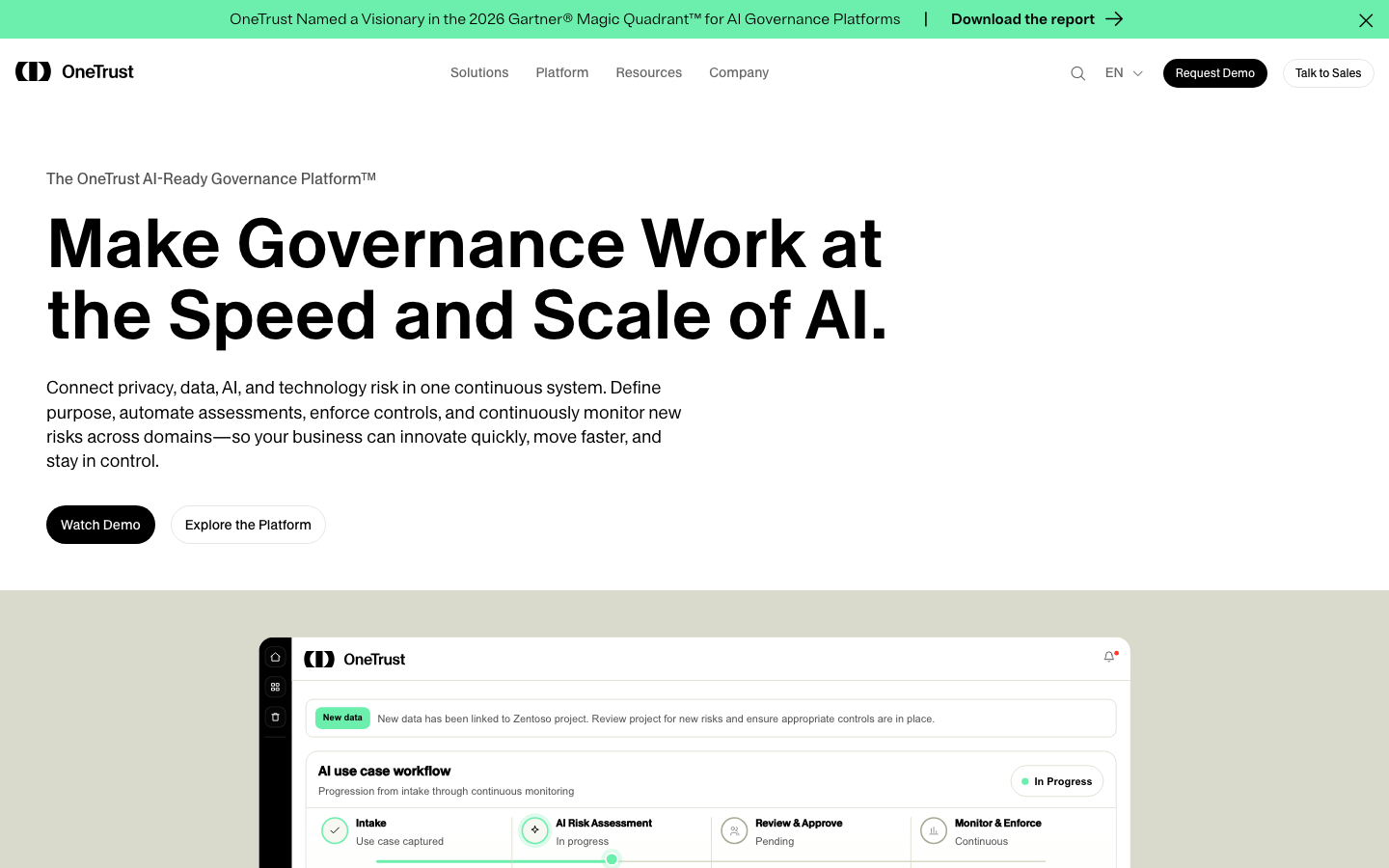
OneTrust runs a questionnaire workflow with pre-completed vendor assessments, sitting inside a much wider governance platform that also covers privacy, data governance, and AI. Its third-party management package is the focus here, rather than the privacy suite it is better known for. The vendor was named a Visionary in the 2026 Gartner Magic Quadrant for AI Governance Platforms, per its own homepage.
Software Pros
- One vendor across third-party risk, privacy, tech risk, and AI governance
- Pre-completed vendor assessments shorten the first pass on common suppliers
- Packaging is published by module, so you can see what you would be buying
Software Cons
- Buying the TPRM module means buying into a much wider platform than you need
- The third-party module profile on G2 carries only five reviews
- Pricing is quote-based with no figures shown on the packaging page
OneTrust Review
What earns its place in this list is consolidation, not depth. If privacy and AI governance are already on your plate, running vendor risk in the same place is a defensible call. If third-party risk is your only problem, a specialist will give you more vendor lifecycle for less platform.
Our Verdict
Governance Suite With TPRM
Optro
Quick Overview
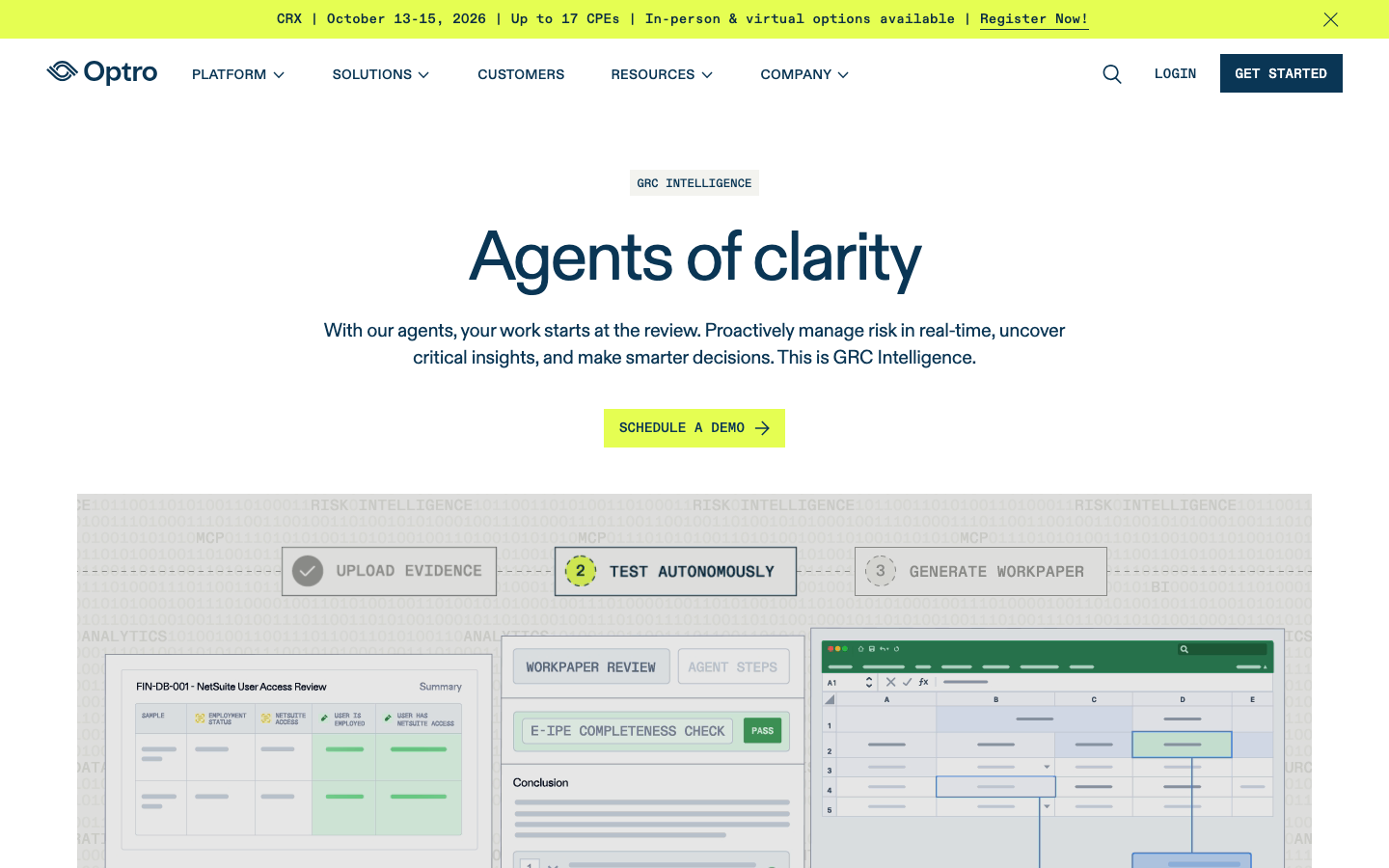
Optro is an enterprise GRC platform built on control testing and issue management. Its third-party risk module reads from the same evidence as internal audit. It rebranded from AuditBoard in March 2026 and kept the audit-led architecture that made it popular with assurance teams. The vendor states that more than 50% of the Fortune 500 use it.
Software Pros
- Audit heritage means the evidence trail is built for people who get examined
- Connected data lets one control test serve audit, SOX, and third-party programs
- AI governance capability added by acquisition rather than bolted on as a label
Software Cons
- Enterprise implementation weight, and rarely a project a small risk team runs alone
- The G2 listing spans the whole GRC suite rather than the third-party module
- Quote-based pricing, with the pricing page collecting contact details instead
Optro Review
I found that the audit lineage is what separates Optro from the other suites here. When an examiner asks how a control was tested and who signed it off, the answer is already assembled. Teams whose primary pain is vendor questionnaire volume will get there, but through a broader and heavier platform than they strictly need.
Our Verdict
Audit Led Connected Risk
Panorays
Quick Overview
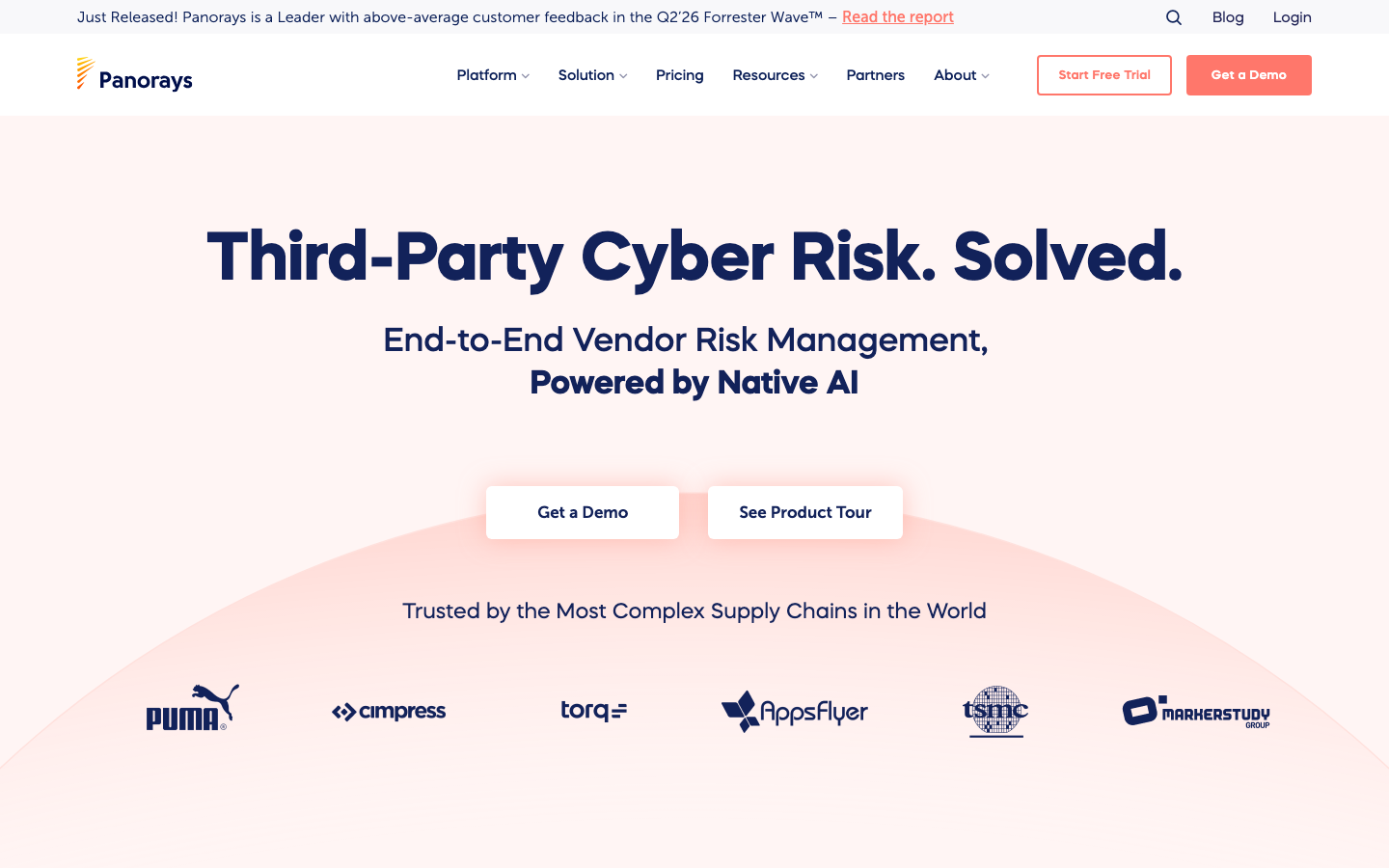
Panorays is a third-party risk specialist with a blended assessment model. It combines external attack surface data with questionnaire analysis, so you get a preliminary view before a vendor answers anything. It also maps fourth- and nth-party relationships, meaning your vendors’ own suppliers. The vendor was named a Leader in the Forrester Wave for third-party risk in the second quarter of 2026, according to its homepage.
Software Pros
- A first assessment exists on day one, from scanning, before questionnaires return
- Supply chain discovery surfaces fourth-party dependencies you did not know about
- Bundles sized by third-party count, which suits teams that know their vendor number
Software Cons
- Focused on cyber risk, so financial and operational vendor risk sit outside it
- Reach outside third-party risk is minimal by design
- Pricing is quote-based, with the pricing page routing to a scoping questionnaire
Panorays Review
Reading the documentation on Panorays, the blend is the point. Getting a provisional risk view without waiting six weeks for a questionnaire is genuinely useful for a small team facing a large vendor list. Just remember the outside-in half is inference, and a tier-one vendor still needs answers from a human being.
Our Verdict
Blended Scanning And Questionnaires
ProcessUnity
Quick Overview
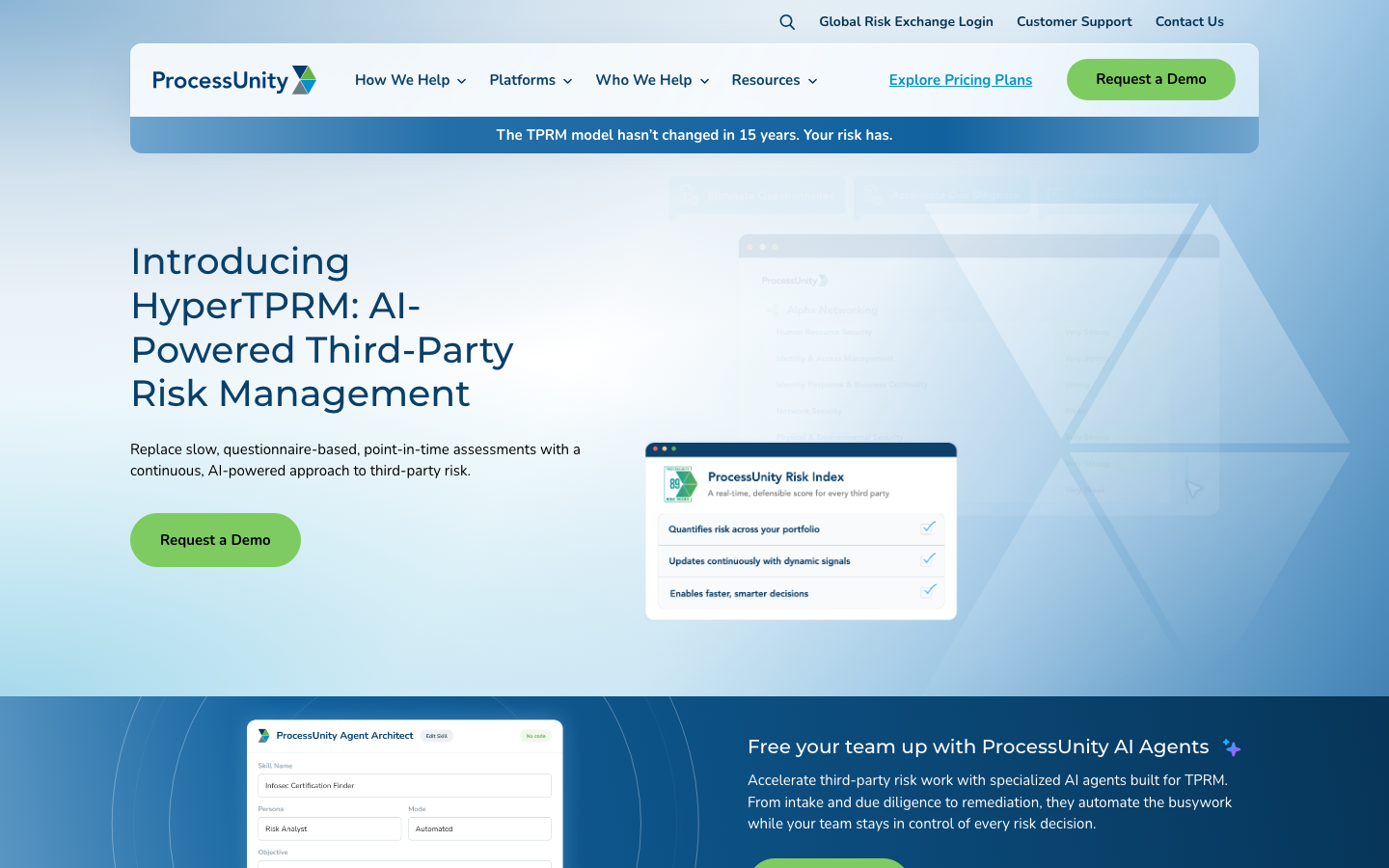
ProcessUnity is a third-party risk specialist that runs questionnaires first and layers a shared exchange underneath. Its workflow runs unusually deep across the full vendor lifecycle, from onboarding to offboarding. Its Global Risk Exchange holds what the vendor describes as more than 370,000 curated vendor risk profiles. The platform now markets an AI-led approach under the name HyperTPRM.
Software Pros
- Lifecycle depth from onboarding and due diligence through to service reviews and offboarding
- A large exchange of curated vendor profiles to draw on instead of starting cold
- Risk Index scoring that is controls-driven rather than purely outside-in
Software Cons
- Built for enterprise process depth, which is more machinery than a small team needs
- Narrower than a GRC suite once you step outside third-party risk
- The pricing page is a lead form rather than a published rate
ProcessUnity Review
Where I would place ProcessUnity is with programs that already have a defined process and need it enforced consistently across thousands of vendors. The workflow depth is the product. A team still deciding what its process should be will meet that same depth as a long list of unmade decisions.
Our Verdict
Deep Vendor Lifecycle Workflow
Riskonnect
Quick Overview
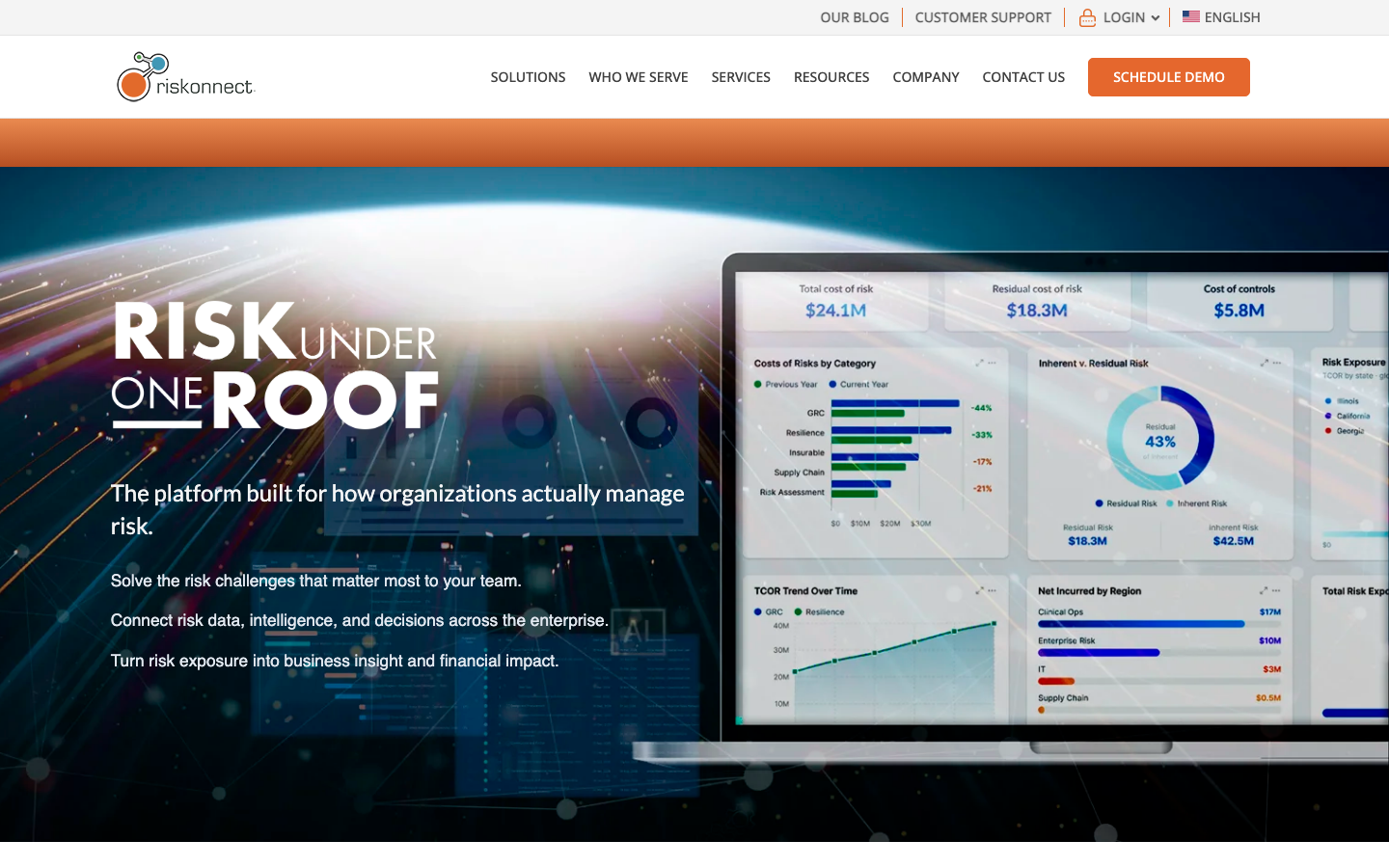
Riskonnect is an enterprise GRC suite assessing risk through risk registers and operational workflows, with roots in insurable and claims risk rather than cyber. It spans enterprise risk, claims, business continuity, health and safety, ESG, and third-party risk. The vendor publishes a customer example of Reimagined Parking reducing claim volume by nearly 34% in a single year.
Software Pros
- Unusual strength in operational, claims, and business continuity risk
- One register covering risk types most GRC platforms leave to a separate system
- Breadth that suits organizations where physical and operational risk dominate
Software Cons
- Third-party risk is one module rather than the platform’s center of gravity
- Cyber and vendor security depth trails the specialists on this list
- Quote-based pricing and an enterprise implementation cadence
Riskonnect Review
I looked hardest at where Riskonnect differs from the other suites, and the answer is the risk types it takes seriously. Claims, safety, and continuity are first-class here, not afterthoughts. For a manufacturer or a retailer, that profile fits well. For a software company whose main exposure is its vendors, it is the wrong shape.
Our Verdict
Operational And Insurable Risk
SecurityScorecard
Quick Overview
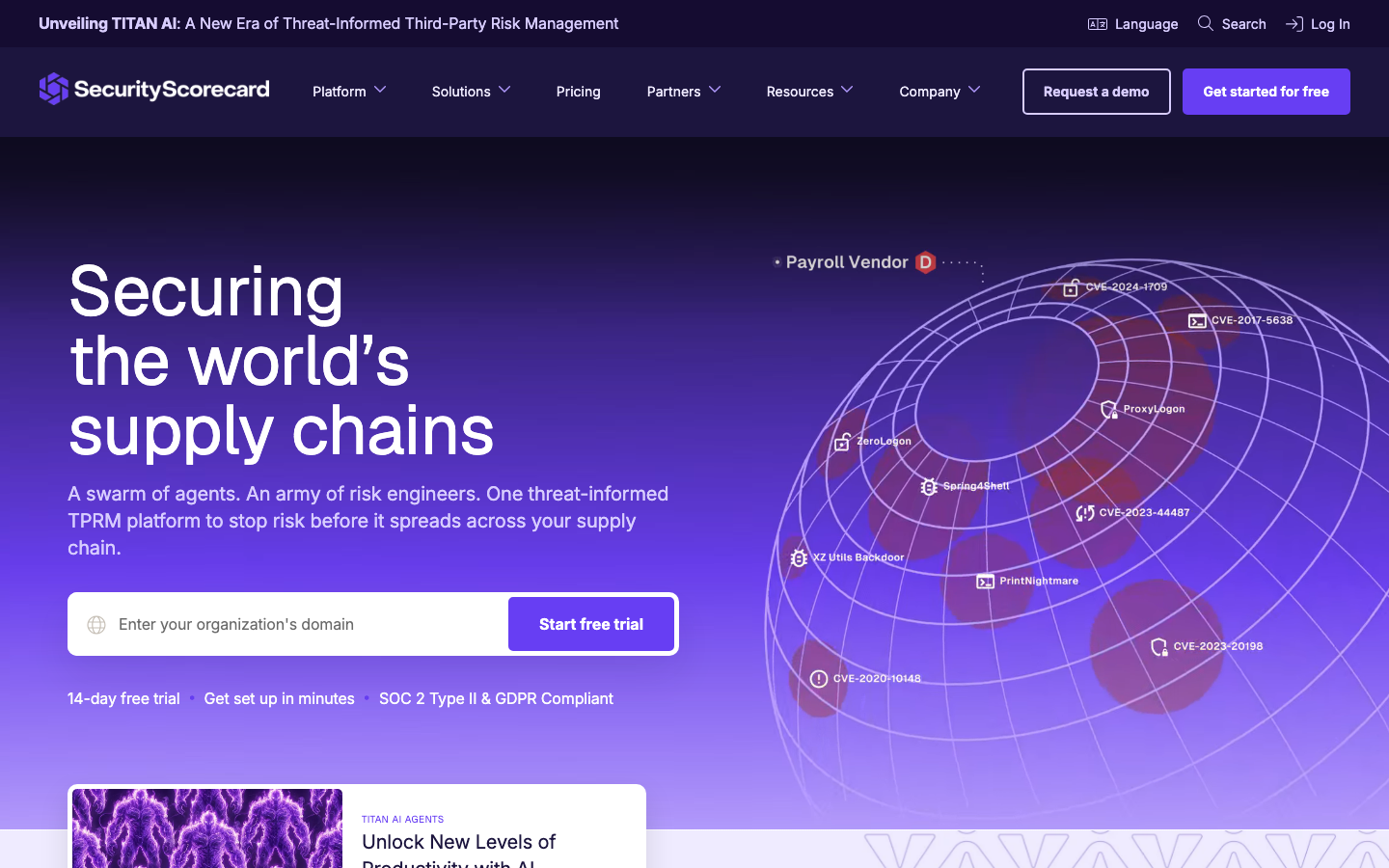
SecurityScorecard is a security ratings platform that grades companies A through F based on externally observable signals. It has since added questionnaire and compliance automation. Its TITAN platform pairs continuous supply chain monitoring with assessment workflows and automated discovery. The vendor claims a 75% reduction in supply chain breaches for customers using TITAN AI.
Software Pros
- Continuous outside-in scoring with an assessment layer now built alongside it
- Supply chain visibility that surfaces vendors and dependencies automatically
- A 14-day free trial, which is rare in a category that runs on demos
Software Cons
- Ratings remain the core, so it complements rather than replaces a TPRM program
- Scoring methodology is proprietary and rated companies occasionally contest grades
- Pricing is quote-based and tracks the portfolio size you monitor
SecurityScorecard Review
The clearest case for SecurityScorecard is a team that wants monitoring and a light assessment workflow from one vendor rather than two contracts. The addition of questionnaire automation makes that a fairer description than it was two years ago. It still measures what is visible from outside, which is a real limit worth keeping in mind.
Our Verdict
Ratings With Assessment Layer
Vanta
Quick Overview
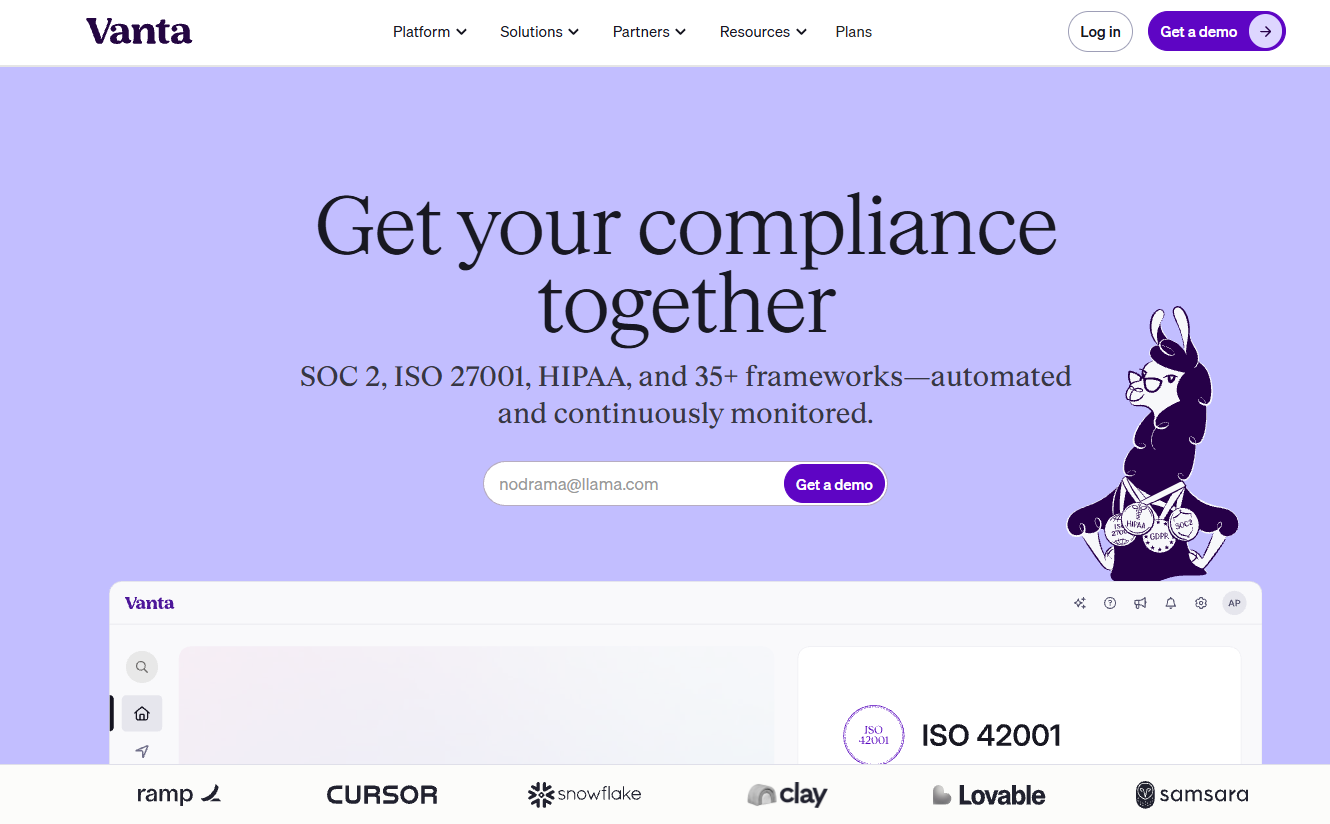
Vanta combines third-party risk management with security, compliance, and internal risk workflows. Its assessment model uses vendor documentation and questionnaires, AI-assisted reviews, customizable risk scoring, and continuous monitoring. Vendor findings connect to the risk register and compliance program, making it a practical option for mid-market and enterprise teams formalizing vendor security reviews.
Software Pros
- Automated evidence requests and follow-ups reduce repetitive work when collecting vendor documentation
- Vendor findings link to internal risk scenarios, controls, and compliance work
- TPRM is available as a standalone product or an add-on to an existing Vanta plan
Software Cons
- Quote-based pricing requires a sales conversation to establish the cost
- Teams still need to define risk tiers, assessment criteria, and decision ownership
- The overall G2 rating covers the broader Vanta product and does not isolate the TPRM experience
Vanta Review
Vanta suits teams that need a repeatable, compliance-connected vendor security review process. Automated evidence collection and AI-assisted reviews reduce routine assessment work, while findings feed into risk treatment alongside controls and policies. Its standalone TPRM option also lets teams adopt vendor risk workflows without an existing Vanta subscription.
Our Verdict
Vendor Security Reviews Connected to Compliance
Venminder
Quick Overview
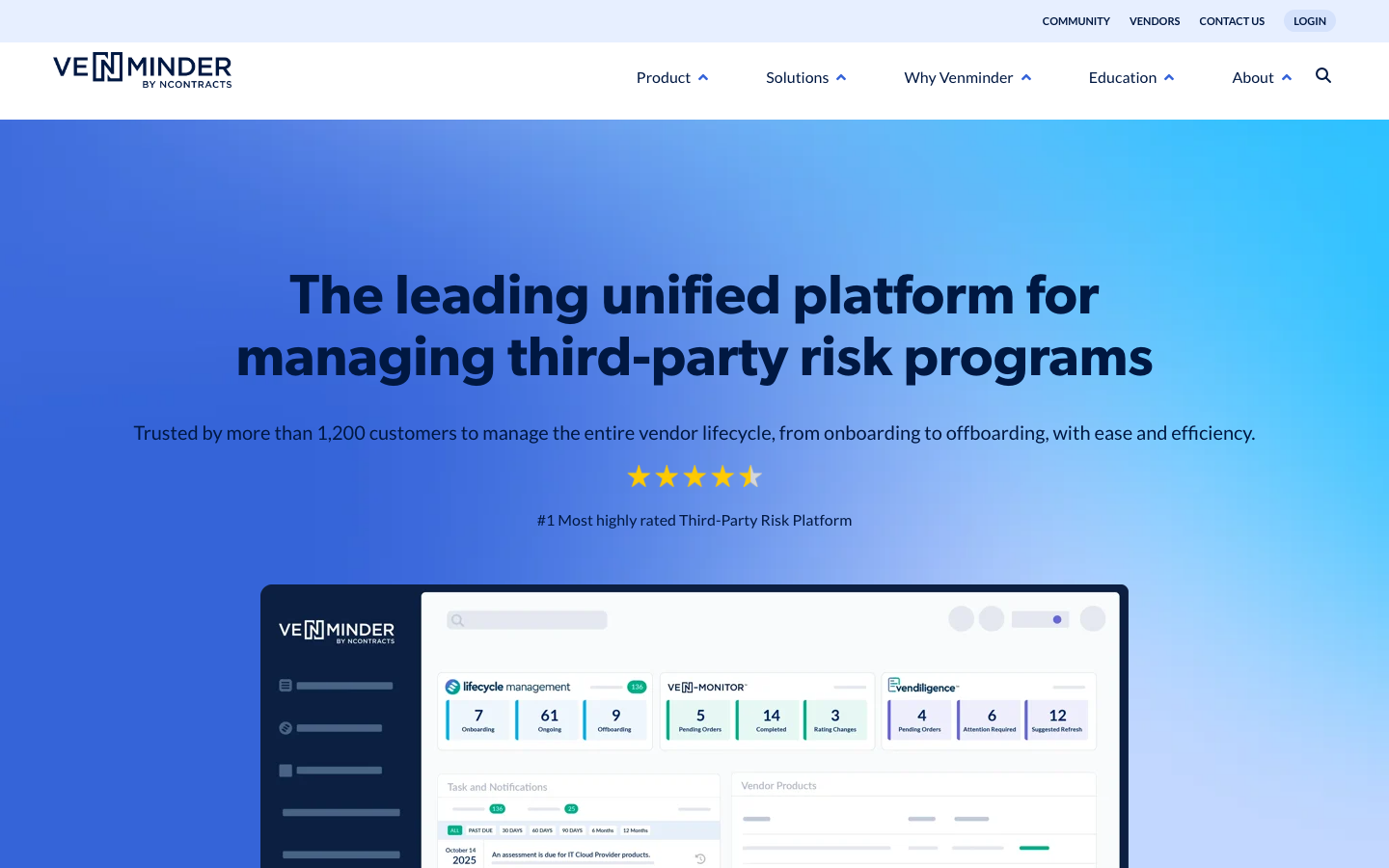
Venminder is a third-party risk specialist that pairs questionnaires with analyst-performed reviews. Its team reads the vendor’s documentation on your behalf and returns a rated assessment. Ncontracts acquired it in September 2024, and the product now ships as Venminder by Ncontracts. The vendor states it serves more than 1,200 customers and that its experts deliver over 30,000 risk-rated assessments annually.
Software Pros
- Analyst-performed due diligence on SOC reports, financials, and cyber documentation
- Ven-Monitor tracks vendor risk changes continuously between formal reviews
- Contract management sits alongside questionnaires and risk assessments
Software Cons
- Managed services are billed as an add-on, so the real cost is two line items
- Reach outside vendor risk is limited compared with a GRC platform
- No published pricing, and analyst hours make quotes harder to compare
Venminder Review
In my assessment, Venminder solves a staffing problem more than a software problem. A small regulated team that cannot spare an analyst to read forty SOC 2 reports a quarter can buy those hours here. Organizations with that capacity in-house are paying for something they already have, and should price the software alone.
Our Verdict
Analyst Backed Vendor Diligence
Whistic
Quick Overview
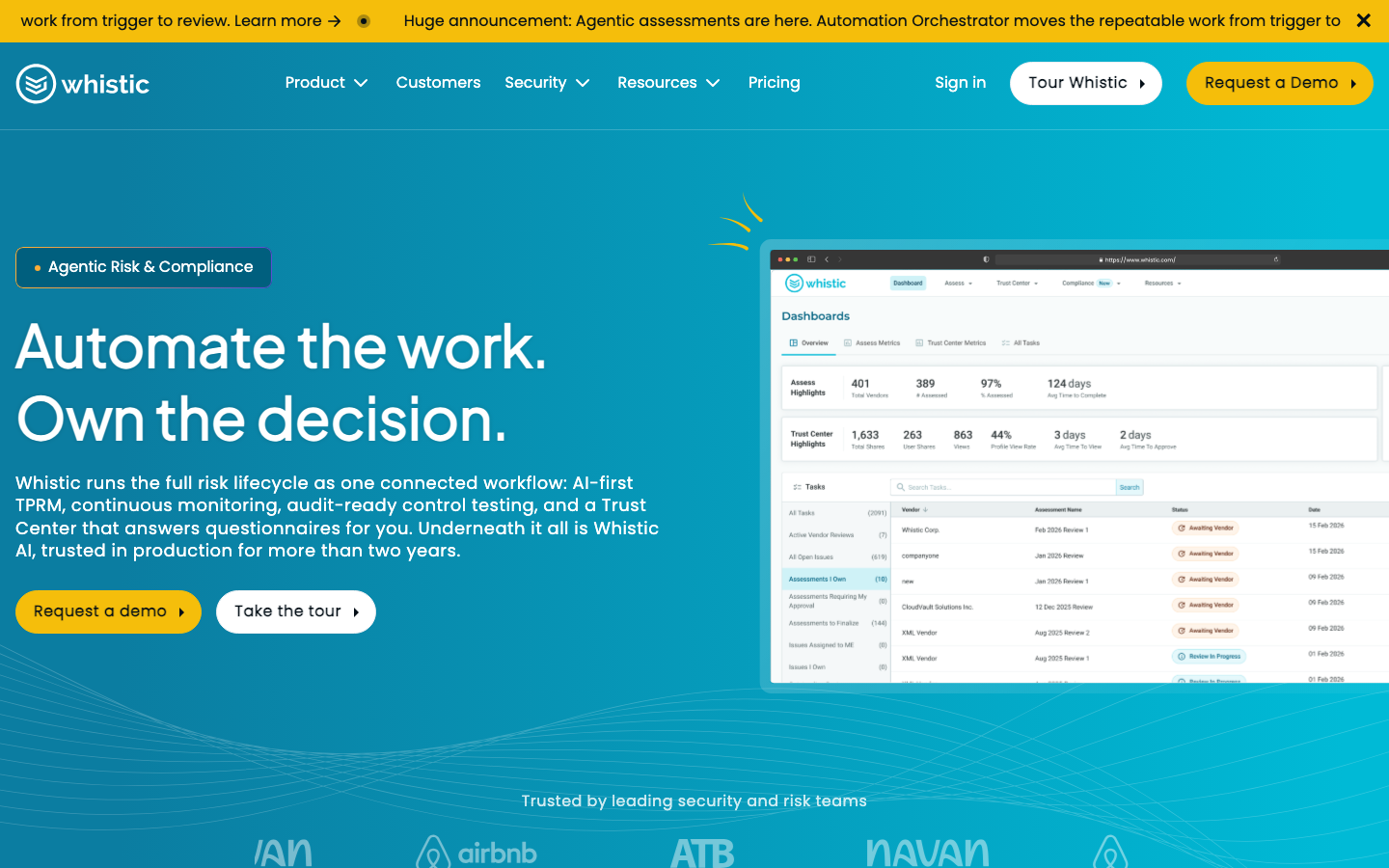
Whistic is a third-party risk specialist built on shared vendor profiles, which inverts the usual direction. Vendors publish a reusable security profile, and buyers pull it instead of sending a fresh questionnaire. Its Trust Center Exchange, Assess module, and Automation Orchestrator run the assessment from trigger through summary. The vendor publishes customer figures of 8x faster assessment turnaround and 90% of profile shares accepted without follow-up.
Software Pros
- Pulling a published profile removes the slowest step in most vendor assessments
- The Trust Center works both ways, answering inbound questionnaires about you
- Packaging is published by assessment volume, so the shape of the deal is visible
Software Cons
- The model works best where your vendors already publish, which is not everywhere
- Narrow outside third-party risk, with no enterprise risk register
- Quote-based pricing despite the published packaging tiers
Whistic Review
What earns its place in this list is the direction of travel. Sending a questionnaire and waiting is the default everywhere else, and Whistic is betting that default disappears. Where your vendors participate, it is faster than anything else here. Where they do not, you are back to chasing, and that is the honest limit.
Our Verdict
Two Sided Trust Exchange
FAQs About Risk Management Software
What Is the Best Risk Management Software?
There is no single answer, because three different product families sit under that phrase. Governance suites cover many risk types on shared data, specialists run the vendor lifecycle end to end, and ratings services score companies continuously from outside. The better question is which of those layers you are missing today. Filter the comparison table near the top of this page on the type column, and the shortlist gets short quickly.
What Is the Difference Between Third-Party Risk and Vendor Risk?
In practice, they are used interchangeably, and nobody will misunderstand you either way. Strictly, third party is the broader term: it covers any external relationship, including partners, agents, resellers, and service providers you do not pay directly. Vendor usually implies a purchased service with a contract behind it. If your program covers relationships you don’t buy from, the broader term is more accurate.
How Much Does It Cost?
Nobody in this category publishes a rate, which is unusual even for enterprise software. Four inputs drive it: monitored third parties, assessments run per year, risk domains licensed, and analyst hours bought. Anyone quoting you a range without those four inputs is guessing, and any figure you find in a comparison blog is unsourced.
Do Security Ratings Replace Vendor Questionnaires?
No, and treating them as interchangeable is a common and expensive mistake. A rating measures what is visible from the internet: certificates, exposed services, patch behavior, leaked credentials. A questionnaire asks what controls exist inside, which no external scan can observe. Programs run both because they answer different questions, and the ratings fill the long gap between annual reviews.
How Many Vendors Should We Actually Assess?
Fewer than you think, and not all to the same depth. Tier by criticality and data access rather than by spend: a small analytics tool holding customer records outranks a large facilities contractor holding nothing. Tier one gets full diligence and continuous monitoring, tier two gets a shorter assessment, and the long tail gets an inventory record. Trying to cover everything equally is how programs stall.
What Is Fourth-Party Risk?
It is your vendors’ vendors: the subprocessors, cloud providers, and subcontractors your supplier depends on to deliver your service. It matters because an outage or breach two steps away can still reach you. Concentration also builds up invisibly when many of your suppliers rely on the same underlying provider. Platforms surface it by mapping dependencies and by asking vendors to disclose their own.
What Is the Best Software for Contract Risk Management?
That question belongs to a different category. Contract risk lives in contract lifecycle management, a separate market whose platforms handle drafting, clause libraries, obligation tracking, and renewal exposure end to end. Several platforms reviewed on this page hold contract records and obligations against a third party, which is useful but not the same thing. If contracts are your main problem, shop that market instead.
Does It Help With Regulatory Compliance?
It produces evidence and an audit trail, which is what a supervisor asks to see. It does not make an organization compliant, and no vendor can promise that, no matter what the marketing says. What these platforms do well is show that assessments happened on schedule, that findings were tracked to closure, and that someone owned each one. The obligations themselves remain yours, and nothing here is legal advice.

Helen is Anywherer’s Market Analyst & Content Researcher, with extensive experience in analyzing global employment markets and HR technology trends. She is skilled at turning complex market data into clear, well-researched insights that inform every piece of content. With a strong grasp of the EOR, PEO, and international hiring space, Helen plays a key role in keeping Anywherer’s research accurate, up to date, and genuinely useful for readers.