Contractor management software runs the whole relationship with the people who work for you but are not on your payroll. Onboarding, contracts, tax documents, invoices, payment, and offboarding, in 1 place with a record of what happened. To be clear about who this page is for: it covers freelancers and independent workers, not building firms.
Independent contractor management software is bought by finance, HR, and operations leaders in roughly equal measure. A startup paying 5 US freelancers wants a payment button and a 1099 at year-end. A company paying 300 people across 22 countries wants tax forms collected automatically, local currency payouts, and an audit trail somebody can defend.
The pressure behind this is scale. MBO Partners counted 72.9 million independent workers in the US in 2025, and reports that 32 percent of them now serve clients abroad. Every 1 of those relationships carries a classification question, a tax document, and a payment that has to clear. Regulators have noticed. The volume of engagements breaks manual processes long before anyone plans a replacement.

INSIGHT: How many people actually work as independent contractors?

The independent workforce is large enough that managing it by hand is no longer viable, which is why this software category exists at all.
- MBO Partners counted 72.9 million independent workers in the US in 2025 in its State of Independence research, and reports 5.6 million of them earning more than $100,000 a year, nearly double the 2020 figure.
- 32 percent of independent workers now serve clients outside their own country, per the same research, and 36 percent of traditional employees report having side gigs alongside their job.
- The spreadsheet does not fail at a headcount. It fails when tax forms, currencies, and renewal dates multiply past what 1 person can handle.
Sources:
read in September 2026. Nothing on this page substitutes for legal or tax advice
So there is no single winner, and 2 questions decide the answer. Where are your contractors, and how much of the compliance work do you want the vendor to carry? The IRS sets out 3 categories of evidence on this question. Those are behavioral control, financial control, and the type of relationship. Software helps you apply that consistently. It does not answer it for you. The best contractor management software matches your geography and your appetite for risk. Below, I’ve reviewed 10 of the leading platforms in A-Z order.
INSIGHT: Who carries the classification risk?
The 10 platforms take on 3 different amounts of the problem, and the difference is the most expensive thing on this page to get wrong.
- Documents and payments: the platform collects tax forms, issues contracts, and pays. Classification and liability stay entirely with the company. Gusto, RemoFirst, Wingspan, and WorkMarket sit here.
- Classification support: the platform assesses risk indicators, applies the same onboarding to everyone, and keeps the audit trail. Worksuite documents a classification service covering 50 US state labor laws, and TalentDesk.io documents built-in contractor classification with AML and KYC checks.
- Contractor of record: the platform contracts the worker itself. 2 of the 10 document this: Deel at a published rate of $325 per contractor of record per month, and RemotePeople, which states on its own page that it carries the misclassification risk.
- Reading what a vendor commits to in writing matters more than any feature list, because the models look similar in a demo and are not similar at all.
Sources:
as of September 2026. None of it constitutes legal or tax advice
Contractor Management Platforms Compared
6 columns hold the argument of this page. The best contractor management software differs from a payment button in 4 things. Reach, how much compliance work it absorbs, whether it can employ somebody later, and what reviewers report.
| Tool | Coverage | Compliance model | Payment reach | Employment path | G2 rating |
|---|---|---|---|---|---|
| Deel | Global | Documents, classification support, contractor of record | 150+ countries and 120+ currencies, per Deel | Yes | 4.7 (6,959) |
| Fiverr Enterprise | Global | Classification assessment | 160 countries, per Fiverr | No, contractors only | 4.7 (176) |
| Gusto | US-first | Documents and tax forms | 120+ countries for payouts, per Gusto | Yes | 4.6 (12,750) |
| RemoFirst | Global | Documents and payments | 150+ countries, per RemoFirst | Yes | 4.5 (403) |
| RemotePeople | Global | Local entities and contractor of record | 150+ countries and 150+ currencies, per RemotePeople | Yes | 5.0 (1) |
| TalentDesk.io | Global | Classification assessment and agent of record | 190+ countries and 55+ currencies, per TalentDesk.io | No, contractors only | 4.8 (72) |
| Wingspan | US-first | Documents and tax forms | Not stated | Contingent W-2 only, per Wingspan | 4.5 (11) |
| WorkMarket | US-first | Documents and verification | Not stated | No, contractors only | 4.1 (29) |
| Worksuite | Global | Classification assessment and agent of record | 190+ countries and 120+ currencies, per Worksuite | No, contractors only | 4.4 (114) |
| YunoJuno | UK and Europe | Classification assessment, including IR35 | 165+ countries, per YunoJuno | Through partners | 4.7 (211) |
Ratings came off G2 product profiles as of September 2026.
What Is Contractor Management Software?
It is the system of record for people who work for a company without being employed by it. A contractor management system software platform covers the full engagement. That means onboarding and identity checks, a signed contract, and tax documents such as a W-9 in the US or a W-8BEN abroad. Then come time tracking, invoicing, payment, and offboarding.
It is not payroll, and the distinction is more than semantic to anyone who has been audited. Payroll withholds tax, files returns, and administers employee benefits. Contractors are not employees, so none of that applies. It is not accounts payable either. Accounts payable will happily pay anybody who sends an invoice. It knows nothing at all about whether that person should have been on the payroll instead.
The honest reason companies buy is scale. At 5 contractors, a spreadsheet and a bank transfer work fine, and any tool is overhead. At 50, the tax documents stop being manageable, renewal dates get missed, and somebody in finance is chasing invoices in 4 currencies. The failure is administrative long before it is ever a compliance problem, and it usually arrives without warning in a single busy month.
The market splits into 3 groups, which is the fastest way to narrow the list. Global platforms pay in many countries and currencies: Deel, Fiverr Enterprise, RemoFirst, RemotePeople, TalentDesk.io, and Worksuite. US-first platforms are built around 1099 workers and domestic payment rails: Gusto, Wingspan, and WorkMarket. YunoJuno is the UK and Europe specialist, built around local rules including IR35, the UK off-payroll working legislation.
Classification, Compliance, and What the Software Actually Covers
Misclassification means treating somebody as an independent contractor when the relationship is really employment. Regulators look at substance rather than the contract label. The IRS groups the evidence into behavioral control, financial control, and the type of relationship. Other countries apply their own version of the same idea. Nothing in this article is legal or tax advice, and no article can classify a specific worker for you.
What the software genuinely does is narrower than most marketing implies. It collects the right documents before work starts and applies the same onboarding to everybody. It holds contracts in 1 place and flags risk indicators, such as a contractor working full-time hours for a single client. That is an audit trail, and an audit trail is worth a great deal when somebody asks how a decision was made 3 years ago.
What it does not do is decide, and the difference between the 3 models is where the money sits. Document collection leaves classification and liability with you. Classification assessment adds a structured opinion and consistency, and Worksuite, TalentDesk.io, YunoJuno, and Fiverr Enterprise all offer document tooling of this kind. Contractor of record goes furthest: Deel and RemotePeople both state that they contract the worker themselves.
Then there is the case nobody plans for, where the relationship should really be employment. Long tenure, set hours, and work at the center of your business all point that way. At that point, the answer is to hire the person rather than improve the paperwork. That means your own entity, or 1 of the employer of record companies that employ on your behalf.
A domestic alternative worth knowing is co-employment, where a PEO company shares employer responsibilities with you for US staff. That is a different structure again, and it applies to employees rather than contractors. It is on this page only so nobody confuses the 3 routes, because buyers regularly arrive asking for 1 and needing another.
Best Contractor Management Software by Team Type
Where your contractors sit decides most of this list, and how many you have decides the rest. Anyone searching for the best contractor tracking software 2026 is usually asking about visibility of work and spend. That is a separate question from compliance. The 4 sections below split the 10 platforms by team type, naming tools A-Z with no ranking implied.
For Global Contractor Teams
Paying somebody in Argentina is not the same as paying somebody in Ohio with a longer bank code. You need a local payment rail, the right tax document for that country, and a contract that holds under local law. The best global contractor management software carries all 3, and the important detail is that compliance rules multiply by country rather than by headcount. A 40th contractor in Poland costs nothing extra. A first contractor in Brazil is a project.
Deel states 150+ countries and payments in 120+ currencies. RemoFirst states 150+ countries at a published contractor rate. RemotePeople, which traded as Horizons until its rebrand, states 150+ countries and 150+ currencies through its own local entities. Worksuite states 190+ countries and 120+ local currencies. Check the specific countries you pay rather than the headline number, because the long tail is where coverage thins out.
For US-Domestic 1099 Programs
A domestic program is a document and payment problem more than a geography one. You collect a W-9 before the first payment and file a 1099 at year-end. The IRS publishes the criteria that separate a contractor from an employee. Gusto handles this alongside employee payroll, which suits companies paying both from 1 system. Wingspan is built as payment infrastructure, with onboarding steps, background checks, and license verification attached to the tax record.
WorkMarket is the option built for volume. Tax ID verification, invoice auditing, talent pools, and assignment tracking suit organizations running 1,000 or more 1099 workers. All 3 keep the classification decision with you. What they change is whether the paperwork arrives complete and on time, which is the part that actually fails in a domestic program.
For Enterprise Contingent Workforces
At 300 or more external workers, the problem becomes governance. Who approved this spend, which budget does it sit against, and can procurement see it before the invoice arrives? The best scalable contractor management software answers those questions as well as the compliance ones. Large programs also sit inside the wider third-party process that risk management software already governs.
Fiverr Enterprise consolidates a company’s own freelancers into a private talent pool with visibility over spend, and states payments across 160 countries. TalentDesk.io focuses on the workflow, with task and budget tracking, consolidated invoicing, and an open API for integration. Worksuite states it manages 1 million contractors and processes $2 billion in contractor payments, aimed squarely at organizations with large external workforces.
For Small Teams on a Budget
Small teams need a published price and no implementation project. Affordable contractor management software here means a rate you can read on the website and cancel next month. Gusto lists its Contractor Only plan at $6 per person per month plus a base fee. It states no monthly per-contractor fee on global contractor payments. RemoFirst lists $25 per contractor per month to process payments, with management itself free.
Wingspan starts at $10 per monthly active payee, billed monthly, which suits a roster that changes size through the year. Here is the honest test. If you pay 4 people in 1 country and nobody has missed a form, a spreadsheet and a bank transfer are still cheaper. Buy when the documents start slipping, not when the headcount hits a round number.
Contractor Management Software Pricing
This category prices more openly than most HR software, and the usual shape is a rate per active contractor per month. 4 of the 10 publish that rate. Enterprise platforms quote instead, against volume and modules. The line buyers forget sits underneath: payment costs are charged separately, including currency conversion and payout fees. At low volume, the platform fee dominates. At high volume, the payment spread does, so the only fair comparison is total cost per contractor per month with payouts included.
| Tool | Pricing model | Free trial or demo | Published starting price |
|---|---|---|---|
| Deel | Per active contractor | Demo on request | $49 per contractor per month |
| Fiverr Enterprise | Quote-based | Demo on request | Custom pricing |
| Gusto | Base fee plus per person | Free account setup | $6 per person per month plus a monthly base fee |
| RemoFirst | Per active contractor | Demo on request | $25 per contractor per month to process payments |
| RemotePeople | Quote-based | Demo on request | Custom pricing |
| TalentDesk.io | Quote-based | Demo on request | Custom pricing |
| Wingspan | Per monthly active payee | Demo on request | From $10 per monthly active payee |
| WorkMarket | Quote-based | Interactive demo | Custom pricing |
| Worksuite | Quote-based | Demo on request | Custom pricing |
| YunoJuno | Percentage of contractor payments | Free account | Custom pricing |
As pricing is subject to change, prices are listed as of September 2026.
INSIGHT: Is the platform fee the real cost of paying a contractor?
No. The platform fee is visible, and the payment costs are not, and at volume the second one is larger.
- 4 of the 10 platforms publish a per-contractor rate openly. Deel lists $49 per contractor per month, RemoFirst $25 per contractor per month to process payments, Wingspan from $10 per monthly active payee, and Gusto $6 per person per month on its Contractor Only plan plus a base fee.
- The other 6 quote against volume and modules. YunoJuno is the outlier in shape rather than in secrecy, stating on its pricing page that its management product charges a percentage fee on contractor payments.
- Deel publishes a separate rate for the deeper model, at $325 per contractor of record per month, which is roughly 6.5 times its standard contractor rate. That gap is the price of moving the engagement onto somebody else’s paper.
- Currency conversion and payout fees sit on top at most vendors. Gusto states $5 per payment to US bank accounts on its global contractor payments add-on and notes that exchange rates vary, which is the honest version of what everyone charges.
How to Choose Contractor Management Software
I would start with where your contractors actually are, because that 1 answer removes most of this list. A US-only roster rules out the global platforms as overkill, and a roster spanning 20 countries rules out the domestic ones entirely. Then decide how much of the compliance work you want the vendor to carry. Read what each one commits to in writing, not what the homepage implies.
Check whether you need an employment path. Some contractors convert, and a platform with no route to employment leaves you starting again with a different vendor at the worst moment. Check payment reach against your actual country list, not the headline count, since the last 3 countries are always the hard ones. Then check which documents are collected automatically and which still land on somebody’s desk.
If budget visibility is part of the problem, check how the platform tracks work, time, and spend. That is a different feature set from compliance. Check the accounting and ERP integrations so payouts reconcile without manual entry. Finally, compare total cost per contractor per month including payout fees. The platform fee is the number vendors compete on, and it rarely decides the bill.
Top 10 Contractor Management Software Platforms for 2026
Across each vendor’s product, compliance, and pricing pages, I was chasing 2 answers. What does this platform actually take on, and where can it pay? Every country count, currency count, and customer figure below is marked as the vendor’s claim. When I shortlist top contractor management software, that sentence is the shortlist.
I’m listing all providers in alphabetical order to keep this comparison neutral.
The mix runs from global platforms like Deel and Worksuite to US-first tools like Gusto and WorkMarket, and a UK specialist in YunoJuno. Anyone assembling a list of the best contractor management software 2026 should read the coverage column first. A platform in the wrong geography cannot be argued into the right one.
Deel
Quick Overview
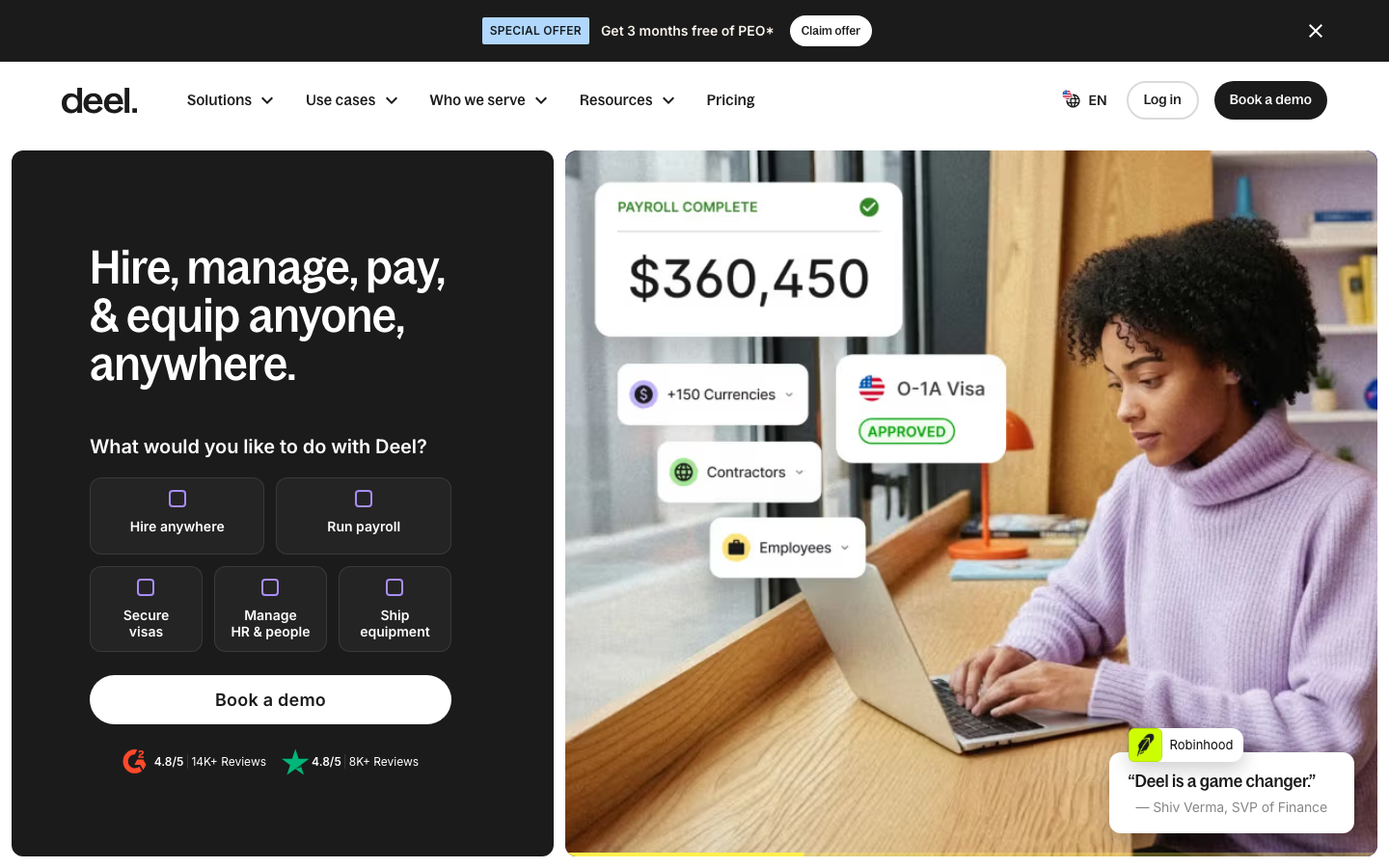
Deel is a global platform covering contractor onboarding, localized contracts, invoicing, and payouts. It is 1 of 2 here documenting a contractor-of-record option, where it contracts the worker itself. The vendor states 150+ countries and payments in 120+ currencies. Its EOR line is not reviewed here.
Software Pros
- Contractor of record published at a rate, not hidden behind a call
- 150+ countries with localized contract templates, per the vendor
- A published $49 per contractor per month rate to anchor a budget
Software Cons
- Rated on G2 under Deel Payroll, a listing far wider than this product
- $325 per contractor of record per month is a steep step up
- Breadth means paying for far more platform than a roster needs
Deel Review
I would shortlist Deel whenever the country list is long, and somebody has asked who signs the contract. Publishing a contractor-of-record rate is unusual candor in a market that prefers to quote. The trade-off is scope. A company paying 8 freelancers in 1 country is buying a platform built for a problem it does not have yet, and may never have.
Our Verdict
Widest Reach, Record Option
*As pricing is subject to change, we are listing prices as they stand in September 2026
Fiverr Enterprise

Quick Overview
Fiverr Enterprise, formerly Stoke Talent and acquired by Fiverr in 2021, is a global freelance management system covering sourcing, onboarding, classification, budget tracking, and payment. It works with freelancers you already use, not only marketplace hires. The vendor states payments across 160 countries on 1 monthly invoice.
Software Pros
- Automated compliance and tax workflows with background checks built in
- Private talent pools giving visibility over freelance spend by team
- 160 countries on a single consolidated monthly invoice, per the vendor
Software Cons
- No employment path, so a converting contractor needs another vendor
- Marketplace association can complicate procurement at conservative buyers
- Priced by quote, so nothing public to compare against
Fiverr Enterprise Review
This program suits a company with freelancers scattered across departments and no central view of who is engaged or what they cost. Pulling them into 1 pool solves a governance problem before it solves a compliance one. If your contractors already sit in a tidy list and the issue is only payments, this is more platform than you need.
Our Verdict
Freelance Network Under Control
Gusto
Quick Overview
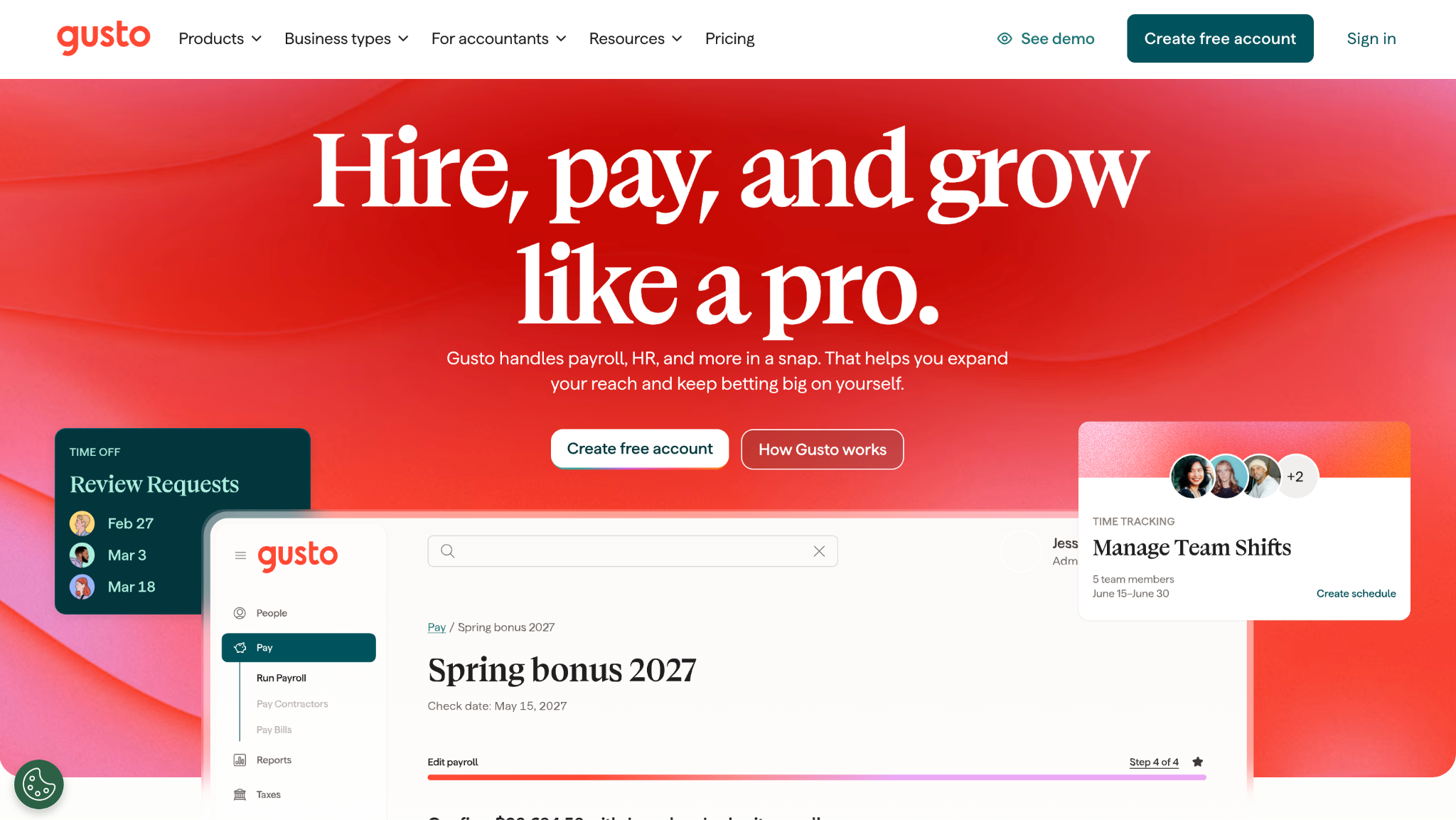
Gusto is a US-first payroll and HR platform whose contractor product handles onboarding, self-service portals, and W-9 and 1099 filing alongside employee payroll. Its compliance model is document collection and tax filing rather than classification assessment. The vendor states it pays contractors in more than 120 countries, with no monthly per-contractor fee.
Software Pros
- Contractors and employees paid from 1 system, with 1099 filing included
- A published Contractor Only plan at $6 per person per month plus a base fee
- Global contractor payouts in 120+ countries, per the vendor
Software Cons
- US-first by design, so international parity should not be assumed
- No classification assessment, only documents and filing
- The G2 score covers the whole payroll platform, not this product
Gusto Review
My read on Gusto is that it wins on the boring question of how many systems finance has to open. Paying W-2 staff and 1099 contractors from 1 login removes reconciliation work that nobody budgets for. It suits US companies with a modest international tail. A business whose contractors are mostly outside the US should look at the global platforms first.
Our Verdict
US Payroll Plus Contractors
*As pricing is subject to change, we are listing prices as they stand in September 2026
RemoFirst

Quick Overview
RemoFirst is a global platform positioned on low per-contractor pricing, local currency invoicing, and wide country reach. Its compliance model centers on documents and payments rather than classification opinions. The vendor states contractor payments across 150+ countries are free to manage, with $25 per contractor per month to process payments.
Software Pros
- Free contractor management with payment processing charged separately
- 150+ countries on a published rate, per the vendor
- An employment route available when a contractor should convert
Software Cons
- Documents and payments rather than a classification assessment
- Support depth varies by country, as it does with any wide network
- Buyers wanting a written risk position will need to ask for it
RemoFirst Review
I keep coming back to RemoFirst for companies that need real global reach on a startup budget. Charging nothing to manage and $25 to pay is an honest structure when your roster changes size every quarter. It doesn’t offer an opinion on classification, so companies with genuine exposure should look at platforms that document it.
Our Verdict
Low Cost Global Payouts
*As pricing is subject to change, we are listing prices as they stand in September 2026
RemotePeople

Quick Overview
RemotePeople, which traded as Horizons before its rebrand, is a global provider operating through its own local entities. It is the second platform here documenting contractor of record. Its own page states that it carries the misclassification risk. The vendor states 150+ countries and 150+ currencies with no wire fees.
Software Pros
- Contractor of record with the risk position stated on its own page
- Local entities rather than a pure partner network, per the vendor
- 150+ currencies with no wire fees charged on payouts
Software Cons
- Only 1 public G2 review, so there is no usable outside signal
- Contractor rates come by proposal rather than off the website
- A recent rebrand means older reviews and links carry the former name
RemotePeople Review
What stands out with RemotePeople is that it puts its risk position in writing instead of implying it. For a company whose legal team is uneasy about a long-running contractor in a strict jurisdiction, that sentence is the product. The public evidence is thin, so ask for the contract language and the country list early rather than trusting the marketing.
Our Verdict
Entities And Record Cover
TalentDesk.io
Quick Overview
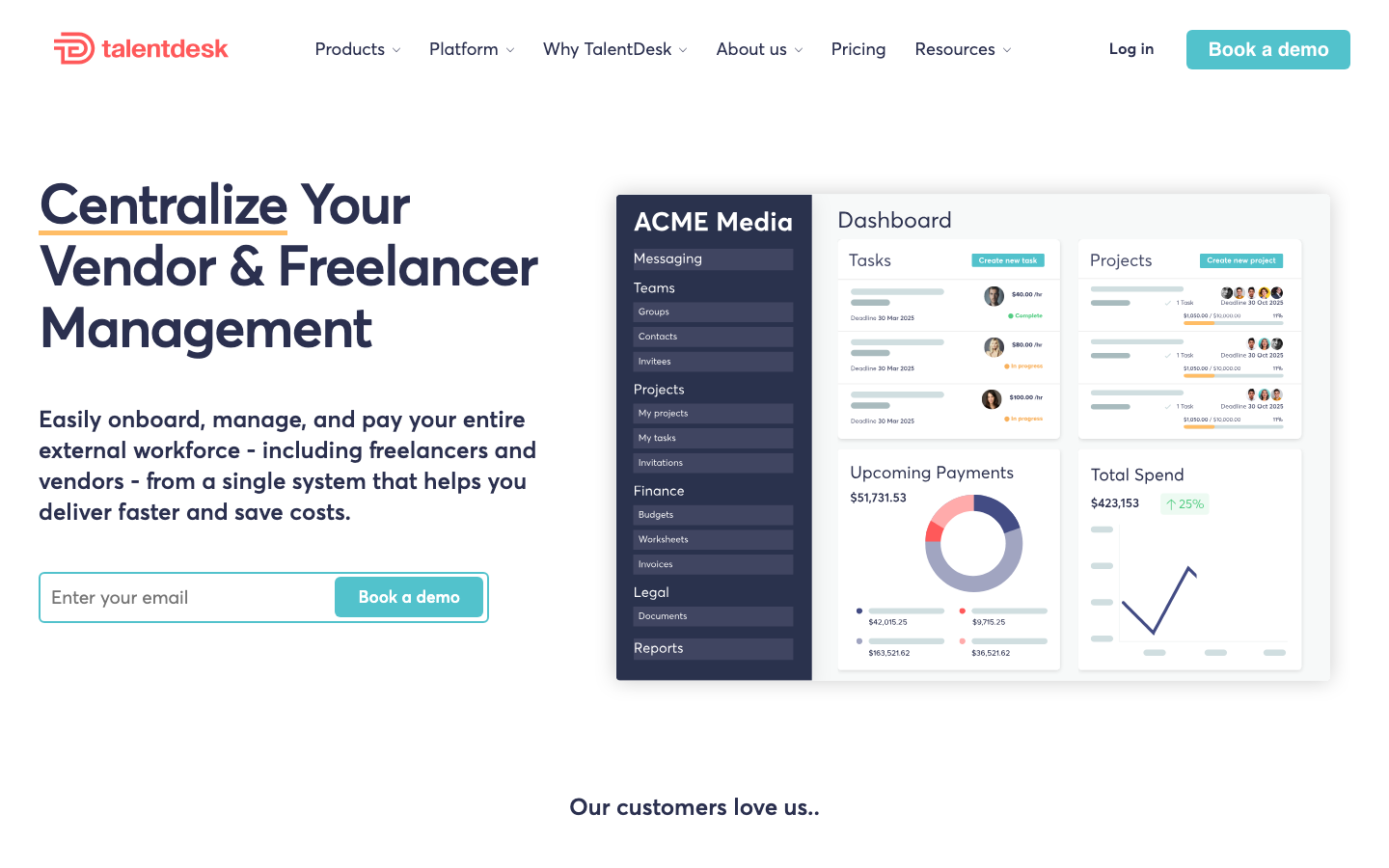
TalentDesk.io is a global freelancer and vendor management system built around workflow: onboarding, contracts, task and budget tracking, consolidated invoicing, and payments. Its compliance model includes built-in contractor classification with AML and KYC checks. The vendor states payments in 190+ countries and 55+ currencies.
Software Pros
- Classification, AML, and KYC checks built into onboarding
- 1 consolidated invoice instead of thousands of individual ones
- Task and budget tracking for teams that need spend visibility
Software Cons
- No employment path, so converting contractors go elsewhere
- Quote-only pricing with no published rate
- Focused on freelance workflow rather than broad HR functionality
TalentDesk.io Review
What stands out with TalentDesk.io is how much of the week it removes for whoever administers freelancers. Consolidated invoicing alone changes the shape of a finance month once you reach 200 contractors. It is a poor fit for a company wanting 1 system covering employees and contractors together. That is deliberately not what this platform was ever meant to be.
Our Verdict
Freelance Workflow And Payments
Wingspan
Quick Overview
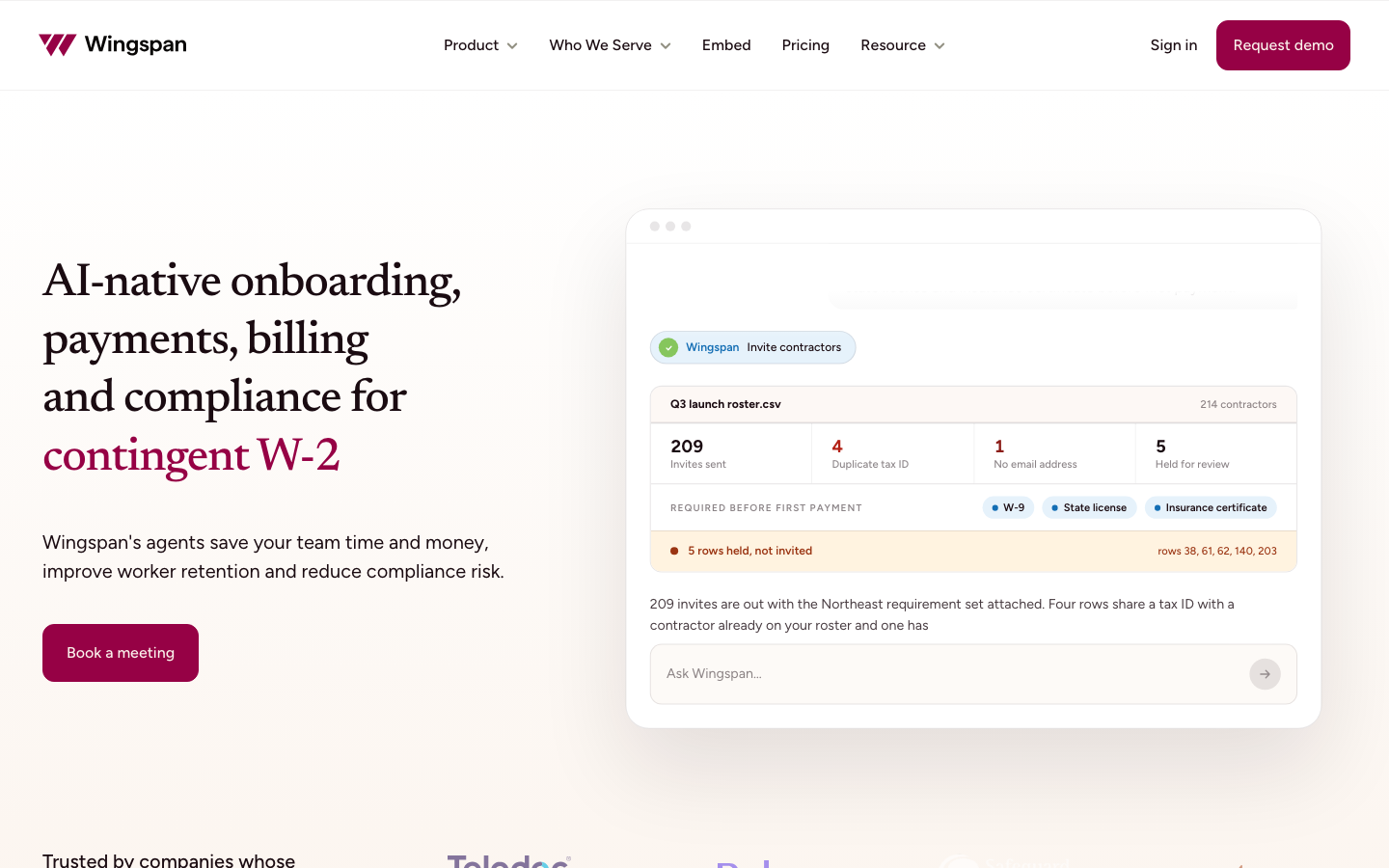
Wingspan is a US-first payments and compliance platform for 1099 contractors, handling W-9 collection, tax records, worker payments, and client billing. The whole flow can also be embedded inside another product. Onboarding extends to background checks and license verification. The vendor states pricing from $10 per monthly active payee.
Software Pros
- Tax records kept complete from onboarding through 1099 filing
- Onboarding steps covering background checks and license verification
- An embed option for platforms that pay contractors themselves
Software Cons
- US-first, with no published country or currency count to check
- Contingent W-2 is the only employment route documented
- A G2 score standing on 11 reviews, which settles nothing
Wingspan Review
I keep coming back to Wingspan when the contractor roster is really a payment operation. Marketplaces, staffing platforms, and healthcare networks paying hundreds of people need infrastructure rather than an HR tool, and the embed option is genuinely unusual. A company paying 12 designers in Europe is simply not the buyer this product was designed for, and will feel that quickly.
Our Verdict
Payments Infrastructure For 1099
*As pricing is subject to change, we are listing prices as they stand in September 2026
WorkMarket

Quick Overview
WorkMarket, an ADP company, is a US-first independent contractor management system built for volume, covering onboarding, verification, work assignment, and payment. Its compliance model is document collection and verification, including tax IDs and invoice auditing. The vendor states it pays workers quickly and at scale, almost anywhere in the world.
Software Pros
- Verification workflows built for hundreds or thousands of 1099 workers
- Talent pools organized by skills and location for repeat assignments
- Assignment tracking, so work delivery sits beside the payment record
Software Cons
- US-first, and international reach is not quantified on its own site
- No employment path within the product itself
- Only 29 public reviews, filed under its parent on G2
WorkMarket Review
The program this suits is a field operation dispatching the same contractors week after week, where verification and assignment matter more than global payouts. Very few platforms are built for that shape at that volume. A company with 20 creative freelancers would find the verification machinery heavy, and most of the assignment features would sit unused for the whole year.
Our Verdict
Verification At 1099 Volume
Worksuite

Quick Overview
Worksuite is a global enterprise freelancer platform with a documented classification service covering 50 US state labor laws. Contractor insurance sits alongside it. The vendor states it supports 190+ countries, 120+ local currencies, manages 1 million contractors, and processes $2 billion in contractor payments.
Software Pros
- A classification service documented across 50 US state labor laws
- 190+ countries and 120+ local currencies, per the vendor
- Contractor insurance available alongside the platform itself
Software Cons
- No employment path, so conversions move to another provider
- Quote-only pricing aimed at enterprise procurement cycles
- Enterprise depth is more platform than a 30-contractor team needs
Worksuite Review
I would shortlist Worksuite when the external workforce is large enough to have its own governance problem. Publishing a classification service by state, rather than gesturing at compliance generally, is the kind of specificity procurement asks for. The buyer is clearly an enterprise with a procurement function. A growing company would be better served by a platform that lists pricing on its website.
Our Verdict
Enterprise Classification And Payments
*As pricing is subject to change, we are listing prices as they stand in September 2026
YunoJuno
Quick Overview
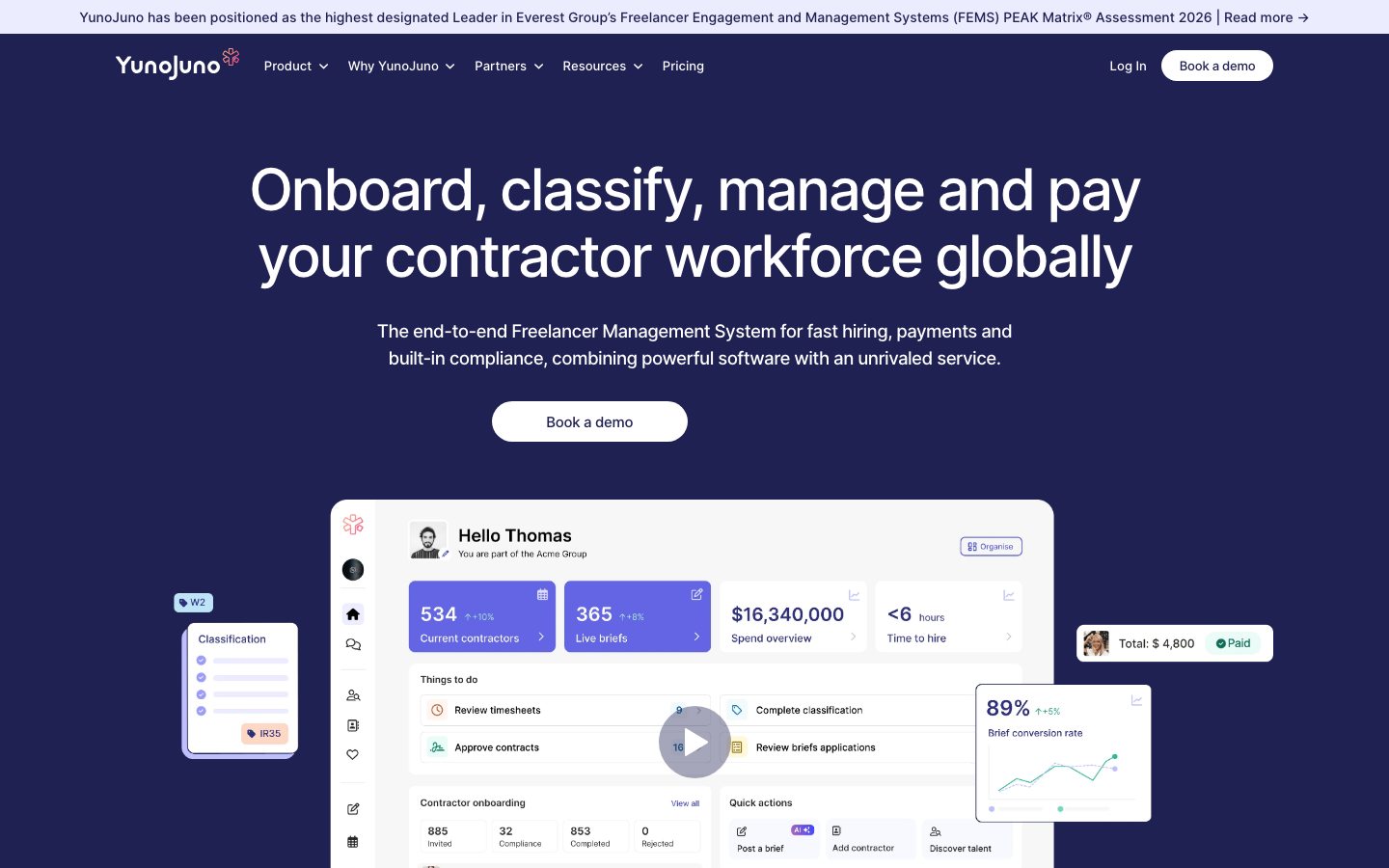
YunoJuno is the UK and Europe specialist, pairing a vetted freelancer marketplace with contractor management. Its local compliance tooling covers IR35, US contractor rules, and sole trader status. The vendor states it makes payments to contractors in 165+ countries and prices its management product as a percentage fee on contractor payments.
Software Pros
- IR35 and sole trader compliance handled as first-class features
- A vetted marketplace beside your existing freelancers
- Consolidated invoicing with spend and compliance dashboards
Software Cons
- Built around UK and European practice, which shapes the whole product
- A percentage fee grows with spend rather than with headcount
- Employment conversion runs through partners rather than in-house
YunoJuno Review
My read on YunoJuno is that it is the obvious answer for a British company and a harder sell elsewhere. IR35 handling built into the product rather than bolted on reflects genuine local knowledge. The percentage pricing model deserves modeling before signing. A roster of expensive contractors costs very differently from a roster of cheap ones on the same terms.
Our Verdict
UK Compliance With Marketplace
FAQs About Contractor Management Software
What is the best contractor management software?
No platform wins outright, because the answer turns on 2 questions. Where do your contractors sit, and how much compliance work should the vendor handle? Global platforms pay across many countries, US-first platforms are built around domestic tax forms, and 1 specialist is built for British and European rules. The comparison table near the top sorts all 10 by coverage and compliance model, which is the fastest way to cut the list.
How is it different from payroll software?
Payroll is built for employees. It withholds tax, files returns, and administers benefits, none of which applies to an independent worker engaged on a contract. The other relationship needs a signed contract, the right tax form before the first payment, and an invoice instead of a pay run. This category is built for that, and the record then shows the engagement was handled consistently from first day to last.
How much does it cost?
The usual shape is a rate per active worker per month, and 4 of the 10 platforms reviewed here publish one. Those published rates run from $6 to $49 per person per month as of September 2026, with 1 vendor charging $10 per monthly active payee. Payment costs sit on top at most vendors, including currency conversion and payout fees. Compare the total rather than the headline platform fee.
Does the software decide whether someone is a contractor or an employee?
No, and any vendor implying otherwise is overselling. What these platforms do is apply the same onboarding to everybody, collect the documents before work starts, and keep an audit trail. They also flag risk indicators, such as full-time hours for a single client. The decision and the liability stay with the company unless a vendor contracts the worker itself, and none of this is legal or tax advice.
What is a contractor of record?
It is an arrangement where the platform contracts the worker itself rather than leaving the engagement between you and the individual. The platform becomes the counterparty on that agreement, which shifts some of the exposure onto its balance sheet. 2 of the platforms reviewed here document the model on their own sites. It costs meaningfully more than standard management, so companies tend to use it selectively.
What is the best contractor tracking software?
Tracking here means work, time, and spend, not people. The best platforms are built around workflow rather than payments alone. Look for task and budget tracking, approvals before an invoice is raised, and dashboards showing committed spend by team. The comparison table above shows which platforms lead with workflow and which lead with payment reach, which is usually the deciding split.
Can I pay international contractors in local currency?
Yes, on global platforms that route payments through local rails and convert at their own rates. Several vendors state coverage in 150 or more countries and 120 or more currencies. The headline count matters less than your specific list, because coverage thins out in the last few countries. Ask for confirmation on the exact markets you pay before you sign anything.
What happens when a contractor should become an employee?
The engagement converts, and better paperwork will not solve it. In practice, that means hiring the person through your own entity in that country, or through a provider that employs on your behalf. Some platforms on this list offer that route themselves, and others stop at contractors. Check that before you commit, because switching vendors part-way through a conversion is avoidable pain that lands at the worst moment.

Helen is Anywherer’s Market Analyst & Content Researcher, with extensive experience in analyzing global employment markets and HR technology trends. She is skilled at turning complex market data into clear, well-researched insights that inform every piece of content. With a strong grasp of the EOR, PEO, and international hiring space, Helen plays a key role in keeping Anywherer’s research accurate, up to date, and genuinely useful for readers.