The shortlisted candidate has three former managers. Two voicemails go unanswered for four days. The third manager responds with a single sentence on LinkedIn: great person, highly recommend. The offer date is tomorrow. The recruiter sends the offer. Six months later, the hire is exited for performance issues that two structured reference calls would have surfaced. A reference check template does not guarantee a different outcome, but it creates a structured, documented process that gives the hiring team something to act on rather than a voicemail trail.
The format problem compounds the signal problem. A phone script, an async email request, and a structured form produce different outputs from the same referee. Distributed hiring panels where references sit across time zones need async, written, structured checks that travel through Slack and ATS comments without losing context. The right template for a reference check depends on the role, the method, and the panel’s expectations. These seven templates cover each format. They sit inside the broader hiring stack covered by a recruitment process plan template, which defines where reference checks fall in the overall sequence.
What Is a Reference Check?
A reference check is a structured conversation or written exchange with a candidate’s former managers, peers, or clients. Its purpose is to validate the signals collected during interviews. The check usually runs after the hiring decision is informally made but before the formal offer is sent. Questions focus on the candidate’s actual performance, working style, and areas of concern in the specific role context.
A reference check is not the same as a background check. A background check is a third-party verification of factual records: identity, employment history, criminal record, and credentials. A reference check is a conversation or written exchange with people who worked directly with the candidate. The two serve different purposes and are governed by different legal frameworks. Many hiring processes run both, but they are not interchangeable.
The format of the check varies by method. A phone script structures a verbal conversation with a former manager. An async email template captures written responses that the hiring panel can review without scheduling a call. A structured form standardizes the output across multiple references so the panel can compare responses side by side. A questions-only template gives the recruiter or hiring manager a bank of role-relevant questions without a prescribed format. Each approach has tradeoffs in depth, turnaround time, and comparability.
Why Companies Need a Reference Check Template
Unstructured reference calls produce inconsistent output. One recruiter asks about the collaboration style. Another asks about technical skills. A third spends twelve minutes on general impressions and forgets to ask the rehire question. The hiring panel gets three documents that cannot be compared and three opinions that carry different weights depending on who ran the call. A template applies the same structure to every check, ensuring every candidate is assessed against the same criteria.
Compliance is the second driver. The U.S. Equal Employment Opportunity Commission prohibits employment decisions based on protected characteristics, including age, race, sex, religion, national origin, and disability status. Reference checks that ask about a candidate’s personal circumstances, family plans, or health put the employer at legal risk. A documented template with pre-approved questions eliminates ad hoc questions and creates a written record that the check was conducted within legal boundaries.
When a reference check involves a third-party screening firm, the Fair Credit Reporting Act (FCRA) requires written candidate consent before the check runs, a specific disclosure process, and an adverse action procedure if the check results affect the hiring decision. For EU-based candidates or roles in EU jurisdictions, the UK ICO employment guidance on GDPR requires a lawful basis for processing reference data and limits what can be retained and for how long. A template that includes a consent section and a data-handling note addresses both frameworks at the process level.
For distributed teams, templates solve a coordination problem. References in different time zones often respond asynchronously. The hiring panel reviews notes in a shared ATS or folder, not in a live debrief. A structured template means the notes are readable and comparable regardless of who ran the check or how the reference responded.
7 Reference Check Template Examples
The seven templates below cover every format a recruiter or hiring manager uses in the reference-check process. Each includes a body-text version for use in an ATS, HR wiki, or shared folder, and an image-ready version for design layouts or printed forms. The text versions use [PLACEHOLDER] fields for role-specific and candidate-specific details. Every template for reference check use should be reviewed by HR and legal before going live, particularly for international hires or senior roles where the questions need to be calibrated to the specific competency framework.
Standard Reference Check Template
Purpose: The general-purpose employee reference check template for most roles and most reference types. It covers the full set of sections that produce actionable output: employment verification, performance questions, a concerns prompt, a rehire question, and recruiter notes. Recruiters run this template by phone or use it as the basis for an email or form version.
Template sections:
- Header: candidate name, role applied for, referee name, referee title, relationship to candidate, and contact details.
- Consent and confidentiality: statement that the call is confidential and used for hiring purposes only; verbal consent confirmed.
- Employment verification: confirm employment dates, job title, and reporting line.
- Role-relevant performance questions: two or three questions specific to the role’s core requirements.
- Behavioral and competency questions: questions about how the candidate works with others, handles pressure, and approaches problems.
- Red-flag prompt: open prompt inviting the referee to share any concerns.
- Rehire eligibility: would the referee rehire or re-engage the candidate, and under what conditions?
- Recruiter notes: space for the recruiter to record observations about the referee’s tone, hesitations, and overall impression.
- Sign-off: date, recruiter name, check method.
Example of a template (text version):
REFERENCE CHECK
Candidate: [NAME] | Role: [ROLE] | Date: [DATE] | Recruiter: [NAME] | Method: Phone / Email / Form
Referee details:
Name: ___________________________ | Title: ___________________________ | Company: ___________________________ | Relationship to candidate: [Direct manager / Peer / Client / Skip-level] | Contact: ___________________________
Consent:
This reference is confidential and used for hiring purposes only. Do you consent to this conversation being recorded in our hiring records? [Yes / No noted]
Employment verification:
1. Can you confirm [CANDIDATE NAME] worked with you from [DATE] to [DATE]? 2. What was their job title and primary responsibilities? 3. Who did they report to?
Performance questions:
4. How did [CANDIDATE NAME] perform against their goals during your time working together? 5. What were their strongest contributions to your team or project? 6. In what areas did they have room to grow?
Behavioral and competency questions:
7. How did [CANDIDATE NAME] handle situations where priorities shifted quickly? 8. Can you describe how they worked with other team members when there was disagreement? 9. How did they approach feedback from managers or peers?
Red-flag prompt:
10. Is there anything about [CANDIDATE NAME]’s performance or conduct that you think I should be aware of before making a hiring decision?
Rehire question:
11. Would you rehire or re-engage [CANDIDATE NAME] if you had the opportunity? If yes, in what capacity? If not, can you say more?
Recruiter notes:
Tone of referee: [Enthusiastic / Measured / Hesitant / Declined to elaborate] | Key positives noted: ___________________________ | Concerns noted: ___________________________ | Overall impression: ___________________________
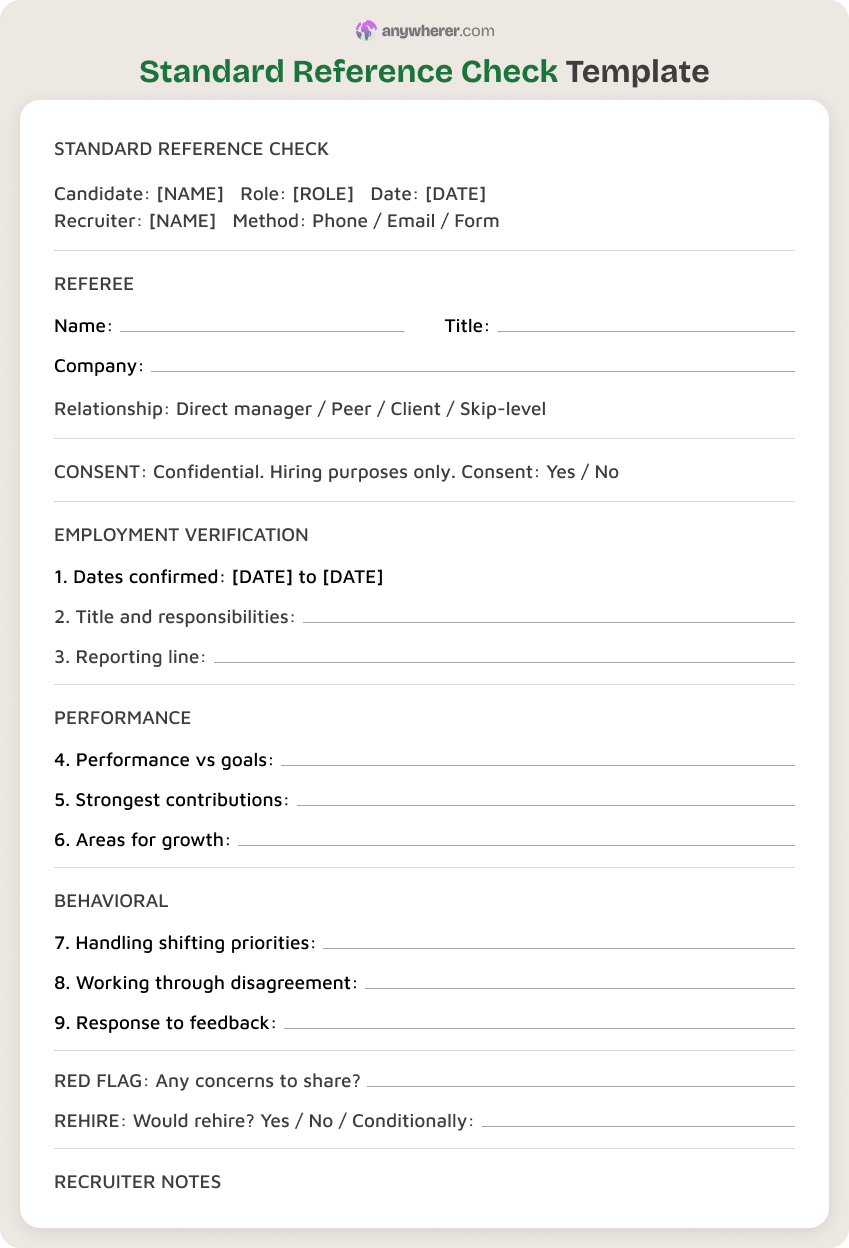
Best for: General-purpose reference checks across most role types and seniority levels. Adapts for phone, email, or form delivery with minimal adjustment.
Employment Reference Check Template
Purpose: A formal employment reference check template that prioritizes employment verification over performance questions. This template is used when HR needs a documented record of employment history confirmation in addition to performance feedback. The employment reference check form template works for regulated industries, senior hires, and any role where the candidate’s stated employment history is material to the decision.
Template sections:
- Header: candidate name, role, date, recruiter, and referee details.
- Consent: explicit written or verbal consent statement.
- Employment history verification: start date, end date, job title at start, job title at exit, department, and reporting structure.
- Reason for leaving: type of departure and whether it was voluntary, involuntary, or by mutual agreement.
- Performance summary: performance rating if the referee is willing to share; core responsibilities met.
- Role-relevant questions: role-specific competency questions calibrated to the open position.
- Red-flag prompt: open concerns prompt.
- Rehire: rehire eligibility confirmation.
- Recruiter sign-off: recruiter notes, tone, and overall recommendation.
Example of a template (text version):
EMPLOYMENT REFERENCE CHECK
Candidate: [NAME] | Role applied for: [ROLE] | Date: [DATE] | HR contact: [NAME, EMAIL]
Referee:
Name: ___________________________ | Title: ___________________________ | Organisation: ___________________________ | Relationship: [Direct manager / HR representative / Skip-level manager]
Consent:
This reference check is conducted by [COMPANY NAME] for employment verification and candidate assessment purposes. Responses are kept confidential within the hiring team. Do you consent to participating? [Yes / No noted]
Employment History Verification:
Start date: ___________ | End date: ___________ | Title at start: ___________________________ | Title at exit: ___________________________ | Department: ___________________________ | Reporting line: ___________________________
Reason for Leaving:
Was the departure voluntary? [Yes / No / Mutual agreement] | Is the candidate eligible for rehire at your organization? [Yes / No / With conditions: ___________________________]
Performance Summary:
How would you rate this candidate’s overall performance during their tenure? [Exceptional / Strong / Meets expectations / Below expectations / Declined to rate] | Primary responsibilities performed well: ___________________________ | Areas where performance was inconsistent: ___________________________
Role-Relevant Questions:
1. [ROLE-SPECIFIC QUESTION 1] | 2. [ROLE-SPECIFIC QUESTION 2] | 3. [ROLE-SPECIFIC QUESTION 3]
Concerns:
Is there anything about this candidate’s performance, conduct, or work history that you think is relevant to a hiring decision? ___________________________
Recruiter sign-off: ___________________________ | Date: ___________
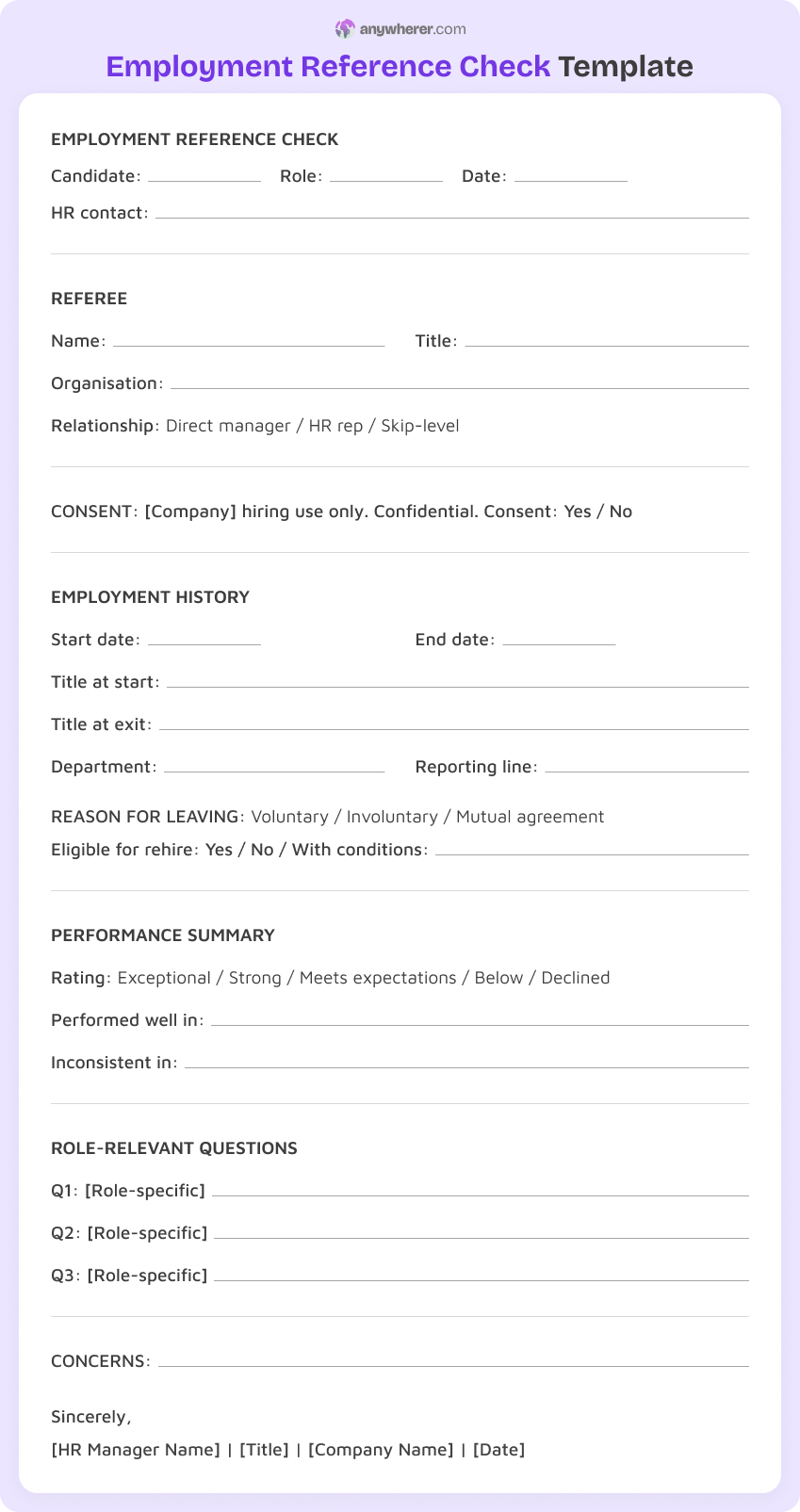
Best for: Regulated industries, senior hires, and any role where employment history verification is as important as performance feedback. Also useful when HR needs a documented record for compliance purposes.
Reference Check Questions Template
Purpose: A questions-only bank for recruiters and hiring managers who already have a form or script structure but need a curated set of role-relevant, behaviorally anchored questions. The reference check questions template and employment reference check questions template both draw from this format. These questions parallel the competency areas covered in behavioral interview questions, so the hiring panel can cross-reference interview evidence with third-party observations from the reference.
Template sections:
- Verification questions: employment dates, title, and reporting structure.
- Performance questions: goal achievement, work quality, and impact.
- Collaboration and interpersonal questions: collaboration, conflict resolution, and communication style.
- Adaptability questions: handling pressure, ambiguity, and change.
- Leadership questions (for people-manager roles): direct-report management, feedback delivery, and team development.
- Closing questions: open concerns prompt and rehire eligibility.
Example of a template (text version):
REFERENCE CHECK QUESTIONS BANK
Verification
1. Can you confirm [CANDIDATE NAME] worked with you from [DATE] to [DATE]? 2. What were their role and primary responsibilities during that time? 3. What was the nature of your working relationship with them?
Performance
4. How did [CANDIDATE NAME] perform against the goals or expectations set for their role? 5. What were their most significant achievements while working with you? 6. In which areas did you observe opportunities for growth or development? 7. How would you describe the quality and consistency of their work output?
Collaboration and Communication
8. How did [CANDIDATE NAME] work with colleagues across different functions or teams? 9. How did they handle situations where there was disagreement within the team? 10. How did they communicate with stakeholders at different seniority levels? 11. How did they give and receive feedback?
Adaptability
12. Can you describe a time when [CANDIDATE NAME] had to adapt to a significant change in priorities or project scope? What was the outcome? 13. How did they perform under pressure or tight deadlines? 14. How did they handle ambiguity when direction was not fully defined?
Leadership (for people manager roles)
15. How did [CANDIDATE NAME] build and maintain their team? 16. How did they handle underperformance in their direct reports? 17. How did they develop the people who reported to them?
Closing
18. Is there anything about [CANDIDATE NAME] that you think would be helpful for us to know before making a hiring decision? 19. Would you rehire or re-engage [CANDIDATE NAME] if you had the opportunity? In what capacity?
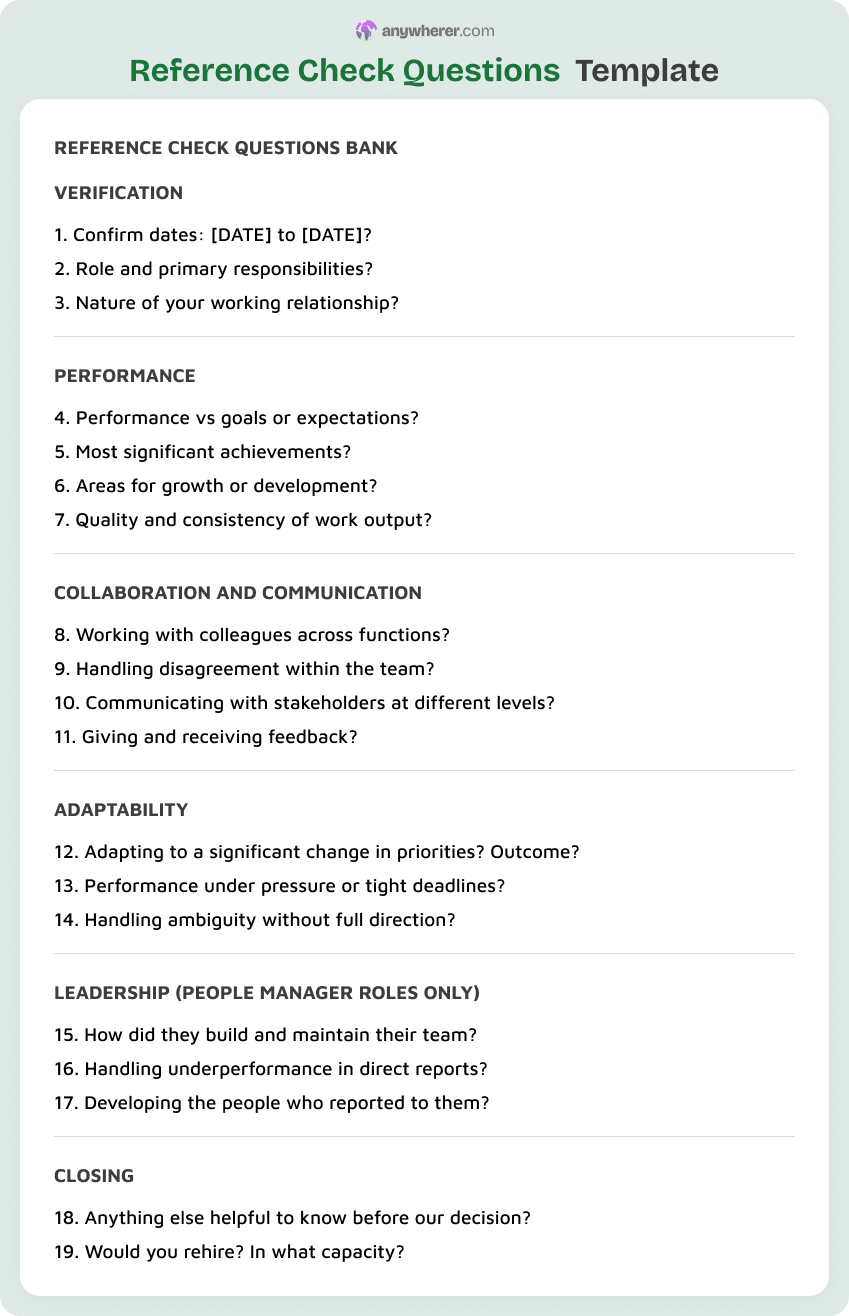
Best for: Recruiters and hiring managers who need a structured question bank to plug into an existing phone script, form, or email template. Select the relevant sections based on the role’s seniority and function.
Reference Check Form Template
Purpose: A structured reference check form template for completion by the referee directly or by the recruiter over the phone. The form format produces standardized, scoreable output that the hiring panel can review side by side across multiple references. A reference check form template free of complex formatting works well as a Google Form, a PDF, or an ATS attachment. The reference check form template is the most panel-friendly format because it translates observations into comparable ratings.
Template sections:
- Header: candidate name, role, date, and referee details with relationship type.
- Consent: written consent confirmation.
- Employment details: confirmed dates, title, and reporting line.
- Rated performance categories: each performance area is rated on a scale with space for written comments.
- Concerns: open text response to an open concerns prompt.
- Rehire: rehire eligibility with a yes, no, or conditional response and written explanation.
- Additional comments: space for the referee to add any comments not covered by the form questions.
- Referee sign-off: referee signature or name confirmation and date.
Example of a template (text version):
REFERENCE CHECK FORM
Candidate: [NAME] | Role: [ROLE] | Date: [DATE] | Recruiter: [NAME]
Referee:
Name: ___________________________ | Organisation: ___________________________ | Title: ___________________________ | Relationship: [Direct manager / Peer / Client / Other] | Years worked with candidate: ___
Consent:
This form is completed for candidate assessment purposes and kept confidential within the hiring team of [COMPANY NAME]. Referee confirms consent to participate: [Yes]
Employment Verification:
Employment dates confirmed: [DATE] to [DATE] | Title confirmed: ___________________________ | Reporting line confirmed: ___________________________
Rated Performance Areas (1 = Poor, 5 = Outstanding):
Quality of work: 1 / 2 / 3 / 4 / 5 | Comments: ___________________________ | Reliability and follow-through: 1 / 2 / 3 / 4 / 5 | Comments: ___________________________ | Communication skills: 1 / 2 / 3 / 4 / 5 | Comments: ___________________________ | Collaboration and teamwork: 1 / 2 / 3 / 4 / 5 | Comments: ___________________________ | Adaptability: 1 / 2 / 3 / 4 / 5 | Comments: ___________________________ | [ROLE-SPECIFIC COMPETENCY]: 1 / 2 / 3 / 4 / 5 | Comments: ___________________________
Concerns:
Is there anything about this candidate’s performance or conduct that you think the hiring team should be aware of? ___________________________
Rehire Eligibility:
Would you rehire this candidate? Yes / No / Conditionally | If no or conditional, please explain: ___________________________
Additional Comments:
_______________________________________________________________
Referee name (print): ___________________________ | Date: ___________
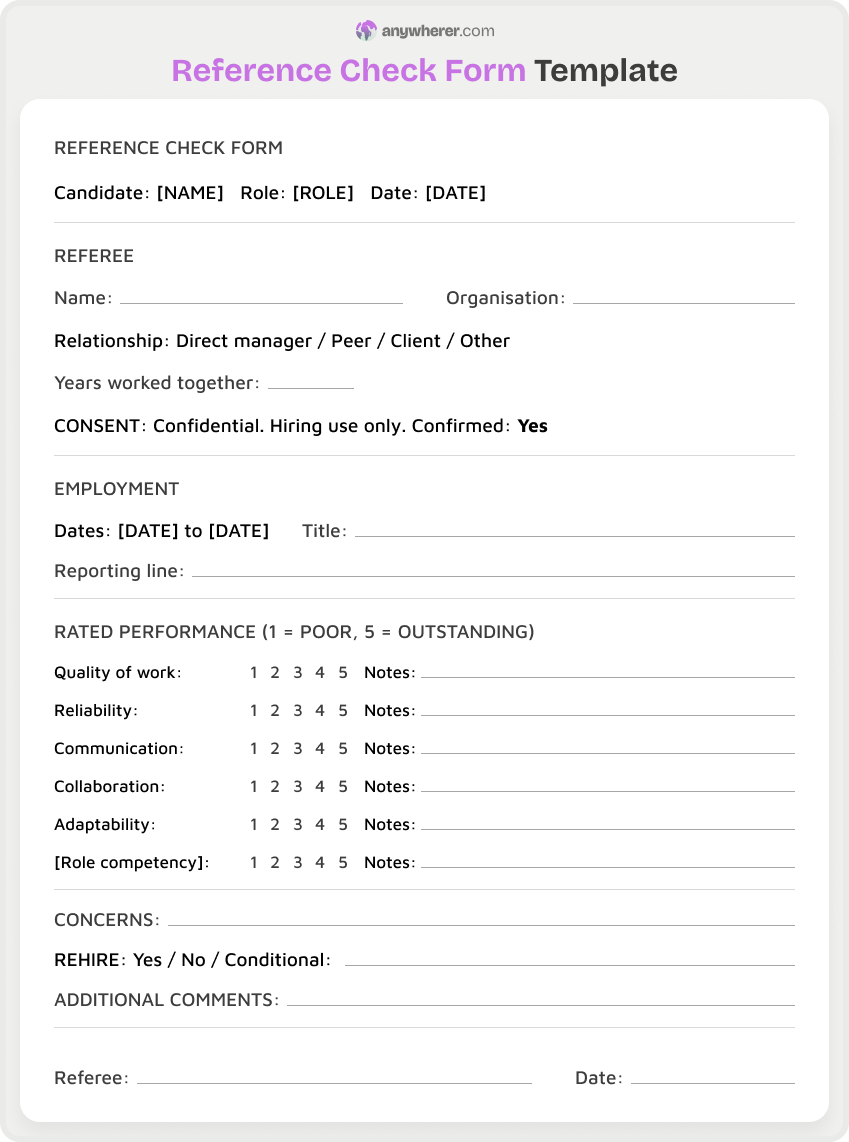
Best for: Hiring panels that need to compare multiple references side by side. The rated categories make it easy to summarize results in a shared ATS note or hiring panel debrief without reading each form in full.
Phone Reference Check Template
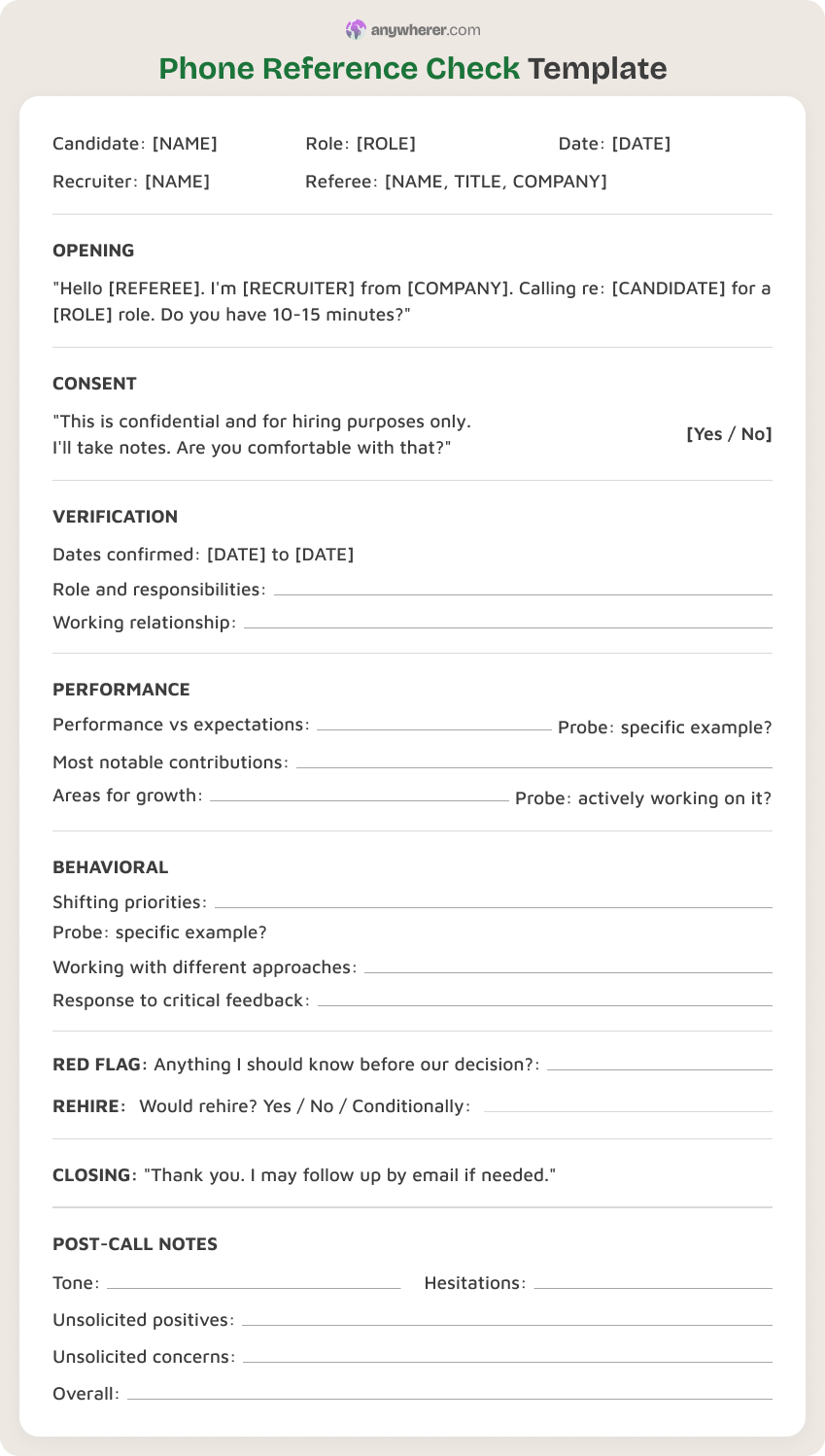
Purpose: A complete phone script for a verbal reference call. The phone reference check template guides the recruiter through the opening, consent, questions, and closing in a natural conversational order. It includes suggested language for each transition point and prompts for follow-up probing when a referee gives a vague or brief answer. Phone checks produce the richest signal because tone, hesitation, and unsolicited comments are audible.
Template sections:
- Opening script: recruiter introduction, candidate name, and purpose of the call.
- Consent language: verbal consent statement and confirmation.
- Verification questions: employment confirmation questions.
- Performance questions with probes: performance and competency questions with follow-up probes.
- Red-flag prompt: open concerns prompt.
- Rehire: rehire question.
- Closing script: closing and thank-you.
- Post-call notes: recruiter notes on tone, hesitations, and overall impression.
Example of a template (text version):
PHONE REFERENCE CHECK SCRIPT
Opening:
“Hello, [REFEREE NAME]. My name is [RECRUITER NAME], and I’m a recruiter at [COMPANY NAME]. I’m calling today about [CANDIDATE NAME], who has applied for a [ROLE] position with us. They’ve listed you as a professional reference, and I’d like to ask a few questions about their work. The call should take about 10 to 15 minutes. Is now a good time?”
Consent:
“Before we start, I want to let you know that this reference is confidential and will be used only for our hiring process. I’ll be taking notes during our conversation. Are you comfortable with that?” [Record: Yes / No]
Verification:
“Can you start by confirming that [CANDIDATE NAME] worked with you from approximately [DATE] to [DATE]?” “What was their role and what were their main responsibilities?” “What was the nature of your working relationship?”
Performance questions:
“How did [CANDIDATE NAME] perform against the expectations of their role?” Probe if vague: “Can you give me a specific example?” “What were their most notable contributions while you worked together?” “In what areas did they have room to grow?” Probe: “Was that something they were actively working on improving?”
Behavioral questions:
“How did [CANDIDATE NAME] handle situations where priorities changed quickly?” Probe: “Can you walk me through a specific time that happened?” “How did they work with people who had a different way of approaching problems?” “How did they respond to critical feedback?”
Red-flag prompt:
“Is there anything about [CANDIDATE NAME]’s work or conduct that you think I should be aware of before we move forward with a hiring decision?”
Rehire:
“Would you rehire or re-engage [CANDIDATE NAME] if you had the chance?” If yes: “In what capacity?” If no: “Can you tell me more about that?”
Closing:
“Thank you so much for your time, [REFEREE NAME]. This has been really helpful. I may follow up by email if we need to clarify anything. Is there anything you’d like to add before we wrap up?”
Post-call notes:
Tone: [Enthusiastic / Warm / Measured / Hesitant / Reluctant] | Hesitations noted: ___________________________ | Unsolicited positive comments: ___________________________ | Unsolicited concerns: ___________________________ | Overall impression: ___________________________
Best for: Final-stage checks on senior or sensitive hires where tone and unsolicited comments carry as much signal as the answers themselves. Phone checks produce the richest output but require scheduling and the most time from recruiters.
Email Reference Check Template
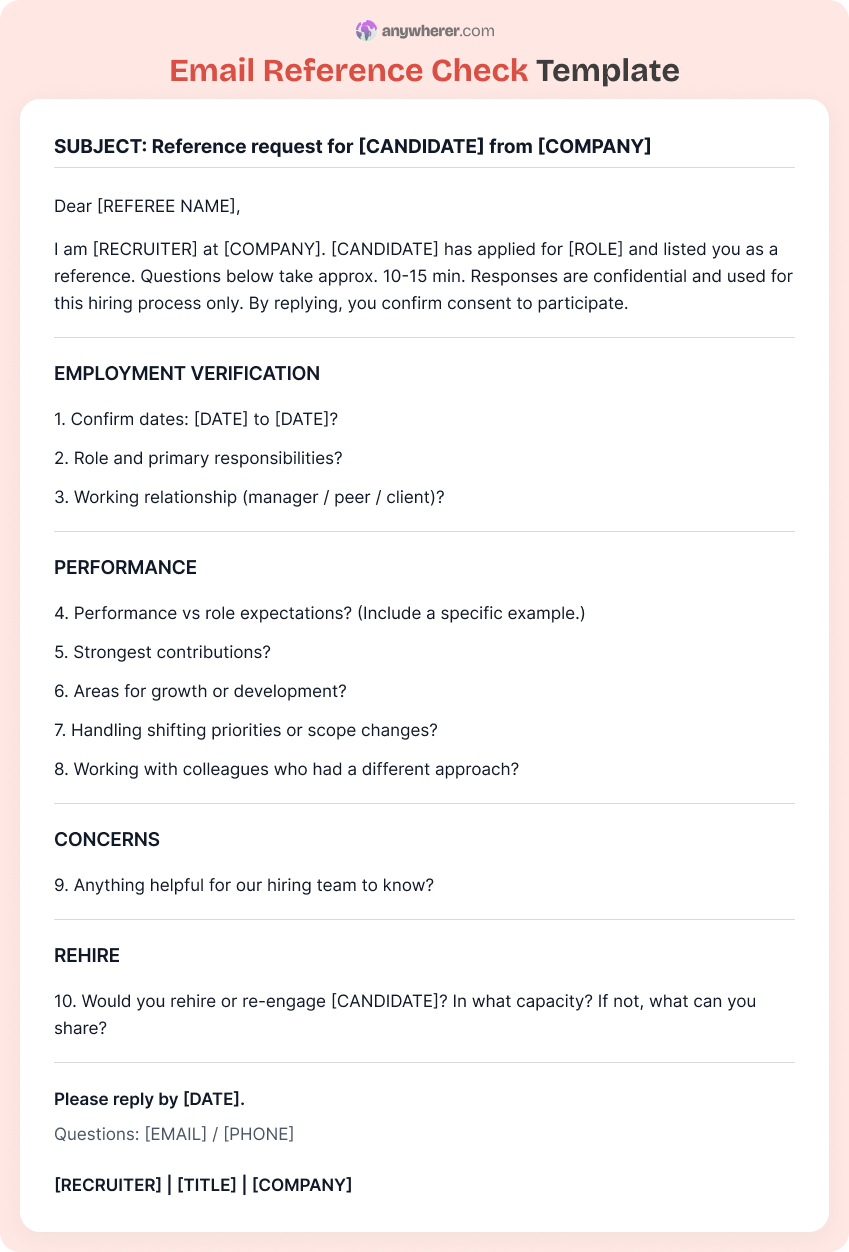
Purpose: An async written reference check template for situations where scheduling a phone call is impractical. The email reference check template sends a structured set of questions to the referee and receives written responses, which the recruiter then pastes into the ATS or the hiring panel folder. It is the most practical format for distributed hiring where references are in different time zones or where the hiring timeline requires a faster turnaround than a scheduled call allows.
Template sections:
- Subject line: identifies the candidate and the company.
- Opening paragraph: brief explanation of who the recruiter is, which role the candidate has applied for, and how long the response should take.
- Consent statement: consent statement in written form.
- Verification questions: employment verification fields.
- Performance questions: four to six performance and behavioral questions.
- Red-flag prompt: open concerns prompt.
- Rehire: rehire question.
- Closing and deadline: response deadline and recruiter contact details.
Example of a template (text version):
Subject: Reference request for [CANDIDATE NAME] from [COMPANY NAME]
Dear [REFEREE NAME],
My name is [RECRUITER NAME], and I am a [TITLE] at [COMPANY NAME]. [CANDIDATE NAME] has applied for the [ROLE] position with us and has listed you as a professional reference. I would appreciate your responses to the short set of questions below. The form should take approximately 10 to 15 minutes to complete.
Your responses will be kept confidential within our hiring team and used only for this hiring process. By responding to this email, you confirm your consent to participate in this reference check.
Employment verification:
1. Can you confirm [CANDIDATE NAME] worked with you from approximately [DATE] to [DATE]? 2. What was their role and primary responsibilities? 3. What was the nature of your working relationship (direct manager, peer, client, etc.)?
Performance and behavioral questions:
4. How did [CANDIDATE NAME] perform against the expectations of their role? Please include a specific example if possible. 5. What were their strongest contributions during the time you worked together? 6. In what areas did you observe room for growth or development? 7. How did they handle situations where priorities shifted or the scope of work changed? 8. How did they work with colleagues or stakeholders who had a different approach?
Concerns:
9. Is there anything about [CANDIDATE NAME]’s performance or conduct that you think would be helpful for our hiring team to know?
Rehire:
10. Would you rehire or re-engage [CANDIDATE NAME] if you had the opportunity? If yes, in what capacity? If not, please share what you are comfortable sharing.
Please reply to this email by [DATE]. If you have any questions, you can reach me at [EMAIL] or [PHONE]. Thank you for your time.
[RECRUITER NAME] | [TITLE] | [COMPANY NAME] | [EMAIL] | [PHONE]
Best for: Distributed hiring where references are in different time zones. Also the fastest format when the hiring timeline is short and scheduling a phone call would add days to the process.
Simple Reference Check Template
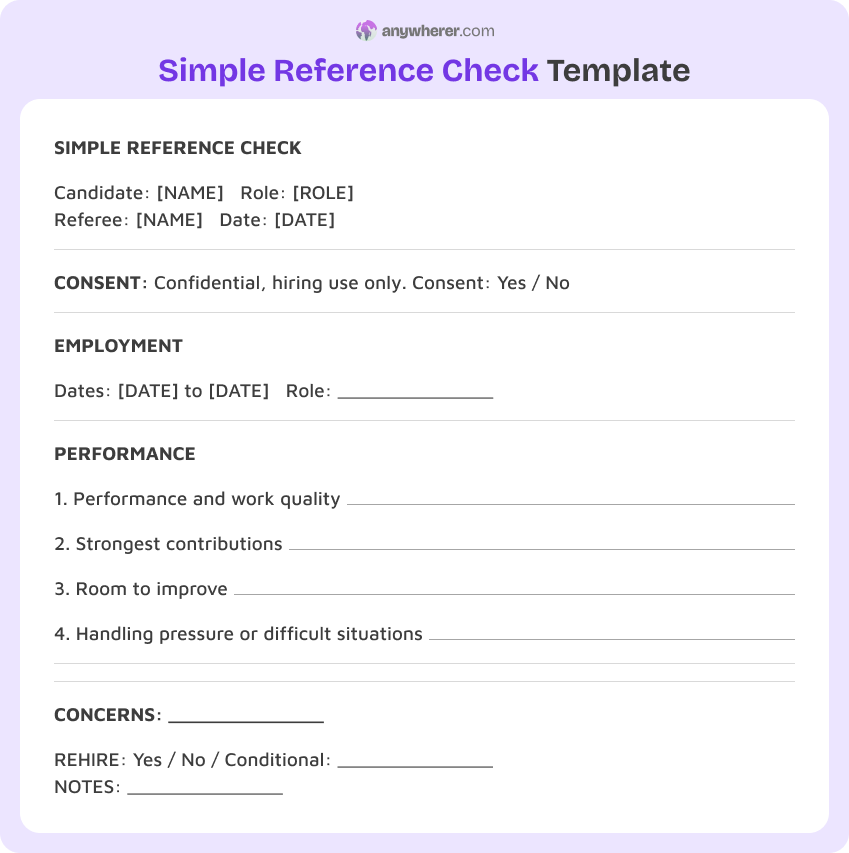
Purpose: A lightweight, plug-and-play reference check template for small businesses, startups, and hiring managers running a one-off final-stage check without a dedicated recruiting operation. The free reference check template removes the scored ratings, detailed script language, and post-call notes sections, keeping only the sections that produce the minimum viable signal for a hiring decision. It works by phone or email with no adaptation required.
Template sections:
- Header: candidate name, role, referee name, and date.
- Consent: brief consent note.
- Employment verification: dates, title, and relationship.
- Performance questions: three to four open performance questions.
- Concerns: concerns prompt.
- Rehire: rehire question.
- Notes: overall impression note.
Example of a template (text version):
SIMPLE REFERENCE CHECK
Candidate: [NAME] | Role: [ROLE] | Referee: [NAME] | Date: [DATE]
Consent:
This reference is confidential and used for hiring purposes only. Do you consent to participating? [Yes / No noted]
Employment verification:
Did [CANDIDATE NAME] work with you from approximately [DATE] to [DATE]? What was their role?
Performance questions:
1. How would you describe [CANDIDATE NAME]’s performance and work quality? 2. What were their strongest contributions in your team? 3. Where did they have room to improve? 4. How did they handle pressure or difficult situations?
Concerns:
Is there anything I should know before making a hiring decision? ___________
Rehire:
Would you rehire this person? Yes / No / Conditionally
Notes:
_______________________________________________________________
Best for: Small businesses, startups, and hiring managers running one-off final-stage checks without a structured recruiting operation. Use as a free reference check template that works by phone or email with no modification required.
How to Run a Reference Check
The process starts with consent. Before contacting any referee, the recruiter confirms written consent from the candidate. This is a legal requirement under the FCRA for checks that use third-party screening firms in the U.S., and a data protection requirement under UK and EU GDPR frameworks for any reference data processed on EU or UK-based candidates. The consent step also gives the candidate the opportunity to flag any referee who should not be contacted.
Request two to three references per candidate and aim for at least one direct manager. A mix of manager and peer references produces a more complete picture than three peer references alone. Contact references using the candidate’s preferred method: phone for the richest signal, email for distributed or time-zone-constrained situations. Run the same structured template on each reference so the outputs are comparable. Score or summarize each completed check and share notes with the hiring panel before the final decision is made. The completed reference check notes inform the same competency areas the panel evaluated during interviews, which is why aligning reference questions to the interview framework produces the most useful output. Once reference checks are complete and the panel has reviewed the results, the recruiter prepares the job offer letter template for the selected candidate.
Aim for five to seven business days between requesting references and completing the check. Some referees take longer to respond, particularly for email checks. Build that buffer into the hiring timeline before the offer deadline. When a referee does not respond within three business days, one follow-up message is appropriate. If a referee declines or remains unresponsive, ask the candidate for an alternative before extending the deadline further.
Key Elements Every Reference Check Should Include
- Documented candidate consent before any referee is contacted.
- Verification of employment dates, job title, and reporting line.
- Role-relevant, behaviorally anchored questions that connect to the competencies the role requires.
- The same questions asked across all references for comparability.
- A red-flag or concerns prompt that gives the referee an explicit opening to share anything the recruiter did not ask about.
- A rehire eligibility question.
- Recruiter notes on tone, hesitations, and overall impression for phone checks.
- A written summary stored in the ATS or hiring panel folder.
Common Mistakes in Reference Checks
- Skipping candidate consent. This is a legal risk under FCRA and GDPR frameworks and creates a documented gap in the hiring record.
- Asking generic questions that produce no signal. Questions like “is this person a good worker” give the referee nowhere to go and the recruiter nothing to act on.
- Calling only the references the candidate chose without seeking peer or skip-level coverage. Candidates select the most favorable referees; a peer reference or a skip-level manager fills the blind spots.
- Treating the check as a formality after the hiring decision is already settled. When the check is genuinely used for the decision, the questions and output change.
- Accepting a single LinkedIn confirmation or a brief email reply as a complete reference check. A one-line endorsement is not a reference check.
- Failing to document the check in writing. No written record means no evidence that a compliant process was followed.
- Asking about protected characteristics including age, family status, health, religion, or national origin. These questions create direct legal exposure under EEOC and equivalent frameworks.
FAQs on Reference Check Templates
What questions should you ask in a reference check?
The most productive reference check questions cover four areas: employment verification (dates, title, reporting line), performance (goal achievement, quality of work, key contributions), behavioral competencies (collaboration, adaptability, response to feedback), and a closing section (concerns prompt and rehire eligibility). Questions should be behaviorally anchored and role-specific where possible. Avoid generic questions that produce unactionable answers. See the reference check questions template in this guide for a full bank organized by competency area.
How many references should you check?
Two to three references is the standard for most roles. At least one should be a direct manager who can speak to performance against goals and day-to-day working style. A peer reference adds a different angle on collaboration and interpersonal dynamics. For senior or executive hires, three references including a skip-level manager is a stronger standard. Checking a single reference, particularly one the candidate hand-selected, leaves the hiring panel with an incomplete picture.
What is the difference between a reference check and a background check?
A reference check is a structured conversation or written exchange with people who worked with the candidate. It produces qualitative insight into performance, working style, and areas of concern. A background check is a third-party factual verification of identity, employment history, criminal record, and credentials. The two serve different purposes. Reference checks require candidate consent and are conducted by the recruiter or HR team. Background checks are typically run by a specialist screening firm and are governed in the U.S. by the FCRA.
Can a former employer refuse to give a reference?
Yes. Former employers and individual referees can decline to participate in a reference check. Many large organisations limit what managers can say to employment dates and title confirmation to reduce defamation risk. When a referee declines or gives only minimal information, the recruiter should ask the candidate for an alternative reference rather than proceeding with an incomplete check. A pattern of referees providing only minimal confirmation across multiple checks can itself be a signal worth exploring with the candidate.
Is there a free reference check template?
Yes. The simple reference check template in this guide is a free reference check template that covers consent, employment verification, four performance questions, a concerns prompt, and a rehire question. It works by phone or email with no modification required. For roles that need rated outputs or a more structured form, the reference check form template in this guide provides a scored version that is also free to adapt and use.
How do you run reference checks for remote or international hires?
The email reference check template is the most practical format for distributed or international hiring. It removes the scheduling problem and produces a written record that the hiring panel can review asynchronously. For international hires, be aware that data protection rules govern how reference responses can be stored and shared. In-house reference checks conducted directly by the recruiter are generally outside FCRA scope but still require documented consent and careful question design to stay within EEOC guidelines.

Yaryna is our lead writer with over 8 years of experience in crafting clear, compelling, and insightful content. Specializing in global employment and EOR solutions, she simplifies complex concepts to help businesses expand their remote teams with confidence. With a strong background working alongside diverse product and software teams, Yaryna brings a tech-savvy perspective to her writing, delivering both in-depth analysis and valuable insights.