Picture a recruiter managing 200 applicants per open role. There is no rejection letter template in sight, so the default response is silence. A week passes, then a month. Candidate-experience scores drop, Glassdoor reviews go negative, and the talent pipeline quietly erodes. Meanwhile, a hiring manager at the final stage is stuck drafting a personal note to a strong candidate who almost got the job, unsure how to say no without closing the door on a future hire. Both problems have the same solution: a well-written, stage-appropriate job rejection letter template that the whole team can use consistently.
Rejection is the counterpart to every offer. A well-run job offer letter template workflow is only as strong as the rejection process that runs in parallel. According to research from Talent Board’s CandE research, candidates who receive no response after applying are significantly more likely to share negative employer-brand experiences publicly. Yet a structured rejection process is still the exception rather than the rule at most companies. This guide provides 7 ready-to-use templates covering every stage of the hiring pipeline, along with structure guidelines, sending mechanics, and answers to the most common recruiter questions.
What Is a Rejection Letter
A rejection letter is a formal or semi-formal communication from an employer telling a candidate that the company is not moving them forward in the hiring process. At its core, it closes an open loop: the candidate applied, the company considered them, and now both parties can move on. Done well, it is a brand asset. When done poorly or not sent at all, it is a liability that shows up in Glassdoor ratings, LinkedIn comments, and referral networks.
The distinction between a rejection email and a rejection letter is mostly one of formality and stage. Early-stage rejections (application review, phone screen) are almost always sent by email: short, professional, and automated where volume demands it. Later-stage rejections (final interviews, executive roles, internal candidates) often warrant a more deliberate message, sometimes preceded by a phone call and followed by a written record. The format should scale with the candidate’s progress.
What makes a rejection letter effective is not warmth for its own sake, but clarity and respect. The candidate needs an unambiguous answer, an acknowledgment of their effort, and language they can walk away from without confusion. A vague response that leaves hope where none exists wastes everyone’s time and generates follow-up emails the recruiter will have to handle anyway.
Why Companies Need Rejection Letter Templates
Ghosting candidates is the most common rejection mistake and the most damaging. Glassdoor employer research consistently shows that negative candidate experiences directly affect an employer’s ability to attract future applicants, particularly at the senior level. A template fixes the consistency problem: recruiters send something rather than nothing, and they send it on time.
Templates also reduce legal exposure. Rejection language that is vague, subjective, or inconsistent can invite discrimination claims if the phrasing differs by demographic group. A standardized template, reviewed by HR or legal, ensures the language is role-relevant and defensible. SHRM guidance on talent management recommends documenting rejection decisions against objective criteria tied to the role requirements, not subjective impressions.
Finally, templates preserve future-hire potential. According to LinkedIn Talent Solutions, a significant share of companies rehire candidates who were previously rejected at the wrong time for the wrong role. A professional, respectful rejection keeps that door open. A dismissive or automated-feeling message closes it permanently.
7 Rejection Letter Template Examples
The templates below cover every major pipeline stage: application review, phone screen, first or second interview, final round, personalized feedback, silver-medalist talent pool, and internal candidate. Each includes a body-text version for use in the article and a clean image-ready version. Placeholders appear in square brackets. Adapt the language to your company’s tone and confirm with HR before sending at scale.
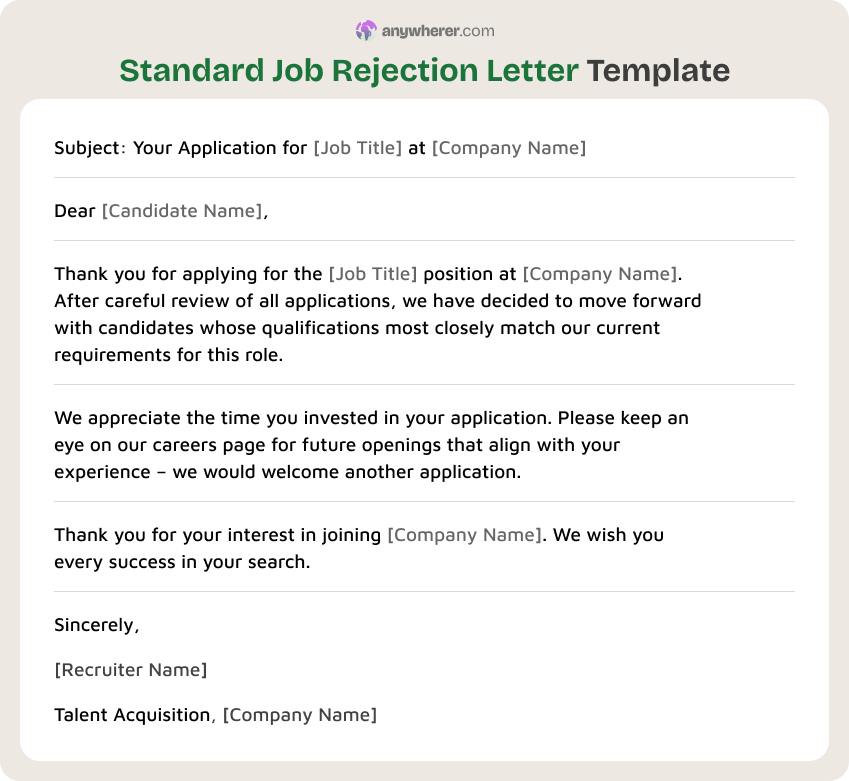
Standard Job Rejection Letter Template
A general-purpose rejection letter template suitable for most roles and most pipeline stages. Use this when a more specific template (interview-stage, internal candidate) does not apply. It works equally well as an email or a formal letter for an employment rejection letter template scenario.
Template sections:
- Salutation with the candidate’s name
- Thank-you opener acknowledging the application
- Clear rejection statement without ambiguity
- Brief acknowledgment of the position and stage
- Encouragement and forward-looking close
- Name and signature of the sender
Template (ready-to-use text):
Subject: Your Application for [Job Title] at [Company Name]
Dear [Candidate Name],
Thank you for taking the time to apply for the [Job Title] position at [Company Name]. We received applications from a large number of qualified candidates and carefully reviewed each submission.
After thorough consideration, we have decided to move forward with other candidates whose qualifications more closely match the requirements for this role at this time.
We appreciate the time and effort you invested in your application. We encourage you to keep an eye on our careers page for future openings that may be a strong match for your background.
Thank you again for your interest in [Company Name]. We wish you every success in your job search.
Sincerely,
[Recruiter Name]
[Title]
[Company Name]
Best for: Any rejection at the application-review or early-stage phone screen level where a specific template does not apply.
Candidate Rejection Email Template After Application Review
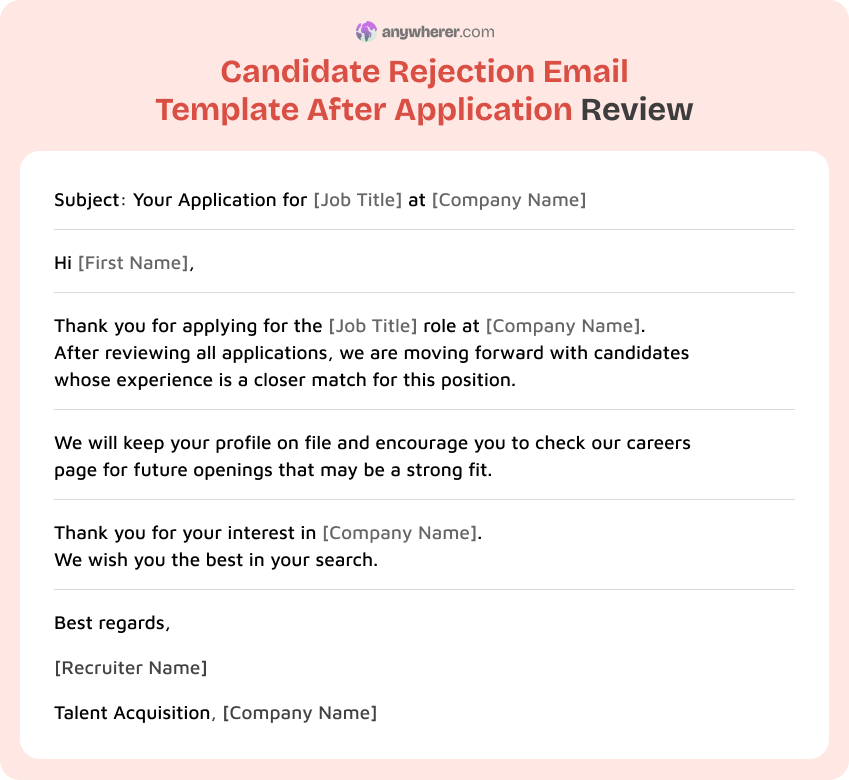
This candidate rejection email template is built for volume. It is short, professional, and designed to be sent at scale, either manually or through an applicant tracking system (ATS), within a few days of the application deadline. An applicant rejection letter template at this stage should never include specific feedback; the recruiter has not had enough interaction with the candidate to provide it honestly.
Template sections:
- Email subject line that names the role
- First-name salutation
- Thank-you for applying
- Clear no-progress statement
- Brief positive close
- Sender name (or team name for high volume)
Template (ready-to-use text):
Subject: Your Application for [Job Title] at [Company Name]
Hi [First Name],
Thank you for applying for the [Job Title] role at [Company Name]. We have completed our initial review and are moving forward with candidates whose experience is a closer match for the requirements at this stage.
We will keep your profile on file for [90 days / 12 months] and encourage you to visit our careers page at [URL] for future openings.
Thank you for your interest in [Company Name]. We wish you well in your search.
Best,
[Recruiter Name]
[Company Name]
Best for: High-volume application-stage rejections sent within 1 week of the application deadline. Suitable for ATS automation.
Rejection Letter After Phone Screen Template
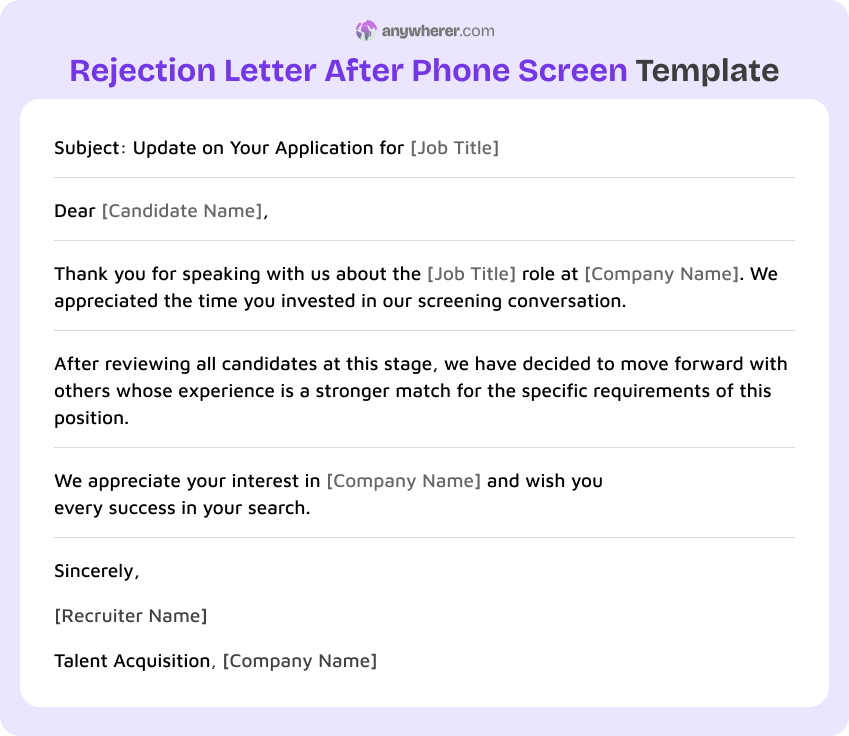
After a 15-to-30-minute screening call, the candidate has invested real time and likely has some expectation of moving forward. This template acknowledges the conversation, delivers the rejection clearly, and closes professionally. It should be sent within 48 to 72 hours of the call, not weeks later.
Template sections:
- Subject line referencing the phone interview
- Thank-you for the conversation (reference the call specifically)
- Clear rejection statement
- General reason (no further detail at this stage)
- Acknowledgment of their time
- Professional close
Template (ready-to-use text):
Subject: Follow-up on Your Phone Interview for [Job Title]
Dear [Candidate Name],
Thank you for speaking with [Interviewer Name] about the [Job Title] position at [Company Name]. We appreciated the time you invested and the insight you shared about your background.
After reviewing all phone screen conversations from this round, we have decided not to move your application forward. We are focusing on candidates whose experience in [general area, e.g., enterprise SaaS sales / back-end engineering] is a closer match for the direction we are taking this hire.
We appreciate the time you set aside for the call and wish you every success. We encourage you to keep an eye on our openings at [careers page URL].
Sincerely,
[Recruiter Name]
[Title]
[Company Name]
Best for: Post-phone screen rejections for any role type, sent within 48-72 hours of the screening call.
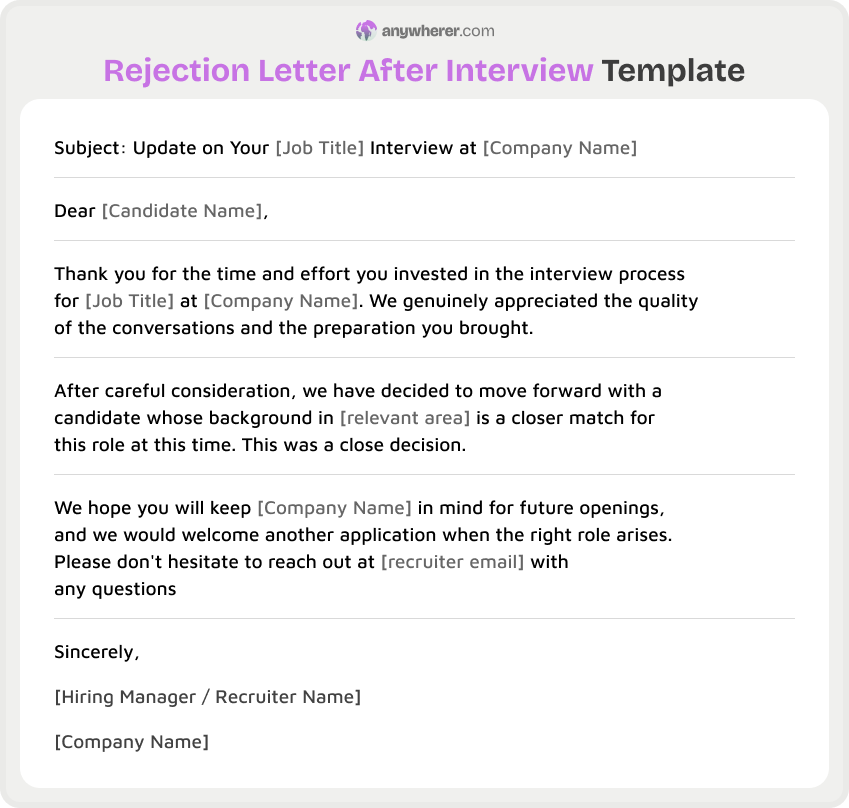
Rejection Letter After Interview Template
A rejection letter template after interview requires more care than earlier-stage templates. The candidate spent several hours preparing, traveled to or sat through a video panel, and was evaluated in detail. An interview rejection letter template should be warmer and more specific than any earlier-stage version. The feedback language to include, if any, should trace back to the objective criteria documented in the interview scorecard template the hiring team completed after the session. Aim to send this template for rejection letter after interview, within 5 business days of the final interviewer completing their assessment.
Template sections:
- Subject line naming the interview round
- Specific thank-you for their time in the interview
- Clear rejection statement
- Acknowledgment of their preparation and performance
- Optional: brief general reason (avoid anything that sounds personal)
- Encouragement and future-possibility line if genuine
- Sender name and direct contact for questions
Template (ready-to-use text):
Subject: Update on Your Interview for [Job Title] at [Company Name]
Dear [Candidate Name],
Thank you for meeting with [Interviewer Name(s)] to discuss the [Job Title] role at [Company Name]. We appreciated the time, preparation, and engagement you brought to the conversation.
After careful deliberation, we have decided to move forward with a candidate whose experience in [specific area, e.g., managing enterprise accounts / leading distributed engineering teams] aligns more closely with the priority criteria for this hire.
This was a genuinely competitive process. Your preparation was evident, and we hope you will consider [Company Name] for future openings that align with your background. Please don’t hesitate to reach out to [Recruiter Name] at [recruiter email] with any questions.
Sincerely,
[Hiring Manager / Recruiter Name]
[Title]
[Company Name]
Best for: First or second-round interview rejections. Adjust the tone toward the warmer end for second-round rejections, especially for senior roles.
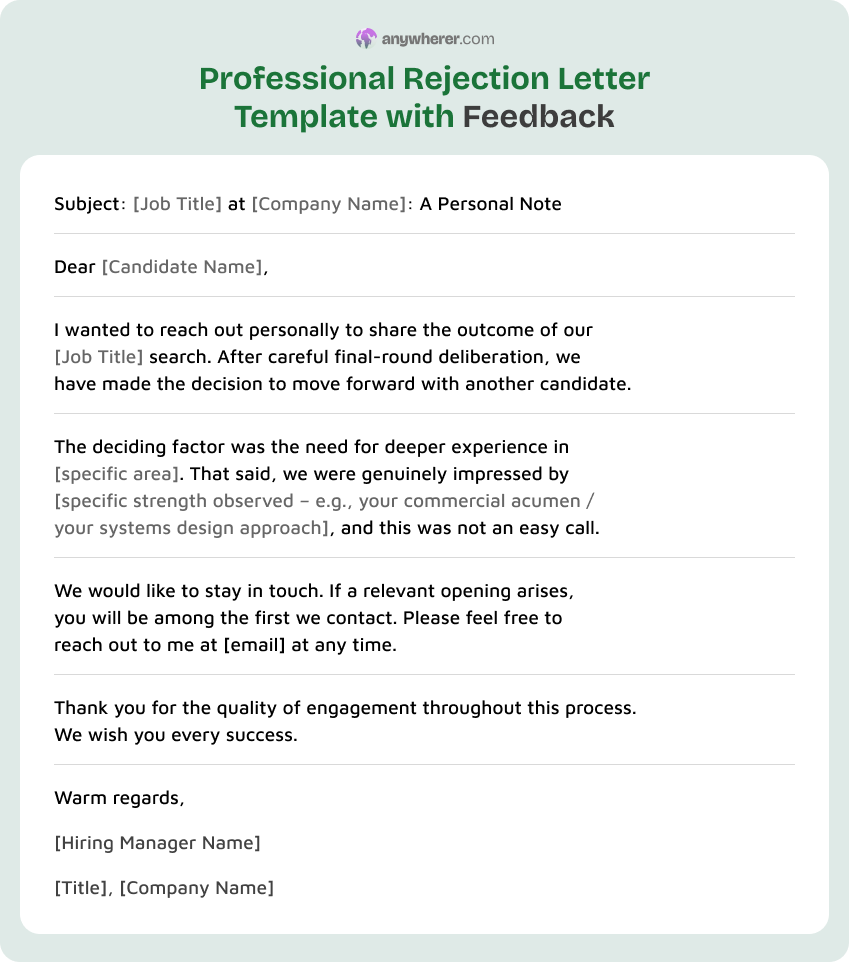
Professional Rejection Letter Template with Feedback
A professional job rejection letter template with feedback is appropriate for final-round candidates, senior roles, and any situation where the hiring team made a genuine commitment of time and where the candidate would benefit from knowing why. This is a professional business rejection letter template that doubles as a relationship-preservation tool. Keep feedback role-relevant and objective; never reference personality or cultural fit without a specific behavioral example.
Template sections:
- Warm but professional subject line
- Personal thank-you referencing the specific role and process
- Clear rejection statement
- One or two specific, objective feedback points tied to role criteria
- Acknowledgment of strengths observed during the process
- Genuine future-possibility line if warranted
- Offer to stay in touch; sender’s direct contact
Template (ready-to-use text):
Subject: [Job Title] at [Company Name]: A Personal Note
Dear [Candidate Name],
I wanted to reach out personally about the outcome of our [Job Title] search at [Company Name]. After completing our final-round interviews, we have made the decision to move forward with another candidate.
The deciding factor was [state the objective hiring criterion, e.g., the need for direct experience running a field sales team of 20 or more / a deeper technical background in distributed systems at scale]. Throughout the process, we were genuinely impressed by [specific strength observed, e.g., the clarity of your commercial strategy presentation / your depth of knowledge in data pipeline architecture].
We would like to stay in touch. If a role that aligns with your background opens up, we will be in contact. In the meantime, please feel free to reach out to me directly at [your direct email].
Thank you for the quality of engagement you brought to this process. We wish you well.
Sincerely,
[Hiring Manager Name]
[Title]
[Company Name]
Best for: Final-round rejections, senior or executive searches, and any role where the hiring team built a genuine rapport with the candidate over multiple rounds.
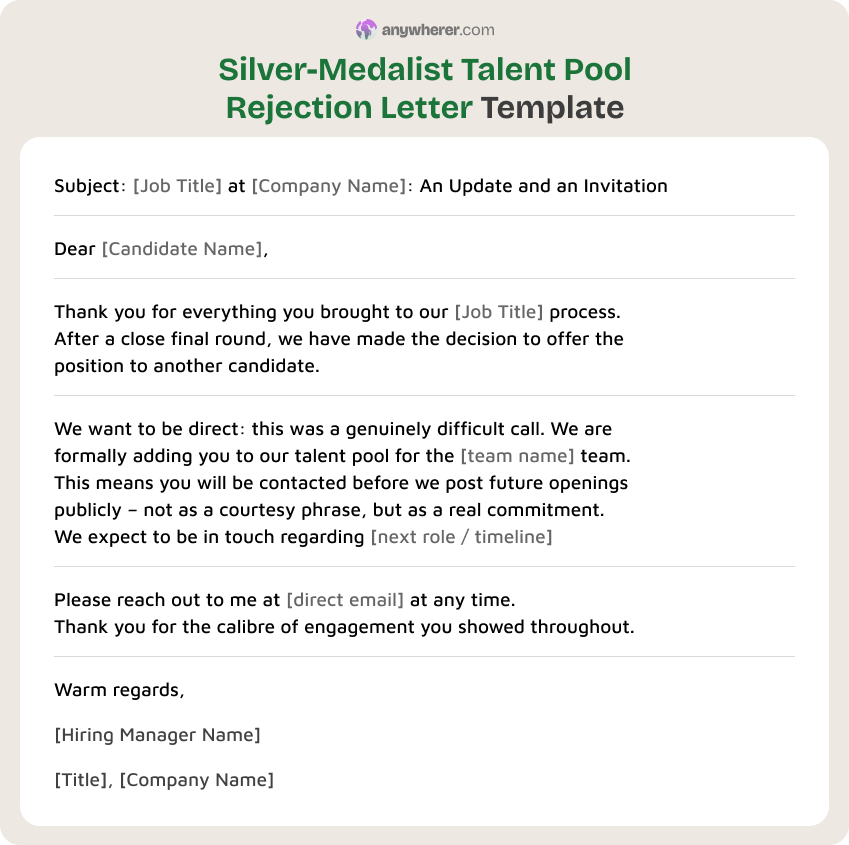
Silver-Medalist Talent Pool Rejection Letter Template
A silver-medalist candidate is someone who made it to the final round but was not selected, and who the hiring team would genuinely consider for a similar opening in the future. This candidate rejection letter template is different from a standard final-round rejection: it explicitly invites the candidate into a talent pool and explains what that means in practical terms. Only use this template when there is a real plan to follow through.
Template sections:
- Personal subject line referencing the role
- Thank-you and acknowledgment of the final-round process
- Clear rejection statement for this specific role
- Explicit talent-pool invitation with a concrete explanation
- What ‘talent pool’ means in practice (not just a phrase)
- Sender’s direct contact for future outreach
Template (ready-to-use text):
Subject: [Job Title] at [Company Name]: An Update and an Invitation
Dear [Candidate Name],
Thank you for the time and effort you invested in our [Job Title] search. After a close final round, we have made the decision to offer the position to another candidate whose experience in [specific area] was a closer match for the direction we are taking this hire.
That said, we want to be direct: this was not an easy decision, and we are genuinely interested in staying connected with you. We are formally adding you to our talent pool for the [team name] team at [Company Name]. This means you will be contacted before we post future openings publicly – not as a courtesy phrase, but as a real commitment. We anticipate [next opening timeline, e.g., Q3 2026 / early next year] and your profile is a strong match.
Please feel free to reach out to me at [direct email] at any time. We look forward to staying in touch.
Sincerely,
[Hiring Manager Name]
[Title]
[Company Name]
Best for: Final-round candidates who are genuinely strong and who the company plans to contact again within 3 to 6 months. Do not use if there is no real follow-through plan.
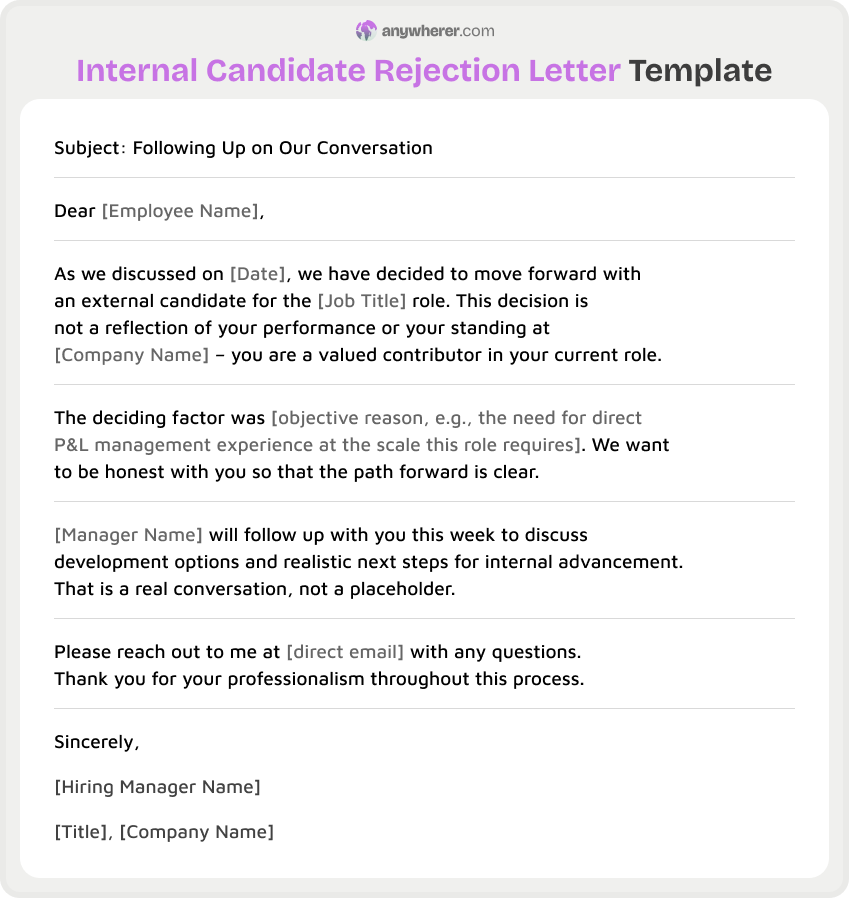
Internal Candidate Rejection Letter Template
Rejecting an internal candidate is the most sensitive scenario in this list. The person will return to their current role, continue reporting to management, and will almost certainly talk to colleagues about the outcome. The rejection should always start with a direct conversation, not an email. This template provides the written follow-up to that conversation, not a replacement for it.
Template sections:
- Informal subject line (avoid clinical subject lines for internal candidates)
- Reference to the in-person or phone conversation just held
- Written confirmation of the rejection decision
- Specific, honest, and constructive feedback tied to the role criteria
- Clear plan for what happens next (development support, timeline for future opportunities)
- Affirmation of the employee’s value in their current role
- Manager’s direct contact for follow-up
Template (ready-to-use text):
Subject: Following Up on Our Conversation
Dear [Employee Name],
Thank you for applying for the [Job Title] position and for the openness you brought to the process. As we discussed on [Date], we have decided to move forward with an external candidate for this role.
This decision is not a reflection of your performance or your value to [Company Name]. The specific factor that led us to another candidate was [state the objective hiring criterion, e.g., direct experience managing a P&L above $5M / a software engineering background, which this role requires from day one].
We want to support your growth in the direction you are aiming. [Manager Name] will set up time with you this week to discuss development steps and a realistic view of future internal opportunities. That is a real commitment, not a formality.
Please reach out to me at [your direct email] if you have questions. Thank you for continuing to bring your best work to your current role.
Sincerely,
[Hiring Manager Name]
[Title]
[Company Name]
Best for: Any internal candidate rejection, regardless of role level. Always deliver the decision verbally first; use this as the written follow-up within 24 hours of that conversation.
How to Send Rejections at Scale
Rejection mechanics depend on the pipeline stage. For application-stage rejections, use your ATS automation: trigger a template email when a candidate is moved to a ‘declined’ status in the system. If the team is still evaluating which platform to use, a comparison of the best applicant tracking systems covers which tools offer built-in rejection automation and candidate communication workflows. Volume at this stage makes manual sending impractical. For phone-screen rejections, automation is still appropriate, but a manual send reviewed by the recruiter is better for higher-priority roles. For interview-stage and above, send manually and personalize at least the opener and the reason. A clearly templated email sent to a final-round candidate feels dismissive and can damage the relationship. A structured rejection process is one part of a broader recruitment process plan template that covers the full hiring lifecycle from job spec to offer.
For finalists and internal candidates, a phone call should come before the written rejection in almost every case. Calling first shows respect, reduces the shock of a written message, and gives the candidate a chance to ask questions in real time. The written rejection follows as a record and a reference point. Sending a rejection email to a finalist or an internal candidate before speaking with them is one of the most cited causes of employer brand damage, a pattern documented across candidate experience research, including the Talent Board CandE benchmarks, which track how rejection handling affects employer net promoter scores.
On timing: aim to reject application-stage candidates within 1 week of closing the review window. Reject phone-screen candidates within 48 to 72 hours of the call. For final-round candidates, send the rejection within 48 hours of the decision. Delayed rejections are almost as harmful as no rejection at all because the candidate is left waiting on a live decision that has already been made.
Key Elements Every Rejection Letter Should Include
Regardless of stage, every rejection letter should cover the following:
- A clear, unambiguous ‘no’: no false hope, no ‘we’re still reviewing,’ no non-committal language.
- Acknowledgment of the stage and effort: reference the specific process the candidate went through, not just the role title.
- Respectful, role-relevant language: avoid boilerplate phrasing that reads as copy-paste with a name swap.
- A future-possibility line only when genuine: if the company does not have a functioning talent-pool process, leave this out.
- Stage-appropriate length: short for application-stage, more detailed for interview and final-round rejections.
- A response window where relevant: final-round and internal candidate rejections should include an offer to discuss further, with a named contact and direct email.
- Recruiter or hiring manager name and signature: anonymous team-name sign-offs are appropriate only for high-volume application-stage emails.
Common Mistakes in Rejection Letters
Even a short rejection email can damage the candidate experience if it feels careless, generic, or misleading. The goal is not to over-explain the decision, but to communicate it clearly, respectfully, and consistently. These are the mistakes employers should avoid when writing rejection letters.
- Ghosting: No response is the most common and most damaging rejection of all. It sends a clear signal about how the company treats people.
- One-size-fits-all templates: Sending the same email to a rejected applicant and a rejected finalist signals that the company did not register the difference in effort.
- Vague reasons with legal exposure: Phrases like ‘not a good fit’ or ‘we found a better match’ carry no objective meaning and can invite questions about discriminatory intent. Stick to role-relevant, documented criteria.
- False talent-pool promises: ‘We’ll keep your resume on file’ is a trust-destroying phrase when there is no system or plan behind it. Use the silver-medalist template only when the company has a real follow-through process.
- Sending within minutes of an interview: An automated rejection that arrives 20 minutes after a final-round interview ends signals to the candidate that the decision was made before the conversation ended, regardless of whether that is true.
- Rejecting internal candidates via email without a prior conversation: An employee learning of a rejection in their inbox rather than from their manager is a management failure, not just a process gap.
- Tone extremes: Too cold reads as dismissive and generates negative reviews. Too apologetic invites pushback and negotiation over a closed decision.
FAQs on Rejection Letter Templates
How do you write a candidate rejection letter?
Start with the candidate’s name and a thank-you that references the specific role or stage of the process. State the rejection clearly in the first or second paragraph without hedging. Include a brief, objective reason if the candidate has completed more than one interview. Close with a genuine forward-looking sentence and the sender’s name. Avoid corporate filler (‘at this time,’ ‘we’ll keep you in mind’) unless there is a real plan behind those phrases.
Is it better to reject candidates by email or letter?
Email is the standard for most rejections and is appropriate from the application stage all the way through to post-interview. A formal letter is rarely used in modern recruiting unless company policy or the role’s seniority demands it. For finalists and internal candidates, a phone call should precede the written rejection in either format. The medium matters less than the timing and the quality of the message.
Should you give feedback in a rejection letter?
Feedback is appropriate at the interview stage and above, and it should be role-relevant and objective. Application-stage rejections should not include feedback: the recruiter has not had enough interaction to provide it honestly. At the final-round stage, specific feedback tied to the hiring criteria is a professional courtesy that most candidates appreciate, and it reduces the risk of a vague rejection being misread as discriminatory. Keep the feedback to one or two criteria and avoid personality observations.
How long should you wait to send a rejection letter?
Application-stage rejections should go out within 1 week of the review window closing or immediately upon screening a candidate out. Phone-screen rejections should be sent within 48 to 72 hours of the call. Interview-stage rejections should be sent within 5 business days of the final interviewer’s assessment being completed. Final-round rejections should go out within 48 hours of the hiring manager’s decision. Delays beyond these windows do not protect the company; they just make the candidate wait on a decision that has already been made.
How do you reject an internal candidate?
Always deliver the news in a direct conversation before sending any written communication. The conversation should occur with the hiring manager, HR, or both, and should cover the objective reason for the decision and the plan to support the employee’s development going forward. The written rejection follows within 24 hours as a record and a reference point. Language should affirm the employee’s value in their current role without hedging on the rejection itself.
Is a rejection letter legally required?
In most jurisdictions, employers are not legally required to send a rejection letter to every applicant. However, maintaining a consistent written record of rejection decisions and the criteria used to make them is a standard risk-management practice. Inconsistent or undocumented rejection processes can expose an organization to discrimination claims if a candidate challenges the outcome. A documented template that uses role-relevant, objective language protects the company and creates a defensible paper trail. Check with local employment counsel for jurisdiction-specific requirements, particularly for government-sector or regulated-industry hiring.

Yaryna is our lead writer with over 8 years of experience in crafting clear, compelling, and insightful content. Specializing in global employment and EOR solutions, she simplifies complex concepts to help businesses expand their remote teams with confidence. With a strong background working alongside diverse product and software teams, Yaryna brings a tech-savvy perspective to her writing, delivering both in-depth analysis and valuable insights.