How someone’s first weeks go at a new company has a direct effect on whether they stay. Gallup found that just 12% of employees strongly agree their company does onboarding well. That number alone should concern any HR leader. And yet, most organizations still rely on gut feeling rather than actual data when judging how their onboarding is going. New hire onboarding survey questions change that: they give your team specific, measurable input you can actually work with.
A manager asking “how’s it going?” over coffee is fine, but it won’t tell you much that’s comparable month to month. Onboarding survey questions for new hires bring structure to this. Everyone answers the same questions, you can track scores across teams and cohorts, and patterns that would otherwise stay hidden become obvious. This guide covers what to ask at each stage, which rating scales work best, how to interpret what you hear, and the mistakes that trip up most programs.
Why Onboarding Surveys Matter
Brandon Hall Group puts some hard numbers behind this: companies with solid onboarding see 82% better retention and over 70% higher productivity among new hires. Big claims, but how do you know if your own process delivers anything close? That’s exactly what onboarding process survey questions are for.
- Early attrition prevention. If someone is frustrated at day 30 or 60, their manager still has time to course-correct. Without a survey, that frustration stays invisible until the resignation letter.
- Process optimization. When the same issues keep appearing across different hires, you’re looking at a process problem, not a people problem. Fix the process.
- Manager accountability. Sharing employee onboarding survey questions results with team leads puts a spotlight on who is investing in their new hires and who isn’t.
- Cultural alignment. Did the interview paint an accurate picture of the day-to-day? Survey responses answer that question directly.
BambooHR reports that about one in three new hires leave within six months. Think about the cost of that: recruiting, training, lost productivity. Onboarding survey questions for managers and HR leaders are your early-warning system. Pair them with a solid new hire onboarding checklist and you have a way to both detect problems and act on them fast.
Onboarding Survey Questions by Stage
When you ask matters almost as much as what you ask. A survey sent once at the 90-day mark will miss everything that went wrong on day two. The sample onboarding survey questions below are split into five stages, each targeting the decisions and experiences that are most relevant at that point.
Preboarding Survey Questions
Preboarding is the window between a signed offer and day one. A lot can go wrong here: laptops that aren’t shipped, login credentials that don’t work, or no one telling the new hire where to show up. New employee onboarding survey questions at this stage are about catching those logistical gaps before they turn into a bad first impression.
Questions:
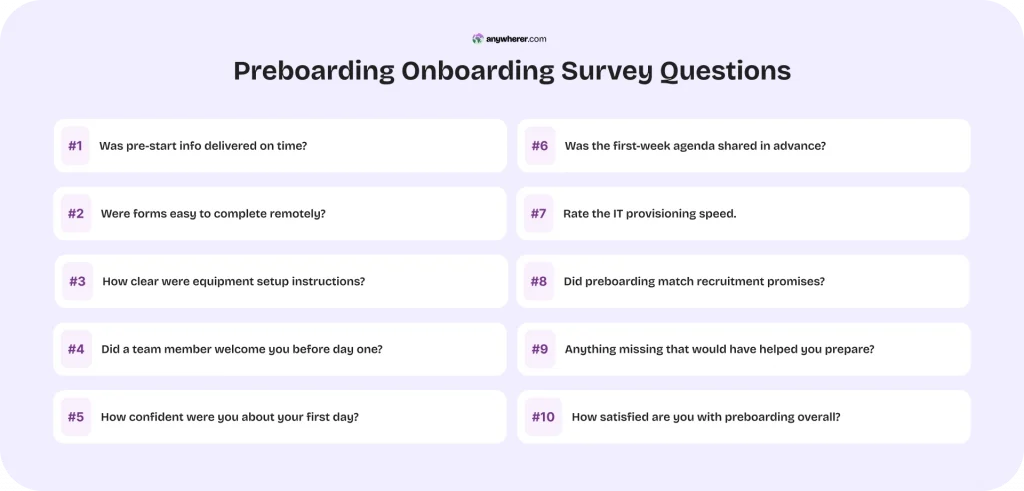
- Did you receive all pre-start information (start date, location, dress code) on time?
- Were the required documents and forms easy to complete before your first day?
- How clear were the instructions for setting up your equipment and accounts?
- Did anyone from your team reach out to welcome you before day one?
- How confident did you feel about what to expect on your first day?
- Were you given a clear agenda or schedule for your first week?
- How would you rate the speed of the IT setup process?
- Did the information provided match what was discussed during recruitment?
- Was there anything missing from your preboarding that would have helped you feel more prepared?
- Overall, how satisfied are you with your preboarding experience?
Suggested rating scale:
- 1-5 Likert (Strongly Disagree to Strongly Agree) works for questions 1-8 and 10.
- Question 9 is better as an open-ended prompt since you want specifics, not a number.
- The Likert scores give you a quick baseline. The open-ended answer tells you what actually went wrong.
Interpretation guidance:
- Questions 1-3 scoring low? That’s usually an HR or IT coordination issue, not a manager problem.
- If answers vary a lot between respondents, your departments may be running different preboarding processes.
- When more than 20% of scores land below 3, bring the operations team in for a preboarding workflow review.
First Week Onboarding Survey Questions
People form opinions fast. By the end of week one, a new hire already has a read on the culture, their manager, and the team. Onboarding experience survey questions sent right now capture those first impressions before they fade or get rationalized away. What to watch for: unclear roles, nobody to eat lunch with, and too many things thrown at someone all at once.
Questions:
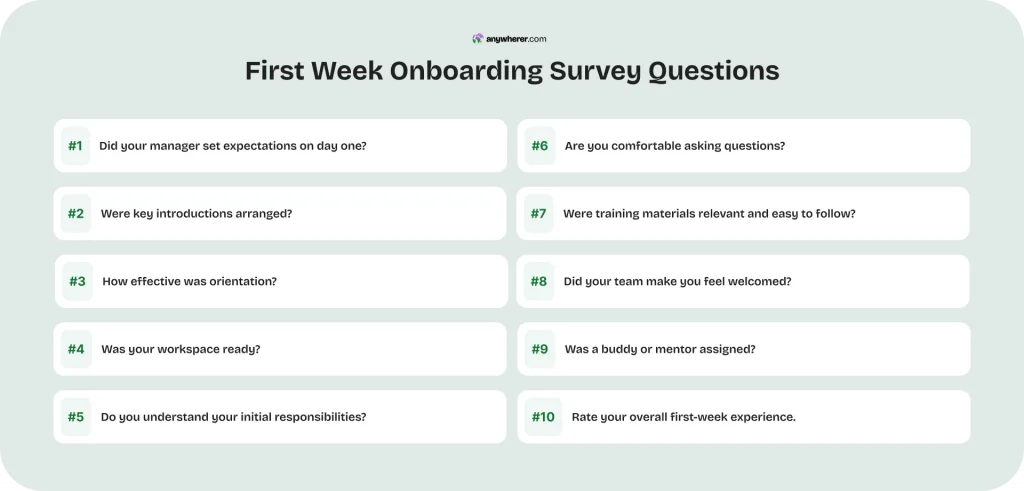
- Did your manager meet with you on your first day to discuss expectations?
- Were you introduced to all key team members and stakeholders?
- How effective was your orientation session in explaining company values and policies?
- Was your workspace (physical or virtual) ready when you arrived?
- Did you receive a clear outline of your role and initial responsibilities?
- How comfortable do you feel asking questions of your manager or teammates?
- Were the training materials relevant and easy to follow?
- Did you feel welcomed by your team during your first week?
- Was there a buddy or mentor assigned to help you navigate your first days?
- How would you rate your overall first-week experience?
Suggested rating scale:
- 1-5 Likert works for most of these.
- Question 6 is worth a 1-10 scale, though. Psychological safety is hard to capture in five points.
- Open-ended follow-ups work well alongside questions 7 and 9 to gather specific improvement ideas.
Interpretation guidance:
- Manager-related items (1, 5, 6) scoring below 3 is a sign that onboarding ownership at the team level is weak.
- When some teams score high and others score low, the experience depends on the manager, not the company process. That’s a problem.
- Departments with consistently low numbers should be flagged for onboarding survey questions for hiring managers review sessions.
30-Day Onboarding Survey Questions
At this point, orientation is over and the new hire is doing actual work. 30 day onboarding survey questions tell you whether the training and support from weeks one through four actually translated into productivity. If someone still doesn’t understand their role or can’t access critical tools by now, that’s a red flag. Use a set of 30 day onboarding survey questions and answers benchmarks to compare results across hiring groups and improve your new employee onboarding plan.
Questions:
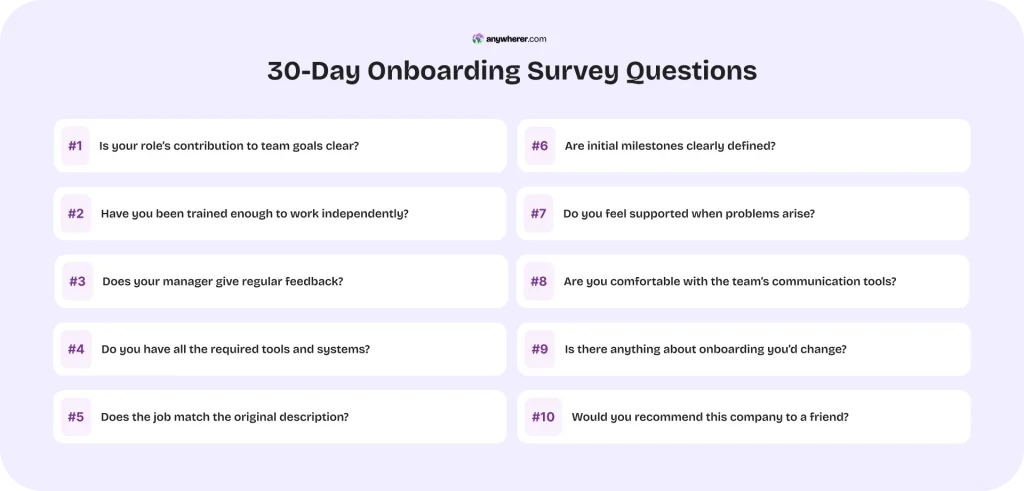
- Do you have a clear understanding of how your role contributes to team and company goals?
- Have you received enough training to perform your core tasks independently?
- How often does your manager provide constructive feedback?
- Do you have access to all the tools and systems you need?
- How well does the job match the description you received during hiring?
- Have your initial goals or milestones been clearly defined?
- Do you feel supported when you encounter problems or blockers?
- How comfortable are you with the team’s communication style and tools?
- Is there anything about your onboarding that you would change so far?
- On a scale of 1-10, how likely are you to recommend this company as a great place to start?
Suggested rating scale:
- 1-5 Likert for questions 1-8.
- Leave question 9 open-ended.
- Question 10 is a 1-10 NPS-style prompt. It gives you a number you can compare against the 60- and 90-day results later.
Interpretation guidance:
- Questions 2 and 4 scoring low? Training or tool provisioning needs fixing.
- If question 5 (job match) drops while others stay fine, the issue is in how the role was described during hiring, not in the onboarding itself.
- According to SHRM, only 29% of new hires feel fully prepared and supported in their role. If you see similar numbers in your data, escalate before the 60-day survey.
60-Day Onboarding Survey Questions
Two months in, a new hire should be contributing regularly and have relationships outside their immediate team. Onboarding survey questions for employees at this stage are about one thing: is the support keeping up with the growing expectations? This is when some people hit a wall. The excitement of being new fades, career direction feels unclear, and motivation can drop. Catch it here.
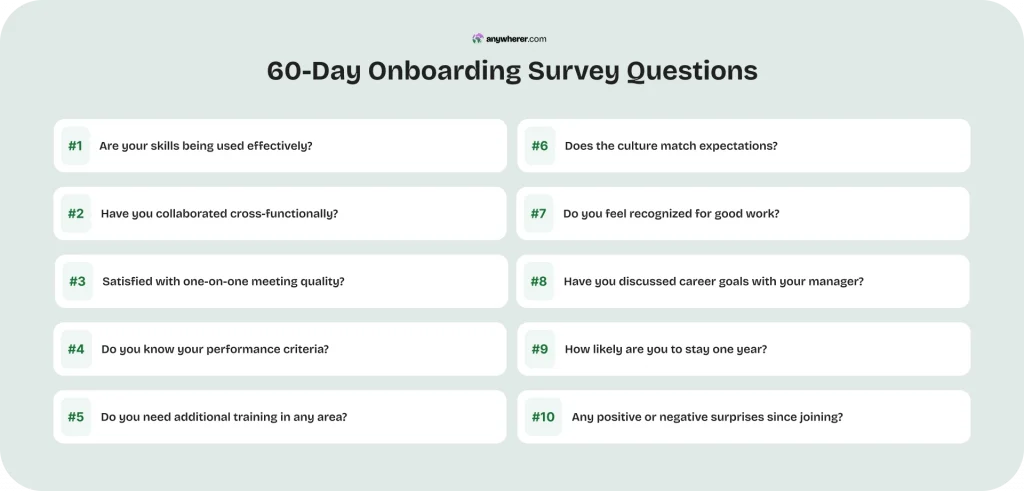
Questions:
- Do you feel your skills are being used effectively in your current role?
- Have you had opportunities to collaborate with people outside your immediate team?
- How satisfied are you with the frequency and quality of one-on-one meetings with your manager?
- Do you understand the performance criteria by which you will be evaluated?
- Are there any skills or knowledge areas where you feel you need additional training?
- How well does the company culture match your expectations?
- Do you feel recognized when you do good work?
- Have you had a chance to discuss your career development goals with your manager?
- Is there anything that has surprised you (positively or negatively) since you joined?
- How likely are you to still be working here in one year?
Suggested rating scale:
- 1-5 Likert for questions 1-8.
- Question 9: open-ended.
- Question 10: 1-10 likelihood.
- At this stage, have both types. Numbers show you the trend, open-ended answers show you the reason.
Interpretation guidance:
- Questions 4 and 8 scoring low means the hand-off from onboarding to ongoing development isn’t working. Someone should own that transition.
- Question 10 averaging below 6? That’s serious. You’re looking at near-term attrition risk.
- Package these as onboarding satisfaction survey questions data and present it to leadership. Show them exactly where the experience breaks down after the first month.
90-Day Onboarding Survey Questions
In many companies, 90 days marks the end of the probation period. So this is the big one. 90 day onboarding survey questions look at the entire arc: did we set this person up to succeed? Did the support hold up over three months? Does the employee actually feel like they belong? Low scores at this point carry the highest risk because the new hire has had plenty of time to decide how they feel about staying.
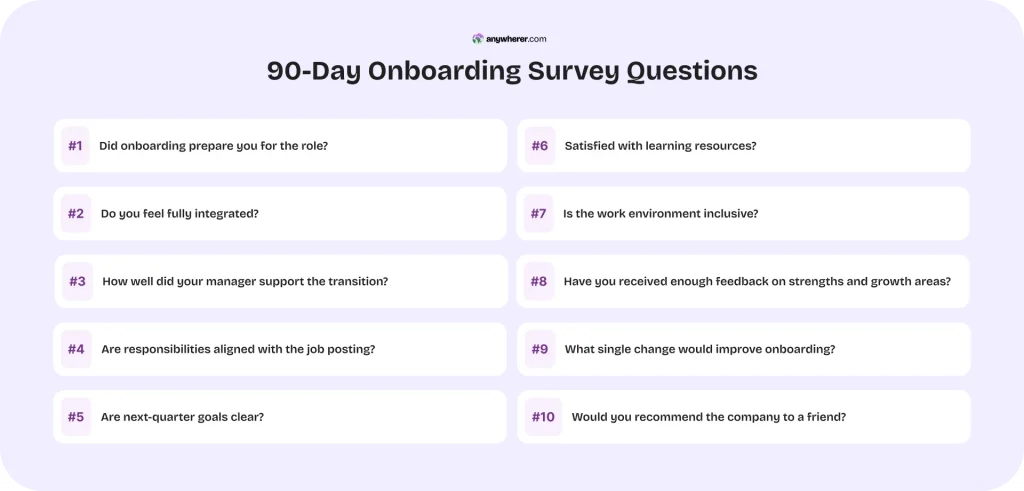
Questions:
- Looking back, did the onboarding program prepare you well for your role?
- Do you feel fully integrated into your team?
- How effectively has your manager supported your transition?
- Are your day-to-day responsibilities aligned with the role as it was described?
- Do you have a clear understanding of your performance goals for the next quarter?
- How satisfied are you with the learning and development resources available?
- Would you describe the work environment as inclusive and supportive?
- Have you received enough feedback to understand your strengths and areas for growth?
- What single change would have made your onboarding experience better?
- On a scale of 1-10, how likely are you to recommend this company to a friend as a place to work?
Suggested rating scale:
- A 1-5 Likert scale covers questions 1-8.
- Question 9 is open-ended.
- Question 10 uses the 1-10 eNPS-style scale.
- Compare this score to the 30-day answer. Going up? Good, the program works. Going down? That needs immediate attention.
Interpretation guidance:
- Question 1 averaging below 3.5 at day 90? The entire program needs restructuring. Small fixes won’t be enough.
- Wide spread on question 3 usually means some managers are great at onboarding and others are not. Address it manager by manager.
- Put the 30-, 60-, and 90-day trends side by side when presenting to leadership. It’s the clearest way to justify the budget for onboarding improvements.
Open-Ended Onboarding Survey Questions
Numbers from a Likert scale tell you where the problem is. They don’t explain why it exists. That’s the job of open-ended onboarding feedback survey questions. Add one or two to every survey, and consider running a dedicated qualitative round at 60 or 90 days to get more depth.
- What was the most helpful part of your onboarding experience?
- What was the most confusing or frustrating part?
- If you could add one resource or session to the onboarding program, what would it be?
- How would you describe the company culture to a friend in three words?
- What information did you have to search for on your own that should have been provided?
- Is there anything your manager could do differently to support your growth?
- What would make you feel more connected to the broader organization?
When to use open-ended questions:
Best used when your numbers flag a problem but don’t explain it. Also helpful right after a major change to the onboarding process, when you want raw, unfiltered reactions before tweaking the scaled questions.
Analyzing qualitative feedback:
Sort answers into buckets: logistics, training, culture, management. Tag whether the tone is positive, negative, or neutral. Then count how often each bucket appears. The one that shows up most is your priority. When you layer this on top of the scaled scores, you get a much clearer picture of what’s actually happening.
Common Onboarding Survey Mistakes
Survey programs trip up in predictable ways. Knowing these upfront saves you from learning the hard way.
- Surveying too early. If the employee hasn’t had enough experience to form a real opinion, your data is useless. Wait until each stage actually ends.
- No action after feedback. People stop filling out surveys once they realize nothing changes. Close the loop. Tell them what you fixed based on their feedback.
- Too many questions. Completion rates tank when surveys are too long. Cap it at 10-12 items per round. Five minutes, tops.
- No anonymity clarity. If people aren’t sure who can see their answers, they hold back. State the anonymity policy at the top of every survey. No exceptions.
FAQs on New Hire Onboarding Survey
When should onboarding surveys be sent?
At five milestones: preboarding, end of week one, day 30, day 60, and day 90. Each one targets a different part of the employee’s adjustment.
How often should new hires receive onboarding surveys?
Five times across 90 days works well. Enough to catch issues at each stage, not so much that people get tired of filling them out.
What should an onboarding survey include?
Scaled questions for benchmarking and one or two open-ended questions for context. Make sure you cover role clarity, manager support, tooling, culture, and overall satisfaction.
How many questions should an onboarding survey have?
Between 8 and 12. Fewer questions risk missing important areas; more questions lower completion rates.
What rating scale should be used for onboarding surveys?
1-5 Likert for most questions. 1-10 for the recommendation/NPS-style question. And always leave room for at least one open-text field.
Should onboarding surveys be anonymous?
In most cases, yes. People are more honest when they know their name isn’t attached, especially on questions about their manager. If you need attributed answers for a specific follow-up, say so upfront.
What is the best format for onboarding feedback surveys?
Digital forms (Google Forms, Typeform, or your HRIS survey module) allow easy distribution, automatic reminders, and centralized reporting. Keep the design mobile-friendly for remote and hybrid workers.

Yaryna is our lead writer with over 8 years of experience in crafting clear, compelling, and insightful content. Specializing in global employment and EOR solutions, she simplifies complex concepts to help businesses expand their remote teams with confidence. With a strong background working alongside diverse product and software teams, Yaryna brings a tech-savvy perspective to her writing, delivering both in-depth analysis and valuable insights.