
Contract talent now makes up a growing share of international teams, and every new freelancer abroad adds a contract, a tax form, and a classification question. Getting that last part wrong can turn a flexible engagement into an employment claim.
So, what is COR? It stands for Contractor of Record, a third party that contracts, classifies, and pays independent Contractors for your company without becoming their employer.
The acronym has several other meanings, which I list near the end. This guide focuses on the Contractor of Record (COR) as a hiring model. I cover what the provider does, how it compares with an Employer of Record, and what the service costs at 3 well-known providers.
What Is COR? Contractor of Record Meaning
In plain terms, a COR takes over the Contractor side of hiring for a client company. It checks whether each worker qualifies as independent, signs the contract, and pays their invoices. It never employs them, and the client still decides what the work is and when it is due.
The setup has 3 parties. Your company signs a service agreement with the provider. The provider signs the Contractor agreement with the freelancer, receives their invoices, and pays them. You approve the work, and the provider handles the paperwork.
If you want to know what is a Contractor of Record in practice, Remote’s own description is a useful example. Remote says its service directly engages and pays Contractors, which means the freelancer’s agreement is held by Remote rather than by the client.
People also ask what Contractor of Record means exactly for the worker. Very little changes on their side: they still invoice, set their own hours within the project scope, and pay their own taxes. What changes is who holds the contract and who checks that the arrangement stays a genuine Contractor relationship.
If you only need the short answer to what is the definition of COR, here it is.

COR, defined
A COR (Contractor of Record) is an outside provider that classifies, contracts, and pays independent Contractors for a company while never becoming their legal employer. The worker keeps self-employed status, and the company keeps control of the work itself. Some providers call the same service an Agent of Record (AOR).
That short Contractor of Record definition is the version I would hand to a finance lead who has 30 seconds to decide whether the model applies.
What Does COR Stand For?
In HR and global hiring, the answer to what does COR stand for is Contractor of Record. It names the party whose name appears on the Contractor paperwork in place of your company’s, much like an employer of Record appears on employment paperwork.
In practice, what COR stands for is a transfer of Contractor admin. The provider reviews classification, issues compliant agreements, collects tax forms, and runs payments, so your team stops maintaining a separate process for every country.
Many providers sell the same service under the name Agent of Record. I explain the meaning of AOR in a separate guide, so here I stick with COR terminology.
What Does a Contractor of Record Do? (COR Services)
Most Contractor of Record services follow the Contractor from the first classification check to the final invoice. The typical scope looks like this:
- Classification review. Before onboarding, the provider checks whether the role can legally run as an independent Contractor engagement in that country.
- Contractor agreement. It drafts a locally compliant agreement, sends it for signature, and holds it as the contracting party.
- Onboarding and documents. It collects IDs, bank details, and tax forms, such as a W-9 for US persons or a W-8BEN for foreign Contractors of US companies.
- Invoicing and payments. It processes invoices and pays Contractors on schedule, usually in the Contractor’s own currency.
- Compliance monitoring. It tracks rule changes that affect active engagements and flags roles that start to look like employment.
- Offboarding. It closes the agreement, settles final invoices, and keeps the Records you may need later.
Processes differ by provider. Multiplier, for example, says its in-house legal team reviews each Contractor’s employment status during onboarding.
Some providers also sell a cheaper Contractor management plan. In that case, the platform handles contracts and payments, but your company remains the contracting party and owns the classification decision. The cost section below shows how wide that price gap can be.
No provider changes the facts of the relationship, though. Whatever the contract says, classification rests on day-to-day reality. The IRS asks who controls how the work is done, who controls the business side of the job, and what kind of relationship the 2 parties actually have.
What a Contractor of Record Handles

Classification review before onboarding

Contractor agreements held by the provider

Tax forms and onboarding documents

Invoices and payments in local currency

Ongoing compliance checks and offboarding

INSIGHT: Why does Contractor classification draw so much attention?
Regulators test the real working relationship, not the job title on the contract, and the EU has written that principle into law for platform work.
- IRS guidance frames the test around control: who directs the work, who holds the money side of the job, and how the 2 parties set up and run the relationship.
- The European Commission estimated that around 28 million people worked through digital labor platforms in the EU, and that 5.5 million of them may be at risk of misclassification (impact assessment SWD(2021) 397).
- Directive (EU) 2024/2831 introduces a rebuttable legal presumption of employment for platform work, and Member States must bring it into force by December 2, 2026. It covers work organized through digital labor platforms, not every Contractor engagement.
Sources:
all read in September 2026
Benefits of Using a Contractor of Record
The value shows up in fewer internal tasks and a clearer Contractor setup. These are the benefits I hear about most from teams that switched:
- Lower misclassification exposure. A classification review happens before anyone starts work, not after a dispute.
- Compliant contracts across jurisdictions. Agreements reflect local rules instead of one template stretched over every country.
- Faster Contractor onboarding. Standard documents and an existing process shorten the gap between offer and first task.
- One invoice and consolidated payments. Finance pays 1 provider rather than dozens of individual freelancers in different currencies.
- Flexibility for project work. You can add or release specialists as projects start and finish.
- Less internal admin. HR, finance, and legal spend less time on tax forms, invoice checks, and contract updates.
- Independent status for Contractors. Freelancers keep running their own business instead of being folded into payroll.
Those gains hold only while the engagement still fits the Contractor model, which is where the comparison with an EOR comes in.
Contractor of Record vs Employer of Record (COR vs EOR)
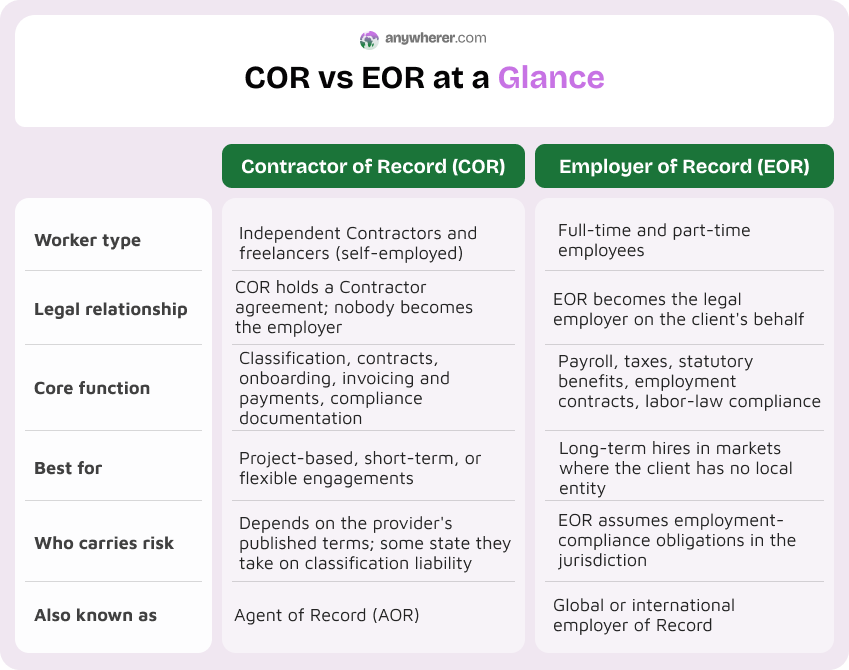
The EOR vs Contractor of Record (COR) question comes down to 1 fact: is the person an independent Contractor or an employee?
A COR works only with Contractors. It handles classification, contracts, payments, and compliance documents, and no employment relationship exists at any point. The freelancer invoices, and the provider pays.
An employer of Record (EOR) takes the employer’s legal seat for full-time or part-time staff where your company has no entity of its own. It runs payroll, withholds taxes, provides statutory benefits, and follows local labor law.
When I weigh employer of Record vs. contractor setups for a client, I start with how the role will run. A defined project, a specialist skill, or a short engagement usually fits a COR. A long-term role with fixed hours, company equipment, and day-to-day supervision usually belongs with an EOR.
Many international companies run both models side by side. Designers or engineers on defined projects stay Contractors, while sales or support staff who work set hours join through an EOR.
In any Contractor of Record vs. Employer of Record decision, watch for roles that drift. When a Contractor starts working like an employee, moving them to an EOR is the usual fix. Multiplier, for instance, says Contractors can be transitioned to full-time employment through its EOR service.
Contractor of Record vs Umbrella Company
An umbrella company solves a different problem. It becomes the Contractor’s employer, invoices the client, and pays the worker through payroll with tax and social contributions deducted. The model is most common in the UK.
A COR does the opposite. The Contractor stays self-employed, invoices as a business, and handles their own taxes, while the provider holds the contract and the compliance file.
In short, an umbrella company suits Contractors who want employee-style payroll and benefits without a permanent job. A COR suits companies that want to keep freelancers genuinely independent across several countries.
I cover the basics of what is Umbrella company employment in a separate guide, including when agencies require it.
How Much Does a Contractor of Record Service Cost?
The cost of Contractor of Record service usually comes as a flat monthly fee per Contractor, charged on top of what you pay the Contractor for their work.
Providers tend to sell 2 tiers. A basic Contractor management plan gives you contracts and payments while you keep the classification decision. The COR tier costs more because, by the providers’ own descriptions, it moves classification liability away from the client.
I checked the list prices on each provider’s own pricing page:
| Provider | Contractor management plan | Contractor of Record plan | What the provider says COR adds |
|---|---|---|---|
| Remote¹ | $29 per Contractor per month (Contractor Management); $99 per Contractor per month (Contractor Management Plus) | From $325 per Contractor per month | Remote directly engages and pays the Contractor; Remote describes uncapped indemnity |
| Deel² | $49 per Contractor per month | $325 per Contractor per month | Shifts classification liability to Deel instead of the client classifying |
| Multiplier³ | $40 per Contractor per month, billed annually (Contractor’s plan) | $400 per Contractor per month, billed annually, plus add-ons and implementation fee as applicable | Indemnity against misclassification risk, no cap published |
¹ Remote prices as listed on remote.com/pricing and remote.com/global-hr/Contractor-of-Record, as of September 25, 2026. Contractor Management Plus includes indemnity coverage of up to $100,000 per Contractor for penalties, per Remote.
² Deel prices as listed on deel.com/pricing, as of September 25, 2026. Deel states its pricing is month-to-month with no long-term contract required.
³ Multiplier prices as listed on usemultiplier.com/pricing, as of September 25, 2026. The Contractor of Record plan card shows $400 per Contractor per month, billed annually, plus compliance-mandated add-ons and an implementation fee as applicable; the FAQ on the same page states pricing starts at $399 per Contractor per month.
All figures are provider list prices and exclude the Contractor’s own fees. Providers may quote differently by country, volume, or contract term.
At these 3 providers, the COR tier costs roughly 6.6 to 11.2 times the basic Contractor plan. Deel charges $325 vs. $49, Remote $325 vs. $29, and Multiplier $400 vs. $40.
The list price is only the starting point of any Contractor of Record service cost. I would also ask about billing terms, add-ons and implementation fees, any deposit requirements, and currency conversion. None of the 3 publish those details in full on their pricing pages.
INSIGHT: Why does the COR tier cost so much more than basic Contractor management?
The gap pays for who holds the Contractor agreement and who carries the classification risk, according to the providers’ own plan descriptions.
- Remote lists Contractor Management at $29 and Contractor Management Plus at $99 per Contractor per month, with Plus covering up to $100,000 per Contractor for penalties; its COR tier starts at $325 and describes uncapped indemnity.
- Deel charges $49 per Contractor per month, or $325 for Contractor of Record, which Deel says shifts liability to Deel.
- Multiplier lists $40 for its Contractors plan and $400 for its COR plan, both per Contractor per month and billed annually, with add-ons and an implementation fee as applicable.
- Across the 3, the COR tier runs about 6.6 to 11.2 times the basic plan.
Other Meanings of COR
COR appears in several other fields, and the context usually tells you which one is meant:
- Certificate of Residence. A document from a tax authority that confirms where a person or company is resident for tax purposes.
- Contracting Officer’s Representative. A US federal role that monitors a Contractor’s performance on a government contract.
- Cost of Revenue. An accounting line that captures the direct costs of producing and delivering what a company sells.
Throughout this guide, COR means Contractor of Record in the Contractor-management sense.
Final Thoughts on the Contractor of Record (COR) Model
I see the COR as the default model for engaging independent Contractors compliantly across borders. It keeps freelancers self-employed, moves the paperwork and payments to a provider, and gives you a documented classification review for every person.
It is not a fix for every worker. The choice comes down to worker type and how much risk you are willing to hold, so I read each provider’s indemnity terms as carefully as its feature list.
Roles that should become employment belong with an EOR, and my list of top Employer of Record companies is a good place to compare providers for that step.
Most growing companies end up with both models: a COR for project specialists and an EOR for the people who become part of the core team.
FAQs About Contractor of Record (COR)
How to choose a Contractor of Record?
Start with coverage: confirm the provider supports your Contractors’ countries and the roles you plan to fill. Then ask how its classification review works and whether the liability terms are written and capped. Compare payment currencies, the total bill with add-ons and billing term, and whether an EOR route exists if a role turns employee-like.
Does a COR become my Contractors’ employer?
No. The worker stays self-employed, and the provider signs a Contractor agreement with them rather than an employment contract. Your company still decides what gets built, sets the priorities, and works with the Contractor day to day. The provider handles the paperwork, payments, and compliance checks for that relationship.
Who is liable if a Contractor is misclassified under a COR?
That depends on the provider’s written terms. Remote describes uncapped indemnity on its top Contractor tier, and Deel frames its offer as shifting classification liability to Deel. Authorities still judge how the work really runs, so managing someone like an employee can bring the exposure back to you. Read the indemnity clause before signing.
Can a COR convert a Contractor into an employee?
Often, yes, through the same provider’s EOR service. Multiplier says Contractors can be transitioned to full-time employment through its Employer of Record offering. The switch brings a new employment contract, payroll, and statutory benefits, so the monthly cost and the onboarding timeline both change once the person becomes an employee.
Does a COR pay Contractors in their local currency?
Usually. Multiplier says Contractors can receive payments in their preferred local currency across supported countries. Before you sign, check that the currency list covers every location on your team. Ask how the exchange rate is priced, and agree in writing who absorbs any transfer fees along the way.

Helen is Anywherer’s Market Analyst & Content Researcher, with extensive experience in analyzing global employment markets and HR technology trends. She is skilled at turning complex market data into clear, well-researched insights that inform every piece of content. With a strong grasp of the EOR, PEO, and international hiring space, Helen plays a key role in keeping Anywherer’s research accurate, up to date, and genuinely useful for readers.