Businesses today rely on contractors more than ever, especially when building international teams or hiring specialized talent. That shift has made compliance a bigger concern. For example, the U.S. Department of Labor closely monitors the economic realities of working relationships to prevent worker misclassification, while the IRS provides strict behavioral and financial control tests to determine true independent contractor status. If you’ve been searching for the AOR meaning, an Agent of Record (AOR) is a third-party provider that engages, classifies, manages, and pays independent contractors on a company’s behalf.
The acronym AOR has several meanings across industries, but this guide focuses only on the contractor-and-workforce model. We’ll walk through the Agent of Record definition, explain how an AOR works, when companies use one, and how it compares with an Employer of Record (EOR) and a Professional Employer Organization (PEO). If you’re new to those models, see our guides to What Is an EOR? and What Is a PEO?
AOR Meaning: What Is an Agent of Record?
If you’re wondering about the AOR meaning, AOR stands for Agent of Record. In global hiring, an Agent of Record (AOR) is a third-party provider that engages, classifies, contracts, and pays independent contractors on behalf of a business. Unlike an Employer of Record, an AOR does not become the legal employer because the worker remains an independent contractor throughout the engagement.
That distinction is important. The contractor stays self-employed and continues to operate as an independent business. The AOR manages the administrative and compliance side of the relationship, while the client directs the contractor’s day-to-day work and projects.
You may also see this model referred to as a Contractor of Record (COR). The two terms are often used interchangeably. Both describe a service that helps companies engage contractors in a compliant way without adding them to payroll as employees.
So, what does Agent of Record mean in practice? An AOR reviews contractor classification, prepares compliant agreements, collects the required documentation, processes contractor payments, and helps reduce the risk of worker misclassification. This makes it easier to hire independent talent across different countries while keeping the contractor relationship intact.
When people search for the agent of record meaning or ask “What is an Agent of Record (AOR)?”, they are usually looking for a solution that simplifies global contractor management. The AOR abbreviation meaning is straightforward: it describes a provider that acts as the administrative intermediary between a company and its independent contractors, without replacing the contractor’s self-employed status or acting as the employer.

Agent of Record (AOR)
An Agent of Record (AOR) is a third-party service that engages, classifies, contracts, and pays independent contractors on a company’s behalf — without becoming their legal employer. It is also known as a Contractor of Record (COR).
What Does AOR Mean in Business?
The AOR meaning in business differs from its use in insurance, marketing, and other industries. In HR and global workforce management, AOR stands for Agent of Record, a service that helps companies hire and manage independent contractors in compliance.
The AOR business meaning centers on contractor management. Instead of handling contractor agreements, classification, onboarding, invoices, and payments internally, a company works with an AOR to manage those tasks. The contractor remains self-employed, while the business continues to oversee the work, deadlines, and deliverables.
One of the main reasons companies use an AOR is to reduce the risk of worker misclassification. Employment laws differ from one country to another, and treating a contractor like an employee can create legal and tax issues. An AOR helps businesses comply with local requirements while maintaining a properly structured contractor relationship.
Another advantage is efficiency. HR, finance, and legal teams spend less time on contractor administration, making it easier to engage talent across multiple countries.
So, if you’ve searched for the AOR definition in business, it refers to a compliance-focused service that supports global contractor engagement. It does not describe the other meaning of AOR used in industries such as insurance, advertising, or healthcare.
What Does an Agent of Record Do? (AOR Services)
An agent of record service company handles the administrative and compliance tasks involved in working with independent contractors. Instead of building these processes in-house, companies rely on specialized Agent of Record (AOR) services and platforms that already have the expertise and systems in place.
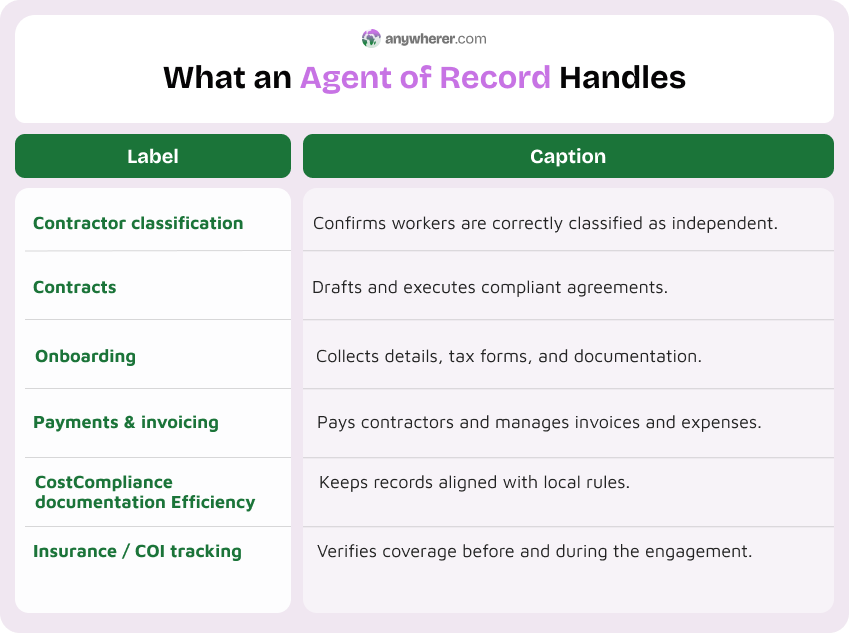
A typical AOR handles responsibilities such as:
- Contractor classification. Reviews whether a worker can legally be engaged as an independent contractor and helps reduce misclassification risks.
- Contract preparation and execution. Drafts compliant contractor agreements and manages the signing process.
- Contractor onboarding. Collects required information and prepares contractors to start work.
- Payments and invoicing. Processes contractor invoices, payments, and approved business expenses.
- Tax and compliance documentation. Collects and maintains documents such as W-9, W-8BEN, 1099, and other country-specific forms where required.
- Insurance verification. Confirms certificates of insurance (COIs) when clients require contractors to carry professional or liability coverage and tracks renewal dates.
- Ongoing compliance monitoring. Keeps track of regulatory changes that may affect contractor engagements and updates processes when needed.
Some companies also refer to these providers as Contractor of Record (COR) services because they focus specifically on independent contractors rather than employees.
You may also come across the phrase AOR consultant. In most cases, the AOR consultant meaning refers to an advisor or provider that helps businesses set up compliant contractor engagements. However, a full-service AOR goes beyond consulting by handling the operational work, documentation, and payments throughout the contractor relationship.
Benefits of Using an Agent of Record
For companies that rely on independent contractors, an Agent of Record can simplify day-to-day operations while reducing compliance risks. Instead of managing contractor administration across different countries, businesses can rely on a single provider to handle many of those responsibilities.
Key benefits include:
- Lower misclassification risk. An AOR helps determine whether a worker can be engaged as an independent contractor under local rules.
- Better compliance across countries. Regulations differ from one jurisdiction to another. An AOR helps businesses follow local requirements throughout the contractor relationship.
- Faster onboarding. Standardized contracts, documentation, and onboarding processes help contractors start work sooner.
- Simplified global payments. Companies can manage invoices, contractor payments, and approved expenses through one provider instead of multiple local processes.
- Greater flexibility. Businesses can quickly engage contractors for short-term projects, specialized work, or changing workloads without hiring employees.
- Less administrative work. HR, finance, and legal teams spend less time preparing contracts, collecting tax forms, reviewing invoices, and monitoring compliance.
- Contractors remain independent. An AOR supports the contractor relationship without changing the worker’s self-employed status or becoming the legal employer.
An AOR is often a practical choice for companies hiring contractors in different countries. Instead of spending time on paperwork and compliance, HR and operations teams can focus on finding the right talent and supporting the business.
Agent of Record vs Employer of Record (AOR vs EOR)
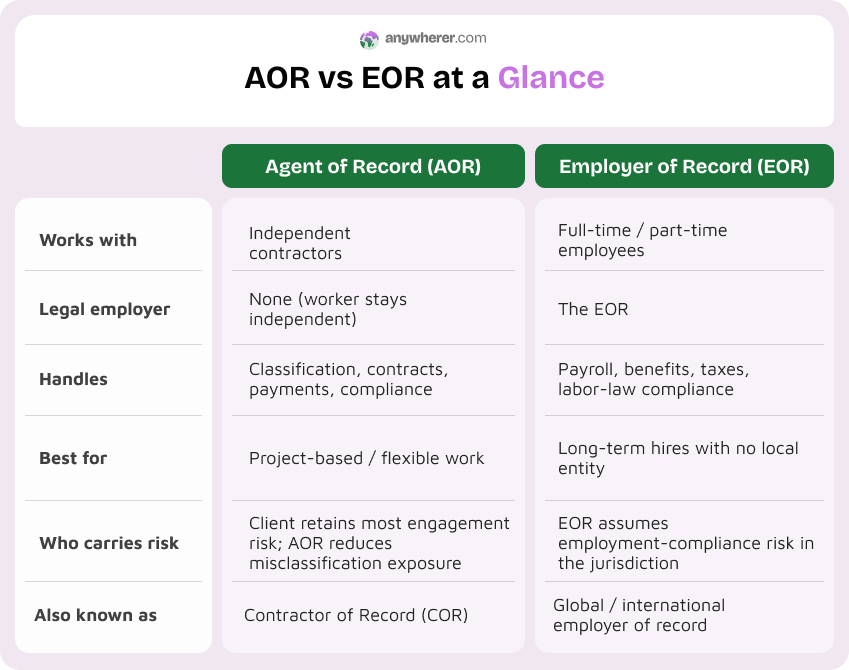
The difference between an Agent of Record vs Employer of Record comes down to one question: Is the worker an independent contractor or an employee?
An AOR is designed for independent contractors. It helps businesses engage contractors compliantly by reviewing worker classification, preparing agreements, collecting documentation, processing payments, and monitoring compliance. The contractor remains self-employed, and the AOR never becomes the legal employer.
An EOR provider hires workers as employees on behalf of a company and becomes their legal employer. The EOR handles payroll, taxes, statutory benefits, employment contracts, and labor law compliance, while the client company manages the employee’s day-to-day work.
When comparing Employer of Record vs Agent of Record, the right choice depends on your hiring model. If you need someone for a defined project and they qualify as an independent contractor, an AOR is usually the better fit. If the role should be treated as employment under the law, an EOR provides a compliant solution.
Many international companies use both models simultaneously. For example, they may hire software engineers or designers as contractors through an AOR while employing sales, operations, or customer success teams through an EOR. Using both gives businesses the flexibility to build a global workforce while matching the right engagement model to each role.
Agent of Record vs Broker of Record
The term Agent of Record (AOR) is also used in the insurance industry, but it means something completely different. In insurance, an agent of record or broker of record is the authorized representative who manages a client’s relationship with insurance carriers. Once appointed, that agent or broker can handle policy changes, renewals, claims support, and communication with insurers on the client’s behalf.
This role should not be confused with the Agent of Record (AOR) used in global hiring. A workforce AOR does not manage insurance policies. Instead, it helps businesses engage independent contractors by handling contractor classification, contracts, payments, and compliance.
If you’re comparing agent of record vs broker of record, both terms are used in the insurance industry and refer to an authorized insurance intermediary. The AOR discussed throughout this guide belongs to a different field altogether. Although the acronym is the same, the responsibilities, legal role, and purpose are entirely different.
Other Meanings of AOR
The AOR abbreviation is used in several industries, so its meaning depends on the context. Throughout this guide, AOR refers to Agent of Record in the context of contractor and workforce management. However, you may also encounter these common definitions:
- Agency of Record (advertising and marketing). The AOR agency meaning refers to the advertising, media, or marketing agency that a company appoints as its primary long-term partner. An Agency of Record typically manages strategy, creative work, media buying, or a combination of marketing services. If you’ve searched for the AOR agency of record definition, this is likely the meaning you were looking for.
- Area of Responsibility (operations and military). The AOR meaning “Area of Responsibility” describes a defined geographic region or operational scope assigned to a person, team, military command, or organization. The term is also used in logistics, emergency response, and large corporate operations.
- Agent of Record or Broker of Record (insurance). In insurance, an Agent or Broker of Record is the authorized intermediary who manages a client’s insurance policies and works with insurance carriers. This meaning is separate from the contractor-management AOR and is covered in the previous section.
Although these definitions share the same acronym, they describe entirely different roles in different industries.
Final Thoughts on the Agent of Record (AOR) Model
An AOR Agent of Record helps companies work with independent contractors. Rather than managing contractor agreements, payments, and compliance internally, businesses can leave those tasks to an AOR. Contractors remain self-employed, while the company gains a simpler way to manage global contractor relationships.
The right model depends on the type of worker you need. If you’re hiring independent contractors, an AOR is often the most appropriate choice. If you need full-time or part-time employees, an Employer of Record (EOR) provides the legal employment framework.
Many companies use both models. They hire employees through an EOR and work with independent contractors through an AOR. This lets them choose the right hiring model for each role instead of trying to fit everyone into the same arrangement.
Start by deciding how each role should be structured. In most cases, that decision will make the choice much clearer. An EOR is designed for employees, while an AOR supports compliant contractor engagements.
FAQs About Agent of Record (AOR)
How to choose agent of record service?
Choose an Agent of Record that already works in the countries where you plan to hire contractors. Check how it handles contractor classification, pricing, payments, and compliance. Also ask how the provider manages contracts, tax forms, and changes to local regulations. These details can make a big difference as your contractor team grows.
Where can I find agent of record service providers?
Many Agent of Record service providers focus on managing global contractors, while others include AOR services as part of a broader workforce platform. When comparing providers, check which countries they support, how they handle compliance, what they charge, how they process payments, and what past clients say about them. Experience in your target markets can make a real difference.
Is an AOR the same as a Contractor of Record (COR)?
Yes, in most cases, Agent of Record (AOR) and Contractor of Record (COR) refer to the same type of service. Both help companies engage independent contractors by handling classification, contracts, payments, and compliance. The difference is usually just the terminology chosen by the provider, not the service itself.
Does an AOR become my contractors’ employer?
No, your contractors remain self-employed, and the AOR does not become their legal employer. Instead, it takes care of contractor classification, agreements, payments, and compliance. Your company still manages the contractor’s work, sets priorities, and oversees day-to-day collaboration.
Can an AOR help prevent contractor misclassification?
Yes, one of an AOR’s main responsibilities is to help companies correctly classify contractors. It reviews the working relationship, prepares the required documents, and helps businesses comply with local regulations. No provider can eliminate all legal risk because worker classification depends on local law and the actual working relationship. However, an AOR can significantly reduce the risk by supporting proper classification, documentation, and compliance.

Yaryna is our lead writer with over 8 years of experience in crafting clear, compelling, and insightful content. Specializing in global employment and EOR solutions, she simplifies complex concepts to help businesses expand their remote teams with confidence. With a strong background working alongside diverse product and software teams, Yaryna brings a tech-savvy perspective to her writing, delivering both in-depth analysis and valuable insights.