Bhutan has a small formal labor market and a statute book written largely in English. Private employers follow the Labor and Employment Act of Bhutan 2007, with most details set by a 2022 Regulation. Provident fund contributions are defined as a minimum each side must pay, not as one fixed rate. Personal income tax also moved to a new Act on January 1, 2026, with a tax-free band of Nu. 300,000 a year.
Hiring in Bhutan: What the Rules Actually Require
Any Bhutan employer of record decision starts with scale. The Kingdom of Bhutan is a landlocked Himalayan state between India and China, and Thimphu, the capital, holds most formal jobs. Paro hosts the international airport, and Phuentsholing on the Indian border is the main trade gateway. World Bank data count 796,682 people in 2025, with GDP of about $3.58 billion and real growth of 8.0%. Dzongkha is the national language, but English runs government business and most employment contracts. The ngultrum (BTN), written Nu., trades at par with the Indian rupee under the Royal Monetary Authority (RMA).
Foreign employers here tend to come from a handful of fields. Hydropower and energy projects, tourism and hospitality, IT and digital services, construction and financial services all hire, and so do development agencies and donor programs. A newer source of demand is the special administrative region taking shape around Gelephu in the south. The formal workforce is small, young and schooled in English, and most of it sits in Thimphu. An overseas business can therefore put staff on a Bhutanese payroll through a partner and skip entity registration.
In this model, a local legal employer holds the contract and runs payroll for a foreign client, which still directs the daily work. An employer of record in Bhutan contracts under the Labor and Employment Act of Bhutan 2007 and its 2022 Regulation on Working Conditions. Pay runs in ngultrum. Once probation ends, the employer and employee must both join a provident fund. Income tax is withheld under the Income Tax Act 2025 and deposited monthly. Non-citizen staff require a Department of Labor work permit. A regular permit lasts up to 1 year under the 2024 foreign worker rules. A project inside Gelephu Mindfulness City (GMC) may fall under separate legislation, so ask early which framework applies.
The 9 providers below appear in one A-to-Z list. Only 1 of them, Rinzing Financial Private Limited, publishes a Bhutan address, and it sits in Thimphu. Among the 8 platforms working from abroad, 3 name the 2007 Act and just 2 mention the Income Tax Act 2025. Every entry sets out scope and strengths in the same order.

INSIGHT: What does a Bhutanese employer actually pay on top of salary?

The provident fund is the only recurring statutory charge, with no separate social insurance layer. Long-service gratuity, not severance, is the cost that builds quietly over the years.
- Provident fund: the employer and the employee each pay at least 5% of monthly basic wage (Section 225, Regulation on Working Conditions 2022). Both shares are deposited in the first week of the following month.
- Enrollment: participation becomes mandatory for both sides once probation ends (Section 223), and neither the Regulation nor NPPF’s 2021 guidelines sets a headcount threshold. In NPPF’s private scheme, membership is formalized by an agreement with the fund.
- Gratuity: after 10 years of continuous service, 1 month of last basic pay per completed year (Sections 243 to 249). It is paid within 15 working days of separation. Accrued from year 1; that is about 8.3% of annual basic pay.
- Income tax: nil up to Nu. 300,000 a year, rising to 30% above Nu. 3,500,000, after a 15% employment deduction capped at Nu. 150,000. The employee pays the tax, and the employer withholds and deposits it within 10 days after month-end (DRC notification, December 16, 2025).
What Is the Best EOR Option in Bhutan?
Local footing counts for more than usual in this market. Contracts run under a 2007 Act and a 2022 Regulation, and the fund turns on a floor plus an agreement. Income tax also moved to a new statute this year. On this employer-of-record Bhutan shortlist, only Rinzing Financial Private Limited publishes an address in the country, in Zilukha, Thimphu. It also lists a Gelephu subsidiary that incorporates companies in GMC, which matters for readers whose project sits there. Like most of the list, it publishes no fee.
Gelephu Mindfulness City needs its own paragraph. A Royal Charter established it as an autonomous special administrative region with legislative and judicial powers. Its Authority has since enacted a GMC Employment Act 2025 (Law No. 3 of 2025), deemed in force from December 26, 2024, plus separate foreign workforce and income tax Acts (GMC legislation). If a role sits inside the zone, confirm which employment rules apply before comparing providers. The national figures on this page may not carry across.
Pay floors need the same care. The 2007 Act lets the ministry fix a national minimum wage by order, expressed as a daily and a monthly rate (Sections 138 and 139). The last circular on the ministry’s site, dated October 31, 2013, set Nu. 125 a day or Nu. 3,750 a month from February 1, 2014 (MoICE circular). The National Workforce Wage Rate is a separate government schedule for workers hired directly by public agencies. Confirm the current floor with the Department of Labor before setting any salary.
Multi-country platforms bring uniform paperwork and one standard across markets. Their published Bhutan details are uneven, and some pages contradict each other. One gives a 5% employer fund rate in its introduction and 10% in its own cost example. Before signing for an EOR in Bhutan, put 4 questions in writing. On what basis is the provider enrolled with a provident fund? Which tax statute does the quote assume? How does it treat gratuity and redundancy notice? Does the role fall inside GMC? Only 2 of the 9 publish a fee.
INSIGHT: Bhutan’s provident fund is a minimum, not a rate
The rules set a floor for each side and leave the actual rate to the contract or the fund agreement. Published guidance turns that floor into several different fixed rates.
- NPPF’s guidelines, in force since November 4, 2021, set the employee contribution at not lower than 5% of basic salary or of total income. The employing agency makes a matching contribution (clauses 9(A)(i) and 9(B)(i)).
- Membership is formalized through an agreement executed with NPPF (clause 7.1). The 2022 Regulation separately makes participation mandatory after probation and allows any authorized financial institution to hold the fund.
- Self-employed members, owners and partners contribute a minimum of 10% of total income (clause 9(C)(i)). Converting a contractor into an employee replaces that with 5% plus the employer match.
- A quote built on a flat 5% each side may be right, low, or high. It depends on the rate in the contract or fund agreement. Ask for the enrollment basis in writing.
Sources:
- NPPF Private Provident Fund Scheme Guidelines 2021
- Regulation on Working Conditions 2022, Sections 222 to 226
checked November 2026
9 Providers Offering EOR Services in Bhutan
To make this list, a firm needed its own Bhutan page describing an employment, EOR, or payroll offer. My criteria were ngultrum payroll, fund enrollment on a stated basis, and contracting under the 2007 Act and its 2022 Regulation. I also checked income tax withholding under the current Act, work permit capability, and pricing transparency. Most employer-of-record services in Bhutan are delivered remotely. Only 1 provider publishes a Bhutan address, and the other 8 reach the country from elsewhere. Just 3 pages name the 2007 Act, 2 name the Income Tax Act 2025, and 2 publish a fee.
Providers appear in A-to-Z order. The sequence says nothing about quality, preference, or ranking.
Global Expansion
Provider Type:
Global
Company Description:
Global Expansion updates its Bhutan Countrypedia guide on a schedule: the last review was October 20, 2026, and the next is due January 2027. It also notes that GMC was created by its own 2024 Act and sits partly outside the national framework.
Key Specialty Area:
Only page flagging the special administrative region
Service Cost:
Quote-based
Top Advantages
- Names the Income Tax Act 2025 as current
- Cites the 2007 Act and 2022 Regulation
- Cost calculator and hiring model comparison tools
Scope of Services:
- Employment through its EOR without an entity
- Payroll, provident fund and tax administration
- Contractor risk checks and model advice
Our Verdict
A strong starting read, though I would test its 10-employee fund threshold against the Regulation.
Gracemark Global
Provider Type:
Global, with no Bhutan office stated
Company Description:
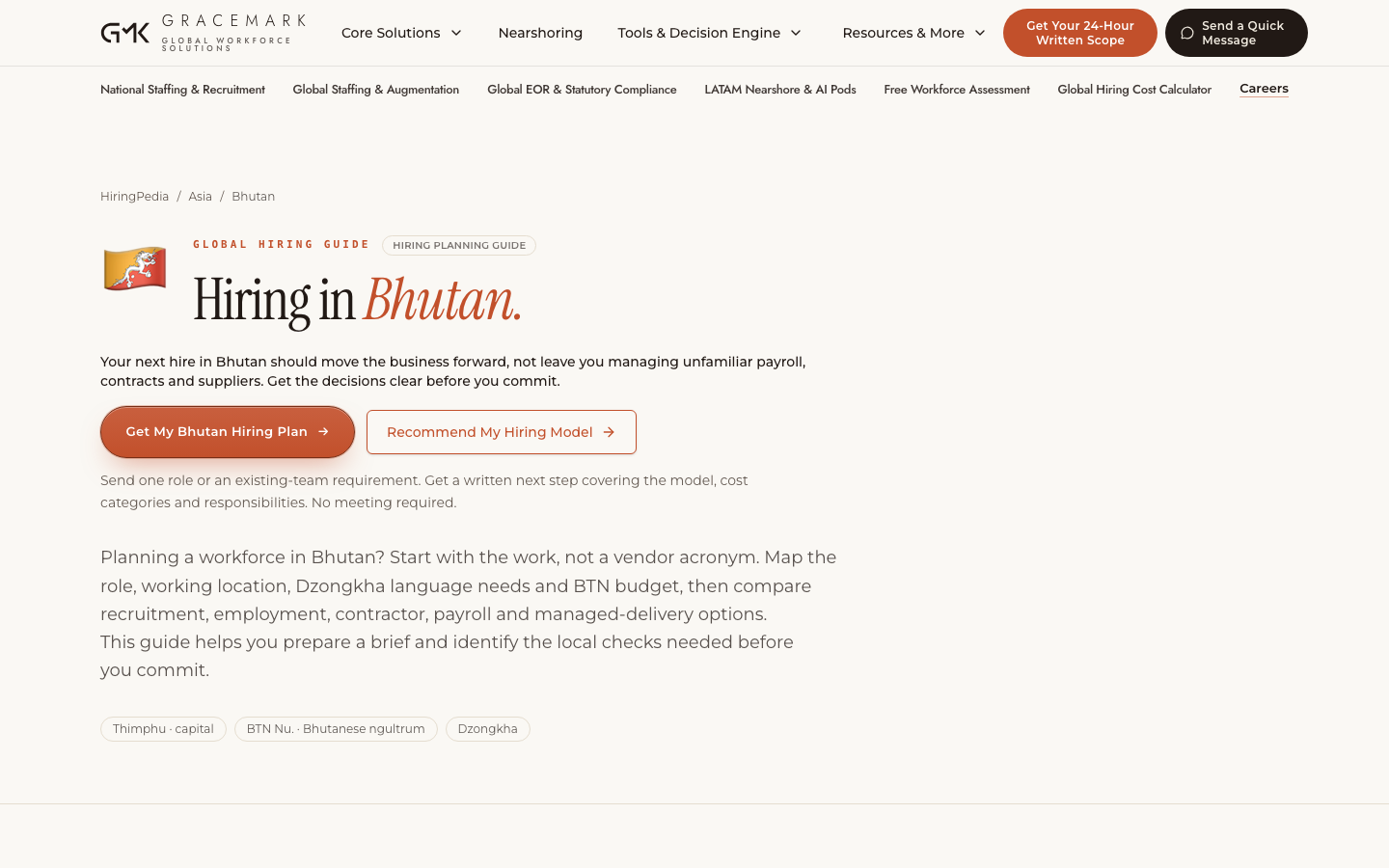
Gracemark Global publishes a Bhutan hiring planning guide that says it does not present verified statutory rates. It compares recruitment, employment, contractor, payroll, and managed-delivery routes, but the page does not say an EOR service runs here.
Key Specialty Area:
Route planning before any statutory figures
Service Cost:
Quote-based
Top Advantages
- Written scope within 24 hours; it states
- No unverified statutory rates on the page
- Planning brief covers role, location, and budget
Scope of Services:
- Hiring model recommendations for Bhutan roles
- Recruitment and candidate screening plans
- Employment and payroll route outlines
Our Verdict
Useful when I still need to choose between hiring, contracting or a managed team.
INS Global
Provider Type:
Global, with a Singapore head office
Company Description:
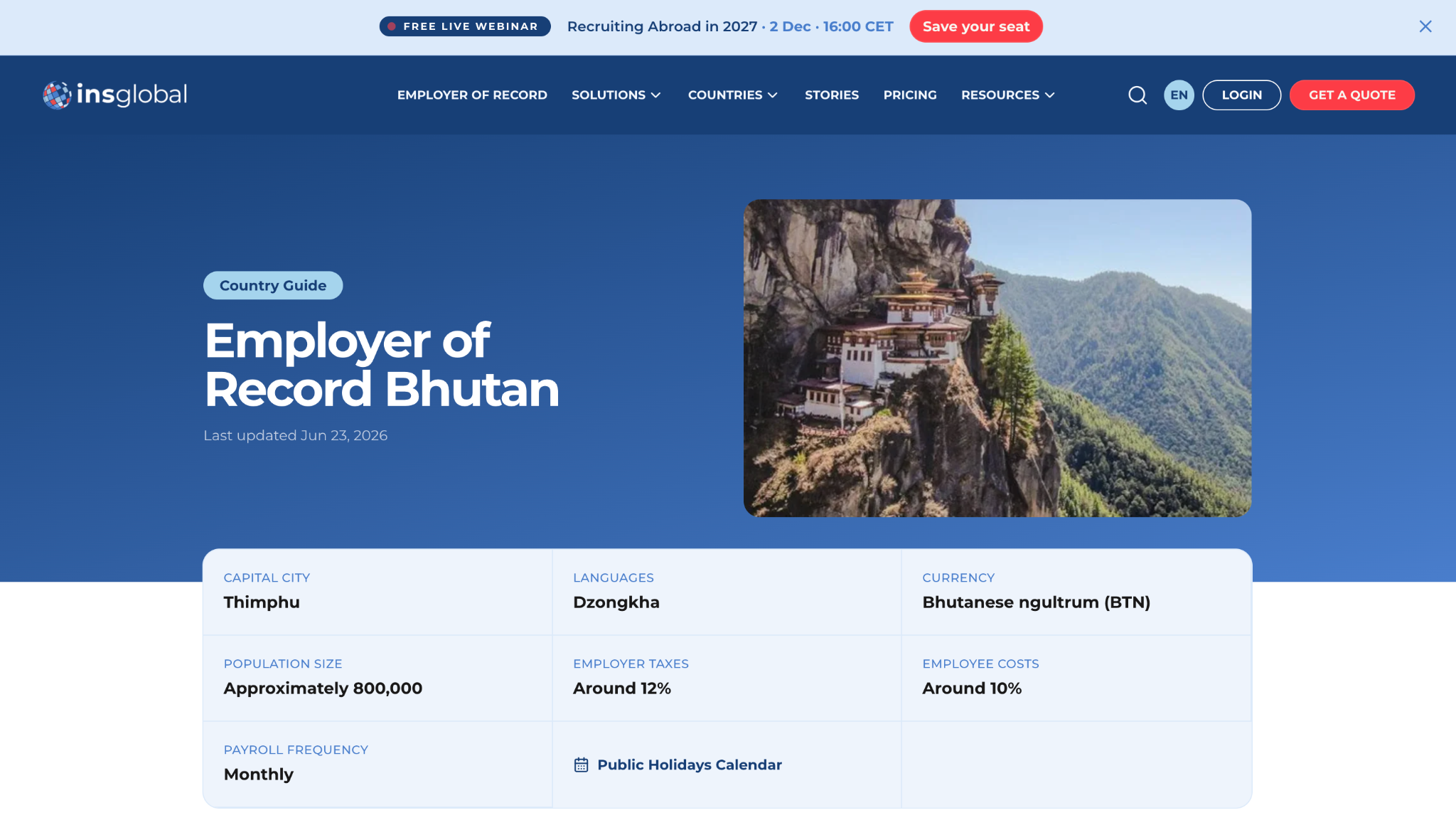
INS Global runs a Bhutan EOR page last updated June 23, 2026, from its global headquarters in Singapore. It covers contribution rates, leave, and holidays but names no statute, so I treat its figures as prompts rather than answers.
Key Specialty Area:
PEO and EOR compared against incorporation
Service Cost:
Quote-based
Top Advantages
- Table weighing EOR against setting up a company
- Leave and holiday overview on one page
- Administrative fee savings claimed by the company
Scope of Services:
- Hiring and onboarding without a local entity
- Monthly payroll, tax filings and benefits
- PEO-style support for existing local entities
Our Verdict
Before signing, I would ask INS which Act and fund basis its quote assumes.
Lano
Provider Type:
Global, run by Lano Software GmbH, with no headquarters city on the page
Company Description:
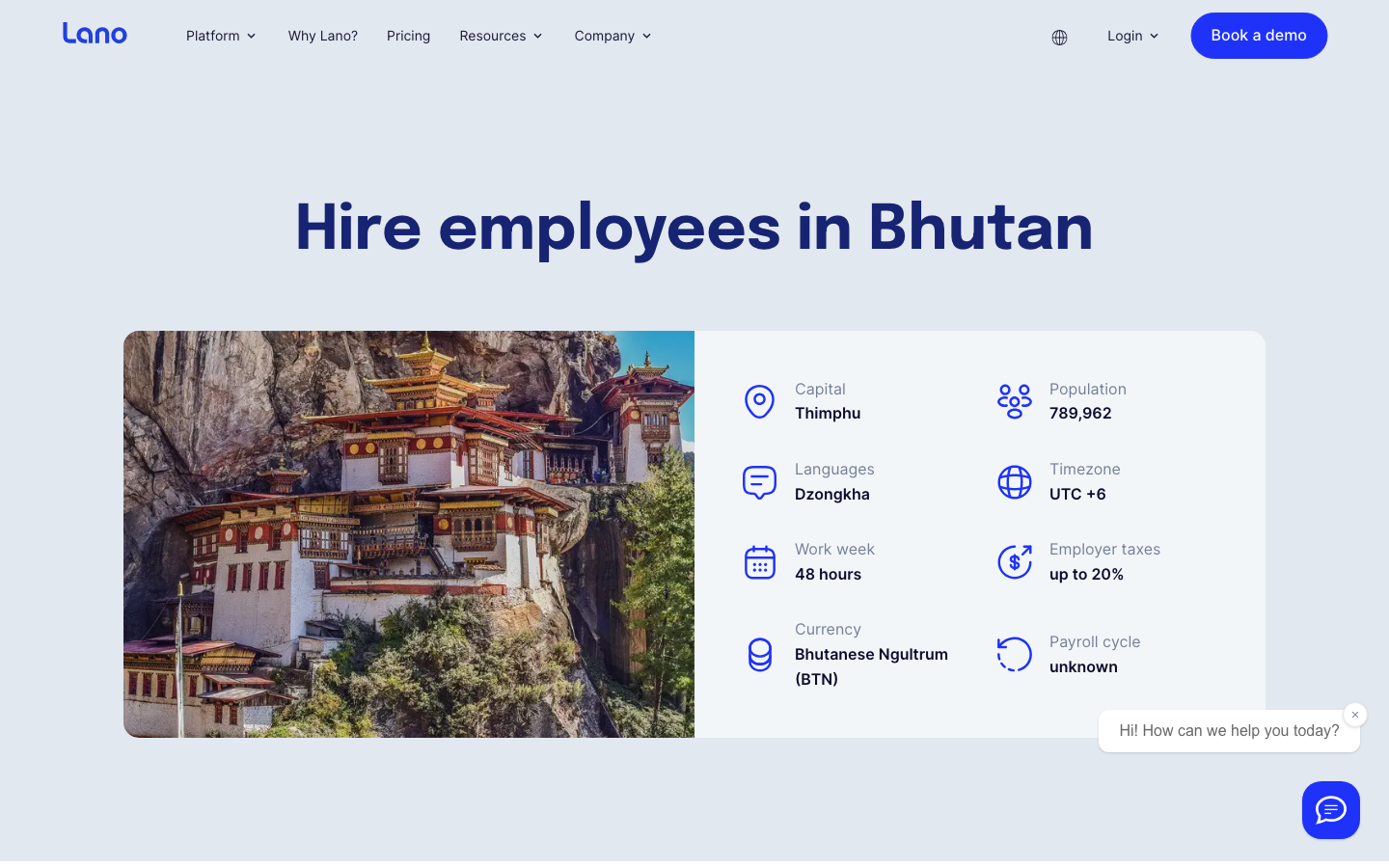
Lano, operated by Lano Software GmbH, offers to hire employees or contractors in Bhutan without a local entity. Its Bhutan page is the shortest here, listing the currency, time zone, and a 48-hour week, with the payroll cycle marked as unknown.
Key Specialty Area:
One account for staff and freelancers alike
Service Cost:
Quote-based
Top Advantages
- Employee and contractor hiring from one account
- Global payroll and salary payments built in
- Employment cost calculator for budget planning
Scope of Services:
- Compliant contracts for employees in Bhutan
- Contractor management and remote team payments
- Global payroll and multi-country consolidation
Our Verdict
I see it fitting a mixed contractor and employee setup, with statutory terms taken elsewhere.
Multiplier
Provider Type:
Global
Company Description:
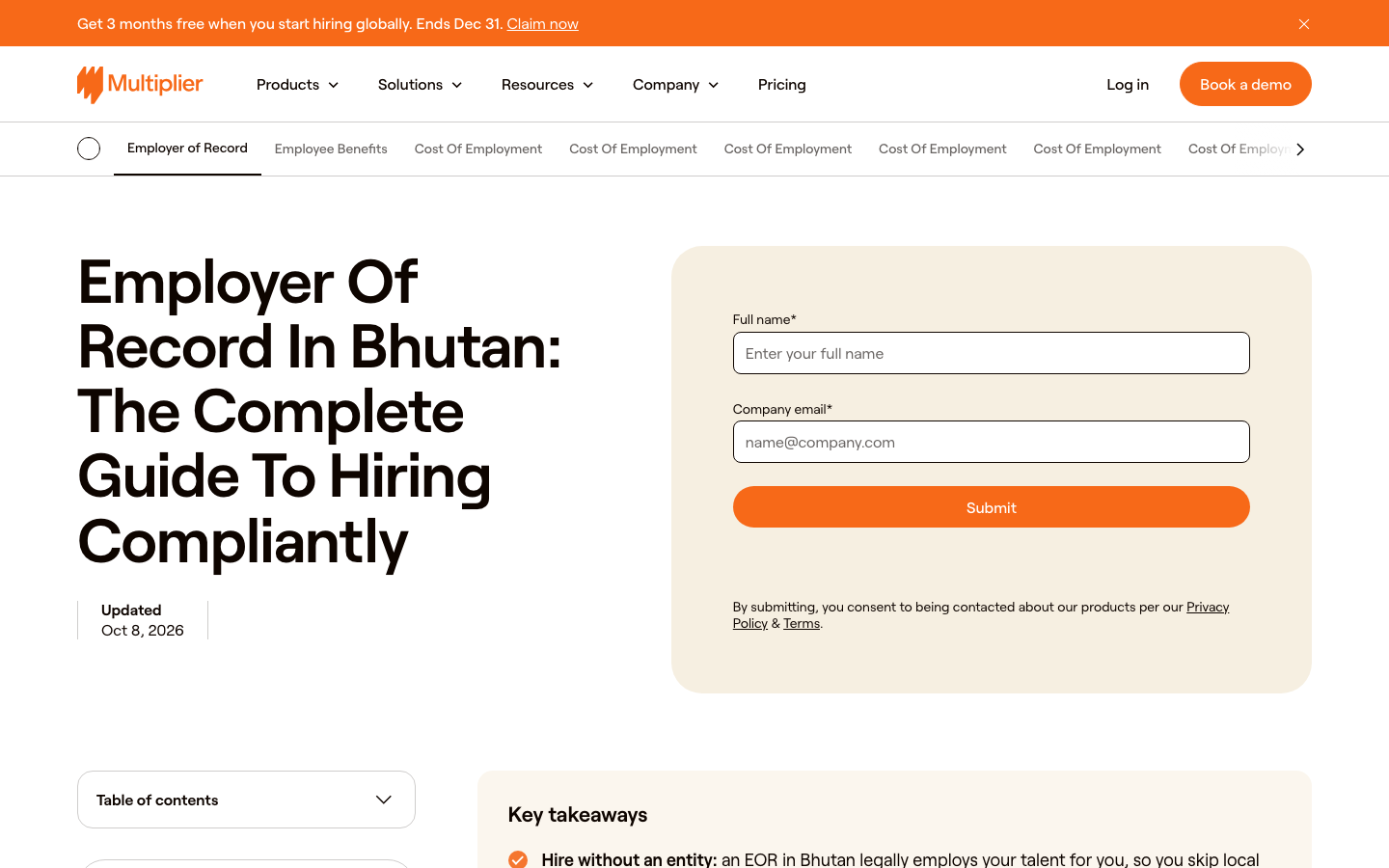
Multiplier has a Bhutan EOR page updated October 8, 2026, that names both the 2007 Act and the 2022 Regulation. It is the only provider page stating the fund contribution as at least 5% each side, and it flags the minimum wage as unsettled.
Key Specialty Area:
States the fund rate as a minimum
Service Cost:
From $400 per employee per month, according to Multiplier
Top Advantages
- Fund contribution written as a floor, not fixed
- Minimum wage uncertainty stated openly
- Starting fee published on the page
Scope of Services:
- Contracts under the Labor and Employment Act
- Payroll in ngultrum with provident fund handling
- Income tax withholding and leave tracking
Our Verdict
Its candor on the fund and the wage makes it my reference among platforms.
*As pricing is subject to change, we are listing prices as they stand in November 2026
RemotePeople
Provider Type:
Global
Company Description:
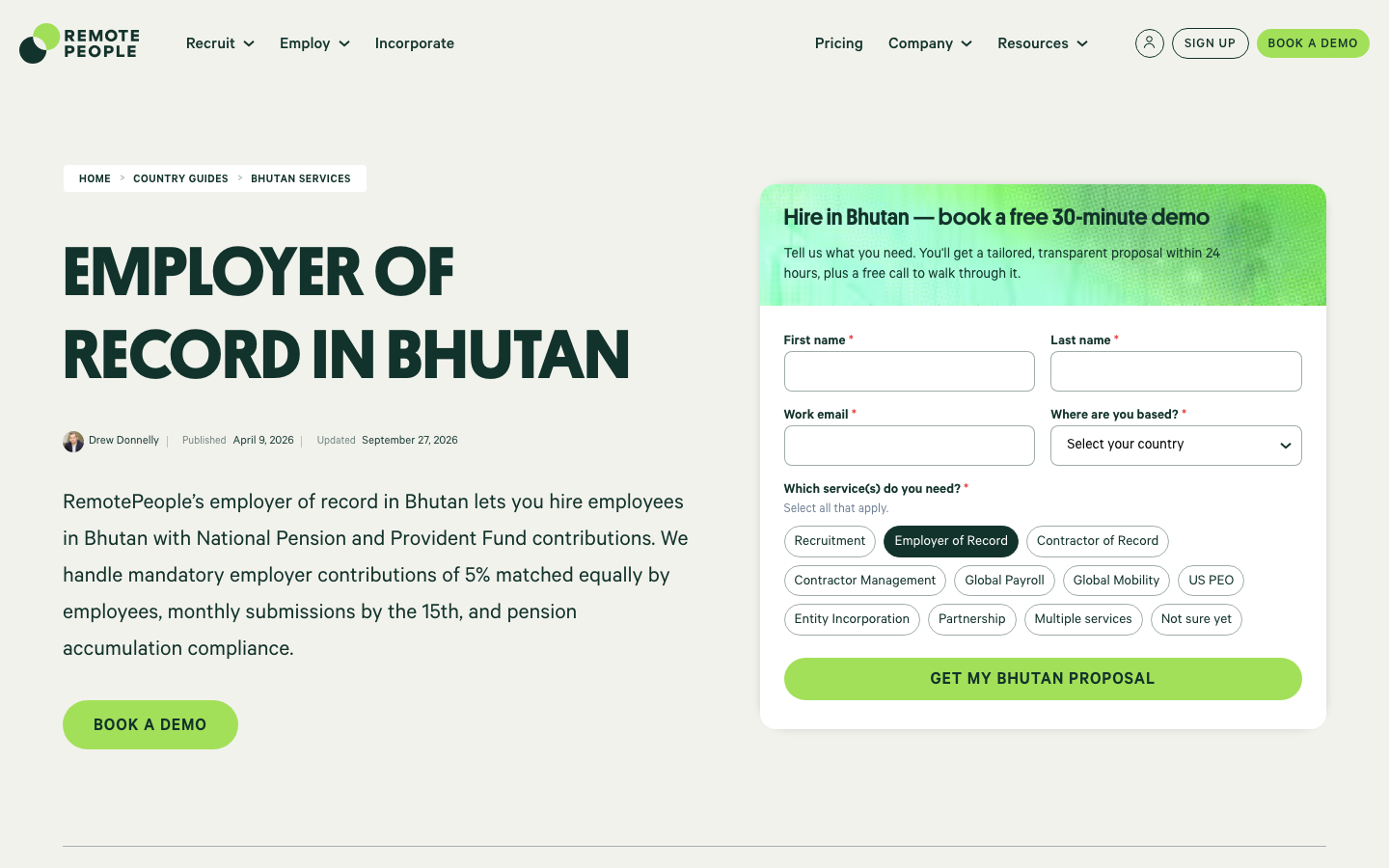
RemotePeople published its Bhutan guide on April 9, 2026, and updated it on September 27, 2026. It cites the 2007 Act and the Income Tax Act 2025. Its intro gives a 5% employer fund rate, while its cost example uses 10%.
Key Specialty Area:
Fee range with a worked cost example
Service Cost:
RemotePeople quotes $300 to $600 a month for Bhutan
Top Advantages
- Names the Income Tax Act 2025 and start date
- Work permit steps explained in detail
- Monthly cost table with every line shown
Scope of Services:
- Employment contracts and NPPF registration
- Payroll, tax withholding and statutory remittances
- Work permit sponsorship and renewals
Our Verdict
I lean on its process detail and recheck every rate against official texts.
*As pricing is subject to change, we are listing prices as they stand in November 2026
Rinzing Financial Private Limited
Provider Type:
Local, Thimphu (219 Chhophel Lam NW, Zilukha), with a Gelephu subsidiary
Company Description:
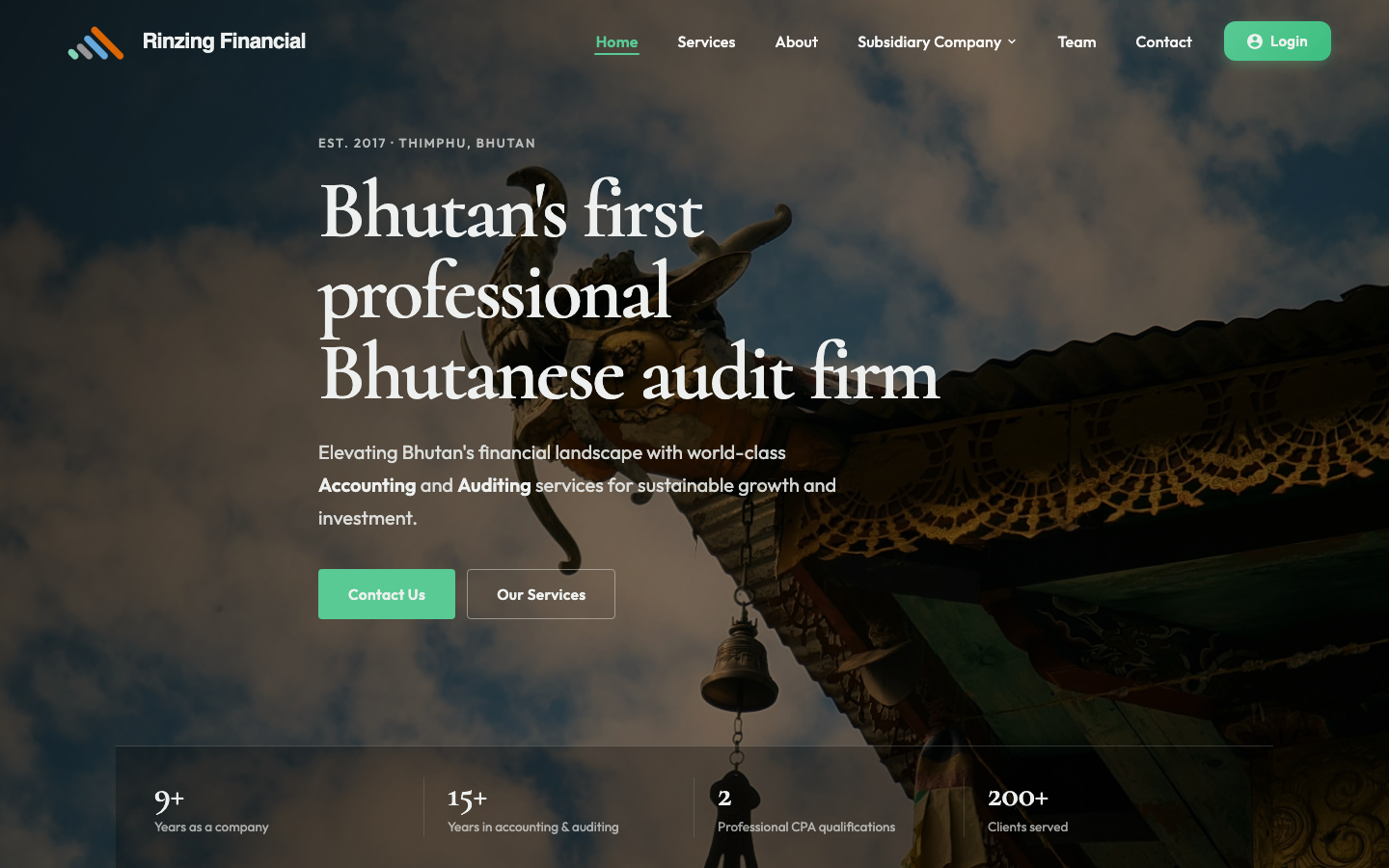
Rinzing Financial Private Limited (RFPL), founded in 2017, is an audit and consulting firm in Thimphu. It offers Employer of Record services, covering payroll, taxes, benefits, and labor law, and runs Rinzing Financial Gelephu Private Limited for GMC incorporations.
Key Specialty Area:
Thimphu office with a Gelephu subsidiary
Service Cost:
Quote-based
Top Advantages
- Thimphu street address and local phone line
- Gelephu subsidiary incorporating companies in GMC
- CPA-led team with audit and tax depth
Scope of Services:
- Employer of Record covering wages and tax filings
- FDI guidance and company registration support
- Statutory, donor-based and internal audits
Our Verdict
If the hire sits in a Thimphu office, this is where I would begin.
Safeguard Global
Provider Type:
Global, with no headquarters city on the Bhutan page
Company Description:
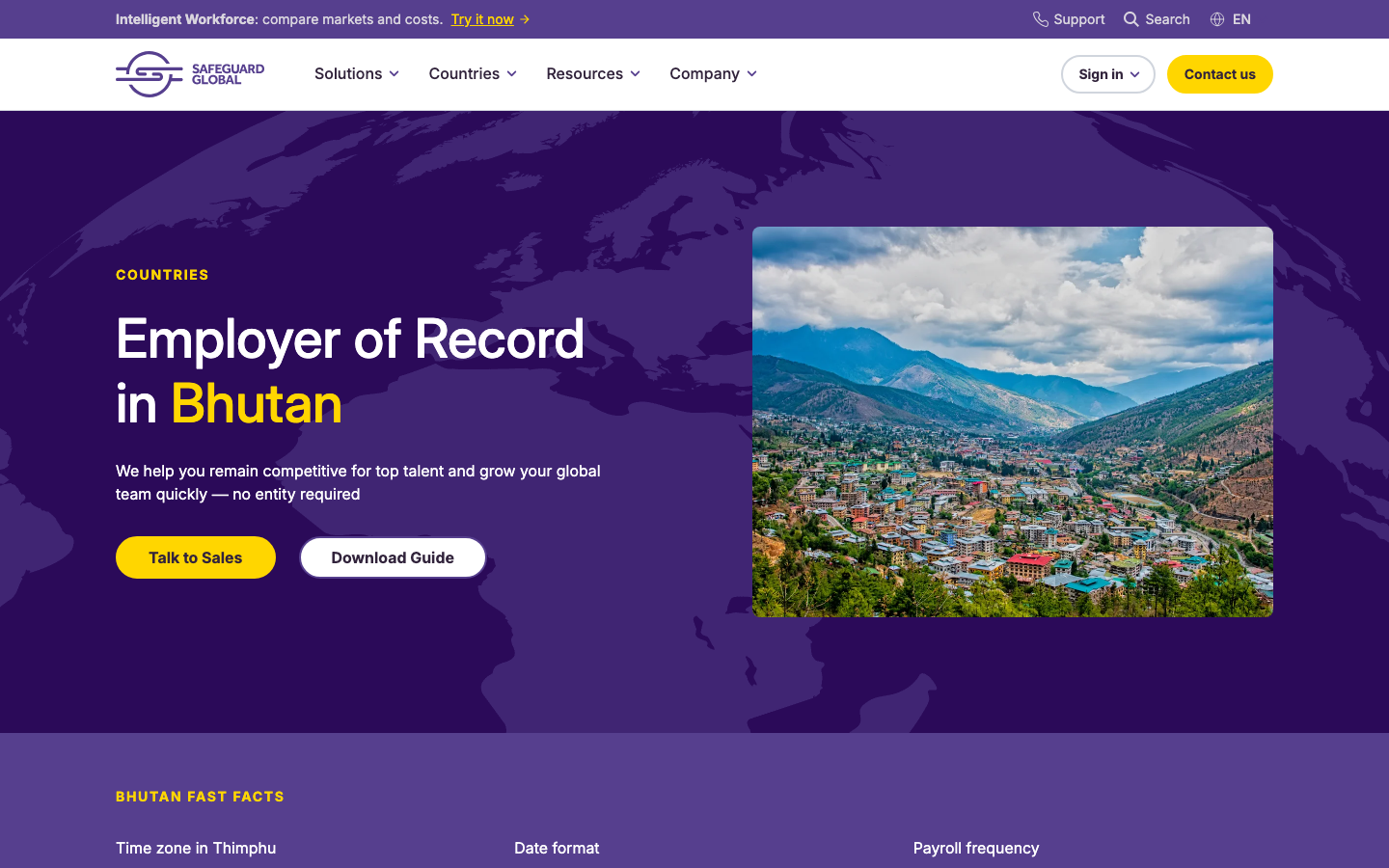
Safeguard Global keeps a Bhutan EOR page within a wider set covering recruiting, payroll, and employment law. It describes an EOR that employs workers and leases them to the client, lists 187 countries, and publishes no rates for Bhutan.
Key Specialty Area:
Contract form rules within a wider guide set
Service Cost:
Quote-based
Top Advantages
- Written contract rules covered by contract type
- Downloadable Bhutan guide for HR teams
- No published rates that could date
Scope of Services:
- Local employment and payroll for Bhutan staff
- Benefits and tax administration for employees
- Recruiting support alongside EOR hiring
Our Verdict
When Bhutan joins a wider rollout, I would add Safeguard to the quote round.
Slasify
Provider Type:
Global, showing a Singapore employment agency license, no headquarters stated
Company Description:
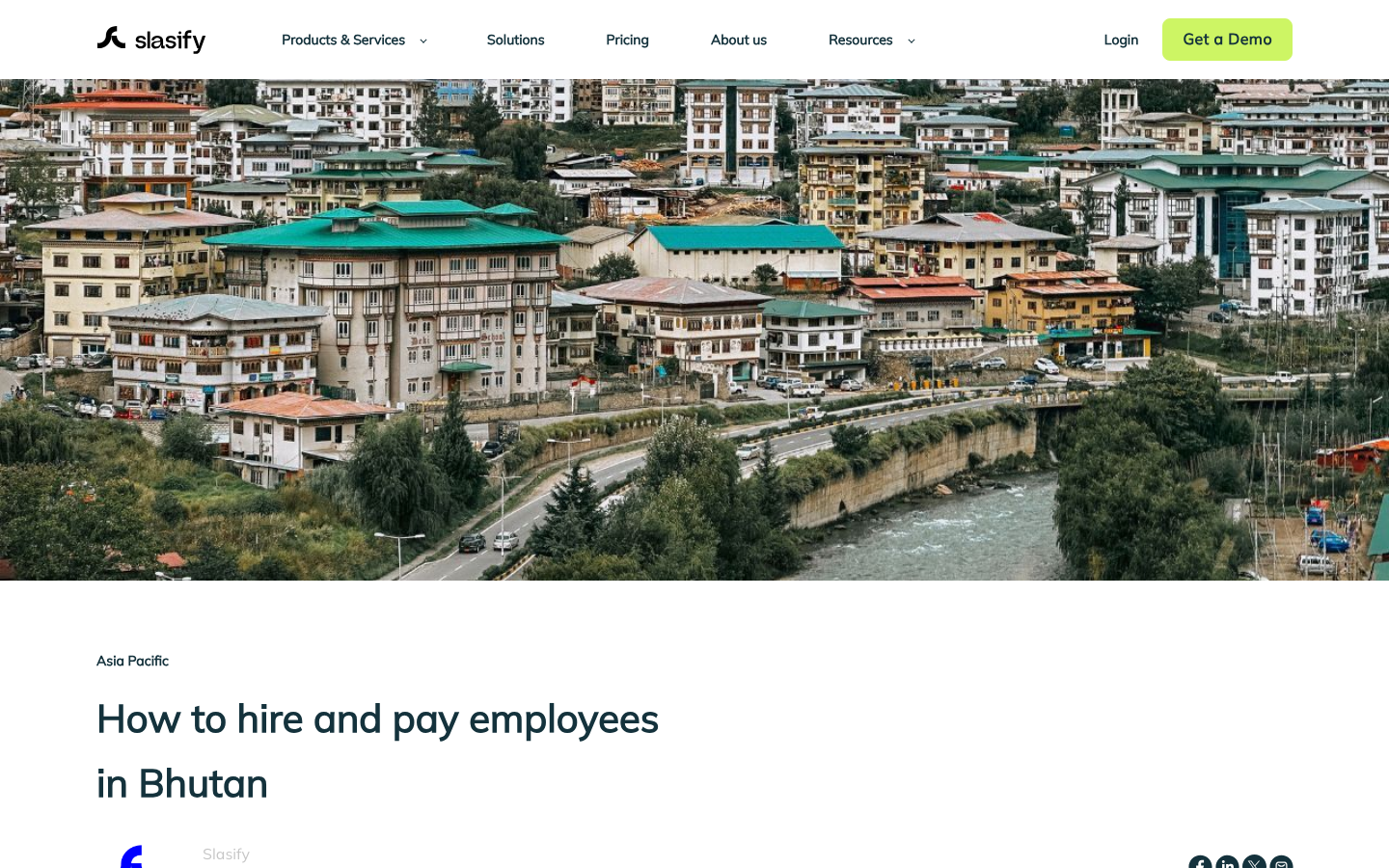
Slasify offers global payroll, EOR, and HR outsourcing in general terms, and its Bhutan guide is dated June 21, 2025, before the current tax Act. The footer shows a Singapore employment agency license number but no headquarters.
Key Specialty Area:
Detailed breaks, rest, and overtime guidance
Service Cost:
Quote-based
Top Advantages
- Rest and meal break rules spelled out
- Annual leave accrual explained month by month
- Singapore employment agency license shown
Scope of Services:
- Global payroll across multiple countries
- EOR described as a general company service
- HR outsourcing for remote teams
Our Verdict
I keep it for operational detail and ask whether it actually employs in Bhutan.
INSIGHT: What does an EOR in Bhutan cost?
Only 2 providers put a number on this market, and they frame it differently, so the figures aren’t like-for-like. Neither includes the fund contribution or a gratuity accrual.
- Published fees: Multiplier starts at $400 per employee per month (updated October 8, 2026). It also cites a $299 to $800 benchmark from its own cost analysis, a vendor claim about vendor prices. RemotePeople gives a $300 to $600 monthly band (page updated September 27, 2026).
- Statutory employer load: a provident fund match of at least 5% of basic wage, at whatever rate the contract or fund agreement sets. The card above explains why a single number would mislead.
- Gratuity: 1 month of last basic pay per completed year once 10 years are reached, about 8.3% of annual basic pay if accrued. Neither quoted fee covers it.
- Ask for each line on its own: management fee, fund contribution on the agreed basis, and income tax pass-through. Add the gratuity accrual, work permit costs, and whether the quote assumes national law or GMC.
Sources:
checked November 2026
*As pricing is subject to change, we are listing prices as they stand in November 2026
The ngultrum moves one-for-one with the rupee, and many employers eyeing Bhutan already run teams across the border. My India EOR guide covers the much larger market next door.
Nepal is the closest structural peer: small, landlocked, Himalayan and tied to the rupee. Local providers are just as scarce there, as my employer of record in Nepal guide shows.
Bangladesh offers a contrast, with a floating currency and a factory-scale labor market. My Bangladesh EOR services guide covers that model. A pegged currency does not bring shared employment law. A Bhutan EOR still answers to its own fund floor, 2026 tax Act, and special region.
What to Know About EOR Bhutan: FAQs
Does an employer have to pay into the provident fund?
Yes, once probation ends. Section 223 of the 2022 Regulation makes participation mandatory for both sides, and Section 225 sets at least 5% of monthly basic wage from each. In NPPF’s private scheme, membership comes through an agreement with the fund. The employer matches the employee, and deposits are due by the 10th of the next month (NPPF guidelines). The Regulation asks for deposits in the first week of the following month, so that earlier date is the safer target.
How is income tax calculated in Bhutan?
The Income Tax Act of Bhutan 2025 has been in effect since January 1, 2026. Annual taxable income up to Nu. 300,000 is tax-free, followed by bands of 5%, 10%, 15%, 20%, and 25%, with 30% above Nu. 3,500,000. Employment income gets a specific deduction of 15%, capped at Nu. 150,000. Employers withhold monthly and deposit within 10 days after month-end. Guidance written before 2026 describes a different scale and should not be used.
What leave are employees entitled to?
After probation, annual leave accrues at 1.5 days a month, at least 18 working days a year, and casual leave adds 5 days. Sick leave is at least 5 days a year. The Regulation sets maternity leave at a minimum of 2 months on last basic pay after 12 months of service, for up to 3 confinements. Paternity leave is at least 10 working days. Longer maternity terms seen online, such as 6 months, describe other schemes rather than this statutory minimum.
What happens when an employment ends?
Notice must be at least 30 days and equal for both sides, or 7 days during a probation of up to 180 days. The 2007 Act sets no general severance payment. Redundancy adds 7 days of notice per year of service, up to 42 days. A court can award 1 month’s pay per year, capped at 6 months, for wrongful dismissal. Gratuity of 1 month’s last basic pay per year applies after 10 years, unless serious misconduct forfeits it.
How do I choose between these providers?
Find out if the provider employs through its own Bhutanese company or a partner firm, and how it enrolls staff in a provident fund. Check which tax statute the quote assumes and how it treats gratuity and redundancy notice. If the role sits in Gelephu, confirm which framework applies. A usable written quote breaks out the fee, fund contributions, tax pass-through, and accruals. Only 2 of the 9 publish a fee, and they’re not built the same way.

Helen is Anywherer’s Market Analyst & Content Researcher, with extensive experience in analyzing global employment markets and HR technology trends. She is skilled at turning complex market data into clear, well-researched insights that inform every piece of content. With a strong grasp of the EOR, PEO, and international hiring space, Helen plays a key role in keeping Anywherer’s research accurate, up to date, and genuinely useful for readers.