An agent is defined by whether it acts. A chatbot answers a question about proof of employment. An AI agent for HR generates the letter, pulls the right dates from the HRIS, and emails it to the employee. That gap between answering and finishing is the whole category. It is also why HR leaders, HR operations managers, and talent acquisition leads keep asking what is actually buyable rather than what demos well.
The pressure to answer that in 2026 is real. SHRM reported in January 2026 that 92% of the 129 CHROs it surveyed anticipate greater AI integration in workforce operations. Notice what that figure does not say. It describes intent rather than deployed agents, and that gap is exactly what this page exists to close.
Two things also get sold together here, and they shouldn’t. One is HR software with AI features bolted on, which we cover separately in our guide to AI tools across HR. The other is an AI HR agent that takes an instruction and completes it in your systems. This page is about the second kind.

INSIGHT: How much HR time goes on answering the same questions?

The case for agents rests on request volume rather than on intelligence. The same handful of question types arrives every week, in every company, forever.
- The Hackett Group’s AI World Class HR benchmarks report up to 187% greater HR self-service and a 26% cost advantage for world-class HR functions over their peers (published 20 July 2026).
- Leena AI claims that more than 70% of tickets are auto-resolved on its platform. That is the vendor’s own figure, measured on the vendor’s own denominator.
- Resolution and deflection rates in this category are never comparable between vendors, because no two of them count the same tickets.
- What changes in practice: response time on routine requests drops. Headcount usually does not.
What Are the Best AI Agents for HR in 2026?
So there is no clear answer to what is the best AI agent for HR teams, and any page naming one winner is selling something. The 13 reviewed here split into three families. Employee service agents resolve HR and IT requests end-to-end. Recruiting agents source, screen, and interview at volume. Horizontal voice platforms are the infrastructure the others are built on, and you configure them yourself. Which family fits depends on which HR work is actually repetitive at your size. The honest starting point is your own ticket log, not a feature grid.
INSIGHT: Employee service, recruiting, or infrastructure?
These 13 platforms do three different jobs. Buying infrastructure when you wanted a finished product is the most expensive mistake available in this market.
- Employee service agents (Aisera, Atomicwork, Leena AI, Resolve, ServiceNow, Workativ) resolve HR and IT requests end to end inside Slack, Teams, or a portal. This is the largest and most proven use case.
- Recruiting agents (ConverzAI, HeyMilo AI, Ribbon) source, screen, and interview at volume and write the results back to the ATS. What a candidate makes of the call is the exposure you have to manage.
- Horizontal voice platforms (Retell AI, Synthflow, Vapi) publish per-minute or contract rates and ship no HR logic at all. Your team builds the workflow.
- The families are not tiers. A recruiting agent is not a lesser employee service agent, and neither one is a worse version of the infrastructure underneath.
Sources:
Below, I’ve reviewed 13 of the leading platforms in A-Z order.
Here is the shortlist at a glance. Anyone weighing AI-powered HR agent solutions should read the third column first. What an agent finishes on its own is the only claim that separates this category from chat.
Deployment is the second column that changes decisions. Some of these replace your service desk, some sit on top of it, and the rest expect you to build. There is no best AI agent tool in the abstract, only one that matches the systems you already run.
| Tool | Family | What it completes without a human | Channels | Deployment | G2 rating |
|---|---|---|---|---|---|
| Aisera | Employee service | Auto-resolves IT and HR service requests | Slack, Teams, web, email, voice | Sits on top of your ITSM | 4.4 (146) |
| Atomicwork | Employee service | Runs onboarding steps and generates employment letters | Slack, Teams, chat, voice, email, portal | Replaces the service desk, or runs on yours | 4.0 (1) |
| ConverzAI | Recruiting | Screens candidates and updates the ATS record | Phone, SMS, email | Standalone | 4.1 (8) |
| HeyMilo AI | Recruiting | Screens and interviews applicants, syncs scored reports to the ATS | Voice, video, SMS, forms | Standalone | 4.8 (24) |
| Leena AI | Employee service | Handles leave, benefits enrollment, and onboarding requests | Slack, Teams, WhatsApp, email, portal | Sits on top of your HRIS and ITSM | 4.6 (151) |
| Resolve | Employee service | Deflects IT and HR requests and runs the fix | Chat, email, portal | Sits on top of your ITSM | 4.6 (47) |
| Retell AI | Horizontal voice platform | Runs, transcribes, and analyzes calls you design | Phone, chat | Build your own | 4.8 (2,638) |
| Ribbon | Recruiting | Conducts a structured screening interview and scores it | Voice, video, SMS, email | Standalone | 4.3 (11) |
| ServiceNow | Employee service | Executes multi-step employee requests across systems | Portal, Slack, Teams, enterprise search | Replaces the service desk | 4.3 (392) |
| Synthflow | Horizontal voice platform | Handles inbound and outbound phone conversations | Phone | Build your own | 4.5 (1,015) |
| Vapi | Horizontal voice platform | Runs the voice workflow you script | Phone, SMS, chat | Build your own | 3.0 (3) |
| Workativ | Employee service | Answers PTO and benefits questions and runs onboarding | Slack, Teams | Sits on top of your HRIS and service desk | 4.8 (3) |
| Zendesk | Employee service | Resolves routine HR and IT requests and routes exceptions with context | Slack, Teams, web, email, portal | Acts as the service desk | 4.3 (7,070) |
G2 scores come from each product profile and were read on 26 August 2026.
What Makes an AI Agent Different From an HR Chatbot?
Take one request and follow it through both. An employee needs proof of employment for a mortgage application. The chatbot recognizes the intent, links the policy page, and offers to raise a ticket. The agent looks up the employee in the HRIS and confirms the employee is entitled to the letter. Then it generates the letter with the correct job title, start date, and salary, and sends it. One of those saves the employee a search. The other closes the request.
Acting requires four unglamorous things. It needs integrations with write access, because a system it can only read from leaves it recommending rather than doing. It needs a defined process, since an HR AI decision agent cannot invent your leave policy. It needs permissions tied to a real user identity, so it never shows one employee another employee’s record. And it needs an escalation path, meaning a clean handover to a person the moment the request leaves the script. An agent is only as accurate as the policy library behind it, which is why policy management software is the quiet prerequisite.
Then there is the build-versus-buy split, sharper here than in most categories. Ready-made HR agents arrive knowing what onboarding is. Horizontal platforms arrive knowing how to hold a phone call, and the rest is yours to configure. HR buyers usually reach this page from the generic best AI agent software searches. Few of them realize the two are priced and staffed completely differently. One last thing is worth flagging. The large HR suites are all shipping their own agents now, so some of this capability may already sit inside software you own.
What still needs a person is the honest part. Approvals, anything with legal consequence, employee relations, and any decision an employee could contest all belong with a human. The sensible pattern is human-in-the-loop, where the agent prepares the action and a person signs it. In practice, an HR manager AI agent takes over request handling rather than management. That is coordinator and shared-services work, and there is a lot of it, but it is not judgment.
Where AI Agents Actually Work in HR
Five use cases carry almost all the value in this category today, and they are not equally mature. Employee service is proven, recruiting is moving fast, and voice is newest. Each group lists its tools A to Z. A platform showing up in one group is not thereby ruled out of the others.
Employee and IT Helpdesk
This is the largest and most proven use case, and it explains why so few of these are HR-only products. The employee who cannot find the parental leave policy also cannot get into Okta, and both requests land in the same Slack channel. Aisera, Atomicwork, Leena AI, Resolve, ServiceNow, and Workativ all address that combined queue. That is what most buyers mean by the best AI agents for HR and IT helpdesk.
What an agent resolves without a ticket is the test worth running. Password resets, leave balances, benefits eligibility, policy lookups, and access requests all follow known rules and touch systems the agent can reach. Teams buying for AI agents for HR operations should count how many of their own requests fit that description before signing anything.
Where a Payroll AI Agent Helps
Payroll and benefits generate the highest-volume, most repetitive questions HR receives. Why is my check different this month? How much leave do I have left? When does my dental coverage start? Aisera, Leena AI, and Workativ all connect to payroll and benefits systems to answer from live data rather than from a policy document.
There is a hard limit here, and it deserves to be said out loud. A payroll AI agent that reads the payroll system incorrectly is worse than no agent at all. A confident wrong answer about someone’s pay travels fast, and it costs trust you will not get back cheaply. Test this one against real records, including the messy ones.
HR Onboarding AI Agent Automation
Onboarding is a multi-system workflow rather than a question, which is exactly what agents are for. Accounts get created, equipment ordered, documents signed, training assigned, and payroll told. Atomicwork, Leena AI, and ServiceNow all run those steps as a sequence rather than as a checklist someone works through by hand.
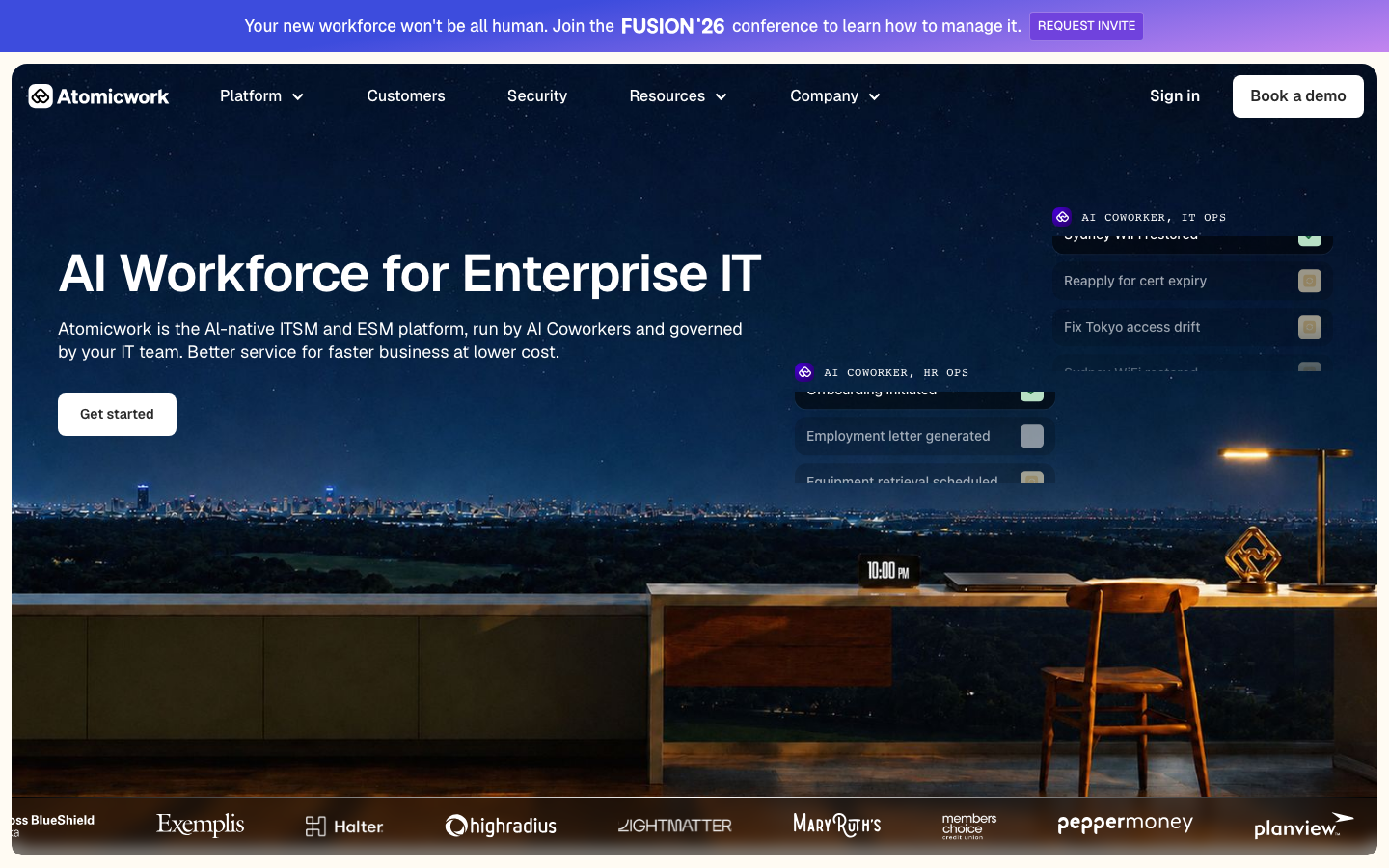
It is also where HR and IT overlap most, and that overlap is the argument for buying one agent instead of two. Atomicwork’s own product page shows an HR Ops coworker initiating onboarding, generating the employment letter, and scheduling equipment retrieval. That is a fair picture of what this looks like in practice.
Where an AI Recruiting Agent Fits
Screening at volume is where an AI recruiting agent earns its keep. ConverzAI, HeyMilo AI, and Ribbon all run structured conversations with every applicant and score them consistently. Each writes the result back to the ATS, which decides whether recruiters use the output.
Two caveats matter. Anyone shortlisting an AI agent for recruiting should ask about completion rates on AI-led calls. Also ask what a candidate sees before the call starts, because the screening experience is also employer branding. And screening is not an assessment. What happens after the agent hands over usually involves proper pre-employment assessment tools. The wider recruiting tool market sits outside this page and is covered in our dedicated guide.
Voice Agents
Voice is where agents are moving fastest, and an AI voice agent for recruiting is now the most common entry point for HR teams. Ribbon runs the interview itself; Retell AI, Synthflow, and Vapi supply the machinery underneath.
The important thing to understand about the best AI voice agent software is that it is horizontal by design. These platforms hold a phone conversation, route it, and hand off to a person. They do not know what a requisition is.
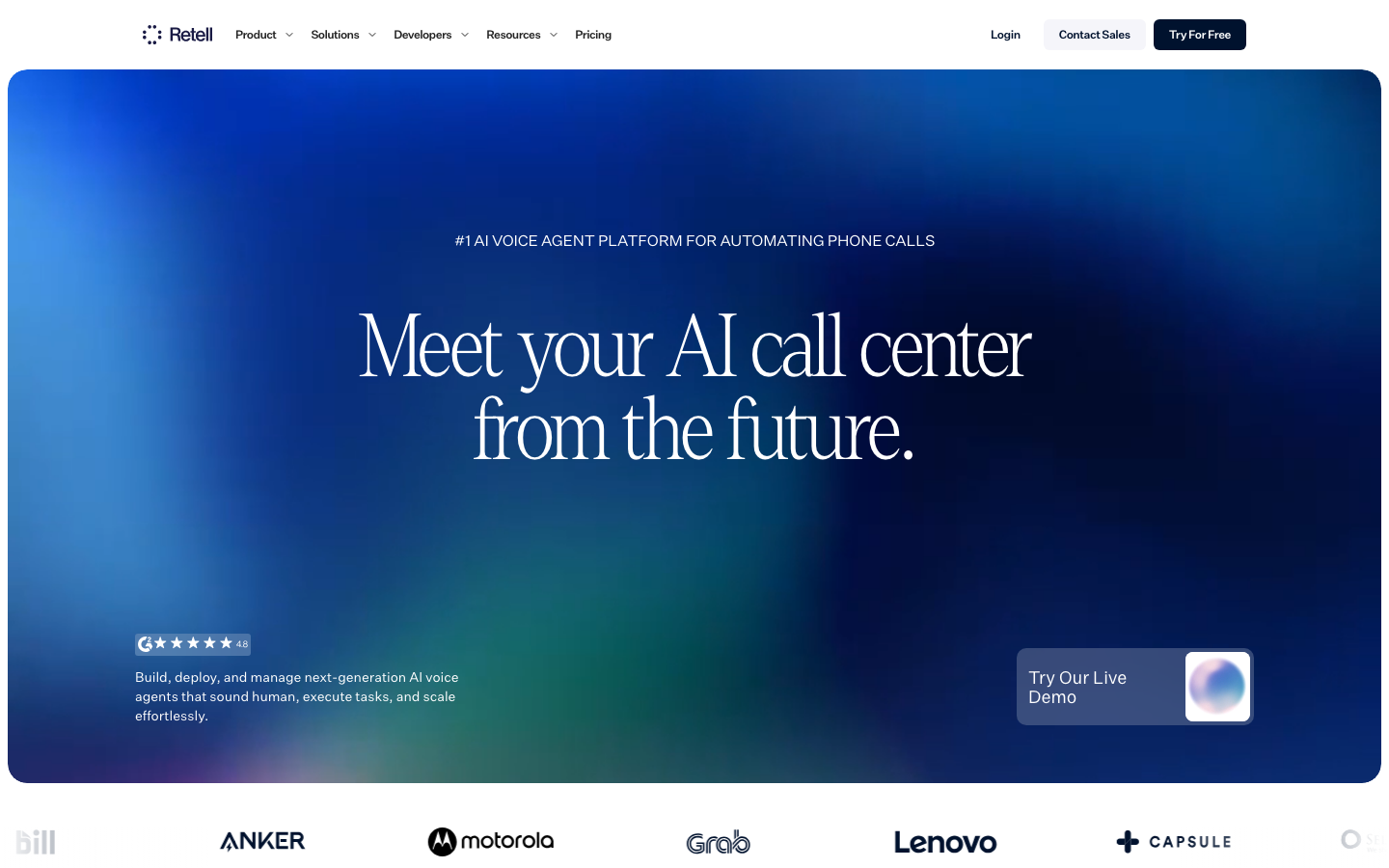
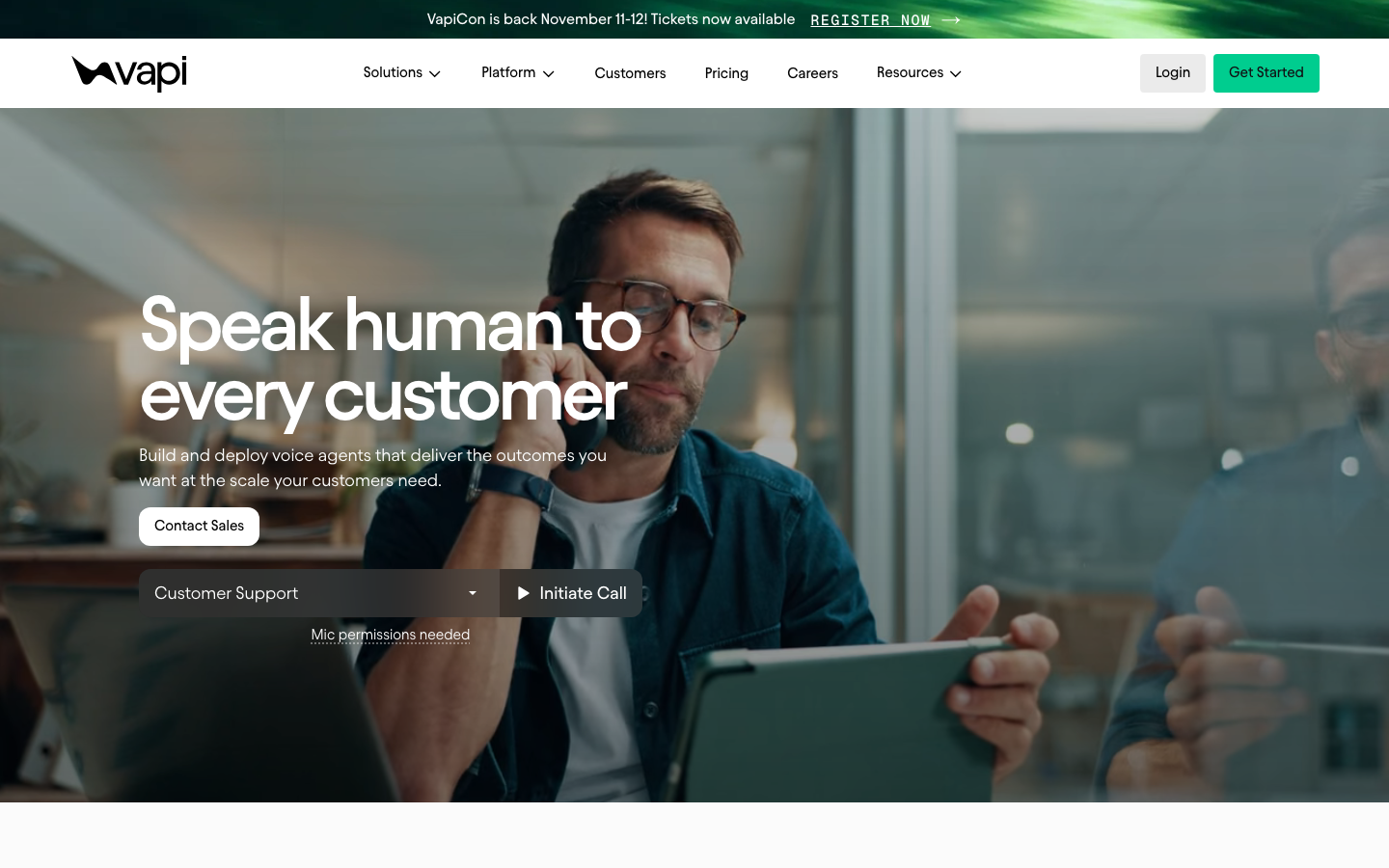
That is why the same vendors turn up when people search for the best voice AI agent software for customer support. It is one product serving both jobs, and their homepages reflect that. Vapi talks about speaking to every customer, and Retell AI describes an AI call center.
It also means shortlists for best AI customer service agent software and for candidate screening frequently contain the same three names. That is not a coincidence or a marketing accident, and pretending these are HR products would not help anyone choosing one.
Three practical points before you run AI voice agent HR recruitment calls. Tell people they are speaking to an AI, because acceptance is measurably better when they know and can reach a human. Measure completion rates rather than call volume. Test accent and background-noise handling with your own candidate population, not the vendor’s demo audio.
AI Agent Pricing for HR Teams
This category bills in four different units, and understanding which one you are signing is more useful than any headline rate. Per resolved ticket or task aligns cost with value but makes forecasting hard. Per session or conversation is what mid-market vendors use for predictability. Per employee is what enterprise vendors prefer. Per minute is how the voice platforms bill.
Two warnings follow from that. Quote-driven per-employee pricing makes total cost hard to forecast as adoption grows, since you are buying a license footprint rather than usage. And a pilot priced per resolution can get expensive precisely because it works. Every figure below came from the vendor’s own pricing page on 26 August 2026, and no number here came from a comparison blog.
| Tool | Pricing model | Free tier or trial | Published starting price |
|---|---|---|---|
| Aisera | Quote-based | Demo only | Custom pricing |
| Atomicwork | Per credit, usage, or outcome-based | Free trial on request | Slack, Teams, chat, voice, email, portal |
| ConverzAI | Quote-based | Demo only | Custom pricing |
| HeyMilo AI | Quote-based | Demo only | Custom pricing |
| Leena AI | Quote-based, per employee | Demo only | Custom pricing |
| Resolve | Quote-based | Demo only | Custom pricing |
| Retell AI | Per minute | $10 in free credits | $0.07 per minute for voice agents |
| Ribbon | Per plan, with per-interview overage | Demo only | $499 per month, Growth plan, billed annually |
| ServiceNow | Quote-based, per employee | Demo only | Custom pricing |
| Synthflow | Annual enterprise contract | Demo only | $30,000 per year |
| Vapi | Per minute | Usage-based entry with 60+ minutes included | $0.05 per minute platform fee, plus model costs |
| Workativ | Per session | Demo only | $99 per month, Starter plan |
| Zendesk | Per agent, tiered plans | Free trial | €29/agent/month, billed annually |
As pricing is subject to change, prices are listed as of September 2026.
INSIGHT: Per ticket, per employee, or per minute?
The pricing unit decides whether success makes the tool cheaper or more expensive. Settle that question before the pilot, not after it.
- 7 of the 13 publish a starting price openly: Atomicwork, Retell AI, Ribbon, Synthflow, Vapi, Workativ and Zendesk. The other six quote.
- The units are genuinely different. Retell AI bills from $0.07 per minute and Vapi from $0.05 per minute plus model costs, Workativ from $99 per month per session bundle, Ribbon from $499 per month with per-interview overage, Zendesk Employee Service from €29 per agent per month billed annually, and Atomicwork and Synthflow on annual contracts from $25,000 and $30,000 respectively.
- Atomicwork is the only one here offering outcome-based pricing alongside usage-based, which is the per-resolution model in its clearest form.
- The trap in one line: per-resolution pricing scales with adoption, so the better the agent works, the larger the bill, while per-employee pricing costs the same whether anyone uses it or not.
How to Choose an AI Agent for HR
I would start from the ticket log rather than from a demo. An agent is only worth buying for request types you receive in volume, and that list is duller than anyone expects. Once you have it, decide whether you are buying a finished HR agent or infrastructure you will configure. That single choice sets your budget, your timeline, and who owns the project.
Then check what the agent can write to, not merely read from. Read-only access produces a chatbot with better manners. Check the HR and IT split honestly too. Most vendors lead with one side and follow with the other, and the brochure will not tell you which. Anyone comparing the best AI agent workflow software should ask to see one multi-step process run end to end. Insist that the orchestration is visible, meaning the sequencing of calls across systems.
Integrations matter more than features. The real question behind what is the best AI agent tool with integrations is narrower than it sounds. Does it connect to your HRIS, your payroll provider, and your service desk, in that order, and with write access? Ask for the named connector, not the logo.
Three more checks, then price. Permissions have to be tied to a real user identity, so an agent cannot expose one employee’s record to another. The escalation path has to let a person take over mid-conversation without the employee repeating themselves. And you need evidence for the decisions the agent made, which stops being theoretical the first time someone disputes one. Only then look at cost, and model it at full adoption rather than at pilot volumes.
Top 13 AI Agents for HR Teams in 2026
I built this list by asking one question of every platform. What does it finish without a person, and where does a human still have to sign? Anything that only answered questions came off the list, no matter how good the answers were.
I’m listing all providers in alphabetical order to keep this comparison neutral.
The mix is deliberately wide. It runs from employee service agents like Leena AI and Resolve to recruiting agents like HeyMilo AI and Ribbon. Voice infrastructure like Retell AI and Vapi sits at the other end. Readers hunting the best AI agents for HR software often expect 13 versions of one product, and that is not what this market looks like.
Each block names the family first, then the concrete action, then three genuine advantages and three genuine trade-offs. If you are comparing best AI agent software 2026 in a hurry, the pros and cons alone will show you where each platform is weak.
Aisera
Quick Overview
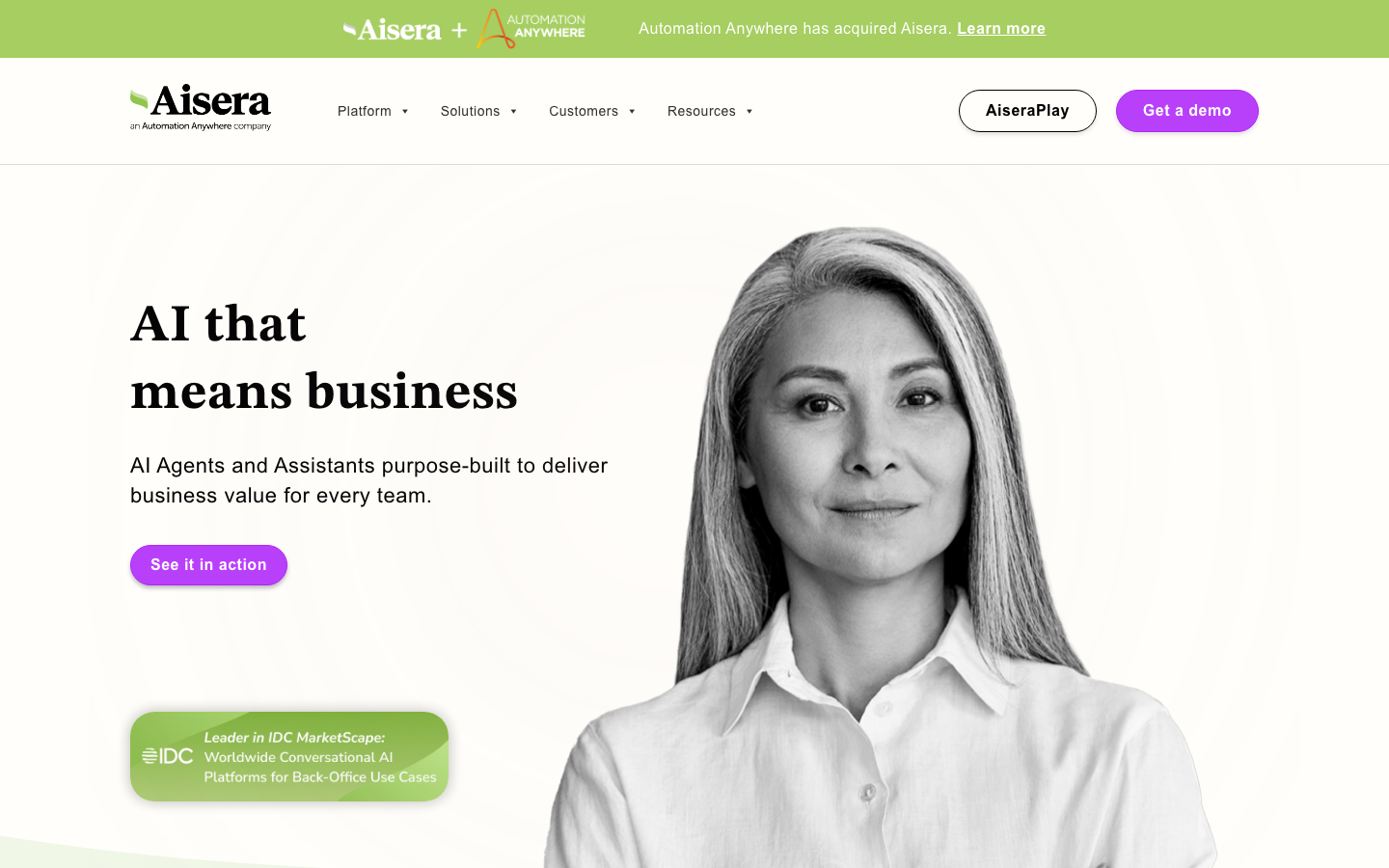
Aisera is an employee service platform that auto-resolves IT, HR, and customer service requests through a single agent layer. It suits enterprises consolidating several service desks rather than one. Automation Anywhere acquired it in November 2025, and the site now carries that byline. Its customer page quotes OmniTRAX auto-resolving 70% of tickets, which is Aisera’s published claim on its own denominator.
Software Pros
- One agent layer across IT, HR, and customer service, so employees get a single front door
- Agent orchestration, meaning several agents sequenced across systems for one request
- Deploys over the service desk you already run rather than replacing it
Software Cons
- Nothing is published on price, so budgeting begins with a sales conversation
- The heritage is IT service management, and HR-specific depth trails it
- Rollout is vendor-led and runs on an enterprise timeline rather than a quarter
Aisera Review
Testing this one against an HR-only shortlist would undersell it. The argument for Aisera is consolidation: one agent layer that answers whether the question is payroll or VPN. It resolves routine service requests outright. Exceptions, policy edge cases, and approvals still route to a person, as they should.
Our Verdict
Cross-Function Enterprise Agent Layer
Atomicwork
Quick Overview
Atomicwork is an employee service platform built AI-native rather than layered onto legacy service management, and it runs in Slack and Microsoft Teams. Its HR Ops coworker initiates onboarding, generates the employment letter, and schedules equipment retrieval with nobody touching the queue. The vendor publishes an 80% AI deflection rate as its own platform figure.
Software Pros
- Named AI Coworkers per function, including an Onboarding Manager and a Benefits Manager
- Published pricing with both usage-based and outcome-based plans, which is rare here
- Runs standalone or on top of an existing ServiceNow or Jira Service Management instance
Software Cons
- The positioning leads with enterprise IT, so HR is the second story on the page
- A single G2 review means there is almost no independent signal to check
- Credit-based pricing needs modeling before you can forecast a real annual bill
Atomicwork Review
What convinced me about Atomicwork is that it names the agents by job. An Onboarding Manager that opens accounts and issues the letter is a claim you can test on day one. The trade-off is clear: this is an IT-first product that does HR well, not the reverse.
Our Verdict
AI Native Service Desk
ConverzAI
Quick Overview
ConverzAI is a recruiting agent aimed at staffing firms and high-volume hiring, running outreach and qualification by phone, SMS, and email. It conducts the screening conversation and then updates the candidate record in the ATS itself. ConverzAI reports screening 60,000 candidates in 90 days at TalentBridge.
Software Pros
- Runs the screening conversation by voice and keeps the same thread across SMS and email
- Writes qualification results straight into the ATS rather than exporting a report
- Handles the follow-up admin too, including certificate chasing and branch visit scheduling
Software Cons
- No published pricing anywhere, so comparison shopping requires demos
- Built for staffing volume, which makes it heavy for a small corporate talent team
- The G2 score rests on eight reviews, which is barely a signal
ConverzAI Review
I would describe ConverzAI as a junior recruiter that never tires of the first call. It qualifies a candidate against the role and records the outcome without a recruiter listening in. The submission decision, the client conversation, and every borderline call stay firmly with your team.
Our Verdict
Voice First Staffing Recruiter
HeyMilo AI
Quick Overview
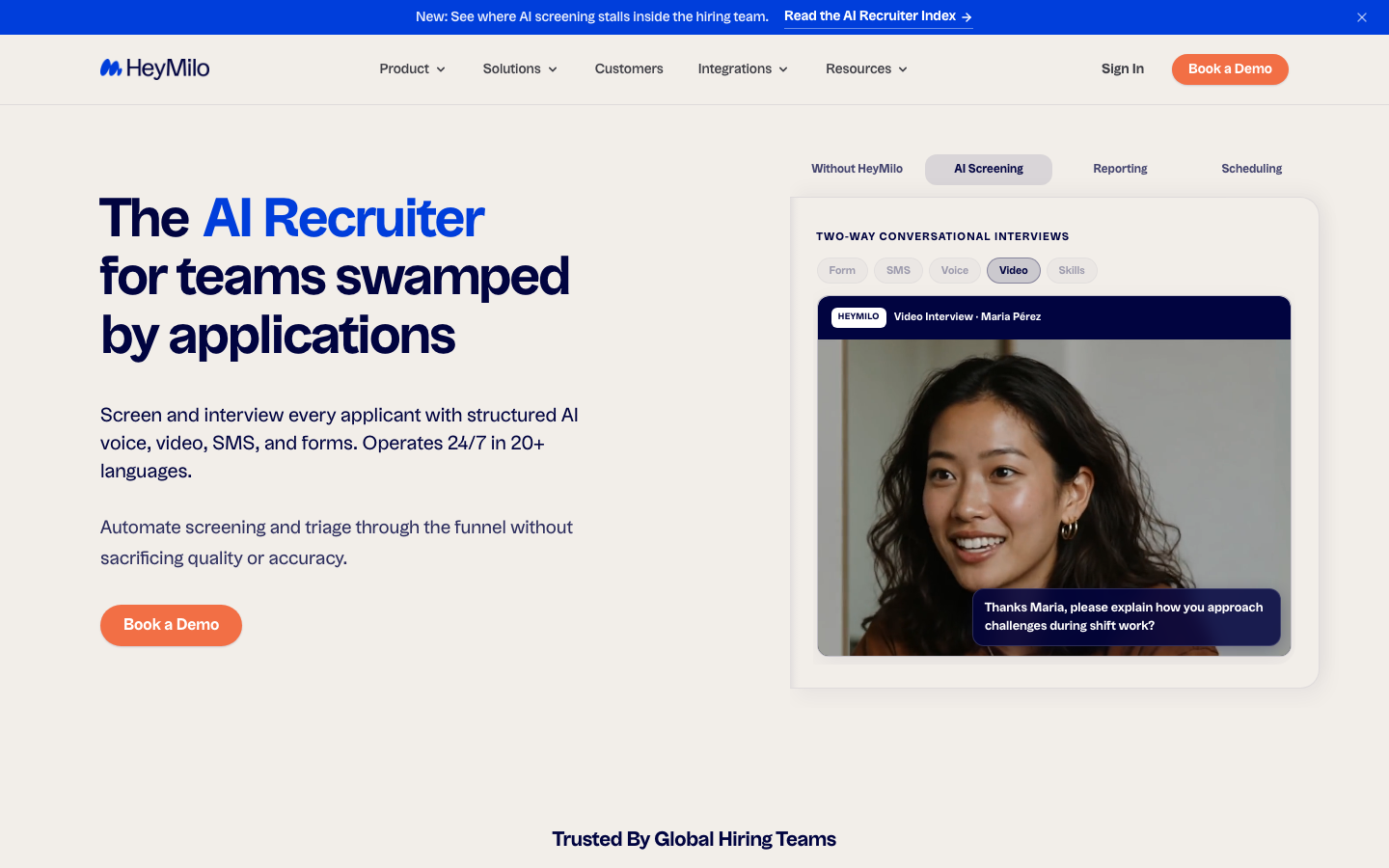
HeyMilo AI is a recruiting agent for teams buried in applications, screening, and interviewing across voice, video, SMS, and forms. It completes a structured interview and syncs a scored report back to the ATS, so recruiters open a shortlist rather than a queue. The vendor says it runs 24/7 in 20+ languages and reports 87% faster screening.
Software Pros
- Four screening channels in one agent, so candidates answer in whichever suits them
- Cheat detection for impersonation and AI-assisted answers before a shortlist forms
- A monthly AI bias audit and SOC 2 Type II, both stated on the vendor’s own site
Software Cons
- Pricing is quote-only, with no figure published at any tier
- Twenty-four G2 reviews is a thin evidence base for an enterprise decision
- Recruiting only, so it does nothing for the employee service side of HR
HeyMilo AI Review
My impression of HeyMilo AI is that it treats screening as an evidence problem rather than a speed problem. Structured scoring plus a bias audit is defensible when a candidate asks how a decision was made. The hiring decision itself still belongs to a recruiter.
Our Verdict
Multichannel Screening At Volume
Leena AI
Quick Overview
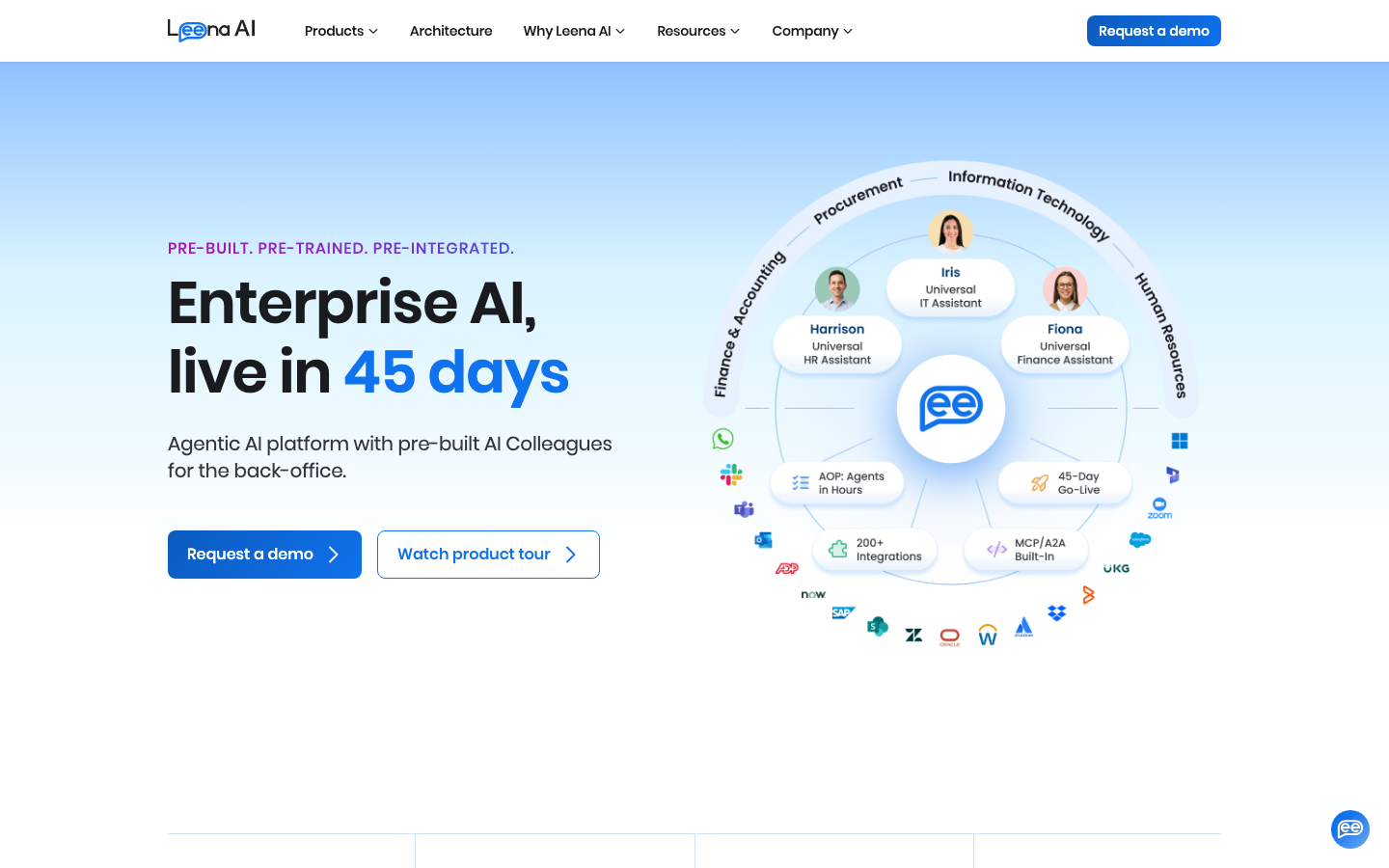
Leena AI is the most HR-first employee service platform here, built around pre-built AI Colleagues that arrive already trained on back-office processes. Harrison, its HR assistant, completes leave applications, benefits enrollment changes, and day-one onboarding against Workday, SAP, ServiceNow, and Oracle. The vendor states it powers 20M+ employees and claims 70%+ of tickets auto-resolved.
Software Pros
- Pre-built HR, IT, and finance colleagues rather than agents you configure from scratch
- MCP and A2A interoperability built in, both named on the vendor’s own product page
- A documented 45-day go-live, which is unusually fast for an enterprise agent platform
Software Cons
- Quote-only pricing on a per-employee basis, so cost grows with headcount, not usage
- Depth in HR means IT service management is the lighter half of the platform
- Getting real value depends on how well your operating procedures are documented
Leena AI Review
Having looked closely at Leena AI, the pre-built colleague idea is both the differentiator and the constraint. Harrison finishes a benefits change inside the HRIS, which is exactly the work HR wants gone. It works from your documented procedures, so undocumented exceptions escalate, which is correct.
Our Verdict
HR First Back Office
Resolve
Quick Overview
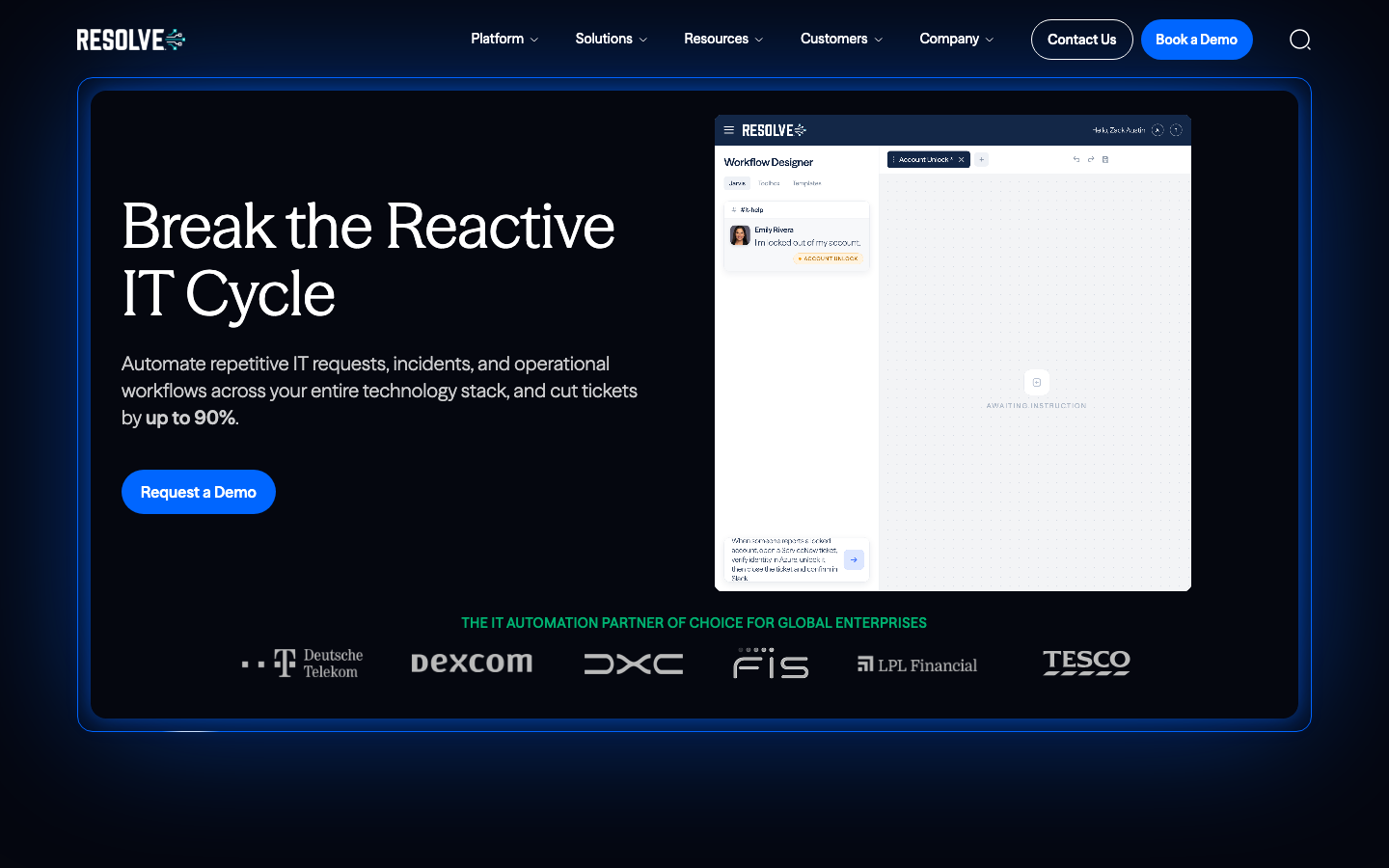
Resolve is an employee service platform that deflects IT and HR requests and then executes the fix. Its own automation engine runs behind RITA, the resolution agent, and Jarvis, the workflow builder. Resolve acquired Espressive, maker of the Barista virtual agent, in September 2025, and espressive.com now points here. The vendor publishes a Dexcom figure of 96% of request emails deflected.
Software Pros
- Deflection and remediation in one product, so a resolved request is actually fixed
- A workflow builder agent, which shortens the gap between a new process and a live one
- Sits over the service desk you already run, so nothing gets ripped out
Software Cons
- The product leads with IT automation, and HR is a secondary use case in its own messaging
- No published pricing, and enterprise automation contracts are rarely small
- Its G2 listing covers the wider automation platform rather than the employee agent
Resolve Review
The part I trust in Resolve is the execution half. Plenty of agents classify a request; this one runs the remediation script behind it and closes the loop. For an HR buyer, the caution is scope. You are buying an IT automation platform that serves HR.
Our Verdict
IT-Led Employee Automation
Retell AI
Quick Overview
Retell AI is horizontal voice infrastructure rather than an HR product, and its blocks in the table above say so for a reason. It runs, transcribes, and analyzes phone conversations you design, which HR teams use for screening, scheduling, and support lines. Pricing is published at $0.07 to $0.31 per minute, with $10 in free credits to start.
Software Pros
- Published per-minute pricing with no annual commitment, which is unusual in voice AI
- Post-call analytics, transcripts, and simulation testing before anything goes live
- Model, voice, and telephony choices are yours, including bringing your own keys
Software Cons
- No HR logic at all, so every workflow has to be built by your team
- Cost tracks call minutes, so a long screening interview is a bigger line item
- Guardrails, meaning the limits on what an agent may say or do, are your responsibility
Retell AI Review
Testing this one as an HR product would be a costly category error. Retell AI gives you a call that runs reliably, gets recorded, and gets scored. What the call asks, how the outcome is stored, and who reviews it are all yours to specify. That is either a strength or a project, depending on your team.
Our Verdict
Transparent Per Minute Voice
*As pricing is subject to change, we are listing prices as they stand in August 2026
Ribbon
Quick Overview
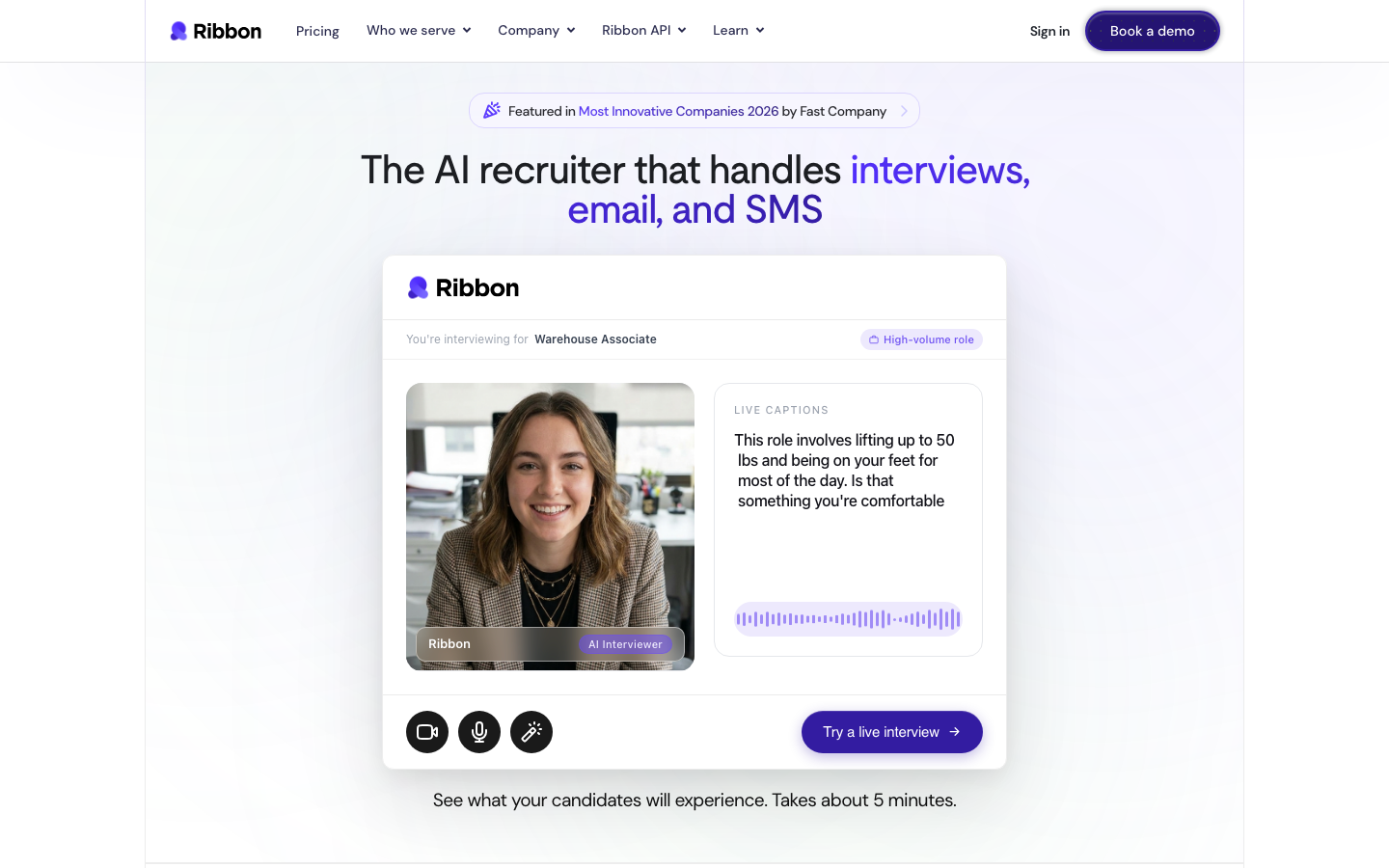
Ribbon is a recruiting agent that conducts structured screening interviews by voice and video and hands back a scored write-up. It targets high-volume, phone-first hiring in retail, logistics, and staffing. It publishes pricing openly, starting at $499 per month on the Growth plan billed annually, and supports interviewing in 10+ languages.
Software Pros
- Published plans with a stated interview allowance and a per-interview overage rate
- A live sample interview on the vendor’s own site, so candidates see it before you buy
- White-label branding and ATS integrations included from the entry plan up
Software Cons
- Interview allowances mean a spike in applications turns into overage charges
- Screening only, with no employee service or post-hire capability
- Eleven G2 reviews is too small a sample to read anything into
Ribbon Review
What convinced me about Ribbon is its transparency, which is rarer than it should be. Published prices, a documented language range, and a live demo interview let you evaluate it without a sales cycle. The agent completes and scores the interview; who advances remains a hiring manager’s call.
Our Verdict
Structured Interview Agent
*As pricing is subject to change, we are listing prices as they stand in August 2026
ServiceNow
Quick Overview
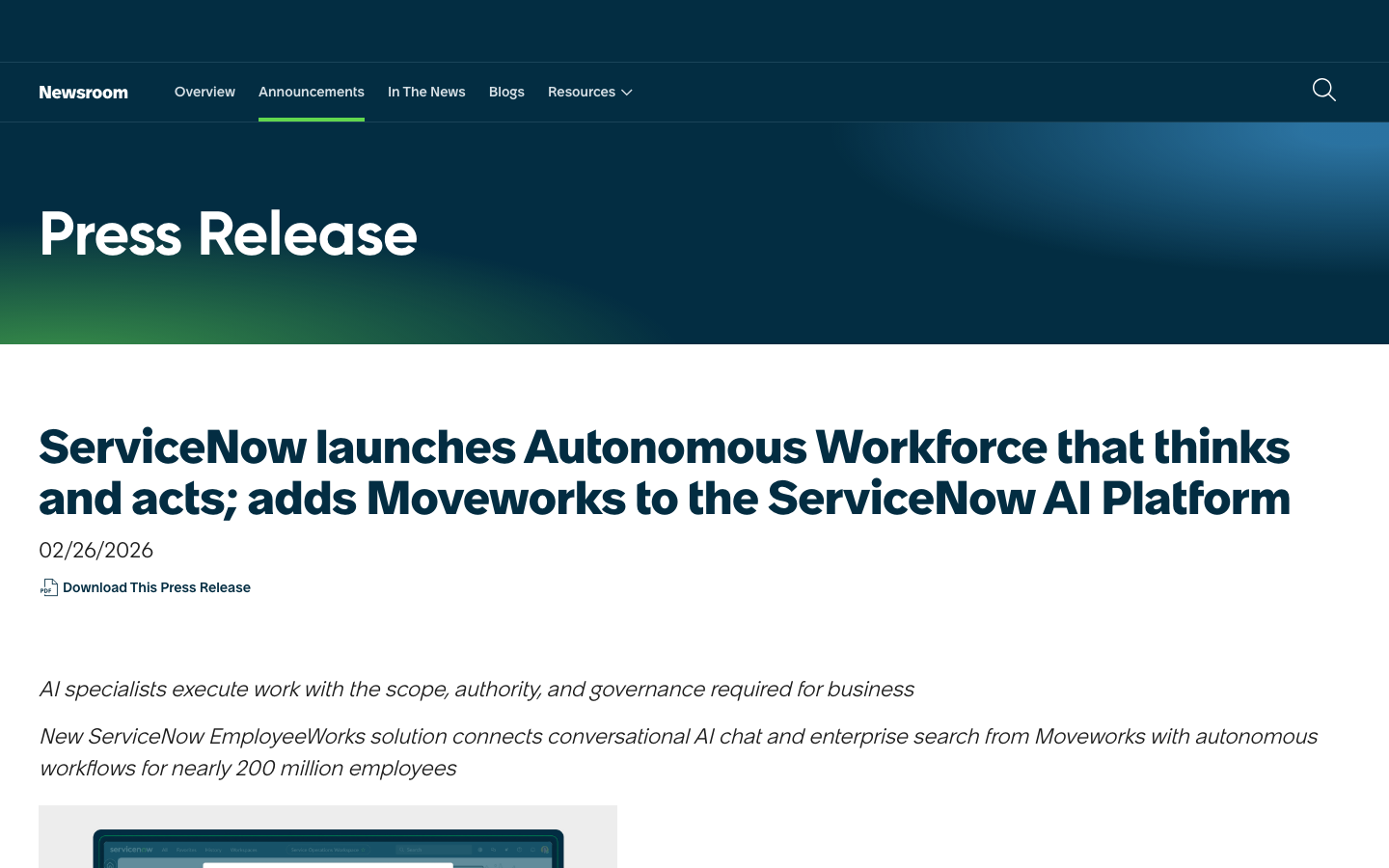
ServiceNow is the employee service option for enterprises already standardized on its platform, and its HR agent capability now ships as ServiceNow EmployeeWorks. That product launched in February 2026. It connects conversational AI and enterprise search from Moveworks, which ServiceNow acquired in December 2025, to workflows that execute multi-step employee requests. ServiceNow states the launch targets nearly 200 million employees.
Software Pros
- One front door across HR and IT for employees already inside the platform
- Agents follow existing business rules, approval paths, and role-based permissions
- Enterprise search across systems, which is what the Moveworks capability adds
Software Cons
- The heaviest implementation of the 12, and rarely a project HR runs alone
- Quote-based and priced per employee, so cost is a license footprint decision
- Its G2 profile covers HR Service Delivery rather than the newer agent product
ServiceNow Review
I would describe this as the option you take because the platform decision was already made. Where ServiceNow is your system of record, an agent executing inside your own approval paths is a strong position. Where it is not, you are buying a platform to get an agent.
Our Verdict
Enterprise Front Door Agent
Synthflow
Quick Overview
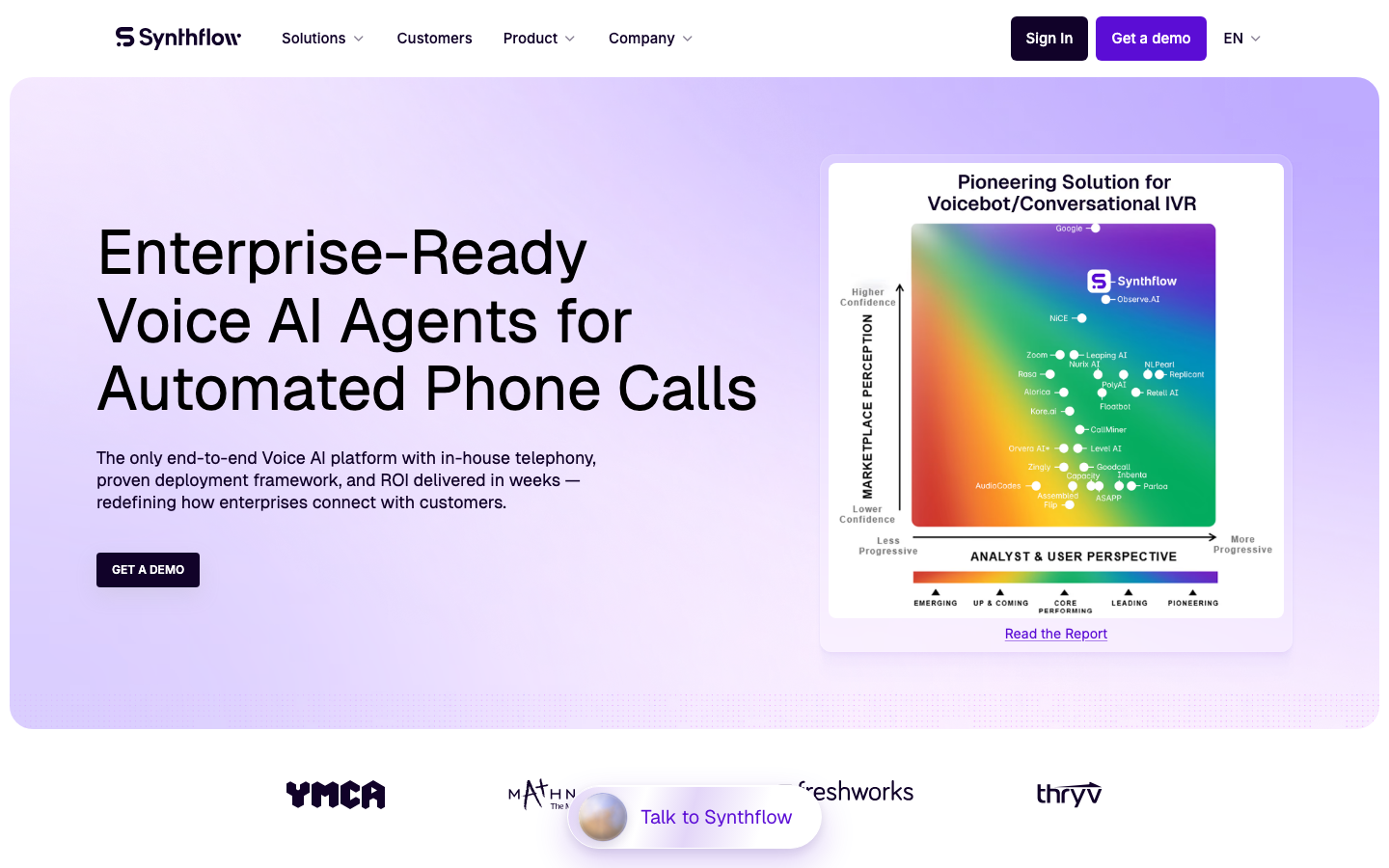
Synthflow is a horizontal voice platform that handles inbound and outbound phone conversations end to end, configured without code. HR and talent teams reach for it when they have no engineering support. It ships in-house telephony rather than assembling it, and the vendor states it powers over 65 million voice calls a month. Enterprise contracts start at $30,000 annually.
Software Pros
- No-code configuration, so the people who own the process can build the agent
- Native telephony plus SIP trunking, which removes a whole integration layer
- Agent memory across calls, so a returning caller is not starting from nothing
Software Cons
- Enterprise-only pricing now, with no self-serve tier to pilot on
- $30,000 a year is a large commitment for a single HR use case
- No HR logic out of the box, so the workflow is still yours to design
Synthflow Review
My impression of Synthflow is that it has moved decisively upmarket, and the pricing page is evidence of that. It completes phone conversations reliably and routes them, which is a real capability. An HR team buying it for screening alone pays enterprise rates for one workflow.
Our Verdict
No Code Enterprise Voice
*As pricing is subject to change, we are listing prices as they stand in August 2026
Vapi
Quick Overview
Vapi is developer-first voice infrastructure, and the most honest way to describe it is a set of building blocks with an API in front. It runs the voice workflow you script, with your choice of model, speech provider, and telephony behind it. Vapi publishes a platform fee of $0.05 per minute for calls and $0.005 per message, with model costs passed through.
Software Pros
- Transparent platform pricing separated from model costs, so you can see both
- Bring your own API keys and the model provider cost drops to zero on your bill
- Model, speech, and telephony are all swappable rather than fixed by the vendor
Software Cons
- This is infrastructure, so an HR team without engineering support cannot use it
- Compliance add-ons are priced separately, at $2,000 a month for HIPAA
- Three G2 reviews averaging 3.0 tells you almost nothing either way
Vapi Review
The part I trust in Vapi is that it does not pretend. The pricing page separates platform fee from model costs, the docs assume you are building, and nothing claims to understand hiring. For a team with engineers, that clarity is worth a lot. For a team without them, this is not a buying decision.
Our Verdict
Developer Voice Infrastructure
*As pricing is subject to change, we are listing prices as they stand in August 2026
Workativ
Quick Overview
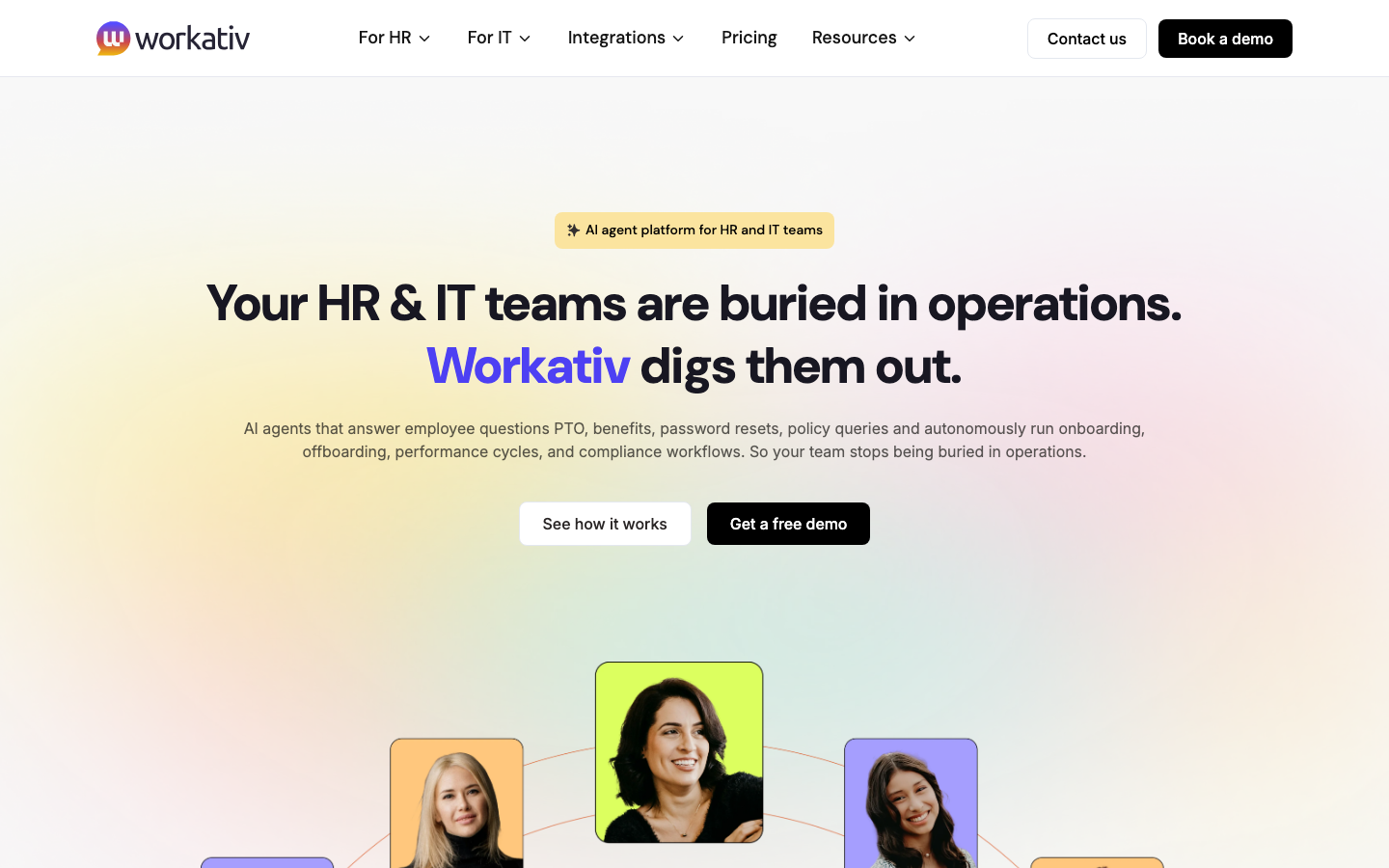
Workativ is an employee service platform for mid-market HR and IT teams, deployed in Slack and Microsoft Teams. Its agents answer PTO, benefits, and policy questions and then run onboarding, offboarding, and compliance workflows as multi-step actions. Pricing is published and session-based rather than per head, starting at $99 a month. The vendor claims customers resolve 65% to 80% of employee queries automatically.
Software Pros
- Session-based pricing with no per-user fee, which keeps cost predictable as you grow
- Workflow automation across 100+ connected apps, including HRIS and identity tools
- A genuinely low entry point, so a pilot does not need a capital request
Software Cons
- Session allowances are small at the lower tiers and run out faster than expected
- Lighter than the enterprise platforms on governance, reporting, and scale
- Three reviews on G2 leave you almost nothing outside the vendor’s own material
Workativ Review
After looking closely at Workativ, the pricing model is the key point. Paying per session rather than per employee means an agent nobody uses costs almost nothing, which is the right risk profile for a first deployment. It resolves routine queries and runs onboarding steps; exceptions go to a person.
Our Verdict
Predictable Mid Market Pricing
*As pricing is subject to change, we are listing prices as they stand in August 2026
Zendesk
Quick Overview
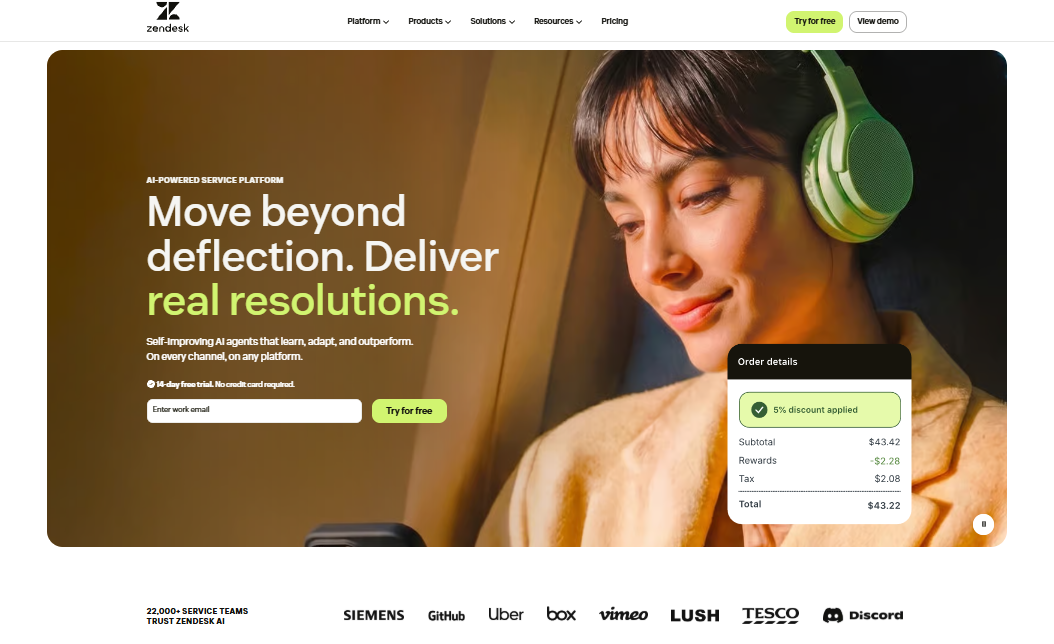
Zendesk brings its Resolution Platform to employee service: AI agents that resolve HR and IT requests end-to-end inside the channels employees already use. Agents answer from the knowledge base, execute workflows through HRIS and identity integrations, and escalate cleanly to a person with full context when a request leaves the script. It suits companies that want employee service running on the same platform their support teams already know.
Software Pros
- AI agents resolve routine HR and IT requests autonomously and hand off exceptions with the conversation attached
- Employees stay in Slack, Teams, email, or the portal; the agent meets them where the question starts
- The Resolution Platform pairs agents with knowledge management, so answer quality improves as the knowledge base does
Software Cons
- Built as a service platform first; teams wanting pre-trained HR-specific agents will configure more than with HR-native rivals
- Value depends on the state of your knowledge base, since agents answer from what is documented
- Strongest for organizations already running Zendesk, where employee service extends an existing deployment
Zendesk Review
Having looked closely at Zendesk’s employee service positioning, the argument is maturity of the underlying machinery. The AI agents, routing, and escalation paths are the same ones handling customer volume at scale, redirected to the internal queue. For a company whose support org already lives in Zendesk, extending that platform to HR requests is the shortest path to a working agent, and the escalation handover shows its class: the person picking up sees everything the agent did.
Our Verdict
Employee Service At Platform Scale
FAQs About AI Agents for HR
What Is an AI Agent in HR?
It is software that takes an instruction, works out the steps, and executes them in your systems, and the test is whether it finishes. Asked for proof of employment, a chatbot points at the policy page. An agent pulls the employee record, generates the letter with the correct dates and title, and sends it. Everything else about the category follows from that difference.
What Is the Best AI Agent for Recruiting Teams?
That depends entirely on your screening volume and your channel. Teams pushing thousands of applicants a month through phone-first roles need a different product from a corporate team screening two hundred. Look at the comparison table near the top of this page and filter on the family column first. 3 of the 13 are built for hiring, and the rest are not.
How Is an AI Agent Different From an HR Chatbot?
A chatbot retrieves and answers, while an agent decides and executes. Doing the second requires four things. It needs write access, a defined process, permissions tied to a real user identity, and a clean handover when the request leaves the script. Without all four, what you have is a well-mannered search box, whatever the vendor calls it.
What HR Tasks Can an Agent Handle on Its Own?
The proven ones are policy and benefits questions, leave balances, employment letters and similar documents, onboarding steps across systems, interview scheduling, and structured screening calls. What it should not do alone is anything with legal consequence, anything touching employee relations, and any decision a person could later contest. Those need a human signature, not just human review.
How Much Do AI Agents for HR Cost?
Four units are in use: per resolved task, per session, per employee, and per minute. Among the 13 reviewed here, published figures start at $0.05 per minute of platform time and $99 a month for a session bundle. They run up to annual contracts of $25,000 and $30,000, all as of August 2026. Half publish nothing at all and quote instead.
Do Employees and Candidates Have to Be Told They Are Talking to an AI?
Disclosure is the expected practice, and several jurisdictions now regulate automated decision tools in hiring specifically. Beyond compliance, there is a practical reason: acceptance is measurably better when people are told upfront and can reach a person on request. Rules differ by state and country, so check yours. Nothing here is legal advice.
Will Agents Replace HR Staff?
They absorb repetitive request handling, which is coordinator and shared services work rather than the whole job. They don’t take over judgment, escalation, employee relations, or anything an employee could dispute. The realistic outcome is narrower. Response times on routine requests drop sharply, and the team spends its hours on the cases that were always the hard part.
Can Agents Work With Our Existing HRIS and Service Desk?
Most vendors document connectors for major systems, but read access and write access are very different. An agent that can only read your HRIS will quote a leave balance and then ask the employee to file a request anyway. One-way integration caps what the agent can finish, which puts you back where you started. Ask which specific fields it can update.

Helen is Anywherer’s Market Analyst & Content Researcher, with extensive experience in analyzing global employment markets and HR technology trends. She is skilled at turning complex market data into clear, well-researched insights that inform every piece of content. With a strong grasp of the EOR, PEO, and international hiring space, Helen plays a key role in keeping Anywherer’s research accurate, up to date, and genuinely useful for readers.