Finding the Best Employee Survey Tools for Modern Organizations
Employee survey software gives HR a repeatable way to ask how work is going, protect answers, and track scores across remote, hybrid, and on-site teams.
The baseline is sobering. Gallup’s State of the Global Workplace: 2026 Report puts global engagement at 20% of employees, so employee engagement survey software is not going to lift a workforce on its own; it tells you where the problem sits and whether anything you tried has worked.
Cadence is the first decision. Employee satisfaction survey software is usually a deep annual or semi-annual questionnaire, while pulse surveys are short check-ins that keep the conversation alive between rounds.
Survey results also carry over into related programs. If wellbeing is part of the picture, our guide to employee wellness platforms covers tools that act on what a survey reveals about stress and workload.
What Employee Survey Software Does
It builds and sends questionnaires, protects respondents’ identities, tracks scores over time, and turns results into something managers can act on.
The survey types differ by depth and cadence. Employee opinion survey software covers the broad annual questionnaire, engagement surveys measure the drivers behind how people feel, satisfaction surveys focus on the experience itself, and pulse surveys repeat a few questions on a short cycle.
Every product reviewed here is online employee survey software, delivered through a browser and usually a phone app, so nobody has to be in an office to answer.
The category then splits by whether surveys are the product or a module. Survey software for employee engagement is built around thresholds, benchmarks, and action plans, while a general builder gives you a blank form and leaves the rest to you.

INSIGHT: Why survey at all if engagement barely moves?

Global numbers have been flat for years, which is why the value sits in your own trend line rather than the benchmark.
- Global engagement stood at 20% of employees in 2025, the figure Gallup publishes in its State of the Global Workplace: 2026 Report.
- Gallup also reports that, globally, only 1 in 4 employees strongly agree that their opinions seem to count at work.
- A tool makes surveying repeatable and results comparable over time. Whether anything changes afterward is a management decision that no software supplies.
Sources:
- Gallup, State of the Global Workplace: 2026 Report
- Gallup, 5 Ways to Make the Most of Employee Voice
both checked September 18, 2026
Top Employee Engagement Survey Tools Comparison: Type, Anonymity, and Cadence
Vendors in this category describe themselves in nearly identical language, so the table below sorts the best employee engagement survey software by what it actually is and what it will show a manager.
Read the anonymity column next to the type column. Employee engagement survey software enforces a minimum group size before results appear, and a general builder simply does not have that concept.
| Tool | Type | Best for | Anonymity | Shortest cadence | Rating (G2) |
|---|---|---|---|---|---|
| 15Five | HR suite with surveys | Weekly check-ins with manager follow-up | Not stated | Weekly | 4.6/5 (1,927) |
| Culture Amp | Dedicated engagement platform | Engagement with benchmarks | Reporting group minimum, example 5 | Pulse, on demand | 4.5/5 (1,617) |
| CultureMonkey | Dedicated engagement platform | Automated listening rhythm | Not stated in block | Automated scheduling | 4.7/5 (67) |
| Effectory | Dedicated engagement platform | European, consultancy-led programs | Not stated | On demand | 4.8/5 (4) |
| Empuls | HR suite with surveys | Surveys besides recognition | Confidentiality thresholds, number not stated | Pulse, on demand | No Empuls profile |
| Engagedly | HR suite with surveys | Surveys beside goals and reviews | Not stated | On demand | 4.3/5 (545) |
| Jotform | General survey builder | Quick forms for any question | No threshold feature | On demand | 4.7/5 (5,578) |
| Lattice | HR suite with surveys | Engagement inside a people platform | Not stated | Pulse, on demand | 4.6/5 (4,124) |
| Leapsome | HR suite with surveys | Engagement with learning and reviews | Anonymous responses supported | Pulse, on demand | 4.8/5 (2,577) |
| LimeSurvey | General survey builder | Self-hosted surveys and data control | Anonymized responses option | On demand | 4.2/5 (33) |
| Microsoft Forms | General survey builder | Teams already on Microsoft 365 | No threshold feature | On demand | 4.4/5 (475) |
| Microsoft Viva Glint | Dedicated engagement platform | Enterprise listening in Microsoft 365 | 3 responses minimum, 5 by default | Always-on, on demand | 4.6/5 (42) |
| Motivosity | HR suite with surveys | eNPS beside recognition | Anonymous responses supported | Pulse, on demand | 4.7/5 (3,638) |
| Officevibe (Workleap) | Dedicated engagement platform | Team-level pulses and manager tips | 3 for scores, 5 for written comments | Weekly | 4.3/5 (1,090) |
| Perceptyx | Dedicated engagement platform | Enterprise listening programs | Not stated | Always-on, on demand | 4.5/5 (39) |
| Polly | Chat-native polling | Polls inside Slack and Teams | Anonymous responses supported | On demand | 4.6/5 (94) |
| Qualtrics | General survey builder | Research-grade survey design | Not stated | On demand | 4.4/5 (463) |
| Quantum Workplace | Dedicated engagement platform | Engagement with action planning | Not stated | Pulse, on demand | 4.3/5 (878) |
| QuestionPro Workforce | Dedicated engagement platform | Benchmarked engagement cycles | Not stated | Pulse, on demand | 4.5/5 (1,159) |
| Sogolytics | General survey builder | Survey platform with an EX module | Anonymity option stated | On demand | 4.6/5 (87) |
| SurveyMonkey | General survey builder | Familiar templates for one-off surveys | No threshold feature | On demand | 4.4/5 (23,906) |
| SurveySparrow | General survey builder | Conversational surveys and response rates | Not stated | Recurring, on demand | 4.4/5 (2,066) |
| TINYpulse (WebMD Health Services) | Dedicated engagement platform | Pulses tied to wellbeing programs | Anonymous responses supported | Weekly | 4.4/5 (214) |
| Typeform | General survey builder | One question at a time | No threshold feature | On demand | 4.5/5 (1,014) |
| Winningtemp | Dedicated engagement platform | Frequent pulses with AI analysis | Anonymous responses supported | Weekly | 4.5/5 (58) |
| Workday Peakon Employee Voice | Dedicated engagement platform | Continuous listening at scale | Configurable thresholds, example 5 | Weekly | 4.6/5 (117) |
| WorkTango | HR suite with surveys | Surveys besides recognition and rewards | Not stated | Pulse, on demand | 4.7/5 (1,329) |
| Zoho Survey | General survey builder | Teams already using Zoho | Anonymous response option | On demand | 4.4/5 (1,040) |
Ratings show the score out of 5 and the number of reviews on each product’s G2 page, read in September 2026.
INSIGHT: Platform, module, or form builder?
These 28 products fall into 4 groups, and most budgets go wrong when they pay platform prices for a form builder or expect platform analytics from one.
- Dedicated engagement and listening platforms (for example Culture Amp, CultureMonkey, Effectory, Officevibe, Perceptyx, Quantum Workplace, QuestionPro Workforce, TINYpulse, Viva Glint, Winningtemp, Workday Peakon): surveys are the product, with thresholds, benchmarks, and action planning built in.
- HR suites with a survey module (for example 15Five, Empuls, Engagedly, Lattice, Leapsome, Motivosity, WorkTango): surveys sit beside reviews, goals, or recognition and are rarely bought alone.
- General survey builders (for example Jotform, LimeSurvey, Microsoft Forms, Qualtrics, Sogolytics, SurveyMonkey, SurveySparrow, Typeform, Zoho Survey): flexible and cheap, with no reporting thresholds or engagement benchmarks unless you build them yourself.
- Chat-native polling (Polly): questions where people already talk, at the cost of depth.
Sources:
- Culture Amp confidentiality documentation
- Microsoft Viva Glint privacy documentation
- Jotform pricing
- Polly
all checked September 18, 2026
The 4 Kinds of Tools on This List, and Quick Picks
Dedicated engagement platforms treat listening as the product: they ship question sets, benchmarks, reporting thresholds, and action plans. HR suites include a survey module alongside reviews, goals, or recognition, which is convenient when you already pay for the suite and limiting when you don’t.
General survey builders give you a blank canvas and no HR logic, which is cheap and risky in equal measure. Chat-native polling puts a question in Slack or Teams and accepts shallow analysis.
6 of these tools also appear in our performance management software guide, which reviews them for reviews, goals, and development; on this page they are judged only on the survey module.
The shortlists below group them by the job you are hiring a tool to do, alphabetically and with no ranking implied.
- Pulses inside chat: Leapsome, Officevibe (Workleap), and Polly are the employee survey tools that integrate with Slack and Microsoft Teams most naturally.
- Annual engagement with benchmarks: Culture Amp, Quantum Workplace, and QuestionPro Workforce ship industry benchmarks with the annual cycle.
- Enterprise listening: Microsoft Viva Glint, Perceptyx, and Workday Peakon Employee Voice are the enterprise employee survey software options built for tens of thousands of responses.
- Across the employee lifecycle: 15Five, Microsoft Viva Glint, and Qualtrics run employee lifecycle survey software for onboarding, milestones, and exit interviews.
- Surveys plus recognition: Empuls, Motivosity, and WorkTango combine surveys with recognition in a single platform.
- Small teams on a budget: Jotform, SurveySparrow, and Zoho Survey are affordable employee engagement survey tools for a team that needs results this month, not a program.
- Mobile and frontline teams: Polly, SurveySparrow, and Typeform work best as an employee survey app on a phone, which matters for frontline staff without a desk.
- Always-on listening: 15Five, Officevibe (Workleap), and Winningtemp work like employee engagement survey apps with always-on prompts rather than scheduled campaigns.
Recognition and listening often land in the same budget. Our guide to employee recognition software covers the platforms built around praise and rewards, which is a different job from measuring engagement.
New-hire surveys are a program of their own. Our roundup of employee onboarding software covers the tools that run the first 90 days, which is where those questions usually belong.
INSIGHT: How anonymous is an anonymous survey?
Anonymity is a reporting rule rather than a promise, and the rule is a number the vendor should be able to state.
- A reporting threshold is the minimum number of responses a group needs before its results are shown. Published examples on this list range from 3 to 10: Microsoft Viva Glint needs at least 3 responses for a confidential survey, and displays scores at 5 and comments at 10 by default; Workleap Officevibe shows scores at 3 and anonymous written comments at 5, and Culture Amp and Workday Peakon both use 5 as the worked example in their documentation.
- Anonymous and confidential are not the same thing. Culture Amp says plainly that its surveys are confidential, meaning responses are linked to demographics but never shown individually, while tools such as Polly, Winningtemp, and TINYpulse offer responses no one can attribute.
- Ask 3 questions before signing: what the threshold is, whether an administrator can filter below it, and whether open-text comments can be traced back to a person.
Sources:
all checked September 18, 2026
Employee Pulse Survey Tools: Short Questions, Steady Cadence
A pulse survey is a handful of questions asked on a fixed short cycle, weekly or monthly, and tracked as a trend. Employee pulse survey software makes that repetition painless: automated scheduling, reminders, and a chart that shows the same question over time.
It is not a replacement for the annual questionnaire. The deep survey measures drivers across the whole organization and compares them with a benchmark; the pulse tells you whether anything changed since then. Employee engagement pulse survey tools are built for the second job, so their reports open on trend lines rather than a single score.
Almost every product on this page can send a short survey. Only some are designed around the cadence, with scheduling, manager-level views, and thresholds that still hold when a team is small. Here are the top employee pulse survey tools from the main list, in alphabetical order.
- 15Five: weekly check-ins that land in the manager’s 1:1 agenda rather than a report.
- CultureMonkey: automated scheduling that keeps a listening rhythm going with little admin, as its block describes.
- Leapsome: recurring surveys delivered in Slack and Microsoft Teams, with anonymous responses.
- Officevibe (Workleap): short weekly questions with published thresholds: 3 responses for scores, 5 for written comments.
- Polly: quick recurring polls inside chat, where the response rate is the whole point.
- TINYpulse (WebMD Health Services): short recurring surveys with anonymous two-way messaging for follow-up questions.
- Winningtemp: frequent short surveys with trend lines and an AI layer that explains movement.
- Workday Peakon Employee Voice: continuous questions with configurable visibility thresholds for segments and comments.
If you are shortlisting the best employee pulse survey tools 2026 has to offer, start with the cadence you can sustain: a weekly question that nobody reviews does more damage than a quarterly one that leads to a decision.
Employee Survey Software Pricing
Pricing here follows 4 models. Dedicated platforms charge per employee per year, usually with a minimum headcount or a minimum contract value, which is why several publish a floor rather than a rate. HR suites fold surveys into a per-seat price for the wider product. General builders charge per creator or per seat, with employees answering for free, and cap responses on lower tiers. Free plans exist across the builders, but they cap responses rather than features, so a company-wide survey will exhaust one in a single round.
| Tool | Pricing model | Free plan or trial | Starting price |
|---|---|---|---|
| 15Five | Per user per month, billed annually | No (demo) | $4/user/month (Engage) |
| Culture Amp | Quote by employee count and modules, billed annually | No (demo) | Custom pricing |
| CultureMonkey | Not stated in block | Not stated in block | Not stated in block |
| Effectory | Quote after a consultation | No (demo) | Custom pricing |
| Empuls | Modular, priced by chosen modules | Trial available | Custom pricing |
| Engagedly | Per user per month by module | No (demo) | Minimum $7,500 a year |
| Jotform | Per account by form and submission limits | Yes (Starter) | €34/month billed annually (Bronze, EU pricing) |
| Lattice | Per seat by product | No (tour) | $4/seat/month (Engagement) |
| Leapsome | Quote by module | Trial only (14 days) | Custom pricing |
| LimeSurvey | Per plan by responses, or self-host free | Yes (free plan) | €29/month billed annually (Expert, EU pricing) |
| Microsoft Forms | Included with Microsoft 365 | Yes (with a Microsoft account) | Included in Microsoft 365 plans |
| Microsoft Viva Glint | Licensed through Microsoft Viva | No (demo) | Custom pricing |
| Motivosity | Per user per month by module | No (demo) | $3,000 minimum spend |
| Officevibe (Workleap) | Annual plan by employee count | No (demo) | From $4,999 a year (Workleap plans) |
| Perceptyx | Quote after a demo | No (demo) | Custom pricing |
| Polly | Per license per year | Trial only | $228 a year per license (Slack plan) |
| Qualtrics | Quote by program and users | Free account for basic surveys | Custom pricing |
| Quantum Workplace | Annual contract by user count | No (demo) | Minimum annual contract $15,000 |
| QuestionPro Workforce | Per plan, quote for workforce programs | Yes (free tier) | Custom pricing |
| Sogolytics | Per user per plan | Yes (free plan) | Custom pricing |
| SurveyMonkey | Per user per month | Yes (free plan) | €30/user/month (Team Advantage, EU pricing) |
| SurveySparrow | Per plan by responses and users | Yes (free plan) | €19/month billed yearly (Basic, EU pricing) |
| TINYpulse (WebMD Health Services) | Quote through WebMD Health Services | No (demo) | Custom pricing |
| Typeform | Per plan by responses and users | Trial only (14 days) | €25/month (Basic, EU pricing) |
| Winningtemp | Quote after a demo | No (demo) | Custom pricing |
| Workday Peakon Employee Voice | Quote through Workday | No (demo) | Custom pricing |
| WorkTango | Quote by modules and headcount | No (demo) | Custom pricing |
| Zoho Survey | Per user per month | Yes (free plan) | Custom pricing |
As pricing is subject to change, prices are listed as of September 2026.
How to Choose an Employee Survey Tool
Start with the honest question: do you need a listening platform, or a survey builder and a spreadsheet? That single decision splits this list in half, and the price difference between the halves is roughly tenfold.
Then pick a cadence you can sustain. A weekly pulse with nobody reading the results is worse than no pulse at all, because employees learn that answering changes nothing.
Next, check the anonymity threshold and ask how the vendor handles small teams. A team of 5 cannot be anonymous in any meaningful sense, so the tool has to hide those results rather than leave the manager to work it out.
Ask where benchmarks come from and how old they are. A benchmark built on a different industry or a different decade will send you chasing the wrong gap.
Compare employee survey tools analytics features carefully, because this is where the category separates: some products give you a bar chart of scores, others give driver analysis, sentiment on open comments, and a recommended action.
AI tools for analyzing employee survey data are now standard at the top of the market. Culture Amp, QuestionPro Workforce, Sogolytics, and Winningtemp all publish AI features that summarize comments or explain score changes, and all still need a human to decide what to do about it.
Finally, check how the results travel. Employee engagement survey HR software that syncs with your HRIS keeps departments, managers, and tenure fields accurate without a monthly CSV, and that accuracy is what makes team-level reporting trustworthy.
Best Employee Survey Tools 2026: Complete Guide
The tools below range from free form builders to enterprise listening programs, and employee engagement survey tools sit in the middle of that range, where most companies end up.
There is no single best employee survey software for every company: the right pick depends on how often you plan to ask, how big your smallest team is, and who has to read the results.
This roundup of the best employee engagement survey tools 2026 includes only options that are still sold and maintained, which is why 2 customer experience tools were removed from the list in this update.
For each entry, we checked the vendor’s own product and pricing pages in September 2026, read the documentation on anonymity and cadence where it exists, and took the rating from the tool’s public G2 profile, which is how we separate the best employee engagement survey providers from the ones with a good homepage.
I list the platforms below in alphabetical order to make a side-by-side comparison easier.
15Five
Quick Overview
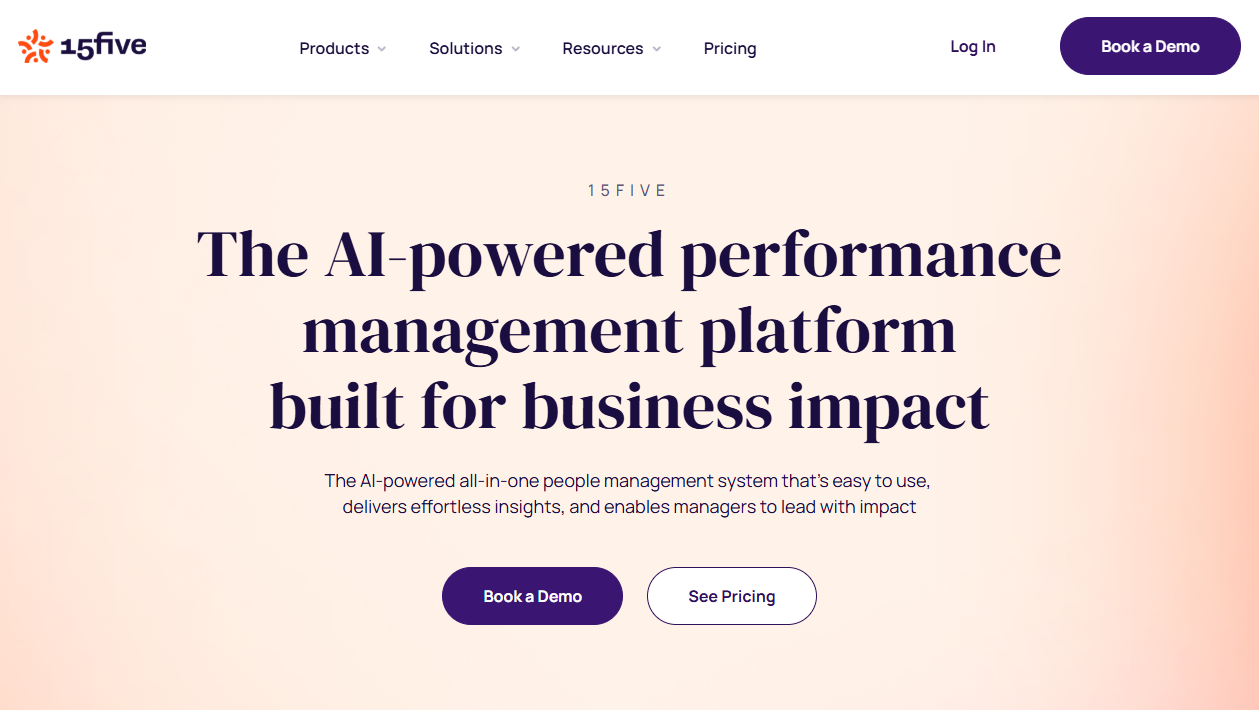
15Five is a performance platform whose listening side runs weekly check-ins, engagement surveys, and eNPS, with onboarding and exit surveys on its higher plans.
Software Pros
- Weekly check-ins that feed manager 1:1s
- Engagement surveys and eNPS in the same plan
- Industry benchmarking on the top tier
Software Cons
- Listening data is tied to a performance product you may not need
- Value drops when managers skip the weekly rhythm
15Five Review
Weekly cadence is the point here. 15Five asks a handful of questions every week and puts the answers in the manager’s 1:1 agenda instead of a quarterly deck. Its Engage plan starts at $4 per user per month billed annually, which is inexpensive for a listening habit and expensive if all you wanted was 1 annual questionnaire.
Our Verdict
Weekly Check-Ins With Manager Follow-Up
Culture Amp
Quick Overview
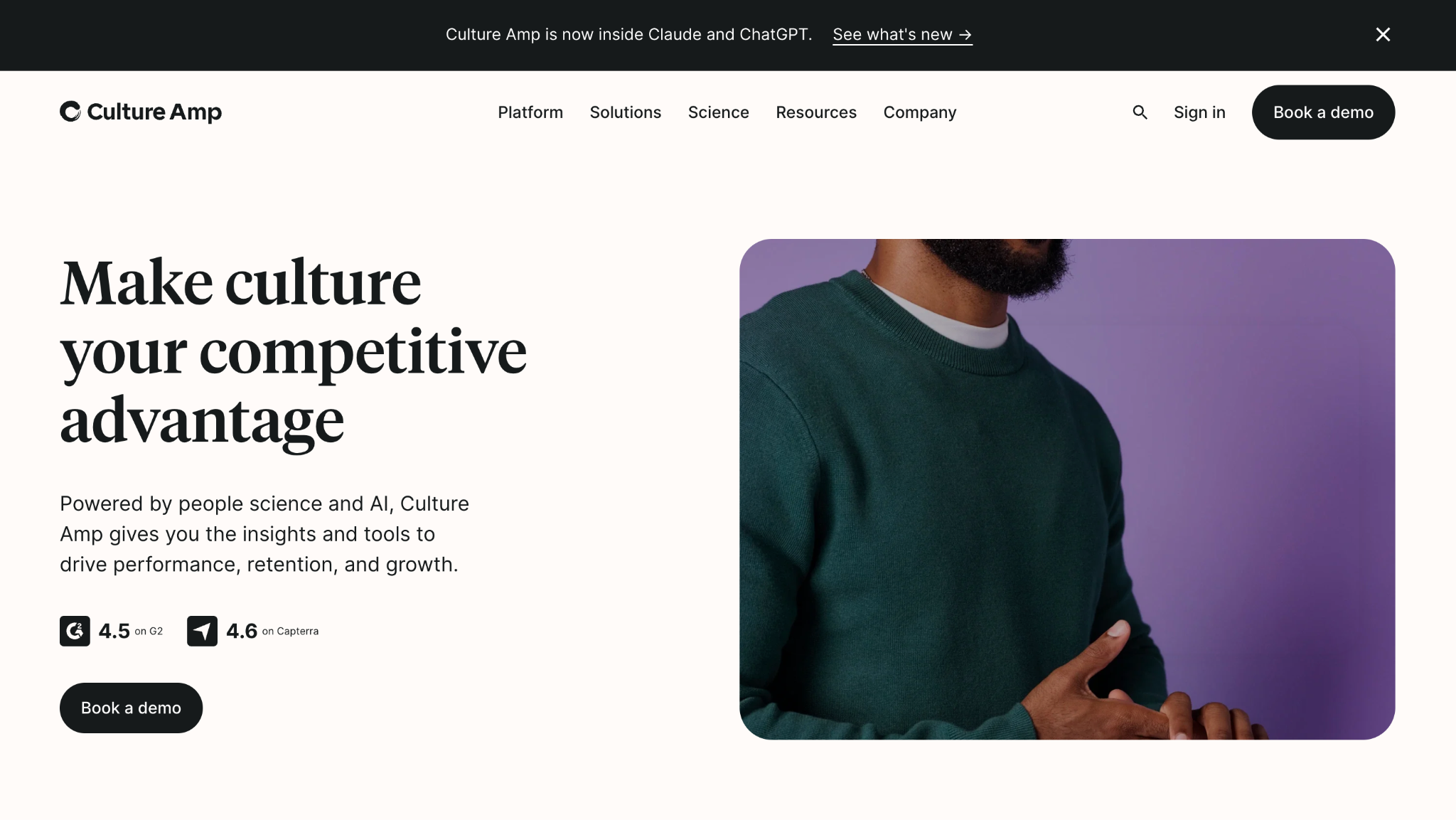
Culture Amp is an engagement platform built around benchmarked surveys, driver analysis, and action planning, with an AI Coach that summarizes comments and drafts next steps for managers.
Software Pros
- Benchmarks drawn from a very large response database
- AI comment summaries and suggested actions
- Slack, Microsoft Teams, and HRIS integrations
Software Cons
- Priced by employee count and billed annually, with no public rate
- More program than a small team can realistically run
Culture Amp Review
Culture Amp is unusually precise about privacy: it describes its surveys as confidential rather than anonymous, and a reporting group minimum hides results for groups that are too small, with 5 used as the example in its own documentation. Wording like that turns a privacy promise into a rule you can point at.
Our Verdict
Benchmarked Engagement With Action Plans
CultureMonkey
Quick Overview
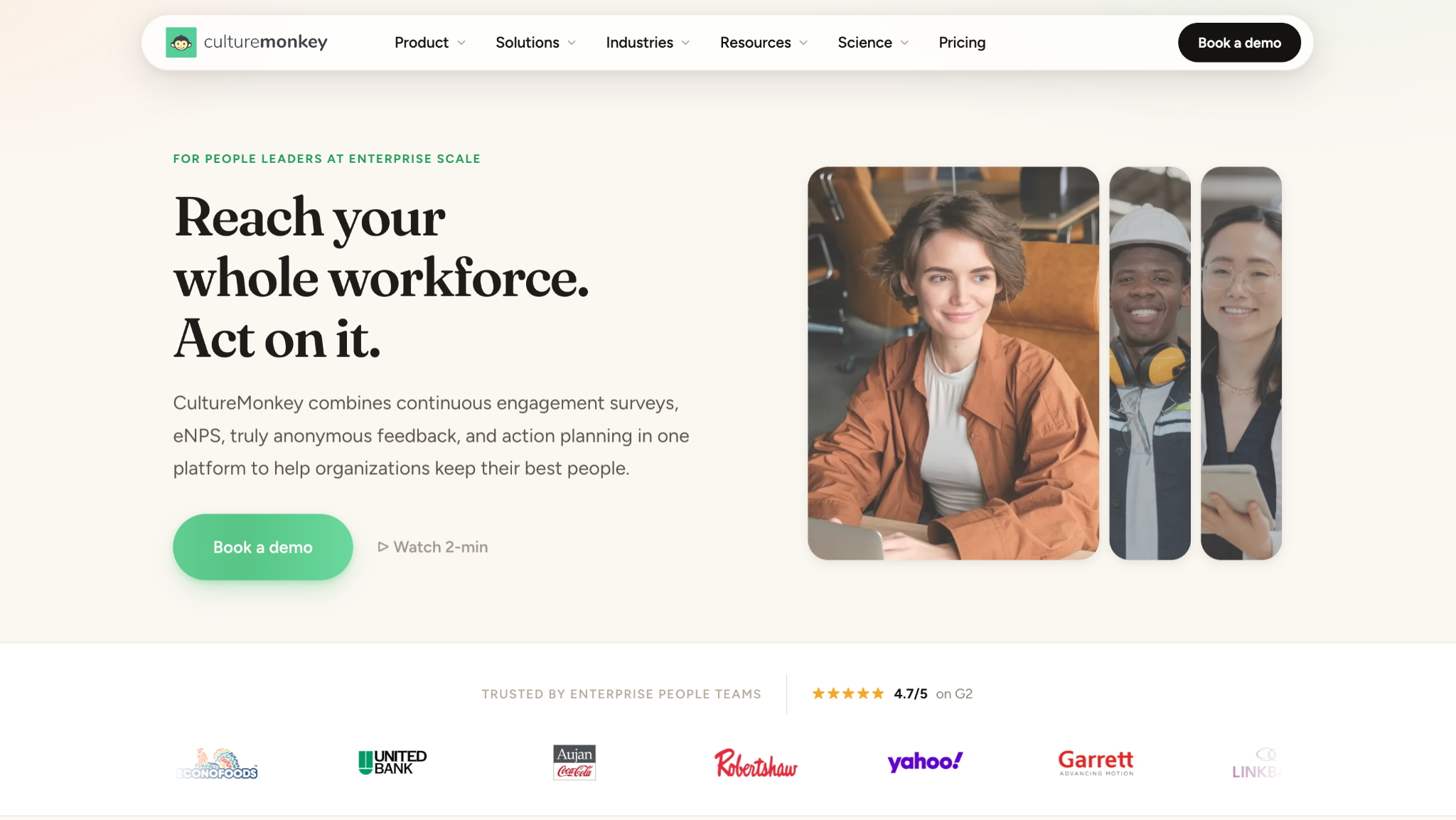
CultureMonkey is a platform for running employee surveys and collecting engagement feedback.
Software Pros
- Automated scheduling
- Easy setup
- Modern interface
Software Cons
- Users want broader functionality beyond surveys
- Templates library could be more modern and progressive
CultureMonkey Review
CultureMonkey feels refreshingly easy to adopt, particularly for teams that value automation and rhythm. From my point, the platform keeps engagement listening consistent without adding operational overhead.
Our Verdict
Automated Engagement Surveys
Effectory
Quick Overview
Effectory is a European employee listening provider that pairs survey technology with consultants who help design the questionnaire and interpret the results with leadership.
Software Pros
- Structured programs delivered with advisory support
- Long track record with European employers
- Benchmarks and follow-up sessions included in programs
Software Cons
- The consultancy model costs more than self-service tools
- Nothing published on price, so the first number arrives from sales
Effectory Review
Where most vendors sell software, Effectory sells a program: someone helps write the questions, then walks the leadership team through what the answers mean. For an HR function without an analyst, that is the difference between a report and a decision; for one that already has an analyst, it is an extra line in the budget.
Our Verdict
Consultant-Led Listening Programs
Empuls
Quick Overview
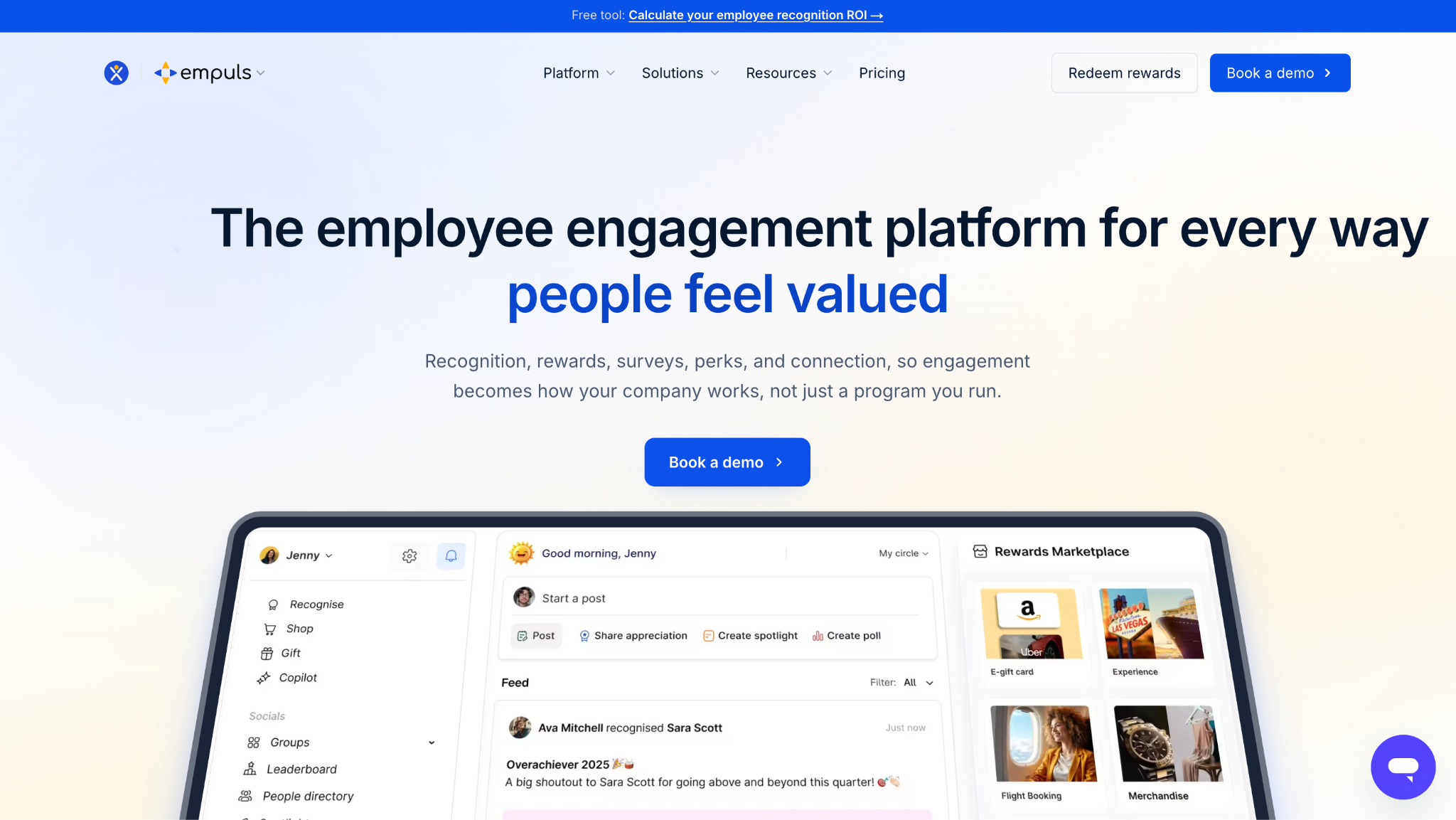
Empuls, from Xoxoday, combines pulse, lifecycle, and 360 surveys with recognition, rewards, and a company feed. Pricing follows the modules you switch on rather than a single per-seat rate.
Software Pros
- Pulse, lifecycle, and eNPS surveys in a single module
- Two-way sync with 50+ HRIS platforms
- AI summaries and suggested action plans
Software Cons
- The listening module sits inside a wider engagement suite
- Modular pricing makes side-by-side comparison harder
Empuls Review
Empuls says its surveys are anonymous by design, with confidentiality thresholds, but it does not publish the number behind them. Ask for it in writing before launch, because that figure is exactly what you will need to quote when an employee asks who can see their answers.
Our Verdict
Surveys Bundled With Recognition
Engagedly
Quick Overview
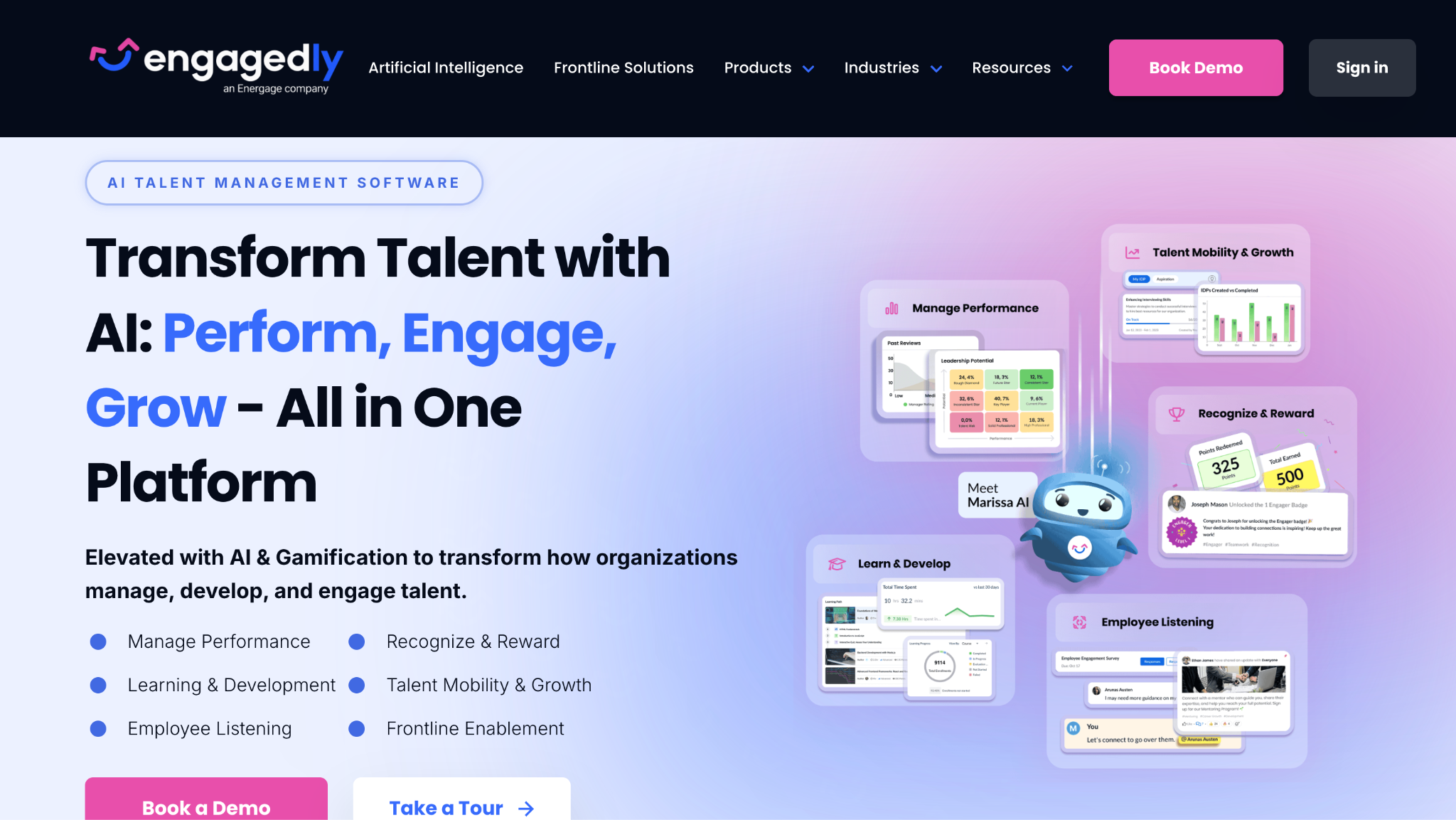
Engagedly is a talent suite where engagement surveys sit next to goals, reviews, and learning, sold as modules with an annual minimum spend.
Software Pros
- Surveys connect to goals and development plans
- Modules can be licensed separately
- Mobile-friendly for teams away from a desk
Software Cons
- Survey features remain secondary to performance management
- Minimum spend of $7,500 a year applies
Engagedly Review
Engagedly’s survey module is capable rather than deep, which suits a company buying Engagedly for reviews and taking listening along with it. Anyone shopping for surveys alone will struggle to justify the annual minimum against the dedicated platforms on this list.
Our Verdict
Surveys Inside a Talent Suite
Jotform
Quick Overview
Jotform is a form builder with survey templates, conditional logic, and a long integration list. It is priced by forms and monthly submissions rather than by employee.
Software Pros
- Free Starter plan with 5 forms and 100 monthly submissions
- Conditional logic and integrations with common work tools
- Cheap to run for occasional or one-off surveys
Software Cons
- No anonymity thresholds and no engagement benchmarks
- Analysis stops at basic charts and exports
Jotform Review
Jotform is what many HR teams quietly use for exit interviews and one-off polls, and it does that job well. What it cannot do is protect a small team: nothing in the product will warn you that only 3 people answered and their manager can guess who said what.
Our Verdict
Flexible Forms Without HR Analytics
Lattice
Quick Overview
Lattice is a people platform whose Engagement product runs pulse and annual surveys alongside goals, reviews, and 1:1s.
Software Pros
- Engagement sold as a standalone product
- Pulse surveys tracked as trends over time
- Results sit beside goal and review data for the same team
Software Cons
- The minimum group size for reporting is not published
- Full value assumes more than the engagement module
Lattice Review
Buying Lattice for surveys alone is unusual but possible, and the advantage is context: an engagement dip appears next to the goals and 1:1 history for that team, which shortens the argument about what to do next. Ask about small-team reporting rules during the demo, since the figure is not on the site.
Our Verdict
Engagement Beside Goals and Reviews
Leapsome
Quick Overview
Leapsome runs engagement and pulse surveys inside a people platform that also covers reviews, goals, and learning, with anonymous responses and delivery through Slack and Microsoft Teams.
Software Pros
- Anonymous responses supported across survey types
- Surveys link to learning paths and review cycles
- Delivery inside Slack and Microsoft Teams
Software Cons
- Quoted by module rather than published per seat
- Best value only when several modules are in use
Leapsome Review
Leapsome’s survey builder is quick, and the reporting is readable, which matters more than a feature count when a manager has 15 minutes to look at results. Because surveys arrive in chat rather than email, response rates depend less on people clearing their inbox.
Our Verdict
Pulse Surveys in a People Platform
LimeSurvey
Quick Overview
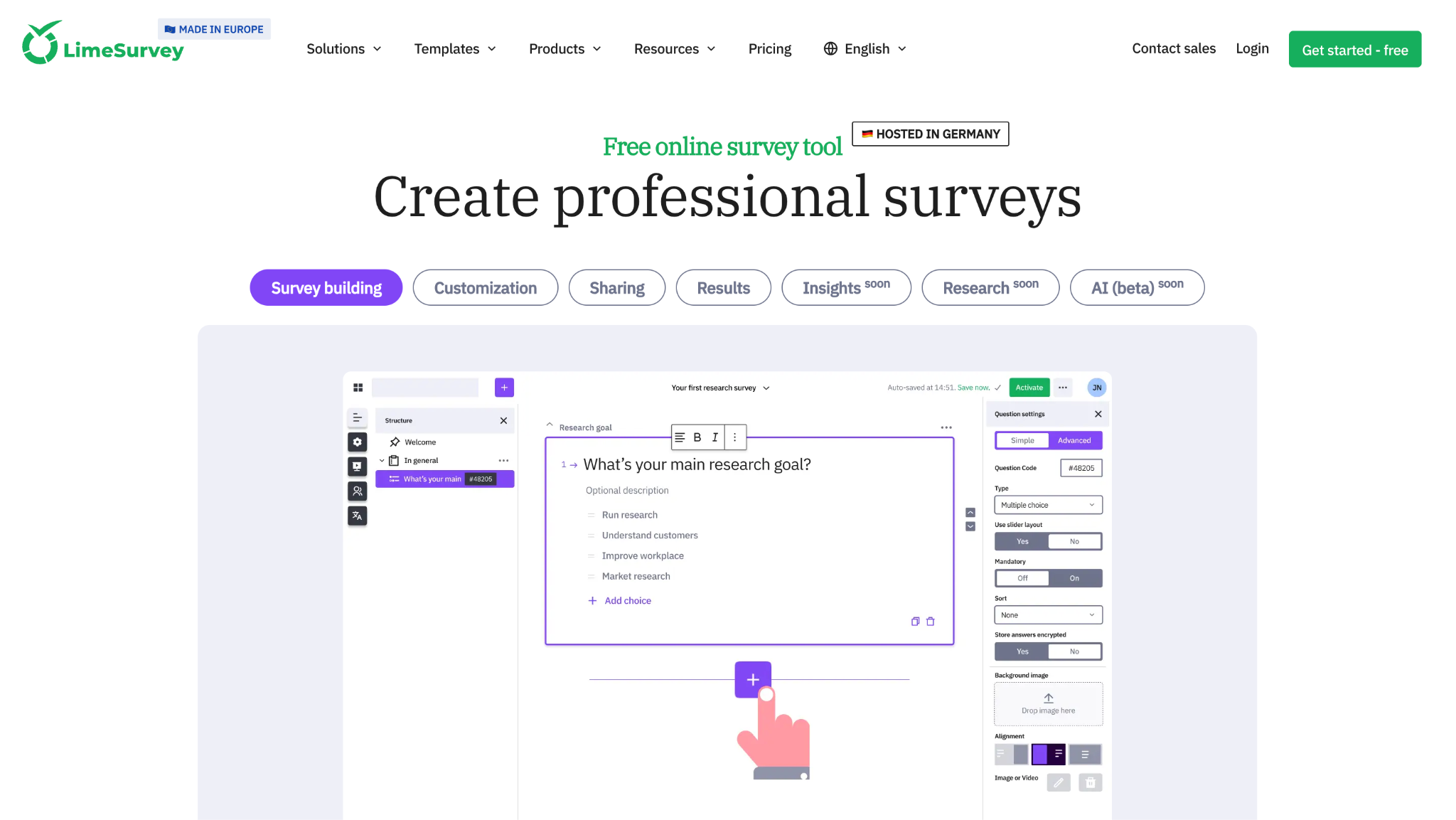
LimeSurvey is open-source survey software you can self-host or buy as a cloud plan. Control over where the data lives is the reason most teams choose it.
Software Pros
- Open source and self-hostable with no license fee
- Anonymized response option built in
- Unlimited surveys and questions on paid plans
Software Cons
- Self-hosting needs someone to own the server
- No engagement benchmarks or HR-specific reporting
LimeSurvey Review
For a works council or a security team that will not accept a hosted US platform, LimeSurvey is often the only workable answer on this list. Cloud plans start at €29 a month billed annually on its own pricing page, and the self-hosted route swaps that fee for maintenance time.
Our Verdict
Self-Hosted Surveys and Data Control
Microsoft Forms
Quick Overview
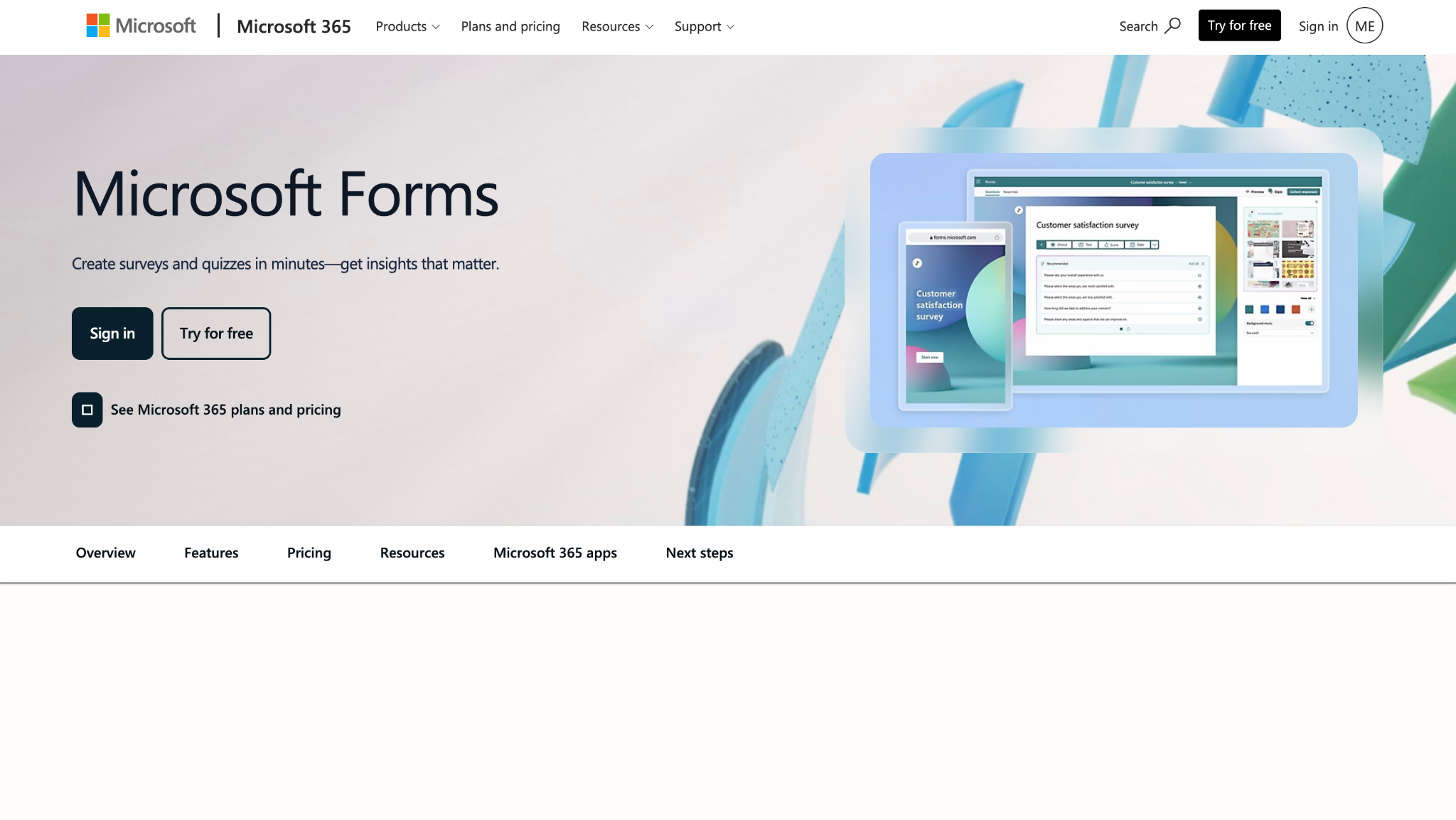
Microsoft Forms is the questionnaire tool included with Microsoft 365. Anyone with a work account can build a survey, send it, and open the results in Excel.
Software Pros
- Included with Microsoft 365 business plans
- Results export straight into Excel
- Familiar to anyone already using Office apps
Software Cons
- No anonymity thresholds and no engagement analytics
- Requires a Microsoft 365 license to use at work
Microsoft Forms Review
Nobody really buys Microsoft Forms; they already have it, so it’s the default for a quick poll. It is the wrong tool for a listening program, because the reporting cannot hide small groups or compare a score against anything but the last time you asked.
Our Verdict
Included Tool for Quick Polls
Microsoft Viva Glint
Quick Overview
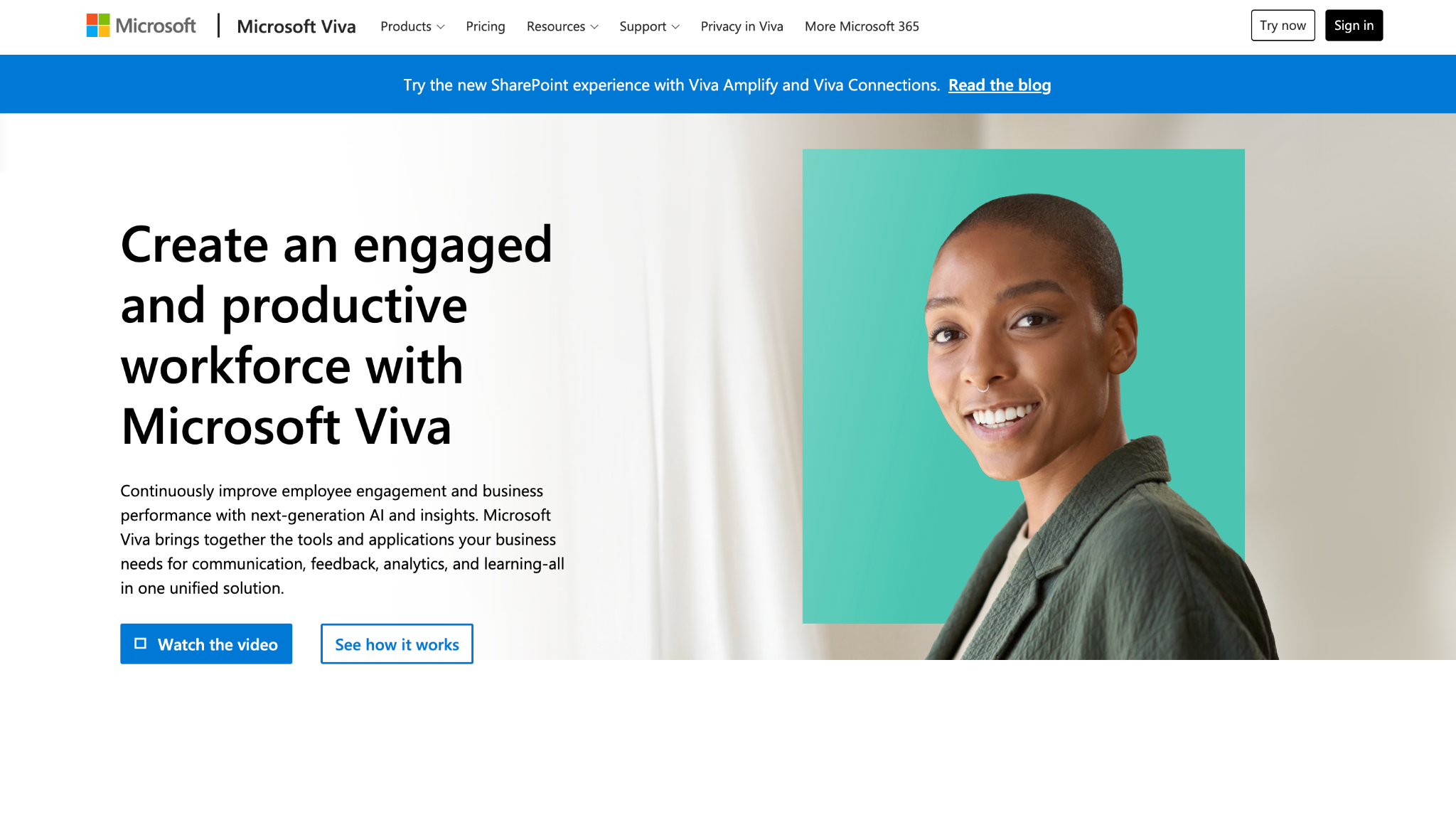
Microsoft Viva Glint is the enterprise listening product in the Viva family, covering engagement, always-on, and lifecycle surveys with confidentiality thresholds an administrator can set.
Software Pros
- Confidential surveys with documented response thresholds
- Lifecycle surveys for onboarding, exit, and other stages
- Reporting built for large organizational hierarchies
Software Cons
- Licensed through Microsoft Viva, with no public price
- Rollout is an enterprise project rather than a setup task
Microsoft Viva Glint Review
Microsoft publishes the numbers other vendors leave vague: a confidential survey needs at least 3 responses, scores display at 5 by default, and comments at 10. Showing employees that page is worth more than most feature comparisons.
Our Verdict
Enterprise Listening With Published Thresholds
Motivosity
Quick Overview
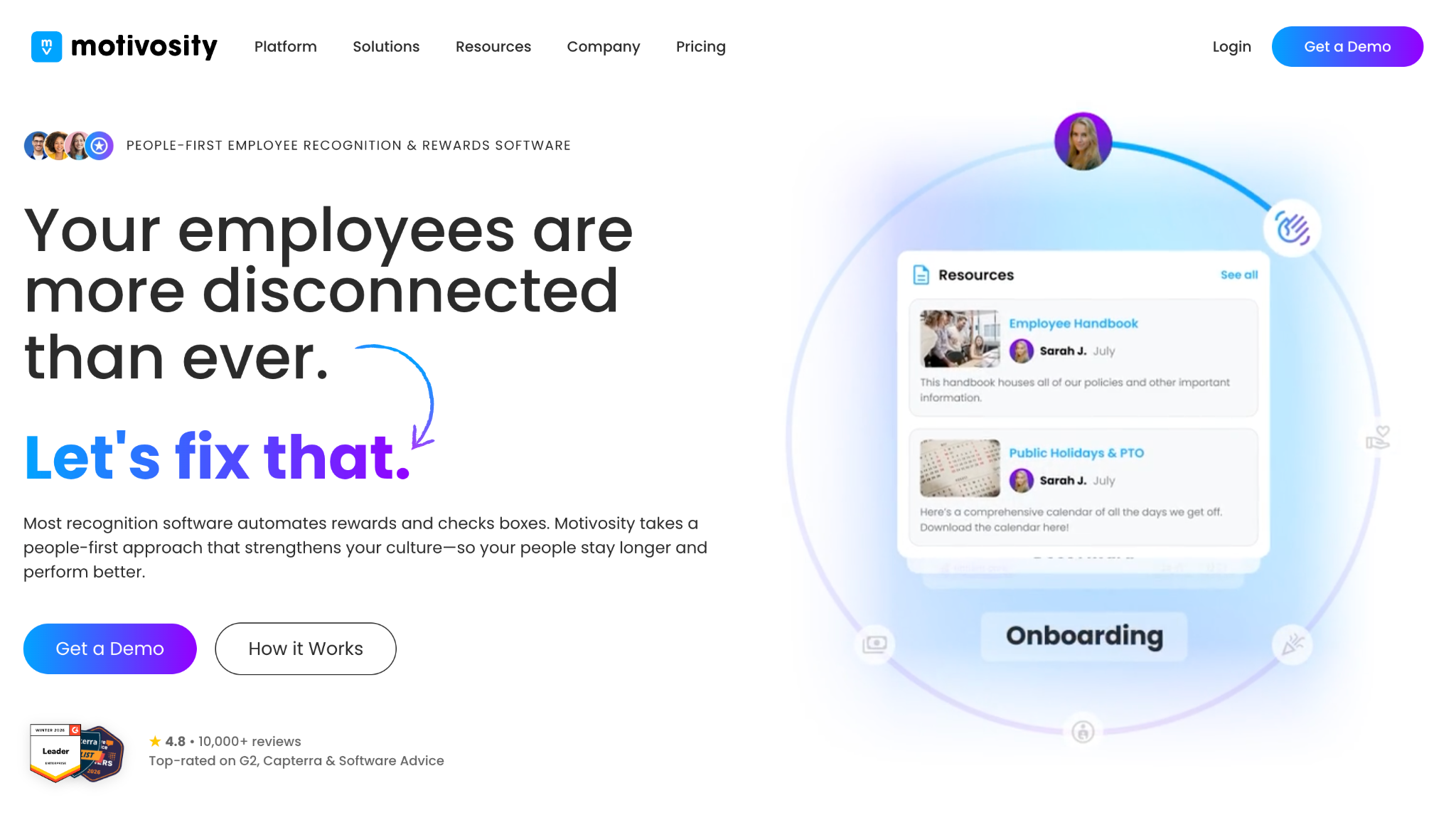
Motivosity is a recognition platform whose leadership module adds recurring eNPS and quick pulse checks, so appreciation activity and engagement scores sit in the same product.
Software Pros
- Recurring eNPS and short pulse surveys
- Anonymous responses collected from employees
- High adoption because people already use the recognition feed
Software Cons
- Surveys are a secondary module, not the main product
- A $3,000 minimum spend applies
Motivosity Review
Companies pick Motivosity for recognition and then find the survey module covers a monthly temperature check. It will not replace a dedicated platform, but response rates benefit from living inside an app people open for other reasons.
Our Verdict
eNPS Alongside Recognition
Officevibe (Workleap)
Quick Overview
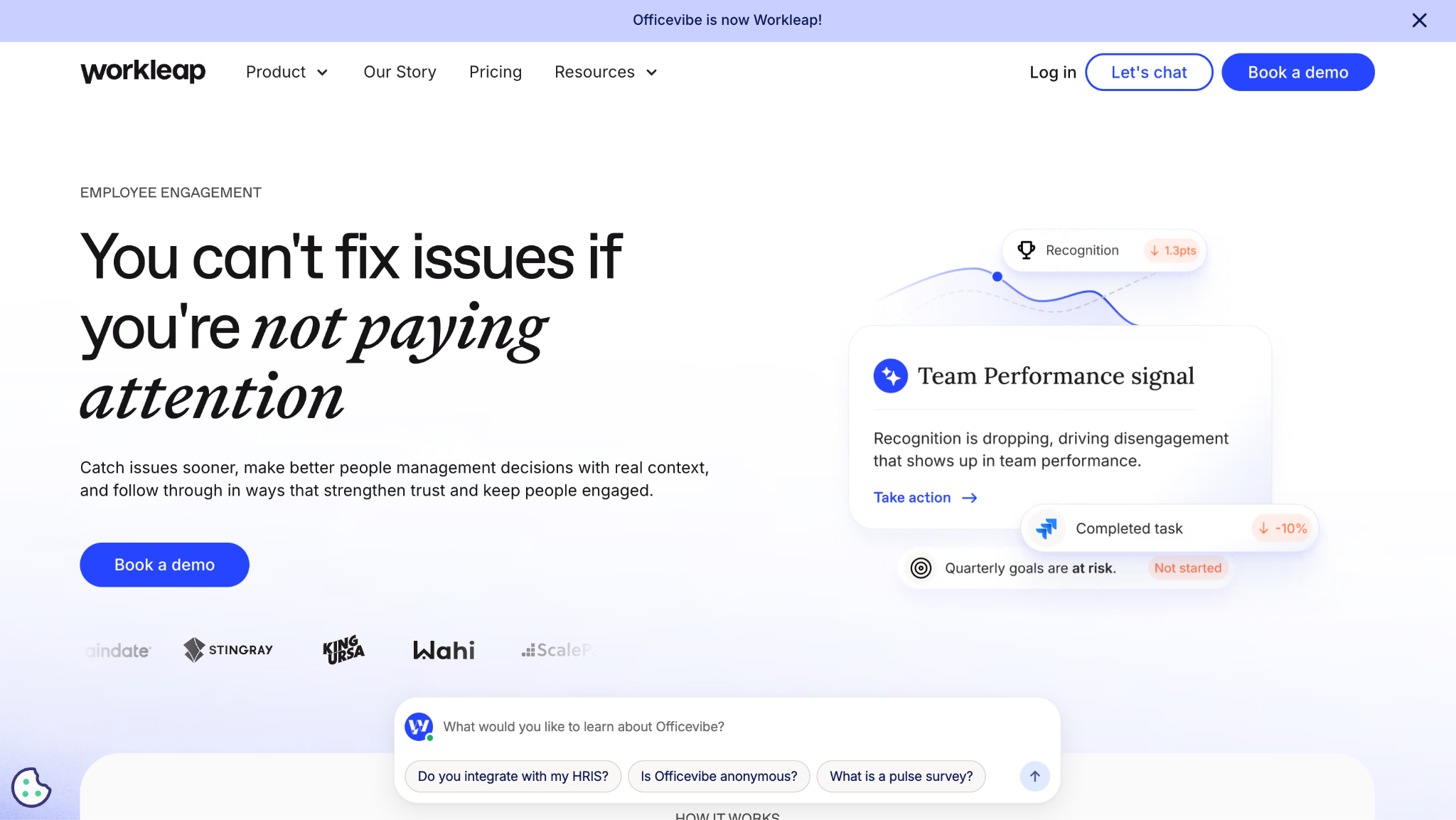
Officevibe, now part of Workleap, is a pulse tool for team managers: short weekly questions, anonymous written comments, and coaching tips attached to the scores.
Software Pros
- Weekly pulse rhythm that needs almost no setup
- Anonymity rules published in the help center
- Manager tips tied to the weakest metrics
Software Cons
- Built for team-level insight rather than enterprise reporting
- Sold within Workleap plans that start at $4,999 a year
Officevibe (Workleap) Review
Workleap states the numbers plainly: scores appear only once 3 active members have answered, and anonymous written comments need a team of at least 5. If your teams are smaller than that, this tool will say so rather than quietly showing a manager 1 person’s answer.
Our Verdict
Weekly Team Pulses With Clear Rules
Perceptyx
Quick Overview
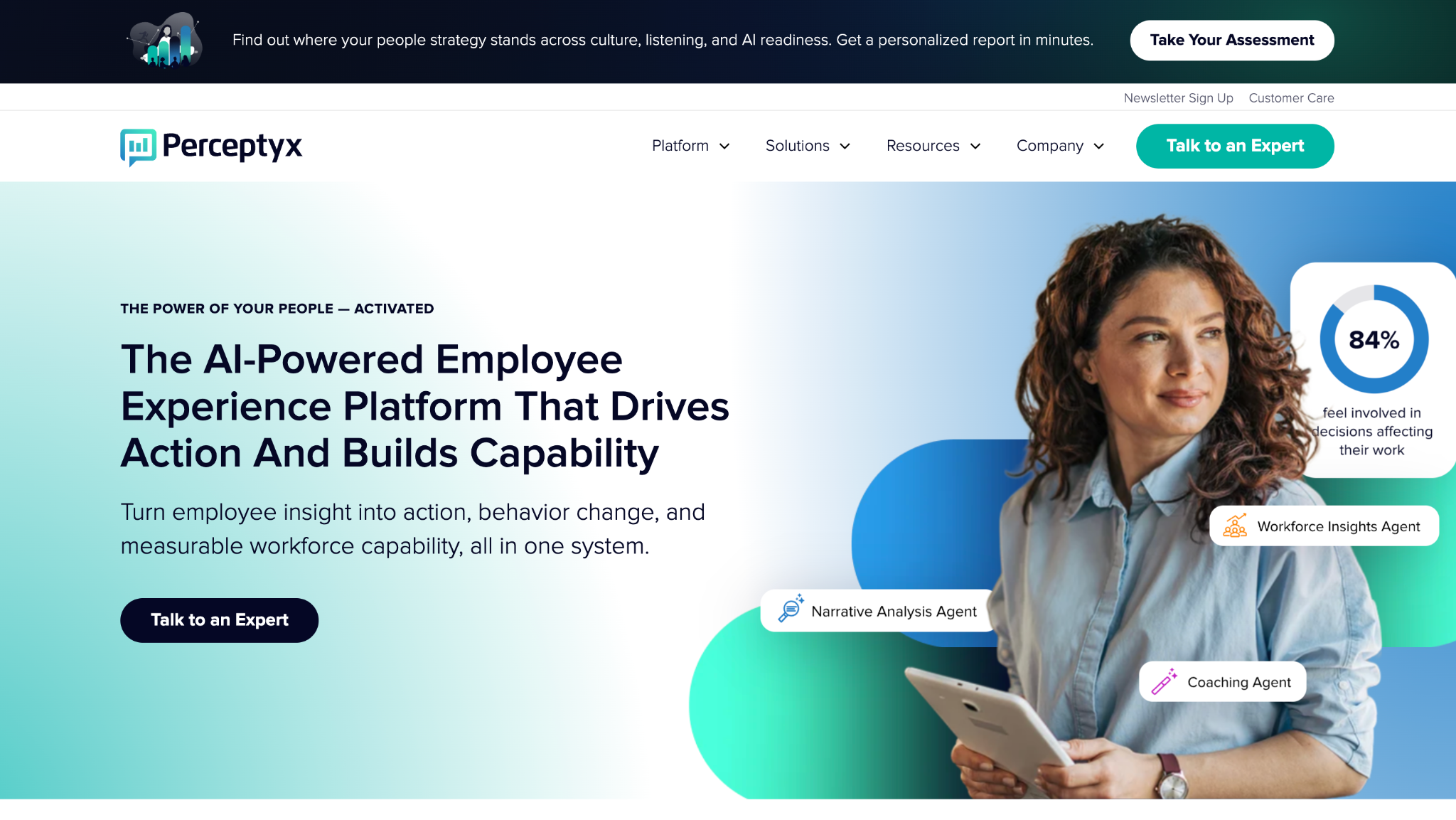
Perceptyx is an enterprise listening platform that combines census surveys, ongoing pulses, and lifecycle surveys with dashboards and AI analysis aimed at large, complex organizations.
Software Pros
- Designed for listening programs across thousands of employees
- Census surveys and continuous pulses in one program
- Manager-level dashboards with recommended actions
Software Cons
- Priced by quote after a demo, never published
- Heavier than a mid-sized company usually needs
Perceptyx Review
Perceptyx sits in the same conversation as Culture Amp, Viva Glint, and Peakon, and it usually arrives through a formal procurement rather than a free trial. Expect a program with a project plan, an implementation team, and a timeline measured in months.
Our Verdict
Enterprise Listening at Program Scale
Polly

Quick Overview
Polly runs polls and short surveys inside Slack and Microsoft Teams, so people answer without leaving the conversation. Its Slack plan is billed per license, not per employee.
Software Pros
- Questions arrive where people already work
- Anonymous and private response options
- Slack plan billed at $228 a year per license
Software Cons
- Depth stops at polls and short questionnaires
- Useless unless your company lives in Slack or Teams
Polly Review
Response rate is Polly’s whole argument. A question that appears in the channel someone is already reading gets answered; the same question in an email does not. You give up analysis, since you get counts and trends rather than driver models.
Our Verdict
Polls Where People Already Talk
Qualtrics
Quick Overview
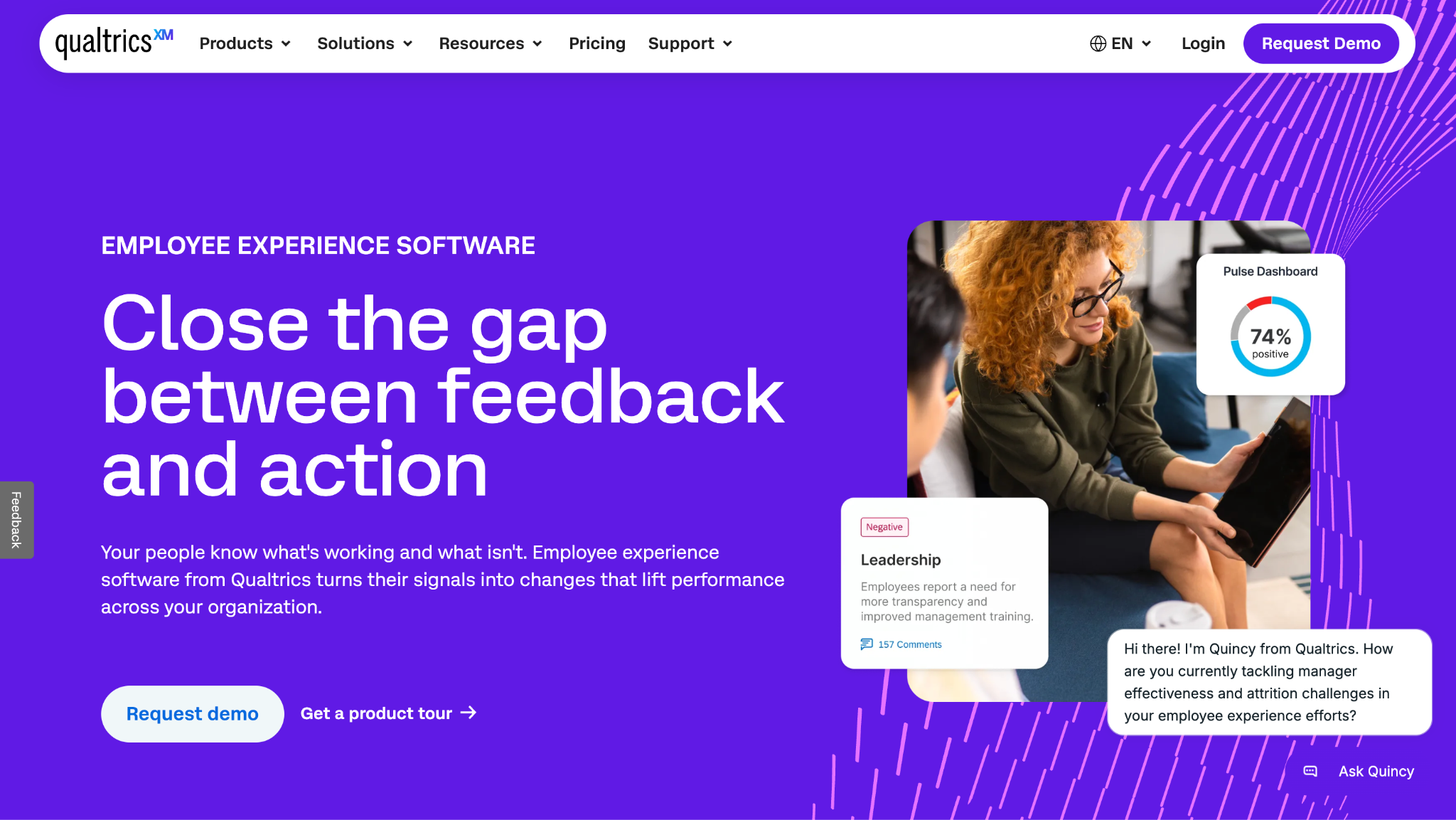
Qualtrics is a research-grade experience platform whose EmployeeXM product covers engagement, lifecycle, and ad hoc surveys with advanced logic, text analysis, and large employee experience benchmarks.
Software Pros
- Question design and branching logic beyond anything else here
- Text analysis across thousands of open comments
- Enterprise security and compliance coverage
Software Cons
- Complex enough to need a trained owner internally
- Quoted by program, with no published price
Qualtrics Review
If your team writes its own survey instruments and cares about question order, scales, and statistical rigor, Qualtrics is the ceiling on this list. That power is also the catch: most HR teams need 12 questions every quarter, not a research platform with a learning curve.
Our Verdict
Research Platform for Survey Specialists
Quantum Workplace
Quick Overview
Quantum Workplace runs engagement, pulse, and exit surveys with benchmarks drawn from its Best Places to Work program, plus optional goals and recognition modules.
Software Pros
- Benchmarks from its own awards program
- Action planning designed for line managers
- Surveys, goals, and recognition under a single contract
Software Cons
- Minimum annual contract of $15,000
- Heavier than a small HR team will ever put to work
Quantum Workplace Review
Quantum Workplace says the quiet part out loud on its pricing page: packages start at $15,000 a year. For a company of several hundred people running an annual survey and quarterly pulses, that buys a supported program rather than a subscription nobody administers.
Our Verdict
Engagement Program With Benchmarks
QuestionPro Workforce
Quick Overview
QuestionPro Workforce is the employee experience side of QuestionPro, covering engagement cycles, 360 reviews, and lifecycle surveys, with AI that drafts questions and reads open comments.
Software Pros
- AI survey builder grounded in employee experience models
- Sentiment analysis across every open comment
- Free tier available to trial the platform
Software Cons
- Workforce programs are quoted rather than listed
- Advanced features take time to learn properly
QuestionPro Workforce Review
QuestionPro leans on AI harder than most: it proposes the questionnaire, reads the comments, and ranks employee suggestions by theme and intensity. Treat those outputs as drafts, but they remove the hours HR usually spends hand-coding free text.
Our Verdict
AI-Assisted Engagement Cycles
Sogolytics
Quick Overview
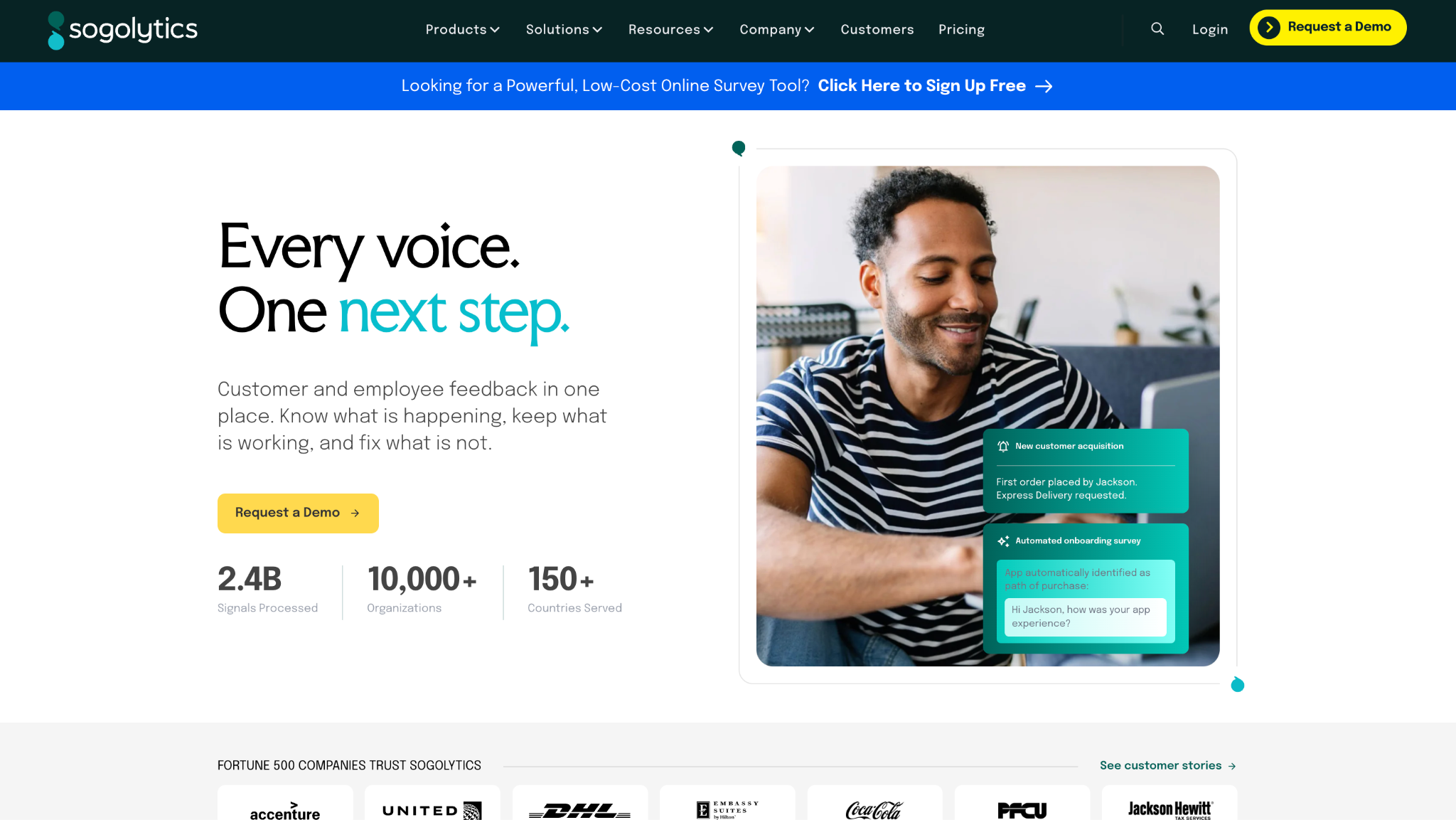
Sogolytics is a survey platform with a separate employee experience module, adding anonymity settings, dashboards, and alerts on top of a general-purpose builder.
Software Pros
- Anonymity guaranteed in the vendor’s own wording
- Real-time reporting with AI-driven insights
- Broad feature coverage for the price
Software Cons
- Interface feels traditional next to newer tools
- Employee benchmarks are thin compared to dedicated platforms
Sogolytics Review
Sogolytics is the middle option: more control than Microsoft Forms, less engagement science than Culture Amp. Teams that run both customer and employee surveys often land here, since a single contract covers both jobs.
Our Verdict
General Platform With an EX Module
SurveyMonkey
Quick Overview
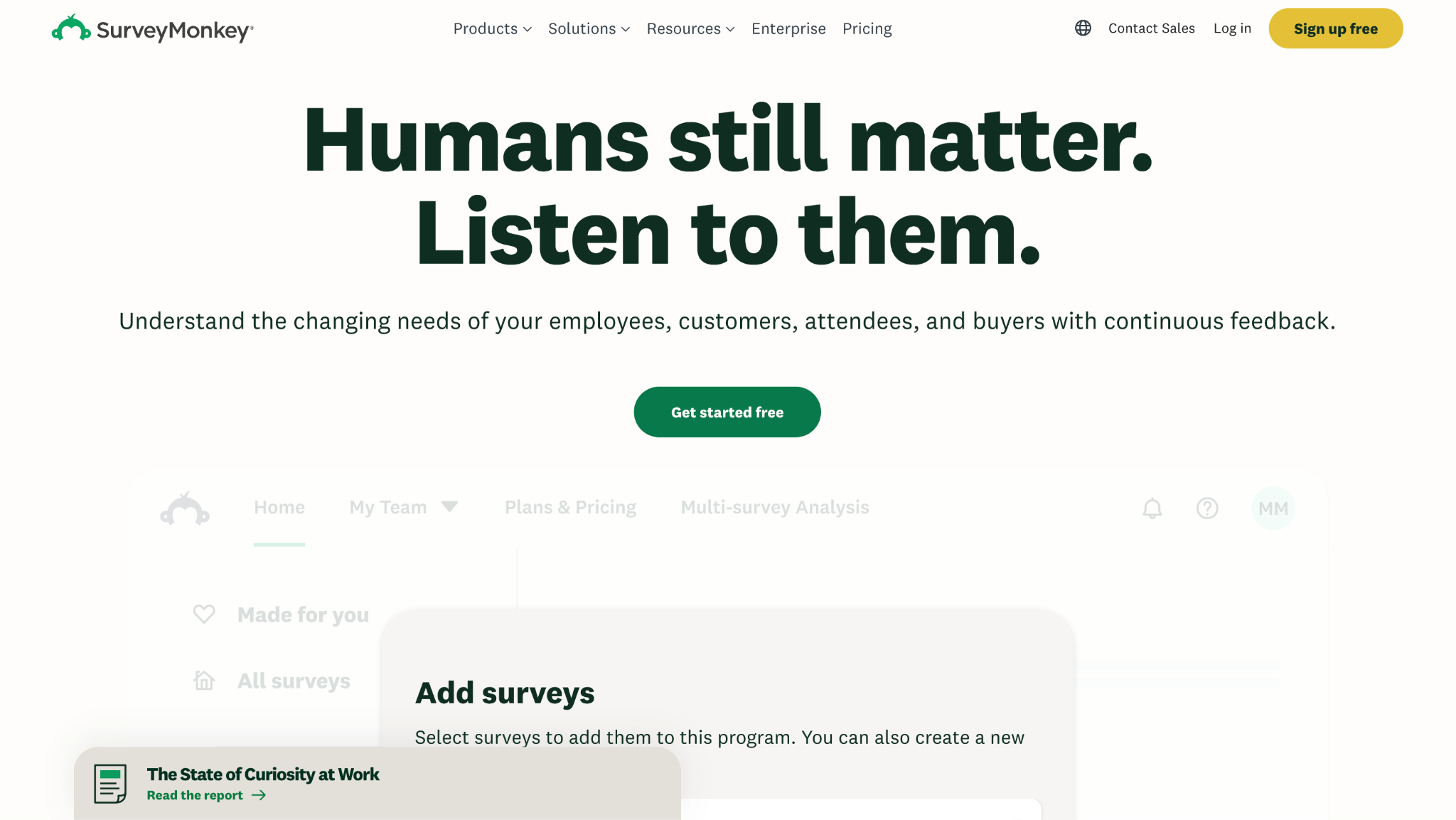
SurveyMonkey is the survey tool most employees have already answered, with engagement templates, per-user team plans, and benchmarks on its enterprise tier.
Software Pros
- Template library covering engagement and eNPS
- Familiar format, which helps completion rates
- Global and industry benchmarks on higher plans
Software Cons
- Not built for HR hierarchies or reporting thresholds
- Per-user pricing adds up once several admins need access
SurveyMonkey Review
SurveyMonkey is fine for an annual questionnaire and poor as a listening program. It has no team hierarchy, so anonymity is something you promise in the invitation email rather than something the platform enforces.
Our Verdict
Familiar Builder for Simple Surveys
SurveySparrow
Quick Overview
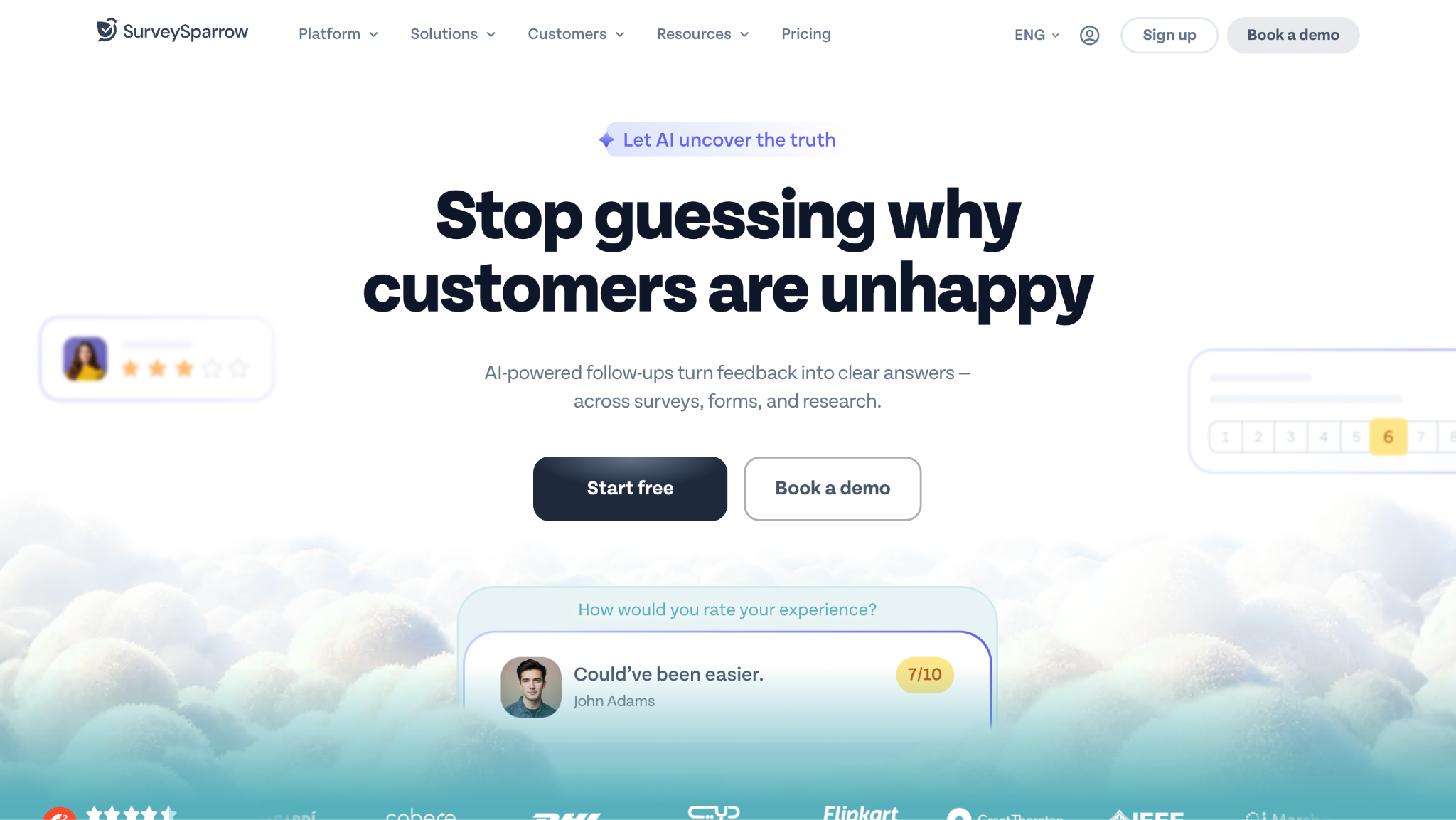
SurveySparrow presents questions one at a time in a chat-style format, and adds recurring surveys, dashboards, and integrations on its paid plans.
Software Pros
- Conversational format that lifts completion rates
- Recurring survey scheduling on paid plans
- Free plan plus a 14-day trial of paid features
Software Cons
- HR analytics are shallow next to dedicated platforms
- Annual response caps apply on lower plans
SurveySparrow Review
Questions arrive like messages rather than as a form, which suits phones and frontline staff who will never open a desktop survey. Check the annual response cap on the plan you choose, because a single company-wide pulse can use it all.
Our Verdict
Conversational Surveys With Higher Completion
TINYpulse (WebMD Health Services)
Quick Overview
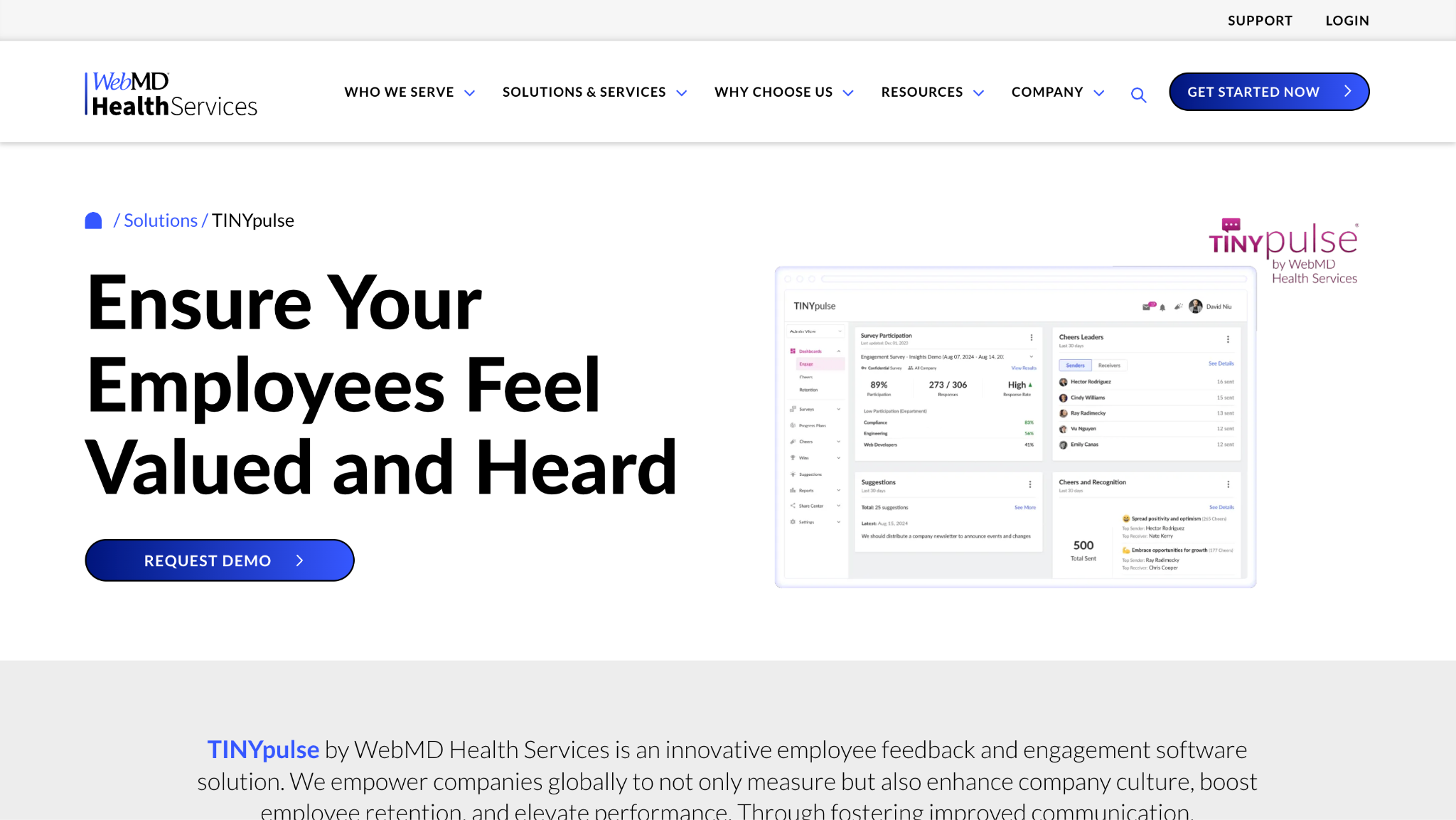
TINYpulse is now sold as TINYpulse by WebMD Health Services, keeping its short recurring surveys, anonymous two-way messaging, and Cheers for Peers recognition.
Software Pros
- Short recurring pulses rather than long questionnaires
- Anonymous two-way messaging with respondents
- Engagement data alongside wellbeing programs
Software Cons
- Sold as part of a wider WebMD engagement offering
- Pricing available only through a quote
TINYpulse (WebMD Health Services) Review
TINYpulse survived its move to WebMD Health Services: tinypulse.com now redirects to the WebMD page, and the name still sits on the product. Anonymous follow-up is its best feature, since a manager can ask a second question without ever learning who answered the first.
Our Verdict
Short Pulses With Anonymous Replies
Typeform
Quick Overview
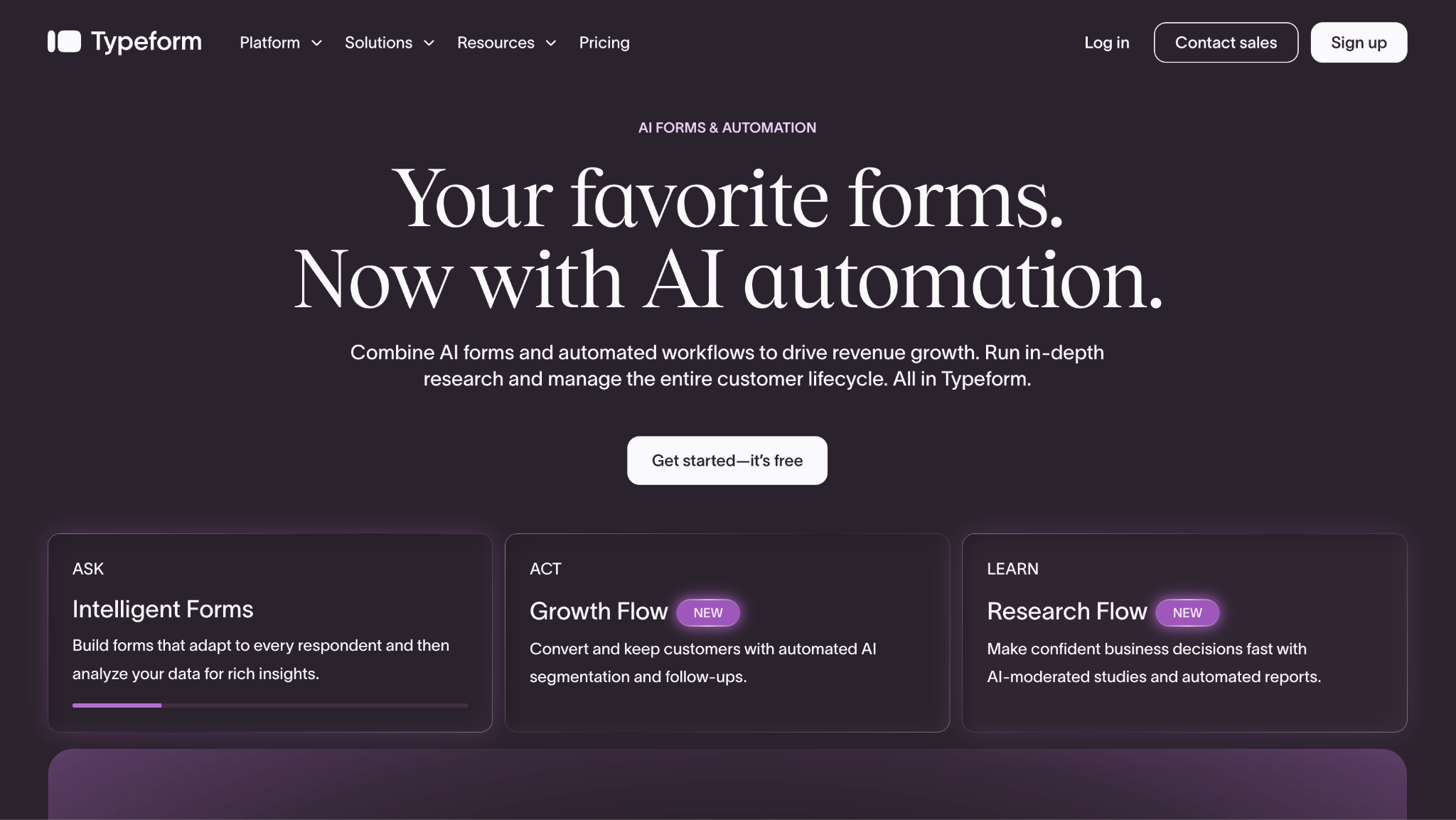
Typeform shows 1 question at a time in a polished interface, which suits short surveys where completion matters more than analysis. Plans are capped by responses and users.
Software Pros
- Showing 1 question at a time keeps people moving
- Strong experience on phones
- 14-day trial of the paid features
Software Cons
- No anonymity thresholds or engagement reporting
- Monthly response limits on the lower plans
Typeform Review
Typeform earns a place for onboarding check-ins and short culture questions people actually finish. Past that, it is a form tool: the output is counts and exports, so somebody in HR will still be building the pivot table.
Our Verdict
Polished Forms for Short Surveys
Winningtemp
Quick Overview
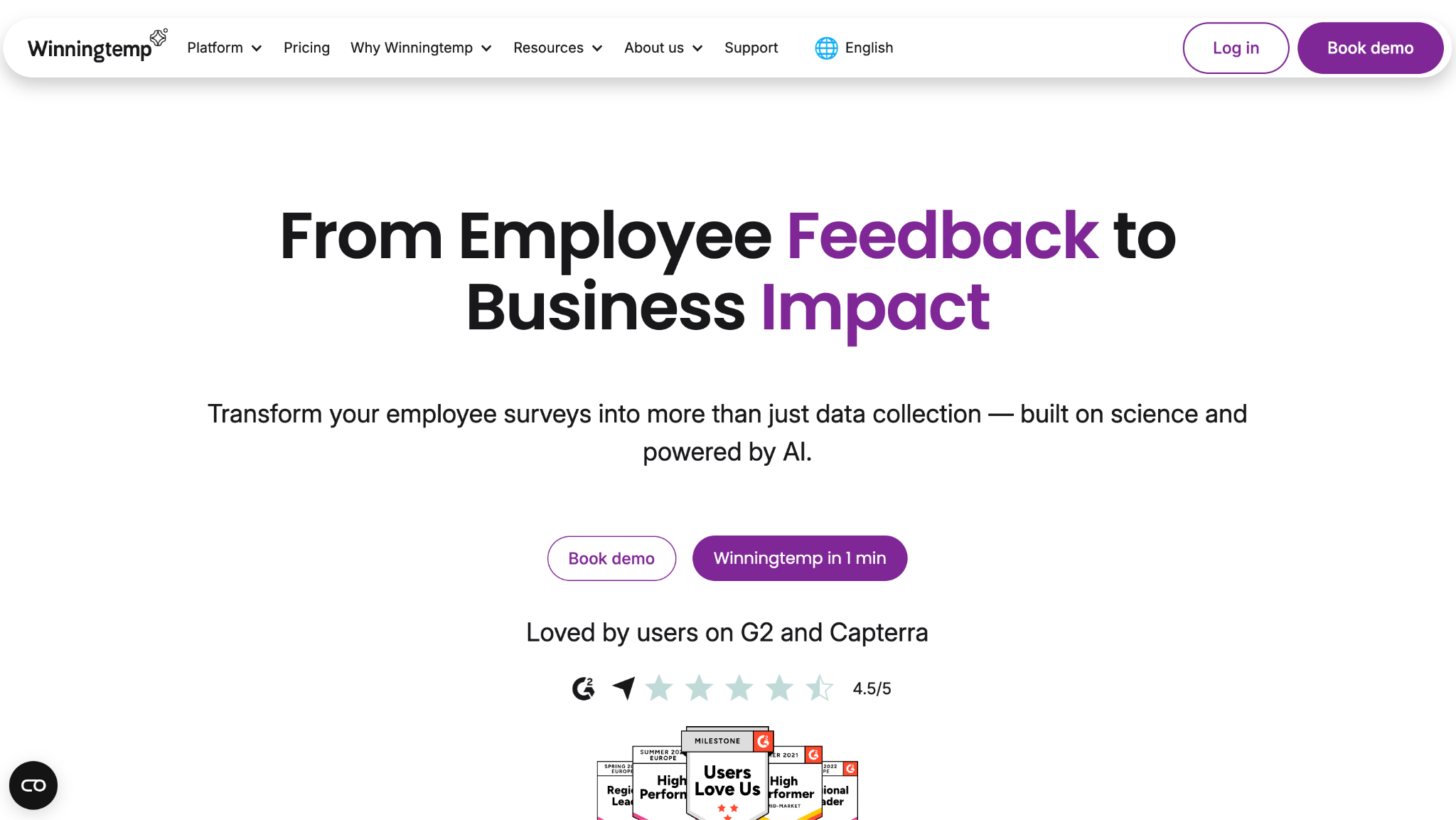
Winningtemp is a listening platform built around frequent short surveys and AI analysis, developed with researchers at the University of Gothenburg and used widely across the Nordics.
Software Pros
- Frequent anonymous surveys with trend lines over time
- AI chat that explains why a score moved
- Question set built with academic researchers
Software Cons
- Pricing only through a quote
- A frequent cadence needs managers who actually read the results
Winningtemp Review
This is the clearest pulse-first product on the list: the design starts with a short, recurring survey rather than an annual census with a pulse feature attached. Its AI layer answers the question managers ask first: why a score changed.
Our Verdict
Pulse-First Listening With AI Analysis
Workday Peakon Employee Voice
Quick Overview
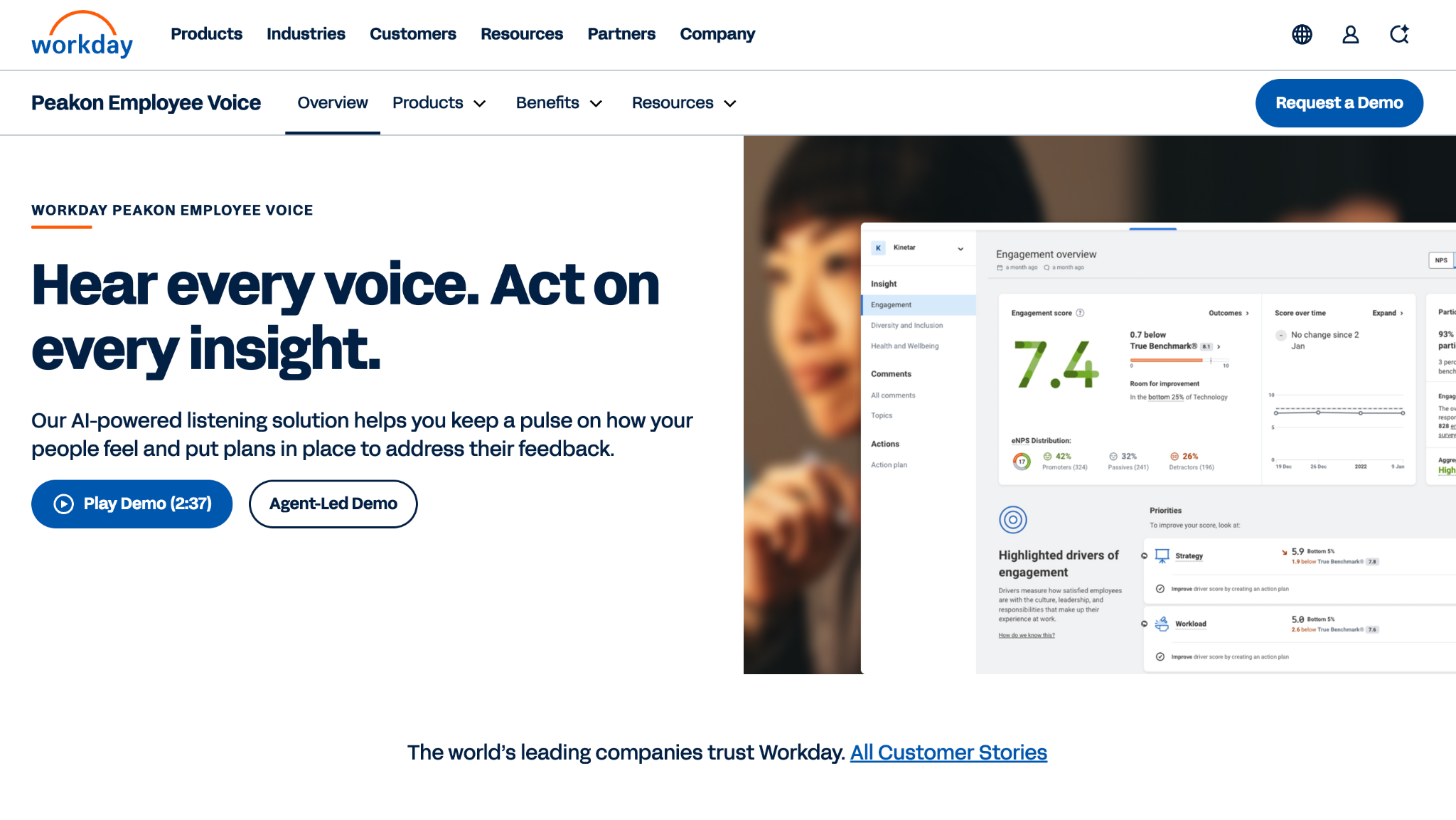
Workday Peakon Employee Voice runs continuous listening through short, recurring surveys, driver analysis, and manager dashboards, with visibility thresholds administrators configure.
Software Pros
- Continuous cadence instead of annual campaigns
- Configurable thresholds for segments, questions, and comments
- Works natively with Workday HCM data
Software Cons
- Full value assumes a Workday environment
- Enterprise pricing through Workday sales
Workday Peakon Employee Voice Review
Peakon’s documentation spells out how it enforces confidentiality, with separate thresholds for segments, questions, and comments, and uses 5 responses as the worked example. For an enterprise sending questions every week, that configurability is the reason to buy it.
Our Verdict
Continuous Listening for Workday Shops
WorkTango
Quick Overview
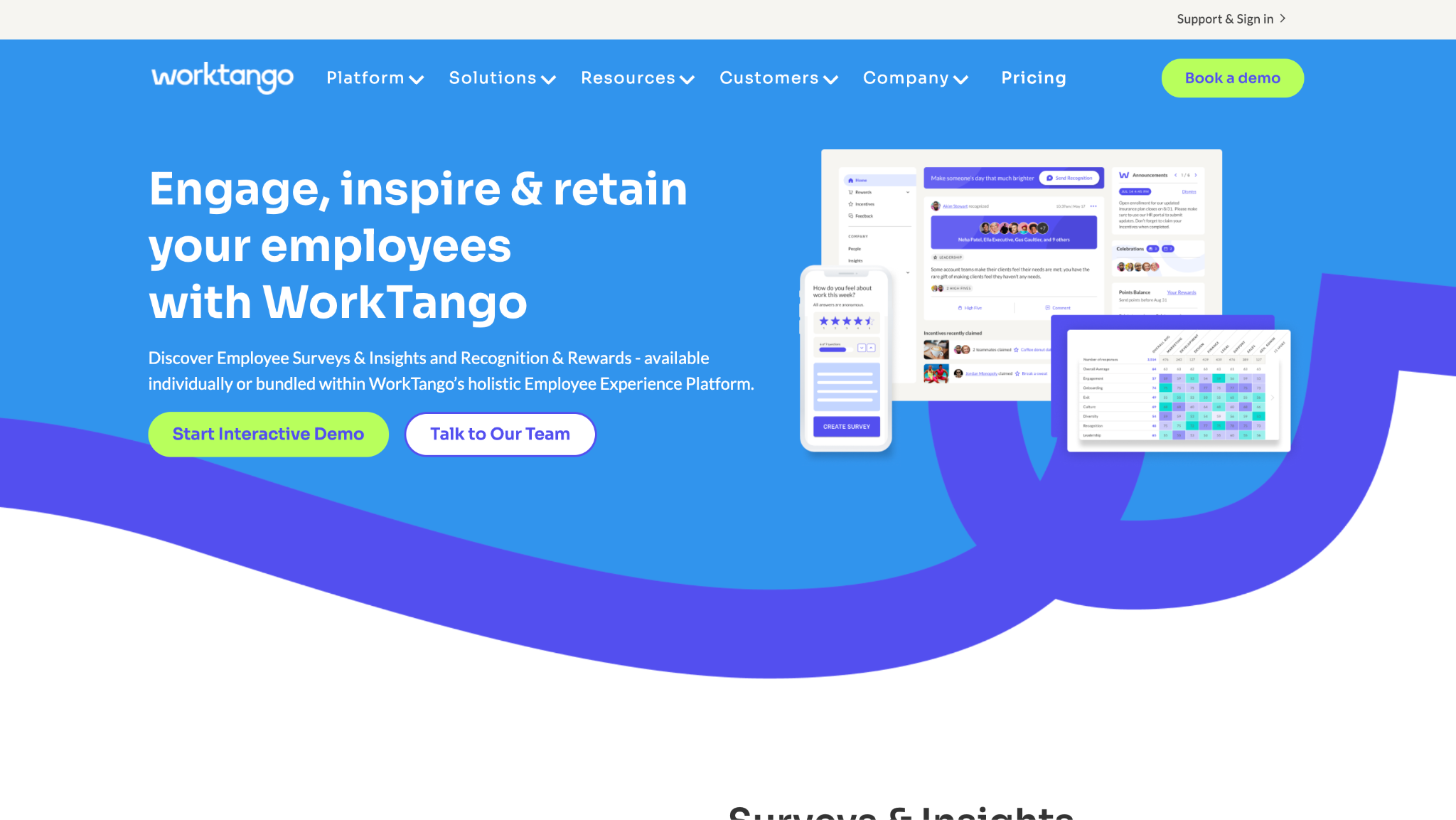
WorkTango sells employee surveys and insights as 1 module and recognition and rewards as another, so a company can start with listening and add recognition later.
Software Pros
- Unlimited surveys with ready-made templates
- Confidential surveys with design help from its team
- Recognition and rewards available from the same vendor
Software Cons
- Survey-only buyers still price against a 2-module platform
- Costs are shared on request, not listed on the site
WorkTango Review
The survey module is a real product, not an afterthought, and WorkTango will bring its own specialists to questionnaire design. Ask how the 2 modules are licensed before you budget, since the answer decides whether this competes with Culture Amp or with Motivosity.
Our Verdict
Surveys Plus Recognition in One Contract
Zoho Survey
Quick Overview
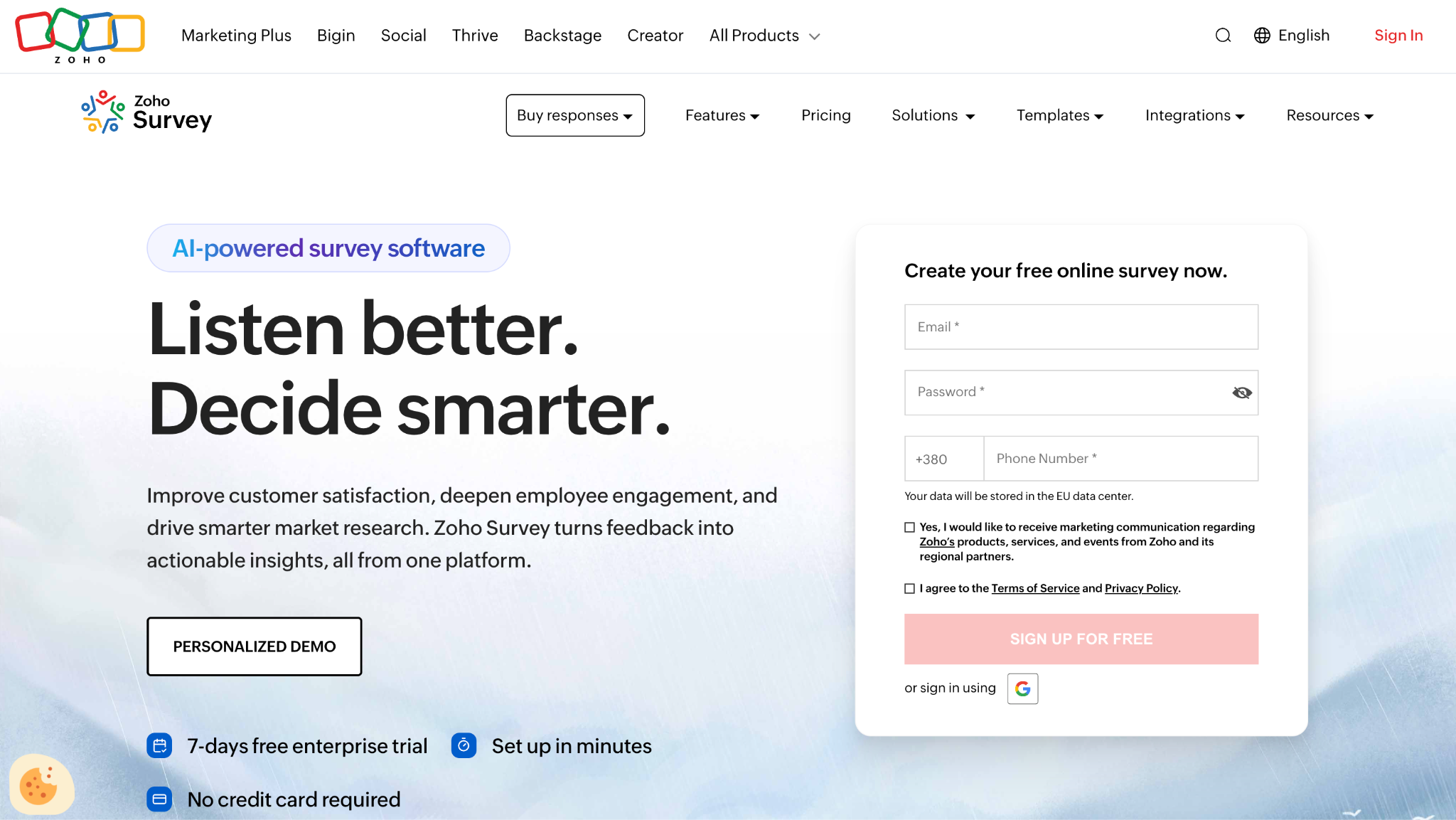
Zoho Survey is the survey app inside the Zoho suite, with templates, logic, and reporting that connect to Zoho People and the rest of the Zoho tools. A free plan covers small, occasional surveys.
Software Pros
- Free plan for short, occasional surveys
- Connects to Zoho People and Zoho CRM
- Anonymous response setting available
Software Cons
- Reporting is generic rather than HR-specific
- Most valuable only if you already run on Zoho
Zoho Survey Review
For a company already paying for Zoho, adding surveys costs very little and keeps employee responses inside the same tenant. Outside that setup, the analysis does not compete with the dedicated platforms above.
Our Verdict
Surveys Inside the Zoho Suite
FAQs About Employee Survey Software and Tools
What is an employee survey tool?
It is software for asking employees structured questions and turning the answers into reports managers can use. Most tools cover the whole cycle: building the questionnaire, sending it, protecting who said what, and tracking scores over time. The depth of that last step is what separates a platform from a form builder.
Why do companies use employee survey tools?
They give leaders evidence about how work actually feels, and they make that evidence comparable from one quarter to the next. Used well, they catch problems such as workload or unclear expectations while there is still time to fix them. Used badly, they become a ritual that employees stop answering.
What types of employee surveys are most common?
Engagement surveys once or twice a year, short pulses in between, and lifecycle surveys at onboarding, milestones, and exit. Many companies also run eNPS, which asks in 1 question whether people would recommend the organization, plus manager or team check-ins.
How often should companies run employee surveys?
A common pattern is 1 deep survey a year or every 6 months, plus monthly or quarterly pulses. The right frequency is the one your managers can act on, because asking more often than you can respond damages trust rather than building it.
Are employee survey tools anonymous?
Some are anonymous, and some are confidential, which is not the same thing. Confidential means responses are linked to attributes such as department and tenure, but results appear only once a group is large enough. That minimum is typically between 3 and 10 responses, and the vendor should be able to tell you the exact number before you launch.
What are the best employee survey tools?
That depends on what you need, not a single winner. Dedicated platforms suit companies running a program with benchmarks and thresholds, HR suites suit those who already own the wider system, and builders suit one-off questionnaires. Use the table near the top of this guide to filter the 28 by type, privacy rules, and cadence.
What is the best employee pulse survey software?
The strongest options are designed around a short, repeating cycle rather than an annual campaign, with automated scheduling, trend charts, and privacy rules that still work for small teams. The pulse section above lists the tools on this page that are built that way, in alphabetical order.

Yaryna is our lead writer with over 8 years of experience in crafting clear, compelling, and insightful content. Specializing in global employment and EOR solutions, she simplifies complex concepts to help businesses expand their remote teams with confidence. With a strong background working alongside diverse product and software teams, Yaryna brings a tech-savvy perspective to her writing, delivering both in-depth analysis and valuable insights.