Multiplier, the global employment platform at usemultiplier.com, offers employer of record (EOR) services. An EOR legally employs workers abroad for a company and handles payroll, taxes, benefits, and local compliance. What an employer of record does depends on local employment laws and the services included. Multiplier starts at $459 per employee per month with annual billing, below Deel and Remote. So companies often look at Multiplier competitors for reasons other than price.
This guide compares the best Multiplier alternatives. I look at what each provider does better and where Multiplier still wins. Multiplier isn’t an expensive EOR, so price isn’t the main issue. The real question is whether its platform and services fit your needs. The best Multiplier alternative depends on what your company needs instead.
Multiplier still has clear advantages. As explained in our Multiplier review, it publishes its EOR pricing, while many competitors do not, and has one of the highest G2 scores on this list. In March 2026, TriNet chose Multiplier to power TriNet Global. The table below compares Multiplier with its main alternatives.

INSIGHT: What does a published EOR price actually cover?

The monthly EOR fee is only part of the total cost. The country where you hire can affect the final cost much more.
- Employer statutory contributions (mandatory employer payments) vary widely by country. These are pass-through costs (employment costs charged back to the client), not part of the EOR fee. For example, employers generally pay 15% in the UK and 17% in Singapore, while Spain’s common-contingencies rate alone is 23.60%. International payroll can also include an FX margin, or a markup on currency conversion
- Six of the nine providers compared here publish an EOR starting price as of August 2026. Rates range from $199 PEPM at RemoFirst to $699 at Oyster HR. A price marked “from” or “starting at” is only a minimum, not the final quote
This is why comparing EOR fees alone can rank two providers correctly but still leave the total employment budget far off.
Multiplier vs Competitors: Side-by-Side Comparison
I compared the main Multiplier alternatives and competitors with Multiplier as the starting point. Price and entity model are two key differences. Some cheaper providers use local partners, while others use their own entities. An owned entity is a legal company controlled by the EOR, while a partner entity is a separate local company that employs workers for the EOR. Multiplier now combines competitive pricing with its own entities, so the best choice depends on what each company needs.
| Provider | EOR /ee/mo | Pricing transparency | Entity Model | Best for | G2 |
|---|---|---|---|---|---|
| Multiplier | From $459 PEPM (Per Employee Per Month) annually | High, published | 100% owned | Cost-conscious global hiring | 4.7★ |
| Deel | $599 PEPM | High, published | 100% owned | Global hiring without local partners | 4.8★ |
| Globalization Partners (G-P) | From $599 PEPM | High, published | Owned plus partner | Cost-conscious global hiring | 4.7★ |
| Oyster HR | $699 PEPM | High, published | Owned plus partner | US teams hiring employees abroad | 4.4★ |
| Papaya Global | From $499 PEPM | Medium, partial | Owned plus partner | Enterprise global payroll and EOR | 4.5★ |
| Pebl (formerly Velocity Global) | Custom pricing | Medium, partial | 100% owned | Compliance-focused global hiring | 4.6★ |
| RemoFirst | From $199 PEPM | High, published | 100% partner | Lower-cost international hiring | 4.5★ |
| Remote | From $699 PEPM | High, published | 100% partner | Direct-owned EOR infrastructure | 4.5★ |
| Rippling | Custom pricing | Low, quote only | Owned plus partner | HR, IT, and global employment | 4.8★ |
As pricing is subject to change, we are listing prices as they stand in August 2026
Why Teams Shop Multiplier Alternatives
Companies often compare Multiplier alternatives because they need a different platform, longer track record, or wider set of workforce services. Multiplier now says it operates through its own legal entities, so employment structure is no longer the main reason to move to providers such as Remote.
- Mixed entity model. Multiplier employs workers through its own entities in some countries and local partners in others. When a partner is involved, another company handles local employment and compliance. This adds another party to the relationship, which some companies prefer to avoid.
- Track record. Multiplier was founded in 2020, making it the youngest provider on this list. Some companies consider years in business when choosing an EOR, especially in regulated industries or for larger global teams.
- The “from” in the published price. Multiplier publishes a starting EOR price, but the final cost can vary by country. Some markets cost more because employment rules and requirements are more complex. This means companies should not expect the starting price to apply to every employee in every country.
- Working capital. Multiplier requires a refundable salary deposit before an EOR employee starts. A salary deposit is money the provider holds to cover employment costs and risks. This ties up company cash while the employee remains with the EOR. Deposits are common in this industry, so this is a contract term to compare rather than a Multiplier-specific drawback
Multiplier still has a strong case. It publishes its EOR price, while many competitors require a quote. Its starting price is also much lower than Deel and Remote. Multiplier has one of the highest G2 scores in this comparison and strong APAC coverage. In April 2026, it added global payroll and cross-border payments. In March 2026, TriNet also chose Multiplier to power TriNet Global. This gives the company strong outside validation. For businesses hiring a few people across several countries, Multiplier remains a practical choice when cost matters. Other providers make more sense when a company needs a different entity model, longer track record, or broader platform.
How I Compared These Multiplier Alternatives
I compared EOR alternatives to Multiplier based on six factors that matter when hiring employees abroad. These include employment structure and permanent establishment, a taxable business presence a company may create in another country.
- Entity model: Whether the provider uses its own entities, local partners, or both, and who legally employs the worker
- Pricing: How much EOR costs, whether prices are public, and what the quoted fee covers
- Country coverage: How many countries the provider says it covers and where EOR services are available
- Onboarding speed: How quickly a new employee can start after the company submits the required information
- Platform depth: What other payroll, HR, contractor, or workforce tools companies get alongside EOR services
- Cost of exit: Deposits, notice periods, and other costs or requirements that may apply when leaving the provider
Best Overall Multiplier Alternative: Deel
Deel is a strong alternative for companies that need more automation and workforce tools. It costs more than Multiplier but offers more integrations and tools for managing global teams.
1. Deel
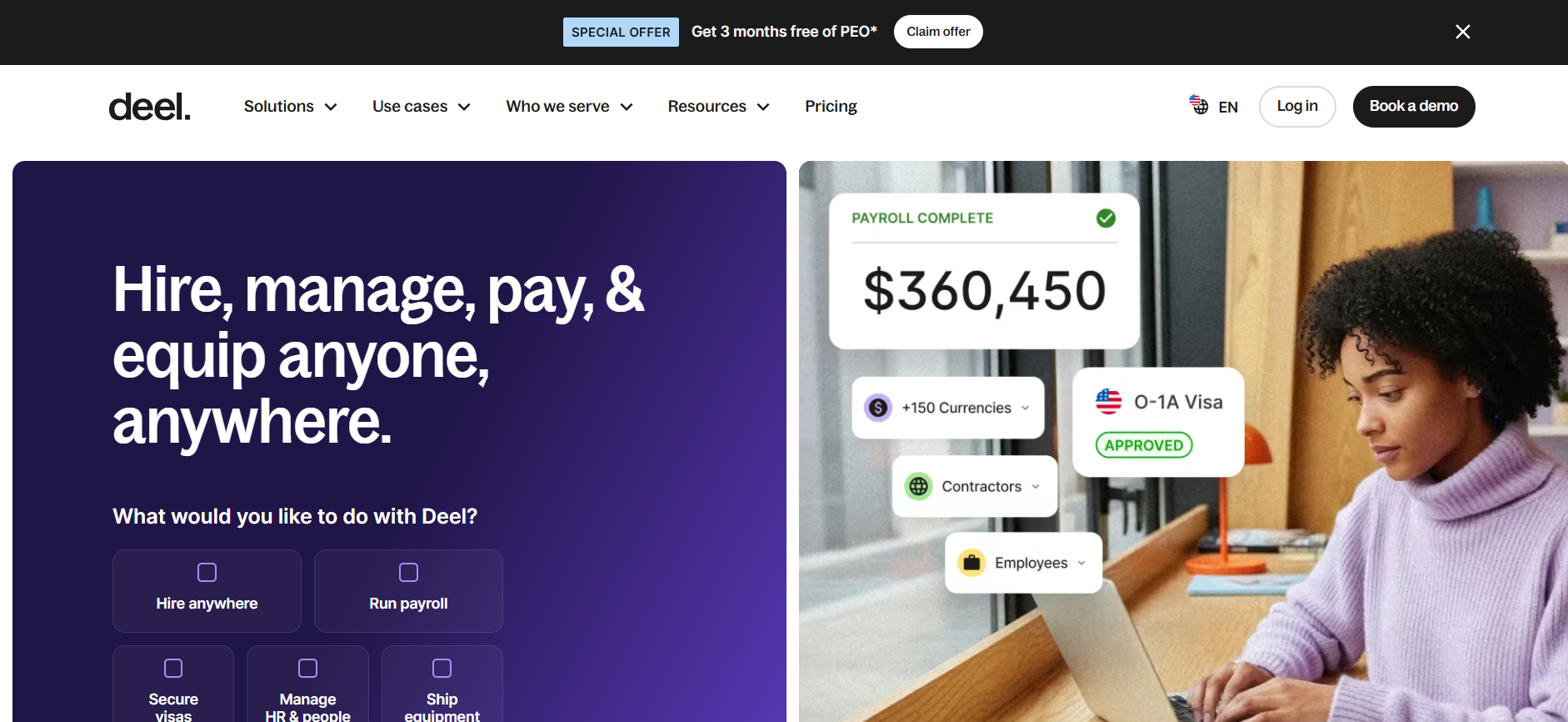
Deel uses a mix of owned and partner infrastructure, similar to Multiplier’s model. Deel charges $599 per EOR employee per month, while Multiplier has a lower published starting rate. The main difference is platform breadth. Deel combines EOR with global payroll, HR, contractor management, US PEO, and other workforce tools. For a closer look at two major global EOR providers, see Deel and Remote compared.
Deel
What it does better than Multiplier:
- Offers a broader set of global workforce tools
- Provides deeper automation across HR and payroll
- Connects with a wider range of business tools
- Has a larger procurement and enterprise footprint
Where Multiplier still wins:
- Charges a lower published starting EOR rate
- Offers a more affordable entry point
- Keeps its EOR offering more focused
- Provides strong value for smaller global teams
EOR price:
$599 PEPM
Transparency:
High
Countries:
EOR in 130+ countries
Entity model:
Owned plus partner
Best for:
Global workforce automation and integrations
G2:
4.8
Pick it over Multiplier if:
You need a wider global workforce platform with more automation and integrations.
Stick with Multiplier if:
You mainly need EOR services and want a lower published starting price.
*As pricing is subject to change, we are listing prices as they stand in August 2026
Owned-Entity Multiplier EOR Alternatives: Globalization Partners and Remote
Globalization Partners and Remote are good options for companies looking for a Multiplier EOR alternative with owned entities. Both employ workers through their own entities, but they focus on different needs and cost more than Multiplier.
2. Globalization Partners
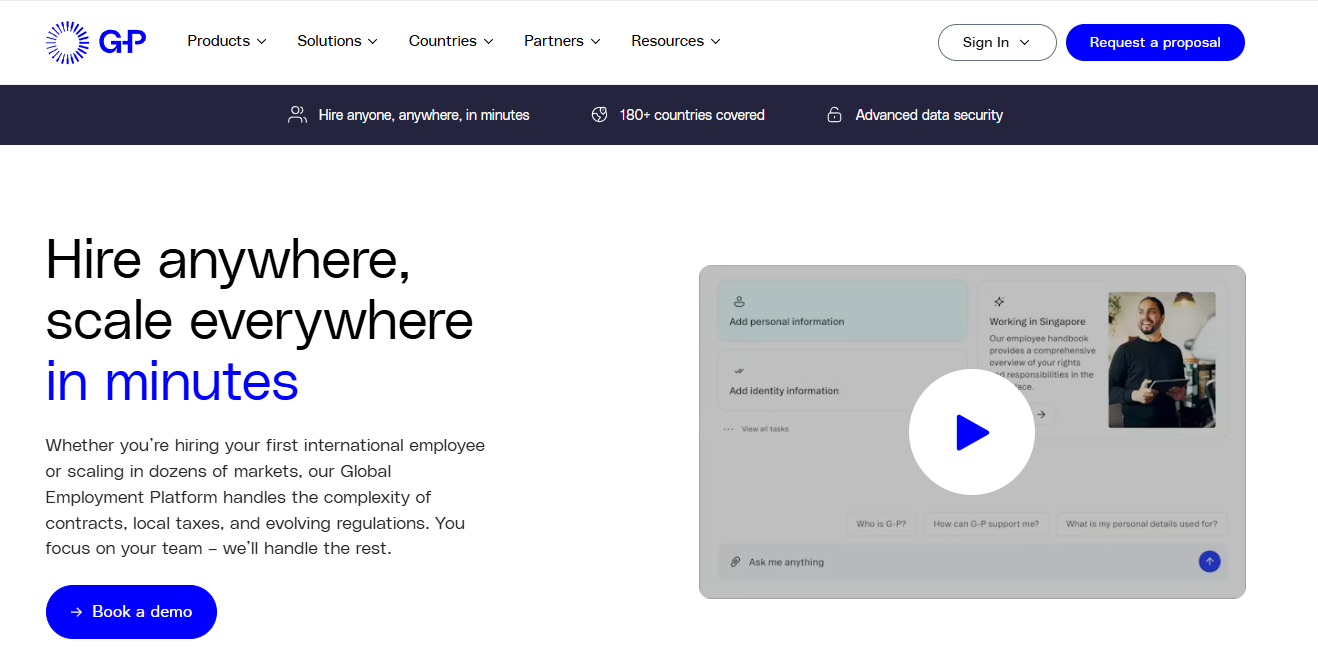
Globalization Partners (G-P) uses a 100% owned-entity model, while Multiplier combines owned and partner infrastructure. G-P uses custom pricing, so it costs considerably more than Multiplier based on the comparison brief. Its main case is not price. G-P focuses on enterprise compliance and global hiring across 180 countries. See our Globalization Partners competitors guide for other options.
Globalization Partners
What it does better than Multiplier:
- Uses owned entities instead of a mixed model
- Covers 180 countries through its EOR platform
- Has operated its owned-entity model since 2012
- Better suited to complex enterprise compliance needs
Where Multiplier still wins:
- Publishes a much lower starting EOR price
- Offers clearer pricing before contacting sales
- Costs less for straightforward international hiring
- Better fits companies that prioritize EOR cost
EOR price:
From $599 PEPM
Transparency:
Low
Countries:
180 countries
Entity model:
100% owned
Best for:
Enterprise compliance and complex expansion
G2:
4.4
Pick it over Multiplier if:
You need owned EOR infrastructure and stronger support for complex or regulated international employment.
Stick with Multiplier if:
You do not need that level of enterprise infrastructure and want a lower published EOR price.
*As pricing is subject to change, we are listing prices as they stand in August 2026
3. Remote
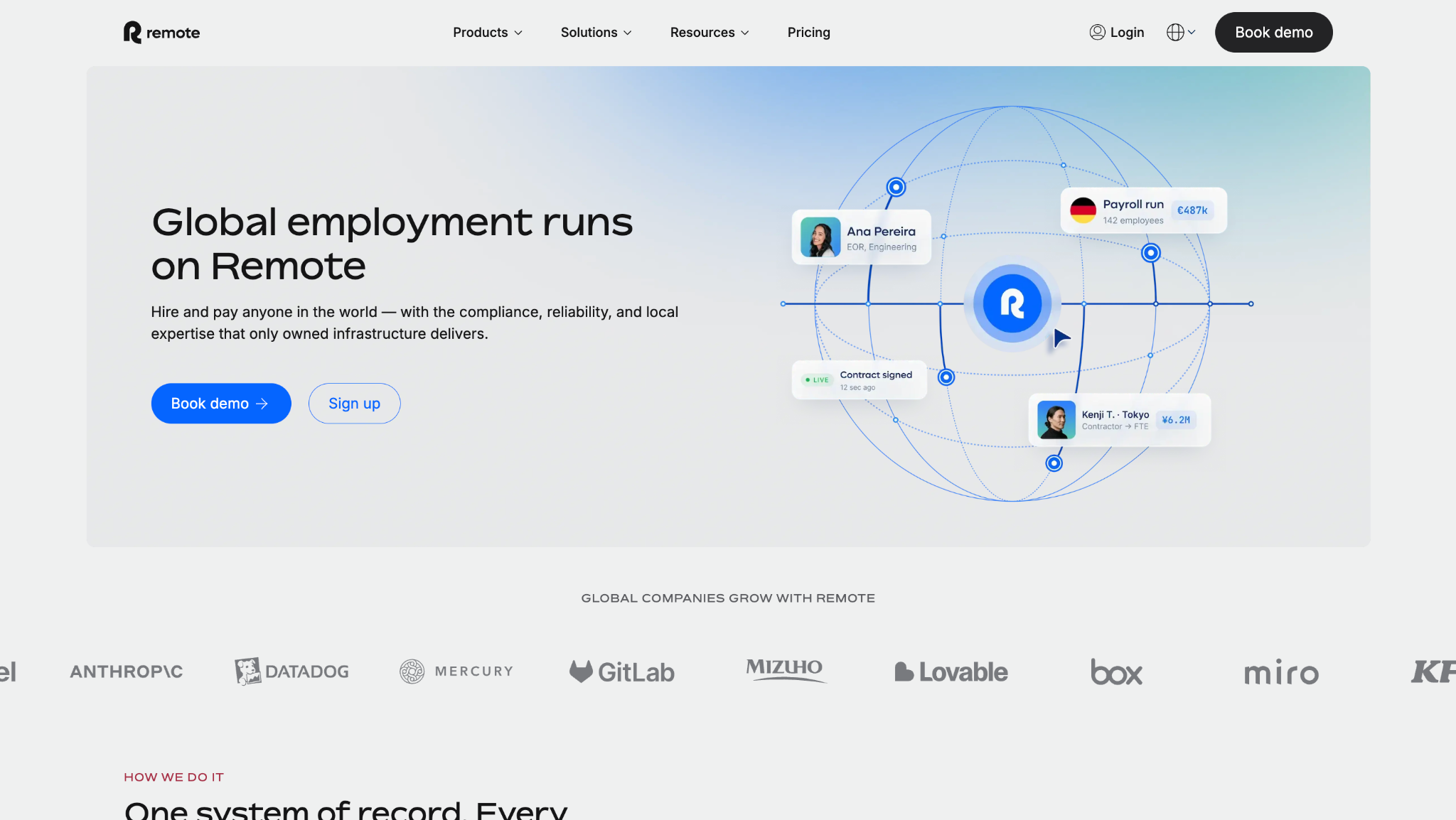
Remote and Multiplier both use their own legal entities to employ EOR workers. Remote charges $699 PEPM monthly, or $599 with annual billing, while Multiplier starts at a lower rate. The main differences now come down to country coverage, platform features, support, and each provider’s operating history. See our Remote alternatives guide for other options.
Remote
What it does better than Multiplier:
- Employs EOR workers only through its own entities
- Keeps employment responsibility within one provider
- Avoids third-party handoffs for EOR employment
- Offers dedicated onboarding and local employment support
Where Multiplier still wins:
- Has a lower published starting EOR price
- Covers more countries for EOR hiring
- Costs less when owned entities are not essential
- Offers a lower-cost route for growing global teams
EOR price:
$699 PEPM
Transparency:
High
Countries:
90+ countries
Entity model:
100% owned
Best for:
Direct-owned EOR infrastructure
G2:
4.5
Pick it over Multiplier if:
You want one provider to employ your workers directly without relying on local EOR partners.
Stick with Multiplier if:
You want broader country coverage and a lower starting price, and a mixed entity model works for your hiring plans.
*As pricing is subject to change, we are listing prices as they stand in August 2026
Platform and Payroll Multiplier Alternatives: Papaya Global and Rippling
Papaya Global and Rippling are good options for companies that need more than EOR. Papaya Global focuses on global payroll, while Rippling combines EOR with HR, IT, and finance tools.
4. Papaya Global
Papaya Global uses owned plus partner entities, similar to Multiplier. Its EOR starts from $499 PEPM, above Multiplier’s starting price. Papaya’s main advantage is broader payroll management. It can consolidate payroll across many countries, which makes it more relevant when payroll operations are the main problem rather than EOR hiring alone.
Papaya Global

What it does better than Multiplier:
- Focuses more heavily on multi-country payroll consolidation
- Operates directly through owned entities in 80+ countries
- Supports in-house, managed, and hybrid payroll models
- Combines payroll, payments, EOR, and contractors in one system
Where Multiplier still wins:
- Has a lower published starting EOR price
- Better fits companies focused mainly on EOR hiring
- Offers a simpler entry point for smaller global teams
- Costs less for straightforward international employment
EOR price:
From $499 PEPM
Transparency:
High
Countries:
EOR hiring in 180+ countries; owned entities in 80+ countries
Entity model:
Owned plus partner
Best for:
Multi-country payroll and EOR
G2:
4.5
Pick it over Multiplier if:
You need to consolidate payroll across many countries and manage EOR employees.
Stick with Multiplier if:
Your main need is international EOR hiring, and you want a lower starting price.
*As pricing is subject to change, we are listing prices as they stand in August 2026
5. Rippling
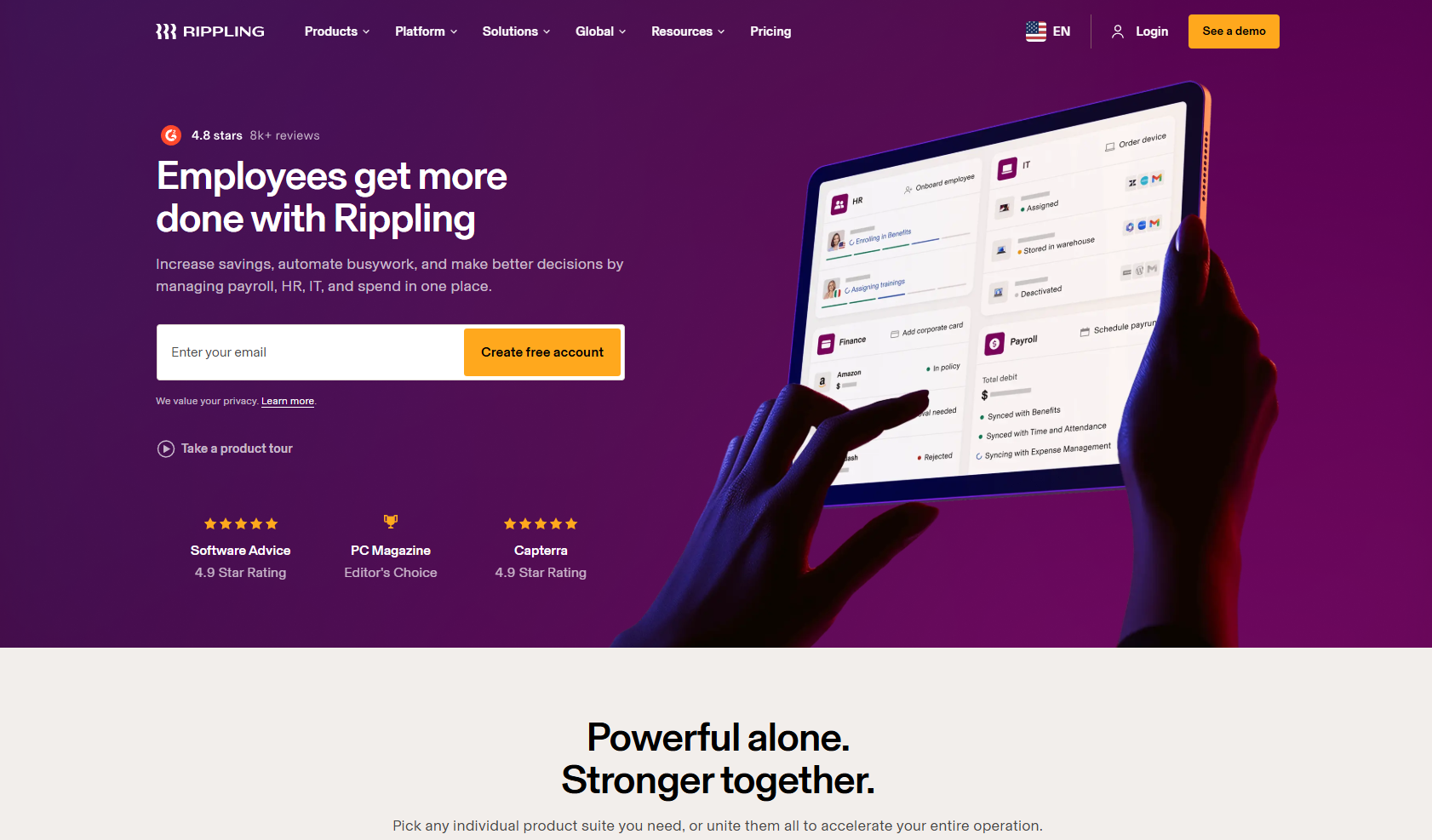
Rippling uses owned plus partner entities, the same broad model as Multiplier, but it does not publish its EOR price. Its main difference is platform depth. Rippling combines global employment with HR, payroll, finance, IT, device management, and app access. It fits companies that want to solve several workforce and IT problems in one system.
Rippling
What it does better than Multiplier:
- Combines EOR with a broader HR platform
- Adds employee device and app management
- Connects HR, IT, payroll, and finance data
- Offers deeper workflow automation across business functions
Where Multiplier still wins:
- Publishes a starting EOR price
- Keeps its offering more focused on global employment
- Makes EOR costs easier to compare upfront
- Better suits teams without broader HR and IT needs
EOR price:
Custom pricing
Transparency:
Low
Countries:
80+ countries
Entity model:
Owned plus partner
Best for:
All-in-one HR, IT, and EOR
G2:
4.8
Pick it over Multiplier if:
You want EOR, HR, payroll, IT, and finance tools in one system.
Stick with Multiplier if:
You mainly need global employment and want a published starting EOR price.
Specialist and Budget Multiplier Alternatives: Oyster HR, Pebl, and RemoFirst
Oyster HR, Pebl, and RemoFirst fit more specific needs. Oyster HR focuses on employee experience, Pebl on M&A and immigration, while RemoFirst offers a lower-cost EOR option.
6. Oyster HR
Oyster HR uses a 100% partner model, while Multiplier combines owned and partner entities. Oyster’s EOR costs more than Multiplier, so the reason to choose it is not price or direct-owned infrastructure. Its stronger case is employee experience, with country-specific benefits, onboarding support, and access to local HR and legal expertise.
Oyster HR

What it does better than Multiplier:
- Puts more emphasis on employee experience and care
- Offers country-specific employee benefits
- Provides access to in-house HR and legal experts
- Has a strong focus on distributed teams
Where Multiplier still wins:
- Has a lower published starting EOR price
- Uses owned entities in addition to partners
- Offers a stronger liability chain in owned markets
- Costs less for straightforward EOR hiring
EOR price:
$699 PEPM
Transparency:
Medium
Countries:
180+ countries
Entity model:
100% partner
Best for:
Benefits and employee experience
G2:
4.4
Pick it over Multiplier if:
Employee benefits and the international employee experience matter more than price or direct-owned infrastructure.
Stick with Multiplier if:
You want a lower starting price and prefer a provider that operates through both owned and partner entities.
*As pricing is subject to change, we are listing prices as they stand in August 2026
7. Pebl
Pebl (formerly Velocity Global) uses owned plus partner entities, similar to Multiplier. Pebl’s official pricing is not fully public, while Multiplier publishes its starting EOR rate. Pebl stands out more for complex global moves, especially immigration and M&A-related workforce transitions, rather than straightforward international hiring. Its September 2025 rebrand from Velocity Global is also relatively recent.
Pebl

What it does better than Multiplier:
- Offers deeper support for global immigration needs
- Handles workforce transitions during mergers and acquisitions
- Has more than a decade of global employment experience
- Covers hiring and employment in 185+ countries
Where Multiplier still wins:
- Publishes its starting EOR price directly
- Makes EOR costs easier to compare upfront
- Has a more established current brand identity
- Better fits straightforward international hiring
EOR price:
Custom pricing
Transparency:
Medium
Countries:
185+ countries
Entity model:
Owned plus partner
Best for:
M&A and global immigration needs
G2:
4.6
Pick it over Multiplier if:
You need EOR support alongside immigration or complex workforce changes during an acquisition
Stick with Multiplier if:
You have simpler EOR needs and want clearer published pricing
8. RemoFirst
RemoFirst uses a 100% partner network, while Multiplier combines owned and partner entities. RemoFirst starts at $199 PEPM, so it costs less than Multiplier. The trade-off is clear: RemoFirst keeps prices low through local partners rather than its own legal entities. This makes it useful for buyers who value cost over direct-owned EOR infrastructure.
RemoFirst

What it does better than Multiplier:
- Starts at a lower EOR price
- Covers 185+ countries through its partner network
- Requires no minimum contract term or employee count
- Provides 24/7 customer support
Where Multiplier still wins:
- Operates through both owned and partner entities
- Offers direct-owned infrastructure in some markets
- Reduces reliance on third-party employment partners
- Better fits buyers who prioritize entity structure
EOR price:
From $199 PEPM
Transparency:
High
Countries:
185+ countries
Entity model:
100% partner
Best for:
Lower-cost international EOR hiring
G2:
4.5
Pick it over Multiplier if:
You want a lower EOR price and are comfortable with a partner-only entity model
Stick with Multiplier if:
You are willing to pay more for access to owned entities in some markets
*As pricing is subject to change, we are listing prices as they stand in August 2026
Which Multiplier Alternative Fits Your Use Case
The right choice depends on what you want to get from an EOR in addition to international employment. I compared these providers by price, entity model, platform features, global coverage, and the companies they serve best. Some focus on lower EOR costs, while others offer more payroll, HR, IT, or enterprise support.
Cheapest Multiplier Alternative
RemoFirst is the cheapest Multiplier pricing alternative on this list. It starts at $199 per employee per month, below Multiplier’s starting price. The main trade-off is the entity model. RemoFirst uses local partners to employ workers, while Multiplier uses its own legal entities.
Best Multiplier Alternative for Owned Entities
Remote and G-P use their own legal entities to employ EOR workers, like Multiplier. Remote has a longer track record in global employment and works well for companies that want direct employment without local partners. G-P is better suited to larger companies with complex compliance needs, but it costs more than Multiplier.
Best Alternatives to Multiplier for US Companies
Deel, Rippling, Oyster HR, and RemoFirst are US-headquartered alternatives to Multiplier. They can suit US companies that prefer working with a US-based provider. However, headquarters does not determine where an EOR can employ workers. Each provider has its own international country coverage.
Best Multiplier Alternative for Enterprise Payroll
Papaya Global is a strong option for companies that manage payroll across many countries. It focuses on global payroll, payments, and EOR services for larger companies. Multiplier now overlaps more with Papaya after adding global payroll and cross-border payments in April 2026, but Papaya remains more focused on enterprise payroll.
Best Multiplier Alternative for All-in-One HR and IT
Rippling is a strong option for companies that need more than global employment. It combines EOR with HR, payroll, IT, finance, and device management. This makes it useful for companies that want to manage employees and their technology in one system.
Best Multiplier Alternative for Benefits and Employee Experience
Oyster HR is a strong option for companies that focus on employee benefits and support. It offers country-specific benefits and support for international employees. This makes it useful for companies that prioritize employee experience over the lowest EOR price.
Best Multiplier Alternative for M&A and Immigration
Pebl is a strong option for companies that need support with mergers, acquisitions, or international employee moves. It also provides immigration and visa services. G-P offers similar support for larger companies with more complex global needs.
When Multiplier Is Still the Right Choice
Multiplier is a good choice for companies hiring a few employees across several countries. It publishes its starting price and has strong APAC coverage. It also suits cost-conscious companies that want to see pricing before talking to sales.
How to Switch From Multiplier
Switching from Multiplier to another EOR means moving employees from one legal employer to another. Several contract, employment, and tax issues need to be checked before the move. This is general information, not legal or tax advice.
- Check your Multiplier contract. Review the notice period and any minimum term before signing with another EOR. These terms can affect when you can leave and what you pay.
- Check your salary deposit (refundable money the EOR holds to cover employment costs). Find out how much Multiplier holds and when it will return the money. Until then, that cash remains tied up.
- Check local employment rules. One legal entity terminates the employee, and another hires them. This can trigger notice periods and, in some countries, severance.
- Check employee benefits. Make sure current benefits do not end before the new ones start. Equity and ESOP arrangements may also need separate handling.
- Consider the tax year. Changing the legal employer mid-year can create extra payroll and tax issues in some countries. Check this before choosing the switch date.
- Confirm the new legal employer. Check whether the new EOR owns an entity in each country or uses a local partner to employ your workers.
INSIGHT: What does switching EOR actually cost?
Most switching costs come from deposits, notice periods, and moving employees between legal employers, not the new provider’s monthly fee.
- Deposits can tie up cash. Multiplier requires a refundable EOR deposit and generally returns it within 60 days after the employee’s last day. Deel also requires a deposit and generally refunds it within 60 days after final invoices are paid. Oyster requires at least one month of fees and returns unused funds within 60 days after outstanding amounts are settled. Remote may require a reserve depending on the customer, country, and employment terms.
- Local notice rules can increase the cost. Germany shows how much timing can matter. Under Section 622 of the German Civil Code, employer notice periods increase with service and reach seven months after 20 years of employment.
- Timing can matter more than the new provider. The practical question may be when to switch rather than who to switch to. The answer depends partly on the countries where employees work and their termination rules, which the company’s own counsel should assess.
FAQs on Multiplier Alternatives
What are the best alternatives to Multiplier?
The best Multiplier alternative depends on your needs. Deel offers more automation and workforce tools. Remote uses only its own entities for EOR services. RemoFirst has the lowest published starting price on this list. Rippling combines global employment with HR, payroll, and IT tools.
What are the alternatives to Multiplier software?
Multiplier is a global employment platform and employer-of-record service, not a software companies install. It helps businesses hire, employ, and pay workers in other countries. The comparison above covers the main alternatives to Multiplier.
Is there a cheaper alternative to Multiplier?
Yes, RemoFirst starts at $199 per employee per month, which is cheaper than Multiplier. The main difference is the entity model. RemoFirst uses local partners to legally employ workers in each country. Multiplier uses a mix of its own entities and local partners, so some employees are hired directly through Multiplier’s entities.
What is the best Multiplier alternative for US companies?
Deel is a strong option for US companies because it is based in the US and has a large US presence. It also offers US payroll and international EOR services. However, a provider’s headquarters does not determine where it can employ workers. Country coverage matters more for international hiring.
Multiplier vs Deel: which is better?
It depends on what you need. Deel offers more automation, integrations, and a larger enterprise footprint. Multiplier has strong APAC coverage and costs less. Its EOR pricing starts at $459 per employee per month with annual billing, compared with Deel’s $599 rate, a difference of $140 per employee per month.
Does Multiplier own its entities?
Yes, Multiplier’s current website says it uses its own legal entities rather than local EOR partners. It states that it operates owned entities across 160+ markets. This is a recent change from older Multiplier pages, which described a mix of owned entities and third parties.
Can I switch EOR providers mid-year?
Yes, but the timing depends on three things: your current EOR’s notice period, local notice and severance rules, and when your deposit is returned. These terms can vary by provider and country because employees move between legal employers. The How to Switch section explains these points in more detail. This is general information, not legal advice.
Verdict: The Best Multiplier Alternative for You
The right Multiplier alternative depends on your needs: choose Deel for more automation and integrations, G-P for complex enterprise needs, Remote for its longer track record, Papaya Global for global payroll, Rippling for HR and IT, Oyster HR for employee experience, Pebl for M&A and immigration, or RemoFirst for a lower starting price. Multiplier remains a strong choice for cost-conscious companies hiring fewer employees across several countries. The alternatives make more sense when enterprise scale, platform features, or a different employment model matters more than Multiplier’s price.

Helen is Anywherer’s Market Analyst & Content Researcher, with extensive experience in analyzing global employment markets and HR technology trends. She is skilled at turning complex market data into clear, well-researched insights that inform every piece of content. With a strong grasp of the EOR, PEO, and international hiring space, Helen plays a key role in keeping Anywherer’s research accurate, up to date, and genuinely useful for readers.