Employment Hero is an all-in-one employment platform from Australia. It combines HR, native payroll (payroll it runs itself rather than through a partner), recruitment, benefits, and rostering in 1 subscription. It runs sites for Australia, New Zealand, the UK, Canada, Singapore, and Malaysia. People shop Employment Hero competitors for 2 reasons. Some want depth in 1 area rather than breadth across many, and others are expanding into markets the platform doesn’t cover. My picks are Rippling for HR, IT, and payroll in 1 system, ELMO Software for an Australian-built suite, and Deel for hiring across borders.
This guide ranks 8 providers against Employment Hero itself. For every provider, I list where it beats Employment Hero and where it falls behind. The list splits by geography, and that matters more than any feature. Some options replace Employment Hero’s Australian payroll, some sit beside it, and 2 exist mainly for work in the United States. The comparison table shows which is which, so an Australian reader doesn’t accidentally swap a payroll system for an HR tool.
The concessions come first. Employment Hero runs native Australian payroll with award interpretation, meaning it turns award rules into correct pay. That is the hardest capability in this market to build. Its bundle covers employment from hiring to exit. It keeps investing, too. It moved into Canada in 2025, took a KKR growth investment the same year, and now sells its own employer of record service. Here is why payroll sits above everything else.

INSIGHT: Why is Australian payroll the hardest thing to replace?

The hard part is applying award rules to every timesheet and reporting each pay run to the tax office as it happens.
- The Fair Work Ombudsman describes a modern award as a legal document setting minimum pay rates and employment conditions. Its terms cover pay rates, penalty rates, allowances, and hours of work.
- Under Single Touch Payroll, the ATO says employers report payroll information each time they pay staff, through STP-enabled software. That covers wages, pay-as-you-go (PAYG) withholding, and superannuation, Australia’s compulsory retirement savings.
- So a platform can beat Employment Hero at HR yet fail to replace it in Australia, which is why the table separates the 2.
Sources:
Read in September 2026. Nothing here is compliance advice.
Employment Hero Alternatives Comparison: Side-by-Side View
This Employment Hero competitors comparison puts Employment Hero in the bold reference row, with the 8 alternatives below ranked. The 2 geography columns decide more than any feature. Native AU payroll shows whether a provider can run Australian pay runs itself. US capability shows whether it pays people in the United States directly or through an employer of record. That is a third party that legally employs staff for you.
| Provider | Native AU payroll | US capability | Pricing | Best for | G2 |
|---|---|---|---|---|---|
| Employment Hero | Yes | No US payroll; own employer of record (HeroForce) claimed in 180+ countries | From A$10 per employee/month; HeroForce 5% of payroll processed | ANZ businesses wanting 1 system | 4.4/5 (4,017) |
| Rippling | Yes | Both | Custom pricing | HR, IT, and payroll together | 4.8/5 (13,392) |
| ELMO Software | Yes | None | Custom pricing | Australian mid-market suite buyers | 4.4/5 (61) |
| Xero | Yes | US payroll via Gusto partnership | From A$78/month, payroll for 2 people | Small businesses already on Xero | 4.4/5 (1,832) |
| HiBob | Via integration (ADP Payforce) | Native US payroll | Custom pricing | Mid-market people platform buyers | N/A |
| Deputy | Yes (Deputy Payroll add-on) | None | From A$6.75 per user/month | Rostered and shift-based teams | 4.6/5 (666) |
| BambooHR | Via integration (Xero Payroll) | Native US payroll | From $10 per employee/month (US dollars) | Core HR, payroll kept elsewhere | 4.4/5 (6,709) |
| Deel | Not confirmed | Employer of record, plus a US PEO | EOR from $599 per employee/month (US dollars) | Employing abroad without an entity | 4.7/5 (6,961) |
| Gusto | No | Native US payroll | From $49/month plus $6 per person (US dollars) | Payroll for a US entity | 4.6/5 (12,871) |
As pricing is subject to change, we list prices as of September 2026.
Why Teams Shop Employment Hero Alternatives
Most businesses leaving Employment Hero are not leaving a broken product. They are leaving a product that stopped fitting, and 5 patterns keep coming up again and again.
- Paying for a bundle you do not use. The all-in-one model is the point, and it is also the first thing questioned by a business using 3 of the modules. That is a fit question, not a defect.
- Wanting specialist depth instead of breadth. Rosters, award interpretation at the timesheet level, and performance management are the most-named gaps. Deputy goes deeper on rosters, while HiBob and BambooHR go deeper on people management.
- Not wanting HR, payroll, and benefits with 1 vendor. Some procurement teams prefer HR, payroll, and benefits split across vendors, particularly as headcount grows. That is a legitimate position, not a verdict on the product.
- Growing past the SMB bundle. Its plans run from HR Essentials up to custom HR Elite and Employment Unlimited tiers, so the product does stretch. The pressure shows when a business wants IT and device management or multi-country HR in the same system.
- Expanding into the United States. The United States is not among Employment Hero’s 6 markets, and it runs no US payroll. It does sell HeroForce, its own employer of record service, priced at 5% of payroll processed. The real question is which route and which provider.
Balance note: Employment Hero is a genuinely strong platform. Founded in 2014, it now says it serves 350,000+ businesses, up from the 300,000 it cited in February 2025. Its Australian payroll is native, with award interpretation, Single Touch Payroll Phase 2, and Payday Super support. At its price point, almost nothing else can claim that. It bundles HR, payroll, recruitment, benefits, and an employee app in 1 subscription. A business without an HR team deals with 1 vendor instead of 4. It has kept moving, adding a Canadian platform in 2025 and taking a KKR growth investment that year. It also launched HeroForce, which it says reaches 180+ countries. For an Australian or New Zealand business of 20 to 200 people wanting employment in 1 place, it does exactly what it claims. The rest of this article is for businesses whose needs point elsewhere.
How I Compared These Employment Hero Alternatives
Every one of these Employment Hero alternatives went through the same 6 tests, using facts from its own website.
- Australian payroll: whether Australian payroll runs natively or through a named integration.
- Awards and STP: how each handles modern awards and Single Touch Payroll reporting.
- United States capability: native US payroll, an employer of record service, both, or neither.
- Breadth or depth: whether the product aims for breadth across employment or depth in 1 area.
- Pricing transparency: whether a rate is published, and in which currency.
- Company size fit: the size of business each product is actually built around.
Best Overall Employment Hero Alternative
Rippling is the only alternative here that runs native Australian payroll and also ties HR to IT and spend in 1 system. It suits a business that has outgrown an employment-focused bundle and wants the rest of its operations tied to the same employee record.
#1 Rippling: HR, IT, and Payroll on 1 Record
Rippling

Rippling runs native Australian payroll, calculating PAYG withholding and submitting STP Phase 2 reports to the ATO from each pay run. In the United States, it runs its own payroll and also sells an employer of record service, live in 80 countries since June 2025. Pricing is custom rather than published.
What it does better than Employment Hero:
- IT device and app management on the same employee record
- Native US payroll alongside Australian payroll in 1 system
- Employer of record coverage in 80 countries, per Rippling
- Corporate cards and spend tied to the same people data
Where Employment Hero still wins:
- Published starting prices, where Rippling quotes every deal
- A 2 million+ jobseeker marketplace behind its hiring tools
- HeroForce claimed in 180+ countries, against Rippling’s 80
- Local sites and support in 6 markets, including Singapore
Native AU payroll:
Yes
US capability:
Both: native US payroll and employer of record
Pricing:
Custom pricing
Country focus:
US-built, with native Australian payroll
Best for:
HR, IT, and payroll together
G2:
4.8/5, 13,392 reviews in September 2026
Pick it over Employment Hero if:
you want devices, apps, and spend managed on the same record as payroll and HR.
Stick with Employment Hero if:
employment is the whole job and a published per-employee price matters to you.
*As pricing is subject to change, we are listing prices as they stand in September 2026
Employment Hero Alternatives With Native Australian Payroll
Both entries run Australian payroll natively, so both are true replacements rather than add-ons. ELMO Software is the closest structural peer, a local suite aimed a step up the market. Xero keeps payroll inside the accounting system many small businesses already use and leaves HR to be bought separately.
#2 ELMO Software: The Australian Suite a Step Up
ELMO Software
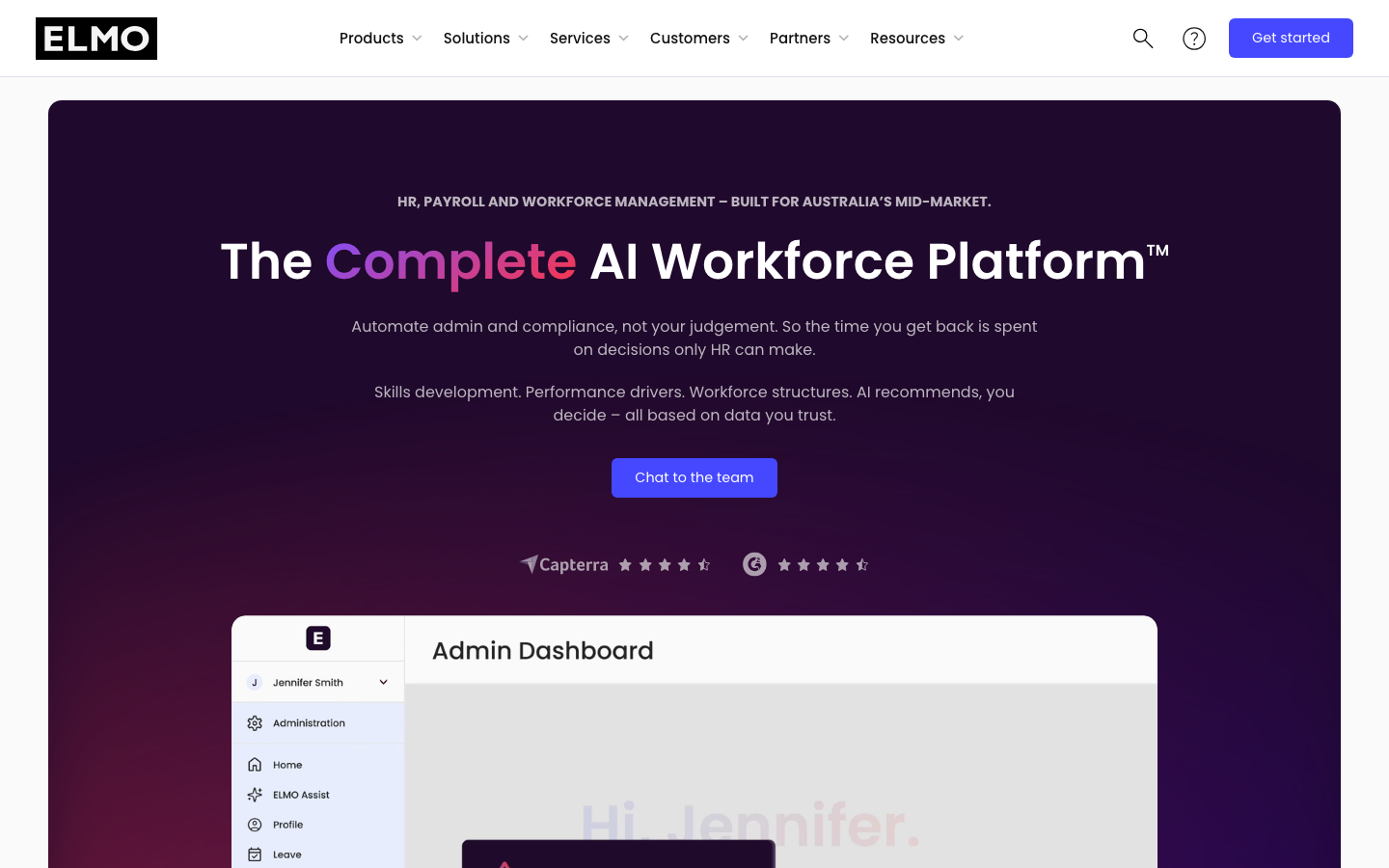
ELMO Software runs native Australian payroll, built around modern awards, enterprise agreements, and Single Touch Payroll. It has no US payroll or employer of record product. Founded in 2002, it serves 2,000+ organizations across Australia, New Zealand, and the UK, and K1 Investment Management took it off the ASX in 2023.
What it does better than Employment Hero:
- 20+ years building for modern awards and enterprise agreements, per ELMO
- HR, payroll, and rostering on 1 data foundation
- Offices across Australia, New Zealand, and the UK
- A product aimed squarely at the Australian mid-market
Where Employment Hero still wins:
- Published starting prices from A$10 per employee per month
- HeroForce employer of record for hiring beyond Australia
- Recruitment tied to a 2 million+ jobseeker marketplace
- A far larger G2 review base than ELMO’s 61 reviews
Native AU payroll:
Yes
US capability:
None
Pricing:
Custom pricing, quoted per user
Country focus:
Australia and New Zealand, plus the UK
Best for:
Australian mid-market suite buyers
G2:
4.4/5, 61 reviews in September 2026
Pick it over Employment Hero if:
you want an Australian-built suite with native payroll and your headcount has moved into mid-market territory.
Stick with Employment Hero if:
you are a smaller business that values published pricing and hiring help in 1 account.
*As pricing is subject to change, we are listing prices as they stand in September 2026
#3 Xero: Payroll Inside the Accounting System
Xero

Xero runs native Australian payroll inside its accounting plans, reporting Single Touch Payroll Phase 2 data to the ATO every payday. Its Grow plan costs A$78 a month after an introductory price and includes payroll for 2 people. In the United States, Xero Payroll is powered by Gusto rather than built by Xero.
What it does better than Employment Hero:
- Payroll and accounting in 1 login, with no second vendor
- Superannuation paid directly through Xero
- A Xero Me app for payslips, leave, and timesheets
- The payroll that BambooHR itself connects to in Australia
Where Employment Hero still wins:
- Onboarding, performance reviews, and learning in the same platform
- Rostering with award-based labor costing in 1 subscription
- Recruitment tools and a 2 million+ jobseeker marketplace
- HeroForce employer of record for hires outside Australia
Native AU payroll:
Yes
US capability:
US payroll via Gusto partnership
Pricing:
From A$78 per month (Grow, payroll for 2 people)
Country focus:
Australia and New Zealand small businesses
Best for:
Small businesses already running Xero
G2:
4.4/5, 1,832 reviews in September 2026
Pick it over Employment Hero if:
your accountant already works in Xero and your team fits inside its payroll limits.
Stick with Employment Hero if:
you need HR, rosters, and recruitment as much as you need payroll.
*As pricing is subject to change, we are listing prices as they stand in September 2026
Employment Hero Competitors for Core HR and Workforce Management
HiBob and BambooHR do not replace Australian payroll, because both hand it to a partner system. Deputy now sells its own Australian payroll add-on, but rosters remain its core. For the wider field of people tools, see this roundup of AI HR software.
#4 HiBob: A Mid-Market People Platform
HiBob
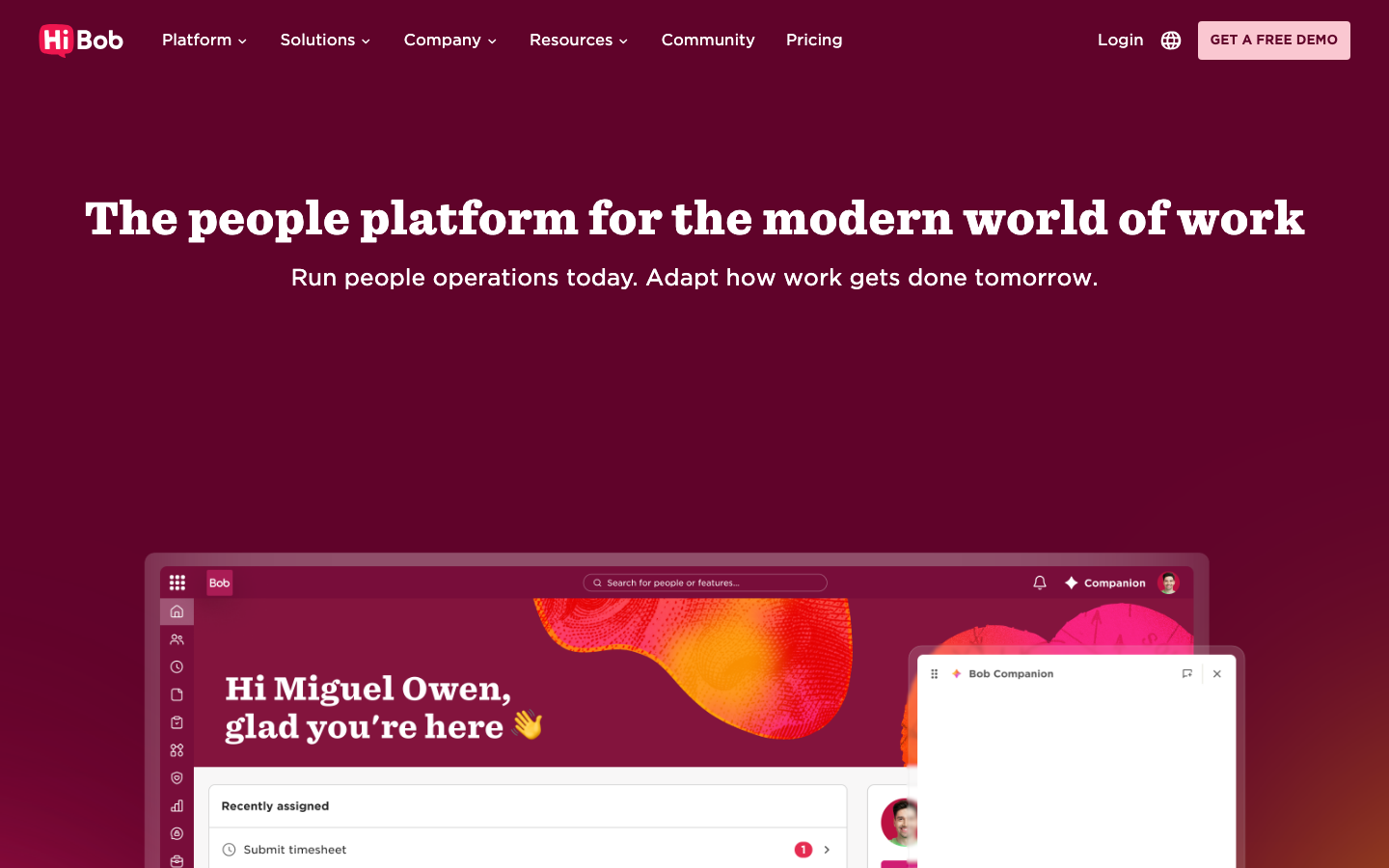
HiBob runs Australian payroll via integration through Bob Payroll Hub’s connection to ADP Payforce. It runs native payroll in the United States and the UK. Pricing is custom, and the platform is pitched squarely at mid-market and enterprise organizations that have outgrown simpler HR tools and SMB bundles.
What it does better than Employment Hero:
- Native US and UK payroll inside the same people platform
- Leave accruals for annual, personal, and long service leave
- Performance check-ins and analytics for growing teams
- Configurable workflows across several countries and entities
Where Employment Hero still wins:
- Native Australian payroll instead of an ADP Payforce integration
- Published starting prices from A$10 per employee per month
- Rostering with award-based costing in the same subscription
- HeroForce employer of record for hires without an entity
Native AU payroll:
Via integration (ADP Payforce)
US capability:
Native US payroll
Pricing:
Custom pricing
Country focus:
Global, with native US and UK payroll
Best for:
Mid-market teams outgrowing an SMB bundle
G2:
N/A
Pick it over Employment Hero if:
people management is the gap and you already run a separate Australian payroll.
Stick with Employment Hero if:
you want Australian payroll and HR from 1 vendor with no integration to maintain.
*As pricing is subject to change, we are listing prices as they stand in September 2026
#5 Deputy: Rosters and Award Costs First
Deputy
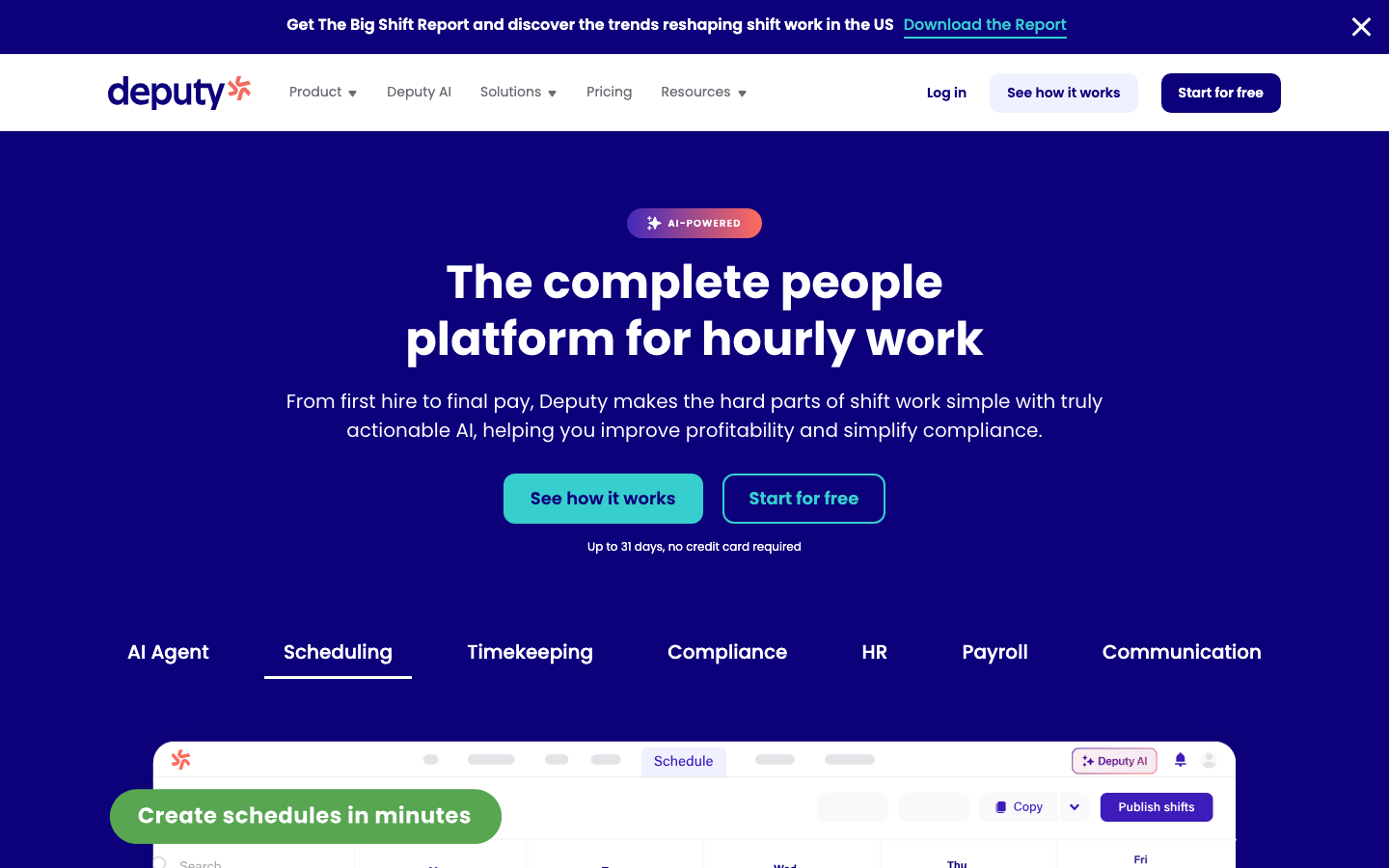
Deputy runs native Australian payroll through Deputy Payroll, an add-on at A$5 per user per month with award templates and STP Phase 2 support. It has no US payroll or employer of record product. Rostering plans start at A$6.75 per user per month, billed annually, and include award interpretation.
What it does better than Employment Hero:
- Award interpretation included from the entry Lite plan
- Auto-scheduling, demand forecasting, and wage budgets on Core
- Shift swaps, biometric time clocks, and timesheet auto-approval
- A Pay Rate Builder for writing custom pay rules
Where Employment Hero still wins:
- Recruitment, onboarding, and performance in the same system
- Payroll at the core of the product rather than an add-on
- Employee Assistance Program options available on its plans
- HeroForce for staff hired without an entity
Native AU payroll:
Yes (Deputy Payroll add-on)
US capability:
None
Pricing:
From A$6.75 per user/month, billed annually
Country focus:
Australia-built, also sold in the US and UK
Best for:
Rostered and shift-based teams
G2:
4.6/5, 666 reviews in September 2026
Pick it over Employment Hero if:
rosters, timesheets, and award costs are where your managers’ hours actually go.
Stick with Employment Hero if:
your team works regular hours and rosters are not the problem.
*As pricing is subject to change, we are listing prices as they stand in September 2026
#6 BambooHR: Clean Core HR, Payroll Kept Elsewhere
BambooHR
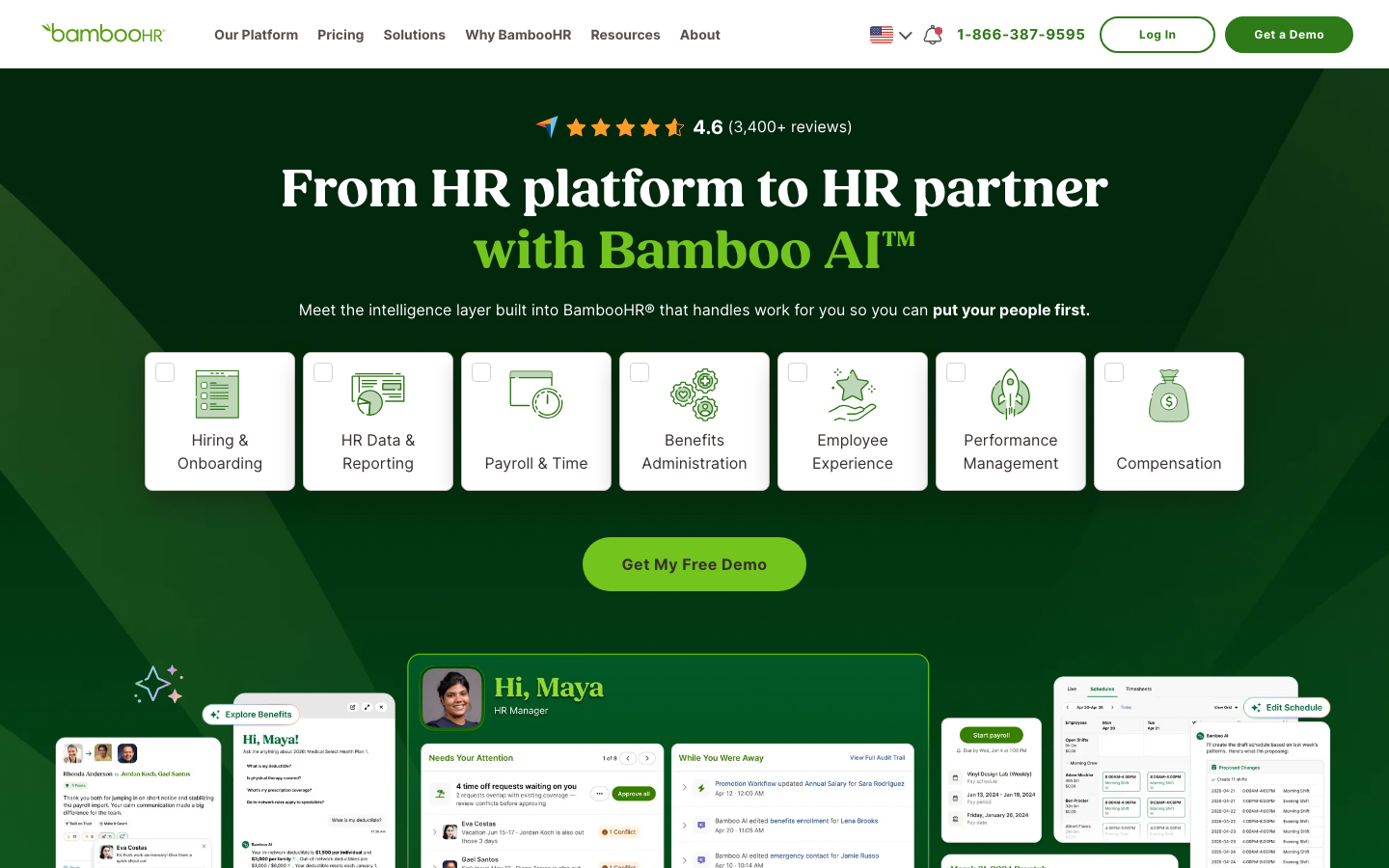
BambooHR runs Australian payroll via integration, connecting to Xero Payroll rather than paying Australian staff itself. Its own payroll covers US employees only. Plans are published at $10, $17, and $25 per employee per month in US dollars, with quotes and volume discounts on top.
What it does better than Employment Hero:
- Native US payroll for a US entity in the same system
- Benefits administration for US employees
- An integrations marketplace for connecting existing tools
- Project tracking and billable hours on higher plans
Where Employment Hero still wins:
- Native Australian payroll instead of a Xero Payroll connection
- Award-based rostering in the same subscription
- Pricing published in Australian dollars for local buyers
- HeroForce employer of record for staff abroad
Native AU payroll:
Via integration (Xero Payroll)
US capability:
Native US payroll
Pricing:
From $10 per employee/month (US dollars)
Country focus:
United States, with Australian payroll via Xero
Best for:
Core HR, payroll kept elsewhere
G2:
4.4/5, 6,709 reviews in September 2026
Pick it over Employment Hero if:
you want a clean people system and are happy to keep Australian payroll in Xero.
Stick with Employment Hero if:
you want award-aware payroll and HR in 1 place without an integration.
*As pricing is subject to change, we are listing prices as they stand in September 2026
Alternatives to Employment Hero for US Entities and Expansion
These 2 are bought alongside an Australian system, not instead of one. Gusto fills the 1 confirmed gap because Employment Hero has no payroll product for a US entity. Deel competes head-to-head, since Employment Hero already sells an employer of record service in HeroForce. Which one you need depends on whether you already own a US company.
#7 Deel: The Head-to-Head Employer of Record
Deel
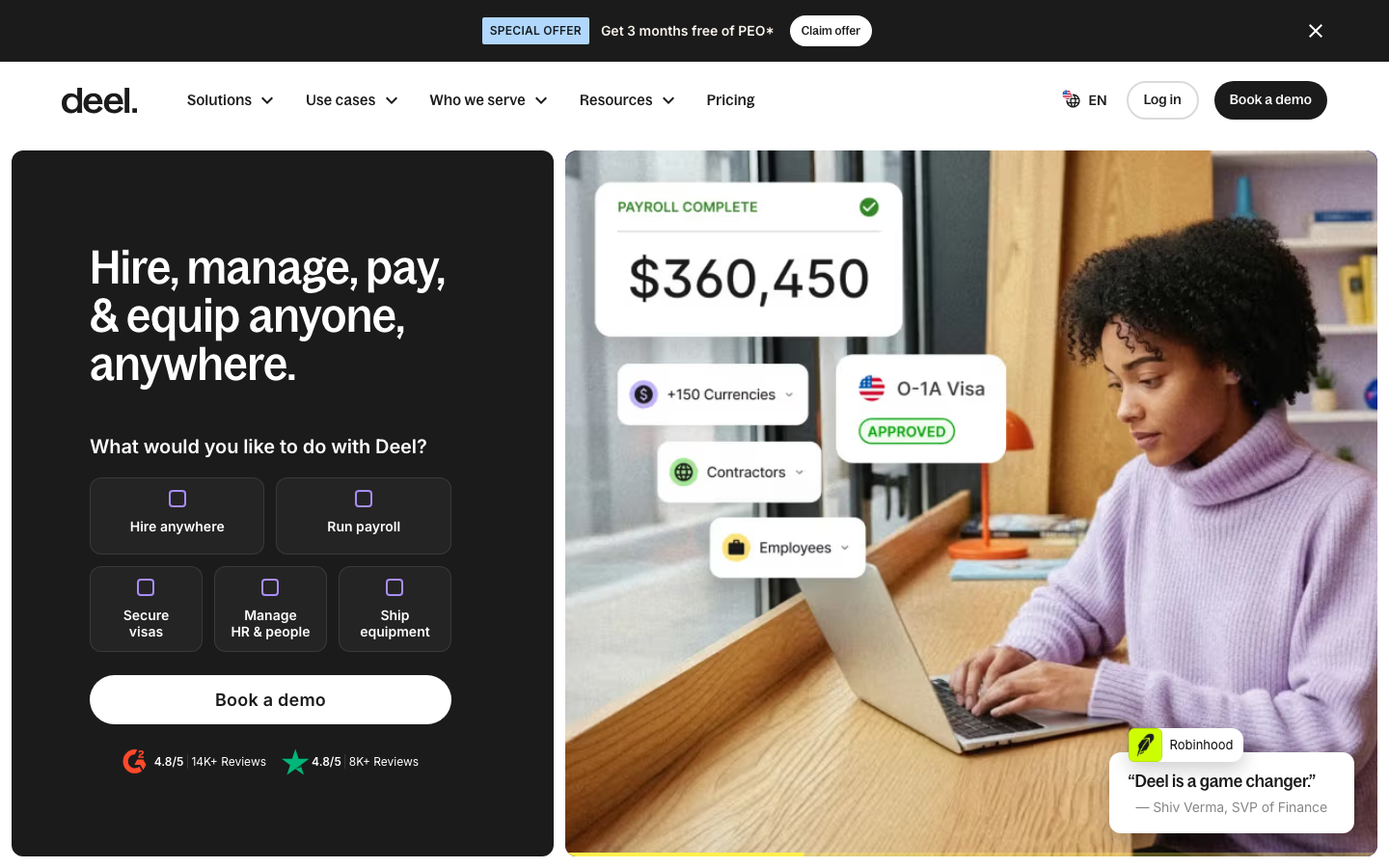
Deel is bought alongside an Australian payroll system, not instead of one. Its native Australian payroll is not confirmed, though it employs people in Australia as an employer of record. Deel prices EOR from $599 per employee per month in US dollars, while HeroForce charges 5% of payroll processed.
What it does better than Employment Hero:
- A flat fee that stops rising as salaries climb
- Employer of record in 130+ countries with published country pages
- A US PEO from $125 per employee per month
- Contractor of record from $325 per contractor per month
Where Employment Hero still wins:
- Deel is an added vendor, not a replacement for Australian payroll
- A percentage fee that costs less on modest salaries
- HR, payroll, and rosters for Australian staff on 1 platform
- HeroForce claimed in 180+ countries, against Deel’s 130+
Native AU payroll:
Not confirmed
US capability:
Employer of record, plus a US PEO
Pricing:
Employer of record at $599 per employee per month, in US dollars
Country focus:
Global employment in 130+ countries
Best for:
Employing abroad without an entity
G2:
4.7/5, 6,961 reviews in September 2026
Pick it over Employment Hero if:
you are hiring well-paid people abroad, where a flat fee undercuts a percentage.
Stick with Employment Hero if:
your overseas hires earn modest salaries and you want them beside your Australian team.
*As pricing is subject to change, we are listing prices as they stand in September 2026
#8 Gusto: US Payroll for a US Entity
Gusto
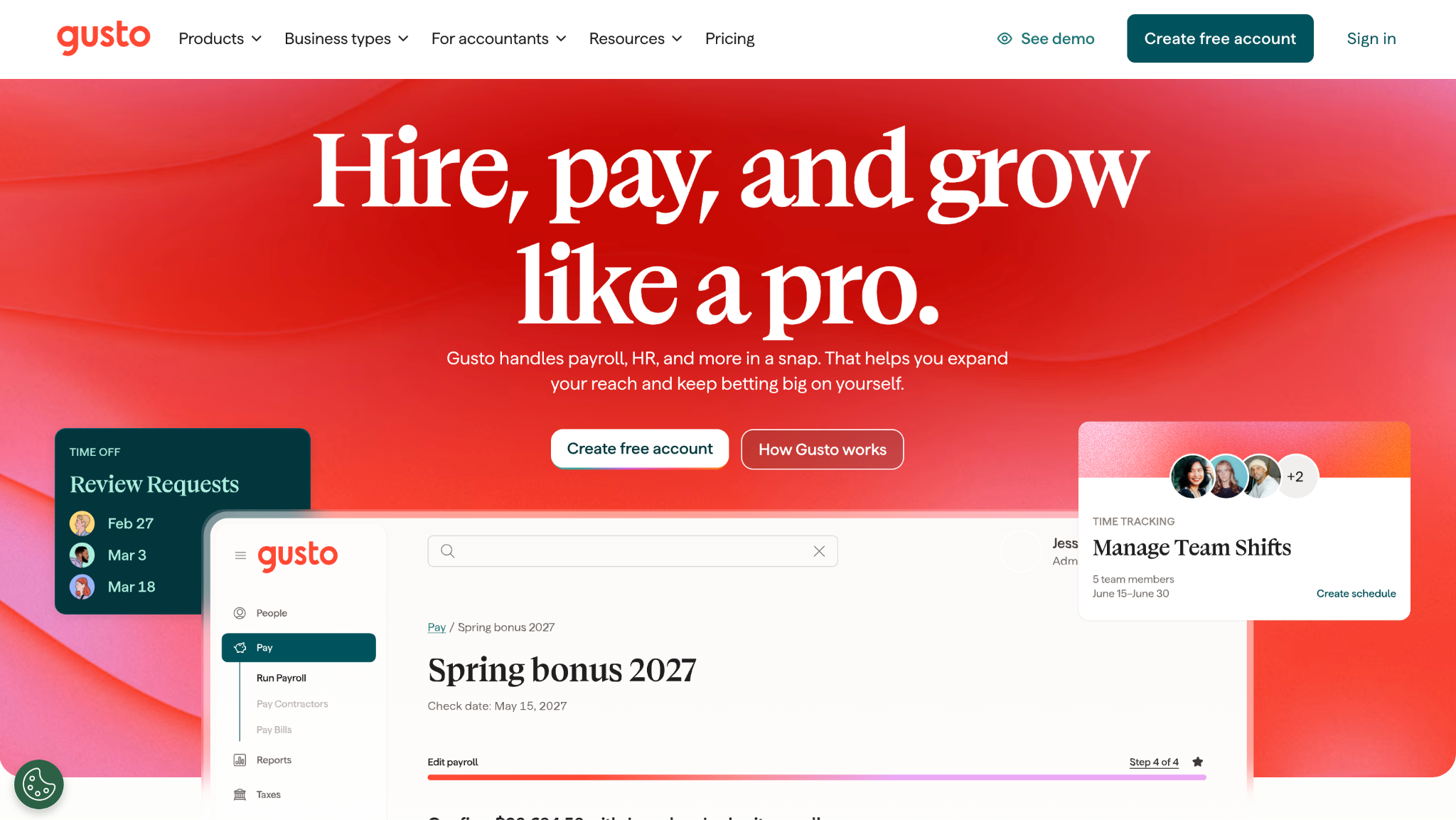
Gusto is a US-only payroll product, bought alongside whatever runs Australian payroll, not instead of it. It has no Australian payroll. Plans start at $49 a month plus $6 per person in US dollars, covering single-state payroll, unlimited pay runs, and tax filings and payments.
What it does better than Employment Hero:
- Federal and state payroll tax filings for a US entity
- Multi-state payroll from the $80 Plus plan
- State tax registration handled when you hire in a new state
- Contractor payments to more than 120 countries
Where Employment Hero still wins:
- Gusto is an added vendor, while Employment Hero keeps Australian payroll
- Native Australian payroll with award interpretation
- Australian dollar pricing and local support
- HR, rosters, and recruitment in 1 subscription
Native AU payroll:
No
US capability:
Native US payroll
Pricing:
From $49 per month plus $6 per person (US dollars)
Country focus:
United States only
Best for:
Payroll for an existing US entity
G2:
4.6/5, 12,871 reviews in September 2026
Pick it over Employment Hero if:
your company owns a US entity and needs American payroll and tax filing run properly.
Stick with Employment Hero if:
you have no US entity yet, where an employer of record fits better.
*As pricing is subject to change, we are listing prices as they stand in September 2026
Which Employment Hero Alternative Fits Your Situation
Best Alternatives to Employment Hero in Australia
Start with payroll, not features. ELMO Software and Xero both run native Australian payroll, so either can replace Employment Hero outright. Deputy now adds Australian payroll to its rostering, which suits shift-based businesses whose hours and award costs live in rosters. HiBob and BambooHR cannot stand alone here, because both send Australian payroll to a partner system. Decide the payroll question first, and the shortlist writes itself.
Employment Hero Alternatives With Native Australian Payroll
4 providers on this list run it natively: Rippling, ELMO Software, Xero, and Deputy through its payroll add-on. Each states Single Touch Payroll support on its own site. HiBob runs Australian payroll through ADP Payforce, and BambooHR through Xero Payroll. Deel’s native Australian payroll is not confirmed, and Gusto has none. That leaves 4 true replacements and 4 products that sit beside a payroll system.
Employment Hero Competitors for Rostered and Shift Teams
Deputy is the pick. A roster is the Australian term for a shift schedule, and Deputy is built around it, with award interpretation included from its A$6.75 Lite plan. The A$8.75 Core plan adds auto-scheduling, demand forecasting, and wage budgets. Deputy Payroll then takes approved timesheets straight into pay runs. For hospitality or retail, that goes deeper than any all-in-one bundle.
Employment Hero Competitors for Core HR
HiBob and BambooHR are the core HR picks. HiBob suits a mid-market team wanting a stronger people platform, with native US and UK payroll. BambooHR suits a company that wants a clean HR system and published plans. Neither runs Australian payroll natively: HiBob connects to ADP Payforce and BambooHR to Xero Payroll, so budget for that second system.
Alternatives to Employment Hero for US Entities
This is the 1 place where Employment Hero simply has no product, because the United States is not one of its markets. A company that already owns a US legal entity needs US payroll and tax filing. Gusto is the direct answer. A PEO, which co-employs staff through your own US entity, is the other route, and it’s worth reading how a PEO works first. Rippling also fits if you want US payroll on a wider platform. Either runs beside Australian payroll.
Alternatives to Employment Hero for US Expansion
Here the company owns nothing in America yet. It hires through an employer of record, a third party that legally employs staff while you direct the work. See what an employer of record does for the model. Unlike the previous route, this one needs no company of your own. HeroForce charges 5% of payroll processed, and Deel charges $599 per employee per month. For a US hire paid in US dollars, the 2 fees meet near a $143,760 salary. Below roughly $140,000 a year, HeroForce costs less, and above roughly $145,000, Deel does, sooner if payroll processing includes employer costs.
Employment Hero Competitors for Multi-Country Teams
Deel and Rippling suit a business operating across Australia, New Zealand, the UK, and Canada. Rippling keeps HR, IT, and payroll on 1 record and runs native Australian payroll. Deel covers employment in 130+ countries without an entity. Employment Hero covers all 4 markets itself, so this choice is about the systems around payroll rather than coverage.
When Employment Hero Is Still the Right Choice
Employment Hero is the right choice for an Australian or New Zealand business that wants employment handled in 1 place. It suits a company that values native award interpretation and has no cross-border problem to solve. For that business, every alternative above either splits the work across vendors or adds tools that won’t be used. Staying put is a sound decision, not inertia.
How to Switch From Employment Hero
Moving off Employment Hero is a payroll migration first and a software change second. Nothing here is legal, tax, or payroll compliance advice.
- Pick the cutover date: switch at the end of a pay cycle, ideally at the Australian financial year boundary rather than the calendar one.
- Settle final STP reporting: confirm who lodges the final Single Touch Payroll reporting and issues end-of-year income statements for the outgoing system.
- Check award coverage: confirm the incoming platform interprets the same modern awards, because rebuilding award rules is what overruns.
- Export everything: export employee records, leave balances, superannuation details, and payroll history before access ends.
- Verify leave balances: check that leave accruals and long service leave balances carry across, since these fields break most often in migrations.
- Run a parallel cycle: run 1 parallel pay cycle on both systems before cutting over.
If the business is also standing up a US entity, treat that as a separate project on a separate timeline.
INSIGHT: What changes when an Australian company hires its first American?
The 2 routes aren’t variations of each other: one needs a US company of your own, and the other exists so you don’t.
- The IRS says an entity registers with its state before applying for an employer identification number, the federal tax ID. Employers then withhold federal income tax, Social Security, and Medicare, and pay federal unemployment tax. State obligations sit on top and vary.
- Under an employer of record, a third party is the legal employer and the client directs daily work. HeroForce and Deel both sell this model.
- The choice usually turns on how many people you expect to hire and how soon, and it is a question for your accountant and counsel.
Sources:
- IRS on employer identification numbers
- IRS on employment taxes
- Anywherer on the employer of record model
Read in September 2026.
FAQs on Employment Hero Alternatives
What are the best Employment Hero alternatives?
It depends on the gap you are filling. Rippling suits HR, IT, and payroll in 1 system, and ELMO Software suits businesses that want an Australian-built suite. Deputy is the pick for rostered teams, and Deel covers cross-border hiring. No single option beats Employment Hero at everything, so name the specific gap first and then read the group built around it.
What are the best Employment Hero alternatives in Australia?
Payroll decides the shortlist before anything else does. ELMO Software, Xero, Rippling, and Deputy run native Australian payroll, so each can replace the current system. HiBob and BambooHR rely on partner payroll through ADP Payforce and Xero Payroll, and Gusto offers no Australian payroll. Choose from the first group if payroll moves with you, and from the second only if your current payroll stays put.
What are the alternatives to Employment Hero software?
Employment Hero bundles HR, payroll, recruitment, and benefits, so its substitutes fall into several software categories rather than 1. Some replace the whole bundle, some replace only payroll or rosters, and some handle US employment. The 4 groups above map those categories to specific providers. Each group also names the size and type of business that product was built around.
Which Employment Hero alternatives have native Australian payroll?
4 providers on this list offer native Australian payroll: Rippling, ELMO Software, Xero, and Deputy through its payroll add-on. HiBob uses an ADP Payforce integration, and BambooHR uses Xero Payroll. Deel’s native Australian payroll is not confirmed, and Gusto is built only for the United States. Each of the 4 native options states Single Touch Payroll support on its own site.
What should I use if my company has a US entity?
With a US legal entity in place, the company needs US payroll and tax filing, which Employment Hero does not provide. Gusto is the most direct option, and Rippling fits if you want US payroll on a wider platform. A PEO is another route through your own entity. Each of these runs alongside the Australian payroll system, not instead of it.
How do I hire in the US before my company has an entity there?
A third-party employer signs the contract and runs payroll while your managers set the work, so you skip forming a US company. HeroForce and Deel both sell this, with a percentage fee plus a flat monthly fee. The previous question required an entity, and this one does not; the right route depends on hiring volume and timing. None of this is legal advice.
Did KKR acquire Employment Hero?
No. In February 2025, Employment Hero announced that KKR had agreed to acquire a stake in the business from SEEK Investments. The SEEK Growth Fund remained a material investor afterward, and co-founder Ben Thompson stayed on as chief executive. Company databases recording an acquisition by KKR get this wrong, because only a stake changed hands and the company was never sold.
Verdict: The Best Employment Hero Alternative for You
Among Employment Hero alternatives, pick Rippling for HR, IT, and payroll in 1 system; ELMO Software or Xero for native Australian payroll; Deputy for rostered teams; HiBob or BambooHR for core HR; Deel for employing abroad without an entity; and Gusto for payroll on a US entity.
The honest close is simple. Employment Hero remains the right answer for an Australian or New Zealand business that wants employment handled in 1 place. The alternatives matter when you need depth in 1 area or want to unbundle. They also matter when work lands in a country the platform does not cover. Until then, it is doing exactly the job it was bought for.

Helen is Anywherer’s Market Analyst & Content Researcher, with extensive experience in analyzing global employment markets and HR technology trends. She is skilled at turning complex market data into clear, well-researched insights that inform every piece of content. With a strong grasp of the EOR, PEO, and international hiring space, Helen plays a key role in keeping Anywherer’s research accurate, up to date, and genuinely useful for readers.