
Harare sits at the center of a country bordered by South Africa, Botswana, Zambia, and Mozambique. Bulawayo is the second city, and there is no coastline anywhere. Business is conducted in English alongside Shona and Ndebele. Money is the part that surprises newcomers: the US dollar circulates beside the Zimbabwe Gold introduced in 2024. The World Bank recorded a population of 16.95 million in 2025, with GDP exceeding $51 billion. Gold, platinum group metals along the Great Dyke, lithium, diamonds, and chrome lead the economy, with tobacco, manufacturing, and Victoria Falls tourism following.
Why Hire in Zimbabwe Through an EOR?
Literacy here has run high for decades, and it shows in the professional pool. Accountants, engineers, healthcare staff and software developers are plentiful, English-speaking by default, and concentrated in Harare and Bulawayo. Pay levels make offshore delivery roles workable. Hiring through an Employer of Record puts a local entity between you and the payroll, so no registered company is needed on your side. Mining, energy and NGO programs drive much of the demand, and those want a project crew rather than a permanent team.
Stripped down, an Employer of Record (EOR) is the company whose name appears on the contract instead of yours. Labor Act duties and the monthly payroll become its problem. The direction of the work never leaves you. The Labor Act governs, updated by the Labor Amendment Act of 2023. National Employment Councils set sector pay and conditions above the statutory floor. Contracts must be written, and in a two-currency market, the contract must name the currency.
Registration follows with the Zimbabwe Revenue Authority for pay-as-you-earn withholding and with the National Social Security Authority for pension and workers’ compensation cover. The AIDS Levy of 3 percent is charged on the tax due rather than on salary, and returns fall due monthly. Reckon on $200 to $800 per employee each month, on top of salary and employer contributions of roughly 7.5 percent.
Statutory detail then stacks on top. Annual leave is capped at 30 days per year, and probation is capped at 3 months. Severance doubled under Statutory Instrument 191 of 2024, to one month of pay per year of service. Expatriates cannot start without a Temporary Employment Permit that has already been granted. Weighing up the best Employer of Record in Zimbabwe therefore comes down to one question: do you want in-country delivery or a global dashboard? Census data is held by ZIMSTAT, which counted 15.18 million people in 2022.
Eight Employer of Record providers in Zimbabwe follow, three based in the country and five global platforms, each with coverage we checked ourselves. Each block sets out how the price works, where the provider is strong, and what lands on your desk in practice.
Speed is the plainest case for EOR in Zimbabwe. Two to three weeks gets someone working. Company registration, plus tax and social-security clearance, stretches into months, and candidates here rarely wait that out.
Top 3 Local Zimbabwe Employer of Record Providers
We reviewed 3 Zimbabwe-based specialists whose coverage of the local EOR market we could verify directly. Hiring desks, directory listings, HR software subscriptions, and rebadged services without their own employing entity did not qualify. Our first question was whether each provider holds its own local registration or relies on a partner. Dual-currency payroll came next, followed by direct social-security and revenue filings, National Employment Council requirements, and Labor Act compliance covering probation, leave, termination, and severance.
Note that all listed providers are added below in alphabetical order.

Arc Fin
Company Description:
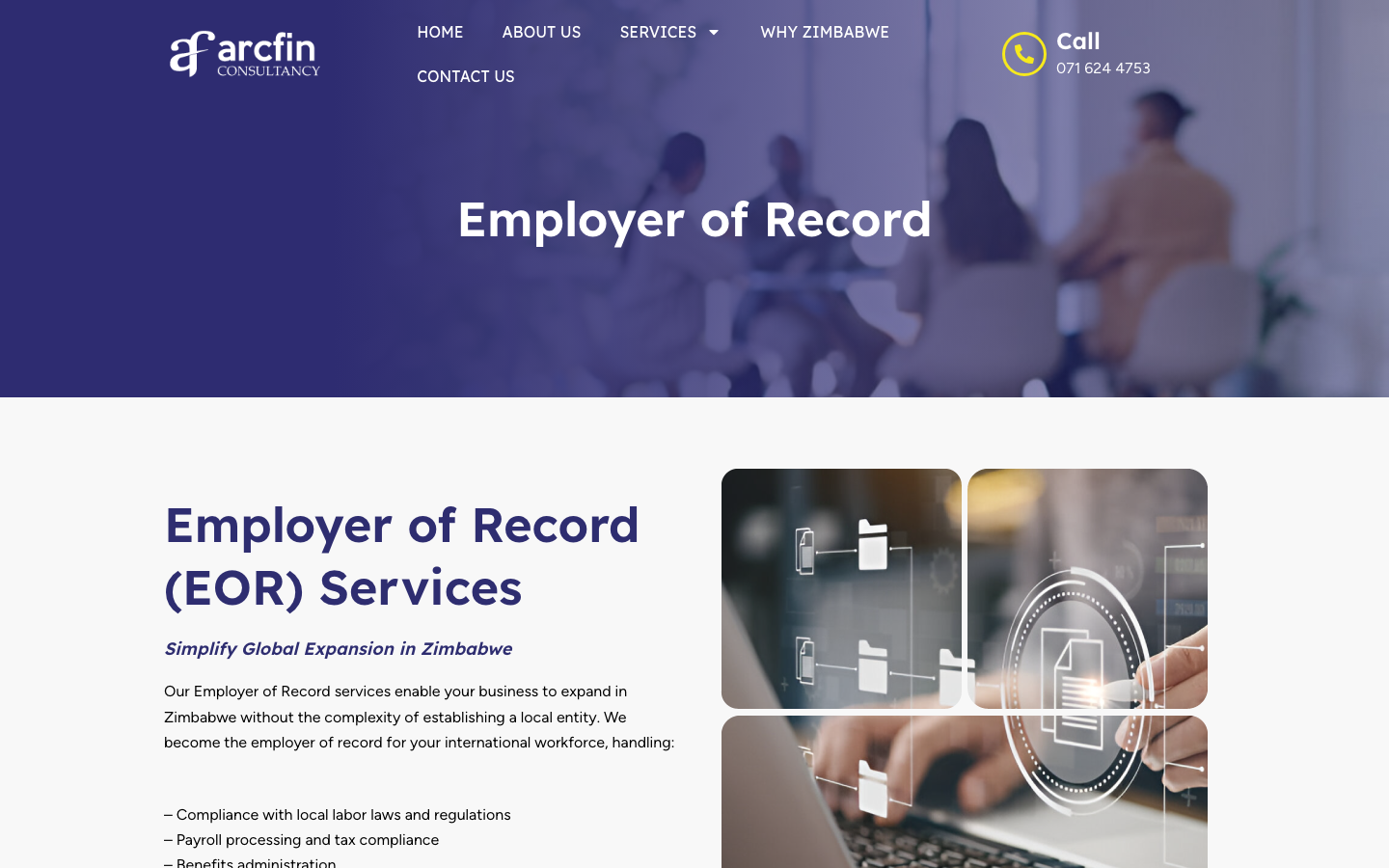
Arc Fin, trading as Arcfin Consultancy from Bodle Avenue in Harare, pairs employment with market-entry advisory, feasibility studies, accounting and tax. Its page covers labor law compliance, payroll, benefits, and HR support. It is the Employer of Record provider in Zimbabwe most likely to tell you not to hire yet.
Key Specialty Area:
Market-entry advisory paired with compliant local employment
Service Cost:
Quote-based, confirmed after an initial scoping consultation
Top Advantages:
- Harare office standing behind every local employment file
- Feasibility and market-entry advice in one engagement
- Accounting and tax advisory available under one roof
Scope of Services:
- Employment compliance handled under Zimbabwean labor law
- Statutory tax compliance built into every payroll run
- Benefits administration plus ongoing HR and talent support
Our Verdict
Our pick when you are still deciding whether to enter
Connect Outsourcing
Company Description:
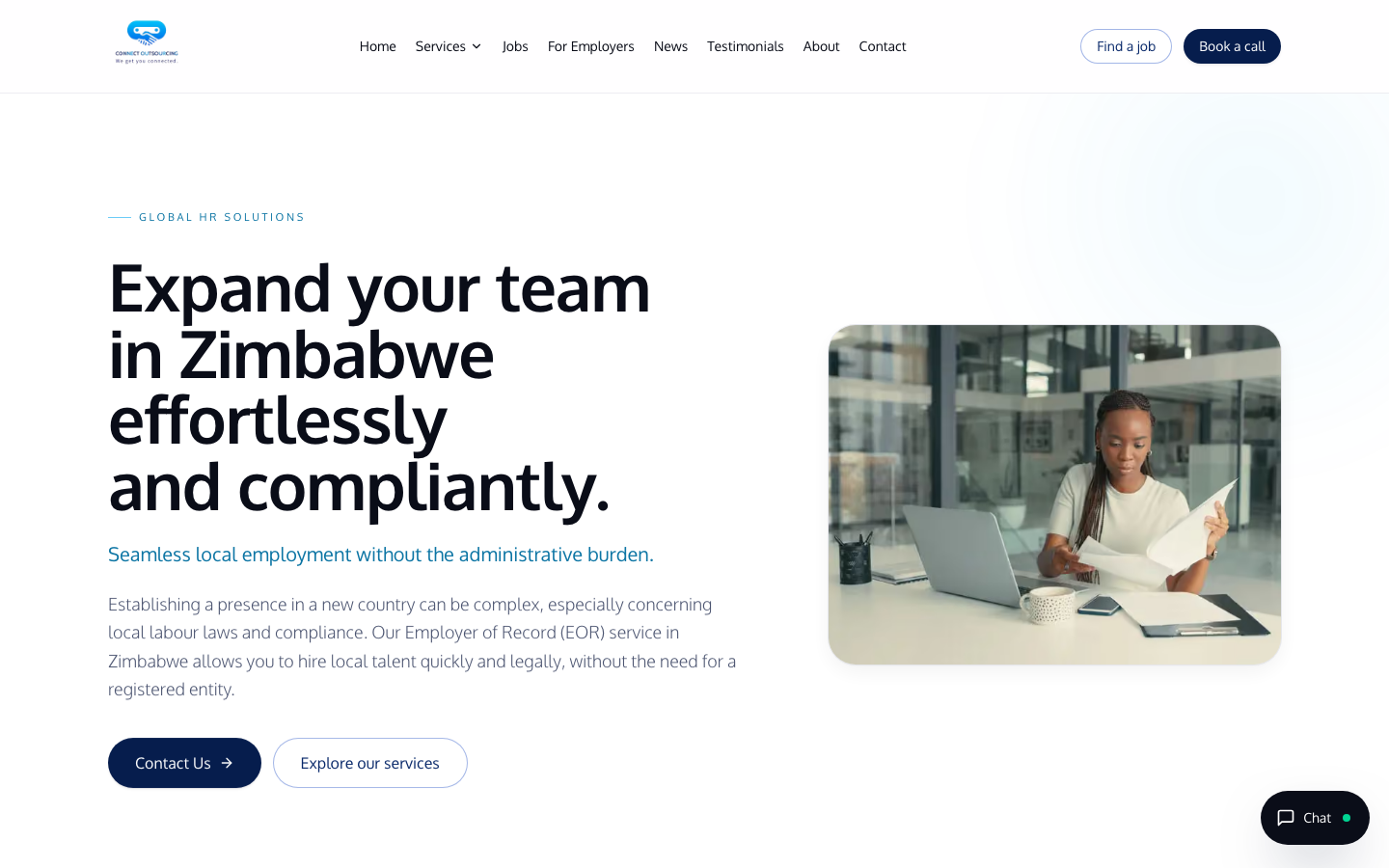
Connect Outsourcing operates from Belvedere in Harare across seven service lines: recruitment, HR outsourcing, payroll, labor outsourcing, business process outsourcing, international workforce solutions, and Employer of Record. Its EOR service is offered to companies in any sector that want to employ in Zimbabwe without registering their own entity. Three support tiers are offered, ranging from essential payroll and compliance to a full retainer.
Key Specialty Area:
Tiered EOR packages delivered by an in-country team
Service Cost:
Quote-based, scaled to headcount and the service scope
Top Advantages:
- EOR delivered across industries rather than one sector
- Eight EOR service components covered under a single engagement
- Three support tiers published, from essential through to retainer
Scope of Services:
- Employment contracts drafted and managed to Zimbabwean legal standards
- Payroll run with deductions and statutory contributions filed
- HR administration, compliance oversight and work-permit support
Our Verdict
Strong local choice whichever industry you are hiring into
CorePay
Company Description:
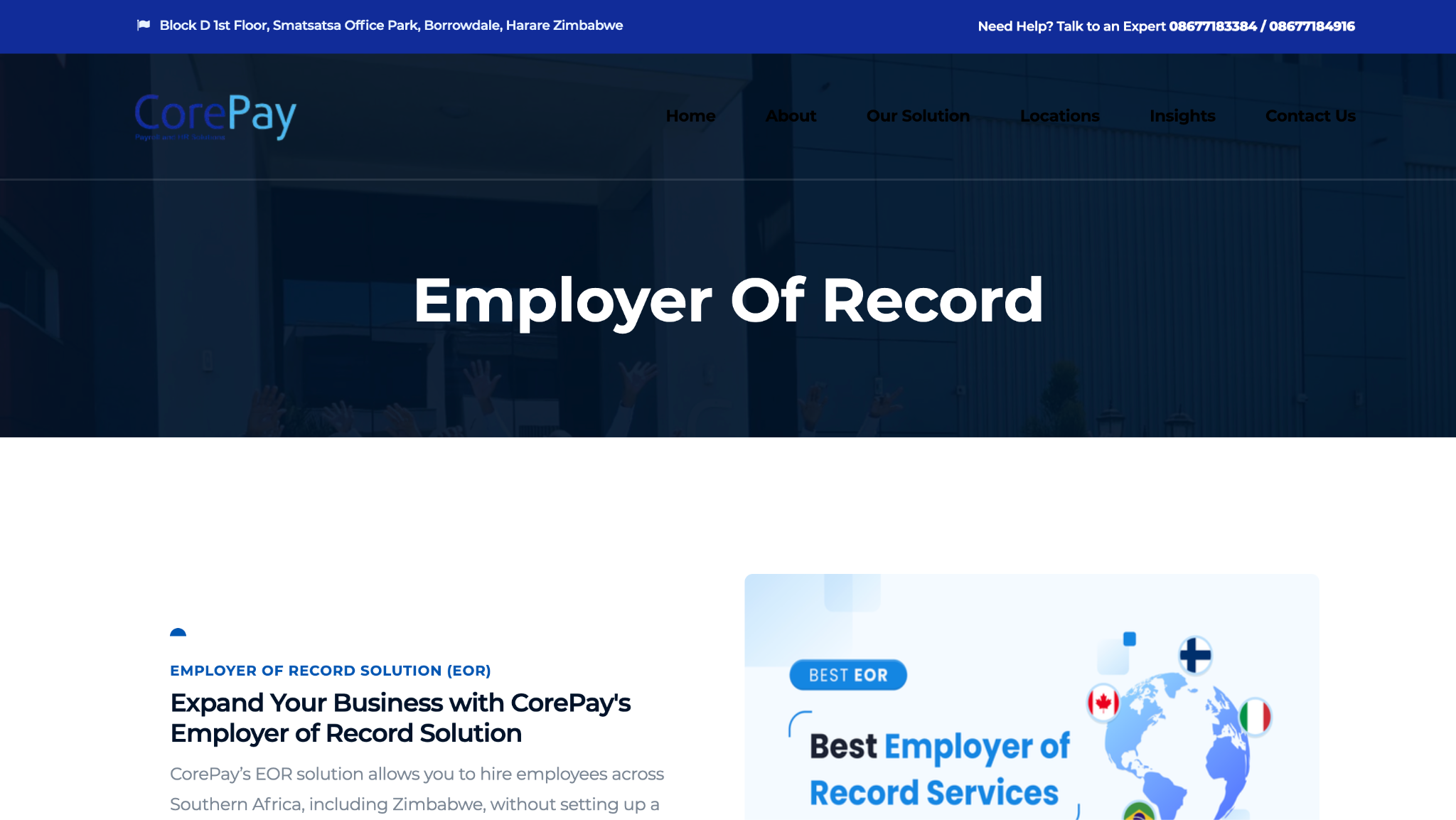
CorePay works out of Smatsatsa Office Park in Borrowdale, Harare, with more than 20 years in payroll. Outsourcing and its own software sit alongside the employment line. Its Zimbabwe EOR services span Southern Africa and allow clients to hire here without an entity.
Key Specialty Area:
Proprietary payroll software sitting behind the service
Service Cost:
Quote-based, tailored after an initial scoping meeting
Top Advantages:
- More than 20 years of payroll industry experience
- Own payroll software rather than a licensed system
- Regional coverage extending well beyond a single country
Scope of Services:
- Legal employer status carried with HR administration attached
- Payroll, taxes and benefits all processed each month
- Compliance oversight while you direct the daily operations
Our Verdict
Worth a look when payroll accuracy outranks everything else
Top 5 Global EOR Companies Supporting Hiring in Zimbabwe
The 5 global EOR platforms serve Zimbabwe through their wider international operations. We assessed them against the same local employment and compliance criteria, along with work permit support, speed to first payroll, and pricing transparency. Monthly EOR rates generally range from $200 to $800 per employee, depending on the scope of services and permit requirements. Every provider page was accessible on the day we checked it.
Note that all listed providers are added below in alphabetical order.
Asanify
Company Description:
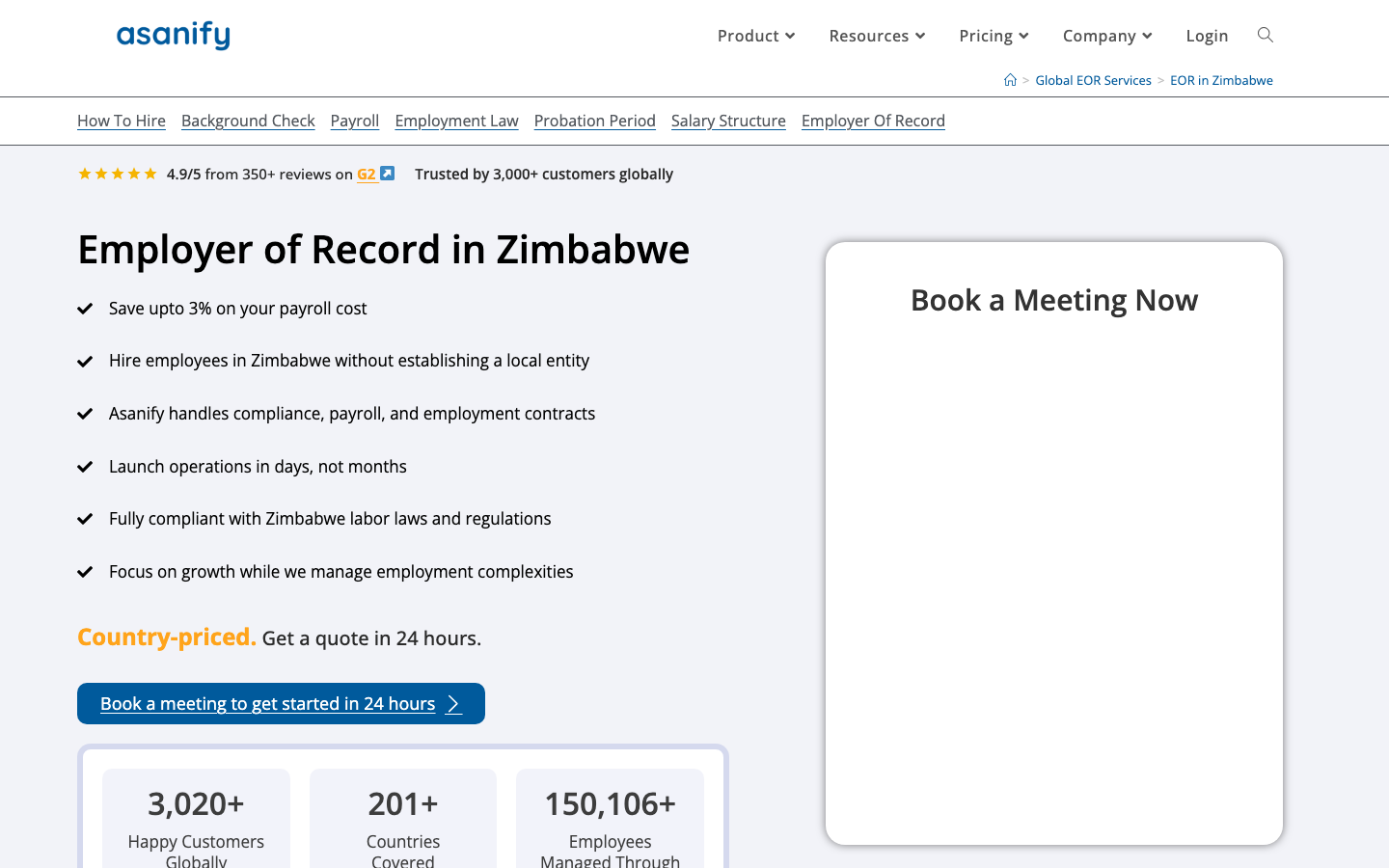
Asanify is a global platform with a dedicated page for this market and a detailed payroll guide behind it. Listed scope covers employment contracts, pay-as-you-earn withholding, social-security contributions, and AIDS Levy processing. Submissions go to both statutory authorities rather than back to the client to handle.
Key Specialty Area:
Multi-currency payroll with statutory submissions handled throughout
Service Cost:
Quote-based and country-priced, returned within 24 hours
Top Advantages:
- Payroll processed directly in United States dollars
- Contracts, withholding and levy processing handled as one
- Country-priced quote turned around within 24 hours
Scope of Services:
- Locally compliant contracts rather than a generic template
- Pay-as-you-earn withholding alongside AIDS Levy processing
- Social-security contributions filed with the statutory authorities
Our Verdict
Strong fit where currency handling is what drives the decision
Atlas HXM
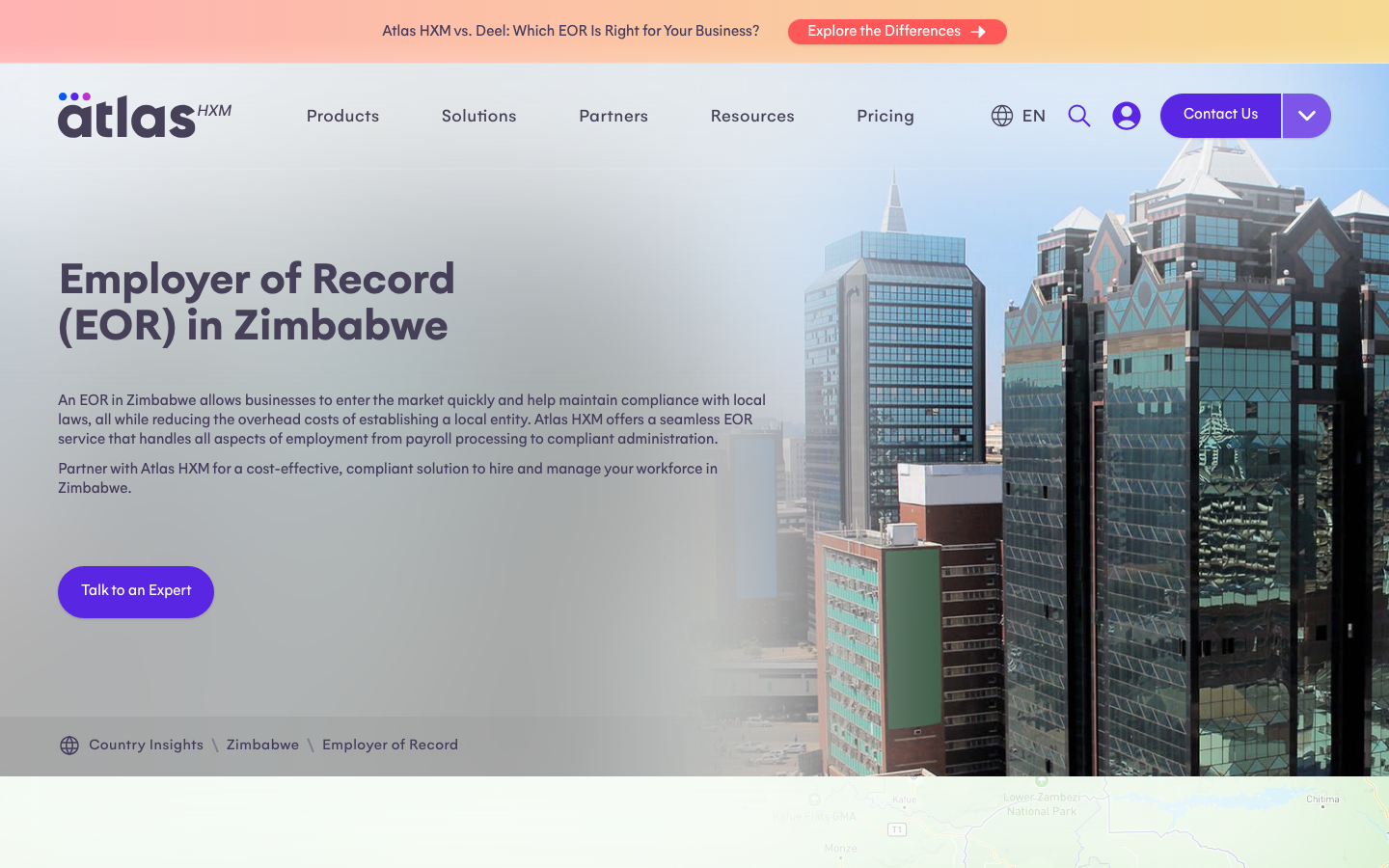
Company Description:
Atlas HXM employs through its own entities rather than through partner firms. Its page here covers compliant employment, local payroll, social security contributions, statutory benefits, work permit support, and HR administration. It also publishes an indicative fee range beside the cost of building your own entity.
Key Specialty Area:
Its own entities, with the fee range published
Service Cost:
Indicative range of $200 to $800 per employee monthly
Top Advantages:
- Employs through its own entities, not partner networks
- Indicative service-fee range published openly on the page
- Entity setup cost published for an honest comparison
Scope of Services:
- Compliant employment paired with local payroll processing
- Statutory contributions and benefits administration both handled
- Work-permit support alongside ongoing HR administration
Our Verdict
A global EOR Zimbabwe route with pricing you can see
*As pricing is subject to change, we are listing prices as they stand in August 2026
Playroll
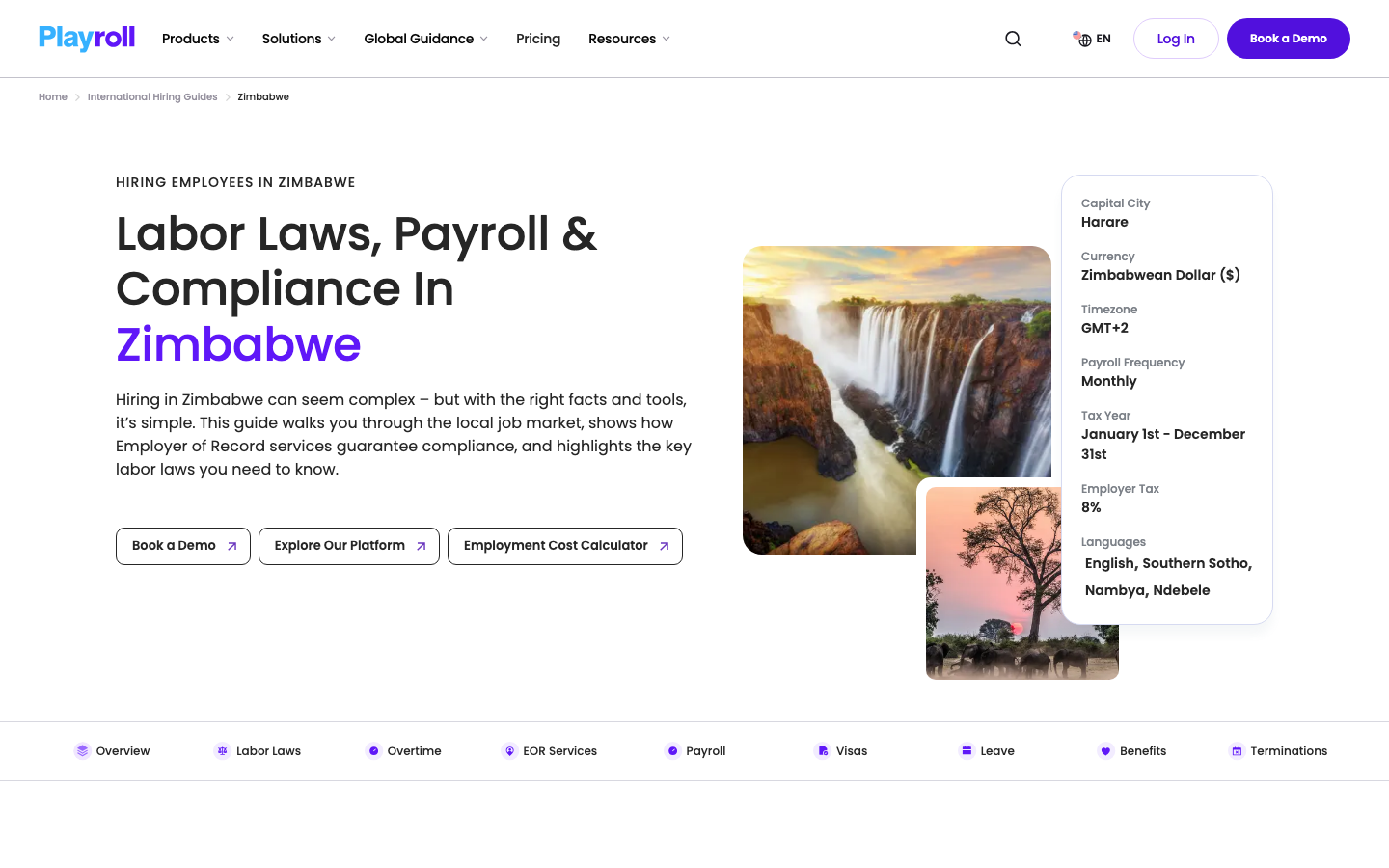
Company Description:
Playroll covers 180+ countries and maintains an international hiring guide here. Published scope runs to compliant contracts, payroll, statutory benefits, and the handling of pay-as-you-earn, social security, and the AIDS Levy. An employment cost calculator runs before you have to speak to anyone.
Key Specialty Area:
Published hiring guide with an employment cost calculator
Service Cost:
Quote-based, with a cost calculator available before contact
Top Advantages:
- Employment cost calculator open before any sales call
- Coverage spanning more than 180 countries in total
- Filing deadlines documented right alongside the service scope
Scope of Services:
- Compliant contracts issued for each local hire made
- Payroll run with pay-as-you-earn and levy handling
- Statutory benefits administration and visa guidance both included
Our Verdict
Useful when the budget has to be modeled before anything
Remote People
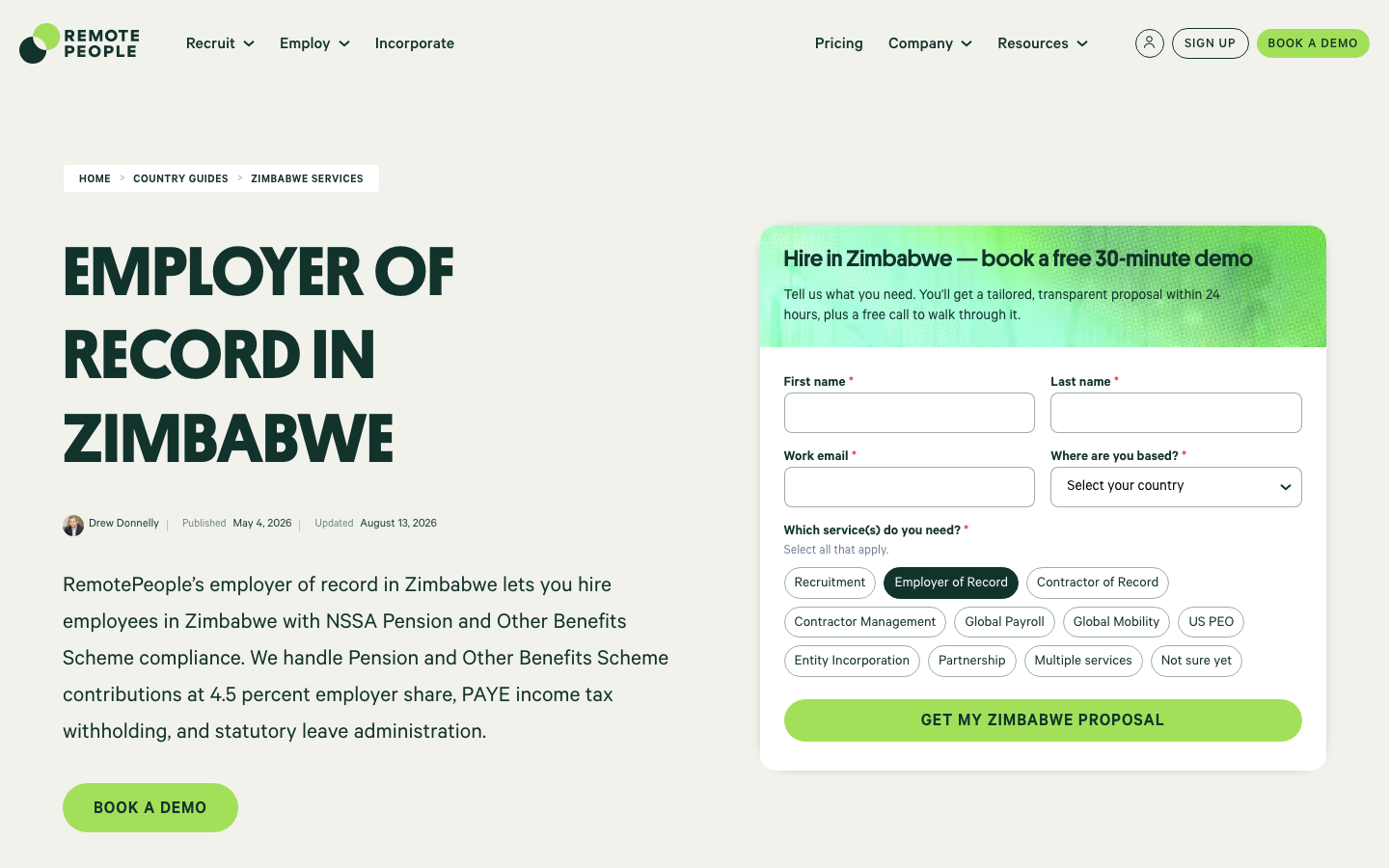
Company Description:
Remote People reaches 150+ countries and publishes the deepest country material in this set, including a separate payroll-tax guide. It runs dual-currency payroll and files pension, workers’ compensation, and manpower levy components. Contracts are drafted to the Labor Act, and permits are managed from application through renewal.
Key Specialty Area:
Documented dual-currency payroll alongside published service fees
Service Cost:
Stated EOR fee of $300 to $600 per month
Top Advantages:
- Dual-currency payroll documented publicly, rate by rate
- Insurable earnings ceilings applied correctly in both currencies
- Local onboarding stated at two to three weeks
Scope of Services:
- Labor Act contracts drafted and issued entirely locally
- Pension, compensation and levy contributions all filed monthly
- Permit lifecycle managed through the immigration authorities
Our Verdict
Our choice where EOR pricing in Zimbabwe cannot be a surprise
*As pricing is subject to change, we are listing prices as they stand in August 2026
Tarmack
Company Description:
Tarmack is a global Employer of Record and professional employer organization with a page for this market. Its standard package covers hiring, payroll, tax and social security handling, benefits, HR policy work, permits, and contractor management. Recruiting is a paid add-on rather than something bundled into the base.
Key Specialty Area:
Employees and contractors inside one standard package
Service Cost:
Quote-based, with tailored pricing for teams above ten
Top Advantages:
- Contractor management sits inside the very same platform
- Enterprise pricing tailored for teams above ten employees
- Company formation offered later if you outgrow it
Scope of Services:
- Hiring and onboarding with fully compliant employment contracts
- Payroll, withholding, contributions and levy filings all handled
- Immigration coordination directly with the Department of Immigration
Our Verdict
Practical when contractors and employees sit on the same team
Regional hiring plans rarely stop at the Limpopo. The neighbor to the south is the usual companion market, and an island economy off the east coast is the usual base for structuring. Neither prices an Employer of Record in Zimbabwe the way they price themselves. Read South Africa EOR and Mauritius Employer of Record next, because statutory funds, notice periods and permit timelines diverge sharply across the three.
What to Know About Zimbabwe EOR: FAQs
Which laws bind an employer hiring here?
The Labor Act [Chapter 28:01] is the framework, updated by the Labor Amendment Act of 2023 and by statutory instruments. National Employment Councils negotiate sector terms that can set pay and conditions above the general baseline, so check the council covering your industry. Written contracts are required. Employers register for income tax withholding and for pension and workers’ compensation cover. They observe statutory leave and the three-month probation cap. Severance follows Statutory Instrument 191 of 2024, which doubled the entitlement to one month of pay for every year worked.
How are payroll, tax and contributions handled month to month?
Legal employer status transfers to the provider, which registers the worker with both authorities and issues a compliant contract. Monthly payroll follows, with income tax withheld under pay-as-you-earn and the AIDS Levy charged at 3 percent of the tax due. Pension, workers’ compensation and manpower development contributions are remitted alongside. Returns are filed by the statutory deadlines, payslips and annual certificates issued, and leave and terminations administered on your behalf. Filing dates are fixed rather than negotiable, and a missed month draws penalties. Contribution rules are published by NSSA.
How does the two-currency system change payroll?
The US dollar circulates alongside the local unit introduced in 2024, so the contract has to name the currency of pay. Separate tax tables run for each currency. Where a salary has components in both, the revenue authority directs employers to use the dollar tables and apportion the tax due. The pension ceiling is gazetted as a dollar figure with a local equivalent. That adds exchange-rate handling and record-keeping no single-currency market requires. Ask any provider to walk you through conversion at filing. Better still, ask to see a payslip that has already been run both ways, rather than a description of the process.
What should you press a shortlisted provider on?
Registration comes first. Where a provider holds the local registration itself, liability for a botched filing has somewhere to land. Confirm it files social-security and revenue returns directly. Test its dual-currency payroll experience with a worked example rather than a claim. Check familiarity with the National Employment Council covering your sector, permit capability, and project-workforce history if you are hiring for mining or NGO work. Then ask how terminations are handled, what the full price includes, and for two references from the region. Exchange-rate policy is set by the Reserve Bank of Zimbabwe.
How fast can someone start, and what will it run to?
Two to three weeks after signature is the normal window for a local start, taking in the contract, both registrations, and the first payroll run. Add roughly six to ten weeks where a Temporary Employment Permit is needed, since immigration review runs on its own schedule. Service fees generally range from $200 to $800 per employee per month. Salary and employer contributions of around 7.5 percent sit on top, subject to the pension ceiling. Confirm the current rates, the ceiling and the minimum wage in force on the day you sign. Quarterly gazetting of the ceiling means an old number leaves you short on every hire you make.

Helen is Anywherer’s Market Analyst & Content Researcher, with extensive experience in analyzing global employment markets and HR technology trends. She is skilled at turning complex market data into clear, well-researched insights that inform every piece of content. With a strong grasp of the EOR, PEO, and international hiring space, Helen plays a key role in keeping Anywherer’s research accurate, up to date, and genuinely useful for readers.