In 2026, PDPs matter even more because skill requirements are shifting fast. In the World Economic Forum press release, employers highlight rapid skills evolution through 2030 and the need for upskilling and reskilling to help people stay effective in their roles. A template makes the process easier and more consistent. Instead of staring at a blank page, you begin with a structure that prompts the right questions: goals, required skills, learning actions, timelines, and proof of progress.
That is why teams often keep a shared set of professional development plan templates and an employee development plan template format for managers to reuse across roles.
What Is a Professional Development Plan?
In plain terms, what does a professional development plan look like? It is a written plan that connects where a person is today (skills, results, role expectations) with where they want to be next (new skills, stronger performance, a bigger scope, or a new role). In many organizations, it also works as a shared action plan between an employee and a manager, so growth does not rely on vague good intentions.
In this guide, each template includes a professional development plan sample you can copy, along with a real-world example showing what a completed plan looks like in practice.
In this guide, you will get 7 templates and PDP examples you can copy and adapt. You will also see a professional development plan example to show what a filled-out plan looks like in real life, alongside examples of personal development plans.
7 Professional Development Plan Template Samples
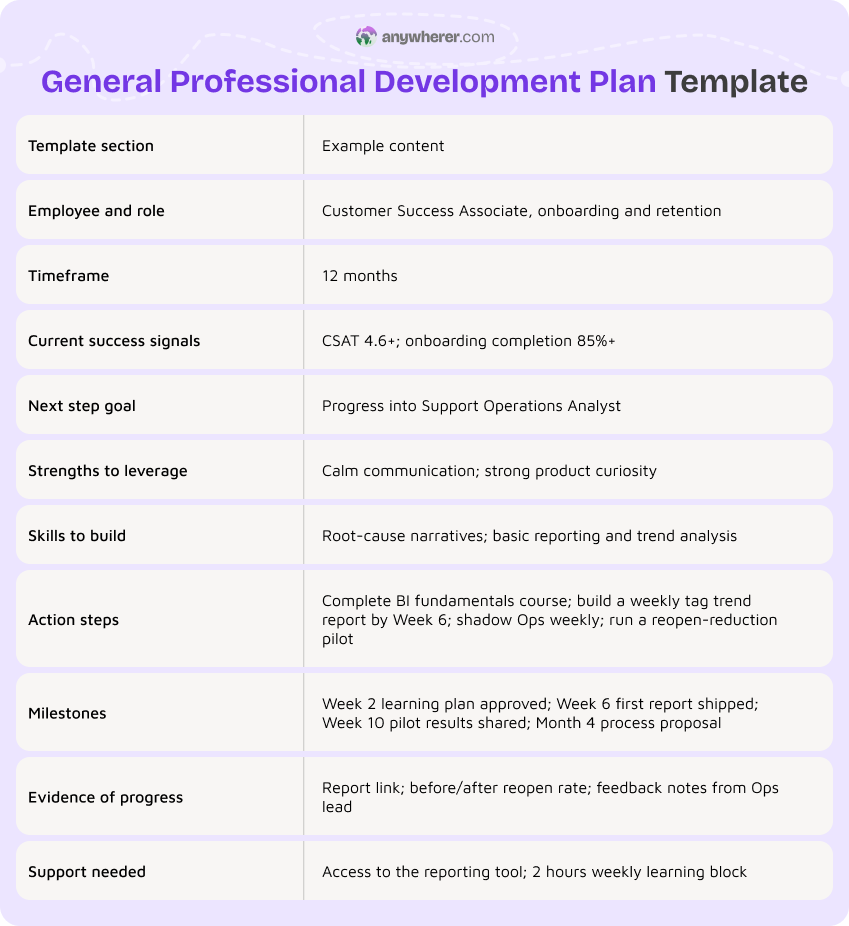
1) General Professional Development Plan Template
Why this template is useful
This is the “baseline” professional development plan template that works for most roles: individual contributors, specialists, and new managers. Use it when you want one consistent PDP format across departments, or when an employee is building a plan for the first time and needs a clear path. It also works as one of the most practical PDP samples when you need a simple, repeatable structure that covers goals, skills, actions, timelines, and proof of progress.
Template structure
- Role context: current role, core responsibilities, and what success means now.
- Career direction (6 to 18 months): the next role or stronger level of impact.
- Strengths to leverage: skills you will use more often.
- Skills to build: 2 to 4 skills with clear definitions.
- Action steps: training, projects, mentoring, practice routines.
- Resources: internal tools, courses, communities, managers, buddies.
- Timeline and milestones: checkpoints and expected outputs.
- Evidence of progress: what you will show (deliverables, metrics, feedback).
- Support needed: what you need from your manager or organization.
Sample content
- Role context: “Customer Support Specialist, focused on tier-2 cases and onboarding.”
- Career direction: “Move into Support Operations Analyst role in 12 months.”
- Strengths: “Clear writing, calm under pressure, strong product curiosity.”
- Skills to build:
- Root-cause analysis (create structured issue narratives)
- Basic data reporting (weekly trends, categories, time to resolution)
- Action steps:
- Complete internal reporting training; deliver first weekly dashboard by Month 2
- Shadow Ops analyst twice per month; write a short “what I learned” recap
- Lead a small improvement project: “Reduce ticket reopens by 10%”
- Evidence: “Dashboard published weekly, improvement project report, manager feedback.”
- Support needed: “Access to reporting tool; 2 hours weekly protected learning time.”
Adaptation advice
- For regulated industries, add a “compliance skill” section.
- For product teams, add “customer impact” and “decision quality” metrics.
- For junior employees, shorten the timeline to 90 days and focus on fundamentals.
2) Leadership Development Plan Template
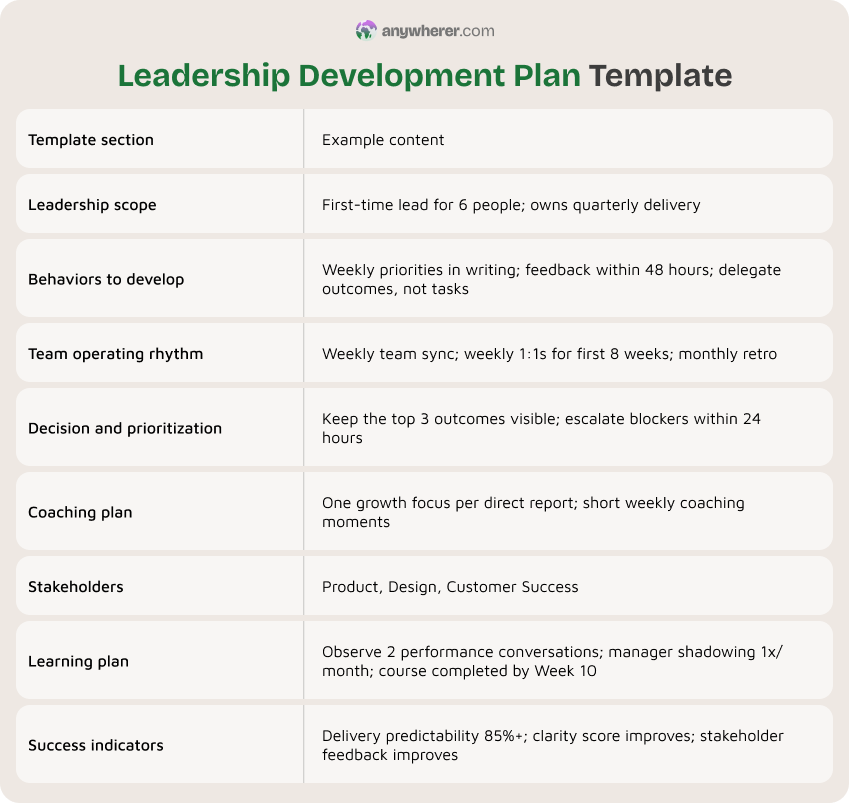
Why this template is useful
Use this when someone is stepping into leadership, aiming for promotion, or leading cross-functional work without formal authority. It is ideal for new team leads, project leads, and managers who want to build consistency in coaching and decision-making. The2025 LinkedIn Workplace Learning Report highlights how career development programs and leadership training are common practices among organizations prioritizing growth.
Template structure
- Leadership scope: what you are responsible for (people, projects, outcomes).
- Leadership behaviors to develop: 3 to 5 behaviors (not vague traits).
- Team operating rhythm: 1:1 cadence, team syncs, feedback loops.
- Decision-making and prioritization: how you will make trade-offs.
- Coaching plan: how you will grow others (and how you will be coached).
- Stakeholder management: who you influence and how you will communicate.
- Learning plan: books, courses, mentoring, shadowing.
- Success indicators: engagement signals, delivery signals, feedback signals.
Sample content
- Leadership scope: “Lead a team of 5 in a hybrid setup; own quarterly outcomes.”
- Behaviors to develop:
- Clarity: set weekly priorities and remove ambiguity
- Coaching: give feedback weekly, not quarterly
- Delegation: assign outcomes, not tasks
- Team rhythm: “Weekly team sync; biweekly 1:1s; monthly retro.”
- Stakeholders: “Product manager, design lead, finance partner.”
- Learning plan: “Shadow senior manager in performance conversations; complete leadership course by Week 8.”
- Success indicators: “Team delivers 90% of planned commitments; team feedback shows improved clarity.”
Adaptation advice
- In fast-moving startups, shorten cycles to monthly goals and weekly feedback.
- In enterprise teams, add “calibration” and “succession planning” sections.
- For first-time managers, add scripts: “how to run 1:1s” and “how to give feedback.”
3) Technical Skills Development Plan Template
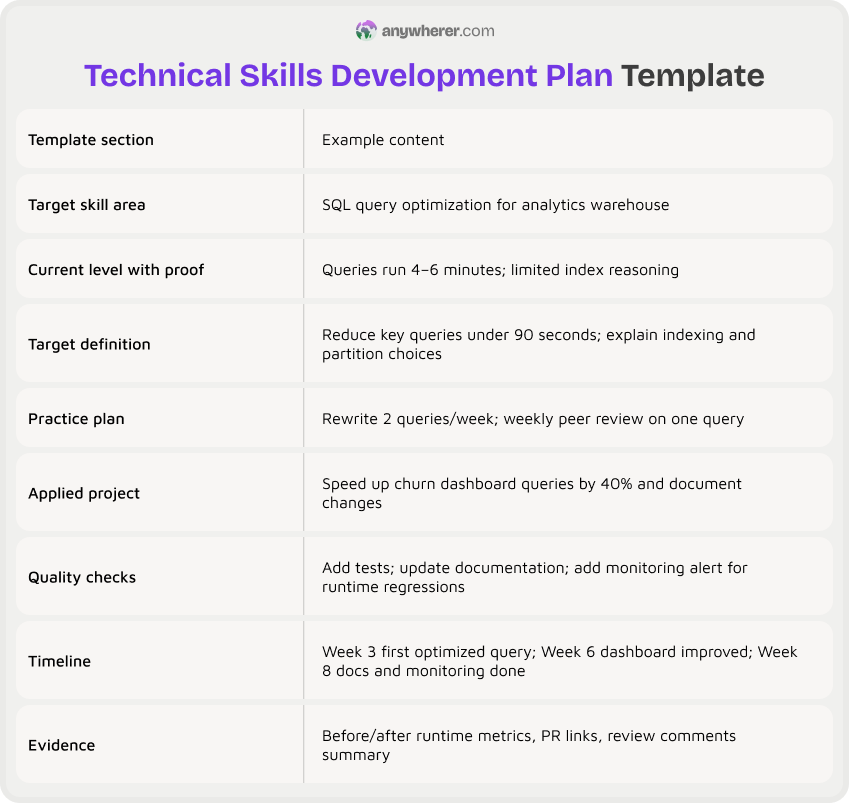
Why this template is useful
This template is for roles where capability is demonstrated through hands-on outputs: engineers, analysts, IT, data, QA, cybersecurity, and operations specialists. Use it when you need a clear “skill ladder” and a way to show progress through projects, not just training completion.
Template structure
- Target skill area: for example, “cloud deployment” or “data modeling.”
- Current level assessment: what you can do today, with proof.
- Target level and definition: what “proficient” means in your team.
- Practice plan: exercises, labs, code reviews, pair work.
- Applied projects: 1 to 2 real work projects that prove the skill.
- Quality checks: standards, testing, documentation, security.
- Timeline: weekly plan plus milestones.
- Evidence: artifacts you will produce (PRs, dashboards, runbooks).
Sample content
- Target skill: “SQL performance tuning and query design.”
- Current level: “Can write basic joins; struggle with large datasets.”
- Target level: “Can optimize queries; explain indexing decisions; reduce runtime.”
- Practice plan: “2 focused practice sessions per week; review one query with mentor weekly.”
- Applied project: “Optimize monthly revenue report queries and reduce runtime by 30%.”
- Evidence: “Before/after metrics, query documentation, code review notes.”
Adaptation advice
- For security roles, add a “threat model” section per project.
- For data roles, add “data quality checks” and “stakeholder interpretation.”
- For QA, add “automation coverage targets” and “bug classification accuracy.”
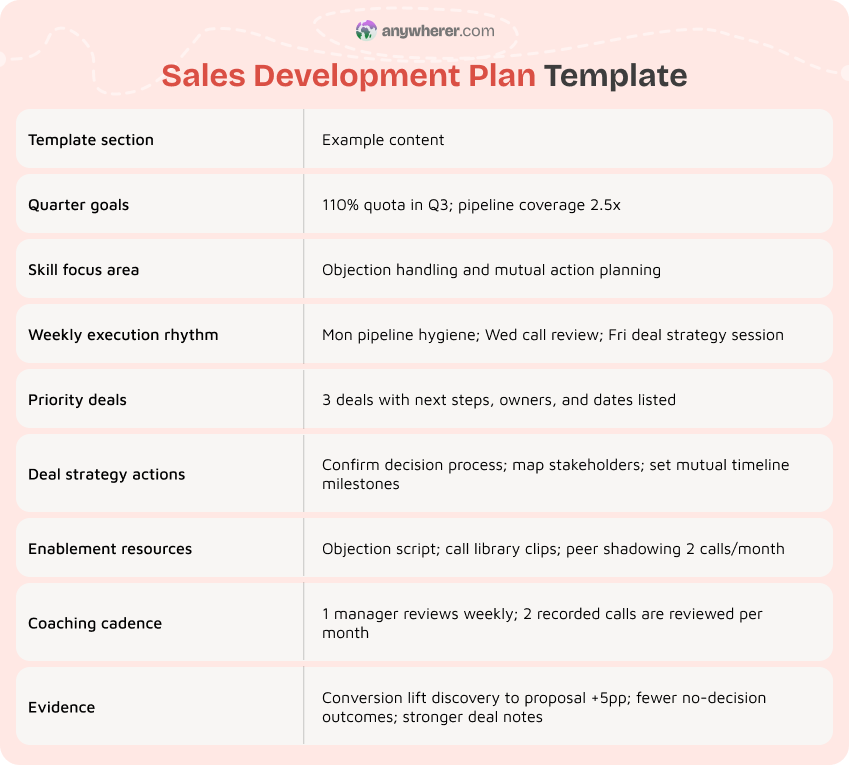
4) Sales Development Plan Template
Why this template is useful
Sales growth is measurable, but the path to better outcomes is not always obvious. This plan helps reps and managers focus on behaviors that drive results: pipeline hygiene, discovery quality, objection handling, and consistent follow-up. It fits SDRs, AEs, account managers, and sales leaders coaching teams, and it works well as a sample professional development plan when you need clear weekly habits tied to measurable pipeline outcomes.
Template structure
- Role goals: quota, pipeline targets, activity targets (balanced).
- Skill focus areas: discovery, closing, negotiation, multi-threading, account plans.
- Weekly execution rhythm: prospecting blocks, deal reviews, call practice.
- Deal strategy actions: 3 priority deals with next steps.
- Enablement resources: scripts, call library, training modules, peer shadowing.
- Feedback loop: manager coaching cadence and call review schedule.
- Milestones: monthly targets and skill checkpoints.
- Evidence: metrics plus qualitative proof (call notes quality, stakeholder map).
Sample content
- Role goals: “Hit 100% quota in Q2; maintain 3x pipeline coverage.”
- Skill focus: “Improve discovery to reduce late-stage drop-offs.”
- Weekly rhythm: “Mon pipeline clean-up; Tue/Thu call practice; Fri deal review.”
- Deal actions: “Enterprise X: add champion; schedule legal call; confirm timeline.”
- Evidence: “Win rate up by 5 points; fewer stalled deals; stronger MEDDICC notes.”
Adaptation advice
- For B2B enterprise, add stakeholder mapping and mutual action plans.
- For SMB, add “speed to lead” and “follow-up SLA” sections.
- For account managers, add expansion plan and renewal risk checklist.
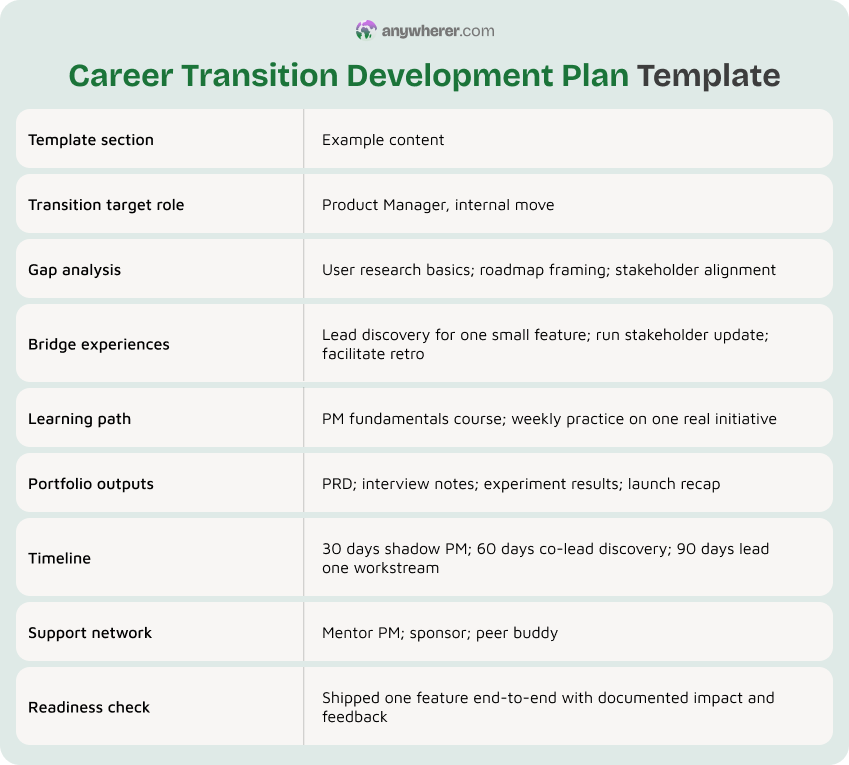
5) Career Transition Development Plan Template
Why this template is useful
This is the best choice when someone is changing direction: moving from individual contributor to manager, switching functions, returning from a career break, or pivoting into a new domain. It is also useful for internal mobility programs. If you want an example of a professional development plan that makes a transition concrete, this format is built around gap analysis, bridge experiences, and a portfolio of proof.
Template structure
- Transition target role: role title and level definition.
- Gap analysis: skills and experiences missing today.
- Bridge experiences: projects, shadowing, internal gigs, stretch work.
- Learning path: structured learning plus practice.
- Portfolio plan: outputs that prove readiness (case studies, presentations, work samples).
- Timeline: 90-day, 180-day, 12-month steps.
- Support network: mentor, sponsor, peer group.
- Readiness check: what confirms you are ready to apply or move.
Sample content
- Target role: “Project Manager (internal transfer).”
- Gaps: “stakeholder management, planning cadence, risk tracking.”
- Bridge: “Co-lead a small project; own weekly status update; run a retrospective.”
- Portfolio: “Project brief, timeline, risk register, lessons learned doc.”
- Readiness: “Successfully led one cross-team project end-to-end.”
Adaptation advice
- In technical transitions, add certification targets only if they are truly required.
- For leadership transitions, add “people management simulation” or coaching practice.
- If the company supports internal gigs, add a section to track them (LinkedIn’s Workplace Learning Report discusses project-based learning and career-enhancing opportunities as part of career development maturity).
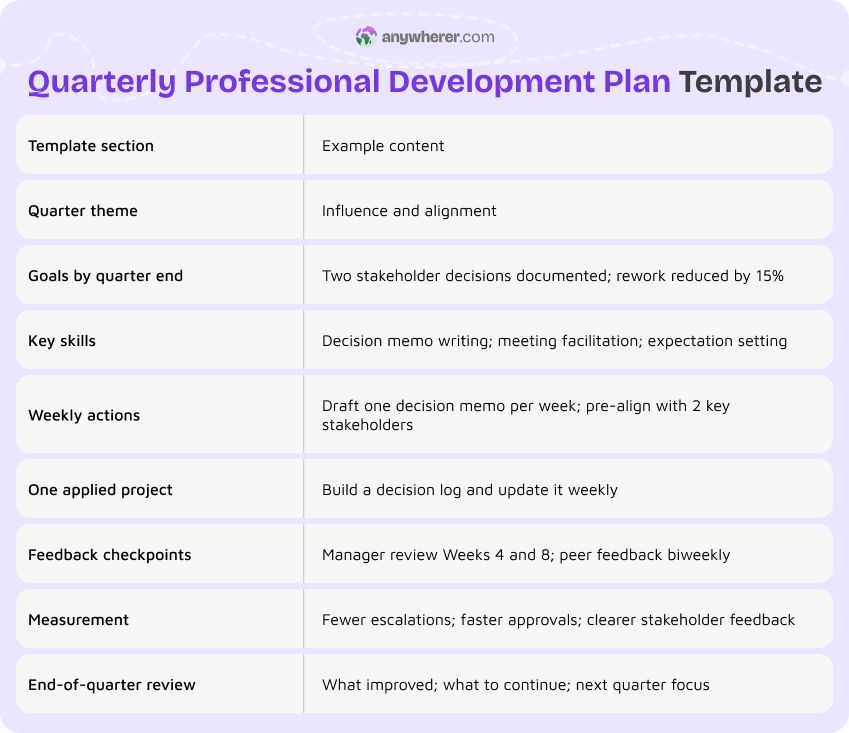
6) Quarterly Professional Development Plan Template
Why this template is useful
If annual plans feel too abstract, a quarterly plan makes professional development more practical. It works well for performance cycles, OKRs, or fast-changing teams. It is also excellent for an employee’s professional development plan where progress must be visible within 90 days.
Template structure
- Quarter theme: one focus area (for example, “influence” or “technical depth”).
- One to two goals: specific outcomes by quarter end.
- Key skills: 2 to 3 skill improvements that support the goals.
- Weekly actions: recurring routines and learning blocks.
- One applied project: a real deliverable that proves growth.
- Feedback checkpoints: manager and peer feedback moments.
- Measurement: how you will track progress.
Sample content
- Theme: “Stakeholder communication.”
- Goals: “Deliver monthly stakeholder update; reduce last-minute escalations.”
- Skills: “structured updates, expectation setting, escalation clarity.”
- Weekly actions: “Draft weekly update in 20 minutes; get peer review biweekly.”
- Project: “Create a one-page project dashboard for leadership.”
- Measurement: “Fewer escalations; feedback that updates are clearer.”
Adaptation advice
- For sales teams, align quarterly goals to pipeline quality and conversion steps.
- For engineers, align to delivery quality: fewer incidents, better reviews, better docs.
- For managers, align with team health: clarity scores, coaching frequency.
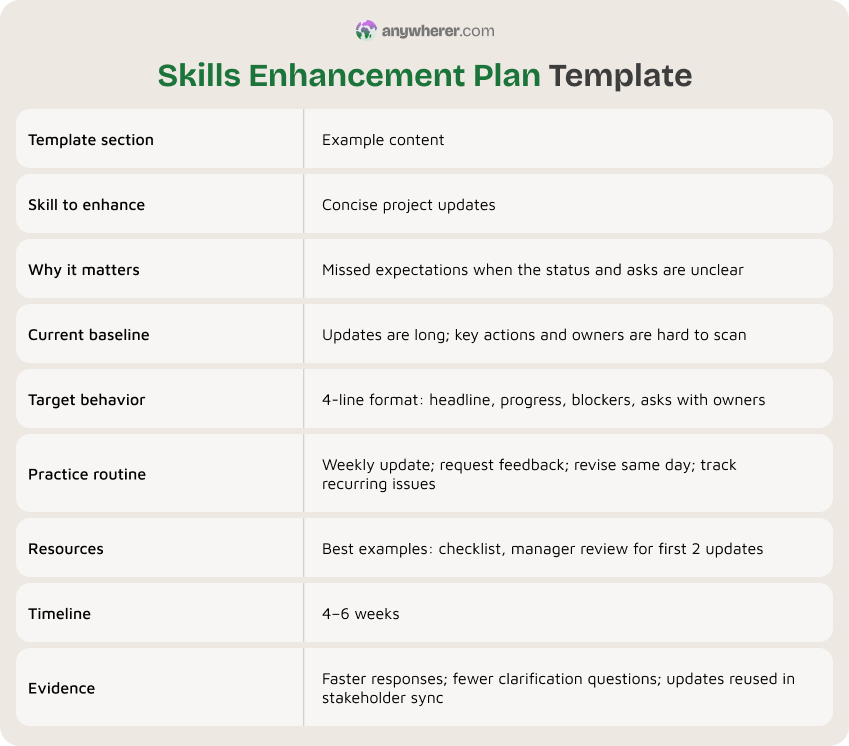
7) Skills Enhancement Plan Template
Why this template is useful
Sometimes the goal is not a new role, but sharper performance in the current one. This template is designed for focused improvement in a small number of skills, and it fits both new hires and experienced employees who want to strengthen a weak area. It is also a solid professional development plan for employees when managers want a simple, repeatable format.
Template structure
- Skill to enhance: one skill, clearly defined.
- Why it matters: impact on team outcomes.
- Current baseline: what happens today.
- Target behaviors: what you will do differently.
- Practice plan: repetition, feedback, reflection.
- Resources: examples, training, coaching.
- Timeline: short timeline (4 to 8 weeks).
- Evidence: observable proof (work samples, metrics, feedback).
Sample content
- Skill: “Writing clear project updates.”
- Why: “Stakeholders miss deadlines because expectations are unclear.”
- Baseline: “Updates are long; owners and dates are hard to find.”
- Target behaviors: “Use a 5-line format: status, risks, decisions needed, next steps, owners.”
- Practice: “Write weekly update; get feedback; revise; track improvements.”
- Evidence: “Stakeholders respond faster; fewer clarification questions.”
Adaptation advice
- For customer-facing roles, focus on communication, conflict handling, and prioritization.
- For technical roles, focus on code quality, documentation, and debugging routines.
- For leadership roles, focus on coaching cadence and clarity of expectations.
How to Create a Professional Development Plan
If you are wondering how to create a professional development plan (or how to write a professional development plan) without overcomplicating it, use this simple flow:
- Pick a direction: stronger impact in role, promotion readiness, or transition.
- Define 2 to 4 skills that matter for that direction.
- Turn skills into actions: practice + real projects.
- Add milestones and proof so progress is visible.
- Review monthly or quarterly and adjust based on reality.
For a practical step-by-step approach with common PDP sections, Coursera’s guide is a useful reference: How to create a goal-oriented career development plan.
FAQs: Professional Development Plan for Employees
What is a Professional Development Plan (PDP)?
Understanding what a professional development plan is starts here: it is a structured document that outlines goals, skills to develop, actions to take, resources to use, and proof of progress. It links the employee’s growth to organizational needs and is best created by the employee with input from the manager.
How do I create a personalized Professional Development Plan?
Start with your next role or next level of impact, then do a quick gap check. Pick a small set of skills, choose actions that include both learning and practice, and define what “proof” looks like. If you need inspiration, use the templates above as examples of individual professional development plans and adapt them to your situation.
What are the key components of a good Professional Development Plan?
A strong PDP template or PDP plan template usually includes: goals, skills, actions, resources, timeline, and evidence. The evidence piece is the part people forget, but it is what turns a plan into a tool. This is also what makes professional development plan examples for employees actually useful: you can see what “completed” looks like.
How do I track progress on my Professional Development Plan?
Use milestones and observable proof. Track deliverables (dashboards, presentations, projects), feedback (manager and peer notes), and relevant metrics. A simple monthly review is sufficient if the plan is well-defined.
How often should I update my Professional Development Plan?
Quarterly is a practical baseline. A quarterly plan keeps the PDP aligned to business shifts and avoids the “set it once and forget it” problem. If your role changes quickly, update monthly.
Can a Professional Development Plan be used for career transitions?
Yes. A career transition template is designed for that exact purpose: to define the target role, identify gaps, plan bridge experiences, and create a portfolio of proof. Those are your best examples of professional development plans when you are changing direction.
How do I tailor a Professional Development Plan for a specific role?
Start with role expectations and success metrics. Then translate them into skills and behaviors. For example, in sales, you might build a PDP example around discovery and pipeline discipline. In engineering, a PDP sample might focus on code quality, incident response, and documentation.
What should I do if I feel my Professional Development Plan isn’t working?
Diagnose the weak link: unclear goal, too many skills, actions that are only “learning” without practice, or no feedback loop. Simplify the plan and add one applied project that forces real behavior change.
What are common mistakes to avoid when creating a Professional Development Plan?
- Writing goals that are vague (“get better at leadership”)
- Trying to improve too many skills at once
- Listing courses without practice or applied projects
- Missing timelines and evidence
- Not involving the manager, which turns the plan into a private wishlist instead of an employee professional development plan tied to real work

Yaryna is our lead writer with over 8 years of experience in crafting clear, compelling, and insightful content. Specializing in global employment and EOR solutions, she simplifies complex concepts to help businesses expand their remote teams with confidence. With a strong background working alongside diverse product and software teams, Yaryna brings a tech-savvy perspective to her writing, delivering both in-depth analysis and valuable insights.