Ask ten employees where they see themselves in three years and you’ll mostly get vague answers. Not because they don’t care, but because nobody helped them think it through. According to LinkedIn’s Workplace Learning Report, 94% of employees would stay longer at companies that invest in their development. Yet career planning at most organizations still means one awkward conversation per year that everyone forgets by February.
A career development plan fixes that. Not by adding bureaucracy, but by giving people a concrete picture of where they’re headed and what they need to do to get there. For HR teams, it’s one of the few tools that simultaneously helps with retention, skill-building, and alignment with business goals.
What follows is a practical guide: a step-by-step walkthrough, a career development plan example for each key component, and a set of ready-to-use templates. If you want a sample career development plan your team can start using this week, you’ll find it here. If you’d rather understand the thinking behind it first, that’s here too.
Why Every Employee Needs a Career Development Plan
People rarely leave jobs because the job itself is bad. They leave because they can’t see where it’s going. That feeling of stagnation is one of the most consistent drivers of voluntary turnover – and it’s one of the most preventable. Career development plan examples for employees across industries tell the same story: structured growth plans correlate with lower attrition, higher engagement scores, and stronger team performance.
Benefits of a Career Development Plan for Employees
- Provides clear career goals: A vague direction and a specific goal produce very different behavior. When someone can name exactly what they’re working toward – a certification, a promotion, a lateral move into a new function – daily decisions get easier and work feels less arbitrary.
- Identifies key skills and areas for improvement: Most people have a rough sense of where they’re strong and where they’re not. This part of the plan makes it explicit, so development effort goes to the gaps that actually matter rather than skills that are already solid.
- Enhances job satisfaction and engagement: Gallup research puts numbers on something most managers already sense: employees who see real growth opportunities are dramatically more engaged than those who don’t. Career clarity isn’t a soft benefit. It shows up in output.
- Fosters a sense of purpose and direction: Knowing that today’s frustrating project is a step toward something you actually want changes how you experience it. People who understand their own trajectory are more resilient when things get hard.
Benefits of a Career Development Plan for Employers
- Helps retain top talent: The math here is uncomfortable. The Society for Human Resource Management (SHRM) estimates that replacing one employee runs between 50% and 200% of their annual salary – recruiting costs, lost productivity, onboarding time, the knowledge that walks out the door. Career development plans are cheap by comparison.
- Ensures alignment with company goals and values: A growth plan built in a vacuum develops skills nobody needs. When managers are involved in the goal-setting, individuals grow in directions that strengthen the team and the organization, not just their personal resume.
- Improves employee performance and skill development: Structured development tends to accelerate skill acquisition. People with a specific target and a defined path close gaps faster than those left to figure it out on their own timeline.
- Boosts productivity and morale: Teams where people feel invested show up differently. There’s less of the quiet disengagement that’s hard to measure but easy to feel. More ownership, fewer people doing the bare minimum.
How to Create a Career Development Plan
The steps aren’t complicated. Whether you’re using a template for career development plan purposes or building from scratch, the process is the same. The hard part isn’t knowing what to do – it’s actually doing each step properly rather than rushing to get something written down.
- Run an honest self-assessment. Not the version you’d share in a performance review. A real one. What do you do well enough that people come to you for it? Where do you consistently hit friction? What feedback have you heard more than once but still haven’t acted on? If you have access to a 360-review tool, use it. If not, sit with the question for an hour before you write anything.
- Write down your goals, short and long. Short-term is the next 12 months: one or two specific, achievable targets. Long-term is the three-to-five-year picture – where you genuinely want to be, not just what seems safe to say out loud. Both matter.
- Do a gap analysis. Look at where you are now and where you want to go. What’s missing? List the actual skills, experiences, or credentials that sit between your current state and your target. That list is the core of the plan.
- Turn gaps into action steps. Each gap on your list needs at least one concrete action attached to it: a course, a certification, a mentor to find, a project to request. And each action needs a deadline. Without a deadline it’s a wish, not a plan.
- Build in review checkpoints. Schedule your quarterly reviews at the same time you write the plan, not later. Later never comes. A plan that doesn’t get reviewed within a few months usually doesn’t get reviewed at all.
- Bring your manager in early. This is the step most people skip and later regret. Managers have context that individuals don’t: what projects are coming up, where the team is short on skills, what the org actually needs over the next year. That context makes the plan far more useful and far more likely to get real support.
Career Development Plan Template
Four components, each with a filled example and a blank visual version. Whether you need an employee career development plan template for one person, a career development plan template for employees to roll out team-wide, or career development plan samples to review with managers before a planning cycle, everything is below. Use this free career development plan template as-is or adapt the employee career development plan examples to fit your organization’s language.
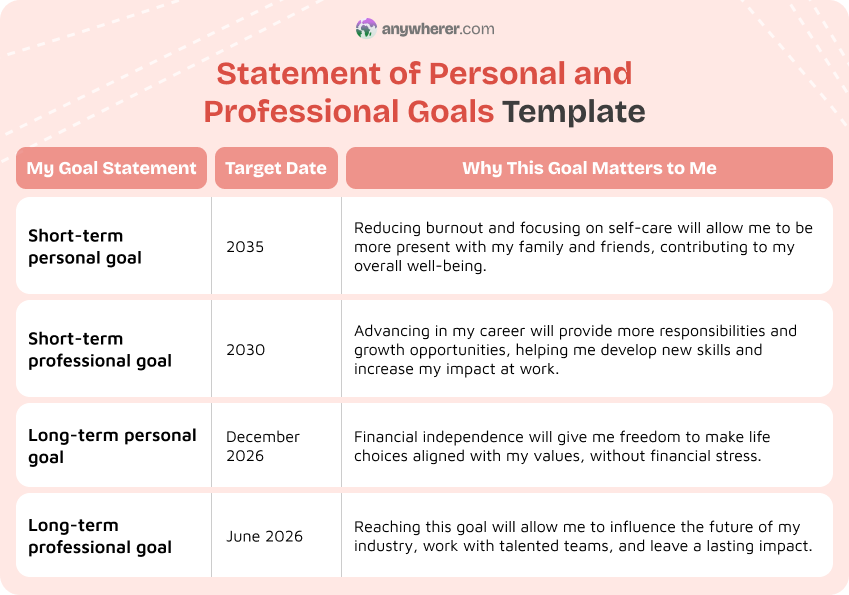
Component 1: Statement of Personal and Professional Goals Template
Most plans fail here, not later. ‘Become a stronger leader’ sounds good but doesn’t tell anyone what to do on Monday morning. As examples of career development plan for employees show repeatedly, the ones that produce results are built on goals you can check off. If you can’t describe what success looks like, the goal isn’t ready yet.
The career development plan for employees template below uses four categories: short-term personal, short-term professional, long-term personal, long-term professional. Separating personal from professional matters more than it sounds – a plan that only tracks work goals tends to ignore the rest of someone’s life until that rest of their life creates a crisis. Write the goals here first. The skills audit and action steps that follow should all tie back to something in this section.
| Category | Goal Statement | Timeline | Why It Matters |
| Short-Term Personal Goal | e.g., Build a consistent 2-hour weekly learning habit | Within 6 months | Develops discipline that supports all other goals |
| Short-Term Professional Goal | e.g., Complete PMP certification | Within 12 months | Opens path to project lead roles |
| Long-Term Personal Goal | e.g., Reach sustainable work-life balance | 3 years | Protects energy and long-term performance |
| Long-Term Professional Goal | e.g., Step into a senior management position | 5 years | Aligns with leadership career path |
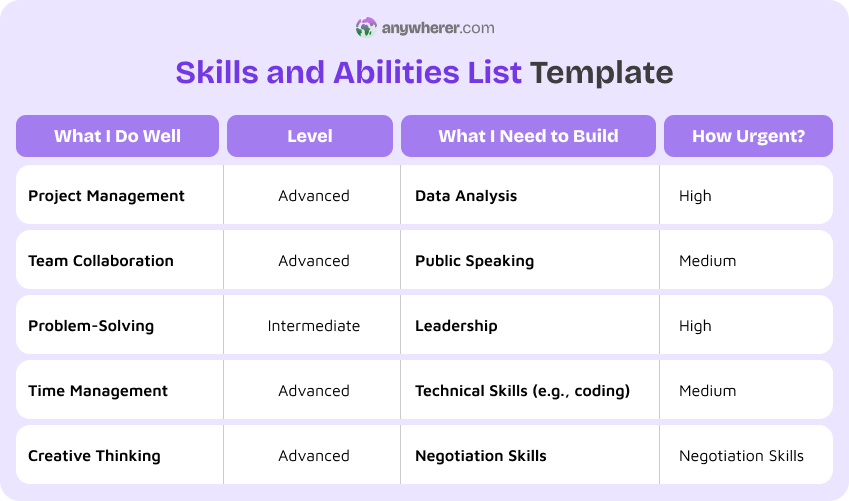
Component 2: Skills and Abilities List Template
A skills audit works only if it’s honest. The goal isn’t to list every strength – it’s to create an accurate map of where you are so you can figure out what’s actually missing. That means looking at hard skills (tools, technical knowledge, certifications) and soft skills (how you run a meeting, how you handle disagreement, how you communicate to a room full of people who don’t agree with you) with equal seriousness.
The two-column format below keeps it grounded. Left side: what you already have. Right side: what the goals in Component 1 require that you don’t yet have. That career development plan for employees example of a gap list becomes the direct input to your action plan. If you skip the honest assessment, the rest of the plan is built on a shaky foundation.
| Current Skills (Strengths) | Proficiency Level | Skills to Develop | Priority |
| e.g., Data analysis (Excel, SQL) | Advanced | e.g., Python for data science | High |
| e.g., Written communication | Intermediate | e.g., Executive presentation delivery | Medium |
| e.g., Project coordination | Intermediate | e.g., Formal project management (PMP) | High |
| e.g., Cross-functional collaboration | Advanced | e.g., Conflict resolution techniques | Medium |
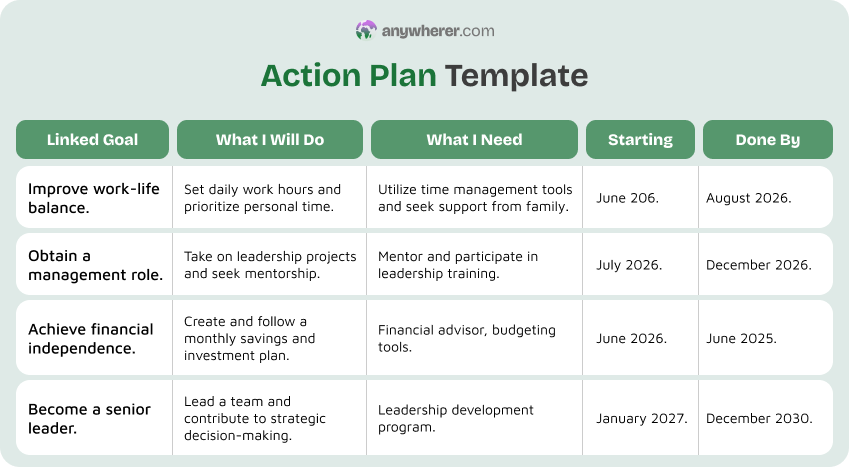
Component 3: Action Plan Template
This is where a plan gets real or stays theoretical. The career development action plan template below translates the gaps from Component 2 into specific tasks with owners, resources, and dates. Not categories of activity – actual steps. ‘Improve communication skills’ is not an action step. ‘Attend the Q2 executive communication workshop and present one project update to the leadership team by June’ is.
Each row needs a start date and an end date. Everything else is negotiable. If you’ve previously used IDP examples with your team, the structure there maps closely to what goes here – the two frameworks complement each other well.
| Goal Reference | Action Step | Resources Needed | Start Date | Target Completion |
| Short-Term Professional Goal | Enroll in PMP exam prep course | Online course ($400), study guide | Month 1 | Month 6 |
| Short-Term Professional Goal | Study 5 hrs/week, complete practice exams | Study schedule, accountability partner | Month 1 | Month 8 |
| Long-Term Professional Goal | Request stretch assignment managing a small project | Manager approval, project opportunity | Month 3 | Month 12 |
| Skills Gap | Attend executive communication workshop | Company L&D budget | Month 2 | Month 3 |
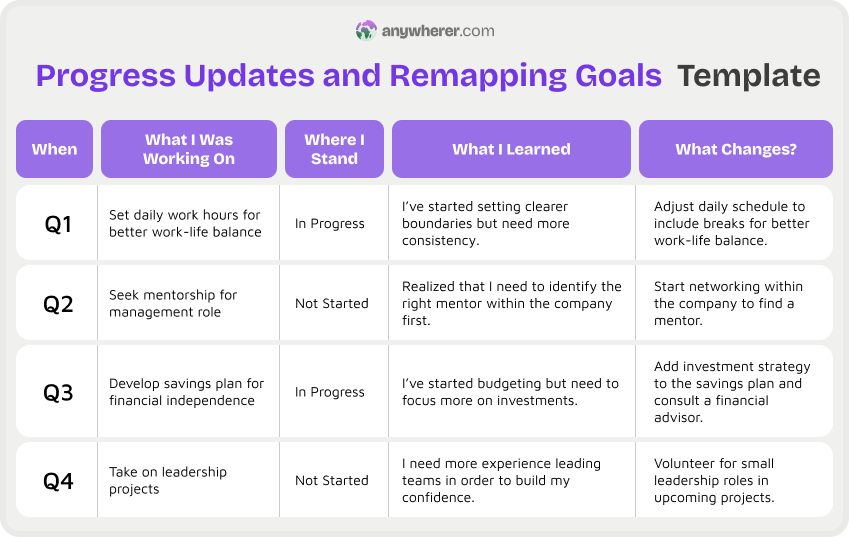
Component 4: Progress Updates and Remapping Goals Template
Plans change. A promotion lands six months ahead of schedule. A product pivot makes a planned skill suddenly irrelevant. A stretch assignment goes sideways and reveals a gap nobody anticipated. None of that means the plan failed – it means the plan needs updating. Quarterly reviews exist for exactly this reason.
Tracking progress also pays dividends at performance review time. Instead of trying to recall what happened over the past year, there’s a written record: what was planned, what actually happened, and what changed along the way. That context is valuable in both directions – for the employee making the case for growth and for the manager trying to assess it fairly.
If any of those performance conversations start moving toward a performance improvement conversation, the company’s free performance improvement plan template is a useful tool to have ready alongside this one.
| Review Date | Goal or Action Step | Status | Progress Notes | Adjusted Next Steps |
| Q1 Review | Complete PMP prep course | In Progress | Completed 4 of 8 modules | Increase study time to 6 hrs/week |
| Q2 Review | Attend communication workshop | Complete | Strong facilitator feedback received | Apply skills in next team presentation |
| Q3 Review | Lead small project | In Progress | Managing 3-person team on product launch | Request feedback from stakeholders |
| Q4 Review | Pass PMP exam | Pending | Exam scheduled for Month 10 | Review weak areas from practice exams |
Common Mistakes in Career Development Planning
Some plans work. Many don’t. When you look at examples of career development plan for employees that went nowhere, the reasons tend to cluster around the same handful of mistakes.
Goals that sound good but mean nothing.
‘Grow as a professional.’ ‘Become a better communicator.’ These aren’t goals, they’re aspirations. A working goal has a clear endpoint and a date attached. ‘Complete a management training course by end of Q2 and run my first cross-functional project by Q4’ – that’s a goal. The specificity isn’t pedantic, it’s what makes the thing actionable.
Writing the plan and never opening it again.
Far more common than people admit. If the quarterly reviews aren’t already on the calendar when the plan is written, they probably won’t happen. Book them on the same day you finalize the plan.
Treating soft skills as optional.
Technical ability gets people hired. How they handle pressure, disagreement, and ambiguity determines what happens after that. Plans that focus only on certifications and hard skills tend to plateau because the person outgrows their technical role but can’t yet operate at the next level interpersonally.
Not involving the manager until sign-off.
A plan written without the manager is missing half the picture. Which skills is the team actually short on? What opportunities are coming in the next six months? What’s the organization willing to invest in right now? Managers know these things. Getting their input during goal-setting rather than just at approval changes the quality of the plan significantly.
Spreading too thin.
A plan with ten development priorities will make progress on approximately none of them. Pick two or three things that move the needle most. Finish those. Then revisit. The discipline to leave things off the list is a feature, not a failure.
Personal goals with no organizational anchor.
A plan that’s entirely about the individual’s ambitions, with no connection to what the team or company needs, tends to hit a wall when it comes to resources. Stretch assignments, training budgets, dedicated development time – these are easier to secure when the plan clearly benefits both sides. Build that connection in from the start.
FAQs
How often should a career development plan be updated?
Quarterly reviews work well for most people and roles. They’re frequent enough to stay relevant but not so frequent that they become a chore. Annual full reassessments make sense on top of that. The exception: anything significant that changes the context – a new manager, a promotion, a company restructure – is reason enough to review ahead of schedule, regardless of where you are in the cycle.
How can career development plans be used to switch careers?
Treat the plan as a bridge. Start with an honest inventory of transferable skills – what you have that actually applies in the target field, not just what you hope applies. Then compare that against what the role genuinely requires. The gap between those two lists is your action plan: targeted courses, certifications, portfolio work that demonstrates relevant output, informational interviews to understand what the field values that job postings don’t mention.
How can employees track their progress in a career development plan?
An example of career development plan tracking that actually gets used: a shared doc or spreadsheet with a simple status column – Not Started, In Progress, Done – updated once a month in under ten minutes. Quarterly, a longer review. Every career development plan template free resource in this guide includes the tracking component, so you don’t need to build it from scratch. Platform doesn’t much matter. A Google Sheet that gets opened is better than sophisticated software that doesn’t.
How can a career development plan be aligned with company goals?
Get the manager in the room during goal-setting, not just at approval. That single change does most of the work. Managers know where the team is short, what’s coming on the roadmap, and what the organization is actually trying to accomplish in the next year. HR can formalize this further by connecting individual plans to a published competency framework or to company OKRs – that linkage makes the plan easier to fund and easier to get traction on when you need support.
How do employers support employees in developing their career plans?
The organizations that do this well share a few things: time carved out for development that isn’t theoretical, L&D budgets people can actually access without a lengthy approval process, internal mentors or coaches who are genuinely available, and managers who’ve been trained to have real career conversations rather than just ticking a compliance box. McKinsey research found that best-in-class organizations provide an average of around 75 hours of training per employee annually, promote at higher rates, and retain people longer. The gap between those organizations and the ones that treat development as a formality is significant and measurable.
Final Thoughts
An employee career development plan template gives you structure. It doesn’t give you follow-through. The career development plan templates and examples in this guide cover the what and the how – the rest depends on whether the people involved actually treat the plan as a living document rather than something filed away after the first conversation.
If starting with all four components feels like too much, don’t. Write two goals. Spend 20 minutes on the skills audit. Pick one action step with a real deadline on it. That’s a plan. It’ll get better every time you revisit it, which is more than can be said for the plan nobody started.

Yaryna is our lead writer with over 8 years of experience in crafting clear, compelling, and insightful content. Specializing in global employment and EOR solutions, she simplifies complex concepts to help businesses expand their remote teams with confidence. With a strong background working alongside diverse product and software teams, Yaryna brings a tech-savvy perspective to her writing, delivering both in-depth analysis and valuable insights.