Workday is an enterprise HCM platform built mainly for companies with around 1,000 employees or more. It does not publish pricing, and industry estimates put implementation at 100% to 150% of the annual subscription cost. Among Workday competitors, Rippling combines HR, IT, and spend without a system integrator. Dayforce offers strong enterprise payroll capabilities, while ADP stands out for payroll tax and compliance. The right choice depends on your company’s size and needs.
This guide compares each provider directly with Workday, showing what it does better and where Workday still has an advantage. When comparing alternatives to Workday, there are two main questions. Do you need the full range of Workday capabilities, and is your company large enough to need them? For many readers, company size is the more important question. A simpler platform may offer everything a mid-market company needs without Workday’s cost and longer implementation.
Workday still has strengths that many competitors do not match. Its single data model connects HR, finance, and planning in one system. Workday also expanded its recruiting and learning tools through acquisitions such as HiredScore, Paradox, and Sana. Companies comparing the best Workday alternatives should first decide which of these capabilities they actually need. The table below compares the main options.

INSIGHT: Why is the Workday subscription only half the bill?

Workday implementation is a separate project, and the cost can match or exceed the annual software subscription. Companies normally pay an implementation provider for this work.
- Implementation can cost more than the subscription. AssistNow estimates Workday implementation at 100% to 150% of the annual subscription, and ERP Research gives the same range. Since Workday does not publish implementation pricing, these figures remain third-party estimates rather than official Workday rates.
- Implementation usually takes months. ERP Research puts a typical Workday project at six to 12 months and says companies generally need a certified system integrator. Workday also offers Launch Now for some projects, with a 10 to 16-week timeline.
- Subscription prices show only part of the cost. Comparing Workday’s per-employee subscription with a competitor’s rate does not show the full cost of either system.
Workday Competitors Comparison 2026: Side-by-Side Overview
What are the top alternatives to Workday? The answer depends on company size, requirements, and implementation needs. This overview of Workday competitors 2026 uses Workday as the reference point for all eight alternatives. Along with pricing and target company size, the table compares implementation timelines. Some platforms take only a few weeks to set up, while larger enterprise systems can take several months.
| Provider | Best for | Pricing | Transparency | Implementation | G2 |
|---|---|---|---|---|---|
| Workday | Enterprises with 1,000+ employees | Custom pricing | Quote only | Typically around 7 months; certified implementation partners commonly support deployments | 4.1★ |
| ADP Workforce Now | Mid-market to large employers | Custom pricing | Quote only | Around 3 months; ADP implementation support, certified partner not normally required | 4.2★ |
| Dayforce | Mid-market to enterprise payroll | Custom pricing | Quote only | Around 7 months; implementation partners available, but not always required | 4.2★ |
| HiBob | Mid-market, roughly 100–3,000 employees | Custom pricing | Quote only | Typically weeks; no certified partner required | 4.5★ |
| Oracle Fusion Cloud HCM | Large enterprises using Oracle ERP | Custom pricing | Quote only | Around 10 months; implementation partners commonly used | 3.8★ |
| Paylocity | US mid-market employers | Custom pricing | Quote only | Around 2 months; no certified partner normally required | 4.5★ |
| Rippling | Small business to mid-market | Custom pricing | Quote only | Around 1 month; no system integrator normally required | 4.8★ |
| SAP SuccessFactors | Large multinational enterprises | Custom pricing | Quote only | Around 5 months; implementation partners commonly used | 4.1★ |
| UKG Pro | Mid-market to enterprise hourly workforces | Custom pricing | Quote only | Around 5 months; implementation partners available | 4.3★ |
As pricing is subject to change, we are listing prices as they stand in August 2026
Why Teams Shop Workday Alternatives
Companies usually compare competitors of Workday because of cost, implementation time, or company size. Workday offers broad enterprise capabilities, but not every business needs that level of complexity. Mid-market companies may prefer a simpler platform, while large organizations often compare Workday with other enterprise systems.
- Implementation cost and duration. Workday can take several months to implement, and setup can add significantly to the total cost. Industry estimates put implementation at around 100% to 150% of the annual subscription. Mid-market projects can cost six or seven figures, depending on their size and requirements. Integrations, data migration, and extra modules can increase both the cost and timeline.
- No published pricing at all. Workday does not publish standard prices, so every buyer needs to contact sales for a quote. Third-party estimates try to fill this gap, but their figures vary widely, sometimes by ten times or more. This makes it difficult for companies to estimate costs or compare Workday with other platforms before starting the sales process.
- Charged on total headcount. Workday prices its software based on total employee headcount, not just the people who actively use the system. This can increase costs for companies with large hourly or frontline teams, where many employees may rarely log in.
- Size fit. Workday is mainly built for organizations with around 1,000 employees or more. For a 250-person company, the platform may offer more complexity than the business needs. That does not make Workday a poor product; it means smaller companies are not its main target customer.
- Ongoing cost beyond the subscription. Workday can come with other ongoing costs. These may include custom integrations, extra system environments, premium support, and certified Workday specialists. Companies may pay Workday partners or hire internal experts to manage these areas after implementation.
Workday remains a major enterprise HCM platform, which is why other providers are often compared with it. It connects HR, finance, and planning through one data model. This helps large companies keep workforce and financial data together. Workday has also expanded recruiting and learning through acquisitions such as HiredScore, Paradox, and Sana. Its large partner network gives companies access to experienced Workday specialists. Its compliance and reporting tools also fit regulated industries and public-sector organizations. Workday costs more and takes longer to set up than many alternatives, but large companies may need the depth it provides.
How I Compared These Workday Alternatives
I compared these competitors to Workday based on the factors that affect cost, implementation, and long-term fit. This Workday competitors analysis considers pricing, company size, implementation, and capabilities to show which businesses each platform suits.
- Company size: The employee range each platform is designed to support
- Pricing: Whether prices are public and based on total headcount or active users
- Implementation: Typical setup time and whether companies normally need a certified partner
- Platform breadth: Capabilities beyond core HR, such as payroll, finance, planning, and IT
- Global capabilities: Support for international companies, multiple countries, and local requirements
- Usability and support: Published user scores for ease of use, implementation, and customer support.
Best Overall Workday Alternative: Rippling
Rippling suits small and mid-market companies that want an easier alternative to Workday. It combines HR, payroll, IT, and spend management in one platform and takes less time to set up. It works well for growing companies that do not need Workday’s enterprise-level features.
1. Rippling
Rippling suits small and mid-market companies. It does not publish a standard price, so companies need a custom quote based on the products they choose. Rippling brings HR, payroll, IT, and spend into one system, which makes it a practical Workday alternative for companies that want a broader business platform without Workday’s enterprise-scale implementation.
Rippling
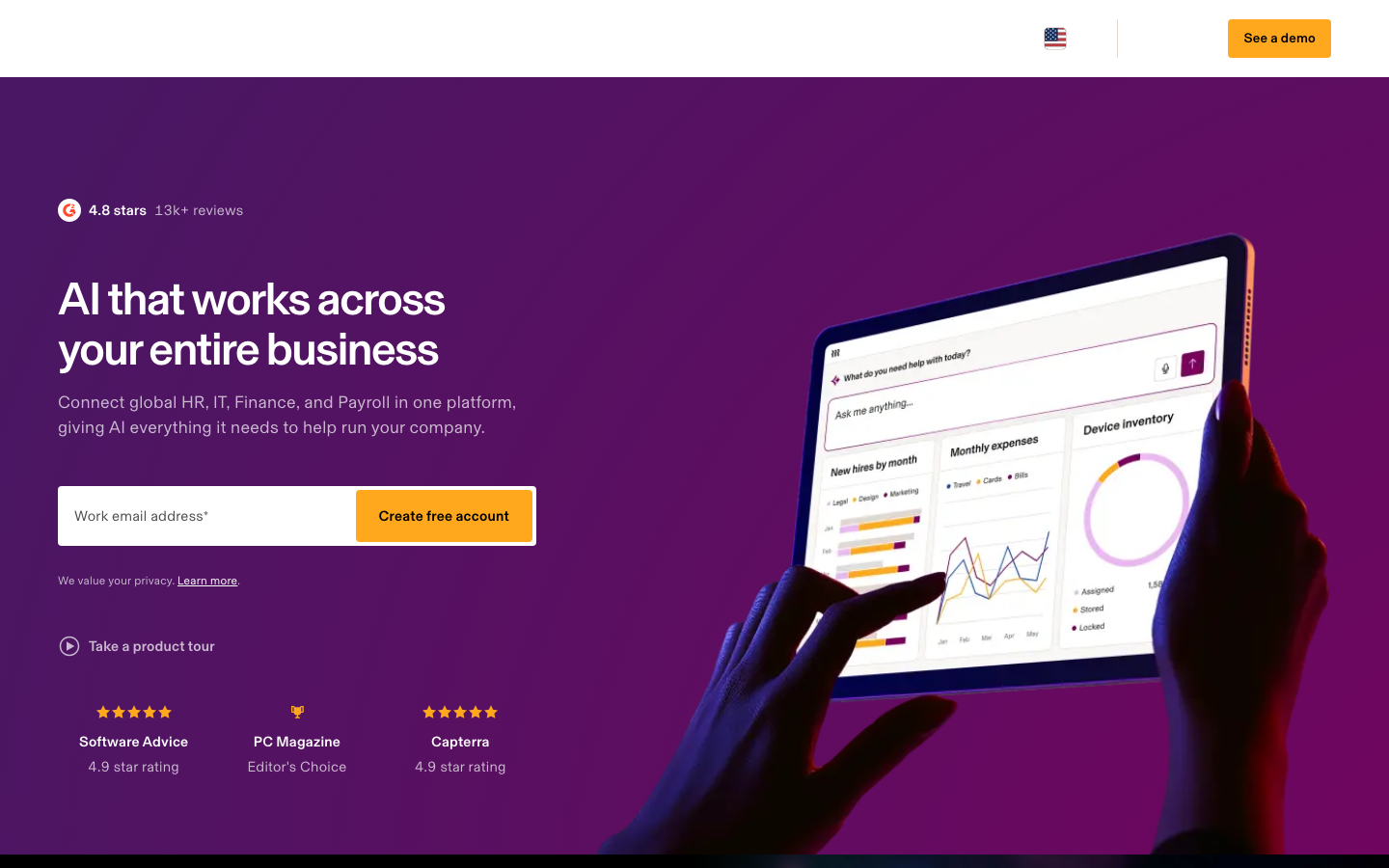
What it does better than Workday:
- Takes less time to implement
- Does not normally require a system integrator
- Manages employee devices and software access
- Connects HR with company spend
Where Workday still wins:
- Better suited to large enterprises
- Combines HCM, finance, and planning
- Handles more complex enterprise requirements
- Has a larger enterprise partner ecosystem
Best for:
Small business to mid-market
Pricing:
Custom pricing
Transparency:
Quote only
Pricing basis:
Per module
Implementation:
Around 1 month; certified partner required: No
G2:
4.8
Pick it over Workday if:
You want HR, payroll, IT, and spend in one system with a shorter implementation
Stick with Workday if:
You run a large organization and need HCM, finance, and planning on one enterprise platform
*As pricing is subject to change, we are listing prices as they stand in August 2026
Workday Top Competitors in Enterprise HCM: ADP, Dayforce, Oracle Fusion Cloud HCM, and SAP SuccessFactors
These four Workday HCM alternatives compete with Workday for large companies with complex HR and payroll needs. When comparing Workday competitors enterprise software, these providers offer a similar level of enterprise capabilities, so choosing one does not mean moving to a simpler platform. The decision comes down to which system better fits your company’s needs.
2. Dayforce
Dayforce serves mid-market and enterprise companies, especially those with complex payroll and workforce management needs. It does not publish standard pricing, so buyers need a custom quote. Its main difference from Workday is payroll: Dayforce calculates payroll continuously as time, benefits, and other employee data change.
Dayforce
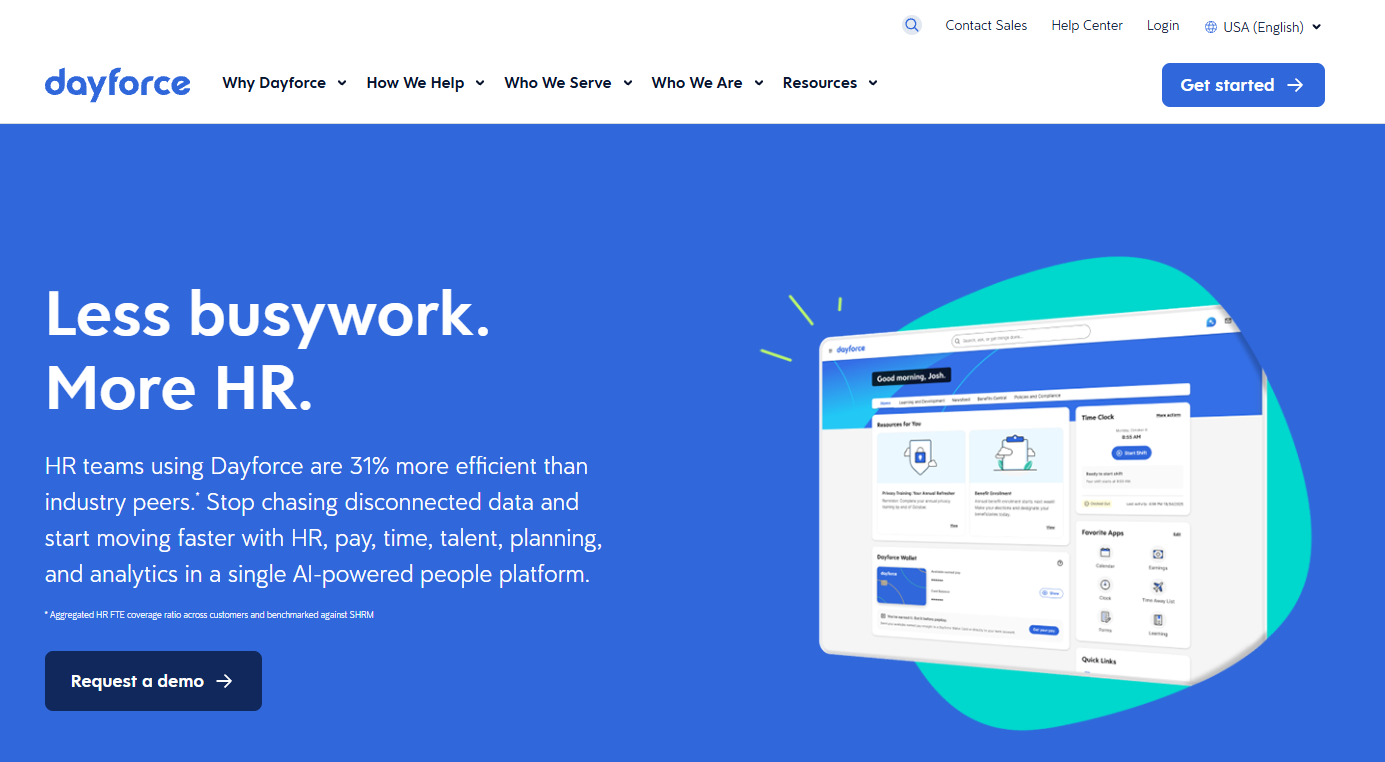
What it does better than Workday:
- Calculates payroll continuously throughout the pay period
- Strong focus on payroll and workforce management
- Connects scheduling, time, and payroll data
- Gives payroll teams real-time labor data
Where Workday still wins:
- Combines HCM with financial management and planning
- Uses a single data model across core applications
- Offers a broader enterprise management platform
- Has a larger ecosystem of implementation partners
Best for:
Mid-market to enterprise payroll
Pricing:
Custom pricing
Transparency:
Quote only
Pricing basis:
Per employee
Implementation:
Around 7 months; certified partner required: No
G2:
4.2
Pick it over Workday if:
Payroll and workforce management are more important to you than combining HR with finance and planning
Stick with Workday if:
You want HR, finance, and planning on one enterprise platform
3. SAP SuccessFactors
SAP SuccessFactors is built for large enterprises and multinational organizations, particularly those operating across many countries. It does not publish standard pricing, so companies need a custom quote. Its strongest case against Workday is global HR and compliance, with more than 100 localizations and deep integration with the wider SAP ecosystem.
SAP SuccessFactors
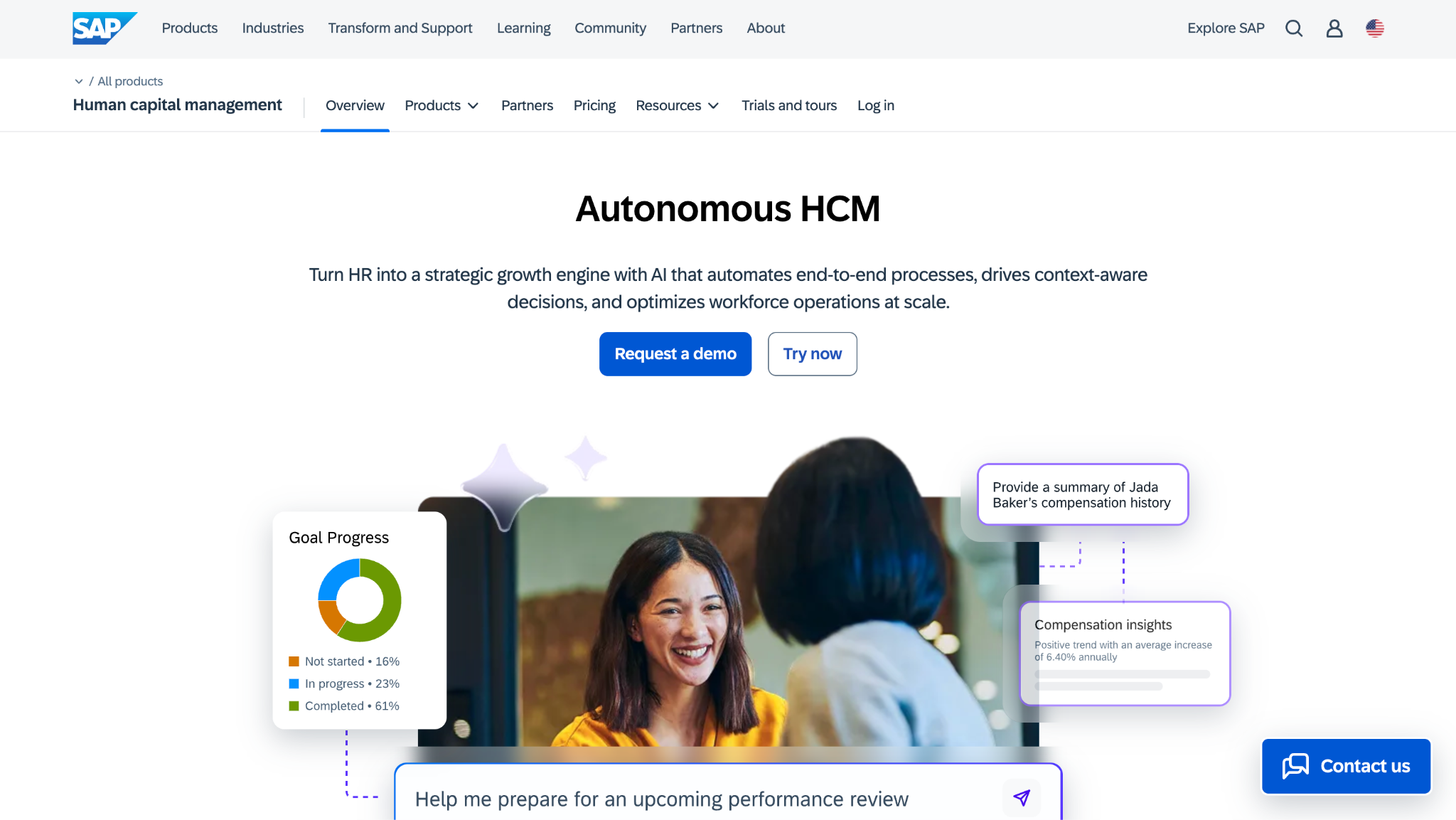
What it does better than Workday:
- Supports more than 100 country localizations
- Fits naturally with existing SAP systems
- Strong focus on multinational HR compliance
- Offers deep country-specific HR capabilities
Where Workday still wins:
- Uses one single data model across HCM and finance
- Connects HR, finance, and planning more closely
- Provides a more consistent platform experience
- Has stronger appeal outside the SAP ecosystem
Best for:
Large multinational enterprises
Pricing:
Custom pricing
Transparency:
Quote only
Pricing basis:
Per module
Implementation:
Around 5 months; certified partner required: Typically yes
G2:
4.1
Pick it over Workday if:
You run a multinational organization with complex local requirements or already use SAP across the business
Stick with Workday if:
You want HCM, finance, and planning built around one data model rather than a broader SAP environment
4. Oracle Fusion Cloud HCM
Oracle Fusion Cloud HCM targets large enterprises and uses custom pricing rather than a published rate. It is particularly relevant for companies that already use Oracle ERP, since HR and finance can work within the same Oracle environment. Like Workday, Oracle supports complex enterprise operations and usually requires a longer implementation.
Oracle Fusion Cloud HCM
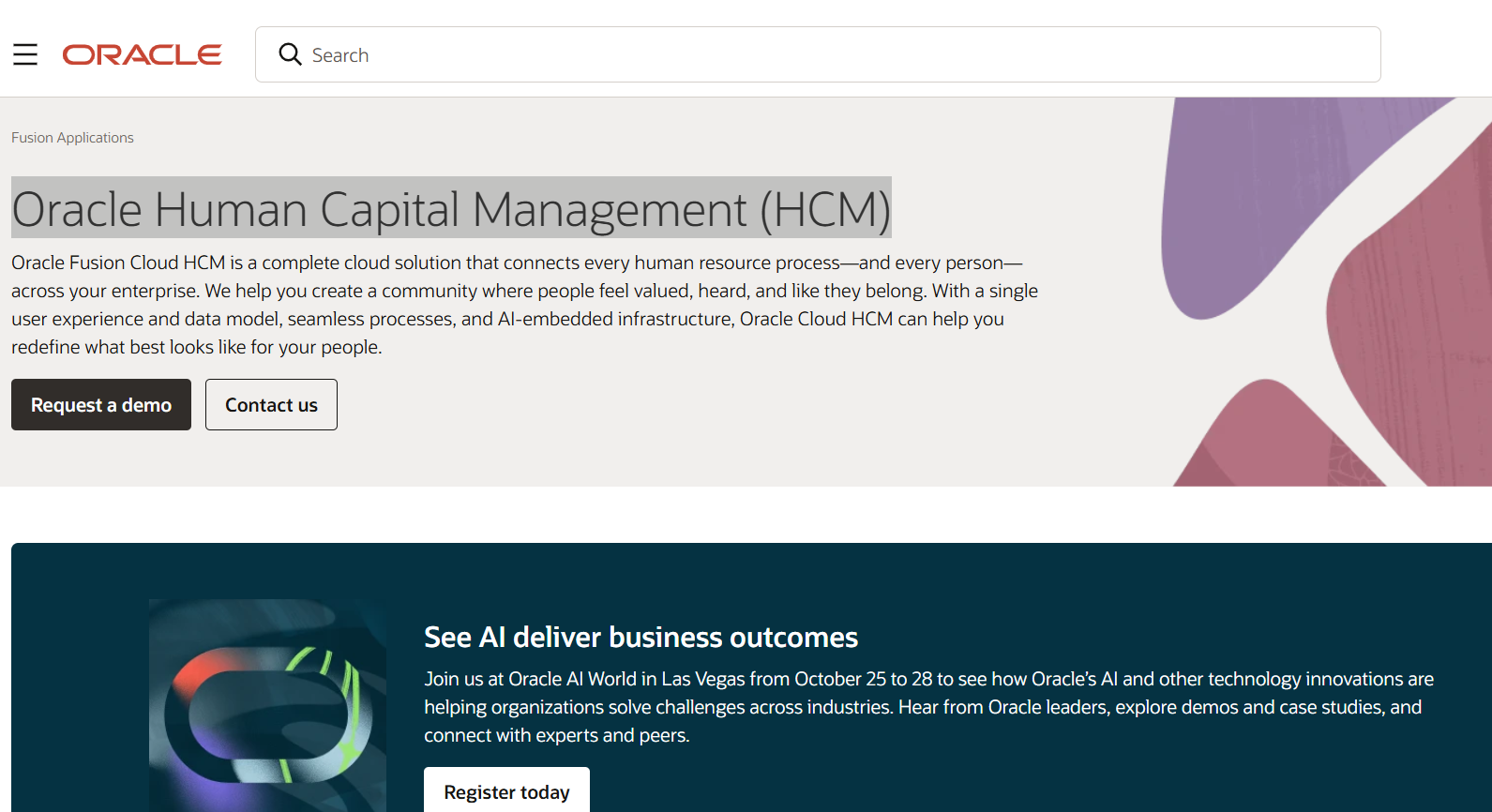
What it does better than Workday:
- Connects directly with Oracle Cloud ERP
- Fits companies already invested in Oracle
- Offers broad global HR capabilities
- Supports complex multinational organizations
Where Workday still wins:
- Uses a single data model across HCM and finance
- Offers a more unified user experience
- Has a strong HR-first market position
- Requires less dependence on the Oracle ecosystem
Best for:
Large enterprises using Oracle ERP
Pricing:
Custom pricing
Transparency:
Quote only
Pricing basis:
Per employee
Implementation:
Around 10 months; certified partner required: Typically yes
G2:
3.8
Pick it over Workday if:
Your company already uses Oracle ERP and wants HCM within the same technology environment
Stick with Workday if:
You want HR, finance, and planning built around Workday’s single data model
5. ADP Workforce Now
ADP Workforce Now serves mid-market and larger companies and is ADP’s main product compared with Workday. ADP sells several product tiers, but only Workforce Now and Vantage HCM compete directly with Workday. Companies comparing ADP competitors should keep these product differences in mind. ADP uses custom pricing and offers deep payroll, payroll tax, and compliance capabilities, with a generally lighter implementation than Workday.
ADP Workforce Now
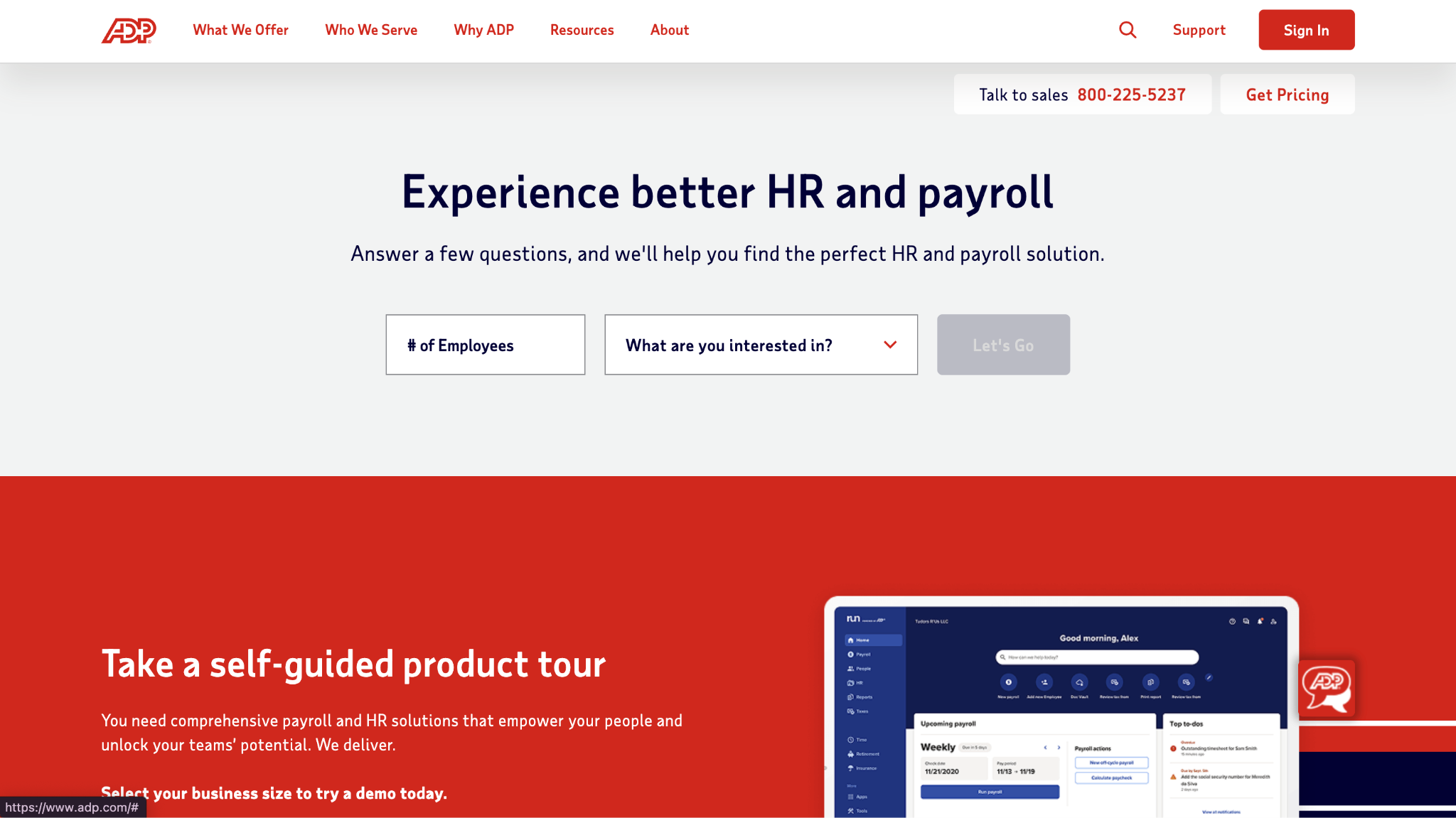
What it does better than Workday:
- Brings deep payroll tax expertise
- Typically takes less time to implement
- Has extensive US payroll experience
- Offers strong payroll compliance support
Where Workday still wins:
- Uses a more unified single data model
- Connects HCM, finance, and planning
- Better fits complex enterprise-wide transformations
- Provides a more integrated enterprise platform
Best for:
Mid-market to large employers
Pricing:
Custom pricing
Transparency:
Quote only
Pricing basis:
Per employee
Implementation:
Around 3 months; certified partner required: No
G2:
4.2
Pick it over Workday if:
Payroll, tax compliance, and a lighter implementation matter more than having HR and finance on one platform
Stick with Workday if:
You need HCM, financial management, and planning connected through one enterprise data model
Mid-Market Workday Alternatives: HiBob and Paylocity
HiBob and Paylocity are two of the best HR software alternatives to Workday for mid-market companies that find Workday too complex. Both are faster to set up and focus on core HR needs. HiBob works well for international scale-ups, while Paylocity focuses more on US companies with payroll and workforce management needs.
6. Paylocity
Paylocity focuses on US mid-market companies and uses custom pricing rather than publishing a standard rate. It combines payroll with HR, workforce management, employee communication, and analytics. Compared with Workday, it offers a lighter system that companies can implement faster, but its international capabilities are more limited.
Paylocity
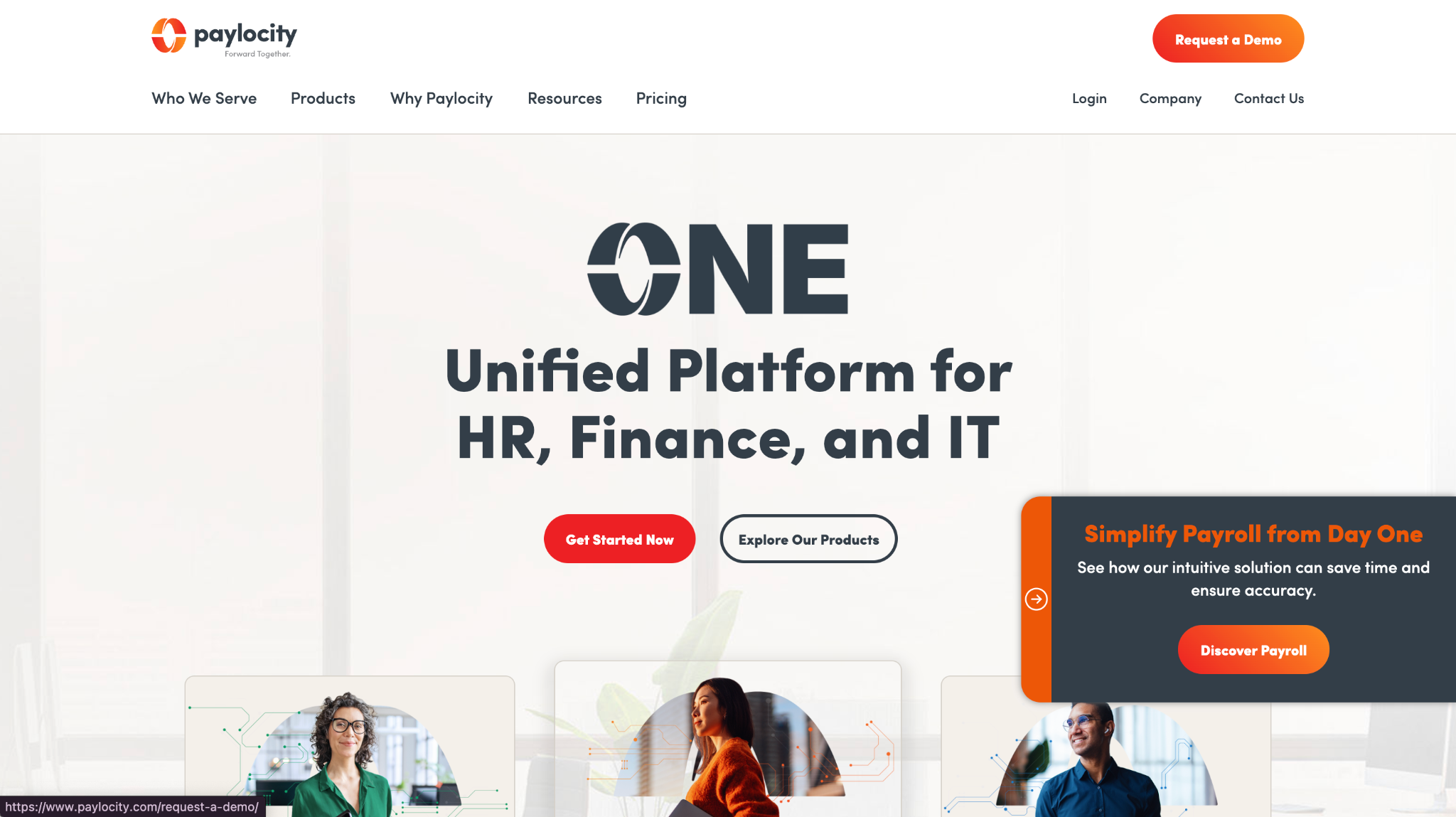
What it does better than Workday:
- Typically takes less time to implement
- Focuses closely on US payroll needs
- Offers built-in employee communication tools
- Fits mid-market HR teams well
Where Workday still wins:
- Supports larger global organizations
- Offers much broader international capabilities
- Connects HCM, finance, and planning
- Handles more complex enterprise requirements
Best for:
US mid-market employers
Pricing:
Custom pricing
Transparency:
Quote only
Pricing basis:
Per employee
Implementation:
Around 2 months; certified partner required: No
G2:
4.5
Pick it over Workday if:
You mainly operate in the US and want a simpler HR and payroll platform with a shorter implementation
Stick with Workday if:
You operate internationally or need HR, finance, and planning on one enterprise platform
*As pricing is subject to change, we are listing prices as they stand in August 2026
7. HiBob
HiBob targets mid-market companies, roughly 100 to 3,000 employees, and is a strong fit for international scale-ups. It does not publish standard pricing, so companies need a custom quote. HiBob offers a simpler HR platform and faster setup than Workday, but it does not match Workday’s depth for very large, complex enterprises.
HiBob
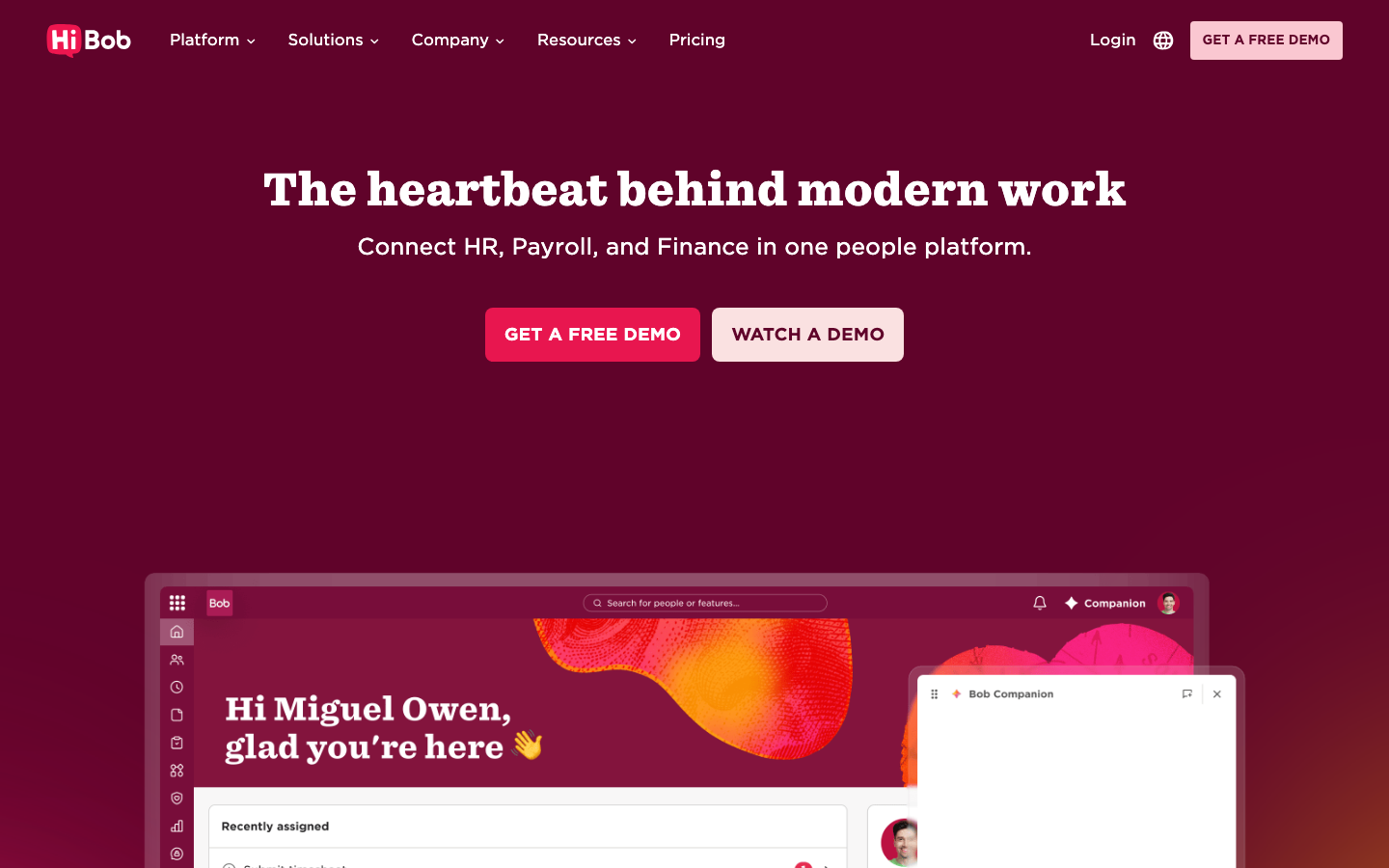
What it does better than Workday:
- Can go live within weeks
- Requires no certified implementation partner
- Offers a simpler user experience
- Fits growing international companies well
Where Workday still wins:
- Scales further for large enterprises
- Combines HCM, finance, and planning
- Handles more complex enterprise requirements
- Supports broader enterprise operations
Best for:
Mid-market international scale-ups
Pricing:
Custom pricing
Transparency:
Quote only
Pricing basis:
Per employee
Implementation:
Typically weeks; certified partner required: No
G2:
4.5
Pick it over Workday if:
You are a growing mid-market company that wants a simpler HR platform and faster implementation
Stick with Workday if:
You expect to outgrow mid-market HR software or need finance, planning, and HCM on one enterprise platform
Workday Alternatives for Frontline and Hourly Workforces: UKG
UKG fits companies with large frontline and hourly workforces. It focuses on scheduling, time tracking, and labor compliance. Unlike Workday, it is built more specifically around the needs of hourly workers, so it suits companies where workforce management is the main priority.
8. UKG Pro
UKG Pro serves mid-market and enterprise companies, with a strong focus on organizations with large hourly and frontline workforces. It does not publish standard pricing, so companies need a custom quote. UKG stands out for workforce management, where scheduling, time tracking, and labor compliance sit at the center of the platform.
UKG Pro

What it does better than Workday:
- Strong focus on hourly workforces
- Offers deep scheduling and time tools
- Handles complex workforce management needs
- Connects payroll closely with time data
Where Workday still wins:
- Combines HCM, finance, and planning
- Offers a broader enterprise platform
- Uses one data model across core applications
- Better fits finance-led enterprise transformations
Best for:
Mid-market to enterprise hourly workforces
Pricing:
Custom pricing
Transparency:
Quote only
Pricing basis:
Per employee
Implementation:
Around 5 months; certified partner required: No
G2:
4.3
Pick it over Workday if:
You manage a large hourly workforce and need strong scheduling, time, and labor management tools
Stick with Workday if:
You want HCM, financial management, and planning connected on one enterprise platform
Which Workday Alternative Fits Your Use Case
Workday Competitors for Mid-Market
Paylocity, HiBob, and Rippling offer mid-market companies simpler systems and faster setup. Insperity HRScale also provides an official route into Workday for US companies. Launched in February 2026, it combines Workday HCM, payroll, time tracking, and absence management with Insperity’s PEO services, adding another choice among Workday competitors mid-market.
Workday Alternatives for Small Business
For companies under roughly 300 employees, Rippling is the clearest option among these Workday alternatives for small business. Workday is designed for larger organizations, and most other providers here are too. Smaller companies may get a better fit from AI HR software built for their size, with simpler tools, faster setup, and lower costs.
Best Alternatives to Workday HR
The right HR platform depends on company size and HR needs. ADP Workforce Now and Dayforce suit larger companies that need a strong system of record (the main place for employee data). Among Workday competitors for HR software, HiBob and Rippling offer simpler options for mid-market companies that do not need Workday’s finance and planning tools.
Best Workday Alternatives HR IT Spend
Rippling is a strong option for Workday alternatives for HR and IT spend. It connects HR with devices, software access, expenses, company cards, and spend management software. For example, when an employee joins or leaves, teams can manage their HR records, laptop, app access, and spending from the same platform.
Best Alternatives to Workday Recruiting
Companies looking for affordable alternatives to Workday recruiting often want a specialist ATS (software for managing hiring) or a more affordable system. Workday expanded its recruiting tools through acquisitions in 2024 and 2025, so recruiting itself is not a clear weakness. For the most recommended alternatives to Workday ATS, as well as the best Workday recruiting alternatives, see our recruiting software guide.
Workday Alternatives for Global and Multinational Teams
SAP SuccessFactors and Oracle Fusion Cloud HCM suit large companies with teams in many countries. SAP SuccessFactors focuses strongly on global HR and local requirements. Oracle Fusion Cloud HCM is a natural option for companies already using Oracle ERP. Both support complex international organizations at a similar enterprise level to Workday.
Workday Competitors for Frontline and Hourly Workforces
UKG suits companies with large hourly and frontline teams, with strong tools for scheduling, time, and labor compliance. Dayforce covers similar needs within a broader HCM platform. Workday charges based on total headcount, so companies with many hourly employees may pay for workers who rarely use the system.
When Workday Is Still the Right Choice
Workday can still work well for companies with more than 1,000 employees. It suits organizations that need HR and finance on one data model. It can also fit regulated industries, public-sector organizations, and companies that already use Workday Financials. For these companies, Workday’s broader capabilities can justify the longer setup.
How to Switch From Workday
Switching from Workday involves replacing the main system that stores and manages your company’s HR data, not just changing an HR tool. The move can affect employee data, payroll, integrations, reporting, and even finance.
- Check your contract and renewal date. Enterprise agreements often run for several years, so your practical exit date may already be set. Review the contract term, renewal rules, and notice period before planning the switch.
- List every integration. Identify every system connected to Workday before estimating the migration cost. Payroll, benefits, finance, identity management, recruiting, and other connections may need rebuilding. These integration costs can significantly change the project budget.
- Export historical records. Secure your payroll, tax, employee, benefits, and other required records before leaving Workday. Confirm the export format, available history, and data retention period in writing so you know what will remain accessible after the contract ends.
- Plan to rebuild your reports. Custom Workday reports do not simply move to another platform. Identify the reports your teams actually use, then determine which ones need to be recreated in the new system.
- Choose the cutover date carefully. Align the move with a payroll and fiscal boundary where possible. This makes it easier to separate records between the old and new systems and reduces reconciliation work.
- Run both systems for a full cycle. Keep Workday and the replacement running in parallel for at least one complete cycle. This gives teams time to compare payroll, employee data, reports, and integrations before relying fully on the new platform.
If your organization also uses Workday Financials, this is no longer just an HR project, and the scope changes significantly. This section provides general information, not procurement or legal advice.
INSIGHT: What makes leaving an HR system of record different from switching a tool?
The integrations and reporting often make the move difficult, not the employee data itself. Both may need to be rebuilt for the new system.
- Integrations can add high cost. ERP Research estimates Workday integration development at roughly $10,000 to $60,000 per connection point. It does not give a typical number of connections per Workday deployment, so the total depends on how many external systems connect to the platform.
- The contract can also limit when a company leaves. Workday’s current European contract terms state that subscriptions run for the period set in the order form. They also state that termination outside specified circumstances does not remove the obligation to pay future amounts due under those orders.
FAQs on Workday Alternatives
What are the best alternatives to Workday?
The best Workday alternative depends on your needs. Rippling combines HR, IT, and spend in one system. Dayforce suits companies that need strong enterprise payroll. SAP SuccessFactors fits multinational companies with complex local requirements. UKG works well for companies with large hourly and frontline teams that need scheduling, time tracking, and workforce management.
Who are Workday competitors?
Workday’s main enterprise competitors include ADP Workforce Now, Dayforce, Oracle Fusion Cloud HCM, and SAP SuccessFactors. These platforms compete in the same enterprise HCM market rather than offering simpler versions of Workday. They support large organizations with complex HR, payroll, workforce management, and international requirements. The main differences come down to each platform’s strengths and how it fits the company’s existing systems.
How much does Workday cost?
Workday does not publish prices, so online figures come from third-party estimates and vary widely. The final cost depends on factors such as employee count, selected modules, contract terms, and location. Implementation costs extra and depends on project size, integrations, data migration, and support needs.
What are the best Workday alternatives for a small business?
For companies with fewer than roughly 300 employees, Rippling is the strongest fit among the providers compared here. Workday is built for larger organizations, so most small businesses do not need its scale and complexity. Most other providers on this list also target mid-market or enterprise companies rather than small businesses.
What are the alternatives to Workday Recruiting?
Companies considering other recruiting platforms often want a specialist ATS or cannot justify the cost of the full Workday suite. Workday expanded its recruiting capabilities by acquiring HiredScore for AI-based talent matching and Paradox for candidate conversations, applications, and interview scheduling. Workday recruiting competitors may be a better fit for companies that only need recruiting tools rather than a full HCM suite.
What are the alternatives to Workday Adaptive Planning?
Workday Adaptive Planning is corporate financial planning software used by finance teams for budgeting, forecasting, and reporting. It’s a separate Workday module with its own pricing rather than part of the standard HCM subscription, so Workday Adaptive Planning alternatives comparing financial planning tools rather than HR systems fall outside this guide’s scope.
Is Workday available for mid-market companies?
Yes, Insperity HRScale (HR services and PEO provider), launched in February 2026, gives US mid-market companies access to Workday HCM, payroll, time tracking, and absence management through Insperity’s PEO model. It offers a different route to Workday for companies below its traditional enterprise market.
Verdict: The Best Workday Alternative for You
When comparing the best Workday alternatives for HR, consider Rippling for HR, IT, and spend; Dayforce for enterprise payroll; SAP SuccessFactors for global companies; ADP for payroll and compliance; and UKG for hourly workforces. Workday still fits large organizations that need HR, finance, and planning on one data model. Alternatives may fit better when implementation costs become too high, or the company is too small for Workday. Moving to another enterprise suite usually solves a capability problem, not a cost problem.

Helen is Anywherer’s Market Analyst & Content Researcher, with extensive experience in analyzing global employment markets and HR technology trends. She is skilled at turning complex market data into clear, well-researched insights that inform every piece of content. With a strong grasp of the EOR, PEO, and international hiring space, Helen plays a key role in keeping Anywherer’s research accurate, up to date, and genuinely useful for readers.