A skills gap analysis is the process of comparing the competencies your team has right now against the competencies their roles demand. The gap between those two numbers tells you where development budgets should go and which hires actually matter. What is a skills gap analysis in practical terms? It is a structured audit that replaces opinions about who needs training with evidence that holds up in a budget meeting.
Most companies know they have skill gaps. Few know exactly where they are. McKinsey Global Survey found that 87% of organizations either have skill gaps today or expect them within the next five years. Remote and hybrid teams face an additional problem: managers cannot gauge capability through hallway conversations the way they once did. A skills gap analysis template solves that by putting every rating in the same format, no matter where the employee sits. In this guide you will find four skills gap analysis template examples, common mistakes to avoid, and a framework for turning gap data into real development plans.
Skills Gap Analysis Template Examples
Each example skills gap analysis template below covers a different use case. Pick the skills gap analysis template free download that matches your situation and adapt the columns to your roles. Every template follows the same logic: define the skill, rate it, measure the gap, and assign an action.
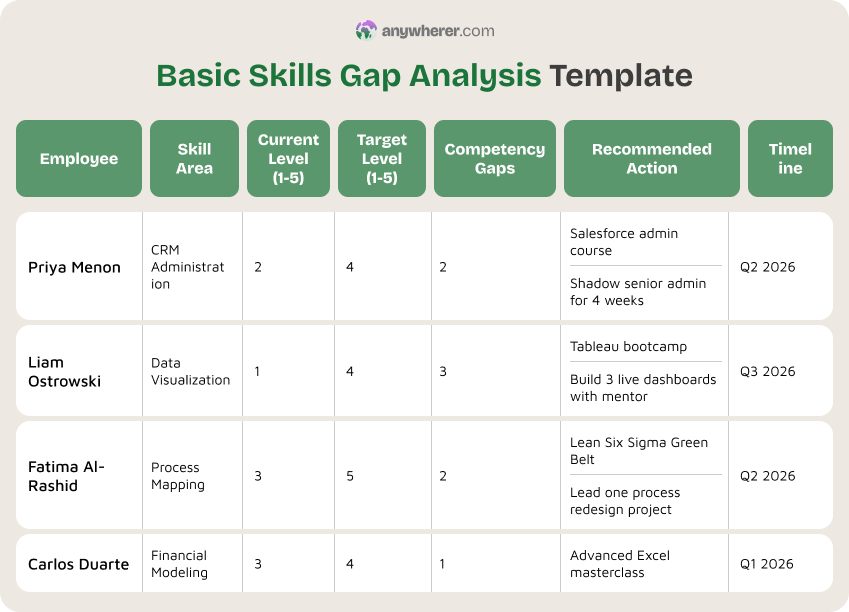
Basic Skills Gap Analysis Template
Purpose
This is the starting point when a team has never run a workforce skills gap analysis before. It strips the process down to the essentials: list the skills, rate current levels, set target levels, and note the gap. Nothing else. If you are figuring out how to conduct a skills gap analysis for the first time, this individual skills gap analysis template removes the guesswork.
What It Reveals
It shows which employees fall short on core competencies and by how much. Gaps of one point on a five-point scale usually close with on-the-job practice. Gaps of three or more signal a hiring need or a major training investment.
Why It Is Valuable
Simplicity is the value. Managers who would never open a 20-tab spreadsheet will actually fill this one in. That means you collect real data instead of assumptions.
Template
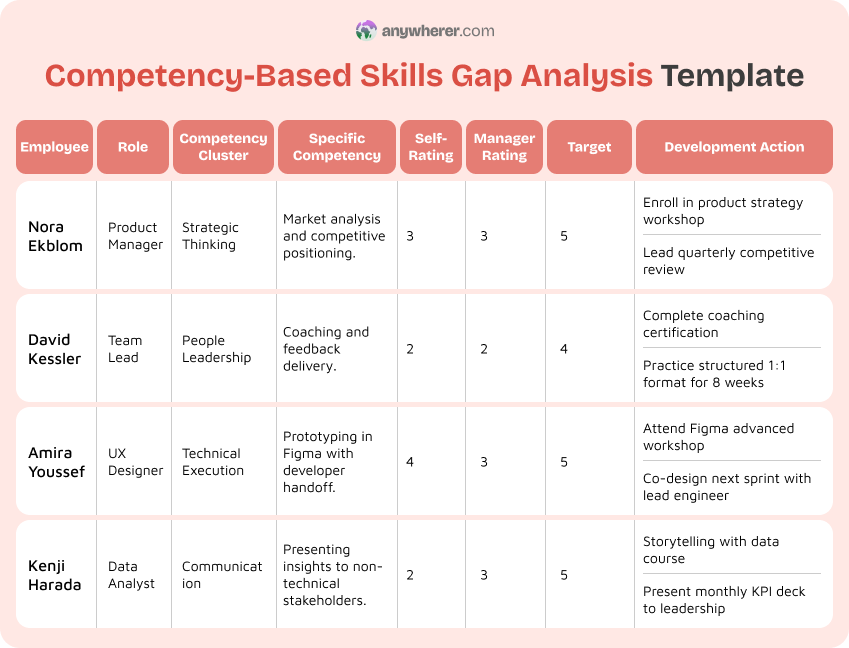
Competency-Based Skills Gap Analysis Template
Purpose
A competency-based approach groups skills into broader competency clusters: technical knowledge, behavioral traits, leadership qualities. Instead of asking whether someone knows Python, it asks whether they can design a scalable data pipeline end to end. That distinction matters when the goal is workforce planning, not just course enrollment.
What It Reveals
It highlights patterns across teams. You might find that individual technical skills are strong but collaboration competencies lag. That kind of insight never surfaces in a basic skills list.
Why It Is Valuable
Competency frameworks connect directly to performance review criteria, so the analysis feeds straight into development plans without translation. HR teams running a skills gap analysis in HR already have these categories built into their HRIS.
Template
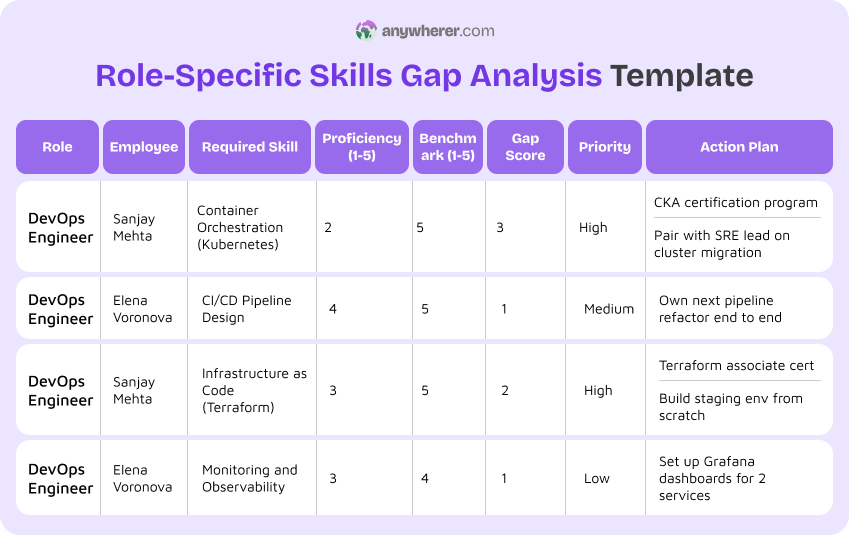
Role-Specific Skills Gap Analysis Template
Purpose
When you need to know how to perform a skills gap analysis for a single position, this template fits. It maps every skill required for a specific role and checks each employee in that role against the benchmark. Useful during restructuring, role redesign, or post-merger integration when job descriptions shift overnight.
What It Reveals
It pinpoints which employees are ready for the new role definition and which ones need targeted upskilling. Managers get a clear picture instead of a hunch.
Why It Is Valuable
Precision. A marketing manager template will look nothing like an infrastructure engineer template, and that is the point. Each role gets exactly the criteria it needs.
Template
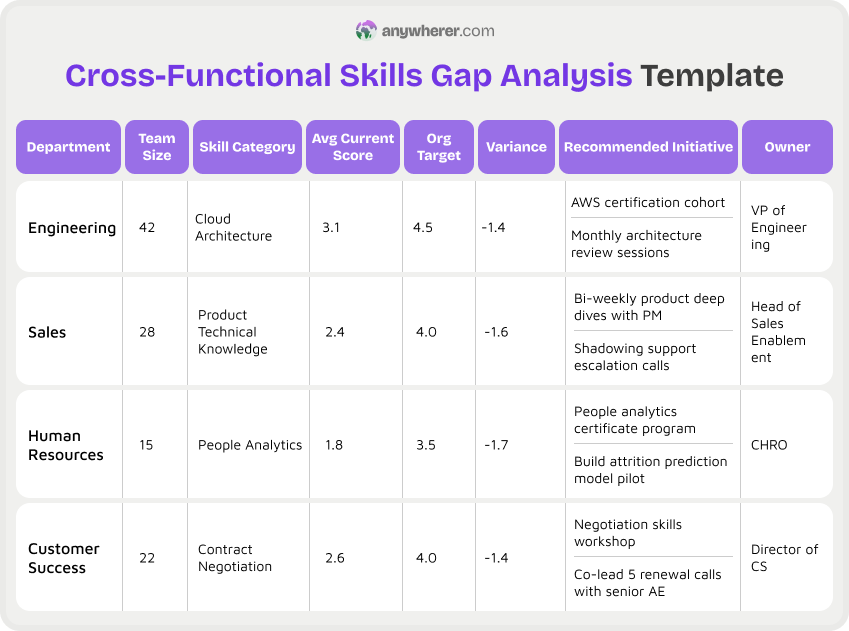
Cross-Functional Skills Gap Analysis Template
Purpose
This example skills gap analysis template looks across departments. It answers the question leaders actually ask: where are the weakest links in our workforce as a whole? Instead of drilling into one person, it compares skill readiness across teams so budget and training resources flow where they matter most.
What It Reveals
It shows organizational blind spots. Engineering might score well on technical depth but poorly on commercial awareness. Sales might rate high on negotiation but low on product knowledge. The cross-functional view surfaces the gaps that single-team analyses miss.
Why It Is Valuable
Resource allocation. When leadership sees that three departments all score below target on data literacy, a company-wide training program makes more sense than three separate ones. It prevents duplicate spending and builds consistency.
Template
Common Mistakes to Avoid When Analyzing Skills Gaps
Running a workforce skills gap analysis is straightforward on paper. In practice, teams make the same errors over and over. These five show up more than any others.
Skipping Self-Assessments and Relying Only on Manager Ratings
Managers see output but miss context. An employee might score low on a skill simply because they never had the chance to use it, not because they lack the ability. Pairing self-assessments with manager ratings catches that blind spot. When both scores diverge, it opens a conversation worth having.
Measuring Too Many Skills at Once
A 40-skill assessment form gets abandoned halfway through. Limit the first pass to 8 to 12 skills per role. You can always add depth later, but you cannot recover engagement once people decide the process is busywork.
Using Outdated Job Descriptions as Benchmarks
If the benchmark comes from a job description written three years ago, the analysis measures fitness for a role that no longer exists. Review and update role profiles before running the assessment.
Collecting Data Without an Action Plan
The most common failure mode. Teams spend weeks gathering ratings and then the spreadsheet sits in a shared drive. Every gap identified needs an owner, a timeline, and a budget line. Otherwise the exercise erodes trust.
Ignoring Soft Skills and Behavioral Competencies
Technical gaps are easy to spot and easy to train. Communication, collaboration, and decision-making gaps are harder to measure but cause more damage when left unaddressed. Include at least two behavioral competencies in every analysis.
How to Turn Skills Gap Data into Actionable Development Plans
Knowing how to conduct a skills gap analysis is only half the job. The other half is turning the data into plans that actually close the gaps. A 2023 World Economic Forum report estimated that 44% of workers’ core skills will be disrupted in the next five years, which means the window for action keeps getting shorter.
Prioritize by Business Impact, Not Gap Size
A three-point gap on a nice-to-have skill matters less than a one-point gap on a revenue-critical capability. Rank gaps by what they cost the business when they stay open, not by the raw number.
Assign Owners and Deadlines
Every action item needs a person responsible and a date. Without both, the development plan is a wish list. Tie deadlines to business milestones, like a product launch or a quarterly review, so progress has a natural checkpoint.
Blend Learning Methods
Courses alone do not close skill gaps. Pair formal training with stretch assignments, peer mentoring, and project-based practice.
Connect to Existing Development Frameworks
Do not build a parallel process. Feed gap data into the tools you already use: performance reviews, quarterly check-ins, and employee development plan templates. That way skills gap analysis in HR becomes a regular input to talent decisions, not a one-off project.
Reassess Quarterly
Skills change. Roles change. Run a lightweight check every quarter to see if gaps are closing or if new ones have opened. Annual-only analysis locks you into yesterday’s picture.
FAQs on Skills Gap Analysis
What is a skills gap analysis?
A skills gap analysis compares the skills employees currently have against the skills their roles require. The output is a list of gaps, ranked by size and business impact, that tells you exactly where training, hiring, or reorganization needs to happen.
How do you do a skills gap analysis step by step?
Start by defining the roles and skills you want to measure. Gather ratings through self-assessment and manager review. Calculate the gap between current and target levels. Prioritize gaps by business impact. Assign development actions with owners and deadlines. Review progress quarterly. That is how to do a skills gap analysis that actually changes something.
What are the benefits of skills gap analysis for remote teams?
Remote teams lose the hallway feedback that office workers take for granted. A structured skills gap analysis replaces assumptions with data so managers know where each person stands without relying on proximity. It also supports better project staffing and individual development plans for employees across time zones.
How often should a company run a skills gap analysis?
At minimum once a year, ideally during the annual planning cycle so results feed directly into budgets. Fast-moving industries benefit from semi-annual reviews. Run an ad hoc analysis any time a major technology shift, merger, or restructuring changes role requirements.
What challenges come with skills gap analysis?
Rating inconsistency is the biggest one. Two managers might rate the same skill completely differently. Calibration sessions help. Another common challenge is employee buy-in: people resist assessments that feel like performance reviews in disguise. Organizations dealing with challenges with skills gap analysis often find that positioning the process as a growth tool, not a judgment tool, fixes most resistance.
Can a skills gap analysis template be used for individual employees?
Yes. An employee skills gap analysis template works at the individual level when paired with a one-on-one conversation between the employee and their manager. The individual version feeds directly into personal development plans and performance goals.

Yaryna is our lead writer with over 8 years of experience in crafting clear, compelling, and insightful content. Specializing in global employment and EOR solutions, she simplifies complex concepts to help businesses expand their remote teams with confidence. With a strong background working alongside diverse product and software teams, Yaryna brings a tech-savvy perspective to her writing, delivering both in-depth analysis and valuable insights.