What is recruitment process at its core? It’s the sequence of actions a company takes to find, evaluate, and hire the right person for an open role. Sounds straightforward. In practice, most hiring workflows are messy. Job descriptions get copy-pasted from three years ago. Screening criteria shift depending on who reviews the resume. Interview feedback sits in someone’s inbox for a week. SHRM puts the average cost per hire at $4,700, and that number climbs quickly for specialized or senior positions. A structured recruitment process template cuts waste by giving every hiring manager the same playbook.
This article walks through six recruitment process plan template examples, each built for a different use case. Basic hiring, end to end recruitment process coverage, optimization-focused plans, tech roles, remote roles, and a pure checklist format. After the templates, it covers common mistakes and the metrics worth tracking. Everything here is a starting point. Adjust the steps for your team size, industry, and hiring volume.
Recruitment Process Plan Template Examples
Below are six template for recruitment process plans ranging from simple to specialized. Each one lists the steps of recruitment process for that scenario, followed by a shorter version formatted for images or manager handouts. For a broader view of hiring strategy, combine these with a recruitment plan example that covers headcount planning, budget, and sourcing channels.
Basic Recruitment Plan Template
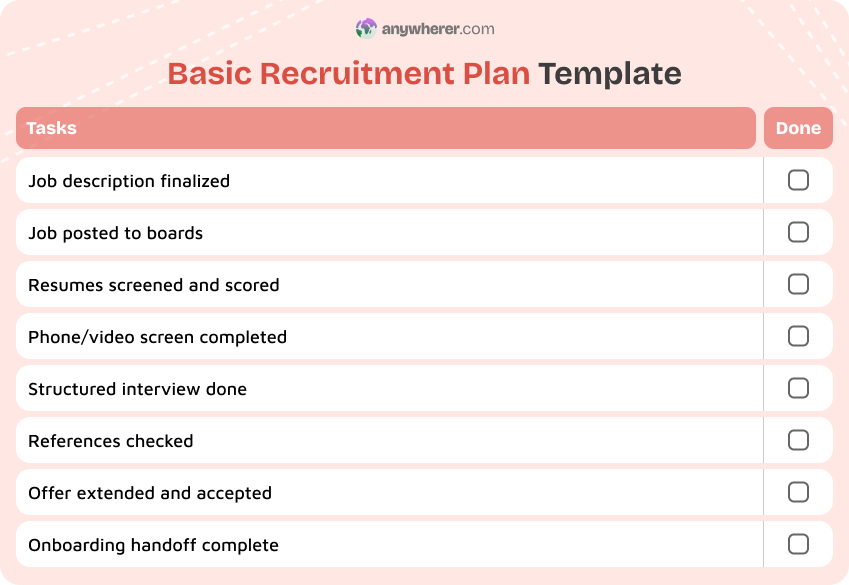
This template works for companies that hire fewer than 20 people a year and don’t need elaborate multi-stage pipelines. It covers the minimum steps in recruitment process that every opening should follow, from posting the job to closing the offer. Think of it as the baseline. If your team isn’t doing at least this much, there are gaps.
Steps:
- Write or update the job description. Include the title, reporting line, core responsibilities, required skills, and salary range. Vague descriptions attract the wrong candidates.
- Post to job boards and internal channels. LinkedIn, Indeed, and the company careers page at minimum.
- Screen resumes against the must-have criteria. Score each application on a 1-3 scale to keep evaluations consistent.
- Conduct a phone or video screen. 20 to 30 minutes. Cover availability, salary expectations, and role fit.
- Run a structured interview with the hiring manager. Predefined questions, scored rubric, written feedback within 24 hours.
- Check references. Two professional references minimum. Ask about strengths, areas to watch, and whether they’d rehire.
- Extend the offer. Written, with the title, start date, compensation, and benefits. Set a response deadline.
- Once accepted, hand the new hire off to the onboarding team with all paperwork ready.
End-to-End Recruitment Plan Template
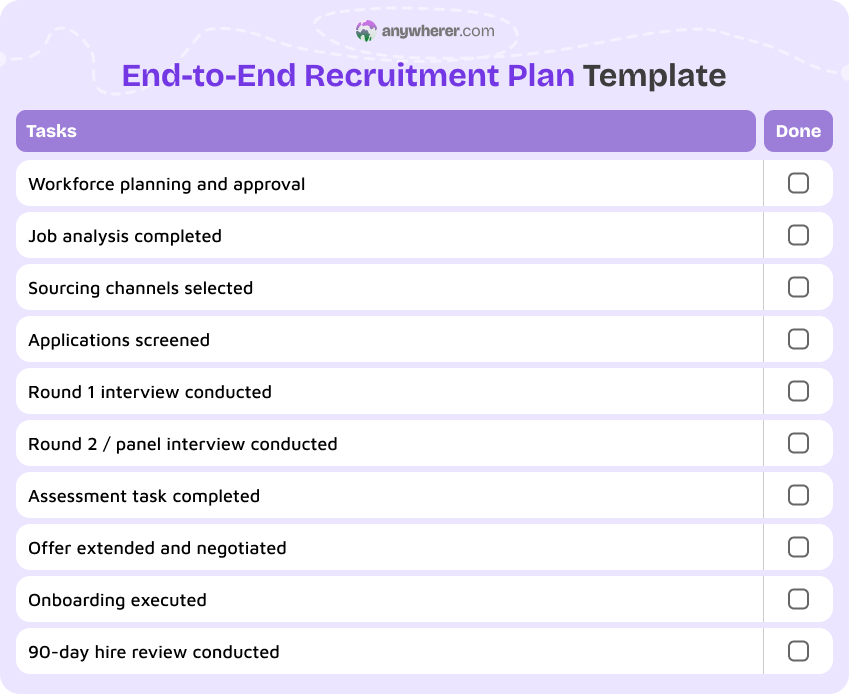
The end to end recruitment process starts before the job is even posted and continues past the hire date. This recruitment process document template includes workforce planning, sourcing strategy, multi-round interviews, offer negotiation, onboarding, and a post-hire review at day 90. It’s the right fit for mid-size to large companies that want a repeatable system across departments.
Steps:
- Workforce planning. Identify the gap: is this a replacement, a new headcount, or a restructured role? Get budget approval before anything else moves.
- Job analysis. Sit down with the hiring manager and write the role requirements from scratch. Don’t recycle old postings unless the role is truly identical.
- Sourcing strategy. Decide which channels to use: job boards, employee referrals, agency partners, social outreach. Allocate budget for each.
- Application screening. Use standardized scorecards. Two reviewers per resume if volume allows.
- First-round interview. Behavioral and situational questions. Record scores against competencies, not gut feeling.
- Second-round interview or panel. Deeper technical or cultural questions depending on the role level.
- Assessment or work sample. A relevant task that mirrors actual job duties. Keep it under two hours.
- Offer and negotiation. Present the package. Have a pre-approved flexibility range so the recruiter doesn’t need to loop back for every counter.
- Onboarding. Structured first week with clear goals, buddy assignment, and tool access before day one.
- 90-day review. Did the hire meet expectations? Did the process surface the right candidate? Document findings for next time.
Recruitment Process with Optimization Focus Checklist Example
This template is for teams that already have a process but want to know how to improve the recruitment process with technology and data. LinkedIn Talent Solutions reports that companies using structured hiring practices see up to 2x improvement in quality of hire. Recruitment process optimization isn’t about replacing human judgment. It’s about removing the manual steps that slow things down and introduce inconsistency.
Steps:
- Audit the current process. Map every step, who owns it, and how long it takes. Flag anything that requires manual data entry or email chains.
- Set up an ATS (Applicant Tracking System) if one isn’t in place. Route all applications through it. No more spreadsheets.
- Enable automated resume screening with keyword matching and knockout criteria. Humans review the shortlist, not the full pile.
- Use pre-recorded video interviews for the first screen. Candidates record answers on their own time. Reviewers watch at 1.5x speed if needed. Saves days of scheduling.
- Build structured scorecards into the ATS. Every interviewer fills the same form. No more “I liked them” emails.
- Track time-to-hire and drop-off rates by stage. If 40% of candidates disappear between round one and round two, something in that gap needs fixing.
- Automate offer generation and e-signatures. The less time between verbal offer and signed letter, the fewer candidates you lose to competing offers.
- Run a quarterly process review with recruiters and hiring managers. What’s working? What’s taking too long?

Recruitment Process for Tech Roles Checklist Example
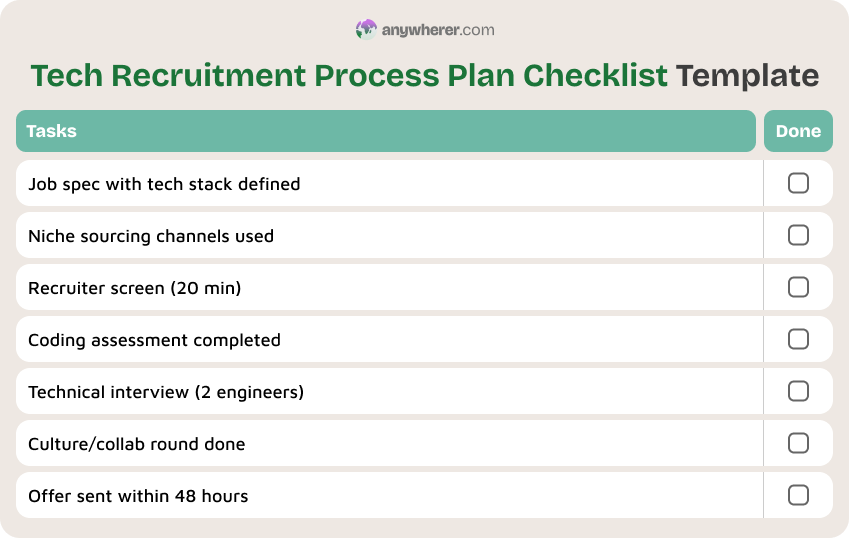
Hiring engineers, data scientists, or DevOps specialists requires steps that a generic template doesn’t cover. Technical screening is different from behavioral screening, and the candidate market is competitive enough that slow processes lose people to faster companies. This recruitment process example for technical positions accounts for coding tests, system design rounds, and the need for speed.
Steps:
- Write the job spec with input from the engineering lead. List the tech stack, required experience levels, and any non-negotiable tools or frameworks.
- Source candidates through niche channels: GitHub, Stack Overflow, tech-specific Slack communities, and referrals from current engineers.
- Initial screen: 20-minute call with the recruiter to confirm experience and mutual interest.
- Technical assessment. A take-home coding challenge (capped at 90 minutes) or a live pair-programming session. Use a platform like HackerRank or CoderPad for consistency.
- Technical interview with two engineers. Cover problem-solving, system design, and code review ability. No whiteboard tricks that don’t reflect the real work.
- Culture and collaboration round with the team lead or product manager. Communication style, approach to feedback, and how they handle disagreements.
- Offer within 48 hours of the final round. For senior engineers, faster is better. Top candidates rarely wait beyond a week.
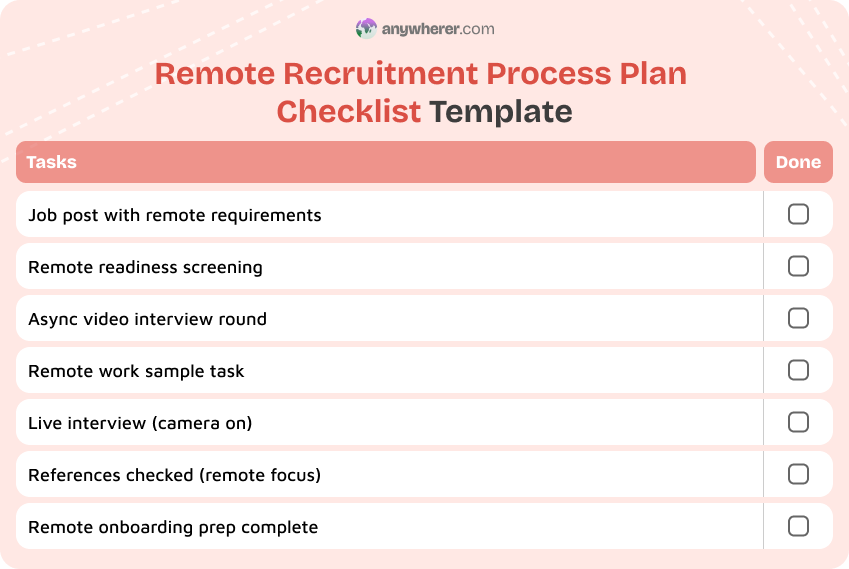
Recruitment Process for Remote Roles Checklist Sample
Remote hiring adds variables that office-based recruitment doesn’t touch: time zone coverage, async communication skills, home office setup, and self-management ability. Gallup reports that over half of U.S. employees with remote-capable jobs now work in a hybrid or fully remote arrangement. The recruitment process sample below addresses the nuances specific to distributed teams.
Steps:
- Include remote-specific requirements in the job posting: required time zone overlap, internet speed minimums, and whether the role is fully remote or hybrid.
- Screen for remote readiness during the first call. Ask about their home workspace, experience with async tools (Slack, Notion, Loom), and how they structure their day without direct supervision.
- Use async video responses for one interview round. This tests written and verbal communication at the same time and shows whether the candidate can deliver a clear message independently.
- Run a timed work sample that mimics a real remote scenario. Hand the candidate a brief, give them a deadline, and see how they communicate progress and questions along the way.
- Live interview with the hiring manager. Camera on. Focus on collaboration patterns, conflict resolution over chat vs. calls, and how they handle isolation or ambiguity.
- Reference check with a focus on remote performance. Did they meet deadlines without hand-holding? Were they responsive in async communication?
- Remote onboarding prep: equipment shipped, all accounts live, a virtual week-one schedule, and a buddy assigned in the same time zone.
Recruitment Process Checklist
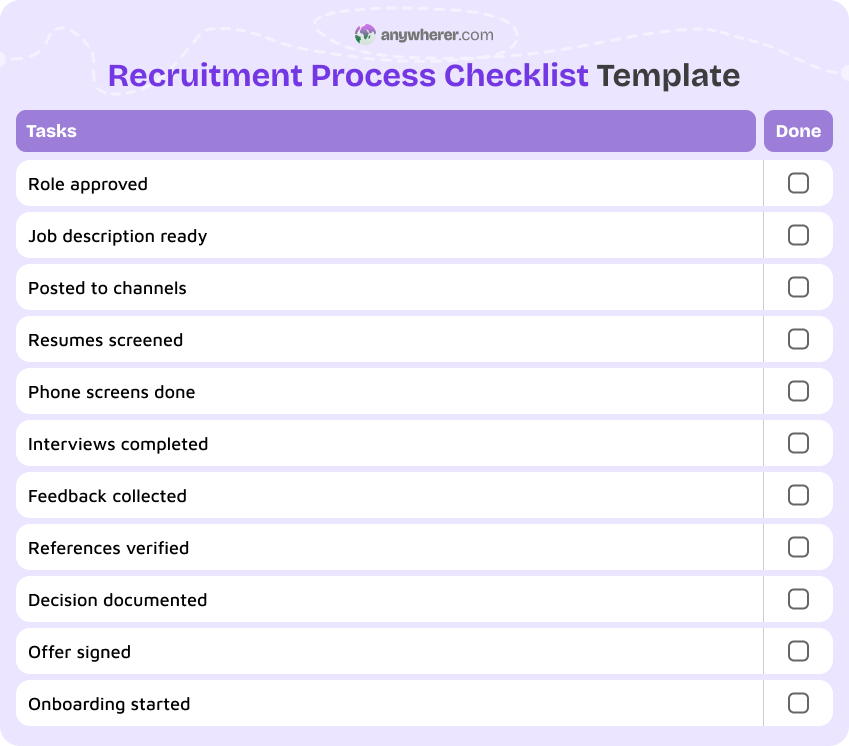
This is the simplest format. A recruitment process checklist template that a hiring manager can print and check off step by step. No narrative, no strategy discussion. Just the action items in order. Use it as a checklist for recruitment process quality control, or as a sample of recruitment process steps to hand to new managers who haven’t hired before.
- Role approved and budgeted
- Job description written and reviewed by HR
- Sourcing channels selected and job posted
- Application deadline set and communicated
- Resumes screened against criteria
- Shortlist created (5-10 candidates)
- Phone screens completed
- Interviews scheduled and run
- Interview feedback collected within 24 hours
- Assessment or work sample reviewed
- Reference checks done
- Hiring decision made with documented rationale
- Offer letter generated and sent
- Offer accepted and signed
- Onboarding handoff to HR and hiring manager
- Candidate records updated in ATS
Common Mistakes to Avoid in the Recruitment Process
Most hiring problems aren’t caused by a shortage of talent. They’re caused by how the company runs the process. Any example of recruitment process failure usually traces back to one of these patterns.
Relying too heavily on resumes
A resume tells you where someone worked and what they claim to have done. It doesn’t tell you how they think, how they handle pressure, or whether they can do the actual work. Add a structured work sample or skill test and the signal improves significantly.
Skipping structured interviews
When every interviewer asks whatever comes to mind, the data is useless for comparison. Structured interviews with predefined questions and scoring rubrics outperform unstructured ones in predicting job performance. This is well-documented in I/O psychology research and it’s one of the fastest ways to learn how to improve recruitment process quality.
Slow communication
Every extra day in the pipeline raises the chance that a strong candidate accepts another offer. Map your timeline. If any stage takes more than a week without a clear reason, compress it.
Ignoring sourcing
Posting a role and waiting for applicants to show up is passive. Sourcing through referrals, direct outreach, and niche communities produces better matches. The best candidates usually aren’t applying on job boards.
No feedback documentation
If two interviewers disagree on a candidate and there’s no documented feedback to compare, the decision comes down to whoever argues loudest. Written scorecards solve this.
Forgetting candidate experience
Hiring is a two-way street. If the process is slow, confusing, or impersonal, good candidates drop out before you make an offer. Every touchpoint shapes how someone sees the company.
Metrics to Track and Measure Recruitment Success
Numbers tell you whether the process is actually working or just feels like it is. Tracking recruitment metrics doesn’t require a dedicated analytics team. Most ATS platforms pull these automatically. Harvard Business Review makes the case that companies spend enormous amounts on hiring but rarely measure whether any of it works. Even a few simple metrics will show you where the bottlenecks are.
- Time to hire. Number of days from posting the job to a signed offer letter. The industry average sits around 44 days depending on the role level. If yours is significantly higher, the pipeline has a bottleneck somewhere.
- Cost per hire.Total spend divided by total hires. Include advertising, agency fees, recruiter salaries, and tool subscriptions. Knowing this number lets you compare sourcing channels and cut what doesn’t produce.
- Candidate satisfaction. Send a short survey after the process ends, whether the person was hired or not. Question topics: communication speed, interview fairness, and whether the role was accurately described. A poor score here means you’re damaging employer brand with every opening.
- Offer acceptance rate. What percentage of offers get signed? If it’s below 80%, either the compensation is off, the process is too slow, or the candidates are getting a better deal elsewhere. Dig into the reasons.
- Quality of hire. Measure how well new hires perform against expectations at 6 and 12 months. This closes the loop between the recruitment process and actual outcomes. If the process is selecting the right people, this number trends upward over time.
- Pipeline conversion rates. What percentage of candidates advance from each stage? If 200 people apply and only two reach the interview, the job description or sourcing strategy is off. If ten reach the final round and six reject the offer, the negotiation stage needs work.
Conclusion
Hiring without a documented process is like running a project without a brief. Some things will work. Most won’t be repeatable. The recruitment process template free formats above give you a starting point regardless of team size or hiring volume. Pick the one closest to your current needs, fill in the details, and run it for a quarter. Then look at the metrics.
What is the best recruitment process template? It’s the one your hiring managers actually use. A ten-step plan that sits in a shared drive untouched is worth less than a five-step checklist that gets pulled up before every opening. Start simple. Add complexity only where the data shows you need it.
FAQs on Recruitment Process Plan Templates
What is a recruitment process plan?
It’s a written document that outlines every step from job approval to onboarding handoff. It defines who does what, in what order, and by when. The goal is repeatability. Without a plan, every opening gets handled differently and quality depends on whoever happens to be running the search.
How do I know if my recruitment process is working?
Track time to hire, cost per hire, offer acceptance rate, and quality of hire at 6 months. If those numbers are stable or improving, the process is working. If they’re not, pick the weakest metric and trace it back to the step causing the problem.
What are some common mistakes to avoid in the recruitment process?
Using unstructured interviews, moving too slowly between stages, writing vague job descriptions, and not collecting interviewer feedback in a standard format. Each of these creates inconsistency, and inconsistency is where bad hires come from.
How do I track the effectiveness of my recruitment process templates?
Compare hiring outcomes before and after adopting the template. Look at time to fill, candidate drop-off rates by stage, interviewer consistency scores, and new hire performance at 90 days. If the template isn’t producing measurable improvement, revise it.
Can a recruitment process plan help with remote hiring?
Yes. Remote hiring adds steps that office-based hiring doesn’t need, like evaluating async communication skills and verifying home office setup. A dedicated remote recruitment template builds those steps into the pipeline so they don’t get skipped. It also standardizes the virtual interview format across hiring managers.

Yaryna is our lead writer with over 8 years of experience in crafting clear, compelling, and insightful content. Specializing in global employment and EOR solutions, she simplifies complex concepts to help businesses expand their remote teams with confidence. With a strong background working alongside diverse product and software teams, Yaryna brings a tech-savvy perspective to her writing, delivering both in-depth analysis and valuable insights.