Performance goals examples for work give managers and employees a shared reference point for what clear, measurable objectives actually look like. Too often, goals written during a review cycle are vague, unmeasurable, or disconnected from the work someone actually does. Statements like “do better” or “improve performance” give no one anything to act on. They create confusion at review time and make it nearly impossible to evaluate progress fairly.
This is especially common during annual review cycles, when people search for annual review performance goals examples but end up recycling generic phrases that do not reflect real priorities. It is also why managers frequently ask, what are good goals for a performance review examples that are specific, practical, and aligned with actual role expectations.
This article provides 60 employee performance goals examples across six categories, each written with a clear action, a measurable outcome, and a realistic condition or timeframe. Whether you are preparing for an annual review, building an individual development plan, or coaching a direct report through a self-performance review goals examples exercise, these work performance goals examples are ready to adapt and use. Each example of performance goals below follows a consistent structure so you can quickly identify what fits your team and customize from there.
What Makes a Good Performance Goal
A good performance goal answers three questions: what will be done, how success will be measured, and by when. The structure is straightforward. Start with an action verb, attach a measurable outcome, and set a timeframe or condition. “Reduce average ticket resolution time from 48 hours to 24 hours by the end of Q3” is a goal. “Be more responsive” is not.
The SMART framework (Specific, Measurable, Achievable, Relevant, Time-bound) remains the most widely used structure for goal setting in performance management. According to research from SHRM, goals that are specific and participative, where both manager and employee are involved in the development process, lead to greater ownership and commitment. The best performance goals samples share a few traits: they avoid vague language, they define a finish line, and they connect to either the individual’s role or the team’s objectives.
It also helps to consider alignment. A performance goal that matters to the employee but has no connection to the team’s priorities will feel isolated. A goal that serves the organization but ignores the individual’s growth will feel imposed. The strongest performance goal examples sit at the intersection of both. They push the employee to develop a meaningful capability while also contributing to a result the team needs. When managers and employees write goals together, the conversation itself often reveals what actually needs to happen, which is half the value of the exercise.
Performance Goals Examples
Below are 60 performance goals for employees examples organized into six categories. Each category contains ten goals. Every goal follows the same structure: an action, a measurable outcome, and a timeframe or condition. These examples of performance goals are written for a range of roles and seniority levels, so you can adapt them to fit your team’s context.
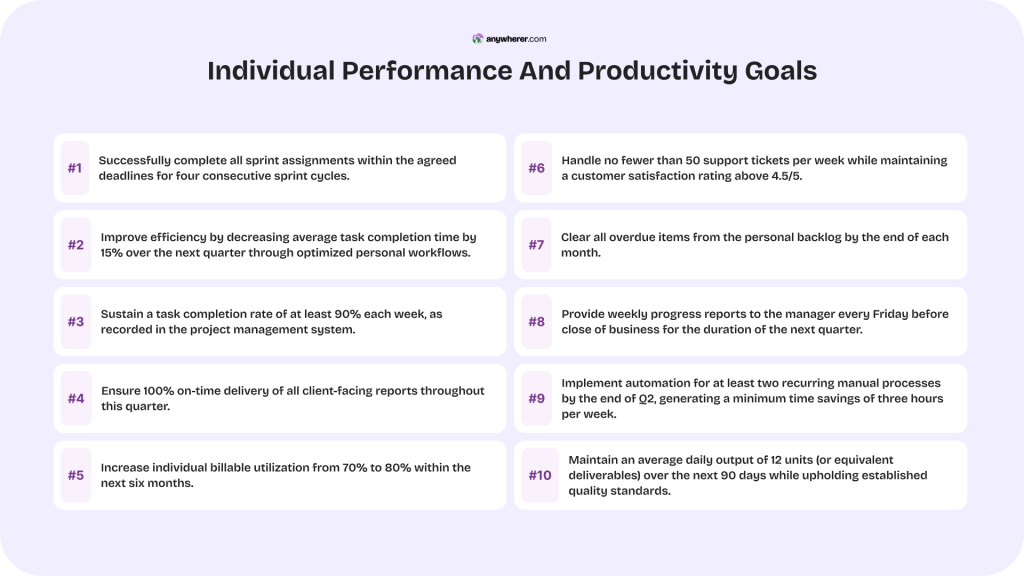
Individual Performance and Productivity Goals
Productivity goals focus on the volume, speed, and consistency of an employee’s output. They work best when paired with a quality metric so that faster work does not mean lower standards.
- Complete all assigned sprint tasks within the agreed timeline for four consecutive sprints.
- Reduce average task completion time by 15% over the next quarter by streamlining personal workflows.
- Maintain a weekly task completion rate of 90% or higher as tracked in the project management tool.
- Deliver all client-facing reports by the scheduled due date with zero missed deadlines this quarter.
- Increase personal billable utilization from 70% to 80% over the next six months.
- Process a minimum of 50 support tickets per week while maintaining a satisfaction score above 4.5 out of 5.
- Reduce the number of overdue items in the personal backlog to zero by the end of each month.
- Submit weekly progress updates to the manager every Friday before end of business for the next quarter.
- Automate at least two recurring manual tasks using available tools by the end of Q2 to free up three or more hours per week.
- Achieve an average daily output of 12 units (or equivalent deliverables) over the next 90 days without compromising quality standards.
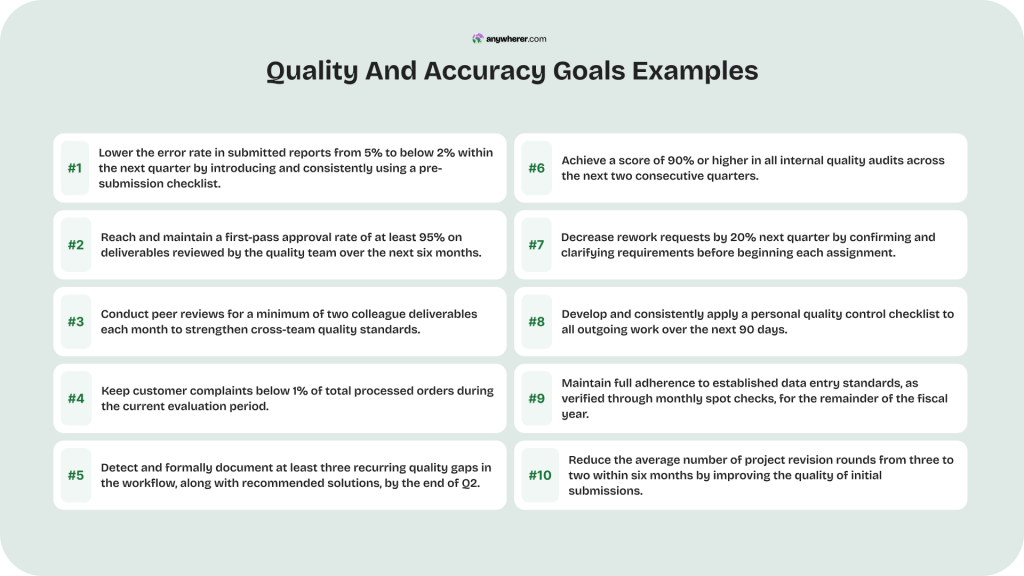
Quality and Accuracy Goals Examples
Quality goals ensure that output meets defined standards and that errors are caught before they reach the client or the next stage of a process. These goals are especially important in roles where mistakes carry a financial or reputational cost.
- Reduce error rate in submitted reports from 5% to under 2% by implementing a pre-submission checklist within the next quarter.
- Achieve a first-pass approval rate of 95% or higher on deliverables reviewed by the quality team over the next six months.
- Complete a peer review of at least two colleague deliverables per month to improve cross-team quality awareness.
- Maintain a customer complaint rate below 1% of total orders handled during the current review period.
- Identify and document at least three recurring quality issues in the current workflow and propose fixes by the end of Q2.
- Score 90% or above on all internal quality audits for the next two consecutive quarters.
- Reduce rework requests by 20% over the next quarter by clarifying requirements before starting each task.
- Implement a personal quality checklist for all outgoing work and use it consistently for the next 90 days.
- Ensure 100% compliance with data entry standards as measured by monthly spot checks for the remainder of the fiscal year.
- Decrease the average number of revision cycles per project from three to two by improving initial output quality over the next six months.
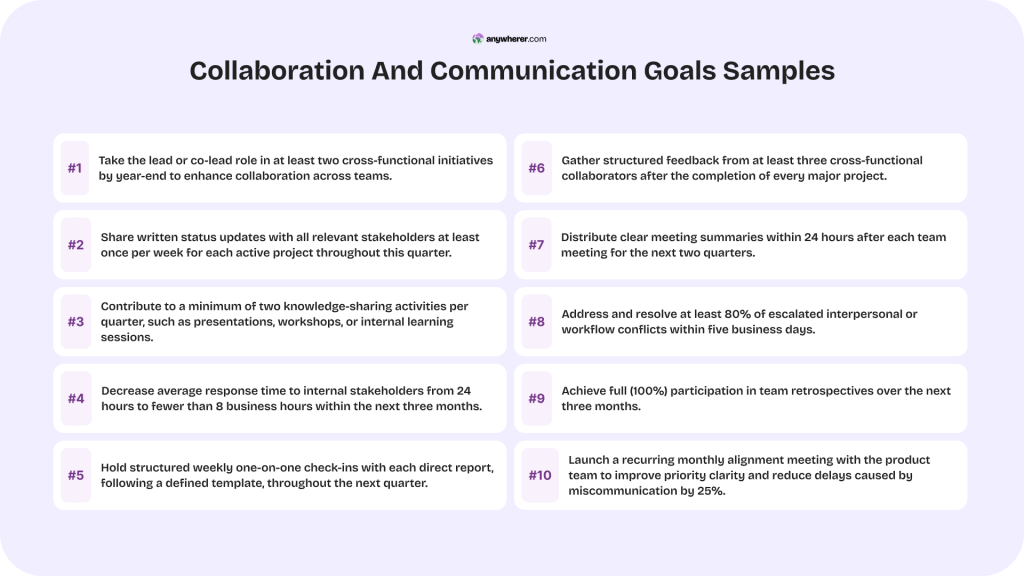
Collaboration and Communication Goals Samples
Communication goals target how well an employee shares information, coordinates with others, and contributes to a team environment. In remote and hybrid settings, these goals are especially relevant because informal communication channels are limited.
- Lead or co-lead at least two cross-functional projects by the end of the year to strengthen inter-team collaboration.
- Provide written status updates to all project stakeholders at least once per week for every active project during this quarter.
- Participate in a minimum of two knowledge-sharing sessions (presentations, lunch-and-learns, or workshops) per quarter.
- Reduce average email response time to internal stakeholders from 24 hours to under 8 business hours over the next three months.
- Schedule and conduct regular one on one meeting template-based check-ins with each direct report weekly for the next quarter.
- Collect structured feedback from at least three cross-functional partners after every major project delivery.
- Document and share meeting notes within 24 hours of every team meeting for the next two quarters.
- Resolve at least 80% of interpersonal or process-related conflicts within the team within five business days of escalation.
- Increase participation in team retrospectives to 100% attendance for the next three months.
- Initiate a monthly sync with the product team to align on priorities and reduce miscommunication-related delays by 25%.
Professional Development and Skill Growth Goals Examples
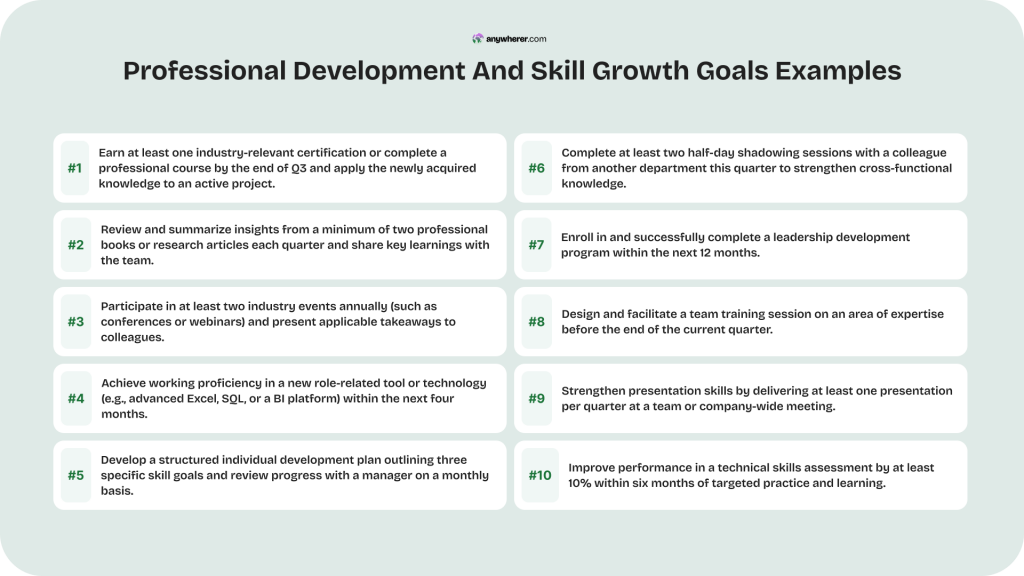
Development goals are forward-looking. They focus on building new skills, expanding knowledge, and preparing for future responsibilities. These are the goals that typically connect to an individual development plan and long-term career growth.
- Complete at least one industry-relevant certification or course by the end of Q3 and apply the knowledge to a current project.
- Read and summarize key takeaways from at least two professional books or research papers per quarter and share them with the team.
- Attend at least two industry conferences, webinars, or professional events per year and report back on applicable insights.
- Build proficiency in a new tool or technology relevant to the role (e.g., advanced Excel, SQL, or a BI platform) within four months.
- Create a personal individual development plan examples-based document with three specific skill targets and review progress monthly with a manager.
- Shadow a colleague in a different department for at least two half-days this quarter to broaden cross-functional understanding.
- Enroll in and complete a leadership development program within the next 12 months.
- Develop and deliver a training session for the team on a topic of expertise by the end of the current quarter.
- Improve public speaking skills by presenting at least once per quarter in a company or team-wide meeting.
- Achieve a measurable improvement (10% or more) in a technical skill assessment score within six months of focused practice.
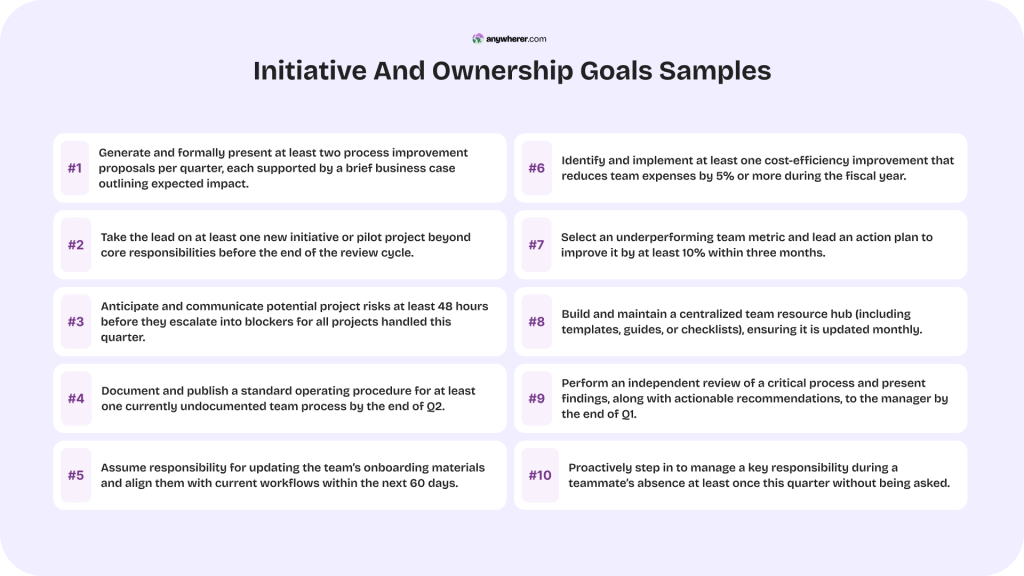
Initiative and Ownership Goals Samples
Initiative goals reward employees who go beyond their assigned responsibilities to improve processes, solve problems, or take on new challenges. These goals are particularly valuable for employees being considered for promotion or expanded scope.
- Identify and propose at least two process improvement ideas per quarter, with a written business case for each.
- Volunteer to lead at least one new initiative or pilot project outside of regular responsibilities by the end of the review period.
- Proactively flag potential project risks at least 48 hours before they become blockers, for every project this quarter.
- Develop a standard operating procedure for one undocumented process in the team by the end of Q2.
- Take ownership of the team’s onboarding documentation and update it to reflect current workflows within the next 60 days.
- Propose and implement at least one cost-saving measure that reduces team expenses by 5% or more within the fiscal year.
- Identify an underperforming metric in the team’s dashboard and own a plan to improve it by 10% within three months.
- Create a shared resource library (templates, guides, or checklists) for the team and maintain it with monthly updates.
- Conduct a self-initiated audit of a key process and present findings with recommended actions to the manager by the end of Q1.
- Step in to cover a critical role or responsibility during a teammate’s absence at least once this quarter without prompting.
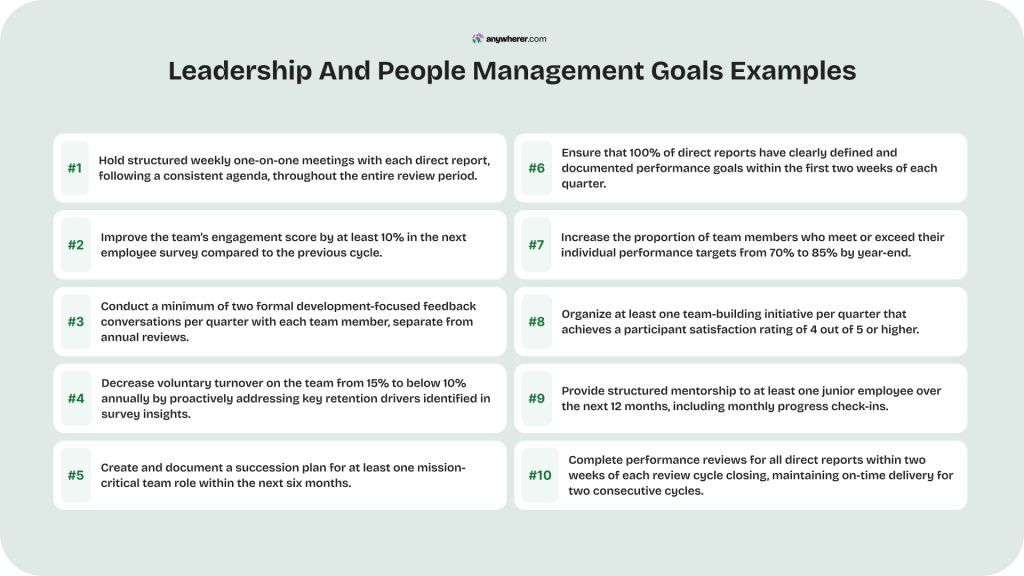
Leadership and People Management Goals Examples
Leadership goals apply to managers, team leads, and anyone responsible for the performance and development of others. These goals measure not just what a leader delivers personally but how well they enable their team to perform.
- Conduct structured weekly one-on-one meetings with each direct report using a consistent agenda for the entire review period.
- Achieve a team engagement score increase of at least 10% in the next employee survey compared to the previous cycle.
- Complete at least two formal feedback conversations (not tied to annual reviews) with each team member per quarter.
- Reduce voluntary attrition on the team from 15% to under 10% annually by addressing top retention drivers identified in survey data.
- Develop and document a succession plan for at least one critical role on the team within the next six months.
- Ensure 100% of direct reports have updated performance goals for managers examples documented within the first two weeks of each quarter.
- Increase the percentage of team members meeting or exceeding their individual goals from 70% to 85% by end of year.
- Facilitate at least one team-building activity per quarter that receives a satisfaction rating of 4 out of 5 or higher from participants.
- Mentor at least one junior employee through a structured mentorship program over the next 12 months, with monthly check-ins.
- Deliver timely performance reviews for all direct reports within two weeks of the review period closing, with no delays for two consecutive cycles.
How Many Performance Goals Should an Employee Have?
Most performance management frameworks recommend between three and five goals per review cycle. That range gives employees enough focus to make meaningful progress without spreading their attention too thin. When someone has ten or more goals, none of them get the attention they deserve, and the review conversation becomes a checklist exercise instead of a development discussion.
The right number also depends on the role. An individual contributor working on a single product might have three focused goals. A senior manager overseeing multiple teams might need five to cover people management, operational delivery, and strategic priorities. Research from McKinsey emphasizes that effective performance management links individual goals directly to organizational objectives, which means quality matters far more than quantity. Three well-constructed goals aligned with team and company priorities will always outperform a list of eight generic ones.
A practical approach is to balance the goals across different areas. One goal might target day-to-day productivity, another might focus on skill development, and a third might address collaboration or leadership. This spread ensures the employee is growing in multiple dimensions without being overwhelmed. It also gives the manager a clearer picture of overall performance instead of seeing only one angle.
Common Mistakes When Setting Performance Goals
Even experienced managers fall into predictable traps when setting performance goals. Here are some of the most common mistakes and why they undermine the process.
- Writing goals that are too vague. A goal like “improve communication” gives the employee no direction. There is no way to know when it has been achieved or what “improvement” actually looks like. Every goal needs a specific outcome attached to it.
- Setting goals that cannot be measured. If you cannot point to a number, a date, or a concrete deliverable, the goal is essentially unverifiable. Performance goals for work examples that work always include at least one measurable indicator.
- Assigning too many goals at once. Overloading an employee with eight or ten goals for a single quarter dilutes focus. The employee ends up making marginal progress on everything and meaningful progress on nothing.
- Setting goals without employee input. Goals imposed top-down, without any discussion, create compliance instead of commitment. When employees participate in defining their own targets, they are more likely to take ownership of the outcome.
- Forgetting to revisit goals during the cycle. A goal set in January and never discussed until December is not a performance goal. It is a forgotten task. Good performance goals for work require regular check-ins, ideally monthly, to adjust timelines or shift priorities as circumstances change.
Examples of Bad Performance Goals (and Why They Fail)
Sometimes the fastest way to understand what a good goal looks like is to see what a bad one looks like. Below are a few examples of goals that sound reasonable but fail on closer inspection, along with a brief explanation of why.
- “Be a better team player.” This is a personality trait, not a goal. There is no way to measure it, no timeline, and no clear action. A better version: “Participate in all scheduled team retrospectives and contribute at least one actionable suggestion per session for the next quarter.”
- “Improve sales numbers.” Improve by how much? Compared to what baseline? By when? Without specifics, this goal is impossible to evaluate. A better version: “Increase monthly closed deals from 8 to 12 by the end of Q3 by expanding outreach to two new market segments.”
- “Learn new skills.” Which skills? How will proficiency be assessed? This is an aspiration, not a performance goal. A better version: “Complete an advanced data visualization course and apply the techniques to at least two client reports by end of Q2.”
- “Be more proactive.” Proactive about what? This gives no direction and no outcome. A better version: “Identify and flag at least two project risks per sprint before they become blockers, documented in the team’s risk register.”
FAQs on Performance Goals
What are good performance goals for employees?
Good performance goals are specific, measurable, and tied to the employee’s role and the team’s objectives. They describe a clear action, define how success will be measured, and include a timeframe. For example, “reduce average response time to client inquiries from 24 hours to 12 hours by end of Q2” is a strong goal because it is concrete, trackable, and relevant to the employee’s day-to-day work.
How do you write a performance goal?
Start with an action verb that describes what the employee will do. Add a measurable outcome so both the employee and the manager can verify whether the goal was met. Then include a timeframe or condition. The formula is: action + measurable result + deadline. Avoid vague language like “improve” or “try to” unless it is paired with a specific metric.
What is an example of a measurable performance goal?
“Increase the team’s Net Promoter Score from 45 to 55 within the next two quarters by implementing a post-interaction feedback loop and acting on the three most common improvement areas.” This goal includes a baseline (45), a target (55), a timeframe (two quarters), and a method (feedback loop plus follow-up).
How often should performance goals be reviewed?
Performance goals should be reviewed at least quarterly, with informal check-ins monthly or during regular one-on-one meetings. Waiting until the end of the year to discuss goals makes it impossible to course-correct or adjust for changing priorities. Frequent reviews also keep the goals relevant and give the employee consistent feedback on their progress.
Can performance goals change during the year?
Yes. Business conditions, team structures, and individual roles shift throughout the year, and performance goals should reflect those changes. If a major project is cancelled or a new priority emerges, updating the goal is better than keeping a target that no longer makes sense. The key is to document the change and align on the revised goal during a check-in conversation.

Yaryna is our lead writer with over 8 years of experience in crafting clear, compelling, and insightful content. Specializing in global employment and EOR solutions, she simplifies complex concepts to help businesses expand their remote teams with confidence. With a strong background working alongside diverse product and software teams, Yaryna brings a tech-savvy perspective to her writing, delivering both in-depth analysis and valuable insights.