Giving effective feedback is one of the most important, and most avoided, responsibilities of any manager. In remote teams, where casual hallway check-ins don’t exist, feedback becomes the primary mechanism for course correction and recognition. In hybrid workplaces, inconsistent face time means some employees receive regular input while others go weeks without hearing how they’re performing. In performance-driven cultures, feedback is the engine that turns individual effort into measurable results.
Yet most managers struggle with it. According to a Gallup State of the Global Workplace report, only 26% of employees strongly agree that the feedback they receive helps them do better work. Many managers avoid negative feedback entirely because they fear damaging relationships. Others default to vague praise like “great job” that feels good momentarily but provides zero actionable direction. And some deliver criticism so bluntly that it demotivates rather than improves.
This guide solves all three problems. Below you will find categorised, real-world employee feedback examples you can adapt immediately, whether you are praising a top performer, addressing missed deadlines, evaluating a new hire, or preparing for an annual review. With over 50 practical examples of employee feedback, every sample is specific, references observable behaviour, and provides a clear path forward.
Why Employee Feedback Matters
The impact of structured feedback extends far beyond individual performance. Research from Harvard Business Review shows that employees who receive regular, strengths-based feedback are up to 14.9% more productive than those who receive none.
- Performance improvement: Specific feedback tells employees exactly what to continue and what to change.
- Employee engagement: People who feel seen and heard invest more discretionary effort in their work.
- Retention: Employees who receive meaningful feedback are significantly less likely to look for another job.
- Psychological safety: A culture of honest, respectful feedback creates an environment where people speak up, take risks, and learn from mistakes.
- Continuous development: Feedback transforms static annual reviews into an ongoing growth conversation.
Understanding why feedback matters is the first step. The sections below show you how to give feedback to employee conversations that actually drive results.
Positive Employee Feedback Examples
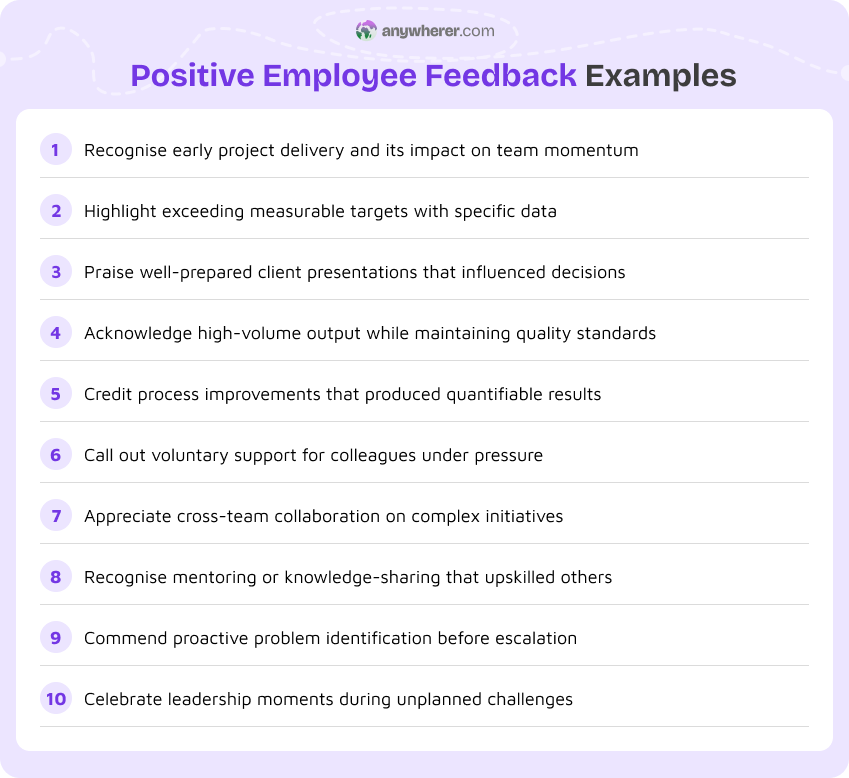
Positive feedback reinforces the behaviours and outcomes you want to see repeated. But for it to be effective, it must be specific. Telling someone “you’re doing great” is kind but forgettable. Telling them exactly what they did well and why it mattered is what sticks. Below are employee positive feedback examples across three categories, with positive employee feedback samples you can adapt right away. Wondering what are some examples of positive feedback for employee conversations? Start here.
Performance-Based Praise Employee Feedback Samples
Use these when an employee delivers strong results, completing a project on time, exceeding KPIs, or consistently producing high-quality work.
1. “You delivered the migration project two days ahead of schedule without compromising quality. That kind of execution sets the standard for the entire team.”
2. “Your conversion rate this quarter was 28% above target. The way you refined the outreach sequence clearly paid off.”
3. “The client presentation you prepared was exceptionally well-researched. The CFO specifically mentioned how much it helped their decision-making process.”
4. “You handled 40% more support tickets this month while keeping your satisfaction score above 95%. That’s a remarkable balance of speed and quality.”
5. “The code review process you introduced reduced production bugs by 30% last quarter. That initiative directly improved our release reliability.”
6. “Your financial forecast was only 2% off from actual results. That accuracy gives leadership real confidence in our planning process.”
Teamwork and Collaboration Employee Feedback Samples
Use these when an employee supports colleagues, collaborates across functions, or mentors others effectively.
1. “When the design team was behind on the product launch, you volunteered to take on their QA tasks so they could focus on creative work. That made the difference between hitting and missing our deadline.”
2. “Your cross-functional collaboration with the engineering team on the API integration was seamless. Both teams reported it was the smoothest joint project this year.”
3. “You spent three hours onboarding the new marketing hire last week even though it wasn’t your responsibility. That kind of initiative builds a stronger team.”
4. “The way you mediated the disagreement between the sales and product teams kept the project on track. You found a compromise everyone could work with.”
5. “Your weekly knowledge-sharing sessions have noticeably raised the skill level across the junior team members. Two of them are now handling tasks independently that they couldn’t a month ago.”
Leadership and Initiative Employee Feedback Examples
Use these when an employee takes ownership, proposes improvements, or steps up during difficult situations.
1. “When the server outage happened on Friday evening, you took charge of the incident response without waiting to be asked. Your quick coordination minimised downtime to 40 minutes.”
2. “Your proposal to automate the monthly reporting process saves the team approximately six hours every cycle. Identifying that opportunity and building the solution showed real ownership.”
3. “You proactively flagged the compliance risk in the new vendor contract before it reached legal review. Catching that early saved us from a potentially costly issue.”
4. “During the leadership offsite, you presented the market analysis with confidence and clarity. Several executives mentioned it was the most actionable insight of the day.”
5. “You stepped into the project lead role mid-sprint when the original lead went on leave and kept the team on track without missing a single milestone.”
Constructive Employee Feedback Examples
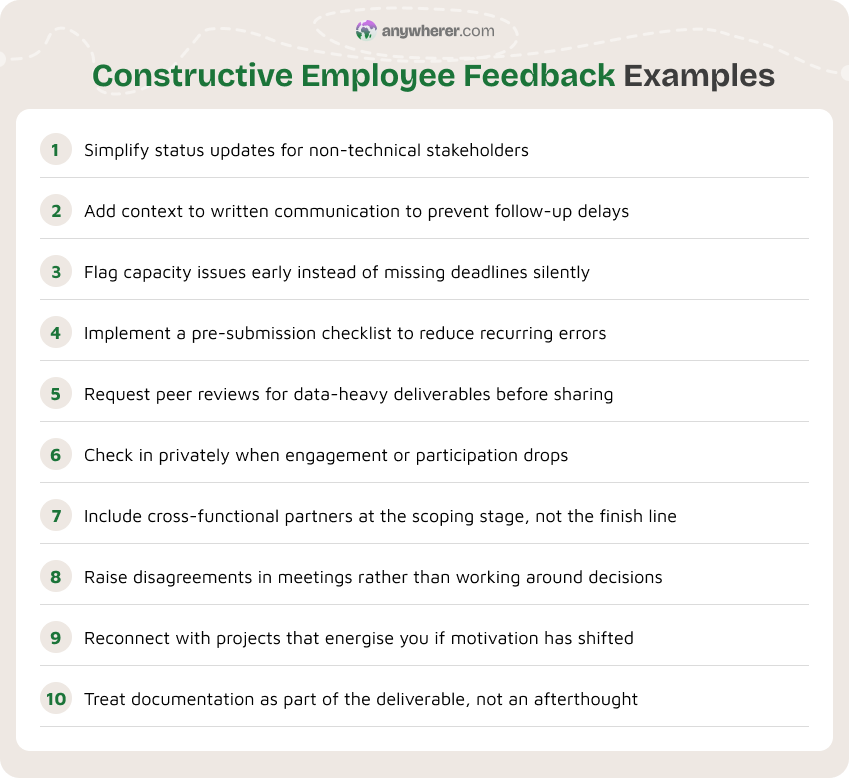
Constructive feedback addresses areas that need improvement while maintaining respect and motivation. The key is a balanced tone: acknowledge what the employee does well, state the issue clearly, and offer a path forward. These employee constructive feedback examples model that approach. If you are looking for areas of improvement for employee feedback examples, this section provides practical language you can adapt.
Communication Issues Feedback Samples
When an employee’s communication style causes misunderstandings, delays, or frustration among colleagues.
1. “Your technical knowledge is strong, but the status updates you send are often too technical for stakeholders outside engineering. Could we work on a simpler format that highlights progress and blockers in plain language?”
2. “I’ve noticed that your emails sometimes lack context, which leads to follow-up questions and delays. Adding a brief background sentence at the top would save everyone time.”
3. “During the last two sprint reviews, several team members mentioned they weren’t sure about your updates because the key takeaway was unclear. Let’s practise leading with the conclusion first.”
4. “You tend to share feedback in group channels when it would be more effective as a direct message. Some topics are better handled privately to keep the team dynamic positive.”
5. “Your verbal contributions in meetings are valuable, but they aren’t always reflected in the written follow-ups. Documenting your points ensures nothing gets lost.”
Missed Deadlines Employee Feedback Examples
When an employee consistently misses or pushes deadlines, affecting team deliverables and downstream work.
1. “The campaign assets were due on Monday, and the delay pushed the launch by three days. I know you had competing priorities, let’s discuss how to flag capacity issues earlier so we can reassign or adjust timelines.”
2. “This is the third time this quarter that the weekly report was delivered late. The data is always accurate, which I appreciate, but the team depends on receiving it by Friday morning. What’s blocking the timeline?”
3. “The feature release was delayed because the testing phase started two days late on your end. Let’s look at your workload and see if we need to redistribute tasks.”
4. “I understand unexpected issues come up, but when a deadline shifts, I need to know as soon as possible, not on the due date. Early communication gives us options.”
5. “Your work quality is consistently high, which makes the deadline issue frustrating for both of us. Let’s explore time management strategies that match your working style.”
Attention to Detail Feedback Samples
When repeated errors in data, documents, or deliverables create rework or undermine credibility.
1. “The last two client proposals contained pricing errors that the client caught before we did. Let’s implement a review checklist before anything goes out.”
2. “The data in your monthly dashboard had three discrepancies this month. Since leadership uses this for decisions, accuracy is critical. Would a peer review step help?”
3. “I noticed several formatting inconsistencies in the report you submitted. The content was solid, but presentation matters when it reaches external stakeholders.”
4. “The invoice you processed last week had the wrong billing code, which caused a delay in payment. Small errors like this add up, so let’s talk about a double-check process.”
5. “Your analysis is always insightful, but the supporting data tables often need corrections before I can share them. Spending five extra minutes reviewing formulas would eliminate most of these issues.”
Low Engagement Employee Feedback Examples
When an employee seems disengaged, participates minimally, or shows reduced enthusiasm compared to their earlier performance.
1. “I’ve noticed you’ve been quieter in team meetings over the past few weeks. Your input is valuable and I want to make sure nothing is preventing you from contributing. Is there anything I can do to help?”
2. “Your participation in the brainstorming sessions has dropped off recently. When you shared ideas earlier this year, several of them became part of our roadmap. I’d like to see that energy again.”
3. “I see that you’re completing assigned tasks but haven’t volunteered for any new initiatives this quarter. That’s a change from last quarter when you led two of them. What’s changed?”
4. “Your energy and enthusiasm were noticeably different during onboarding. I want to check in, are there challenges with the role, the team, or the workload that we should talk about?”
5. “You used to proactively share ideas for process improvement. I miss that and I think the team does too. Let’s find a way to re-engage with work that excites you.”
Collaboration Problems Feedback Samples
When an employee works too independently, resists input, or causes friction within the team.
1. “The design team mentioned they weren’t included in the feature scoping until the last minute, which limited their ability to contribute. Bringing them in earlier would improve the final output.”
2. “I’ve heard from two colleagues that sharing resources or information with you sometimes feels one-directional. Collaboration works best when it goes both ways.”
3. “When you disagree with a team decision, I’d like you to raise it in the meeting rather than working around it afterwards. The team respects your perspective, but only if they hear it directly.”
4. “Your solo work is excellent, but several projects this quarter required teamwork and the handoffs were rocky. Let’s talk about how to make those transitions smoother.”
5. “I noticed you declined the last two cross-functional workshops. Those sessions are important for alignment. Let’s discuss what’s making them feel unproductive for you so we can improve them.”
Negative Employee Feedback Examples (Handled Professionally)
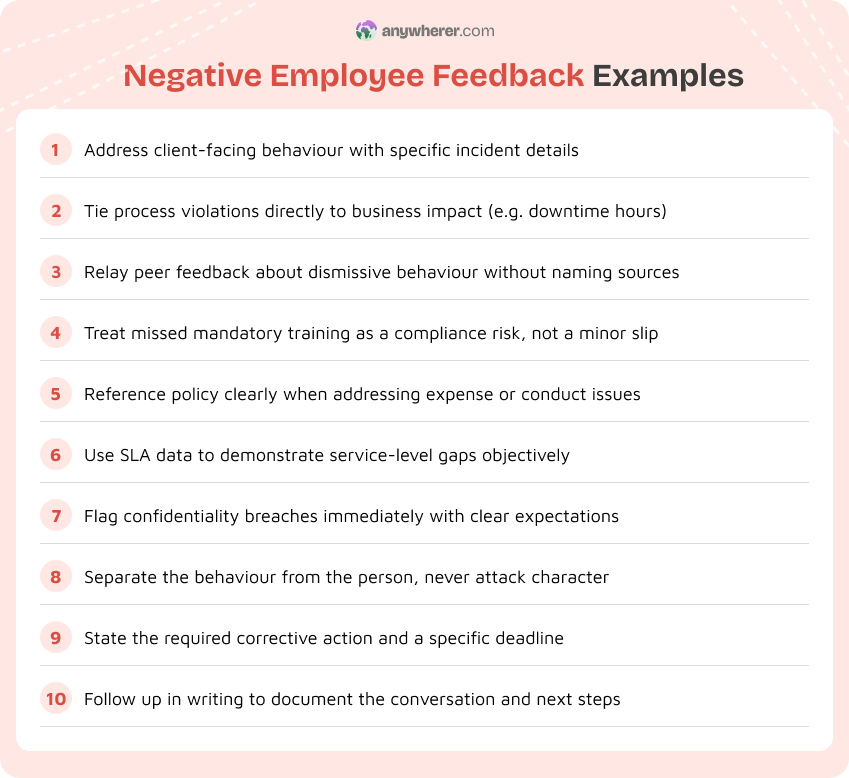
Negative feedback addresses serious performance or behaviour issues that, if left unaddressed, will harm the team or the business. The key principle: focus on behaviour and impact, never on personality. Avoid absolutes like “you always” or “you never.” These negative employee feedback examples show how to handle difficult conversations with professionalism. If you need employee negative feedback examples that avoid shaming language, use these as a starting point.
1. “During the client call on Tuesday, you interrupted the client three times, which visibly frustrated them. In future calls, I need you to let the client finish before responding, even if you already know the answer.”
2. “The error in the production deployment last week caused two hours of downtime. The root cause was skipping the staging environment. Going forward, every deployment must follow the full release checklist without exceptions.”
3. “I’ve received feedback from three team members this month about dismissive responses during code reviews. Your technical expertise is valued, but the delivery is creating friction. Let’s work on a more constructive review style.”
4. “You missed the compliance training deadline for the second consecutive quarter. This is a mandatory requirement and puts the company at risk. I need it completed by Friday, and we need to discuss why this keeps happening.”
5. “The expense report you submitted included charges that don’t align with our policy. I’m not questioning your intent, but I do need you to review the guidelines and resubmit by the end of week.”
6. “Your response time on customer escalations has averaged 48 hours this month, which is double our SLA. Customers are escalating to leadership as a result. We need to get this back to the 24-hour standard immediately.”
7. “You shared confidential project information in a public Slack channel last week. That information was meant for the leadership team only. Please be more careful about where sensitive details are discussed.”
New Employee Feedback Examples
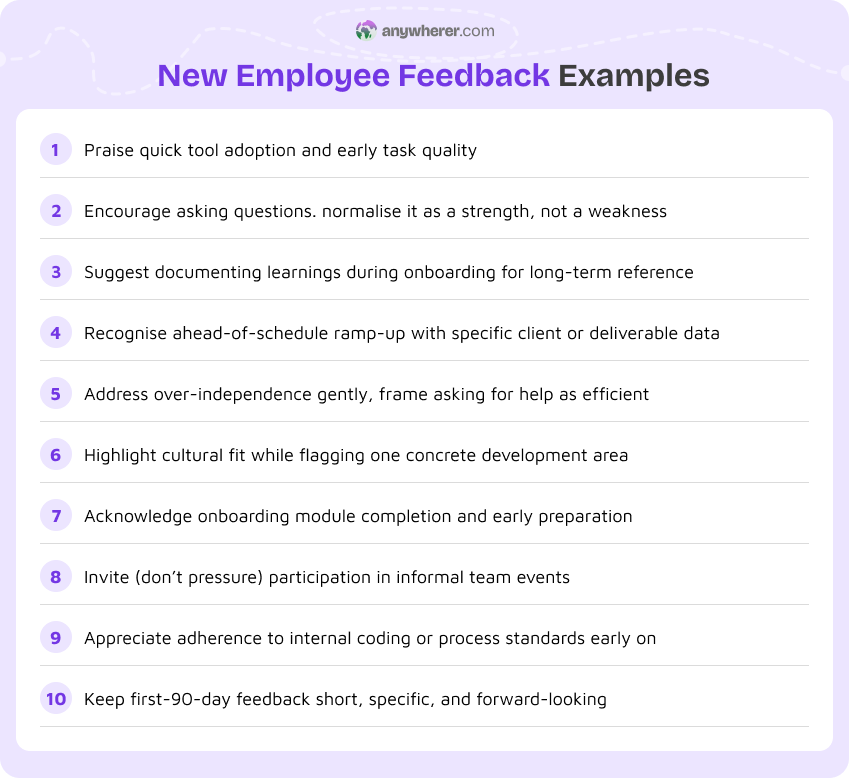
Feedback during the first 90 days shapes how new hires perceive the company, their manager, and their own potential. Early feedback should be frequent, encouraging, and specific, helping new employees understand what “good” looks like in this organisation. Below are new employee feedback examples for different onboarding stages, covering both positive recognition and developmental guidance.
First 30 Days Employee Feedback Samples
1. “You picked up our project management tool faster than anyone I’ve onboarded before. Your first task submission was well-structured and required almost no edits.”
2. “I can see you’re still getting comfortable asking questions in meetings. That’s completely normal at this stage, but please don’t hesitate. Your questions during onboarding sessions showed great critical thinking.”
3. “You’ve done a great job learning the team’s processes this month. One area to develop: try to document your learnings as you go so you can reference them later.”
First 90 Days Feedback Samples
1. “After three months, you are already handling client calls independently and the feedback from clients has been positive. That’s ahead of the typical ramp-up timeline.”
2. “Your technical skills are meeting expectations, but I’ve noticed you tend to work through problems alone for too long before asking for help. Reaching out earlier will save time and help you learn our systems faster.”
3. “You’ve adapted well to the team culture and your colleagues appreciate your collaborative approach. One thing to focus on: tightening your time estimates for tasks, they’ve been 20–30% off consistently.”
Onboarding Performance and Culture Adaptation Feedback Examples
1. “You completed all onboarding modules on time and your quiz scores were among the highest in this cohort. That preparation is already showing in your first deliverables.”
2. “I’ve noticed you haven’t joined any of the informal team events yet. They’re completely optional, but they’re a good way to build relationships outside of project work.”
3. “Your first sprint contribution was solid and you followed our coding standards closely. Great attention to our internal practices right from the start.”
Employee Review Feedback Examples (Performance Reviews)
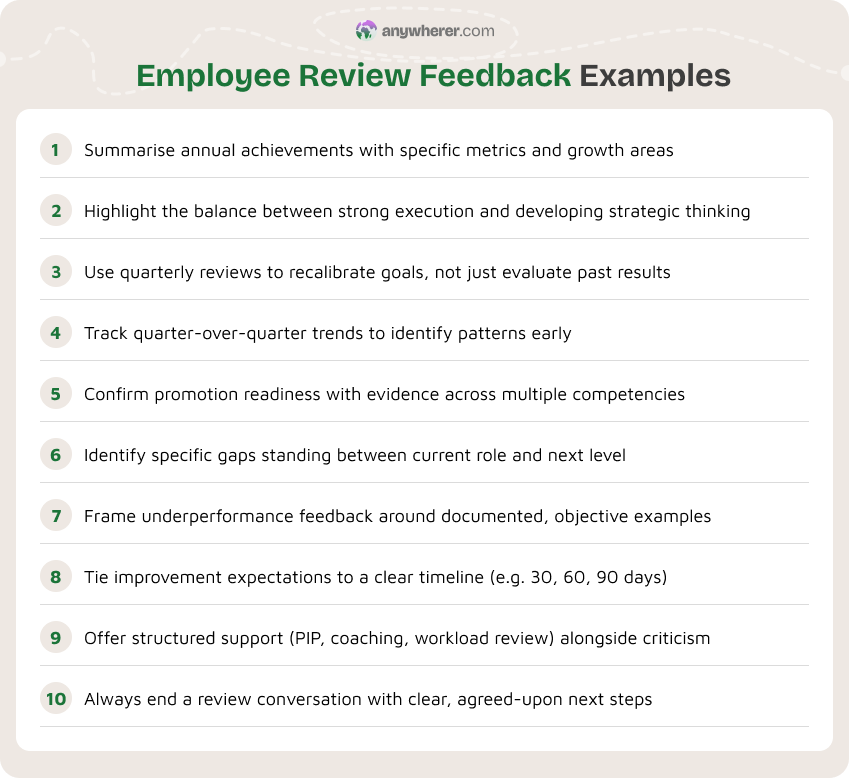
Performance reviews require feedback that is both reflective and forward-looking. The examples below are structured for different review contexts. For more detailed examples of performance appraisal formats and performance review phrases, see our dedicated guides. These employee review feedback examples and employee evaluation feedback examples will help you prepare for any review cycle.
Annual Employee Review Samples
1. “Over the past year, you consistently exceeded your quarterly targets and took on two additional projects outside your core responsibilities. Your growth this year has been impressive.”
2. “Your performance this year was strong in execution but showed room for growth in strategic thinking. I’d like to see you contribute more to planning discussions next year.”
3. “You navigated a significant team restructure this year with professionalism and adaptability. Your ability to maintain performance during uncertainty stood out.”
4. “Your technical output was above expectations, but stakeholder communication, particularly with non-technical teams, needs improvement. Let’s make that a development goal for next year.”
5. “This year you mentored two junior team members, both of whom received strong performance ratings. Your leadership impact is growing.”
Quarterly Employee Review Examples
1. “This quarter you hit all three of your key objectives. The marketing campaign you led generated 35% more qualified leads than projected.”
2. “You made solid progress on two of your three goals this quarter. The third, improving response time, still needs attention. Let’s create a specific action plan for Q3.”
3. “Your collaboration with the product team this quarter was the best it’s been. The shared planning sessions you initiated made a real difference.”
4. “This quarter showed a dip in your usual output quality. I know the workload increased, so let’s discuss whether your current project load is sustainable.”
Promotion Readiness Feedback Samples
1. “You are consistently performing at the next level. Your project leadership, stakeholder management, and ability to coach junior colleagues all demonstrate readiness for a senior role.”
2. “You have most of the competencies needed for promotion. The remaining gap is cross-functional influence, leading initiatives that involve teams outside your direct function.”
3. “Your technical expertise is already at a senior level. To be considered for promotion, I need to see more ownership of end-to-end project outcomes, including post-launch analysis.”
4. “I’m recommending you for promotion this cycle. Your consistent delivery, mentorship contributions, and initiative in improving team processes make a strong case.”
Not Meeting Expectations Feedback Examples
These employee feedback examples for improvement address situations where performance has fallen below the required standard. Feedback on employee performance examples like these should always include a clear improvement path and timeline.
1. “Over the past quarter, three of your five deliverables were either late or required significant rework. This is below the standard we agreed on. Let’s build a structured plan to get back on track within 30 days.”
2. “Your attendance and punctuality have been inconsistent for the past two months. I need to understand what’s happening and see immediate improvement.”
3. “The quality of your client reports has declined significantly this quarter. I’ve documented specific examples. Let’s review them together and agree on the expected standard going forward.”
4. “You’ve received similar feedback about time management in two consecutive reviews. At this point, this has become a formal performance concern. I’d like to create a Performance Improvement Plan with clear milestones.”
5. “Your peers have raised concerns about reliability on shared projects. I take this seriously and want to give you the opportunity to address it. Let’s discuss concrete steps this week.”
Employee Feedback Template
A reusable employee feedback template ensures consistency and completeness every time you deliver feedback. Use this structure for one-on-ones, performance reviews, or written feedback documentation. Giving employee feedback examples is easier when you follow a repeatable format.
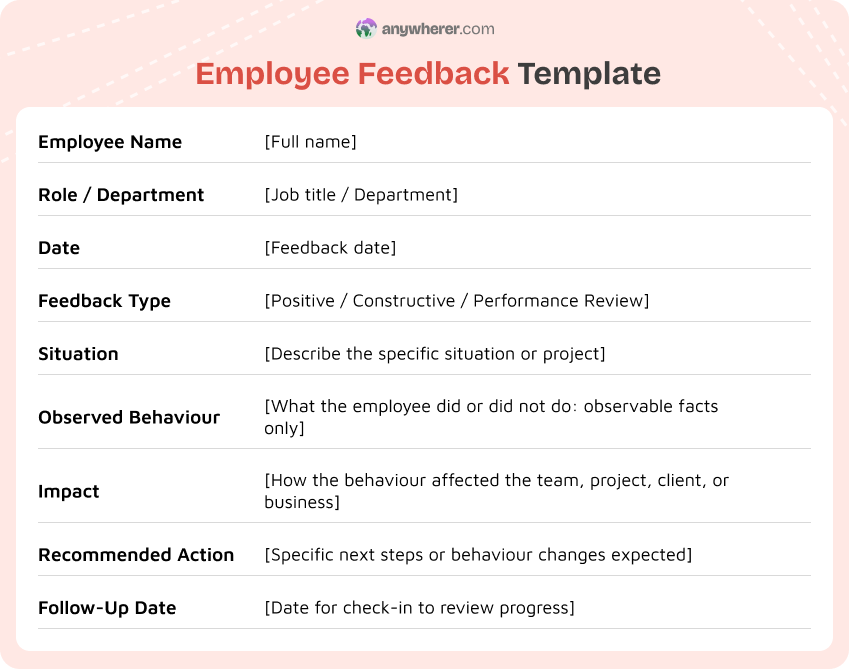
This feedback for employee examples structure works for both positive and developmental conversations. Keeping the format consistent trains managers to focus on behaviour and impact rather than vague impressions. Download this as part of your sample workforce planning documentation or adapt it into your HRIS system.
Examples of Good Employee Feedback vs Bad Feedback
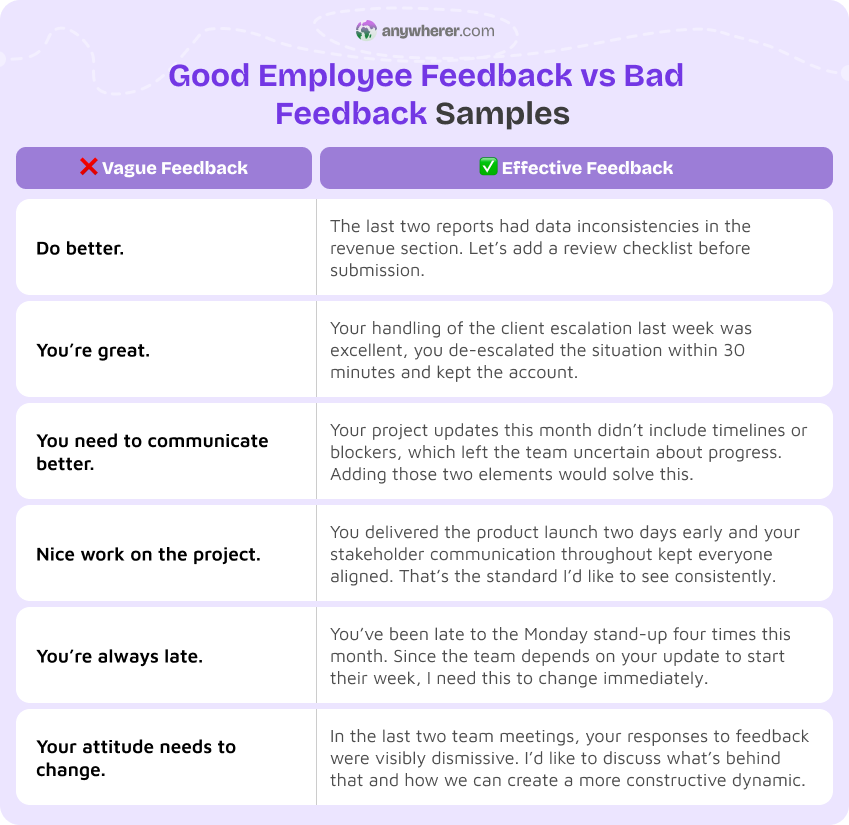
The difference between feedback that drives change and feedback that gets ignored often comes down to specificity. The table below shows good employee feedback examples alongside vague alternatives to illustrate the contrast.
FAQs on How to Give Feedback to Employee
What are some examples of positive feedback for employee conversations?
Effective positive feedback references specific behaviour and its impact. For instance: “Your detailed project plan kept the entire team aligned and we delivered on time.” Avoid generic phrases like “good job” and instead highlight what the employee did, why it mattered, and the result it produced.
How do you give constructive feedback without demotivating?
Lead with something the employee does well, then state the issue using specific examples, and close with a clear improvement path. Research from the Center for Creative Leadership supports the Situation–Behaviour–Impact model as one of the most effective frameworks for delivering feedback that motivates rather than deflates.
What is a good employee feedback template?
A strong employee feedback template includes fields for employee name, date, feedback type, the specific situation, the observed behaviour, the impact, a recommended action, and a follow-up date. This structure forces clarity and ensures nothing important is skipped.
How often should managers give feedback?
At minimum, managers should provide structured feedback during quarterly reviews. However, the most effective managers give informal feedback weekly: brief, specific comments after meetings, project milestones, or notable contributions. The goal is continuous dialogue, not periodic surprises.
How do you give feedback to underperforming employees?
Use documented, specific examples of where performance fell short. Focus on behaviour and measurable outcomes, not personality. Present a clear improvement plan with milestones and a review date. Offering support: coaching, workload adjustment, or additional resources, alongside accountability shows that you are invested in the employee’s success, not just the outcome.

Yaryna is our lead writer with over 8 years of experience in crafting clear, compelling, and insightful content. Specializing in global employment and EOR solutions, she simplifies complex concepts to help businesses expand their remote teams with confidence. With a strong background working alongside diverse product and software teams, Yaryna brings a tech-savvy perspective to her writing, delivering both in-depth analysis and valuable insights.