Getting worker classification wrong in 2026 is more expensive than ever. Governments worldwide have tightened enforcement, with the IRS, HMRC, and EU regulators all increasing audits on businesses that blur the line between employees and independent contractors. The rise of remote and global hiring has made the issue even more complex. A worker classified as a contractor in one jurisdiction may legally qualify as an employee in another.
The financial and legal risks of misclassification are significant: back taxes, unpaid benefits, penalties, and in some jurisdictions, criminal liability. Yet the difference between contractor and employee is not always obvious, especially when contractors work full-time hours or integrate deeply into a team.
This guide provides a structured contractor vs employee checklist you can apply to any contracting vs employment arrangement. It covers six classification categories, practical scenarios, and the key questions every hiring manager should ask before engaging a worker.
Why Contractor vs Employee Classification Matters
Correct classification determines how a worker is taxed, what benefits they receive, and which labour laws apply. According to the U.S. Department of Labor, misclassification denies workers minimum wage protections, overtime pay, and unemployment insurance. For businesses, the consequences are equally serious.
- Tax implications: Employers withhold income tax and pay payroll taxes for employees. Independent contractor taxes vs employee obligations differ substantially: contractors handle their own tax filings and payments.
- Benefits eligibility: Employees may be entitled to health insurance, paid leave, and pension contributions. Contractors are not.
- Labour law protections: Employment law covers minimum wage, working hours, and termination notice. Contractors fall outside most of these frameworks.
- Liability risks: Misclassified workers can file claims for unpaid benefits, overtime, and wrongful termination.
- Penalties: The IRS can impose penalties of up to 100% of the tax that should have been withheld. EU countries impose similar fines, and repeated violations can trigger criminal investigations.
A clear employee vs contractor checklist protects the business from these risks while ensuring workers receive the protections they are legally entitled to.
Contractor vs Employee Checklist
No single factor determines classification. Tax authorities evaluate the overall relationship across multiple criteria. Use this employee vs independent contractor checklist to assess each dimension.
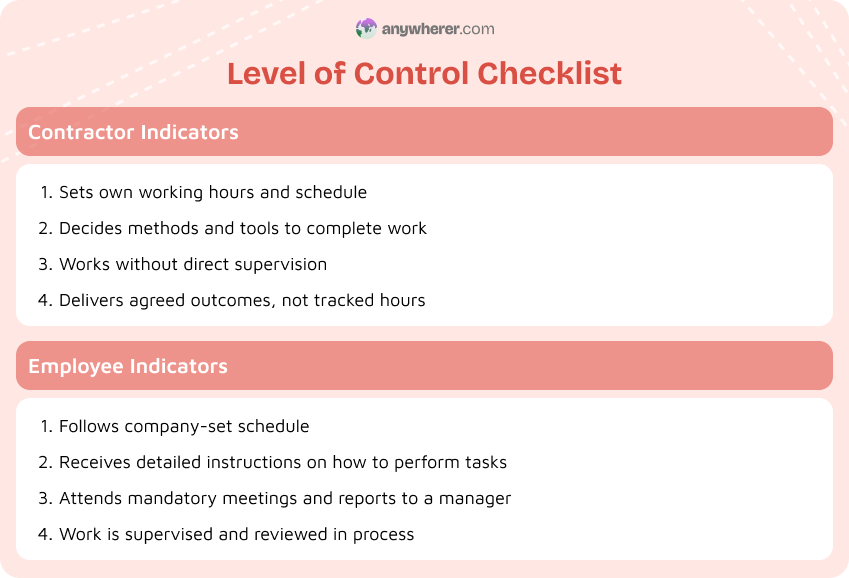
Level of Control Checklist Sample
Control is the single most important factor in any independent contractor vs employee checklist. It examines who dictates how, when, and where work is performed.
- Who sets working hours? Employees typically follow a set schedule. Contractors choose when they work.
- Who determines how work is performed? Employees receive detailed instructions and supervision. Contractors are hired for results, not methods.
- Is there direct supervision? Regular check-ins, mandatory meetings, and performance monitoring suggest an employment relationship.
Risk note: if you dictate working hours, require daily stand-ups, and approve every task, the worker is likely an employee regardless of what the contract says.
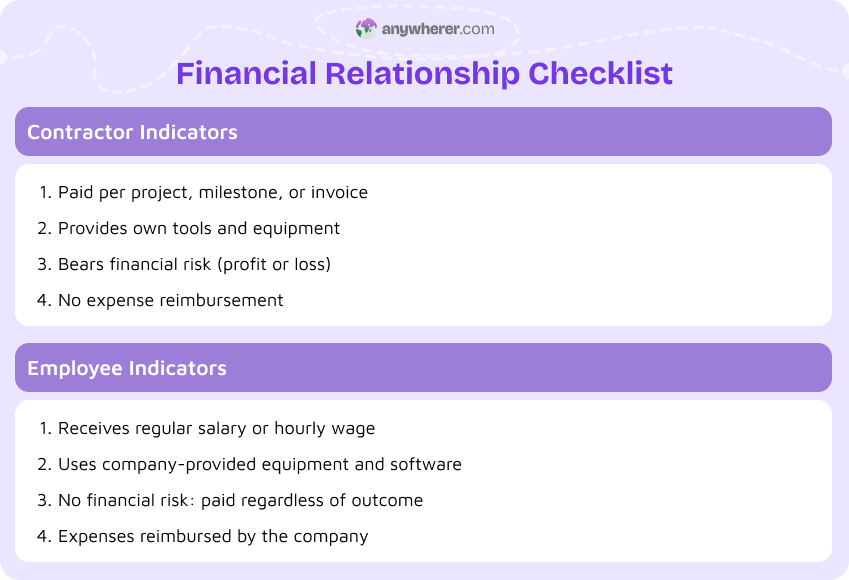
Financial Relationship Checklist Example
How do you pay independent contractors versus employees? The payment structure reveals the nature of the relationship. Employees receive regular wages; contractors are typically paid per project or invoice.
- Payment structure: Salary or hourly wage with regular pay cycles indicates employment. Per-project or invoice-based payment indicates contracting.
- Expense reimbursement: Companies that reimburse expenses (travel, meals, software) are treating the worker more like an employee.
- Equipment investment: Contractors supply their own tools and software. Employees use company-provided equipment.
- Opportunity for profit or loss: Contractors can profit by working efficiently or lose money on fixed-price projects. Employees earn the same regardless.
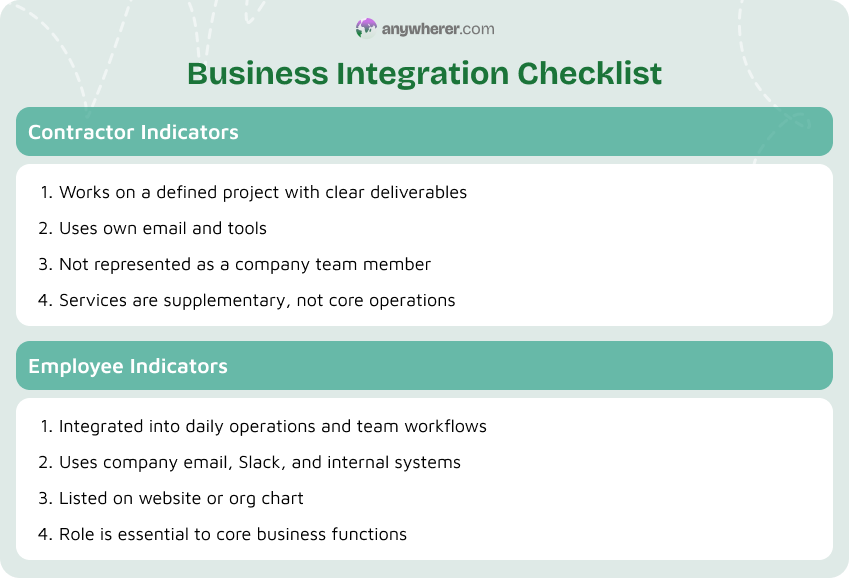
Integration into Business Checklist
The more deeply a worker is integrated into the organisation, the more likely they are an employee. This factor looks at whether the role is core to daily operations or a supplementary service.
- Is the role core to business operations? A developer building your main product is more integrated than a freelancer designing a one-off marketing brochure.
- Does the worker use a company email address, appear on the org chart, or attend all-hands meetings?
- Is the worker represented publicly as part of the company: on the website, in client communications, or at events?
Risk note: giving a contractor a company email, a title, and a seat in the office creates strong evidence of an employment relationship.
Duration and Exclusivity Checklist Sample
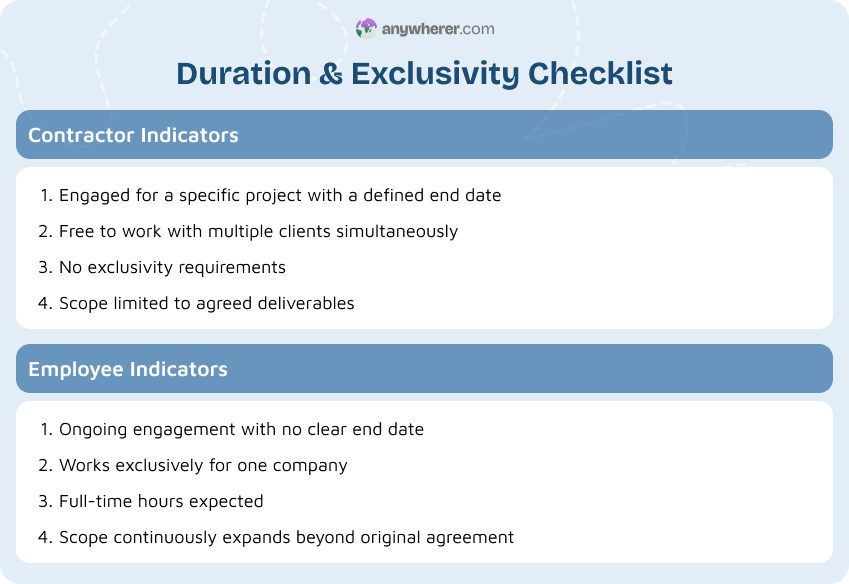
The length and exclusivity of the engagement are strong signals. The definition of independent contractor vs employee often hinges on whether the relationship is project-based or ongoing.
- Long-term ongoing work with no defined end date suggests employment.
- Exclusivity clauses that prevent the worker from serving other clients point toward employee status.
- Full-time engagement: a contractor working 40 hours per week for one client looks like an employee to regulators.
Benefits and Legal Protections Checklist
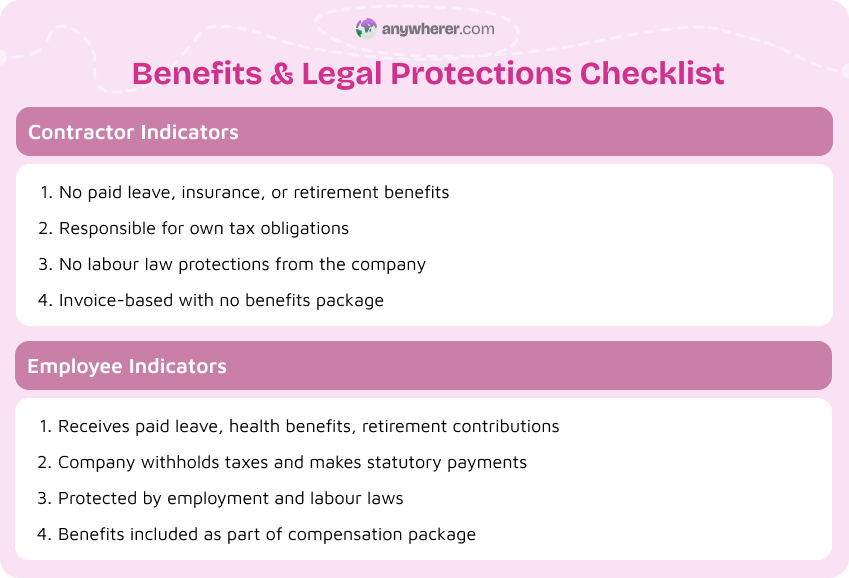
The employee contractor distinction is reinforced by whether the company provides statutory benefits. Offering employee-level benefits to a contractor undermines the classification.
- Paid leave: Vacation, sick days, and public holidays are employee entitlements. Contractors manage their own time off.
- Health benefits: Providing health insurance or wellness stipends signals an employment relationship.
- Retirement contributions: Pension or 401(k) matching is an employer obligation for employees.
- Labour law coverage: Employees are protected by wrongful termination, minimum wage, and anti-discrimination laws.
Location and Work Setup Checklist
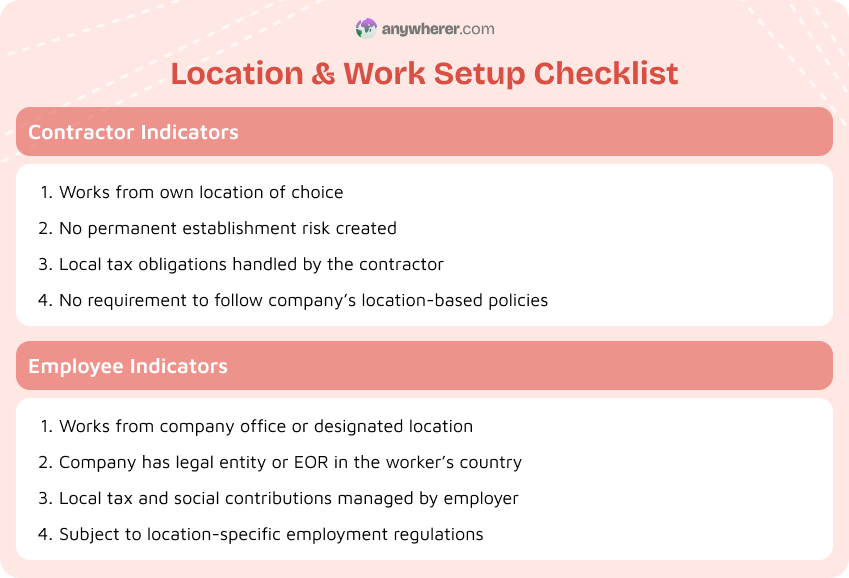
This category is especially relevant for remote and global teams. Cross-border engagements introduce additional classification risks because local labour laws may override the terms of the contract. Companies hiring internationally should pair this employee vs. contractor checklist with a remote work policy template and a workforce planning template to ensure full compliance.
- Cross-border tax implications: A contractor in another country may trigger permanent establishment risk or local tax obligations for the hiring company.
- Local labour law exposure: Some jurisdictions (e.g. Spain, the Netherlands) have strict rules that reclassify contractors as employees if certain conditions are met.
- Employer of Record involvement: Using an EOR to employ a worker in another country eliminates misclassification risk but requires treating the worker as an employee.
Risk note: according to OECD guidelines, cross-border contractor arrangements are among the highest-risk areas for misclassification enforcement in 2026.
Contractor vs Employee: Practical Scenarios
Theory is useful, but classification decisions happen in context. Here are four common scenarios that illustrate how the checklist applies in practice.
Scenario 1: Freelance designer hired for 3 months
A company hires a freelance designer for a product launch. The designer works from home, uses own software, invoices monthly, and serves two other clients.
Classification: Contractor.
Project-based engagement, own schedule and tools, no exclusivity. All six checklist categories point toward the contractor.
Scenario 2: Full-time remote developer engaged for 2 years
A company engages a “contractor” developer who works 40 hours per week, attends daily stand-ups, uses a company laptop and email, and works exclusively for this client. The contract has been renewed three times.
Classification: Likely employee.
Despite the contract label, the level of control, integration, exclusivity, and duration all indicate employment. This is a classic employee versus contractor misclassification risk where the contract versus employee reality does not match.
Scenario 3: Cross-border contractor in another country
A UK company hires a marketing consultant based in Spain to run paid advertising campaigns. The consultant works independently and uses their own tools, but works exclusively for this client for 18 months.
Classification: High risk.
Under Spanish labour law, exclusivity plus long duration can trigger automatic reclassification. The UK company should formalise employment through a local entity or EOR, or remove exclusivity.
Scenario 4: Sales rep working exclusively for one company
A sales representative signs a contractor agreement but works exclusively for one company, follows a company playbook, uses company CRM and email, and receives a monthly retainer plus commission.
Classification: Likely employee.
The control (playbook, CRM), integration (email, team), exclusivity, and payment structure (retainer) all signal employment. This is a high-risk arrangement that should be reviewed using the full independent contractor vs employee checklist.
FAQs on Contractor vs Employee Checklist
What is the difference between a contractor and an employee?
An employee works under the company’s control, following set hours, using company tools, and receiving benefits. A contractor operates independently, controls how work is done, provides their own tools, and is paid per project or invoice.
How do you determine worker classification?
Apply the six-factor employee vs independent contractor checklist above: level of control, financial relationship, business integration, duration and exclusivity, benefits, and location. No single factor is decisive, the overall picture determines classification.
What happens if you misclassify a worker?
The company may owe back taxes, unpaid benefits, overtime, and statutory penalties. In the U.S., IRS penalties can reach 100% of unpaid taxes. EU countries impose similar fines plus mandatory reclassification.
Can a contractor work full-time?
Technically yes, but full-time hours plus exclusivity and company control creates serious misclassification risk. Most jurisdictions treat a contractor working 40 hours per week for one client long-term as an employee.
Is a remote worker automatically a contractor?
No. Work location does not determine classification. A remote worker who follows a company schedule, uses company tools, and works exclusively for one employer is an employee, regardless of where they sit.
Does location affect worker classification?
Yes. Each country has its own classification rules. A worker classified as a contractor under U.S. rules may be legally an employee under EU or UK law. Cross-border engagements require country-specific review.
What are IRS guidelines for contractors vs employees?
The IRS uses a three-factor test: behavioural control (how work is done), financial control (payment and expenses), and relationship type (contracts, benefits, permanence). All three are weighed together.

Yaryna is our lead writer with over 8 years of experience in crafting clear, compelling, and insightful content. Specializing in global employment and EOR solutions, she simplifies complex concepts to help businesses expand their remote teams with confidence. With a strong background working alongside diverse product and software teams, Yaryna brings a tech-savvy perspective to her writing, delivering both in-depth analysis and valuable insights.