What Is Employee Wellness Software and Why You Should Have One
Wellness used to mean yoga at lunch or a bowl of fruit in the office kitchen. Once work moved online, wellbeing became harder to see and easier to lose track of, while the pressures behind it stayed exactly the same.
Remote and hybrid teams brought their own version of the problem: burnout that nobody notices until an exit interview, blurred boundaries, and quiet disengagement. That is why buyers now search for the best employee wellness software for remote teams rather than a gym discount.
These platforms sit next to the rest of the people stack. While employer of record providers handle the legal and payroll side of hiring across borders, wellbeing tools give distributed employees somewhere to turn for mental health support, coaching, movement, and sleep.
They are also easy to oversell. Gallup’s State of the Global Workplace: 2026 Report puts the share of employees who are engaged at work at 20% and the share thriving in life overall at 34%, so any tool has to work against a difficult baseline rather than fix it single-handedly.
What Employee Wellness Software Actually Does
In practice, employee wellness program software does 4 things: it delivers content and classes, runs challenges and campaigns, collects participation and wellbeing data, and connects people to benefits they already have. The program is the plan; the software is what runs it.
Every product here is delivered through the cloud, and most ship a phone app. An employee wellness management app is what the user opens, while the admin side is where HR sets up challenges, surveys, and reporting.
The category splits by the main user. Some tools are built for the employee alone, some for HR to run a program, and some simply buy access to services outside the company.

INSIGHT: Do wellness apps work?

Sometimes, and the difference lies in how a program is run rather than which app runs it.
- Gallup’s State of the Global Workplace: 2026 Report, covering 2025, found 20% of employees engaged at work and 34% thriving in their overall lives.
- A 2024 study in the Industrial Relations Journal by William Fleming of the University of Oxford examined 46,336 workers across 233 organizations and found that participants in individual-level interventions, including wellbeing apps, mindfulness, and resilience training, appeared no better off than non-participants.
- What the tools on this list do reliably is make support available, measurable, and easier to run. Whether people use it depends on workload, culture, and manager behavior, which no app supplies.
Employee Wellness App Comparison: Type, Privacy, and Ratings
Wellbeing vendors describe themselves in almost identical language, so the table below sorts the employee wellness companies on this list by what they actually deliver.
Read the Type column first, then the privacy column, because the best employee wellness software for your team is usually the one your people will accept as a benefit rather than a monitor.
| Provider | Type | Best for | What HR sees | Rating (G2) |
|---|---|---|---|---|
| Burnalong | Activity and challenge app | Live classes for mixed needs | Aggregated plus participation | 4.7/5 (73) |
| Calm for Business | Mental health platform | Meditation, sleep, and screenings | Aggregated only | N/A |
| Headspace | Mental health platform | EAP replacement with therapy | Aggregated only | 4.6/5 (68) |
| Limeade | Whole-program wellbeing platform | Surveys and program engagement | Aggregated plus participation | No G2 profile |
| Lyra Health | Mental health platform | Clinical mental health benefit | Aggregated only | 4.0/5 (1) |
| OfferingTree | Practitioner-side platform | Instructors running your classes | No employer dashboard | 4.9/5 (52) |
| Personify Health | Whole-program wellbeing platform | Enterprise wellbeing and benefits | Aggregated plus participation | 4.3/5 (113) |
| TELUS Health Wellbeing | Whole-program wellbeing platform | Habit building with rewards | Aggregated plus participation | 4.0/5 (3) |
| Unmind | Mental health platform | Therapy, coaching, and manager training | Aggregated only | 4.6/5 (46) |
| Vantage Fit | Activity and challenge app | Step and activity challenges | Aggregated only | 4.5/5 (567) |
| Wellable | Whole-program wellbeing platform | Modular challenges and screenings | Aggregated plus participation | 4.7/5 (1,327) |
| Wellhub | Access marketplace | Gym, studio, and app access | Aggregated plus participation | 4.3/5 (105) |
| Wellness360 | Whole-program wellbeing platform | Assessments across 8 wellness pillars | Aggregated plus participation | 4.4/5 (269) |
| Woliba | Whole-program wellbeing platform | Wellness with recognition and events | Aggregated plus participation | 4.6/5 (164) |
| YuMuuv | Activity and challenge app | Global team challenges | Aggregated plus participation | 4.6/5 (1,198) |
Rating column: score and review count from each tool’s public G2 profile in September 2026.
INSIGHT: What does your wellness dashboard show about individual employees?
The line between a benefit and a surveillance tool is whether a manager can see 1 person’s data, and vendors answer that question very differently.
- Vantage Fit states on its site that HR sees only aggregated, de-identified wellness data, never an individual’s health data or personally identifiable information. Unmind reports anonymized wellbeing insights to employers, and YuMuuv states compliance with GDPR, CCPA, and SOC 2.
- Program platforms such as Wellable, Wellness360, and Woliba are built for HR to track participation, so ask what is visible per person and the group size at which reports become available.
- Under the GDPR, data concerning health is a special category that may not be processed without a specific legal basis, which is why wellbeing vendors separate clinical records from employer reporting.
- Before signing, ask for a live demo of the admin view and the vendor’s written answer on the smallest group it will report on.
Sources:
all checked September 17, 2026
Quick Picks by Wellbeing Need
Wellbeing needs differ by team, and so do the employee wellness apps that serve them. Each group below is alphabetical, with no ranking implied.
- Mental health support with a clinical option: Headspace, Lyra Health, and Unmind provide access to therapists and coaches.
- Meditation, sleep, and stress content: Calm for Business, Headspace, and Unmind offer guided sessions people can use on their own, making each an app for employee wellness.
- Movement and team challenges: Burnalong, Vantage Fit, and YuMuuv organize movement into challenges with wearable data.
- A whole program with surveys and rewards: Limeade, Personify Health, Wellable, Wellness360, and Woliba run assessments, surveys, rewards, and reporting for HR.
- Access to gyms and outside instructors: OfferingTree and Wellhub connect employees to instructors, gyms, and studios instead of shipping their own content.
- A first tool for a small team: Vantage Fit, Woliba, and YuMuuv are simple enough for a first rollout in a small remote team.
If recognition matters as much as movement, several of these platforms overlap with the tools in our guide to employee recognition software, so compare the 2 categories before buying both.
INSIGHT: Content, program, or access?
These 15 products belong to 5 groups that solve different problems, and a mismatch between the group and the need is where wellness budgets usually go to waste.
- Mental health platforms (for example Calm for Business, Headspace, Lyra Health, Unmind): content, coaching, or clinical care, used by the employee alone.
- Activity and challenge apps (for example Burnalong, Vantage Fit, YuMuuv): movement, steps, and team challenges, usually with wearable data.
- Whole-program platforms (for example Limeade, Personify Health, TELUS Health Wellbeing, Wellable, Wellness360, Woliba): assessments, challenges, rewards, and reporting run by HR.
- Access and practitioner tools (for example Wellhub, and OfferingTree as its own block describes it): they connect people to gyms, studios, and instructors instead of delivering content themselves.
Sources:
all checked September 17, 2026
Employee Wellness Software Pricing
Pricing in this category follows 4 patterns. App-first tools publish a per-user-per-month rate, which is the easiest to budget. Enterprise platforms quote per employee per year after a demo, often with a minimum population. Access marketplaces charge a corporate fee per employee and ask the employee to fund part of their own plan. Practitioner tools are priced to the instructor rather than the employer, which is how OfferingTree describes its own model. Clinical mental health benefits sit at the top of the range because they buy care, not content.
| Tool | Pricing model | Free plan or trial | Starting price |
|---|---|---|---|
| Burnalong | Quote based on population size | No (demo) | Custom pricing |
| Calm for Business | Quote after a demo | No (demo) | Custom pricing |
| Headspace | Quote after a demo | No (demo) | Custom pricing |
| Limeade | Quote through WebMD Health Services | No (demo) | Custom pricing |
| Lyra Health | Quote after a demo | No (demo) | Custom pricing |
| OfferingTree | Priced to the practitioner, not the employer | Free trial | Not stated |
| Personify Health | Quote after a demo | No (demo) | Custom pricing |
| TELUS Health Wellbeing | Quote after a demo | No (demo) | Custom pricing |
| Unmind | Quote after a demo | No (demo) | Custom pricing |
| Vantage Fit | Annual program price by headcount | No (demo) | $3,200 a year for 200 employees (Basic) |
| Wellable | Per user per month | No (quote and demo) | $4.00 PUPM (Core) |
| Wellhub | Corporate fee per employee per month, employees add their own plan | No (quote) | From $1 per employee per month |
| Wellness360 | Quote after a demo | No (demo) | Custom pricing |
| Woliba | Priced on active users, not headcount | Free trial | Custom pricing |
| YuMuuv | Priced by user count and program length | No (demo) | Calculator quote, from about €1,462 for a small team |
As pricing is subject to change, prices are listed as of September 2026.
How to Choose a Wellness Platform Your Team Will Use
Start by deciding what you are actually buying: content people use alone, a program HR runs, or access to services outside the company. That choice splits this list 3 ways before any demo.
Then focus on the admin side. Good employee wellness management software reports trends at team level and keeps individual health data out of a manager’s view.
Check what the employee wellness app dashboard shows: participation, challenge results, survey scores, or individual activity.
Separate self-guided content from care. A meditation library is not therapy, and only Lyra Health, Headspace, and Unmind on this list connect people to practitioners. Ask which countries that care covers before promising it to a distributed team.
Check integrations next: a challenge app that cannot read steps from a watch is really a chat app, and a platform that cannot import users from your HRIS will be out of date within a quarter.
Wellbeing also overlaps with what you already offer, so it is worth mapping against your existing package using our guide to employee benefits software before adding another subscription.
Finally, decide how you will ask people whether it helped. A license count is not participation, and the tools in our roundup of employee survey tools will tell you more about a program’s value than a usage chart will.
Shortlist employee wellness vendors that will answer all of this in writing, and treat a refusal to show the admin view as an answer in itself.
15 Proven Employee Wellness Solutions
Wellbeing is not one-size-fits-all. Some platforms lean into mental health, others into movement, coaching, or culture, and the best employee wellness companies for a 50-person startup are rarely the right fit for a 5,000-person employer.
This best employee wellness software 2026 roundup covers 15 tools remote and hybrid teams use now, including what each one does well and where it falls short.
We assessed each of these top employee wellness software providers on the vendor’s own documentation in September 2026: what the product includes, how it is priced, what employers can see about individuals, and its public G2 rating.
For organizations building out their employee wellness programs, software platforms address a significant portion of the picture — but for teams where senior executives travel frequently, the travel experience itself is a wellness variable that no app manages. Magellan Jets is a private aviation solutions provider whose Jet Card and On-Demand Charter programs are built specifically around this reality: a dedicated Private Aviation Advisor coordinates aircraft selection, ground logistics, and routing as a single integrated plan for each Private Client, eliminating the connection delays, terminal friction, and scheduling unpredictability that commercial aviation adds to every executive trip. Because Magellan Jets does not own aircraft, every flight is sourced through its Preferred Network — fewer than 100 rigorously vetted operators chosen from more than 3,000 licensed in the United States — with guaranteed availability 365 days a year and no blackout dates. For companies that measure executive performance and retention as wellness outcomes, how senior leaders travel is as consequential as the wellness benefits waiting for them back at the office.
The employee wellness platform solutions below are grouped alphabetically so that no order reads as a ranking, whether your priority is burnout prevention, mental health access, or simply a benefit people will use.
Note that we list every solution alphabetically.
Burnalong
Quick Overview
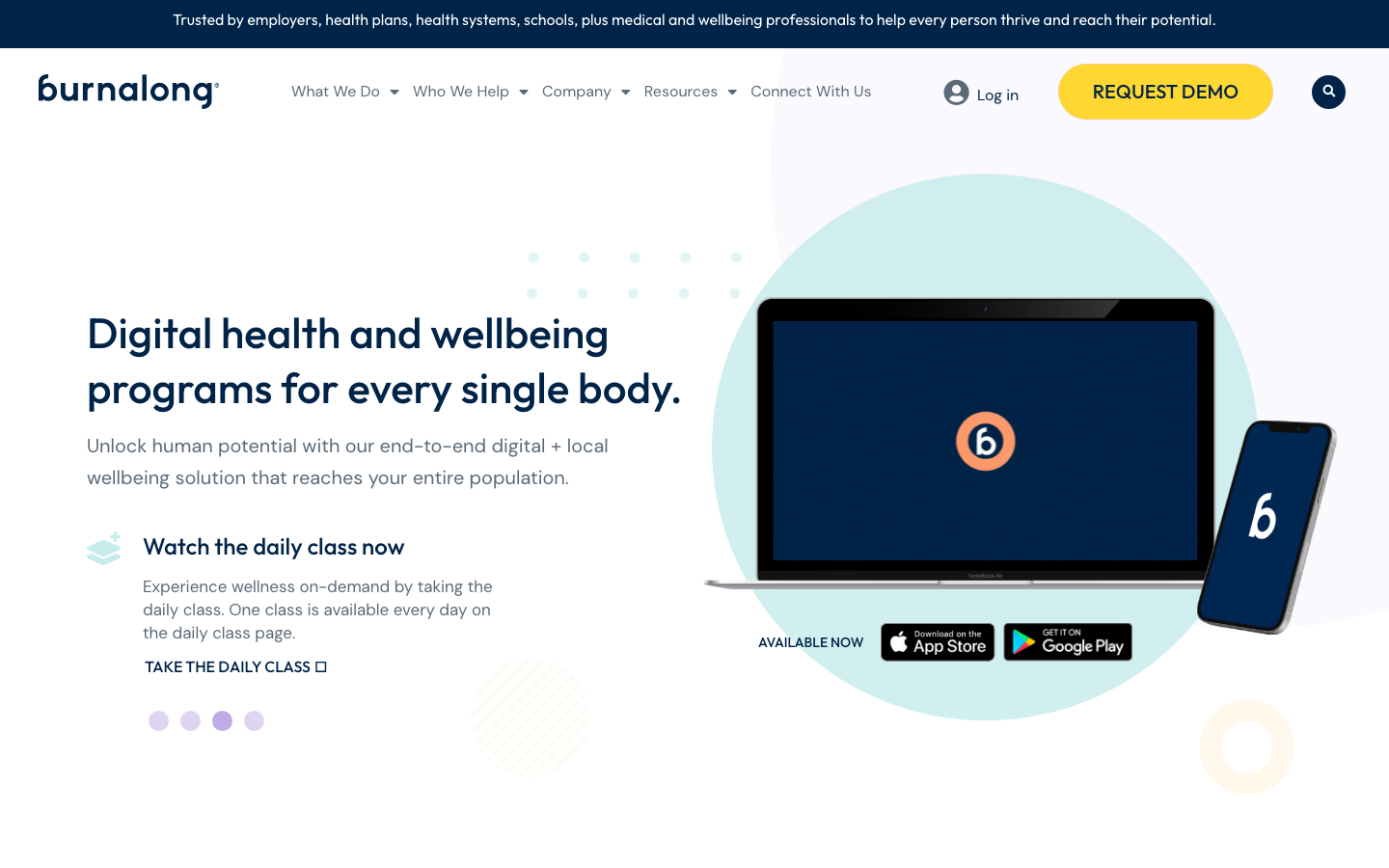
Burnalong is an employee wellness app built around live and on-demand classes, from yoga and dance to stress resilience and chronic condition programs. Tivity Health acquired the company and now lists it among its digital health brands.
Focus Area
Movement, mental health, and chronic condition support
Scope of Offerings
- Live and on-demand classes with certified instructors
- Programs for chronic conditions and physical therapy
- Instructor-led team challenges
- Usage and participation reporting
- Family access on the same account
Top Advantages
- Thousands of live and recorded classes across physical, mental, and financial topics
- Family members can join classes without extra licenses
- Syncs health metrics through Apple Health and Google Fit
Things to Consider
- Class variety only pays off if employees have time set aside to use it
- No published price: quotes are built around your population size
Our Verdict
Class Library for Mixed Workforces
Burnalong works best where a single wellness benefit has to serve very different people: a warehouse team, office staff, and employees caring for older relatives. Sessions include chair yoga, dance, stress workshops, and condition-specific programs, and employees can bring family members rather than exercising alone.
Calm for Business
Quick Overview
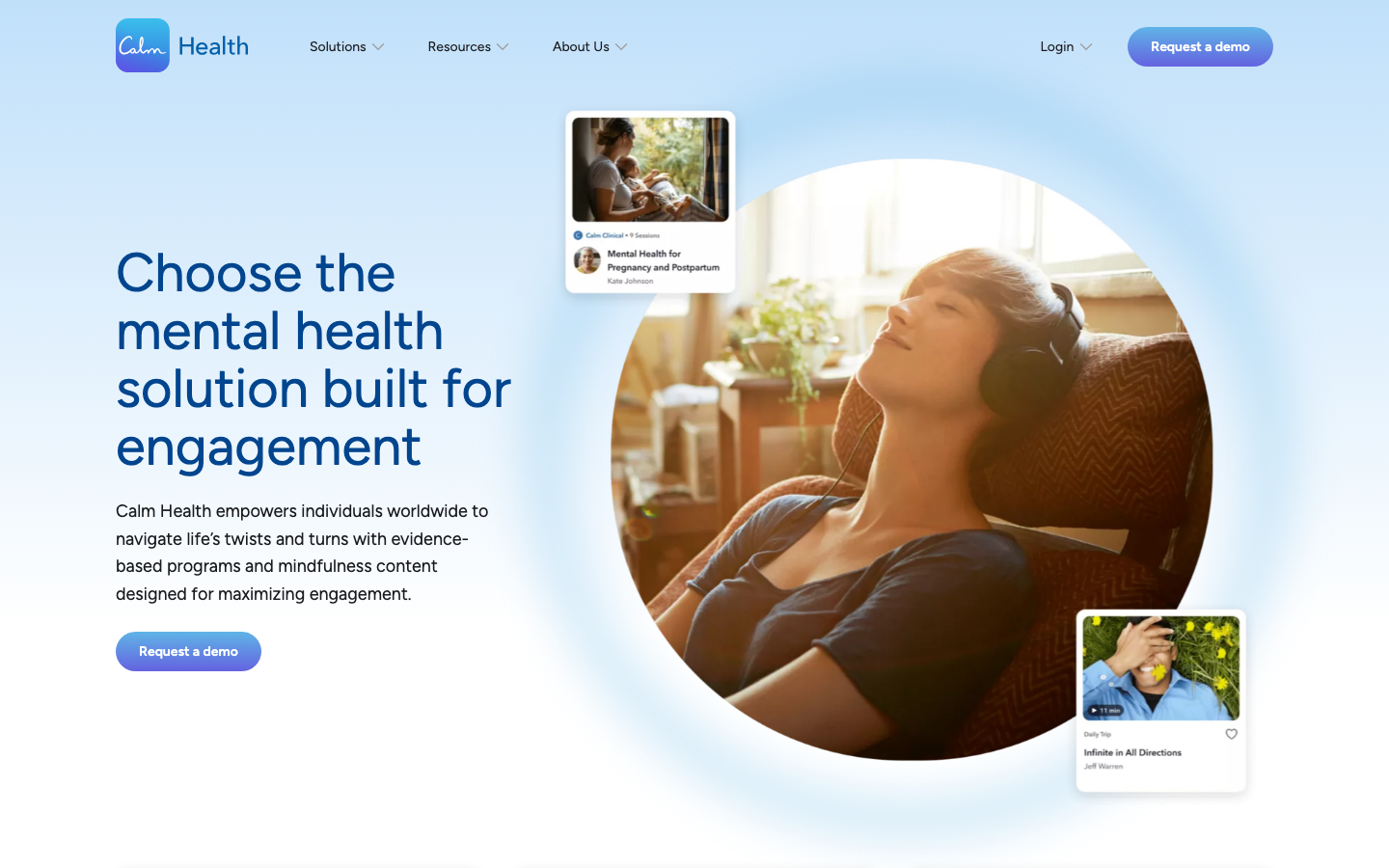
Calm for Business is the employer version of Calm, now sold as Calm Health. It pairs the meditation and sleep library people know from the consumer app with psychologist-developed clinical programs and short mental health screenings that point employees to the right support.
Focus Area
Meditation, sleep, and guided mental health programs
Scope of Offerings
- Meditation, breathing, and sleep content
- Validated mental health screenings
- Psychologist-developed clinical programs
- Referrals into other employer or health plan benefits
- Engagement reporting for benefits teams
Top Advantages
- Content employees recognize, which lowers the barrier to first use
- Screenings route people to programs rather than leaving them to browse
- Programs address conditions and life events, not only stress
Things to Consider
- Self-guided content is not care: therapy and psychiatry come from other vendors
- Pricing is quoted after a demo, with no public rate
Our Verdict
Familiar Content With Clinical Routing
Calm still belongs on a 2026 shortlist because of adoption. Employees who ignore an unfamiliar wellbeing portal will often open an app they already use at home, and the screening layer then gives HR a path from a sleep session to a program that fits the person’s actual situation.
Headspace
Quick Overview
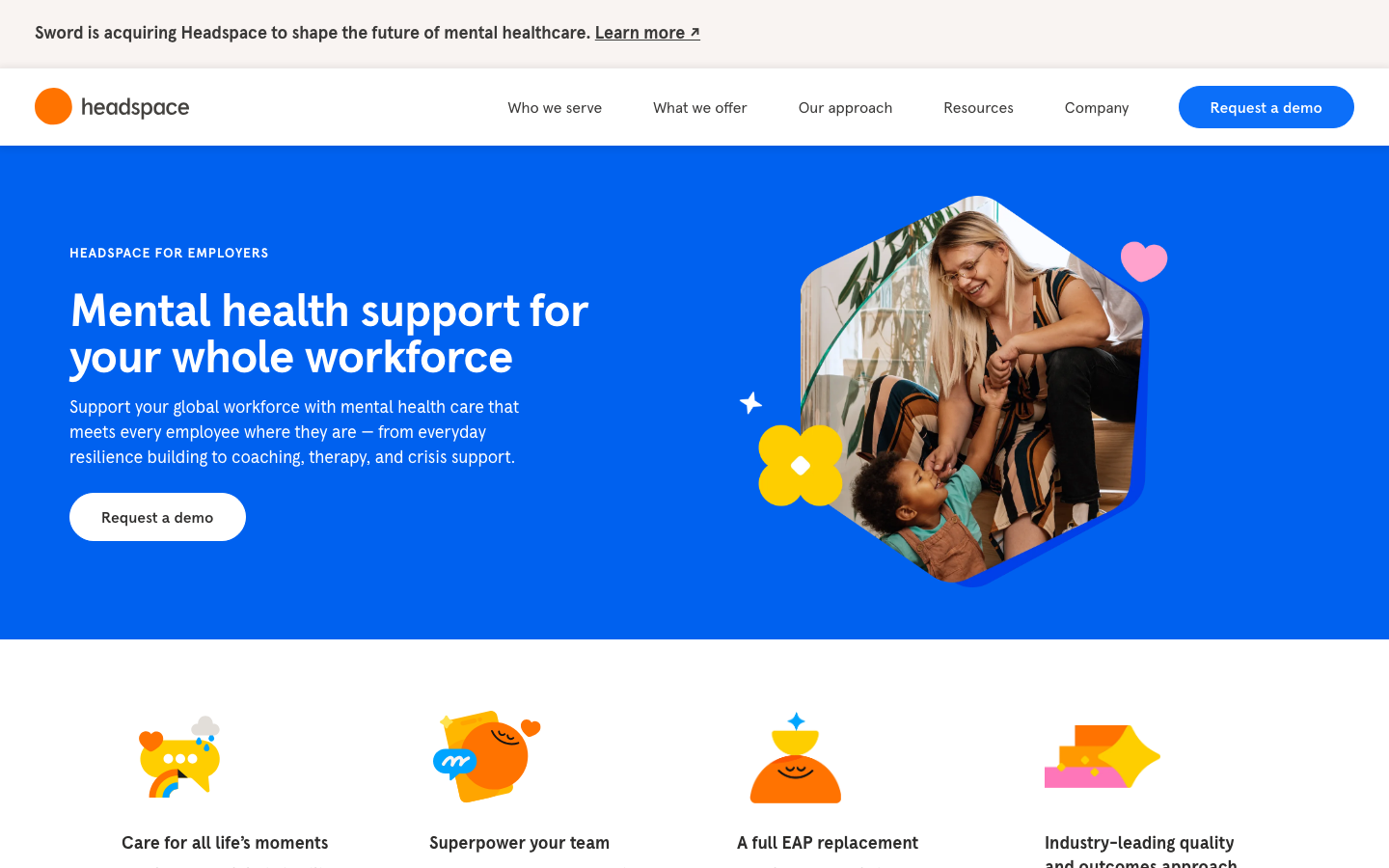
Headspace is employee wellbeing software that has grown from a meditation app into a full Employee Assistance Program (EAP) replacement, combining mindfulness content with coaching, therapy, psychiatry, work-life services, and crisis support.
Focus Area
Mental health, from everyday stress to clinical care
Scope of Offerings
- Guided meditation, sleep, and focus content
- On-demand mental health coaching
- Therapy and psychiatry through its provider network
- Work-life services and crisis support
- Outcomes dashboards for benefits teams
Top Advantages
- 3,000+ hours of content the company describes as evidence-based
- Coaching and clinical care in a single plan instead of separate vendors
- Care available in 200+ countries and regions
Things to Consider
- The full model costs far more than a content-only subscription
- Sword Health has announced that it is acquiring Headspace, so roadmaps may shift
Our Verdict
Content Plus Clinical Care in a Single Plan
Its stated goal is to support remote employee wellbeing at every level of need, from a 5-minute breathing exercise to a course of therapy, and the company reports faster access to coaching and therapy than a traditional EAP.
As an employee wellness tool, it now competes with clinical benefits rather than with meditation apps, which makes the comparison a benefits decision rather than a content one. Buyers replacing an EAP should ask how referrals, reporting, and escalation work in each country where they employ people.
Limeade
Quick Overview
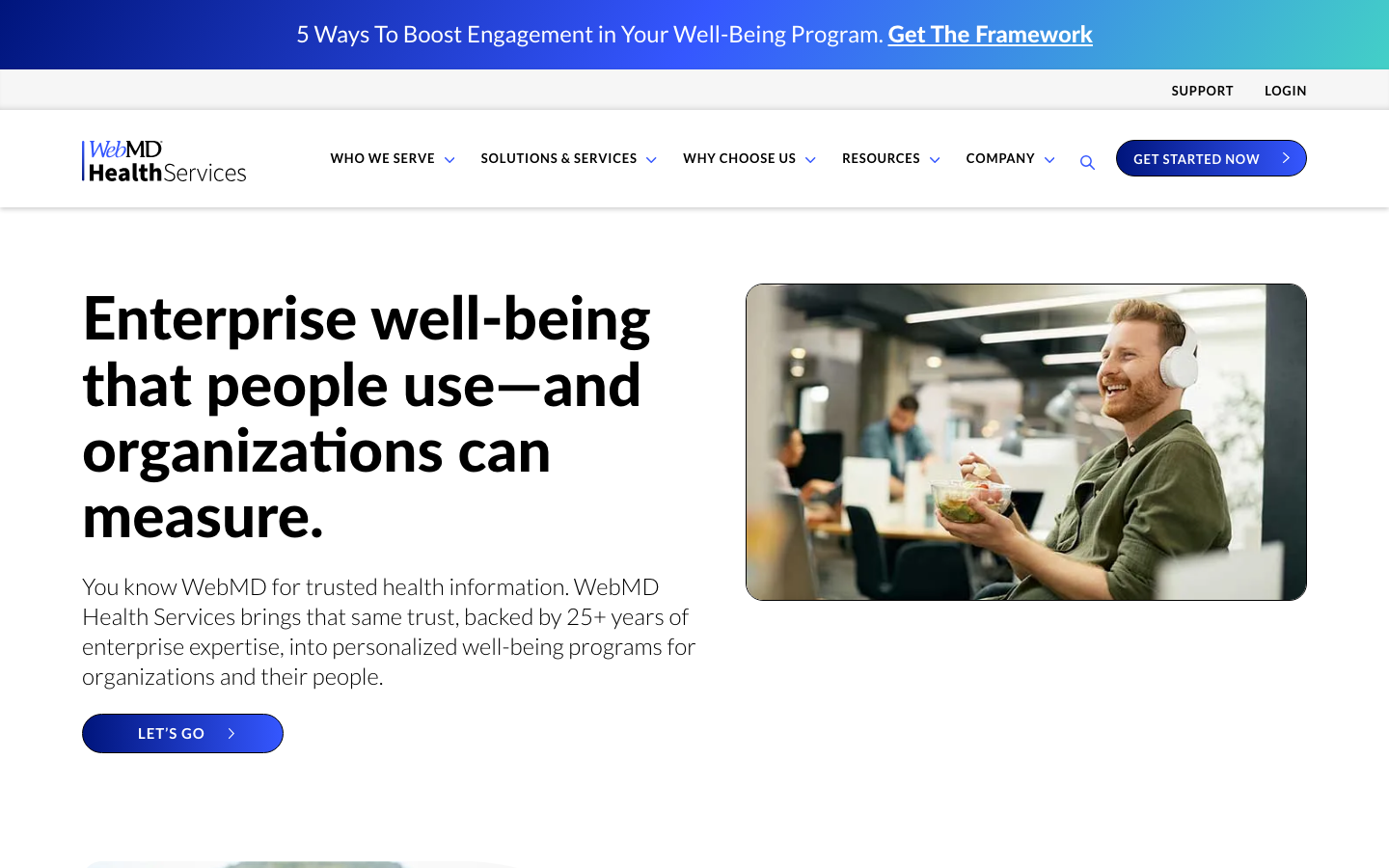
Limeade is workplace employee wellness software built around employee voice: pulse surveys, targeted programs, nudges, and recognition. Its well-being solutions are now part of WebMD Health Services, which acquired the company, and limeade.com redirects to the WebMD Health Services site.
Focus Area
Culture, engagement, and wellbeing programs
Scope of Offerings
- Wellbeing and pulse survey engine
- Personalized program journeys
- Content feeds, nudges, and reminders
- Recognition tools
- Reporting for HR and leadership
Top Advantages
- Asks employees what they need before assigning programs
- Survey data links wellbeing to engagement rather than steps alone
- Now backed by the WebMD Health Services product and services team
Things to Consider
- Branding and product naming are in transition after the acquisition
- Program design work sits with HR, so it needs an internal owner
Our Verdict
Survey-Led Wellbeing Programs
Limeade suits companies whose wellbeing problem is not a lack of content but a lack of insight: high absence in one department, quiet disengagement in another. Confirm with the vendor which platform you would be buying today, and how long the Limeade experience will be maintained under WebMD Health Services.
Lyra Health
Quick Overview
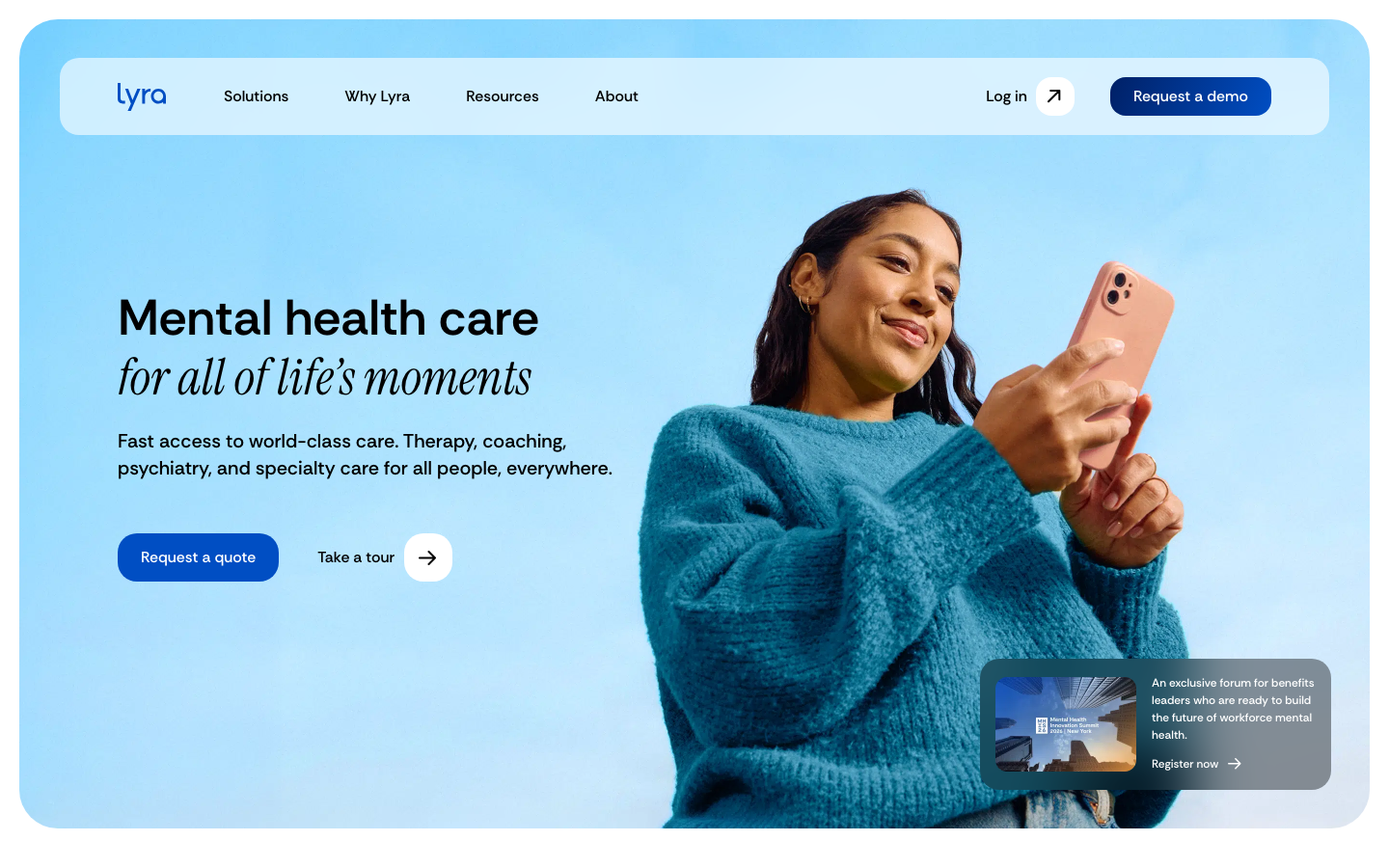
Lyra Health is a clinical mental health benefit, not a wellbeing app. It provides therapy, coaching, psychiatry, and specialty care through its own provider network, and is sold to employers as a replacement for a traditional EAP.
Focus Area
Clinical mental health care for employees and families
Scope of Offerings
- Therapy and psychiatry with matched providers
- Mental health coaching
- Specialty care for complex needs
- Manager and leader training
- Reporting on outcomes and utilization
Top Advantages
- Network the company describes as 30,000+ providers with clinical oversight
- Care matching that aims to get people to the right level of support quickly
- Workplace consulting alongside the clinical benefit
Things to Consider
- Priced as a health benefit, so it is the most expensive option on this list
- There is no self-serve content library for casual daily use
Our Verdict
Clinical Care as a Benefit
Lyra belongs on the shortlist when the problem is access to treatment, not access to meditation. Employees book sessions with licensed providers, and HR sees utilization and outcome reporting instead of individual clinical records, which is the boundary any clinical vendor should hold.
OfferingTree
Quick Overview
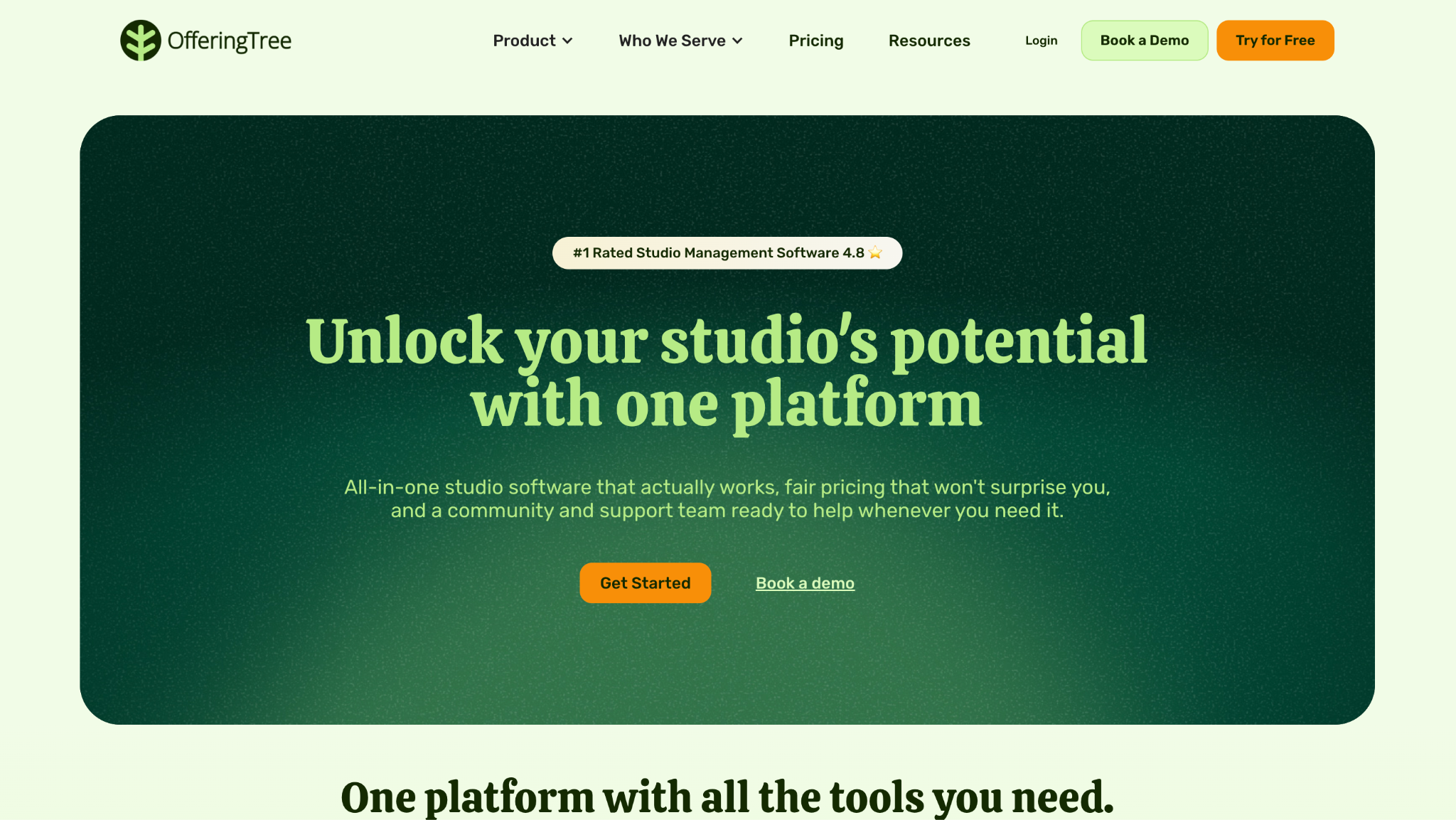
OfferingTree is an all-in-one platform built for wellness professionals, giving the teachers, coaches, and studios who run sessions their scheduling, payments, and content library in one place.
Focus Area
Session delivery: scheduling, payments, and content for wellness practitioners
Scope of Offerings
- Class, event, and appointment scheduling with family booking
- Memberships, class packs, and online payments
- On-demand video libraries, courses, and challenge programs
- Website builder, branded client app, and email and text marketing
Top Advantages
- Created by wellness professionals for wellness professionals
- Replaces a stack of separate website, booking, and payment tools
- Free trial with one-on-one onboarding and migration support
Our Verdict
Practitioner-Side Wellness Platform
OfferingTree sits on the other side of the wellness equation from most platforms on this list. Rather than handing HR a dashboard, it equips the people who actually run the classes: a teacher gets a website, a booking calendar, memberships, and a video library without having to stitch together four separate subscriptions. That matters when your wellness program runs on live sessions with outside instructors rather than a company-wide app subscription. Employees book through the instructor’s own site and client app, and there are no seats for you to license or administer. More than 2,000 wellness businesses run on the platform, so there is a fair chance an instructor you approach already works in it.
Personify Health
Quick Overview
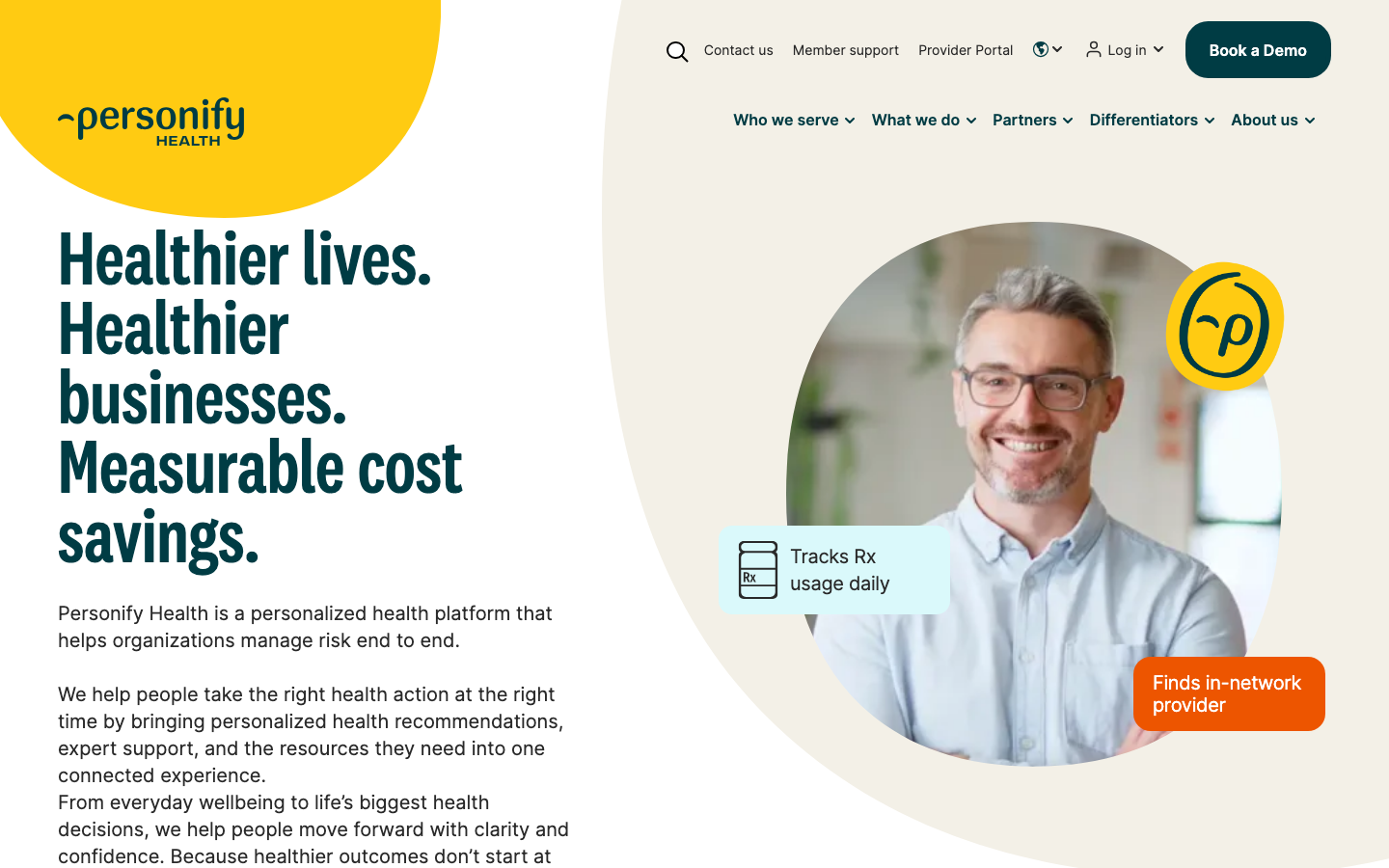
Personify Health is the enterprise platform created when Virgin Pulse and HealthComp merged, combining wellbeing programs, health navigation, and benefits administration in one place. It functions as an employee health and wellness app for staff and a reporting layer for benefits teams.
Focus Area
Enterprise wellbeing with navigation and benefits administration
Scope of Offerings
- Daily wellbeing programs and challenges
- Health navigation and provider search
- Care and condition management
- Benefits administration and cost containment
- Analytics for benefits leaders
Top Advantages
- One vendor for wellbeing, navigation, and claims-side services
- Science Advisory Board reviews the wellbeing experience
- Scale and services aimed at large employers with self-funded plans
Things to Consider
- Far more platform than a small or mid-sized team needs
- Implementation depends on benefits and claims data, so it takes time
Our Verdict
Wellbeing Inside a Benefits Platform
Personify Health targets employers that already run self-funded health plans and want wellbeing to sit next to claims, navigation, and condition management. Teams looking for a simple challenge app will find the scope overwhelming, but for a large US employer the single-vendor story is the appeal.
TELUS Health Wellbeing
Quick Overview
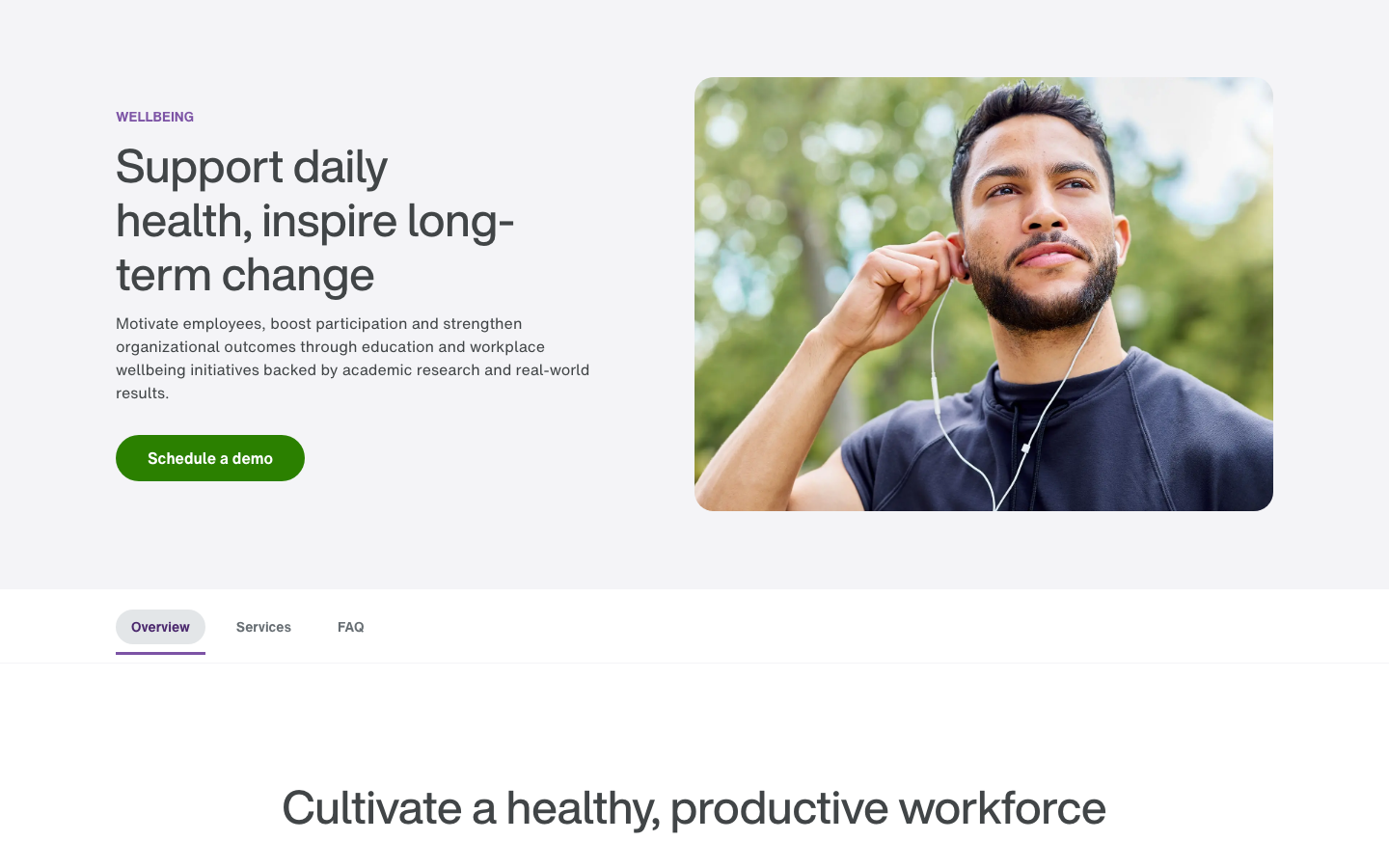
TELUS Health Wellbeing is a program platform that helps employers support healthier habits through wellbeing assessments, personalized content, challenges, rewards, and program analytics.
Focus Area
Habit building, engagement, and program reporting
Scope of Offerings
- Wellbeing assessments with personalized recommendations
- Activity tracking and challenges
- Rewards and community features
- Wearable and device integrations
- Program reporting and analytics
Top Advantages
- Covers physical, mental, and financial wellbeing in one program
- Rewards and communities give people a reason to return
- Reporting shows engagement rather than licenses issued
Things to Consider
- Sits within a large health services portfolio, so product names change
- Costs are shared after a demo rather than published
Our Verdict
Program Platform for Everyday Habits
This is an employee wellness support program rather than a content subscription: assessments set a baseline, challenges and rewards keep people moving, and reporting tells HR whether anyone is using it. It fits employers that want a measurable program instead of a library nobody opens.
Unmind
Quick Overview
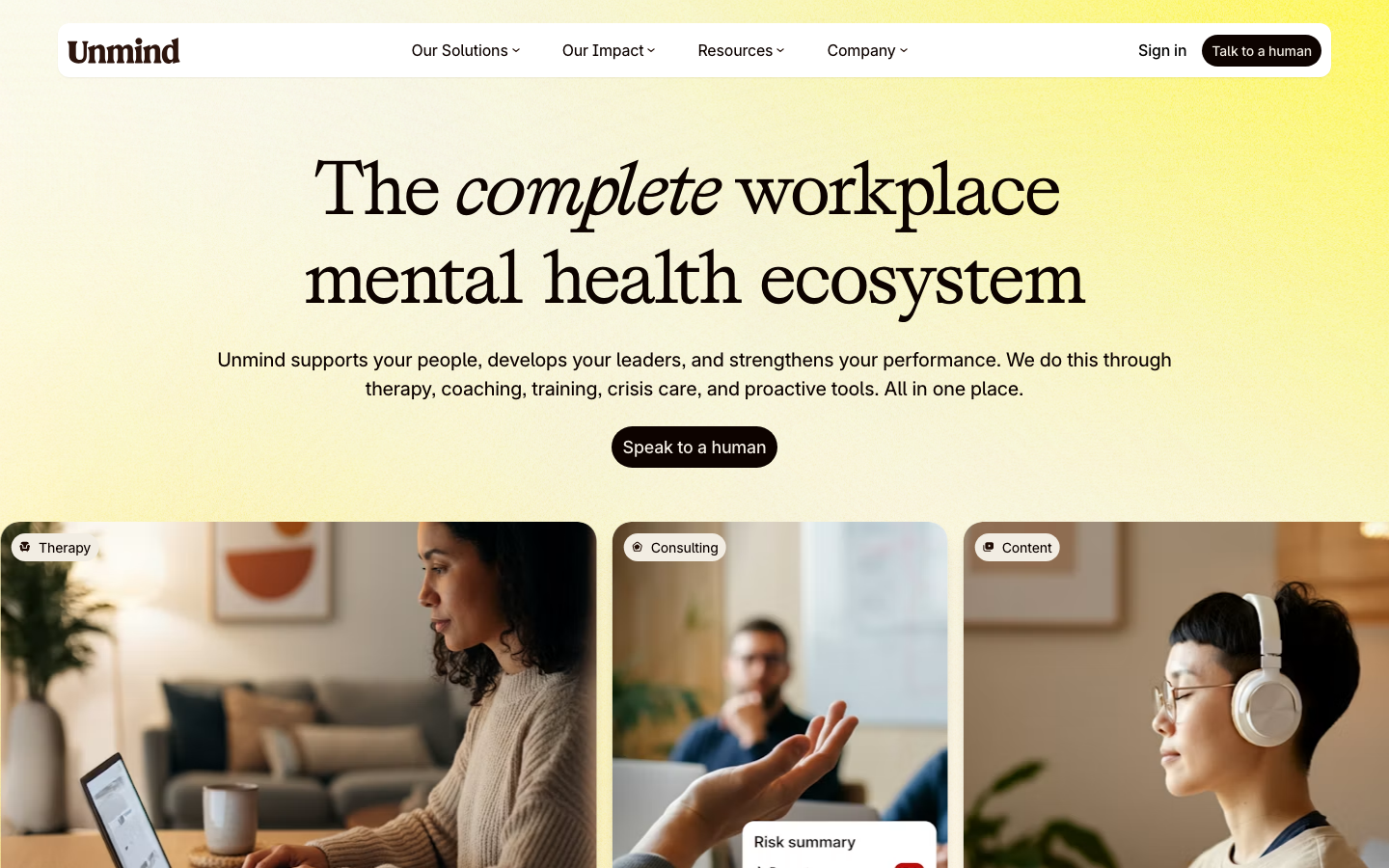
Unmind is a workplace mental health platform that combines self-guided tools with access to therapists and coaches, manager training, and crisis care. The company says its network covers more than 90,000 therapists and coaches.
Focus Area
Mental health, manager capability, and wellbeing insight
Scope of Offerings
- Self-guided courses and proactive tools
- Therapy and coaching sessions with qualified practitioners
- AI coaching with clinical safeguards
- Manager and leader training
- Anonymized wellbeing insights for employers
Top Advantages
- Describes its approach as grounded in proven psychology, with clinical oversight
- Employer insights are reported anonymously rather than per person
- Practitioners available in multiple languages and regions
Things to Consider
- Most useful when managers are trained alongside the rollout
- Neither prices nor a pilot tier are published, so budgeting starts with sales
Our Verdict
Therapy, Coaching, and Manager Training
Unmind fits companies that want employees to have real sessions with practitioners while also equipping managers to notice a struggling team. Employers see wellbeing trends at team level, which supports a conversation about workload without exposing an individual’s mental health data.
Vantage Fit
Quick Overview
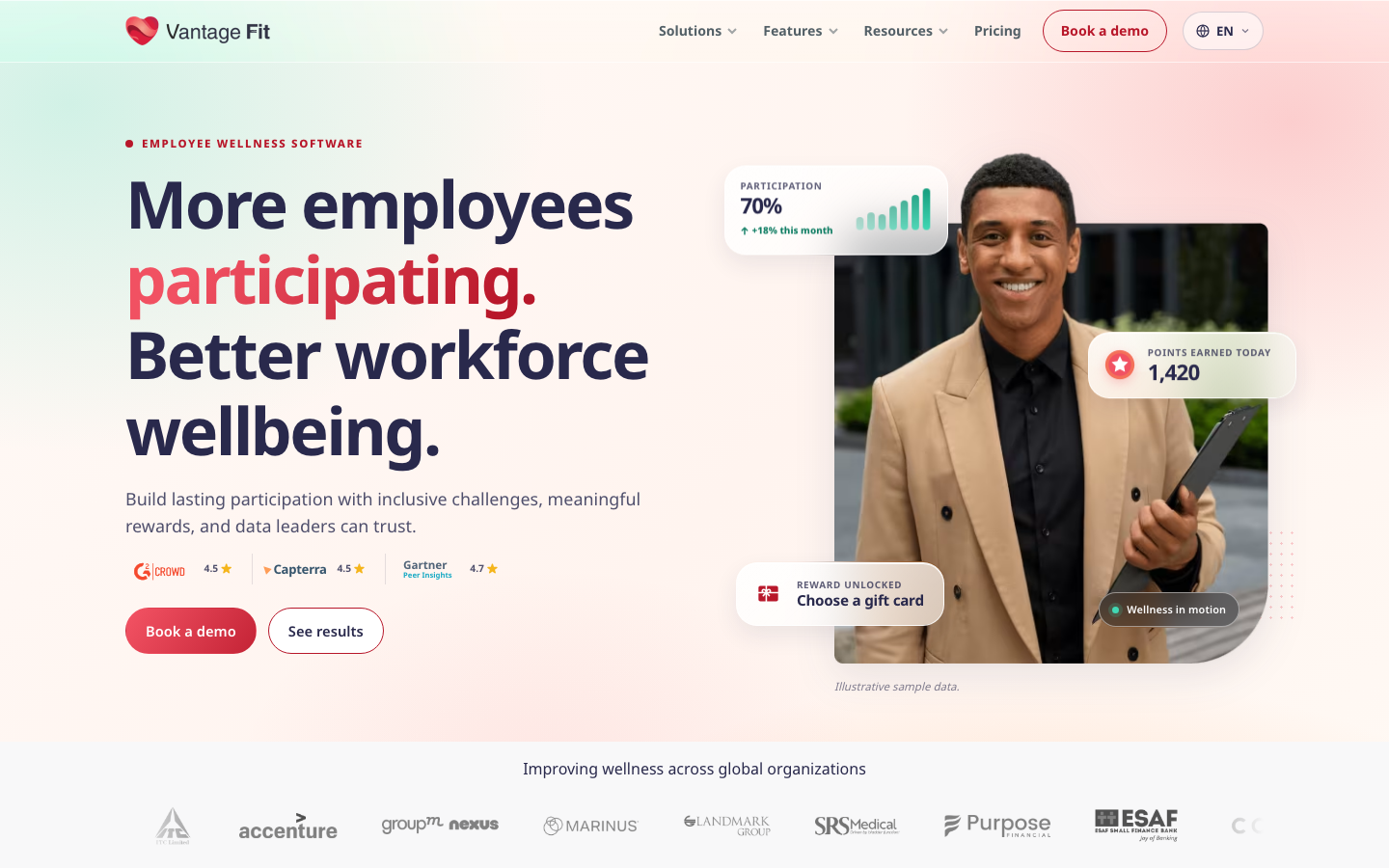
Vantage Fit is employee wellness tracking software built around step and activity challenges, with wearable sync, leaderboards, and a rewards store. It is part of the Vantage Circle suite.
Focus Area
Physical activity, challenges, and healthy habits
Scope of Offerings
- Step, running, and cycling challenges
- Activity and sleep tracking through wearables
- Team and individual leaderboards
- Built-in employee surveys
- Rewards and recognition store
Top Advantages
- Syncs with Fitbit, Garmin, Apple Health, and other trackers
- Available in 14+ languages for distributed teams
- Its site states that HR sees only aggregated, de-identified data
Things to Consider
- Challenge-led design appeals most to employees who already exercise
- Some features, including surveys and automatic rewards, need the annual plan
Our Verdict
Challenge App With a Clear Privacy Line
As an app to track employee wellness, Vantage Fit keeps the mechanics simple: join a challenge, sync a watch, climb a leaderboard, redeem a reward. Because the vendor publishes its privacy position, it is also one of the easier tools to defend to a works council or a skeptical team.
Wellable
Quick Overview
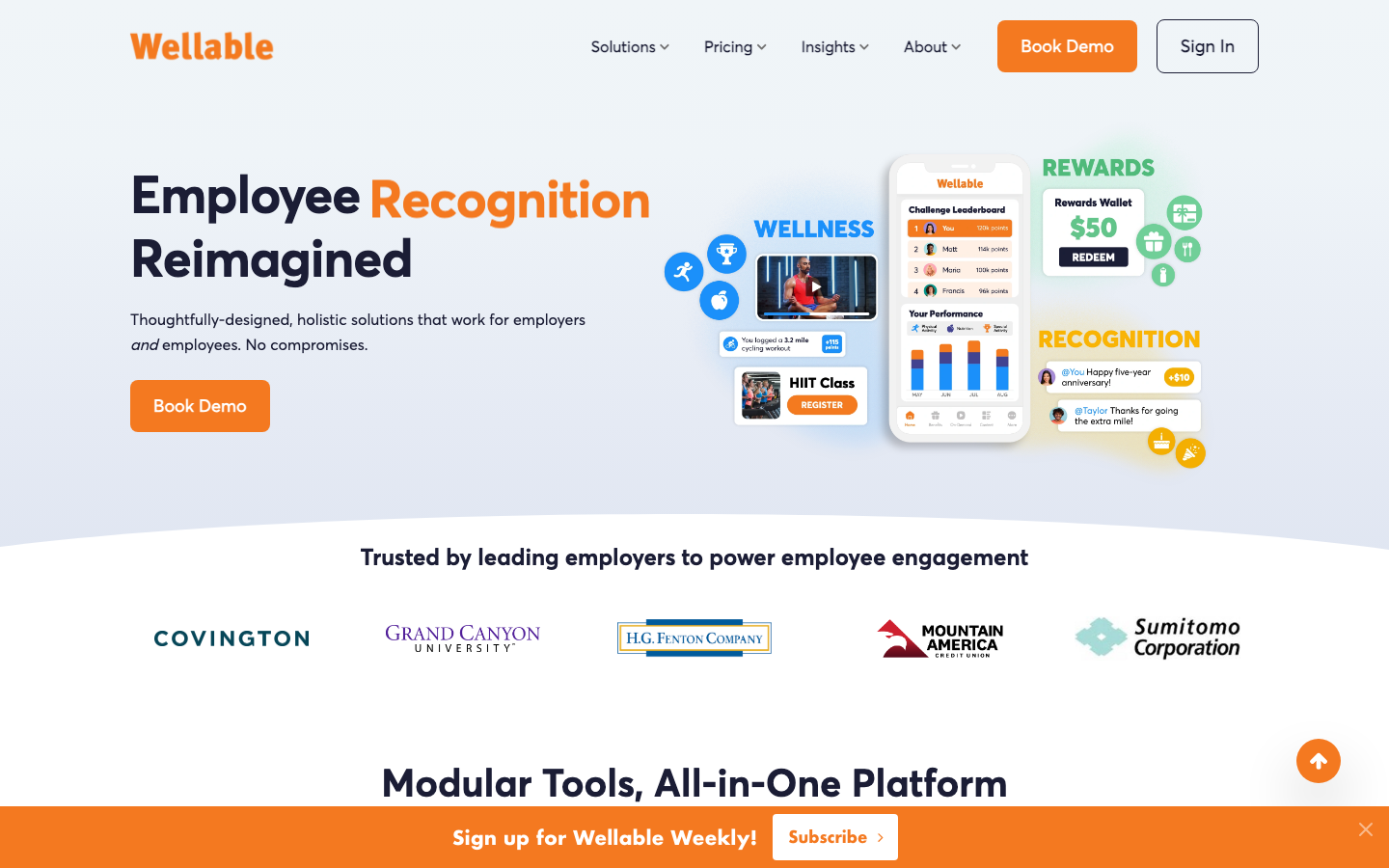
Wellable is a modular wellness platform: employers switch on the pieces they want, from challenges and on-demand classes to health coaching, biometric screenings, and rewards. Its published subscription tiers start at $4.00 per user per month.
Focus Area
Configurable programs, incentives, and screenings
Scope of Offerings
- Fitness, nutrition, and mindfulness challenges
- 2,500+ on-demand classes
- Health coaching from board-certified professionals
- Biometric screenings delivered with eHealthScreenings
- Rewards, surveys, and program reporting
Top Advantages
- Modules can be added or dropped as a program matures
- Published per-user pricing, which is rare in this category
- HRIS and payroll integrations for user provisioning
Things to Consider
- Add-ons such as screenings and coaching are priced separately
- Program design still needs an owner inside HR
Our Verdict
Modular Program With Published Pricing
Among employee wellness service providers, Wellable is unusually transparent: the subscription tiers and add-on list are on its pricing page, so you can build a budget before the first sales call.
It is also a practical employee wellness survey tool, since the same platform that runs a challenge can collect lifestyle survey responses and report them back to admins without a separate vendor.
Wellhub
Quick Overview
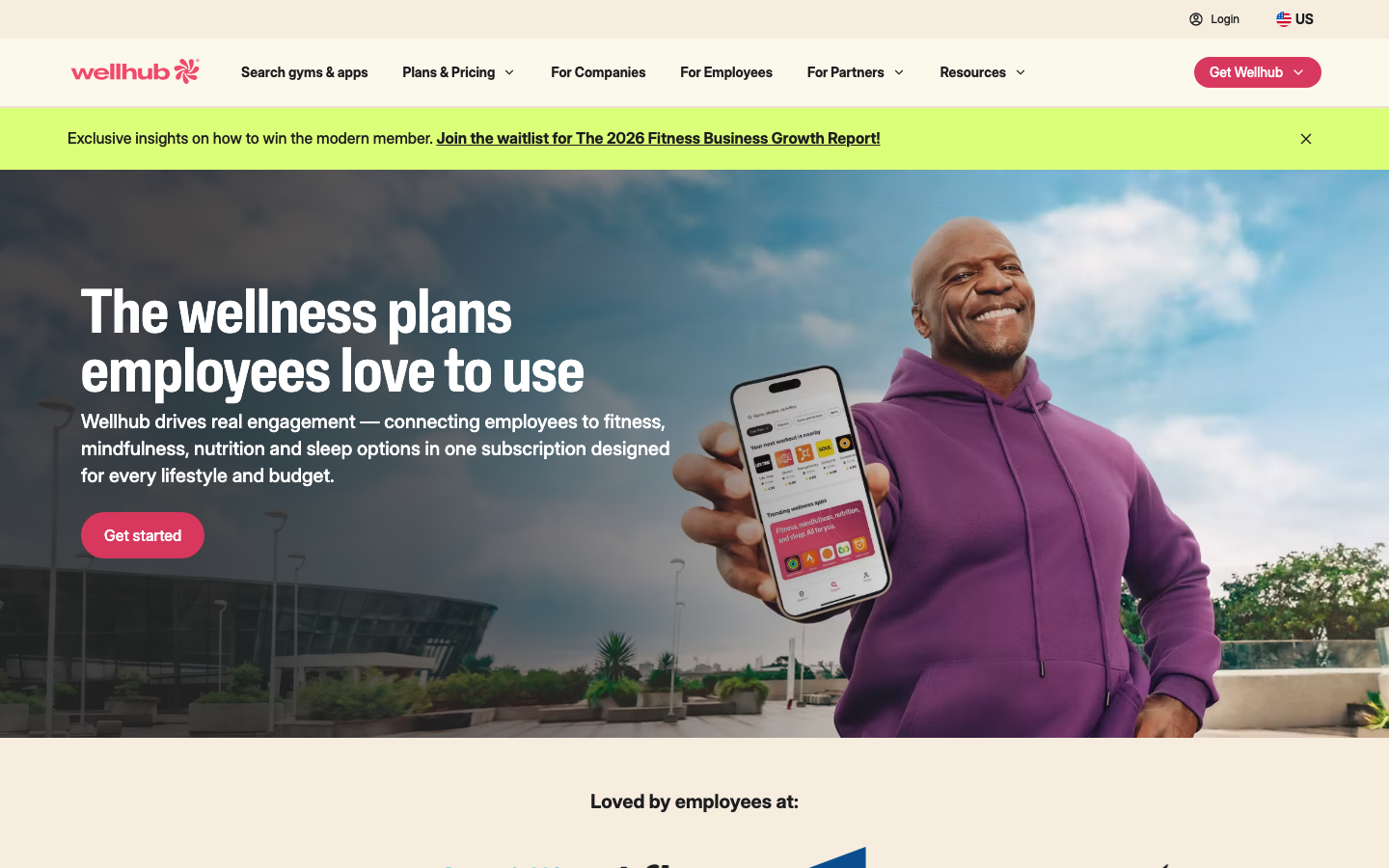
Wellhub, the company formerly known as Gympass, is an access marketplace rather than a content platform. Employers pay a corporate fee, and employees choose a membership plan that covers gyms, studios, and wellbeing apps.
Focus Area
Access to gyms, studios, classes, and wellbeing apps
Scope of Offerings
- 110,000+ gyms and studios in its network
- 90+ wellness apps for fitness, nutrition, sleep, and mindfulness
- 3,800+ virtual personal trainers
- 10 employee membership plans
- Usage reporting for the employer
Top Advantages
- Corporate fees start at about $1 per employee per month
- Employees pick and upgrade their own plan, so costs flex with use
- Useful for staff who want in-person exercise rather than an app
Things to Consider
- Employees contribute financially unless you fund a higher plan
- It delivers access, not wellbeing programs, surveys, or mental health care
Our Verdict
Gym and Studio Access as a Benefit
Wellhub answers a different question from the rest of this list: not what content to give people, but how to pay for the gym, yoga studio, or app they would use anyway. The trade-off is that HR gets participation data rather than a wellbeing program to run.
Wellness360
Quick Overview
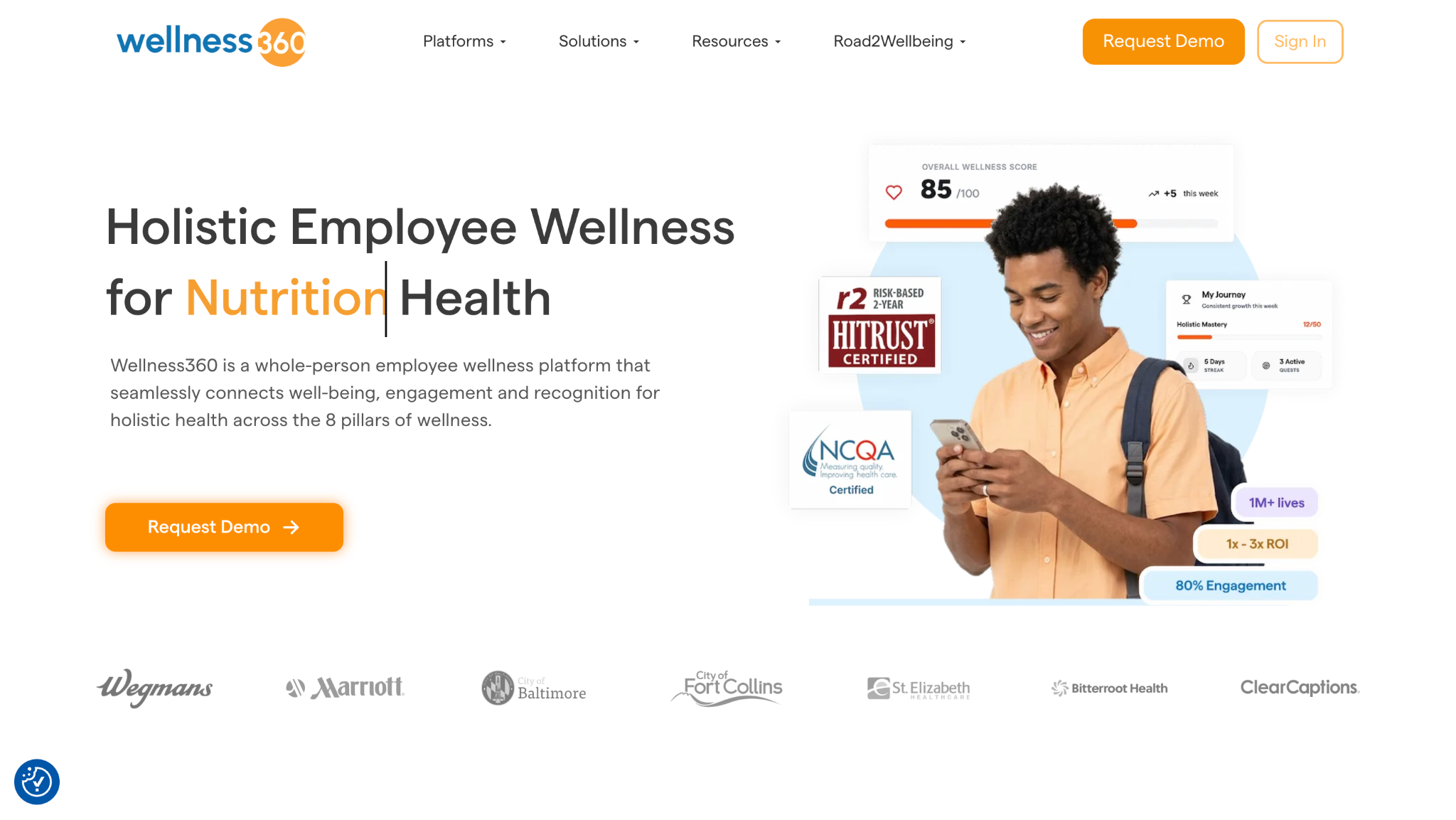
Wellness360 is employee health & wellness software that spans 8 wellness pillars, from physical and nutritional to financial and social, and connects wellbeing with recognition and engagement surveys.
Focus Area
Whole-person programs with assessments and rewards
Scope of Offerings
- Health assessments and personalized wellness journeys
- Challenges for steps, hydration, mindfulness, and sleep
- Rewards and recognition
- Engagement surveys
- Dashboards for HR and program administrators
Top Advantages
- Programs adapt to assessment results rather than one fixed plan
- Wellness, recognition, and surveys run in the same platform
- Reporting is built for program administrators
Things to Consider
- Depth of configuration means a longer setup than a simple challenge app
- No published pricing page, so budgets start with a demo
Our Verdict
Assessment-Led Wellness Programs
The assessment is the core of the product: employees answer questions about sleep, stress, nutrition, and activity, then follow a journey based on the results. Health risk assessments of this kind are what employee wellness screening means in practice, and only a few tools on this list offer them.
Woliba
Quick Overview
Woliba is one of the employee wellness platforms that bundle several people programs together: wellness challenges, recognition, surveys, events, rewards, and analytics in a single login.
Focus Area
Wellbeing, recognition, and engagement in one platform
Scope of Offerings
- Activity and wellness challenges
- Peer recognition and rewards
- Surveys and feedback loops
- Event studio for live sessions
- Engagement analytics and reporting
Top Advantages
- Replaces several separate engagement tools with one platform
- Free trial before any contract
- Billing is based on active users, not headcount
Things to Consider
- Breadth means no single module is as deep as a specialist tool
- Analytics features that flag burnout risk need care in how they are communicated
Our Verdict
Wellness With Recognition Built In
Woliba provides employee wellness services alongside the recognition and survey tools that usually sit in separate systems, which suits a small people team running everything itself.
YuMuuv
Quick Overview
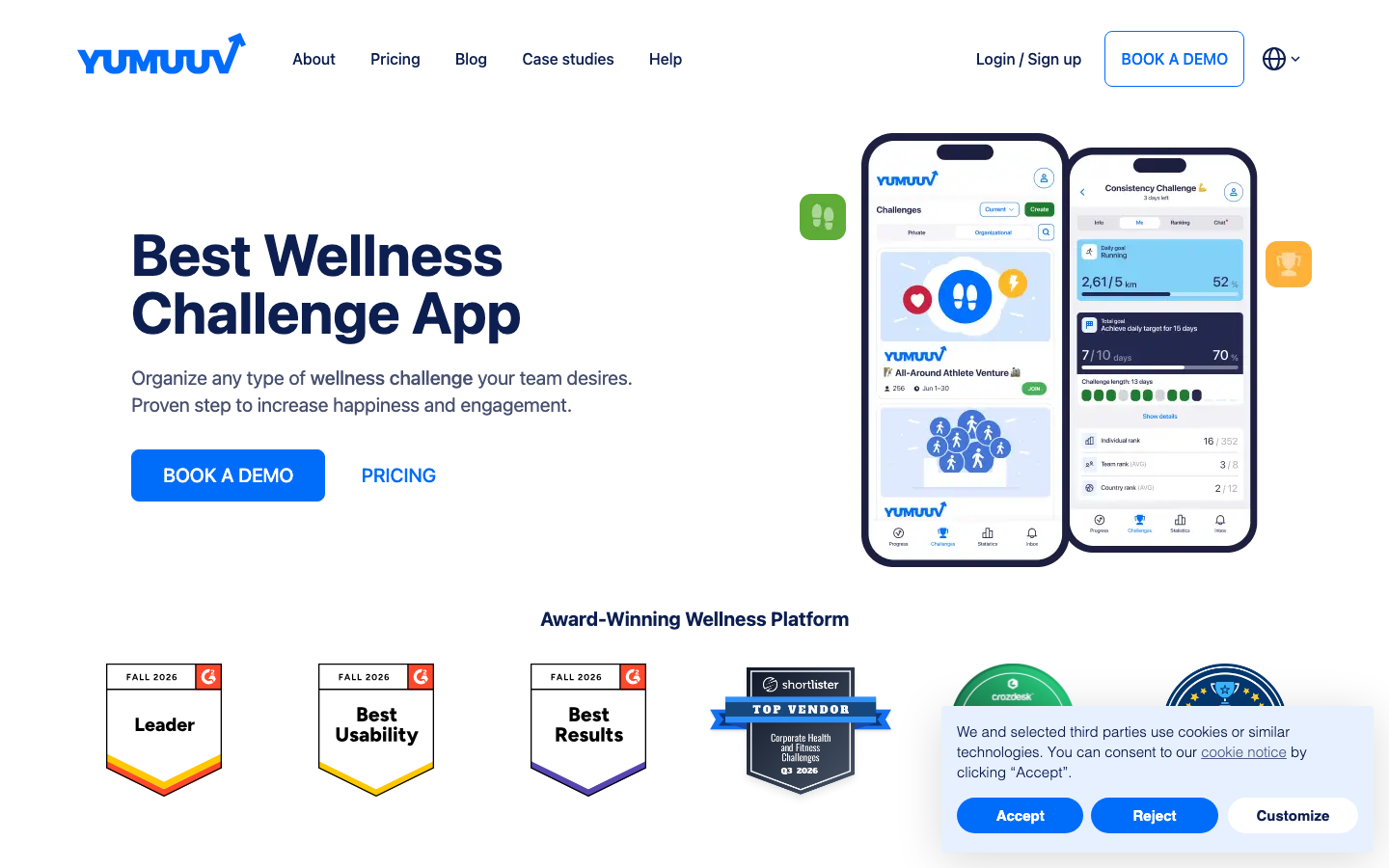
YuMuuv is a challenge app for distributed teams, built around activity tracking, leaderboards, and group chat. It reports use in 100+ countries and supports 47 languages.
Focus Area
Team challenges and social movement
Scope of Offerings
- Step, sleep, hydration, and activity challenges
- Wearable integrations with Apple Health, Google Fit, Garmin, Fitbit, and more
- Team chat and photo sharing
- Leaderboards and badges
- Participation reporting for organizers
Top Advantages
- Activity scoring that measures effort rather than athletic ability
- 47 languages, which helps in multi-country teams
- States compliance with GDPR, CCPA, and SOC 2
Things to Consider
- Challenges are the whole product: no coaching, therapy, or assessments
- Prices depend on active participants and program length, so budgets vary
Our Verdict
Simple Challenges for Global Teams
YuMuuv works when the goal is participation across time zones rather than clinical support. Employees can invite family members into private challenges at no extra cost, which tends to lift the numbers in a way a purely work-based challenge rarely does.
Closing Thoughts on Employee Wellness Services
In remote and hybrid teams, wellbeing support has to be deliberate. When people can get help for stress, sleep, or a mental health problem without asking a manager first, they tend to stay longer and work more consistently.
The right employee wellness solutions make that support visible and measurable: a program with an owner, a budget, and numbers that show whether anyone used it. The wrong ones are a subscription nobody opens after week 2.
Wellbeing is also part of a wider picture for international teams. If you are moving people between countries, our guide to global mobility services covers the relocation and immigration side of supporting those employees.
FAQs about Employee Wellness Platforms
What is a remote wellbeing solution?
A service or platform that supports the mental, physical, and emotional health of people working outside a traditional office. Delivery is digital, through an app or a browser, so employees can reach content, classes, coaching, or care from wherever they work.
How do virtual wellness platforms support global teams?
They provide on-demand resources that do not depend on a shared office or time zone: content libraries, challenges, coaching, and community features. Multi-language support and local provider networks determine how well that works in practice, so both are worth checking country by country.
Are employee wellness programs effective for remote workers?
The evidence is mixed. Independent research has found that individual-level interventions such as apps and resilience training often show no measurable benefit, while programs that also change workload, scheduling, or management practice do better. Treat a subscription as one part of the plan, not the plan itself.
How to choose the right wellness platform for a distributed team?
Decide whether your priority is mental health access, physical activity, or a broad program with reporting, then shortlist within that group. After that, compare what administrators can see about individuals, which countries the support covers, and how the tool connects to your HR system and wearables.
What is the best employee wellness software?
There is no single winner, because these tools do different jobs: some deliver content, some run programs for HR, and some buy access to gyms or clinicians. The comparison table above groups all 15 by type, typical buyer, and what administrators can see, which is the fastest way to narrow a shortlist to 2 or 3 options.
How to gather employee feedback on a wellness app?
Use short pulse surveys a few weeks after launch, in-app ratings at the end of a session or challenge, and usage measured against enrollment rather than licenses purchased. A license count is not participation, and 1 honest question about whether the tool helped will tell you more than a dashboard of logins.

Yaryna is our lead writer with over 8 years of experience in crafting clear, compelling, and insightful content. Specializing in global employment and EOR solutions, she simplifies complex concepts to help businesses expand their remote teams with confidence. With a strong background working alongside diverse product and software teams, Yaryna brings a tech-savvy perspective to her writing, delivering both in-depth analysis and valuable insights.