This guide covers 10 providers in a single A-to-Z list, each with its base, specialty, scope, and my verdict. Keep 2 facts in mind as you read. Lesotho replaced its labor statute in April 2024, and much published guidance still describes the old one. The loti is also pegged to the rand, which removes currency risk.
Why Lesotho Hiring Changed in 2024
A Lesotho employer of record hire lands in a mountainous kingdom entirely enclosed by South Africa. Maseru, on the western border, is the capital, and most industry sits in the western lowlands. The economy is small: World Bank figures show 2,363,325 residents, GDP of $2.57 billion, and growth of 2.0% in 2025. English and Sesotho are both official, and English is the language of the statute and of contracts. The loti (plural maloti, code LSL) is pegged to the rand within the Common Monetary Area (CMA), according to the Central Bank of Lesotho.
Textiles and apparel lead hiring. The sector is the largest private employer, with 31,000 to 34,000 jobs in 2024, per the Lesotho National Development Corporation. Diamond mining, water infrastructure, construction, wool and mohair, retail, banking, and a sizable donor and NGO sector follow. The workforce speaks English, wages sit well below South African levels, and many Basotho have worked across the border. Through an employer-of-record Lesotho arrangement, a foreign company can hire without registering an entity.
Put simply, an employer of record is an outside legal entity that signs local staff on behalf of a foreign company. That entity carries the statutory obligations and pays salaries, while the foreign company decides the work. In Lesotho, the arrangement rests on a contract under the Labor Act No. 3 of 2024 and payroll in Maloti. Pay-as-you-earn (PAYE) is withheld against a personal tax credit and paid to Revenue Services Lesotho (RSL). Work authorization covers non-citizens. Any employer of record in Lesotho must also apply the leave the 2024 Act created, which older guidance misses.
After checking all 10 sites, I found that only 3 cite the current statute, while 2 still name the repealed 1992 Order. Only 1 provider is based in Lesotho, and it sells HR software rather than employment services. Each block sets out scope and strengths, a useful benchmark against the months a local company registration may need.

INSIGHT: What does a Lesotho employer actually pay on top of salary?

The statutory load is small by regional standards, which is good news. Published figures still range from 0% to 10% combined, so the number must be established rather than looked up.
- No contributory social security or pension applies. The old-age pension is universal and government-paid, with no employer share (SSA, 2019). Work injury is an employer liability under the Workmen’s Compensation Act No. 13 of 1977, usually insured privately; Legal Notice No. 6 of 2026 raised the caps from 1 February 2026 (Mayet & Associates).
- PAYE: 20% on the first M77,760 a year (M6,480 a month) and 30% above. A non-refundable credit of M12,240 (M1,020 a month) applies from 1 April 2026 under Legal Notice No. 24 of 2026 (CRS). The credit reduces tax due; it is not an exempt band (RSL).
- Minimum wage: set by sector in Legal Notice No. 54 of 2026, effective 1 April 2026. A textile general worker earns at least M2,834 a month in year 1 and M3,138 after (Mayet & Associates).
- Severance: 2 weeks’ wages for each completed year once service passes 1 year, at the final rate (section 136). Final wages are due by the next working day (section 179, Labor Act 2024).
Sources:
checked October 2026
What Is the Best EOR Option in Lesotho?
A provider with real local footing has obvious appeal. Contracts now run under a statute barely 2 years old, wages are gazetted sector by sector, and leave rules changed in 2024. Of the 10 providers here, only PayBell HR is based in Lesotho, on Kingsway in Maseru. What it sells is cloud HR and payroll software, though, not an employer of record service. A company that already has its own entity may value that software, but it does not solve the legal employer question.
A platform reaching in brings uniform paperwork, one dashboard and one standard across markets. Payroll in Lesotho needs no currency hedging, because the loti tracks the rand. Published detail varies widely, from pages with no Lesotho figures at all to full statutory walkthroughs. Depth isn’t currency, and in this market the most detailed pages aren’t always the most reliable.
Before signing, send every shortlisted firm the same 4 written questions. Which legal entity signs the contract, and is it registered in Lesotho? Does the provider work from the 2024 Act or the repealed Order? Which employer charges does the quote assume, under which law? How will the sector wage schedule apply to your role? Only 2 of the 10 publish a fee at all, so most comparisons start with a request for quotes.
INSIGHT: Lesotho replaced its labor law in 2024, and the leave rules changed
The Labor Act 2024 repealed the 1992 Order and created entitlements that did not exist before. Guidance written against the old Code understates what an employer owes.
- The Labor Act No. 3 of 2024 was gazetted on 2 April 2024 and took effect on publication (section 1). Section 219 repeals the Labor Code Order, 1992 (Labor Act 2024).
- Maternity leave runs from up to 7 weeks before birth until 7 weeks after, or 8 if the mother is ill. That is about 14 weeks, against 12 under the old Code, and a stillbirth carries 3 weeks (section 191, ENSafrica).
- New entitlements: 14 days of paternity leave, 14 days of bonding leave after an adoption and 5 days of bereavement leave. Parents also get responsibility leave while a child is in hospital, as a doctor advises (section 191).
- The ordinary week is 45 hours. Hours may instead be set at 195 a month, with a 260-hour cap including overtime (section 186). Unions have publicly opposed the monthly option (ENSafrica).
Sources:
checked October 2026
10 Providers Offering Lesotho EOR Services
I reviewed providers that list employment, EOR, or payroll services covering Lesotho, each with a dedicated Lesotho page rather than a dropdown entry. My checks for a Lesotho EOR were payroll in Maloti and correct use of the Labor Act 2024. I also looked for PAYE withheld against the personal tax credit, the sector wage schedule, work authorization support, and pricing. Only 3 of the 10 cite the current statute. Just 1 is based in Lesotho, and it publishes HR software, not EOR. Only 2 show a fee.
Providers appear in A-to-Z order. The sequence says nothing about quality, preference, or ranking.
Africa HR Solutions
Provider Type:
Regional; the Mauritius head office sits in Phoenix
Company Description:
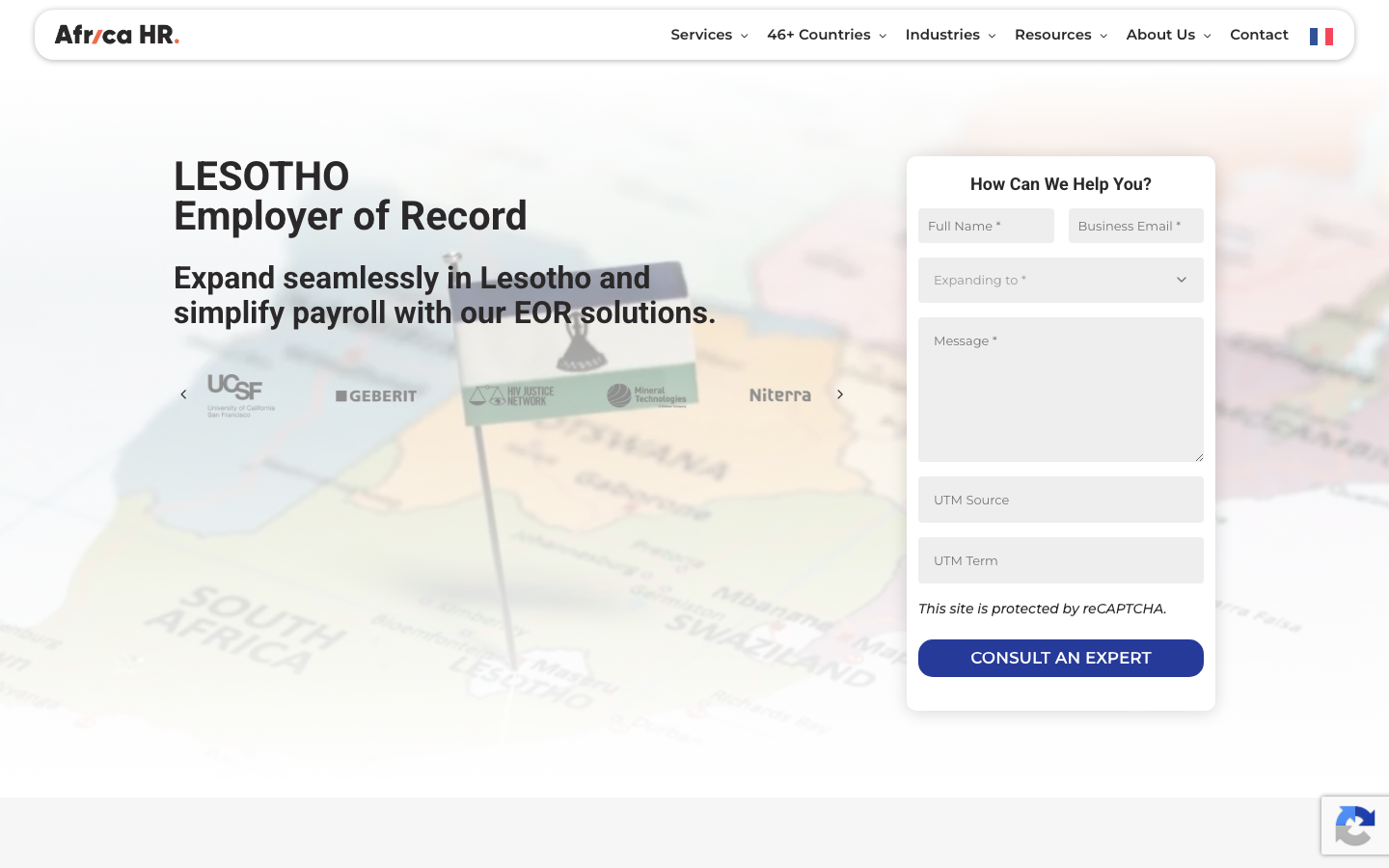
Africa HR Solutions lists Lesotho among more than 46 African countries and cites 16 years of experience with over 400 international clients. Its Lesotho page names no statute and publishes no statutory figures, which at least avoids repeating repealed rules.
Key Specialty Area:
Africa-only coverage from a Mauritius hub
Service Cost:
Quote-based
Top Advantages
- Coverage of more than 46 African markets
- Clients keep the same account lead throughout
- Extras such as relocation, laptops and office leasing
Scope of Services
- Lesotho contracts drafted and new staff onboarded
- Payroll, tax and compliance administration
- Statutory benefits administration for each hire
Our Verdict
I would brief this team when Lesotho is one stop in a wider African rollout.
Asanify
Provider Type:
Global, contact address in Kolkata, India
Company Description:
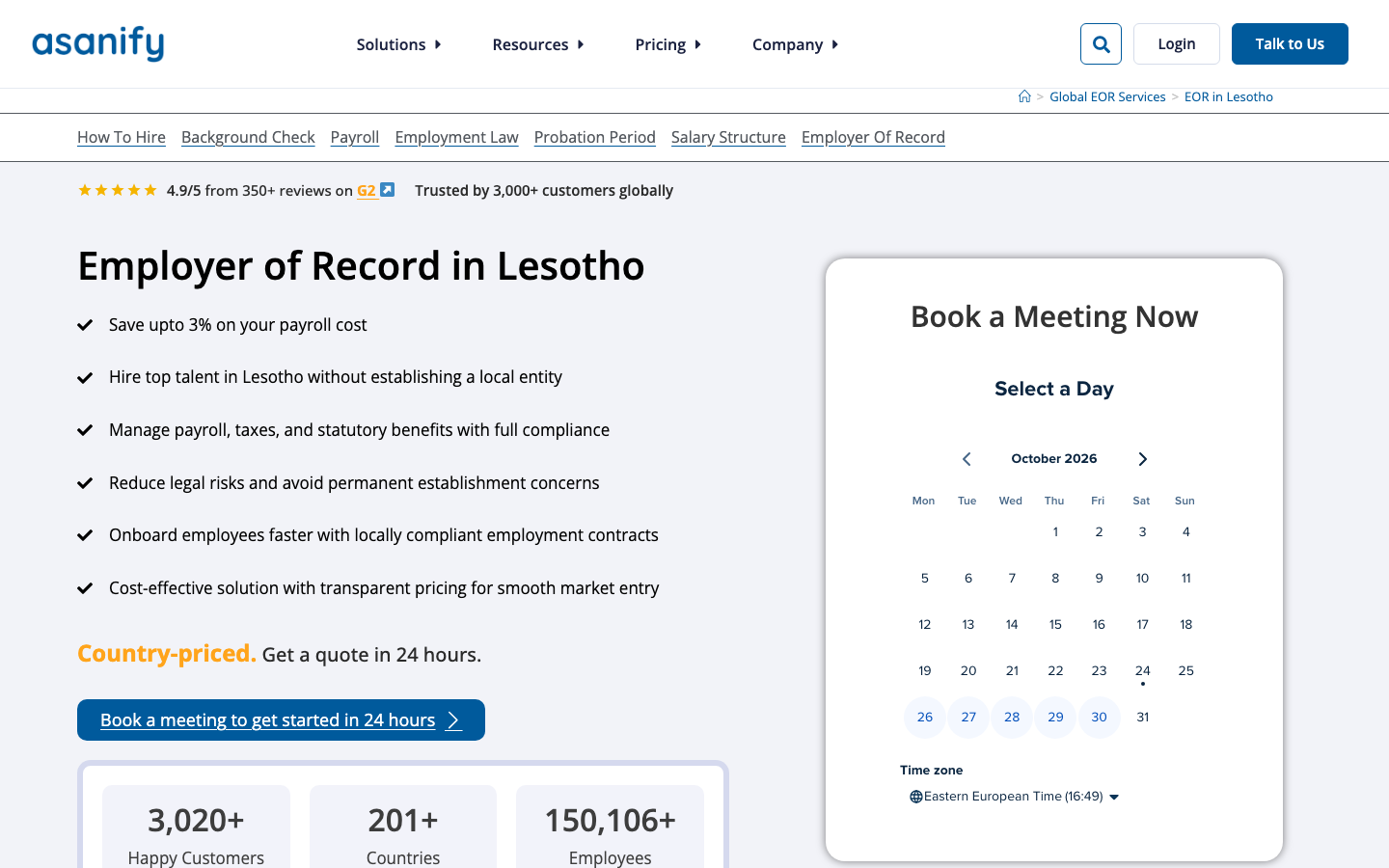
Asanify lists a Kolkata address with US and Indian phone lines. Its Lesotho page notes that the rand circulates alongside the loti. It still cites the 1992 Labor Code Order, which the 2024 Act repealed.
Key Specialty Area:
Notes that both loti and rand circulate
Service Cost:
Quote-based
Top Advantages
- Quote within 24 hours, per the company
- Currency, capital, and payroll cycle summarized clearly
- Statutory leave administration included in service
Scope of Services
- Locally drafted employment contracts for each hire
- Monthly payroll with tax withholding
- Annual, sick and maternity leave management
Our Verdict
Fine for a fast first quote, provided the contract is rebuilt on the 2024 Act.
Global Expansion
Provider Type:
Global
Company Description:
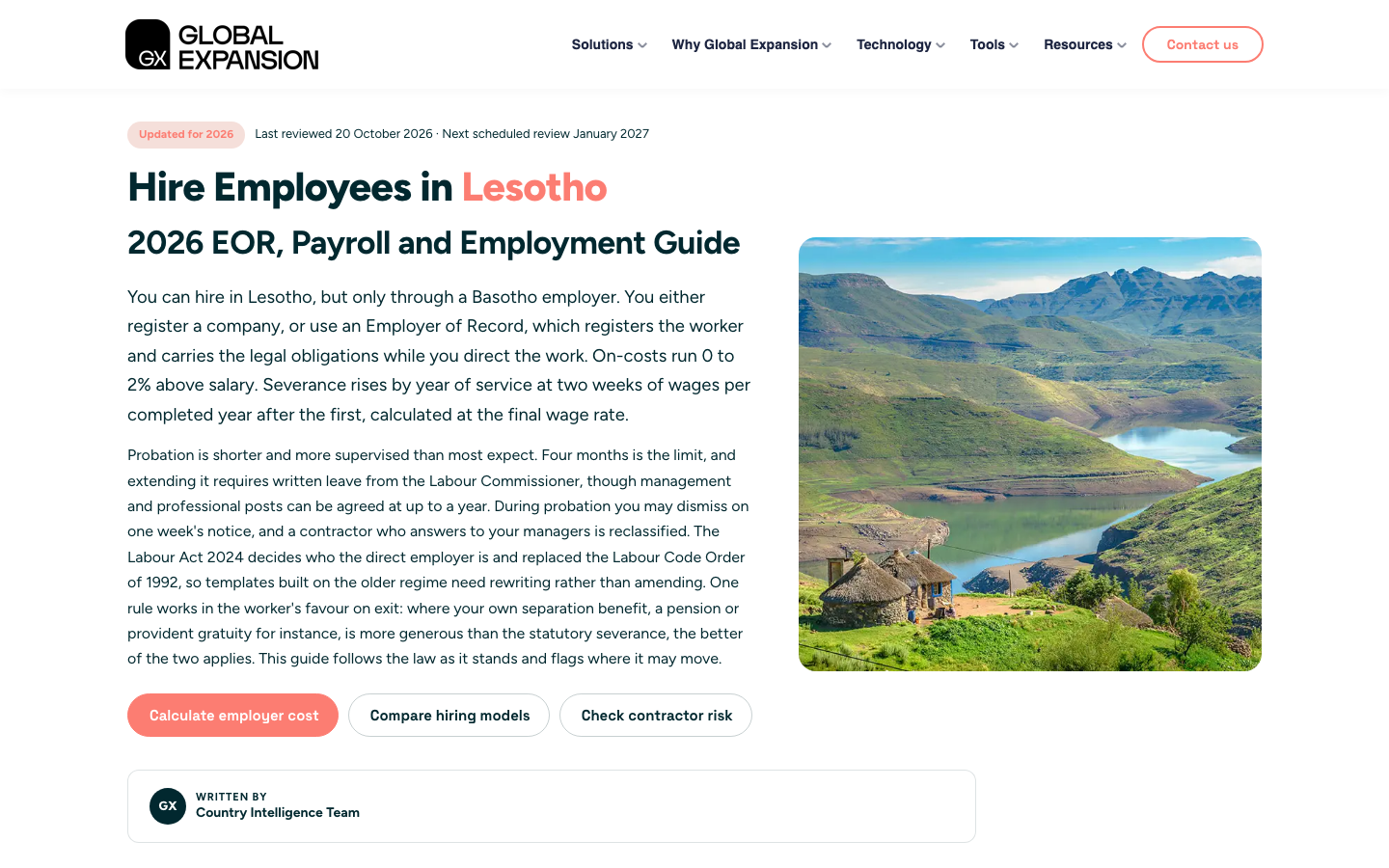
Global Expansion runs a Lesotho Countrypedia guide last reviewed on 20 October 2026, with the next review set for January 2027. It states that the 2024 Act replaced the 1992 Order and already shows the April 2026 tax credit.
Key Specialty Area:
Current tax credit with a stated review date
Service Cost:
Quote-based
Top Advantages
- Flags published figures it cannot reconcile
- Shows the 2026 tax credit and bracket
- Review dates printed at the top of the page
Scope of Services
- Hiring as a legal employer with local contracts
- Payroll processing and PAYE withholding
- Entity versus EOR comparison and cost tools
Our Verdict
My pick for readers who want the page to admit what it doesn’t know.
INS Global
Provider Type:
Global
Company Description:
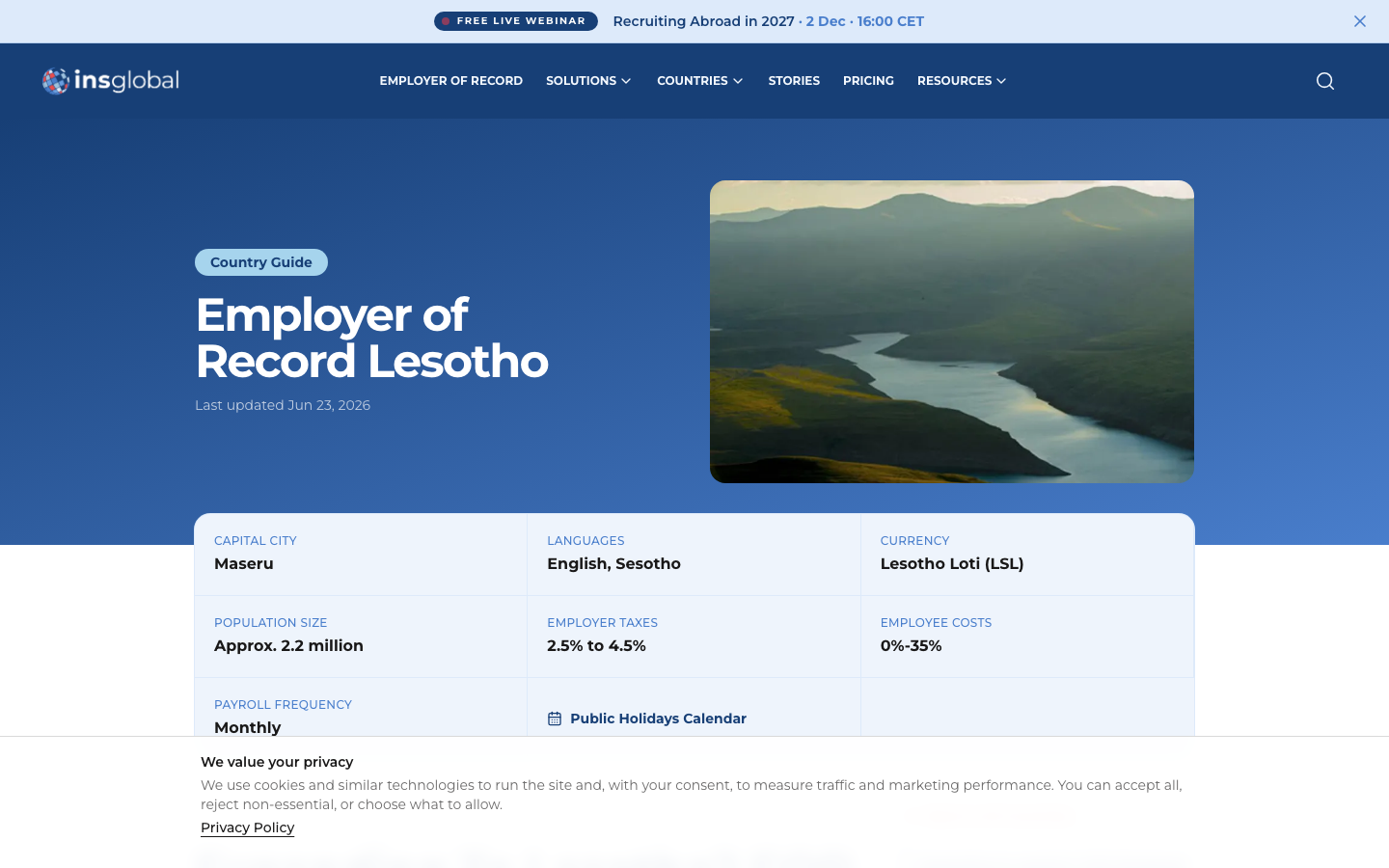
INS Global keeps a Lesotho EOR guide last updated in June 2026, covering notice, severance, probation, and sick leave. It names no statute, and its 48-hour week conflicts with the 45 hours set by section 186 of the 2024 Act.
Key Specialty Area:
Detailed notice and termination section
Service Cost:
Quote-based
Top Advantages
- Downloadable country guide for HR teams
- Termination and severance explained in one place
- Many markets managed from a single account
Scope of Services
- Employment contracts and employee onboarding
- Payroll, tax and benefits administration
- Termination handling and severance calculation
Our Verdict
Use it for process, but take every hour and leave figure from the Act.
PayBell HR
Provider Type:
Local, office on Kingsway in Maseru
Company Description:
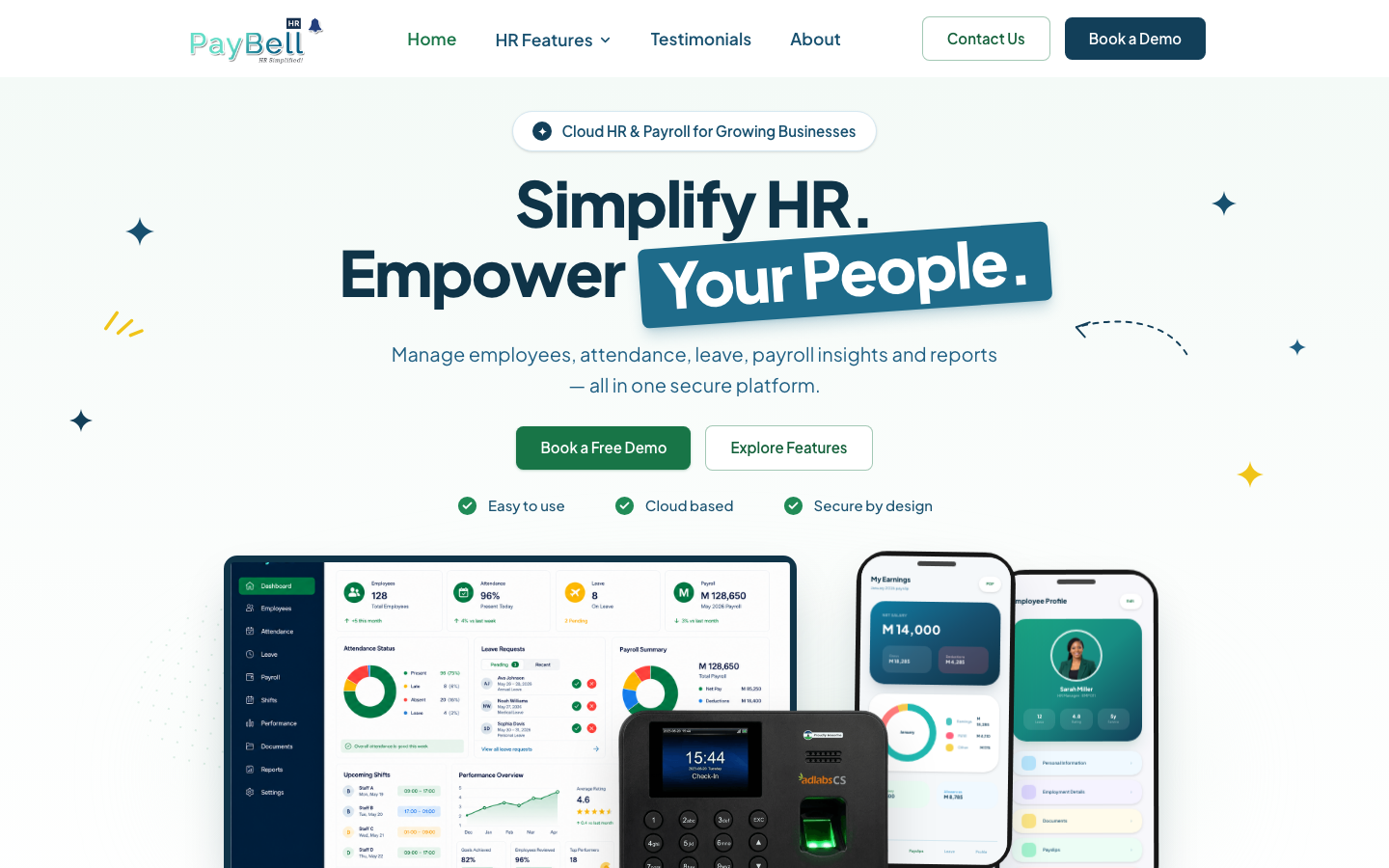
PayBell HR is cloud HR and payroll software from Adlabs Consultancy Solutions Pty Ltd, used by organizations in Lesotho since 2016. Its site describes no employer of record service, so the client remains the legal employer.
Key Specialty Area:
Maseru-based team, unlike every other entry
Service Cost:
Quote-based (demo on request)
Top Advantages
- Local team supporting clients from Maseru
- Monthly and yearly RSL schedules generated automatically
- Editions also sold for Botswana and South Africa
Scope of Services
- Payroll processing with PAYE schedules
- Biometric attendance and leave management
- Appraisals and employee self-service on mobile
Our Verdict
Worth a look once you have your own entity and need local payroll software.
Playroll
Provider Type:
Global
Company Description:
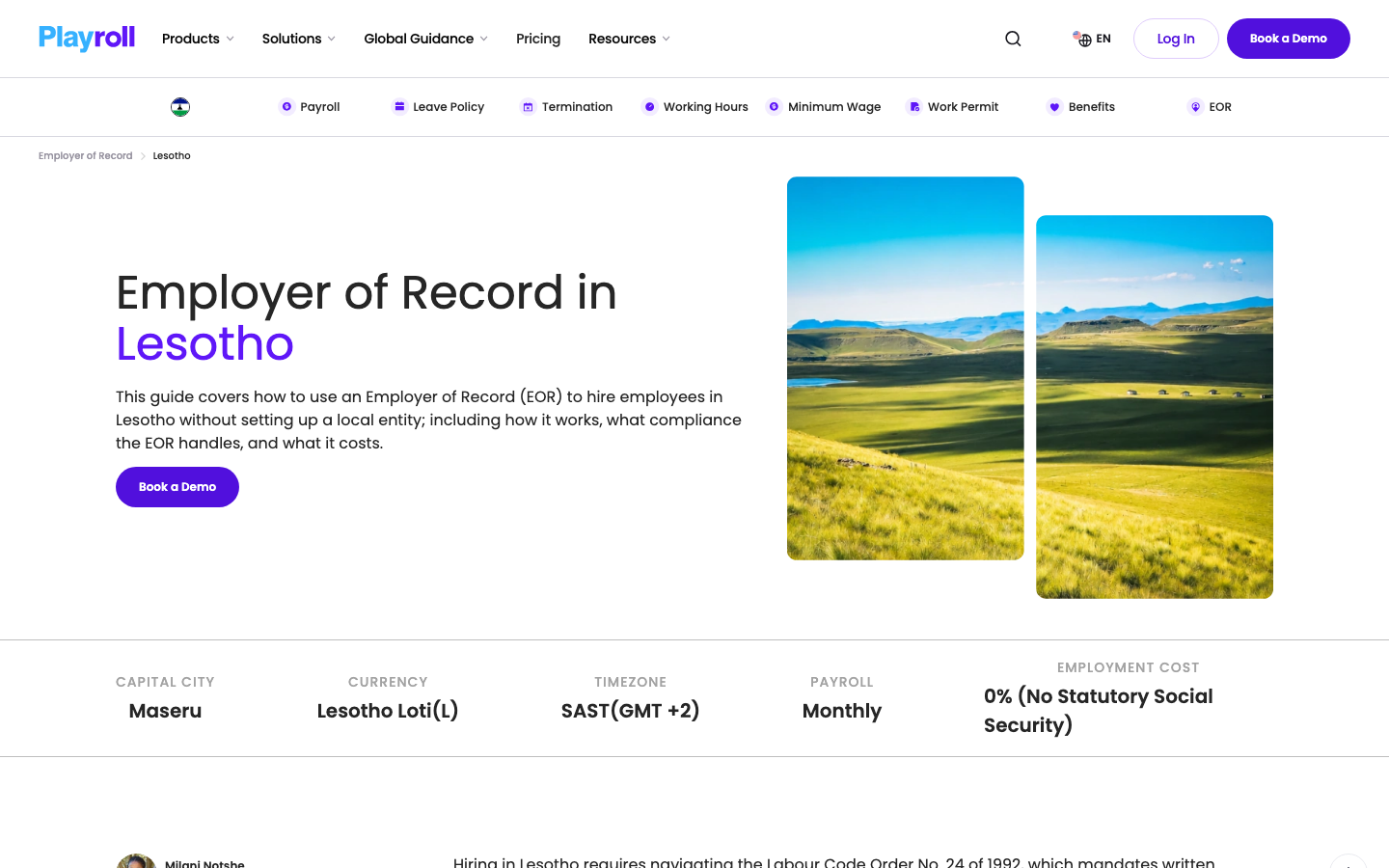
Playroll publishes a starting fee on its Lesotho page, updated on 16 October 2026. Its legal section still cites the Labor Code Order of 1992 and an Employment Act of 1967, and it never mentions the 2024 Act.
Key Specialty Area:
Lesotho price floor published up front
Service Cost:
From $399 per employee per month, per the company
Top Advantages
- Starting fee shown before any sales call
- EOR fee billed separately from payroll
- Later move to your own entity supported
Scope of Services
- Contract preparation and government registrations
- Monthly payroll and statutory filings
- Entity incorporation through Global Entity Setup
Our Verdict
Shortlist it for a clear budget line, then check the contract against current law.
*As pricing is subject to change, we are listing prices as they stand in November 2026
RemotePeople
Provider Type:
Global
Company Description:
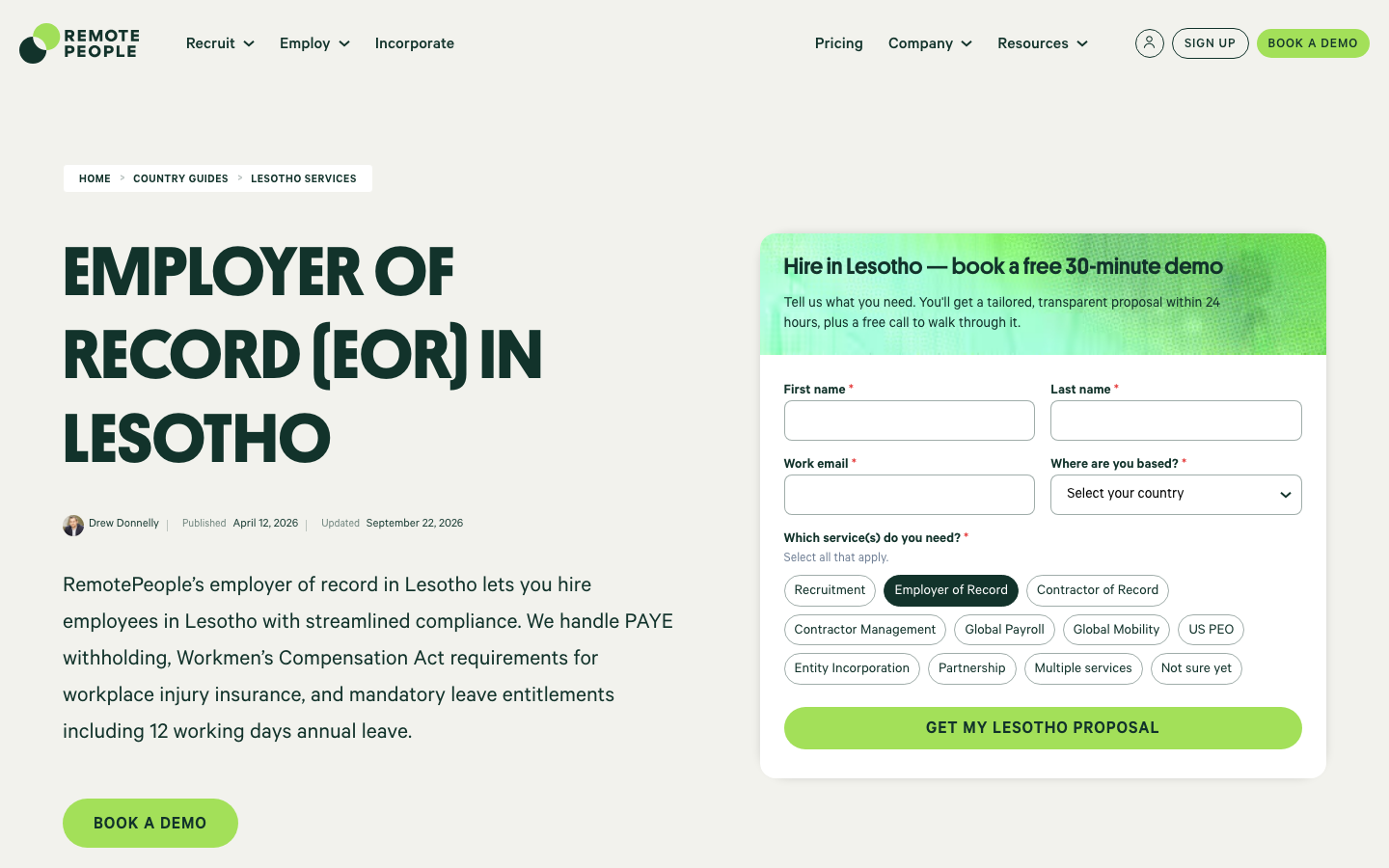
RemotePeople offers more Lesotho detail than any rival on this list, posted in April and revised in September 2026. It cites the Labor Act No. 3 of 2024 with its start date and shows a fee range, though it says paternity leave does not exist.
Key Specialty Area:
Cites the current Act and shows fees
Service Cost:
$300 to $600 per employee per month, per the company
Top Advantages
- Names the 2024 Act and its start date
- States there is no mandatory pension contribution
- Publishes a fee range and total cost estimate
Scope of Services
- Employment contracts and PAYE withholding
- Work permit applications for foreign hires
- Leave, benefits and termination administration
Our Verdict
The page I would read first, while correcting its paternity line against section 191.
*As pricing is subject to change, we are listing prices as they stand in November 2026
Safeguard Global
Provider Type:
Global
Company Description:
Safeguard Global says it can hire and pay in Lesotho with no entity required. Its Lesotho pages also cover payroll, recruiting, employment law, and immigration, yet none lists a rate or threshold.
Key Specialty Area:
Recruiting, payroll, and EOR under one roof
Service Cost:
Quote-based
Top Advantages
- Separate Lesotho pages for payroll and immigration
- Says new hires can start within 2 weeks
- Recruitment and hiring handled by one team
Scope of Services
- Legal employer hiring with onboarding included
- Global payroll and contractor management
- International entity setup and accounting support
Our Verdict
Sensible when Lesotho joins a global payroll you already run with them.
Talent Grid Africa
Provider Type:
Regional, African coverage with no headquarters city given
Company Description:
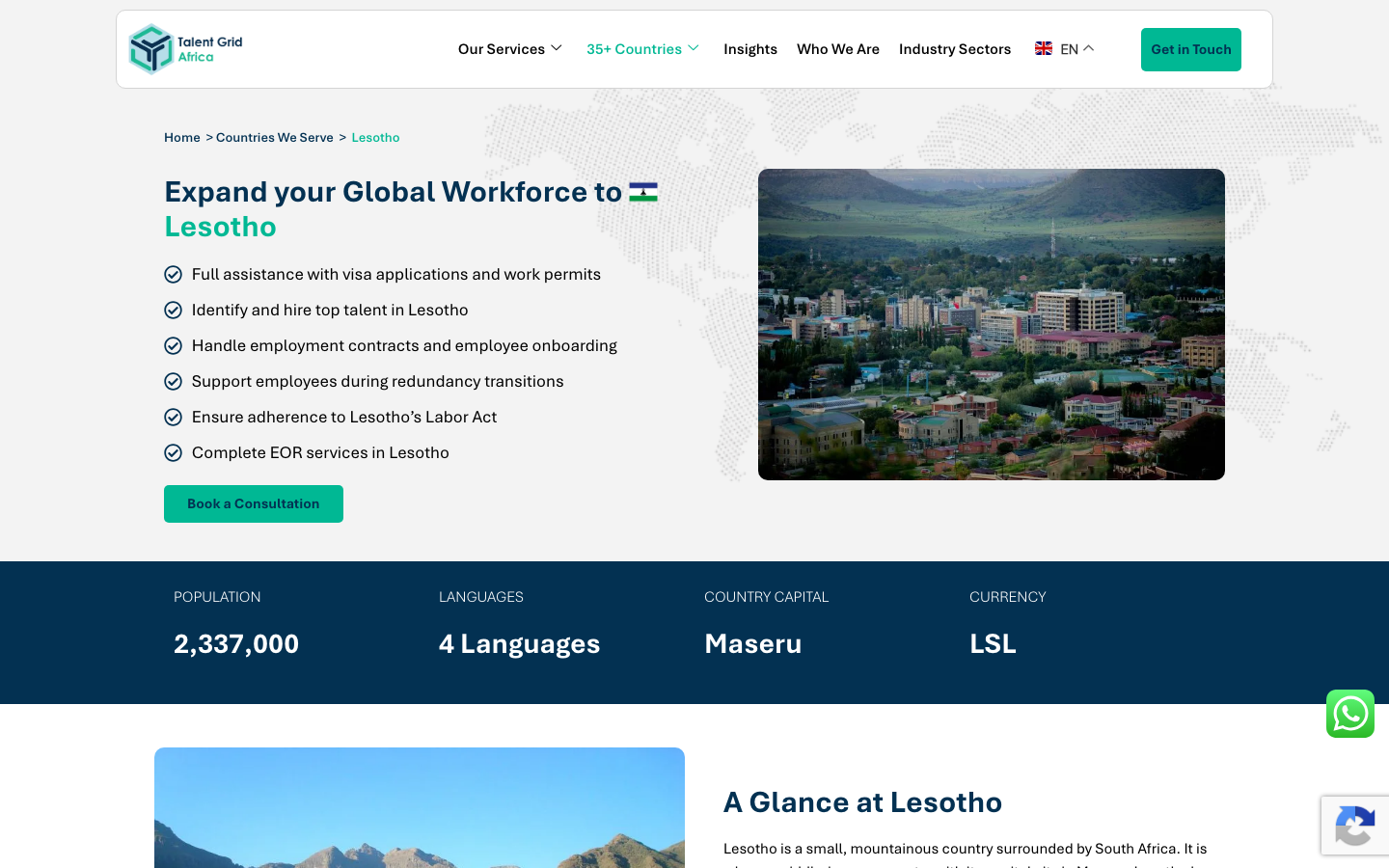
Talent Grid Africa covers more than 35 African countries and says the 2024 Act replaced the 1992 Order. Its EOR Lesotho page also claims mandatory pension and health insurance contributions, which no official source supports.
Key Specialty Area:
Names the 2024 Act on its page
Service Cost:
Quote-based
Top Advantages
- Africa-focused team across 35-plus countries
- Redundancy support for departing employees
- Consultation booked directly from the page
Scope of Services
- Employment contracts and employee onboarding
- Payroll processing and tax compliance
- Redundancy and transition support for employees
Our Verdict
Credit for the statute, but strike its contribution claims before accepting a cost model.
Workpay
Provider Type:
Regional (Africa), Nairobi office at Westpark Towers
Company Description:
Workpay says it acts as the legal employer across more than 35 countries. Its Lesotho guide shows employer taxes of 0% but names no statute. Its maternity rule of 12 weeks after 2 years predates the 2024 Act.
Key Specialty Area:
African payroll software with EOR attached
Service Cost:
Quote-based
Top Advantages
- Payroll software and EOR in one product
- Public holiday list on the country guide
- Support lines in Kenya and Nigeria
Scope of Services
- Full-time hiring with Workpay as legal employer
- Payroll, tax and compliance handling
- Contracts issued and staff onboarded quickly
Our Verdict
A practical fit for teams already running African payroll on Workpay.
INSIGHT: What does an EOR in Lesotho cost?
Only 2 providers publish a fee, and 1 adds a total employer cost, which is rare. The statutory load underneath is the part published pages disagree on.
- Published fees: Playroll starts from $399 per employee per month, and RemotePeople quotes $300 to $600 (both checked October 2026). These are figures from 2 companies, not a market rate.
- RemotePeople puts the total monthly cost at about 19% to 20% above gross salary. That is its own estimate, and it assumes employer charges that official sources do not confirm.
- Confirmed statutory load: no employer pension or social security contribution, plus work injury cover under the 1977 Act (SSA). Published figures for this load range from 0% to 10%.
- Ask for separate lines: management fee, work injury premium, PAYE pass-through, severance accrual at 2 weeks per year, and work permit costs.
Lesotho sits entirely inside South Africa, and the 2 currencies are linked. If a role could sit on either side of the border, my South Africa EOR guide covers the larger market.
For another Common Monetary Area member with a rand-linked currency, see my notes on employer of record in Namibia.
Botswana shares the customs union but has its own currency, so my Botswana EOR services guide offers a useful contrast. A shared currency area is not shared law, though. An EOR in Lesotho still follows its own 2024 Act, wage schedule, and cost base.
What to Know About EOR Lesotho: FAQs
Which law governs employment in Lesotho?
The Labor Act No. 3 of 2024 does. It was gazetted on 2 April 2024, took effect on publication, and section 219 repealed the Labor Code Order, 1992. It covers private and public service but excludes the army, police, national security and correctional services. It also establishes the National Advisory Committee on Labor, a wages board, and the Directorate of Dispute Prevention and Resolution (DDPR). Any guide still calling the 1992 Order current is out of date.
What leave are employees entitled to?
Annual leave accrues at 1 working day per month, with at least 12 working days a year. Sick leave is unpaid in the first 6 months, then 12 days on full pay. After a year, it is 12 days on full pay plus 24 days on half pay. Maternity leave covers about 14 weeks, 7 before birth and 7 after. The 2024 Act also added 14 days of paternity leave, 14 days of adoption bonding leave and 5 days of bereavement leave.
What does an employer pay on top of salary?
There is no employer pension or social security contribution. Work injury is an employer liability under the Workmen’s Compensation Act of 1977 and is normally insured. Employees pay PAYE at 20% on the first M77,760 a year and 30% above. A tax credit of M12,240 is then deducted from the tax computed, which differs from an exempt band. Published estimates of the employer load vary widely, and RSL settles the tax side.
Is there a minimum wage in Lesotho?
There is no single national rate. Legal Notice No. 54 of 2026 sets sector minimums from 1 April 2026, after review by the Wages Board. In year 1, a textile general worker earns at least M2,834 a month, a construction worker M3,371, and a domestic worker M911. Any single figure quoted as the national minimum usually belongs to one sector, so several conflicting amounts circulate. Employers must also display the current notice at the workplace (section 170).
How do I choose between these providers?
Ask whether the provider holds its own local entity or uses a partner, and whether it works from the 2024 Act or the repealed Order. Check which employer charges the quote assumes and how the sector wage schedule applies. Confirm that severance is accrued from year 1. Insist on a written quote that separates the fee, statutory pass-through items, and contingent liabilities, since just 2 firms on this list show any price.

Helen is Anywherer’s Market Analyst & Content Researcher, with extensive experience in analyzing global employment markets and HR technology trends. She is skilled at turning complex market data into clear, well-researched insights that inform every piece of content. With a strong grasp of the EOR, PEO, and international hiring space, Helen plays a key role in keeping Anywherer’s research accurate, up to date, and genuinely useful for readers.