Under an employer of record arrangement, one firm becomes the worker’s legal employer while a business elsewhere receives the work. That firm issues the contract, runs payroll, and pays the statutory contributions. The client still decides what the worker does each day—nothing about the job changes for the employee except the name on the payslip.
Palau changes the usual calculation in 2 ways. Wages are paid in US dollars, the official currency, so no exchange step is needed. The law also guarantees very few private-sector benefits. A Palau employer of record contract therefore sets leave and overtime itself instead of copying a statutory minimum.
Hiring in Palau: What the Rules Actually Require
Hiring through an employer of record Palau arrangement takes you to a western Pacific archipelago of several hundred islands, only a handful of them inhabited. The capital is Ngerulmud on Babeldaob, while Koror is the largest town and the commercial center where nearly all hiring happens. The World Bank estimated the population at 17,663 in 2025 and the economy at $345 million, which grew 6.3% that year. The country has 2 official languages, Palauan and English, and contracts and business correspondence run in English.
Tourism and hospitality employ the most people, followed by marine services, fisheries, construction, telecommunications, and professional and financial services. Conservation groups and donor-funded programs are unusually visible here because of the national marine sanctuary. Local labor is scarce, so many private employers bring in staff from abroad, mostly from the Philippines. A foreign company can still employ someone in Koror without opening a branch by using a partner that already holds a local registration.
Put simply, the provider is a third-party legal entity that signs on staff for an overseas client, carries the local duties, and runs payroll. The client manages the work. An employer of record in Palau signs a written contract under the Palau National Code and pays wages in dollars. It withholds wages and salaries tax at 6%, 10%, and 12% for the Bureau of Revenue and Taxation, with no tax-free band. It reports Social Security and Healthcare Fund (HCF) contributions each quarter to the Republic of Palau Social Security Administration (ROPSSA). For a non-citizen, it also runs the permit sequence through the Division of Employment Services (DES).
The field is small. I found 6 providers with a genuine Palau page, and that is the whole list, not a shortlist. None is based in Palau. I checked several familiar platforms and excluded them because their Palau pages offered contractors only, described another country, or didn’t exist. Each entry below sets out scope and strengths so the 6 can be compared directly.

INSIGHT: What does a Palau employer actually pay on top of salary?

The employer load is 2 contributions and nothing else, paid in dollars. The 9.5% rate stays the same at every salary level.
- Social Security: 7% from the employer and 7% from the employee, paid each quarter, 1 month after it ends (ROPSSA, checked October 2026).
- Healthcare Fund: 2.5% from each side. The employee’s half goes to a personal Medical Savings Account (MSA), the employer’s half to the pooled National Health Insurance (NHI) account.
- Combined employer cost: 9.5%, with no wage ceiling on either fund. The Social Security cap was abolished on 1 October 2017 (41 PNCA § 742).
- Minimum wage: $5.00 an hour since 1 October 2025. The government-backed ILO guide (May 2026) applies it to migrant workers too.
What Palau Law Does Not Require
Private employers in Palau owe no statutory vacation, sick, maternity, paternity, or overtime pay. The International Labor Organization guide, written with the Ministry of Human Resources, Culture, Tourism and Development, says so directly. It rests on Title 13 of the Palau National Code and the Division of Labor Rules and Regulations 2019. The rules require 1 day off each week, with 10 continuous hours of rest between 6 a.m. and 6 p.m.
In practice, the contract provides all entitlements, so drafting it is the main compliance task. The ILO guide records common practice. Contracts run 12 or 24 months, and sick leave is usually 5 working days per term. Vacation must be taken rather than paid out. Those are habits, not legal minimums. Several published hiring guides still list leave as mandatory, so a budget based on one of them would cover costs the law does not require.
Ending a job also triggers a rule that surprises many employers. A foreign worker whose employment ends generally cannot work for another employer in Palau for 5 years. The ILO guide lists 3 exceptions. The worker is married to a Palauan citizen, or the employer died, sold, or closed the business, and the new owner keeps the worker. The third is the employer’s conviction for a crime against the worker or dependents. Because the provider is the legal employer, moving between providers or onto your own entity isn’t routine paperwork. Ask any Palau employer of record how it handles this before signing.
INSIGHT: Palau’s minimum wage rose to $5.00 in October 2025
The wage floor has climbed twice since 2024. Some published hiring guidance has not caught up, and at least 1 platform still shows a rate from an earlier era.
- Current rate: $5.00 an hour from 1 October 2025, set by Public Law 11-34, signed on 10 June 2024 (Marianas Business Journal).
- Path: $3.50 for almost a decade, $4.25 from 1 October 2024, then $5.00 a year later (Islands Business, June 2024).
- Exempt: students, non-profit staff, and up to 2 farmers and 2 domestic helpers per employer. Workers aged 20 or younger on probation for up to 90 days are also exempt. No employer may have more than 10 exempt workers.
- Foreign workers: the ILO guide, prepared for migrant workers with the DES, applies the $5.00 floor without a nationality exemption. 1 wage tracker still lists foreign workers as excluded, so get written confirmation from the DES.
What Is the Best EOR Option in Palau?
No local provider exists for an EOR Palau hire, so every option is a global platform reaching in. That turns 3 questions into the core of the decision. Which legal entity will sign the employment contract? Does it hold a Palau business license and an employer number with ROPSSA? Has it already run a Palau payroll, or would yours be the first?
A global platform still has real advantages. You get one contract format, one login, and one compliance standard across every country you hire in, and dollar payroll needs no conversion. Published Palau detail across the 6 ranges from nothing at all to a full country library. Content depth isn’t the same as on-the-ground depth, and some of the most detailed pages have the most errors.
4 questions often get skipped. Does the quote cover the foreign worker sequence, or only the employment itself? Who pays the return airfare at the end? What does the contract promise on leave, given that the law promises nothing? How is the 5-year bar handled if the engagement ends early? Ask for all 4 answers in writing, because only 1 of the 6 publishes a fee at all.
6 Providers Offering Palau EOR Services
I reviewed global platforms that list employment, payroll, or EOR in Palau on a page built for the country, not as a dropdown option. My criteria were dollar payroll, wages and salaries tax withholding, ROPSSA registration with quarterly filing, foreign worker sponsorship, and pricing transparency. These 6 cover the entire field, and I found no Palau-based provider. Large platforms were excluded when their Palau pages were contractor-only, copied from another country, or missing. A single provider shows its price.
Providers appear in A-to-Z order. The sequence says nothing about quality, preference, or ranking.
Global Expansion
Provider Type:
Global platform, dedicated Palau country page
Company Description:
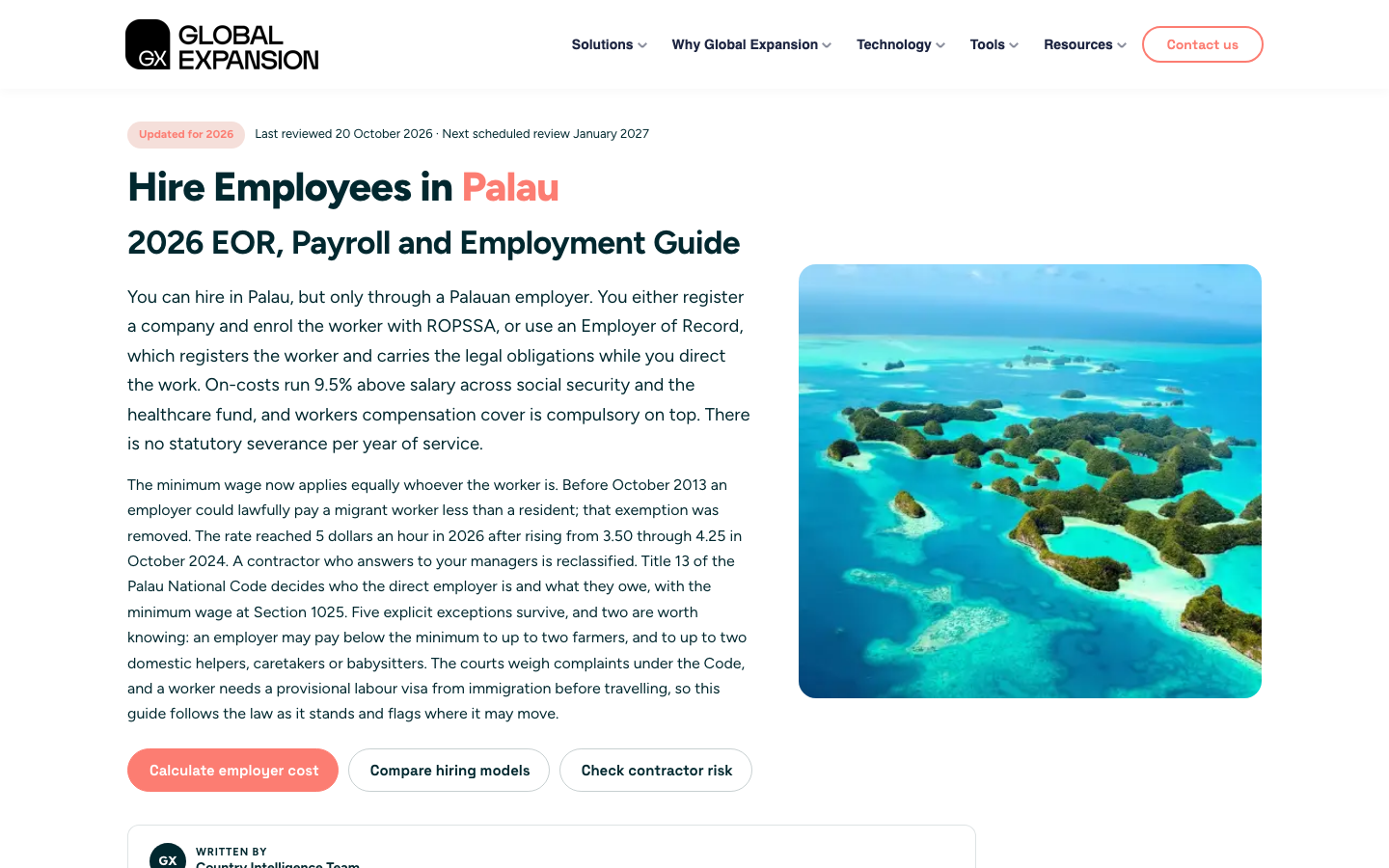
Global Expansion publishes a Palau entry in its Countrypedia series covering EOR, payroll, and employment, last reviewed on 20 October 2026. Palau is one of many markets it serves.
Key Specialty Area:
Freshest review date among the 6 Palau pages
Service Cost:
Quote-based
Top Advantages
- Correct 7% and 2.5% contribution split shown
- Full minimum wage history through $5.00
- Marks unconfirmed figures instead of guessing
Scope of Services:
- EOR contracts for workers hired in Koror
- Quarterly ROPSSA and Healthcare Fund filing
- Employer cost modeling and onboarding
It states that Palau has no statutory severance based on years of service. The 3-to-6-week onboarding time and the 12-to-20-hire entity break-even are company estimates.
Our Verdict
What I would open first to sense-check a quote against current law.
Gracemark Global
Provider Type:
Global platform, Palau planning guide
Company Description:
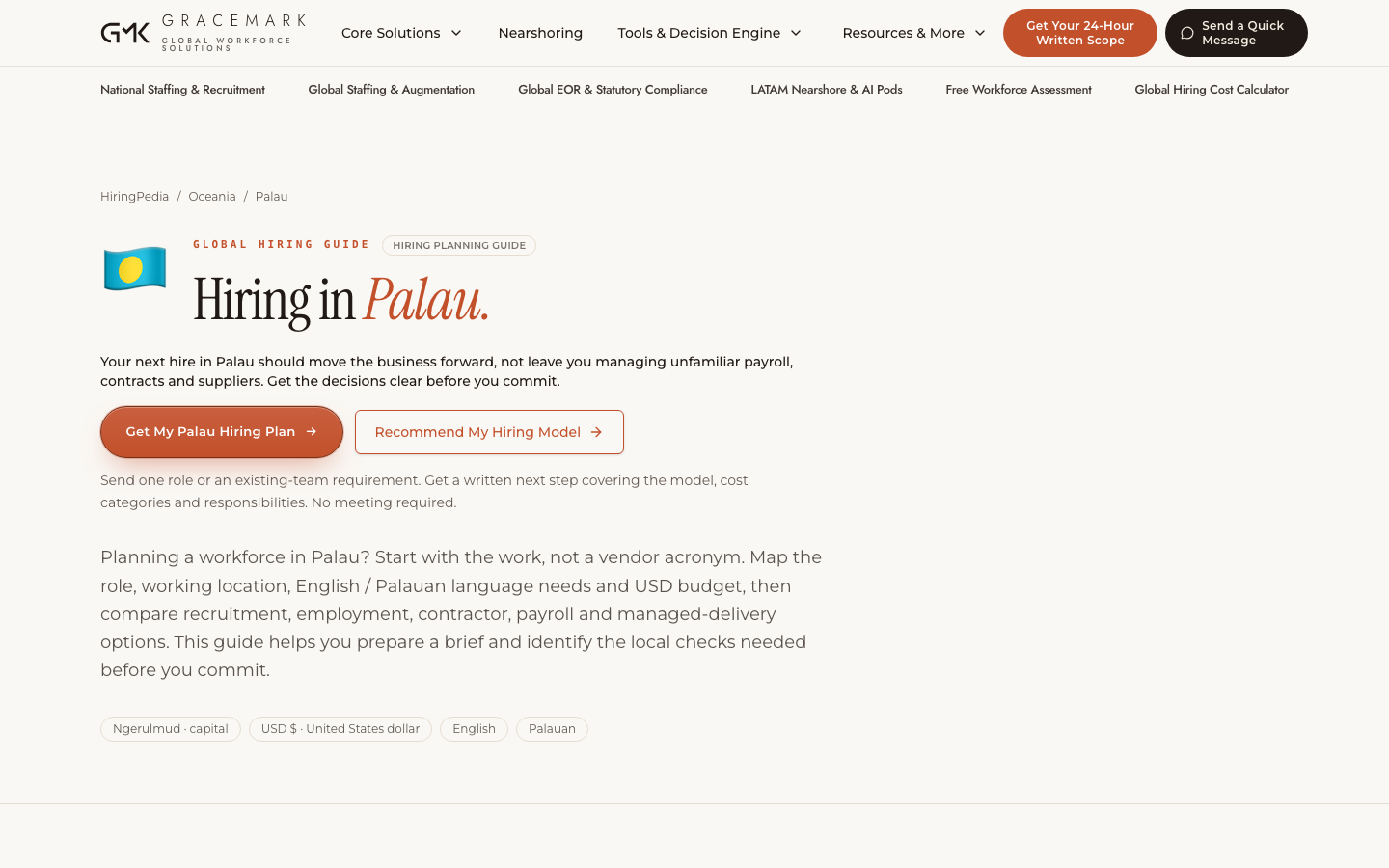
Gracemark Global covers Palau through a HiringPedia planning guide rather than a service page. It offers recruitment, employment of a selected worker, pay for an existing team, or a managed service across 100+ countries.
Key Specialty Area:
Candid planning guide with a stated 24-hour scope
Service Cost:
Quote-based
Top Advantages
- Openly says it publishes no verified rates
- Lists the checks a buyer should run
- Written next step without a required meeting
Scope of Services:
- Employment of an already selected worker
- Recruitment and sourcing for Palau roles
- Payroll for existing teams or managed delivery
The page never says outright that Gracemark acts as employer of record in Palau, so ask which entity would employ the worker.
Our Verdict
I would shortlist it when the right hiring model is still undecided.
Lano
Provider Type:
Global platform, dedicated Palau hiring page
Company Description:
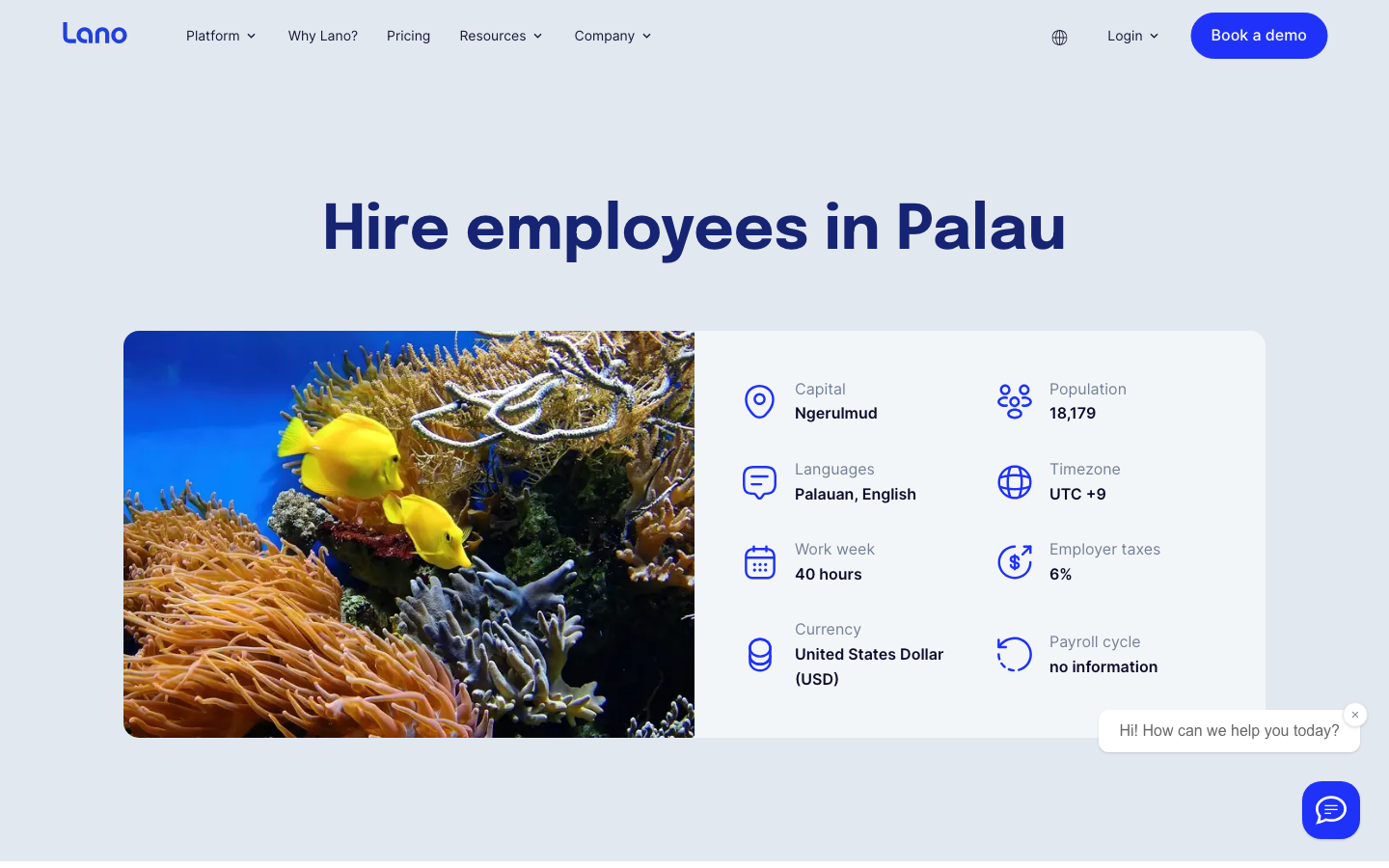
Lano, from Lano Software GmbH, offers to hire full-time employees or contractors in Palau without a local entity. Its Palau page is brief, and the country is one entry in a wider global payroll catalog.
Key Specialty Area:
Freelancers and salaried hires paid side by side
Service Cost:
Quote-based
Top Advantages
- Staff and freelancers run on one system
- Payroll consolidation across several countries
- Built-in wallet for cross-border pay
Scope of Services:
- Contracts drafted without forming a Palau company
- Global payroll and multi-country payroll runs
- Contractor management and contractor payments
Its short fact panel shows employer taxes of 6% against the 9.5% ROPSSA total, so use the page for scope only.
Our Verdict
Worth a call if Palau joins a payroll already run on Lano.
Multiplier
Provider Type:
Global platform, Palau country guide plus work permit page
Company Description:
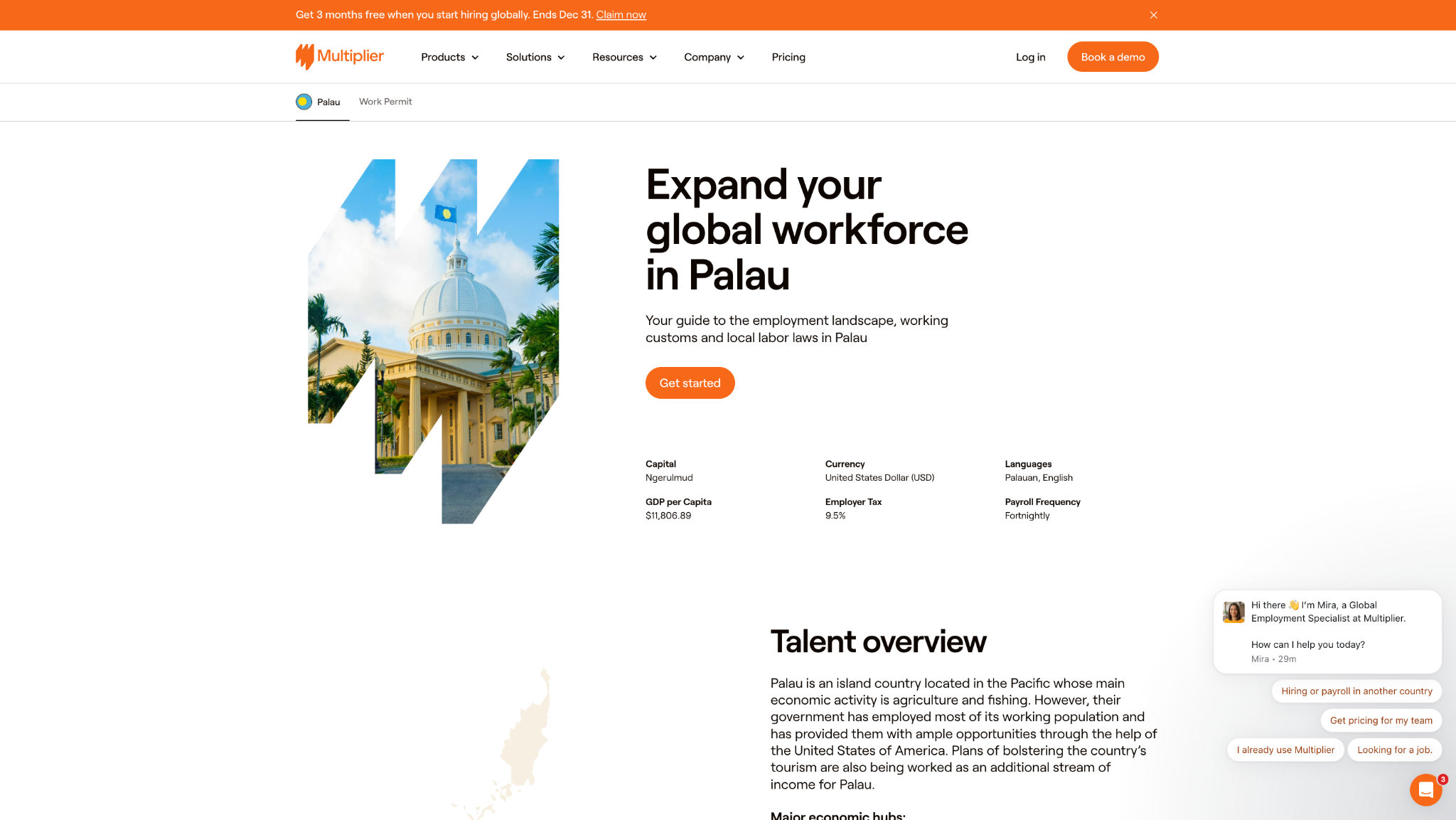
Multiplier describes itself as a global employment and payroll provider covering 150+ countries. Its Palau guide sits beside a separate Palau work permit page that explains its sponsorship role.
Key Specialty Area:
Stand-alone Palau work permit page
Service Cost:
Quote-based
Top Advantages
- Correct 6%, 10%, and 12% tax bands
- Dedicated Palau page on permit sponsorship
- EOR and payroll bought from one vendor
Scope of Services:
- Palau EOR contracts and onboarding
- Dollar payroll with graduated tax withheld
- Sponsorship for non-resident worker permits
The page lists a $3 minimum wage and calls up to 30 days of annual and sick leave mandatory. It adds 5 months of maternity leave, and its holiday table dates from 2023.
Our Verdict
My pick for a team that already runs payroll elsewhere on Multiplier.
Pebl
Provider Type:
Global platform, dedicated Palau EOR page
Company Description:
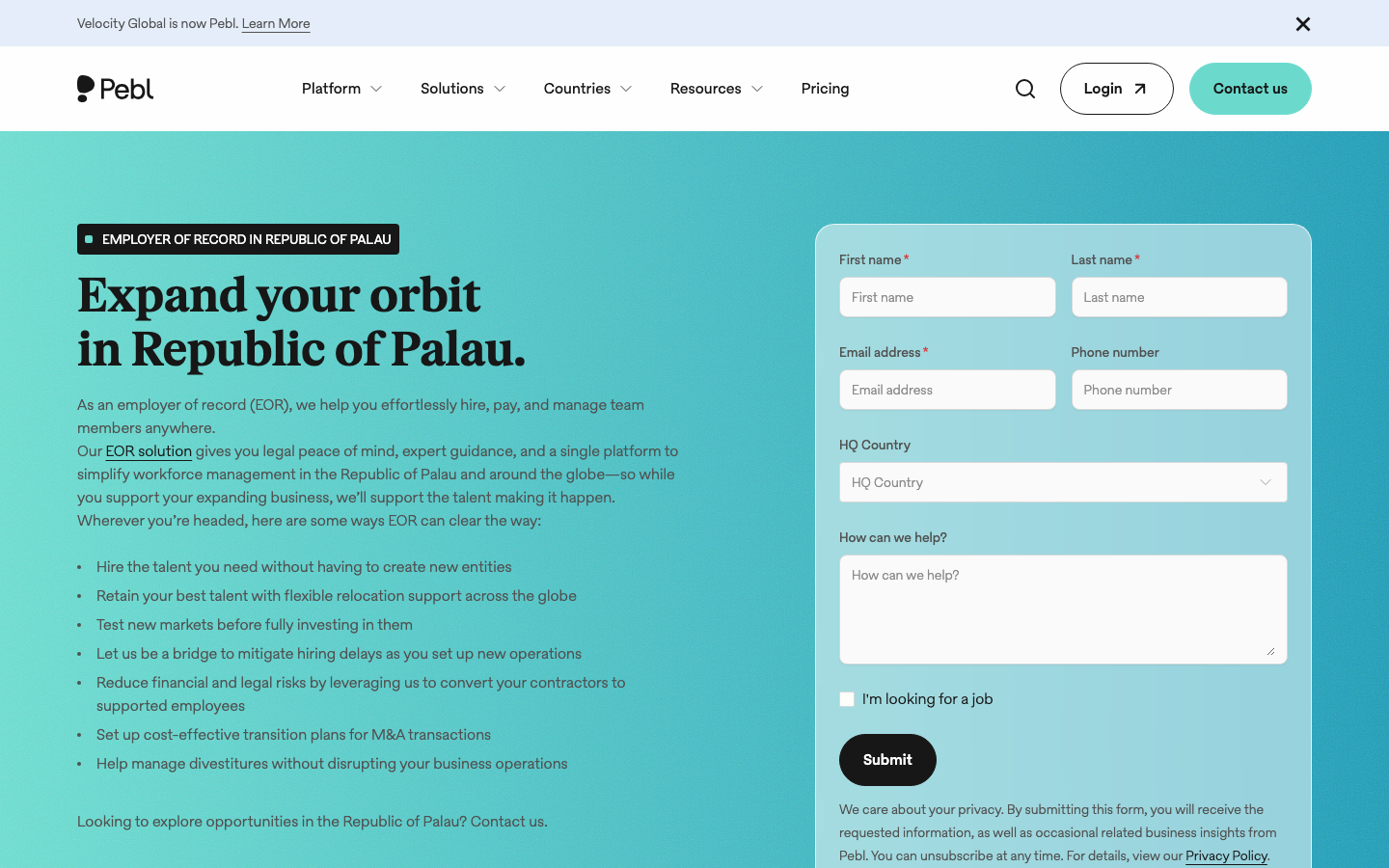
Pebl, formerly known as Velocity Global, offers an employer of record page for the Republic of Palau, listed among its Oceania markets.
Key Specialty Area:
Relocations, market tests and deal-related moves
Service Cost:
Quote-based
Top Advantages
- Hires without creating a new entity
- Relocation support for moving existing staff
- Bridge cover while an entity is formed
Scope of Services:
- Palau hires placed on its employment books
- Contractor conversion to supported employees
- Transition support during M&A or divestitures
A banner confirms that Velocity Global is now Pebl. The page publishes no Palau statutory figures so that detail will arrive with the quote.
Our Verdict
The name I would call about moving a current employee to Koror.
RemotePeople
Provider Type:
Global platform, Palau EOR page with sub-guides
Company Description:
RemotePeople publishes the deepest Palau content in the set, including separate minimum wage, payroll tax, and work visa pages. It published its main page in April 2026 and updated it in September 2026.
Key Specialty Area:
The single public price list for Palau
Service Cost:
$400 to $700 per employee per month; permit sponsorship $1,500 to $3,000 once
Top Advantages
- Current $5.00 minimum wage shown
- Fee and sponsorship priced as separate lines
- Separate sub-pages on tax and visas
Scope of Services:
- Employment contracts under Palau law
- Non-resident worker permit sponsorship and renewals
- Quarterly wages tax and ROPSSA filing
Its $8,000 quarterly Social Security ceiling was abolished in 2017, and its leave figures come from public service rules.
Our Verdict
Where I would start if budget certainty matters before any sales call
*As pricing is subject to change, we are listing prices as they stand in October 2026
INSIGHT: What does an EOR in Palau cost?
1 provider publishes a monthly fee, and nobody else publishes anything. The statutory load is light, and foreign worker sponsorship is the surprise.
- Service fee: $400 to $700 per employee per month, as published by RemotePeople in September 2026. Treat it as one company’s list price rather than a benchmark.
- Sponsorship: RemotePeople lists permit sponsorship separately as a one-time charge of $1,500 to $3,000, plus government fees.
- Official permit fees: $150 for 1 year or $300 for 2 years for skilled workers. Unskilled permits cost $125 or $250, plus a $25 application fee (ILO guide, May 2026).
- Statutory load: 9.5% to ROPSSA. Ask for the fee, wages tax pass-through, both funds, permit costs, and the return airfare on separate lines.
Most of Palau’s foreign workforce comes from the Philippines. If a role could sit in either country, start with my Philippines EOR guide.
Readers planning across the Pacific rather than hiring once can compare an employer of record in Fiji, the closest Pacific comparison on this site.
By contrast, Papua New Guinea EOR services use a local currency and a higher statutory floor. Palau’s thin legal minimums, dollar payroll, and 5-year re-employment bar apply only to an EOR in Palau and don’t carry across the region.
What to Know About EOR Palau: FAQs
What leave are employees entitled to in Palau?
None by statute in the private sector. The International Labor Organization guide published in May 2026 confirms that the law sets no minimum vacation, sick, maternity, or paternity leave. The contract must create each one. Common practice is about 5 working days of sick leave per contract term, and vacation must be taken rather than cashed out. The rules do require 1 day off each week with 10 continuous hours of rest.
What does an employer contribute in Palau?
The employer pays 7% of gross wages to Social Security and 2.5% to the Healthcare Fund, a total of 9.5%. The employee pays the same amounts. Both are reported and paid every quarter, due 1 month after the quarter ends. The employee’s Healthcare Fund share builds a personal Medical Savings Account, while the employer’s share funds pooled national insurance. Neither fund applies a wage ceiling.
What is the minimum wage in Palau?
The rate is $5.00 an hour from 1 October 2025, up from $4.25 a year earlier and $3.50 before that. Exemptions cover up to 2 farmers and 2 domestic helpers per employer, students, non-profit staff, and workers aged 20 or younger on short probation. No employer may have more than 10 exempt workers. The government-backed migrant worker guide applies the rate to foreign workers, and the Division of Employment Services can confirm this in writing.
How do I hire a foreign worker in Palau?
The Division of Employment Services first advertises the job locally for 30 days. If no citizen qualifies, the employer applies, and a decision takes about 10 working days. An approved worker enters on a Provisional Labor Visa (PLV), then gets a Social Security number and a health check within 10 days. The permit follows in 1 or 2 working days and costs $125 to $300. The sequence, not the fee, sets the timeline.
What happens when an employment ends?
Standard contracts require 10 working days’ notice from either side. The employer must tell the Division of Employment Services in writing at least 5 days before the end date and explain any early termination. It also pays the worker’s airfare home, but only after the worker breaches the contract. The worker generally cannot join another Palau employer for 5 years, with narrow exceptions such as marriage to a citizen.
How do I choose between these providers?
Start with track record: has the provider paid anyone in Palau before, and whose name goes on the contract? Check whether the quote covers foreign worker sponsorship or only the employment. Read the contract for what it says about leave, since the law requires none, and how it handles airfare and the 5-year bar. Get the price split into fee, statutory costs, and one-time charges, because only 1 of the 6 publishes a fee.

Helen is Anywherer’s Market Analyst & Content Researcher, with extensive experience in analyzing global employment markets and HR technology trends. She is skilled at turning complex market data into clear, well-researched insights that inform every piece of content. With a strong grasp of the EOR, PEO, and international hiring space, Helen plays a key role in keeping Anywherer’s research accurate, up to date, and genuinely useful for readers.