Staffing agency software is organized around a business model rather than a hiring process. Your agency recruits for a paying client. The system therefore has to hold client records, the job orders those clients place, and the submittals you send them. It also has to track the fee or margin each placement earns. On a temp desk, it also has to capture timesheets and run pay and bill. That extra machinery is what separates the best staffing software from a corporate hiring tool. It is also why agency owners cannot shop the same shortlist as an in-house talent team.
The category matters because the work is enormous and thin on margin. The American Staffing Association reports that nearly 2.2 million temporary and contract employees worked for America’s staffing companies during an average week in 2024. That work is spread across roughly 27,000 firms running close to 54,000 offices. Two things follow for anyone buying software in 2026. Speed to submit decides who wins the job order, and contractor compliance decides whether the placement stays profitable once it is filled.

INSIGHT: How much hiring actually runs through staffing agencies?

Agencies place a large share of the temporary and contract workforce. That is why their software is its own product category rather than a variant of corporate hiring tools.
- Nearly 2.2 million temporary and contract employees worked for America’s staffing companies during an average week in 2024 (ASA, read 26 August 2026).
- About 27,000 US staffing and recruiting firms run close to 54,000 offices, and roughly 57% of those firms and 76% of those offices sit in the temporary and contract sector (ASA, read 26 August 2026).
- US staffing sales came to $27.6 billion in the first quarter of 2026 (ASA, published 25 June 2026).
- What that means for software: the platform has to bill a client, not just track a candidate.
What Is the Best Staffing Agency Software in 2026?
So there is no single winner, and any page that names one is guessing at your desk. What actually decides a shortlist is whether you place people on your client’s payroll or on your own. Buyers searching for top recruitment software for staffing agencies are usually two different buyers wearing the same job title. One needs sourcing and fee tracking. The other needs shift scheduling and a clean pay run. Note too that this page reviews the software agencies buy, not the firms themselves, which Anywherer covers separately under recruitment agencies by country.
Below, I’ve reviewed 10 of the leading platforms in A-Z order.
INSIGHT: What does agency software have that a corporate ATS does not?
Five things, and each one exists because there is a paying client on the other side of the placement.
- Client and contact records with job orders attached, so the agency tracks the buyer and not only the candidate.
- Submittals and client portals, where candidates are presented for approval and the hiring manager’s feedback flows back into the pipeline.
- Fees, splits, and margin, with revenue attached to a placement and often divided between the recruiters who worked it.
- Temp machinery: timesheets, pay and bill, and redeployment, which only earns its keep if you place contract workers.
- Assignment records that carry pay and bill rates plus start and end dates, which a corporate ATS has no reason to model at all.
Here is how the best staffing agency software compares before you read a single review. Desk fit is the first column on purpose, because it rules platforms in or out faster than any feature does.
Read the rest as a filter, not a scoreboard. Among the top recruiting tools for staffing agencies, the back office column changes the most decisions. A native pay run and an exported one make for very different month-ends.
| Tool | Desk fit | Back office | Client CRM and job orders | AI capability | G2 rating |
|---|---|---|---|---|---|
| Avionté | Temp and contract | Native pay and bill | Yes | AI for job creation, candidate discovery, and screening | 4.3 (466) |
| Ceipal | Temp and contract | Workforce management and invoicing | Yes | AI matching plus sourcing and outreach agents | 4.7 (1,502) |
| Crelate | Perm and search | Timekeeping and invoicing, payroll export | Yes | Co-Pilot, Discovery Agent, Insights Agent | 4.4 (221) |
| JobAdder | Both | Via integration, exports to payroll and billing | Yes | Adder Intelligence | 4.4 (146) |
| JobDiva | Temp and contract | Native pay and bill (DivaFinancials) | Yes | JobDiva AI with patented matching | 4.7 (1,847) |
| Loxo | Perm and search | None | Yes | AI sourcing across an 850 million person talent graph | 4.6 (171) |
| PCRecruiter | Perm and search | None | Yes | Natural language database search and AI matching | 4.4 (232) |
| Recruit CRM | Both | Timesheets, invoicing, contractor pay | Yes | AI agents for sourcing, matching, and submittals | 4.8 (116) |
| Recruiterflow | Perm and search | None | Yes | AIRA search, source, and notetaker | 4.6 (201) |
| Vincere | Both | Timesheets, expenses, invoicing, leave | Yes | Copilot AI and agentic modules | 4.5 (403) |
G2 scores were read from each vendor’s own product profile on 26 August 2026.
Temp Desk or Perm Desk: What Decides Your Shortlist
A perm or search desk sells one event. You find a person, present them, and invoice a fee when the client hires. Everything the software has to do well happens before that moment. That means sourcing, a database that stays warm for years, and client relationships measured in decades. It also means clean tracking of the fee and of any split, which is the division of one fee across two or more people. Pay-and-bill machinery adds nothing here, and a perm recruiter will never open it.
A temp or contract desk sells time, repeatedly, so the placement is the start of the work rather than the end of it. Staffing software can help manage these ongoing assignments, from job
orders and worker records to timesheets and other operational workflows.
Shifts get scheduled and hours get captured on a timesheet. The worker is paid at a pay rate, the client is billed at a bill rate, and the gap between the two is your margin. Add worker compliance and redeployment queues that move a contractor to the next assignment before the current one ends. Add job orders arriving through a VMS, the vendor management system a large employer uses to buy contract labor. Those programs often run through an MSP, a managed service provider sitting between you and the buyer. No perm-focused platform does any of that natively.
Hybrid desks are common, and the trade-off is worth saying out loud. Running both sides usually means buying the temp platform and accepting that perm recruiters will use half of it. The reverse rarely works, since bolting pay and bill onto a search tool means a second vendor and a monthly reconciliation. The best software for staffing companies with both desks is the one your perm team will tolerate in the front office.
One more line separates the category from corporate hiring tools. Agency platforms model the client: companies, contacts, job orders, submittals, fees, splits, and margin. Shoppers who type top recruiting crm software for staffing agencies aren’t looking for a sales CRM with a careers page attached. A corporate applicant tracking system has no concept of a paying customer. Our guide to those systems covers the distinction in more depth.
What Are the Best AI Tools for Staffing Firms?
The useful answer is narrower than the marketing. On an agency desk, AI earns its keep in five places. It searches a large candidate pool, parses resumes, and pulls skills out of a database you have been filling for a decade. It also matches people to open job orders, suggests redeployments, and drafts outbound sequences. Everything else is a demo.
Sourcing is where the ten diverge most. Anyone comparing top AI sourcing software for staffing firms should separate platforms that own a dataset from platforms that query yours. Loxo documents an 850 million-person talent graph it built itself, and Recruiterflow’s AIRA Source reaches a pool of similar scale. PCRecruiter and Crelate point their AI at your own database instead, which suits a firm whose asset is twenty years of records. That difference matters more than any feature list, and it echoes a pattern we traced in our roundup of AI tools across HR.
Matching and admin are the second cluster. Ceipal runs matching and ranking agents against its own database, and Recruit CRM ships agents that format resumes and assemble candidate submissions. JobDiva pairs patented search with harvesting, which refreshes talent pools from job board subscriptions you already pay for. Buyers weighing the best AI recruiting tools for staffing agencies should test these against their own messy data, not a clean demo tenant.
One caveat belongs here. Standalone AI sourcing products exist outside this list, and most agencies buy one alongside their platform rather than instead of it. Two of them are reviewed in a dedicated section at the end of this guide. Treat the AI column above as what each vendor documents today, not a promise about next quarter.
Best Staffing Software by Agency Type
Desk type narrows the field, and vertical narrows it again. A firm placing contract engineers through a VMS program has little in common with a two-person search boutique. The four groups below cover where readers usually land. Tools inside each are listed A to Z, and appearing in one group does not rule out another.
For IT and Technical Staffing
IT desks live on VMS flow and on knowing how long someone has used a technology. Ceipal was built around contract placement, carries its own Procurewise VMS, and integrates with the enterprise systems those programs run on. JobDiva calls itself the pioneer of VMS synchronization and pulls requisitions, timesheets, and expenses straight off the major systems. Loxo comes at it from the other end, with sourcing depth for the roles nobody has applied for. Together they cover most of what the best IT staffing software has to do.
Redeployment is the second test, and it is a revenue question. A contractor rolling off in three weeks is either your next placement or a competitor’s candidate. Anyone shortlisting the best software for technical staffing agencies should ask to see the queue that surfaces those people. The report that counts them afterward is no substitute.
For Legal Staffing
Legal work carries requirements the rest of the market does not share. Conflict checks run before a submittal, bar admission and credentials are tracked by jurisdiction, and contract attorneys on document review carry their own compliance rules. Billing is tied to a matter rather than a cost center. None of the ten is purpose-built for that, and pretending otherwise would not help you.
What comes closest is configurability plus contract billing. Crelate lets you model custom fields and workflows around credential checks. Recruit CRM adds timesheets and invoicing for document review teams, and Vincere carries contract lifecycle and invoicing alongside the front office. Anyone hunting the best recruitment software for legal staffing should budget for a conflicts process that lives partly outside the platform.
For Specialized and Niche Firms
Niche firms compete on a database nobody else has and on relationships measured in years. Crelate offers Boolean search across the full record set with saved criteria, and Loxo pairs its directory with a CRM built for retained work. PCRecruiter is unapologetically database-first, with a company-centric structure that follows a contact through job changes.
The requirement they share is memory. A candidate you spoke to in 2019 has to surface with the note attached, and a hiring manager who moved firms carries their history along. That is the real test for the best software for specialized staffing firms. It is also why migration quality matters more here than anywhere else on this page.
For New and Small Agencies
So what is the best staffing agency software for startups? Read startup here as a new agency rather than a tech company. The constraint is the same either way: no implementation budget and no time. Recruit CRM and Recruiterflow both publish a per-seat rate, start in days rather than quarters, and let you add seats as billers join.
Watch what happens at seat number ten. A rate that feels trivial for two recruiters is a real line item on a growing team. Seats are also easier to add than to remove. Decide on the year-two invoice rather than the opening one.
Staffing Agency Software Pricing
This category splits in half at the checkout, and saying so plainly is the most useful thing this page can offer. Perm and search platforms publish a per-seat rate you can act on the same afternoon. Temp and enterprise platforms quote instead. Their price tracks worker volume, payroll runs, and branch count rather than recruiter headcount, and only a call can size that.
Per-seat pricing also compounds, which is the trap. Work out your annual bill at today’s seat count, then at a realistic count eighteen months out. Then ask what happens if you shrink, because reducing seats mid-contract is rarely as simple as adding them. Every figure below came from the vendor’s own page on 26 August 2026, and third-party estimates were excluded.
| Tool | Pricing model | Free plan or trial | Starting price |
|---|---|---|---|
| Avionté | Quote based | Demo only | Custom pricing |
| Ceipal | Quote based | Demo only | Custom pricing |
| Crelate | Per seat | Free trial | $85 per user per month, Essentials, paid annually |
| JobAdder | Quote based | Free demo | Custom pricing |
| JobDiva | Quote based | Live demo only | Custom pricing |
| Loxo | Per seat | 7-day free trial | $149 per user per month, Core, billed annually |
| PCRecruiter | Per seat | Demo only | Around $115 per user per month, per the vendor FAQ |
| Recruit CRM | Per seat | 30-day free trial | €79 per user per month, Pro |
| Recruiterflow | Per seat | Demo only | $149 per user per month, Platform plan |
| Vincere | Per seat plus AI modules | AI module trial | £69 per user per month for CRM and ATS |
As pricing is subject to change, prices are listed as of August 2026.
INSIGHT: Why do perm platforms publish prices and temp platforms not?
Because perm software is priced per recruiter, a number you already know. Temp software is priced against worker volume, payroll runs, and branches, which only a sales conversation can size.
- Six of the ten publish a usable starting rate openly: Crelate, Loxo, PCRecruiter, Recruit CRM, Recruiterflow, and Vincere. The other four quote.
- The published entry range runs from $85 per user per month at Crelate to $149 at Loxo and Recruiterflow, with PCRecruiter’s own FAQ putting accounts at around $115 (vendor pages, read 26 August 2026).
- Two of the six publish outside the dollar: Recruit CRM opens at €79 per user per month and Vincere at £69, with AI packages priced per agency on top.
- The compounding trap in one line: a rate that looks cheap at three recruiters is a different number at ten, and seats are easier to add than to remove.
Sources:
How to Choose Staffing Agency Software
I would settle the desk question before looking at a single feature grid, because it decides the shortlist on its own. Once that is fixed, I check whether pay and bill are native or bolted on. That answer is really a question about what your month-end looks like. Then the client side. Job orders, submittals, and a portal a hiring manager will actually log into are what make this best software for staffing agencies. Without them, you have an applicant tracker with new labels.
Next, I would stress the boring parts. Ask how your candidate database migrates, field by field, because that database is the business and a lossy import quietly destroys years of work. Ask how splits and fees are tracked if more than one recruiter touches a placement. Ask what sits in front of a submittal, because what you send a client is your reputation. Pair the platform with proper pre-employment assessment tools if the roles warrant it.
Finally, match integrations to the channels you actually work. That means your real VMS programs and your real job boards, not a logo wall. And read the renewal, not the signup. Almost every disappointing bill I have heard about in this category traces back to a seat count that grew faster than anyone modeled.
Top 10 Staffing Software Platforms for 2026
I built this shortlist the way an agency owner would: by asking what each platform does on the day a client calls with an order. That test rewards unglamorous things, which is why the top staffing software here isn’t simply the ten prettiest interfaces on the market.
I’m listing all providers in alphabetical order to keep this comparison neutral.
The mix runs wide on purpose, from enterprise temp platforms like Avionté and JobDiva to search-desk tools like Loxo and Recruit CRM. Readers arriving on best recruiting software for staffing agencies searches tend to want both ends represented, because the same owner often runs both desks.
Every entry below is a platform an agency buys and lives in daily. That is a tighter definition than most best staffing tools 2026 roundups use. Point solutions, job boards, and screening add-ons are deliberately out of scope.
Each block follows the same shape: what the platform is, three genuine advantages, three genuine trade-offs, and my own read. Anyone scanning for top staffing agency software 2026 can stop at the pros and cons and still get a fair picture.
One note on scope before the reviews. The list covers software rather than service providers, so a search for best recruiting software for staffing agency 2026 lands in the right place. Readers looking for firms to partner with want our agency coverage instead.
Avionté
Quick Overview
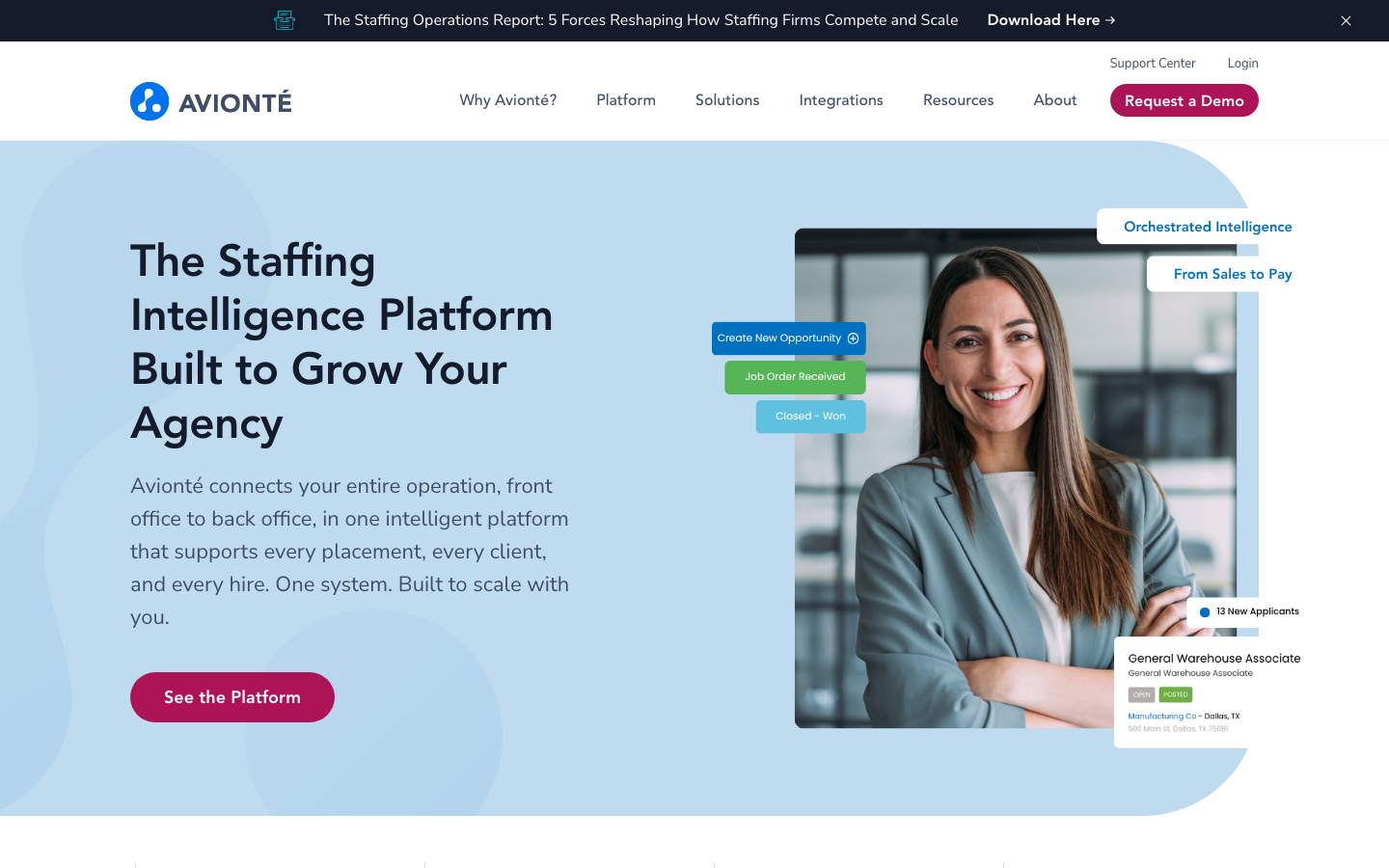
Avionté is an enterprise platform for temp and contract operations. It carries a job order from the sales call through to the pay run without leaving the system. ATS, client CRM, onboarding, payroll, and billing sit in one record set. The vendor states that it processes 4.6 million W2s and $15 billion in payroll annually.
Software Pros
- Native pay and bill, so timesheets, payroll, and invoicing close in the system that took the order
- A mobile talent app, which matters when your workforce never sits at a desk
- Large-order job management aimed at the volume work that breaks lighter tools
Software Cons
- Quote-based pricing with nothing published, so budgeting starts with a sales call
- A perm desk pays for temp machinery it will never open
- Implementation is a project rather than a signup, which frustrates smaller firms
Avionté Review
Working through the platform, what registers is how much of it exists after the placement. The value sits in payroll accuracy, invoice accuracy, and keeping a warehouse crew informed on a phone. For an agency running its own W2 workforce across branches, that is the right center of gravity. For a boutique search firm, it is an expensive filing cabinet.
Our Verdict
Enterprise Temp Operations Backbone
Ceipal
Quick Overview
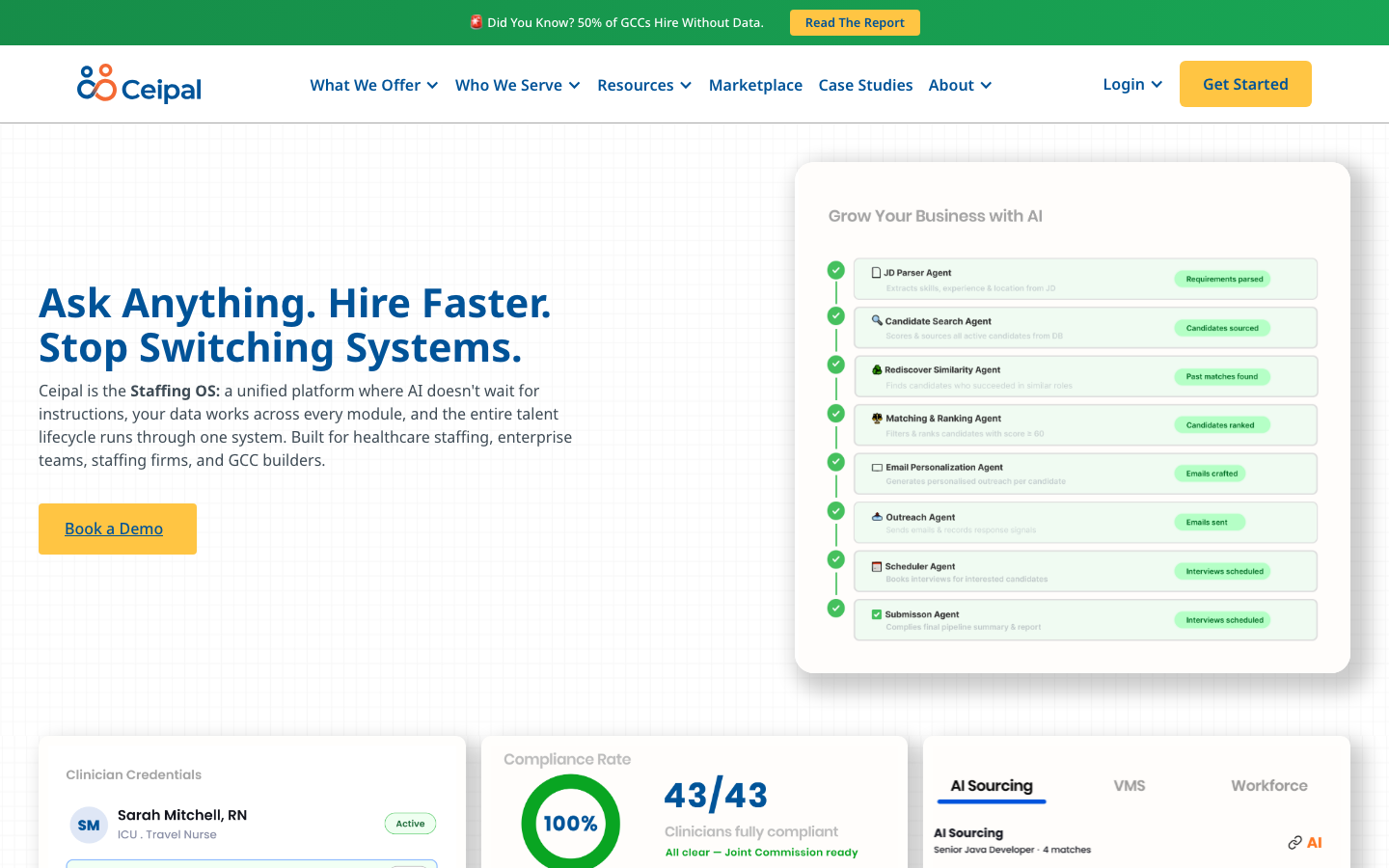
Ceipal targets contract and temporary placement, with the VMS and compliance plumbing IT and healthcare staffing firms need. The platform pairs an ATS with its own Procurewise VMS, workforce management, and credentialing modules. Ceipal markets it as a staffing operating system rather than a tracker. The vendor says over 200,000 recruiters and hiring managers use the platform.
Software Pros
- A VMS of its own plus integrations with the enterprise systems that MSP programs run on
- Credential and compliance tracking aimed at regulated contract placement
- Matching and outreach agents that score candidates against an open job order
Software Cons
- No published price anywhere on the site, so comparison shopping means booking demos
- The breadth is aimed at contract desks, and a pure perm team will leave modules untouched
- Reporting depth takes configuration before it tells you anything useful
Ceipal Review
My read on Ceipal is that it solves the supply-chain half of staffing better than the relationship half. If your orders arrive through a vendor management system and your risk sits in expiring credentials, it is built for you. If you win work over lunch and place two people a month, the machinery is overhead you are renting.
Our Verdict
Contract Staffing Through VMS
Crelate
Quick Overview
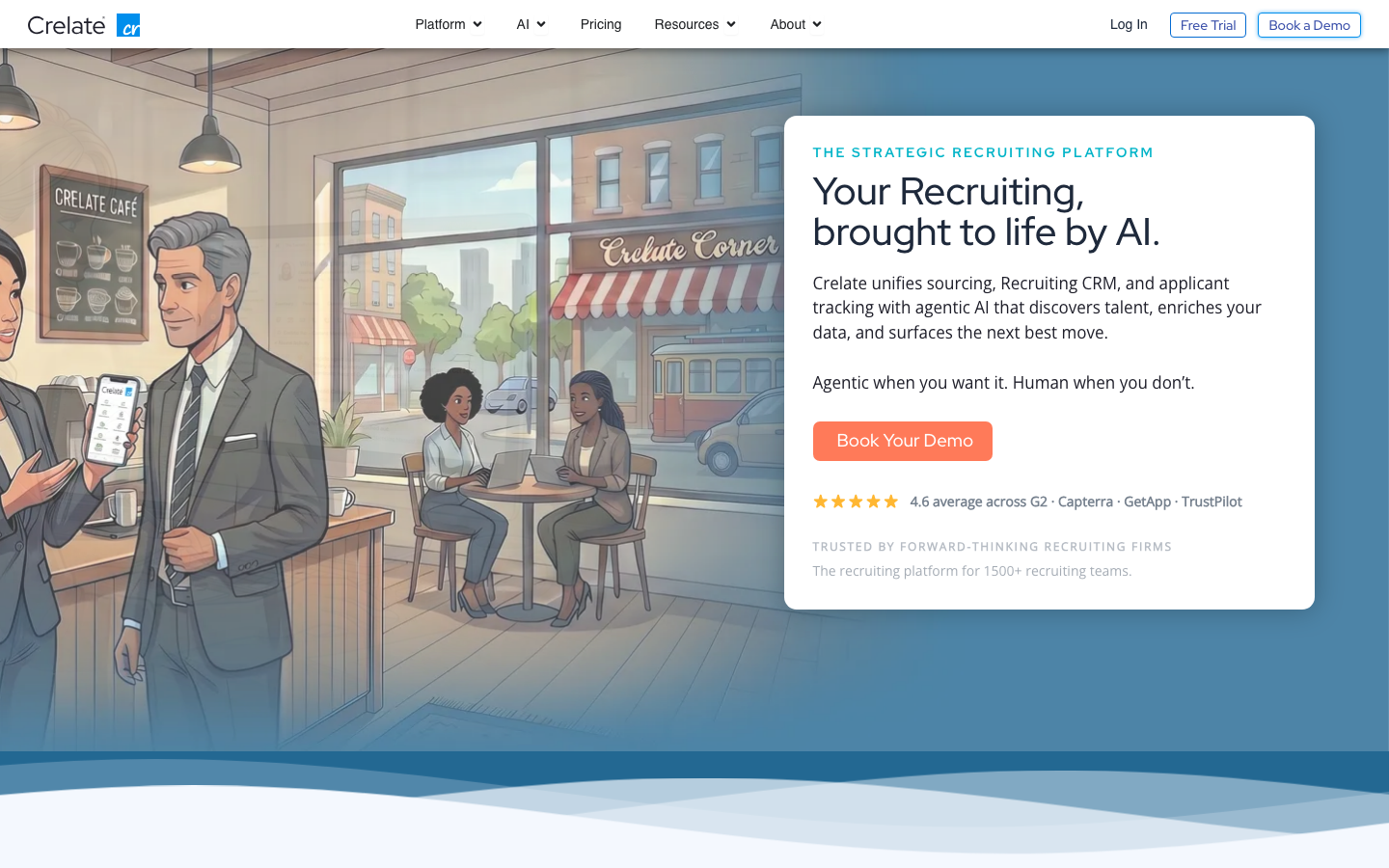
Crelate serves perm and search desks that place hard-to-find people, combining an ATS, a recruiting CRM, and business development tracking in one view. Boolean search runs across the full record set, and a client portal carries submittals out and feedback back. The vendor describes it as the platform for more than 1,500 recruiting teams.
Software Pros
- Boolean search over every record and document at once, with reusable saved criteria
- A client and hiring manager portal for submittals, feedback, and status
- Crelate Deliver adds timekeeping, invoicing, and payroll export for light contract work
Software Cons
- Payroll itself still runs at your provider, so a heavy temp desk needs a partner product
- The entry plan caps at two users, which pushes small teams up a tier sooner than expected
- Advanced automation and sequences sit behind the custom-priced tier
Crelate Review
I came away from Crelate thinking of it as a search desk tool that grew a modest back office rather than the other way around. That order matters. Search, pipeline, and the client portal are what recruiters touch all day, and they are the strongest parts. Contract billing is present, but sized for a few assignments rather than a few hundred.
Our Verdict
Search Desk With Timekeeping
JobAdder
Quick Overview
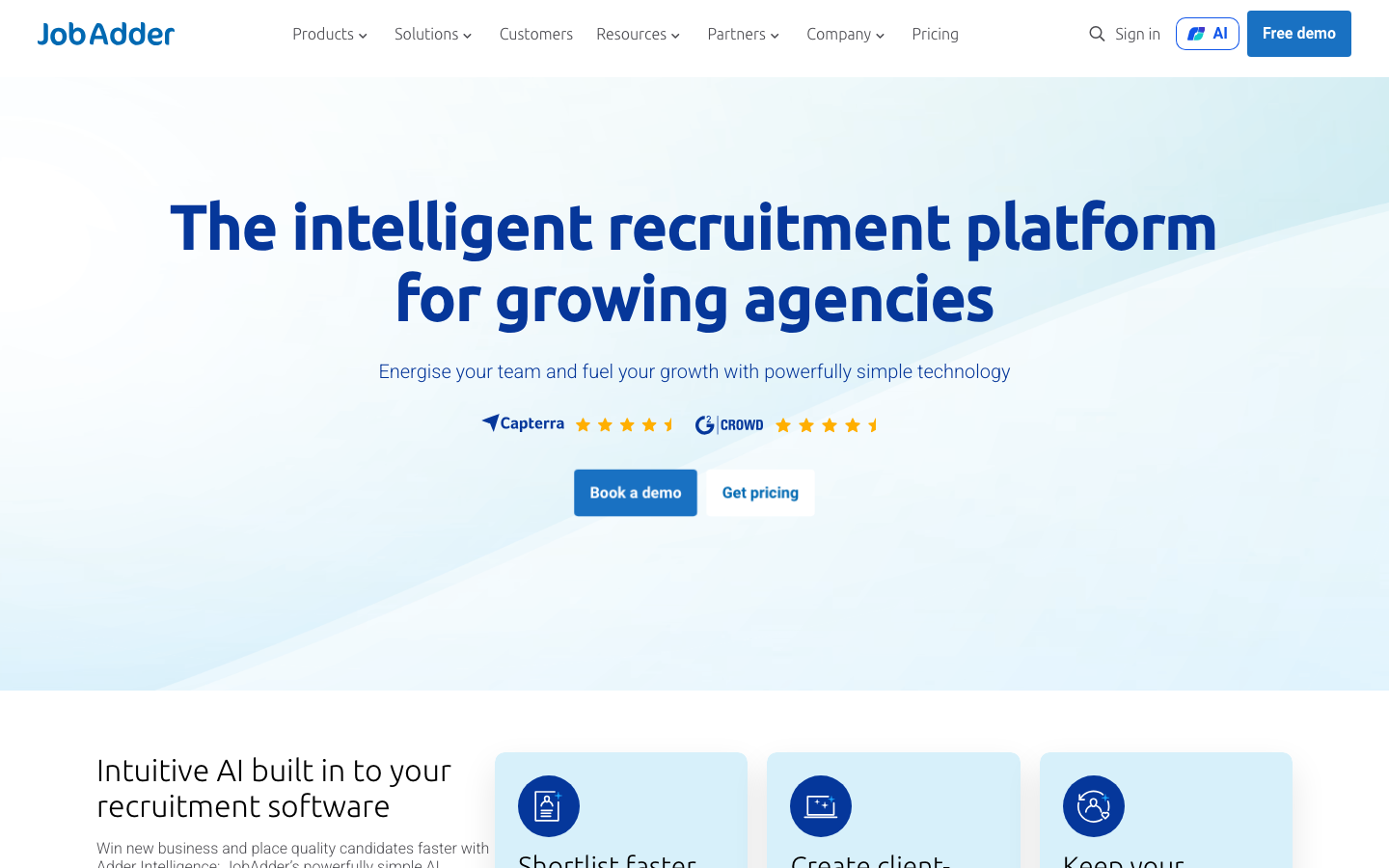
JobAdder sits between the two desk types, with workflows for both permanent and contract placement and a strong client-facing layer. Placement records carry compliance prerequisites, document expiry alerts, and temp-to-perm conversion. Ads go out to more than 200 global, regional, and industry job boards with one click, according to the vendor. Australian in origin, it is widely used across APAC and the UK.
Software Pros
- Multi-board publishing to over 200 job boards, plus career pages and a job feed
- Placement compliance that holds a candidate pending until documents and checks are valid
- Temp workforce views for active assignments, extensions, and temp-to-perm conversion
Software Cons
- Payroll and billing are exported to another system rather than run natively
- Pricing is quote-only, built from a base plan plus add-ons after a demo
- Some messaging features remain region-specific, which shows on a global rollout
JobAdder Review
I kept returning to the client-facing side while assessing this one. Portals, forms, and shared workflows make an agency look organized to the buyer, which is a commercial advantage rather than a cosmetic one. The trade-off is honest. The placement leaves JobAdder for payroll, so a busy temp operation gains a second system.
Our Verdict
Client Facing Agency Platform
JobDiva
Quick Overview
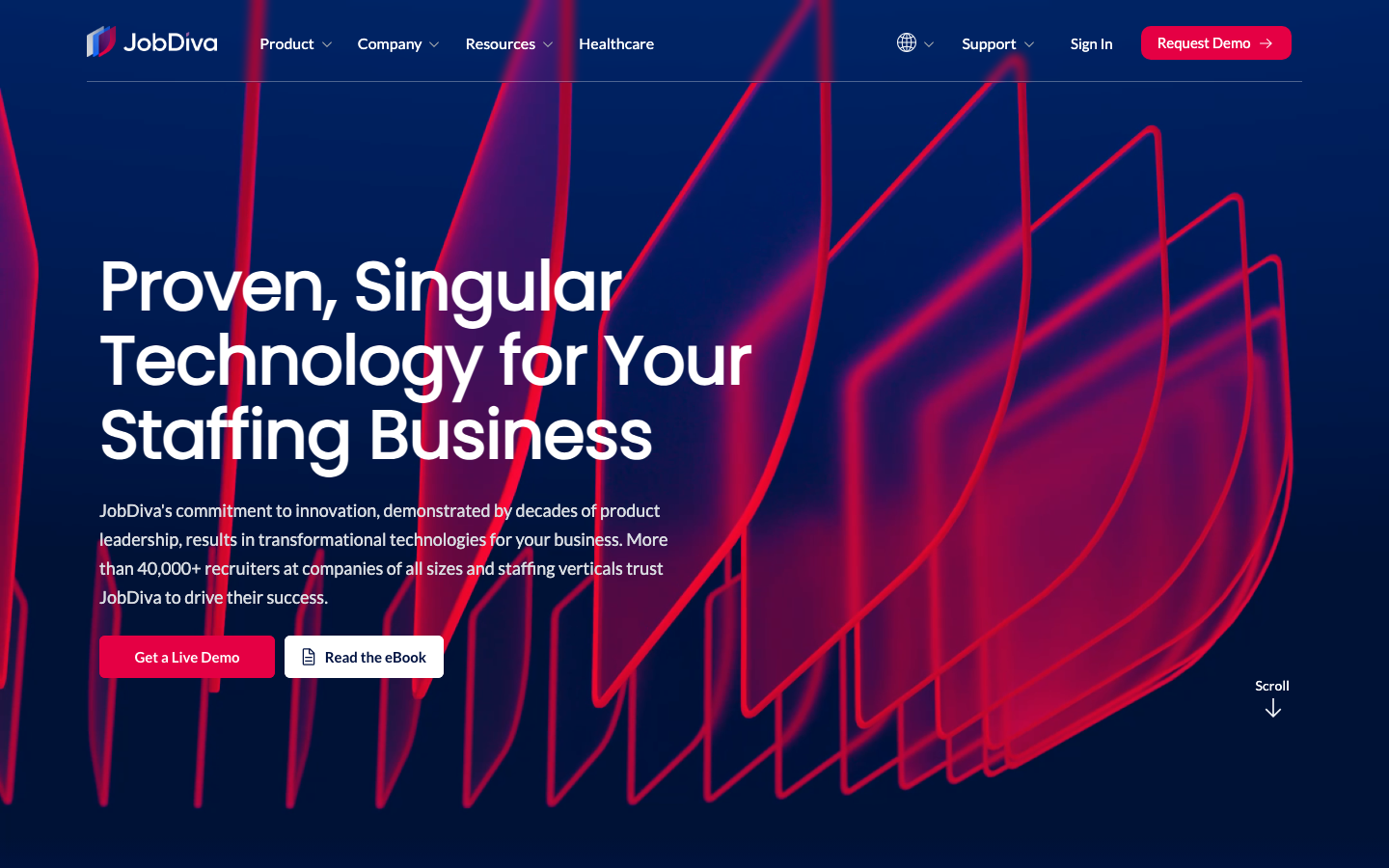
JobDiva is a high-volume contract and IT staffing platform. It is known for harvesting resumes programmatically from the job board subscriptions an agency already pays for, and for patented search. DivaFinancials runs timesheets, billing, and payroll natively, and DivaVMS lets a firm operate as an MSP. The vendor states that over 40,000 recruiters use it.
Software Pros
- Harvesting keeps the talent pool refreshing from your own subscriptions and applicants
- VMS synchronization pulls requisitions, timesheets, and expenses off the major systems
- DivaFinancials handles timesheet collection, billing, and payroll inside the platform
Software Cons
- Nothing about price is published, and scale-based quotes vary widely
- The interface reads as functional rather than modern next to newer rivals
- A perm-only desk buys a large amount of contract machinery it will never use
JobDiva Review
What I take from JobDiva is that it was engineered for throughput. Searching millions of records in a second, syncing requisitions as they post, and closing the billing cycle without an export all answer one question. How many contractors can a single team keep working? Judged on anything else, it looks heavy, which is fair enough.
Our Verdict
High Volume Contract Engine
Loxo
Quick Overview
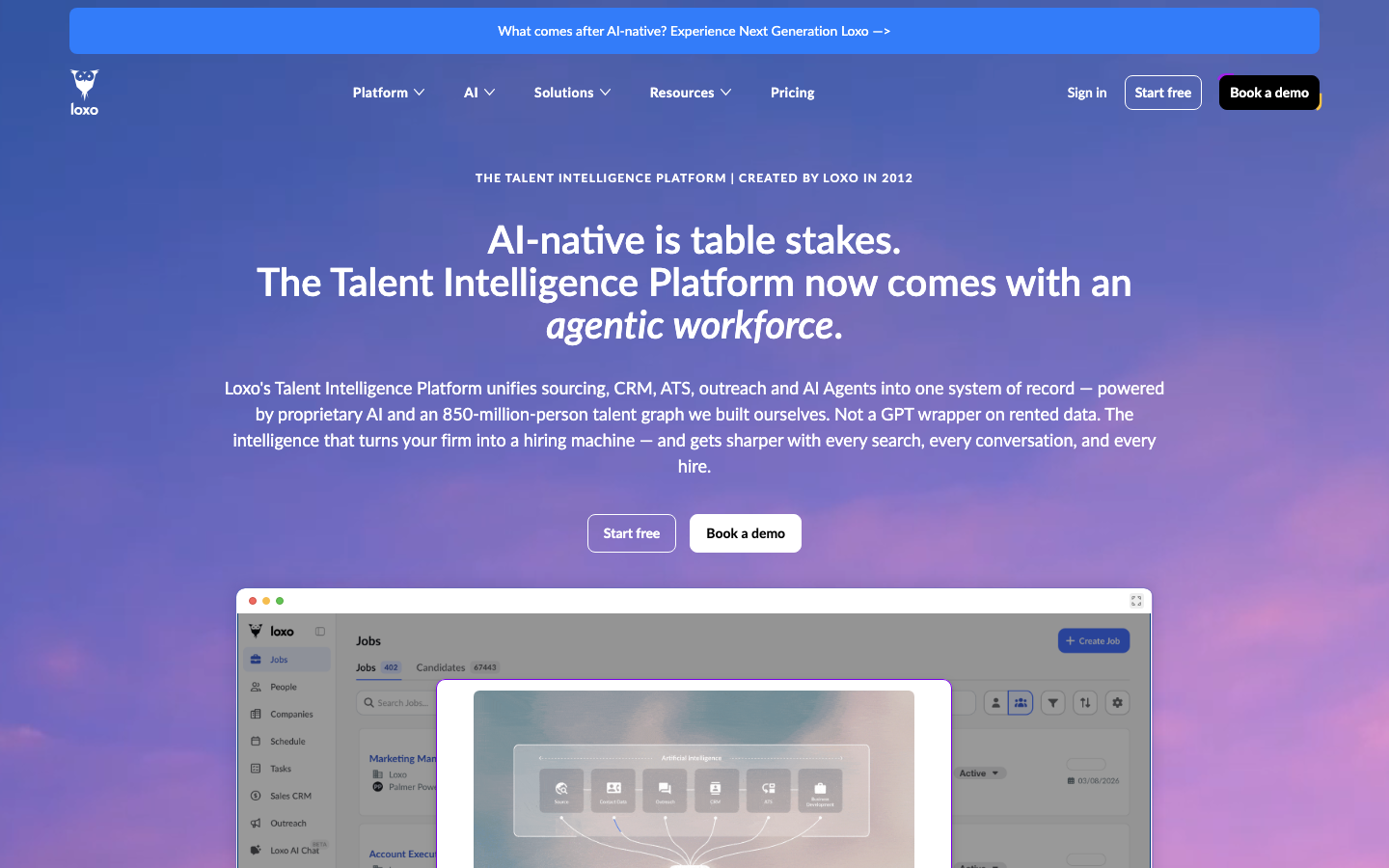
Loxo is a sourcing-led platform for perm, retained, and executive search. It is built around a candidate directory the vendor says it built itself and describes as an 850 million-person talent graph. ATS, CRM, outreach, and AI agents sit on the same record, so a name found in the directory becomes a pipeline entry without an import.
Software Pros
- A built-in candidate directory, replacing the separate sourcing subscription most search firms carry
- Sourcing, CRM, outreach, and tracking share one record, so nothing is re-keyed
- Published rates and a seven-day trial mean you can evaluate it without a sales cycle
Software Cons
- No back office at all, so any contract placement needs a separate pay-and-bill system
- Directory access and the agent features sit on the higher tier, not the entry one
- Credit-based usage means heavy sourcing months cost more than the headline rate
Loxo Review
Working through Loxo, the pitch is unusually coherent. It replaces the sourcing tool and the ATS at once, and for a boutique search firm that is a real saving. The catch is equally clear. Place one contractor, and you are shopping for a second system, because this product has no timesheet.
Our Verdict
Sourcing-Led Search Platform
PCRecruiter
Quick Overview
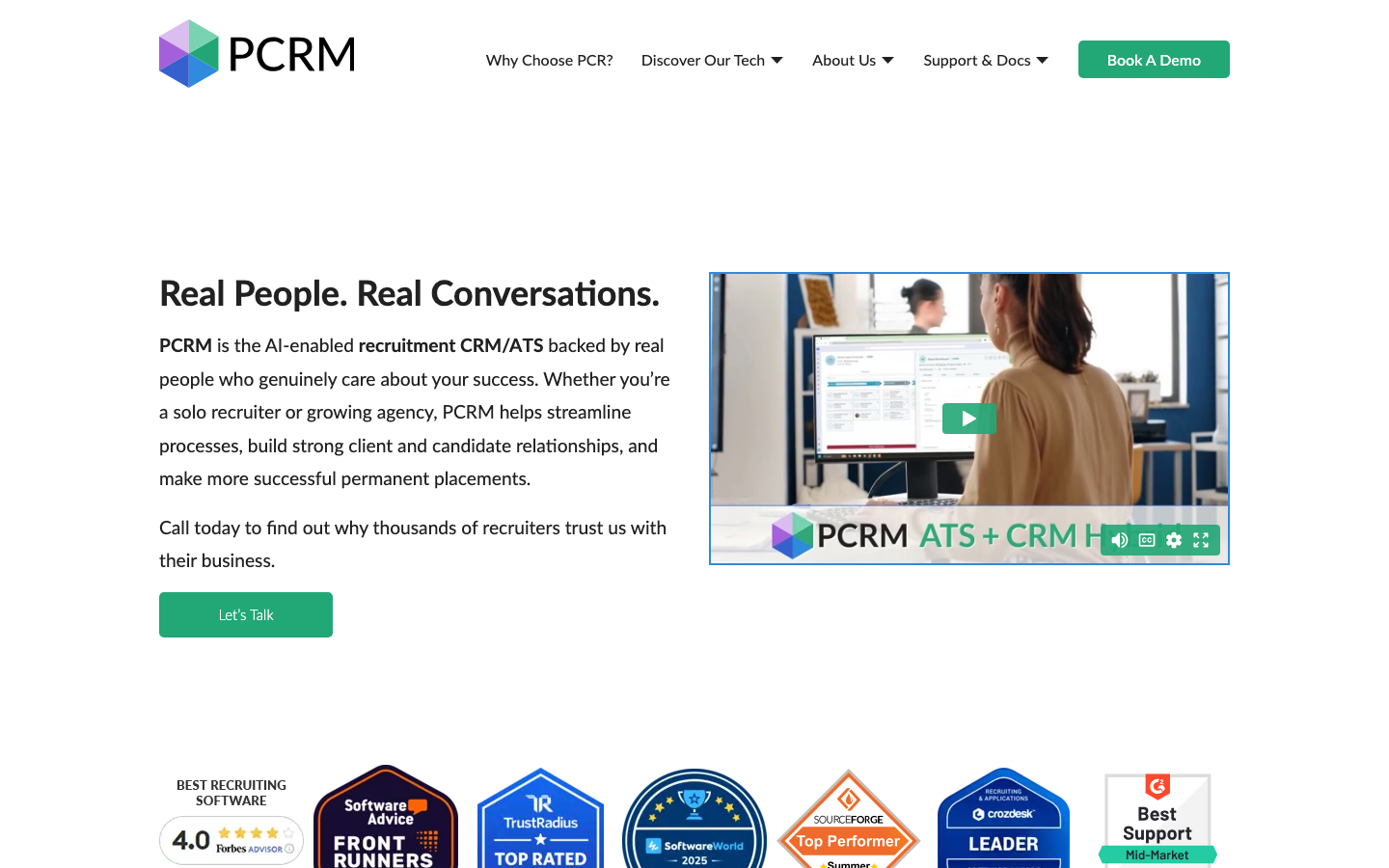
PCRecruiter, now marketed as PCRM, is a database-first ATS and CRM for perm and search desks. The vendor dates its service to recruiters back to 1998. The structure is company-centric, so today’s candidate becomes tomorrow’s client contact without duplicate records. Sequencing automation, a deals workflow, natural language search, and configurable portals sit on that database.
Software Pros
- A company-centric data model that follows a contact through every job change
- Sequencing automation for calls, drip emails, LinkedIn touches, and SMS in one list
- Natural language search and AI summaries aimed at your database, not a rented pool
Software Cons
- No back office, so contract billing lives entirely in another system
- The interface shows its long history and takes longer to feel natural than newer rivals
- Setup and training carry a one-time fee on top of the per-seat rate
PCRecruiter Review
My read on PCRecruiter is that it is built for firms whose asset is the database itself. The company-centric structure gives it away, assuming a twenty-year relationship rather than a single req. Recruiters who want a modern interface will find it dated. Recruiters who want a name they logged in 2011, notes intact, will find it excellent.
Our Verdict
Database First Perm Workhorse
Recruit CRM
Quick Overview
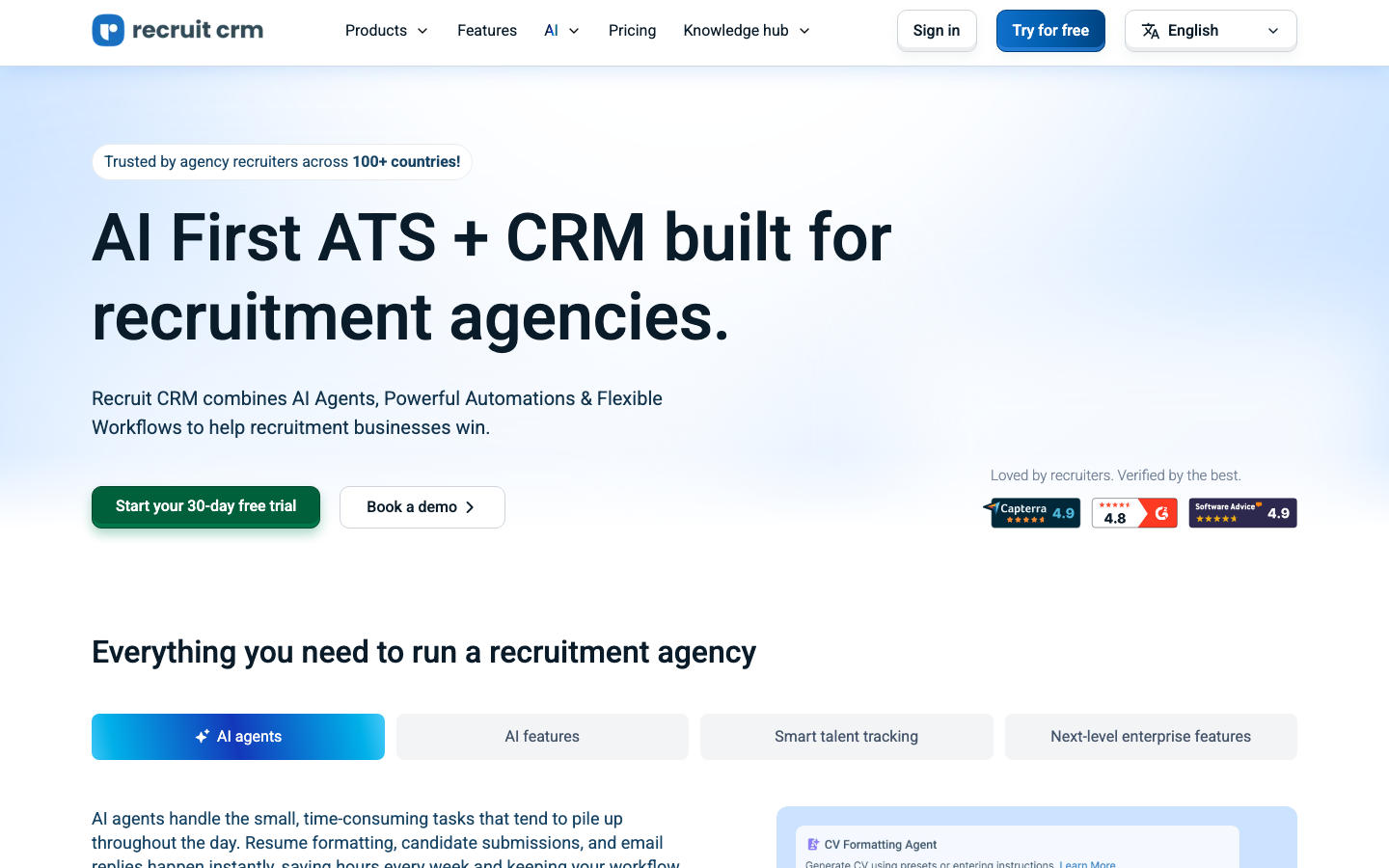
Recruit CRM is an ATS and CRM for recruiting and executive search firms that has quietly grown a contract side. Timesheets, invoicing, and contractor pay sit in the same platform as the pipeline. Candidate portals, career pages, resume parsing, and a deals pipeline round it out. The vendor says over 30,000 recruiters across more than 100 countries use it.
Software Pros
- Timesheets, invoicing, and contractor pay handled in-platform rather than exported
- AI agents that format resumes and assemble a client-ready candidate submission
- A published rate and a 30-day trial, so a two-person desk starts without a sales call
Software Cons
- The contract side is lighter than a purpose-built temp platform at real volume
- Enterprise features are billed separately on top of the seat price
- Workflow automation and advanced analytics only arrive on the top tier
Recruit CRM Review
I came away from Recruit CRM impressed by how much ground it covers for the money. The submittal agents save an hour a day on a busy desk, and invoicing beside the pipeline removes a recurring irritation. It will not run a hundred-contractor payroll and does not claim to. For a small international agency, the range is unusual.
Our Verdict
Global Small Agency Pick
Recruiterflow
Quick Overview
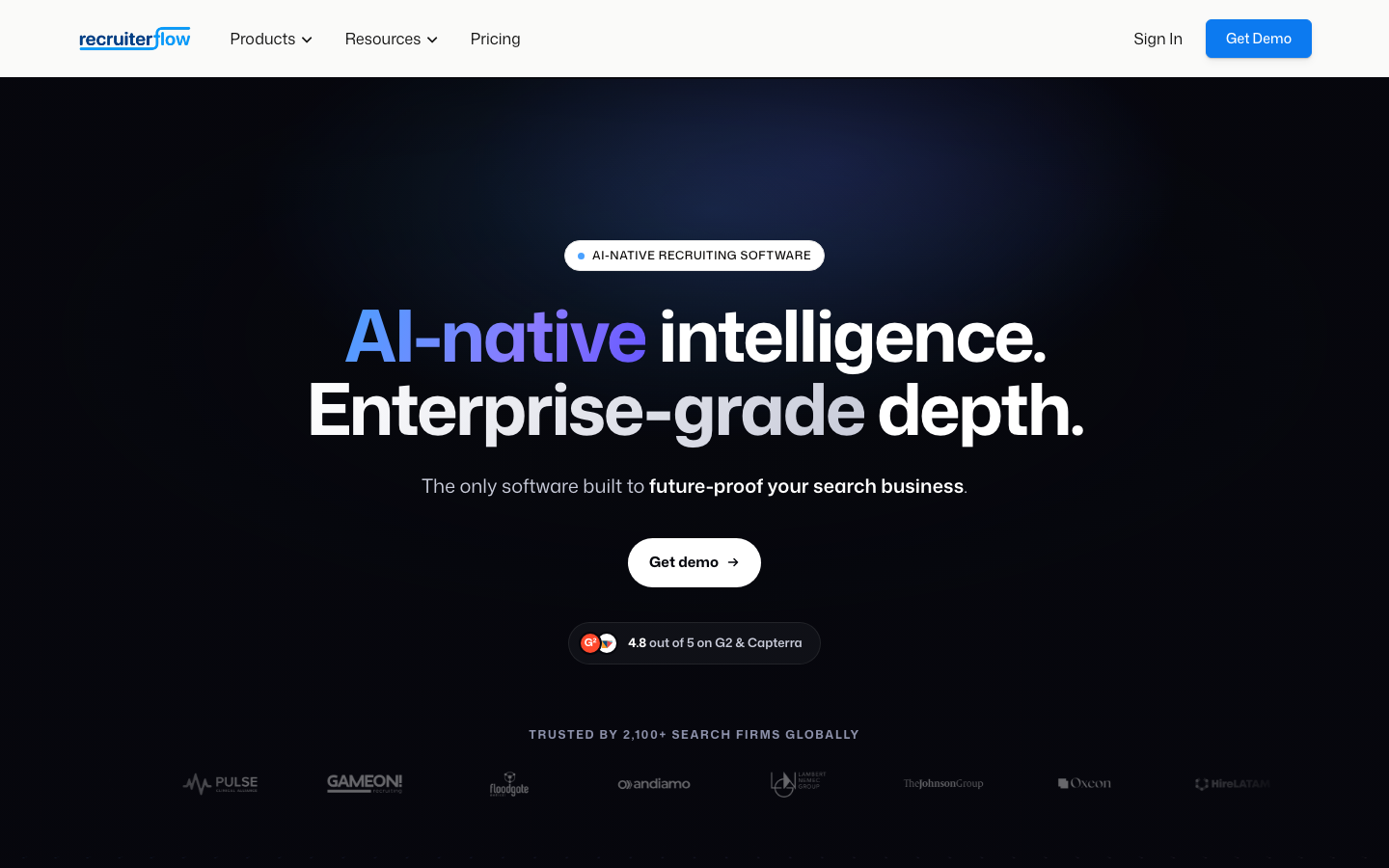
Recruiterflow is an ATS and CRM for perm and search desks, built around outbound. Multichannel sequences run across email, LinkedIn, and phone, and workflow triggers move a candidate along without anyone clicking. Its AIRA features add natural language search, sourcing, and call notes. The vendor states that over 2,100 search firms use it globally.
Software Pros
- Multichannel outbound sequences aimed at business development as much as sourcing
- Workflow automation that fires on pipeline events rather than on a reminder
- Goals and leaderboards, which map onto how billing teams are actually managed
Software Cons
- No native pay and bill, so contract placements need a separate system
- One published seat rate with the agent tier quoted separately
- The outbound focus assumes a team that prospects, which not every desk does
Recruiterflow Review
What I take from Recruiterflow is that it treats an agency as a sales business that happens to sell people. Sequences, triggers, and leaderboards all point the same way, which suits a growing perm firm chasing new logos. A desk that fills inbound orders from existing clients pays for engine capacity it never uses.
Our Verdict
Outbound Automation For Growth
Vincere
Quick Overview
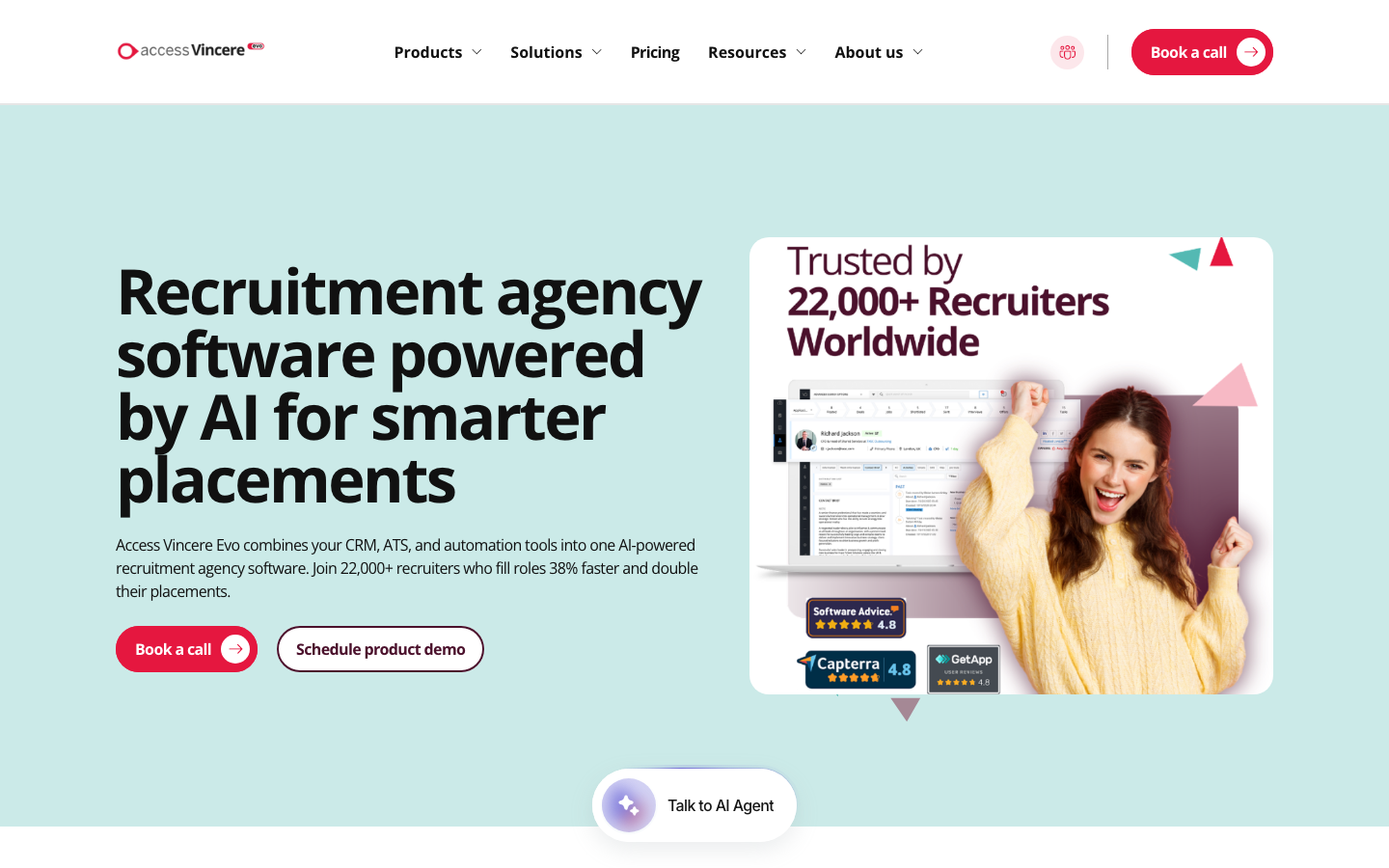
Vincere now ships as Access Vincere Evo, following its acquisition by The Access Group, announced in January 2022. It remains one of the few platforms that runs front- and back-office together. CRM, ATS, automation, timesheet management, and no-code client and candidate portals sit in one system. The vendor states that over 22,000 recruiters use it worldwide.
Software Pros
- Front and back office together, with timesheets, expenses, invoicing, and leave tracking
- No-code candidate and client portals for updates, onboarding, and availability
- A published per-user rate, rare among platforms carrying contract machinery
Software Cons
- AI is priced per agency on top of the seat rate, so the real bill is two numbers
- The breadth means a perm-only team activates a fraction of what it licenses
- The rebrand means older documentation still uses the previous product name
Vincere Review
I kept returning to the range here. Very few tools on this page let a hybrid agency run a perm desk and a contract desk on one record set. Vincere does it without a second vendor. The cost is setup complexity and a pricing sheet with two axes, which is a fair trade if you run both sides.
Our Verdict
Hybrid Desk Operating System
AI Layers Staffing Agencies Buy Alongside Their Platform
The caveat earlier in this guide deserves its own section: standalone AI products aren’t competitors to the ten platforms above, but companions. Agencies license them alongside the ATS or CRM they already run, pointed at the two jobs a desk platform doesn’t own: finding people and clients outside your database, and handling call volume no team can absorb. Two are reviewed below, in A-Z order.
Parloa

Quick Overview
Parloa is an enterprise agentic AI platform for voice and chat conversations, built in Berlin with contact-center-grade reliability. On an agency desk, it supplies the machinery for conversation volume: candidate screening calls, availability and shift confirmations, and interview scheduling, running around the clock in a natural-sounding voice. Like the horizontal voice platforms in this market, it ships conversation infrastructure rather than recruiting logic; the agency designs the workflow, and Parloa runs it at volume.
Software Pros
- Enterprise-grade voice AI that holds natural phone conversations at a volume no branch team can staff
- Around-the-clock availability, which matters when contractors confirm shifts at 6 a.m. and candidates answer calls after work
- Integrates with existing systems, so call outcomes land in the platform your recruiters already live in
Software Cons
- Conversation infrastructure by design: screening scripts and workflows are the agency’s to define
- Built for enterprise conversation volume; a boutique perm desk will not generate the call load that justifies it
- Contact-center heritage means recruiting-specific templates take configuration rather than arriving out of the box
Parloa Review
My read on Parloa is that it solves the problem temp desks feel first: the phone. A high-volume contract operation lives on calls, and every unanswered one is a placement at risk. Parloa is the layer that makes that volume survivable, with a conversation quality closer to a person than the robocall tools agencies remember. Judge it as infrastructure for your call workflows, purchased alongside the platform that holds the records.
Our Verdict
Voice AI For Agency Call Volume
ZoomInfo
Quick Overview
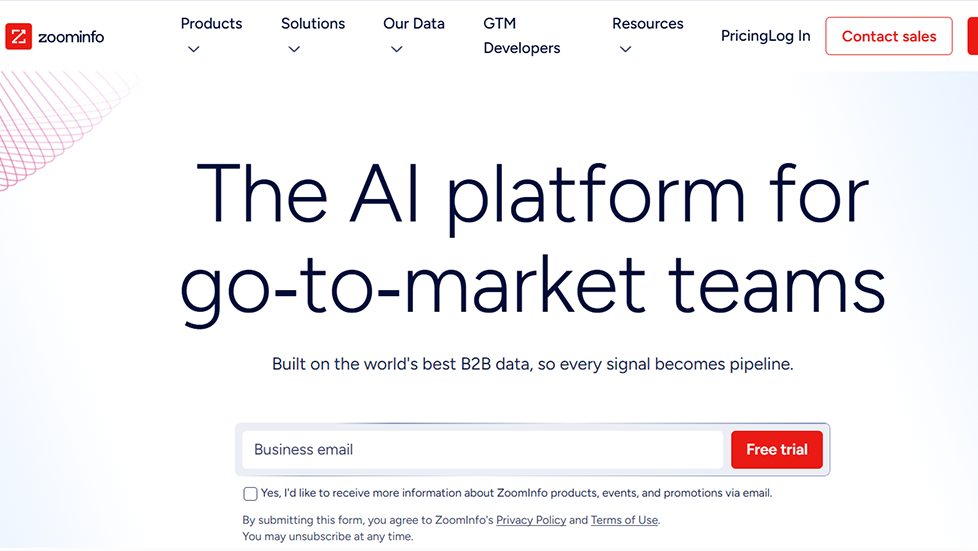
ZoomInfo is a B2B intelligence database that covers both sides of an agency desk with one license. On the candidate side, its professional graph with verified emails and direct dials makes sourced people reachable. On the client side, company signals such as funding rounds, expansions, and leadership changes show which employers are about to place job orders, and who the hiring decision-makers are. Data exports into the ATS and CRM the agency already runs.
Software Pros
- One database serves candidate sourcing and business development, the two revenue activities of any desk
- Verified direct contact data, so outreach reaches people instead of dying at a guessed email
- Company hiring signals turn business development from cold lists into timed approaches
Software Cons
- Quote-based pricing, so budgeting starts with a sales conversation
- An intelligence layer beside the agency platform rather than a replacement for any part of it
- Deepest for corporate, sales, and professional roles, with the strongest coverage in the United States
ZoomInfo Review
What I take from ZoomInfo in an agency context is that it is the rare tool both halves of the business can justify. Recruiters use it to reach candidates who never applied; the business development side uses the same license to spot companies whose funding round or expansion means job orders next quarter. For a firm that wins work by calling the right hiring manager the week the need appears, the signal layer is the commercial edge.
Our Verdict
One Database, Both Sides Of The Desk
FAQs About Staffing Agency Software
What Is the Best Staffing Agency Software?
Nobody can answer that without knowing which desk you run. A perm or search firm wants sourcing depth, a durable database, and fee tracking. A temp or contract operation wants timesheets, pay and bill, worker compliance, and vendor management flow. Filter the comparison table above on desk fit first, and most readers are down to three names before anything else.
How Is Staffing Agency Software Different From a Corporate ATS?
A corporate applicant tracking system has no concept of a paying customer. Agency platforms add client and contact records, job orders placed against those clients, and submittals sent for approval. They also attach fees and splits to a placement, and on contract desks they run the timesheets, pay, and billing that follow. Those five things are structural rather than cosmetic, which is why corporate tools cannot be adapted into agency ones.
How Much Does Staffing Agency Software Cost?
Perm and search platforms charge per recruiter and mostly publish the rate. Among the ones reviewed here, it runs from around $85 to $149 per user per month, with two vendors pricing in euros and pounds. Temp and enterprise platforms quote against worker volume, payroll runs, and branches instead. A seat rate compounds, so model the bill at the headcount you expect in eighteen months.
Do I Need Back Office and Pay and Bill?
Only if you place temporary or contract workers on your own payroll. Native back office covers timesheet capture, approvals, pay rates, and client billing at the bill rate. It reports the margin between them inside the system that took the order. A payroll integration suffices for a handful of contractors a year, though past a few dozen the export step becomes the bottleneck.
Can One Platform Run Both Perm and Temp Desks?
Yes, and three of the ten reviewed here are built for exactly that. One side of your team will still use a fraction of what you license. In practice, agencies buy the platform that handles the harder half, almost always the contract side. Perm recruiters then ignore the timesheet modules, which is still cheaper than running two systems and reconciling them.
What Should I Check Before Migrating My Candidate Database?
Ask for a field-by-field mapping before anything moves. Confirm that notes and activity history travel with the record rather than flattening into one text blob. Check that resume files come across attached, ask how duplicates are detected and merged, and get written confirmation that you can export everything on demand. Your database is the business asset, so treat the migration as due diligence rather than a task.
Which Are the Top Tech Staffing Agencies With AI Tools?
This article reviews the software agencies buy, not the agencies themselves, so naming firms here would not serve you well. What is fair to say is that many technical staffing firms now run AI sourcing, matching, and screening internally. They usually do it on a platform of the kind reviewed above. If you want a firm to partner with rather than a system to license, our recruitment agency coverage by country is the place to start.

Helen is Anywherer’s Market Analyst & Content Researcher, with extensive experience in analyzing global employment markets and HR technology trends. She is skilled at turning complex market data into clear, well-researched insights that inform every piece of content. With a strong grasp of the EOR, PEO, and international hiring space, Helen plays a key role in keeping Anywherer’s research accurate, up to date, and genuinely useful for readers.