Most companies run corporate cards, employee expenses, supplier invoices, and procurement in four different systems, then reconcile them by hand at month-end. The platforms in this guide to AI spend management software pull that work into one workflow and hand the routine judgment to a model. I’ve reviewed 10 of them in A-to-Z order. Each entry names the AI capability the vendor documents, the published price (where available), and the trade-off attached.
What Is AI Spend Management Software in 2026?
Every dollar a company commits outside payroll runs through one approval chain rather than four disconnected ones. The label artificial intelligence spend management software only means something when the vendor ships named capabilities that act on transactions. Think auto-coding to the ledger, receipt matching, policy checks at purchase, and anomaly detection. Buyers are finance leaders, controllers, FP&A, and procurement teams at companies of 50 to several thousand people.
This became urgent in 2026 for a reason. Deloitte surveyed 200 finance chiefs and found that 87% of CFOs expect AI to be extremely or very important to finance operations in 2026. More than half made AI agents a transformation priority. What gen AI spend management software adds is the language layer. It drafts a policy in plain English, answers a spend question without a report, and reads a crumpled receipt correctly.
Finance is not moving alone. The same shift runs through people teams, and anyone evaluating AI tools for HR teams will recognize the pattern. The useful products are wired into transactional data, not bolted onto a dashboard.

INSIGHT: Does AI actually change how finance teams review spend?

The shift is from sampling to reviewing everything. Machine learning spend management software can check 100% of transactions against policy, where a human team checks a sample.
- Deloitte’s Q4 2025 CFO Signals survey of 200 North American finance chiefs found 87% expect AI to be extremely or very important to finance operations in 2026, with only 2% saying it will not matter.
- By its Q2 2026 edition, the same survey found 51% of CFOs using AI for operational productivity work, 44% for planning and budgeting, and 41% to analyze financial data.
- Ramp states that its Policy Agent reviews every expense rather than a sample, and BILL documents predictive AI monitoring transactions in real time. Both are vendor claims, not audited figures.
- The payoff is narrower than the pitch. Nobody submits an expense faster; the hours come back at month-end close, and the surprises stop arriving after the money is already gone.
Sources:
So which platform wins? None of them, and the honest answer is that these 10 do three different jobs. Card-first platforms apply policy at the swipe and code the transaction on the way to the ledger. Enterprise procure-to-pay suites govern supplier spend, contracts, and invoices at a scale that takes months to implement. Travel-and-expense specialists own booking and reimbursement. Naming which of the three has broken at your company is the whole of choosing the best AI spend management software.
Below, I’ve reviewed 10 of the leading platforms in A to Z order. Read best AI-powered spend management software as shorthand for the right fit, not a single winner. The wrong family disappoints, no matter how good the product is.
INSIGHT: Card control, procure-to-pay, or travel and expense?
The 10 tools here do three different jobs, and most disappointment with spend software comes from buying the wrong one.
- Card-first spend control (BILL Spend & Expense, Brex, Payhawk, Pleo, Ramp, Rippling Finance): policy applied at the swipe, AI coding and receipt matching, AP as an add-on. The software is free or priced per user.
- Enterprise procure-to-pay (Coupa, SAP Ariba): sourcing, contracts, supplier management, invoices and payments for large organizations, with AI aimed at supplier risk and document capture. Quote-only, and implementation runs in months.
- Travel and expense first (Emburse, Navan, SAP Concur): booking and expense in one flow, AI for receipt reading and compliance, noticeably lighter on procurement.
AI Spend Management Software Comparison
Read the coverage column before the score. A platform that stops at cards and expenses cannot fix a broken purchase-order process, whatever its rating says. Anyone looking for AI spend management software top rated by real buyers will find the scores in the last column, with review counts attached.
| Tool | Coverage | Named AI capability | Own cards | ERP integrations | G2 rating |
|---|---|---|---|---|---|
| BILL Spend & Expense | Cards, expenses, AP | Transaction Agent | Yes | NetSuite, QuickBooks, Xero, Sage Intacct | 4.5 (2,236) |
| Brex | Cards, expenses, AP, travel, treasury | AI-powered controls | Yes | NetSuite, QuickBooks, Xero, Sage Intacct | 4.8 (1,620) |
| Coupa | Expenses, AP, procurement, treasury | Navi agents | Via partner | SAP, Oracle, NetSuite, Microsoft Dynamics | 4.2 (569) |
| Emburse | Cards, expenses, AP, travel | Emburse Assurance | Yes | NetSuite, Sage Intacct, Microsoft Dynamics, Oracle | 4.3 (2,358)* |
| Navan | Cards, expenses, travel | Automated expense reconciliation | Yes | NetSuite, QuickBooks, Xero, Sage Intacct | 4.7 (9,298) |
| Payhawk | Cards, expenses, AP, procurement, travel | Agent Fetch | Yes | NetSuite, Xero, Microsoft Dynamics, SAP | 4.5 (908) |
| Pleo | Cards, expenses, AP | AI-powered spend guidelines | Yes | NetSuite, QuickBooks, Xero, Sage Intacct | 4.7 (1,435) |
| Ramp | Cards, expenses, AP, procurement, travel, treasury | Policy Agent | Yes | NetSuite, QuickBooks, Xero, Sage Intacct | 4.8 (2,502) |
| Rippling Finance | Cards, expenses, AP, travel, procurement | AI workflow automation | Yes | NetSuite, QuickBooks, Xero, Sage Intacct | 4.7 (1,917) |
| SAP Spend Management | Expenses, AP, procurement, travel | Joule agents | Via partner | SAP, Oracle, Microsoft Dynamics, NetSuite | 4.0 (7,184)** |
Scores belong to each tool’s individual G2 product profile and were read in August 2026.
Quick Picks by Company Type
Find the line that sounds like your company. Names run A to Z inside each group. The best spend management software with AI features for one profile is usually a poor fit for the others.
- US startups and SMBs that want cards at no software cost: BILL Spend & Expense, Brex, Ramp
- European and multi-entity mid-market companies: Payhawk, Pleo
- Travel-heavy organizations: Emburse, Navan
- Companies that want spend tied to HR and payroll records: Rippling Finance
- Large enterprises that need full procure-to-pay and supplier management: Coupa, SAP Spend Management
AI Spend Management Software Pricing
Pricing confuses people for one reason: three business models sit on the same list. Card-first platforms earn interchange every time an employee swipes, so the software can be free. Per-user vendors charge for expense and AP modules on top of whatever card you use. Enterprise suites quote for the deployment, and implementation often exceeds the first year of license. Compare totals, card rewards included.
| Tool | Pricing model | Free plan | Starting price |
|---|---|---|---|
| BILL Spend & Expense | Free with card | No published tier | Custom pricing |
| Brex | Free with card, paid tiers per user | Yes, Essentials | $0, Premium $12 per user/month |
| Coupa | Quote-based enterprise suite | No | Custom pricing |
| Emburse | Per user plus modules | No | Custom pricing |
| Navan | Free with card, expense per user | Yes, up to 300 employees | $0, expense $15 per user/month |
| Payhawk | Per user plus modules | No | £149 per month, small-business program |
| Pleo | Per user plus modules | No | £9.50 per user/month, billed yearly |
| Ramp | Free with card, paid tiers per user | Yes, Ramp Free | $0, Plus $15 per user/month |
| Rippling Finance | Per user plus modules | No | Custom pricing |
| SAP Spend Management | Quote-based enterprise suite | No | Custom pricing |
As pricing is subject to change, prices are listed as of August 2026.
INSIGHT: Why are some spend management platforms free?
Because the card pays for the software. Card-first platforms earn interchange on every swipe, so the expense and AP modules can be free; per-user and quote-based vendors have no such revenue line.
- Three of the 10 publish a genuine free tier: Brex Essentials at $0 a user each month, Navan Business free for companies up to 300 employees, and Ramp Free. Two more publish a paid entry rate, and five quote privately.
- Eight of the 10 issue their own cards. Coupa and SAP Concur are the exceptions, using partner cards and card feeds instead, which is why neither offers a free tier.
- The trade-off is where the money moves. Free-with-card pricing means the vendor wants your card spend on its card, so weigh it against an existing bank relationship or a rewards program you already earn on.
How to Choose AI Spend Management Software
I would settle one question before booking a single demo. Is the problem card and expense control, or procurement and supplier spend? That answer halves the list and saves weeks comparing products that were never alternatives.
Next, work out whether the AI acts or only reports. A policy agent that blocks an out-of-policy swipe is a different product from a dashboard that flags it next week. This is where generative AI spend management software earns its keep. Vendors are rarely clear on which side of that line a feature sits.
Then ask whether the platform issues its own cards, because that changes both price and banking setup. Interchange funds the free tiers, and moving card spend to a new issuer is a bigger decision than buying software.
Check the accounting fit carefully. AI coding saves time only if the transaction lands in the right GL account with your dimensions intact. A wrong code that arrives automatically is worse than no code at all.
Make sure a written spend policy exists before you buy a policy agent. A model can only enforce rules somebody wrote down. Teams that keep their rules in policy management software get more out of these tools than teams that rely on memory.
Look at reporting by department, entity, and currency, and ask whether that output can sit beside headcount data. Spend per department means little until you know the department grew. Pairing it with HR reporting and analytics tools is what turns a cost report into a decision.
Last, test global reach against your actual map: currencies supported, where local cards are issued, which countries it reimburses in, and how VAT reclaim works.
Top 10 AI Spend Management Software Platforms for 2026
Every entry below rests on the same four sources. I read the vendor’s product pages, its published pricing, its G2 profile, and whatever it formally calls an AI capability. The mix runs from enterprise suites like Coupa and SAP, to card-first platforms like Brex and Ramp, to European specialists like Payhawk and Pleo. Line up the top AI platforms for spend management, and they disagree on what the product even is, which tells you plenty.
The best AI-powered spend management software in 2026 isn’t one product but three families. Read each verdict against your own broken process, not against the other nine.
I’m listing all providers in alphabetical order to keep this comparison neutral.
BILL Spend & Expense
Quick Overview
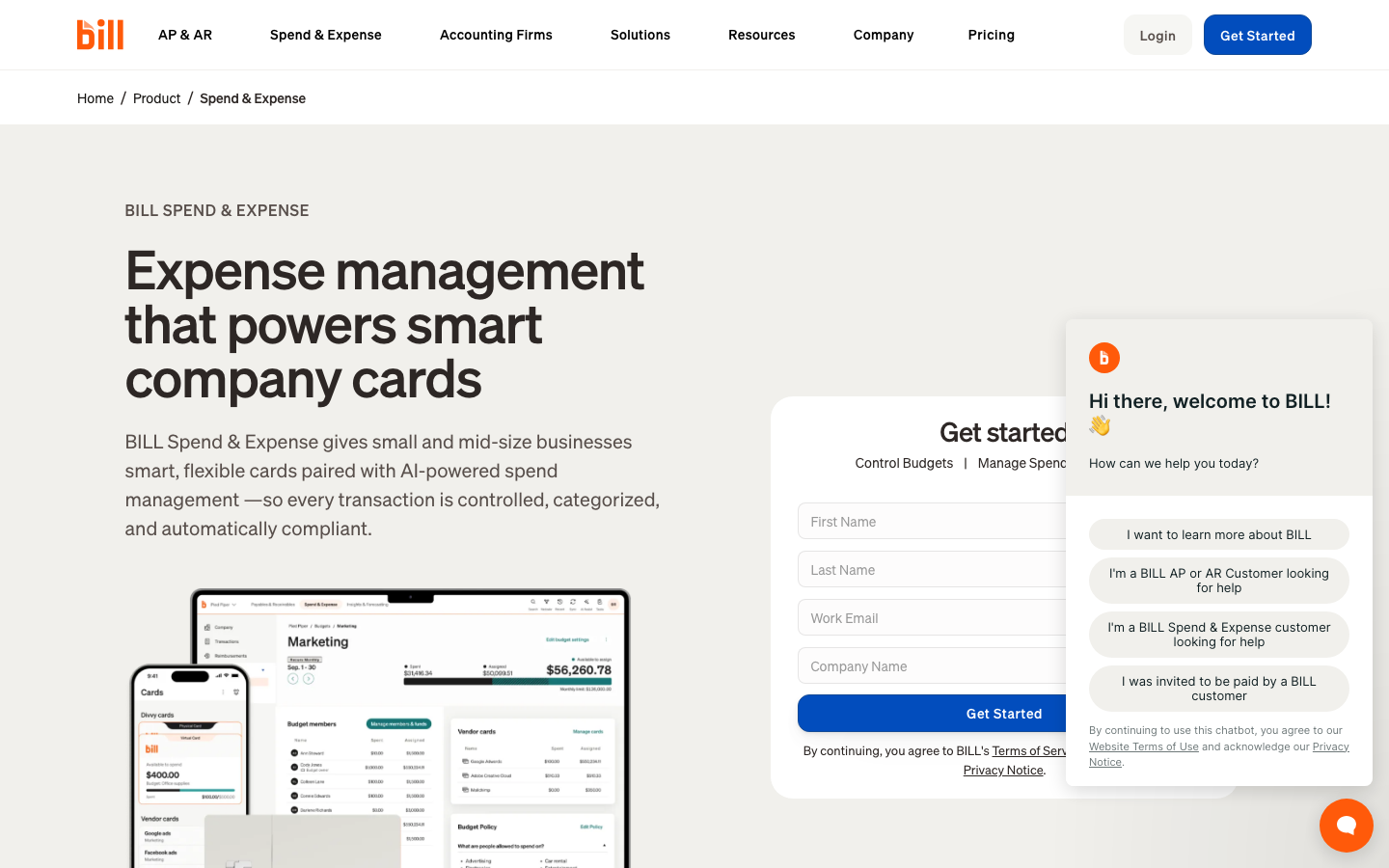
BILL Spend & Expense, formerly Divvy, pairs corporate cards with expense management inside BILL’s wider financial operations suite, covering cards, expenses, and AP. The vendor reports 300M transactions across its network and more than 5M predictions a day.
Software Pros
- AI codes every accounting field and matches receipts to the right transaction automatically
- Predictive models monitor transactions in real time to flag suspicious activity
- Budgets are set before the spend happens, so limits sit on the card itself
Software Cons
- The product page publishes no rate, so the cost depends on a sales conversation
- Procurement and supplier management are absent, which caps it below enterprise needs
- The value case assumes you also run BILL for accounts payable
BILL Spend & Expense Review
While reviewing BILL Spend & Expense, the reconciliation side is what earns its place. The agent categorizes a transaction and writes the business note a controller would otherwise type at month-end. As ML spend management software, it is learning from a large transaction network rather than from your company alone. Without the models, it would be a card with a budget attached.
Our Verdict
Card Platform Funded By Interchange
*As pricing is subject to change, we are listing prices as they stand in August 2026
Brex
Quick Overview
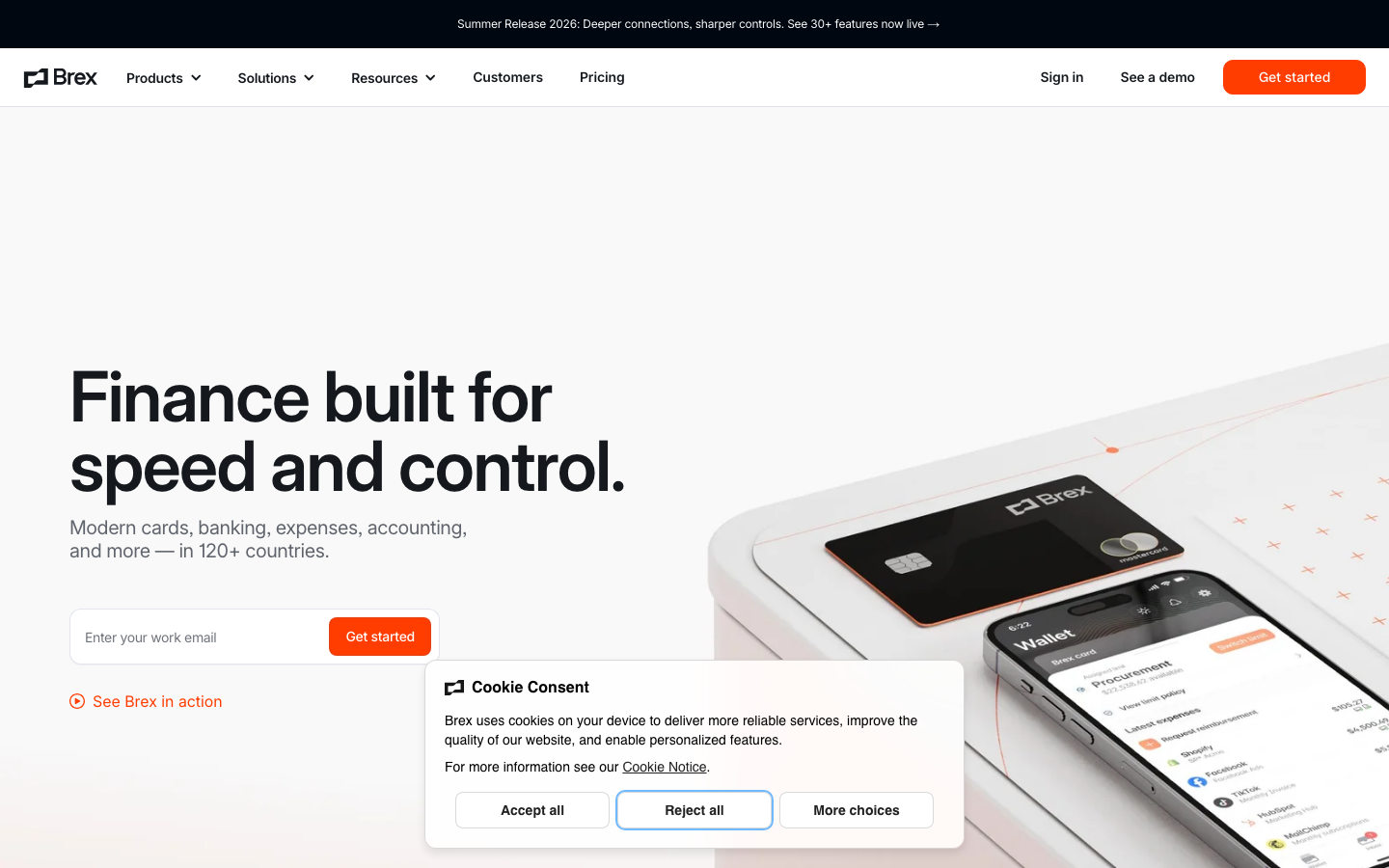
Brex runs corporate cards, expenses, reimbursements, travel, bill pay, and business accounts on one platform. AI controls enforce policy at the point of purchase. The vendor states it is trusted by 35,000+ companies.
Software Pros
- AI-powered controls apply spend rules at the moment of purchase, not after the fact
- Global card acceptance and multi-currency support suit companies operating outside one market
- An Essentials tier at $0 a user each month makes it testable without procurement
Software Cons
- Premium features sit behind a $12 per user monthly tier, so the free plan is a floor
- Procurement and supplier management are thinner than the enterprise suites offer
- The Capital One relationship is new, and roadmap direction under a bank owner is unproven
Brex Review
What stood out to me is how much Brex puts in the free tier. Custom AI rules and accounting integrations usually sit behind a paywall here, but they don’t. One piece of context worth knowing: Capital One completed its acquisition of Brex on 7 April 2026, so the roadmap now sits under a bank. Take the controls away, and it is a corporate card with good reporting.
Our Verdict
Global Card And Expense Control
*As pricing is subject to change, we are listing prices as they stand in August 2026
Coupa
Quick Overview
Coupa is an enterprise total spend management platform running source-to-contract, procure-to-pay, AP, payments and treasury. Its Navi agents have run in production with more than 450 customers since 2025, according to the vendor. Coupa Compose arrived in 2026 to orchestrate them.
Software Pros
- Navi agents work across procurement, finance, and supply chain rather than one module
- Community benchmarking compares your spend against a large pooled data set
- Source-to-contract and supplier management go far deeper than any card-first tool
Software Cons
- Quote-only pricing with implementation measured in months, not weeks
- Far more platform than a company under a few hundred people can absorb
- Cards come through a partner, so there is no interchange model to offset the cost
Coupa Review
During my evaluation, the agent story was the clearest reason to look at Coupa in 2026. Cutting requisition cycle times is a procurement problem, not a card problem, and almost nothing else on this list touches it. The trade-off is honest and large: this is a multi-month implementation with a quoted price. Remove the AI, and you still have a serious procurement suite underneath.
Our Verdict
Enterprise Source-To-Pay Suite
Emburse
Quick Overview
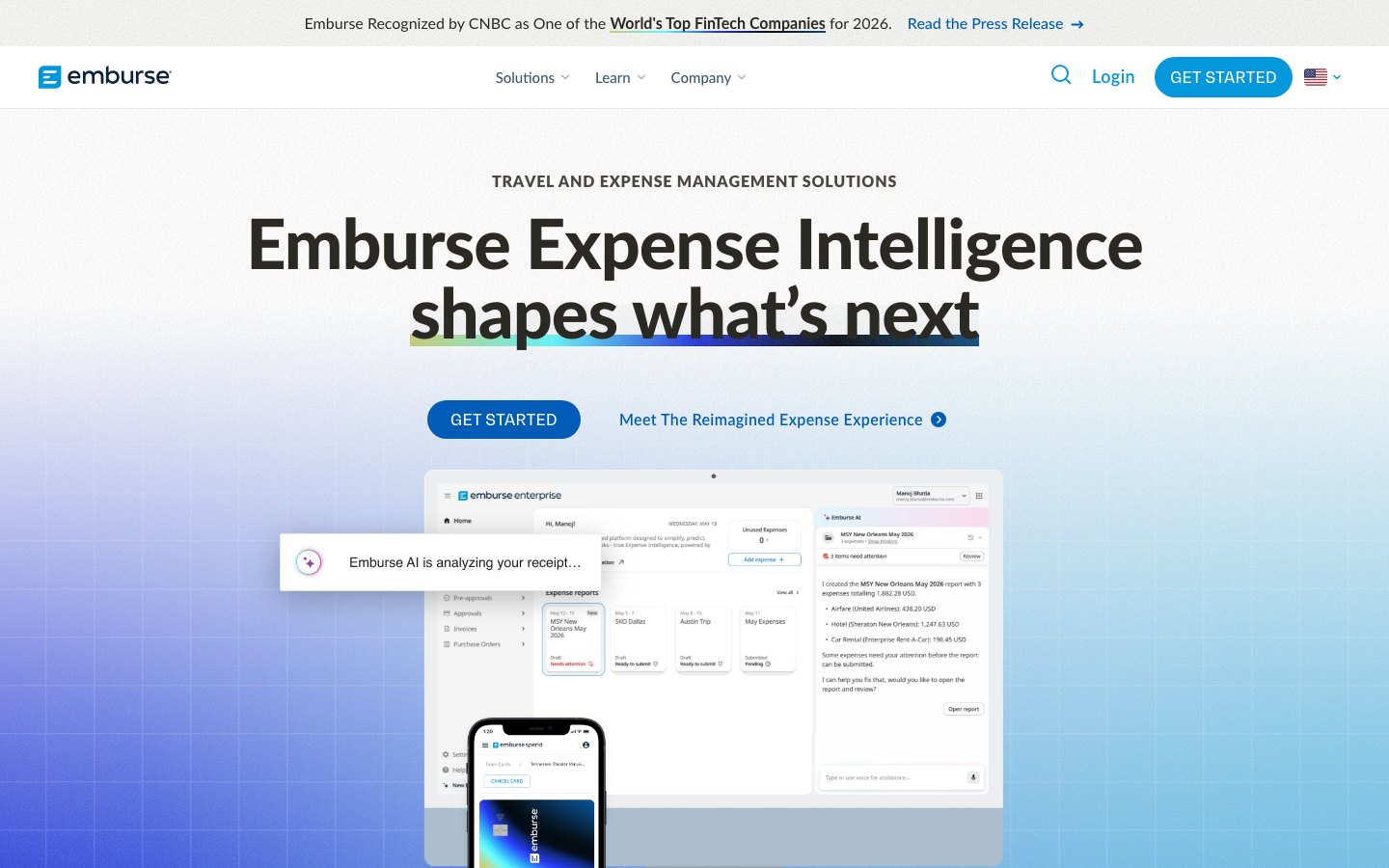
Emburse handles travel, expense, AP automation, payments, and cards for mid-market and enterprise finance teams, with localization and vendor documents for 100+ countries. Emburse Assurance adds a compliance layer that guides employees before they submit a claim.
Software Pros
- Emburse Assurance analyzes receipts pre-submission and warns employees in real time
- Automatic categorization covers a wide set of expense types out of the box
- Localization across 100+ countries suits organizations with scattered travel spend
Software Cons
- Procurement is light, so supplier and contract work needs another system
- Nothing published on cost, and quotes swing on which modules you take
- Several product listings exist, so confirm which edition a quote actually covers
Emburse Review
I spent time on the pre-submission logic, which is what separates Emburse from the card-first tools. Catching a problem while the employee is still filling in the claim is worth more than catching it in an audit queue three weeks later. The AI Audit add-on extends that to sampling after the fact. Without Assurance, it is a capable but conventional travel and expense system.
Our Verdict
Travel And Expense Compliance Engine
Navan
Quick Overview
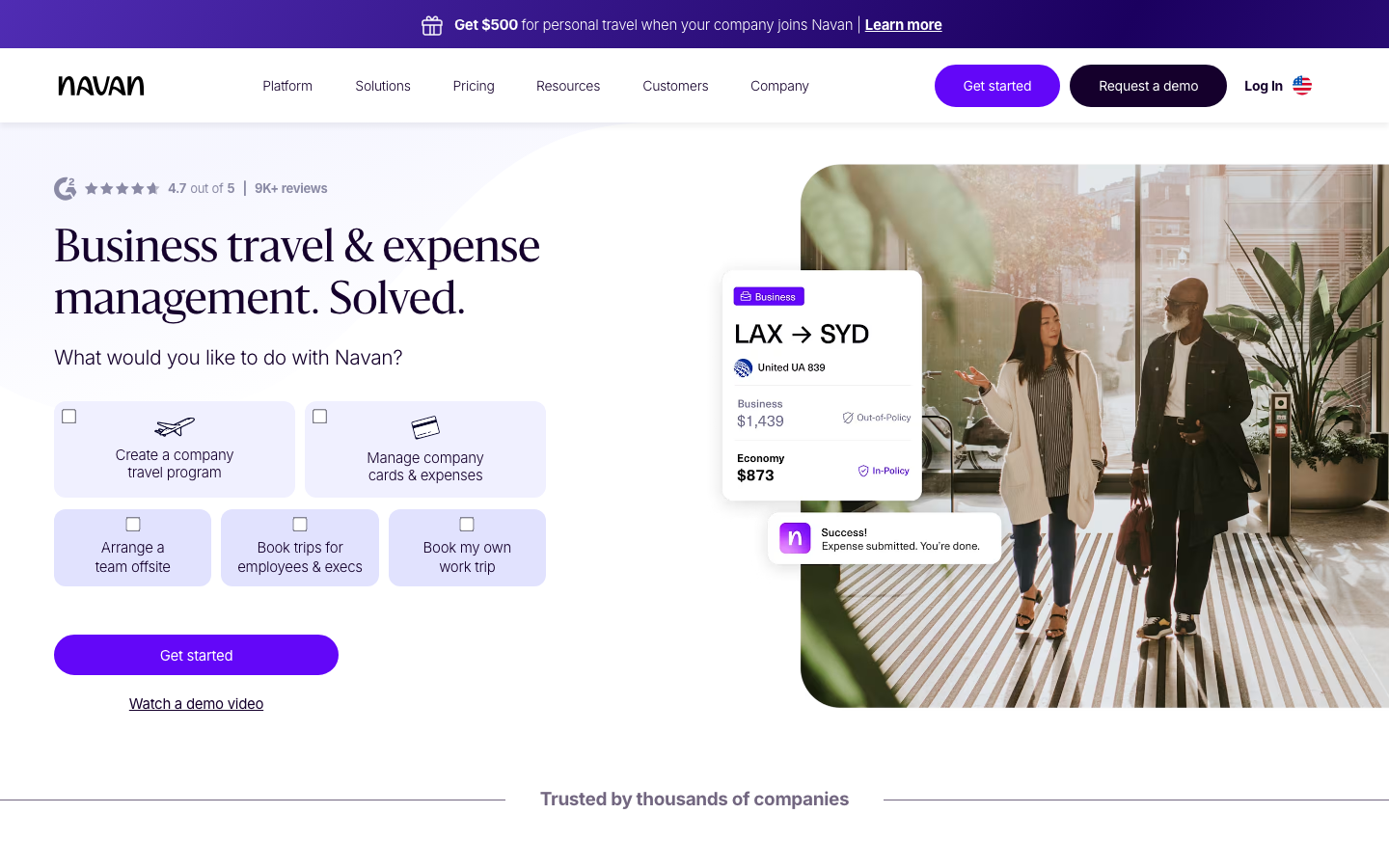
Navan, formerly TripActions, books business travel, issues cards and reconciles expenses in a single flow, applying policy at the moment of booking. Behind its score sit 9,298 G2 reviews, more than any other tool here.
Software Pros
- Policy is checked at booking, so a non-compliant trip is stopped before it is bought
- Travel and expense reconcile automatically because both sit on the same record
- Navan Business is free for companies up to 300 employees
Software Cons
- Procurement and supplier management are outside its scope entirely
- Expense costs $15 a user each month beyond the first five expensing users
- The value drops sharply if your company does not travel much
Navan Review
The feature I kept coming back to is that booking and expense are the same event here. Most tools reconcile a trip after somebody books it elsewhere. Navan never lets the two drift apart, which removes a whole category of month-end mismatch. For a company with heavy travel, that is a structural advantage. Strip out the automation, and it becomes a booking tool with a card.
Our Verdict
Booking And Expense In One
*As pricing is subject to change, we are listing prices as they stand in August 2026
Payhawk

Quick Overview
Payhawk runs cards, expenses, bills, travel and procurement on a global money account built for multi-entity companies. Its AI Office of the CFO bundles four named agents: Financial Controller, Procurement, Payments and Travel, with data extraction of the vendor documents in 65+ languages.
Software Pros
- Agent Fetch chases the missing receipts a controller would otherwise chase by email
- Multi-entity structures are handled natively rather than as separate accounts
- Procurement sits on the same platform, which is rare outside the enterprise suites
Software Cons
- Pricing is modular and mostly quoted, so the published rate covers a narrow case
- The published Growth Program is limited to UK and EEA businesses under 20 employees
- Strongest in Europe, so US-only companies may find better local coverage elsewhere
Payhawk Review
While reviewing Payhawk, multi-entity handling set it apart. Companies with subsidiaries in several countries usually run one instance per entity elsewhere on this list. Consolidating that is a genuine relief. The agent lineup maps to real finance roles rather than marketing categories. Remove the agents, and it remains a solid European card and expense platform.
Our Verdict
Multi-Entity Platform With AI Agents
Pleo
Quick Overview
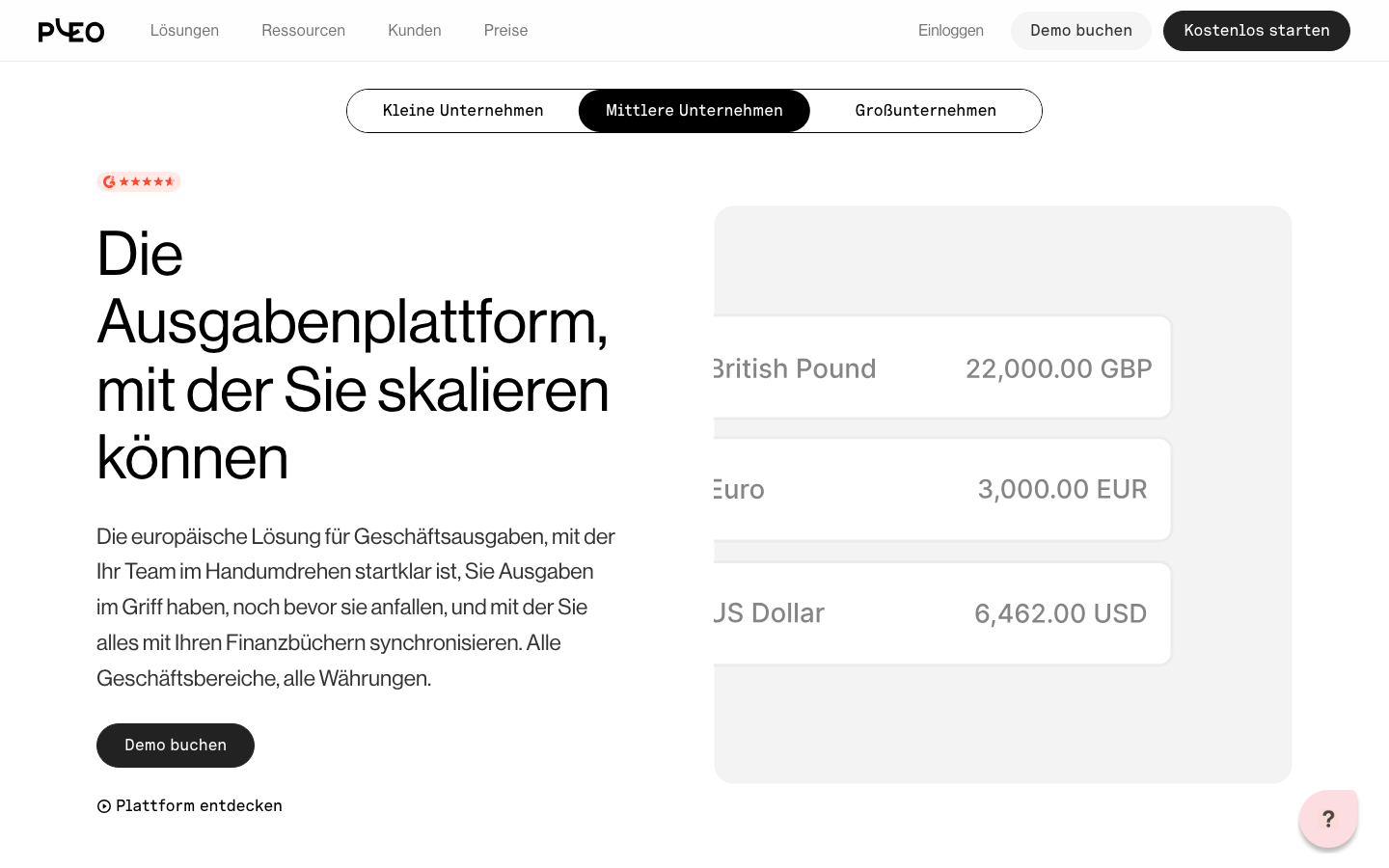
Pleo gives European teams smart company cards with automated expenses, invoice payments and subscription tracking. The vendor reports serving 40,000+ businesses across 16 markets. AI-powered spend guidelines appear from the Essential tier, with AI-powered expense review on Business.
Software Pros
- Spend guidelines apply policy automatically once rules are configured
- Subscription tracking surfaces recurring charges that usually escape review
- A published entry price of £9.50 a user each month is unusually transparent here
Software Cons
- No free tier, so every seat carries a cost from day one
- Procurement is absent, which limits it to card and expense control
- Coverage is European, so companies hiring widely outside those markets will notice
Pleo Review
What stood out to me about Pleo is how little it overreaches. Cards, expenses, and invoices for smaller European companies, with no pretense of running procurement. The subscription tracking quietly solves a problem most finance teams only discover during a cost review. Published pricing across four tiers is a courtesy the enterprise end of this list does not extend. Without the automation, it is a prepaid card with an app.
Our Verdict
European SMB Card Platform
*As pricing is subject to change, we are listing prices as they stand in August 2026
Ramp
Quick Overview
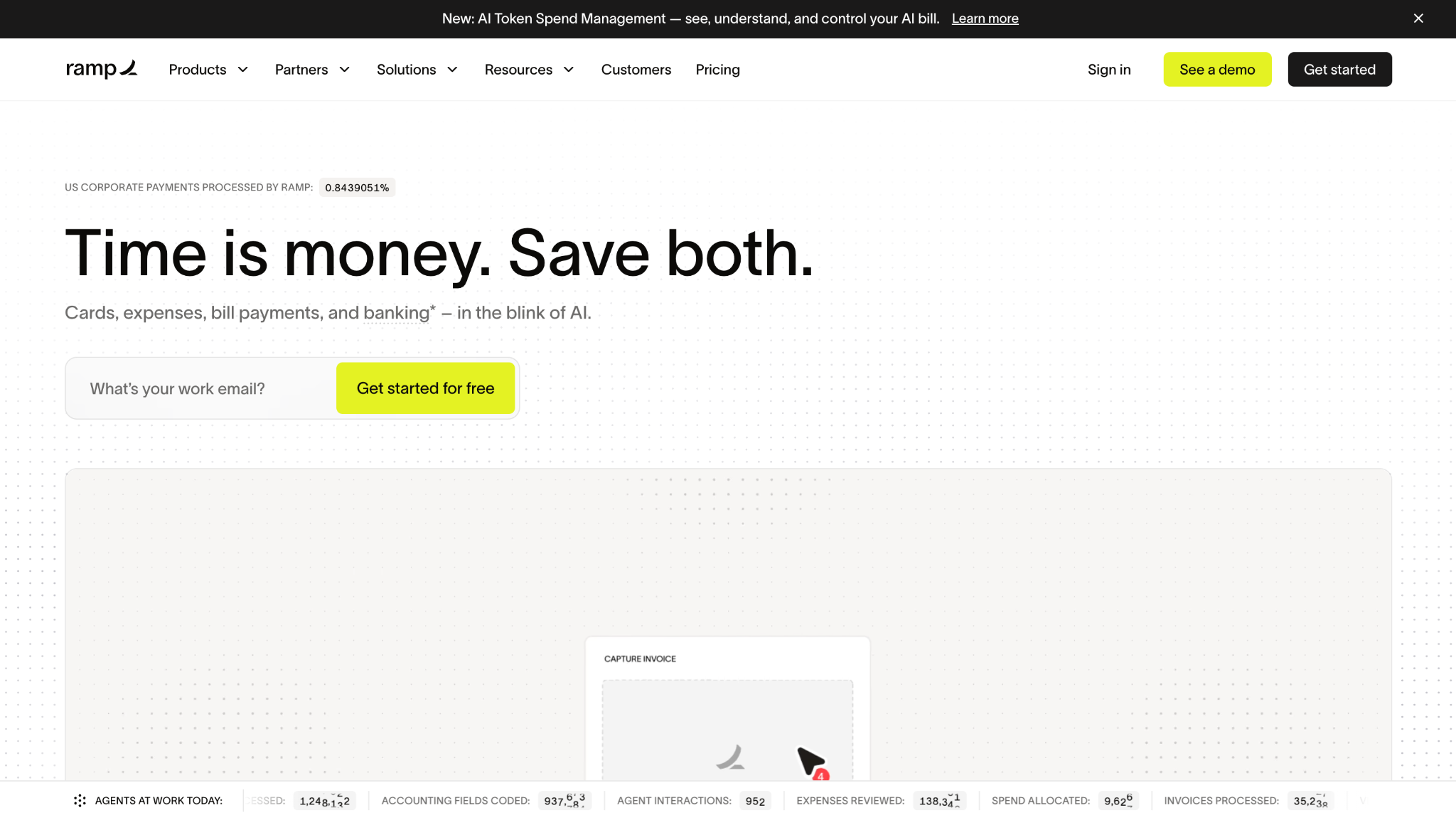
Ramp combines corporate cards, expense management, AP, procurement, travel and treasury, used by 70,000+ businesses according to the vendor. Its Policy Agent reviews expenses rather than sampling them, and a set of AP agents handles coding, fraud checks, approval recommendations, and payment.
Software Pros
- Policy Agent reviews every expense instead of auditing a sample after the fact
- AP agents auto-code line items and run fraud checks before a bill is paid
- A genuinely usable free tier, with Plus at $15 a user each month
Software Cons
- The Plus tier adds a platform fee that scales with headcount, so $15 is not the whole cost
- Strongest for US-headquartered companies; international coverage is thinner
- Procurement is newer here than at the enterprise suites and less deep
Ramp Review
During my evaluation, the breadth at this price was the surprising part. Cards, expenses, AP, procurement, travel, and treasury usually mean an enterprise contract, and Ramp starts at zero. Its 4.8 rating across 2,502 G2 reviews is the strongest combination of score and sample on this list. Take the agents out, and the platform loses the thing that makes the free tier viable.
Our Verdict
All-In-One Finance Automation Platform
*As pricing is subject to change, we are listing prices as they stand in August 2026
Rippling Finance
Quick Overview
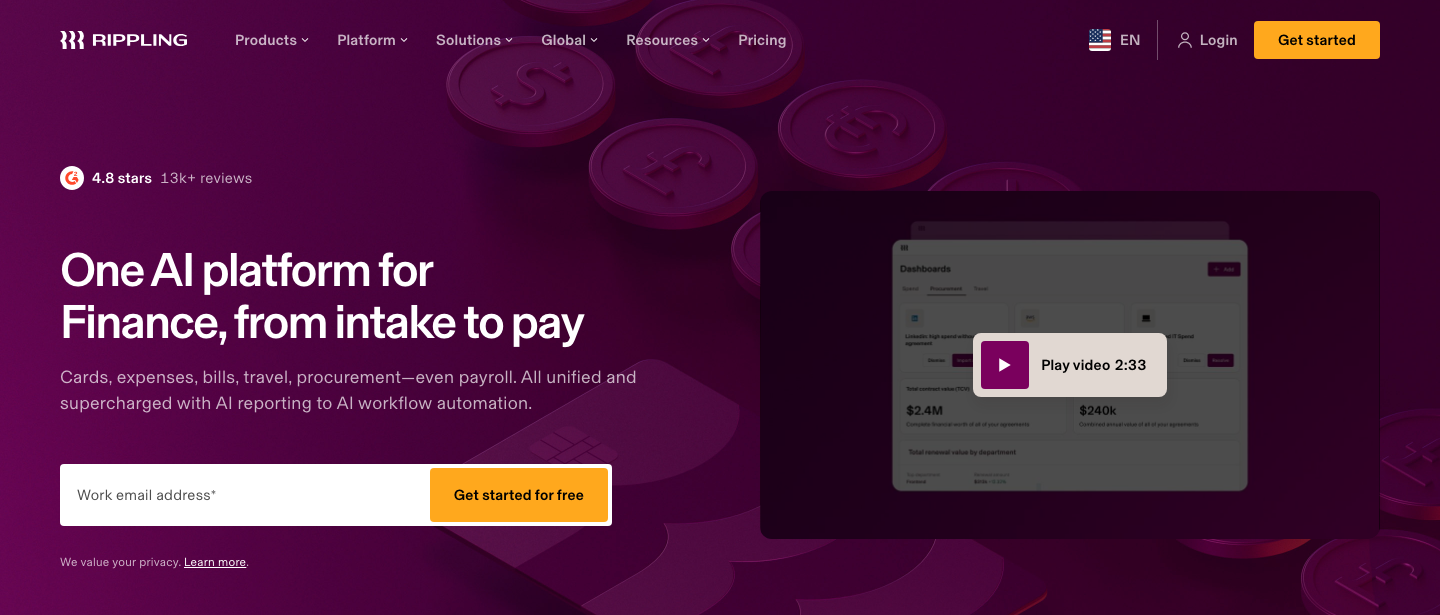
Rippling Finance builds spend management on Rippling’s HR and payroll data, covering cards, expenses, bill pay, travel and procurement. Policies trigger off role, department and entity because the employee record already holds them, and it runs standalone or alongside Rippling HCM.
Software Pros
- Spend policies key off the employee record, so a promotion updates limits automatically
- Cards, expenses, bills, and travel report through one system with payroll beside them
- Offboarding cuts card access at the same moment it cuts system access
Software Cons
- Cost is quoted per deployment, so comparing it against a per-seat rival is work
- The strongest case assumes you run or plan to run Rippling for HR
- Procurement is lighter than a dedicated source-to-pay suite provides
Rippling Finance Review
I spent time with the employee-record angle, which is the whole argument for this one. When somebody changes department, the spend rules follow without anyone editing a policy, because HR and finance read the same record. Our Rippling review covers the wider platform in detail. Without that shared record, it would be another card and expense tool.
Our Verdict
Spend Tied To Employee Records
SAP Spend Management
Quick Overview
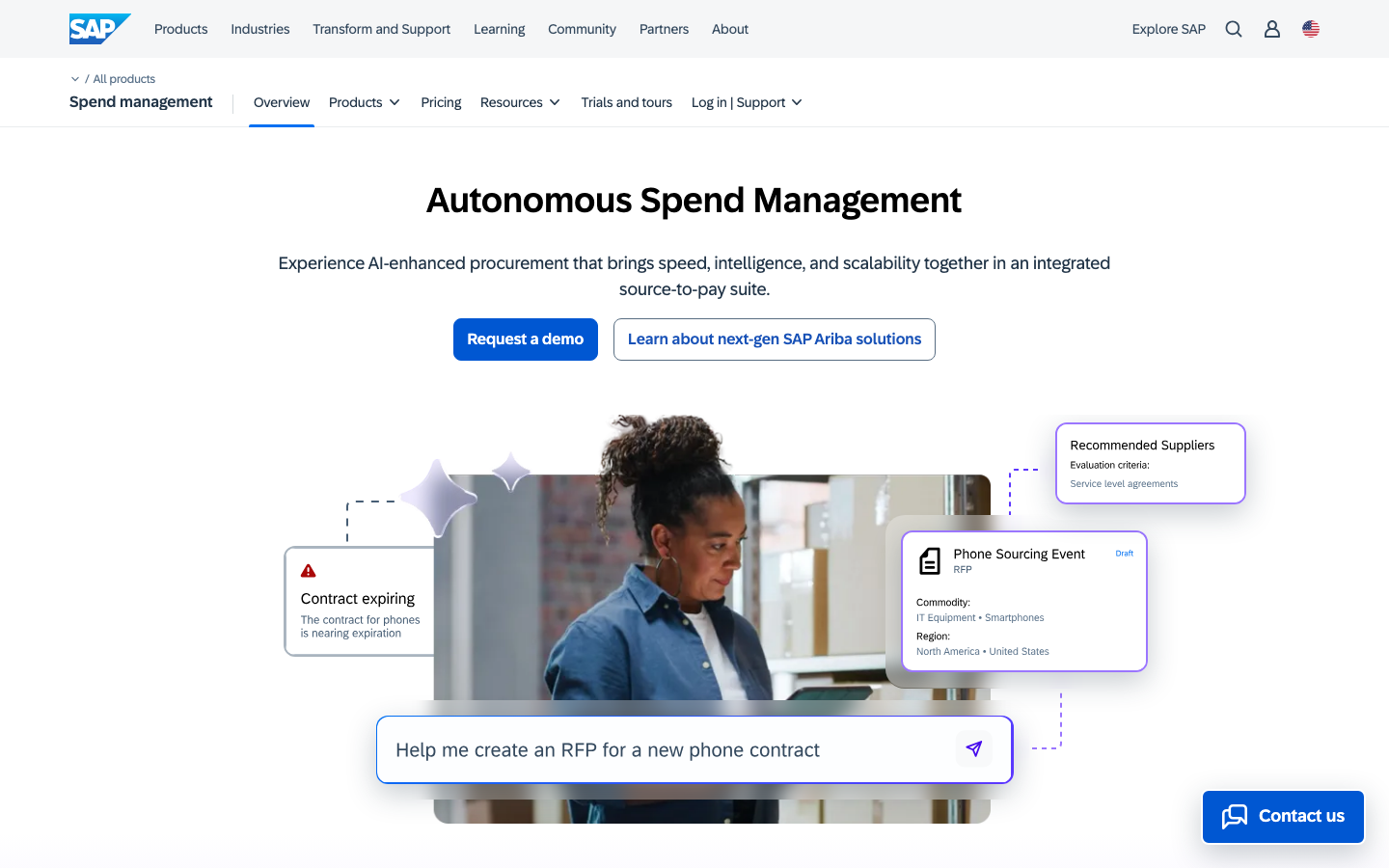
SAP Spend Management is not one product but three. SAP Ariba covers procurement and sourcing, SAP Concur travel and expense, and SAP Fieldglass the external workforce. Joule agents sit across sourcing, approvals, and expense review, for organizations on SAP ERP.
Software Pros
- Joule agents handle procurement workflows such as drafting an RFP from a request
- Ariba’s supplier network and sourcing depth are unmatched by any card-first platform
- Concur brings machine-learning audit and natural-language expense help to travel spend
Software Cons
- Quote-only pricing, and implementation is a program rather than a project
- Buying three products means three learning curves and three sets of configuration
- Concur’s 4.0 G2 rating is the lowest here, across a very large review sample
SAP Spend Management Review
The feature I kept coming back to is the request-to-RFP flow, where a plain sentence becomes a draft sourcing event. That is procurement work no card platform attempts. The honest counterweight is scale: this suite makes sense for a global enterprise on SAP ERP and almost nobody else. Remove Joule, and you still have the source-to-pay backbone that large organizations already run on.
Our Verdict
Procurement Suite With Joule Agents
FAQs About AI Spend Management Software
What is AI spend management software?
It is one platform for corporate cards, employee expenses, supplier bills, and sometimes procurement. It codes transactions to the ledger, matches receipts, checks policy, and flags fraud. The difference from an expense-only tool is scope: an expense product reimburses employees, while these also issue the cards and pay the suppliers.
What does the AI actually do in spend management software?
Five concrete jobs. It reads receipts and matches them to transactions. It codes spend to the right ledger account and learns from corrections, checks purchases against policy, spots duplicates, and forecasts what is coming. The question that matters is whether the model acts on that judgment or merely recommends and waits.
How much does AI spend management software cost?
Three shapes exist. Card-first platforms can be free because interchange funds them, and Brex Essentials, Navan Business and Ramp Free all sit at zero as of August 2026. Per-user products charge for expense and AP modules, with Pleo from £9.50 and Ramp Plus and Navan Expense both at $15 a user each month. Enterprise suites quote privately, and implementation is billed separately.
Which spend management platforms issue their own corporate cards?
Eight of the 10 reviewed here do: BILL Spend & Expense, Brex, Emburse, Navan, Payhawk, Pleo, Ramp and Rippling Finance. Coupa and SAP Concur are the exceptions and work from partner cards and card feeds instead. That single difference explains most of the pricing gap between the two groups.
What is the difference between spend management and expense management software?
Expense management handles what employees pay for and claim back, so its scope ends at reimbursement. Spend management covers every non-payroll commitment: card programs, supplier invoices, and 10 purchase orders and contracts. The boundary is blurring, since several expense tools have added cards and bill pay while several spend platforms started as one narrow module.
Can these tools track what my company spends on AI tools and models?
Some can, and a few now treat it as its own category, tracking AI subscriptions and token bills alongside travel and software. Treat it as a useful feature, not a reason to choose a platform. If controlling model and vendor costs is the actual problem you are solving, a dedicated software subscription tool will go deeper than any of these.
How does AI spend management software integrate with accounting and ERP systems?
Through prebuilt connectors to NetSuite, QuickBooks, Xero, Sage Intacct, Microsoft Dynamics, SAP and Oracle. The connector matters less than the mapping: automated coding only saves time when your chart of accounts and dimensions sync both ways. Ask to see a live sync during the demo, using your own data.

Helen is Anywherer’s Market Analyst & Content Researcher, with extensive experience in analyzing global employment markets and HR technology trends. She is skilled at turning complex market data into clear, well-researched insights that inform every piece of content. With a strong grasp of the EOR, PEO, and international hiring space, Helen plays a key role in keeping Anywherer’s research accurate, up to date, and genuinely useful for readers.