Scale is the first thing to grasp about Ethiopia. Home to well over 100 million people and the seat of the African Union in Addis Ababa, it is the continent’s second-largest nation and one of its fastest-growing economies. An Ethiopian Employer of Record turns that scale into hires without the wait for incorporation. Amharic is the working language, though English carries much of the business world, and salaries are paid in birr. The 2024 currency float reshaped the macro picture, so expatriate pay is often set with an eye on the birr. With income tax topping out at 35% (PwC Tax Summaries), a population estimated between 120 and 130 million, and growth in the 6 to 8% range, an Employer of Record Ethiopia setup is a sensible way to test the market.
Why Hire in Ethiopia Through an EOR?
What Ethiopia offers is a young, cost-competitive labor force at real volume, with Addis Ababa acting as a hub for the African Union, UN agencies, NGOs, and multinationals, a status the Ethiopian Investment Commission actively promotes. Manufacturing, business-process outsourcing, agribusiness, aviation, and a nascent tech scene all pull on that talent. Instead of forming a company, a foreign business can use an EOR to employ locally and move fast, though Ethiopia does lean hard on local hiring and tight expatriate rules. That mix is why an EOR Ethiopia route is often the pragmatic first step into the Horn of Africa.
An Employer of Record (EOR) is a third-party legal entity that hires staff on a foreign client’s behalf, takes on Ethiopian Labor Proclamation duties, and runs local payroll while the client manages the work. The governing law is Labor Proclamation No. 1156/2019, and contracts may be written in Amharic or English and paid in birr. The provider enrolls staff with the Ministry of Revenues for income tax and registers pension contributions with POESSA, where the employer share sits near 11% against about 7% for the employee.
Progressive PAYE reaches 35%, and there is no national private-sector minimum wage, so pay is negotiated. Staff receive 16 working days of leave, 120 days of maternity leave, a probation of roughly 60 days, and a 48-hour week, with severance under the Proclamation. Expatriate work and residence permits run through the Ministry of Labor and Skills, and monthly fees usually fall between USD 199 and 699 per employee. Because on-costs move with the pension bands, a written per-hire estimate is worth requesting early.
The ten providers reviewed below appear most often for Ethiopian hiring, arranged loosely from a local Addis operator and East Africa regional specialists to global platforms. Each entry names the cost model, a defining strength, and the usual onboarding window, which tends to be a week or two here, compared to the months an entity takes. Use them to work out which Employer of Record in Ethiopia suits your brief, since the right choice turns on how much local presence you truly need and how many markets you plan to cover.
Top 6 Local and Regional EOR Providers in Ethiopia
A local Addis provider and East Africa regional specialists come first, giving companies access to teams with direct knowledge of employment in Ethiopia. We looked at local footprint, birr payroll, POESSA and income-tax work, Amharic and English contracting, severance under Labor Proclamation 1156/2019, permit support, and onboarding pace.
Note that all listed providers are added below in alphabetical order.

Africa Deployments
Company Description:
Africa Deployments is a pan-African EOR reaching more than fifty countries, Ethiopia among them, that manages payroll, tax, compliance, and benefits with quick onboarding and a budget-friendly rate. With a published starting figure, its EOR pricing in Ethiopia is easy to weigh against pricier platforms. The low entry point suits lean teams testing a first African hire. Larger or compliance-heavy mandates may want a provider with a deeper local desk. Fast onboarding is a clear draw when a start date is already fixed.
Key Specialty Area:
Budget-friendly pan-African EOR
Service Cost:
From USD 199/month per employee
Top Advantages:
- Fifty-plus country coverage
- Published, low starting rate
- Fast onboarding and benefits
Scope of Services:
- Amharic and English contracts
- Payroll, POESSA, income tax
- Benefits administration
Our Verdict
Best for cost-conscious teams making a first African hire
*As pricing is subject to change, we are listing prices as they stand in July 2026
Breedj
Company Description:
Breedj runs an AI-assisted EOR and portage platform that covers Ethiopia and steps in as a legal employer for both locals and expatriates, handling payroll, taxes, benefits, and compliance. The automation keeps overhead light for teams spread across borders. A hands-on local adviser is not the point here, so buyers wanting that may look elsewhere. Its willingness to employ expatriates as well as locals is a genuine plus for mixed teams. The portage angle also suits contractors who want compliant status without a full employment tie.
Key Specialty Area:
AI-assisted EOR for locals and expats
Service Cost:
Quote-based
Top Advantages:
- Employs locals and expatriates
- Automation-led compliance
- Cross-border team focus
Scope of Services:
- Amharic and English contracts
- Payroll, POESSA, income tax
- Benefits and compliance
Our Verdict
Handy for distributed teams comfortable with automation
Flexi Personnel
Company Description:
With more than fifteen years across East Africa, Flexi Personnel runs a dedicated Ethiopia EOR and payroll-outsourcing service, issuing compliant contracts, handling statutory benefits, and sorting visas through a named account manager. Clients who dislike being bounced between agents get one point of contact. The regional experience shows in how smoothly cross-border cases move. A single Ethiopian placement may not need that reach, so weigh it against a purely local firm.
Key Specialty Area:
East Africa EOR with a named manager
Service Cost:
Quote-based
Top Advantages:
- Fifteen-plus East African years
- Dedicated account manager
- Visa and work-permit handling
Scope of Services:
- Amharic and English contracts
- Payroll and statutory benefits
- Visa and permit support
Our Verdict
Strong for buyers wanting one named contact
Talent Grid Africa
Company Description:
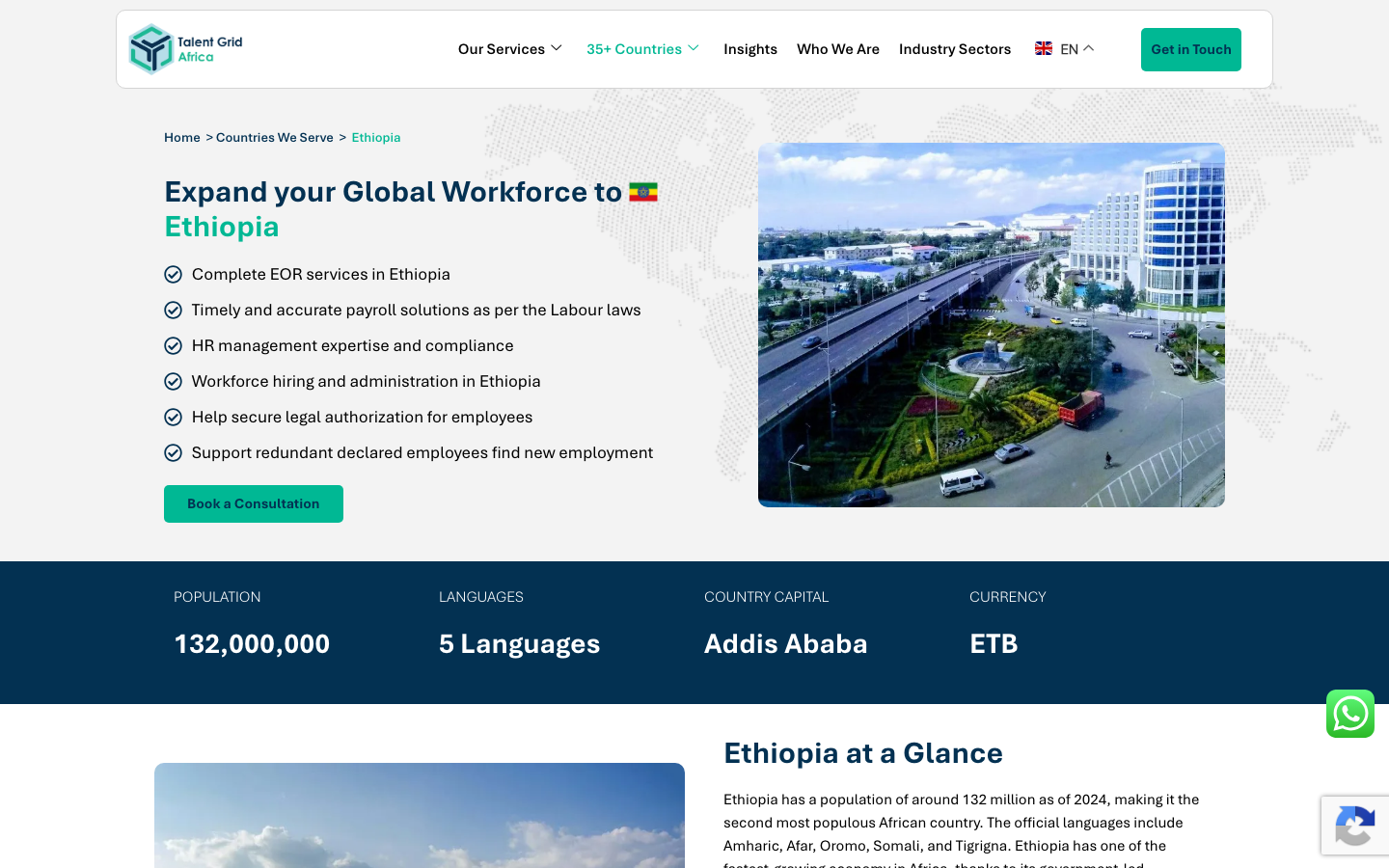
An East Africa specialist, Talent Grid Africa covers Ethiopia with payroll, onboarding, and tax compliance at the core, plus recruitment, work-permit support, and executive search. Its Ethiopia EOR services suit clients who want to source senior people and employ them under one roof. The compliance focus reassures buyers most anxious about getting tax and returns right. The recruitment side means one partner can find the person and then employ them. That single thread helps most in senior roles where continuity matters.
Key Specialty Area:
Regional EOR with recruitment and search
Service Cost:
Quote-based
Top Advantages:
- Tax-compliance emphasis
- Onboarding and payroll
- Recruitment and executive search
Scope of Services:
- Amharic and English contracts
- Payroll, POESSA, tax
- Work permits and search
Our Verdict
Useful for sourcing and employing senior talent together
Workforce Africa
Company Description:
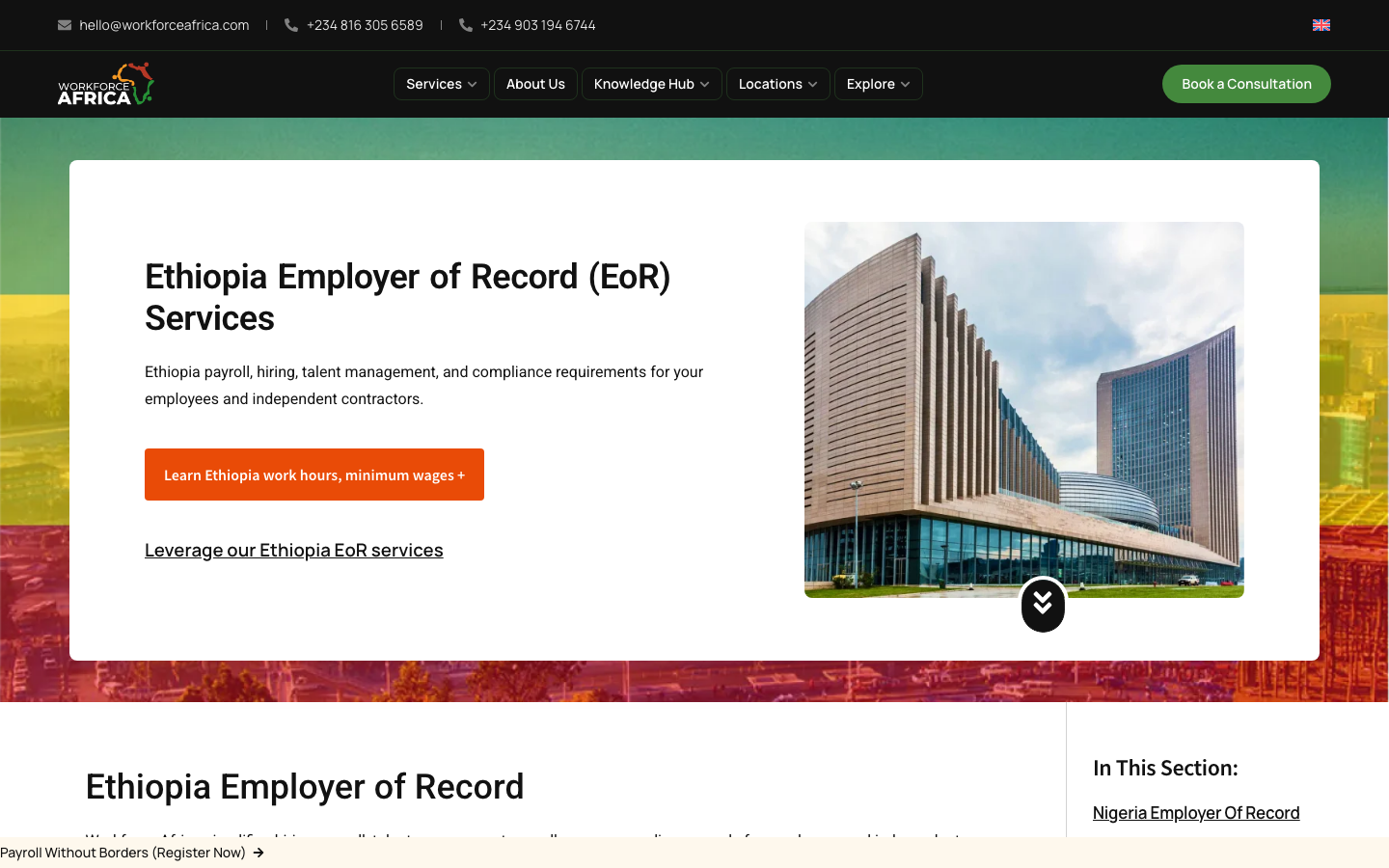
Workforce Africa is an HR outsourcing group with more than 20 years in the region and a notable presence in Ethiopia, offering EOR services covering payroll, benefits, compliance, contracts, onboarding, and work permits. The single-package breadth suits clients who would rather hand over the whole employment lifecycle. A lone contractor may find that the scope is broader than the task, so scope the engagement to the size of the plan.
Key Specialty Area:
Full-lifecycle regional HR outsourcing and EOR
Service Cost:
Quote-based
Top Advantages:
- Strong on-the-ground Ethiopia presence
- The whole employment lifecycle is covered
- Twenty-plus years in the region
Scope of Services:
- Amharic and English contracts
- Payroll and benefits
- Onboarding and work permits
Our Verdict
Best for handling the full employment lifecycle
YES – Your Employment Solutions

Company Description:
YES – Your Employment Solutions is an Ethiopian employment-solutions firm that acts as a local Employer of Record provider in Ethiopia, offering payroll, HR services, and statutory-compliance support from inside the market. Being on the ground in Addis means POESSA and tax filings are handled directly. For buyers who want a domestic partner rather than a foreign platform, that presence counts. The tradeoff is a narrower geographic reach than the pan-African players, which matters only if you hire beyond Ethiopia. For a purely Ethiopian team, the domestic focus is exactly the point.
Key Specialty Area:
Local Ethiopian EOR and payroll
Service Cost:
Quote-based
Top Advantages:
- Addis-based domestic operator
- Direct POESSA and tax filings
- Local statutory-compliance support
Scope of Services:
- Amharic and English contracts
- Payroll, POESSA, income tax
- HR and compliance support
Our Verdict
The pick for a domestic in-country partner
Top 4 Global EOR Platforms with Ethiopia Coverage
Global platforms follow with broader multi-country coverage and partner or entity networks that include Ethiopia. We compared network structure, compliance support, onboarding, permit assistance, and pricing. As a rough guide, EOR services in Ethiopia cost USD 199 to 699 per employee per month, depending on the visa and compliance depth a client needs.
Note that all listed providers are added below in alphabetical order.
Deel
Company Description:
Deel needs little introduction, covering more than 150 countries, and its Ethiopia service automates contracts, birr payroll, and POESSA and income-tax deductions. A rate published up front lets budget owners plan before they sign. The flip side is a platform-led experience rather than an Addis office you can walk into. For a first Ethiopian hire, though, the predictable process and price are reassuring, especially for a team already standardized on the platform elsewhere.
Key Specialty Area:
Automated global EOR platform
Service Cost:
From USD 599/month per employee
Top Advantages:
- Upfront published pricing
- 150-plus country reach
- Automated contract generation
Scope of Services:
- Amharic and English contracts
- ETB payroll, POESSA, tax
- Self-serve hiring console
Our Verdict
Best where a client already runs Deel in other markets
*As pricing is subject to change, we are listing prices as they stand in July 2026
G-P (Globalization Partners)
Company Description:
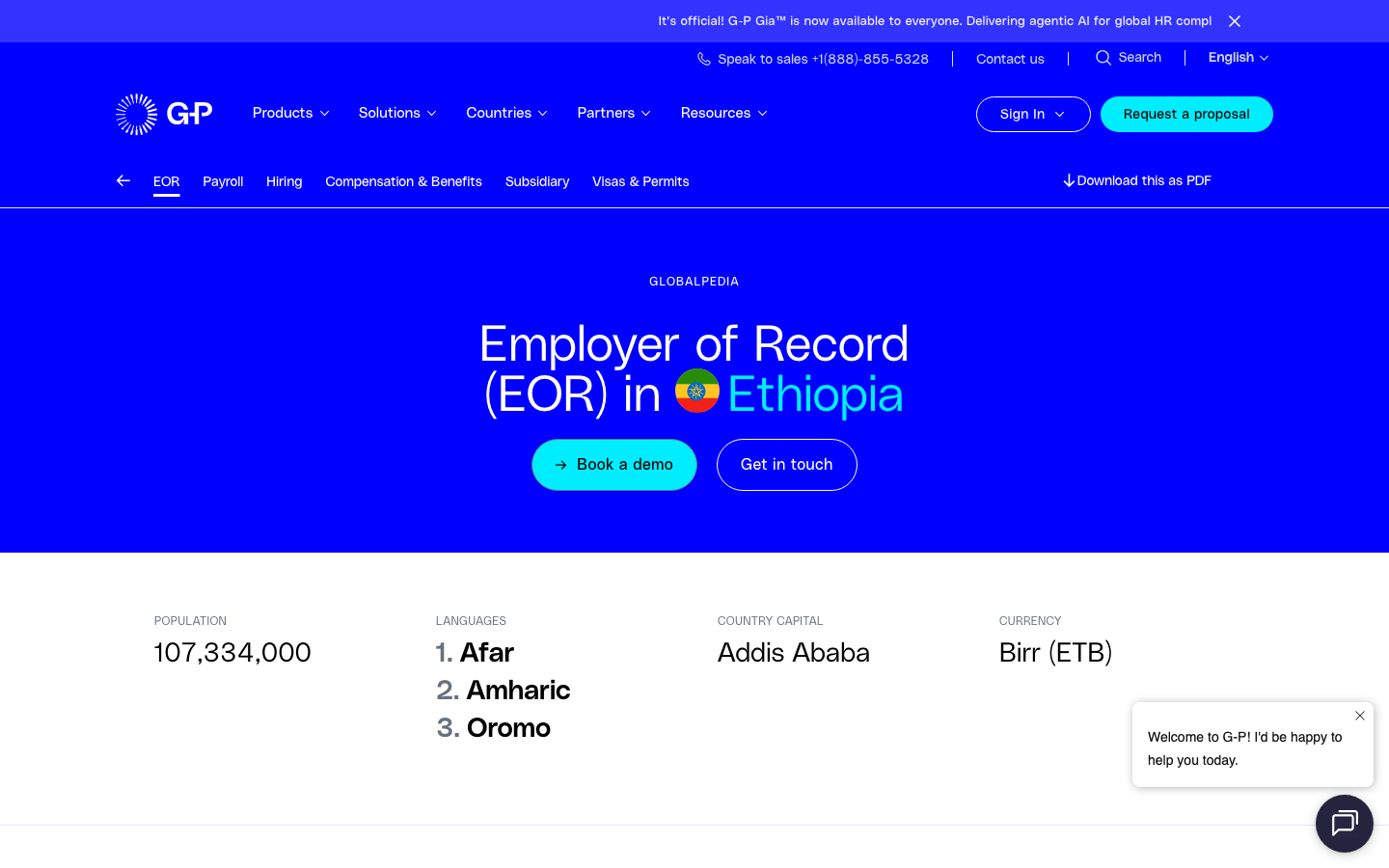
G-P (Globalization Partners) operates a long-standing enterprise EOR across 180-plus countries, and its Ethiopia practice drafts compliant contracts while managing payroll, statutory benefits, and severance under Labor Proclamation No. 1156/2019. Uniform terms and audited compliance are the draw for multi-country hiring. A single Ethiopian role may find the enterprise machinery larger than needed, so a small headcount should test the fee against a regional rival. Where audited, uniform compliance is the priority; the platform earns its keep.
Key Specialty Area:
Enterprise global EOR, Proclamation 1156/2019 aware
Service Cost:
Quote-based
Top Advantages:
- Established enterprise platform
- Severance under the 2019 Proclamation
- Uniform terms across markets
Scope of Services:
- Amharic and English contracting
- Payroll and statutory benefits
- Severance administration
Our Verdict
Fits enterprises standardizing terms across many countries
Multiplier
Company Description:
Multiplier is a global self-serve platform that covers Ethiopia with compliant contracts, birr payroll, and POESSA and income-tax handling on transparent monthly pricing. Teams that like to steer their own contracts and pay runs get a clean interface. As with any portal, it is worth testing local support depth before a first hire. For lean teams, running EOR in Ethiopia through one console keeps overhead low. More complex hires may still prefer a provider with a person on the ground in Addis. The upside is that a client keeps full control of contracts and pay cycles.
Key Specialty Area:
Self-serve global EOR platform
Service Cost:
Quote-based
Top Advantages:
- Transparent monthly pricing
- ETB payroll and deductions
- Portal-driven onboarding
Scope of Services:
- Amharic and English contracts
- Payroll, POESSA, tax
- Management dashboard
Our Verdict
Handy for teams that like to self-manage payroll
Rivermate
Company Description:
Rivermate provides a global EOR with Ethiopia coverage that ties Labor Proclamation compliance to an employment-cost calculator and support from real people, with recruitment offered on request. The human-first setup appeals to smaller buyers who want a name on the account. Sourcing is charged only when a client actually uses it, which keeps the base offering lean for teams that just want employment handled. A named contact is the draw for buyers wary of a purely automated service.
Key Specialty Area:
People-first global EOR with optional recruiting
Service Cost:
From USD 319/month per employee
Top Advantages:
- Human account support
- Employment-cost calculator
- Recruitment only on request
Scope of Services:
- Amharic and English contracts
- Payroll, POESSA, tax
- Optional recruitment add-on
Our Verdict
Good for buyers who want a human on the account
*As pricing is subject to change, we are listing prices as they stand in July 2026
Ethiopian hiring usually forms part of a wider regional push, so an Ethiopia EOR call reads better beside its neighbors; compare Kenya EOR, Nigeria Employer of Record, and Tanzania EOR to see how rates and rules differ, and let the broader picture guide your shortlist.
What to Know About Ethiopia EOR: FAQs
Which labor rules govern hiring in Ethiopia through an EOR?
Labor Proclamation No. 1156/2019 is the anchor, overseen by the Ministry of Labor and Skills. Contracts may be in Amharic or English, the working week runs to 48 hours, and staff earn 16 working days of annual leave with 120 days of maternity leave. Probation is about 60 days, and severance follows the Proclamation. There is no national private-sector minimum wage, so pay is settled by negotiation and market practice rather than a legal floor. Enterprise unions and collective agreements can layer terms on top of these statutory basics.
What does an EOR handle for payroll and POESSA in Ethiopia?
As the legal employer, the provider pays staff in birr and registers them with POESSA and the tax authority. It forwards the employer’s roughly 11% and the employee’s 7% pension contributions, deducts income tax to the Ministry of Revenues, and issues compliant Amharic or English contracts and payslips. Monthly statutory returns are filed on the client’s behalf, leaving the client to run the actual work rather than the administration. Filing deadlines are firm, so an experienced local payroll team helps a client avoid penalties.
Can an Ethiopian EOR arrange work permits for foreign staff?
Yes. Established providers secure work and residence permits for expatriates through the Ministry of Labor and Skills and immigration, while keeping within Ethiopia’s localization and quota expectations. A provider with its own Ethiopian entity usually runs this directly, whereas a global platform may hand it to a local partner. Because rules and timelines shift, confirm exactly how far a provider’s expatriate support reaches before committing. Roles that a local could fill may face a tougher permit case, so the job description matters, and timelines vary by nationality, which makes an early start on paperwork sensible.
How does a buyer weigh EOR providers in Ethiopia?
Ask first whether the provider is inside Ethiopia or works through a partner network. Then check its record on BIRR payroll, POESSA, and income-tax withholding, and its comfort contracting in Amharic and English. Severance handling under Proclamation 1156/2019, clear fees, flexible terms, and reachable references all count, and a short call with an existing client tells you more than any capability deck. It is worth asking how a provider handles an exit, since offboarding is where thinner operators tend to slip.
How fast is onboarding in Ethiopia, and what should a buyer budget?
A resident hire is typically brought on in one to two weeks by local or regional providers, while expatriate cases stretch out until the permits come through. Expect monthly fees between USD 199 and 699 per employee, plus salary, the employer’s roughly 11% pension contribution, and income tax run through payroll. Verify the current POESSA rates and income-tax bands before budgeting, and note that Ethiopia has no national private-sector minimum wage to anchor pay. Leaving room for benefits and permit fees keeps that first estimate realistic.

Yaryna is our lead writer with over 8 years of experience in crafting clear, compelling, and insightful content. Specializing in global employment and EOR solutions, she simplifies complex concepts to help businesses expand their remote teams with confidence. With a strong background working alongside diverse product and software teams, Yaryna brings a tech-savvy perspective to her writing, delivering both in-depth analysis and valuable insights.